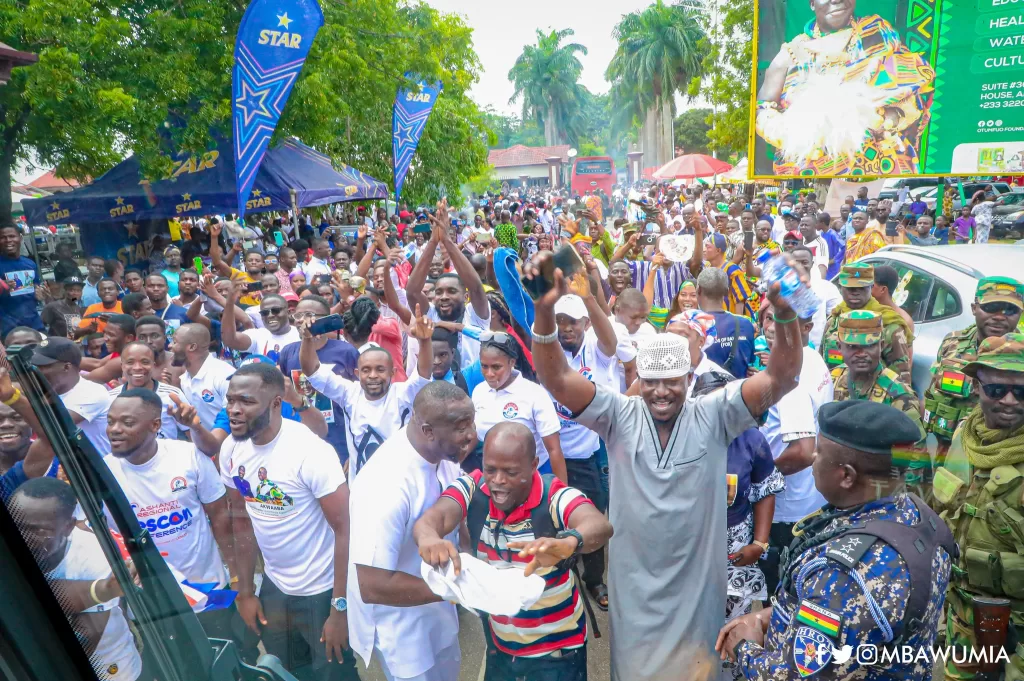
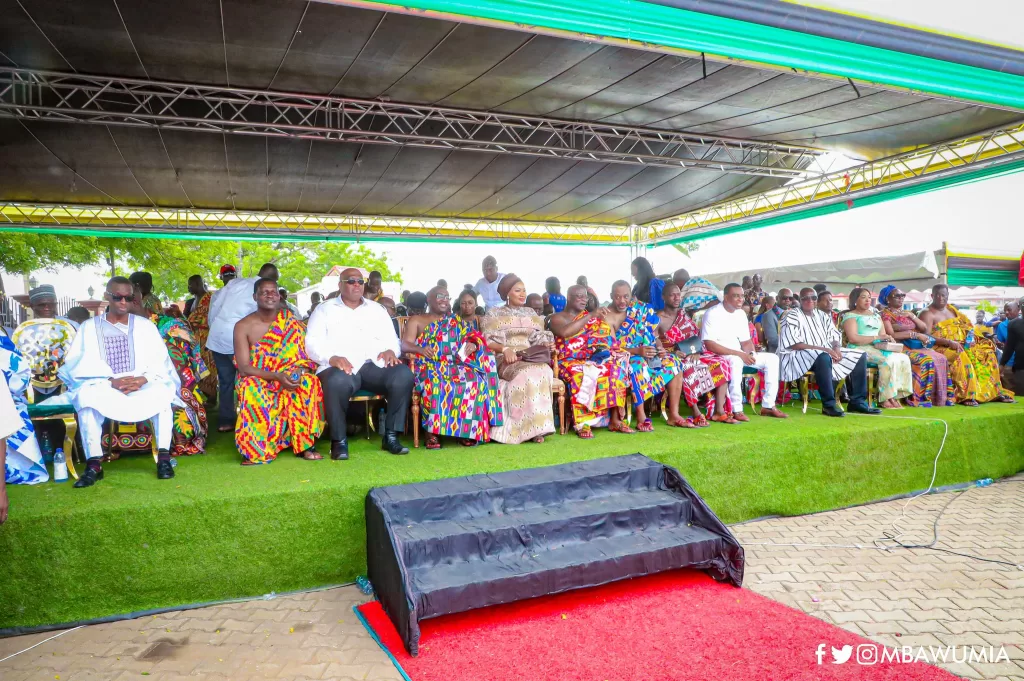
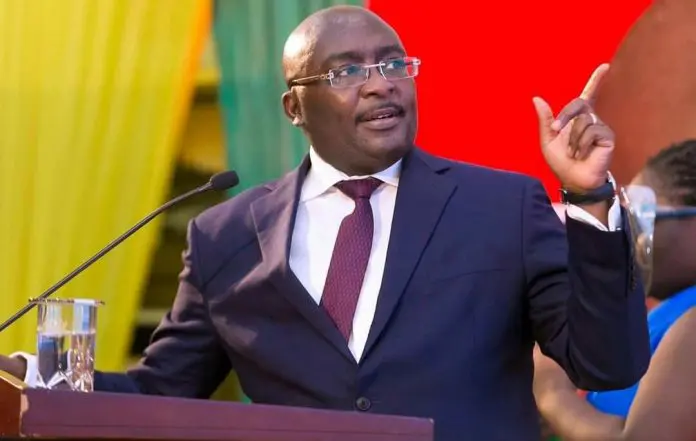
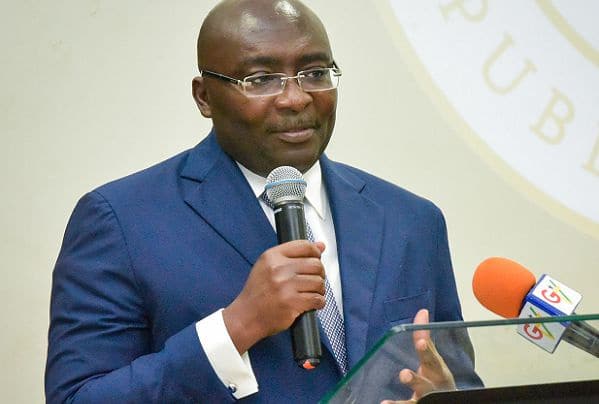
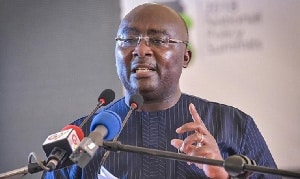
Yesterday, Vice President Dr. Mahamudu Bawumia attended the second Akwasidae of the year at Manhyia Palace in Kumasi.
According to reports, he was met with loud cheers.
He was accompanied by theAshanti Region Constituency Executives of the party, some party elders, and Ministers of State and their Deputies.
Earlier, speaking at a brief event ahead of the Akwasidae, Dr. Mahamudu Bawumia hailed the NPP in the Ashanti Region for the tremendous show of love for him.
He described the gesture, not only as surprising but also tremendous, urging the rank and file of the party in the region to continue to forge ahead in unity.
Vice President, Dr. Mahamudu Bawumia has a lot of support from the New Patriotic Party’s (NPP) membership to lead the party as leader into the general elections of 2024, according to First Deputy Speaker of Parliament Joseph Osei Owusu (Joewise).
He claimed that the number of NPP MPs and Ministers of States that accompanied Dr. Baswumia to the Manhyia palace inKumasi for the second Akwasiadae of the year, 2023, is evidence of the support the party accords him.
The Bekwai Member of Parliament said “All the MPs and ministers following Dr Bawumia are ministers and MPs who support the bid of Dr Bawumia to lead the NPP in the flagbeareship race. So we came with him to demonstrate or support for his bid to lead the NPP in the flagbeareship race.
“That is why all of us are here today to support him to greet the Otumfuo and also for us to pay homage to Otumfuo on Akwasiadae.”
He added “The number of MPs and Ministers following Dr Bawumia demonstrates the support he has within the leadership of the party and even within the rank and file of the party, it shows that in the competition to lead the NPP Dr Bawumia is high above everybody else.
“Those who supported the other candidates have followed him to come and greet Otumfuo so why would the rest of us who support Dr Bawumia not follow him?
“There is no controversy, in competition, it is a choice and everybody is able to choose freely, so this is a free choice.”
Although Akwasidae is primarily a vibrant cultural event of the Ashanti Kingdom, it has grown in importance over time.
The festival, which features the Asantehene sitting in state and receiving respect from his subjects and visitors from all over the world, has been characterized by political, diplomatic, and entertainment elements.
The presence of current and former presidents has frequently been a significant highlight of the regularly crowded event.
The March 20 celebration of Akwasidae was attended by Vice President Dr. Mahamudu Bawumia, who was attending on behalf of the president Nana Addo Dankwa Akufo-Addo.
He attended along with his wife Samira Bawumia.
Videos making the rounds on social media shows Bawumia and an entourage including about 80 MPs arriving at the event grounds on a bus as they are mobbed by a crowd of party faithful.
Most of the cheering supporters are waving the New Patriotic Party (NPP) flag and are wearing branded T-shirts with the Vice President’s portrait. He is seen waving back along with the Second Lady.
They later go on to join dignitaries to pay homage to the Asantehene and his sub-chiefs.
Hon.Yohane Amarh Ashitey has drawn attention to what he describes as “magic” happening as a result of Vice President Mahamudu Bawumia’s gold for oil barter programme.
Responding to the Vice President’s announcement that fuel prices will further be reduced as a result of the program, the Metropolitan Chief Executive of Tema, wrote that the magic has already begun happening and that Vice President Bawumia deserves to be heavily commended for it.
“Like Vice President Bawumia said, fuel prices have reduced from ¢23 per litre to around ¢12 per litre. The magic is already happening on the ground,” Hon. Yohane Amarh Ashitey wrote.
As a result of the positive effect the policy has brought to bear on fuel prices so far, the MCE added that Vice President Bawumia’s promise that fuel prices will further reduce can be believed.
“This man is not speaking in a vacuum, already the results are available for all to see. Therefore, his promise is absolutely believable,” he added.
On March 15th 2023, Vice President Bawumia promised that the reduction in fuel prices as a result of the gold for oil barter program will continue in the coming days with fuel prices reducing further.
“As a result of the policy, we have not only seen a decline in the price from ¢23 per litre to around ¢12 per litre. We have also seen stability in the exchange rate as we predicted”, he explained.
The gold for oil program, the MCE adlibbed, is a game changer for Ghana’s forex and currency depreciation problems as it will ultimately beat down the price of fuel which is key to the exchange rate problems.
“Once we have this fixed, our economy will be transformed forever, and already, we are seeing results with the reduction in fuel prices,” the Tema MCE wrote.
He reiterated calls for Ghanaians to keep supporting the government and trusting it to steer the country out of the current conundrum.
“Like His Excellency President Akufo-Addo has said in the past, we know how to bring the economy back on its feet but we do not have the means to bring people back once they die.” Hon. Yohane Amarh Ashitey wrote.
Former New Patriotic Party (NPP) constituency chairman for New Juaben North has pledged to resign from politics should Vice President Dr. Mahamudu Bawumia be defeated in the NPP flagbearership contest.
According to Kwadwo Boateng-Agyemang, Dr. Bawumia’s defeat will merely confirm that politics is in fact a game of deception.
He was speaking on Asempa FM’s Ekosii Sen.
“Mark it on the wall, I swear by the grave of my father who passed when I was 10 that I will quit politics because it will give me a clear picture that there is indeed no truth in politics,” he stated without mincing words.
Former New Juaben North Chairman
About five leading members of the governing NPP including former Energy Minister; Boakye Agyarko, former Agric Minister; Dr Owusu Afriyie Akoto, former Trade Minister; Alan Kyerematen, and former General Secretary Kwabena Agyapong have all expressed interest in contesting the flagbearership slot of the party.
Many have also tipped Vice President Dr Mahamudu Bawumia for the position but he is yet to officially make his intentions known.
But Mr Boateng-Agyemang has expressed conviction Dr Bawumia will gain a resounding victory, adding the grounds are fertile for him.
“I know what is happening on the grounds and you can go and conduct a survey to ascertain that fact,” he added.
Dr. Owusu Afriyie Akoto, a former minister of food and agriculture, is convinced he would prevail in the flagbearership race of the New Patriotic Party (NPP).
He expressed confidence that he would receive a resounding majority of the party’s delegate votes to lead the party in the general elections of 2024.
According to him, the delegates will choose a competent person to lead the party.
“Well you go into a contest to win, so I’m in the contest hoping to win, and I know that God will bless me to win this contest,” Dr. Owusu Afriyie Akoto said.
Speaking on the Point of View on Citi TV, with Bernard Avle,Dr. Owusu Afriyie Akoto said he’s not worried that Vice President Dr. Mahamudu Bawumia is in the race adding that he does not have any advantage over him and the other hopefuls.
“The incumbency of the Vice President does not worry me at all, it doesn’t give any advantage over others. The party people know who is who. You just have to make sure that they know you are in the race. Most of our delegates are rural people, they benefitted from Planting for Food and Jobs. They are part of the 1.7 million farmers that have benefitted from the PFJ. So they relate to what I’m doing,” a flagbearer hopeful of NPP said.
He added, “NPP is not an ethnic party, it’s a national party so if the delegates decide who is competent enough to lead them, they will vote for the person. So what is it about tribalism and all that, I can’t understand it”.
Dr. Owusu Afriyie Akoto who has been silent after resigning explained that he does not want to break the party’s rules by campaigning vigorously.
“The party has regulations, and I’m the last person to break regulations which state that until the party sets a date and invites potential contestants to come and pick forms and so on and so forth, there should be no campaigning. This has been grossly overlooked by a lot of people, I wasn’t going to stampede into that. But it doesn’t mean that I’m not working,” he explained.
According to deputy minister for roads and highways, Stephen Pambiin Jalulah, the vice president, Dr. Mahamudu Bawumia, is the finest candidate to succeed President Akufo-Addo.
Speaking to the mediaon Sunday, March 12, the Pru West MP said he was confident that the Vice President would succeed the president ahead of the party’s presidential primaries.
Even though, the conversation on the programme centred on President Akufo-Addo’s claim that his administration has built more roads than any other government in Ghana’s 4th Republican history, the Deputy Minister could not hide his desire for Dr Bawumia to become NPP’s next flagbearer and Ghana’s next president.
He was arguing against claims by members of the opposition National Democratic Congress the Akufo-Addo administration dare not take credit for the Pokuase Interchange because an NDC-led government secured funding for the project. But the Deputy Minister insisted that actual works, including sod-cutting, started in the Akufo-led administration.
“The construction of the Pokuase Interchange was just a dream to them (NDC) because constantly, we don’t have enough and as a result we are constantly looking outside either to get the commercial facility or the grant to come and cause the development of the nation.
His argument was that whoever executes a project takes credit for it, not those who dreamt it.
“Now if you go to talk to the government and people of Japan that we need an interchange at this point please help us; and we are even doing one currently but I will not name the place- which will not materialise under the leadership of President Akufo-Addo but the next government which will be Insha Allah Dr Mahamudu Bawumia, but Nana Akufo-Addo cannot claim credit for what he is doing now for an interchange to be built in another city of the country.
“It is a dream which must happen because governance is a continuous process,” he said.
Already, several bigwigs in the party including the former Trades and Industry Minister, Alan Kwadwo Kyerematen, and the former Agriculture Minister, Dr Owusu Afriyie Akoto have declared their intentions to seek the party’s mandate to lead it as flagbearer for the 2024 election.
Even though, the Vice President has not officially declared his candidacy, party folks and political analysts say it is only a matter of time when he declares his interest.
It is his anticipated candidacy the Deputy Minister has thrown his weight behind.
Deadlock with date for primaries
The National Executive Committee and the National Council of the governing NPP, has a couple times failed to agree on a date for its presidential and parliamentary primaries.
A meeting on Thursday, February 2, which had in attendance the President, the Vice President, the Chief of Staff, some Members of Parliament and presidential hopefuls which was expected to officially set a date for the remaining two elections on the party’s calendar ended in a deadlock.
Already, blocs within the party are pushing for an early congress whilst others want the party to stick to its constitution of electing a flagbearer 12 months to a major election.
Dr. Bawumia, who was born in Tamale, undoubtedly knows a thing or two about ethnic dance.
The Vice President of Ghana was caught in the throng showing off his ethnic dance abilities while attending the final funeral rituals of his late mother, Hajia Mariama Bawumia, in Kpasenkpe in the North East Region.
Clad in a black and white fugu, Dr Bawumia, who caught the eye of the people gathered got some spraying him with cash while dancing.
It would be recalled that Dr Mahamudu Bawumia lost his mother to death on September 13, 2021.
Hajia Mariama Bawumia was a native of Kpasenkpe in the West Mamprusi district of the North East Region.
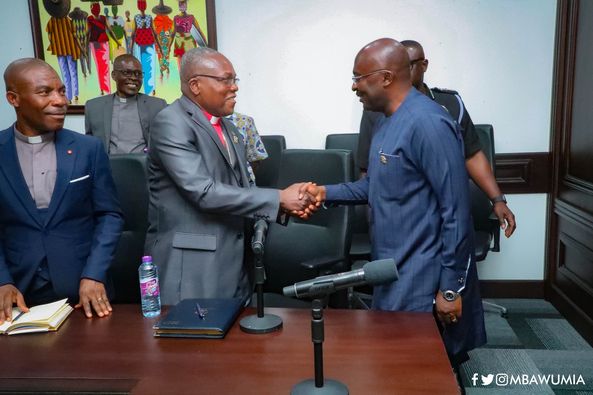
On Wednesday morning, Vice President Dr. Mahamudu Bawumia, had the privilege of hosting the leadership of the Evangelical Presbyterian Church, Ghana, led by the Moderator, Rt Rev Lt Col Bliss Divine Kofi Agbeko (Rtd).
The delegation was at Jubilee House to among others, express appreciation for his active participation in the launch of the Church’s 175th Anniversarycelebrations, and to pray for the nation.
Harmonious religious diversity and acceptance is vital for our nation’s development. I commend the leadership of the EP Church, and all religious leaders, for their continued efforts in nation-building.
The Vice president assured religious bodies of government’s preparedness to collaborate with them in ensuring the development of the nation.
A Member of Parliament (MP) for the Akim Swedru Constituency, Kennedy Osei Nyarko, has made a passionate defense for Vice President Dr. Mahamudu Bawumia to be chosen as the New Patriotic Party’s (NPP) flagbearer .
The lawmaker and former Deputy Minister of Agriculture opined that Dr. Bawumia’s sacrifices and contributions to the party amid attacks and vilification by both the opposition and government are sufficient grounds for him to lead the governing party into the 2024 elections.
“He led our 2016 campaign and received all the attacks from our opponents and won us power with a historical margin. He is still receiving attacks for the party and government, and you think I should sidestep him? All the current attacks from the opposition parties are being directed at him just because he has decided to sacrifice himself for the party,” he wrote on Facebook.
Kennedy Osei forcefully stated that there are positions being occupied and enjoyed by government appointees under President Akufo-Addothat are the results of the sacrifices of Dr. Bawumia, whom he further described as the nemesis of the opposition National Democratic Congress.
“Many are today holding different portfolios and positions in this Government because of the work he did for the party then in opposition in 2016. He singlehandedly took the entire NDC government on, both in opposition and in government, so no wonder they are after his head and would prefer that he not be on the NPP’s ticket. He is the greatest nemesis of the biggest opposition party,” he added.
This latest endorsement by the Akim Swedru MP adds up to the overwhelming number of NPP parliamentarians who have thrown their weight behind the Vice President ahead of the party’s presidential primaries.
Though Dr. Mahamudu Bawumia has not officially declared his intentions to be president, Dr. Gideon Boako, a spokesperson for the Vice President, has stated that the official announcement will be made if the party opens nominations for the primaries.
A state funeral will be held for thelate Christian Atsu, according to Vice President Dr. Mahamudu Bawumia.
The late Ghanaian international football player perished tragically on February 6 as a result of a powerful earthquake that shook parts of Turkey and Syria.
On the evening of February 19, during a brief ceremony to receive the late Atsu’s remains from Turkey, Dr. Bawumia declared that the nation had lost an accomplished son who would be missed.
“It is a very sad day that we are here to receive the remains of our brother, Christian Atsu. The earthquake that struck Turkey was devastating, and we prayed every day that passed for our brother to be found, but when he was found, he was no more,” he said.
“He was much loved, and we will surely miss him.” “It is a very painful loss, and we pray that the soul of our brother rests in the bosom of our maker,” he added.
“We extend our sincere condolences to the entire family for their loss, and I would like to say that the state will be fully involved with the family in providing him a befitting burial,” Bawumia declared.
According to Dr. Gideon Boako, Dr. Mahamudu Bawumia’s spokesperson, Dr. Mahamudu Bawumia will run for the New Patriotic Party’s (NPP) flagbearership when nominations are opened.
He told Adom TV that his boss was ready to throw his hat into a race that included the likes of Alan Kyerematen, Kennedy Agyapong, Kwabena Agyepong, Francis Addai-Nimoh, Kofi Konadu Apraku and Boakye Agyarko.
Explaining the weight thatBawumia brings to the race, Boako said his boss was in politics strictly to serve unlike others who get in to amass wealth, stressing that the NPP and Ghana needs such a leader at this time.
He also stressed that with all the signs showing that the main opposition National Democratic Congress (NDC) will field former president John Dramani Mahama in the 2024 elections, the NPP needed a Bawumia-type personality to match the opposition.
“In 2024, the NDC will surely bring Mahama, so we should get personality who can measure up to Mahama and then also we need to look at the level of knowledge the candidate brings on board.
“Unofficially, all Ghanaians believe that the vice president has demonstrated beyond his office and has been more impactful in modern-day political season is Bawumia. He did not just play a supportive role but he had major involvement,” Boako stressed.
Bawumia is Ghana’s sixth vice president under the 1992 Constitution. He occupies an office previously held by Kow Nkensen Arkaah, John Evans Atta Mills, Alhaji Aliu Mahama and John Dramani Mahama and Kwei Bekoe Amissah-Arthur.
Dr. Boako said all major achievements of the current government, listing among others: Zipline drone, Free SHS, mobilemoney interoperability, NABCo, digitization, Agenda 111, ambulances, before adding: “all these ideas and things, you cannot take Bawumia out.”
The NDC has a May 2023 date to hold its presidential and parliamentary primaries whereas in the case of the NPP, reports say the national leadership of the party and its caucus in parliament wanted an early congress which the presidency is opposed to.
On February 12, Vice President Dr. Mahamudu Bawumia cut the first sod at Akweteyman, Accra, for the Liberty Assemblies of God Hospital.
The construction of the 50-bed community hospital, is in commemoration of the 50th Anniversary of the Liberty Assemblies of God Church.
Vice President Bawumia, who has provided financial support as well as 500 bags of cement to the church towards the start of construction, congratulated the congregation on its 50th anniversary and also expressed delight at joining them for the groundbreaking ceremony, which he described as “a manifestation of the goodness of God”.
“It is really a pleasure and a privilege to be here,” Dr. Bawumia said.
“Liberty Assemblies of God Church is 50 years this year and I was very privileged to be with you on that day when we celebrated the 50th Anniversary. And the theme was: ‘Declaring the goodness of God’.
“This (sod cutting) is a manifestation of that theme. We are here today because we are seeing the goodness of God.
“The church, to thank God for 50 years, has decided to construct a 50-bed hospital for the community of Akweteyman.”
Dr. Bawumia, having provided the Church his support, also reiterated his commitment towards the project.
“I am so happy and so honoured to be part of it and I want to assure Reverend that I will be keeping a close eye and participating in the construction of this beautiful edifice,” he said.
“We want to see the completion in two years by the grace of God so I am one of you as we are going through this project, and we will see, by the grace of God, to its completion.
“I just want to thank all of you, Reverend in particular for making me a part and an honorary member of Liberty, of which I’m very proud. May God bless this building and may God bless all the people who are going to be working.”
Church thanks Dr. Bawumia for support
The Church expressed gratitude to the Vice President for his kind gesture and commitment towards the execution of the project.
“First of all, we wish to thank you for honouring our invitation to attend our 50th Anniversary in this local church. We also appreciate the fact that you made a giant contribution into the project we intended to undertake,” said the Head Pastor.
“Mr. Vice President, thereafter, your 500 bags of cement was received and we are grateful again. At the last visit to your home when we made you aware the project was going to begin, you duly requested that you’ll love to be part of the sod cutting.
“I was personally elated to hear that and I am happy to know that you have a keen interest in the project we are undertaking. We appreciate this,” the Head Pastor added.
He declared that the Akufo-Addo-led administration is dedicated to the battle against corruption when speaking at the Institute of Internal Auditors (Ghanaannual )’s conference in 2022.
Read the entire article, which was first published on May 6, 2022 by Dailymailgh.
Vice President Mahamudu Bawumia has indicated that the Akufo-Addo administration’s use of digitalization in the delivery of public services as part of its fight against corruption is starting to show significant effects. Additional interventions are planned to make this fight even more effective.
“Building strong institutions means putting in place the right systems and practices that ensure transparency and brings about efficiency. With this, although corruption may remain a chronic disease, transparency will be its vaccine to reduce the rate of spread. As the saying goes, our biggest disease is corruption and the vaccine is transparency. Corrupt people hate transparency,” he indicated.
Dr Bawumia explained that in its quest to deal ruthlessly with the menace of bribery and corruption, Government has since 2017 ensured the deployment of technology and digitalization with the twin aim of ensuring easier, affordable access, and as an anti-corruption strategy.
“I would like to draw your attention to where we are as a country in our digitalisation process. We have made tremendous progress in building the digital infrastructure that serves as the bedrock for our digitalised economy as part of the paradigm shift in our economic transformation.
“We approached the building of this digital infrastructure on the key pillars of standardising individual identification using the Ghana Card; solving the address and property systems using GhanaPostGPS; solving under-banking and bringing financial inclusion to most people through a robust mobile money and bank interoperability and digital payment platform; and integration of Government Databases and digitising public service delivery using the Ghana.gov platform.”
Citing the massive improvements in the revenues and performance of Government institutions which have embraced digitization, Dr Bawumia said “even more transparency” is going to be infused in order to “shine a light into the dark recesses of corruption.”
“Already, we are seeing the impacts of these initiatives including efficient public service delivery by all Ministries, Departments and Agencies on the Ghana.gov portal, combatting corruption by removing the middle-man and “ghost names” in many transactions, bringing more Ghanaians into the formal sector, and driving domestic revenue mobilization, among others.
“If you take the Passport Office for instance, in 2017 there were about 16,000 applications for passports generating about Ghs1m. But with the advent of digitization, there were over 498,000 online applications in 2021, generating over Ghs56m. Similar things are happening at the DVLA, the ports, and other institutions.
“Recently, due to the introduction of e-tickets, we recorded the highest gate proceeds from a football match in Ghana. We will continue to shine the light of transparency in all aspects of national life.”
The Vice President charged Internal Auditors to play their part in the fight against corruption, given their key role in the governance structure in institutions both public and private.
“As internal auditors in a digitalised economy, your ability to provide independent assurance that public sector institutions’ risk management, governance and internal control processes are operating effectively depends first and foremost on your embracing and adoption of digital technology. It is critical for those responsible for governance to embrace digitalisation for survival and growth.
“In tune with the mission of the Institute of Internal Auditors, the internal audit function must be well-positioned to help organisations accomplish their objectives by providing insight and foresight. This, must be achieved by adopting the systematic disciplined approach to evaluate and improve the effectiveness of risk management, control and governance.”
The President of the Institute of Internal Auditors, Mrs Harriet Karikari, urged institutions to invest in the continued training of their internal audit staff to improve their efficiency and effectiveness in anticipating, identifying and providing remedies for any challenges.
Paying a landlord more than six months’ worth of rent is not illegal, according to Emmanuel Kporsu, Public Relations Officer for the Rent Control Department.
He said it only becomes an offence if the landlord made the demand for the tenant to pay for more than 6 months.
The PRO explained that the law prohibits landlords from demanding one to two years of rent from tenants.
However, it is not an offence if the tenant decides to pay for one to two years when the landlord has not requested it.
He was speaking about the department’s involvement in the Rent Assistance Scheme, which Vice President Dr. Mahamudu Bawumia announced last week.
He stated that the scheme is intended to pay rent advances to applicants between 6 months and two years.
Applicants who meet the criteria may have their applications approved for a maximum monthly rent of GHC1,500 for a period of two years.
It was then questioned why they would pay two years in advance when the law forbids it.
At this point, he explained that the law only prohibits landlords from making tenant demands.
However, if the tenant pays the rent for more than six months, the landlord will not be in violation.
Mr. Kporsu stated “Section 25 subsection 5 of the existing law states that during a short tenancy, the landlord should not demand more than two months’ rent in advance. If the tenancy is longer than six months, the landlord should not demand more than six months’ rent in advance. However, it is not a crime if the tenant pays the landlord for more than the approved number of months.”
If the landlord makes the demand and you have evidence, you can report the landlord and the law will take care of the situation,” he said on Nyankonton Mu Nsem on Rainbow Radio 87.5Fm.
More than 600 New Patriotic Party (NPP) delegates from the Krachi East Constituency have formally endorsed Dr. Mahamudu Bawumia for presidency.
The executives include Electoral Area Coordinators, Polling station Executives, Constituency Executives, and the former Member of Parliament (MP), Mr Michael Yaw Gyato.
Addressing the group at the Church of Pentecost Dambai Central Chapel, the former MP tasked the Executives to carefully weigh the merits of the Vice President’s flagbearership and vote for him to lead the party to victory in 2024.
He called on the rank and file of the party in the constituency to ignore the propaganda machinery of the National Democratic Congress (NDC) party that describes the NPP as an Akan party.
Mr Gyato said the NPP has the most credible record of embracing every ethnic group in the country and tapping wide range knowledge of expertise from members and therefore would not reduce membership to only one ethnic group.
Speaking in an interview with the Ghana News Agency (GNA), the former MP refuted the perception that the NPP is an Akan party. He said NPP cuts across all ethnic persuasions and always give opportunities to members in all its endeavours.
He explained that the founding fathers of the party were not only Akans and that the foundation of the party was built on solid inter-ethnic persuasion without any prejudice to ethnic groups.
Mr Gyato said the labelling of the NPP as an Akan party, especially by the people of northern decent and most instructively from the NDC was a smear campaign to create false impression to northerners that Akans in the NPP party dictated the pace in the party.
He thanked the National Muslim Conference and the various Muslim groups around the country and diaspora for allowing their son to bridge the religion in Ghana.
Some die-hard executives also believed that to “break the eight years” in office for political parties in the 4th Republic, the Vice President, Dr Mahamud Bawumia remains the preferred candidate for December 2024 polls.
Kennedy Agyapong, the presidential candidate for the New Patriotic Party (NPP), has stated that he must run for president in 2024 if his party is to secure an unprecedented third consecutive term in office.
According to him, the NPP will struggle to win the 2024 presidential elections if he is not the substantive flagbearer of the party.
“We have two years to make a difference in society in terms of development. If were are able to do it I think Ghanaians will give us another chance.
“But you know with, me we will break the 8… without Ken Agyapong well it will be tough,” he said during a Good Evening Ghana interview monitored by GhanaWeb on Tuesday, January 31, 2023.
“With Ken Agyapong as the number one on the ticket, we will break the 8,” Ken Agyapong, the Member of Parliament for Assin Central, stressed.
The MP for Assin Central is expected to face stiff competition from the likes of the former Minister of Trade and Industry, Alan Kyerematen Vice President Dr. Mahamudu Bawumia, the former Food and Agriculture Minister, Dr. Owusu Afriyie Akoto and ex- Mampong MP Francis Addai-Nimoh for the flagbearership position of the NPP.
Despite the government’s claims that the policy is an intervention for the poor, the policy analyst contends that it is a business to profit some individuals.
He added that the plan was a vote-buying strategy intended to retain the existing administration in power.
Mr. Kwofie continued by claiming that the strategy was poorly thought out and not sustainable.
For him, the policy will fail in the same way that the Nation Builders Corp (NABCO) did.
The NRAS is designed to make rental accommodation more accessible, affordable, and convenient by taking away the unfair burden faced by lower-income households and the youth across the country of multi-year rent advance payments demanded by landlords.
The Scheme will target individuals in the formal and informal sectors with identifiable and regular income. The rent advance loans will be paid directly into landlords’ bank accounts, who would also have to register with the Scheme.
The initial rollout, with a seed funding of GHs 30m, will take place in the Greater Accra, Ashanti, Western, Eastern, Bono East, and Northern Regions, where data from the Ghana Statistical Service shows renters have the greatest challenge with rental accommodation, he said at the launch.
ILAPI’s boss stressed that the scheme would breed corruption because it lacks transparency in who really needs this scheme.
Read his full opinion below;
What the government didn’t tell you about the National Rental Assistance Scheme
1. The national Rental Assistance Scheme (NRAS) has a website built at a cost of taxpayers contributions. Remember NABCO also had a website.
2. The NRAS is a business not a social intervention as claimed by the government. The cost of your 1 year rent would be paid by the government. An interest of about 20% is on your monthly payment of the rent fee. This would be paid to the government monthly.
3. The government has a share of the 20% interest which will be collected by a private firm.
4. The NRAS has allocated GH30 million for the program. At the time of writing this, the seed money has not hit the NRAS’s account and likely the program will be delayed. Remember GH30 million was equally used to train MMDAS to implement NABCO and could see the end results????????????.
5. The NRAS is a vote buying business scheme of the government to maintain the regime. All vote buying programs of the government have led to wasteful expenditures. Don’t for get NABCO, NEIP, Free Fertilizer Distribution, and youth in Afforestation.
6. It has no well-thought-out policy paper to guide the implementation and for reviews in future.
7. The NRAS is not driven by taxes or tax policies for its sustainability. Ghana has a poor loan repayment culture at the individual level due to high dependency ratio and extractive economic institutions.
This scheme would breed corruption looking at lack of transparency in who really needs this scheme.
A white paper is needed immediately to guide the implementation.
A seed money of GHC30 million isn’t enough for this program and must be relooked.
The Ministry of Works and Housing and other important stakeholders will oversee the management of the NRAS by a private sector property manager.
The initial roll out, with a seed funding of GHC30m, will take place in the Greater Accra, Ashanti, Western, Eastern, Bono East and Northern Regions, where data from the Ghana Statistical Service indicate renters have the greatest challenge with rental accommodation.
“The initial roll out, with a seed funding of Ghc30m, will take place in the Greater Accra, Ashanti, Western, Eastern, Bono East and Northern Regions, where data from the Ghana Statistical Service indicate renters have the greatest challenge with rental accommodation.”
“I don’t think we have even gotten there; he should have engaged parliament first. Because you are telling us that the money is coming from the government but I know it is not coming from the Ministry of Works and Housing because there wasn’t any provision in the budget for that,” Ranking Member on Works and Housing in Parliament, Vincent Oppong Asamoah stated.
He continued: “So, probably you need to count on the office of government machinery. I know there have been a lot of initiatives that are locked up over there and scrutiny of those projects becomes so difficult when it is under the office of government machinery. To scrutinize it is so difficult because if you want to even get the answers, who are you going to call from the office of government.
Mr. Oppong Asamoah stated that if the situation is not checked the initiative will suffer the same fate as others.
“If you call them, they will tell you about the National security issue so we cannot even go into that. That is what will happen to it but if it’s an initiative by the Ministry of Work and Housing there should be a budget allocation. So that we can also follow and see the right things are done. But so far as I have explained to you previously there wasn’t any provision in the budget so I don’t even know where they are going to gather that.”
Government commits GH¢30 million to assist tenants to rent – Asenso-Boakye
The New Patriotic Party (NPP) presidential hopeful, Alan Kyerematen, was mobbed by his supporters, on Monday, January 30, 2023, as he arrived in the Ashanti regional capital, Kumasi.
According to reports, Alan is in Kumasi to pay a courtesy call on the Asantehene, Otumfuo Osei Tutu II.
A viral video of Alan’s arrival at the Kumasi Airport showed a crowd of supporters amassed at the airport as they awaited his arrival.
As he was alighting from the plane, some of the supporters could be seen jumping as they shouted, “this is the next president of Ghana.”
The former minister of trade and industry is expected to face stiff competition from Vice President Dr. Mahamudu Bawumia and former Food and Agriculture Minister, Dr Owusu Afriyie Akoto, for the flagbearership position of the NPP.
Meanwhile, the vice president has been projected to be the flagbearer of the NPP in a recent study co-conducted by Outcomes International Ghana and the Centre for Sustainable African Development Initiatives (C-SADI) UK.
According to the survey, the most popular candidate for the New Patriotic Party flagbearer position in all 16 regions of Ghana is the vice president.
In all, the survey got responses from around 197,000 NPP polling station executives (PSEs) in all the regions.
“Data was obtained mainly through computer-assisted personal interviewing (CAPI) technology between 15th November 2022 and 15th December 2022. Based on 95% confidence level and 2% margin of error a sample size of 6000 PSEs was used. However, 5641 PSEs were successfully interviewed (response rate of 94%) from all 96 constituencies.
“Greater Accra region had the highest number of PSEs interviewed with 1142 PSEs followed by the Ashanti region with 869 PSEs corresponding to 20.2% and 15.4% respectively. More than half of PSE’s who participated in the survey were Akan (54% [n=3056 PSEs]), and 46% (n=2585 PSEs) were non-Akan. In terms of religious distribution, 78% of the PSEs were Christian whilst 20.6% were Muslim,” the report stated.
He went on to say that the industry was vulnerable to numerous types of corruption, which might have a negative impact on trade and investment.
Dr Buwumia who made the call last Thursday in a speech read on his behalf at the opening of the Global Best in Vessel Clearance Workshop in Accra said the lack of transparency in Import and Export Licensing as well as with other regulatory requirements which make movement of goods time consuming, burdensome and expensive contributed to corruption in our Ports.
The Ghana Revenue Authority for instance estimates that Ghana loses more than $8.3 million monthly in revenue through corrupt practices at our Ports.
This figure amounts to almost $50 million every six months and a $100 million annually.
“These loses are due in part to the deception by some Importers who deliberately wrongly declare contents of imported containers with some Port Officials aiding in this deception,” he said.
That in turn, he said had negative effects on social, economic and sustainable development as well as a country’s risk and integrity rating, potentially impacting on foreign direct investment.
Hence, it was vital for all Stakeholders in the Ship/shore interface to embrace and implement anti-corruption practices and procedures.
Nature of shipping industry The Deputy Director-General of Finance & Administration at the Ghana Maritime Authority (GMA), Yaw Akosa Antwi, said corruption in the maritime industry will persist due to the nature of the shipping industry.
“This fragmented and impervious nature of the shipping industry makes fighting corruption difficult as it portends a multidimensional challenge that requires an all-inclusive solution.
It is therefore essential for the public and private sector as well as other actors to collaborate and align standards thereby mitigating the corruption risk,” he said.
For his part, the Associate Director for Global Operations & Industry Engagement at the Maritime Anti-Corruption Network, Vivek Menon, said despite last year’s drop in piracy incidents, approaching West-African ports were still considered a high-risk and a global concern for the shipping industry.He said the African Continental Free Trade Area (AfCFTA) agreement had opportunities for Africa to boost intra-African Trade and integrate into the global economy.
However, for AfCFTA to be successful, it was crucial that the continent had an efficient and reliable transport system in place.
“This is where the new port of Tema can be part of inspiration to extend the necessary infrastructure, services and capacities to support the “Let us work together to harness the potential of the blue economy for Africa, ensuring that any obstacles to realising its potential will be eliminated,” Mr Menon said.
Ghana spends 36 percent on the richest 20 percent of students, compared to 12 percent for the 20 percent of students who are the lowest. Senior High School (SHS) students receive three times as much funding as elementary school students.
According to the civil society organisation, the practice of short-changing the basic for the second cycle at the pre-tertiary level of education started in 2015 when Ghana cancelled free exercise books in basic schools and re-introduced same in SHS in 2017, following the introduction of FSHS policy.
Fast forward, SHS students are already enjoying free exercise books, notebooks, calculators, physical education (PE) kits, school uniforms, and school cloth, which are all good. But these provisions not available in basic schools.
On the flip side, primary schools still do not have all textbooks four years into the introduction of the new curriculum. Also, less than 15 percent of the basic school Capitation Grant (CG) required for this academic year was allocated. This is because the free basic education budget was cut by 40 percent, even as education’s share of the national budget declined to a two-decade low of 12.9 percent due to Ghana’s debt crisis.
“It is great to have tablets for all SHS students as students can access digital content to enhance their learning experience. Eduwatch advocated for this after Wi-Fi was provided in all SHS across the country. The issue is never whether or not the promise of a tablet for 1.3 million SHS students is possible, but its implications on equitable financing of pre-tertiary education in an austerity.
He reiterated that contrary to the government’s promises of providing textbooks, less than 30 percent were supplied last year due to financial issues after four years of a new curriculum. He further stated that in such a period of austerity, the government must first find money to provide all needed textbooks and capitation grants for basic schools; and then purchase the tablets when the economic situation improves.
According to UNICEF’s January 2023 report on education financing, Ghana is among other countries that cannot transform its education without improving on equitable spending.
This is because the country is not spending its education resources equitably across sub-sectors and income categories. Therefore, the one-student, one-tablet initiative is great but must be well-timed until the austerity pressures on the sector’s resources ease.
A pilot in about 20 SHSs from urban, peri-urban (with Internet), and rural SHS without Internet should be a great start this year. The lessons from both off and online usage should be useful in enriching a future roll-out, the Eduwatch suggested.
The Majority Chief Whip, Frank Annoh-Dompreh, has praised Vice President, Dr. Mahamudu Bawumia, for leading Ghana’s digitalisation drive.
Annoh-Dompreh was reacting to news of Ghana being ranked number one in the 2022 Digital Competitiveness Index in Anglophone West Africa.
Ghana scored 66 percent on the index, half a percentage point more than Cape Verde, which was ranked second-best. Nigeria completed the top three with a 65 percent score.
The index was compiled by the pan-African think tank Digital Foundation Africa, and it measures and ranks which of the West African states is implementing and adopting good digitalisation policies while mapping the growth of its digital development sectors for socio-economic transformations.
The index was compiled using about 10 variables, ranging from mobile money and online transactions, to digital infrastructure and policy implementation.
“The Ranking would guide ECOWAS states in their approach in the implementation and development of the digital sector hence translating into how citizens transact and use digital in their daily lives. After the release of the index, activities will be held to engage governments and other stakeholders per country to help in the direction and future of the digital sector,” parts of a statement announcing the 2022 Digital Competitiveness Index read.
Reacting to the development in a tweet shared on January 24, 2023, Annoh-Dompreh, the Member of Parliament for Nsawam Adoagyiri, described Bawumia as an economic and digitalisation genius.
His tweet was a retweet of a feat as shared by a pro-NPP activist. He captioned his post, “The Economic & Digital Messiah.”
He went on to say that the industry was vulnerable to numerous types of corruption, which might have a negative impact on trade and investment.
Dr. Buwumia made the statement last Thursday at the Global Best in Vessel Clearance Workshop in Accra, in a speech that was read on his behalf. He said that the lack of transparency in import and export licensing, as well as other regulatory requirements that make moving goods time-consuming, difficult, and expensive, contributed to corruption in our ports.
The workshop organised by the Maritime Anti-Corruption Network (MACN) and the Convention on Business Integrity (CBI) in partnership with GMA brought together maritime experts from six African countries to deliberate on new trends in best practices in vessel clearance at seaports.“
This figure amounts to almost $50 million every six months and a $100 million annually.
“These loses are due in part to the deception by some Importers who deliberately wrongly declare contents of imported containers with some Port Officials aiding in this deception,” he said.
That in turn, he said had negative effects on social, economic and sustainable development as well as a country’s risk and integrity rating, potentially impacting on foreign direct investment.
Hence, it was vital for all Stakeholders in the Ship/shore interface to embrace and implement anti-corruption practices and procedures.
Nature of shipping industry The Deputy Director-General of Finance & Administration at the Ghana Maritime Authority (GMA), Yaw Akosa Antwi, said corruption in the maritime industry will persist due to the nature of the shipping industry.
“This fragmented and impervious nature of the shipping industry makes fighting corruption difficult as it portends a multidimensional challenge that requires an all-inclusive solution.
It is therefore essential for the public and private sector as well as other actors to collaborate and align standards thereby mitigating the corruption risk,” he said.
For his part, the Associate Director for Global Operations & Industry Engagement at the Maritime Anti-Corruption Network, Vivek Menon, said despite last year’s drop in piracy incidents, approaching West-African ports were still considered a high-risk and a global concern for the shipping industry.He said the African Continental Free Trade Area (AfCFTA) agreement had opportunities for Africa to boost intra-African Trade and integrate into the global economy.
However, for AfCFTA to be successful, it was crucial that the continent had an efficient and reliable transport system in place.
“This is where the new port of Tema can be part of inspiration to extend the necessary infrastructure, services and capacities to support the “Let us work together to harness the potential of the blue economy for Africa, ensuring that any obstacles to realising its potential will be eliminated,” Mr Menon said.
The Majority Chief Whip, Frank Annoh-Dompreh, has praised Vice President, Dr. Mahamudu Bawumia, for leading Ghana’s digitalisation drive.
Annoh-Dompreh was reacting to news of Ghana being ranked number one in the 2022 Digital Competitiveness Index in Anglophone West Africa.
Ghana scored 66 percent on the index, half a percentage point more than Cape Verde, which was ranked second-best. Nigeria completed the top three with a 65 percent score.
The index was compiled by the pan-African think tank Digital Foundation Africa, and it measures and ranks which of the West African states is implementing and adopting good digitalisation policies while mapping the growth of its digital development sectors for socio-economic transformations.
The index was compiled using about 10 variables, ranging from mobile money and online transactions, to digital infrastructure and policy implementation.
“The Ranking would guide ECOWAS states in their approach in the implementation and development of the digital sector hence translating into how citizens transact and use digital in their daily lives. After the release of the index, activities will be held to engage governments and other stakeholders per country to help in the direction and future of the digital sector,” parts of a statement announcing the 2022 Digital Competitiveness Index read.
Reacting to the development in a tweet shared on January 24, 2023, Annoh-Dompreh, the Member of Parliament for Nsawam Adoagyiri, described Bawumia as an economic and digitalisation genius.
His tweet was a retweet of a feat as shared by a pro-NPP activist. He captioned his post, “The Economic & Digital Messiah.”
Ghana outperformed Cape Verde, which came in second on the measure with a score of 66%, by 0.5 percentage points. With a score of 65%, Nigeria finished third.
The pan-African think tank Digital Foundation Africa created the index. According to a statement they released, “the Index measures, access and ranks which of the West African states is implementing, adopting while using good policies among other uses of digital services while mapping the growth of its digital development sectors for socio-economic transformations.”
The index was compiled using about 10 variables from Mobile Money & Online transactions to Digital Infrastructure & Policy implementation.
“The Ranking would guide ECOWAS states in their approach in the implementation and development of the digital sector hence translating into how citizens transact and use digital in their daily lives. After the release of the index, activities will be held to engage governments and other stakeholders per country to help in the direction and future of the digital sector,” the statement added.
Ghana has built a strong digital economy in recent years championed by Vice President Dr Mahamudu Bawumia Bawumia, whose digital advocacy led to being named one of the most influential leaders in Africa, has postulated digitalisation as a solution to most problems plaguing African nations.
As a consequence, digitalisation has been employed as a tool to make life better for Ghanaians under the Vice President’s leadership.
Milestones achieved during the Bawumia digital era include the national identification card system (Ghana card), digital property address system, mobile money interoperability, ghana.gov platform and digitalised operations at the Ports, Driver and Vehicle Licensing Authority (DVLA), Passport office etc.
Others include the National Electronic Pharmacy Platform (NEPP), use of drones to deliver medical supplies, and the complete networking of all government hospitals, plus more.
In 2022, Ghana’s digital progression was recognised by the Mobile World Congress Africa after being named the No.1.
In a recent interview with Joynews, Dr. Nyaho Nyaho-Tamakloe questioned Kennedy Agyapong’s suitability and commitment to serve as the NPP’s flagbearer.
He asserts that while individuals like Vice President Dr. Mahamudu Bawumia have a reputation for standing up for the party, the Assin Central MP does “I said what! What is Nyaho Tamakloe trying to say? In 2016 alone Kennedy Agypong and Kutin bought almost a hundred pickups. He paid a debt of $3 million for the NPP and that was even in the 90s,” Obiri Boahen said. “Tell me which of the 275 constituencies in Ghana have not felt the impact of Kennedy Agyapong? I am with Bawumia,
I am campaigning for Bawumia but it doesn’t mean I should sit aloof if someone says something about Bawumia’s competitor and I have details about it,” he added. Mr Obiri Boahen noted that contrary to his claims, it is rather Dr Nyaho-Tamakloe who has no track record of commitment to the party. “Recently did Kennedy Agyapong not donate nine thousand bags of rice? Has Nyaho Tamakloe donated even a cup of rice before?” he questioned. Describing Dr Nyaho-Tamakloe as disgraced, the former deputy communications director said Dr Nyaho-Tamakloe has no basis to issue such criticism since he is no longer a member of the NPP. “On what basis? Nyaho Tamakloe just like Wereko Brobbey has been dismissed. If Kennedy Agyapong is contesting he needs the vote of NPP persons so where do you come in? “Some journalists keep referring to him as a founding member. At what point in time? If he is, we have dismissed him from NPP so please they should stop that,” he stated. The NPP later this year is expected to elect a flagbearer. Already,
Kennedy Agyapong, former NPP General Secretary Kwabena Agyapong and former Energy Minister Boakye Agyarko have all announced their intent to contest as the party’s flagbearer. Last week two ministers in the current government resigned ahead of the NPP’s flagbearer elections. Former Trade and Industry Minister, John Alan Kwadwo Kyerematen announced his intent to contest after resigning while former Minister for Agriculture, Dr Afriyie Akoto is yet to make an official announcement after resigning. However, Vice President Bawumia who is yet to officially announce his bid is deemed one of the lead contenders in the race to elect a flagbearer of the NPP.
“Ghana is an oasis of peace in the sub-region, where the rule of law works. I assured them of the safety of their investments due to the rigorous application of the law, and encouraged the business community to seriously consider investing back home”, Dr Bawumia posted on his Facebook wall on Friday, 12 April 2019, after addressing the Ghanaian business community in New York at an event organised by the Ghana Chamber of Commerce, USA.
“I reiterated the government’s commitment to creating a conducive investment environment in Ghana, and how businesses the world over have taken advantage of it to set up shop in the country,” he added.
Dr Bawumia is expected to deliver a keynote address at the Columbia University’s Annual Economic Forum in New York City and at Chicago University’s Booth Business School’s 2019 Emerging Market Summit in Chicago, Illinois.
He will also travel to Dallas, Texas to interact with the Ghanaian community and brief them on events back home.
Watch the latest episode of BizTech below:
BizTech: Experts speak on financial principles of life, generational wealth creation
BizTech: Saving money and creating generational wealth through financial literacy. Many people do not know how to save their monies, and for those who save, they leave the money to sit in their accounts without investing them to accrue some interests. This is because they either have no or little knowledge about financial literacy. Now, how do we become financially literate? What should we look out for before investing in a project? On this Friday’s edition of BizTech, our host, Ernestina Serwaa Asante sits with two financial experts; Michael Adjei and Des Amey to give us an insight on this topic. They’ll also teach us how to create generational wealth and the need to have multiple streams of income.
The year 2022 can be characterized as one that many inhabitants have never experienced before. The economy has been severely affected by corporate failures, a falling currency, fuel price increases, tariff increases, and job losses, to name a few.
Ghana was hailed as a commercial and investment destination due to its stable political environment, among other factors, before it started to face these difficulties.
However, that was only temporary as alarming economic indications eventually forced the government to request a financial bailout from the International Monetary Fund.
Prior to that, the government had and continues to undertake a number of business deal which it believes would rake in revenue for development.
While these may seem to be working in the interest of the state, some business deals announced by the government have raised eyebrows in the eyes of many and caused some political fallouts.
GhanaWeb Business in this article takes a look at some of the controversial business deals which took place in 2022.
E-Levy
The Minister of Finance, Ken Ofori-Atta, in the November 2021 budget statement reading, announced plans to introduce the controversial Electronic Transfer Levy (E-Levy). The tax measure was intended to generate revenue for the government and widen the country’s tax net.
With an impasse in parliament over the tax measure resulting in political fallouts, the government in March this year imposed a 1.5% charge on all electronic transfers above the GH¢100 threshold.
The charging entities for the E-Levy are telecommunications companies, commercial banks, special deposit-taking institutions and Payment Service Providers (PSPs).
The government hoped to rake in about GH¢7 billion from the collection of the 1.5% levy on Mobile Money and other electronic transactions, but the figure was recently revised downwards to about GH¢4 billion.
The Ghana Revenue Authority (GRA) in October this year noted that a total of GH¢328 million has been raked in as E-Levy, which was far below its earlier target.
At the 2023 budget presentation, the government reviewed the rate of the levy from 1.5 percent to 1.0 percent. It also removed the GH¢100 daily threshold on transactions.
National Cathedral project
In May this year, the Minister of Finance, Ken Ofori-Atta, announced that an amount of US$25 million had been released to enable the project consultants to undertake certain aspects of the construction of the National Cathedral.
The project, since its announcement, has courted widespread controversies, condemnations and backlash from the Ghanaian public, CSOs and lawmakers.
But the finance minister said the amount which was tagged as “seed money” was paid in November 2020, to the project consultants.
Ken Ofori-Atta was subsequently hauled before parliament by the Minority caucus under seven grounds of a censure motion against him.
Under these grounds, the National Cathedral project was key in the motion filed.
Meanwhile, the recently published 2021 Auditor-General’s report discovered that a total of GH¢142,762,500 from the national coffers was spent on the Ghana National Cathedral project in 2021.
This particular expenditure was however captured under the government’s priority programmes and interventions for the year under review.
The move, according to him, seeks to address the persistent depreciation of the cedi and reduce dependence on the dollar for the purchase of oil on the international market.
Since its announcement, many citizens and CSOs raised concerns about the policy.
But the said engagement on gold-for-oil barter deal with Emirates National Oil Company was quickly shot down by the firm.
According to a Bloomberg report, the claim by a senior Ghanaian official is untrue.
Bloomberg said an ENOC person said that the assertion is “totally baseless and incorrect,” adding that “there have been no discussions regarding this subject.”
This comes after an economic adviser to Vice President Mahamudu Bawumia, Kabiru Mahama, had earlier said government reached a “tentative” agreement with the Dubai-based oil firm.
But the firm has now outrightly denied the said agreement.
Vice President Dr. Mahamudu Bawumia has urged Apostle Isaac Owusu-Bempah, Head Pastor of the Glorious Word Power Miracles International, to remain praying for Ghana’s peace as well as on behalf of the administration.
Dr Bawumia indicated that Ghana has enjoyed peace due to the prayers of Men and Women of Ghana including Mr Owusu-Bempah.
He said this when he attended the Christmas church service at the Glorious Word Power Miracles International on Sunday December 25.
“Today, Ghana is one of the most peaceful countries, the most peaceful country in West Africa and the second most peaceful country in the whole of Africa, we should thank God.
“I believe that we are a peaceful country not by a coincidence but by the grace of God, we have men and women of God who keep praying for the this country and God is listening to our prayers.
“I want to thank Rev Owusu-Bempah for his prayers for this country I want to ask that he should continue praying for Ghana and the government.”
The Vice President said the digital drive has enormous benefits for all swathes of society, including the police service, who will now have access to cutting-edge policing tools used throughout the world to make their jobs easier. He was speaking at a donation of mobile devices and software packages to the police service.
“We are going to see more and more devices in the hands of police officers across the country so that policing will be very effective in Ghana and this is something that Ghana and the Ghana police service will be proud of because we’re moving into an area where in fact many advanced countries are still trying to get into that area,” Dr Bawumia said.
The Vice President was speaking on Friday, December 23rd 2022 as Margins Group, an indigenous Ghanaian Identity Systems Company, donated over $2 million worth of mobile identification devices and a Mobile Device Management System to the Police Service.
These mobile devices and systems will capture the unique biometric and biographic information of individuals, verify vehicle registration, drivers license, road worthiness certificate and insurance, and match the data against other databases including the National Identification Authority’s database.
The devices will give police officers real- time access to data on individuals, vehicles, criminal histories etc. and therefore help in the fight against crime.
‘’If you’re going to benefit from digitalisation, you cannot allow the system that you’re setting up to sit in silos. You have to integrate the systems so that you can benefit from knowing if you’re in a crime database and you integrate it with the national ID database, you can tell when you meet somebody who is on the crime database that this person is either a criminal or someone who is wanted,” Dr Bawumia said.
“So the issue of integration of the police database with the NIA database is very important. With these devices (mobile device software) it is very important that when the Police meet you on the street they can tell who you are with or without your Ghana card.
“They can tell if you’re wanted or not. They can tell whether the vehicle you’re driving is registered or not because you’re linking the databases. So it is a valuable weapon in the fight against crime and the protection of the public and the safety of the public.”
The Veep added that this is just the beginning of efforts to equip the Police Service with more gadgets, devices and software to exploit digitalisation to enhance crime fighting.
The Inspector General of Police, Dr George Akuffo Dampare, was visibly excited about the donation and expressed optimism that how it will help the men in uniform as part of the police transformation agenda.
“We can’t wait to use them because we know it will transform Policing in Ghana.” Dampare said.
In comparison to the US dollar and the euro, the Ghanaian cedi keeps strengthening.
As of Monday, December 19, 2022, the cedi is trading for GHC8 to the dollar, according to checks at several forex bureaus.
The increase of currency flows from remittances and the mining industry, as well as the staff level agreement with the IMF for a US$3 billion package, are what the president of Ghana, Akufo-Addo, has credited to “the strengthening of the cedi.”
Spokesperson to Vice President Dr. Mahamudu Bawumia, Dr. Gideon Boako speaking to this, hinted that the dollar will drop further if government is able to go through with its gold-for-oil policy and complete the board approval of the IMF loan.
“I can confidently say that once government has reached the staff level agreement, the next thing is the board approval; once the board approval comes, the news and the impact of that will affect the currency and so there’s a likelihood that the dollar will drop further . . . there’s a huge expectation that between now and January to March, the dollar will fall again so if you’re a smart trader, you wouldn’t want to keep dollars for anything . . . ” he stated on Peace FM’s morning show ‘Kokrokoo’.
A Plus claims that the plan, which was mostly developed by Vice President Dr. Mahamudu Bawumia, is “great” and deserving of praise.
Let’s have a conversation about: A Plus posted on Facebook:
Ghana has been the world’s top gold producer for more than a century, but we are constantly in desperate need of paper money (the dollar) to import petroleum products.
The oil for gold program, in my opinion, is a great idea. All the natural resources the west requires are found in Africa. As to why we trade
Kwame A Plus put the question up for discussion and whilst many followers agreed with his prognosis, others also called for Ghana to start refining its own crude by reestablishing the Tema Oil Refinery (TOR).
Dr Bawumia said: “The demand for foreign exchange by oil importers in the face of dwindling foreign exchange reserves results in the depreciation of the cedi and increases in the cost of living with higher prices for fuel, transportation, utilities, etc. To address this challenge, Government is negotiating a new policy regime where our gold (rather than our US dollar reserves) will be used to buy oil products. The barter of sustainably mined gold for oil is one of the most important economic policy changes in Ghana since independence,”
The Vice President continued: “If we implement it as envisioned, it will fundamentally change our balance of payments and significantly reduce the persistent depreciation of our currency with its associated increases in fuel, electricity, water, transport, and food prices. This is because the exchange rate (spot or forward) will no longer directly enter the formula for the determination of fuel or utility prices since all the domestic sellers of fuel will no longer need foreign exchange to import oil products.
“The barter of gold for oil represents a major structural change. My thanks to the Ministers for Lands and Natural Resources, Energy, and Finance, Precious Minerals Marketing Company, and the Governor of the Bank of Ghana for their supportive work on this new policy.
“We expect this new framework to be fully operational by the end of the first quarter of 2023. God bless our homeland Ghana.”
The vice president, Dr. Mahamudu Bawumia, has lauded the enormous, cooperative advancements made under the umbrella of the UK-Ghana Business Council (UKGBC) since its founding in 2018.
Speaking at the 7th session of the Council at the Jubilee House, Accra, Dr Bawumia expressed delight that six years down the line, his vision for the Council – to reduce trade barriers and enhance cooperation between the Governments of Ghana and the United Kingdom – had led to the funding of major infrastructure projects across the country through UK Export Financing.
“I have been so impressed with the accomplishments that have been made over the last six years under the UKGBC. If you look at the projects, in the area of infrastructure for instance, they have been quite significant. The Kumasi International Airport easily comes to mind; the Tamale Airport as well.
“You have the Eastern Regional Hospital which is ongoing, [reconstruction and modernization of the 44-Year old] Maternity and Children’s Block at the Komfo Anokye Teaching Hospital in Kumasi. You have Aqua Africa Limited which is supplying critical water to 16 towns across the country; Obetsebi Lamptey Interchange Phase II, Kejetia Market Phase II, equipping of the Bekwai Hospital, and the Tema-Aflao highway, which is really key and many more.
“I think there has been significant progress made under the UK-Ghana Business Council, its setting up makes a lot of sense, and I’m glad that we are continuing in the same spirit of cooperation and partnership between the UK and Ghana. There is a solid record of accomplishment thus far,” he stated.
“I would like to thank the UK Government for the support it continues to offer Ghana and the cooperation that we are seeing from the private sector, the investments that are taking place here, and look forward to working together especially as we chart new ground in the area of climate change,” he added.
Accompanied by Baroness Kate Hoey, UK Trade Envoy to Ghana, and Ms Harriet Thompson, UK High Commissioner to Ghana, Rt Hon Andrew Mitchell, UK Minister of State for Development and Africa acknowledged the important role the UKGBC has played in deepening relations between the two countries, and pledged his country’s commitment to even deeper cooperation.
“I know from my Ministerial colleagues including Penny Mordaunt and Vickie Ford who chaired the last session in London in May, just what a central role the UK Ghana Business Council has played in deepening our bilateral relationship, increasing trade and investment, building partnerships, creating jobs, supporting sustainable growth and building mutual, shared prosperity.
“By focusing on a set of priority sectors, UKGBC has helped us target the areas that we can collectively make the biggest difference. I am delighted that today we will be able to hear about progress across those sectors, in particular in the auto and energy sectors; I had a chance this morning to visit the auto sector to see for myself what is going on,” he emphasized.
In order to implement a gold for oil barter strategy, the government requires large-scale miners to sell at least 20% of their gold to the Bank of Ghana in local currency.
The Chamber, however, asserts that the policy, when combined with an already-existing revenue repatriation program, would mean that miners are now keeping up to 50% of revenue in cedis, a situation it warned could have very serious repercussions for miners given the shaky nature of the local currency.
“If you combine the existing repatriation arrangement with the 20 percent, effectively mining companies are expected to convert 50 percent of their revenue into Ghana cedis and that maybe too much for the mining industry. We will continue to discuss but we want to pitch at a point where we will be able to help the country and, at the same time, we are not going to make the industry worse off.
“We may be sitting with so much cedis, and once we sit with so much cedis – a volatile currency which is wobbly – then, it actually affects you as well. So we need to calibrate it and put it at a point both parties will be happy,” says the Chamber’s Chief Executive Officer, Sulemana Koney.
Mr. Koney spoke to the B&FT on the sidelines of the 2022 Ghana Mining Industry Awards in Accra, and said much proper engagements are needed to strike a fine balance between what the industry can do to help the government and maintain a vibrant industry.
Asked if the Chamber, which is the umbrella body of all large miners, has been officially informed about the proposed oil for barter policy, he said: “As far as we are concerned, we have had conversations but essentially on the back of mutually agreed points or positions. So it is something we need to have proper conversations with the government on, but we have not had a formal communication from the Minerals Commission or sector ministry or possibly the Bank of Ghana.
“We have had conversations, no two ways about it, with the Governor of the central bank, the Vice President and Members of Cabinet that our expectations or outstanding was that it was going to be a short-term programme. We had targets for 2022 and 2023; that is what we had and we have had the occasion to find out from our member-companies how much of the target presented to us by the BoG and we have gone back to BoG to say this is what our members can do.
“So, yes we have not had a formal communication, but…we need to sit and discuss how we can work together to make sure we balance the industry because it is important that we continue to have viable mining industry,” he further added.
He also clarified that the underpinnings of the gold for oil exchange policy and the ongoing gold purchase programme by Bank of Ghana were different, as the former seeks to accumulate domestic mined gold in exchange for finished petroleum products, which the economy spends about US$380million importing every month.
This year alone, the cedi has lost over 53 percent of its value; and the gold for oil exchange policy, which Vice President Dr. Mahamudu Bawumia says would save the economy US$3billion in foreign reserves, when implemented, is one of a number of desperate measures to arrest the persistent depreciation of the domestic currency.
Meanwhile, questions have been asked about the viability of the policy, particularly how the government intends to raise as much as US$380million monthly to buy gold in exchange for petroleum products.
For instance, the policy has been described as premature and one with the potential to breed corruption by two leading energy sector civil society organisations – Africa Centre for Energy Policy (ACEP) and Institute for Energy Security (IES).
“We can always stress-test policy before announcements. Gold for oil is weird,” says Benjamin Boakye, ACEP’s Executive Director. “The common denominator is the dollar. Total gold export was US$4.8billion last year, just about how much we needed to import refined products.”
“Our monthly import bill for finished petroleum products is roughly US$380million. Can government get gold to the tune of US$380million every month for exchange of finished products?” Nana Amoasi VII, Executive Director of IES, asked.
He warned that barter is not a transparent arrangement, and could breed corruption.
He said similar arrangements – including Iran’s ‘oil for food programme’ in the 1990s, Nigeria’s recent ‘crude oil for finished products’ programme – all became avenues for corruption.
The government is looking into ways it can provide dialysis at a reasonable price due to the high cost of treating kidney disease.
According to Vice President Dr Mahamudu Bawumia, government is hoping to achieve this by facilitating the production of dialysate, a solution of pure water, electrolytes, and salts used in dialysis.
Speaking at a public symposium held last Thursday in Accra by the Ghana Kidney Association and the Ghana College of Physicians and Surgeons to commemorate the 50th anniversary of dialysis in Ghana, the Vice President urged the private sector to work with the government to achieve affordable healthcare for kidney disease patients.
“One of the lessons we learnt from Covid-19 was the need to build our capacity to produce vaccines. Last week, for example, we had a meeting where we were looking at the progress on vaccine manufacturing in Ghana. One of the lessons we learned is that the COVID-19 vaccine manufacturing is actually a lot more complicated than if we were to manufacture some of the consumables for dialysis in Ghana.”
“I believe very, very firmly that in collaboration with the private sector, what we have done to bring in vaccine manufacturing in Ghana, we can do the same for Dialysate manufacturing,” he said.
Dr Mahamudu Bawumia explained, that due to the current state of the local currency, the cost of importing the materials needed for dialysis has shot up significantly.
He is optimistic that Ghana will soon independently ensure that citizens in dire need of dialysis will have easy access at subsidised rates compared to the current prices.
“We can do it. It’s less complicated than what we have for vaccines. And so government would be prepared to support in whatever way to make sure we manufacture here,” he stressed.
It is reported that 14 percent of the population suffers from a chronic kidney disease. A kidney patient is expected to pay between GH₵400 and GH₵595 for three dialysis sessions per week.
On average, one is supposed to pay GH₵4,800 per month and over GH₵50,000 for dialysis services per year.
“One of the issues that have come up here is the request for the government to take steps to make sure that the NHIS is able to cover dialysis treatment. This is a very good point, and I think that at the very least, the NHIS at least could cover treatment for children on dialysis to start with,” the Vice President mentioned.
Dr Bawumia, however, noted that the NHIS would not be able to cater for such extra expense, and thus called on citizens to be willing to pay a litte more to ensure the Scheme caters for dialysis.
“Whilst we also advocate for the NHIS to come in for dialysis treatment, we should also think about their finances and also advocate for more financing for the NHIS to make whatever challenges they take on sustainable. We don’t want to break the NHIS in the process; then everybody loses out,” he said.
He recalled when the NHIS sought to cover childhood cancers, but faced difficulties in funding the tests that had to be carried out.
The Black Stars have received praise from Vice President Dr. Mahamudu Bawumia for their performance at the 2017 FIFA World Cup in Qatar.
On Friday, December 2, 2022, after the squad’s elimination following a 2–0 loss to Uruguay, Bawumia responded, “Even though the outcomes did not go as intended, the players did themselves and Ghana proud.
After the defeat, he wrote on social media: “The match versus Uruguay didn’t go as we intended.
Regardless of today’s outcome, the Black Stars performed admirably and brought honour to Ghana.
“Hold your heads high guys as we prepare for other footballing assignments for mother Ghana.”
Ghana ended bottom of Group H with Portugal topping whiles South Korea finsihed second ahead of Uruguay on goal difference – both teams finished with four points apiece.
The Black Stars recorded three points from three games – losing to Portugal and Uruguay and beating South Korea. They scored five goals and conceded seven.
Coach Otto Addo has resigned his position in the post-match press conference.
Match Report: Uruguay vs. Ghana
The Black Stars of Ghana had one task going into their final Group H fixture at the 2022 World Cup.
Win at all costs, worse case draw against Uruguay and secure passage into the Round-of-16 stage of the competition.
The match was, however, settled with three major incidents in the first half. A penalty miss by Black Stars skipper Andre Dede Ayew, when the score was goalless.
Then Giorgian de Arrascaeta’s two goals for Uruguay which came in quick sucession, consigned the Black Stars to a second World Cup defeat against the South Americans who broke hearts of Africans in 2010.
Their 2 – 0 victory over the Black Stars was, however, not enough to get them through to the next round of the tournament as South Korea beat Portugal 2-1.
With Uruguay in dire need of a third goal to progress to the next round of the World Cup, Suarez was reduced to tears as efforts to score another goal proved futile.
Portugal and South Korea advanced from Group H as Uruguay and Ghana exited the tournament after finished 3rd and 4th respectively.
The decision to remove the licences of qualified healthcare practitioners who charge unlawful fees, according to NHIA Chief Executive Dr. Bernard Okoe-Boye, is not negotiable.
He underscored that no healthcare professional found acting recklessly would escape punishment.
“We are making sure our members are properly taken care of. We are ready to revoke the credentials of healthcare facilities who make extra monetary demands from our members with impunity,” he said.
Upper East Regional Minister, Stephen Yakubu commended the bond between the NHIA executive management and the governing board.
He said the people of the northern belt have largely been beneficiaries of the NHIS because it is pro-poor focused.
The Regional Minister described as enormous the NHIA’s recent innovations such as the Mobile Renewal platform and the Ghana card and NHIS card linkage.
As part of the visit, Dr. Okoe-Boye paid a courtesy call on the Paramount Chief of Paga traditional area where he stated, “We trust that our revered father, the Pagapio will go on with his blessings and good counselling to enable the NHIA make progress in ensuring that all residents in Ghana are covered by the NHIS.”
“We encourage the entire population in Kassena Nankana to enroll onto the Scheme to access affordable and quality healthcare.”
He said it would soon be possible for all residents in Ghana and beyond to register onto the NHIS via online through a digital platform yet to be officially launched by the Vice President, Alhaji Dr. Mahamudu Bawumia in Tamale.
He underscored the need for NHIS members to periodically renew their membership using the dedicated short code *929#.
The Pagapio, Pe Pwanalunga-Charles Awiah Awampaga II applauded the NHIA’s executive management and the Governing Board for touching base with him.
He made a firm pledge to help the NHIA succeed in increasing the NHIS active membership in his traditional area.
The Pagapio made a passionate appeal to Dr. Okoe Boye and the Governing Board to open an additional office in the area.
The team visited the NHIS Navrongo district office and also interacted with staff who talked about their achievements and challenges.
The NHIA Chief Executive on November 28,2022 embarked on a working visit to the northern belt comprising the Northern, North East, Savannah and Upper East regions, except the Upper West region.
The nationwide working tour was to interface with major stakeholders including traditional leaders, administrative heads and staff of the National Health Insurance Scheme (NHIS).
He is being accompanied by some NHIA Board members and Directors, among others.
To make kidney disease treatment consumables more accessible and inexpensive, the government has urged the private sector to work with it on their production.
Dr. Mahamudu Bawumia, the vice president, made the suggestion at the Ghana Kidney Association’s 50th anniversary celebration of dialysis on Thursday, December 1, 2022, in Accra. He said that similar to how the government partnered with the private sector to produce vaccines in the wake of the COVID pandemic, the private sector could work with the government to produce consumables, particularly Dialysate, which is currently all imported.
“One of the clear areas that we have seen, and all the presentations have repeated, is the high cost of consumables as a major factor in the treatment because many of these consumables are imported.
“Of course that means we are at the mercy of the high import cost. We have to find foreign exchange to import them in the first place. But a significant part of it is that we have to import all the Dialysate and the other consumables that we use in dialysis.
“One of the lessons we learnt from Covid-19 was the need to build our capacity to produce vaccines. Last week for example, we had a meeting where we were looking at the progress on vaccine manufacturing in Ghana. One of the lessons we learned is that the Covid vaccine manufacturing is actually a lot more complicated than if we were to manufacture some of the consumables for dialysis in Ghana. I believe very, very firmly that in collaboration with the private sector, what we have done to bring in vaccine manufacturing in Ghana, we can do the same for Dialysate manufacturing.
“We can do it. It’s less complicated than what we have for vaccines. And so government would be prepared to support in whatever way to make sure we manufacture here. Therefore, we reduce the cost component and make sure there is affordability.”
“I’m sure the private sector will be willing and government is not averse to tax incentives for the private sector to do this,” Dr Bawumia maintained.
Responding to calls for the inclusion of dialysis in the list of treatments covered by the National Health Insurance Scheme (NHIS), Dr Bawumia said while the call is very laudable, it is also important to consider the financial health of the Scheme in order not to overburden and eventually collapse it.
“One of the issues that have come up here is the request for Government to take steps to make sure that the NHIS is able to cover dialysis treatment. This is a very good point, and I think that at the very least, the NHIS at least could cover treatment for children on dialysis to start with.
“The last couple of years, one of the areas Dr Nsiah Asare (Presidential Advisor on Health) and I have worked on is to look at sickle cell disease, for example, where we’ve made sure the NHIS is covering Hydroxyurea for people with sickle cell disease and that has come to pass and it is now the case.
“We also pushed to make sure childhood cancers are also now covered under the NHIS. So I think the third goal now for us is to push for dialysis.
“But, when we were pushing for childhood cancers to be covered, we saw the difficulty that the NHIS was facing because all the tests showed that there was going to be a major stress on their finances. So, whilst we also advocate for the NHIS to come in for dialysis treatment, we should also think about their finances and also advocate for more financing for the NHIS to make whatever challenges they take on sustainable. We don’t want to break the NHIS in the process; then everybody loses out.
“So we should look at our willingness to pay a little more to make sure that the NHIS is functioning,” he urged.
On Thursday, Vice President Mahamudu Bawumia made a suggestion that, due to the high expense of treatment, the National Health Insurance Scheme (NHIS) could be willing to offer financial assistance to kids with kidney illness.
The Vice President was of the opinion that Ghanaians should be willing to pay a little bit more to the Scheme in order to sustain it and function well, even if he did not give a date for when the NHIS would begin assisting kids with kidney illness.
He said that the government would assist investors who were prepared to produce intravenous infusion and other essential materials for kidney therapy locally.
At a public symposium held by the Ghana Kidney Association and the Ghana College of Physicians and Surgeons in Accra to commemorate 50 years of dialysis in Ghana, Vice President Bawumia made this announcement.
According to recent figures, 14 percent of Ghana’s population of over 30 million people suffer from chronic renal disease. A kidney patient must spend between GHS 400 and GHS 595 for three weekly dialysis treatments.
For dialysis services, an individual should expect to pay approximately GHS4,800 per month and more than GHS 50,000 annually.
The symposium’s goal was to reflect on the past, present, and future of kidney therapy in Ghana and to map out a course for ensuring that all Ghanaians, regardless of their financial situation, could access it. Its theme was “50 Years of Dialysis in Ghana, the Past, Present, and Future.”
There are currently 103 dialysis machines and 15 dialysis centers across the nation, along with 14 nephrologists.
Vice President Bawumia emphasized the need for all Ghanaians to address the underlying causes of acute kidney failures and noted that the contamination of water sources with mercury and other hazardous chemicals by illegal miners may be a significant contributing factor to the rising number of cases of the disease.
He gave the Food and Drugs Authority (FDA) the responsibility of monitoring the unauthorized distribution of herbal medications that claim to treat kidney disease but really make many patients’ health issues worse.
In order to provide better healthcare for renal patients in the nation, Dr. Bawumia believed that public-private partnerships were essential.
In his opening remarks, Professor Sampson Antwi, President of the Ghana Kidney Association, recalled the dark times when the failure of a vital organ like the kidney really resulted in a person’s demise.
However, he noted that over the previous 50 years, medical research had made significant strides, with the introduction of dialysis centers in Ghana keeping patients with chronic renal disease alive.
“It is no little accomplishment for Ghana to have been one of the first countries in Africa to build dialysis facilities half a century ago on the African continent,” he said.
He stated, “As we as a nation celebrate this accomplishment, we are conscious of the tremendous financial constraints faced by clients in maintaining themselves on dialysis.
“As we reflect on dialysis services for the past 50 years, the present and the future, we hope that the narrative will change from an out-of-pocket funding of dialysis to a fully funded chronic dialysis programme as pertains elsewhere,” he stated.
Prof. Antwi said, for instance, at the Komfo Anokye Teaching Hospital in Kumasi a minimum of 15 children are diagnosed of Kidney failure every year and a maximum of 40 per year, noting that most of them either die at the health facility or at home because of the lack of funds to sustain dialysis therapy.
He, therefore, called on corporate Ghana, philanthropists and all well-meaning Ghanaians to join the Ghana Kidney Association in highlighting the need for funding support for dialysis in the country.
He was optimistic that the ultimate choice of renal replacement therapy-kidney transplant would become a well-established therapeutic service in the country in the not-too-distant future.
Using the football analogy to drum home his message on the floor of Parliament while debating the 2023 budget statement on Wednesday, November 30, the MP indicated that just as Harry Maguire of the Manchester United Football Club, Dr. Mahamudu Bawumia is Ghana’s “Economic Maguire”.
Adongo explained that Manchester United’s Maguire has become a threat to the defence of his club by scoring ‘own goals’ and assisting opponents to beat his club, arguing that Dr. Bawumia has become a risk to the economy and thereby was destroying the fundamentals of the Ghanaian economy.
The MP noted that, before the ruling New Patriotic Party assumed office in 2016, Dr. Bawumia was projected to be the ‘economic wizard’, delivering lectures on how to tackle the cedi depreciation and improve the economy.
“This ‘Economic Maguire’ went to Mallam Atta market and we were clapping saying this man is the best in managing foreign currency. The same ‘Economic Maguire’ was roaming at Central University delivering lectures on how to restore the value of the cedi.
“Mr. Speaker, when we gave this Maguire the opportunity to be at the centre of our defence, he became the risk of our own goal. Dr. Bawumia, our Economic Maguire is now tackling all the fundamentals of our economy and destroying all of them,” Isaac Adongo said on the floor amidst laughter by the MPs.
Ghana’s inflation rate is currently at 40.4% with the cedi depreciating by 53.8% in 2022. Fuel prices have increased more than three times this year with the cost of living now high.
The government is seeking an International Monetary Fund (IMF) bailout to support the Ghanaian economy.
Moody’s, on the other hand, has also downgraded the Government of Ghana’s long-term issuer ratings to Ca from Caa2 or further junk status and changed the outlook to stable.
This concludes the review for the downgrade that was initiated on September 30, 2022.
“The Ca rating reflects Moody’s expectation that private creditors will likely incur substantial losses in the restructuring of both local and foreign currencies debts planned by the government as part of its 2023 budget proposed to Parliament on 24 November 2022″, a statement published on its website said.
He claims that the policy’s goal of stockpiling domestically mined gold in return for finished petroleum products will lessen the need for foreign currency to pay for the annual imports of petroleum products worth around US$3 billion.
“As a result, we will avoid spending $3 billion on foreign exchange since the Bank of Ghana won’t need it.
The pressure on the cedi is instantly relieved as a result, and the currency will depreciate much, much less as a result, he said.
This comes on the back of the Russia-Ukraine war, which continues to impact the global oil market.
Subsequently, the price of Russian crude fell following sanctions imposed by the EU and U.S.; although it is now selling more oil to countries like China and India, which have not imposed sanctions on Moscow.
On the demand side, the easing of COVID-19 restrictions globally has led to increasing demand for crude oil – thereby pushing prices on the world market to go up amid the shortfall of supply with Russia being ‘cut-out’.
More recently, prices are beginning to fall on the world market due to a contraction in global output.
According to the minister, the January to September 2022 receipts exclude US$14.61million petroleum receipts from Corporate Income Tax and PHF Income that spilled over from 2021 to 2022.
This brings the total petroleum receipt available for distribution to US$1.18billion. The Carried and Participating Interest (CAPI) contributed the highest, at 50.8 percent, to total petroleum receipts for the period; followed by Royalties, 23.9 percent; and Corporate Income Tax, 25.1 percent.
The rest include Surface Rental of 0.17 percent to petroleum receipts for the period.
However, the minister said there were no receipts from gas for the period under review. This is despite recording a total of 189,469.44 million standard cubic feet (Mscf) of gas produced in the first to third quarters of the year from the three producing fields.
Total crude oil production for January to September 2022 was 39.15 million barrels. This comprises Greater Jubilee’s output of 23.09 million barrels, Tweneboa Enyenra-Ntomme (TEN) of 6.43 million barrels and Sankofa-Gye Nyame (SGN), 9.64 million barrels, representing 58.97, 16.41 and 24.62 percent respectively of the total output.
But the first to third-quarter of 2022 crude oil production of 39.15 million, according to the minister, is 5.73 percent lower than the production of 41.53 million barrels for the same period in 2021.
“The reduction in crude oil production is generally due to natural field decline from the TEN and SGN fields,” he added.
Meanwhile, of the total crude oil production for January to September 2022 of 39.15 million barrels, Ghana National Petroleum Corporation (GNPC) on behalf of the state lifted 7.55 million barrels – comprising 4.71 million barrels from the Jubilee field, 0.99 million barrels from TEN field and 1.85 million barrels from Sankofa Gye Nyame (SGN) field.
Petroleum Receipts for January to September 2022
Total receipts from crude oil liftings only by GNPC for January-September was US$873.25million (GH₵8.34billion), comprising the 63rd – 67th Jubilee liftings; 20th and 21st TEN liftings; and the 9th and 10th liftings from the Sankofa Gye-Nyame field.
He claims that the policy’s goal of stockpiling domestically mined gold in return for finished petroleum products will lessen the need for foreign currency to pay for the annual imports of petroleum products worth around US$3 billion.
“As a result, we will avoid spending $3 billion on foreign exchange since the Bank of Ghana won’t need it.
The pressure on the cedi is instantly relieved as a result, and the currency will depreciate much, much less as a result, he said.
Instead of the Bulk Distribution Companies going to the Bank of Ghana every few weeks to ask for foreign exchange to import oil, he said, this will no longer be the case when the barter policy is implemented.
This, he added, will effectively lower depreciation of the currency by ushering in a more stable exchange rate regime to enable the business community to flourish.
Speaking at the 11th Association of Ghana Industries (AGI) Awards 2022 in Accra, he said the import-reliant nature of the economy – particularly for finished petroleum products – accelerates depreciation of the cedi, increases cost of doing business and the cost of living.
“What drives fuel price increases, what drives the cost of doing business is fundamentally the exchange rate. So, if you are able to have a handle on the exchange rate movement, you are able to lower depreciation of the cedi,” he said.
Since independence, he added, the country has accumulated just 8 tonnes of gold despite being one of the world’s leading producers of the precious yellow metal.
Against this backdrop, the Vice President said the policy will require large gold mining companies to sell at least 20 percent of their gold to the central bank in domestic currency.
All other miners, including community mining schemes and small-scale miners, will also be mandated to sell their gold to the Precious Minerals Company beginning in first-quarter 2023.
Domestic purchase of the precious metal is to enable government accumulate substantial gold reserves for the barter policy.
No anti-dollar agenda
Dr. Bawumia said the barter policy is to correct a problem in the economy, contrary to claims that government is against the use of United States dollars in international transactions.
“We are not on any mission against use of the United States dollar in international transactions. In fact, we want to accumulate more dollars in our reserves.
“We have a specific issue to deal with – oil import and the nexus between those oil imports and the price of fuel, transport, food and utilities – and that is essentially what we are targetting by exchanging our gold for oil,” he clarified.
Most importantly, the move is to insulate domestic industries from persistent depreciation of the cedi – which also affects the cost of doing business and cost of living.
The domestic currency has depreciated by over 53 percent this year, one of its worst performances in history.
With a more stable exchange rate and microeconomic environment, he said: “There are many products that we are importing which we have the capacity to produce in Ghana”.
Meanwhile, president of AGI Humphrey Ayim-Darke said exchange rate volatility remains a major headache for businesses.
“Exchange rate losses continue to rise, and we can only hope that the measures being put in place will give us a glimmer of hope and some recovery within next year.
“While we acknowledge that a number of the current challenges emanate from external shocks over which we have little control, we urge government to expedite the announced measures so we can all smile again,” he advocated.
AGI Ghana Industry and Quality Awards
Organised by the Association of Ghana Industries in partnership with the Ministry of Trade and Industry and Ghana Standards Authority, the annual awards ceremony is designed to recognise excellence and innovation in the country’s manufacturing sector.
This year’s event, themed ‘Leveraging public-private collaborations to facilitate business recovery’, saw Kasapreko Company Limited walk away with the coveted Industrial Company of the Year award.
Kojo Poku, an energy specialist, said that no civil society organizations have participated in the vice president’s gold-for-oil barter strategy to date.
He claimed that the policy’s introduction was hasty since the National Petroleum Authority (NPA) had only recently started talking about the change.
Kojo Poku pointed out that because running policies with CSOs was an essential component of their execution, the vice president ought to have postponed the release.
He also added: “I don’t even think you can come out with any. Government said they were going to do Agyapa, civil society said it wasn’t going to be possible and Agyapa was not done. GNPC said they were going to do Aker but we said it wasn’t going to be possible to do it and they couldn’t do Aker. PDS, we said it wasn’t going to last, it did not last.
He continued, .”.We in civil society have a track record in analyzing government policies and telling government that if we do not do extensive and proper engagement, this policy will not work and they do not listen, they just go ahead.”
“This seems to be one of those policies. I don’t know who in the energy sector that Dr Amin Antah [Deputy Minister of Energy] said they have engaged but I can assure you that they have not engaged anyone within our space, within the civil society space,” Kojo Poku stressed .
“I speak to quite a number of them and none of them has been engaged. My little investigation I have done shows that it was an initial discussion at the NPA level and nobody knows why it ended up on the Facebook page of the Vice President,” he noted.
The Vice President in a Facebook post announced that “Government is negotiating a new policy regime where our gold (rather than our US dollar reserves) will be used to buy oil products. The barter of sustainably mined gold for oil is one of the most important economic policy changes in Ghana since its independence.
“The barter of gold for oil represents a major structural change. My thanks to the Ministers for Lands and Natural Resources, Energy, and Finance, Precious Minerals Marketing Company, The Ghana Chamber of Mines, and the Governor of the Bank of Ghana for their supportive work on this new policy. We expect this new framework to be fully operational by the end of the first quarter of 2023,” he added.
Meanwhile, Dubai oil firm ENOC has denied being in talks with Ghana on the gold for oil barter arrangement.
In order to do this, he stated that the Ministry of Energy and its agencies would work with the pertinent parties in order to make sure that the nation’s clean and green energy goals were coordinated.
Speaking at the sixth Ghana Energy Awards in Accra, the vice president reaffirmed the nation’s commitment to complete its transformation by 2070, having already established the National Energy Transition Committee and the Ghana Energy Transition Plan.
The country has also initiated several clean projects and initiatives that seek to reduce emissions, including solar plants, and the clean cooking initiative, among others.
However, Dr. Bawumia observed that “having made these commitments, the critical concern for the sector and our country still exists – the continuous exploitation of our hydrocarbon assets.”
He indicated that the government does not plan to abruptly abandon the exploitation of the oil and gas resources as they are critical to the economy.
“Instead, the government intends to gradually wean Ghana off dependence on fossil fuel through the acceleration of the rollout of renewables,” he said.
Government will not abandon plan for exploration of oil and gas resources – Dr Bawumia
0 seconds of 6 minutes, 6 seconds, Volume 90%
Ghana Energy Awards
This year’s awards ceremony was held under the theme: “Global decarbonisation: A just and equitable energy transition in Ghana.”
The Event Director of the Ghana Energy Awards, Henry Teinor, also speaking at the ceremony, said the country has to deepen the development of its energy sector while making the effort to extend its focus and impact into the rest of the continent.
Among others, he revealed that plans are in place to launch the maiden edition of the West Africa Power and Petroleum Awards (WAPPA) next year.
This is intended to celebrate the achievements of Heads of State and sector ministers in energy development.
“With a major focus on the SDGs, WAPPA will recognize increased energy access projects, clean energy development, and climate leadership initiatives,” he added.
It is expected that it will provide a platform to share ideas to improve on issues of generation capacity, electricity access, and affordable clean energy among others.
The Ghana Energy Awards Scheme has been held since 2017 to recognize excellence and innovation in the country’s energy sector. It is organised by the Energy Media Group, in partnership with GP Business Consulting with the support of the Ministry of Energy, World Energy Council Ghana.
Awardees
In all, some 33 institutions and personalities were recognised.
The coveted male Energy Personality of the Year went to the Chief Executive of the Volta River Authority (VRA), Emmanuel Antwi-Darkwa, while the Executive Partner of Arthur Energy Advisors, Harriette Amissah-Arthur, was awarded the female Energy Personality of the Year.
Others are CEO of the Year (Power), which went to the Chief Executive, Bui Power Authority, Samuel Dzamesi, and CEO of the Year (Petroleum), Managing Director, Bulk Oil Storage and Transportation Company, Edwin Provencal.
Meanwhile, the Energy Commission was adjudged the Energy Institution of the Year, Ghana Grid Company won Energy Company of the Year (Power), and PETROSOL was named the Energy Company of the Year (Petroleum), with Energy Company of the Year (Renewable) going to Bui Power Authority.
Other winners include: Rising Star Award, Dr. Riverson Oppong – Manager, Commercial Operations at Ghana National Gas Company; Innovation Project of the Year, Meinergy Technology; Emerging Energy Company of the Year, Done By Us; Energy Think Tank of the Year, Chamber of Petroleum Consumers Ghana; Brand of the Year, Public Utilities Regulatory Commission and; Corporate Social Responsibility of the Year, Ghana National Petroleum Corporation.
The rest are: Health and Safety Excellence Award, Ghana National Gas Company; Excellence in Power Generation, Volta River Authority; Clean Energy Initiative of the Year, Sunon Asogli Power; Off-grid Energy Solution of the Year, Wilkins Engineering; Visionary Leadership Award: Emmanuel Antwi-Darkwa, Chief Executive, VRA; Eco-Innovation Business Award, Bui Power Authority; Outstanding Energy Management Award, Prof. Kwaku Appiah-Adu – National Coordinator, Energy Sector Recovery Programme; Novel Deployment of Renewable Energy Technology Award, Council for Scientific and Industrial Research – Institute of Industrial Research (CSIR-IIR); Sustainable Energy Partnership of the Year, Sustainable Energy Technologies Limited and; Energy Reporter of the Year, Rebekah Adwoa Awuah of Ghana Broadcasting Corporation.
The Minister of Energy, Dr. Matthew Opoku Prempeh, was also presented with a special recognition award for his exceptional commitment to Africa’s energy transition.
Ghana now has enough gold in its reserves, according to Deputy Energy Minister Dr. Mohammed Amin Adam, to carry out the exchange agreement for oil products.
He clarified that the action is largely intended to address skyrocketing fuel prices and to relieve pressure on the local currency, which has been steadily eroding.
On November 27, 2022, Dr. Amin Adam said on Joy News in Accra that “gold mobilization and gold purchasing are everyday activity and government has thoroughly looked at the market.”
“The Bank of Ghana is already buying gold and they are able to do 50,000 ounces of gold a month. The PMC [Precious Mining Company] also purchase gold from small-scale miners and they are able to buy 160,00 ounces every month. And what we need is 205,000 a month,” he is quoted by Joy Business.
He further indicated that, through the policy which is set to kick off next year, Ghana stands a great chance of mobilizing the required gold to exchange for oil in the proposed barter trade deal.
“And so, if you look at our oil bill vis-à-vis the worth of the gold we are able to mobilize monthly, there is no doubt that we’ll be able to get the required gold to exchange for the requirement of our petroleum products and so we are very confident that this is a policy we can implement without difficulties,” he said.
The announcement of the policy was first made by Vice President Dr. Mahamudu Bawumia last week who said government was in talks to negotiate the deal as part of efforts to address Ghana’s dwindling foreign exchange reserves and curtail the cedi’s depreciation.
The assertion made by a senior Ghanaian official is inaccurate, according to a Bloomberg article.
The statement is “completely false and inaccurate,” an ENOC representative was quoted by Bloomberg as saying. They further said that “there have been no discussions surrounding this subject.”
But the firm has now outrightly denied the said agreement.
Bawumia clarifies the usage of gold instead of dollars to purchase oil products
The Vice President of Ghana, Dr. Mahamudu Bawumia, has stated the usage of gold to purchase oil instead of dollars is not a move against the usage of the US dollar for international transactions.
He explained that the decision came about, due to the persistent depreciation of the Ghana cedi.
Speaking at the AGI Awards night in Accra, Dr. Bawumia said Ghana at the present needs a lot more dollars in its reserves, thus the decision is not to boycott the use of foreign currency.
He said: “To address this fundamental challenge that we all face of depreciation and its impact on fuel and utility prices and food and so on, the government has opted to implement a policy of using our gold to buy oil products.”
“If we implement it as we have envisioned, it will fundamentally change our balance of payment and significantly reduce the persistent deprecation of our currency,” he added.
“This has been misrepresented as Ghana being against the use of the US dollars in international transactions. This is not the case. We are not on any mission against the use of the dollars in international transactions, far from it. In fact, we want to accommodate all US dollars in our reserves. But we have a specific issue to deal with oil imports and the prices of fuel, food, and transport and utilities that’s essentially what we are targeting,” the Vice President explained.
Dr. Bawumia had earlier revealed government is negotiating a new policy that seeks to ensure the country purchases imported oil products with gold rather than foreign exchange.
In a Facebook post on November 24, 2022, the Vice President said the policy is expected to take effect by the end of the first quarter of 2023 and form parts of efforts to address the persistent depreciation of the cedi.
He explained that once the policy is implemented, “it will fundamentally change our balance of payments and significantly reduce the persistent depreciation of our currency with its associated increases in fuel, electricity, water, transport, and food prices”
“This is because the exchange rate (spot or forward) will no longer directly enter the formula for the determination of fuel or utility prices since all the domestic sellers of fuel will no longer need foreign exchange to import oil products,” the Vice president said.
“The barter of gold for oil represents a major structural change. My thanks to the Ministers for Lands and Natural Resources, Energy, and Finance, Precious Minerals Marketing Company, and the Governor of the Bank of Ghana for their supportive work on this new policy. We expect this new framework to be fully operational by the end of the first quarter of 2023. God bless our homeland Ghana,” Dr. Bawumia earlier wrote on Facebook.
Former Chief Executive of the National Petroleum Authority (NPA), Moses Asaga has shot down the idea of the government’s use of gold to buy oil from the international market.
The former Member of Parliament for the Nabdam constituency in the Upper East Region said that it is not a brilliant idea to buy oil with gold because the total consumption of oil per year against the country’s gold receipts that go through the Bank of Ghana per year do not tally.
“Our total refined product including LPG, petrol, and diesel was almost $4 billion per year which could have even increased by now. So, if we import $4 billion worth of refined products, how can the receipt of gold be able to match the $4 billion? That is where I think the Vice President didn’t really go deep to do his analysis unless this is just a temporary measure.”
The former CEO expressed worry over the deliberate neglect of the National Petroleum Authority from the deal, knowing very well it is the authority mandated to regulate and ensure the supply of petroleum products across the country.
“If you are dealing with gold in exchange for refined products, the NPA should be involved in this because it is the NPA that has all the statistics and figures. Our total bullion gold reserve is 8.7 tons that we have been accumulating all these years. And if you have 8.7 tons and multiply that by 36,000 ounces and further multiply that by $1,700 per ounce, it brings us to $500 million. That is what we are holding today in our bullion at 8.7 tons of gold. So, if you have $500 million, how can this translate into collateral for a product worth over $4 billion?”
The idea of using gold to buy oil was first made by the Vice President, Dr. Mahamudu Bawumia in a Facebook post which he said is needed to tackle the country’s dwindling foreign exchange reserves which have resulted in the depreciation of the cedi.
The Vice President’s post which was widely reported partly said: “The demand for foreign exchange by oil importers in the face of dwindling foreign exchange reserves results in the depreciation of the cedi and increases in the cost of living with higher prices for fuel, transportation, utilities, etc. To address this challenge, the Government is negotiating a new policy regime where our gold (rather than our US dollar reserves) will be used to buy oil products.”
Enumerating the benefits Ghana is expected to derive from the policy, Dr. Bawumia added that “the barter of sustainably mined gold for oil is one of the most important economic policy changes in Ghana since its independence. If we implement it as envisioned, it will fundamentally change our balance of payments and significantly reduce the persistent depreciation of our currency with its associated increases in fuel, electricity, water, transport, and food prices.”
“This is because the exchange rate (spot or forward) will no longer directly enter the formula for the determination of fuel or utility prices, since all the domestic sellers of fuel will no longer need foreign exchange to import oil products. The barter of gold for oil represents a major structural change. My thanks to the Ministers for Lands and Natural Resources, Energy, and Finance, Precious Minerals Marketing Company, The Ghana Chamber of Mines and the Governor of the Bank of Ghana for their supportive work on this new policy. We expect this new framework to be fully operational by the end of the first quarter of 2023.”
He added that the decision was made as a result of the Ghana cedi’s ongoing depreciation.
Dr. Bawumia stated that Ghana currently needs a lot more dollars in its reserves, hence the choice was not to boycott the usage of foreign money, during the AGI Awards night in Accra.
“If we implement it as we have envisioned, it will fundamentally change our balance of payment and significantly reduce the persistent deprecation of our currency,” he added.
“This has been misrepresented as Ghana being against the use of the US dollars in international transactions. This is not the case. We are not on any mission against the use of the dollars in international transactions, far from it. In fact, we want to accommodate all US dollars in our reserves. But we have a specific issue to deal with oil imports and the prices of fuel, food, and transport and utilities that’s essentially what we are targeting,” the Vice President explained.
In a Facebook post on November 24, 2022, the Vice President said the policy is expected to take effect by the end of the first quarter of 2023 and form parts of efforts to address the persistent depreciation of the cedi.
He explained that once the policy is implemented, “it will fundamentally change our balance of payments and significantly reduce the persistent depreciation of our currency with its associated increases in fuel, electricity, water, transport, and food prices”
“This is because the exchange rate (spot or forward) will no longer directly enter the formula for the determination of fuel or utility prices since all the domestic sellers of fuel will no longer need foreign exchange to import oil products,” the Vice president said.
“The barter of gold for oil represents a major structural change. My thanks to the Ministers for Lands and Natural Resources, Energy, and Finance, Precious Minerals Marketing Company, and the Governor of the Bank of Ghana for their supportive work on this new policy. We expect this new framework to be fully operational by the end of the first quarter of 2023. God bless our homeland Ghana,” Dr. Bawumia earlier wrote on Facebook.
When Vice President Dr. Mahamadu Bawumia was observed on a commercial jet while traveling within the country, social media users immediately began to remark in droves.
According to a picture posted on social media by journalist Manasseh Azure Awuni, the flight to Tamale took off early on Saturday, November 26.
Manasseh captioned the photo thus: “This morning, those of us on board Africa World’s Embraer 145 commercial flight to Tamale were joined by an unexpected passenger.
“I don’t know how often it happens, but this is the first time I have heard or seen Ghana’s president or vice president on a local commercial flight,” the post added.
Dr Bawumia is buckled up on an Embraer 145 aircraft operated by Africa World Airline. He is alone in the double row of seats, and his security assistant is seated just behind him.
The image has drawn mixed reactions, with some admiring his gesture and others criticizing it as mere theater.
Others are reminded of how many leaders in other jurisdictions go to and from work on bicycles, buses, and trains.
Investigations by GhanaWeb shows that it is not the first time the Vice President has flown on a commercial flight locally.
Bawumia’s trip to the same Tamale in early November 2022 was via the Togbe Afede-owned Africa World Airlines. He flew to the Northern Regional capital for an event organized by the Northern Development Authority (NDA).
Photos shared exclusively on Twitter by a user @nie_gh, showed the Second Gentleman in a queue waiting his turn to board the flight. He is also pictured in one of the photos waving to some people.
We further corroborated whether he indeed had an engagement in Tamale within that time and our search returned a Ghana News Agency report on what he went to do in Tamale.
The November 3 report read in part:
Vice President Dr Mahamudu Bawumia has launched the Medium-Term Development Strategy for Northern Ghana (MTDS) to create economic growth and improve the livelihoods of the people in the area.
The MTDS, which will be implemented within the next five years (2022 – 2027), focuses on promoting socio-economic growth and climate change adaptation whilst unlocking the potential of the northern savannah ecological zone by building synergies of actors, and building the resilience of the people to create wealth and restore the environment.