Tag: DRC

  • Rwandan Minister sanctioned for alleged role in conflict in Congo

    Rwandan Minister sanctioned for alleged role in conflict in Congo

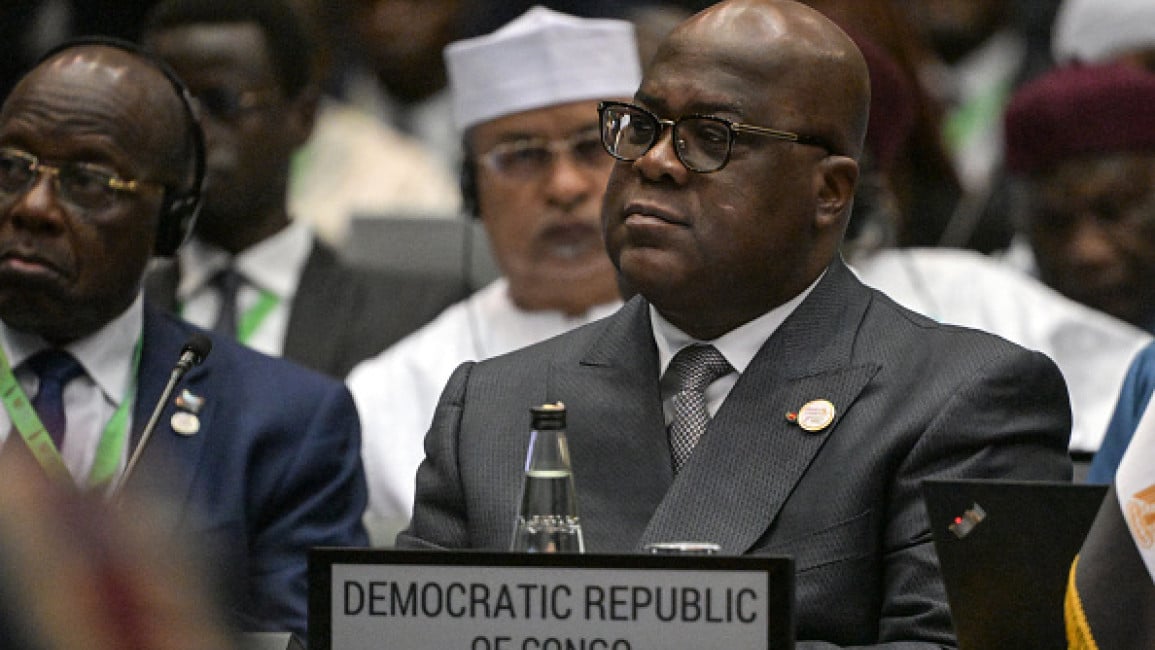
    On Thursday, the U.S. took action by imposing sanctions on a Rwandan minister, James Kabarebe, over his alleged involvement in the escalating conflict in the Democratic Republic of Congo (DRC).

    Kabarebe, Rwanda’s Minister for Regional Integration, is accused of aiding the M23 rebel group, which has been fighting the Congolese army and capturing critical territories, including two major cities.

    Alongside Kabarebe, the U.S. also sanctioned Lawrence Kanyuka Kingston, a spokesperson for the M23 rebels, as well as two companies connected to him that are registered in France and the United Kingdom.

    The M23 rebels are one of many armed factions vying for control over eastern Congo’s vast mineral resources. The group’s rapid expansion has seen them take control of Goma, the largest city in eastern Congo, in just three weeks. On Sunday, they also captured Bukavu, the second-largest city in the region.

    The U.S. government has urged Rwanda to cease its support for the M23 and to withdraw its troops from Congo. U.N. experts estimate that around 4,000 Rwandan soldiers are currently deployed in the region.

    “The leaders of Rwanda to end their support for M23” and withdraw all Rwandan troops from Congo. U.N. experts say there are about 4,000 troops from Rwanda in Congo.

    A statement from U.S. State Department spokesperson Tammy Bruce called for both Congo and Rwanda to ensure accountability for those responsible for human rights abuses in the conflict.

    Kabarebe, a retired military officer, is said to be involved in the M23 rebels’ management of mineral resources taken from eastern Congo, including overseeing their export.

    Bradley T. Smith, acting undersecretary of the U.S. Treasury, emphasized that these sanctions are part of efforts to hold responsible those in positions of power, such as Kabarebe and Kanyuka, for their roles in the ongoing violence.

    “Today’s action underscores our intent to hold accountable key officials and leaders like Kabarebe and Kanyuka,” said Bradley T. Smith, an acting undersecretary of the Treasury.

    Since the M23 offensive began on January 26, more than 700 lives have been lost, and nearly 3,000 people have been injured in Goma and surrounding areas.
  • Leader of failed DRC coup filmed Facebook Live inside palace before death

    Leader of failed DRC coup filmed Facebook Live inside palace before death

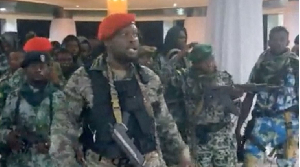
    Footage has surfaced showing the leader of an attempted coup in the Democratic Republic of Congo(DRC) broadcasting live on Facebook from within the presidential palace shortly before authorities killed him following the failed coup on Sunday.

    In the video, verified by Reuters, Christian Malanga, named by the army as the ringleader, declares in the Lingala language: “We, the militants, are tired.

    We cannot drag on with Tshisekedi.”

    Reuters independently verified the location as the palace in Kinshasa by matching imagery with satellite data and archival photos.

    The news agency also confirmed the date through corroborating information.

    The government reported that Malanga, a Congolese politician based in the US, was killed when his forces launched an attack on the palace and the residence of Vital Kamerhe, a candidate for parliament speaker, early Sunday morning.

    Approximately 50 people, including three American citizens, were arrested, according to army spokesman Sylvain Ekenge.

    He added that one of the US nationals arrested was Malanga’s son.

  • UN calls for “independent” investigation into anti-MONUSCO protest

    UN calls for “independent” investigation into anti-MONUSCO protest

    The United Nations has called for an “independent” investigation after a crackdown on an anti-UN protest in eastern Democratic Republic of Congo (DRC) resulted in dozens of deaths.

    The UN is actively engaging with the DRC authorities to ensure that the probe they have initiated is “independent, effective, and that measures are put in place to ensure that future demonstrations are policed in line with international human rights standards,” stated UN rights office spokeswoman Ravina Shamdasani.

    According to the UN, at least 43 people were killed, including a police officer, and 56 others were injured during the crackdown, although the actual toll may be higher.

    An internal army document reported 48 deaths in addition to the slain police officer and 75 wounded individuals.

    Shamdasani also expressed concern over the high risk of human rights violations in such a charged context.

    The incident underscores the ongoing tensions in eastern DRC, which has been plagued by militia violence for several decades, and raises questions about the role and effectiveness of the UN peacekeeping mission (MONUSCO) in the region, which has faced criticism for its perceived passivity in preventing conflicts.

  • UAE signs $1.9 billion deal with DRC mining company

    UAE signs $1.9 billion deal with DRC mining company

    On Monday, President Félix Tshisekedi of the Democratic Republic of Congo (DRC) revealed that a $1.9 billion agreement had been signed between the United Arab Emirates and the state-owned mining company la Société aurifère du Kivu et du Maniema (Sakima).

    The deal was finalized in Kinshasa by a UAE government delegation. As part of the partnership, the plan is to develop a minimum of four industrial mines in the troubled eastern areas of South Kivu and Maniema.

    Sakima currently holds mining concessions in the region for various minerals including tin, tantalum, tungsten, and gold. However, the specific minerals covered by this agreement have not been disclosed by the government.

    In December, the Democratic Republic of Congo (DRC) signed a 25-year contract with UAE company Primera Group, granting them export rights for artisanally mined ores. Artisanal mining involves independent miners who are not employed by mining companies.

    The agreement provided Primera Group with a majority stake in two joint ventures, Primera Gold and Primera Metals, granting them preferential export rates for gold, coltan, tin, tantalum, and tungsten.

    The DRC presented this initiative as a strategy to combat mineral trafficking to armed groups, particularly prevalent in the country’s eastern region.

    The eastern part of the DRC has long been plagued by armed conflict, with the United Nations estimating the presence of up to 120 different militia groups in the area. These groups receive support, at least in part, through the trade of smuggled minerals.

    However, a report published by the United Nations in June expressed concerns about the legality of artisanal mines supplying Primera Gold. The report highlighted the potential for the supply chain to be contaminated with ore from sites controlled by armed groups due to inadequate traceability mechanisms.

    Despite these concerns, Primera Gold commenced operations in South Kivu in January and reportedly shipped a ton of certified gold in May, as reported by the Congolese Ministry of Finance.

  • Rwanda and DRC end year with icy relations as fresh allegations emerge

    Rwanda and DRC end year with icy relations as fresh allegations emerge

    Rwanda and the Democratic Republic of Congo are trading accusations over alleged territorial violations and espionage, which could dampen the hope for any ebbing of tensions between the two countries.

    On Wednesday, Kigali said a Congolese military plane had trespassed into Rwandan territory, the second such incident raised in more than a month. Kinshasa did not immediately respond, although it had admitted to an earlier violation in November, terming it as an “unfortunate” disorientation by the pilot.

    The spark was touched off on Tuesday after authorities in DRC said they were holding two Rwandans and two Congolese citizens accused of spying for Kigali under the cover of their day jobs.

    The four were presented in Kinshasa and described as “spies for Rwandan authorities who operate in Kinshasa under the cover of NGO African Health Development Organisation, AHDO.”

    According to a brief from the Deputy Minister of Interior, Jean-Claude Molipe, one of the Rwandans is a medical doctor while the other is a soldier with the Rwandan Defence Force.

    Mr. Molipe claimed that “these spies had infiltrated senior army officers, political figures, economic operators, and members of civil society.”
    The Congolese nationals are affiliated with AHDO. The Rwandans had, in fact, been arrested in August, a matter that caused a diplomatic protest from Kigali.

    Rwanda’s Minister for Foreign Affairs Vincent Biruta on November 4 wrote to Congolese counterpart Christophe Lutundula to demand the “unconditional release” of the two Rwandans. In response to the incident in November, the DRC government said its jet “unfortunately” entered Rwandan airspace and that it had “never harbored intentions of violating that of its neighbor.”

    Rwanda did not immediately respond to the latest espionage allegations but, on Wednesday, Kigali accused DRC of violating its airspace. A statement said a Sukhoi-25 fighter jet from DRC violated Rwandan airspace along Lake Kivu in the Western Province at around midday. Rwanda accuses DRC of repeated violations, against the spirit of Luanda and Nairobi peace initiatives.

    “The authorities in the DRC seem to be emboldened by consistent coddling by some in the international community, who repeatedly heap blame on Rwanda for all ills in the DRC while ignoring the transgressions originating from the DRC,” the Rwandan government said in a statement issued December 29.

    The Nairobi and Luanda peace initiatives are two peace-seeking processes for the eastern part of DR Congo, which is plagued by war between the M23 rebels and the Congolese army. Eastern DRC is also home to dozens of local and foreign armed groups, responsible for several massacres and abuses against civilians.

    The Nairobi and Luanda process recommended a ceasefire and de-escalation between the DRC and the M23 rebels, but also to cool tensions between Rwanda and the DRC, who accuse one another of sponsoring rebels against their authorities. The Nairobi process was signed between the DRC government and about 50 armed groups (apart from the M23) in search of peace.

    The DRC, now joined by France and the US, has sustained allegations that M23 receives backing from Rwanda, a charge Kigali rejects.

    On Tuesday, Congolese officials made accusations about the four people arrested. Molipe said the four had acquired “a large amount of land in the areas [near] N’djili International Airport and the Kibomango military base.” The airport is Kinshasa’s biggest while the base lies east of Kinshasa, a few kilometers from the city center.

    The Deputy Minister of the Interior and Security added that the fact that these people had acquired land near the airport suggested: “they were preparing for a Machiavellian plan.”

    “The arrested Rwandan soldier revealed that he had access to different strategic sites in Kinshasa, in complicity with some general officers of the Congolese army.”

    He said that investigations are continuing to arrest “military or civilian accomplices.” With the continual tensions between Kigali and Kinshasa, there is a risk of deteriorating the fragile relations between the two EAC partners.

    Source:

  • Religious leaders meet in eastern DRC

    Religious leaders met on Saturday in Goma following the violence that resulted in at least 50 deaths in eastern DRC.

    On Thursday, the military accused the M23 rebel movement of the deaths and breaching a recently brokered ceasefire.

    “Our effective commitment to the inter-faith project for peace in North Kivu, our support for the authorities of the province in their efforts to seek peace and the peaceful coexistence of communities, our appeal to all of the faithful, in particular the population in general, to get involved in the promotion of peace. Our determination to say each week in our parishes and mosques a common prayer on the ecumenical peace of the French saint of Assisi”, said Rev. Samuel Ngahiembako, President of the ECC (L’Eglise du Christ au Congo: Church of Christ in Congo, Ed.)

    On Friday, DRC president Felix Tshisekedi declared three days of national mourning following the violence.

    Local resident Amani Fundiko, added “I have so many worries because we have no peace, no joy to see our compatriots being killed in Rutshuru, Runyonyi, Rugari, everywhere there, our wish is that the President takes decisions to take charge of this situation and see if they can put an end to the M23, even look at the Goma-Rutshuru road, it is blocked. The situation is very complicated and we are hungry”, he said.

    The M23 rebel movement re-emerged last year in November claiming the government had not stuck to the terms of the peace deal.


    Source: African News

  • DRC relatively calm but no withdrawal from M23-held areas

    The ceasefire between the M23 rebels and the Congolese army appeared to be holding on Monday in eastern DRC, but no movement to withdraw from areas occupied by the rebellion, as called for by the Luanda summit, appeared to be taking place, according to reports gathered by AFP.

    As at the weekend, clashes pitted the Tutsi rebel M23 against Hutu militias, notably the Democratic Forces for the Liberation of Rwanda (FDLR).

    “During the night, an M23 vehicle was ambushed” near the village of Kinyandonyi, in Rutshuru territory. Another attack attributed to the same militia took place on Sunday about 30 km away, in the locality of Biruma, according to a local resident.

    A hospital source also said that six civilians were killed in clashes on Saturday in the same area between the M23 and “mai-mai” (community militias) in Kisharo .

    But no fighting was reported between the M23 and the loyalist army, as the two sides continued to observe each other on the various front lines, including that of Kibumba, the closest – about 20 km – to the major city of Goma, capital of North Kivu province.

    During an offensive launched last month, the rebels quickly approached the town but have not advanced for about two weeks, progressing instead on other fronts, towards the west in the direction of Masisi, and the northeast.

    A precarious calm has prevailed since the weekend, suggesting that calls for a ceasefire may have been heeded.

    Last Wednesday, a mini-summit in Luanda decided on a cessation of hostilities on Friday evening, followed two days later by the withdrawal of the M23 rebels “from occupied areas” and their “withdrawal to their initial positions” on Sunday.

    But no withdrawal was triggered on Monday. “We have always said that we are asking for dialogue with the government and at that time we will discuss this issue,” said Willy Ngoma, M23 military spokesman.

    The Luanda summit added that if the M23 rebels refused to withdraw, the East African regional force deployed in Goma would “use force to push them into submission”.

    As long as the M23 occupies parts of Congolese territory, the Kinshasa government refuses to talk to the M23, which it describes as a “terrorist movement” backed by Rwanda.

    A new round of talks with armed groups active in eastern DRC opened in Nairobi on Monday, without the M23.


    Source:

  • War in DRC’s east: Demonstrators call out ‘international community’s complicity’

    The demonstration took place one day after a meeting in Luanda where the DRC, Burundi, Rwanda as well as the East African Community envoy called for a cease-fire to take effect Friday.

    “I mean, we are satisfied with this agreement signed (ceasefire signed in Angola on Wednesday), but we are still pessimistic about its implementation, especially since this is not the first agreement’, Jean Claude Mbambaze, the president of the civil society of Rutshuru said.

    “There have been many summits, but the decisions have not been implemented.”

    After the summit in Angola, the participants released a statement calling for a cease-fire to begin Friday evening in eastern Congo, followed by a rebel withdrawal from the major towns it holds – Bunagana, Rutshuru and Kiwanja.

    Some protesters carried banners in support of the Congolese armed forces who are fighting M23 rebels. Other placards were hostile to the recent agreement.

    Demonstrators marched to the French and British consulate.

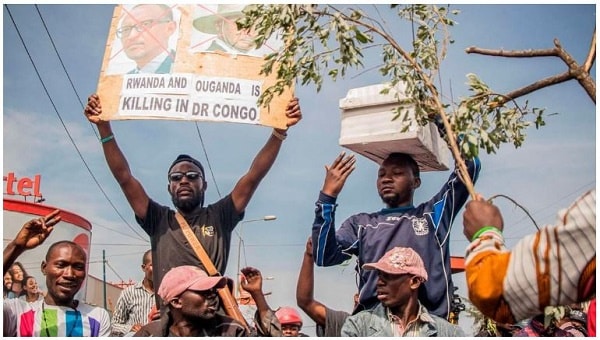
    “We do not understand, when there are rebels who call themselves Congolese, they ask for negotiations, and it is Rwanda and Uganda who represent them. That is why we protest about this complicity, …And there is a notorious silence of the international community, the EAC (East African Countries bloc), the African Union, all are accomplices”, demonstrator Jack Sizahera shouted.

    The protestors delivered a letter to both French and British consulates with grievances including an end to the international community’s ambiguous response in the face of the M23 aggression.

    “We demand the international community – as a whole – to ask the Rwandan and Ugandan heads of state to urgently withdraw their fighters camouflaged under the label of M23/RDF/UPDF (rebel groups)”, John Banyene, the president of the civil society of Nord-Kivu read.

    Adding, we demand the international community “to sanction Rwanda and Uganda for the aggression against DRC for more than 25 years”.

    In August, U.N. experts said they had “solid evidence” that members of Rwanda’s armed forces backed the M23 rebels. Kigali denied the allegations.


    Source: African News

  • DRC: Two die from lightning strikes at displaced persons camp

    Two people died from lightning strikes on Monday in a displaced persons camp in the eastern Democratic Republic of Congo.

    More than 260,000 people have been forced to flee their homes due to recent fighting between government forces and M23 rebels, according to assessments by the United Nations.

    The camp Kanyaruchinya, just north of Goma city, is only 20 kilometres (12 miles) from the frontlines of the fighting. One of the victims was a pregnant woman who had stepped out from her tent when she was struck. Another was a young child.

    The bodies of the victims have been brought to the provincial morgue in Goma to await the funeral.

    Grieving families of the victims asked for help from the government.

    “May the government help us with assistance because we are suffering a lot, the displaced are suffering, we have no food, and the suffering is getting worse every day,” said Byamungu Sigrezambo, father of one of the victims.

    Other displaced people living in this site remain worried about tough living conditions.

    The fresh fighting between the M23 rebels and the Congolese army and its allies in the territory of Rutshuru, has forced tens of thousands to take refuge in informal sites in Kanyaruchinya and in the surrounding localities.

    Aid workers said an urgent international response is needed and are looking for 50-million US dollars to fund its work here for the next six months.


    Source: Africa News

  • DRC: Artillery fire on M23 rebel positions

    The Democratic Republic of Congo (DRC) is yet to fulfil its promise by taking action to protect its people despite promise, local sources have revealed.

    “We woke up to heavy fighting in Rugari,” a resident of the town, about 30km north of Goma, the capital of North Kivu province, told AFP by phone.

    He said the population had fled north. “I am in Rumangabo (10 km from Rugari), where we can hear the sound of the bombs,” he said.

    Even from Kiwanja, about 30 km from Rugari, residents said they heard “a lot of shooting” from the area of clashes.

    The artillery fire is coming from the south, from Kibumba, another town on the National Road 2 to Goma, said another resident.

    On the outskirts of Goma, an AFP correspondent saw at least one tank and an army truck carrying ammunition passing by on their way to the battle zone.

    “The fighting continues in Rugari, we are progressing towards Rumangabo,” a security source confirmed on condition of anonymity.

    The high-voltage line linking Goma to the Matebe hydroelectric plant, built by Virunga National Park in Rutshuru territory, was hit by the fighting, its operator said.

    Electricity supply was disrupted in the afternoon in the town of more than one million people.

    The bombing comes three days after two Congolese army fighter jets and two helicopter gunships struck rebel positions.

    The 23 March Movement (M23) is a former Tutsi rebellion that took up arms at the end of 2021 and conquered several localities in Rutshuru territory, including Bunagana, a strategic town on the border with Uganda.

    After several weeks of calm, the rebels resumed their offensive on 20 October and extended their hold westwards, occupying localities on the RN2.

    The DRC accuses neighbouring Rwanda of supporting this rebellion, which Kigali denies, accusing in return the Congolese army of receiving support from the Rwandan Hutu rebels of the FDLR (Forces démocratiques de libération du Rwanda).

  • DRC: A coffee entrepreneur’s success

    Aristotle Mumbere, who is 25, works day and night to transform these seeds into coffee powder with the help of his small team from North Kivu in DRC.

    These seeds are locally sourced from a field about 50 kilometers from Goma.

    The coffee has to be as natural as possible to satisfy his hundreds of customers.

    Aristotle hopes to grow his customers base all across the continent.

    “Due to the competitors coming from abroad, we explain to our customers the benefits of our coffee which is local and natural,” Mumbere said.

    “The natural coffee we produce locally is very high in caffeine.

    “There are no roads to our fields, this is the biggest problem because we do not know how to transport our products if they are in the fields. That is the biggest challenge.”

    In this restaurant, customers exclusively consume the local brand.

    Josaphat Irenge, one of the clients, is convinced the DRC should no longer import coffee.

    “This is a product owned by a young entrepreneur who lives here and we have the obligation to support entrepreneurs and local entrepreneurship,” he said.

    “It is in this framework that instead of imported coffee we decide and choose to consume locally”

    In the last few years, the North Kivu province has faced growing insecurity.

    Many young people remain idle, and some are opting for entrepreneurship to survive.

    Source: africanews.com