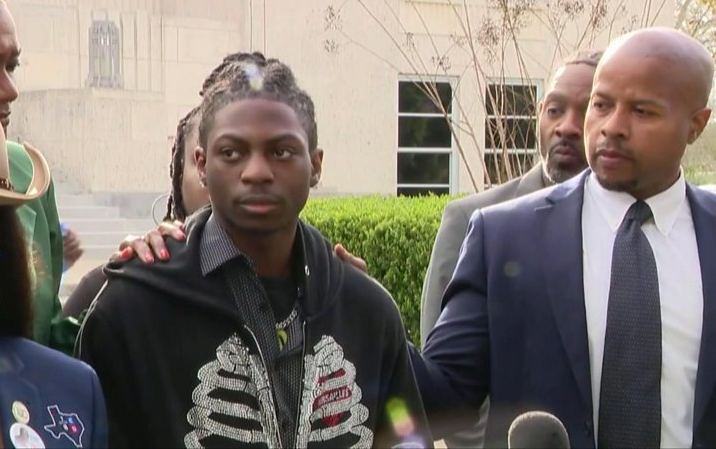
A Texas judge ruled that a school’s disciplinary action against a black student for wearing dreadlocks was not unfair.
Last August, Darryl George, 18, was suspended from Barbers Hill Independent School District because his hairstyle did not follow the school’s rules.
The judge said the Houston-area school did not break a law that stops prejudice against people based on their hair.
The family’s lawyer said they will ask for another court decision.
The student will be suspended and not allowed to go to regular classes at school.
Judge Cain III decided that the school district won after listening to testimony for about three hours on Thursday.
Mr George expressed his feelings of “being mad, sad, and let down” outside the courthouse after the ruling.
The school district has a rule about how long students can wear their hair. It says hair must not go past the top of a T-shirt collar, eyebrows, or ear lobes when it’s down.
However, George did not want to cut his braided dreadlocks. His family said the dreadlocks are important in the black community.
Last year Texas made a law called the Crown Act. It stops people from being treated unfairly because of their hair style.
Darresha George, the mother of the student, complained that the school district broke the new law.
In September, the school district took legal action to solve a problem, and Thursday’s decision was the result of that.
But the superintendent of Barbers Hill High School, Dr Greg Poole, supported the school’s decision. He said that the Crown Act does not specifically mention the length of hair.
Since last August, Mr. George has been getting in trouble at Barbers Hill High School for not cutting his hair.
He got kicked out of class and had to stay in a special school area at school, and then had to go to a different program outside of school.
“His mother told the Associated Press in August that he has to sit on a small chair for eight hours in a small office space. ”
“That feels really bad. ” Every day when he came home, he would say that his back hurts because he has to sit on a stool.
Barbers Hill ISD has been in the news because of problems with its dress code for black students.
De’Andre Arnold and Kaden Bradford had to cut their long, twisted hair in 2020, so their families decided to take legal action.
In that situation, a judge decided that the district’s hair rules were unfair.
A law called the Crown Act was approved by the House of Representatives in 2023, but it was not approved by the Senate.
Tag: dreadlocks
-
Texas judge maintains black student’s suspension from school over dreadlocks
-
Nigerian mother creates stir online by cutting son’s dreadlocks while he sleeps
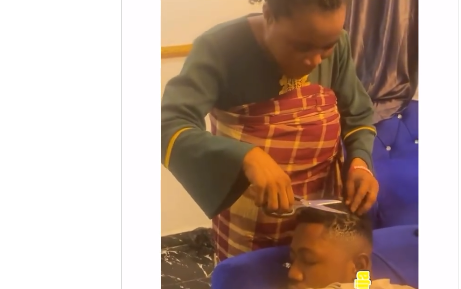
A Nigerian mother has caused a stir on social media by taking extreme measures and cutting off her son’s dreadlocks while he was deeply asleep.
The video capturing this unusual act was filmed by the son’s brother, who attempted to plead with the mother to spare his sibling’s hair, but she remained resolute.
According to the mother, she had previously warned her son against having dreadlocks in her house, and she deemed her actions necessary to enforce her rules.
She admitted to putting sleeping pills in his food, explaining why she served him a separate meal.
See some reactions to the video here
perrysignature2 wrote: “I hate person wey dey sleep deep like this”
weightlossproducts9ja added: “African mothers 😂 but please if you still live under your parents and they still take care of your bills please abide by their rules and not yours. 😂😂”
shes_spotless reacted: “Lmao She Gave Him A Different Food So He Can Sleep Very Well 😂”
officialeldero1 said: “Samson don looseguard o…it’s a tufiakwa situation.”
kingslia_israel stated: “I know someone that sleeps like this 😂😂😂😂 can’t call name but a tailor came to measure him sleeping like that I can never forget that day 😂😂😂”
officialdeedollar asked: “Your mama na Delilah?”
Watch video here
-

Student in Malawian school banned for 3years over dreadlocks
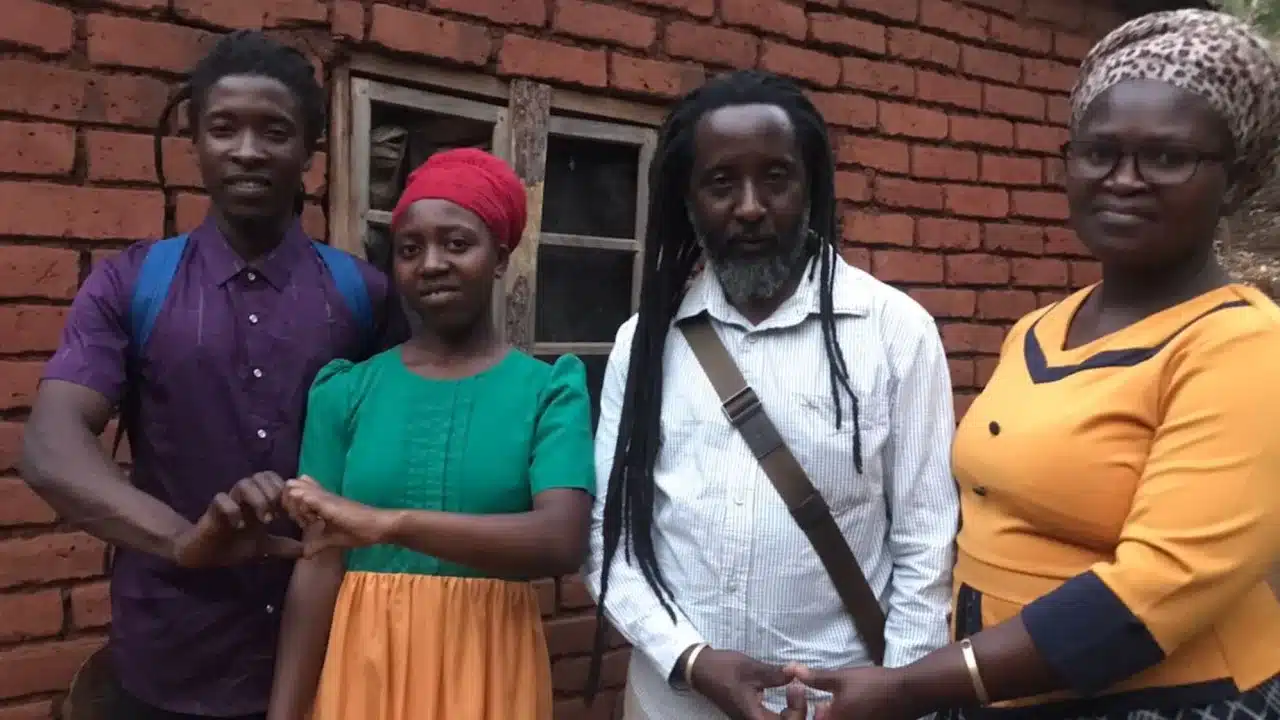
Alli Nansolo debated whether or not to clip his son’s dreadlocks for years. Although it is not a legal requirement in Malawi, an informal policy that was implemented across government schools meant that his son was denied entrance due to his hair.
Nansolo’s could not pay for private education for his son Ishmael from his modest dressmaking income and cutting his hair, an important symbol of their Rastafari religion, was inconceivable to him.
“Rastafari is a spiritual way of life. Keeping dreadlocks is like we are committing ourselves to a vow before the most high creator that we will serve him in our life without denying his laws or commandments,” Nansolo told CNN.
The 48-year-old makes between 200,000 to 300,000 Malawian Kwacha (around $194 to $291) monthly, while his wife Empress supplements the family’s income by selling secondhand clothes.
Jamaica’s high court ruled a school was legally right in banning a child with dreadlocks
“I felt oppressed,” Nansolo said as he recalled the staff of a state-run secondary school in Zomba, southern Malawi. refusing to register Ishmael because of his hair.
Nansolo said he contacted an officer at the Ministry of Education who advised him to cut his son’s hair so that he could go to school.
Nansolo found himself caught up in the discriminatory policies of Malawian public schools and decided to take legal action against the Ministry of Education, along with a group of parents.
“I went to the Women Lawyers Association of Malawi to ask for help. The association accepted and we went to court in November 2017,” he said.
A temporary relief
For three years, Ishmael, then 15, would remain out of school as the court case dragged on.Then, in 2020, the Malawi High Court placed an interim order compelling public schools to enroll Ishmael and other Rastafari children until a final ruling was reached.
It was a legal victory that marked a significant milestone for the estimated 15,000 Rastafarian community in Malawi, according to Nansolo, who is also a community elder.
However, the temporary relief did not address the broader issue of discrimination that around 1,200 affected students face, their lawyer Chikondi Chijozi told CNN.
“We saw a number of Rastafari children being admitted into government schools but there were still reported cases of children of [the] Rastafari community being denied admission into government schools, and their parents were forced to take the court injunction to the school to compel them to admit them,” Chijozi said.
‘Free’ at last, but challenges remain
After a six-year legal challenge, the Malawian High Court delivered a landmark ruling on May 8.The court ruled that it was unlawful to require learners, including Rastafarian kids, to cut their hair before they are enrolled into public schools.
The ruling came into immediate effect but the government has until June 30 to issue a nationwide statement mandating acceptance of all dreadlocked children into school.
Chijoki told CNN: “We got a judgment from the court which essentially upheld the rights of the Rastafari children and abolished the policy that requires all learners, including Rastafari children, to cut off their dreadlocks for them to be admitted into government schools.”
Nansolo expressed his community’s jubilation that their children could now finally continue their education.
“The judgment means that we are now free because most of us in [the] Rastafarian community don’t earn much, so we couldn’t manage to send our children to private schools,” Nansolo said.
“We are happy seeing that our children will now be going to public schools without being sent back or denied their right to education.”
CNN has contacted the education ministry for comment on the ruling.
Despite this victory, Malawi’s Rastafarian community still faces numerous challenges. Unemployment, poverty, and corporate discrimination persistently plague the community. Data on the community is hard to come by but the US State Department says around 5.6 percent of Malawi’s nearly 21 million population is formed of other religions including Hindus, Baha’is, Rastafarians, Jews, and Sikhs.
“Most of us rely on business to survive. Lack of jobs is a big challenge for the Rastafarian community because those in offices are reluctant to employ Rastas,” Nansolo said.
“The corporate world feels that being Rastafari is associated with criminality, but we are not like that.”
-
Rastafarian’s son banned from school for 3 years over dreadlocks in Malawi
Alli Nansolo debated whether or not to trim his son’s dreadlocks for years. Although it is not required by law in Malawi, a widespread unwritten policy meant that his son was being turned away from government schools because of the colour of his hair.
With his meagre earnings from manufacturing dresses, Nansolo’s was unable to provide his son Ishmael with a private education, and cutting his hair—a significant Rastafari religious symbol—was out of the question.
“The rastafari way of life is spiritual. Maintaining dreadlocks is comparable to making a pledge before the Most High Creator that we shall live our lives in service to Him without disobeying His Laws or Commandments, according to Nansolo, who spoke to CNN.
The 48-year-old makes between 200,000 to 300,000 Malawian Kwacha (around $194 to $291) monthly, while his wifeEmpress supplements the family’s income by selling secondhand clothes.
“I felt oppressed,” Nansolo said as he recalled the staff of a state-run secondary school in Zomba, southern Malawi. refusing to register Ishmael because of his hair.
Nansolo said he contacted an officer at the Ministry of Education who advised him to cut his son’s hair so that he could go to school.
Nansolo found himself caught up in the discriminatory policies of Malawian public schools and decided to take legal action against the Ministry of Education, along with a group of parents.
“I went to the Women Lawyers Association of Malawi to ask for help. The association accepted and we went to court in November 2017,” he said.
For three years, Ishmael, then 15, would remain out of school as the court case dragged on.
Then, in 2020, the Malawi High Court placed an interim order compelling public schools to enroll Ishmael and other Rastafari children until a final ruling was reached.
It was a legal victory that marked a significant milestone for the estimated 15,000 Rastafarian community in Malawi, according to Nansolo, who is also a community elder.
However, the temporary relief did not address the broader issue of discrimination that around 1,200 affected students face, their lawyer Chikondi Chijozi told CNN.
“We saw a number of Rastafari children being admitted into government schools but there were still reported cases of children of [the]Rastafari community being denied admission into government schools, and their parents were forced to take the court injunction to the school to compel them to admit them,” Chijozi said.
After a six-year legal challenge, the Malawian High Court delivered a landmark ruling on May 8.
The court ruled that it was unlawful to require learners, including Rastafarian kids, to cut their hair before they are enrolled into public schools.
The ruling came into immediate effect but the government has until June 30 to issue a nationwide statement mandating acceptance of all dreadlocked children into school.
Chijoki told CNN: “We got a judgment from the court which essentially upheld the rights of the Rastafari children and abolished the policy that requires all learners, including Rastafari children, to cut off their dreadlocks for them to be admitted into government schools.”
Nansolo expressed his community’s jubilation that their children could now finally continue their education.
“The judgment means that we are now free because most of us in [the]Rastafarian community don’t earn much, so we couldn’t manage to send our children to private schools,” Nansolo said.
“We are happy seeing that our children will now be going to public schools without being sent back or denied their right to education.”
CNN has contacted the education ministry for comment on the ruling.
Despite this victory, Malawi’s Rastafarian community still faces numerous challenges. Unemployment, poverty, and corporate discrimination persistently plague the community. Data on the community is hard to come by but the US State Department says around 5.6 percent of Malawi’s nearly 21 million population is formed of other religions includingHindus, Baha’is, Rastafarians, Jews, and Sikhs.
“Most of us rely on business to survive. Lack of jobs is a big challenge for the Rastafarian community because those in offices are reluctant to employ Rastas,” Nansolo said.
“The corporate world feels that being Rastafari is associated with criminality, but we are not like that.”
-

Schools in Malawi ordered to allow use of dreadlocks
A Malawian high court has ruled that students with dreadlocks be admitted to public schools across the country.
The court, which was sitting in the eastern city of Zomba, was hearing a plea filed by two Rastafarian youngsters who were denied entry to public schools in 2016 and 2010.
The two students, on the other hand, have been attending school since they won a court injunction.
Negotiations between Malawi’s Rastafarian community and the country’s attorney general to settle the dispute failed, leading in a lengthy judicial battle, the outcome of which was announced on Monday.
Judge Zione Ntaba ruled that barring children with dreadlocks from attending school was a breach of their right to education.
“The Ministry of Education should issue a statement to allow all children of the Rastafarian community with dreadlocks to be allowed in class. The circular should be done by 30th June,” Justice Ntaba ordered.
The case was filed by three human rights organisations on behalf of the Rastafarian community in the country.