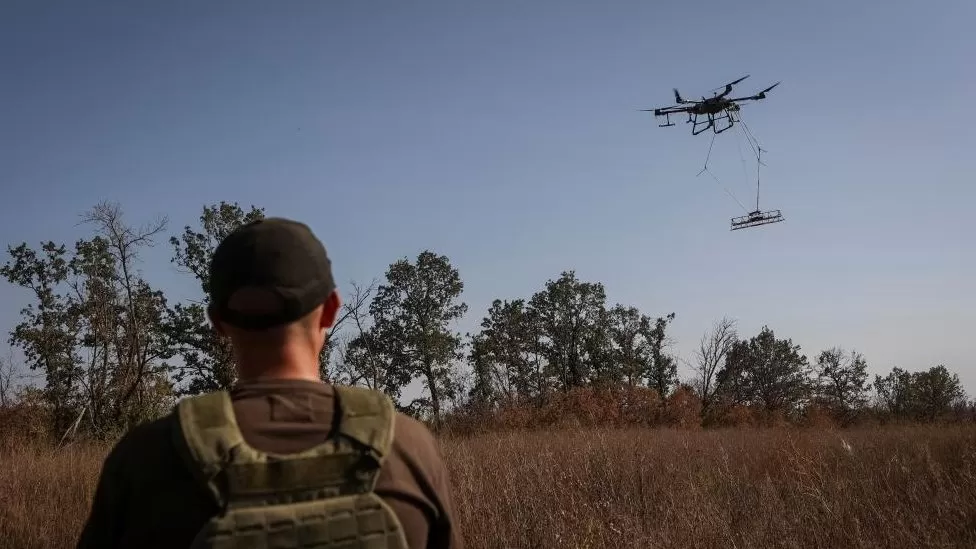
Security forces in Bawku have introduced drones to assist in tracking weapons and identifying those responsible for ongoing attacks in the area.
The initiative has already resulted in the arrest of several suspects and the seizure of firearms. The drones, which are equipped to operate at high altitudes, are being used to monitor and track the movements of individuals involved in the violent activities. Once suspects are identified, security forces move in to make arrests.
This morning, gunmen opened fire around 6 AM, with reports of heavy shooting in the Bawku-Gingande and Kpalore areas. However, no fatalities have been reported from the confrontation.
The drone deployment follows a series of killings by unknown assailants. On December 16, two individuals were killed in separate incidents. Moro Aziz, a mentally ill man from Gozesi, was found dead near the Bawku cemetery, while Kasim was shot dead in Daduri while attempting to relocate.
These incidents bring the total number of fatalities in Bawku since the renewed violence in late October to 35.
Two people will face military justice for making mistakes that led to civilians being killed. They thought the civilians were terrorists. The Defense Headquarters spokesperson did not give more information.
The Nigerian military frequently uses air strikes to fight against violent extremists and rebel attacks in the northern part of Nigeria. This has caused harm to innocent people for over ten years.
Since 2017, the military has accidentally killed about 400 civilians, according to a security firm in Lagos.
In December, there was a problem with a gun while people were celebrating a Muslim holiday in Tudun Biri village, Kaduna state.
Ewang said we really need a careful plan to make sure the victims of the airstrikes get fairness and justice.
Nigeria’s President Bola Tinubu said that mistakes that could have been prevented cannot happen again. Rights groups and activists also criticized the attack and asked for more careful monitoring of the military’s actions in war areas.
One big worry is that there are too many drones in Nigerian security groups and there are no clear rules on when they can be used. This was said by Kabir Adamu, a security expert in Abuja.
Buba said that the military will be more careful in the future to make sure that people who are not fighting in wars are safe.
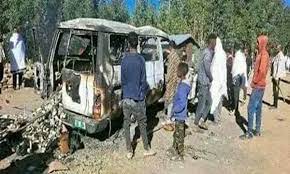
Five ordinary people have died in Ethiopia’s Amhara region when a drone attack hit an ambulance, according to people who saw it happen and told the media.
Three more people, including a hospital leader, got hurt in the event in Wogel Tena town in north-eastern Amhara.
The attack happened last week, but the local authorities didn’t confirm it until Wednesday because of communication restrictions.
According to witnesses, the person driving the ambulance, a pharmacist, and some construction workers nearby were killed.
The government’s soldiers are using drones to attack local groups, as the fighting that started in April gets worse.
The UN was worried about drones hitting innocent people in Amhara last month.
Many people died in an attack at a school and bus station.
Drones have had a big impact on the war in Ukraine, used a lot by both sides. China’s decision to limit the amount of goods it exports has raised worries that there might be a shortage of supplies.
A lot of these things are made in China and bought ready to use. We need more supplies because many of them get lost in the fighting.
However, it seems like there may be fewer Chinese drones and drone parts accessible to both Ukraine and Russia.
Based on a report by a London think tank called the Royal United Services Institute (Rusi), Ukraine loses around 10,000 drones every month.
Many volunteer groups have used donated money to help the Ukrainian army get new supplies.
Commercial drones are used together with military drones that are specifically made for fighting, like the Turkish Bayraktar drones used by Ukraine and the Iranian Shaheds used by Russia.
The Chinese government recently put new rules in place starting from 1 September. These rules are for bigger drones that weigh more than 4kg. They also apply to certain equipment like cameras and radio modules that are used with drones.
Chinese manufacturers of this equipment now have to ask for permission to sell it overseas and give certificates to show who will use it. The government in Beijing, which has not criticized Russia for invading Ukraine, says Chinese drones should only be used for business, not military, reasons.
Ukrainian volunteers and soldiers are not greatly affected by the recent Chinese restrictions on drones. The popular lightweight Mavic drones made by DJI are still easily available. But, they are saying that there is a problem getting the parts they need, and they are also worried that it might get even worse later on.
Lyuba Shypovych, the leader of Dignitas, a big Ukrainian volunteer group that provides the military with drones, said that the only difference for now is that they are buying the remaining stock in European warehouses more actively. “But we don’t know what we will be doing in the future. ”
She is very concerned about whether there will be enough thermal imaging cameras available.
The shorter days and longer nights are affecting our military supplies and how we conduct warfare because we have fewer thermal imaging drones. She said our units cannot see well at night. This impacts both drones that are already made and come with thermal imaging cameras, as well as the individual parts used to build drones.
It is especially important to have enough parts for people who build their own drones or make upgrades on ones they bought.
The effect is being noticed. According to a drone operator named Oddr, China’s license restrictions have reduced Ukraine’s ability to acquire drone parts. “However, we are searching for other options to ensure that our drones continue to function just like they did previously. ”
This is the most recent problem that volunteers have in getting drones for the Russian and Ukrainian armies.
The biggest company that makes drones for business, DJI, stopped selling directly to both countries two months after the big attack started in February 2022. They also stopped their distributors everywhere in the world from selling DJI products to customers in Russia or Ukraine.
Ms Shypovych said that there were a lot fewer Chinese drones for sale in Europe between August and September 2022.
It’s doubtful that it occurred randomly. “She says European countries are where Ukrainians get drones from. ”
When the BBC asked DJI, they couldn’t say for sure if the number of drones they were giving to distributors in Europe had changed or not.
None of the 10 UK companies that sell DJI products and were asked by the BBC were able to comment on the issue.
A recent investigation by The New York Times found that Chinese companies have reduced the number of drones and parts they sell to people in Ukraine.
However, other countries are also impacted by this situation, not just Ukraine.
Russia’s Kommersant newspaper said that the regulations put in place by China’s government on drone exports have made it very difficult for Russia to receive the supplies they need. This has caused a shortage of certain parts, like thermal imaging cameras.
When Russian buyers can’t get drones directly, they often go to other countries like Kazakhstan to buy Chinese drones. However, it has become tougher for them because Kazakhstan has made its own rules about importing drones.
To reduce the effects of the Chinese restrictions, Ukrainian volunteers have been working hard to find other options made in different countries, both in the West and Ukraine.
Anatoly Polkovnikov, who assists in getting drones, shares that a Ukrainian start-up is getting ready to start producing drone motors.
He believes that the Chinese restrictions won’t affect the overall situation and is hopeful for the future. I think that in the future, they will encourage more production in Ukraine.
The war in Ukraine is the first time drones have been used in a big way, and both sides want to continue using them a lot.
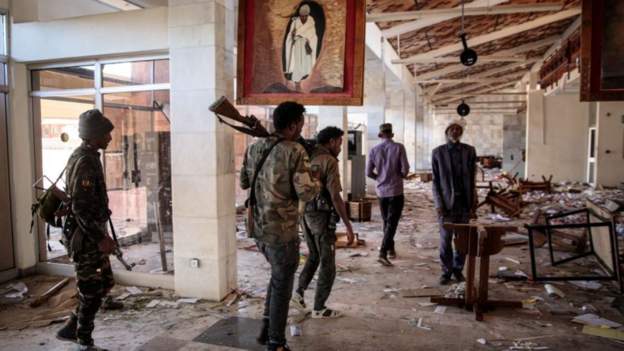
Many people living in Ethiopian towns in the Amhara region shared with the BBC that a lot of innocent people were killed by drone attacks on Sunday.
An anonymous resident from Quarit said that there were two different drone attacks in the area. In one of the attacks, the person living there said that “around 30 people died”.
One more person who visited the places where the drone attacks happened said that the strikes occurred in areas far away from where a lot of fighting was happening. There also didn’t seem to be any signs of militants in those areas at that time. He said another drone attack happened in a forest and no one got hurt.
There was another drone attack in Dembecha town that reportedly killed around 18 people. Someone who lives there told the BBC that the attack happened near Michael’s Church and that they helped find and bring back the bodies.
The government has not replied about the supposed drone attacks, even though the BBC tried to talk to them.
The previous month, the BBC shared news about drone attacks in Fnote Salam where over 30 people died and 50 were injured.
The long-lasting fight between Fano forces and federal troops, which started because the government told the militia to join the official security team, reached its highest point in early August.
A new report from the United Nations has recorded over 180 people who have died because of this conflict since July. This shows that over 1,000 people have been arrested in Amhara since the state of emergency was announced.
The Ethiopian Human Rights Commission (EHRC) recently said that government security forces have killed people in the Amhara region without going through the legal process.
A source from the military has revealed that an air base in eastern Libya, suspected to house mercenaries from the Russian paramilitary group Wagner, was targeted by drone strikes of unknown origin on Thursday night. Fortunately, the attacks did not result in any casualties.
The source, who requested anonymity, told AFP that drones “of unknown origin struck the al-Kharrouba air base, located 150 km south-east of Benghazi (east), where elements of the Wagner group are believed to be based”.
“The strikes caused no casualties”, she added.
Libya has been in the grip of a major political crisis since the fall of Muammar Gaddafi’s regime in 2011, undermined by divisions between east and west and foreign interference.
From April 2019 to June 2020, Khalifa Haftar, the strongman of eastern Libya, used Chadian, Sudanese, Nigerian and Syrian fighters, but above all mercenaries from Wagner, in his failed attempt to seize the capital Tripoli.
Since then, hundreds of Wagner members have remained active in the east, in the area of the oil terminals, and in the south of Libya after some of their troops left for Mali or Ukraine to fight alongside the Russian army.
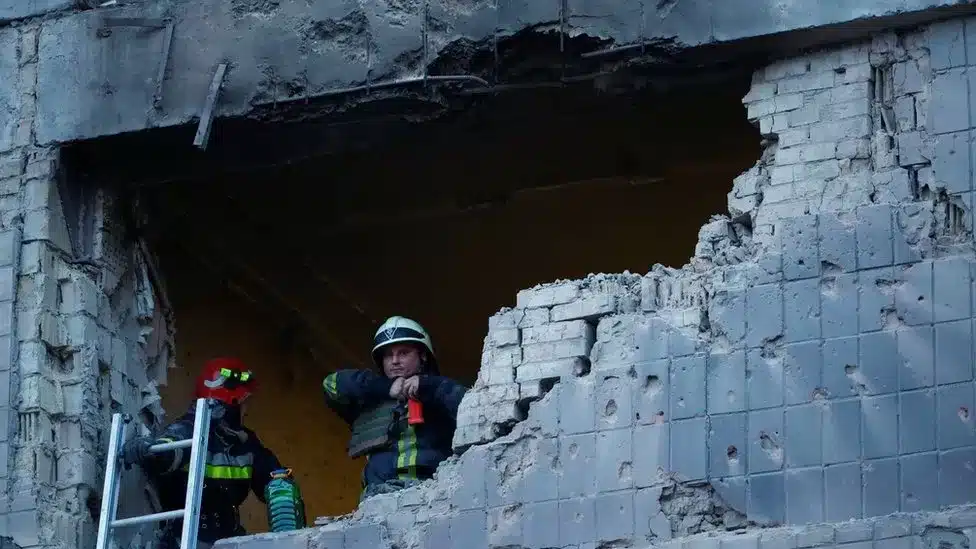
Local officials have reported that Russia carried out a new major overnight drone attack on Ukraine’s capital, Kyiv, killing at least one person.
Kyiv’s mayor Vitaliy Klitschko said a man died when drone wreckage fell near a petrol station. A woman was injured.
Overall, Russia launched a record 54 so-called kamikaze drones on Ukrainian targets, 52 of which were shot down, Ukraine’s Air Force reported.
In Kyiv alone, more than 40 drones were downed, officials said.
This information has not been independently verified.
Russia – which launched its full-scale invasion in February 2022 – has in recent weeks stepped up its attacks on Kyiv, seeking to overwhelm the capital’s defences.
Earlier on Sunday, air raid alerts were activated in 12 regions of Ukraine, from Volyn in the north-west to Dnipropetrovsk in the south-east.
In a post on social media, Mr Klitschko urged Kyiv residents to “stay in shelters”, warning of waves of drone attacks and a “difficult” night ahead.
He said at least two high-rising buildings in different districts of the capital were on fire after being hit by falling drone fragments.
Kyiv officials also reported that warehouses in the southern Holosiyivsky district were ablaze.
Some officials accused Russia of targeting Kyiv deliberately as residents prepared to celebrate Kyiv Day – the anniversary of the city’s foundation 1500 years ago and a popular holiday before the war.
There were also reports of explosions in the city of Zhytomyr, west of Kyiv.
The air alert was later lifted in the capital and across the country.
In its recent attacks, Russia has been using so-called kamikaze drones as well as a range of cruise and ballistic missiles.
The attacks come ahead of a widely expected Ukrainian counter-offensive.
On Saturday, one of Ukraine’s most senior security officials told the BBC the country was ready to launch such an operation.
Oleksiy Danilov, secretary of the powerful National Security and Defence Council of Ukraine, said an assault to retake territory from President Vladimir Putin’s occupying forces could begin “tomorrow, the day after tomorrow or in a week”.
‘We’re ready to begin counter-offensive’ – Ukraine
Ukraine has been planning a counter-offensive for months. But it has wanted as much time as possible to train troops and to receive military equipment from Western allies.
In the meantime, Russian forces have been preparing their defences in the seized regions of south-eastern Ukraine.
Speaking to the BBC, Andrei Kelin, Russia’s ambassador to the UK, said his country had “enormous resources” and it was yet to “act very seriously”.
Warning that supplies of weapons to Ukraine risk escalating the war to levels not seen so far, he added: “Sooner or later, of course, this escalation may get a new dimension which we do not need and we do not want.”
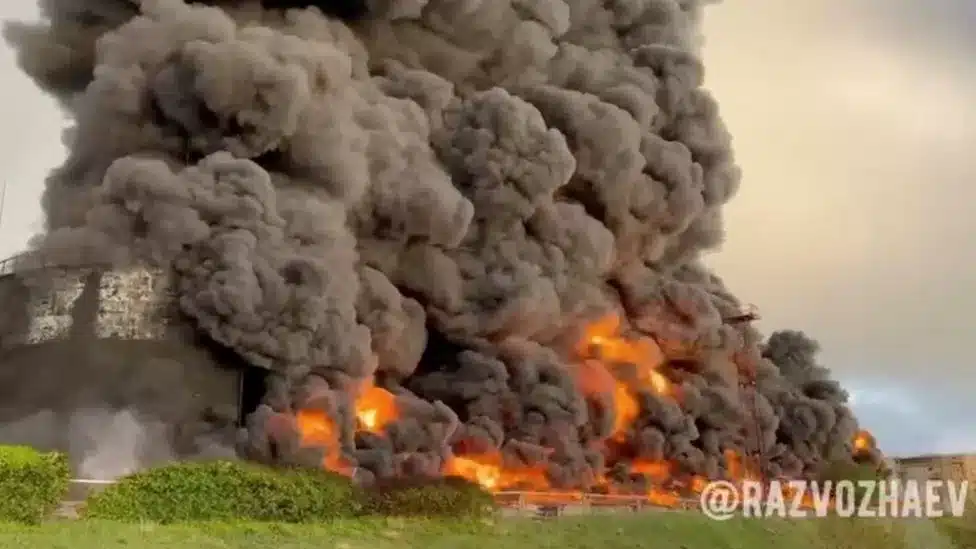
Local authorities have made claims that a drone attack in Crimea under Russian authority started a large fire at an oil store.
Social-media footage showed flames billowing from the site in Sevastopol, Crimea’s main city, early on Saturday.
The fire was later put out and no-one was hurt, the Moscow-appointed regional governor said.
On Friday Russia launched a wave of air strikes in cities across Ukraine, killing at least 25 people. It was the first such attack in months.
The Crimean peninsula, which was annexed by Russia in 2014, is home to the main naval base for Moscow’s Black Sea Fleet.
“According to preliminary information, [the fire] was caused by a drone strike,” Governor Mikhail Razvozhayev said on the messaging app Telegram.
It comes five days after Russian officials said they had fended off a drone attack by the Ukrainian military in the same area. Crimea has come under repeated attacks since the start of the war in Ukraine.
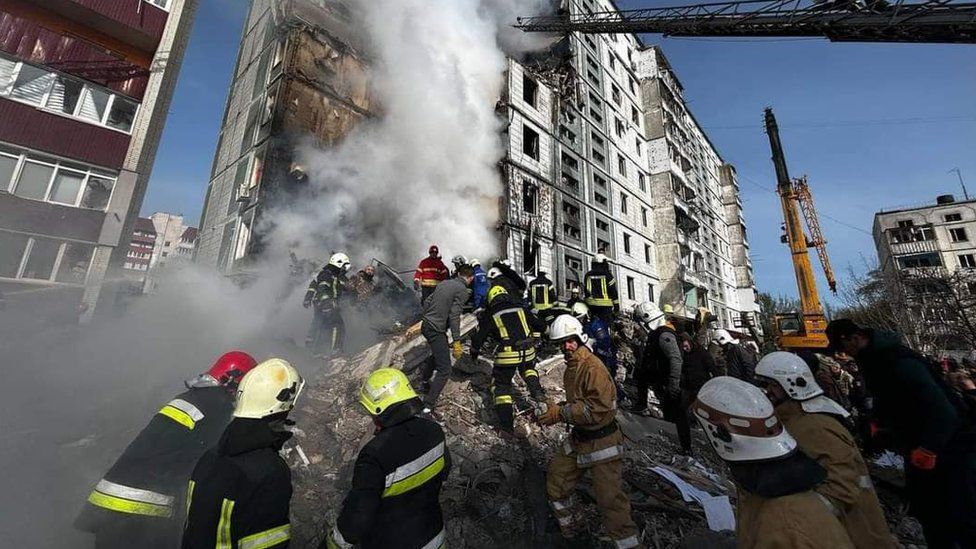
Friday’s Russian barrage included a strike on a block of flats that killed 23 people – including four children – in the central Ukrainian city of Uman.
And a woman and her three-year-old daughter were killed in the city of Dnipro.
Image caption,Rescuers in Uman pulled casualties from the rubble
Kyiv was also targeted for the first time in 51 days. There were no reports of casualties in the capital.
Twenty-one out of 23 missiles and two drones were shot down by Ukraine’s air defence system, officials said.
The Russian defence ministry said its military had targeted Ukrainian army reserve units. Moscow has previously said it does not deliberately target civilians, but thousands have been injured and killed across Ukraine since Russia’s invasion.
Ukrainian President Volodymyr Zelensky said the attacks showed further international action needed to be taken against Russia.
“Evil can be stopped by weapons… And it can be stopped by sanctions – global sanctions must be enhanced,” he said in a tweet on Friday.
The attacks come as Ukrainian forces say they are ready to launch a military offensive with new equipment supplied by Western allies.
Russia has struggled to make headway in a winter offensive, including a 10-month battle for control of the strategically important city of Bakhmut.
Ghana’ innovative decision to use drones to deliver PPEs and samples for testing in the fight against the Coronavirus is fast getting international recognition as Britain has announced it will use drones for COVID-19 medical deliveries from next week.
Government has employed the services of the Zipline Drones to deliver urgent medical essentials, especially samples from remote communities to designated testing centres to help in the fight against the Coronavirus.
Earlier this week, the TIME magazine reported that Ghana is the first country in the world to employ this innovation since COVID-19 broke out, and also revealed America’s intention to urgently consider using the drones.
Britain is now the latest state to announce its readiness to use the drones in its charge on the Coronavirus.
At its daily COVID-19 press briefing, Sky News reported that British Transport Secretary Grant Shaps announced that drones are being trialed to deliver medical supplies to help Britain’s response against the Coronavirus.
The trial, according to the Transport Secretary, will begin next week and it will carry supplies to St Mary’s Hospital on the Isle Of Wight.
Considering the urgency of the situation and Britain’s quest to immediately employ the drones service, the Transport Secretary said he had “fast-tracked” the trials following a £28m awarded by the government earlier this year to Southampton and Portsmouth councils to carry out drone operations as part of a wider trial.
Before the outbreak of the Coronavirus, Ghana had been employing drones to deliver urgent medical supplies to remote communities since the Zipline Service was launched by Vice President Dr. Mahamudu Bawumia last year.
The introduction of the drones was criticised by the opposition NDC who said the service was not needed in the country.
Events, especially during the outbreak of the Coronavirus pandemic, have however proved that the government was even ahead of many developed countries in the world.
Ghana has two main drone stations at Omenako in the Eastern Region and Mampong in the Ashanti Region.
Works are also nearing completion for the third and forth zones at Kukua near Walewale, in the North East Region and Sefwi Wiawso in the Western North Region.
The Ghana Health Service (GHS) has employed the services of the Zipline Medical Drones to deliver COVID-19 samples for testing.
The test flight was successfully conducted yesterday when samples from remote parts of the Ashanti Region were delivered to Kumasi for testing.
The successful delivery of COVID-19 samples by the drone is further proof of the technology’s usefulness and contribution to medical delivery in the country.
The medical drone service, which was launched by Ghana’s Vice President, Dr. Mahamudu Bawumia last year, has been providing swift responses to medical emergencies by dropping much-needed drugs to medical facilities when distress calls are placed to a command centre.
Despite the constant political criticism of the introduction of the drones, its reliable interventions in emergency situations, such as yesterday’s delivery of COVID-19 samples, have helped many deprived communities.
The drones often deliver life-saving medical reliefs to patients in deprived communities where access to drugs in emergency situations would have been difficult.
As the GHS embarks on intensive contact tracing and testing following the confirmation of positive cases in the regions, sources have confirmed that more drones will be used for swift delivery of samples from remote communities for testing.
There are currently two Zipline Medical Drone Zones in Omenako in the Eastern Region and Mampong in the Ashanti Region.
Works are also nearing completion for the forth and fifth zones at Kukua near Walewale, in the North East Region and Sefwi Wiawso in the Western North Region.
The Zipline drone is able to travel to about 500 health facilities within an 80-kilometer range from any of the zones throughout the country to deliver drugs and other medical essentials.
In its COVID-19 role, the drones will mainly be delivering samples from remote areas to designated COVID-19 testing centres.
Pakistan’s army said Thursday it had shot down a small Indian surveillance drone in Kashmir, as tensions rose over continued cross-border shelling in the disputed territory.
According to a statement from the army media wing, the Indian quadcopter — about the same size as a commercially available hobby drone — had crossed 600 metres (650 yards) over the de facto border known as the Line of Control (LoC).
“This blatant act was aggressively responded to by Pakistan Army troops shooting down Indian quadcopter,” the statement read.
An Indian army spokesman said the drone “is not ours”.
The incident came as Pakistan and India accuse each other of violating ceasefire terms at the LoC, with sporadic shelling reported from both sides.
Relations between the nuclear-armed neighbours nosedived in February last year, with India launching an air strike inside Pakistan after accusing its neighbour of harbouring a group that staged a suicide bomb attack that killed 40 Indian paramilitaries in Kashmir.
Pakistan launched its own raid the next day and later shot down an Indian fighter jet and captured its pilot, taking the arch-rivals to the brink of war.
The sky-high animosity between the two countries deescalated after Pakistan returned the downed pilot to India.
Tensions also recently spiked when New Delhi revoked the partial autonomy of Indian Kashmir in August.
Kashmir has been divided between India and Pakistan since independence in 1947, and has been the spark of two wars and numerous flare-ups between the two foes.