Tag: EC

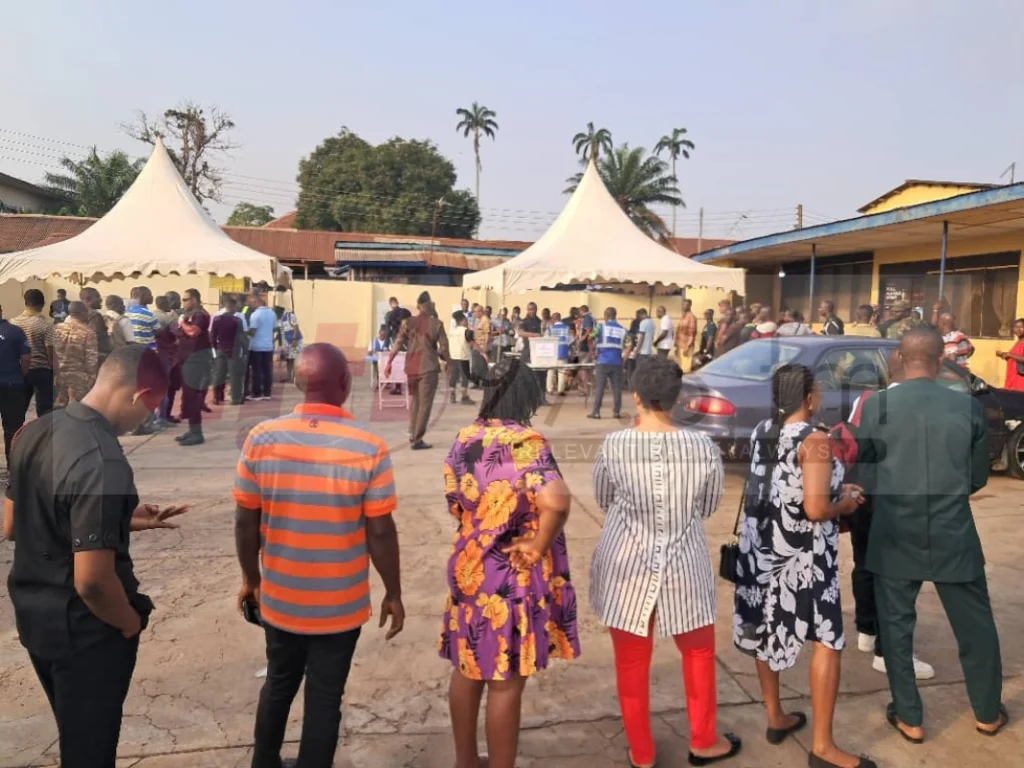
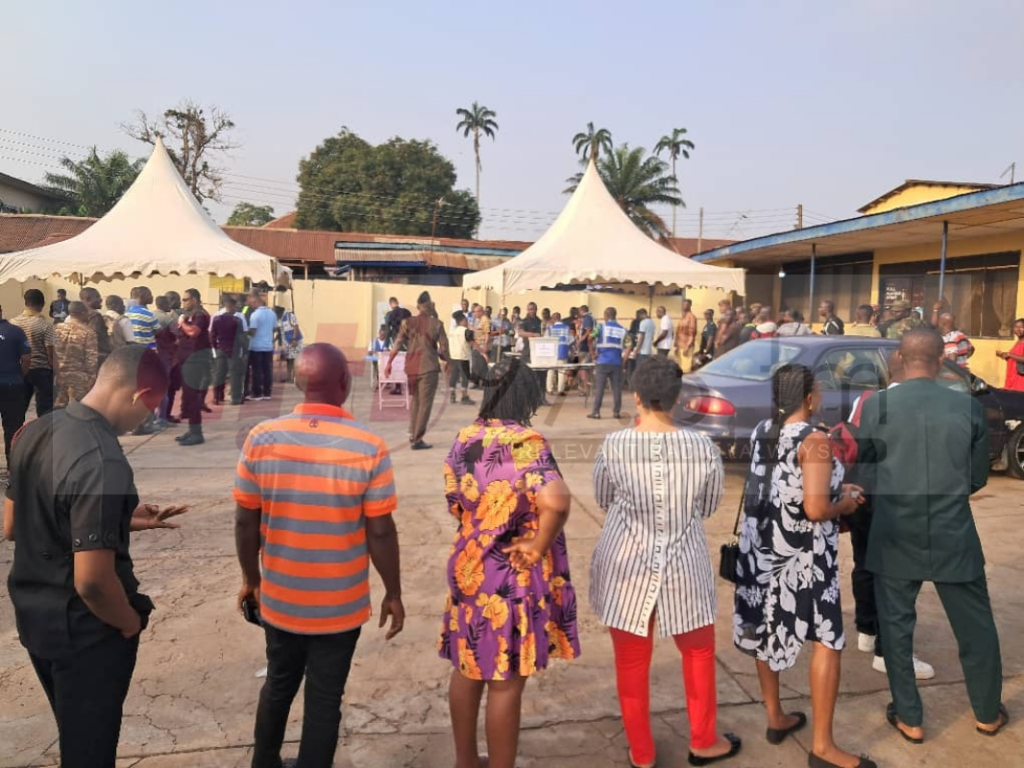
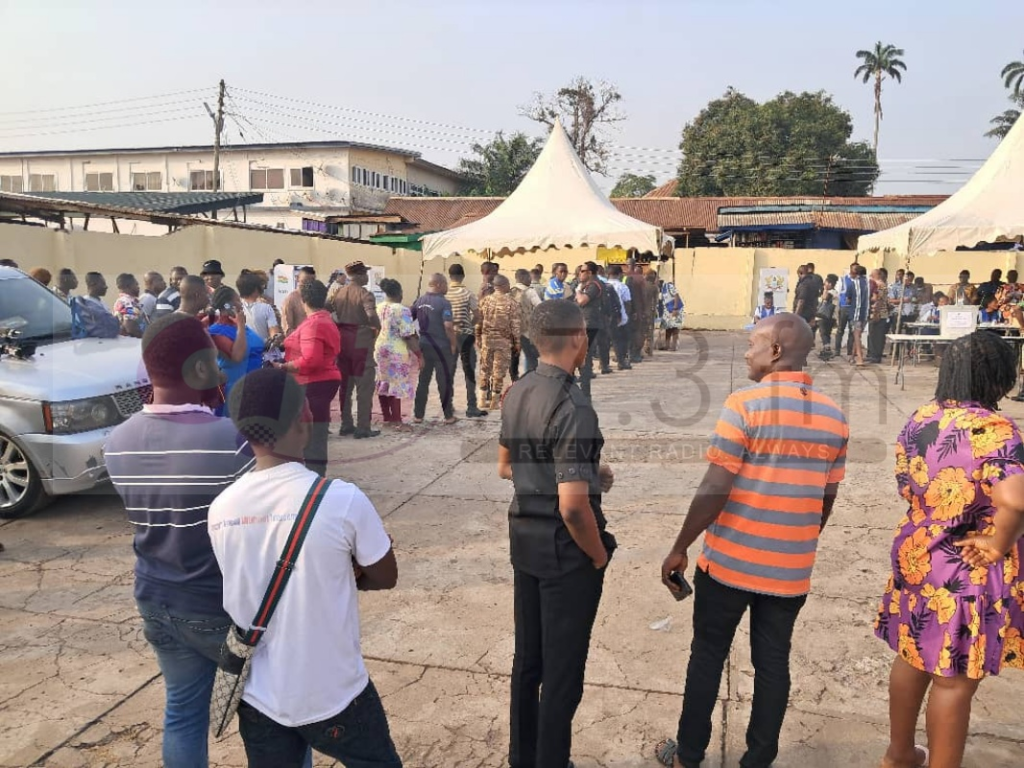
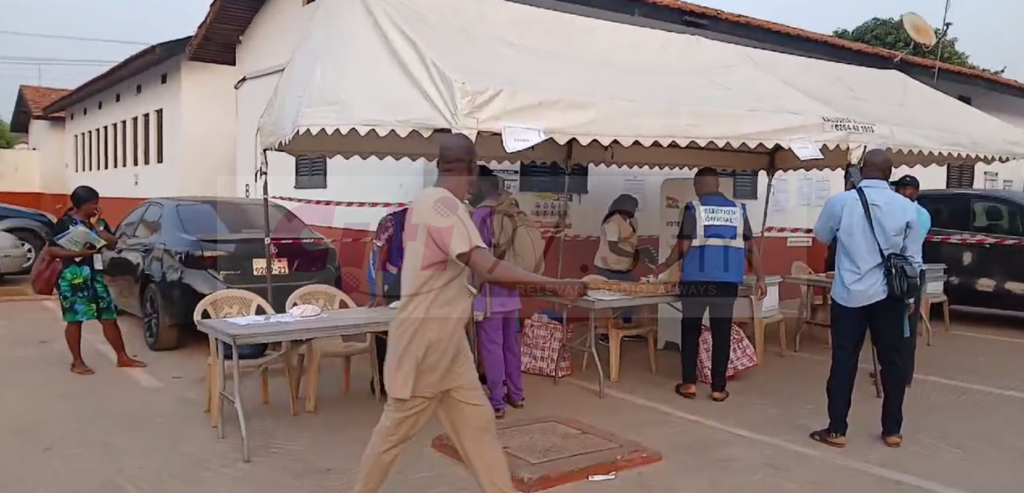
  • Special voting happening now at selected polling stations in 14 regions

    Special voting happening now at selected polling stations in 14 regions

    Special voting is currently underway at selected polling stations across Ghana, marking an important milestone ahead of the December 7 general elections.

    This exercise is for selected people, such as electoral officials, security personnel, and media representatives, to cast their votes ahead of time to ensure they can fulfil their duties during the main election.

    According to the Electoral Commission (EC), about 131,478 individuals—accounting for 0.007% of the total registered electorate of 18,741,159—are expected to take part in this exercise today, December 2.

    However, the Special Voting as originally intended, was expected to take place across all 16 regions nationwide. Following a ballot paper leakage and breach of security seals of the ballot papers for the Eastern and Western Regions, the EC issued a directive for a recall and reprint of the ballot papers.

    To uphold the integrity of the process, special voting in the Eastern and Western Regions has been rescheduled for Thursday, December 5.

    Jean Mensa, the Chairperson of the EC, during an Inter-Party Advisory Committee (IPAC) meeting, provided assurances to the public regarding the credibility and efficiency of the voting process.

    She emphasised the EC’s dedication to addressing all concerns, ensuring transparency, and delivering a free and fair election.

    The Special Voting exercise is scheduled from 7:00 a.m. to 5:00 p.m. at designated polling centres across all 14 regions. Eligible participants must present valid identification to polling officials to cast their votes.

    Unlike the general voting process, ballots cast during the Special Voting exercise will not be counted on the same day. Instead, they will be securely stored and tallied on December 7 at the Constituency Collation Centers.

    The results will then be separately documented on Presidential and Parliamentary Election Results Collation Forms before being integrated into the overall election results.

  • “The Commission has nothing to hide” – EC responds to critics over ballot paper shortages in Volta Region

    “The Commission has nothing to hide” – EC responds to critics over ballot paper shortages in Volta Region

    Electoral Commission (EC) has reassured the public of its commitment to transparency and accountability in the upcoming elections.

    This comes after reports of a shortage of ballot papers in the Bono and Volta Regions ahead of the December 7 polls.

    According to the EC, these challenges were identified by its regional staff during routine checks, a standard procedure to ensure the correct printing and distribution of ballots.

    In a memo sent to political parties and printing companies, the EC highlighted that this extra verification step is important to identify and fix any problems before Election Day.

    The Commission also added that finding these shortages shows the effectiveness of its accountability system, which requires staff at regional and district levels to review all received ballots and ensure they match the quantities provided to printers and political parties.

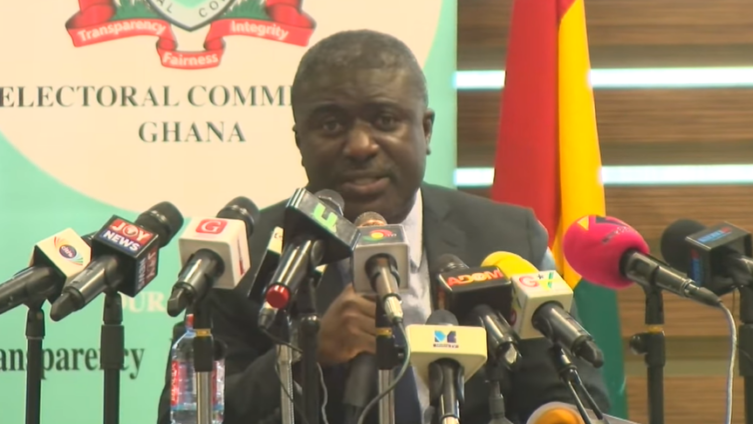
    “It is the Commission’s staff at the regional level that discovered these issues and reported back to the Commission as required. It is the Commission that ordered the reprinting of the shortfalls and informed the political parties. The Commission has nothing to hide,” stated Samuel Tettey, Deputy Chairman of Operations.

    The EC revealed that similar shortages of ballot papers were found and corrected in regions including Greater Accra, Western North, Upper West, Western, and Bono East. Political parties were informed in writing, and reprints were made to address the discrepancies.

    The Commission emphasised that it has always involved political parties in both the reprinting process and the disposal of defective ballots, reinforcing its commitment to transparency.

    The EC also criticised misleading claims on social media that focus only on ballot paper shortages in the Volta Region without mentioning similar issues in other areas.

    The Commission called these claims an attempt to damage its reputation and create distrust among the public.

    “Why would the Commission inform political parties in writing if it had anything to hide? The memo in circulation demonstrates the Commission’s resolve to operate transparently and accountably,” Tettey emphasised.

    The Commission has urged the public to disregard acts of mischief and to seek clarity from official sources to avoid being swayed by misinformation. It assured Ghanaians that all necessary measures are being taken to ensure the credibility and integrity of the electoral process.

  • Ballot paper challenges has exposed the EC’s incompetence – Bawah Mogtari

    Ballot paper challenges has exposed the EC’s incompetence – Bawah Mogtari

    Special Aide to NDC Presidential Candidate John Dramani Mahama, Joyce Bawah Mogtari, has slammed the Electoral Commission (EC) over the reported shortages of ballot papers in parts of the Volta Region.

    The affected areas include Keta, Ketu North, Ho Central, Hohoe, and Ho West.

    On November 28, the EC announced the shortage, which has sparked public concern. During a press briefing on November 29, the Commission clarified that the issue was not limited to the Volta Region and assured the public that measures were being taken to resolve the problem.

    Despite this, Bawah Mogtari accused the EC of inefficiency and questioned its ability to manage the electoral process smoothly. She hinted that the shortages could reflect deeper structural problems within the Commission rather than being mere accidents.

    Speaking at the Legal Green Forum for law students and legal professionals, she emphasised the need for transparency and accountability. She urged the EC to take swift action to fix the problem and maintain public confidence as the December elections approach.

    “This is not the first time we’ve pointed out that the Electoral Commission is not up to the task. They are not acting like an independent body. We’ve always suspected this because so many partisans are parading as commissioners. I’m happy these mistakes have been noticed, as they highlight the EC’s incompetence.”

    “Even at the printing houses, we are being told they are printing more than they need. The beauty of this is that we are now very vigilant. Every step of the way, we’ve worked hard to expose the EC’s biases and incompetence.”

    She emphasised the party’s commitment to protecting the integrity of the elections.

    “This is an election the NDC is supposed to win. Ghanaians are yearning for change, and we will ensure that every ballot is protected. Our polling agents have been accurately trained, and we are poised for victory,” she assured.

  • Media accrediation for constituencies and regional collation centres increases by 1192 – EC

    Media accrediation for constituencies and regional collation centres increases by 1192 – EC

    The Electoral Commission has announced an increase in the number of accreditations for the media to cover the collation of results at the constituency and regional collation centres to 4,500.

    This marks a thousand one hundred and ninety-two (1192) increase following the initial 3,308.

    Speaking at a press conference on Friday, November 29, 2024, the Chairperson of the EC announced that the Commission will issue the 4,500 accreditation cards to the leadership of the Ghana Journalists Association (GJA) and the Ghana Independent Broadcaster Association (GIBA) by Sunday evening, December 1, 2024.

    The EC added that the allocation and distribution of the 4,500 accreditation cards shall be done by the GJA and GIBA. The EC will not play any role in the allocation and distribution of the cards.

    The Commission also noted that it needs the media more at this, rather at this crucial stage of the electoral process, highlighting that they are committed to working with the media ahead of the elections, during, and after the 2024 polls.

    This remarks follow an earlier memo that suggested limited coverage by the media at the various collation centres, a move that was met with harsh criticism, with many labelling it as one of the ploys by the EC to rig the election.

    In light of this, the Commission explained that its earlier communique was to ensure that there would be minimum coverage at all constituency and regional collation centres, rather than seeking to restrict media access to the collation process.

    The earlier memo that suggested three TV stations and five radio stations per constituency collation centre and five TV stations and seven radio stations for each regional collation centre was therefore only to ensure minimum coverage of the collation process.

    The Commission has however agreed with the GJA and GIBA that, in spite of the space limitation at many constituency and regional collation centres.

    This amounts to 1,192 more accreditations to the constituency and regional collation centres.

    Once again, the 4,500 accreditation cards will be delivered to GJA and GIBA by Sunday evening.

  • Ballot paper shortage affecting Volta, Bono and 5 other regions – EC

    Ballot paper shortage affecting Volta, Bono and 5 other regions – EC

    The Electoral Commission (EC) has indicated that other regions aside from Volta and Bono Regions are grappling with the shortage of ballot papers for the 2024 general elections.

    Speaking during an emergency meeting of the Inter-Party Advisory Committee (IPAC) on Friday, Deputy Commissioner Dr. Bossman Asare mentioned Greater Accra, Western North, Upper West, Western, and Bono East as the regions experiencing ballot paper shortages.

    “The shortfalls occurred in Greater Accra, Western North, Upper West, Western, and Bono East Regions. The Volta and Bono regions were no exceptions. As in the case of the Volta Region, the political parties were informed in writing, and the reprint was done to cover the shortfalls in those five regions.

    “Why the noise about the shortfalls of only the Volta region? If the Commission has anything to hide, will it transparently call for a reprint of the ballots to make up for the shortfalls?

    “The Commission urges the general public, especially political parties to disregard mischief by persons whose only objective is to malign the commission and sow a seed of mistrust and doubts. The memo in circulation demonstrates the commission’s resolve to operate in a transparent and accountable manner.

    “We entreat the general public and political parties to read memos carefully by the EC which may find their way on social media so as not to be swayed by persons whose sole agenda is to cause fear and panic and tarnish the image of the Commission ahead of the presidential and parliamentary elections.”

    This clarification comes in response to concerns by the National Democratic Congress (NDC) that has described the shortage of ballot papers in the Volta Region as an avoidable error and has urged the Electoral Commission (EC) to thoroughly investigate the issue.

    Dr. Boamah reiterated the NDC’s demand for a detailed explanation from the EC to uphold the integrity of the electoral process. He stressed that proactive measures are essential to ensuring a seamless and credible election in December.

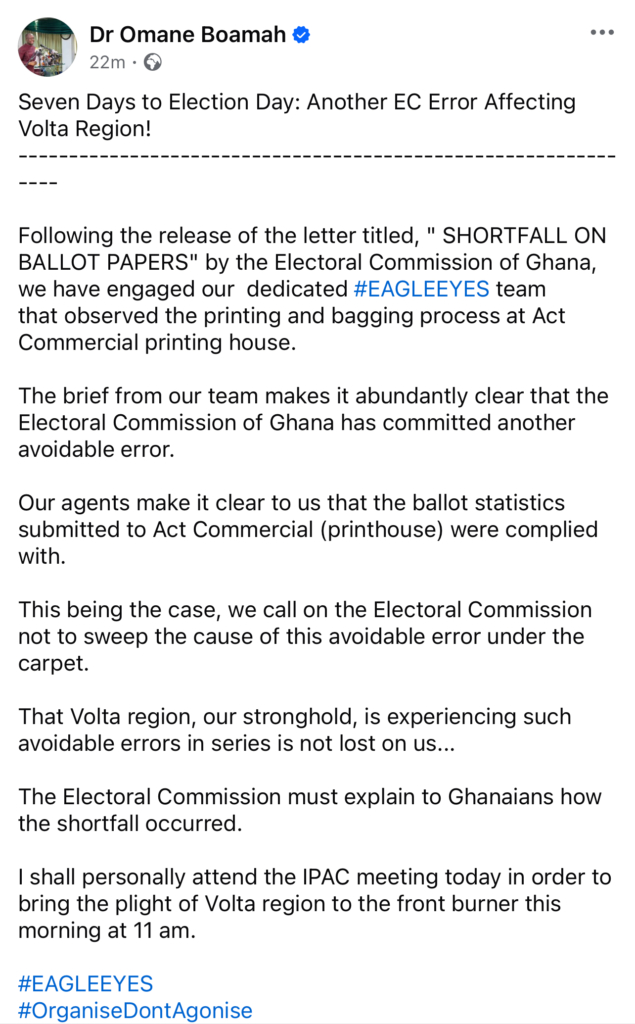
    In a Facebook post on Friday, November 29, Dr. Omane Boamah called for transparency in addressing the issue, stating:

    “The brief from our team makes it abundantly clear that the Electoral Commission of Ghana has committed another avoidable error. Our agents make it clear to us that the ballot statistics submitted to Act Commercial (printhouse) were complied with.

    “This being the case, we call on the Electoral Commission not to sweep the cause of this avoidable error under the carpet. That Volta Region, our stronghold, is experiencing such avoidable errors in series is not lost on us.

    “The Electoral Commission must explain to Ghanaians how the shortfall occurred,” he posted.

  • All our materials are on the field, we are ready – EC on Dec 7 polls

    All our materials are on the field, we are ready – EC on Dec 7 polls

    The Electoral Commission (EC) has announced its readiness for the 2024 general election scheduled for December 7, with all election-related processes, deployments, and training set to conclude today, November 29.

    Speaking to Joy News on the sidelines of a peace ceremony in Accra, where all 12 presidential candidates pledged to uphold peace, EC Chairperson Jean Mensa reaffirmed the Commission’s commitment to transparency and fairness.

    “On the part of the Commission, we commit to carrying out transparent, robust electoral processes and elections, and as indicated during my presentation, we will announce the will of the people that is expressed at the polls. And we entreat all the presidential candidates to accept the outcomes of the result. I think we are ready. All our materials are on the field, our training is taking place. We are ready,” she stated.

    The assurance comes amid reports of a shortage of presidential and parliamentary ballot papers for five constituencies in the Volta Region: Keta, Ketu North, Ho Central, Hohoe, and Ho West.

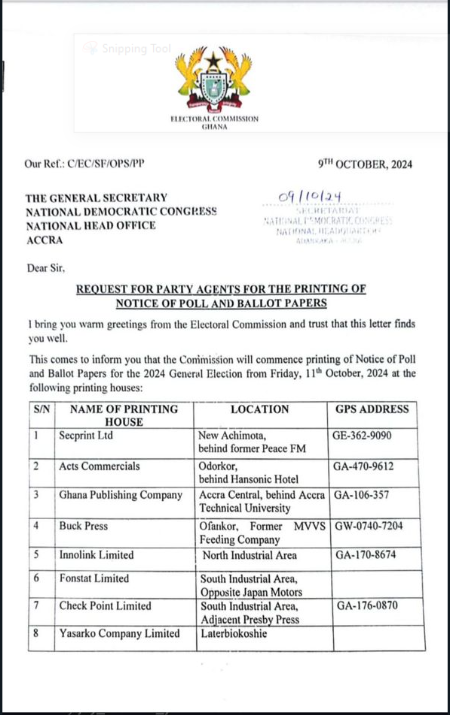
    To address the shortfall, the EC has outlined plans to print additional ballots at Acts Commercials Printing House in Accra. In a letter to the representatives of all presidential candidates, the Commission detailed its resolution strategy and invited political parties and independent candidates to send two representatives each to observe the process.

    The observation, set for Friday morning, aims to ensure transparency and build trust in the electoral process. Samuel Tettey, the EC’s Deputy Chair of Operations, assured the public that the Commission is taking all necessary steps to uphold the credibility of the elections.

    “The Commission is committed to conducting a free, fair, and credible election,” he emphasized.

    This proactive approach, coupled with calls for peace from the EC and presidential candidates, underscores the importance of ensuring a smooth electoral process as Ghanaians prepare to cast their votes.

  • Shortage of ballot papers for Volta Region must be explained – NDC tells EC

    Shortage of ballot papers for Volta Region must be explained – NDC tells EC

    The National Democratic Congress (NDC) has described the shortage of ballot papers in the Volta Region as an avoidable error and has urged the Electoral Commission (EC) to thoroughly investigate the issue.

    Dr. Edward Omane Boamah, the NDC’s Director of Elections and IT, emphasised the need to address the root cause of the shortage to prevent its recurrence as Ghana prepares for the general elections on 7th December.

    The Electoral Commission recently acknowledged that ballot paper shortages had been identified in five constituencies within the Volta Region, raising concerns about its impact on voter confidence and the overall electoral process.

    In a Facebook post on Friday, November 29, Dr. Omane Boamah called for transparency in addressing the issue, stating:

    “The brief from our team makes it abundantly clear that the Electoral Commission of Ghana has committed another avoidable error. Our agents make it clear to us that the ballot statistics submitted to Act Commercial (printhouse) were complied with.

    “This being the case, we call on the Electoral Commission not to sweep the cause of this avoidable error under the carpet. That Volta Region, our stronghold, is experiencing such avoidable errors in series is not lost on us.

    “The Electoral Commission must explain to Ghanaians how the shortfall occurred,” he posted.

    In response, the EC announced that it has begun printing additional ballot papers to address the shortages and assured the public that the new batch will be distributed promptly to the affected constituencies.

    Despite this assurance, Dr. Boamah reiterated the NDC’s demand for a detailed explanation from the EC to uphold the integrity of the electoral process. He stressed that proactive measures are essential to ensuring a seamless and credible election in December.

  • Special voting exercise will be peaceful, credible and transparent – EC

    Special voting exercise will be peaceful, credible and transparent – EC

    The Electoral Commission (EC) of Ghana has expressed its readiness to conduct the special voting exercise slated for Monday, December 2, ahead of the December 7 polls.

    The exercise taking place in 328 special voting centres is exclusive to members of the security agencies, media, and electoral officials who have applied and been processed to cast their ballot.

    In an engagement with the National Security Task Force, led by the Inspector-General of Police (IGP), Dr George Akuffo Dampare, the EC Chairperson, Jean Mensa, said: “We are confident that we will have a successful special voting arrangements on Monday. We have adequate supply of ballot papers, indelible ink and the various forms that may be necessary, and the biometric verification devices are in place for a smooth and seamless special voting exercise.”

    “We stand in readiness. We are ready to conduct a peaceful, credible, transparent and fair elections on December 2 and December 7,” Jean Mensa added.

    The individuals who have registered can verify their participation on the website of the Commission, Jean Mensa stated. However, the special voter list on the EC’s website is inaccessible, per checks by The Independent Ghana.

    Reacting to safety concerns, Dr Dampare, on behalf of the National Election Task Force, indicated that the security officers will work with the Commission to have a successful exercise.

    “We are clear in our minds on all the issues that you need and want us to address so that that aspect will be successful. We will work wit you and your technical team to firm up,” the IGP said.

    A little over 900,00 new voters have been added to the voter register ahead of the polls. The finalised voter register has been disseminated to the various political parties, according to the Commission.

    Ballot papers for most regions and all registers have already been dispatched to the 16 regions, except for the Northern, Bono, and Bono East Regions. The ballot papers for the afformentioned regions are in the custody of the security services via the police armories.

    The EC will use aid memoirs—that will be pasted at vantage points—polling stations, polling centres, during the election to assist electorates on correction of forms and other grey areas.

    On security issues, Dr Dampare assured Ghanaians of a peaceful election process. He stressed that “we’ll do all it takes to ensure that this country continues to be at peace with itself. We will protect every Ghanaian, and we will protect every stakeholder in this election.”

  • Richard Dela Sky threatens to sue EC over limited media access to collation centres

    Richard Dela Sky threatens to sue EC over limited media access to collation centres

    Ghanaian journalist, Richard Dela Sky, has threatened to drag the Electoral Commission (EC) over its recent directive to limit media access to the constituency and regional collation centres during the 2024 general elections.

    Speaking on the Citibreakfast show today, he described the EC’s stance as rReckless, irresponsible,” threatening that “if they don’t withdraw this decision, I will sue…”

    The Electoral Commission (EC) has responded to growing concerns from media organizations about its recent directive.

    The directive, which imposes restrictions on the number of media outlets allowed at the collation centres, has garnered significant feedback from various media stakeholders.

    A memo from the EC instructed its staff at both district and regional levels to allocate a specific number of media accreditations for each centre.

    Under the new guidelines, only eight media outlets will be allowed at each constituency collation centre, while 12 will be permitted at regional centres. While the EC aims to maintain order, the limitations have sparked concerns about transparency and inclusiveness in the process.

    In response, the EC announced on November 27 that it is in discussions with the leadership of the Ghana Journalists Association and the Ghana Independent Broadcasters Association (GIBA) to address the concerns raised.

    https://twitter.com/Citi973/status/1861694358078071089

    The Commission assured stakeholders that it remains committed to finding a solution that balances transparency with an organized collation process.

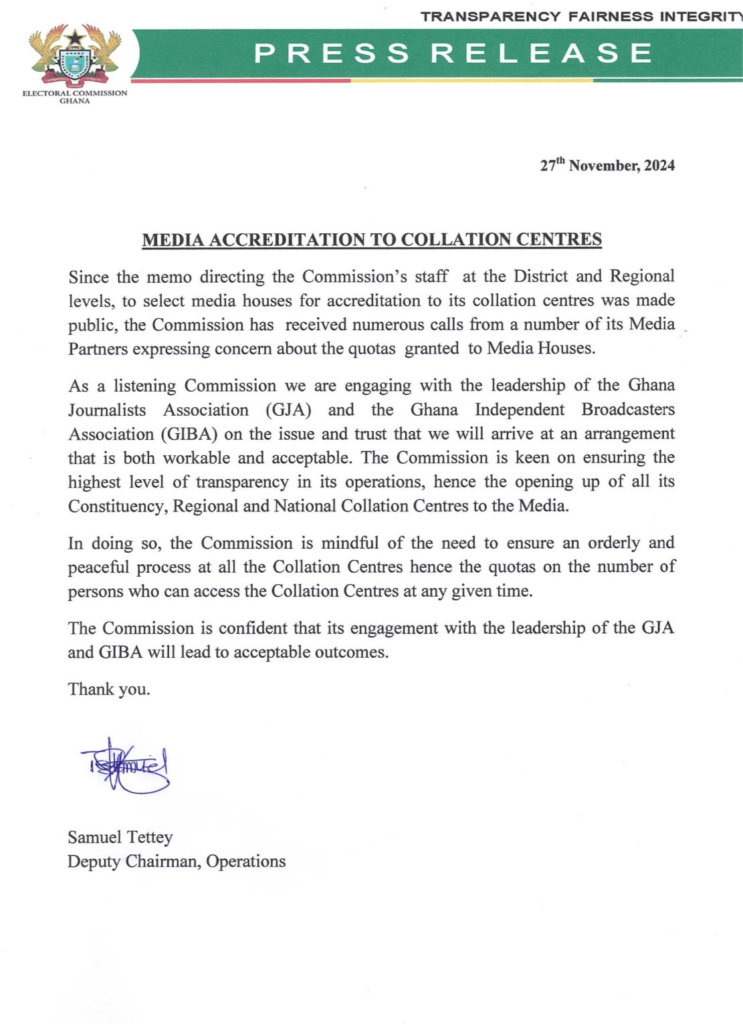
    “As a listening Commission, we are engaging with the leadership of the Ghana Journalists Association (GJA) and the Ghana Independent Broadcasters Association (GIBA) on the issue and trust that we will arrive at an arrangement that is both workable and acceptable.”

    The Electoral Commission (EC) reaffirmed its commitment to ensuring full transparency during the collation of election results, announcing that media access will be granted to all constituency, regional, and national collation centres.

    However, the EC also stressed the need to regulate the number of individuals allowed at these centres in order to maintain order and ensure a smooth and peaceful process.

    “The Commission is keen on ensuring the highest level of transparency in its operations, hence the opening up of all its Constituency, Regional and National Collation Centres to the Media.

    “In doing so, the Commission is mindful of the need to ensure an orderly and peaceful process at all the Collation Centres hence the quotas on the number of persons who can access the Collation Centres at any given time.”

    The Commission is optimistic that its discussions with the leadership of GJA and GIBA will lead to a satisfactory resolution.

    It believes these talks will allow media partners to perform their duties effectively, while ensuring the collation process remains transparent and efficient.

    Richard Dela Sky presently has a case at the Supreme Court where he is contesting the constitutionality of the anti-LGBTQ bill passed by Parliament in February this year. The court is expected to deliver its ruling next month.

  • Ballot papers to Northern, 2 other regions and BVDs disseminated to police armories – EC

    Ballot papers to Northern, 2 other regions and BVDs disseminated to police armories – EC

    The Electoral Commission (EC) of Ghana has announced the dissemination of ballot papers for the Northern, Bono, and Bono East Regions to police armories, with the remaining ballot papers scheduled for delivery by the end of the day.

    Jean Mensa, Chairperson of the EC, disclosed during a meeting with the National Elections Security Task Force, chaired by the Inspector-General of Police, Dr. George Akuffo Dampare, on Tuesday that biometric verification devices (BVDs) are also being secured across the country.

    “As we speak, the BVDs have been sent to over 8 regional armories and are in safe keeping there,” Jean Mensa stated on November 26, 2024, adding that all devices will be under police protection by the weekend.

    She further noted that ballot papers for most regions and all registers have already been dispatched to the 16 regions, except for the Northern, Bono, and Bono East Regions, which are set to receive their ballot papers this afternoon.

    The EC has also recruited 210,000 temporary officials, including returning officers, deputy returning officers, presiding officers, and polling assistants, for the December 7 elections. These officials are being trained extensively, with the introduction of aide memoires to guide them in their roles.

    “They are undergoing extensive training for all categories of staff. This year, we have developed what we call the aide memoires, which are basic instructions on the key aspects of our work, based on feedback from our officers on the ground and various election observation missions,” Mensa explained.

    Both the EC and security officials have assured the public of a credible, transparent, and peaceful electoral process as preparations intensify ahead of the polls.

    “We will do all it takes to ensure this country continues to be at peace with herself,” Dr. George Akuffo Dampare added.

  • There should be no room for partisan election officers – NDC to EC

    There should be no room for partisan election officers – NDC to EC

    The Director of Elections for the National Democratic Congress (NDC), Dr. Edward Omane Boamah, has urged the Electoral Commission (EC) to avoid appointing partisan election officers ahead of the 2024 general elections.

    In a Facebook post on Tuesday, November 26, Dr. Omane Boamah emphasized the need for transparency and fairness in the election process, cautioning against any actions that could compromise the integrity of the polls.

    “The NDC will be closely monitoring the selection of election officers and will compare the list of delegates from the New Patriotic Party (NPP) to those appointed to oversee the December 7 polls,” he stated.

    Dr. Omane Boamah called on the EC to uphold neutrality in its operations to foster trust and credibility as the nation approaches the critical elections. Ghana goes to the polls in less than 2 weeks.

  • 2024 elections remain Dec 7 – EC refutes Wontumi TV presenter’s claims

    2024 elections remain Dec 7 – EC refutes Wontumi TV presenter’s claims

    The Electoral Commission (EC) has refuted allegations regarding separate voting dates for presidential candidates in the 2024 general elections.

    These claims, stemming from recent media reports by a Wontumi TV presenter, Oheneba Nana Asiedu, were categorically dismissed by the Commission, which urged the public to disregard such misinformation.

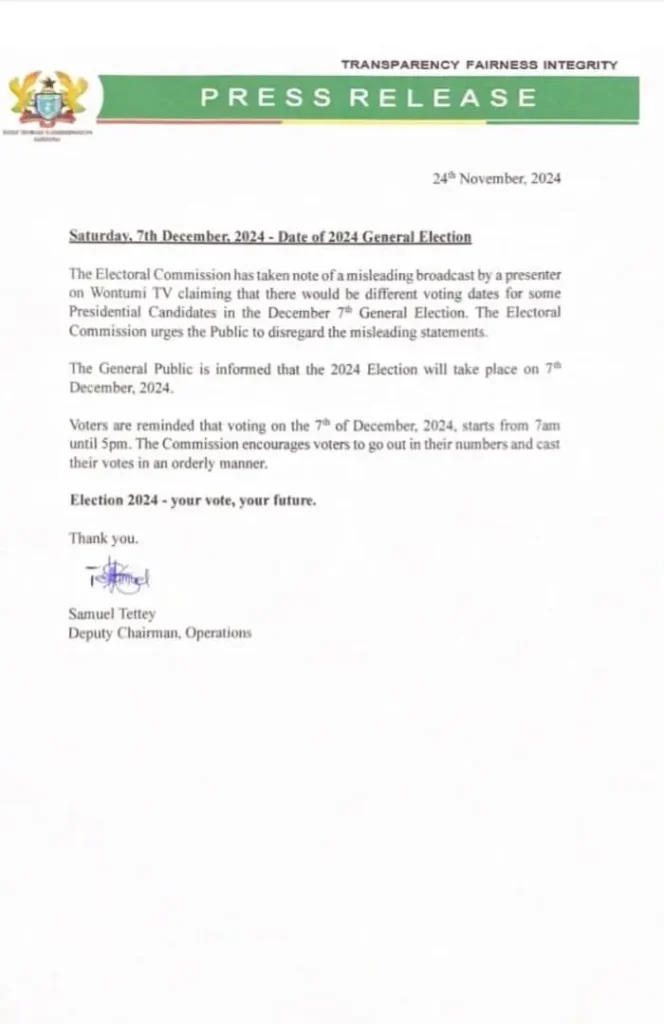
    In an official statement released on November 24, the EC reaffirmed that the nationwide voting for the 2024 elections will occur on Saturday, December 7, 2024, between 7:00 AM and 5:00 PM.

    “The general public is informed that the 2024 election will take place on 7th December, 2024.”

    The Commission also encouraged all eligible voters to actively participate in the elections and called for calm and orderly conduct at the polling stations.

    Oheneba Nana Asiedu, a Kumasi-based radio and television presenter, who was arrested by the Ghana Police Service on Saturday for offences including publication of false news contrary to section 208 of the Criminal Offences Act, 1960 (Act 29) has been granted bail.

    The Service earlier invited him for questioning following the circulation of a video on social media in which the presenter is seen at the studios of Wontumi FM in Kumasi making false claims about the voting schedule for the December 2024 general elections.

    In the video, Oheneba Asiedu is heard urging the public to vote for presidential candidates on separate dates during the elections—a statement described by the Police as untrue and likely to disturb public peace.

    Oheneba Asiedu was asked to report to the Ashanti Regional Police Command in Kumasi to assist with investigations into the matter. He was arrested at the Command and is currently in Police custody.

    The Police have assured that the case will be presented before the court for him to face justice.

    Meanwhile, the Police have cautioned media practitioners and the public at large to exercise responsibility and accuracy in their communication, particularly during this election period.

    “We urge the public, particularly media practitioners, to exercise utmost caution and responsibility, and refrain from publishing false news which is likely to disturb public peace before, during, and after the upcoming general elections,” a Police statement emphasized.

  • Declaring votes for Akua Donkor as rejected unconstitutional – Prof Stephen Kwaku Asare

    Declaring votes for Akua Donkor as rejected unconstitutional – Prof Stephen Kwaku Asare

    The Electoral Commission’s decision to count votes cast for the late Akua Donkor, founder and former flagbearer of the Ghana Freedom Party, as rejected ballots has been described as unconstitutional by Prof. Stephen Kwaku Asare, a Fellow in Public Law and Justice at CDD-Ghana.

    In a statement, the Commission noted that “votes cast in favour of Madam Akua Donkor will not be added to the Valid Votes Cast.” This directive, according to the Electoral Commission, has been communicated to its permanent and temporary staff as well as agents of the presidential candidates.

    The decision follows Akua Donkor’s passing after the Commission had almost completed printing ballot papers for the 2024 presidential election. To save costs, the EC decided not to print new ballot papers, retaining the late candidate’s image and party logo on the ballot.

    The move has sparked criticism from some stakeholders, with Prof. Asare arguing that the current constitutional instrument (C.I) governing elections does not provide for rejecting votes cast for a deceased candidate.

    “Declaring such votes as rejected would go beyond the regulation’s scope, necessitating either a statutory amendment to include this scenario or a judicial interpretation to expand the regulation’s application,” he said.

    Prof. Asare emphasized the broader implications of such a decision, stating that if the votes were counted as valid, it would increase the total number of valid votes cast, subsequently raising the threshold required for a candidate to secure a majority.

    “This could disadvantage other candidates, as the votes for the deceased candidate become ‘wasted,’ contributing to no living candidate’s tally,” he explained.

    Despite the EC’s justification of cost-saving, its decision has also faced resistance from political parties, with some describing it as unconstitutional.

  • Electoral Commission burns surplus ballot papers over errors

    Electoral Commission burns surplus ballot papers over errors

    Electoral Commission (EC) of Ghana has begun the destruction of ballot papers with serial number errors for the Ahafo and Volta Regions. These ballots, which contain mistakes in the serial numbering for both presidential and parliamentary elections, are being incinerated.

    A footage shared on November 21, 2024, shows EC officials, party representatives, and security personnel from the National Intelligence Bureau, National Security, and the Ghana Police Service overseeing the destruction.

    The operation is taking place at the Adepa Waste Management Center in Nsawam Adoagyiri.

    This follows a previous destruction of faulty ballots on Sunday, November 16, 2024, due to similar serialisation issues. An EC representative clarified that while the destruction process on Thursday is focused on burning erroneous ballots, waste papers, and the destruction of plates, this exercise is distinct from the earlier action taken at the South Industrial area.

    “We burnt the waste papers, overs, and the destroyed plates at the premises of the company in the industrial area. That is totally different from this, and that is a routine thing that we do when we finish the printing process.

    “The plate used for the ballot printing has to be destroyed as the final item under destruction. This particular one has a peculiar case because the EC rejected these ballots that were printed by the printing house based on the defects indicated in the press release,” he said.

    The Electoral Commission of Ghana has confirmed that it is taking action to address issues found in the printing of presidential and parliamentary ballot papers for the Volta and Ahafo Regions.

    In a statement made during an urgent Inter-Party Advisory Committee (IPAC) meeting on Friday, November 15, 2024, Samuel Tettey, the Deputy Commissioner for Operations, outlined that the Commission has initiated corrective steps, including the reprinting of the affected ballot papers.

    “The Commission has seriously taken action to cure the defect and has deployed teams to the printing house to correct the anomaly. Gaps still exist, and the commission has taken the decision to recall the ballot papers for the Ahafo and Volta Regions.

    The commission has decided that the ballots for the two regions will now be printed by Bulk and Acts Commercials, respectively,” he stated.

  • EC burns ballot papers for Ahafo and Volta Regions due to errors in serialization

    EC burns ballot papers for Ahafo and Volta Regions due to errors in serialization

    The Electoral Commission (EC) has destroyed defective ballot papers initially intended for the Ahafo and Volta Regions following the discovery of serialization errors.

    The destruction exercise was carried out on Thursday, November 21st November, at Nsawam Adagyiri under strict supervision by representatives of political parties, the National Intelligence Bureau, National Security, the Ghana Police Service, and the Electoral Commission.

    The transfer of the flawed ballots was halted immediately after the defects were identified. On Sunday, November 17, the Commission began accounting for all the ballot papers printed for both regions, which were affected by serial number discrepancies.

    Although the EC has dismissed claims that political parties were responsible for detecting the error, stating that the issue was flagged by its internal quality control mechanisms, the National Democratic Congress (NDC) maintains that their representatives identified the problem, prompting the corrective measures.

    As part of the process, on Saturday, November 16, a quantity of electoral materials for the Ahafo and Volta Regions was burned. The destroyed materials included excess or scrap ballot papers and plates used for printing the Presidential and Parliamentary ballots for the two regions.

    To ensure the integrity of the electoral process, the EC has engaged Buck Press and Acts Commercials to reprint new, error-free ballots. The Commission has reiterated its dedication to preserving the credibility of Ghana’s elections, emphasizing that this commitment outweighs any concerns about cost.

    Dr. Bossman Asare, Deputy Chairman of the EC in charge of Corporate Services, clarified the Commission’s stance during an interview with the media.

    “The Commission didn’t think so much in terms of the cost as to the quality of the country’s elections,” he stated.

  • EC plans to declare presidential election results 72 hours after voting

    EC plans to declare presidential election results 72 hours after voting

    The Electoral Commission (EC) has assured Ghanaians that the 2024 presidential election results will be declared within 72 hours after polls close on December 7.

    Dr. Bossman Asare, Deputy Chairman of the EC in charge of Corporate Services, emphasized the importance of accuracy, transparency, and adherence to timelines while speaking on Joy News’ PM Express.

    “By convention, we work within 72 hours, and I believe we are going to work within the 72 hours to ensure that Ghanaians know the outcome of the presidential election,” Dr. Asare stated.

    He explained that while the EC is committed to working efficiently, the multi-step process required to collate results demands meticulous checks at every stage to maintain credibility.

    “For the parliamentary [election], some constituencies may conclude their processes as early as 12 midnight, 1 am, or 2 am. After that, those presidential results will be sent to the regional capitals,” he noted.

    From the regional capitals, officials will review the results and forward them to the EC headquarters in Accra, where the Chairperson will officially declare the outcome.

    Dr. Asare reiterated the EC’s commitment to transparency throughout the process.

    “We shouldn’t forget that parties are going to be represented at all these levels to ensure transparency and credibility of the process,” he stated.

    Reflecting on the 2020 elections, he acknowledged that while the EC initially targeted declaring results within 24 hours, the announcement was made in 48 hours. The decision to adopt a 72-hour timeline this year is intended to balance efficiency with thoroughness.

    “The target we set in 2020 was to do it in 24 hours, but we ended up doing it in almost 48 hours. This time, we are giving ourselves more time.

    “If we can get everything in less than 24 hours, why not? If we can get it in about 36 hours, we’ll go ahead and do it. But as much as possible, within 72 hours, we are going to do the needful,” Dr. Asare explained.

    He reassured Ghanaians that the Commission is fully prepared to deliver timely and credible results.

    “We will take our time and ensure that every step of the process is carefully managed so that, by the end of three days, the outcome is clear and satisfactory to all stakeholders,” he said.

    Acknowledging logistical challenges in transmitting results from remote constituencies to regional capitals, Dr. Asare affirmed that the EC has systems in place to manage the process efficiently.

    “We will do our very best to follow convention and ensure Ghanaians receive the results they deserve,” he added.

  • We’re prioritising credibility over cost savings – EC on 2024 elections

    We’re prioritising credibility over cost savings – EC on 2024 elections

    The Electoral Commission (EC) of Ghana has emphasized that preserving the integrity and credibility of the nation’s electoral process is more important than cost savings.

    Dr. Bossman Asare, Deputy Chairman of the EC in charge of Corporate Services, explained on Joy News’ PM Express on November 19 that the decision to reprint ballot papers for the Volta and Ahafo regions due to serial number discrepancies reflects the Commission’s commitment to credible elections.

    “The Commission didn’t think so much in terms of the cost as to the quality of the country’s elections,” he stated.

    According to Dr. Asare, the serial number discrepancies had the potential to compromise the electoral process, which could have far-reaching consequences.

    “If you don’t get the serial numbers right, and someone votes for a candidate, there’s a risk that the ballot could be deemed rejected,” he explained.

    Acknowledging the financial implications of the reprinting exercise, Dr. Asare reiterated that the priority was to ensure that the elections remain credible and transparent.

    “We believe that the taxpayer will be more concerned about us having a system that is very peaceful, very credible, and very transparent,” he added.

    To ensure accountability, the EC plans to collaborate with political parties, the Ghana Police Service, the National Intelligence Bureau, and the printing house involved to oversee the destruction of the erroneous ballot papers.

    “When we finish burning them, we have what we call the destruction certificate, which all the parties are going to sign to confirm their presence during the destruction,” Dr. Asare explained.

    The EC also decided to engage additional printing houses to handle the reprinting of the affected ballots, a move Dr. Asare described as vital for maintaining election integrity.

    “We have a strong reputation to protect,” he stated. “For us, ensuring the integrity of the process so that all the political parties are happy is more important than the cost argument.”

    Dr. Asare further emphasized the EC’s commitment to inclusivity, noting the involvement of political parties in addressing the issue.

    “It will interest you to know that when we met with the parties and informed them of the issues, they tried to salvage it. But we still noticed some gaps, so we made the decision to ensure ballot integrity,” he said.

    While the Commission will engage the printing house to discuss the cost implications, Dr. Asare stressed that ensuring the credibility of the elections was a non-negotiable priority.

    “Inaction on this issue would have been more devastating. Just imagine people saying there are problems with the ballot papers after voting—it would certainly not bode well for the Commission,” he noted.

    Concluding, Dr. Asare highlighted the EC’s unwavering dedication to delivering credible elections.

    “We believe that a credible system, where all players and stakeholders are satisfied, is what matters most,” he said.

  • EC reprinting ballot pappers for Ahafo, Volta regions

    EC reprinting ballot pappers for Ahafo, Volta regions

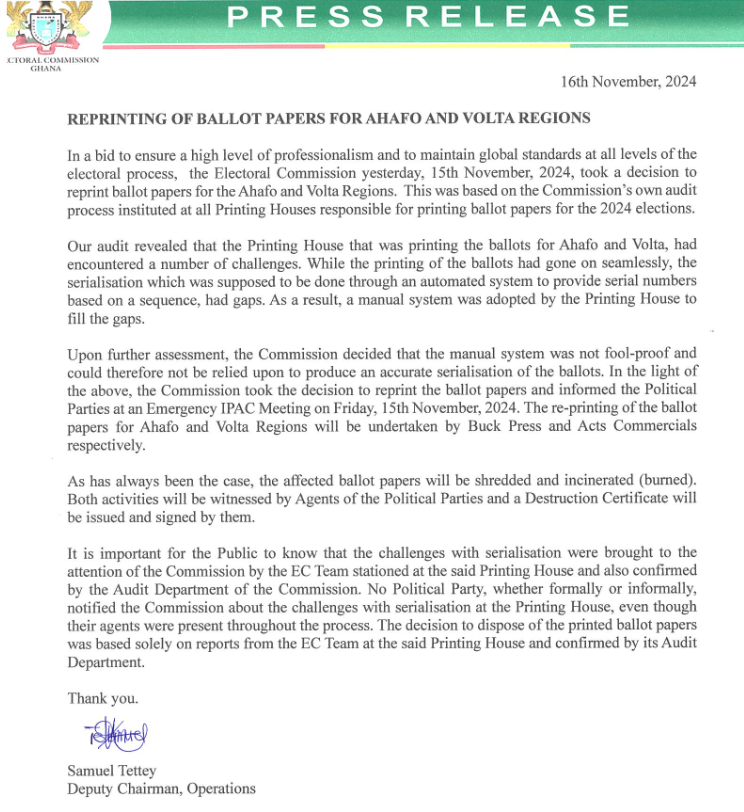
    The Electoral Commission (EC) has announced the reprinting of ballot papers for the Ahafo and Volta Regions following challenges with the serialisation process during the ongoing preparations for the 2024 general elections.

    In a statement issued on November 15, 2024, the EC disclosed that its internal audit of the printing process identified discrepancies in the automated system responsible for generating sequential serial numbers on the ballot papers. To address the issue, the Printing House responsible had resorted to a manual system to fill the gaps, but the EC determined this approach was not sufficiently reliable.

    “Upon further assessment, the Commission decided that the manual system was not fool-proof and could therefore not be relied upon to produce an accurate serialisation of the ballots,” the statement read.

    The EC informed political parties of its decision at an emergency Inter-Party Advisory Committee (IPAC) meeting held on November 15. The reprinting will be carried out by Buck Press and Acts Commercials for the Ahafo and Volta Regions, respectively.

    As part of the process, the ballot papers initially printed will be shredded and incinerated, with party representatives present to witness the destruction and sign a Destruction Certificate to ensure transparency.

    The Commission clarified that the irregularities were flagged by its own monitoring team stationed at the Printing House and later corroborated by its Audit Department. It emphasized that no political party raised concerns about the issue, although their agents were present during the printing process.

    The EC reiterated its commitment to maintaining global standards and professionalism in all aspects of the electoral process, assuring the public of its dedication to delivering credible elections.

  • Recalled ballot papers for Ahafo and Volta Regions burnt by EC

    Recalled ballot papers for Ahafo and Volta Regions burnt by EC

    The Electoral Commission (EC) of Ghana has confirmed the destruction of defective and excess electoral materials for the Ahafo and Volta Regions ahead of the 2024 general elections.

    In a press release on November 15, the EC disclosed that ballot papers for these regions were recalled due to serialisation errors. The defective materials were subsequently destroyed on Saturday, November 16, through burning, in the presence of key stakeholders.

    “The destruction done through burning was witnessed by the Agents of the Political Parties, the National Intelligence Bureau, National Security, Ghana Police Service, and the Electoral Commission,” stated Samuel Tettey, Deputy Chairman of Operations at the EC, in a signed statement.

    The move comes as Ghanaians prepare to head to the polls in 19 days to elect their leaders for the next four years.

  • Ballot papers for Ahafo, Volta regions to be reprinted over incorrect serial numbers – EC

    Ballot papers for Ahafo, Volta regions to be reprinted over incorrect serial numbers – EC

    The Electoral Commission (EC) has announced plans to reprint all ballot papers designated for the Volta and Ahafo regions due to errors in their serial numbers.

    Samuel Tettey, the Deputy Chairman in charge of Operations, disclosed this during an emergency Inter-Party Advisory Committee (IPAC) meeting held on Friday, November 15.

    Tettey noted that while the overall ballot printing process has been smooth, recent concerns emerged about discrepancies in the serial numbers for ballots intended for the two regions, prompting the decision to reprint.

    “The challenge faced by the Commission has been with the serialisation of the numbers on the ballot papers,” he said.

    He explained that the Commission has taken serious steps to address the issue and has deployed teams to the printing house to rectify the anomalies.

    He noted that gaps still remain, prompting the Commission to decide to reprint the papers for the Ahafo and Volta regions.

    Mr Tettey further stated that the Commission has resolved to have both the presidential and parliamentary ballot papers for the two regions printed by Buck Press and Acts Commercials.

    “We wish to inform you that we will share the printing timetable with you by the close of today,” he said.

    He further stated that arrangements for properly disposing of the faulty ballot papers will be communicated to all stakeholders and political parties. To ensure transparency, a certificate of destruction will be issued, signed by all parties involved in the process, and copies will be distributed to each party

  • Ghana is one of the best in the continent – EC reacts to claims of public loosing confidence in commission

    Ghana is one of the best in the continent – EC reacts to claims of public loosing confidence in commission

    Electoral Commission (EC) has firmly dismissed claims that public confidence in its operations is declining as the December 7 general elections approach.

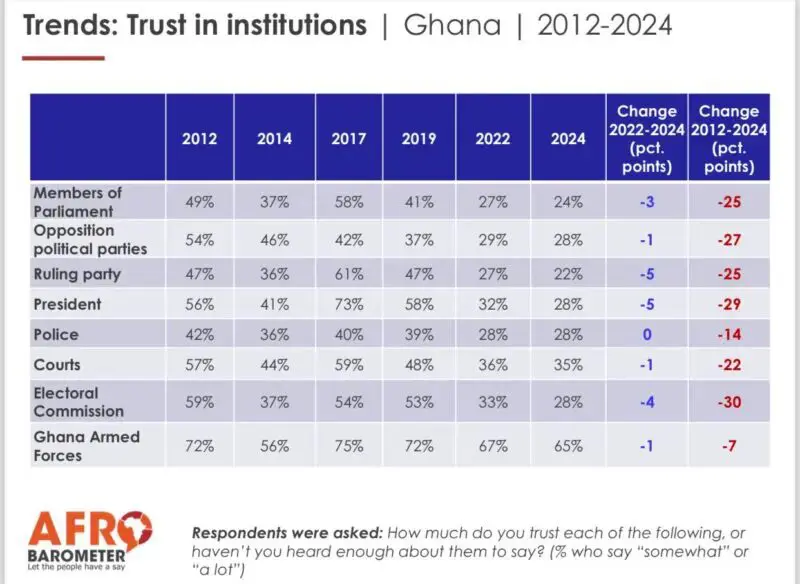
    In response to concerns raised by an Afrobarometer report from the Ghana Center for Democratic Development (CDD-Ghana), which highlighted growing skepticism among Ghanaians regarding the EC’s impartiality, the Commission reassured the public that it is fully equipped to conduct free, fair, and transparent elections.

    The CDD-Ghana report revealed that a significant portion of the population questions the EC’s independence and neutrality.

    However, Dr. Eric Bossman Asare, the EC’s Deputy Chairperson, addressed these concerns in a media interview, calling them baseless and reaffirming the Commission’s commitment to upholding electoral integrity.

    He emphasized that the EC has implemented a range of measures to improve the credibility of the election process, including the use of advanced biometric systems, comprehensive training for polling staff, and enhanced monitoring protocols at all voting locations.

    “You talk about the quality of elections in Africa, Ghana is one of the best in the continent. Ghana is one of the best in the business.

    “So regarding this forensic audit issue you just mentioned, you remember as soon as we had a meeting publicly, which was televised nationally, all Ghanaians saw that the EC had nothing to hide.”

    He encouraged the public to focus on the EC’s track record of organizing previous successful elections and assured that their votes will be accurately counted and transparently reported.

  • Elections integrity is important; EC must forget about money and reprint the ballots – Kofi Akpaloo

    Elections integrity is important; EC must forget about money and reprint the ballots – Kofi Akpaloo

    The presidential candidate of the Liberal Party of Ghana (LPG), Kofi Akpaloo, has urged the Electoral Commission (EC) to reprint the 2024 presidential ballot papers, raising concerns over the inclusion of the late Akua Donkor, former candidate of the Ghana Freedom Party (GFP).

    Mr. Akpaloo argues that the presence of Akua Donkor’s image on the ballot could mislead voters and influence the election results.

    Speaking at a press conference in Accra on Wednesday, November 13, he emphasized that featuring the deceased candidate could create confusion and possibly lead to disputes regarding the election outcome.

    “Having a ballot paper with Akua Donkor’s picture is going to create a whole lot of problems in the country. People are going to vote for Akua Donkor, of whom we are all aware that she is not alive,” Mr. Akpaloo stated. “Are we going to say that those votes cast for her will be ignored, or are they going to be counted? We don’t want a situation where a losing candidate might challenge the results because of percentages.”

    The LPG flagbearer also questioned the EC’s decision not to reprint ballots, noting that if a new GFP flagbearer had been approved, the EC would have reprinted the ballots to reflect the change. He suggested that allowing Akua Donkor’s image to remain on the ballot could set a problematic precedent for future elections.

    “Leaving her image on the ballot raises questions about the electoral process’s integrity and would certainly affect voter perceptions,” he argued. He further pointed out that the EC should not be deterred by financial concerns if the reprint is necessary to uphold electoral integrity.

    The EC has yet to respond to Mr. Akpaloo’s call, which adds to the discourse around the upcoming December election.

    “They should forget about the money involved, let’s do the right thing that would create a peaceful environment in this country,” he said.

    He further argued that there would be no need for re-balloting.

    “No, we don’t need the re-ballloting. It’s like when you take the Parliamentary arrangement. If a party is not presenting a candidate in a particular constituency, that place is removed and it is pushed up, so the same thing applies here. So far as they (GFP) are not contesting this election, all that we have to do is take their portion out and push the position up”.

    He said although he was not personally present at yesterday’s Inter-Party Advisory Committee (IPAC) meeting, his General Secretary raised these concerns but they were not heeded to by the EC.

    Mr. Akpaloo added that he was considering seeking legal redress over the EC’s decision.

  • Akua Donkor’s face on ballot papers will create electoral controversy – Kofi Akpaloo

    Akua Donkor’s face on ballot papers will create electoral controversy – Kofi Akpaloo

    Flagbearer of the Liberal Party of Ghana (LPG), Kofi Akpaloo, has called on the Electoral Commission (EC) to reprint the presidential ballot papers for the 2024 elections, expressing concerns over the inclusion of deceased Ghana Freedom Party (GFP) candidate, Akua Donkor.

    Akpaloo argues that featuring Akua Donkor’s image on the ballot could impact the election outcome, potentially causing confusion among voters.

    “Having a ballot paper with Akua Donkor’s picture is going to create a whole lot of problems in the country. People are going to vote for Akua Donkor, of whom we are all aware that she is not alive, so how are they going to do the counting? Because with the presidential polls, we do the calculations based on the percentage garnered by each candidate,” Akpaloo stated at a press conference on Wednesday, November 13.

    He further explained, “Are we going to say that those votes that were cast for her will be taken off the ballot or are they going to be counted? We don’t want a situation whereby a losing candidate will say he will not accept the results because of percentages, and so we are asking the EC to reprint new ballot papers without Akua Donkor’s picture on them.”

    Electoral Commission of Ghana has clarified the decision to retain the image of the late Akua Donkor on the presidential ballot paper for the 2024 presidential election.

    During an Inter-Party Advisory Committee (IPAC) meeting held on Tuesday, November 12, 2024, the Chairperson, Jean Mensa, explained that although Akua Donkor has passed away and Philip Appiah Kubi, the replacement flagbearer for the Ghana Freedom Party (GFP), has been disqualified due to errors and alleged irregularities discovered in his nomination documents, the Commission has chosen not to reorder the ballot positions to avoid delays and additional costs associated with reprinting.

    “We are almost 90 percent complete with the printing of presidential ballots, and you are also aware that following the passing of Madam Akua Donkor, we requested the printing houses to cease printing until the law had taken its course.

    “Now that the presidential candidate has been disqualified, the Commission wants to inform you that the positions will proceed on the current ballot as it is in the interest of time and to save this country millions of cedis,” she stated.

    Akpaloo however emphasizes that a reprint would not only uphold the integrity of the ballot but also eliminate any grounds for post-election disputes tied to this issue.

    He added that if a new GFP candidate had been approved, the EC would have made the necessary adjustments to the ballot, underscoring the need for similar action in light of Donkor’s passing.

    Akua Donkor died on Monday, October 28, 2024, at Ridge Hospital in Accra, just weeks before the nation’s general elections.

  • 2024 Election: Misinformation by the media is our greatest fears – EC

    2024 Election: Misinformation by the media is our greatest fears – EC

    The Electoral Commission (EC) has voiced concerns that fake news and misinformation may significantly influence the upcoming December 7 general elections, potentially shaking voter confidence and jeopardizing the peaceful conduct of the polls.

    The EC warns that unchecked false information could mislead voters and damage the election’s credibility, putting the integrity of the process at risk.

    To counter these dangers, the EC has emphasized the need for proactive fact-checking to ensure accurate information is shared with the public.

    Dr. Serebour Quaicoo, the EC’s Director of Training, underscored that unrestrained misinformation could heighten tensions and erode trust in the electoral process.

    “And I said that my greatest fear for Election 2024 is misinformation. Because both the traditional and the social media at times are in a hurry to put forward information without checking the authenticity.”

    “So I am saying that I am seeing ahead of us where people will come out with some videos that may not even be related to Ghana’s election,” Dr. Serebour stated.

    He urged both media outlets and the public to prioritize correctness over speed when disseminating election-related news.

    In a media interview on Tuesday, November 12, Dr. Quaicoo disclosed that the EC is strengthening its communication channels to swiftly provide the public with verified information.

    This effort seeks to deliver accurate updates to voters, minimizing the likelihood of misinformation affecting public sentiment during the election period.

    Dr. Quaicoo also advised voters to consult reliable sources for updates and to report any dubious or unverified information they come across.

    He noted that by approaching information cautiously, citizens can help maintain the election’s integrity and contribute to a transparent and peaceful voting process.

  • Certified Voters Register released to political parties

    Certified Voters Register released to political parties

    The Electoral Commission (EC) has released the Certified Voters Register to all registered political parties and independent presidential candidates, providing essential electoral data ahead of the December elections.

    This distribution, conducted in line with Sub-Regulation 4 of Regulation 27 of Constitutional Instrument (C.I.) 91, aims to ensure transparency and preparedness for the upcoming vote.

    The Certified Voters Register, shared as a soft copy on external hard drives, includes not only the Valid Voters Register but also several supplementary lists: the Exceptions List, the Multiples List, the Transferred Voters List, the Absent Voters List, the Manual Verification List, the Proxy Voters List, and the Special Voters List. This comprehensive package offers parties and candidates a full overview of voter data, supporting a smoother election process.

    During the briefing on Wednesday, November 6, the National Democratic Congress (NDC) requested a statistical summary of the various lists. While not legally obligated to do so, the EC agreed to fulfill this request as a gesture of transparency. Although the summaries were generated regionally, the EC is expected to provide the parties with the data soon.

    The EC highlighted that this is the first time any party has requested such a breakdown; since 1992, it has traditionally provided only the Certified Voters Register without additional summaries. The Commission further emphasized its commitment to timely processes, noting that it had met its promise to deliver the Certified Voters Register by the first week of November, as outlined during the Inter-Party Advisory Committee (IPAC) meeting on October 15, 2024.

    The EC assured stakeholders of the credibility of the Certified Voters Register and urged public support for its efforts to conduct a free, fair, and transparent election in December.

  • EC reintroduces use of contracted collation offers for Dec polls

    EC reintroduces use of contracted collation offers for Dec polls

    The Electoral Commission (EC) has reintroduced the use of contracted collation officers to assist in compiling election results for the upcoming December polls, a process initially adopted in 2016 but set aside in 2020.

    This reinstatement aims to enhance transparency and boost credibility in the election process. Speaking to Luv FM, Francis Osei Nsiah, the EC’s Director in the Ashanti Region, explained that individuals with expertise in modern technology and data collation have been recruited specifically for this role.

    “In 2016, we used collation officers, but we didn’t continue in 2020. This time, we’re bringing them back,” he said. “We’ve hired qualified professionals with expertise in data handling to ensure accurate collation at both regional and constituency levels.”

    Previously, returning officers handled result collation at the constituency level, but the additional responsibilities on Election Day often proved challenging. By reintroducing specialized collation officers, the EC aims to allow returning officers to focus on other critical tasks once voting concludes.

    Yaw Boadu Ayeboafo, Chairperson of the National Media Commission (NMC), also emphasized the media’s role in maintaining national peace, especially as the election nears. “We have a responsibility to ensure that, even when emotions run high, we help calm any tensions,” he noted.

    With just a month remaining until the election, political parties are intensifying campaigns, and the EC is implementing measures to ensure a smooth, transparent, and credible election process.

  • Quality communication is key in 2024 election – US Envoy to EC, political parties

    Quality communication is key in 2024 election – US Envoy to EC, political parties

    Ahead of Ghana’s December elections, UN Special Representative for West Africa and the Sahel, Leonardo Santos Simão, has stressed the importance of quality communication and transparency between the Electoral Commission (EC), the judiciary, and key political stakeholders, including the National Democratic Congress (NDC).

    Simão stressed that open engagement is critical to fostering trust and ensuring a credible electoral process.

    In an interview on Joy News, Simão highlighted that “continuous communication is essential to building a transparent and credible electoral process,” expressing optimism that the EC and Mahama’s camp will maintain open dialogue to secure a fair and peaceful election.

    Simão also called for more public outreach from the judiciary, pointing to their professionalism but noting that limited communication has sometimes led to misunderstandings.

    “High professionalism alone isn’t enough; the quality of communication must also match the stakes involved,” he emphasized.

    He advocated for clear, audience-specific information, recommending technical details for legal experts and broader explanations for the general public to enhance transparency and public trust during the election period.

  • Make it easier for us to vote this year – Ghana Federation of Disability Organizations to EC

    Make it easier for us to vote this year – Ghana Federation of Disability Organizations to EC

    The Ghana Federation of Disability Organizations (GFD) has called on the Electoral Commission (EC) to improve voting accessibility for persons with disabilities (PWDs) in the upcoming elections.

    Karim Iddrisu, President of the Obuasi chapter of the GFD, emphasized that many PWDs face challenges at polling stations, with some having to endure long queues, which discourages participation.

    “We as PWDs always believe in democracy since it is the only way we can be part of governance processes and be heard too,” he said. “So we are appealing to the EC to make it easier for our members to participate in the process.”

    The appeal came during a ceremony in Obuasi, where the Obuasi Municipal Assembly presented various items to PWDs to support their livelihoods. According to Elijah Adansi-Bonah, the Municipal Chief Executive, the Disability Fund—financed by 3 percent of the District Assembly Common Fund (DACF)—has provided sustainable income opportunities for around 95 percent of PWDs in the municipality, significantly reducing the need for roadside begging.

    In total, 21 PWDs received items such as knitting machines, fufu pounding machines, and industrial sewing machines, while others were given educational and medical support. To ensure the donations are used as intended, all items have been embossed to discourage reselling.

    Mr. Adansi-Bonah highlighted the positive impact of the Disability Fund on PWDs, enabling many to start their own businesses and become self-sufficient. “The idea behind the Fund is to provide social protection for PWDs,” he stated, urging beneficiaries to make the best use of the resources provided.

    Mr. Iddrisu expressed appreciation for the government’s support through the Fund, which he described as a “laudable intervention,” while reiterating the GFD’s request for accessible voting measures to allow all PWDs to exercise their democratic rights.

  • EC to address issue of presidential ballot printing next week after Akua Donkor’s passing – Dr Bossman Asare

    EC to address issue of presidential ballot printing next week after Akua Donkor’s passing – Dr Bossman Asare

    The Electoral Commission (EC) has announced that it will reconsider its decision to halt the printing of ballot papers for the upcoming 2024 presidential election during the next week. This suspension was initiated following the passing of Madam Akua Donkor, the Ghana Freedom Party (GFP) candidate, on October 28, 2024.

    According to the EC, the GFP has been given a period of 10 days to appoint a new flagbearer, in compliance with Article 50 (4) of the 1992 Constitution. Dr. Bossman Asare, the Deputy Chairman responsible for Corporate Services at the EC, confirmed this information during a media briefing after inspecting three ballot printing facilities in Accra. He stated that the Commission is set to revisit this issue next week.

    “As you are aware, the printing of parliamentary ballots is ongoing. We have put the presidential ballot papers on hold. It is likely that by next week, the Commission will revisit that particular issue,” he said.

    The recent tour of printing facilities by the Electoral Commission (EC) included three key locations: Buck Press in Ofankor, which is responsible for producing ballot papers for the Ashanti, Savannah, Oti, and Central regions; Innolink in the North Industrial Area, which handles ballots for the Greater Accra and North East regions; and Acts Commercials Limited in Darkuman, where ballots for Upper East, Upper West, and Western North are being printed.

    This tour aimed to provide journalists with a direct look at the printing process, thereby promoting transparency and fostering public confidence in the electoral system. Leading the tour were the EC’s Director of Electoral Services, Benjamin Bano-Bioh, and Dr. Asare, who highlighted the commitment to maintaining transparency throughout the ballot printing operations.

    He dismissed claims that the Commission had printed more ballots than needed for the 2024 election, calling such reports a “complete lie.”

    “What the EC wants you to know is that nothing is done without the knowledge, even the inputs of political parties, and you can see clearly here that not only the main political parties are represented here.

    “We even have Madam Akua Donkor who is no longer going to be a candidate, the agent is here, the independent candidates also have their agents here as well as the other minor political parties.

    “So, if you hear anyone saying that the Electoral Commission has printed more than necessary ballots, that’s a complete lie, because the parties are aware; they know the ballot statistics for each region, for each constituency,” he said.

    Mr Bano-Bioh said the Commission was one of the few election management institutions in the sub-region that printed its ballot papers locally, indicating the strength of its operations.

    He said the Commission had nothing to hide, adding that it (EC) was committed to a free, fair, and transparent electoral process.

    “We are here to let you know that printing ballots is not done in secrecy. We open up to the public for you to know that we are doing it together with the political party agents.

    “At every level, there are agents, and they observe to ensure that the right thing is done. They take copies of the serial range of numbers; they take copies of quantities being printed for each constituency, and we give them all these details at the end.

    “So, printing ballots, they are with us, and they make sure that whatever we have packaged and is ready to be sent to our regions and our constituencies, apart from the Electoral Commission’s seals, they also add their seals and take records of that,” he stated.

    Dr Francis Nyanin, Executive Director of Buck Press, said the company was working around the clock to ensure that it met the deadline.

  • Military has no point being at polling stations; deploy them for state of emergency – Adams Bonaa to govt

    Military has no point being at polling stations; deploy them for state of emergency – Adams Bonaa to govt

    Security analyst Dr. Adams Bonaa has advised against deploying the military to polling stations for the December 7 elections.

    He emphasised that the Ghana Police Service is well-equipped to manage security before, during, and after the polls, suggesting that routine military involvement in such operations should be discouraged.

    “We are not under attack. The military can be deployed only during a state of emergency,” he said.

    Speaking at a democracy lecture in Accra, themed “Ghana’s Democratic Development: Evaluating the Vigilantism and Related Offences Act 2019 for Ensuring Peaceful December 2024 Elections,” Dr. Adams Bonaa cautioned against deploying the military at polling stations.

    Organized by Care for Free and Fair Elections Ghana (Care Ghana) in partnership with Friedrich Ebert Stiftung (FES), the event focused on addressing rising electoral violence and inflammatory rhetoric from high-ranking officials, aiming to foster transparency and ensure a peaceful, fair election on December 7, 2024.

    Dr. Bonaa noted that despite the introduction of the Vigilantism and Related Offences Act in 2019 to disband vigilante groups—including political vigilante groups and land guards—the number of such groups has increased, now totaling 72. He stated that although roughly 20 groups were officially disbanded, many have since re-emerged, some even integrated as “men in uniform” within various security services.

    “Unfortunately, those who get involved in such acts are promoted. The danger is that those who perpetrated such acts are still in the system and in uniform.

    “Some have modified their operations by forming private security companies to perpetrate the same atrocities in a disguised form,” he alleged.

    Dr. Bonaa emphasised that these practices pose a serious threat to Ghana’s democracy and encouraged voters to reflect carefully, choosing leaders who prioritise accountability.

  • Release information early to prevent misinformation – EC told

    Release information early to prevent misinformation – EC told

    Executive Director of Paradigm Initiative, a pan-African organisation, Mr. Gbenga Sesan, has called on the Electoral Commission (EC) to ensure that the public receives timely information regarding the upcoming December 7 election.

    He believes that this practice would help mitigate the spread of misinformation and disinformation, thereby enhancing public confidence in the electoral process.

    Mr. Sesan shared this recommendation during a news conference in Accra on Thursday, which aimed to present the findings of a multi-stakeholder engagement organised by Paradigm Initiative.

    The engagement was conducted in partnership with several organisations, including Community Focus Foundation Ghana (CFF-Ghana), the E-Governance and Internet Governance Foundation for Africa (EGIGFA), and the Internet Society Ghana Chapter (ISOC Ghana).

    Mr. Sesan opposed suggestions to regulate the internet, especially social media, during election periods as a means to combat misinformation. Last October, the EC proposed a framework aimed at regulating social media usage during elections to safeguard the integrity of the electoral process.

    However, Mr. Sesan cautioned that such regulations could prove perilous and potentially increase speculation and uncertainty.

    “What we have learnt over the last few years is that electoral commissions are often responsible for the spread of fake news due to delays in releasing information,” he stated. “When you want fake news to die, release real news in advance. Carry citizens along during the process. Information gaps and asymmetries lead to assumptions and guesses.”

    Mr. Sesan encouraged the EC to establish strong relationships with political parties and other stakeholders, sharing timely information with them to build trust in the process.

    He also advised the government to avoid media control and instead establish standards to promote responsible reporting.

    The president of the Internet Society, Mr. Francis Acquah Amaning urged the National Communications Authority to ensure strong internet access during and after the polls for timely information delivery.

    He also appealed to Ghanaians to respect the rights of their fellow citizens online and avoid spreading false information to protect the integrity of the electoral process.

    Mr. Amaning called on the media to adhere to professional ethics, exercising caution in their reporting to safeguard democracy, peace, and security.

  • Lies! EC denies printing more than necessary ballots

    Lies! EC denies printing more than necessary ballots

    The Electoral Commission (EC) has refuted claims that it is secretly printing ballot papers beyond the agreed quantities for the upcoming 2024 general election. Deputy EC Chairperson Dr. Bossman Asare, addressing these allegations during a media tour of printing facilities, dismissed such suggestions as false.

    Dr. Asare clarified that the EC has maintained transparency by sharing ballot statistics with all political parties and candidates. The exact quantities allocated for each region and constituency are predetermined and thoroughly documented.

    Additionally, he emphasized that representatives from all political parties are present during the counting and sealing processes, ensuring accountability and preventing any potential discrepancies.

    “This is the particular number going to this region, this is the particular number going to this constituency, so if you hear anywhere that the Electoral Commission has printed more than the necessary ballots, that’s a complete lie, because the parties are aware, they know the ballot statistics for each region, for each constituency, and in this year’s election, what the Commission said is that we are giving each constituency an increase of two percent, and that’s what we are printing.

    “So if you hear anywhere that oh the EC has printed excess of 2,000, 3,000 it’s not true. The parties are here and the party agents themselves can testify that indeed the numbers the EC has given to the parties, that’s what we are printing, that’s what the printing houses are printing, and that’s what EC officials are also checking, the parties are also checking.

    “And as I indicated, when we finish, all the ballots for each constituency, as far as each region is concerned, will be bagged, and the parties are going to have their seals on the bags; the EC is also going to have its seals on the bags. So everything is very, very transparent.”

    The Electoral Commission’s denial follows an allegation made by Richard Dzakpa, supervisor of the National Democratic Congress (NDC) agents, who claimed that the printing firms assigned to produce ballots for the Ashanti and Eastern regions—strongholds of the ruling New Patriotic Party (NPP)—as well as the Savannah and North East regions, where presidential candidates John Mahama and Dr. Mahamudu Bawumia hail from, were printing an extra 3,000 ballots per constituency. Dzakpa suggested that this could indicate a hidden agenda.

    “It’s too much of a coincidence to have their two strongholds, and where the two flagbearers come from, printing in excess of 3,000 per constituency as internal printing house operational losses,” he alleged.

  • Charlotte Osei’s removal eroded public confidence in the EC – Former UN Governance Advisor

    Charlotte Osei’s removal eroded public confidence in the EC – Former UN Governance Advisor

    Former UN Governance Advisor Prof. Baffour Agyeman-Duah has raised concerns about the lingering effects of former Electoral Commission (EC) Chairperson Charlotte Osei’s dismissal, describing it as a decision that continues to shape the public’s perception of the Commission.

    Speaking on Joy News’ PM Express program on Tuesday, Agyeman-Duah remarked that this action set a challenging precedent for the institution’s credibility and has contributed to a persistent lack of public trust.

    His comments coincide with fresh concerns about the EC’s transparency following recent Afrobarometer findings, which show a sharp drop in trust ahead of the 2024 elections.

    With just 40 days until the December 7 vote, the survey revealed that only 28% of Ghanaians now trust the EC, down from a 59% confidence rate recorded in 2012. Last year, trust stood at 33%, but this figure has further declined in 2023.

    The Afrobarometer report also indicates a growing perception of corruption within the EC, which has cemented its position as one of the least trusted public institutions in Ghana.

    This development is a cause of concern for Prof. Agyeman-Duah.

    Recalling the 2016 election campaign, Prof. Agyeman-Duah stated, “The opposition then said that if they won the elections, they were going to displace her. Truly, the President came in, and within three years, that came to pass.”

    He reflected on the simplicity of the removal process: “A single individual wrote the petition to the President, who simply acted as a conveyor, sending it to the Chief Justice, who then made the decision.”

    This swift removal, he argued, was unusual and tainted the public’s view of the EC’s independence.

    For Prof. Agyeman-Duah, the incident fostered a narrative that the EC could be influenced by political interests.

    “In my view, that event has really tarnished the Electoral Commission’s image,” he stated.

    Current EC officials, he added, “are in a tough position because of the circumstances under which they were appointed, which created doubt about their credibility.”

    The move, he argues, sustained and emboldened opposition criticism, creating a cycle of mistrust that remains an obstacle for the EC.

  • Find out Akua Donkor’s real age and what killed her

    Find out Akua Donkor’s real age and what killed her

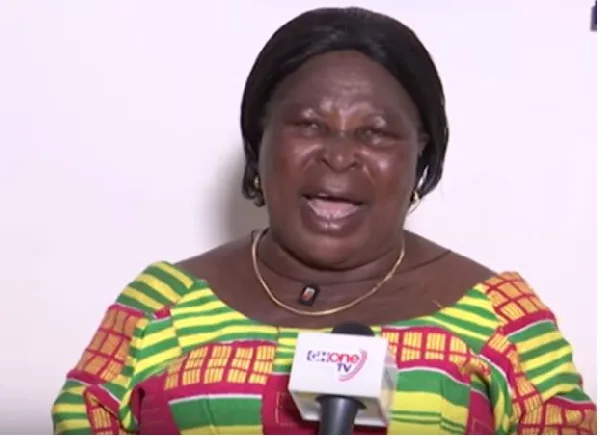
    The age of Akua Donkor, founder and leader of the Ghana Freedom Party (GFP), has stirred debate following her death on October 28 at the Ridge Hospital in Accra.

    While various media sources reported her age as 72, 83 new information from the Electoral Commission (EC) suggests she was actually 69.

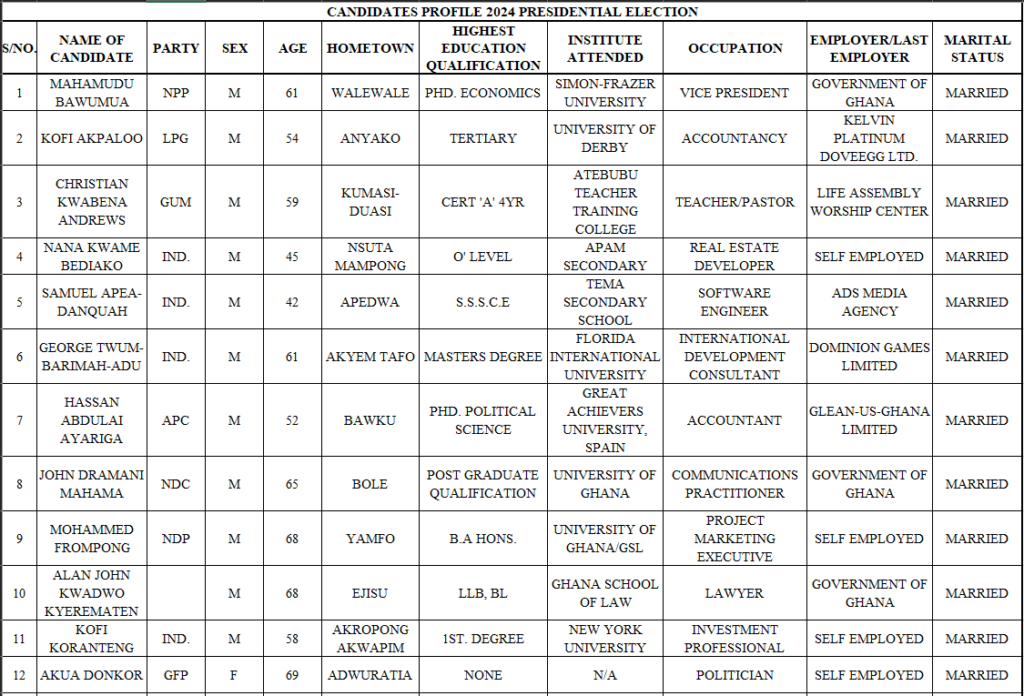
    According to an EC document released to The Independent Ghana, which profiles presidential candidates for the 2024 elections, Akua Donkor’s age was listed as 69, indicating a birth year of 1955, not 1952 as widely cited.

    To cement the EC’s age provided, the online platform AdomNews reported the manner in which Akua Donkor marked her 65th birthday in 2020. The report mentioned June was her birth month.

    Additionally, one of the deceased’s children, Mary, who engaged the media noted that her mother was 83 years old. This suggests that Akua Donkor was born in 1941.

    One of the criteria for presidential aspirants is “forms should include properly attested statutory declarations stating that candidate has provided accurate details to the Commission, has met all the requirements and is qualified for the office of President”.

    This discrepancy raises questions about official records, as presidential candidates are required to submit verified statutory declarations confirming their personal details to meet eligibility requirements for office.

    It is reported that Akua Donkor died of respiratory health challenges.

    Akua Donkor’s political journey began as an Assemblywoman for Herman, a position that brought her into the national spotlight. She launched her first presidential bid in 2012 as an independent candidate but was disqualified, later endorsing Papa Kwesi Nduom of the Progressive People’s Party (PPP).

    Her path was further hindered in 2016 when a fire destroyed the GFP’s headquarters in Kabu, Eastern Region, and she was ultimately disqualified from that election as well.

    Since her passing, tributes have poured in, honouring her commitment to Ghanaian politics. The GFP now faces the task of selecting a new leader if it wishes to contest in the upcoming elections.

  • Akua Donkor was 69 years before her passing – EC’s profile of presidential aspirants reveals

    Akua Donkor was 69 years before her passing – EC’s profile of presidential aspirants reveals

    The age of Akua Donkor, founder and leader of the Ghana Freedom Party (GFP), has come under scrutiny following conflicting reports.

    While several media outlets reported that she was 72 years old at the time of her death on October 28 at the Ridge Hospital in Accra, a document released by the Electoral Commission (EC) to The Independent Ghana suggests otherwise.

    According to the EC’s profile of presidential candidates for the 2024 elections released in September, Akua Donkor was listed as 69 years old, indicating a birth year of 1955 rather than 1952, as widely reported.

    This discrepancy raises questions regarding official records, especially as presidential candidates must submit verified statutory declarations to confirm the accuracy of their details, meeting all eligibility requirements for office.

    Akua Donkor’s political career began as the Assemblywoman for Herman, where her determination and aspirations garnered widespread attention. In 2012, she made her first bid for the presidency as an independent candidate but was disqualified on eligibility grounds, subsequently endorsing Papa Kwesi Nduom of the Progressive People’s Party (PPP).

    Her political journey faced further challenges in 2016 when a fire destroyed the GFP’s headquarters in Kabu, Eastern Region, ultimately leading to her disqualification from the election process.

    Since her passing, tributes from across the country have honored her dedication and resilience in Ghanaian politics. With her death, the GFP must now select a new flagbearer if the party intends to participate in the upcoming elections.

  • Election 2024: Presidential results to be announced for individual region separately – EC

    Election 2024: Presidential results to be announced for individual region separately – EC

    Deputy Chairperson of the Electoral Commission (EC), Dr Eric Bossman Asare, has announced that the Commission will declare the regional presidential results from all 16 regions before announcing the national results in the upcoming December 7 elections.

    According to Dr Bossman Asare, this decision is intended to enhance transparency during the polls.

    Speaking at the launch of the Coalition of Domestic Election Observers (CODEO) Election Monitoring System, Dr Bossman Asare emphasised the EC’s commitment to ensuring a free and fair election.

    “For the presidential election, after the polling station, all the results from the polling stations will be taken to the constituency coalition centres. So from the constituency coalition centre, then all the results will now go to the regional coalition centres.

    “So what the commission is doing is that we are going to announce presidential results for each region. We will announce presidential results for each region. And the parties are well aware.”

  • Joana Gyan’s lawyers fight disqualification ruling by  EC

    Joana Gyan’s lawyers fight disqualification ruling by EC

    The legal team representing Joana Gyan Cudjoe, the National Democratic Congress (NDC) parliamentary candidate for Amenfi Central, has formally appealed against her disqualification by the Electoral Commission (EC).

    The appeal follows the EC’s decision to disqualify Cudjoe based on a pending interlocutory injunction.

    In a letter dated October 15 and signed by Ayine and Associates, Cudjoe’s lawyers argued that her disqualification was unlawful, stressing that she was duly elected as the NDC candidate for the constituency in full compliance with the party’s regulations.

    “We write as lawyers for and on behalf of the National Democratic Congress (NDC) and Joana Gyan Cudjoe, who is the NDC Parliamentary Candidate for the Amenfi Central Consistency for the 2024 Parliamentary Elections (hereinafter called ‘our clients’), on whose instructions we write to you in respect of the above subject matter,” the letter stated.

    The controversy surrounding Cudjoe’s candidacy arose when the EC ruled against her, citing the interlocutory injunction as grounds for her disqualification. However, her legal team argues that this decision lacks merit, as she has the full backing of the NDC and followed all proper election procedures.

    Her legal representatives emphasized that the EC’s actions infringe upon Cudjoe’s rights and disrupt the democratic process within the party. They further argued that any legal matters regarding her candidacy should be resolved without penalizing her as the election date approaches.

    The lawyers highlighted the petition filed on September 13, 2024, which the EC used to justify the disqualification. The petition, followed by a letter on September 24, claimed there was an injunction restraining Cudjoe from holding herself out as the duly elected NDC candidate for the Amenfi Central constituency.

    Despite these claims, Cudjoe’s team maintains that the EC’s ruling is baseless, insisting that she was properly elected and should be allowed to participate in the upcoming December 7 elections.

  • Relying on an injunction to disqualify Joana Gyan  legally flawed – Lawyer to EC

    Relying on an injunction to disqualify Joana Gyan legally flawed – Lawyer to EC

    Private legal practitioner Samson Lardy Anyenini has criticized the Electoral Commission (EC) for disqualifying Joana Gyan Cudjoe, the NDC’s Amenfi Central parliamentary candidate, based on an interlocutory injunction.

    According to Mr Anyenini, relying on such an injunction as grounds for disqualification is legally flawed, as it is a temporary order that does not carry the legal weight to settle a dispute or disqualify a candidate without a final ruling.

    “An interlocutory injunction is not a perpetual injunction, and it does not determine the rights of the parties involved. So, to use that as the basis for disqualification is not only premature but also legally flawed,” Anyenini explained while speaking on PM Express.

    He noted that the EC’s decision was especially questionable because the May 2023 election, which was the subject of the injunction, had been annulled by the NDC, and a fresh election took place in September 2024 under the supervision of the EC. Joana Gyan Cudjoe was declared the winner in the September election.

    “The Electoral Commission supervised the September 2024 election and declared Joana Cudjoe duly elected. So, it’s baffling that they would later disqualify her based on an injunction tied to the annulled May election,” Anyenini added.

    Mr Anyenini emphasized that the injunction was tied to an election that no longer had legal standing and warned that the EC’s actions could be considered an overreach of its authority.

    “The injunction relates to the May 2023 election. There’s no suit regarding the September 2024 election. It sounds absurd that the EC would disqualify her based on an issue that has already been settled through a fresh election,” he said.

    He also raised concerns about the EC’s haste in issuing the disqualification and highlighted the potential implications if the injunction were vacated.

    “Suppose the injunction is vacated tomorrow—what happens to the EC’s disqualification then? It simply shows that the EC jumped the gun,” Anyenini concluded.

  • Re-exhibition of Provisional Voter Register first of its kind thanks to NDC – EC

    Re-exhibition of Provisional Voter Register first of its kind thanks to NDC – EC

    The Electoral Commission (EC) of Ghana has credited the National Democratic Congress (NDC) for initiating the first-ever re-exhibition of the Provisional Voters Register ahead of the 2024 general elections.

    This unprecedented move, recommended by the NDC, aims to resolve potential discrepancies and ensure the accuracy of the voters’ roll.

    During an Inter-Party Advisory Committee (IPAC) meeting in Accra on Tuesday, October 15, 2024, EC Chairperson Jean Mensa praised the NDC’s recommendation as a key step toward enhancing transparency and boosting confidence in the electoral process.

    “The re-exhibition of the Provisional Voter Register has never happened before; indeed, this is the first time. And it demonstrates that this commission is a listening one, it’s a commission that is open to receiving feedback for the betterment of its stakeholders,” she stated.

    “We would like to thank the NDC for this idea of re-exhibiting the voter’s register. It also demonstrates that we’re a transparent commission and that we walk and work with our stakeholders.”

    She emphasized the importance of feedback from political parties and acknowledged the NDC’s role in the Commission’s decision to re-exhibit the register. Madam Mensa commended the party for its active involvement in improving the electoral system, reinforcing the Commission’s commitment to working with all political stakeholders to ensure a credible election in 2024.

    “We are confident with this approach, and we believe that we will have a near-perfect final voters’ register ahead of the December 2024 elections.”

  • Voters register to be re-exhibited online from October 15 to 19

    Voters register to be re-exhibited online from October 15 to 19

    The Electoral Commission (EC) has announced the online re-exhibition of the 2024 Provisional Voter Register (PVR), scheduled to take place from Tuesday, October 15 to Sunday, October 19, 2024.

    This move follows the EC’s commitment to re-exhibit the revised register during a Special Inter-Party Advisory Committee (IPAC) meeting held on October 1.

    The re-exhibition aims to provide registered voters with an opportunity to verify their details and report any discrepancies, in response to concerns raised by the National Democratic Congress (NDC) regarding the accuracy of the register. By ensuring that all registered voters have accurate information, the EC hopes to facilitate a smoother voting process ahead of the 2024 General Elections.

    In a statement issued on Monday, October 14, the EC stated: “The Electoral Commission wishes to announce for the information of the General Public, Registered Voters and all Stakeholders, that Re-Exhibition of the Provisional Voters Register (PVR) will commence on Tuesday, 15th October and end on Saturday, 19th October, 2024.”

    Starting Tuesday, voters can check their details using the shortcode 71151# free of charge or by visiting the EC’s website (https://ec.gov.gh). Voters using the website are instructed to click on the pop-up link at the bottom-right corner of the screen and enter their 10-digit Voter ID number to access their registration details.

    The EC also urged the public to report any discrepancies to its District Offices for correction during the re-exhibition period. “The Public should note that any discrepancies identified must be reported to the District Office of the Commission where they are registered voters for correction.

    Once the Re-Exhibition Exercise ends on Saturday, 19th October, voters will still be able to check their details Online but CANNOT request for correction of their details,” the statement added.

    In addition, political parties are encouraged to use the official Template provided by the EC to report any inconsistencies identified during the re-exhibition process.

    By taking these steps, the EC is working to address concerns and ensure that the voter register is accurate and up to date ahead of the 2024 elections.

  • EC addresses delay in printing of notice of poll

    EC addresses delay in printing of notice of poll

    The Electoral Commission (EC) has explained that the delays in printing the Notice of Poll for the upcoming December 7 general elections are due to errors in the spelling of names and issues related to some political party symbols.

    In a statement issued on October 10, the EC announced that the printing of Notices of Poll for both the presidential and parliamentary elections would commence on Friday, October 11, 2024.

    However, the actual printing of ballot papers will only begin after the Commission provides ballot statistics to all candidates, political parties, and printing houses.

    Some political party representatives have raised concerns regarding the delay. Dr. Rashid Tanko Computer, Deputy Director of Elections for the opposition National Democratic Congress (NDC), clarified that the NDC had no issues with the printing of the Notices of Poll, but expressed concerns over the printing of the ballot papers.

    “We have no issues with the printing of the Notice of Polls, it’s just the corrections, which we have just done. We just closed the meeting with them, and we have no issue. Our issues with them were about the printing of the ballot papers. Their initial letter indicated that they wanted to go ahead with the printing of the ballot papers, which we had issues with. We told them that could not be the case because you don’t just print ballot papers without the voter registration document and the statistics therein before the printing can commence,” Dr. Rashid Tanko explained.

    Meanwhile, Sam Korankye, a disqualified presidential aspirant for the December 7 election, criticized the EC’s decision to proceed with the printing process. He described it as a “slap in the face of democracy,” accusing the Commission of acting unfairly.

    “For them to go ahead and invite agents of various candidates regarding the printing of the ballot paper to the various printing houses is totally unfair and unacceptable. I don’t think this is good for the Electoral Commission in terms of deepening democracy and building confidence of the people going forward to such a big election,” Korankye stated.

    He also hinted at potential legal action, possibly taking the matter to the Supreme Court. Korankye urged the EC to rectify the situation, adding, “Going ahead to print these ballot papers regardless of what is pending is totally unfair and a slap on the face of democracy.”

  • EC dragged to court by Apea-Danquah over disqualification from 2024 election

    EC dragged to court by Apea-Danquah over disqualification from 2024 election

    Samuel Apea-Danquah, popularly known as “Yellow Ghana,” has taken legal action against the Electoral Commission (EC) after being disqualified from the 2024 presidential race.

    Apea-Danquah was among 11 presidential hopefuls disqualified by the EC due to irregularities found in their nomination forms.

    In a motion filed on Thursday, as obtained by Citi News, Apea-Danquah is seeking a court order (certiorari) to overturn the EC’s decision. He is also requesting an order of mandamus to compel the EC to reinstate him as a valid candidate for the upcoming elections.

    In his lawsuit, Apea-Danquah argues that his disqualification is unjust and seeks to have the decision reversed in time for the 2024 polls.

    In a related development, Bernard Anbataayela Mornah, the flagbearer of the People’s National Convention (PNC), and Kofi Asamoah-Siaw, the leader of the Progressive People’s Party (PPP), have also filed lawsuits challenging their disqualification by the EC, similarly citing procedural issues with the nomination process.

    These disqualified candidates are seeking redress from the courts in hopes of securing their spots on the ballot for the 2024 general elections.

  • EC announces 40,647 main polling stations, 328 special voting centers for 2024 elections

    EC announces 40,647 main polling stations, 328 special voting centers for 2024 elections

    The Electoral Commission (EC) has announced that there will be a total of 40,647 main polling stations, with 328 designated for special voting, for the upcoming 2024 presidential and parliamentary elections.

    This information was contained in an October 10 statement signed by the EC’s Deputy Chairman in Charge of Operations, Samuel Tetteh.

    Additionally, in a communique issued on Wednesday, October 9, the EC revealed that the printing of notices of poll and ballot papers would soon commence. However, this announcement was met with strong opposition from the National Democratic Congress (NDC), prompting a meeting with other political parties on Thursday, October 10.

    During the meeting, the NDC demanded access to the ballot statistics prior to the printing process. However, the party revealed that the EC’s leadership directed them to confirm those statistics with the respective printing houses tasked with producing the ballots.

    In response to the concerns, the EC issued a clarification on Friday, October 11, stating that it is the printing of the notices of poll for the presidential and parliamentary elections that is set to begin, not the ballot papers themselves.

  • ‘Partisan’ changing of EC bosses dangerous and problematic – Prof. Agyeman-Duah

    ‘Partisan’ changing of EC bosses dangerous and problematic – Prof. Agyeman-Duah

    Former UN Senior Governance Advisor, Prof. Baffuor Agyeman-Duah, has expressed concern over the recurring practice of replacing heads of the Electoral Commission (EC) whenever a new government takes office in Ghana. He believes this trend poses a serious threat to the nation’s democratic stability.

    Citing examples like the removal of Charlotte Osei following the New Patriotic Party’s (NPP) victory in the 2016 elections, Prof. Agyeman-Duah pointed out that this issue is gaining even more attention now.

    The opposition National Democratic Congress (NDC), which opposed Osei’s dismissal at the time, has recently threatened to remove the current EC Chair if they win the 2024 elections.

    Addressing the Ghana Speaks High-Level Forum 2024, organized by IDEG, the co-founder of the Centre for Democratic Development (CDD-Ghana) described this pattern as “dangerous.”

    He explained that such frequent changes at the top of the EC undermine the integrity of the electoral system and weaken good governance.

    Prof. Agyeman-Duah emphasized the importance of preserving continuity and impartiality within the Electoral Commission to maintain public trust in elections.

    He urged Ghanaian political parties to abandon this practice and take inspiration from Western democracies, where transitions in EC leadership are less politicized and more conducive to ensuring the stability of the electoral process.

    “The suspicion is always there, I don’t know why, but because they are appointed by the president, it’s difficult for the political parties to accept that this is a neutral body.

    I hope we nip it in the bud, but this new culture of a president comes, doesn’t like the previous chairperson of the Electoral Commission, so I appointed my own.

    “I don’t know who is going to win the elections, but suppose John Mahama becomes president again, my good friend Jean Mensa will not be there. They have already said that ‘when we come, we will also change you’.

    “After all, it’s so easy to change, one petition from a person to the president, onwards to the chief justice, they constitute the panel, and you are gone. Is that not so? And that is dangerous.

    “That is the system, and I’m saying we need to review the system. The president doesn’t have to appoint. In other countries and other democracies, electoral officers or bodies are appointed differently; we can learn.”

  • EC: Election Watch seeks contract details of Ballot Printing in RTI request

    EC: Election Watch seeks contract details of Ballot Printing in RTI request

    Election Watch Ghana has filed a Right to Information (RTI) request with the Electoral Commission (EC), seeking detailed information on the contracts related to the printing of ballot papers and notices of polls.

    The request, made under the Right to Information Act, 2019 (Act 989), and backed by Article 21(f) of the 1992 Constitution, emphasises the public’s right to access such information.

    The organisation is asking for specific details on the procurement process, including when the tender was issued, the names of the companies that submitted bids, and the criteria used to select the final contractors.

    Election Watch Ghana argues that ensuring transparency in these matters is vital due to the importance of ballot printing in the electoral process.

    This RTI request comes after the EC’s recent announcement on October 9, stating that the printing of ballot papers and notices of polls will commence soon, with notices scheduled for printing on October 11, followed by the ballots shortly after.

    In addition to procurement details, the group has requested a full breakdown of the bidding process, the methods used to evaluate bids, and minutes from meetings with political parties about contractor selections.

    They also seek copies of all communication between the EC and the shortlisted companies.

  • Printing of ballot papers not taking place on Oct. 11 – EC clarifies

    Printing of ballot papers not taking place on Oct. 11 – EC clarifies

    Electoral Commission (EC) has addressed public concerns regarding the release of ballot statistics prior to the printing of ballot papers for the 2024 presidential and parliamentary elections.

    The EC has assured the public that the printing of ballot papers has not yet begun.

    Starting Friday, October 11, 2024, the Commission will begin printing Notices of Poll for both the presidential and parliamentary elections.

    However, the Commission clarified that providing ballot statistics to printing firms, political parties, and all candidates will take place before the actual printing of the ballots.

    The EC, in a statement, reaffirmed its commitment to transparency, saying, “As has always been the case, the Commission will provide ballot statistics to the Candidates / Political Parties and all Printing Houses before the printing of ballot papers starts.

    “Printing of ballot papers will only commence after ballot statistics have been provided to all Stakeholders. The Commission will not depart from this practice.

    “We urge the Public and all Stakeholders to trust the Electoral Commission to deliver a transparent, credible, free, and fair election in December 2024.”

  • EC, NDC to hold discussions over printing of ballot papers

    EC, NDC to hold discussions over printing of ballot papers

    The National Democratic Congress (NDC) is scheduled to meet with the Electoral Commission (EC) today, Thursday, October 10, 2024, to address concerns surrounding the printing of ballot papers ahead of upcoming elections.

    The EC announced plans to begin printing ballot papers and notices of poll starting Friday, October 11, prompting the NDC to seek clarity on the process.

    The NDC has expressed concerns over the potential for irregularities, with specific worries about the statistics being used for printing. In past elections, the party has raised issues over alleged instances of additional ballot papers being printed, which has led to heightened scrutiny this time around.

    In an interview with Citi News, Dr. Tanko Rashid Computer, the NDC’s Deputy Director of Elections and IT, emphasized the party’s demand for detailed information before the printing process begins.

    “The Electoral Commission indicated they were going to give us a revised provisional register. But as we speak now, they don’t have it. They haven’t given us. They have not also given us ballot statistics. Ballot statistics will emanate from the voters’ code book of the register but we don’t have that,” Dr. Rashid Computer stated.

    He further questioned how the EC could proceed with printing without providing the necessary figures. “How come we are going ahead to print ballot papers? On which figures are they going to use to print the ballot papers? We have written back to them, indicating our position on that.”

    The NDC intends to use the upcoming meeting to ensure they receive the voter code books and related statistics from the EC. Dr. Rashid Computer clarified that while the party does not object to the printing of notices of poll, it insists that the printing of ballot papers should not proceed without the requested data.

    “We will send a letter to them that, look, you cannot proceed with the printing of the ballot papers if we don’t have the statistics and then the voter code books of each of the regions. We will not accept that kind of thing, but if they want to go ahead with the printing of the notices of polls, we have no difficulties with that,” he added.

  • EC to begin printing of ballot papers on Oct 11

    EC to begin printing of ballot papers on Oct 11

    The Electoral Commission (EC) of Ghana has officially announced the commencement of printing the Notice of Poll and Ballot Papers for the upcoming 2024 General Elections.

    According to a letter addressed to the General Secretary of the National Democratic Congress (NDC), the EC will begin this critical process on Friday, October 11, 2024.

    The printing will take place at eight designated printing houses across various locations in Accra, including:

    1. Secprint Ltd (New Achimota, behind Peace FM)
    2. Acts Commercials (Odorkor, behind Hansonic Hotel)
    3. Ghana Publishing Company (Accra Central, behind Accra Technical University)
    4. Buck Press (Ofankor, Former MVVS Feeding Company)
    5. Innolink Limited (North Industrial Area)
    6. Fonstat Limited (South Industrial Area, opposite Japan Motors)
    7. Check Point Limited (South Industrial Area, adjacent Presby Press)
    8. Yasarko Company Limited (Laterbiokorshie)

    The selected party agents are kindly requested to report to the Director of Electoral Services, on Thursday, 10th October 2024 at 11:00 am, at the Electoral Commission’s Corporate Office for a brief orientation before the commencement of the printing.

    The EC has called on the NDC to assign party agents to observe the printing process at these locations to ensure transparency and accountability.

    The involvement of party agents is part of the EC’s efforts to maintain openness in the preparation for the 2024 elections.

  • Election 2024: EC optimistic about exceeding 79% voter turnout

    Election 2024: EC optimistic about exceeding 79% voter turnout

    Electoral Commission (EC) has expressed optimism about improving voter turnout in this year’s elections.

    While several polls have suggested potential voter apathy, Dr. Bossman Asare, the Deputy Chair of the Commission in Charge of Corporate Services, confidently stated at a Democracy and Governance Forum hosted by the West Africa Democracy Radio in Accra that the EC is determined to surpass the 79% turnout recorded in the 2020 elections.

    “As far as the Electoral Commission is concerned, we were ready for the elections yesterday,” Dr. Asare said. “We believe that with the measures we have put in place, Ghana is set for another successful general election.”
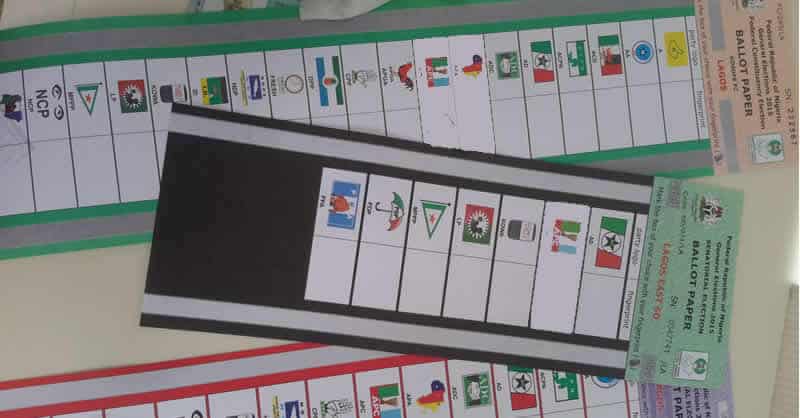
    He emphasised the importance of encouraging citizens to participate in the electoral process.

    “In 2020, we recorded a turnout of just over 79%. This year, we aim to exceed that. We expect every registered voter to go out and exercise their right to vote,” he added.
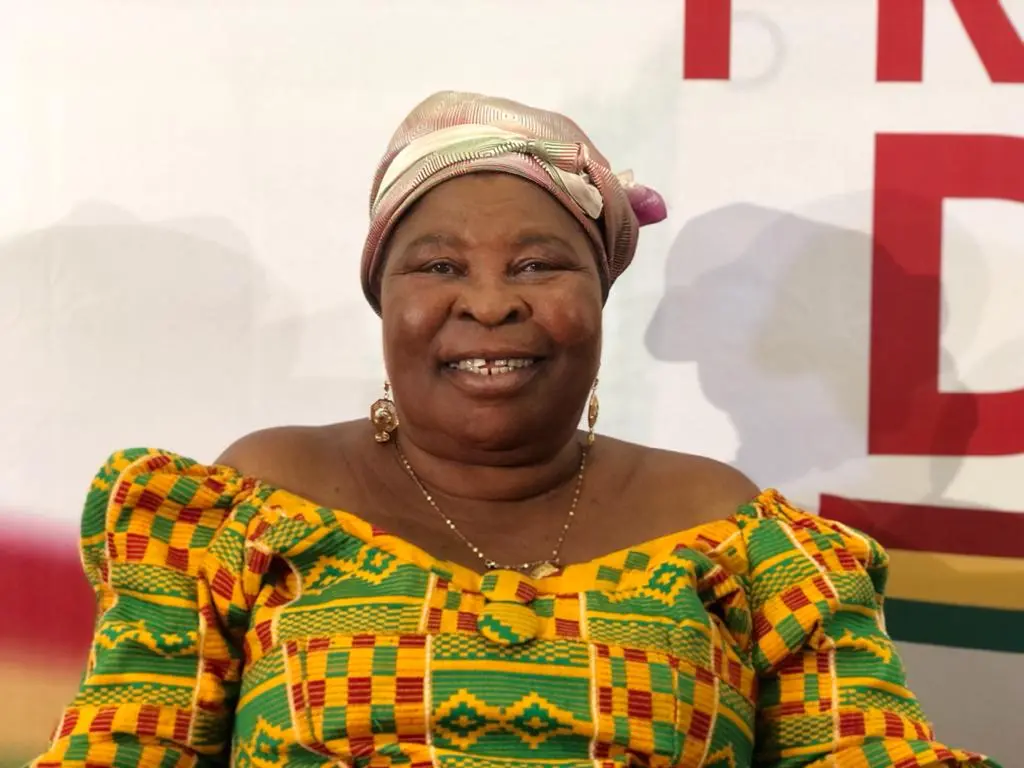
    Dr. Asare also addressed concerns regarding the transparency of the commission’s operations, assuring the public that steps are being taken to ensure the election’s credibility.
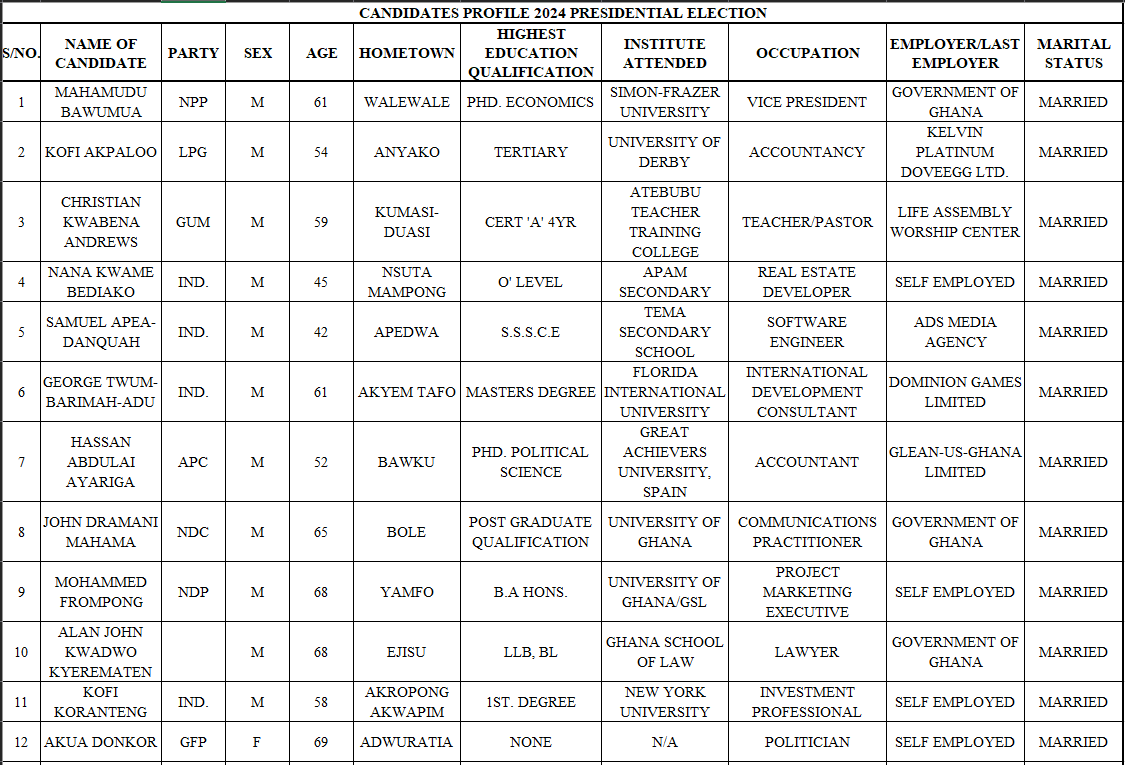
    “From the registration process to everything we do, we collaborate with the political parties. In 2020, the commission spent six months compiling a new voter register and conducting the elections.

    We learnt a lot from that experience and are committed to ensuring a peaceful process this time around,” he explained.

    In total, approximately 18.7 million Ghanaians are expected to cast their ballots on December 7.

  • Revised voters register would be accessible within 2 weeks or earlier – EC clarifies timeline

    Revised voters register would be accessible within 2 weeks or earlier – EC clarifies timeline

    The Electoral Commission (EC) has clarified reports regarding the release of the revised 2024 Provisional Voters Register (PVR), following claims by the National Democratic Congress (NDC) that the register would be available within a week.

    In a statement dated October 8 and signed by Samuel Tettey, Deputy Chairperson in charge of Operations, the EC denied making any such commitment.

    The EC wrote: “For the records, the Chairperson of the EC indicated during the televised IPAC meeting that the Commission would provide the Political Parties with the revised PVR and upload it online within two (2) weeks or earlier.”

    The NDC, after the Inter-Party Advisory Committee (IPAC) meeting held on Tuesday, October 1, issued a statement indicating that it had accepted the EC’s alleged promise to release the corrected or updated version of the 2024 Provisional Voters Register to political parties within one week.

    The party is quoted to have stated: “The Functional Executive Committee of the NDC has deliberated and decided to accept the EC’s promise to release to political parties, the corrected/updated version of the 2024 Provisional Voters Register for scrutiny within one week.”

    In its response, the commission clarified that its Chairperson, Jean Mensa, had actually informed political parties during the IPAC meeting that the Commission would provide the revised PVR and make it available online within two weeks or earlier.

    “Nowhere in her statement did the Chairperson indicate that the revised PVR would be made available within a week,” the EC emphasized.

    Meanwhile, the Chairperson of the Electoral Commission (EC), Jean Mensa, has reported that significant progress has been made in addressing the issues identified in the voter register.

    She noted that while the register is still a work in progress and contains some minor inaccuracies, this is to be expected in any large-scale registration exercise.

    The NDC’s examination of the register identified five key anomalies:

    1. Missing Names: The party discovered that the names of registered voters were missing from the list, potentially disenfranchising eligible voters.
    2. Misplaced on Lists: Qualified voters were incorrectly placed on the Exception List or the Multiple List, which could prevent them from voting on election day.
    3. Disqualified Individuals: Some individuals disqualified due to multiple registrations or successful challenges were still found on the Main Provisional Voters Register (PVR), raising questions about the accuracy of the register.
    4. Unauthorized Transfers: Voters were transferred from one polling station to another without their knowledge. Additionally, old transfers that should have been resolved were still appearing on the register.
    5. Polling Station Changes: Some voters were moved from one polling station to another without their consent, causing confusion and potential voter suppression.

    The EC has admitted to errors in the transfer of votes.