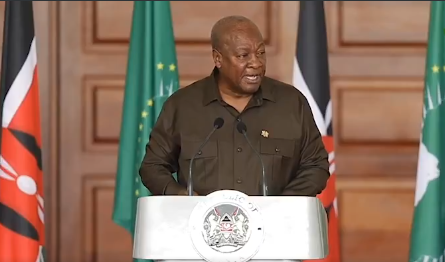
The much-anticipated National Economic Dialogue (NED) takes place today, March 3, 2025, at the Accra International Conference Centre.
Organized by the government and led by President John Dramani Mahama, the two-day event will focus on addressing Ghana’s economic difficulties and setting a course for recovery and sustainable growth.
With a strong emphasis on rebuilding the economy, President Mahama is expected to deliver a keynote speech outlining his administration’s strategy for revitalization.
The initiative reflects the government’s dedication to fostering inclusive discussions on economic policies, encouraging key stakeholders to contribute to shaping Ghana’s financial future.
A broad spectrum of participants, including representatives from the private sector, academia, public policy institutions, and civil society, will take part in the discussions.
The dialogue will explore solutions to stabilize the economy, accelerate development, strengthen infrastructure, reform economic policies, and promote private sector investment while reinforcing good governance.
At a time when the country faces financial challenges, authorities believe this engagement will help generate solutions that restore confidence in the business environment, enhance infrastructure, and improve livelihoods.
The insights gathered from the discussions will play a crucial role in shaping policy implementation and setting a path toward economic resilience and long-term prosperity.
As deliberations unfold, expectations remain high that this forum will produce actionable recommendations to drive meaningful economic change and position Ghana for a more stable and prosperous future.
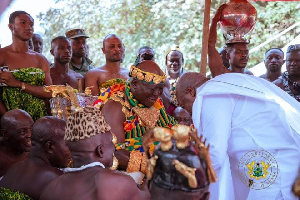
President John Dramani Mahama has announced plans to meet with the Asantehene, Otumfuo Osei Tutu II, as part of his approach to addressing the current economic challenges facing Ghana.
During the Akwasidae celebration at the Manhyia Palace on January 19, 2025, President Mahama highlighted the significant role the Asantehene played in assisting his previous government with tackling economic issues.
“Our nation, Ghana, is facing a dire economic crisis. While this is not the first time we have been in such a crisis, this particular one is characterised by a high rate of inflation, macroeconomic instability, a depreciating currency, and a debt default which has shut us out of the international credit market.
“It’s a more daunting challenge than we have ever experienced in our history. Your Royal Majesty, as a former president between 2013 and 2017, we faced macroeconomic instability, and I remember some of the obstacles we encountered in our efforts to bring stability to our economy and restore economic growth.
“I had the privilege of calling on you to use your influence and diplomacy to smooth the path towards prosperity and progress. Anytime I called on you, you didn’t hesitate. I would like to thank you for the cooperation I enjoyed with you at that time,” President Mahama stated.
He continued: “As we have inherited a difficult economic situation, I will be calling on you again from time to time. I know that anytime I call on you, you will not hesitate to work together to put our nation back on its feet.”
“We would like you to please remember always the undertakings and promises you have made. I implore you to fulfil all your promises to us in the great Asante Kingdom.
“We have absolute trust in you that you shall not let us down. All ongoing developmental projects within the kingdom and across all kingdoms, you will fulfil them,” the Paramount Chief of the Mampong Traditional Area, Dasebre Osei Bonsu II, spoke on behalf of the Asantehene.
A technical recession is when the economy shrinks for two quarters in a row.
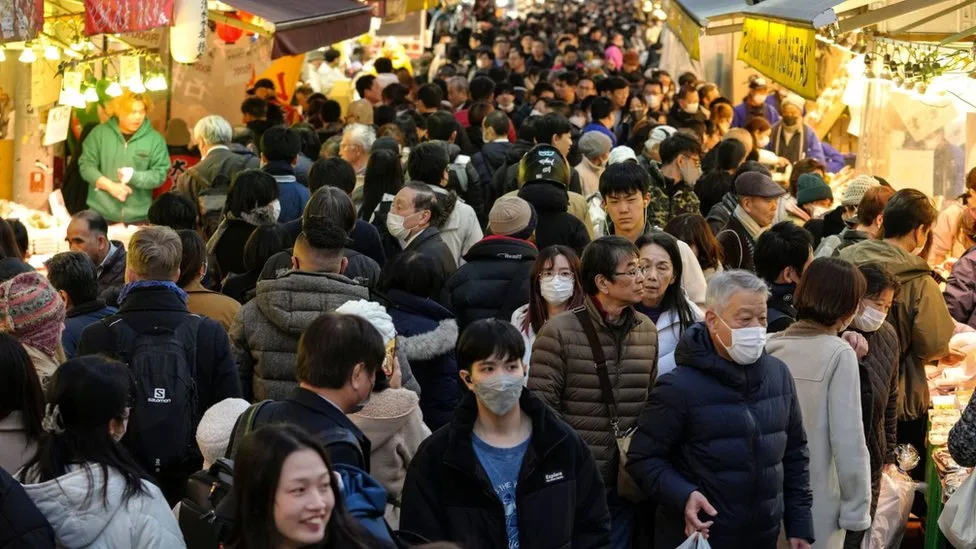
In October, the IMF said that Germany is expected to become the world’s third-biggest economy when measured in US dollars, surpassing Japan.
The IMF will only say which country is doing better once both countries have shared their final economic growth numbers. It started sharing information about different economies in 1980.
This happened because the Japanese money was not very strong compared to the dollar. If the yen gets stronger again, Japan could become the third biggest economy again, Mr.
At a meeting for the media in Tokyo, the IMF’s second in command, Gita Gopinath, said an important reason Japan might drop in the rankings is because the yen dropped 9% against the US dollar last year.
However, the yen is not very strong, which has made the stock prices of big Japanese companies go up. This is because it makes it cheaper for other countries to buy Japanese exports like cars.
This week, Tokyo’s main stock index, the Nikkei 225, reached 38,000 for the first time since 1990, when a drop in property prices caused an economic crisis. The Nikkei 225 reached its highest point ever on December 29, 1989, at 38,915. 87
The new GDP data might also mean that the country’s central bank will wait even longer to decide to increase the cost of borrowing.
The Bank of Japan made interest rates below zero in 2016 to encourage people to spend and invest more money.
Negative rates make the yen less appealing to people around the world, so the value of the currency has gone down.
Economist Professor, Godfred Alufar Bokpin has suggested that Ghana’s economy will witness notable growth in 2024 due to election-related activities.
Prof. Bokpin explained that the elections would lead to increased usage of hospitality services, particularly hotels and car rentals, injecting more liquidity into the economy and providing relief to Ghanaians.
In an exclusive interview with the Ghana News Agency reflecting on the 2023 fiscal year and the country’s economic outlook for the coming year, he emphasized the importance of policies aimed at enhancing productivity and stability.
The economist highlighted the positive impact of election-year spending by politicians on businesses such as car rentals and the hotel industry.
However, he cautioned the government to implement measures preventing inflation from rising due to increased liquidity from political expenditures.
“There’s some good news next year because it’s an election year; politicians are going to spend, including travels across all the regions, and that in itself, would inject some liquidity into the system,” he stated.
“This means that there are some related businesses that will also pick up next year – car rentals and the hotel industry, and some Ghanaians whose lifestyles are indexed to political activities, this will be their harvest season,” he noted.
While acknowledging potential benefits for some Ghanaians, Prof. Bokpin advised caution, as excessive liquidity without a corresponding rise in production could lead to inflation.
Looking ahead, he predicted a reduction in external funds flowing into the country from the second half of 2024, potentially putting pressure on the Ghanaian Cedi. Prof. Bokpin explained that investors tend to adopt a “wait and see” approach during election periods.
“That pickup can benefit some Ghanaians, but we should be mindful that the same situation could cause inflation to go up, because there may be a lot more liquidity injection without a corresponding increase in production,” Prof Bokpin said.
He urged Ghanaians to moderate their growth expectations for 2024, emphasizing that challenges still exist and a sustained recovery requires careful management.
Regarding the government, Prof. Bokpin called for expeditious agreements with bilateral and commercial creditors for the second tranche of the $600 million loan from the International Monetary Fund (IMF) and the syndicated cocoa loan.
He emphasized that such agreements would mitigate economic uncertainty, support the Cedi, and maintain overall economic stability.
“The election fever begins from the second half of the year as experienced in all previous competitive elections, and many investors would not like to bring their funds into the country, but adopt the attitude of wait and see.
“We should be moderate with our expectations because we’re not entirely out of the woods and there’s still some considerable price that we have to pay to sustain the recovery.We need to conclude doing so, in addition to the syndicated cocoa loan,” the economist explained.
Ghana’s economic growth slowed to two percent year-on-year in the third quarter, down from 2.7 percent the previous year, reflecting the impact of fiscal tightening and high interest rates aimed at curbing inflation.
Despite the deceleration, analysts anticipate that the economy is still poised to achieve the government’s revised full-year growth target of 2.3 percent for 2023.
Apakan Securities noted that while challenges persist, the annual expansion is expected to slightly surpass the upwardly revised goal.
The central bank’s economic activity index indicates a steady recovery, raising expectations of faster growth in the fourth quarter.
The third-quarter figure of 2 percent brings the year-to-date average expansion to 2.8 percent, slightly below the 2023 target.
Ghana’s provisional non-oil real GDP eased to 2.7 percent year-on-year in Q3 2023, compared to 3.3 percent in Q3 2022.
The real quarterly GDP, including the oil and gas sector, reached GH¢44.74 billion in Q3 2023. Non-oil real GDP rose to approximately GH¢41.91 billion.
Agriculture exhibited robust 5.9 percent growth, while the services sector expanded by 5.5 percent.
The industry sector contracted by 4.3 percent, with construction experiencing an 8.3 percent decline.
Services remained resilient, with broad-based 5.5 percent growth led by professional services, transport, real estate, and healthcare.
Agriculture, growing at a solid 5.9 percent, offset a surprise contraction in cocoa output and challenges in forestry. The industry sector, facing its fourth consecutive contraction, dropped 4.3 percent on the quarter.
Construction saw a sharp 8.3 percent decline, and mining and electricity also contributed to the overall contraction.
The weak industrial performance reflects the impact of inflation-fighting measures, including spending cuts and a 10-percentage-point interest rate hike since early 2022.
The authorities are committed to tightening policies to bring inflation back within the official target band after reaching a 21-year peak in October.
On Friday, the 18th of August 2023, a recognition event was held by President Akufo-Addo to honor a group of enterprising young men and women.
This event celebrated their accomplishments through the Presidential Pitch initiative.
President Akufo-Addo commended these youthful entrepreneurs for defying challenges and embarking on entrepreneurial endeavors, resulting in the creation of job opportunities for themselves and fellow Ghanaians.
Since its inception in 2017, the Presidential Pitch initiative has successfully conducted three editions.
Through these editions, a total of thirty young entrepreneurs have been bestowed with monetary rewards aimed at facilitating the establishment and expansion of their businesses.
Addressing the importance of entrepreneurship in fostering economic growth and development, President Akufo-Addo emphasized its global recognition as a significant catalyst for economic transformation.
He firmly believed that the convergence of technology, entrepreneurship, and business represents the most effective approach to addressing economic hurdles and the concerning levels of unemployment.
Furthermore, President Akufo-Addo underlined that governments worldwide acknowledge youth entrepreneurship as a potent solution to contemporary unemployment issues.
He went on to highlight the positive impact of the Presidential Pitch initiative.
Under its first three seasons, a notable achievement of 702 direct jobs and numerous indirect job opportunities have been generated by the initiative’s winners.
Most notably, these employment opportunities have been established primarily within rural communities, contributing to their development.
President Akufo-Addo expressed special commendation for Christian Boakye Yiadom, the Chief Executive Officer of Pizzaman Chickenman, who secured the tenth place in Season Two of the competition.
Christian’s pizza enterprise, launched on the premises of Kwame Nkrumah University of Science and Technology in Kumasi, was awarded twenty-five thousand cedis (25,000) through the initiative.
This capital infusion facilitated the expansion of his business, culminating in the opening of the first Pizzaman Chickenman branch on the KNUST campus on January 17th, 2020, six months following the competition.
Today, Pizzaman Chickenman stands as a prominent and beloved culinary brand, widely recognized and enjoyed by many.
Defence Chiefs from the 15 countries within the Economic Community of West African States (ECOWAS) have affirmed their willingness to join a standby force aimed at reinstating democratic governance in Niger Republic.
This move follows a military coup carried out by the Presidential Guards in Niger, resulting in the overthrow of President Mohamed Bazoum.
In response, ECOWAS issued a seven-day ultimatum for the military junta to restore power or face potential sanctions, including the use of force.
Despite the junta’s dismissal of ECOWAS‘ threat and their commitment to resist international intervention, the regional body called upon Defence Chiefs of member states to activate the standby force and facilitate the restoration of democracy in Niger.
During a meeting in Accra, Ghana, on August 17, the Defence Chiefs, excluding those from military-controlled states and Cape Verde, expressed their readiness to support the reestablishment of civilian rule in Niger.
The Chief of Defence Staff of Nigeria, General Christopher Gwabin Musa, also emphasized their stance against the coup plotters.
Member of Parliament for Assin Central Constituency and Chairman of the Defence and Interior Committee, Kennedy Ohene Agyapong, has expressed his support for the deployment of Ghanaian troops to Niger if the Economic Community of West African States (ECOWAS) decides on a military intervention.
ECOWAS has urged member states to establish a standby force as a potential solution to the crisis in Niger.
The regional body aims to secure the release of President Mohamed Bazoum from house arrest and reinstate him as the constitutionally-elected head of state.
Scheduled for August 17, ECOWAS’ Committee of Chiefs of Defence Staff will meet in Accra to determine the best course of action for restoring constitutional order in Niger.
In an interview with the media, Agyapong, a former member of the ECOWAS Parliament, asserted that a combined West African military effort would act as a deterrent to other states in the sub-region.
“We have an obligation as Ecowas countries and you cannot run away from it,” he said.
He highlighted that ECOWAS member countries have a responsibility to address such situations and prevent coup attempts. Agyapong emphasized that the situation in Niger should be used as an example to discourage future coup d’état attempts, considering the increasing frequency of such incidents in the region.
“should serve as a deterrent because coups d’etat is becoming rampant in Ecowas so we should use Niger to serve as a deterrent and say anybody who tries again, Ecowas will come after them and this is not the first time”.
Recognizing Ghana’s vital contribution to the force, he labeled Ghana as the second most significant country in West Africa and stressed the nation’s importance within ECOWAS.
“In fact, the second most important country in West Africa is Ghana. I’ve been an Ecowas member [of Parliament] before so it is an obligation.”
Agyapong asserted that allowing coups to occur within the sub-region could have serious consequences for political stability, leading to arrests, dissolution of parliaments, and curbs on press freedom.
“If we make a mistake and we allow coups d’etat all over West Africa, tomorrow it will be me and you and the first thing is that the two of us will go to jail first before anybody.
“They will dissolve Parliament, they will arrest journalists, check all the coups. So, the security of this county is very very important and no matter the amount of money prevention is better than cure. Prevention will not cost you as much as you are curing it,” he added.
He emphasized the significance of prioritizing security and prevention measures to avoid costly remedies.
On Thursday, West African leaders heightened their condemnation of the coup leaders in Niger, revealing plans to activate and deploy a regional standby force in order to restore the nation’s constitutional order after the recent coup.
Convening in Abuja, Nigeria after the lapse of the one-week ultimatum given to Niger’s military junta, representatives from the Economic Community of West African States (ECOWAS) urged the deployment of this force “to restore constitutional order in the Republic of Niger,” as conveyed in a statement read by Omar Alieu Touray, the President of the ECOWAS Commission.
The exact scope and nature of this “deployment” and “activation” remain unclear. The statement underscored a commitment to maintain all options open for a peaceful resolution of the crisis.
Niger has plunged into a state of political turmoil since late last month when President Mohamed Bazoum was overthrown in a coup orchestrated by the presidential guard. In response, ECOWAS imposed sanctions and issued a one-week ultimatum to the ruling military junta, demanding their relinquishment of power or facing potential military intervention.
Despite the deadline expiring on August 6 without any change in the political landscape, ECOWAS leaders emphasized their preference for a diplomatic resolution and proposed military intervention as a last resort.
The regional bloc vowed to uphold the measures and principles agreed upon during the extraordinary summit held on July 30, 2023, during which severe sanctions were levied against Niger’s military junta.
Touray additionally cautioned about consequences for “member states that, directly or indirectly, impede the peaceful resolution of the crisis.”
Mali and Burkina Faso, both led by military officials who have seized power, expressed solidarity with Niger’s junta and cautioned that any military interference would be interpreted as a declaration of war. Guinea also voiced its support for Niger.
Niger’s armed forces seemed to be gearing up for potential military action this week, as reported by a military source to CNN.
A convoy comprising approximately 40 pickup trucks arrived in the capital after nightfall on Sunday, ferrying troops from various parts of the country.
A Certified Economist Dr. Samuel Ankrah, who is running for president of Ghana in 2024, claims that because of his training and expertise as an economist, he is the only one who is equipped to manage the nation’s unstable economy.
Dr. Ankrah, an Investment Banker, Global Business Strategist, and Development Economist explained that, the level of mismanagement of the economy by both successive NDC and NPP governments has resulted in the country running to the International Monetary Fund for a bad seventeenth time in search for a bailout.
He made this statement during a virtual leadership summit with the Ghana Universities Journal on Sunday, May 21, 2023. Dr. Ankrah, who seeks to become the first independent candidate to ascend the presidential seat of Ghana mentioned that, the best brains to manage the affairs of Ghana are currently sitting on the fringes and not in governance, therefore they need to be brought on board, which he will do when he becomes President of Ghana.
According to the 2024 Presidential Hopeful, Ghana needs a systematic and pragmatic approach in attaining the best for its citizens. Rule of law, efficient government structures, and a structured and firm fight against corruption are the best ways to have an enabling Ghanaian environment, according to Dr. Ankrah.
He further called on the youth not to lose hope in the country, even though the current government has not created any alternative change to bring hope to the youth. He also urged them to be creative in all their thoughts and throw their weight behind his ten-point plan which will break the duopoly of NPP and NDC in the political and governance history of Ghana.
* The authorities’ strong reform program aims at restoring macroeconomic stability and debt sustainability while protecting the vulnerable, preserving financial stability, and laying the foundation for strong and inclusive recovery. To support the objective of restoring public debt sustainability, the authorities have launched a comprehensive debt operation.
* In addition to a frontloaded fiscal consolidation and measures to reduce inflation and rebuild external buffers, the program envisages wide-ranging reforms to address structural weaknesses and enhance resilience to shocks.
Accra, Ghana: An International Monetary Fund (IMF) team led by Mr. Stéphane Roudet, Mission Chief for Ghana, visited Accra during December 1 – 13, 2022, to discuss with the Ghanaian authorities IMF support for their policy and reform plans.
At the end of the mission, Mr. Roudet issued the following statement:
I am pleased to announce that the IMF team reached staff-level agreement with the Ghanaian authorities on a three-year program supported by an arrangement under the Extended Credit Facility (ECF) in the amount of SDR 2.242 billion or about US$3 billion. The economic program aims to restore macroeconomic stability and debt sustainability while laying the foundation for stronger and more inclusive growth. The staff-level agreement is subject to IMF Management and Executive Board approval and receipt of the necessary financing assurances by Ghana’s partners and creditors.
“Key reforms aim to ensure the sustainability of public finances while protecting the vulnerable. The fiscal strategy relies on frontloaded measures to increase domestic resource mobilization and streamline expenditure. In addition, the authorities have committed to strengthening social safety nets, including reinforcing the existing targeted cash-transfer program for vulnerable households and improving the coverage and efficiency of social spending.
“Structural reforms will be introduced to underpin the fiscal strategy and ensure a durable consolidation. These include developing a medium-term plan to generate additional revenue and advancing reforms to bolster tax compliance. This will help create space for growth-enhancing measures and social spending. Efforts will also be made to strengthen public expenditure commitment controls, improve fiscal transparency (including the reporting and monitoring of arrears), improve the management of public enterprises, and tackle structural challenges in the energy and cocoa sectors. The authorities are also committed to further bolstering governance and accountability.
“To support the objective of restoring public debt sustainability, the authorities have announced a comprehensive debt restructuring. Sufficient assurances and progress on this front will be needed before the proposed Fund-supported program can be presented to the IMF Executive Board for approval.
“Reducing inflation, enhancing resilience to external shocks, and improving market confidence are also important program priorities. Accordingly, the Bank of Ghana will continue to strengthen its monetary policy framework and promote exchange rate flexibility to rebuild external buffers. As part of the authorities’ debt strategy, a domestic debt exchange has been launched. The authorities are committed to taking the necessary mitigation measures to ensure financial sector stability is preserved.
“IMF staff held meetings with Vice President Bawumia, Finance Minister Ofori-Atta, and Bank of Ghana Governor Addison, and their teams, as well as representatives from various government agencies. The IMF team has also continued to engage with other stakeholders. Staff would like to express their gratitude to the Ghanaian authorities, Parliament’s Finance Committee and all the private sector, trade union, and civil society representatives for their open and constructive engagement over the past few months.”
The national Chairman for Progressive Peoples Party (PPP), Nana Ofori Owusu, has asked the president of Ghana, Nana Addo Dankwa Akufo-Addo to suspend the construction of the national cathedral with immediate effect.
The project, according to him, is of no priority at this time of economic difficulty.
Speaking on Peace FM’s morning show, Kokrokoo, the politician argued that all non-essential projects of the government must be put on hold.
“If you know you can’t pay your money don’t go and start any new projects, suspend all non-essential projects like the national cathedral. We’re in crises, this time that we are in economic challenges, and people are taking ‘haircut’, you are saying you are going to build a national cathedral. In this difficult time, does it make sense? Which solution are they giving to us as a nation, the executive budget should be reduced by 60% and they should reduce the number of ministers to 14 in total. It should not be more than 35, including deputies.”
One may recall that, on May 5, 2022, the president of the republic of Ghana, Nana Addo Dankwa Akufo-Addo, delivering an inaugural Africa lecture at the Museum of the Bible in Washington, Dc, USA, said that the construction of the national cathedral was of high priority to him as president.
“I am a Christian in politics who is unashamed of asserting my Christian faith as part of my political calling. It is the faith and this belief in God’s power to transform difficult situations into beacons of hope that has animated my vison for moving Ghana to a situation beyond aid and putting the country onto the road of self-reliance and sustained progress and prosperity,” the president said.
Austria-based Ghanaian, Richard Owusu, has stated that he has no hope that Ghana can develop in the future because the leaders and the people do not love each other enough to want the best for them.
In an interview on Daily Hustle Worldwide, Richard Owusu indicated that the opportunities available for Europeans cannot be compared to Ghana despite the current global economic crisis.
He disclosed that Austria is also experiencing price hikes, but the prices don’t go up as often as in Ghana. Moreover, he mentioned some of the benefits Austrian citizens enjoy now.
“I bought fresh tomatoes after work today, and it was 3 Euros, 50 cents. If you don’t work here, you won’t eat. Even if someone gives you bread today, you can’t go back for more tomorrow. You have to pay bills and all. But you can always find a job here with whatever qualification you have, so people are well off,”
Speaking on the economic situation in Ghana, Richard noted that he has no hope when it comes to the development of Ghana and that the country will continue to wallow in poverty because there is no love among Ghanaians.
“It is not the same in Ghana, and it is a big problem. There are no manufacturing companies for skilled workers to do. I’m sorry, but we have allowed a lot to go, so we can’t compare ourselves to the whites. I have no hope for Ghana to develop. What we are going through now will continue forever because we don’t have love,” he told DJ Nyaami on SVTV Africa.
Ken Ofori-Atta, the embattled finance minister is optimistic that Ghana will come out strongly from the current economic crisis caused mainly by external factors.
According to him, Ghana, as a nation, is being tested by these current economic challenges and this is the time the country requires a united and concerted response to the crisis.
“I implore our chiefs, elders and churches to take the mantle and speak a common language. Let us all work as one country to support labour negotiations, find a solution to the impasse in Parliament and rise above witch-hunting and entrapment,” Ken Ofori-Atta told the 8-member committee that was investigating the allegations made by the Minority against him, on Friday, November 18.
He added that these are not ennobling and progressive for a society seeking transformation.
“Ghana is a resilient country. Ghana has faced economic challenges since its independence. Ghana has always come through each of them stronger and better than before.
“God willing, we shall come out of these difficult times too. Ghana, will, and must rise again,” Ofori-Atta noted.
Censure Motion
The minority moved a censure motion to get the Finance minister out of office on the following grounds
-Despicable conflict of interest ensuring that he directly benefits from Ghana’s economic woes as his companies receive commissions and other unethical contractual advantages, particularly from Ghana’s debt overhang.
-Unconstitutional withdrawals from the Consolidated Fund in blatant contravention of Article 178 of the 1992 -Constitution, supposedly for the construction of the President’s Cathedral:
-Illegal payment of oil revenues into offshore accounts, in flagrant violation of Article 176 of the 1992 Constitution:
-Deliberate and dishonest misreporting of economic data to Parliament 5. Fiscal recklessness leading to the crash of the Ghana Cedi which is currently the worst-performing currency in the world:
-Alarming incompetence and frightening ineptitude, resulting in the collapse of the Ghanaian economy and an excruciating cost of living crisis;
-Gross mismanagement of the Ghanaian economy which has occasioned untold and unprecedented hardship.
Elvis Afriyie Ankrah had just finished reading a Master’s degree course in International Relations and was hoping that he would receive a callback from the Economic Community of West African States (ECOWAS) to start his dream job with them.
And as is the case for most young graduates, the urge to experience working in any environment that presented him with much more made his hopes even greater.
But Elvis Ankrah said something that jolted his dream sideways and put that long-time dream on permanent hold.
And it all started when he was approached by one of the stalwarts of the National Democratic Congress (NDC), Ato Ahwoi, to take up an unusual job: a spokesperson for a presidential candidate.
The job was for him to deputise as a spokesperson for the late former president of Ghana, Prof. John Evans Atta Mills, who was by then campaigning to become Head of State.
He explained to GhanaWeb TV’s Edward Smith Anamale that when that call came through, it was not one of the things on his mind.
“I went to do my Masters in International Relations and when I came back, I was on the verge of… I’d actually gone to ECOWAS to put in an application for a job and I was expecting a response because I had spoken with Dr. Chambas and all that, and then Mr Ato Ahwoi called me and said he wanted me to be the deputy campaign spokesperson for Prof Mills’ presidential primaries.
“It was a very difficult decision to make: go to ECOWAS, go and earn some good dollars because I studied international relations so that had been my interest; to work with an international agency: ECOWAS, AU or the United Nations, so local politics was not part of my plan,” he explained.
Elvis Afriyie Ankrah, however, explained in the election Desk interview on GhanaWeb TV that after a while, he agreed to take on that job, also because of something profound that Ato Ahwoi said to him.
“And he said, go and do this thing for us, and after several months, I eventually agreed because he told me something: ‘If you go to your ECOWAS or UN and after 15 years you come back to Ghana, don’t you know you’ll be a stranger, and your colleagues would have gone ahead of you? So, what will happen to all the experience you gathered as SRC president and NUGS.
“So, that really got me thinking so I took up the challenge and so, myself, Ludwig and Rojo, we went round with Prof Mills around the whole Ghana. We went to almost every city, town, village – every nook and cranny. It was a very eye-opening experience and that is where I gathered a lot of data and network with the grassroots,” he explained.
Musician Sarkodie is not going back on his word regarding his stance on certain national issues.
The award-winning artiste has been at the receiving end of criticisms that his creative expression of sentiment against political ills has reduced.
Some songs such as ‘Inflation’, ‘Masses’ and others addressed political leaders and their role in economic mismanagement.
But his latest commentary which came on Kuami Eugene’s ‘Happy Day’ song, raised eyebrows.
On that 2021 collaboration, Michael Owusu Addo as he is known outside music circles, trumpeted the benefits of the NPP government’s flagship Free Senior High School programme.
Since this line, the economy has taken a downward turn, the cost of living has skyrocketed and the Finance Ministry is currently negotiating with the International Monetary Fund (IMF) for a bailout.
Some music lovers were hoping to get another epistle as characteristic of ‘The Highest’ which has never seen the light of day.
According to the 37-year-old, his conviction during ‘Happy Day’, for example, came from a need that the specific government policy had satisfied among his close relations.
Explaining his ‘Nana Toaso’ line on 3 Music, he said “I think I benefitted from Free SHS directly and I have the right to say I endorse that. This is directly.”
“My mum has these girls that she supports. At first, she calls me [about their school fees]. I’m not saying it’s much but just the fact that you’re not getting that call anymore… It came from that place and I was specific about what I was endorsing.”
He says he knew the verse would be controversial but still stands by his word and won’t apologise for it.
The musician also said that compelling him to do so may conflict with his creative process.
“You might think you’re doing a good thing trying to get me to do it, but you are actually interfering in [my] creative feel,” he said on Thursday.
He however conceded that the country was experiencing a very difficult time adding that the conditions highlighted in his previous politically-inclined songs, remain unchanged.
“The country is worse… people are really suffering,” the VGMA Artiste of the Decade concluded.
Economist, Professor Lord Mensah, has said the Minister of Finance, Ken Ofori-Atta must resign for a new person to take over the management of the economy.
According to him, the Finance Minister is trying to dissociate the economic dynamics from its management adding that what Mr. Ofori-Atta is doing is not real and it doesn’t happen anywhere.
The Economist explained that economic management goes with economic dynamics.
“Obviously it has to do with management so if the entire population is calling for his head. It sends the signal that what is on the grounds is not good. So for him to say that we should focus on the IMF and possibly restore the economy it’s uncalled for.
“For me his understanding of the management and influence of economic dynamics, he should understand that the economy is not on autopilot, the economy must be managed. If at the end of the day those that are supposed to feel the impact of the economy are saying that things are not going well with them that he should resign, he has to. He is not the one to come and explain and tell us that we have to focus on how we can restore the economy,” Prof. Mensah told Starr News.
He further stated that a new hand can give Ghanaians breathing space.
“I think his resignation will bring about some confidence to the economy and as a result of that maybe the economy will head in the right direction. Trust me you cannot dissociate human thinking when it comes to economic dynamics from the real numbers that are on the ground. We are waiting for him to resign so that we can have breathing space. As we speak now his presence as a Finance Minister has brought about a whole lot of uncertainty in the economy.
“People cannot even plan, investors cannot even look ahead and look at the next moment. As we speak now there are so many things going on at the back side of the economy that we don’t even know.”
National Youth Organiser of governing New Patriotic Party (NPP) Salam Mustapha says the widespread disaffection by Ghanaians against government in the wake of heightened economic difficulties is evidence that Ghanaians hold the governing party to high standard as compared to the opposition National Democratic Congress(NDC).
Following recent unprecedented hikes in prices of fuel, transportation, food and general cost of living, Ghanaians have expressed displeasure and angst at government as political watchers say the prevailing economic conundrum narrows the chances of the NPP to win the next election.
There have been reports of booing at both the President and Vice President at public functions as a demonstration of disapproval of the management of the economy.
But reacting to the recent booing incidents and general expression of frustration and displeasure amongst Ghanaians, the National Youth Organiser of the ruling party said Ghanaians hold the NPP in high esteem and expect more of the party as compared to the opposition NDC, a reason there is widespread uproar amidst the current economic challenges.
Speaking in an interview on A1 Radio in Bolgatanga monitored by MyNewsGh.com, he argued that Ghana’s economy was growing significantly until the recent invasion of Ukraine by Russia and post-COVID-19 challenges.
“It [booing] gives me a different impression. I think the Ghanaian people have higher expectations of the NPP. They believe that we are more capable and they hold us higher than the NDC. If they [Ghanaians] feel that we are letting them down of a sort, it is natural to protest,” he said.
He described the acts of booing at government officials by some citizens as politically contrived acts perpetrated by elements of the opposition National Democratic Congress.
In the midst of economic hardships fueled by high inflation rates, some Ghanaians have dedicated today, November 5, 2022, to demonstrate in demand for better living conditions.
The organizers noted that this is to send a “strong message” to the government to act in order to relieve Ghanaians of the challenges they currently face.
They also called for the resignation of the leadership of the country.
Addressing a news conference in Accra on Friday ahead of the demonstration, Nii Ayi Opare, Spokesperson of the Economic Fighters League and a member of the Organisers of the “Kume Preko” demo, charged protestors to engage in a peaceful exercise.
“Tomorrow’s demonstration is going to be a peaceful one and I want to place on record that, the youth of Ghana are law-abiding and peace-lovers. No one has to look far from the three main demonstrations under the ‘fix the country’ banner. All three that we’ve had were peaceful and without any incidents with the police or without.
“To those few elements who are planning to use this demonstration to cause trouble, to engage in any violent activity whatsoever, this is not the space for you, indeed, you will be routed out on your own and handed over directly to the State institutions to take proper action against you,” he said.
Protestors would converge at the Obra Spot at Kwame Nkrumah Circle at 0700hrs, and march through the 28th February Road to Farisco Junction and then through the Liberia Road to Independence Square.
Martin Kpebu, the Lead Organiser, also said, “It’s clear to you, I mean from the hardship we are all suffering daily, that this country is in an economic quagmire. We’re falling into a deep crater as a result of the reckless borrowing and other forms of misgovernance by President Akufo-Addo.”
“We are dying. Citizens are dying, citizens can’t afford food, citizens are starving all because of mal-governance by President Akufo-Addo,” he said.
To say ‘times are hard’ in Ghana now will only be stating the obvious, and for President Akufo-Addo to have confirmed the same only reaffirms the fact that the country is faced with very trying times.
From the crumbling Ghana cedi against foreign currencies like the United States dollar to the ever-rising prices of fuel, the soaring food prices and general standards of living, truly, the country is not in normal times.
In his words, President Akufo-Addo has assured Ghanaians that he will turn things around just as, he added, he has done before.
“For us in Ghana, our reality is that our economy is in great difficulty.
“We are in a crisis; I do not exaggerate when I say so. I cannot find an example in history when so many malevolent forces have come together at the same time,” excerpts of his address to the nation on Sunday, October 30, 2022, read.
But while the president sought to indicate that there has never been a time in history where so many forces have come together to affect the country, there actually has been such a time before.
In fact, in that ‘such a time,’ when Ghana experienced one of its toughest economic downturns, it has emerged that there are some spooky similarities between those two years: 1983 and 2022.
It has emerged that the same calendar used in 1983 is the same calendar that is currently being used in the year 2022. For more clarity, if you look at the calendar of 1983 and 2022, it is the same thing.
Even more interesting is the fact that 1983 in Ghana was a time of a great food drought, while in 2022, the country is experiencing harsh economic difficulties.
A mere case of coincidence? Well, let’s look at the striking similarities between these two years that history appears to be repeating.
About the 1983 drought in Ghana:
The following description of what happened in 1983 was written by Kwasi Gyan-Apenteng and first published on GhanaWeb on May 13, 2013.
The year 1983 perhaps was the harshest year in Ghana’s modern history.
The year 1983 did not start well. One of the harshest droughts was in progress. There had been little meaningful rain since 1981; that is, it has either rained little or the rain had come at the wrong place and time. The drought could not have come at the worst possible moment.
To understand the full import of what happened, a bit of history is in order. The most unsettled decade for this country has to be the 1970s, the years during which, for good or ill, the chickens of the Nkrumah overthrow in 1966 came home to roost.
Maybe the Progress Party government of Dr. Kofi Abrefa Busia could have succeeded in its policy of rural development, but we have no way of knowing because it lasted only 27 months. In the meantime, it managed to sell off state assets in a manner that foreshadowed other economic controversies, some would say disasters, in the following decades.
In January 1972, Colonel Kutu Acheampong and his close friends staged a military coup and took over the country. They did not appear to have any development strategy, but they managed to infuse a sense of purpose and urgency around their slogan of “Operation Feed Yourself” and a mild form of pan-Africanism and Nkrumaist orientation, later to be described as “domestication” by the late Dan Lartey who was one of their civilian advisers.
In 1975, Acheampong’s closest comrades in their National Redemption Council government were demoted to a second tier of government in a palace coup staged by the most senior officers in all branches of the military. They formed the Supreme Military Council, still with Acheampong as head but without the esprit de corps he enjoyed with his demoted friends, who quietly left the centre stage of government.
The SMC had no policies except staying in power through some of the most disastrous economic crises we have ever known. This article is not the place to go into the details of those policies and their consequences, except to remind us that almost all sections of society rose up against the government.
Trapped and with nowhere to go, the SMC tried one last trick; this was the “Union Government” (UNIGOV), an ill-defined coalition of civilians, soldiers and police officers. A botched referendum was the last straw, and yet another palace coup overthrew Acheampong in 1978 and replaced him with General F.W.K. Akuffo, who was generally acknowledged to be a first-class military officer but untested as a political leader. He is the man who used military discipline and precision to lead Ghana’s switch from driving on the left to the right in 1974 without a single accident on the day of the change.
However, his attempts, first to continue the UNIGOV scam under a different guise and then absolve the military of blame, did not sit well with soldiers and civilians.
On June 4 1979, a fortnight before the first general elections in a decade, a group of young soldiers overthrew the Akuffo government as they successfully released a certain Air force officer from custody at the Special Branch headquarters where he had been held since leading a failed insurrection on May 15 that year.
That young air force officer, of course, was Flt Lt. Jerry John Rawlings, who needs no introduction in this discussion. On the last day of the year 1981, Rawlings, who had retired from the military, led another insurrection to overthrow the Limann-led Peoples National Party government, which had been in office since the Rawlings insurrectionist gave up power three months after their coup.
Flt Lt Rawlings announced at the beginning of his insurrectionary regime that it was a “revolution”, and the revolution’s first year saw the country economically destabilised partly by the revolutionaries’ own activities and by international pressure. Squeezed by international commercial lenders, Ghana’s credit dwindled and disappeared. Our credit was not a lot to start with; Nigeria had to bring in truckloads of gifts, including toilet rolls, to soften our difficulties during Christmas! Understandably, life got very difficult for most citizens of this country.
In the meantime, as the lack of raw materials shut local production of everything, we could make ourselves there was no money to import anything and yet warehouses had been emptied by revolutionaries pursuing social justice.
The revolutionaries had a point, even if it was excessively expressed. Ghana could not continue on the path, whichever it was, that had driven us that far. The nation needed restructuring, and whether a political revolution was the ideal way to perform this all-out change in those circumstances still needs to be debated in this country. There is a Japanese proverb that says, “although the sign reads, do not pluck these flowers from this garden, it is useless against the wind which does not read”. The drought did not read the revolutionary script and deepened as 1982 turned into 1983.
There had been little notice in the Ghanaian media that Nigeria had given a very strict and final ultimatum in 1982 to foreigners there to “regulate” their stay or be kicked out early in 1983. It is difficult not to conclude that Nigeria’s actions were in some way retaliation for Ghana’s own eviction of foreigners, mostly Nigerians, some fourteen years earlier.
More than one million Ghanaians had to pack bags and baggage and head home. They came into an empty country. Food was scarce and disappearing fast, and although our “returnees” came with some nicely painted bags known as “Ghana Must Go” and many stories of atrocities, none brought a morsel of food to add to the national stock.
Ghana at present:
The government of Ghana has routinely explained that recent economic headwinds are attributable largely to the ravages of the COVID-19 pandemic, the ongoing Russia-Ukraine war and the banking sector clean-up.
The rippling effect has been an increase in the cost of living, high inflation rates and downgrades of the economy by rating agencies such as S&P and Fitch – a situation which has dealt a heavy blow to government’s ability to access the international capital market.
The Cedi has also been on a free fall compelling the Bank of Ghana to resort to hiking its monetary policy rate to deal with the situation.
The worsening economic situation compelled the government in July to initiate contact with International Monetary Fund for an economic support programme.
Ghana is targeting an amount of US$3 billion over three years from the Fund once an agreement on a programme is reached.
Government hopes to complete negotiations by the end of this year in order to receive the funds in the first quarter of 2023.
The Institute of Statistical Social and Economic Research (ISSER) has attributed Ghana’s current economic woes partly due to overspending on capital projects amid political and campaign promises.
This is according to the 2021 and 2022 Economic Outlook Report released by the Institute.
Presenting the findings of the report in Accra, Director of Research at ISSER, Professor Peter Quartey, said the research revealed that government had overspent its budget prior to the 2020 general election.
He however said should government cut its overspending on capital projects, especially during election periods, the country will begin to witness significant changes in its finances.
“When you look at our expenditure during political periods, I think election can also be blamed for where we are at the current economic situation. We overspent on so many projects, we cut sod for a lot of projects that we have to borrow to fund them,” he is quoted by Joy Business.
“…So, in the end, we use three years to clear the mess. Every election year we enter into such situations then two years after election, there are fiscal challenges,” Prof. Quartey said.
In addition to this, ISSER has admonished President Nana Addo Dankwa Akufo-Addo to reduce the size of the current government as part of efforts to cut down spending and boost investor confidence in the economy.
“I can’t put a number to how many ministers the government should have but the President must look at merging some of the ministries and get the work done. There shouldn’t be duplication in any role,” he said.
Touching on the controversial Electronic Transfer Levy, the ISSER Director called for a downward review of the 1.5 percent rate imposed on transactions.
Meanwhile, a review of the economic performance of Ghana in the third quarter of 2022 noted government must begin to critically address significant loopholes in the tax system, among others.
President of the Republic, Nana Addo Dankwa Akufo-Addo, in an emergency meeting with leadership and members of the New Patriotic Party (NPP) majority caucus in Parliament Tuesday, expressed regret on the approach taking by some 80 of them in their call for the removal of Ken Ofori-Atta and Charles Adu Boahen, as Minister of Finance and Minister of State in charge of Finance, respectively.
In a meeting that was cordial but tense, both sides, sources say, ended the meeting with deeper understanding of each other’s standpoint, with the common belief that the interest of the government, party and nation are paramount and need not be in conflict.
The President, in a passionate, eloquent but sober manner, told the NPP MPs that he would have expected those among them calling for removal of the two men to have first come to him directly on the matter.
There he could have also put his viewpoint and if they were not satisfied with his response then they would have been perfectly understood to advise themselves otherwise.
He told them, the nation was going through economic difficulties and the Presidency was open to ideas from an important arm of the ruling party, such as MPs, on the best way forward. But, the approach may matter as much as the message itself.
Majority Presser
In a press conference held at the foyer in Parliament Tuesday, Andy Appiah Kubi, MP for Asante-Akim North, the spokesperson for the group, demanded the resignation of Ken Ofori-Atta, and Charles Adu-Boahen over the management of the economy.
According to the group of MPs, they will not participate in any government business that involves the Ministry of Finance or have any dealings with the Finance Minister or the minister of state for finance, until both men leave the government.
“We have had occasion to defend allegations of conflict of interest, lack of confidence and trust against leadership of our Finance Ministry. The recent developments within our economy are of great concern to the greater majority of members of our caucus and our constituents.
“The summary of our concern leads to the plea that the Minister of Finance, Ken Ofori-Atta, and the minister of state at the Ministry of Finance, Charles Adu Boahen, should be removed from office.
“Meanwhile, we want to serve notice that until such persons as aforementioned are made to resign or removed from office, we members of the Majority Caucus here in Parliament will not participate in any business of government by or for the president or by any other minister” Appiah-Kubi said when he addressed the press.
“If our request is not responded to positively, we’ll not be present for the Budget hearing, neither would we participate in the debate,” Appiah-Kubi added.
Wrong approach
The President made it clear to his MPs and the party delegation led by National Chairman Stephen Ntim, that his office has no record of any petition or request for a meeting by the MPs themselves, through the party leadership or the leadership of the majority side in Parliament on the subject matter.
Yes, he has been aware of murmurings, but the approach adopted took him by surprise and that was not the best. An Asaase News source who attended the meeting held also on Tuesday 25 October 2022, at the Jubilee House, says the President also described the timing of the resignation call as ill.
There have been growing calls for the removal of the Finance Minister due to the high levels of anxiety as a result of the persisting economic challenges exacerbated by the steep cedi depreciation.
The timing for the dismissal call, President Akufo-Addo, stressed, was not optimal due to the following reasons:
His government has 20 days more to present the 2023 Budget, which is intrinsically linked to the IMF negotiations. So there is a the need to appropriately reflect the priorities of the IMF negotiations in this critical budget. He called on his MPs to not lose sight of the importance of maintaining focus.
Both Ofori-Atta and Adu Boahen have been leading Bilateral/ Multilateral Negotiations to secure additional funding to support the budget and Ghana’s development programme in line with the manifesto promise of the party.
The President was also clear that the ruling party could not afford any delay in either in concluding the debt sustainability agenda of the country or in securing the IMF programme itself.
He was in doubt over the duo’s determination to conclude the IMF negotiations, secure additional funding and finalise the 2023 budget and appropriation to bring relief to Ghanaians. “You do not change a captain who is steering the ship out of a storm”, he stressed.
There are also concerns over likely negative reaction of the market to new leadership who may not be privy to earlier discussions.
Inspite of all the challenges With the wealth of network and experiences built over the years and on the job, he asked for the two be allowed to finish with the budget and IMF negotiations, and if at the end the vast number of them are still not happy, he has no problem with listening to their concerns and taking the appropriate steps to address them.
For the President, given the exigencies of recent challenges, while he understands the anxieties this is also the time for calm heads.
Consultation
Majority leader, Osei Kyei Mensah-Bonsu, according to the source, welcomed the sentiments expressed by the President and told him that the leadership of the majority caucus of Parliament will meet with the MPs demanding the resignation of the Finance Minister and they will consult the “old lady” and revert to him.
NPP MPs are meeting Wednesday afternoon on the matter. Asaase News is gathering that some of the ringleaders are still adamant that the duo must go.
However a large number of the backbenchers who were also for the removal are now shifting to the side of the argument that the two must be allowed to first prepare the budget and conclude the IMF negotiations.
Asaase News further learns that some are even planning another press conference to say the position stays and there are moves to organise a demonstration against the duo.
Party position
The Chairman of the New Patriotic Party (NPP), Mr Stephen Ayensu Ntim, who was present at the meeting, said the party was fully behind both the Government and the Majority Caucus.
However, he added that the party will await the outcome of the proposed consultation between leadership and the MPs to determine the way forward.
Deputy Majority Leader, Alexander Kwamina Afenyo-Markin is happy with events in Parliament where 80 Members of Parliament, MPs, from his party demanded the removal of Finance Minister Ken Ofori-Atta from office.
The demand was made through an October 25 press conference addressed by Andy Kwame Appiah-Kubi, MP for Asante Akim North, at the precincts of Parliament.
In a follow-up presser, after the breakaway MPs had made their demands known, Afenyo Markin flanked by four other colleagues told the media that the move was a plus for Ghana’s democracy.
He, however, stressed that it was important that the majority and minority caucuses unite and “build consensus on key issues to support the government, to me that is our main agenda but not the usual NPP, NDC partisan attacks.
“Regarding views expressed by the majority on some issues of national importance, I think that is the beauty of democracy, people having the opportunity to express their views,” he added.
He said it was important that where Ghana has gotten to in its democratic exercise, people should be voicing out instead of keeping their thoughts and viewpoints within them for fear of being gagged.
“So, we take all of that in good faith and continue to soldier on and work together for the betterment of our people,” he added.
Breakaway NPP MPs call for Ofori-Atta’s head
The group said it will not do business with the government nor support the 2023 Budget if the president fails to heed their call to remove Ofori-Atta and the Minister of State at the Finance Ministry, Charles Adu Boahen.
According to them, the move follows previous concerns sent to the government that have not yielded any positive results.
“We have had occasions to defend allegations of conflicts of interest, lack of confidence, and trust against the leadership of the Finance Ministry.
“The recent development within the economy is of major concern to our caucus and our constituents. We have made our grave concern to our president through the parliamentary leadership and the leadership of the party without and positive response,” Andy Appiah Kubi said.
The MPs believe the move will change the current economic situation in the country.
“We are by this medium communicating our strong desire that the president changes the Minister of Finance and the Minister of State at the Finance Ministry without further delay in order to restore hope to the finance sector and reverse the downward trend in the growth of the economy,” he added.
Minister for Information, Kojo Oppong-Nkrumah is currently topping trends on social media platform; Twitter, after he broke the silence on the cedi depreciation.
This comes after many Ghanaians took to social media to react to the high cost of living and the lack of government effort to curb the cedi depreciation.
On the Interbank forex rates from the Bank of Ghana on October 24, 2022, the Ghana Cedi is trading against the dollar at a buying price of 12.5244 and a selling price of 12.5370.
However, on October 24, the information minister revealed that the government is engaged is in a series of consultations with relevant stakeholders in the financial sector to solve the issue of the cedi depreciation.
Aside from that, the Economic Management Team, chaired by Vice-President Mahamudu Bawumia, will also hold a series of meetings with other stakeholders, Asaaseradio.com adds.
This consultation will end with a cabinet retreat, after which the president will address the nation with steps taken to solve the current economic hardship.
Following these revelations, the information minister has topped Twitter trends as many have expressed mixed reactions to this development.
Pharuk FK posted “I’m certain that Kojo Oppong Nkrumah in his private moments will have regrets being the minister of information now. The most difficult job in Ghana now is attempting to defend this government.”
Another user said “The hardest job on earth today is being an information minister to Akufo Addo’s government. Man will say shit then they’ll ask you to come and clarify. I pity Oppong Nkrumah. His credibility gone all in the name of being a minister.”
Here are some of the tweets:
Oppong Nkrumah and the NPP are waiting for cocoa Syndicate loan to stabilise the cedi for 2 weeks max! This loan is a great canker! Oppong Nkrumah is gradually becoming a clown in the face of Ghanaians. He will realise it when he is out of power! @NAkufoAddo
The hardest job on earth today is being an information minister to Akufo Addo’s government. Man will say shit then they’ll ask you to come and clarify. I pity Oppong Nkrumah. His credibility gone all in the name of being a minister.
So wait ooh, Does this mean Ghana as a country don’t have any gold reserve? Other countries that don’t even produce gold do have reserves. If we had a reserve,I think it would have helped us a lot as a country in times like this. ???????? The NPP NDC Len Ofori Atta Kojo Oppong Nkrumah
I can’t believe this. Kojo Oppong Nkrumah on Joy FM, rattled like a Parrot on the deficiencies of the NDC/JDM. It was bcs he said he cld defend the incompetence of Akufo Addo, that was why Hamid was removed & he given the position. How can he be tired now? What a shame. https://t.co/S61kW6X9Sp
Senior Presidential Advisor, Yaw Osafo-Maafo, has said persons who are eying the presidency and are labeling President Akufo Addo as incompetent have nothing to offer Ghanaians.
According to him, the critics have not provided any alternatives to salvage the current economic crisis to prove their competence.
Addressing a durbar at Ofoase in the Eastern Region, Osafo-Maafo said, “Those who are seeking to govern this country, I don’t understand them. They aren’t providing any alternative. They actually don’t have anything to offer.”
His comment comes at the back of backlashes from Ghanaians and key industry players for the country’s economic woes.
Osafo-Maafo noted that he was optimistic the economy will bounce back despite its wobbling state.
“We all know the economy is not in good shape,” he is quoted by 3news.com to have said in vernacular.
“The economic challenge is not from Ghana. If something is not from you, you have to take your time to strategically resolve it. It won’t keep long and we will work on the economic challenge,” he added.
The former Finance Minister added that voting for the opposition National Democratic Congress (NDC) is not the alternative to solving the economic woes as some Ghanaians have suggested, 3news.com reported.
In Ghana today, there is a general consensus that things are no longer working as smoothly as they should have been in the country.
The daily struggles to make ends meet, for many of the citizenry, have been compounded by external factors that directly affect their struggles because the leaders they have elected to ensure that the country runs smoothly appear to have woefully failed at it.
It is the same understanding that has given a number of Ghanaians course to rank the Nana Addo Dankwa Akufo-Addo government as a poor-performing government, premised on many economic indicators.
In this GhanaWeb article, we take a look at some of the achievements of this government that have turned out as infamous because the NPP government which touted itself as ‘having the men’ have found it tough in dealing with the economic turmoil of the country.
For better perspectives, the article focuses on metrics since Ghana become a democracy in 1992 till date.
Worst exchange rate against foreign currencies:
Under the Nana Addo Dankwa Akufo-Addo government, Ghana has experienced its worst exchange rate on the Ghana cedi against foreign currencies such as the United States dollar.
GhanaWeb’s daily reports on the performance of the Ghana cedi showed that on Wednesday, October 12, 2022, the Ghana Cedi is trading against the dollar at a buying price of 9.7176 and a selling price of 9.7274.
This is compared to trading of Tuesday, October 11, 2022, where there was a recorded buying price of 9.6427 and a selling price of 9.6523. At a forex bureau in Accra, the dollar is being bought at a rate of 11.03 and sold at a rate of 11.23.
Against the Pound Sterling, the Cedi is trading at a buying price of 10.7807 and a selling price of 10.7935 as compared to yesterday’s trading of a buying price of 10.6465 and a selling price of 10.6581.
At a forex bureau in Accra, the pound sterling is being bought at a rate of 11.98 and sold at a rate of 12.28.
The Euro is trading at a buying price of 9.4435 and a selling price of 9.4530 as compared to yesterday’s trading of a buying price of 9.3489 and a selling price of 9.3582.
At a forex bureau in Accra, Euro is being bought at a rate of 10.52 and sold at a rate of 10.77.
The South African Rand is trading at a buying price of 0.5372 and a selling price of 0.5374 compared to yesterday’s trading of a buying price of 0.5318 and a selling price of 0.5321.
At a forex bureau in Accra, South African Rand is being bought at a rate of 0.45 and sold at a rate of 0.80.
The Nigerian Naira is trading at a buying price of 45.0656 and a selling price of 45.1827 as compared to yesterday’s trading of a buying price of 45.0656 and a selling price of 45.1827.
At a forex bureau in Accra, Nigerian Naira is being bought at a rate of 13.00 Naira for every 1 Cedi and sold at a rate of 15.50.
At the time of taking overpower in 2017, the cedi to dollar rate was around GH₵4.
Debt to GDP:
The current Debt to Gross Domestic Product (GDP) in the country is at all-time high, at GH¢402.4 billion as of July 2022.
The debt stock which stood at GH¢392.1 billion in March 2022 dropped to GH¢388.1 billion in April 2022, and later went up marginally to GH¢389.2 billion in May 2022 and to GH¢393.4 billion in June 2022.
In early October 2022, Ghana was classified as a high debt distressed country, by the World Bank.
The Bank’s October 2022 Africa Pulse Report said that Ghana’s rising debt-to-Gross Domestic Product (GDP) is now projected to reach 104 percent by the end of this year.
This would represent an increase from 76.6 percent a year earlier with the report attributing the development to the depreciation of the cedi, widening government deficit and rising debt service costs.
It further attributed Ghana losing its access to international capital markets as another contributing factor.
“Debt is expected to jump in Ghana to 104.6% of GDP, from 76.6% a year earlier amid a widened government deficit, massive weakening of the cedi, and rising debt service costs,” the report noted.
Inflation hits 33.9%, highest in 21 years:
In August 2022, GhanaWeb reported that Ghana’s consumer price inflation had hit a 21-year record high of 33.9%, according to the Ghana Statistical Service.
This means that prices of goods and services went up by 2.2% between July and August 2022.
July’s inflation stood at 31.7%. Government’s statistician, Samuel Kobina Annim, who announced the rate on September 14, 2022, said for the first time in 2022, month-on-month inflation was 1.9%, the lowest this year.
This made it another of the infamous achievements under the Nana Addo Dankwa Akufo-Addogovernment because since the dawn of the fourth republic, no such inflation figures have been recorded before in the country.
Food prices:
Multiple reports have shown that in the history of Ghana’s fourth republic, the rates at which food prices have been increasing in recent years have been nothing as have been experienced before.
For instance, food vendors now sell one egg at GH₵2 compared to GH¢1 in 2021. The raw eggs on the shelves of provision shops are also being sold between GH₵1.20p and GH₵1.50p for one, whereas they were sold at 70 pesewas and 80 pesewas depending on size.
And those who sell cooked eggs with ground pepper, which is usually bought as a snack, also sell an egg at GH₵1.50p compared to GH¢1 previously.
“The profit I make initially has reduced significantly. I used to sell over 600 crates in a week and make a profit of GH₵2 on each crate. And now, because farmers are also complaining that their production cost has increased, they are unable to produce more for us, their clients. Presently, I sell about 500 eggs in a week,” a wholesaler at Mallam, Kuukua Krampah, told the B&FT in an interview.
The same situation has affected the prices of rice.
A 5-kilogram bag of rice now sells at almost GH¢80, GhanaWeb’s checks have revealed. The alarming rate of the increase has been attributed to the increase in fuel prices and the rippling effects on transport fares.
During a market survey by GhanaWeb on August 15, 2022, Ama Amoabea, a seller of grains, including rice, beans, and other products at the Lapaz Newmarket, said the price of rice had increased from GH¢300cedis for 25kg, translating to GH¢60 for each 5kg bag.
“The foreign ones too are becoming expensive, it was 300cedis at first but it is 350cedis and 400cedis currently. They told us that since transportation fares have been increased, the prices of everything have increased as well so they should reduce transportation so that we can also reduce the prices,” she said.
Fuel prices:
At the fuel pumps in 2022, Ghanaians are having to pay more than they have ever paid for before. The prices of petroleum products have been soaring since the start of 2022, with petrol currently selling at GH¢11.55 per litre, while Diesel is selling at GH¢14.50 per litre across various pumps in the country.
Public transport fares have also been affected by this, with all other forms of products and food items eventually being affected.
Govt explanation
The government has admitted to the challenges in the economy but maintains it is a global phenomenon triggered by the aftermath of the Covid pandemic and exacerbated by the recent Russia and Ukraine war.
The CEO of the GFZA, Amb. Mike Oquaye Jr has kicked off a week-long engagement with licensed free zone companies in the Ashanti and Western Regions of Ghana.
With two enclaves in the western region and one in the Ashanti region, Ghana’s lead agency for regulating the free zones scheme and Ghana’s Special Economic Zones remains ready to do more.
Amb. Mike Oquaye Jnr. and his team kicked off the customer-facing engagement in the Ashanti Region.
His first stop was at Angel FM, where he answered questions from listeners and the presenter centered on the mandate of the institution and the plans Ghana has to accelerate the development of the Great Kumasi Industrial City Project.
The CEO stressed the need for Ashanti-based industrialists with export orientation to take advantage of available incentives.
“It is our mandate as an institution to support you to achieve more exports as Ghana takes the needed steps to address its structural economic setup. Accelerating our export drive is imperative to becoming the Ghana we want,” Amb. Mike Oquaye Jr.
As part of the regional tour, the team visited Juaben Oil Mills Limited, an agro-processing company at the heart of adding value to oil palm, among others.
After touring the factory and engaging with its leadership, the GFZA team then paid a courtesy call to the Omanhene of the Juaben traditional area, Nana Otuo Siriboe II.
Amb. Mike Oquaye thanked Nana for his continuous support for industrialization and for guiding and shaping the growth of Juaben Oil Mills from inception to date.
Nana Otuo Siriboe II commended Amb. Mike Oquaye for his stellar performance at the GFZA and urged him to do more to achieve the mandate given to him by the President on behalf of the Good People of Ghana.
The GFZA then visited OLAM Ghana Limited, one of Ghana’s largest licensed agro-food processing firms. OLAM Ghana is an adept buyer and exporter of processed cocoa, cashew, and rice in Ghana.
Amb. Oquaye encouraged OLAM to do more for the sector as he committed to working closely with the company to clear bottlenecks that might impede their growth
The next company visited by the team was Logs & Lumber Ghana Limited, one of the leading timber logging and processing companies in Ghana and the West African sub-region. Amb. Mike Oquaye noted the company’s concerns and committed to working with other state actors to address them.
In the Western Region, Ambassador Oquaye and the team paid a working visit to the Regional Minister, Hon. Kwabena Okyere Darko Mensah, to discuss pertinent land-related issues before heading to the Lands Commission with the team.
Before meeting the Regional Minister, Amb. Mike Oquaye was interviewed extensively on Skyy FM during which he updated listeners on a wide range of issues about Free Zones and its activities in the Western Region.
The GFZA team then met with the CEO and management team of Wayoe Engineering & Construction Limited, one of the largest privately-owned Ghanaian engineering and construction companies in West Africa.
The group toured the new factory of the company to get a sense of the investment the company had made and its growth potential. Amb. Mike Oquaye committed to working closely with the company to find lasting solutions to some identified problems.
The team then visited Amalitech Limited, a social enterprise that harnesses the potential of remote work to build the future of work in sub-Saharan Africa.
Speaking at the end of the one-week working visit, Amb Mike Oquaye expressed satisfaction with the achievements of many of the institutions in the two regions.
He also charged the regional heads of the GFZA to continue delivering value to all GFZA-licensed businesses.
Mr. Ziblim Alhassan, Director of Administration and Human Resources; Mr. Jesse Agyepong, Director of Corporate Affairs; and Mr. Lawrence Osei-Boateng, Director of Business Development and Research, accompanied Ambassador Mike Oquaye on the working visit. He was also accompanied by Mr. Ricky Osei Owusu, Regional Head of the Ashanti Region; Hajia Hanatu Abubakar, Regional Director for the Western Region; Mr. Fred Agyei-Gyane, Manager in Charge of Compliance; and Mr. Harry Ansah, Personal Assistant to the CEO.
A senior lecturer at the University of Ghana, Professor Godfred Alufar Bokpin, has stated that even though the Bank of Ghana’s efforts to address the rising inflation rates by increasing the monetary policy, the timing for its recent hike is wrong.
The Bank of Ghana increased the monetary policy rate by 250 basis points to 24.5% on October 6, 2022.
Prof. Bokpin explained that what the Bank of Ghana currently lacks is the right positioning of the policy rate to effectively deal with the current economic crisis.
“We have said that where we are, the triggers are much more from the fiscal side and therefore there is a limit to how far you can deploy monetary policy largely of course to eliminate the demand-related inflationary pressures but where I disagree with the Bank of Ghana is the timing of their policy rate adjustment that seems to lack in terms of positioning it to anchor inflationary expectation, I think we missed it,” he is quoted by myjoyonline.com.
Ghana’s current inflation currently stands at 33.9% as of August 2022, the highest it has been in 21 years.
However, the economist identified that Ghana’s problem has to do largely with the fiscal side of the economy.
Therefore, the Bank of Ghana should not be blamed entirely.
“We may be missing the point if we blame the Bank of Ghana so much and leave out the big elephant in the room which is the fiscal side where the political economy is dominant and where politicians and managers of the fiscal side are to be blamed for the current mess that we are in.
“If you look at Bank of Ghana’s statement for the past year, you will see a certain posture of Bank of Ghana that suggests that they are unhappy with the way the fiscal side is being managed,” he explained.
Ghana’s public debt stands at GH¢402.4 billion as of July 2022, 68% of the country’s Gross Domestic Product.
The debt stock which stood at GH¢392.1 billion in March 2022 dropped to GH¢388.1 billion in April 2022, and later went up marginally to GH¢389.2 billion in May 2022 and to GH¢393.4 billion in June 2022.
But according to the Central Bank, the country’s debt dropped marginally in dollar terms from $54.4 billion in June 2022 to $53.2 billion in July 2022.
This was contained in the October 2022 Bank of Ghana Summary of Economic and Financial Data.
The data showed that Ghana did not borrow fresh funds from the global market in recent times.
The external debt remained unchanged at $28 billion, equivalent to 35.8% of GDP.
However, the domestic debt increased from GH¢190.1 billion in June 2022 to GH¢190.3 billion in July 2022.
The domestic debt stood at GH¢181.9 billion in January 2022, went up to GH¢185.4 billion in February 2022, and GH¢190.1 billion in March 2022. It subsequently shot up to GH¢189.2 in April 2022 and GH¢188.5 billion in May 2022.
The increase in domestic debt can be attributed to the government’s excessive borrowing from the domestic market.
Ghana’s debt will, however, see some increases due to the receipt of the $750 million Afrieximbank loan that came in August 2022.
Amidst the worsening economic conditions and government’s plan to secure an IMF support programme, Finance Minister, Ken Ofori-Atta is hopeful of a “Ghana miracle” to salvage the economy.
Addressing the media on the state of the Ghanaian economy on Wednesday, the Minister said, “the sanctity and the well-functioning of the financial system are sacrosanct” and the country’s economy can only revive with the support and trust of all Ghanaians.
Ken Ofori-Atta in his address was optimistic and likened the revival of the country’s economy to the great Celtic Miracle in Ireland in the 1980s when Ireland was one of Europe’s poorest economies and described as the “beggars of Europe“.
However, Ireland’s economic situation changed in the 1990s and its economy recorded an impressive average growth rate.
This is the miracle Ken Ofori-Atta is hoping will materialise in the country’s economy.
“The sanctity and the well-functioning of the financial system are sacrosanct and we need the support and trust of all Ghanaians to deliver this. Let us join hands to get this done.
“The great Celtic Miracle in Ireland in the 1980s was the result of such collaborations, especially with Labour and we shall also be blessed with the Ghana Miracle,” the Minister said.
Meanwhile, the government in a bid to revive the economy has announced a 5-Member Committee consisting of prominent financial services professionals to lead extensive stakeholder engagements across all the key segments of the financial sector – banking, asset, management, pensions, and insurance – as part of moves to protect the financial system.
This is coming following the probability that the nation may undertake a debt restructuring programme.
The announcement of the Committee Members is expected to be made in the coming days.
According to Finance Minister, Ken Ofori-Atta, the committee will immediately get to work to engage key stakeholders in the financial services sector, additional to ongoing engagements with Civil Society Organizations (CSOs), social partners (labour unions, employers, and FBOs), academia, industry professionals, and the leadership of Parliament.
This, he says, is government ambition to protect the financial sector.
While visiting Kenya to attend President Ruto’s inauguration a few days ago, Vice President Dr. Mahamudu Bawumia spoke about current global economic challenges and how Ghana is coping.
Speaking with Kenyan media, Dr. Bawumia also highlighted the benefits of the African Continental Free Trade Area (AfCFTA) of which Ghana is the secretariat and how it will play a large part in Africa’s continued economic growth.
“It is important that Africa trades by itself… we are very passionate about it. There are a lot of opportunities and potential to realise’ he mentioned to The Standard.
When asked about the current economic situation facing Ghana specifically with high levels of inflation, Bawumia emphasised it is a problem affecting all global economies following the global pandemic and Russia’s invasion of Ukraine.
“We are trying to deal with the issue in this context of very squeezed and tight budgets. On the monetary side, the Central Bank is trying to contain inflation through a number of interest rate increases. Ultimately, you deal with this crisis by expanding your production. If it is a food crisis, then we need to increase food production” he told KTN News in an interview.
To further lessen the burden on families in Ghana in terms of increasing living costs, Dr. Bawumia said government continues to offer free secondary school education to citizens and is exploring other ways in which it can help all Ghanaians cope with the global crisis.
“For the government, central to Ghana’s recovery is a bottom-up economic model that includes all Ghanaians from all over the country, from all backgrounds. The NPP’s ongoing digitisation agenda is an example of this strategy that is helping all Ghanaians move forward and not be left behind,” Dr Bawumia said.
The Vice President, during his time at the Bank of Ghana, helped to reduce inflation from 40 percent to just 10 percent and is now drawing on his decades of experience to help Ghana move forward and recover.
The Minister for Local Government, Decentralisation and Rural Development, Mr Daniel Botwe, has said the implementation of the Gulf of Guinea Northern Regions Social Cohesion (SOCO) project will complement Ghana’s pro-poor policies.
Cross section of Participants
According to him, it would reduce inequality, foster economic growth and create the needed jobs to empower the youth in the beneficiary districts and municipalities.
He said some interventions, especially the Medium Term National Development Policy Framework (2022-2025) and the Ghana@100 vision, rolled out by the government had been contributing significantly to the progress of the country, and the implementation of the SOCO project was going to add value to it.
The Minister made this known in his keynote address at a three-day orientation and sensitisation programme on the Gulf of Guinea Northern Regions SOCO project held in Bolgatanga of the Upper East Region here on Friday.
The project is a multi-country US$450 million credit facility secured by the government of Ghana from the World Bank to be implemented in Ghana and three other West African countries; including Cote d’Ivoire, Togo and Benin.
The SOCO project aims at providing support to the northern parts of the Gulf of Guinea countries considered as the worst hit by fragilities following food insecurity, climate change, conflict, and violence.
Of the total amount of money, MrBotwe disclosed that Ghana through the Ministry of Local Government had received US$150 million, and the project was going to be implemented in six regions of the country;Oti Region, Savannah, Northern, Upper West, Upper East and North East Regions.
“For almost a decade, the living conditions of the over 16 million people living in the northern parts of Benin, Cote d’Ivoire, Ghana, and Togo have been threatened by the spread of conflict from the Sahel, which has led to increased vulnerability to the impacts of climate change.
“These external pressures of conflict and climate change, as well as the recent outbreak of the COVID-19 pandemic, have compounded challenges of poverty, exclusion, and weak governance”, MrBotwe indicated as he justified the selection of the beneficiary countries.
In Ghana, he said 48 Metropolitan Municipal and District Assemblies (MMDAs) in the six regions were selected to benefit from the project, explaining that those MMDAs had been chosen premised on climate vulnerability, exposure to security risk, poverty incidence and unemployment rate.
He, therefore, challenged the various Regional Coordinating Directorates (RCCs) under the care of the respective Regional Ministers to ensure routined monitoring of the MMDAs for effective and efficient implementation of the project.
This, he noted, would inure to the benefit of the people in the beneficiary regions since the objectives of the project would undoubtedly culminate in improved livelihoods of the citizenry.
The Minister also charged all other relevant stakeholders to contribute towards a successful implementation of the project as it was anticipated to deliver an estimated 1,406 socio-economic community-level climate resilient infrastructure via community-driven development approach.
A Project Implementation Manual (PIM), he said, had been prepared to serve as a guide for an efficient and effective project implementation and management.
He reiterated the vision of president Nana AddoDankwaAkufo-Addo towards the rapid socio-economic development of the districts and municipalities, stressing that “the vision of the President regarding Local Governance and Decentralisation is to ensure that the living conditions of the citizenry are improved through the formulation of appropriate policies at the local level”.
The SOCO project is going to be executed under four components in the selected MMDAs in the country. These include; Investing in Community Resilience and Inclusion; Building Foundation and Capacity for Inclusive and Resilient Communities; Regional Coordination Platform and Dialogue; and Project Management.
In a letter addressed to the Minister of Trade and Industry, the GFL made this claim. The letter was signed by the GFL’s President and General Secretary, Mr. Caleb Nartey and Mr. Abraham Koomson, respectively.
The federation stated in the letter a copy of which is available to the Ghana News Agency, that they were drawing the attention of the sector minister to the resurfaced illegal textile trade and the extremely high cost of local production.
In order to safeguard the struggling industrial sector, it thus pleaded on the Minister to act quickly.
The GFL noted that surveys conducted by its field officers revealed that the market outlets were dominated by over 70 percent pirated and counterfeit fabrics smuggled into the country through unapproved entry borders.
This development, it stated, has reversed the fortunes of the local manufacturing industry and compelled employers to lay staff off or completely shut down.
The Federation recalled that the Ministry of Trade and Industry took steps to address the self-inflicted challenges attributed to illegal trading in products manufactured locally to encourage investment in local production.
While expressing appreciation to the Ministry for the measures put in place to check the smuggling, pirating, and counterfeiting as well as grant zero value-added tax to sustain the local manufacturing companies, it did achieve its aim.
“Unfortunately, the anticipated benefits to boost local production have truncated as a result of the relapse of the problems afflicting the industry,†the GFL added.
The letter also stated that the distressed situation of the industry has been aggravated by the utility price hikes, and the high cost of labour rendering the pricing of products uncompetitive with the smuggled fabrics.
Panama hats and designer sunglasses, champagne buckets and luxury cars: in the mountain resort town of Faqra, Lebanon’s economic crisis is not immediately obvious. Digging into a crunchy salad at an exclusive country club in the Lebanese mountains, Zeina el-Khalil said she was glad to have escaped here for the summer.
“The atmosphere in Beirut has become heavy and depressing. Reality is everywhere. But here we feel like we’re in another country,” she said.
Lebanon is mired in its worst economic crisis in decades, with the downturn sparking soaring inflation and plunging almost half the country’s population into poverty.
For the better-off, any plans of holidays abroad have been dashed this year after banks prevented dollar withdrawals or transfers and the coronavirus pandemic further complicated international travel.
But around 200 of the country’s most wealthy families have found an escape in Faqra Club, a private club perched 1,600 meters (5,250 feet) above the Mediterranean.
“Usually we spend our holidays abroad, but this year we can’t travel for financial reasons and COVID-19,” said the woman in her fifties with a golden tan.
Nestled in a mountain resort town famous for its ski slopes, the Faqra Club is an oasis of luxury in an otherwise collapsing country.
It’s motto, according to the official website, is: “Life at the top.”
Expensive cars packed the parking lot outside, while club members shuffled between its many facilities, which include a horse stable, a tennis court and a 9D movie theatre.
Around a long swimming pool, bronzed bodies sprawled on sofas and sun loungers, some sipping cocktails, as music blasted in the background.
“Life must go on,” said Sara, a 26-year-old lawyer, a smile on her face.
“We won’t stay trapped in the house,” she told AFP from in the pool.
‘Bank accounts abroad’ Sealed off from the many woes plaguing the rest of the country, the Faqra Club has become a magnet for those looking to make brisk business.
Many restaurants and stores have opened Faqra chains, with the hopes of softening the blow of an economic crisis that has seen the value of the Lebanese pound plummet against the dollar on the black market.
Along a bustling alley, around 40 kiosks dotted the side of the street, some displaying luxury swimsuits and silk Abayas.
Selim Heleiwa, who owns a high-end liquor store in Faqra, said that people here can afford luxury, unlike the rest of their compatriots.
“The customers here suffer less from the crisis. They are often people who work or have bank accounts abroad,” he told AFP.
Thousands of businesses across the country have closed, but for Heleiwa it is a “satisfactory” season, and he is not alone.
The Auberge de Faqra, the main hotel in Faqra Club, is fully booked every weekend, while landmark hotels across the country have shut down because of bankruptcy.
Its rate stands at 795,000 Lebanese pounds per night, equivalent to $530 at the official rate of 1,500 Lebanese pounds to the dollar.
But at the black market exchange rate, the stay costs only around $100.
For those who have access to the greenback, the price is a bargain, even though the club has almost doubled its rate since last summer.
“Many of our customers have dollars. For them, the stay has actually become cheaper,” said a hotel employee, who asked not to be named.
‘Escape’ The relative prosperity on display in Faqra has not gone unnoticed.
In early July, a video showing a teenager flaunting a dollar banknote to a TV reporter caused a storm of social media criticism against an out of touch elite sheltered from the country’s crisis.
But for Khalil, the criticism is unfounded.
“Getting the economy moving and making life better is not a bad thing,” said the woman, who is a director of a Lebanese NGO that teaches underprivileged children.
“All the people here are trying to help the poor. If they are trying to live (at the same time)… that should not be seen in a negative light.”
Leaving a nearby restaurant with his family, Sharif Zakka, a 38-year-old expatriate, echoed a similar sentiment.
“Being physically here doesn’t make you disconnected from people,” said the man who has rented a chalet for $2,500 a month.
“It’s (only) an escape.”
Faqra Club owner Liliane Rahme said the club does not just benefit the rich.
It is also an economic lifeline for more than 200 employees, mostly young students, she told AFP. For its members, it also serves an important purpose.
“We don’t want to die,” she said.
“The Lebanese love life. It is our way of resisting.”
Bank of America Corp on Tuesday pledged $1 billion to help communities across the country address economic and racial inequality, the first big bank to vow monetary support following violent protests after the death of an unarmed black man at the hands of police in Minneapolis.
“The events of the past week have created a sense of true urgency that has arisen across our nation, particularly in view of the racial injustices we have seen in the communities where we work and live,†Chief Executive Officer Brian Moynihan said.
“We all need to do more,†he said in a statement.
Major cities across the country were hit by the worst civil unrest seen in years following the death of George Floyd last week, with demonstrators setting fire to a strip mall in Los Angeles, looting stores in New York City and clashing with police.
The protests come at a time when businesses are looking to reopen after months of coronavirus-induced lockdowns.
Bank of America said its four-year commitment will include programs such as virus testing and other health services, especially focusing on communities of color, support to minority-owned small businesses, and partnerships with historically black and Hispanic educational institutions.
Last week, Citigroup Inc Chief Financial Officer Mark Mason, one of the few black executives on Wall Street, published a personal essay on expressing his “horror, disgust and anger†over the killing of Floyd.
Heads of U.S. lenders JPMorgan Chase & Co and Wells Fargo & Co also issued statements denouncing racism and discrimination, while CEOs of Canadian banks Toronto-Dominion Bank and Canadian Imperial Bank of Commerce called for action to tackle racism.
Goldman Sach Group Inc in April pledged here $300 million to support communities and small business, while JPMorgan in March commited here $50 million to address public health and economic challenges from the pandemic.
While economists say China’s economic data can’t always be trusted, they now have a new dilemma – there is no data.
On Friday, China said it wouldn’t be setting a target for economic growth for this year.
That’s unprecedented – the Chinese government hasn’t done this since it began publishing such goals in 1990.
Abandoning the growth target is an acknowledgement of just how difficult a recovery in China will be in a post pandemic era.
And while recent figures have shown that China is on the way out of its slowdown: it’s an uneven recovery.
First, the good news.
For the first time since the pandemic hit China – factories are making goods again.
Industrial output in April grew by a better-than-expected 3.9% – a marked difference from the collapse of 13.5% in the first two months of this year as massive lockdowns were imposed.
There’s also a swathe of other data that has been surprisingly strong – pointing to what economists like to call a V-shaped recovery – a sharp, drastic initial fall – followed by a quick rebound in economic activity.
Coal consumption by six major power generators surged back to historical norms after May’s “Golden week” holidays, according to investment bank JP Morgan. It currently stands 1.5% above the historical average, suggesting that power demand has returned to normal.
And the pollution-free Chinese skies that we saw in the aftermath of the lockdowns there – well, they’ve disappeared as economic activity has picked up.
China’s air pollution levels recently surpassed concentrations over the same period last year for the first time since the coronavirus crisis began, driven by industrial emissions.
All of this shows that China is slowly getting back to business.
But it’s not business as usual, and this shows just how difficult it will be for the rest of us to get our economies going again.
Recent retail sales figures show just how difficult it is going to be to get people into shops and buying things.
Sales were down 7.5% in April – better than March – but nowhere near where they need to be for the economy to be running on full cylinders. Many Chinese people are still worried about a second wave of infection, and they’re not spending as much as they used to.
It’s no wonder China has abandoned it’s growth target this year – the government knows it will be hard to forecast just how deep this crisis has become.
Rising unemployment
Compounding all of that – are the all-important unemployment figures – which officially came in slightly higher in April than in March, at 6%, edging closer to historical highs.
But most economists say the real number is much worse.
The “true level of unemployment is likely double this”, given that around a fifth of migrant workers haven’t returned to the cities, says the think tank Capital Economics.
Even China’s hard-line Communist mouthpiece the Global Times – typically the Chinese economy’s biggest cheerleader – has pointed out how dire the employment picture is.
It is saying that this year “it will be nearly impossible for Chinese employees in the private sector to earn as much salary as they did in 2019,” as small businesses have had to fire employees or cut staff.
It’s going to get worse before it gets better.
Some 85% of private enterprises will struggle to survive over the next three months, writes Prof Justin Yifu Lin of Peking University, citing a Tsinghua University survey in March.
“Bankruptcy of enterprises will lead to an increase in unemployment,” he adds.
Granted, many Chinese people are employed by state-owned enterprises, and China’s economic system is able to absorb the ranks of the unemployed better than the US.
Chinese people have more savings, better family support, and many migrant workers also have land back home that they can rely on for basic needs and even sustenance in the very worst of circumstances.
“You will see a great transition of migrant workers going back to their villages where they have their own piece of land,” Wang Huiyao of the Centre for China and Globalisation tells me.
“Yes, there will be some hardships, but people outside of China probably don’t understand how we view hardships and difficulties – which Chinese people just experienced not too long ago when China was very poor. ”
This time it’s different
The Communist Party has always stated a growth target to achieve as a way of signalling how well China is doing.
But clearly this time it’s different: no target – so there’s no getting away from the fact that the current economic environment is the most challenging China has faced in recent years.
Indeed, China has been through difficult economic periods before – the 1990s, for instance, saw huge numbers of people laid off.
The economy at the time was dominated by state-owned enterprises – they provided jobs for the bulk of the working population.
As the economy slowed down, they shed millions of workers – and unemployment rose rapidly, by one percentage point every year according to the National Bureau of Economic Research.
State-owned enterprises went from employing 60% of the working population in 1995 to 30% in 2002.
But China recovered, and the private sector stepped in to hire young people.
This time, it’s different and the private sector is also under pressure, says economist George Magnus, associate at the China Centre, Oxford University. “No one was talking about trade wars at that time. The great offshoring of manufacturing to China was underway.
“Now, the rest of the world is an economic funk – so there’s no consumer demand, and nothing in terms of foreign trade. All of the headwinds that China was facing before the pandemic have been compounded by the coronavirus.”
‘Chinese dream’ under pressure
For the last 40 years, China’s Communist Party has been able to promise a simple contract to its citizens: we’ll keep your quality of life improving and you fall in line so that we can keep China on the right path.
It is the social contract that China’s leader Xi Jinping crystallised as the “Chinese dream” when he announced it in 2012.
2020 was meant to be a pivotal part of that grand plan – the year China would eliminate absolute poverty, raising the quality and standard of life for millions of people.
But the coronavirus could be putting that social contract at risk.
Arguably more than any other economic crisis in the Chinese Communist Party’s history, this health crisis has become a major threat for social stability in the country.
Millions of young people may not be guaranteed the same degree of success that their parents’ generation has seen. Keeping that contract of wealth, employment and stability is key to the Chinese Communist Party’s legitimacy.
Which is why economic recovery for China is so critical – and not having a growth target gives the government much needed flexibility to work out a plan.
Rating agency Fitch has affirmed Ghana’s Long-Term Foreign-Currency Issuer Default Rating (IDR) at ‘B’ with the economic outlook at stable.
The affirmation of the ‘B’ rating reflects Fitch’s expectation of a swift recovery after the coronavirus pandemic shock and the availability of additional fiscal and external financing options to the sovereign.
This comes a day after Moody’s downgraded Ghana’s economy from positive to negative.
According to Fitch, there is balanced against the risk that a deeper and longer economic shock will result in worsening fiscal and external debt metrics.
It said the coronavirus crisis will cause a shock to Ghana’s near-term growth and fiscal outturns.
“Public finances are already a rating weakness, as Ghana has a track record of fiscal slippage around elections and deficiencies in public financial management (PFM) that weakened the government’s ability to meet fiscal targets.
“In the years following the 2016 election, the government passed the Fiscal Responsibility Act, which caps the targeted fiscal deficit at 5% of GDP, along with a number of PFM reforms, which helped lower government deficits on a commitment basisâ€, it emphasised.
Fitch now forecasts the general government cash deficit to widen from an estimated 7.6% of GDP in 2019 to above 10% in 2020.
The 2020 cash deficit includes approximately 2.8% of GDP in arrears clearance and the realisation of contingent liabilities from the financial and energy sectors.
Continuing, it said “We expect that the fiscal deficit will narrow in 2021, supported by stronger growth and fewer materialising contingent liabilities. However, the December 2020 elections heighten risks of additional fiscal slippage this year and of possible post-election reversal of the 5% deficit cap and PFM reforms.â€
Fitch estimates Ghana’s total 2020 financing requirement, including debt amortisation, at approximately GHS78 billion or 21% of GDP.
The issuance of US$3 billion (4.9% of GDP) in Eurobonds in January 2020, before the COVID-19 crisis effectively shut many emerging markets out of international capital markets, allowed the government to meet a significant portion of its financing needs.
The widening of the fiscal deficit will mean that the financing requirement will be approximately 3% of GDP higher than what was programmed in the 2020 budget.
To meet the extra financing needs, Ghana has come to an agreement with the IMF on a Rapid Credit Facility that will disburse US$1 billion (1.6% of GDP) and the government expects an additional USD300 million (0.5% of GDP) from the World Bank.
The government also plan to draw on approximately US$200 million (0.3% of GDP) in deposits from Ghana’s Petroleum Funds, Fitch added. The remainder of the financing needs will likely come by increasing the government’s call on the domestic debt market.
“If the fiscal deficit widens further than we currently expect, we believe that the government will be able to access additional financing from international financial institutions and draw further on its petroleum funds, which currently have a balance of just below USD1 billion (1.6% of GDP).
“The government has also considered amending the Bank of Ghana Act to allow direct borrowing from the Bank of Ghana up to 10% of the previous year’s revenue, which equals GHS5.3 billion (1.6% of GDP). The law allows direct financing of up to 5% of the previous year’s revenue but the government currently has no outstanding balance to the central bankâ€, said the UK-based rating agency”, said the UK based rating agency.
Fitch also expects fiscal outturns to improve over the medium term, but high general government debt will remain a constraint on the ratings.
Fitch anticipates general government debt to increase to 76.8% of GDP in 2020, owing to the combination of a wider fiscal deficit and cedi depreciation. Debt would equal 535% of government revenue, twice the ‘B’ median of 214%.
Furthermore, the cedi depreciation has increased external debt servicing costs in local-currency terms and we forecast interest costs to reach 40.3% of revenue compared with the ‘B’ median of 8.6%. We expect government debt to plateau in 2022, although there is a risk of larger-than-expected contingent liabilities from the energy sector.
It continued, saying, the government will continue to realise contingent liabilities from Ghana’s banking sector in 2020 from the financial sector clean-up.
The ratio of non-performing loans (NPL) to total loans fell to 13.9% at end-2019 from 18.2% in the previous year.
“We expect the NPL ratio to remain elevated in 2020 as a result of economic challenges, but bad loans in the energy sector will continue being cleared slowly through the Energy Sector Recovery Programme (ESRP). Real private sector credit growth increased to 15.2% YoY in January 2020, from 8.4% at end-2018, but we expect a sharp reduction for the rest of the year as the economy slows. Increased government borrowing requirements will also lead to some crowding out of private sector credit provision.â€
ESG – Governance:
It said Ghana has an ESG Relevance Score (RS) of 5 for both Political Stability and Rights and for the Rule of Law, Institutional and Regulatory Quality and Control of Corruption, as is the case for all sovereigns.
These scores reflect the high weight that the World Bank Governance Indicators (WBGI) have in our proprietary Sovereign Rating Model.
Ghana has a medium WBGI ranking at the 54th percentile, reflecting a recent track record of peaceful political transitions, a moderate level of rights for participation in the political process, moderate institutional capacity, established rule of law and a moderate level of corruption.
The economies of Latin America and the Caribbean will contract by a record 5.3% in 2020 as the coronavirus outbreak ravages the region, unleashing the worst social and economic crisis in decades, according to a United Nations agency report on Tuesday.
The crisis will hit hardest in South America, a region especially dependent on exports to China and impacted by plummeting commodity prices, the Economic Commission for Latin America and the Caribbean said in the report.
Mexico will also be hard hit, with a contraction of 6.5% this year, according to the report.
“The crisis in the region in 2020…will be the worst in its entire history,†the agency said. “To find a contraction of comparable magnitude, you need to go back to the Great Depression of 1930 (-5%) or even more to 1914 (-4.9%).â€
The shriveling regional economy will leave almost 30 million in poverty and deepen already alarming levels of extreme poverty in some countries, the agency warned. Unemployment will spike to 11.5%, an increase of 3.4% compared to 2019.
Latin America has logged more than 100,000 cases of the novel coronavirus to date, according to a Reuters count based on official figures.
Asian stock markets fell sharply on Monday spooked by a major crash in oil prices and weak economic data.
In Japan, the benchmark Nikkei 225 index fell more than 5% while in Australia, the ASX 200 slumped 7.3%, its biggest daily drop since 2008.
Markets have been rattled by the threat of a price war between oil exporting group Opec and its main ally Russia.
Asian investors also reacted to a slump in Chinese export figures and the shrinking of the Japanese economy.
Global markets have already seen heightened volatility over fears of a major economic hit from the coronavirus outbreak.
With oil prices crashing more than 30% on Monday, energy firms have seen some of the biggest share price falls.
Australia-listed Oil Search’s share price dropped by 31% while energy firm Santos saw its shares drop more than a quarter in value (27%).
Oil and other commodity companies make up a large part of the Australian stock market.
In China, its benchmark Shanghai Composite fell almost 2%, while in Hong Kong, the Hang Seng index plummeted 3.7% in early trading on Monday.
“China will make its contribution to the thunder clouds hanging over markets as Monday starts,” said Jeffrey Halley, senior market analyst at broker OANDA.
On Saturday, China released import and export figures for the first two months of the year. Exports fell by 17.2% while imports dropped by 4%. This gave the Chinese economy a trade deficit of $7.1 billion as it struggles with the economic impact of the coronavirus outbreak.
“China may slowly be returning to work, but manufacturers will now likely be facing an international fall in demand, with coronavirus now well-established outside of Chinese shores,” added Mr Halley.
In Japan, market sentiment was hit by GDP data that showed a plunge in economic growth of -7.1% in the fourth quarter of 2019.
Haitian Prime Minister Joseph Jouthe said on Wednesday during his first public appearance since his appointment by presidential decree that he would focus on fighting insecurity and inequality while boosting the economy.
Jouthe, a trained civil engineer, who was appointed this week by President Jovenel Moise, is considered an experienced policymaker. He was environment minister and interim finance minister, and also worked for the humanitarian agencies.
“We’re living today in a very precarious socio-economic situation which could lead at any time to a humanitarian disaster, our country is in agony,” he said.
“My government reiterates its commitment to continue working to improve public finances in order to increase gross domestic product (GDP), reduce inflation, increase public revenues and, above all, fight corruption.”
Jouthe called on Haitians, the divided political class and international organizations to stand by him at a time of economic crisis.
The US Embassy in Haiti said in a statement it would work with Moise and Jouthe but urged them to improve security and economic growth, and organize “free, fair and credible legislative elections as soon as technically feasible”.
Economic repercussions of a three-month countrywide lockdown are still unfolding in what was already the Western Hemisphere’s poorest nation, where around two-thirds of adults are estimated to be unemployed or underemployed.
Moise has been ruling Haiti by decree since January because the mandates of lower house deputies and most senators formally expired when no elections were held.
Jouthe replaces Jean Michel Lapin, who was acting prime minister since Moise appointed him in March last year until his resignation in July. Despite several attempts, his appointment was never approved.
A two-day workshop has been held for planners within the Western Region to equip them with relevant information on the Local Economic Development (LED).
The workshop organised by the Western Regional Coordinating Council (WRCC) would enable Planning Unit Committee members and officers from the various Districts, Municipal and Metropolitan Assemblies in the Region target at restructuring towns and zonal councils within the Assemblies to meet emerging international standards.
Addressing the participants, the Regional Chief Coordinating Director, Mr Atta Adjei said the development of Assemblies had evolved into a contemporary system where the District planners spearheaded initiative rather than relying on the central government to determine economic development within the local areas.
Dr. Kwabena Koforobour Agyemang, a resource person, educated the participants on the concept of LED as an emerging wheel for economic growth.
He said countries like China, Dubai and USA have already advanced on the concept and stressed that LED was a participatory process, which employed indigenous resources and ideas, modified with technology to enhance local commercial activities that would generate a strong and sustainable economy.
He further stated that LED had become necessary in recent times to build the economic abilities of localities within the Assemblies for improved standard of living, reduction in poverty and economic sustainability.
“LED has become strategic in increasing productivity and competitiveness of local businesses as well as positioning towns for investment”.
Dr. Agyemang pointed out that cities or towns were in competition with each other, therefore the execution of key projects like roads, hospitals, electricity, good communication network, together with good human capacity could attract investors and give one city an advantage over the others.
In this regard, Dr Agyemang indicated that there was the need for branding of cities and zonal councils within the Region.
He said, “every district should prioritize adding value to raw materials or tourist sites they have. Quality should not be downplayed because cities are competing with each otherâ€.
The Participants raised concerns about the difficulty in land acquisition for developmental projects, which posed a threat to creating branded cities.
The Accra High Court has adjourned the trial of Samuel Ofosu-Ampofo and Anthony Kwaku Boahen, both Chairman and Deputy Communications Officer of the National Democratic Congress respectively to February 19, 2020.
This followed a letter from Ofosu-Ampofo’s counsel, Mr Tony Lithur that he had to appear before the Supreme Court.
Dr Aziz Bamba, lawyer for Boahen, however, was not aware of the letter which was addressed to the Director of Public Prosecutions (DPP).
Mrs Yvonne Atakorah Obuobisa, the DPP, got the letter late and announced its content in court on Tuesday, February 11.
Ofosu-Ampofo has been charged with conspiracy to cause harm and assault on public officers, whilst Boahen has been charged with conspiracy to cause harm.
They have both denied the offences and have been granted a GHc100,000.00 bail with one surety each.