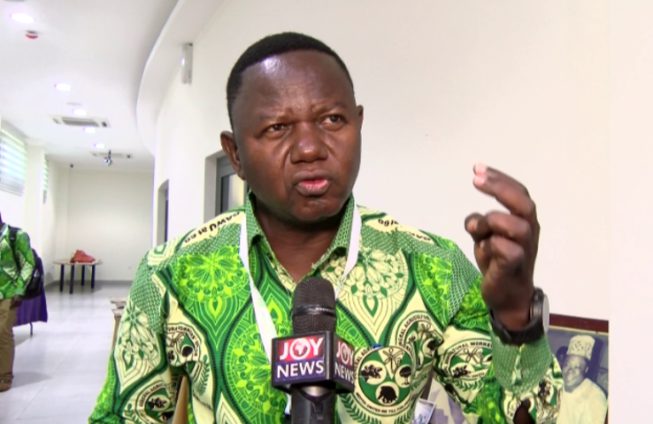
Tag: Edward Kareweh

  • I don’t see what Alan will do differently – GAWU General Secretary

    I don’t see what Alan will do differently – GAWU General Secretary

    General Secretary of the General Agricultural Workers’ Union (GAWU), Edward Kareweh has cast doubts on the effectiveness of Alan John Kyerematen’s policies in his bid to become flagbearer of the New Patriotic Party (NPP).

    Mr. Edward explained that Mr Kyerematen’s policies are generalised, making it difficult to conclude that such policies are not doable.

    “I believe all that happened had cabinet endorsement and he was one of them. So I’m not seeing what he could come to do differently. If he then becomes the president, he’s not the person who’s going to implement those policies,” he said on Wednesday.
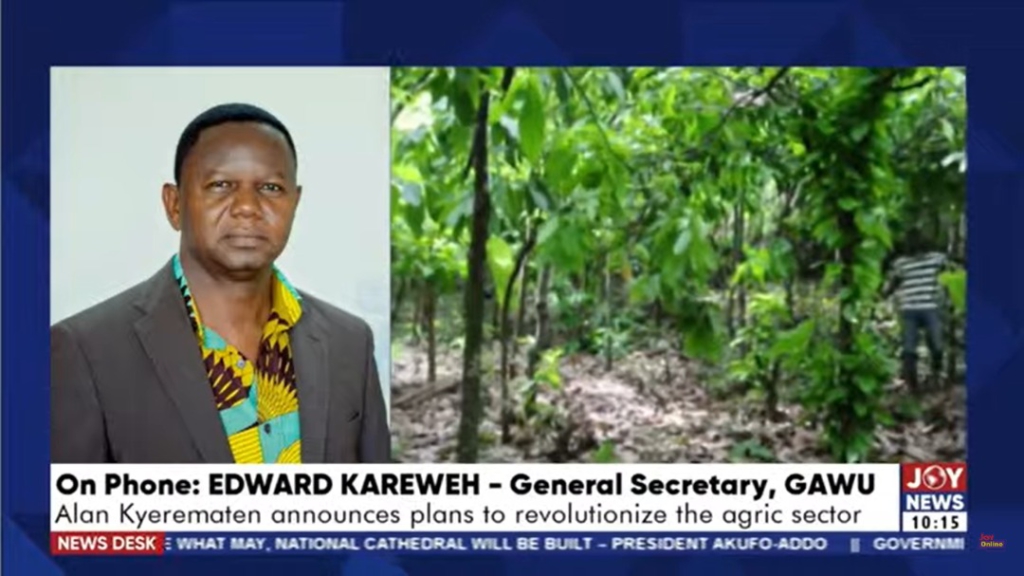
    I don't see what Alan will do differently - GAWU General Secretary

    Speaking on JoyNews’ News Desk, the union’s General Secretary insisted that the trajectory in the roll-out of policies by former Trade Minister’s government leaves questions about his latest announcement.

    “It’s his ministers like him as he is today who’s not a president that implement policies. So I’m not too sure that if he becomes the president and he has these ideas and then you have a minister to implement those policies, he can guarantee that those policies would be properly implemented.

    “So if he’s still talking about generalities, and when you’re are the point of generalities, it is very difficult for one to say it is not doable. But when it comes to the details, what we know, the experience that we already have in this country, particularly with his government gives a lot of doubt,” he added.

    However, a Marketing Consultant at the University of Education, Winneba, Dr. Bernard Tutu-Boahene is of the view that Mr Kyerematen’s speech reflects an acknowledgment of the “good things that the Akufo-Addo led government had done and he believes that there’s still room for improvement.”

    According to him, “the fact that he was serving in the Akufo-Addo-led government doesn’t mean that he was part of, he probably agreed with it.”

    He said Mr Kyeremanteng’s speech only reveals that he could have done things differently if given the nod.

    The former Trade Minister announced his resignation on January 10, 2023, to pursue his presidential ambition.

    The 67-year-old politician is seeking to file nomination to contest in the flagbearership race of the governing NPP.

    “I wish to use this platform to formally announce my decision to contest the flagbearership of the New Patriotic Party when the Party officially opens nominations for that purpose,” he said in a televised broadcast.

    Some policies revealed in his speech include; Downsizing of government, New Agricultural Revolution (NAR) for Ghana, a Strong Macroeconomic Environment amongst others which are classified under one title called the “Great Transformational Plan” (GTP).

    Following his resignation was another resignation of the Minister of Food and Agriculture, Dr. Owusu Afriyie Akoto who is also seeking to contest in the flagbearership race.

    Source: Myjoyonline

  • TUC decries freeze on employment in 2023 budget

    Trades Union Congress members have warned that the measures in the 2023 budget statement and economic strategy will worsen the nation’s economic problems and have called on their union to reject them.

    The TUC claims that the budget was intended to impoverish the typical Ghanaian and workers, citing the decision to forbid civil and public servants from taking on new jobs, the increase of value added tax (VAT) by 2.5 percent, and the removal of the levy threshold on electronic transactions (E-Levy), among other issues.

    Speaking at a post-budget forum organised by the TUC and themed ‘Rebuilding Path’, Secretary-General Agriculture Workers Union (GAWU), Edward Kareweh, described the budget as inimical to the aspirations of Ghanaians and labour.

    “The budget did not reflect the aspirations of Ghanaians. It did not reflect the aspirations of labour. It did not reflect the dire situation of farmers. Why am I saying so? In the budget, government agreed that the major concern of our country is unemployment.

    “We also know that unemployment has been rising. But the budget aims to increase unemployment through a deliberate policy not to employ people. It’s not by accident or inability of government to create jobs; they are saying that they are deliberately through this policy not going to employ people,” he stated.

    Speaking to journalists on the forum’s sidelines, the TUC Secretary-General, Dr. Yaw Baah, added that the decision will negatively impact productivity and welfare of the country.

    “Your effectiveness in service delivery will be affected, and the workers who are working will have to share the burden of those who have retired without any compensation; and that is why we have issues with this,” Dr. Baah said.

    He added: “We know that we are in crisis, but the policies we adopt as solutions to the crisis could even deepen it. That is not what we want. We want solutions which will be effective, will make sure everybody wins”.

    Speaking on the subject, Dr. Kwabena Nyarko Otoo – Director of TUC’s Labour Research and Policy Institute (LRPI), called for government’s economic policies in 2023 to go beyond the IMF bailout.

    He said government should roll-out homegrown policies which seek to transform the economy’s structure, with gricultural investment and industrialisation being a key policy in the medium- to long-term.

    Dr. Nyarko Otoo further called for an intensification of revenue mobilisation and implementation of the Exemptions Act, as well as ending harmful exemptions which deprive the state of revenues.

    “In the medium- to long-term, government must implement policies which can generate more revenue from our mineral wealth. Currently, Ghana receives just 10 percent of the mining sector’s revenues while government imposes a maximum 25 percent tax on wages/salaries of workers,” he stated.

    The forum afforded the TUC and its affiliates an opportunity to ascertain the extent to which the budget will help address current economic challenges and put the economy on a growth-path, so as to create decent employment for the citizenry.

  • 2023 Budget uninspiring for Agric sector – GAWU

    The General Agricultural Workers Union (GAWU) expresses dissatisfaction with the 2023 Budget declaration, calling the economic strategy “uninspiring” for the agricultural industry.

    Edward Kareweh, the general secretary of the GAWU, stated in a statement to Starr News that although the government announced an insurance policy for farmers as part of its investment plan, it fails to address important concerns plaguing the industry.

    “I believe that this budget’s status as an IMF budget has been proven, and it is uninspiring to us.
    This budget does not propose any dramatic policy changes to revive agriculture.

    He added: “This is a budget that has concentrated on trying to constrain benefits to workers. This is a budget that has concentrated on raising taxes to affect workers and the entire Ghanaian population. This is a budget that has got austerity measures that are not targeted at those who are benefiting from the current crisis but rather the measures are seeking to further take away the little that the vulnerable have.”

  • I’m not too optimistic 2023 Budget will address challenges within agriculture sector – GAWU

    The General Agricultural Workers Union (GAWU) is casting doubts over the 2023 Budget turning the fortunes of the sector around.

    Prices of foodstuff have shot up significantly this year, with some items going up by more than 50%.

    Though the growth rate of the sector has been appreciable, the high food prices, which is partly due to high fuel prices, has been a major concern.

    General Secretary of GAWU, Edward Kareweh, told Joy Business the sector may not see considerable funding for next year because of the expected austere budget.

    “I’m not too optimistic that the challenges within the agriculture sector will be addressed in the coming budget. I’m saying so because the budget is going to be an austere budget, whether government has concluded the negotiation with the IMF or not.”

    “I expect the budget to reflect some conditionalities that the IMF will be expecting the Ghana government to carry on before they reach a deal”.

    To this end, Mr. Kareweh does not expect investments in agriculture in 2023.

    “I’m not seeing how there will be adequate budgetary allocation to agriculture in the 2023 Budget, increase investments and so on.

    Source: Myjoyonline.com

  • There is food in Ghana but locked up at the farm gate – GAWU

    “There is food in Ghana, but locked up at the farmgate, things are not well,” Mr. Edward Kareweh, General Secretary of the General Agricultural Workers Union (GAWU) has revealed.

    He said, “things are not done properly. Improper application of laudable policies has created a problem, where food is cheap at the farm, but expensive on the side of the final consumer.”

    “Poorly formed relations along most Agricultural value chains in the country were fostering a high degree of predatory behaviour between actors, affecting the sector negatively,” he said.

    This predatory, Mr. Kareweh explained, also worsened, and weakened the reinforcing system that limited investments and decreased efficiency and resiliency, preventing competitiveness which overall affected the incomes and willingness of the ordinary farmer to purchase inputs.

    Mr. Kareweh was speaking on the theme: “Ghana’s Agricultural Value Chain,” at the 17th Monthly Stakeholders Engagement and Workers’ appreciation day seminar organized by the Ghana News Agency’s Tema Regional Office, which aimed at providing a platform for both state and non-state organizations to address national issues to enhance development.

    The event also served as a motivational mechanism to recognize the editorial contribution of reporters toward national development in general, growth, and promotion of the Tema GNA as the industrial news hub.

    The GAWU General Secretary argued that government policies must provide specific incentives to agricultural equipment dealers and users to help expand smallholders as key stakeholders.

    “So we must not blow our own trumpets that we are working. Let those we are serving judge. We must not praise a project because of its beautiful features, we must do that after seeing results,” he said.

    Mr. Kareweh stated that the financial sector was weak and poorly structured to take on capacity-building investments needed to effectively support the agricultural sector in general, specifically the equipment sector, which was hindering the value chain from its massive potential.

    He noted that wholesalers had limited interest in building branded retail channels, which passed through to the farmer making it less important as a leverage point for improving broader and more appropriate access for smallholders.

    He added that there were larger retailers with multiple outlets that were keenly interested in expanding their distribution networks but were concerned by the risks and cost of setting up new stores because of a failed economic system adding that the country needs a structural bailout.

    He stressed that the country currently lacks effective structural policies to optimize the competitiveness of the agricultural value chain.

    “Enhancing the competitiveness of the agricultural value chains demands improvement in productivity along the specific value chains for an effective and efficient input supply system,” has stated.

    Mr. Kareweh explained that formulating the right policies and allowing them to be championed by competent leaders would improve crop productivity and product quality along the agricultural value chains.

    He said there was a need for the government to create an enabling environment to help facilitate linkages between core value chain actors and support services including financial services, technical advisers, and mechanization services to producers.

    Mr. Francis Ameyibor, Ghana News Agency Tema Regional Manager explained that “we recognize the excellence in stakeholder engagement, which we believe will assist us GNA and our stakeholders to deliver and ensure that society plays an active watchdog role so that institutions perform.”

    He said the Agency was strategically placed as a credible news organization that needed to deepen its relations with its stakeholders for mutual benefit and to advance the prospects of the agency and the country.


  • MoFA has no business in food distribution chain – GAWU

    The General Agriculture Worker’s Union (GAWU) is raising some eyebrows about the activities of the Ministry of Food and Agriculture (MoFA) in the food distribution chain concerning its Planting for Food and Jobs (PFJ) pilot market.

    According to GAWU, the ministry has no business in the food middlemen business.

    The MoFA last Friday, November 11, 2022, piloted the sale of some selected food items at its forecourt in Accra to cushion some Civil and Local Government staff to get affordable food items in the wake of food price hikes in the country.

    The General Secretary of GAWU, Edward Kareweh questioned the ministry’s rationale for introducing the programme.

    He was of the view that the ministry was usurping the work of the National Buffer Stock Limited while speaking in an interview on the 505 news analysis programme hosted by Valentina Ofori Afriyie on Accra-based Class 91.3 FM on Friday, November 11, 2022.

    He was categorical in saying the ministry has no mandate to engage in such exercises when there is a dedicated company for doing so.

    He further questioned the ministry’s budget for playing the role of food middleman in the food distribution and supply chain.

    ”The ministry ought to tell us which budget they are using for the pilot programme when there is the need for the ministry to scale up its supply of fertilizers to farmers among others in the country,” he stressed.

    He said since 2021 the ministry has scaled down the supply of fertilisers to farmers across the country.

    This should be a source of worry to the minister and the heads of departments at the ministry and not dabbling in the food supply chain.

    He said there has been a drastic reduction in subsidies on fertilisers leading to a reduction in the volumes supplied to the farmers.

    He added that what is needed to salvage the situation is investments in agriculture and not the ministry drifting to areas it has no mandate.

    He said there is a shortage of maize which is a key component in PFJ crops and asked why the ministry is not working to make that available through the PFJ pilot market but rather focusing o plantain which is not part of the PFJ list of crops?


  • Planting for food and jobs policy largely ineffective – GAWU

    The government’s planting for food and jobs policy (PFJ), according to Edward Kareweh, general secretary of the General Agricultural Workers Union (GAWU), has been entirely ineffective.

    According to government data, the PFJ has had a positive impact on the agricultural sector. For example, farmer participation has increased from 202,000 in 2017 to 1.2 million in 2019, and yields have increased for both paddy rice and corn (from 688,000 MT in 2016 to 925,000 MT in 2019 and 71% for maize, respectively).

    However, Mr. Kareweh claimed in an interview with Emmanuel Agyabeng on Let’s Talk Business that these figures do not accurately reflect the state of the industry at the moment.

    “The figures the government gave us does not represent what is on the ground. You cannot tell us that maize production for instance, in 2020, had gone up than in 2019 when there was no covid and then few months later, there was no maize in the system. The poultry industry has suffered severely and since it has not recovered, how do you reconcile this? When there is no food, you claim the policy has been successful. Where is the success? ”, he quizzed.

    He also called out the government for blaming Covid-19 for the challenges in the sector.

    “Government said that in 2023, we are going to be sufficient in production. Today, they are blaming everything on Covid when in 2020 we had higher production volumes than the year before. That tells us that Covid never affected agriculture”, he said.

    Meanwhile, Executive Director of the Peasant Farmers Association of Ghana, Dr Charles Nyaaba has described decision of the Agric Ministry to issue fuel coupons for carting foodstuff as a Political talk.

    The Agric ministry announced in July this year that it was considering offering fuel subsidies to transport firms and owners to enable them to haul foodstuffs to the market centres and force down food prices. Two months on, the peasant farmers say they are yet to see the policy being implemented.

    When that announcement was made, it was always evident to us that the government lacked the necessary resources and that it wasn’t a wise course of action for them to take.
    Anyone in the industry can tell you if the government is helping them transport food to metropolitan centers.
    What method would they employ? It seemed to me like political talk,” Says Dr. Nyaaba

    “In my opinion, the government occasionally makes problems for itself.
    Things that we don’t insist on give the idea that they can be done, but when it comes to execution, they fall short.
    Without taking into account the availability of resources to carry out their promises, I believe the administration is being overly ambitious.
    Farmers’ faith in the government is actually declining, he continued.