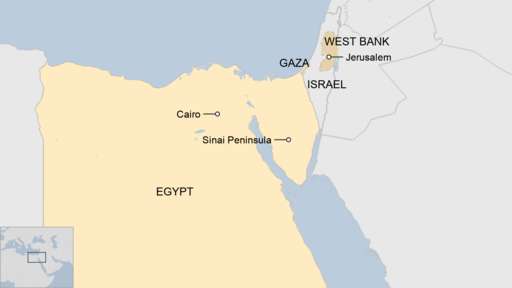
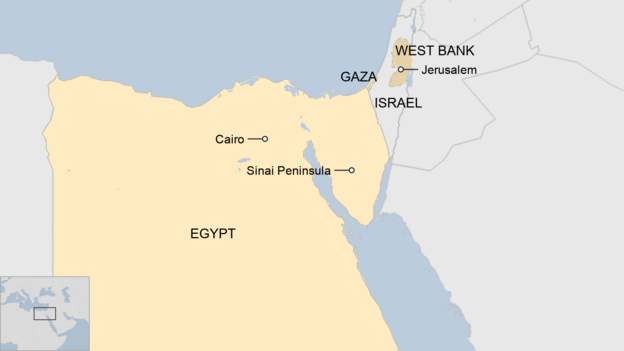
Egypt has revealed that it is routing international aid flights for Gaza through an airport in northern Sinai.
Egypt, a significant mediator between Israel and the Palestinians, has urged Israel to refrain from targeting the Rafah crossing between Egypt and Gaza, which was subjected to multiple bombings earlier in the week.
Several nations, including South Africa, have extended offers to assist in resolving the crisis. Multiple sources indicate that Egypt had alerted Israel to a looming attack days before Hamas initiated a deadly cross-border raid into Israel.
However, Israeli leader Benjamin Netanyahu dismissed these reports as “absolutely false.”
Egypt is sending help from different countries to Gaza using an airport in the north part of Sinai.
The country in North Africa plays an important role in bringing together Israel and the Palestinians as a neutral middleman.
Cairo has requested Israel not to attack the Rafah crossing from Egypt to Gaza, which was bombed multiple times earlier this week.
Many other countries, including South Africa, have offered to assist in finding a solution to the crisis.
According to many sources, Egypt told Israel that an attack was coming, a few days before Hamas attacked Israel from across the border. But Israeli leader Benjamin Netanyahu said that the reports are completely untrue.
Egypt told Israel about possible violence three days before Hamas attacked across the border, according to a chairman of a US congressional panel.
Michael McCaul, who is in charge of the House of Representatives Foreign Affairs Committee, informed reporters about the reported warning.
Israeli Prime Minister Benjamin Netanyahu said the reports are “not true at all”.
Israeli intelligence services are being questioned for not stopping the most deadly attack ever made by Palestinian militants in Israel’s 75-year history.
According to Mr. McCaul, who spoke to reporters after a private intelligence briefing, Egypt had told Israel three days before that something like this could occur.
“I don’t want to discuss classified information, but a warning was issued,” said the Texas Republican. I believe the question was asking about the level.
An Egyptian intelligence official recently told the Associated Press news agency that Cairo had warned Israel multiple times about a major event that was being planned from Gaza.
We told them that a big explosion in the situation is going to happen soon. But they didn’t fully understand or believe these warnings,” said the official, who chose to remain anonymous.
The person from Cairo said that Israeli officials have not been taking the threat from Gaza seriously and have been paying more attention to the West Bank.
Sir Alex Younger, who was in charge of the UK’s foreign intelligence agency from 2014 to 2020, stated that Hamas fighters were able to attack on 7 October because there was a lack of alertness and preparedness in Israel.
He said on BBC Radio 4’s Today Podcast that Israel may have thought that Hamas didn’t want another fight, so they ignored any information that proved otherwise.
“He said that he believes there is information that could have been understood differently and would definitely be seen that way later, even though he is not directly involved. ”
He said that feeling too confident and relying too much on technology to watch over Gaza may have made people feel safe when they shouldn’t have.
According to the Financial Times, two officials who were not named and knew about the situation said that there was no solid information about a particular attack.
On Wednesday, Mr. Netanyahu said that any claim about Israel being warned before the attack was completely false.
Egypt has the power to decide who can enter or leave the Gaza Strip. It also helps to make peace talks between Israel and Hamas.
Over 1,500 fighters forcefully broke through the Gaza security barrier in a planned attack on Saturday, using land, air, and sea means.
Over 1,200 people have died in Israel due to the attacks carried out by Hamas. Over 1,000 people died when Israel bombed Gaza.
Israel has been attacking Hamas targets in Gaza because of something they did. The people who live in Gaza have no electricity because their power plant ran out of fuel.
Hamas is upset with US President Joe Biden’s comments made on Tuesday. Biden said that Israel had a responsibility to react to the attacks, which he described as a very cruel act.
The Palestinian group said that Mr. Biden’s words were provocative and intended to increase tensions in the Gaza Strip.
After the Hamas attack, the US said it would send an aircraft carrier, ships, and jets to the eastern Mediterranean. They also promised to give Israel more supplies and weapons.
The Israeli government says that two Israeli tourists and their Egyptian guide were killed by gunshots in Alexandria, Egypt.
Another person from Israel was hurt in the attack that happened on Sunday morning. The ministry said that the attack was done by someone from the nearby area.
Egyptian authorities have not confirmed yet.
But according to the private Extra News TV channel, a police officer shot at a group of people who were visiting an old Roman location called Pompey’s Pillar.
The person who attacked shot his gun without any specific target. A security source said this and also mentioned that the attacker was arrested at the place of the incident.
A video shared on social media showed that after the attack, there were at least two people who appeared to be dead on the ground at an ancient site.
The government of Israel is helping the Egyptian authorities to bring back Israeli citizens to Israel quickly.
The shooting occurred one day after the militant group Hamas from Palestine attacked southern Israel in a way that had never happened before. They sent many gunmen across the border from Gaza and launched thousands of rockets.
Approximately 350 people have died in Israel, and around 313 people in Gaza have been killed in air strikes from Israel as a response.
Egypt was the first Arab country to make peace with Israel in 1979. However, the way Israel treats the Palestinians has made many Egyptians not like it.
In June, a soldier from Egypt’s police force killed three soldiers from Israel near the border of the two countries. Egypt reported that there was a shooting between their soldiers and some people involved in smuggling drugs, but Israel said it was a planned attack by terrorists.
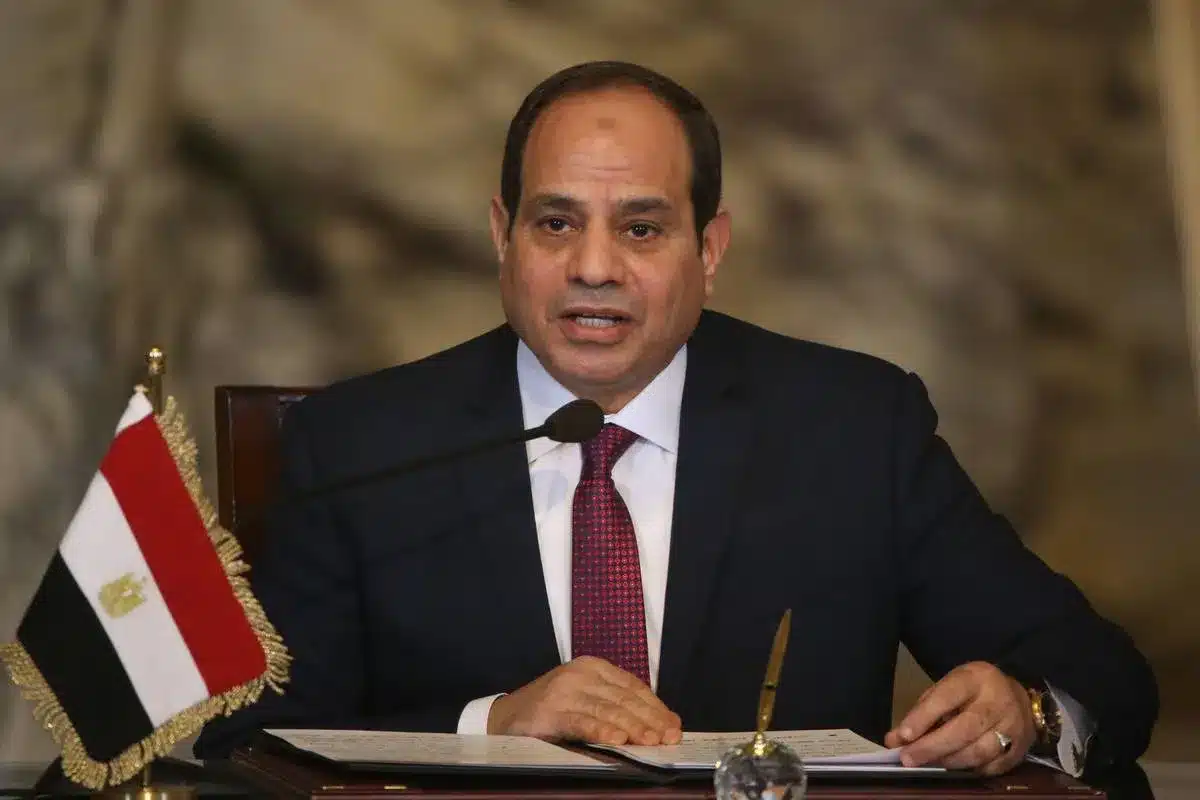
Around 400 individuals in Egypt have been taken into custody due to “riot incidents” following President Abdul Fattah al-Sisi’s declaration to seek a third term, as reported by local media.
President Sisi made comments on Tuesday that caused unusual public anger. Videos from social media went viral, showing protests in Marsa Matrouh, a city in the northwest.
In the video, you can hear people saying “Sisi out” and asking for his regime, which has lasted for ten years, to end. Other videos showed fights between people protesting and the police.
A news website reported that Saleh Abou-Attiya, who is the head of a lawyers’ association, said that 400 mostly young men were arrested.
The ex-military leader has been in charge since he helped remove Mohammed Morsi, the head of the Muslim Brotherhood, in 2013 during large protests against his leadership.
People who speak out against Mr. Sisi say that during his time in office, he has been very harsh towards anyone who disagrees with him, and the Egyptian economy has gotten much worse.
Egypt’s presidential elections are planned for December.
In a significant development, a massive fire has erupted at a police complex located in the city of Ismailia, situated in northeastern Egypt.
According to initial reports, multiple individuals have sustained injuries as a result of this incident.
Videos shared across various online platforms vividly illustrate the security directorate, a towering multi-story building, being engulfed in flames. Civil defense sources have indicated that certain sections of the structure have collapsed due to the intense blaze.
Eyewitnesses on the scene have noted that fire crews dispatched to the location appear to be facing considerable challenges in their efforts to bring the fire under control. Reuters news agency has cited witnesses who describe the scene as fire engines grapple with the inferno. However, there is some relief in the form of a later report from state TV, confirming that the fire has been successfully contained.
As of now, the cause of the fire remains shrouded in uncertainty and is the subject of ongoing investigation.
It is deeply concerning to note that deadly fires in Egypt are not uncommon occurrences, often attributable to inadequately enforced fire safety regulations. Tragically, this is not an isolated incident, as just last year in August, dozens of lives were lost in a devastating fire that swept through a church.
Our hearts go out to the victims and their families during this challenging time. We will continue to provide updates as more information becomes available. Please stay tuned for further developments concerning this alarming incident.
Over a week now, the teams said most of the victims’ bodies are in the sea, and some are in hard-to-reach places that require special tools to access.
The person from Tunisia said in a meeting with representatives from other countries that the bodies are decaying a lot and it may become impossible to get them back at some point. “We require help to make our intervention more effective,” he said.
Representatives from the UAE, Egypt, and Algeria said they found dead bodies in the Mediterranean Sea in places that can only be reached by special boats.
The person from Algeria said that his team saw about 50 dead bodies from a high cliff, about 7 miles away from the Derna port. However, only divers and boats can reach that area.
The person from Egypt said that if we have the correct boats, we can bring back 100 bodies each day.
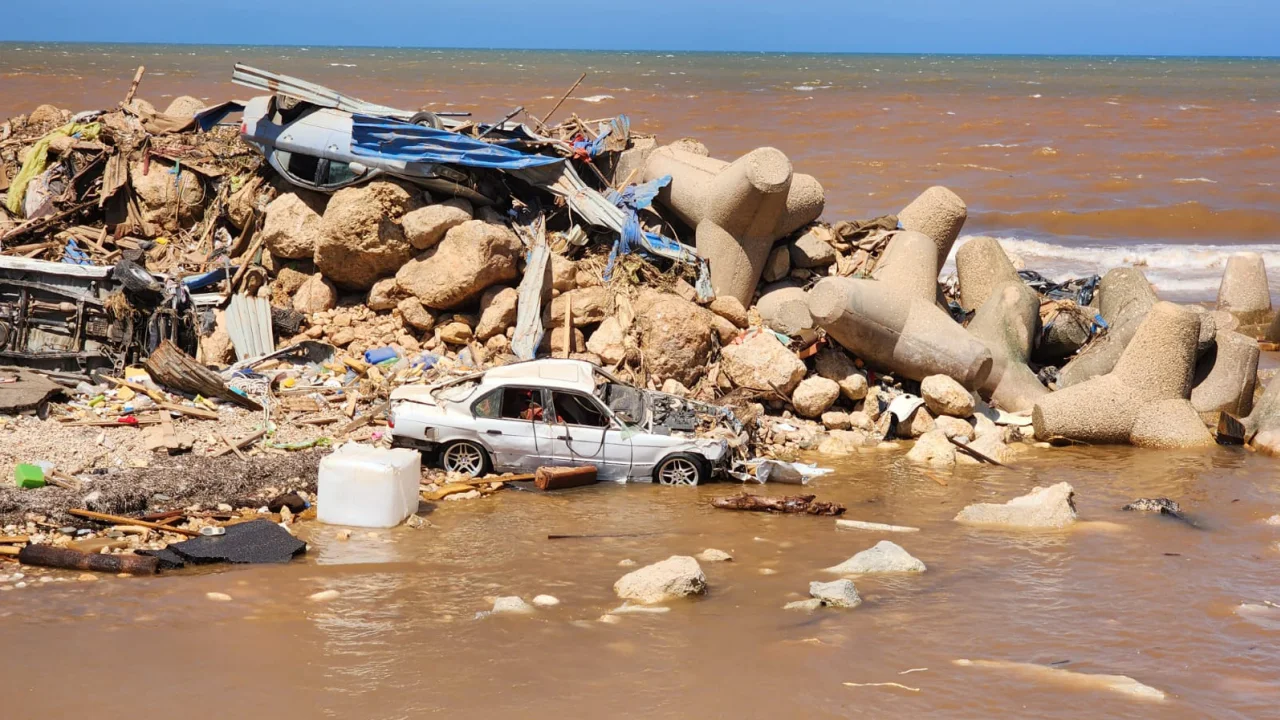
A very bad flood happened last Sunday and it washed away whole neighborhoods into the Mediterranean Sea.
We don’t know how many people have been affected by the floods in Derna. A report from the UN, released on Saturday, says that the number of people who have died has gone up to at least 11,300. There are also 10,100 people who are still missing.
However, the officials in Libya disagreed with this number. The health ministry of Libya’s eastern government said they have recorded 3,252 deaths in Derna. They believe the United Nations’ count is not correct. The health ministry records information about the dead bodies that are found and put in graves.
Over 40,000 people in northeastern Libya were forced out of their homes due to heavy rain brought by Storm Daniel, according to the United Nations.
According to experts, the storm’s impact was made much worse by a deadly combination of factors including old and falling apart infrastructure, not enough warnings, and the effects of climate change getting worse.
Derna, the center of the disaster, was divided into two parts when flood waters came and destroyed whole neighborhoods, creating a path to the sea. It had about 100,000 people before the sad event.
The waterfront is now being used as the main place to deliver and transport dead bodies for burial. This is because it is not safe to have decomposing bodies in multiple locations due to the health risks.
On Saturday, a group of people from CNN saw at least four bodies being carried and placed into a truck.
Two people from Derna who were helping said that on Saturday, 22 dead bodies were brought for burial. They said that on Friday, up to 90 dead bodies were brought.
The bodies of the people who died are not easily recognizable after seven days of flooding as they all appear similar. This was explained by a volunteer to CNN.
Asma Awad, one more person who offered to help, told Jomana that she lost many family members, including her husband’s whole family. Derna was a very pretty city, Awad said, and she nicknamed it “the mermaid. ”
Awad asked if Derna will recover and start again, then started crying.
Led by Lt Gen Osama Askar, the army chief of staff of Egypt, the group will start an airlift. They will use three aircraft to deliver medical supplies, food, and rescue teams. Another plane will assist in moving people who were hurt or killed during the storm.
The person speaking on behalf of the group shared pictures on Facebook that showed them being greeted by some Libyan military leaders, including Khalifa Haftar, who is in charge of the Libyan National Army in the eastern region.
In another message, the military spokesperson said that the Egyptian President, Abdul Fattah al-Sisi, told the armed forces to provide various kinds of help like medical staff, rescue tools, and temporary camps for people in need.
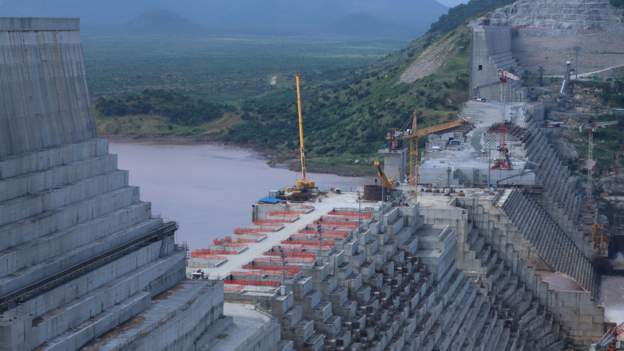
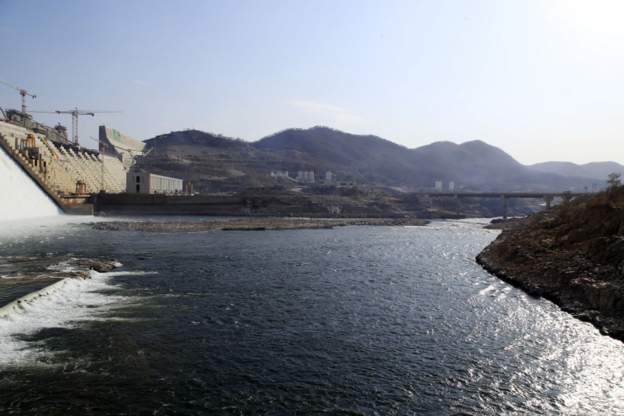
Ethiopia has been arguing with Egypt and Sudan about the mega project since it started in 2011. Egypt gets almost all of its water from the Nile River.
Egypt’s foreign ministry stated that Ethiopia was not considering the concerns of the countries downstream.
Ethiopia claims that the $4. 2 billion (£34 billion) dam won’t reduce their portion of Nile water.
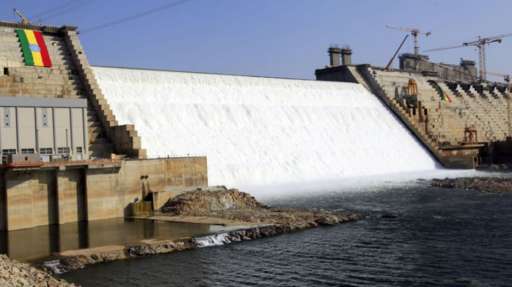
Ethiopian Prime Minister Abiy Ahmed said on X, which is formerly known as Twitter, that he is very happy to announce that the fourth and final filling of the Renaissance Dam has been successfully completed.
He said the project had problems from inside and outside, but “we managed to handle everything. ” The dam started making electricity in February 2022.
Ethiopia thinks that the Grand Ethiopian Renaissance Dam (GERD) will make twice the amount of electricity that the country currently produces. This will help the country develop and improve as almost half of its 127 million people do not have access to electricity.
The goal is to produce over 6,000 MW of electricity at the dam, which is located about 30km (19 miles) away from Ethiopia’s border with Sudan.
Egypt and Sudan are having a disagreement about the rules for how Gerd should work. They are worried that Ethiopia, who needs a lot of energy, could make their water shortages even worse.
Talks about the project started again last month. They had been stopped in 2021.
The country of Sudan, which is currently facing conflict between two armies, did not respond immediately to the announcement made by Prime Minister Abiy Ahmed on Sunday.
The Egyptian foreign ministry wrote on Facebook that Ethiopia filling the reservoir on its own is against the agreement signed by the three countries in 2015. They also said that Ethiopia’s action is illegal.
“The statement said that the three countries must agree on the rules for filling and operating the Gerd before they can start filling it. ”
“Ethiopia’s actions ignore the concerns and rights of the countries downstream. This goes against international law, which promises them water security. ”
Cairo, the capital of Egypt, has reopened talks over the contentious megadam that Ethiopia is constructing on the Blue Nile river.
The resumption of negotiations was confirmed by a statement from Ethiopia’s communications office.
For more than ten years, Ethiopia and the two nations that it shares a border with, Egypt and Sudan, have been embroiled in a diplomatic dispute over the $5 billion (£3.9 billion) hydropower dam.
The crucial water resources of Egypt and Sudan are feared to be in danger due to the dam.
There have been several rounds of negotiations, but efforts to sign a legally binding agreement have failed.
The leaders of Egypt and Ethiopia met in July and decided to resume their negotiations.
According to Ethiopia, the dam is a component of its plans to electrify millions of homes, primarily in rural areas.
The Egyptian authorities arrested then released a journalist who published articles accusing officials of involvement in smuggling cash, weapons and gold to Zambia.
The allegations by Karim Asaad followed the seizure by Zambian officials of a chartered aircraft at Lusaka airport.
It was said to be carrying more than $5m (£3.9m) in cash as well as pistols, ammunition and over 100kg of suspected gold.
Documents – purportedly from a Zambian investigation – had allegedly named several Egyptian army and police officers as suspects.
Egypt’s national press union says Mr Asaad was the 24th journalist to be detained in the country.
Mr Asaad works for the news site Matsda2sh. Colleagues of Mr Asaad have accused security forces of assaulting his wife and child during his arrest on Saturday.
On Thursday July 28, Egypt announced a series of measures, including planned power cuts, to address the surging energy consumption caused by the intense heat wave sweeping the country.
During a televised address on 6th August, Prime Minister Mustafa al-Madbouly called on the private sector to implement similar measures. He stated that civil servants who don’t work in public-facing roles would be required to work from home one day a week for a month to alleviate pressure on the electricity grids.
To manage the increasing energy demand nationwide, the planned power cuts are expected to last for one or two hours per day at most, and they will continue until the end of the ongoing heatwave. Some parts of the country have experienced temperatures exceeding 45 degrees Celsius this week.
The government began implementing the power cuts last week and also urged residents not to use elevators at specific times of the day.
This measure, however, sparked discontent on social media, with many people complaining that the power cuts, often during the hottest hours, lasted for more than two hours and occurred only once a week.
Egypt’s economy has been facing challenges due to soaring inflation and repeated currency devaluations, which have impacted purchasing power and the ability to import essential goods.
A similar energy crisis occurred during the presidency of Islamist Mohamed Morsi in 2013, leading to widespread anger and protests before he was ousted by the military.
In 2015, the Egyptian authorities struck a deal with Germany’s Siemens to construct three major power plants, with investments estimated at six billion euros, aimed at doubling the country’s electricity production.
Since then, Egypt has had to grapple with the depletion of its foreign exchange reserves and mounting debt, further exacerbated by Russia’s invasion of Ukraine.
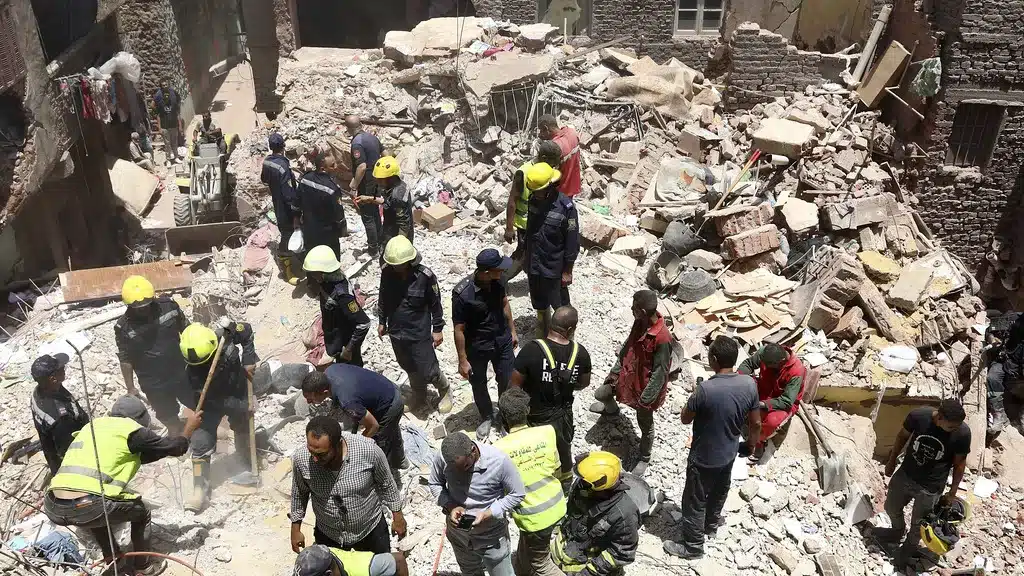
Authorities have reported that a five-storey building in Cairo, the capital of Egypt, collapsed on Monday, resulting in the tragic loss of at least nine lives. Rescue efforts are underway as teams diligently search through the debris.
Building collapses are unfortunately common in Egypt, largely due to substandard construction practices and a lack of maintenance prevalent in slums, urban areas, and rural regions.
According to the state-run MENA news agency, rescue teams have recovered the bodies of nine individuals from beneath the rubble in Cairo’s Hadaeq el-Qubbah district, situated approximately 3.2 kilometers away from the city center. Additionally, four survivors have been transported to the hospital, and authorities have evacuated a neighboring building.
Preliminary investigations conducted by Cairo’s deputy governor, Hossam Fawzi, have revealed that the collapse was caused by a ground-floor resident who had removed several walls during previous maintenance work. The individual has been apprehended and will undergo further scrutiny.
The Ministry of Social Solidarity in Egypt has announced its intention to donate 60,000 Egyptian pounds ($1,940) to the families of the nine victims. The ministry is also providing assistance to the injured individuals and monitoring the extent of damage to nearby properties.
Local reports indicate that the area has been cordoned off by the police, while rescue teams continue their search for any possible survivors.
In recent years, the Egyptian government has made efforts to combat illegal construction and enforce stricter regulations, following a long history of lax enforcement. Additionally, authorities are constructing new towns and neighborhoods to relocate individuals living in high-risk areas.
Ethiopia and Egypt have reached an agreement to restart negotiations concerning the controversial hydroelectric mega-dam being constructed by Addis Ababa on the Blue Nile river.
The nearing completion of the dam has caused diplomatic tensions between the two countries, with Egypt expressing concerns about potential impacts on its vital water supplies, while Ethiopia sees it as a crucial component of its plan to provide electricity to millions of households.
Prime Minister Abiy Ahmed and Egyptian President Abdul Fattah al-Sisi met in Cairo, where they agreed to engage in talks specifically regarding the filling of the dam’s reservoir.
They also aimed to finalize their agreements within four months, as stated in a joint statement from the Ethiopian prime minister’s office.
The dam’s reservoir has been gradually filled during the past three rainy seasons while the dam wall was being constructed. Egypt and Sudan, as downstream countries, objected to this action since it occurred without a binding agreement among all three nations.
The decision to resume talks has received commendation from the African Union. Construction of the dam began in 2011 and was initially projected to be completed within six years.
President of Egypt Abdul Fattah al-Sisi has pleaded with the warring parties in Sudan to put down their weapons in exchange for peace talks and to allow for the safe delivery of humanitarian goods.
He listed these as the top two priorities in his opening remarks at a summit on the war taking place in Cairo:
Firstly, calling on the warring factions to cease escalation and to start without further ado on serious negotiations that aim at reaching an immediate and sustainable ceasefire.
Quote Message: Secondly, calling on all Sudanese parties to facilitate the passage of humanitarian aid, to provide safe passage to deliver this aid to the areas most in need inside Sudan, and to establish a mechanism to provide needed protection to the humanitarian aid convoys and the staff of the international relief agencies to help them do their jobs.”
Secondly, calling on all Sudanese parties to facilitate the passage of humanitarian aid, to provide safe passage to deliver this aid to the areas most in need inside Sudan, and to establish a mechanism to provide needed protection to the humanitarian aid convoys and the staff of the international relief agencies to help them do their jobs.”
Some of Sudan’s neighbors, including South Sudan, Chad, and the Central African Republic, are also present at the summit.
The conflicting military factions have sent representatives to the summit, although earlier regional and global peace efforts have been unsuccessful.
Ghana now has higher interest rates than Egypt and 15 other nations in Africa.
With 24.39% and 26.03% for the 91-day and 182-day treasury bills, respectively, Ghana outperformed Egypt in the Weekly Fixed Income Update compiled by several investment firms, making it the highest among the top 15 African economies.
Egypt, on the other hand, came in second place among the top 15 African nations with rates for 91-day and 182-day Treasury bills of 23.41% and 24.02%, respectively.
Interest rates in Ghana drastically decreased when the Domestic Debt Exchange Programme (DDEP) was finished in March 2023. Since that time, the prices have consistently increased to roughly 30% (364-day bill).
The 91-day T-bill and 182-day T-bill also had declines of 10.97% and 9.95%, respectively, during the same time period in March.
Despite this, Ghana now has the highest interest rates in the world, with an average lending rate of almost 38%, making it one of the most expensive countries in Africa.
Since then, several economists and market observers have issued warnings about a potential rise in interest rates, particularly at a time when the government is looking for more money to fund its initiatives.
The Bank of Ghana’s Monetary Policy Committee will meet for the 113th time on the appointed date to decide the next policy rate from the present 29.5 percent in order to reduce inflationary pressures.
Liverpool and Egypt may face a potential disagreement as the Egyptian national team manager, Rogerio Micale, expresses his desire to include Mohamed Salah in his squad for the 2024 Olympic Games.
According to the Liverpool Echo, Micale has openly admitted his intention to have Salah participate as an overage player in the Olympics, which is scheduled to take place between July 26 and August 11 in Paris.
If Salah were to be selected, it is likely that he would miss the beginning of the 2024-25 season, as his involvement in the tournament would overlap with the start of domestic fixtures.
Moreover, Salah is already expected to participate in the Africa Cup of Nations (AFCON) between January and February of the upcoming season, leading to his absence from several Liverpool matches.
Liverpool has previously turned down a request for Salah to participate in the Olympics, rejecting a similar proposal for the Tokyo edition in 2021.
As such, the situation between Liverpool and Egypt may potentially lead to a dispute regarding Salah’s availability for both international and club competitions.
Because the Olympics is a non-FIFA sanctioned event, clubs can block their players from participating, and Liverpool may do so again.
Micale said: “We still have one year to think of the matter and evaluate the situation, but for sure we welcome Salah… Salah is as significant as Neymar in Brazil.”
Salah is likely to be key for the Reds as they attempt to recover from a disappointing 2022-23 season, in which they failed to qualify for theChampions League.
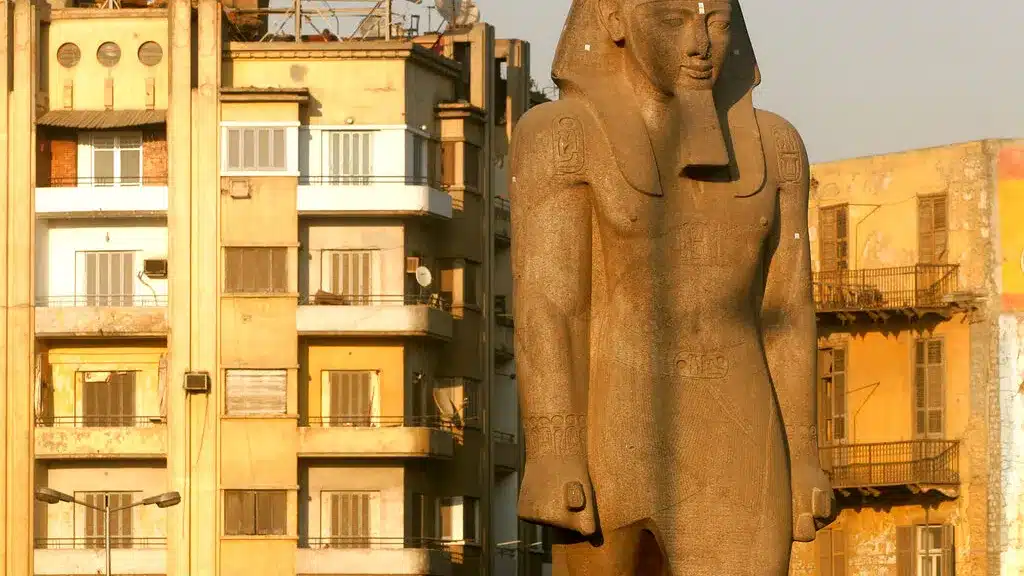
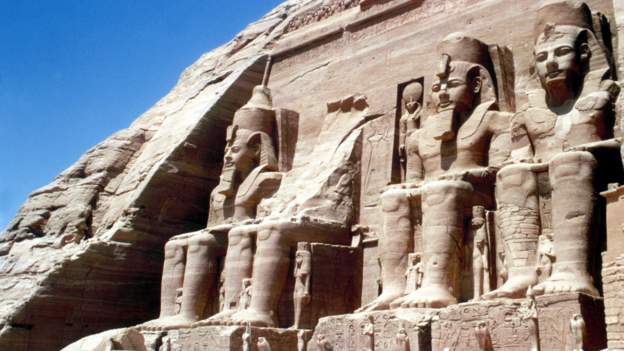
On Monday, Switzerland returned a fragment of a statue of Pharaoh Ramses II to Egypt, which had been stolen several decades ago from a temple in Abydos.
Carine Bachmann, the director of the Federal Office of Culture (OFC), handed over this “significant archaeological artifact” to the Egyptian embassy in Bern, Switzerland.
The fragment belongs to a stone sculpture of Pharaoh Ramses II, which is part of a group statue featuring the king alongside various Egyptian deities, according to the OFC.
Ramses II ascended to the throne at the age of 25, succeeding his father Seti I, and his reign lasted approximately 66 years, making it the longest in Egyptian history. Currently, there is an exhibition dedicated to Ramses II in Paris, which runs until September 6th.
The fragment that was returned had been stolen from the temple of Ramses II in Abydos, Egypt, between the late 1980s and early 1990s.
It had passed through several countries before reaching Switzerland, where it was ultimately confiscated by the authorities in the canton of Geneva following legal proceedings.
“This restitution underlines the joint commitment of Switzerland and Egypt to combat the illicit trade in cultural property, reinforced in 2011 by the entry into force of a bilateral agreement on the import and return of cultural property. “, said the Federal Office of Culture.
Both Switzerland and Egypt are parties to the 1970 UNESCO Convention to Prohibit and Prevent the Illicit Import, Export and Transfer of Ownership of Cultural Property.
Campaigns in Egypt demand that young females no longer get circumcised. The 28 million women who have previously undergone genital mutilation have just one private clinic to turn to for assistance, even if the state wishes to safeguard future generations.
Nourhane, in her thirties, took the plunge at the end of 2021. This resident of Alexandria, in the coastal north, who speaks under a pseudonym, turned to surgeon Reham Awwad to “become once again the one who decides for (her) body”.
Eight months after a reconstruction operation, her chronic pain has been replaced by “completely new sensations” and “a clear physical and psychological improvement,” she explained.
It has only been possible to carry out this type of operation in Egypt since 2020.
By founding Restore FGM, Dr Awwad and her colleague Amr Seifeldin have offered victims a rare space in a country where disclosing excision is still taboo.
Surrounded by psychologists, they offer therapies, plasma injections to regenerate damaged tissue and clitoral reconstruction.
“Surgery is the last resort”, insists Dr Awwad, adding that plasma injections combined with psychological support “can reduce the need for surgery by 50%” and avoid another traumatic procedure.
This is the option being considered by Intisar, who is also speaking under a pseudonym. “Something in me has been broken, and I want to repair it”, told the forty-year-old.
When she was 10, “my grandmother took me to a doctor who excised me”, and she kept saying “it’s for your own good, you’re better off like that”. Despite being a doctor and the headmistress of her school, her parents had agreed to the operation during the summer the peak of girl circumcisions, according to campaigner Lobna Darwish.
An old tradition now medicalized
To combat this practice, “we need to run prevention campaigns in schools before the summer holidays”, argues Ms. Darwish, who oversees gender issues at the Egyptian Initiative for Personal Rights (EIPR).
The figures are staggering according to the authorities, 86% of married Egyptian women aged between 15 and 49 had been circumcised by 2021. UNICEF estimates that 200 million women in the world have been circumcised. More than one in ten is Egyptian.
In the most populous of Arab countries, excision involves the removal of the clitoris and labia minora. According to the World Health Organization (WHO), it causes pain, hemorrhage, infections, painful sexual relations and complications during childbirth.
Although illegal since 2008 and regularly denounced by the Muslim and Christian authorities, this age-old practice remains widespread in the patriarchal and conservative country, where many clinics offer it.
After years of campaigning against traditional excisers, three quarters of Egyptian women have been circumcised by a doctor, according to official figures.
“Excision cuts across all social classes,” says Intissar, now a journalist.
Promoted as a “cosmetic” operation, she continues, it is in fact aimed at “disconnecting women from their bodies and their pleasure”.
“We were told that it was religious, that it was better, cleaner”, agrees Nourhane, who was mutilated at the age of 11 with her eight-year-old sister under the gaze of the women in her family.
Egypt isn’t the only country that practices this ritual in Africa.
Three British tourists are missing after a fire on board a boat during a sea cruise in the Egyptian Red Sea.
Twenty-four other people, including 12 Britons, were rescued from the boat, called Hurricane, which was off the coast of Marsa Alam, authorities said.
They added that initial reports suggested the fire was the result of an electrical fault.
The boat had been on a dive cruise and had left Port Ghalib on 6 June and had been due to return on Sunday.
Local authorities said 15 British passengers had been on board along with 10 crew members and two guides.
The Red Sea Governorate said initial examinations had found an electrical short circuit in the engine room, while the public prosecution office had begun an investigation.
All of those who had been rescued were said to be well.
The Red Sea is a popular resort for diving trips.
“This is really bad news for the tourism industry,” said BBC News correspondent Sally Nabil Nabil. “They depend on tourism, particularly British tourism.”
The Foreign Office said it was supporting British nationals involved.
A spokesman said: “We are in contact with local authorities following an incident aboard a dive boat near Marsa Alam, and are supporting British nationals involved.”
Before being devoured by a shark in Egypt, a man screamed “Papa, save me” in front of his grieving father and startled spectators.
The tiger shark killed 23-year-old Russian citizen Vladimir Popov by mauling him to death off the coast of the Hurghada vacation town in the Red Sea.
Online videos of the attack show Mr. Popov writhing around in the water while being repeatedly mauled by a shark. Then he is pulled under.
Then, according to a witness, the animal played with Mr. Popov’s body for two hours.
The shark was eventually caught, and footage shows it being brought into shore on a boat, before being beaten to death.
Mr Popov’s devastated dad Yury, who saw the attack, told local media his son yelled ‘papa, save me’ as he was attacked.
Yury added: ‘We went to the beach to relax. My son was attacked by a shark. It all happened in seconds.
‘What kind of help can you give? This meat grinder happened in 20 seconds, he was just dragged under the water…’
He said the beach was safe and described the killing as an ‘absolutely ridiculous coincidence’.
Yury added: ‘There are ships and yachts around. It’s never happened there. They usually attack on wild beaches. It is just some kind of evil fate.’
The Russian Consulate in Hurghada confirmed Popov was Russian but said he was a permanent resident of Egypt. It’s believed he’s been living in Egypt for a number of months.
Other beachgoers were seen frantically running out of the water when the attack happened.
An eyewitness said: ‘Children swim [in the area where theshark attacked] very often – there were children’s slides.
‘All this happened not far from a descent into the sea, next to the ladder, used by everyone who went into the water. At one point, the shark appeared, and immediately bit this man.
‘Rescuers saw this and began to start the boat. He tried to swim away from the shark, but he couldn’t.
‘It immediately saw through him, his legs surfaced quickly. And it dragged the body for two hours. It constantly dragged him under the water.’
Another source said there was a woman in the water not far from the man who was screaming.
They said: ‘The rescuers dragged her onto the boat, after which they rescued two more girls.
‘They were all taken away by doctors or the police, because they were in [a state of] shock, hysterical.’
The 46 mile (74km) stretch of coastline was closed off and is not expected to reopen until Sunday.
The ministry said the shark is being looked at in a laboratory to try and establish why it attacked, and if it was responsible for other maulings.
Although it’s not common for sharks to attack in the coastal regions of the Red Sea, an Austrian and a Romanian tourist were killed within days of each other last year.
Tourists, including many from Europe, flock to Egypt’s Red Sea resorts each year, with divers being drawn to the coral reefs and colourful sea life.
But numbers have been hit by years of political instability, the Covid pandemic and the war in Ukraine.
Tiger sharks are one of the larger shark species that can grow to over five metres. The live in mostly tropical and temperate waters and are among the most cited by the International Shark Attack File for unprovoked attacks on humans.
Last month an American tourist lost her foot in a shark attack while snorkelling in the Turks and Caicos Islands.
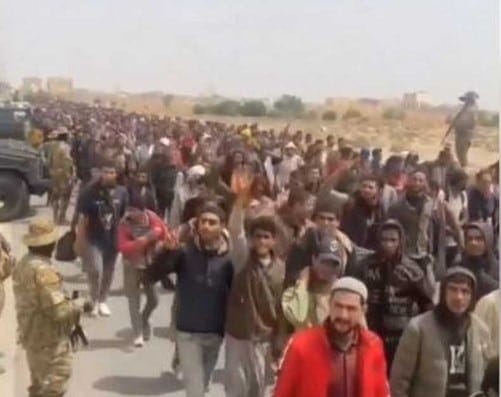
Reports emerging from Libya indicate that a significant number of Egyptian migrants have been forcibly expelled and made to undertake a challenging journey on foot back to Egypt.
Libyan authorities have conducted raids on people traffickers in the eastern part of the country, resulting in the discovery of approximately 4,000 migrants, as confirmed by a Libyan security source.
However, an Egyptian security source has countered these claims by stating that only those individuals who were residing in Libya illegally, constituting around half of the total number apprehended, were subjected to deportation.
This suggests that the other half had legal status or valid reasons for being in Libya.
Migration agencies estimate that there are approximately half a million migrants currently residing in Libya.
Many of them harbor aspirations of reaching Europe by crossing the Mediterranean Sea, while others have managed to secure employment and establish settled lives within the country.
In ancient mummification factories and tombs found close to the capital Cairo, a stunningly well-preserved Egyptian sarcophagus has been found.
The beautiful blue, yellow, and maroon-patterned coffin was discovered in the Pharaonic necropolis of Saqqara, a section of Memphis, the former capital of Egypt and a Unesco World Heritage site.
In addition to the sarcophagus, archaeologists discovered clay pots, stone beds, and ceremonial containers in addition to natron salt, one of the primary materials needed for mummification.
Unveiling the spectacular find, Mostafa Waziri, secretary-general of the Supreme Council of Antiquities, said the workshops had been used to mummify humans and sacred animals.
They are believed to date back to the 30th Pharaonic Dynasty (380BCE to 343BCE) and Ptolemaic period (305BCE to 30BCE).
The tombs found nearby date back much further. One belongs to Ne Hesut Ba of the Old Kingdom’s fifth dynasty, 4,400 years ago, and the other to Men Kheber of the late kingdom’s 18th dynasty, 3,400 years ago. Both men were priests.
Inscriptions of cultivation, hunting and other daily activities were found on the walls of Ne Hesut Ba’s tomb, while ‘scenes showing the deceased in different positions’ were engraved in Men Kheber’s tomb, officials said.
In January, archaeologists found 4,300-year-old statues of Egyptian priests, officials and servants in Saqqara, while last year the necropolis revealed a ‘dream discovery’ in the sarcophagus of Ptah-em-wia, treasurer for King Ramses II – also known as Ramses the Great.
Egypt’s government has heavily promoted new archaeological finds to international media and diplomats in recent years. It hopes that such discoveries will help attract more tourists to the country to revive an industry that has suffered since the 2011 Arab Spring, and been further impacted by the Covid-19 pandemic and Ukraine war.
The government, lawmakers, giant corporations, and startups in Japan are keen to invest in Africa.
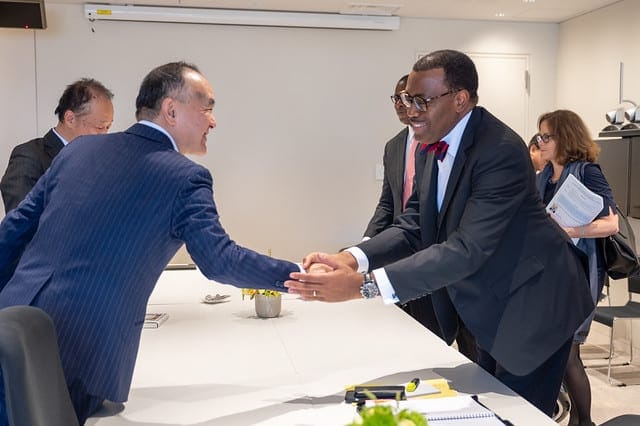
As a delegation from the African Development Bank Group led by President Dr Akinwumi Adesina visited Japan to showcase the enormous investment opportunities on the continent, the Prime Minister of Japan Fumio Kishida, was leading his country’s charge with a tour of four countries, namely Egypt, Ghana, Kenya, and Mozambique.
In Japan, Dr Adesina accompanied by three Vice Presidents, Dr Kevin Kariuki, Dr Beth Dunford and Solomon Quaynor, and Executive Director Takaaki Nomoto, held a series of meetings with senior government officials including the Minister for Finance Shunichi Suzuki, Vice Minister for Finance Masato Kanda and the Director General in the Ministry of Finance Atshushi Mimura.
They met with the top leadership of global mega brands including Mitsui & Co Ltd., Sumitomo Corporation, Mitsubishi Corporation and Toyota Tsusho, as well as Japan’s leading business community, the Keizai Doyukai, that brings together more than 1000 business executives.
The result of this high-level engagement could see Japan’s net Foreign Direct Investment to Africa rebounding to pre-Covid19 levels when it amounted to $10 billion compared to $6 billion in 2021.
In this write up we take a look at what the companies are looking for and a keynote message delivered by Bank President Dr Adesina. MITSUI & CO LTD
One of the largest investors in Africa, Mitsui & co Ltd, announced plans to resume the construction of the multibillion-dollar Mozambique LNG project which was stopped in 2021 following an insurgent attack on the facility in the country’s northern region of Cabo Delgado.
A combined deployment of the Mozambican army, troops from Rwanda and members of the South African Development Community (SADC) has since brought the situation under control.
“The security situation has been significantly improved. We want to restart construction work in summer,” announced Koji Asanuma, General Manager, Mozambique Project Dept(link is external).
He said preparatory work was continuing and they will soon be contacting lenders to kickstart construction.
The African Development Bank has invested $400 million in the project.
Mitsui & Co Ltd has five 5 offices in Africa: Ghana, Kenya, Morocco, Mozambique and South Africa.
In addition to Mozambique’s LNG project, the company has also invested in Mozambique’s Nacala Rail and Transport project and Egypt’s Refining Company. It’s involved in renewable energy projects in Morocco, South Africa, Kenya, Nigeria, and Uganda. TOYOTA TSHUSHO:
Toyota Tshusho Corporation is one of the front-runners among Japanese companies doing business in Africa. It is present in all 54 countries with businesses covering automobile, pharmaceutical, beverages and energy. Across the continent it employs about 22,000 people.
The Executive Vice President of Toyota Tsusho Corporation Toshimitsu Imai said the company is looking for more projects for wind power in North Africa, solar energy in West Africa and Geothermal in East Africa. Globally it is aiming to generate 10 GW.
The company is keen to discuss with the Bank the possibility of investing in Green Hydrogen. It’s carrying out studies in South Africa, Kenya and Egypt. “We will come to the Bank to discuss financing,” said Imai.
In terms of local manufacturing of lithium-ion batteries used in electric vehicles, Imai saw possibilities in South Africa which has a huge automobile industry or DRC which has some of the world’s largest deposits of minerals needed for lithium-ion batteries.
The Toyota Tshusho Executive Vice President also expressed interest in the Africa Pharmaceutical Technology Foundation, an Africa-led and Africa-centered initiative that will significantly enhance the continent’s access to the technologies that underpin the manufacture of medicines, vaccines, and other pharmaceutical products. MITSUBISHI CORPORATION
AfDB President’s visit to Tokyo: Meeting with Mitsubishi Corporation
The company is present in 11 countries in Africa: Algeria, Cote d’Ivoire, Egypt, Ethiopia, Kenya, Morocco, Nigeria, Senegal, South Africa. Tanzania and Tunisia. Since entering the African market in 1954, Mitsubishi Corporation has spread its investment wings mineral and metal resources, automotive & mobility, natural gas, food industry and power solutions.
During a meeting with Dr Adesina, it was clear Mitsubishi Corporation is hungry for more. It’s Senior Vice President Tetsuya Shinohara, said the company had limited activities on the continent.
“Africa is a tough region,” he said, “We are figuring out areas to invest in, in the future. We are asking for suggestions about the way to follow.”
The Deputy General Manager for Global Strategy and Coordination Department Jun Fujino said there are stereotypes about doing business in Africa because of political instability, unpredictability of regulatory frameworks and that the consumer market may take too long to develop. SUMITOMO CORPORATION
AfDB President’s visit to Tokyo: Bilateral Meeting with Sumitomo
Another large Japanese general trading house, Sumitomo Corporation with investments in mineral resources, energy, chemical & electronics, real estate, media & digital, transportation & construction system is eager to expand its business on the continent.
“We want to grow together,” Masayuki Hyodo, President and CEO, Sumitomo Corporation said as discussions with the Bank delegation begun, adding, “We have started new business in Egypt, and we want to expand further.”
And the response was commensurate. “You are in the right place,” Dr Adesina told Mr Hyodo, “You are with the right partner. On infrastructure, we are trying to expand in green infrastructure in terms of roads, water and digital. We are trying to mobilize $10 billion to invest in green infrastructure.”
Sumitomo has offices in Algeria, Ethiopia, Ghana, Kenya, Madagascar, Morocco, Mozambique, Tanzania and South Africa. ROUNDTABLE DISCUSSIONS
AfDB President’s visit to Tokyo: Roundtable with the Private Sector
During the visit, the Bank delegation held roundtable discussions with about ten Japanese companies and Venture Capital funds operating in Africa. The discussion focused on new technologies related to energy and decarbonization such as next-generation solar power, hydrogen/ammonia, and storage batteries. They also discussed how Japanese technology and innovation can contribute to solving social issues in Africa. The roundtable featured a presentation by the Bank’s Vice President for Power, Energy, Climate Change and Green Growth, Dr Kevin Kariuki.
The second session featured Japanese entrepreneurs and investors with interest in the agriculture sector.
They were joined by venture capital companies to highlight the significant role startups play in the development in Africa. The session had presentations from two Bank vice presidents – VP for Agriculture, Social and Human Development Dr Beth Dunford, and Private Sector, Infrastructure and Industrialization VP, Solomon Quaynor.
The roundtable discussions culminated in a keynote address by Dr Adesina. The roundtable discussions were organized by Keizai Doyukai and the United Nations Development Fund. Keizai Doyukai, a private, non-profit and nonpartisan organization that brings together nearly 1,400 top executives of some 1,000 corporations.
Participating firms included:
Toshiba Energy Systems & Solutions Corporation: has invested in generation of thermal and hydropower projects across 10 countries.
Hitachi Energy: another global technology leader with significant investments in generation of renewable power including hydrogen. It has a presence in more than 20 countries with main hubs in Cairo and Johannesburg.
Kawasaki Heavy Industries Ltd: a manufacturer of motorcycles, aerospace and defense equipment, robots, gas turbines and other industrial products.
Tsubame BHB: is a startup company involved in the production of green ammonia fertilizer for small-scale farmers in Africa.
AfDB President’s visit to Tokyo: Visit of Tsubame BHB
NEC Corporation: began operating in Africa in 1963 delivering technologies behind establishing national ID and biometric authentication systems in South Africa, laying telecommunication infrastructure such as the 6,200-km-submarine cable between Angola and Brazil.
Kepple Africa Ventures: launched in Africa in 2018. It is the largest Japanese Venture Capital fund based in Nigeria and Kenya. It led 15 Japanese companies such as Mitsubishi UFJ Financial Group, Toyota Tsusho Corporation and Yamaha to make direct investment into African startups.
Degas Limited: is a startup company based in Japan and Ghana where it is providing agricultural inputs, knowledge and digitalization support to 3,000 farmers.
Uncovered Fund: established in 2019 in Tokyo, has invested in 26 African startup companies particularly those that provide financial services essential for daily life and economic activities, sales promotion of retail stores, logistics in distribution and supply and urban transportation. It’s based in Egypt, Nigeria, Kenya and South Africa.
AfDB President’s visit to Tokyo: Bilateral Meeting with AAIC
The Asia-Africa Investment & Consulting (AAIC): aims to invest in fast-growing companies within the healthcare sector in Africa. Among other activities, it is investing and managing agribusiness in Rwanda via the Rwanda Nuts Company.
Sasakawa Africa Association activities go back 36 years when it was established by Japanese Philanthropist Ryoichi Sasakawa, Nobel Laureate Dr Norman Borlaug and former US President Jimmy Carter.
AfDB President’s visit to Tokyo:Bilateral Meeting Sasakawa Africa
The association focuses on agriculture and especially smallholder farmer development in 12 countries across sub-Saharan Africa. President Makoto Kitanaka spoke about the association’s increasing use of technology in the delivery of its services. Dr Adesina meets with University of Tokyo
The University of Tokyo is investing in startups, with more than 400 already up its sleeves. Wassha, one of the startups associated with the University of Tokyo has developed an electrical power service business to reach people in rural Tanzania who do not have access to electricity. Beneficiaries rent LED lanterns which are offered on a Pay As You Go system.
AfDB President’s visit to Tokyo: Bilateral Meeting with President of the University of Tokyo
The University of Tokyo President Dr Teruo Fujii and Dr Adesina discussed ways their two institutions could collaborate including the possibility of establishing a joint Japan Africa Entrepreneurship program. This would bring together venture capital funds, establish joint businesses and establish a staff exchange program between the University of Tokyo and selected universities in Africa.
The two leaders also spoke about the possibility of collaboration between the University’s School of Pharmacology and the Rwanda-based African Pharmaceutical Technology Foundation
The Bank delegation also held meetings with Japanese Bank of International Cooperation(link is external) and Japanese International Cooperation Agency(link is external) which signed a $350 million funding agreement with the Bank to support Africa’s private sector.
Before his departure Dr Adesina met with diplomatic representatives of more than 30 countries in Africa. He shared with them the achievements the Bank had made over the past seven years and the urgent need to attract more foreign direct investments to Africa.
AfDB President’s visit to Tokyo: Reception for African Development Bank, African Diplomatic Corps (ADC)
Following the five-day roadshow to showcase Africa’s enormous investment opportunities, the message was clear: The door and the road to Africa for Japanese investors is wide open!
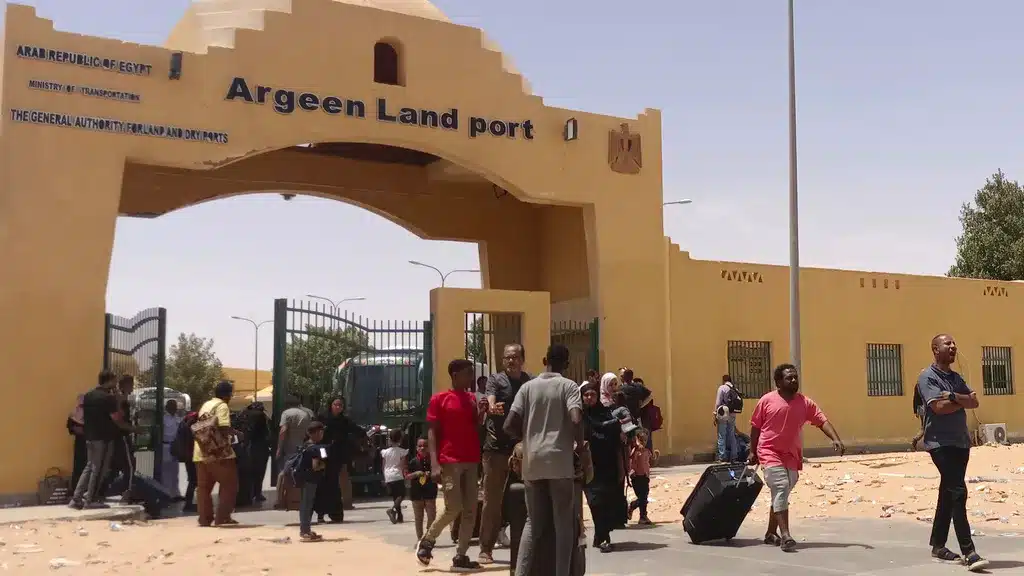
Thousands of Sudanese have begun entering Egypt through the northern Arqin border as a result of the conflict that broke out in their nation in mid-April between the army and the paramilitary Rapid Support Forces.
Buses are lining up at the border area and families have been sleeping outside in the desert, waiting to be let in to the neighbouring country.
“I left my home, my place because of the fighting between people of the same country against each other,” said Sudanese citizen Nawal al-Sharif.
The Egyptian foreign ministry said Thursday that more than 14,000 refugees from Sudan had crossed the border into Egypt since deadly
It added that a further 2,000 nationals from 50 other countries or members of international organisations had crossed into or were airlifted to Egypt.
The Sudanese Health Ministry says at least 512 people, including civilians and combatants, have been killed and another 4,200 wounded since the fighting began.
The Doctors’ Syndicate, which tracks civilian casualties, said at least 295 civilians have been killed and 1,790 wounded.
Tens of thousands of residents of the capital, Khartoum, have also fled to neighbouring provinces or into already existing camps within Sudan that house victims of past conflicts.
Egypt has close ties with the Sudanese military but has called on both sides to end the fighting.
The Grand Ethiopian Renaissance Dam (Gerd) remains the subject of ongoing trilateral negotiations, which Ethiopia states it is prepared to resume with Egypt and Sudan.
Mesganu Arga, the state minister for foreign affairs, made the remarks while speaking with Mike Hammer, the US special representative for the Horn of Africa.
“Regarding Gerd, he [Ambassador Mesganu] said Ethiopia is ready to resume the tripartite negotiations under the auspices of the AU,” the ministry posted on Twitter.
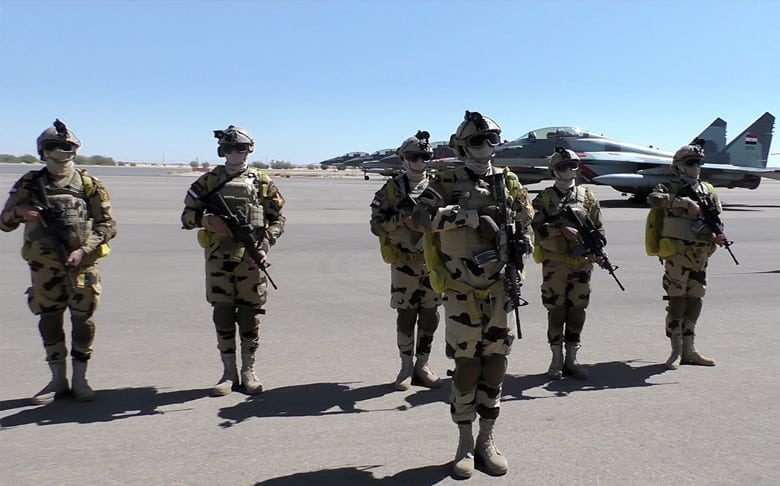
The presence of some Egyptian soldiers in neighboring Sudan who are not taking part in the present battle has been confirmed by Egypt’s President Abdul Fattah al-Sisi.
He said that they weren’t taking sides in the battle between the army and the Rapid Support Forces (RSF) paramilitary organization and that they were only there as part of a cooperative training initiative.
A video that the RSF said showed Egyptian soldiers “turning themselves in” at the Merowe military air base in northern Sudan was released on Twitter on Saturday.
“I hope we retrieve these forces at the fastest earliest time,” Mr Sisi said.
The president made the comments during a meeting with the Supreme Council of the Armed Forces on Monday, part of which was broadcast on the privately owned Extra News TV.
He said Egypt would not interfere in Sudan’s “internal affairs”, but added it could play a role in mediating between factions “to encourage them to cease fire”.
Egyptian President Abdel Fattah el-Sissi on Monday April 17 2023 claimed that his government was in contact with the warring parties in Sudan in an effort to put an end to the fighting and begin talks aimed at reestablishing normalcy in the neighboring nation.
Speaking at a meeting with Egypt’s Supreme Council of the Armed Forces, the president added that he and his counterpart from South Sudan were both ready to “play a mediation role.”
“If I had a message to deliver, and I have said that to President Salva Kiir (of South Sudan), we are both ready to play a mediation role between our brothers in Sudan in order to reach a truce between the brothers and this is still going on and we have endless calls between the Sudanese armed forces and the Rapid Support Forces, we are in constant contact with them to encourage them to cease fire and end the bloodshed of the Sudanese and reaching negotiations that leads to restoring stability once again,” said President Abdel Fattah el-Sissi.
The power struggle in Sudan pits General Abdel-Fattah Burhan, the commander of the armed forces, against his former ally, General Mohammed Hamdan Dagalo, who heads the Rapid Support Forces (RSF), a paramilitary group.
El-Sissi also said Egypt was in contact with the RSF in order to secure the release of a number of Egyptian troops who were captured in Sudan.
The president insisted that the soldiers had been taking part in joint exercises, and were not deployed to Sudan “to side with anyone or to support a side against another.”
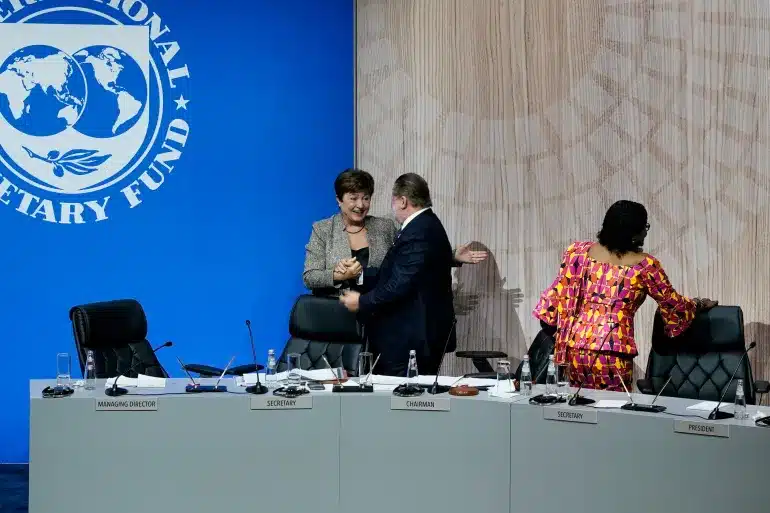
The International Monetary Fund wants Egypt to enact more of the reforms that Cairo has committed to before it conducts the first review of the country’s $3bn rescue package, Bloomberg News has reported.
The Washington-based lender wants Cairo to privatise certain state assets and allow flexibility in the Egyptian pound to make sure the review is successful, Bloomberg reported on Sunday, citing unnamed people familiar with the matter.
IMF Managing Director Kristalina Georgieva said last week that the fund was preparing to carry out the review but did not say when it might take place.
Egypt is required to pass the review to access the second tranche of its loan worth about $354m.
Jihad Azour, the IMF’s director for the Middle East, North Africa and Central Asia, said during a press conference last week that a flexible exchange rate would help protect Egypt’s economy from external shocks and the state should allow the private sector to “create growth and create more foreign currencies”.
The IMF in December announced a deal to provide $3bn to debt-ridden Egypt over nearly four years, including immediate access to $347m.
Gulf allies including Saudi Arabia, Qatar and the United Arab Emirates have also offered support, although billions of dollars in pledged investments have yet to materialise as they seek clarity on the progress of the country’s financial reforms.
Egypt’s economy has been hammered by rising oil and food prices due to the aftermath of the COVID-19 pandemic and the war in Ukraine, with the Egyptian pound losing half of its value against the dollar since March.
About one-third of the country’s 104 million people live in poverty, according to government figures. Many Egyptians depend on state subsidies to keep basic goods like food affordable.
As part of the IMF deal, Cairo has agreed to sell stakes in several dozen state-owned companies this year and pledged to shift to a flexible exchange rate, although the pound’s stability has raised questions about the government’s commitment to its reforms.
Southern African countries dominated the continent’s growth markets and wealth in 2021, experiencing the fastest growth compared to 2020.
Total private wealth in Africa was $21 trillion between the first quarter of 2021 and the last quarter of 2022. This included 136,000 approximations of millionaires with net assets of at least $1 million each, 6,700 approximations of multi-millionaires with net assets of at least $10 million each, 305 approximations of cent-millionaires with net assets of at least $100 million each, and 18 approximations of billionaires with net assets of at least $1 billion each.
Nigeria’s total private wealth stood at $228 billion, with many multi-millionaires, cent-millionaires, and three billionaires. Morocco’s total private wealth stood at $125 billion, with many multi-millionaires, cent-millionaires, and two billionaires.
Algeria, Zimbabwe, and Tanzania have one billionaire each with many multi-millionaires and cent-millionaires, while Ghana, Kenya, and many other countries have many multi-millionaires and cent-millionaires. South Africa, Egypt, and Nigeria make up about 56% of Africa’s wealth (wealth of individuals).
As the wealth reports for 2023 are gradually emerging, let’s take a look at the top African countries with the highest number of billionaires.
Egypt says three people have been detained for trying to steal a massive statue of an ancient Pharaoh – using a crane.
The prosecutor’s office said the three were found in possession of digging tools and the crane with which they had tried to lift the 10-tonne statue and excavate antiquities in the ancient city of Aswan.
The statue is of Ramses the Great, who died more than 3,000 years ago.
A probe is being held and there are orders to investigate any further accomplices.
In recent years Egypt’s managed to recover thousands of antiquities illegally taken abroad.
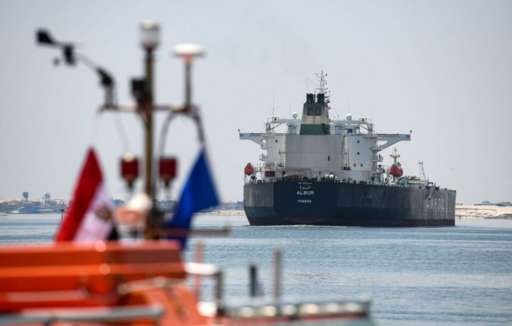
A cargo ship that became stranded in the Suez Canal has been raised to the surface byEgyptian authorities.
Leth Agencies, a shipping company, had earlier reported that the MV Glory had grounded close to the northeastern city of El-Qantarah.
Later, it announced that 21 vessels would resume transiting the Suez Canal with only minor delays after being refloated by tugboats from the authority.
The vessel was listed as carrying over 65,000 metric tonnes of grain from Ukraine bound for China, the Associated Press agency reports.
In 2021 a giant container ship, the Ever Given, blocked the canal, disrupting global trade.
The Suez Canal is a vital waterway that connects the Mediterranean with the Red Sea, providing an avenue for vessels to pass between Asia and the Middle East and Europe.
Ghana’s CHAN team, the Black Galaxies will play a friendly game against the national U20 team of Egypt, the Young Pharaohs at the Cairo International Stadium on Tuesday, December 27, 2022 at 2:45pm.
Ghana’s homebased national team are currently in Cairo as part of preparations for the upcoming TotalEnergies African Nations Championship(CHAN) which will be staged in Algeria from January 13- February 4, 2023.
A delegation made up of players, technical staff and officials arrived in Cairo on Saturday and held an intensive training session at the Pyramid FC training pitch on Monday morning.
Tuesday’s friendly against Egypt’s U-20 will be the first of friendly games the Black Galaxies will play during their stay in Egypt.
Ghana makes a return to the CHAN tournament for the first time since 2014 when they lost on penalties to Libya in the final match.
Reports have revealed that some kids in Egypt have perished as a result of receiving phony medications.
In one instance, doctors at the hospital administered medications that turned out to be fake to a two-year-old boy who had a high temperature. The boy later died.
Egyptian media say more than $160m worth of fake medicines have been seized there in the past month alone – though the problem is a global one.
A recent report by the American Journal of Tropical Medicine and Hygiene estimated that counterfeit medicines killas many as 300,000 children each year.
According to reports, some kids in Egypt have perished after receiving phony medications by mistake.
One instance included a two-year-old child who had a high temperature who passed away after hospital staff administered medications that turned out to be fake.
Although the issue is widespread, Egyptian media report that more than $160 million worth of bogus drugs have been seized there in the last month alone.
According to a recent report from the American Journal of Tropical Medicine and Hygiene, up to 300,000 youngsters die each year from using fake medications.
Ancient Egyptian mummies have been discovered with golden tongues inserted in their mouths.
Researchers believe they were meant to help the dead talk with Osiris, the god of the underworld, per The Daily Mail.
The mummies were found in the Quewaisna necropolis, about 40 miles south of Cairo in Egypt, the Ministry of Tourism and Antiquities said in a Facebook post on November 24.
It is the latest in a series of mummies found with gold tongues in the mouth.
Last year, archaeologists reported finding mummies with gold tongues twice, once in El Bahnasa, about 136 miles south of Cairo, and once in Alexandria.
Those mummies were about 2,500 and about 2,000 years old respectively.
Mustafa Waziri, secretary-general of the Supreme Council for Archeology, said the mummies in the Quewaisna necropolis were in a poor state of preservation.
Gold flakes were also found on the bones of some of the remains, per the Facebook post, suggesting their bodies were sprinkled with gold.
Some of the flakes were shaped into lotus flowers or scarabs, ARTNews reported.
It’s not clear when the mummies were buried, as the cemetery was used during three distinct historical periods: the Ptolemaic period, and two phases in the Roman era.
Amulets, figurines, and pottery, were also found at the site.
Ancient Egyptians believed the deceased could take items with them in the afterlife, so often buired them with objects meant to help.
Deceased dignitaries have been found buried with mummified food, mummified animals, protective amulets and figurines, elaborate face masks, and even boats.
Next on Business Insider
Tesla investors tell Elon Musk to stop wasting time on Twitter as erratic tweets prompt them to sell shares.
TheEuropean Union’s climate policychief has just criticised the commitment of some countries towards efforts to limit rising temperatures.
Frans Timmermans says there is a “yawning gap” between climate policies and climate science adding that the mitigation programme agreement allows for some parties to “hide from their commitments”.
“This is the make or break decade,” he says. “But what we have in front of us is not enough of a step forward for people and planet.
Before finishing his speech to applause from delegates, Timmermans urged countries to acknowledge the deal reached in Egypt had fallen short.
He adds: “Too many parties are not ready to make progress in the fight against the climate crisis.
“Some are afraid of the transition ahead and the cost of change.”
Sudan, Ethiopia, Senegal, Zimbabwe, Egypt, Tunisia, Mali, Mozambique, Morocco, Mauritania, Niger, Eritrea, Algeria, Sudan, Benin, Rwanda, Chad, Kenya, and Libya are just a few of the many African nations that have been identified as among the thirty (30) nations in the world that are most at risk from the effects of climate change.
According to reports, these nations are experiencing the negative effects of climate change, including food crises, ocean acidification from rising CO2 levels, droughts, flood risks, storms, melting glaciers, rising sea levels that affect low-lying areas and coastal cities, declining crop yields, especially in tropical regions, and water shortages.
These negative effects are leading to the destruction of tropical forests, forest fires, Malnutrition and heat stress, spread of vector-borne disease e.g., malaria, dengue fever etc., Physical displacement of populations and risks of mass migrations, Damage to ecosystems and species extinction, Sudden shifts in weather patterns and many more problems that are confronting humanity and the environment.
Thus, international economist and a member of tralac Advisory Board who is also a former Chief Economist at the Word Trade Center, Patrick Low has challenged African countries to seize the opportunity of the ongoing COP 27 in Egypt to concentrate on Green Growth to improve competitiveness and enhance access in big markets.
Addressing the 2022 tralac Annual Conference in Nairobi, Kenya, Patrick Low who currently serves as a fellow of the Asia Global Institute emphasized that there is the need for a clear and united African position to addressing the climate issues affecting the continent considering the fact that Africa’s population will double by 2050.
Patrick Low distinguished between two main approaches to tackling climate change issues; namely abatement and adaptation where abatement which is also referred to also mitigation seeks to reduce emissions while adaptation refers to preparing the environment to sustain a given level of global warming. He however advised Africa to focus on the sustained growth trajectory relying on particularly the current integrated continental trading under AfCFTA.
“Africa’s challenge is not abatement, but rather mapping out a sustainable growth trajectory. Green growth will improve competitiveness and enhance access in big markets,” he advised.
The Geneva-based consultant on trade and trade-related matters also charged the continent to Support the development of a negotiated carbon price among major emitters and a market for carbon credits particularly when all the major emitters are not necessarily part of the top-tier list of countries that face the worse threats from climate change.
“It is in all countries’ interest to act maximally, especially the major emitters on abatement and the richer countries also with finance for adaptation around the world,” he recommended.
Patrick Low encouraged Africans to continue pushing for countries particularly big emitters of CO2 to fulfill their commitment to climate change financing in order to have funds tackle the adaptation approach of handling climate change.
“Keep up the pressure on financing, remind RoW that Africa is an important carbon sink,” the international economist advocated.
He added that adaptation is about reducing the impact of global warming and big emitters can pursue meaningful abatement policies, but this is less true of small emitters who are the most vulnerable to climate change with disparate income and development levels, vulnerabilities afflicting dozens of countries powerless to address them, even though everyone can play the appropriate part and therefore a Unified Africa can team with other parts of the world to corporate on the levels of addressing all climate change issues.
A BBC-led investigation has discovered that pollution from an Egyptian oilfacility on the Red Sea coast is threatening the survival of some of the world’s last thriving coral reefs.
According to experts who studied satellite imagery of the area, contaminated water has been entering the sea since 1985 and was still flowing as recently as September.
Until three years ago, the plant was jointly owned by the British oil giant BP and Egypt’s state-owned Gupco oil company.
Egypt is hosting the COP27 climate summit, and neither the environment ministry nor Gupco would comment on the findings.
Red Sea corals have a unique ability to withstand warming sea temperatures.
The investigation was undertaken by BBC News Arabicand journalists from the group Source Material.
Ghanaian environmental activist Gideon Commey has taken the fight against illegal mining, also known as “galamsey”, to the climate change conference (COP27) at Sharm el-Sheikh in Egypt.
The founder of Ghana Youth Environmental Movement staged a one-man protest at the ongoing COP27 to draw the attention of the international community on what he describes as the government’s failure to tackle the galamsey menace.
“I staged the one-man protest at #COP27 yesterday as an activist who deeply cares about the climate, and a concerned Ghanaian citizen frustrated and angry at the current state of our water bodies and forests because of galamsey (illegal small-scale mining).
“The attention the video has received and overall support for the campaign has been overwhelming. This shows I spoke the minds of thousands of Ghanaians who are exhausted and feeling hopeless about the lack of conviction, leadership and action from our political leaders,” Commey posted on Facebook.
“This in turn gives me hope about what our youth can do if we rise, speak truth to power and hold leaders accountable. Thank you everyone! I’m also grateful to Collins Gameli Hodoli for providing me with direct support without which I wouldn’t have been successful yesterday,” he added.
The World Health Organization has said that 99% of the planet’s population breaths air that threatens their health.
It’s a shocking statistic, and nowhere is that more apparent than the Egyptian capital, Cairo. With the eyes of the world on the country as it hosts COP27, Egyptians don’t have to look far for the devastating effects of pollution.
This greater area of this sprawling metropolis is home to 21 million people, one of the biggest cities in Africa. For years though, its residents have been breathing air that contains high levels of some of the most poisonous pollution particles.
The government admits two million people seek treatment nationwide for respiratory problems caused by bad air, with the World Bank saying there are around 2,600 premature deaths in Cairo alone annually because of it.
You certainly notice it as soon as you step out of your door.
In several neighbourhoods in the city, you can feel the soot at the back of your throat, and you feel conscious of the taste of the air. On several occasions, despite the heat, I found myself sneezing, a visceral reminder of the fumes around me.
The city’s streets are a constant throng of congestion, with vehicles, some modern, others battered relics of the 70s and 80s, battling their way through the traffic. They are not the only cause of the problem though. Cairo is heavily industrialised and also sits in a valley, which can trap bad air. Sand and desert dust can also add to the air pollution.
Authorities here know there is a problem. An official from the Ministry of Environment tells me that tackling air pollution is one of their main priorities, and that they have introduced 116 air monitoring stations across the country.
One of the main factors of the issue used to be farmers burning rice straw at the end of their harvest, which would create an annual black cloud over the city. This has now been mainly stopped and recycling encouraged.
Someone looking upwards for a solution to the problem is 18-year-old Maha Abdalla Ahmed.
I meet her on the roof of a dilapidated block of apartments in a working class part of the Arab al-Maadi district. It’s a maze of crumbling buildings, with the sounds of traffic and crowing cockerels filling the air. I can taste the dust and pollution as we speak.
She and her friend are using these rice husks as a compost to place plants and foliage on the flat roofs of buildings across Cairo. She tells me that for every one square metre she plants, it removes 100 grammes of pollutants a year.
When I ask if she is worried for the future of the planet, a concerned look crosses her face. “Of course I am. We need to start applying the sustainable development goals so that we can have a sustainable and green planet. Everyone can make a difference.”
There is no doubt that the lungs of the city are choking, but with schemes like Maha’s and governmental action, the residents of Cairo will be hoping it’s not too late to save their hometown’s environment.
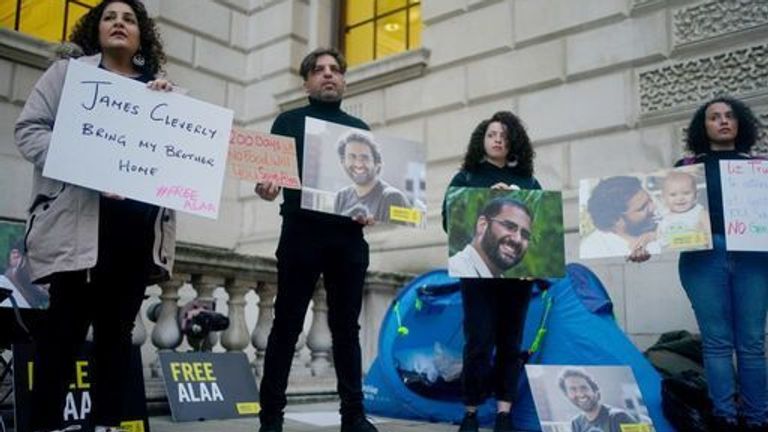
On Sunday, the first day of the COP27 climate summit in Sharm el-Sheikh, Egypt, Alaa Abd El-Fattah stopped eating and began refusing water.
According to his mother, Egyptian prison authorities intervened medically days after jailed British-Egyptian pro-democracy activist Alaa Abd El-Fattah escalated his hunger strike.
The nature of the intervention is unknown, but Mr Abd El-family Fattah’s is concerned that prison officials will force-feed him.
According to the family, this would be torture.
She told the Associated Press news agency she asked “if it was by force, and they said no” and told her “Alaa is good”.
Mr Abd El-Fattah had been on a partial hunger strike of 100 calories a day for the past six months.
He stopped all calorie intake and began refusing water on Sunday – the first day of the COP27 climate summit held in Sharm el-Sheikh in Egypt.
His hope was to get the attention of British Prime Minister Rishi Sunak, who attended the UN-led summit this week, and persuade him to take immediate action for his release.
Mr Abd El-Fattah is now in a prison hospital following the escalation in his hunger strike.
The activist said in an earlier letter that he was prepared to die in prison if not freed.
Ms Soueif has called for her son to be transferred to a civilian hospital rather than a prison facility.
“I need proof for this. I don’t trust them,” she said.
She has been waiting outside the prison every day this week, asking for proof her son is alive.
Mr Abd El-Fattah’s sister Mona Seif has said she has now been informed by prison officials that he is undergoing “medical intervention”.
The activist’s family have been increasingly worried for his health and continuously campaigned for his release ahead of COP27.
Image:Mona Seif (left), the sister of writer Alaa Abd el-Fattah, outside the Foreign Office in October
Mr Abd El-Fattah’s younger sister Sanaa Seif said last week in a public address to world leaders at COP27: “You are going to be in the same land as a British citizen dying.
“And if you don’t show that you care, it will be interpreted as a green light to kill him. My brother can be saved.”
“If you don’t save him, you have blood on your hands.”
Mr Abd El-Fattah rose to prominence during the pro-democracy uprisings in 2011 which took place throughout the Middle East and played a role in dismounting Egypt’s long-time president Hosni Mubarak.
World leaders and activists have repeatedly called for Egyptian authorities to release him.
At COP27, UK Prime Minister Rishi Sunak, French President Emmanuel Macron and German Chancellor Olaf Scholz raised the activist’s case in their talks with Mr el-Sissi.
Celebrities who have spoken out in support of Mr Abd El-Fattah include Dame Judi Dench, Dame Emma Thompson, Mark Ruffalo, Carey Mulligan andKhalid Abdalla.
Samantha Power, USAID Administrator, made the announcement during a visit to Lebanon ahead of a trip to Egypt for the United Nations Climate Conference (COP27).
During his visit, Power plans to meet with Lebanese political leaders to press for a resolution to the country’s political vacuum and for leaders to implement a series of political and economic reforms mandated by the International Monetary Fund in order to secure a $3 billion aid package.
The visit comes at a time when Lebanon is experiencing its worst economic and financial crisis in modern history.
Power declined to say, however, whether any U.S. assistance would be contingent on Lebanon taking these measures.
“We are not focused on what happens if those reforms don’t happen. The reforms have to happen,” she told The Associated Press.
The prospect of an IMF deal “should be enough to end the infighting and bickering and do what is needed for the sake of the country,” Power said.
USAID has provided about $260 million to Lebanon in 2022 to date. On Wednesday, Power announced an additional $72 million for food assistance to some 650,000 people over five months as part of a $2 billion global food security initiative.
Lebanon, which relies heavily on imported food and has historically imported the majority of its wheat from Ukraine and Russia, has faced increased food security anxieties in the wake of the Russian war in Ukraine.
Power also announced $8.5 million to fund 22 new solar-powered pumping stations. Lebanon has been dealing with a crippling electricity crisis that has also led to water shortages due to lack of power at pumping stations.
The shortages in public water supply are fueling a cholera outbreak, the first Lebanon has seen in three decades. Most Lebanese now rely on water trucked in by private suppliers, which is often not tested for safety.
Indonesia’s capital, Jakarta, faces such challenges due to climate change that the plan is to build a new capital city more than 1,000 kilometres away.
Jakarta is sinking.
Notorious for traffic gridlock and poor air quality, Indonesia’s sprawling capital faces such a perfect storm of climate and environmental challenges that the government has decided to move it somewhere safer.
Increasingly severe rainfall and flooding, rising sea levels, and land subsidence have conspired to make the Southeast Asian megacity a challenging place for its more than 10.5 million people to live.
A quarter of the city — located on the western tip of the densely populated island of Java — could be underwater by 2050.
So, the Indonesian government is bidding farewell to Jakarta and plans to relocate to a new capital: Nusantara — a purpose-built city more than 1,000km (620 miles) away in Borneo island’s East Kalimantan province.
As world leaders gather for the COP27 summit in Egypt and thrash out ways and timeframes to avert what UN Secretary-General Antonio Guterres told them was the “collective suicide” of climate change, Jakarta’s fate vividly demonstrates how people in the developing world are already suffering from, and adapting to, a climatically-changed reality.
Indonesian national police rescue residents from flooding that inundated Jakarta in February 2021 [Bagus Indahono/EPA]
Relocating a capital city is a daunting task although plans appear to be advanced, according to the official ibu kota negara (the nation’s capital) website.
President Joko Widodo plans to host Indonesia’s 79th independence day celebrations in Nusantara in August 2024, where core infrastructure for an initial 500,000 residents will have been completed, according to the website.
Bambang Susantono, a former Indonesian transport minister who is leading the new capital city development project, is upbeat about the gargantuan task.
Creating a new city from “scratch” was an advantage, Susantono wrote on his LinkedIn page recently, as it allowed control over the master plan, quality of engineering work, and the application of the latest technology.
“In Nusantara, we do climate change adaptation at scale,” he wrote, pointing out that 65 percent of the city will remain tropical forest.
“Given these facts, I believe Nusantara will be a prime example of how cities and countries can respond to climate change,” he wrote.
Critics are not so sure.
Goodbye, Jakarta. Welcome to Nusantara
Indonesian President Joko Widodo gestures with Governor of East Kalimantan Isran Noor during their visit to the planned location of Indonesia’s new capital [File: Akbar Nugroho Gumay/Antara Foto via Reuters]
Climate change did not cause Jakarta to sink — that is due to unsustainable groundwater depletion that has resulted in subsidence — but the city is being swamped by rising sea levels, which have been caused by planet-warming greenhouse gases.
Whether to move or not is “a big question for many”, said Edvin Aldrian, professor of meteorology and climatology at the Agency for Assessment and Application of Technology BPPT Indonesia.
Building a new capital might also amount to “only moving the problem”, said Aldrian, who also teaches at the University of Indonesia, Bogor Agricultural Institute and Udayana University in Bali.
Moving will not stop the increasingly extreme rainfall and flooding, which is “getting heavier and heavier” either in Jakarta or, in the future, in Nusantara, he adds.
“I’m afraid that there are many floods already in Kalimantan.”
Aldrian has warned that about 40 percent of Jakarta lies below sea level and the northern part of the city is sinking at a rate of 4.9cm (almost 2 inches) each year.
Subsidence is due mainly to the city’s use of groundwater sucked up through water wells. Although heavy rains should replenish underground aquifers and shore up Jakarta’s foundations, urban sprawl creates a concrete boundary that prevents the aquifers from being replenished, while the streets often flood.
And “while the capital’s land surface is sinking, the sea is rising,” he added.
Below, groundwater is being depleted, but three bodies of water above ground threaten the city, as he explains:
Torrential rain over the city has become more common, causing an increase in severe floods. Added to that, heavy rain in higher terrain nearby flows down into Jakarta, flooding the city’s canals and waterways. And then there is the sea, where rising waters threaten the city, particularly at high tide.
The New Year’s Eve storm of 2020 that turned Jakarta into a mucky swimming pool in just a few hours demonstrates for Aldrian the challenges posed by climate change.
Rain clouds were estimated to have formed for many kilometres above the city, whereas a normal height for cloud cover would be about 3 to 4km, he says. When the rain fell, it was like nothing he had ever seen.
Some areas saw rainfall at an intensity of 377mm (almost 15 inches) in a day, inflicting some of the worst flooding ever to hit Jakarta.
“You can’t do anything. You are isolated in your home…. Cars can’t move, electricity and communications are down, and drinkable water supplies have become contaminated by overflowing drains and sewers,” he told Al Jazeera.
“The problem is not during the flood it is afterwards”, he adds, explaining that all the costs are in cleaning up the mess.
Asia’s sinking megacities
What has occurred in Jakarta is also affecting other megacities in South and Southeast Asia, where, according to a recent study led by Singapore’s Nanyang Technological University, coastal cities are sinking faster than in other parts of the world.
Indonesian youths play in flood water in a neighbourhood in Jakarta after overnight rains caused rivers to burst their banks, inundating thousands of homes and paralysing parts of the city’s transport networks [File: Achmad Ibrahim/Reuters]
Vietnam’s economic hub Ho Chi Minh City, Myanmar’s Yangon, Bangladesh’s port city of Chittagong, China’s Tianjin, and the Indian city of Ahmedabad are among the cities most steadily subsiding under the weight of their populations and the effect of urbanisation.
Like Jakarta, they too are contending with rising sea levels.
Learning from Jakarta’s challenges, Nusantara’s city planners want to create a green city that can cope with and mitigate the effects of climate change.
Widodo announced the plan to relocate the capital from flood-prone Java to a 2,560-square-kilometre (almost 990 square miles) site on the forested island of Borneo in 2019.
Work is already underway and a completion date of 2024 has been set for the first of four phases of development: the relocation of key administrative elements, including the president’s office, according to a report on the move by scholars Anuar Nugroho and Dimas Wisnu Adrianto.
The second phase is a decade-long process, from 2025-35, to develop a foundational capital city area, followed by a third phase, from 2035-45, to develop the overall infrastructure — physical and socioeconomic.
The final phase is to establish Nusantara’s reputation globally as a “World City for All”, according to Nugroho and Adrianto, and an “economic Super Hub driving the economy of the nation” with the creation of 4.8 million jobs by 2045.
Plans for the city available on the ibu kota negara (the nation’s capital) website look and sound impressive: Eco-friendly construction of all high-rise buildings; 80 percent of travel in the city will involve public transport or “active mobility”, such as walking and cycling; and all important facilities will be located within 10 minutes of a public transport hub.
Residents will also have access to recreational green space as well as social and community services within 10 minutes of their homes. Zero poverty is to be achieved by 2035, and there will also be 100 percent digital connectivity for all residents and businesses.
A computer-generated image released in 2022 showing the design illustration for Indonesia’s future presidential palace in East Kalimantan [Nyoman Nuarta/handout via AFP]
Renewable energy will provide all energy needs, and the city will achieve net zero emissions by 2045. Ten percent of the city’s area will be devoted to food production, 60 percent of the city’s waste will be recycled by 2045, and 100 percent of wastewater will be treated by the city’s water management system by 2035.
With such a list of envy-inducing initiatives, the city also aims to be among the top 10 cities on the Global Liveability Index by 2045.
Computer-generated images depict the future city as covered in trees with water features, wide pedestrian avenues, electric vehicles on carless roads, and futuristic buildings that appear to borrow a virtual world aesthetic.
Such a green city does not come cheap.
The cost of building the new capital is estimated to be more than $34bn and three international firms — United States-based engineers AECOM, global consulting firm McKinsey and Japanese architects and engineers Nikken Sekkei — have been brought in to help design its high-tech and environmentally-friendly elements, according to news reports.
Indonesia will build the new city with state funds and is seeking investors.
But the issue of who should pay for the damage created by the climate crisis – such as the inundation of megacities like Jakarta due to rising sea levels – has emerged as a key issue at COP27.
People in the most vulnerable countries in the world have done little to contribute to the change in their climates, but are suffering the effects earlier and more severely than countries whose industries and consumption patterns are responsible for the lion’s share.
“It evokes the question,” Bethany Tietjen of the Climate Policy Lab at Tufts University wrote last week in The Conversation.
“Why should countries that have done little to cause global warming be responsible for the damage resulting from the emissions of wealthy countries?”
Jakarta is still sinking
Critics point out that the new city is being built on an island with vast tracts of rainforest that are a crucial carbon sink and there are fears the new capital might eventually face some of the same issues as the old capital.
Building a state-of-the-art capital on Borneo also does not solve the crises faced by the millions who will remain in Jakarta.
“It’s a very ambitious plan,” said Tiza Mafira, head of Climate Policy Initiative (CPI) Indonesia.
Mafira says while she is in favour of the country’s administrative and political centre being separated from its business hub, moving away will not solve the issues facing Jakarta, which still must be tackled.
Improved spatial planning, safeguarding groundwater, and, basically, re-thinking Jakarta as a city, is the no small task that is required, Mafira said.
“In order to solve that root of the problem, you would need to rethink, re-green Jakarta,” she told Al Jazeera.
“It is possible to re-green Jakarta,” she added.
“It would take some transition. You would not only have to re-green whatever area is left to re-green, but you would also need to reassess the function of some areas,” she adds.
“Some areas would need some hard decisions. If a mall was built that wasn’t supposed to be built, then it would have to go … and be replaced with a park, for example.”
What also might need re-thinking is the decision to build in Kalimantan.
“It’s literally a forest … you would have to cut down an existing forest in order to build this capital city,” Mafira said.
There is also the real possibility that Nusantara turns out to be more of a white elephant in Borneo than a green-city alternative to Jakarta.
Mafira speaks of capital cities that end up being “a seat of administration, but nobody really wants to live there”.
Myanmar’s capital, Naypyidaw, comes easily to mind.
“There has to be a whole cultural and social shift that will make it actually a comfortable place to live, that people would want to move to,” Mafira said.
Otherwise, “they end up moving back and forth between their home and that capital city”, she said, noting the possible effect on climate through increased air traffic as people commute between their homes in Jakarta and their jobs in the new capital.
‘We have to be hopeful’
Chisa Umemiya, research manager at the Institute for Global Environmental Strategies in Japan, emphasises community involvement as the essential ingredient in the success of decision-making around climate change.
Umemiya wonders about the extent of the Indonesian government’s consultation with local communities on the project.
“My point is that from a community inclusion point of view, it’s really essential to have such a discussion,” she told Al Jazeera, drawing parallels with earlier research she conducted on forest preservation in Thailand.
On an international level too, Umemiya says, solutions to climate change need to include the input of local communities.
Particularly communities in the developing world, she says, as the climate change debate has too often and or too long been “framed around the needs or interests of developed countries”.
“Of course, reducing emissions is the solution. But who does that? To me, responsibility lies mostly in developed country and not developing country,” she said.
“I really see a gap there, to involve more views coming from the community level and especially from developing countries, and especially from Southeast Asia, where climate impact is enormous.”
Tiza Mafira, of the CPI, echoes that sentiment, noting that climate change has long affected people in the developing world — Jakarta’s problems have been evident for years — but the crisis is just now being acknowledged because richer countries are also beginning to experience the effects.
“We’re only now starting to see a larger level of ambition because it now has begun to affect, glaringly, the industrialised and developed countries,” she said.
“I can’t remember who said it, but I’m echoing the sentiment that we’ll see accelerated ambitions at COP [the UN’s climate change Conference of the Parties] once the industrialised countries are truly suffering the consequences of the climate crisis,” she added
“And it’s unfortunate that it has to come to that, because we could have prevented this sooner.”
On Jakarta’s future and successfully mitigating the effect of climate change, Aldrian says: “Of course, we have to be hopeful.”
Volker Turk, the UN High Commissioner for Human Rights, has urged Egypt to release hunger striker and popular activist Alaa Abd el-Fattah immediately.The life of hunger striker Alaa Abd el-Fattah is in grave danger, according to UN High Commissioner for Human Rights Volker Turk, who renewed his call for Egypt to release him immediately.
“I urge the Egyptian government to immediately release Abd el-Fattah from prison and provide him with the necessary medical treatment,” Turk said in a statement on Tuesday, warning that the activist “is in great danger.”
“His dry hunger strike puts his life at acute risk.”
Abd el-Fattah, a prominent activist and blogger who is a dual British and Egyptian citizen, was jailed in 2014 for five years on charges of participating in an unauthorised gathering. He was re-arrested in 2019, and in December 2021, was sentenced to another five years on charges of spreading false news.
The 40-year-old has been on a hunger strike for 220 days against his detention and prison conditions.
Abd el-Fattah informed his family that he would stop drinking water on Sunday in an escalation of his protest. His mother said she did not receive a letter she usually receives from him when she visited on Monday.
Without water, Abd el-Fattah’s health could rapidly deteriorate. The escalation of his protest has coincided with the COP27 climate summit, the UN’s annual gathering of world leaders to discuss global warming, being held this year in Egypt.
Ravina Shamdasani, Turk’s spokesperson, said that the official had personally spoken with Egyptian authorities to appeal for Abd el-Fattah’s release, most recently on Friday.
Asked whether there was a risk he may have already died, given the lack of communication, Shamdasani told a briefing in Geneva, “We are very concerned for his health and there is a lack of transparency, as well around his current condition”.
But he called “on the Egyptian authorities to fulfil their human rights obligations and immediately release all those arbitrarily detained, including those in pre-trial detention, as well as those unfairly convicted”.
“No one should be detained for exercising their basic human rights or defending those of others,” he said.
Prisoners of conscience
Abd el-Fattah’s detention has become a prominent issue at the COP27 summit in Sharm el-Sheikh, which his sister Sanaa Seif – herself a former political prisoner – is attending to campaign for his release.
Activists at COP27 have also been posting prolifically on Twitter under the hashtag #FreeAlaa, and several speakers have ended their speeches with the words “you have not yet been defeated” – the title of his book.
According to rights groups, Abd el-Fattah is among more than 60,000 prisoners of conscience in Egypt since President Abdel Fattah el-Sisi came to power, deposing former President Mohamed Morsi in 2013.
Asked about the case, Egyptian foreign minister and COP27 President Sameh Shoukry told CNBC that prison authorities would provide Abd el-Fattah with healthcare. Egyptian officials have said previously that he was receiving meals.
British Prime Minister Rishi Sunak and French President Emmanuel Macron both directly met Egyptian President el-Sisi on Monday and increased the pressure for his release, hours after three Egyptian journalists said they had begun their own hunger strikes over his fate.
President Akufo-Addo has asked rich countries to allow heavily indebted poor African countries to swap their debts with climate interventions.
The President has been addressing the world at this year’s United Nations Climate Change Conference, COP27 in Egypt.
Ghana is currently facing crippling economic crisis fueled by huge debt.
The debt situation is proving to be a major stumbling block to getting an IMF deal in time.
Ghana is seeking a $3 billion bailout but the IMF has made it clear it will not lend to a country with unsustainable debt levels.
The IMF team has already worked with the finance ministry to complete a debt sustainability analysis.
The IMF executive board is expected to base its final decision on the report which may include debt restructuring.
President Akufo-Addo took advantage of the COP27 stage to raise the issue with the rich world.
“I urge those who hold African debt to commit to debt for climate swap initiatives,” the President said.
The President did not hold back in dismissing the global financial architecture as not fit for purpose.
He said a “Radical restructuring of the global financial architecture as proposed by the African finance ministers to accommodate the demands of the developing world is of urgent necessity.
“It is evident that with these poly crisis that it is not fit for purpose.”
The President once again took on the rich world for failing to honor a pledge to release $100 billion to help developing countries deal with the impact of climate change.
He also announced that his government will soon be launching a number of climate interventions to create jobs for Ghanaians.
This he says will happen through the rollout of initiatives that will promote regenerative agriculture that requires less fertilizers and reforestation with strong biodiversity content.
The European Commission and UK leaders have agreed to collaborate to address “very real problems” with the post-Brexit trade deal.
According to Sunak’s office, Britain’s Prime Minister Rishi Sunak and European Commission Chief Ursula von der Leyen have agreed to work together to resolve issues with the Northern Ireland Protocol – the post-Brexit trade deal.
The discussion at the COP27 conference in Egypt on Monday came as Britain renewed its call to Brussels to end a delay in granting access to European Union scientific research, as agreed in the post-Brexit trade deal.
Sunak inherited from his predecessors the problem of the Northern Ireland Protocol, which was designed to prevent a return to violence in Ireland by avoiding a hard border between Northern Ireland and the Republic of Ireland.
Thus, although Northern Ireland remains part of Britain, it remains part of the EU’s trade bloc. But that means curtailment in its trade with the rest of Britain, which is vocally opposed by unionists who claim it cuts off the region from the rest of Britain.
The post-Brexit solution is cited as the Democratic Unionist Party’s main reason for refusing to return to power-sharing.
The instability in Northern Ireland has raised concerns in Dublin, Brussels and Washington and the row between Britain and the EU shows few signs of coming to a rapid conclusion, despite indications of a more positive tone from the British side in recent weeks.
‘Good first meeting’
A Downing Street spokesperson said: “The prime minister reiterated the need to find solutions to the very real problems it had created on the ground in Northern Ireland. They agreed on the importance of working together to agree a resolution.”
Von der Leyen called it a “good first meeting”.
“We face many common challenges, from tackling climate change and the energy transition to Russia’s war against Ukraine,” she tweeted. She said she looked forward to “constructive cooperation” between the two countries.
This comes as Britain’s Europe minister, Leo Docherty, in an address to British and European parliamentarians at Westminster, is expected to say that, in continuing to deny access to research programmes such as Horizon, the EU is failing to fulfil its part of the agreement.
He will say that both sides stand to gain from cooperation on shared challenges, from climate change to global health and energy security.
“The UK’s participation would be a clear win-win for the UK and the EU, but the UK cannot wait much longer,” he will say, according to advance extracts of his address.
“The EU’s approach is causing intolerable uncertainty for our research and business communities.”
Working together
Although differences over the implementation of the Northern Ireland Protocol have dominated the recent dialogue between London and Brussels, Docherty’s comments underline that other sources of friction remain.
In his speech, he will, however, emphasise how the war in Ukraine has demonstrated the importance of the two sides working together.
“A clear lesson from the last nine months has been that, despite the challenges in our relationship, the UK and EU are effective allies where it matters most,” he will say.
“The Ukrainians have stood firm against Vladimir Putin, in part because of the actions of our government and those across the EU.
“That action has been stronger because it has been coordinated between us.
“I urge our European friends to continue to work with us in providing more weapons,imposing more sanctions, and backing Ukraine to push Russian forces out.”