The government of Somalia says that over one million people have had to leave their homes because of floods from El Niño. The Horn of Africa has been hit by very heavy rains, causing a lot of damage, people being forced to leave their homes, and many deaths. These are the worst rains in over 20 years.
World leaders are meeting in Dubai to talk about the climate crisis at the COP28 summit.
At least 270 people have died in Somalia, Kenya, and southern Ethiopia. The region was in a long drought, and now it is getting a lot of heavy rain.
Over 100 people have died in sudden floods in Somalia.
Entire towns have been flooded, so most people had to go find a new place to stay. President Hassan Sheikh Mohamud said the country is in a very serious situation.
Ethiopia and Kenya next to each other are facing big floods too.
The problem is going to get worse because it’s expected to keep raining heavily until early next year.
The World Food Programme says the situation is making the food security crisis in the region worse. Some people are worried about diseases spreading.
Charity groups want world leaders at COP28 to think about countries in the Horn of Africa that are affected by climate change but didn’t cause it.
Tag: El Niño
-

Millions of Somalians escapes home due to El Niño flooding
-

El Niño returns, global temperature likely to surge
World Meteorological Organization (WMO) has projected a surge in global temperatures and disruptive weather and climate patterns.
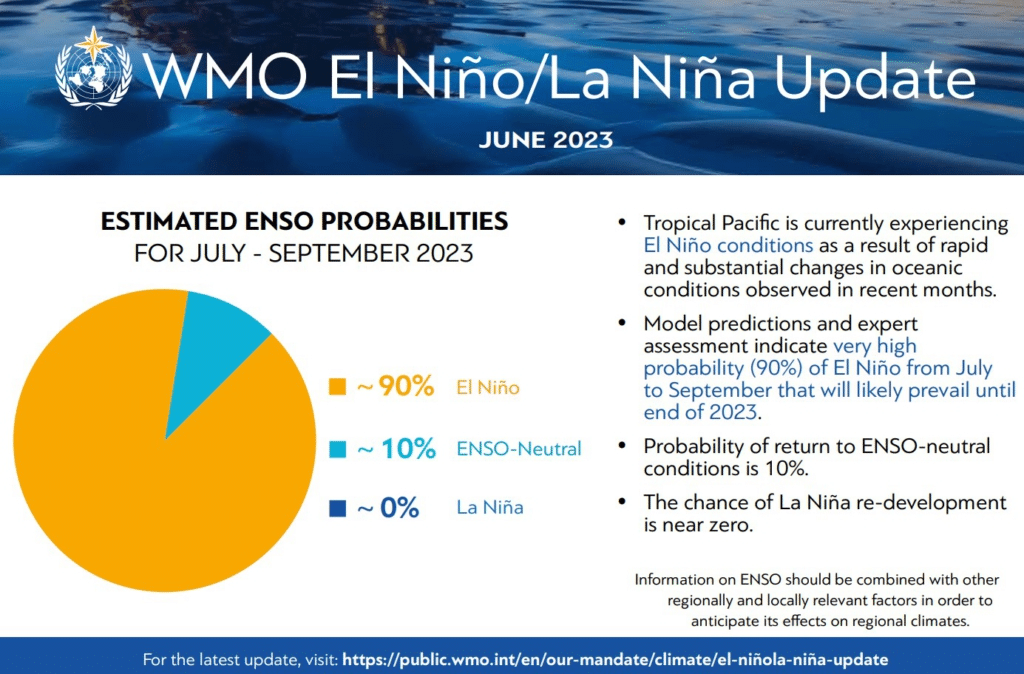
The WMO’s prediction stems from El Niño conditions that have developed in the tropical Pacific for the first time in seven years.
There is a 90% chance that the El Niño event will continue through the second half of 2023 as it is expected to be of moderate strength, according to the WHO.
The changes in global temperatures will most likely be visible in 2024.
As WMO Secretary-General Prof. Petteri Taalas stated, early warnings and anticipatory action of extreme weather events associated with this major climate phenomenon are critical to saving lives and livelihoods.
El Niño weather patterns have been linked to the heightened transmission of viral infections like dengue, Zika, and chikungunya.
In June of this year, Tedros Adhanom Ghebreyesus, the Director-General of the World Health Organization, issued a warning that climate change is contributing to increased mosquito breeding, leading to a significant rise in dengue fever cases, particularly in the Americas.
El Niño, characterized by elevated sea surface temperatures in the central and eastern Pacific Oceans, has been associated with various extreme weather events such as tropical cyclones, heavy rainfall, and severe droughts.
This phenomenon, occurring within the context of human-induced climate change, typically takes place every two to seven years, with episodes lasting approximately nine to twelve months. It is a natural climate trend correlated with the rising temperatures of the central and eastern tropical Pacific Ocean.

The average world temperature in 2022 was about 1.15 degrees Celsius higher than the 1850-1900 average due to the cooling triple-dip La Niña, according to the World Meteorological Organization.
The World Meteorological Organization (WMO) research, released in May, also stated that there is a 66% chance that the annual average near-surface global temperature between 2023 and 2027 will be hotter than 1.5°C above pre-industrial levels for at least one year.
“The onset of El Niño will greatly increase the likelihood of breaking temperature records and triggering more extreme heat in many parts of the world and in the ocean,” said Prof. Taalas.
According to the World Meteorological Organization’s State of the Global Climate reports, 2016 was the warmest year on record due to a “double whammy” of a very severe El Niño phenomenon and human-induced warming from greenhouse emissions.
But WMO Director of Climate Services Prof. Chris Hewitt says, it is yet another wake up call, or an early warning, that the world is not yet going in the right direction to limit the warming to within the targets set in Paris in 2015 designed to substantially reduce the impacts of climate change.
“This is not to say that in the next five years we would exceed the 1.5°C level specified in the Paris Agreement because that agreement refers to long-term warming over many years,” he said.