Tag: El Salvador

  • Over 68,000 gang members ‘tortured to death’ in El Salvador prisons

    Over 68,000 gang members ‘tortured to death’ in El Salvador prisons

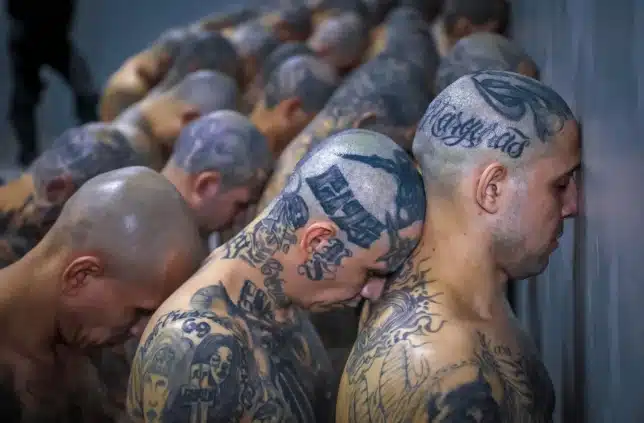
    Since El Salvador imprisoned tens of thousands of people earlier this year as part of a campaign against street gangs, at least 153 detainees have been tortured and died there.

    The country’s “war on gangs” has resulted in dozens of people dying in state custody after being detained without being given a chance to defend themselves, according to a report by the human rights organisation Cristosal.

    According to the report, four women were among those killed, and the vast majority of deaths were the consequence of torture, as well as repeated and significant injuries.

    The bodies of nearly half of the victims showed symptoms of asphyxiation, fractures, and lacerations. Nearly half of the victims died violent deaths.

    Others showed signs of malnutrition and deliberate denial of food, medicine and medical assistance.

    None of the people who died in prison had not been officially convicted of the crime they were accused of committing at the time of their arrest.

    The deaths revealed punitive policies carried out by guards and prison officials. The report stated that such actions would have required authorization and backing by the highest level security officials.

    El Salvador opened a mega-prison earlier this year to house some 40,000 suspected gang members, after the government granted itself emergency powers in March 2022 to tackle the country’s powerful street gangs.

    The high-tech prison, designed specifically to house gang members, is the largest of its kind in the Americas, and the security minister for the Central American country warned inmates they ‘will never walk out of here’.

    Following its opening, El Savador’s president Nayib Bukele tweeted that ‘at dawn, in a single operation, we transferred the first 2,000 members to the Center for the Confinement of Terrorism (CECOT)’.

    He added: ‘This will be their new house, where they will live for decades, all mixed, unable to do any further harm to the population.’

    Officially, the government has arrested more than 68,000 people under the new powers, although the actual number is thought to be even higher.

    More than 5,000 people have been freed because they could not convince a judge they were tied to criminal structures, according to authorities.

    Cristosal said it compiled the information through field work, including at common graves, and collecting documents from medical examiners. Investigators also interviewed victims’ families and neighbours, as well as others who were jailed and later released.

    The organisation called on the administration of President Nayib Bukele to answer about the conditions people are held under, respect due process, free the innocent, answer for those who have died, provide all available information to victims’ families and end the measures implemented under the special powers.

    Other human rights groups and foreign governments have condemned the government’s actions and called for a lifting of what were supposed to be temporary measures.

    Bukele, however, maintains high levels of approval within El Salvador for his actions against the gangs.

    The rights group’s report comes as a judge sentenced former El Salvador President Mauricio Funes to 14 years in prison on Monday for allegedly negotiating with gangs during his administration.

    Funes’ trial began in April with the former leader living in Nicaragua. El Salvador changed its laws last year to allow trials in absentia.

    Prosecutors had accused Funes of illicit association and failure to perform his duties for the gang truce negotiated in 2012. Funes had denied negotiating with the gangs or giving their leaders any privileges.

    Funes’ former Security Minister Gen. David Munguía Payes was also sentenced to 18 years in prison for his involvement in the negotiations.

    The former president, who governed from 2009 to 2014 and lives in Nicaragua, was granted Nicaraguan citizenship in 2019. The Nicaraguan constitution holds that no citizen may be extradited.

  • Mexico and the unbearable whiteness of advertising

    From beers to cars to supermarkets, Mexico and other postcolonial societies are grappling with a whiteness epidemic.

    Scrolling through Facebook recently on my phone in Mexico, I came upon an advertisement informing me in Spanish: “The moment has arrived to renew yourself.” A company based in the northern Mexican state of Nuevo León offered to loan me up to 250,000 pesos — more than $12,000 — to pursue the plastic surgery of my choice. An image of a bikini-clad white woman with blond hair provided additional encouragement.

    A perusal of the company’s Facebook page revealed that she was not the only white person selected to promote these surgically focused financial services. In fact, not a single non-white person had been chosen to embody “renewal”. This in a country where the vast majority of people are not white, and where a soaring national poverty rate — nearly 44 percent at the end of 2020 — means most folks could never afford a $12,000 loan.

    And yet the Nuevo León firm is scarcely alone in its extra-white marketing approach. Generally speaking, the chromatic composition of Mexican advertising exists in glaring defiance of the physical diversity of Mexico’s primarily mestizo (mixed heritage) and Indigenous population. As is the case elsewhere in Latin America and in other countries subjected to European colonial depredations, the Spanish colonial legacy in Mexico has meant that lighter skin is associated with societal superiority and economic advantage. And what is the point of advertising if not to make people want to be something “better” than they are?

    Nowadays in Mexico, the citizen-consumer is bombarded with advertising images that blatantly illustrate the overlap of racism and classism in the social hierarchy. From beer and car companies to department stores and supermarket chains, the whiteness of ads has become a sort of sinister elephant in the room, urging poor Mexicans to spend their way out of socioeconomic misery into an impossibly whiter future.

    As social anthropologist Juris Tipa notes in a 2020 peer-reviewed paper on “colourism” in Mexican advertising, the overwhelmingly dominant casting profile requested by firms for commercial advertisements is “international Latino” — which basically translates into someone with light skin, dark hair, and dark eyes, “reinforcing the imagery of a ‘Europeanised Latin Americanity’” at the expense of the average Mexican.

    Meanwhile, the Afro-Mexican population — which is more than 2.5 million strong — is effectively rendered invisible by the commercial advertising landscape, as Juris observes. In contributing to the perpetuation of a vicious cycle of colourist discrimination, advertising firms and their clients have helped maintain a colonial “pigmentocracy” in Mexico.

    Sometimes, the Mexican advertising industry gets publicly called out for its racist shenanigans — like in 2018 when an ad campaign for Indio beer featured a bunch of fair-skinned Mexicans sporting t-shirts on which the phrase “pinche indio” (“f****** Indian”, a prevalent insult in Mexico) was partially crossed out and replaced with “orgullosamente indio” or “proudly Indian”. According to the minds behind the campaign, its objective was to raise awareness of discrimination in the country — something that is clearly best achieved by having white people appropriate Indigenous identity.

    When I asked a middle-aged Mexican man — a descendant of Totonac people from the state of Veracruz — what he made of the faux wokeness of the whole Indio campaign, he shrugged and reckoned it was no worse than the ads from decades past for Mexico’s Superior beer brand, which had involved frolicking blond women, the US actress Farrah Fawcett, and the slogan “la rubia que todos quieren,” or “the blond that everyone wants”.

    Of course, the unbearable whiteness of advertising is hardly confined to Mexico. Travelling by bus years ago through Peru, I recall questioning the logic behind populating highway billboards with Scandinavian-type models in a country where the majority of humans are brown.

    From soda advertisements in El Salvador to laundry detergent ads in Colombia to the “Elite” toilet paper brand found throughout Latin America, the consensus appears to be that whiteness sells — a result, in part, of the superior societal value placed on white skin.

    On the other side of the world, too, colonial legacies of racist colourism die hard. In West Africa in 2017, the German company Nivea came under fire for promoting a cream that promised “visibly fairer skin”. That same year, Nivea was forced to pull a deodorant ad proclaiming “White Is Purity”. Naturally, the company is still making bank five years later. Welcome to capitalism.

    Speaking of capitalism, University of Hawaii professor L Ayu Saraswati, whose essay on “shaming the colour of beauty” in Indonesia was published in 2012 in the scholarly journal Feminist Studies, documents how transnational corporations like Unilever and L’Oreal have “aggressively marketed their skin-whitening creams throughout Asia, Africa, Europe, and the United States”. And while this may be business as usual in the globalised era, it also constitutes corporate complicity in the normalisation of racism.

    Unilever is the parent company of Dove, the US soap brand that had its own “oops” marketing moment in 2017 with an ad that showed a Black woman turning into a white woman. It bears mentioning, though, that the US is usually exempt from the unbearable whiteness of advertising, as the industry often instead prefers a multicoloured, multiethnic approach that projects an image of harmonious egalitarianism — and that stands in stark contrast to the domestic US reality of dog-eat-dog neoliberalism, institutionalised racism, and general non-democracy.

    Call it false advertising — and a handy justification for the US’s self-declared right to impose its will on the rest of humanity.

    But back to that Mexican financial services firm and the loan that can turn you into a blond white woman in a bikini. As the current US brand of racist capitalism wreaks havoc in Mexico and across the Global South — and poor people are taught to aspire to socioeconomic advancement in a system designed to keep them poor — all this whiteness looks pretty dark, indeed.

    DISCLAIMER: Independentghana.com will not be liable for any inaccuracies contained in this article. The views expressed in the article are solely those of the author’s, and do not reflect those of The Independent Ghana

    Source: Aljazeera.com 


  • El Salvador: Thousands of troops surround city in gang crackdown

    Around 10,000 troops have surrounded the city of Soyapango in El Salvador as part of a massive crackdown on gangs, President Nayib Bukele has announced.

    All roads leading to the city have been blocked, and special forces have been searching houses for gang members.

    Officers have also been stopping everyone attempting to leave the city and checking identity papers.

    The operation is part of a massive crackdown on gangs after a surge in violence earlier this year.

    The justice minister said 12 people had been arrested so far.

    Soyapango is one of El Salvador’s largest cities and is home to more than 290,000 people. The city – which sits just 13 km (8 miles) west of the capital San Salvador – has long been known as a hub for gang activity.

    “As of this moment, the municipality of Soyapango is totally surrounded,” President Bukele wrote on Twitter. “Extraction teams from the police and the army are tasked with extricating all the gang members still there one by one.”

    He added that ordinary people “have nothing to fear” and said that the crackdown was part of “an operation against criminals, not against honest citizens”.

    Images released by the government showed heavily armed troops clad in body armour and carrying assault rifles outside the city.

    One resident, Guadalupe Perez, told the AFP news agency that the raid had come as a welcome surprise.

    “They search you and ask for your identity papers to verify where you live, but that’s fine – it’s all for our safety,” the 53-year-old said.

    Since Mr Bukele announced a state of emergency in late March, more than 58,000 people have been jailed by authorities in the country of 6.5 million people.

    Rights groups have criticised the heavy handed nature of the crackdown, saying the measures, which allow police to arrest suspects without warrants, have led to arbitrary detentions.

    But Mr Bukele’s allies say the crackdown is necessary after a wave of homicides culminated with gangs being blamed for 62 murders in a single day on 26 March.

    A recent poll taken by the Central American University (UCA) found that 75.9 percent of Salvadorans approved of the state of emergency.


    Source: BBC


  • Former President of El Salvador’s Soccer Federation sentenced to 16 months in FIFA bribery scandal

    The former president of El Salvador’s soccer federation has been sentenced to prison for his involvement in the yearslong FIFA corruption scandal.

    Reynaldo Vasquez, 66, the former president of the Federacion Salvadorena de Futbol (FESFUT), or the Salvadoran Football Federation was sentenced in federal court in Brooklyn on Thursday to 16 months in prison. Vasquez, who was arrested and indicted in November 2015, before being extradited to the United States from El Salvador in 2021, pleaded guilty to racketeering conspiracy in August 2021.

    Vasquez admitted to receiving a $350,000 bribe in 2012 from Miami-based Media World, which paid the FIFA official for the media and marketing rights to El Salvador’s qualifying matches to be played in advance of the 2018 World Cup.

    “The defendant and his co-conspirators, motivated by greed, disgraced themselves by lining their pockets with hundreds of thousands of dollars in bribes, at the expense of a beautiful sport, El Salvador’s soccer federation, and the community it served,” United States Attorney Breon Peace said in a statement. “Vasquez has now been held to account, like the many other corrupt soccer officials who have been exposed by the government’s investigation.”

     As part of a plea agreement, Vasquez, who served as head of the Federación Salvadoreña de Fútbol from 2009 to 2011, has agreed to forfeit $360,000 and multiple bank accounts to the government.

    Complex.com