In a fervent call to action, the National Democratic Congress (NDC) has implored Ghanaians to actively contribute to securing a brighter future for the country by advocating for a change in leadership through the ousting of the governing New Patriotic Party in the upcoming 2024 polls. The party’s appeal underscores its vision for a transformative future and encourages citizens to play a pivotal role in shaping the nation’s trajectory.
The NDC contends that the prevailing economic challenges in Ghana stem from the mismanagement by the ruling party.
In a New Year’s address, the General Secretary of the NDC, Fifi Fiavi Kwetey, encouraged Ghanaians to perceive the approaching 2024 election as an opportunity to reshape the fortunes of the country.
“In the spirit of unity and shared aspirations for progress, let us recognize this upcoming election as an opportunity to shape a brighter future and address the challenges imposed by the present leadership. Despite the economic difficulties, the National Democratic Congress remains committed to serving the interests of all Ghanaians, working towards a future characterized by inclusivity, economic development, and social harmony.”
“As we bid farewell to 2023, a year marked by economic hardships inflicted by the current NPP government, the National Democratic Congress (NDC) extends warm New Year wishes to the resilient people of Ghana,” Mr. Kwetey stated.
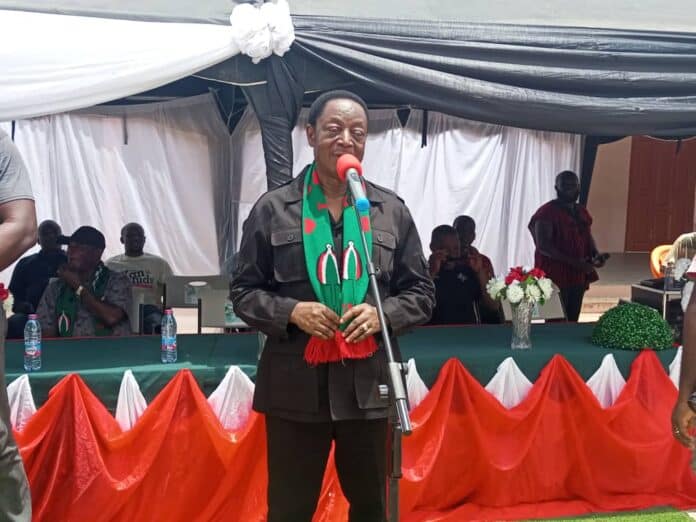
A prospective flagbearer for National Democratic Congress (NDC), Dr. Kwabena Duffuor, has promised to revive the economy under his leadership, regardless of how much damage theAkufo-Addoadministration has done to it.
According to Dr. Kwabena Duffuor, he has proven track record of implementing policies that led to single digit inflation, sustainable economic growth, job creation and poverty reduction, therefore, when given the nod to lead the NDC to victory in 2024 he will transform the economy.
“We have done it before during late Atta Mills era we inherited terrible economy but by the grace of God and fact that NDC had competent people, the Economy was turned around so be patient. Regardless the state in which Akufo-Addowill leave the economy, we will turn it around. They have borrowed all over the world. They know how to secure loans but they don’t know how to pay, now they are begging. This is a shame, they are going round begging”.
Dr. Duffuor continued “We will fix the economy and create more jobs for the youth to get employment opportunities. Just be patient, don’t be thinking so much about the economic mess created to get blood pressure. In 2008/2009 we did it. Inflation came down to 8.5 for about 31 months, unemployment dropped to 2.2%. It will happen again so don’t be sad,” the former governor of the Central Bank recognized as one of the four best central governors in the world in 1999 assured.
Dr Kwabena Duffuor said this Monday May 1, 2023 when addressing delegates of the NDC party in New Juaben North constituency to kick start his 4-day campaign tour in the Eastern region.
He stated that the NDC must be financially sound, buy shares in multimillion companies just as major political parties in South Africa, Japan and some other countries have been doing in order to fund its political activities.
He said the “Ahotor Project” is a step in this direction. He assured to also institute monthly stipends for executives of the NDC from constituency to Regional levels, resource the branches and revive the hero fund of the party.
According to Dr. Duffuor the NDC has to be fully prepared and be resourceful to be able to defeat the ruling NPP which is bent on doing everything possible to retain power.
Dr. Duffuor and his campaign team had earlier met the regional executives of the party.
He was however not impressed with the poor state of the regional office therefore assured to build a befitting office for the regional Secretariat of the NDC as well as the Constituencies should he become leader after the presidential primaries.
“During the late Prof. Mills tenure I was the Finance Minister. I mobilized business people and friends to build the national headquarters of the party. We didn’t use state fund because that is not right. So we are going to do same to build Regional and constituency offices”.
The National Identification Authority (NIA) has announced that it has completed printing the 541,529 backlogs of Ghana cards and are ready for collection.
On February 28, 2023, the NIA assured Members of Parliament that it will print the cards within 11 days.
The expedited printing exercise, which began on 18 March 2023, “came to a smooth end on Monday, 27 March 2023 with all records in backlog printed, the ultimate objective of this exercise was to print records of registered Ghanaians in backlog since July 2022,” a statement issued by the corporate affairs directorate of the NIA said.
According to the NIA “With focus, rigour and coherence in project management and implementation, NIA achieved this feat with a dedicated team of supervisors, assistant technical support officers and assistant technical enrolment officers drawn from its headquarters, regional and district offices. The staff worked fervently for ten continuous days in two shifts — day and night.
“The printed cards, which are now being packaged, will be distributed to NIA’s Regional and District Offices nationwide from today Wednesday, 29 March 2023 to Sunday, 2 April 2023 for issuance to registered applicants,” the statement said.
“All Ghanaians who have registered for their Ghana Cards since July 2022 but are yet to receive them, are assured that effective Wednesday, 5 April 2023, they can visit the District or Regional Offices where they registered for their printed cards to be issued to them.
“The NIA stands committed to serving the public and the nation as whole with respect, dignity, integrity and efficiency as a dedicated and responsible public sector institution,” the statement added.
Start of printing
The NIA, in a press release dated 22 March 2023, announced the commencement of the expedited printing of the backlog of 541,529 records accumulated since July 2022.
“Preparatory works for the expedited printing started on Wednesday, 15th March 2023 and included the configuration of printers, print servers and laminators, as well as the deployment of additional staff from NIA’s regional and district offices to augment the staff capacity at the Head Office,” the 22 March statement said.
“The commencement of the expedited printing follows the payment of GHC100 million by Government of Ghana (GoG) to CalBank PLC, which then caused the release of a quantity of blank cards to NIA on Tuesday, 14 March 2023. The printing of the blank cards is expected to last for 11 days, ending on 29 March 2023,” the Authority further said.
At the end of the exercise, the NIA says it “will make the cards available at its regional and district offices nationwide and announce to the public when the persons who registered for the cards since July 2022 should go to their respective NIA offices for the cards to be issued to them”.
Ghana’s High Commissioner to Nigeria, Rashid Bawa, has said that his office will take steps to safeguard the safety of Ghanaians living in the country of West Africa.
Currently, polls have officially ended in the country, with collation underway.
Despite what has been generally described as a relatively peaceful election, there have been some pockets of disturbances in some polling units across the country.
But speaking on JoyNews‘ The Probe/Nigeria Decides on Sunday, Mr Bawa said Ghanaians in that country will be shielded from harm.
“So far there’s no incident involving a Ghanaian. But we’re still monitoring because it’s quite fluid. Until the elections is declared and situations return to normal, we are not resting on our oars.
“We’re in touch with almost all the associations across the federation; from Maiduguri down to River States. Hopefully, we can go through this period and there’ll be no incidents”, he told host, Emefa Apawu.
He continued, “We want to assure Ghanaians who have got their relatives here that all things are being done to ensure the safety of Ghanaians during this period”.
Meanwhile, Rashid Bawa, says he is not surprised by the results compiled so far by the country’s electoral management body.
Earlier, the Independent Electoral Commission (INEC), announced results from Ekiti state with Bola Tinubu of the All Progressives Congress (APC) leading in that regard.
Reacting to the trickling results on JoyNews, Mr Bawa said with hesitation that, he is not surprised at the present outcome.
“I hardly, would want to talk about it but I’m not too surprised. It’s expected. If you look at where the results is coming from”, he said.
“Nigeria is actually divided into geographical zones. We have the North, we have the South-South and we have the South-West. The South-South are largely the Igbo’s.
“The South-West are the Youba’s. And the North are the Hausa’s, the Hausa’s Fulani. Now these major tribes have got three leading candidates. Each candidate wherever he’s coming from, has his strength”, he explained.
Mr Bawa continued, “So when you look at most of the results, if it’s the North that is dropping in, you’ll realise that the candidate from the North gets most of the votes.”
Nigeria’s Independent National Electoral Commission (INEC) has received presidential results from various parts of the country and counting is currently underway in Lagos.
Nigeria’s election will continue on Sunday, February 26, 2023, in some parts of the country.
This is according to the Chairman of the Independent National Electoral Commission (INEC), who disclosed that the election has been rescheduled following disruptions in the election process at some places.
During the second briefing on the elections, Chairman of INEC, Professor Mahmood Yakubu, noted that: “we have a situation in Bayelsa state, particularly in the capital Yenogoa, where in four wards; ward 4, 6, 8, and 14, involving a 141 polling units the process was disrupted.”
He, however, mentioned that the situation is currently under control.
“We will mobilise security. The security is calm for us to proceed with the process but the youth core members expressed some apprehension in going back. So we met with the security agencies and we have decided that voting in these 141 polling units where the materials are actually intact will take place tomorrow morning,” he said.
The elections which commenced on Saturday morning, February 25, 2023, was expected to end at 2pm same day. For some polling stations, the election ended smoothly and counting commenced.
However, at other stations, the process could not go on as expected due to disruptions such as seizing, destroying and in some instances burning of ballot boxes.
Reports of physical attacks on voters at various polling stations in the ongoing Nigerian elections are emerging.
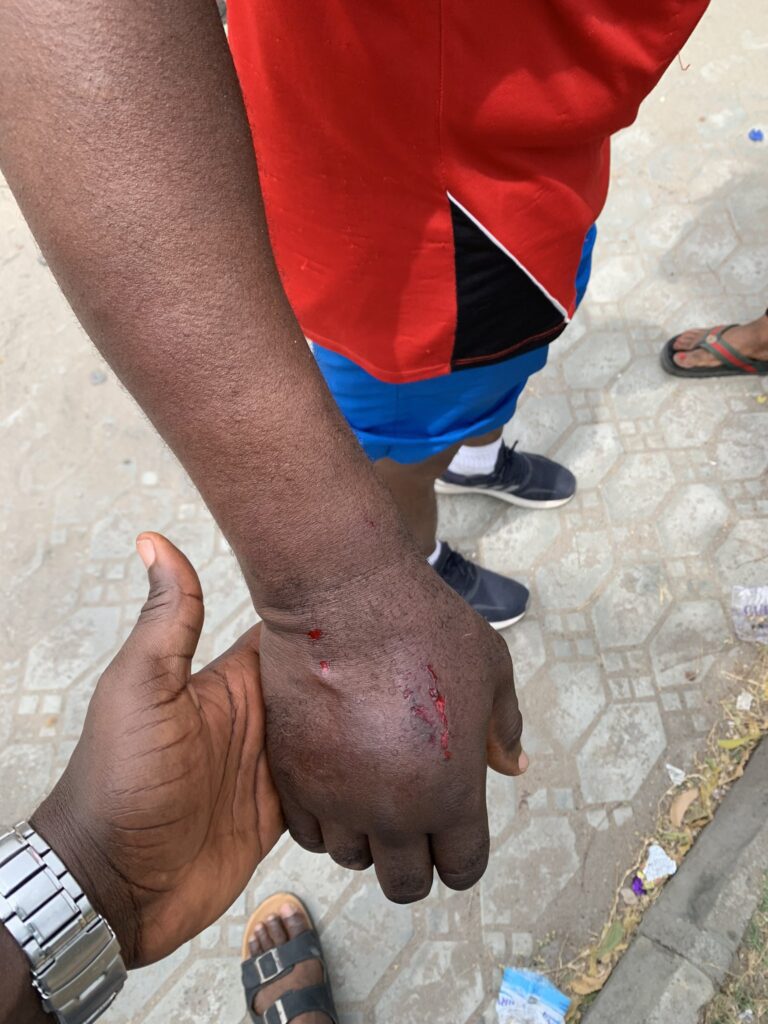
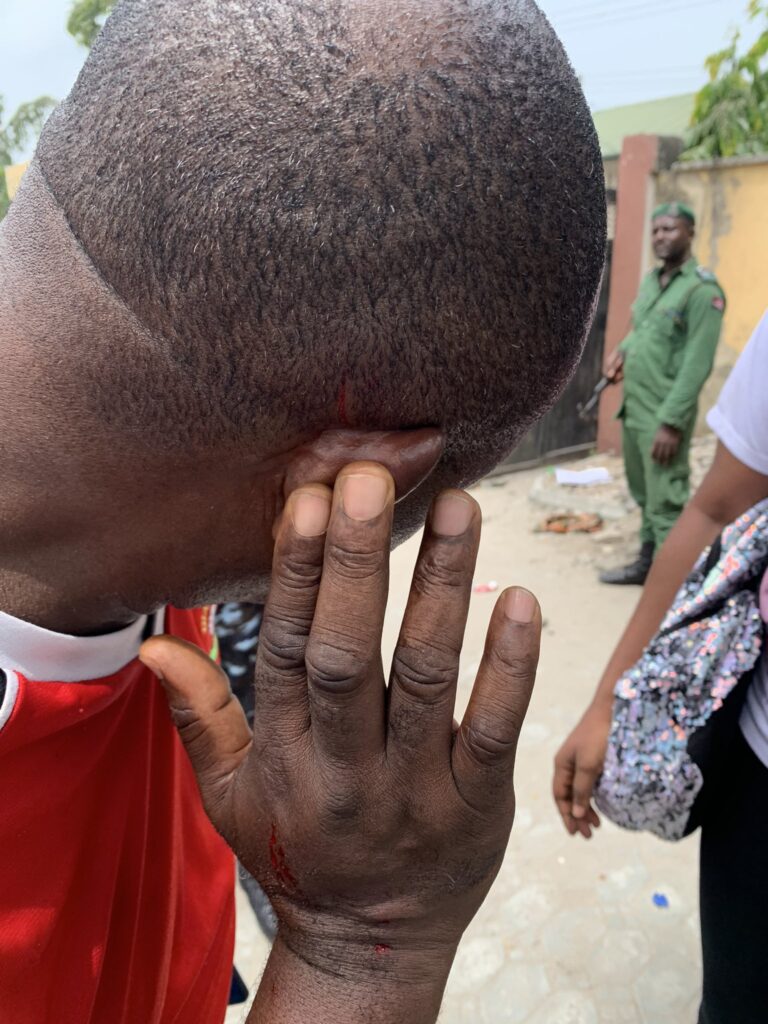
Thugs have reportedly disrupted the voting process at Ikota Primary School, Oshodi, Lagos. Although it is unclear what may have triggered the violence, The Independent Ghana has intercepted photos of a man who was allegedly attacked and has sustained cuts on his arms and head following the incident.
There have also been reports of vandalised ballot boxes.
Some hoodlums are roaming the streets of Nigeria, destroying ballot boxes at various polling stations in the country.
According to one Joey Akan, a journalist, these thugs visited Oba Elegushi and turned the place upside down.
In his attempt to save the situation, he received a number of slaps before being rescued.
“Thugs have destroyed ballot boxes and threw away the ballot papers at Oba Elegushi. I collected a couple of slaps for fighting back before I got pulled from the melee, into a house for my safety. Now I have to be smuggled out of the voting area because I have been marked,” he tweeted.
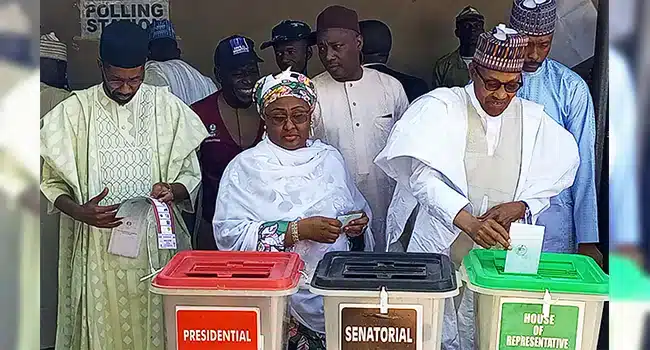
President Muhammadu Buhari has taken his turn to cast his ballot in the ongoing presidential election.
The outgoing President did so in his hometown of Daura, Katsina State. He voted alongside his wife, Aisha.
The President, whose two-term tenure of eight years ends on May 29, 2023, is a member of the All Progressives Congress (APC) and a campaigner for his party’s flag bearer, Bola Tinubu.
Addressing reporters, the President urged Nigerians to vote for the candidate of their choice, adding that nobody has more than one vote.
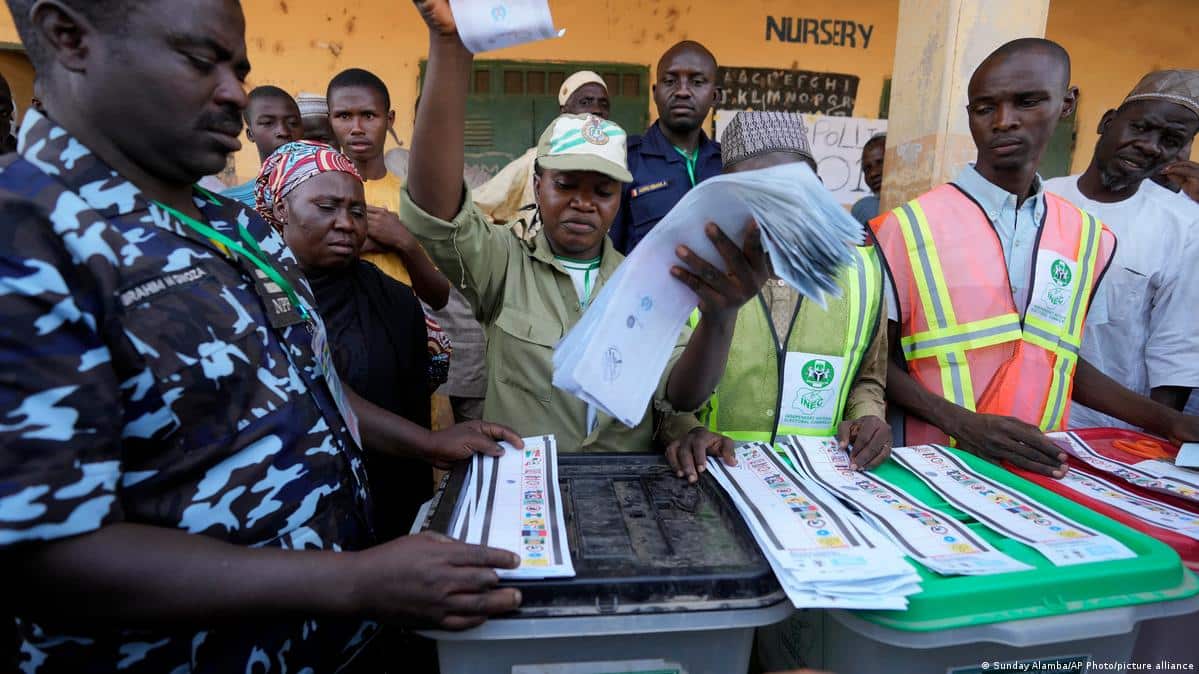
Nationwide, officials of the country’s electoral agency, the Independent National Electoral Commission (INEC) have arrived at some of the 176,606 polling units scattered across the 36 states and the Federal Capital Territory that make up Nigeria.
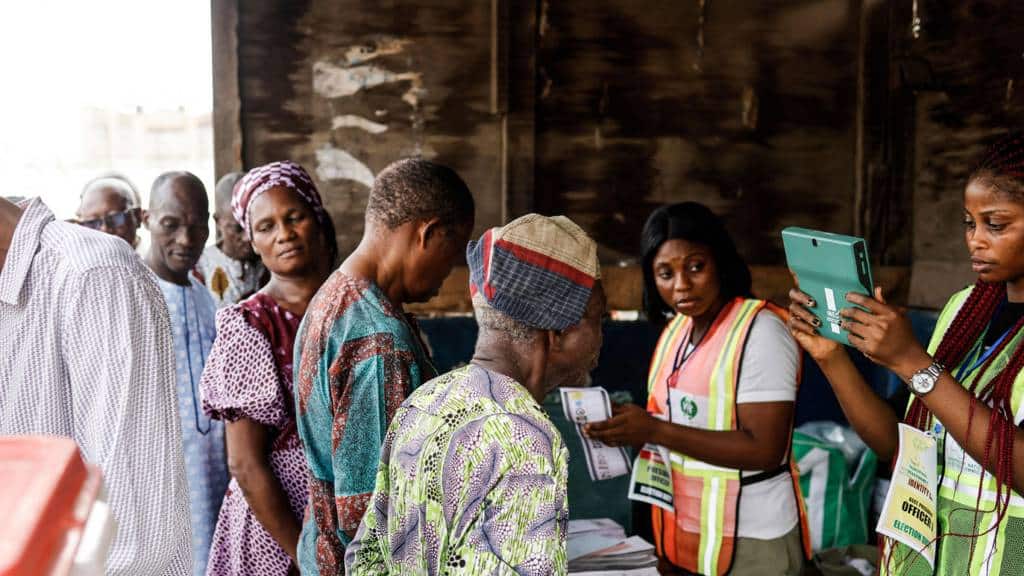
Accreditation and voting commenced around 08:30 am in some polling units in parts of Nigeria as the 87.2 million voters with Permanent Voter Cards go to the polls to elect a new president and members of the country’s National Assembly.
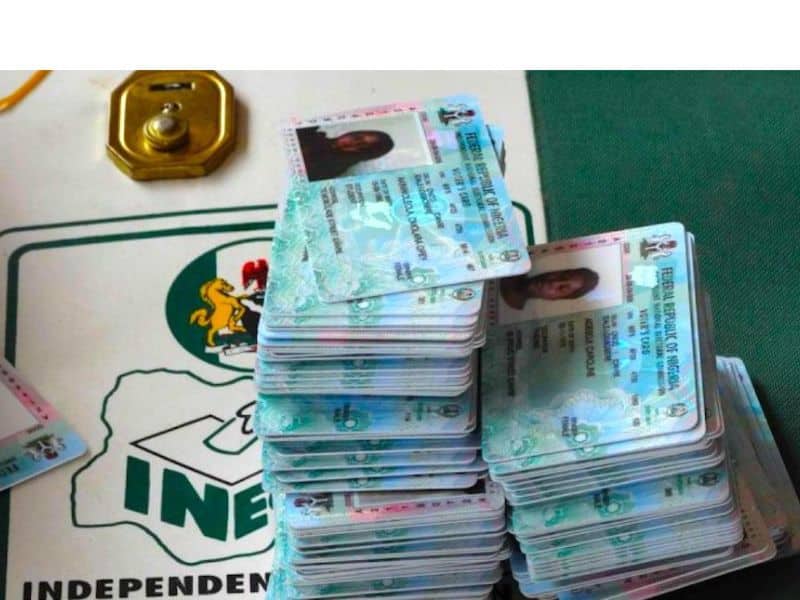
As of Thursday, February 23, 2023, a total of 6,259,229, Permanent Voter Cards (PVCs) were still in the custody of Nigerian Elections officers, data from the Independent National Electoral Commission INEC, indicates.
A total number of 87,209,007 PVCs had been collected by Nigerians during the time of the release of the data.
The data which was collated as of 5th February 2023 shows that uncollected PVCs stood at 6,259,229. Nigeria has a registered voting population of 93,469,008.
The Tinubu-Shettima Presidential Campaign Council PCC had on Wednesday demanded a breakdown of Nigerians who have collected their PVCs, saying the data was necessary for its election planning.
At a news conference Wednesday in Abuja, INEC Chairman, Prof. Mahmood Yakubu disclosed that the commission would upload the PVC data collection disaggregation on a polling unit basis to its website by Friday.
Aside from journalists from domestic and foreign media, some of those present at the briefing were a former President of Malawi, Joyce Banda; leaders of the International Republican Institute IRI and National Democratic Institute NDI; Chairmen of the electoral commissions of the Republic of Benin, Gambia, Sierra Leone, Namibia, Tanzania, and Niger Republic as well as members of the Diplomatic Corps.
State-by-state figures.
A state-by-state analysis of PVCs collection showed that Lagos has the highest figure of 6,214,970, followed by Kano with 5,594,193; Kaduna, 4,164,473; Katsina, 3,459,945; and, Rivers, 3,285,785.
Ekiti which has the lowest number of registered voters also has the lowest number of PVCs collected – 958, 052.
A summation of PVCs collected on the basis of geopolitical zones showed that the Northwest has 21,445,000; Southwest, 15,536,213; North Central, 14,603,621; South-South, 13,284,920; North East, 11,937,769; and, South East, 10,401,484.
In his address, Yakubu said the Commission has meticulously prepared and implemented its Election Project Plan, learning from recent elections.
“This election is a huge logistical deployment. We have painstakingly procured, organized, and delivered all the materials to the States for deployment. We commenced the delivery of non-sensitive materials over two months ago and they have been batched down to Registration Area/Ward and Pulling Unit levels.
“Sensitive materials have been delivered to the States and are presently being delivered to our Local Government Area offices. As such, these materials are only between one and two levels away from the Polling Units. We have achieved this by learning from our recent difficult experience with logistics. We have completed arrangements with the transport unions for the final leg of the movement of personnel and materials to the Polling Units. They have assured us of their readiness to provide all the vehicular needs of the Commission for the election”, he said.
Yakubu added that the commission has also completed all the testing of its technologies to be deployed for the election, particularly the Bimodal Voter Accreditation System BVAS and the INEC Results Viewing Portal IReV.
“On 4th February 2023, we tested the BVAS in a mock accreditation exercise and uploaded the results to IReV. We are satisfied with the performance of the BVAS, which has been confirmed by several groups that observed the exercise. Lessons learnt from the exercise have helped us in the training of 10,600 Registration Area Technical Support Staff RATECHS. They will provide the necessary support to ensure that the deployment of the BVAS is without hitches.
No PVC, no voting
“Let me reiterate that the procedure for voting as provided in the Electoral Act 2022, clearly makes the use of the BVAS mandatory. So also, the use of the Permanent Voters’ Card PVC. The ‘No PVC, No Voting’ rule subsists.
“In the last few months, we made 13,676,907 PVCs available for collection for new voters and applicants for transfer and replacement of lost/damaged cards. While we are pleased that the rate of collection is higher than in previous years, there are still, unfortunately, many cards that were not collected.
“Vote buying remains a major threat to our democracy. We have worked closely with enforcement agencies to ensure that this is eliminated from our electoral process. We are convinced that our joint operations before and on election day will vastly reduce the prospect of voter inducement, which is not only illegal but immoral.
“The ban on the use of mobile phones and photographic devices at the voting cubicles is still in place. Some voters have used these devices in previous elections to snap their marked ballot papers for vote transactions. However, citizens are permitted to come to the Polling Units with these devices, as long as they do not take them to the voting cubicles. Our arrangement of placing the ballot box near the voting cubicle and away from party agents remains.
“In the build-up to the general election, several of our facilities were attacked by unknown assailants in various parts of the country. I am pleased that we have fully recovered from those attacks, and we have been further assured that our facilities, staff, voters, observers, and citizens will be safe during the election.
“As a result of recent developments in the economy, we have also had to consult with the Nigerian National Petroleum Company Limited NNPCL on the fuel situation. As you all know, we require Premium Motor Spirit PMS and Automotive Gas Oil AGO to power vehicles and boast for land and marine transportation as well as our generators during the election.
“We are pleased that the NNPC Limited assured us that it will ensure the availability of the products for the polls. Likewise, the Central Bank of Nigeria (CBN) has assured us that it will provide us with the small amount of cash we require from our budget to cash payments to some critical service providers for the election. I must reiterate that the bulk of payment for works goods and services is still paid for by electronic transfer.
“I want to assure Nigerians that we are adequately prepared for this election. We remain fully committed to a free, fair, and credible process. I want to once again declare that our allegiance is only to Nigerians. Our commitment is to ensure that in this election we put everything in place for free choice, fair contest, and credible outcome”, he added.
Nigeria, with 214 million inhabitants, is the most populous and wealthiest nation in Africa, and its actions have a significant impact on the rest of the continent. After eight years under Muhammadu Buhari, voters will choose a new president, but whoever is elected will face some difficult obstacles.
Some of the issues that voters are considering are shown in the following charts.
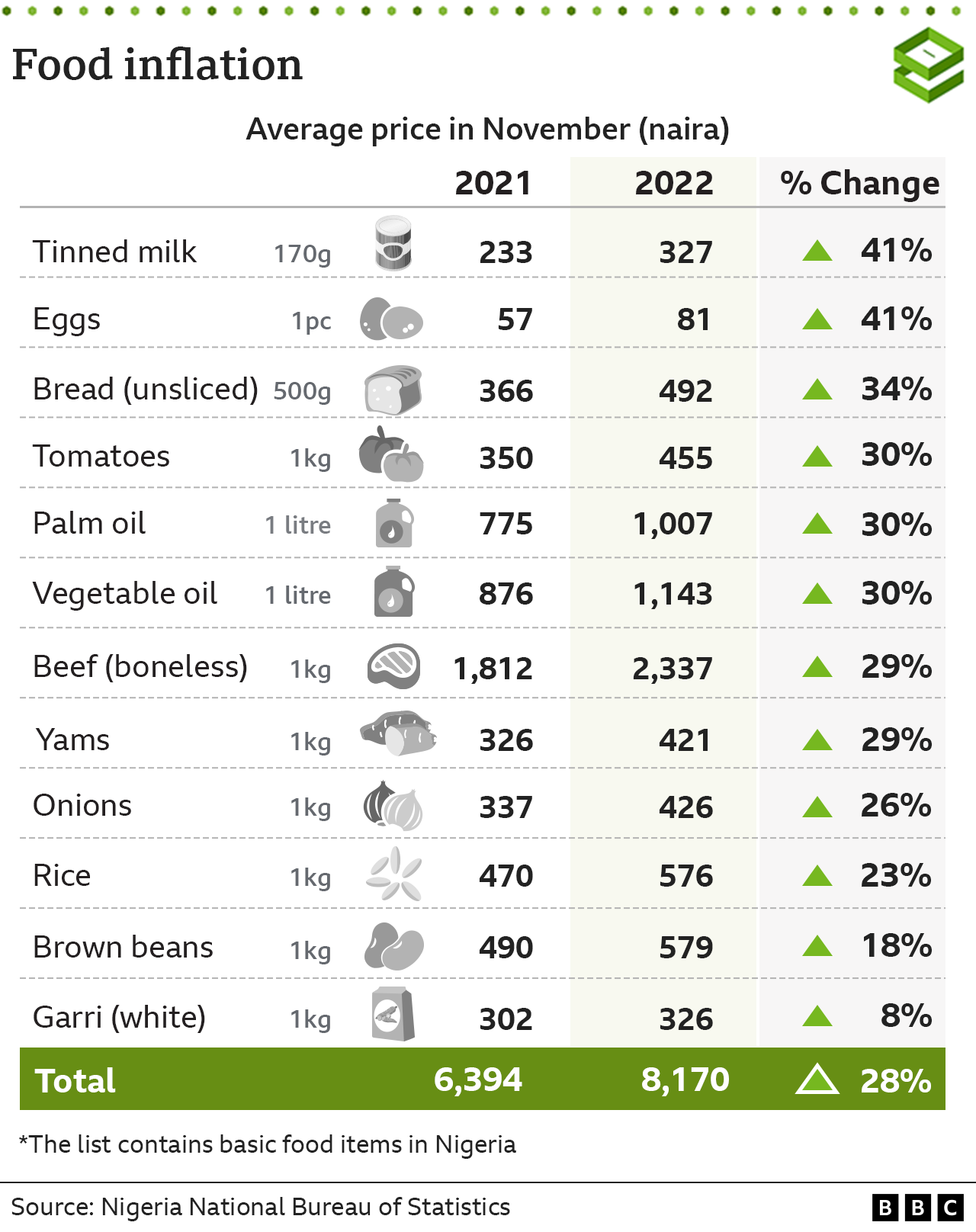
Nigerians, like others all over the world, have experienced an increase in food costs over the past year as a result of the consequences from the conflict in Ukraine. Yet, prices had been rising prior to the war due to a shortage of foreign currency and the closing of the border to numerous imports.
In total, inflation in 2022 was just under 19%, which was the highest level in 20 years. Garri, or cassava flakes, a staple food, has been one of the fundamental items least impacted, but families are being greatly impacted by the sharp increase in the price of other necessities like tomatoes and vegetable oil.
If the new president wants to help people with the cost of basic items, they will face the problem that the government is already spending more than it receives.
Huge sums are spent on subsidising petrol and the oil-producing nation has not been able to take advantage of higher oil prices as it has little refining capacity and has to re-import petrol.
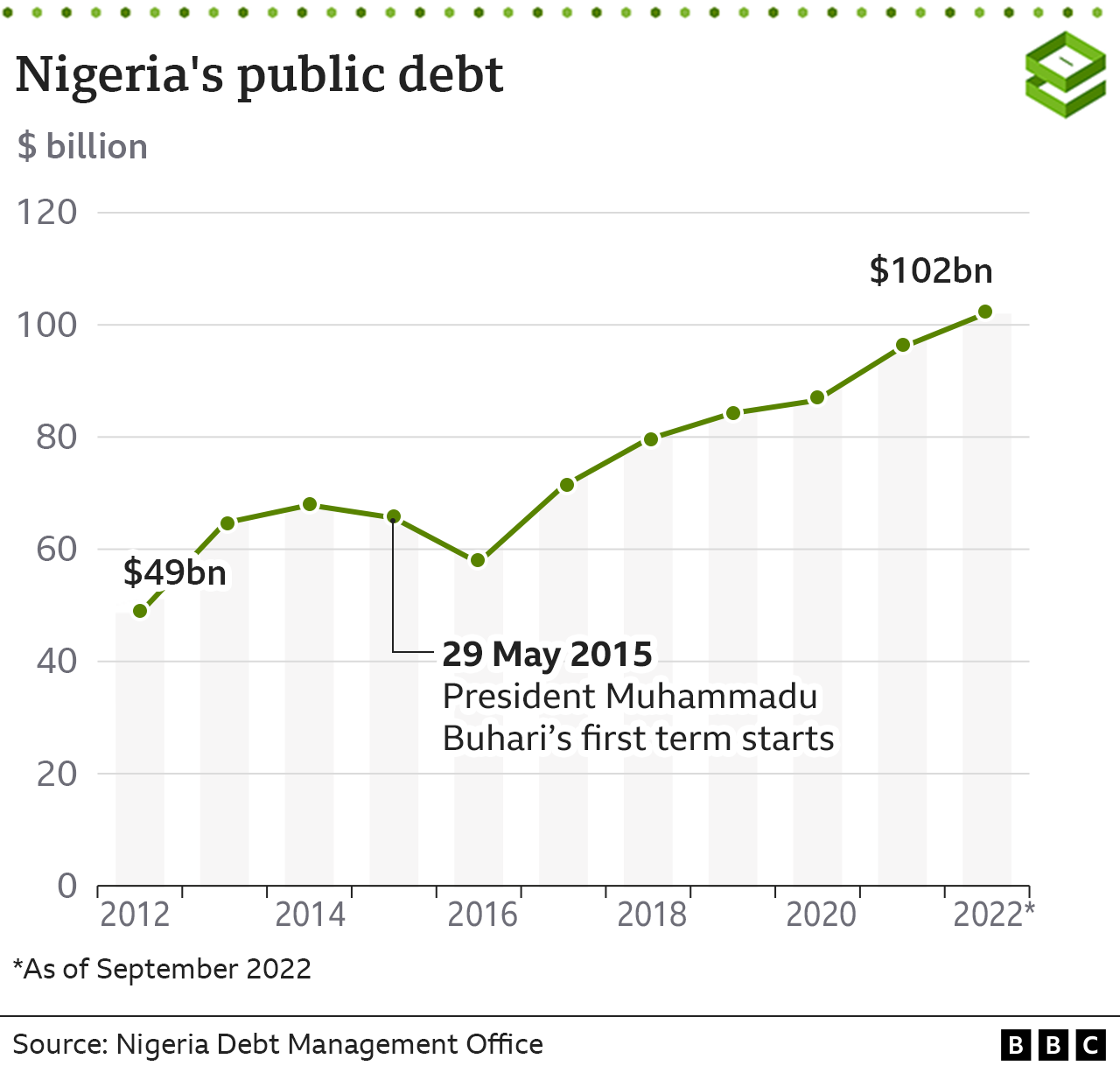
Analysts are getting increasingly concerned about the sustainability of the public debt with the cost of paying the interest on it exceeding government income at times in 2022.
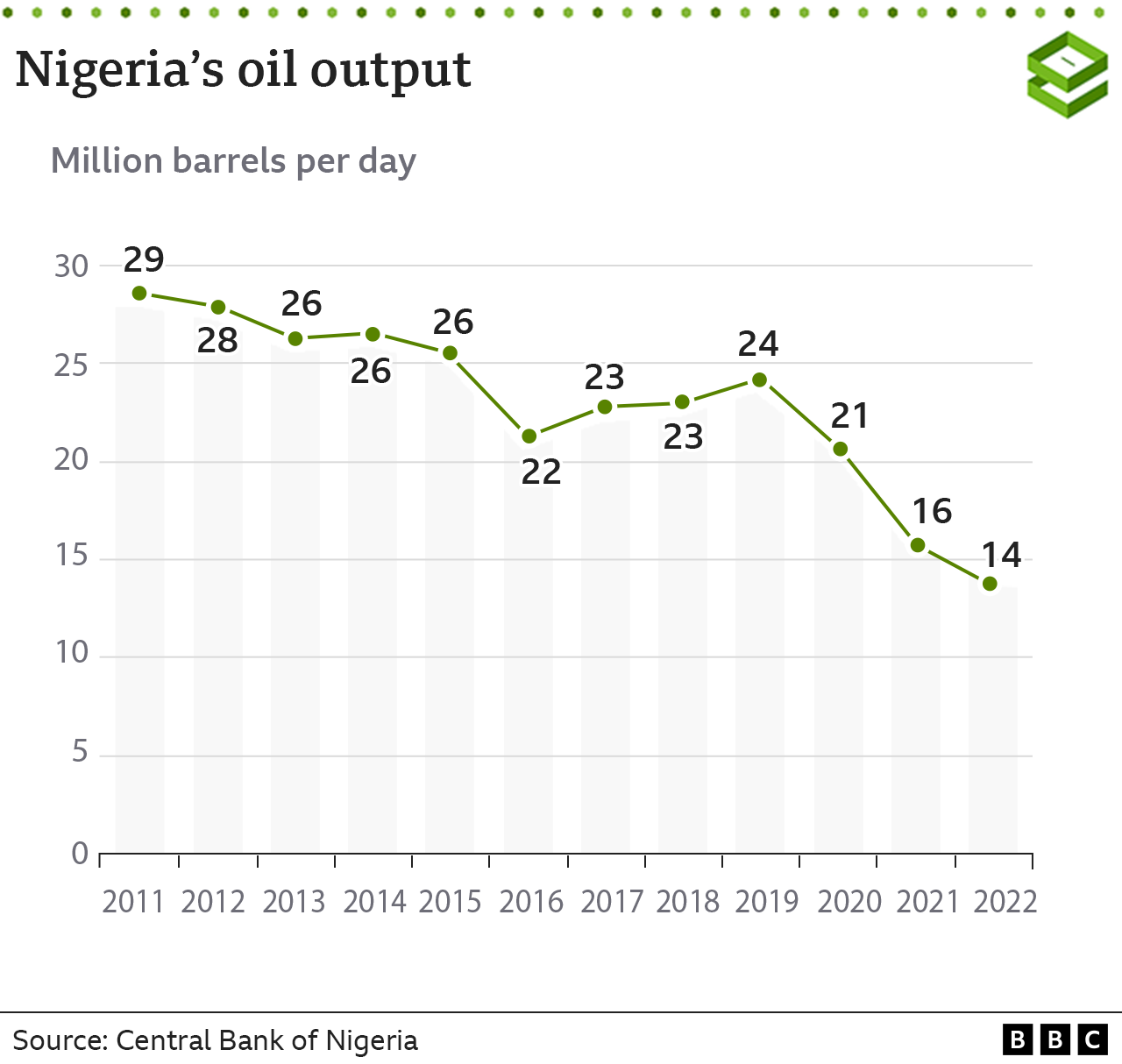
As one of Africa’s top oil producers, Nigeria has relied on the black gold for government revenue as well as a source of vital foreign currency. Nevertheless, the oil-rich country has not taken advantage of the money generated – much of it has been stolen or misused.
And oil production has been declining in the last decade. In 2022 it fell to its lowest level in 30 years.
Oil theft and vandalism have been blamed for the loss of output. This, added to years of under-investment and the age of the oil fields themselves, means that Nigeria is falling behind other oil-producing nations.
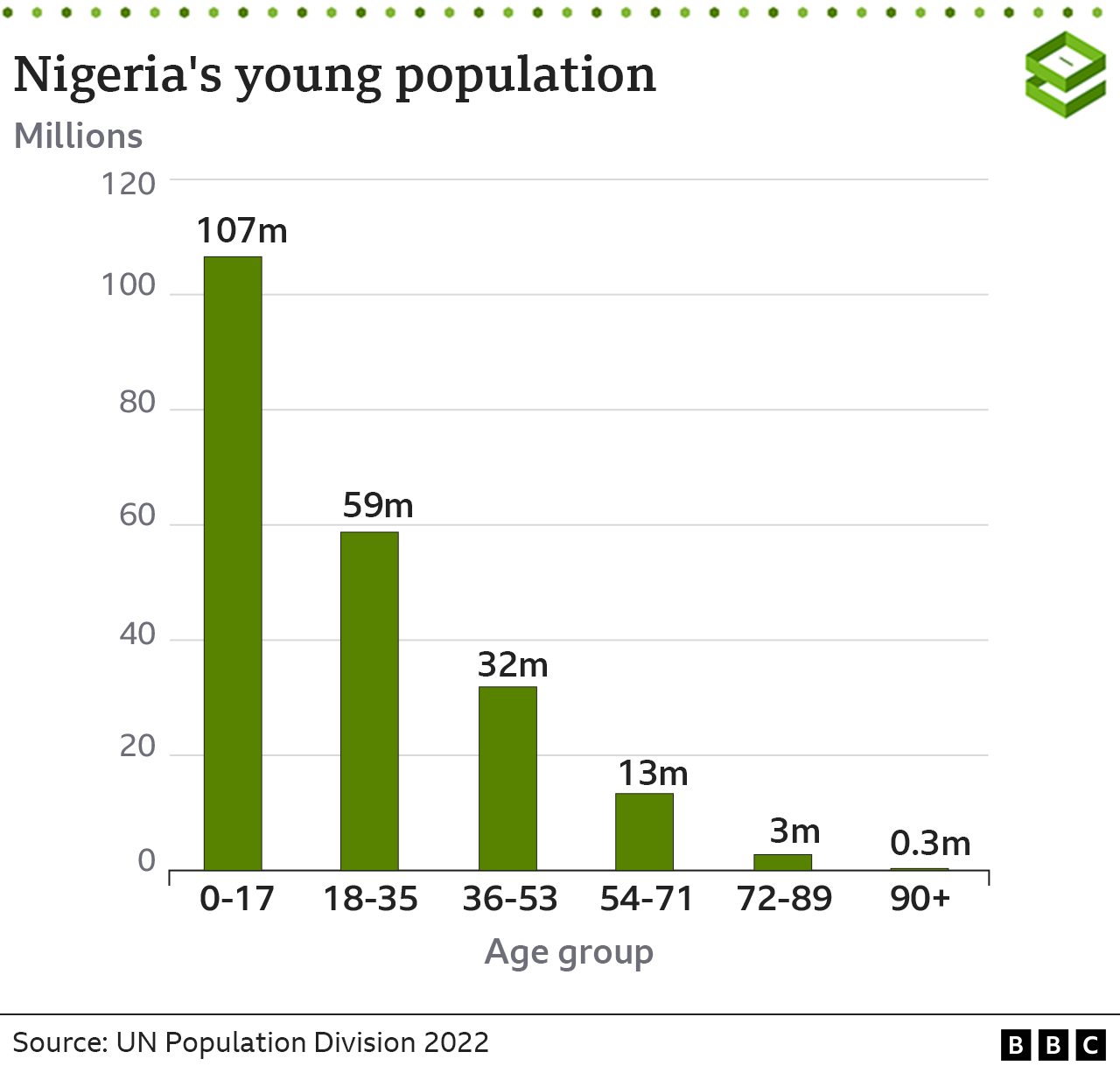
With half of Nigerians under the age of 18, the country’s leaders face the challenge of how to harness this youthful population.
They need to help the economy grow to fulfil the needs and ambitions of all those young people.
Even with so many people too young to cast their ballots, 40% of registered voters are under the age of 35, making them a huge constituency. A direct appeal to them could influence the outcome of the election.
The first thing that most young Nigerians want is a job.
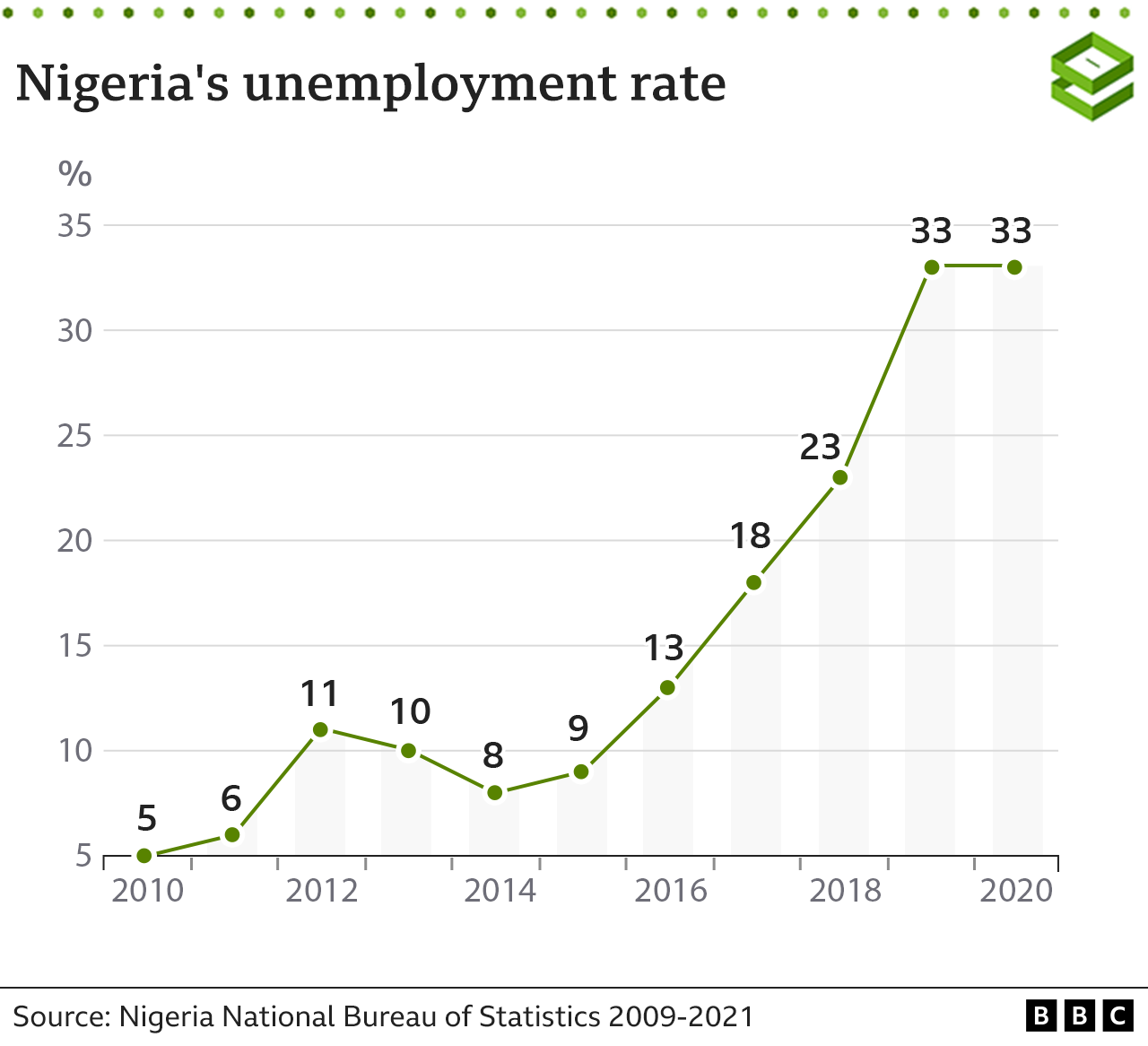
Currently a third of Nigerians who want to work are unemployed. When it comes to young people, more than half of those between 15 and 24 are looking for work.
The measures to deal with the Covid pandemic certainly had an impact but unemployment rates were rising before the outbreak of the virus.
The economy has grown since 2015, but just not fast enough to accommodate all the new people seeking jobs.
Insecurity has been cited as one of the reasons behind low growth, but economists have also blamed other measures such as currency restrictions and shutting the borders to many imports, saying they discourage investment.
The level of access to some basic infrastructure that could improve the ease of doing business, as well as everyday lives, is low.
The poor state of the power network has long been a source of criticism and only around 55% of the population have access to electricity, according to World Bank figures.
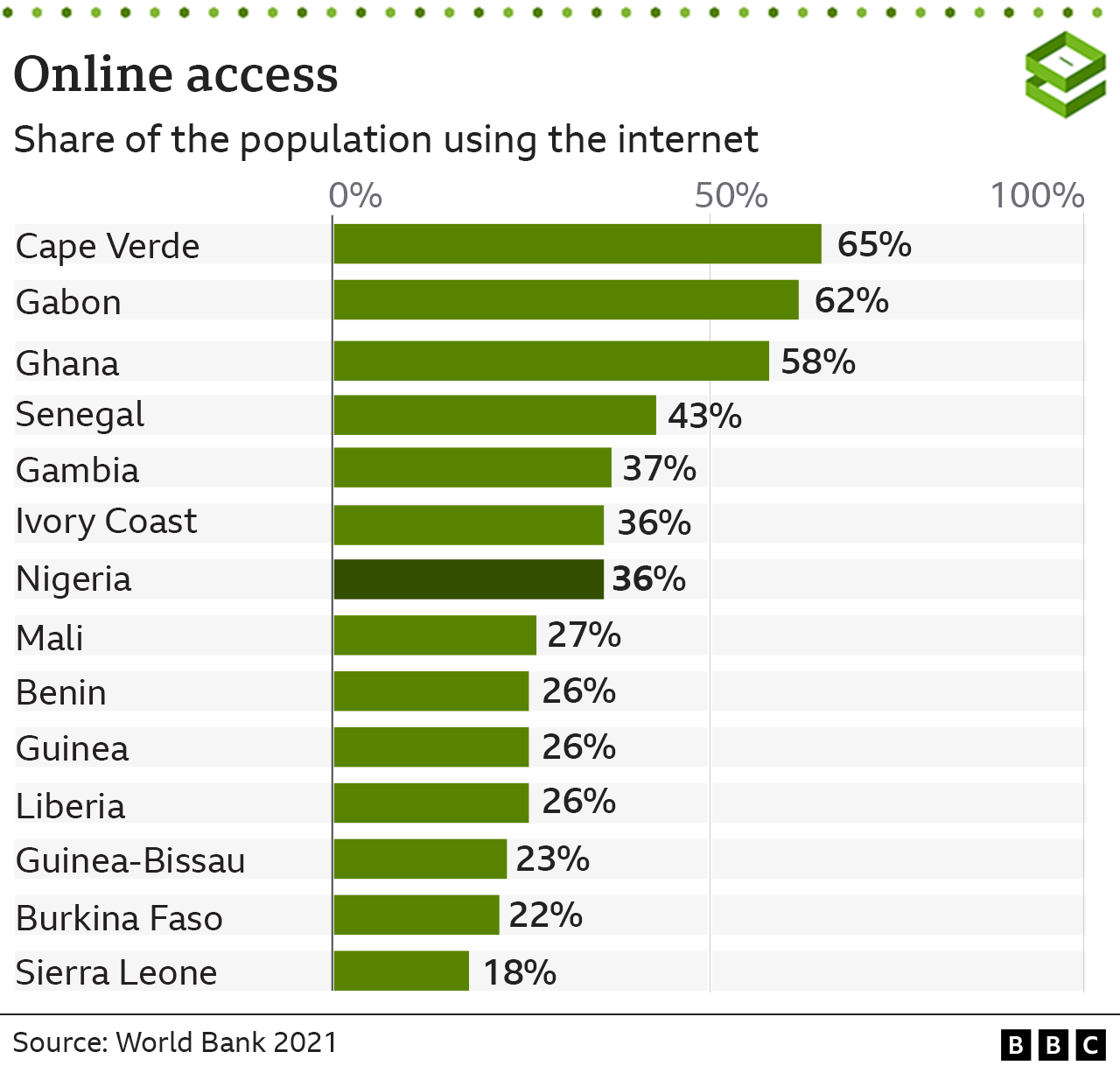
And when it comes to the internet, just 36% of Nigerians are getting online, which puts it in the middle of the pack of West African countries.
Dealing with the growing levels of violence in Nigeria will be a major priority for the next president.
When President Buhari was first elected in 2015, the threat from militant Islamist group Boko Haram in the north-east was the biggest concern. While they no longer control much territory, upsurges in kidnappings, politically motivated attacks, farmer-herder tensions, criminal violence and a separatist insurgency in the south-east, as well as police brutality, undermine faith in the state to keep the population safe.
This is no longer an issue that is largely confined to the north-east – the problem has now spread across the country.
Of all the children around the world who don’t go to school, one in five live in Nigeria.
While this is partly a reflection of the sheer size of the country’s young population, the fact that nearly 40% of the country’s 5-11-year-olds are not in school is a major concern.
This is a countrywide issue but attendance levels are generally worse in the north. Some of this has been affected by insecurity, but gender and poverty are also factors.