The National Democratic Congress (NDC) has noted a positive shift in the atmosphere of Inter-Party Advisory Committee (IPAC) meetings, describing the current environment as more amicable.
In January of this year, the NDC reversed its decision to abstain from IPAC meetings, marking a return to constructive engagement.
IPAC meetings provide a platform for political parties to review election-related activities, voice grievances, and contribute constructively.
The committee also serves as an advisory body to the Electoral Commission (EC).
In 2021, the NDC boycotted IPAC meetings, citing concerns about the EC’s alleged bias in favor of the New Patriotic Party during the 2020 general elections.
“It was very cordial. Don’t forget this year happens to be the third IPAC meeting that we attended. The first IPAC meeting was on 22nd February 2024. The second was on 29th February, and 7th March. So it’s been cordial since we returned to IPAC.”
“…It appears they have changed…It is not very cordial, very lovely. Not acrimonious. It is like the IPAC we used to know. That is consensus-building,” he stated.
The New Patriotic Party (NPP) is yet to receive official communication from the Electoral Commission (EC) regarding the schedule for this year’s general elections, a sentiment shared earlier by the National Democratic Congress (NDC).
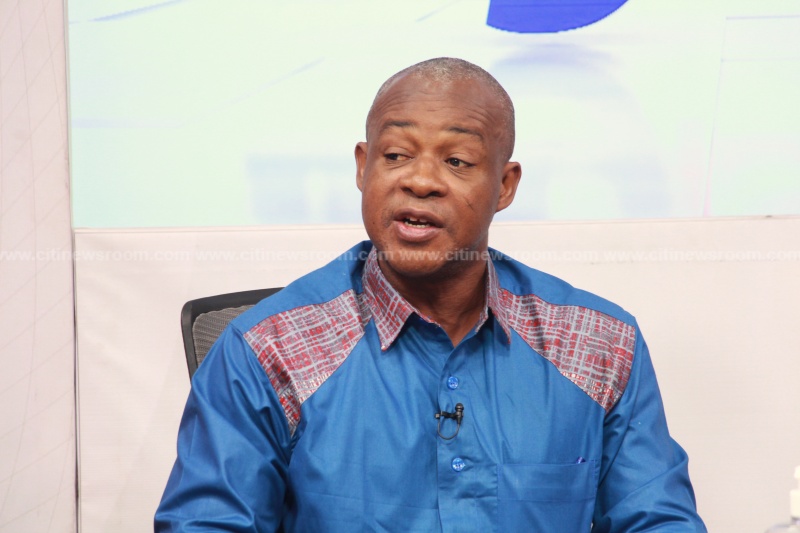
The NPP’s Director of Research and Elections, Evans Nimako, clarified in an interview that the party had only received an invitation for an Inter-Party Advisory Committee (IPAC) meeting, scheduled for Thursday, March 7, 2024.
This comes amidst reports of the Electoral Commission’s plans for key election activities, including nominations, balloting, and result declaration, with the NPP emphasising the absence of official communication on the broader election program.
“The NPP has not received any official communication from the EC concerning the programme of activities for the 2024 presidential and parliamentary elections.”
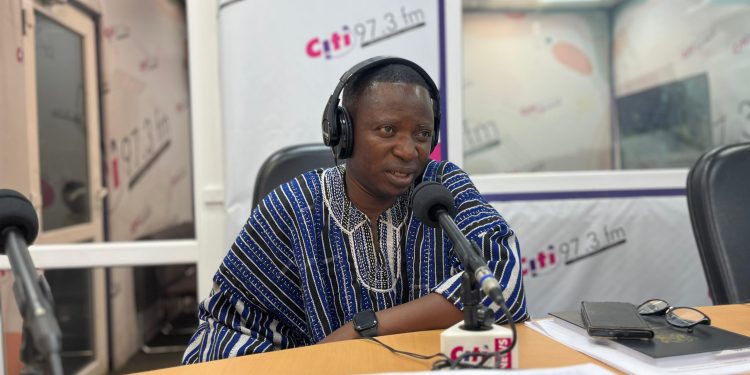
“All that we have gotten is a notice of invitation for an IPAC meeting to be held on Thursday 7th of this month at the EC Headquarters so I will also confirm that we have not received any such communication from the EC,” Evans Nimako stated in an Eyewitness news interview on Citi News.
The statement echoes the sentiments previously expressed by the National Democratic Congress (NDC), which criticised the commission for releasing the calendar to the public.
Reports indicate that the Electoral Commission plans to accept nominations for this year’s presidential and parliamentary elections from September 9 to 13, marking a significant countdown to the peak of the political season.
This will be followed by the balloting for positions on the presidential ballot paper on September 23, 2024, and the parliamentary balloting on September 24, 2024.
Furthermore, the Electoral Commission expects to declare the results of the 2024 presidential polls within three days of the voting exercise, provided everything proceeds as planned.
As part of its activities for the 2024 general election, the Electoral Commission will conduct a voters’ registration exercise from May 7 to May 27, 2024, and will also undertake a nationwide exercise to replace missing voter ID cards starting from May 30, 2024.
The registration exercise will be preceded by a 56-day public education campaign, which will run from April 1 to May 26, 2024.
The New Patriotic Party (NPP) has confirmed it has not received an official communication from the Electoral Commission(EC) on the schedule for the upcoming general elections.
This aligns with the National Democratic Congress (NDC)’s critique of the public release of the election calendar.
Reports suggest the Electoral Commission plans to receive nominations for the presidential and parliamentary elections from September 9 to 13. Subsequently, the presidential ballot paper positions will be drawn on September 23, 2024, and the parliamentary positions on September 24, 2024.
The Commission aims to declare 2024 presidential poll results within three days post-election.
Additionally, a voters’ registration period runs from May 7 to May 27, 2024, alongside a nationwide effort to replace missing voter ID cards starting May 30, 2024.
NPP’s Director of Research and Elections, Evans Nimako, stated in an interview that the party received an invite for an Inter-Party Advisory Committee (IPAC) meeting on Thursday, March 7, 2024, but no official communication on the election program.
“The NPP has not received any official communication from the EC concerning the programme of activities for the 2024 presidential and parliamentary elections.”
“All that we have gotten is a notice of invitation to for an IPAC meeting to be held on Thursday 7th of this month at the EC Headquarters so I will also confirm that we have not received any such communication from the EC,” he said.
The Electoral Commission (EC) has outlined its plan to announce the results of the presidential election within three days after December 7, 2024, as disclosed in the Commission’s election calendar.
Although there is no legal requirement for a specific declaration timeframe, the EC aims to ensure the timely release of presidential results, aiming for a maximum of three days.
Additionally, the election management body has scheduled the opening of nominations for both presidential and parliamentary candidates for the upcoming election from September 9 to September 19.
“There was no law requiring the EC to declare the results within a specified period, the EC intended to ensure that it would be able to declare the presidential results within a maximum of three days,” the statement stated.
The provisional voters’ register is set to be submitted to political parties between July 9 and July 18, 2024.
Balloting for positions on the presidential ballot paper is scheduled for September 23, 2024, providing clarity on the sequence of candidates.
The EC has also designated December 2 for special voting for selected professionals, with the main election scheduled for December 7, 2024.
The Electoral Commission of Ghana (EC) has taken a pivotal step towards addressing the upcoming December 7, 2024 general elections by convening an Inter-Party Advisory Committee (IPAC) meeting scheduled for Thursday, March 7, 2024.
Responding to mounting pressure from political parties and members of parliament demanding clarity on the election timeline, the EC officially invited party representatives through a letter dated March 1, 2024.
Signed by Mr. Bossman Eric Asare, Deputy Chairman for Corporate Services at the EC, the invitation instructs each party to send three representatives to the IPAC meeting.
The central focus of the meeting, slated to commence at 10 am in the IPAC room of the Electoral Commission, is to lay the groundwork for the announcement of election 2024 programs.
Furthermore, the gathering of political stakeholders provides an opportunity for open discussions on any other pertinent matters relevant to the upcoming elections.
The Electoral Commission (EC) has outlined a comprehensive schedule of activities for the 2024 general election.
Per reports by the Daily Graphic, the EC aims to declare the results of the 2024 presidential polls within three days of the voting exercise, barring any unforeseen circumstances despite there not being a legal requirement for the EC to declare the results within a specified period.
Regional Collation Centres will be maintained to announce results at the regional level.
The Electoral Commission’s programme of activities for the 2024 general election, as reported, includes a voters’ registration exercise scheduled to take place from May 7 to May 27, 2024.
Following this, a nationwide exercise to replace missing voter ID cards will commence on May 30, 2024.
The programme includes 56 days of public education on the voter registration exercise, scheduled to take place from April 1 to May 26, 2024. Following this, the EC will conduct the voters’ registration exercise from May 7 to May 27, 2024, and then proceed with a nationwide exercise to replace missing voter ID cards from May 30, 2024.
The EC plans to submit the provisional voters’ register to political parties between July 9 and 18, 2024, and conduct an exhibition of the voters’ register from July 15 to 24, 2024. The final voter register is expected to be submitted to political parties between August 30 and September 5, 2024.
Nominations of candidates for the presidential and parliamentary elections will be received by the EC from September 9 to 13, 2024. This will be followed by the balloting for positions on the presidential ballot paper on September 23, 2024, and the parliamentary balloting on September 24, 2024.
The Electoral Commission (EC) has outlined a series of engagements and activities as part of its schedule for the 2024 general election, aimed at ensuring transparency and inclusivity in the electoral process.
According to sources within the EC, the commission will hold meetings with stakeholders outside the political parties’ framework and engage the public through its “Let The Citizen Know” series. These efforts are intended to promote understanding and appreciation of the EC’s efforts towards a free and fair electoral process, thereby reducing suspicion and mistrust among stakeholders.
Additionally, the EC will conduct Special Voting for selected professionals on December 2, five days before the main polls. This will be open to security agencies and accredited media personnel.
It is important to note that all dates provided are subject to review, as indicated by the sources within the EC.
The Member of Parliament for Tamale North Constituency, Alhassan Suhuyini has accused the Electoral Commission of focusing on trivial matters instead of focusing on providing adequate tools for her workers.
He pointed out that during the last district-level election, voting materials arrived very late and some equipments were not even functional upon arrival.
Thus the EC needs to focus on providing proper tools and equipment to for workers and fix all malfunctional equipment.
“In my constituency for example, in one electoral area they voted till 2am, materials arrived late, the equipment still malfunctioned and you are not dealing with that,” he said on the AM Show.
“Electoral Commission is majoring on minor things and minoring on major things” he added.
He mentioned that some officers in the Electoral Commission were given vehicles, but were denied of funds for its maintenance.
“There are so many officers that I know that were given vehicles, pickups in 2020, have not been serviced. They have not been given money for servicing at all and we are in 2024. They sent only two spare tyres to them, does a vehicle use two tyres?
“Sending them two tyres for just one pickup to run in the constituency when is election time, they don’t get their fuel on time, nothing.
“During the limited registration exercise, when colleagues and I went around the district offices, in some cases we had to give money for them to buy credit, to be able to power their offices. These are basic things.
“Despondency is at the highest level today at the Electoral Commission. Workers don’t feel motivated to work because they are not even given the basic tools to work, and these are the things you need to fix as the leader of that institution,” he added.
The Electoral Commission (EC) has reassured the public and stakeholders that it will reveal the electoral calendar for 2024 by the close of February, maintaining the original December 7 date for the general elections despite earlier discussions for a change.
Controversy has emerged over potential alterations to the 2024 election date, triggered by concerns from the Seventh Day Adventist Church regarding the election day coinciding with a Sabbath.
The opposition National Democratic Congress (NDC) has criticized the EC for not prioritizing the release of the electoral calendar, labelling their focus on other matters as “unproductive endeavors.”
Addressing the concerns, Deputy Chair of the Commission, Dr. Bossman Asare, assured during an appearance before the Public Accounts Committee on Wednesday, February 21, that the EC will soon announce the electoral calendar for 2024.
“We will certainly disclose it [the calendar] before the end of February. It should be out by the end of this month [February],” Dr. Asare promised.
The High Court in Ho has dismissed two applications put forth by the petitioners in the SALL Election petition.
These applications sought to withdraw an initially filed application for judgment on admissions and a substantive application for judgment on admissions made by the Electoral Commission.
As the court prepared to deliver its ruling on a motion for judgment based on admissions made by the first respondent, the Electoral Commission, it faced an interruption due to a late application by John Peter Amewu to enter a late appearance and to stay the court’s ruling.
The court granted approval for the late entry application but rejected the application to halt the court’s ruling.
Subsequently, the petitioners, represented by their lawyer Tsatsu Tsikata, filed a motion to withdraw their application for judgment based on the admission made by the EC.
The court ruled that the admissions made by the EC only provide grounds for the court to issue orders, not judgments.
Consequently, the application for judgment based on admissions was dismissed, and the court adjourned to March 15, 2024, to determine the course of legal arguments or a full trial regarding the merits of the petitioners’ case and the reliefs sought.
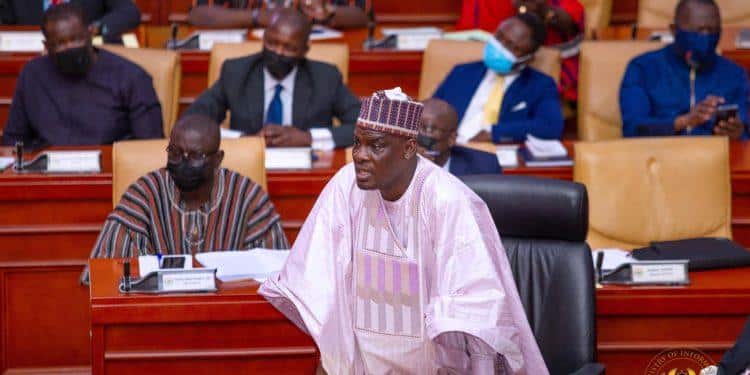
The Minority Leader, Dr. Cassiel Ato Forson, has declared that the Minority in Parliament will vehemently oppose any efforts by the Electoral Commission (EC) to eliminate the use of indelible ink in the 2024 polls.
The EC recently disclosed plans to discard the traditional practice of applying indelible ink to voters’ fingers, a method aimed at preventing multiple voting, in favor of more “modern” verification methods.
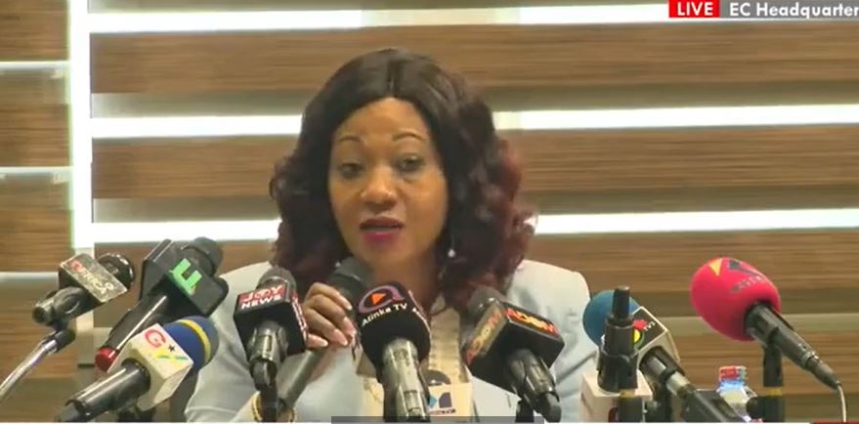
EC Chairperson Jean Mensa clarified that indelible ink would not be necessary in district-level elections and subsequent polls as part of ongoing efforts to enhance the electoral process.
Expressing strong dissent against this decision, Dr. Ato Forson emphatically stated during a parliamentary session on February 6, 2014, “Mr. Speaker, we will not countenance the elimination of indelible ink from the electoral process. We will not! Read my lips, we will not! Touch wood, we will not.”
The Minority Leader argued that the use of indelible ink in elections has stood the test of time in identifying voters, emphasizing that it would be a mistake for the EC to abandon this established practice.
He asserted that indelible ink contributes to the integrity of elections by ensuring visible, transparent, and physical verification alongside biometric verification.
Dr. Ato Forson underscored the importance of indelible ink, stating,
“The truth of the matter is that the use of indelible ink in our electoral process does no harm to the conduct of free and fair elections in Ghana. In fact, indelible ink adds another layer to the integrity of elections by ensuring that voters are visibly, transparently, and physically verified in addition to biometric verification.
Indelible ink has not only become a feature of our elections in the Fourth Republic, but it is also a time-tested method of easily identifying persons who have already cast their ballot and therefore helps to prevent multiple voting.”
He emphasized that indelible ink has become a consistent feature of elections in the Fourth Republic and serves as a proven method to easily identify individuals who have cast their ballots, thereby preventing multiple voting.
Former Minority Leader and Tamale South MP, Haruna Iddrisu, has joined voices in the opposition National Democratic Congress (NDC) kicking against the implementation of a new date for the country’s general elections.
Speaking at a Town Hall meeting held as part of the National Democratic Congress (NDC)’s “Building Ghana Tour” in Gushegu, Haruna Iddrisu asserted that such a move undermines the rights of the electorate and defies common sense.
The legislator, in his address stressed on the fundamental nature of the right to vote, enshrined under Article 42 of the constitution.
He fervently argued that any alteration to the voting time would inevitably impede the electorate’s capacity to fully exercise this sacred right, regardless of the length of the queue.
“It is a common sense matter,” stated Haruna Iddrisu. “Some people can finish voting at 10 am because their numbers are inadequate. It makes common sense that whenever you have a queue of Ghanaians, even up to 11 pm, legitimacy and constitutionalism require that you respect the right to vote.”
Expressing apprehension regarding the potential consequences of the Electoral Commission’s proposed amendment, Haruna Iddrisu underscored the significant constitutional challenge it presents.
He emphasized that changing the voting time would require amending two articles of the constitution, suggesting that achieving consensus in Parliament could pose considerable difficulty.
“We do not think that parliament may be able to build a consensus on that matter because it will require a constitutional amendment of two articles,” emphasized Haruna Iddrisu.
Moreover, he stressed the importance of maintaining the use of indelible ink for the election, underlining its crucial role in preserving the integrity and credibility of the electoral process.
The Electoral Commission of Ghana (EC) has declared its intention and is making plans to change the election date from December 7 to November 7. The decision follows a proposal from the Seventh-Day Adventist Church for the amendment of the December 7, 2024, election date to a different day.
The SDA church wants the date moved since it is a Saturday and a day of worship for the church. The EC subsequently welcomed the idea and suggested that the voting date be moved to November 7.
An Inter-Party Advisory Committee (IPAC) meeting to deliberate on the change of the date for the 2024 general election was held in Accra on Monday, January 29, 2024.
The meeting was attended by representatives of the various political parties that make up IPAC.
The meeting, which started at 10:30 a.m. with the two Deputy Commissioners of the Electoral Commission (EC) -Corporate Services, Dr Eric Bossman Asare; and Operations, Samuel Tettey, at the helm of affairs was afford IPAC members an opportunity to discuss the EC’s proposal to move the election date from the traditional December 7 to November 7 and also make it a holiday.
While the EC maintained that it could go through the needed processes to effect the change of date, some of the political parties said activating such a move in an election year was too short a period.
However, the parties have agreed in principle that the processes for the change in election date could begin after the 2024 elections and be applied in the 2028 elections.
The Electoral Commission (EC) has placed five electoral officers, responsible for overseeing the New Patriotic Party’s parliamentary primaries in Yendi, on interdiction.
As per information from a source affiliated with the regional directorate of the Commission, the interdiction encompasses five officers who were designated to support the election process, excluding municipal officers.
The Yendi constituency’s parliamentary election on Saturday, January 27, was marred by allegations against an Electoral Commission official accused of manipulating the ballots for one of the candidates.
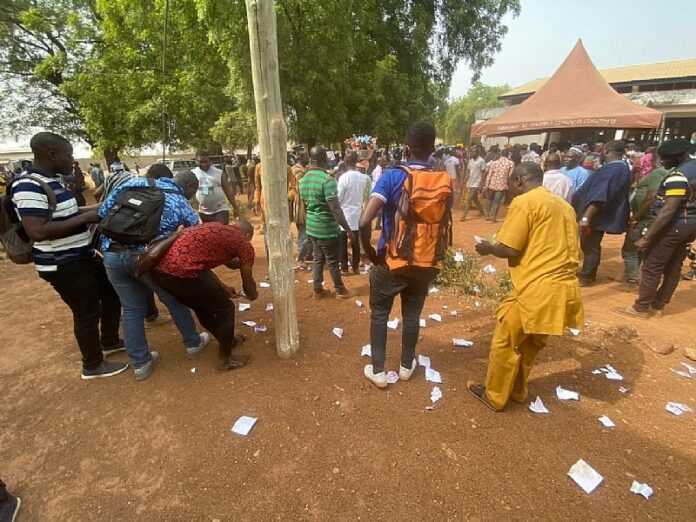
A Commission officer faced accusations of secreting Abibata’s ballot papers into his jacket, leading to a dispute resulting in torn ballot papers.
Security intervention was necessary to restore order, and the election materials, including ballot papers, were transferred to the Yendi municipal police station.
Despite this, EC officials declined to tally and announce the results.
Alhaji Masawudu Osman, the party’s third Vice Chairman, declared Farouk Aliu Mahama as the winner of the elections.
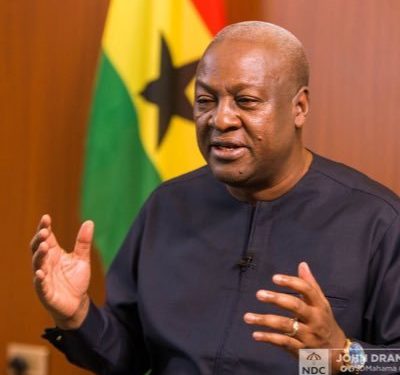
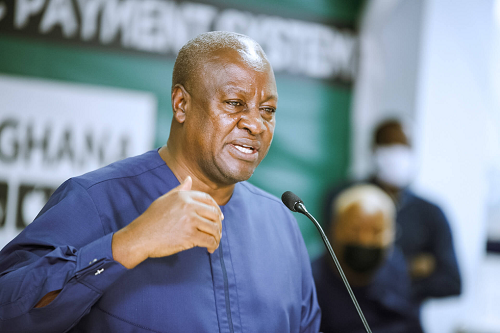
Former President John Dramani Mahama has expressed disapproval of the Electoral Commission’s (EC) plan to change the date of the upcoming presidential and parliamentary elections.
Mahama emphasized that implementing such a significant electoral reform during an election year could lead to chaos if not handled carefully.
Speaking at a breakfast meeting with clergymen and Christian community leaders in Koforidua, Eastern Region, Mahama questioned the appropriateness of the EC’s actions.
He criticised the timing of proposed changes, including the omission of indelible ink and the shift in the election date, asserting that such surprises erode people’s confidence in the electoral process.
“What the EC does sometimes does not sound right. Since we voted in 2020 and now it’s left with just nine months to this year’s general elections, you are now coming up with major changes, saying they will not introduce indelible ink and all that.
“If you do that you don’t build the confidence of the people in the electoral process. They are also saying they want to shift the election date and bring a new C.I. to change the old C.I. What we’re saying is that, why wait till now? You don’t spring surprises on people like that,” the NDC leader asserted.
The EC had earlier disclosed that approximately 60% of political parties supported its proposal to conduct the elections in November.
However, Mahama, along with the NDC and some political parties, rejected the idea, citing concerns about the limited time for the EC to organise a peaceful and successful poll.
Deputy Chairman of the EC in charge of Corporate Services, Dr. Bossman Eric Asare, acknowledged the majority support for the 2028 timeline among political parties but revealed that about 60% were open to the possibility of implementing the changes in 2024, provided it can be legally accomplished.
“So in principle, all the parties that attended IPAC yesterday were for it for 2028. But for 2024, almost 60% of the parties, more than half of the parties, said if it will be possible for the EC to go through the legal processes to have it implemented this year, let’s go ahead,” Dr. Asare indicated in an interview.
Dr. Asare assured that the EC is confident in meeting all legal requirements to hold the elections in November.
“Looking at our calendar, we are pretty sure that we will be able to do everything, whatever it takes to ensure that we go through the legal process.
“But as I said, as far as we are concerned, whatever we need to do, whatever is necessary, whatever is proper that must be done to ensure that we are able to consummate it and have the elections, we are well able to do that,” Dr. Asare noted.
The NDC’s Director of Elections and ICT, Dr. Edward Omane Boamah, said the EC must proceed with caution.
He said that the overwhelming agreement was that, given everything the EC has to do between now and the next presidential and parliamentary elections, it would be taking on more than it could do.
“As an institution, if it wanted to add the needed parliamentary processes to change the date for the elections, it’s something that we all discussed, and we are all men and women of faith,” he said.
The Electoral Commission (EC) has provided justification for its proposal to shift the date of the upcoming general election from December 7 to November 7, 2024
The proposed shift in the election date, according to the Commission will serve as a measure to afford the EC ample time to execute its responsibilities effectively.
During an Inter-Party Advisory Committee (IPAC) a meeting on Monday, January 22, 2024, the deputy chairperson of the Electoral Commission in charge of Corporate Services, Dr Bossman Asare stated that “organising the elections within three weeks will be very tight”.
He added that” Beyond that, the time for the inauguration you have a new government and an old government leaving office, the time will be too short”.
According to him, the EC had been advocating for a change in the election date long before the church’s petition.
“Let me state very clearly that it had nothing to do with what the Adventist Church brought in the form of a petition,” he added.
This justification comes after Chairperson of the Commission, Jean Mensa, proposed that the Commission is contemplating a shift in the election date from December 7 to November 7.
The Electoral Commission (EC) has revealed that it contemplated changing the election date for the 2024 general election as early as 2020.
The clarification comes after Chairperson of the Commission, Jean Mensa, reportedly proposed that the Commission is contemplating a shift in the election date from December 7 to November 7.
She revealed this adjustment during a meeting with the Inter-Party Advisory Committee (IPAC) on Monday, January 22.
This development to many, aligns with with a recent proposition put forth by the Seventh-day Adventist Church, which aimed to modify the election date based on religious considerations.
The church, referencing Saturday, December 7, 2024, as a day dedicated to divine worship, formally appealed to the Attorney-General’s office, urging support in sponsoring legislation to amend the election day.
However, the deputy chairperson of the EC in charge of Corporate Services, Dr Bossman Asare has stated that “Let me state very clearly that it had nothing to do with what the Adventist Church brought in the form of a petition.
According to him the intention to change the 2024 election date was considered in 2020 comes after certain political parties proposed a change in date with the reason being that “in the event there was a run-off, the EC will have exactly 21 days, and right after the 21 days, the next one week would be the inauguration”.
“This was something the Commission had thought about from 2020, but we did not have enough time to be able to put it into action in 2020. Yesterday [Monday], when we met at IPAC, we made it very clear to the parties that this was a proposal that came from the political parties themselves in 2015,” he said.
“The reason they gave at the time was that in the event there was a run-off, the EC will have exactly 21 days, and right after the 21 days, the next one week would be the inauguration.
“Apart from that too, we gave a reason that the time for the EC to work on organising the elections within three weeks will be very, very tight. Beyond that, the time for the inauguration you have a new government and an old government leaving office, the time will be too short,” he added.
Aspiring 2024 presidential candidate for the New Force movement, Nana Kwame Bediako, commonly known as Cheddar and has leveled an accusation against the Electoral Commission (EC), alleging that they are intentionally withholding a political party license from him.
Bediako asserts that despite meeting all stipulated requirements and submitting the necessary documents, the EC has not issued a provisional license to his group, leaving the New Force movement in a state of uncertainty.
Speaking in an interview on TV3 on January 11, 2024, he detailed the hurdles, his party has faced in its pursuit of formal recognition.
“I started my journey and I realized that the kind of things I have to do to have a political party were quite tough. I had to get these officers in the regions and buildings, and of course, I started. We did the work; we went to get offices in all 16 regions.
“We did what the law is saying… We submitted them to the EC, all the documents and then we paid the first money to say that you can become a political party, but we are going to give you a provisional license.
“And then you go to the rest of the constituencies, which is a hundred and seventy-seven districts that we have to also create more offices, which we are ready and we have it in motion.
“Now, when we did that, the clause says that they would reply after seven days, every time we have gone back to ask, they say that they were doing something, they were waiting for this and that,” he said.
He further voiced apprehension about the lack of transparency in the procedure, stating, “It has been two to three months, and what troubles me the most is the recurring phrase I hear, ‘orders from above.’”
“I don’t go there myself but someone will tell my people that orders from above say that; maybe we should wait, orders from above are saying that we should arrest this, we should keep this, orders from above are saying that we should cancel this.
“We, as the New Force are a little bit confused about the entire national governance. I feel like there have to be some human rights in there, which I think Ghana is not fully going by because clearly, we are still waiting to be responded to. At least give us a letter,” he lamented.
Former General Secretary of the Christian Council, Rev. Dr. Kwabena Opuni Frimpong, has called for increased transparency and improved public information efforts by the Electoral Commission of Ghana (EC).
Rev. Opuni Frimpong expressed his desire to see the EC demonstrate sincerity and transparency in its operations, emphasizing the importance of actions aligning with intentions.
“To me, they [EC] want to be sincere and transparent with the nation, and I would never assume that they have the intention to do so. I want to see their actions confirming this,” he said on Tuesday, January 9, 2024.
He likened the communication approach of the EC to that of an inclusive classroom, where every individual, regardless of their background or understanding, should be carried along.
Rev. Opuni Frimpong stressed the need for the EC’s educational unit, along with the National Commission for Civic Education (NCCE), to ensure that information service plans are accessible and understandable to people from various educational backgrounds.
“”Some students have to say and repeat and give extra examples before they understand, but you must carry everybody in the class along. For the sharp ones and the low learners, you must carry everyone along. I have been to the meetings, and I understand what they are trying to say.
“As long as I have my grandmother in my village who wants to understand what they are saying, I do not understand,” remarked Rev. Opuni Frimpong, emphasizing the importance of reaching all segments of society, including those who may not have had formal education,” he said.
He urged the EC to actively engage in inclusive communication strategies, considering the diversity of the Ghanaian population. Rev. Opuni Frimpong suggested that both the NCCE and the EC’s educational unit should work collaboratively to ensure that information reaches every corner of the nation, from the village to the city.
The National Democratic Congress (NDC) has unequivocally expressed its opposition to the Electoral Commission’s decision not to use indelible ink in the upcoming 2024 elections.
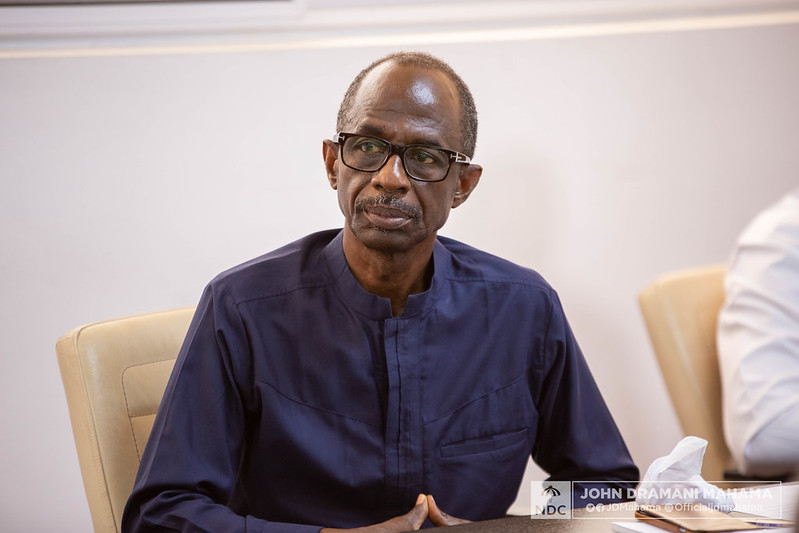
Speaking at a press brief on Monday January 8, 2024, at the party’s headquarters, National Chairman for the party, Johnson Asiedu Nketiah, emphasized that discontinuing the use of indelible ink at this juncture poses a significant risk, potentially opening the floodgates for nefarious activities that could compromise the integrity of Ghana’s elections.
The party contends that the visibility and physical verification provided by indelible ink are essential safeguards against fraudulent practices.
Addressing the media, Mr Asiedu Nketiah noted that, “Let me be abundantly clear one more time that the NDC is diametrically opposed to the Electoral Commission decision not to use indelible ink during the election 2024.”
The party insists that relying solely on Biometric Verification Devices (BVDs) introduces vulnerabilities, as these devices can fail, thus jeopardizing the electoral process.
The NDC’s strong stance is rooted in its conviction that indelible ink offers an additional layer of verification that complements biometric verification.
The party argues that the visible and physical verification provided by indelible ink acts as a crucial fail-safe in the event of any BVD failure, ensuring the overall integrity of the electoral process.
As Ghana prepares for the 2024 elections, Mr Asiedu Nketiah has called on national stakeholders and faith-based organisations to channel their energies towards advocating against the EC’s decision not to use indelible ink during the election.
Founding President of IMANI Africa, Franklin Cudjoe, has urged the Electoral Commission (EC) to ensure proper management of electoral processes to avoid errors in the 2024 general elections.
Citing instances from the recently held District Level elections, he emphasized that technical challenges encountered during those elections should not be repeated in the upcoming 2024 elections.
He added that “Ghana must ensure our Electoral Commission gets it right without the haphazard and in some instances, as in the infamous case of SALL, complete high-handed and near banditry tactics carefully deployed 24 hours to the elections in alienating a whole lot of Ghanaians in the vote without any official remedy, nearly four years on.”
“The recent bungling of district-level elections by the EC must not be repeated in 2024,” he said.
He expressed concerns about the EC’s handling of the 2020 election, suggesting that the electoral body may have been “complicit” in the unfortunate deaths of seven Ghanaian voters during that election.
“I still think Ghana’s EC is complicit in the needless deaths of 7 Ghanaian voters in 2020. Even sadder is the complete disregard by the security agencies, the National Security Ministry and the President on this grave matter,” he added.
Security and safety analyst, Dr. Adam Bonaa, has criticized the Electoral Commission’s recent decision to eliminate the use of indelible ink in the upcoming 2024 general election.
Dr. Bonaa argued that the decision appears to lack careful consideration, emphasizing that indelible ink plays a pivotal role in ensuring the integrity of the electoral process.
Speaking in an interview with GhanaWeb, Dr. Bonaa highlighted the prevailing issues of mistrust, distrust, and suspicion that often surround public elections in the country.
He expressed concerns that abandoning indelible ink, a widely recognized tool for preventing double voting, might escalate tensions on election day.
“It looks like the policy is not a well thought through policy. If you look at the issues we have when it comes to public elections in this country, they are issues to do with mistrust, distrust and suspicion.
“You don’t want a situation where you are going to have an all-out confrontation amongst the citizenry vis-a-vis the EC officials and the security officers who are supposed to be manning the polling centres.
“So to say that the indelible ink is not going to be used again is almost saying you are calling for an all-out war on election day because looking at the issues going into election 2024, there is suspicion everywhere.
“NPP is telling us it wants to break the 8, NDC says it is staging a comeback and you already have some former officers or members of the NPP going independent and also threatening to win the elections. So if anybody tells you that 2024 elections is going to be quiet, that person probably does not understand what they are saying,” he stated.
Dr. Bonaa cautioned against underestimating the potential for confrontations between citizens, Electoral Commission officials, and security officers responsible for managing polling centers.
He suggested that signaling the discontinuation of indelible ink could be interpreted as inviting chaos, particularly given the heightened political atmosphere leading up to the 2024 elections.
The Electoral Commission recently announced at a press conference that indelible ink would no longer be required, as a biometric authentication system would replace it. The system is being piloted during the ongoing district elections.
EC Chairperson Jean Mensa expressed confidence in the new system, stating that once a voter is verified, they cannot come back for a second attempt.
Despite the EC’s assurances, Dr. Bonaa argued that the decision might complicate the work of security agencies on election day. He called for the Electoral Commission to reconsider its stance and emphasized the importance of conducting extensive stakeholder engagement before making decisions with significant security implications.
Dr. Bonaa acknowledged the EC’s independence but urged them to prioritize comprehensive discussions with relevant stakeholders to maintain public trust in the electoral process.
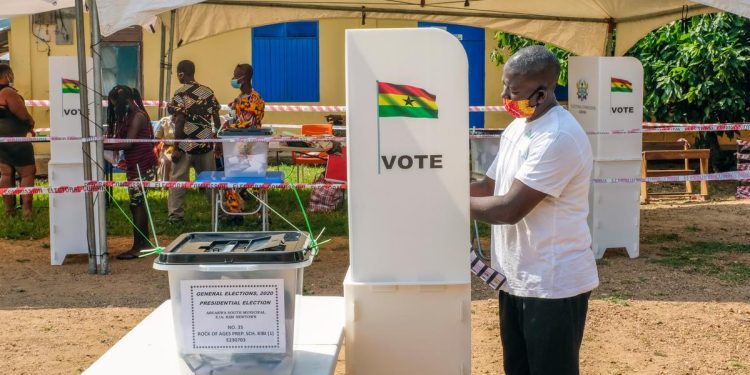
Today, Thursday, December 21, the Electoral Commission (EC) is set to conduct elections in district assemblies where the polls were previously postponed.
Approximately 40 districts in the Ashanti and Eastern Regions experienced delays due to errors on ballot papers, challenges in the distribution of voting materials, and malfunctions of Biometric Verification Devices (BVD).
Following the setbacks in the District Level Elections held nationwide on Tuesday, December 19, stakeholders, including the Coalition of Domestic Election Observers (CODEO), expressed disappointment in the challenges encountered.
CODEO attributed the issues to the EC’s failure to fulfill its responsibilities and called for improved performance in subsequent polls.
The National Democratic Congress (NDC) issued a stern warning to the EC, urging the commission to rectify technical challenges and avoid repeating the same issues in the upcoming 2024 polls.
The party emphasized the need to prevent any untoward incidents and called for a more effective electoral process.
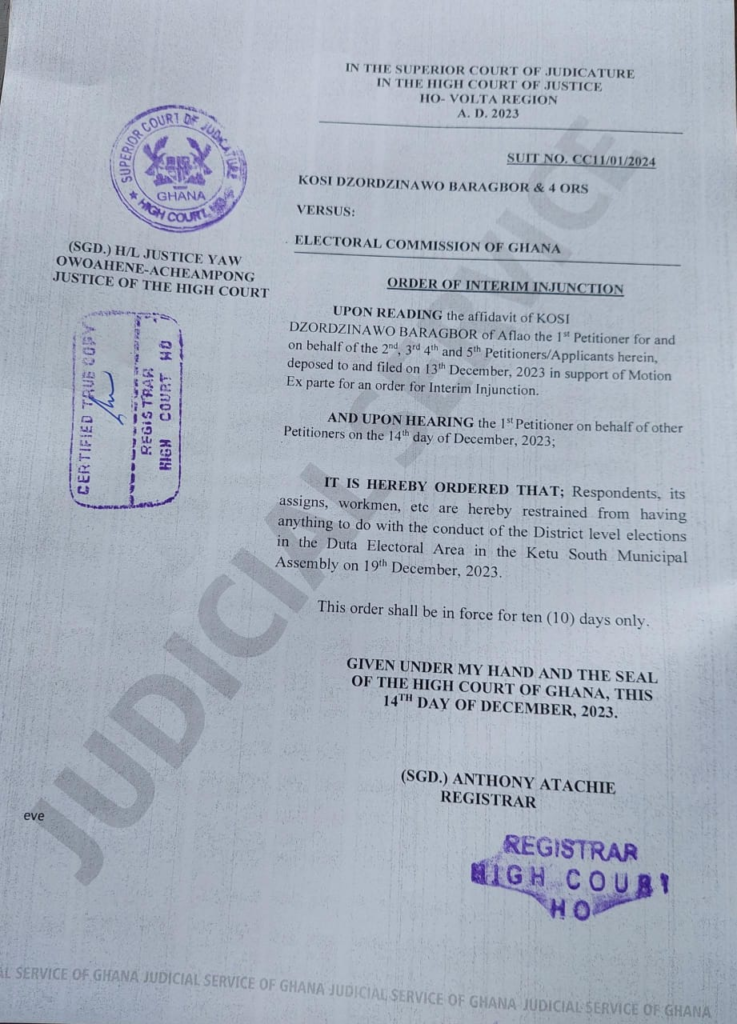
Five individuals in the Duta Electoral Area of Ketu South have obtained an interim injunction, through an ex parte motion, to prevent the Electoral Commission (EC) from conducting the upcoming District-Level Elections in the area on December 19, 2023.
The order, which is valid for ten days, restrains the EC, its assigns, and workmen from any involvement in the elections.
The petitioners have also indicated that all 24 candidates and registered voters in the Duta Electoral Area are similarly restrained from participating in the elections.
“We also filed a Motion Exparte for an interim injunction to restrain the Electoral Commission from having anything to do with the conduct of the District Level Elections in the Duta Electoral Area on the 19th day of December 2023.”
The High Court, Ho presided over by His Lordship Yaw Owoahene –Acheampong graciously granted the Motion Exparte and restrained the Electoral Commission, its assigns, workmen, etc. from having anything to do with the conduct of the District Level Elections in the Duta Electoral Area on the 19th day of December 2023.
President John Dramani Mahama has urged the Electoral Commission (EC) to ensure a transparent and credible electoral process in the upcoming 2024 general election.
As part of his “Building Ghana Tour” in the Western North Region, the 2024 presidential candidate of the National Democratic Congress (NDC) emphasized the significance of ensuring that the genuine aspirations of the voters are reflected in the outcomes of the elections.
Mahama emphasized that the credibility of an election relies on the integrity of the Electoral Commission.
Addressing students at Wiawso College of Education and the Nursing Training College, Mahama made a direct appeal to Electoral Commission officers, calling on them to follow the rules and guarantee a just electoral process.
“They should do their duty to God and country. They shouldn’t cheat for anybody. I don’t want them to cheat for me, and they shouldn’t rig the election for anybody, they [EC] should let the wishes of the Ghanaian people prevail,” myjoyonline.com quoted him to have said.
He added “I have that experience; I have been President of Ghana before, and you all know the work that I did when I was President. I know that on 7th December 2024, insha Allah [God willing], NDC will win the election.”
John Mahama previously served as President of Ghana from 2012 to 2016, before losing to Akufo-Addo in the 2016 presidential election.
He unsuccessfully ran against Akufo-Addo again in the 2020 election.
He has expressed confidence that he can win in 2024 and bring about the changes he believes the country needs.
Member of Parliament for Tamale South under the National Democratic Congress (NDC), Haruna Iddrisu, is advocating for an increase in the budgetary allocation for the Electoral Commission (EC) outlined in the 2024 Budget Statement, which currently stands at GH¢786 million.
Expressing his concerns, he deems the allocated GH¢786 million as significantly insufficient, emphasizing that the Electoral Commission requires more resources to effectively conduct the District Assemblies Election scheduled for December and the subsequent Presidential and Parliamentary Elections in December of the following year.
This call for an increased budgetary allocation was presented by the Tamale South Lawmaker during his contribution to the ongoing debate on the 2024 Budget on the floor of Parliament in Accra.
“And Mr Speaker, this is what has been provided for them in the Budget, go and make a case for them, it is not enough.”
Speaking about the electoral body’s voter registration process, Mr. Iddrisu mentioned that the Minority had been vehemently arguing in the House that the EC should not proceed with voter registration in the absence of the Guarantor System.
He pointed out that while the EC had been promoting the use of the Ghana Card for voter registration and that no one was opposed to its use, it needed to be made widely available so that every Ghanaian could obtain one before the minority would be willing to support its use for voter registration.
“Mr Speaker, it is revealed in the just ended limited Voters ‘Registration exercise that 61 per cent of people who registered were from the guarantor system, which meant that 900 thousand were registered, 550,000 would not have been registered, if this House hadn’t insisted that the right thing must be done.”
He emphasized that if Parliament hadn’t insisted on doing the right thing, the 550,000 individuals who registered through the Guarantor System would have faced disenfranchisement.
Mr. Iddrisu urged both the House and the Government to prioritize allocating sufficient resources to the Electoral Commission (EC) and the National Identification Authority. The latter is mandated by law to issue the Ghana Card to Ghanaians.
Appealing to the finance minister, he called for the fulfillment of the promise to allocate adequate resources to these two bodies, enabling them to successfully accomplish their respective tasks.
The Director of Electoral Services at the Electoral Commission (EC), Dr. Serebour Quaicoe has called upon New Patriotic Party (NPP) delegates participating in Saturday’s presidential primary to uphold the principle of secret voting.
He emphasized the importance of respecting electoral laws and ensuring the integrity of the voting process. Dr. Serebour also advised delegates to refrain from taking photos of their ballots.
This action, according to him was in direct violation of the laws governing the electoral process.
“Every law on elections is in place and it is imperative that the sanctity of the secret ballot is upheld. It is vital that all delegates respect the laws and maintain the integrity of the voting process. Any attempt to capture your vote on camera will result in your ballot being disqualified,” he said.
Dr. Serebour Quaicoe also noted that individuals found taking photos of their ballots would face consequences, including being reported to the police for appropriate action.
Voting is scheduled to begin at 7 am and conclude at 2 pm, with over 200,000 party delegates expected to take part in the poll.
The Electoral Commission (EC) has provided assurance to the victims of the Akosombo Dam spillage, ensuring they can actively participate in the forthcoming District-Level Elections set for December 19, 2023.
In a press briefing titled “Let the citizens know” held on November 1, 2023, Samuel Tettey, the Deputy Chairman overseeing Operations, clarified that even if the affected residents had misplaced their voter ID cards, they could still exercise their voting rights, provided their names were accurately recorded in the commission’s database
“If it is the voter ID card that you have lost and your name is properly entered into the voter’s register, you can still vote without your voter’s ID card,” Mr Tettey said.
However, Samuel Tettey emphasized that the ease of voting for the flood victims would depend on them going to the correct polling stations.
“The difficulty is that, if you go to the wrong polling station, you are going to waste everybody’s time because we may be going through the register and we may not be finding you. But if you go to the right polling station, your name will be on the register and you will be allowed to vote,” Mr Tettey added.
The Electoral Commission (EC) will conduct the provisional voters register exhibition from Friday, November 3, 2023, to Tuesday, November 7, 2023, in preparation for the District Level Elections (DLE).
This exhibition will occur at all 38,622 polling stations across the nation, operating from 7 a.m. to 6 p.m. throughout the exercise.
The primary purpose of this exhibition is to enable potential voters to verify their personal details, including their name, age, gender, and assigned polling station. Additionally, individuals may request changes or additions if necessary.
Moreover, voters have the option to raise objections to the inclusion of unqualified voters in the register or request the removal of the names of deceased individuals
The Electoral Commission (EC) will conduct an exhibition of the provisional voters register from Friday, November 3, 2023, to Tuesday, November 7, 2023, in preparation for the District Level Elections (DLE).
This exhibition will occur at all 38,622 polling stations nationwide and will run from 7 a.m. to 6 p.m. It serves the purpose of allowing potential voters to confirm their details, including name, age, gender, and polling station. It also enables them to request amendments or additions as needed.
Additionally, voters have the opportunity to raise objections regarding unqualified voters’ names on the register or request the removal of deceased individuals’ names. Samuel Tettey, Deputy Chair of the EC, announced these details during a press conference held in Accra on Wednesday.
“As part of the commission’s preparation towards the conduct of the district level elections slated for 19 November 2023, the commission will display or exhibit the provisional voters register at all the 38,622 polling stations across the country. The Commission will therefore exhibit the provisional voters register simultaneously at all polling stations which will serve as exhibition centres throughout the country from Friday 3rd November to Tuesday 7th November 2023.”
“The exhibition exercise will start at 7 a.m. and end at 6 p.m. throughout the exercise. The purpose of the exhibition exercise is to allow prospective voters to verify details. That is name, age, sex, etc as captured during the registration exercise, and make requests for amendments or insertions where necessary. It will also help voters to know their polling stations on the day of voting,” he stated
The Electoral Commission (EC) has successfully registered 910,996 new voters. A majority of the applicants (61.9 percent) used the guarantor system for registration during the recently concluded voter registration exercise.
The Limited Voter Registration Exercise took place at all 268 District Offices of the Commission from Tuesday, September 12, 2023, to October 2, 2023, in preparation for the upcoming District Level Elections.
The EC had initially projected to register 700,000 new applicants out of an estimated 1.35 million individuals who had reached the age of 18 since the last voter registration exercise in 2020.
Speaking at a press conference in Accra, Mr. Samuel Tettey, Deputy EC Chair in Charge of Operations, expressed the Commission’s satisfaction with the results of the exercise.
“We projected registering 700, 000 voters but we exceeded our target and registered 910,996 voters,” he said and attributed the success to the measures adopted by the EC to resolve the challenges that emerged at the initial stages.
Regional Breakdown
The number of registered voters in various regions of Ghana following the recent voter registration exercise is as follows:
Ashanti Region: 148,294
Greater Accra Region: 124,166
Western Region: 55,886
Western North Region: 31,483
Central Region: 85,152
Volta Region: 55,557
Oti Region: 36,481
Eastern Region: 92,780
Bono Region: 31,932
Ahafo Region: 22,203
Bono East Region: 39,804
Savannah Region: 21,754
Northern Region: 66,510
North East Region: 24,667
Upper East Region: 43,641
Upper West Region: 20,656
Mr. Tettey provided a breakdown of the registration methods used by new voters, with 61.9 percent using the guarantor system, 37.8 percent using the Ghana Card, and 0.3 percent using the passport.
Additionally, the Commission recorded 9,720 challenged cases during the registration process. It was mentioned that individuals who provided guarantees for more than 10 applicants in violation of registration laws would face prosecution.
“We have data on applicants, who guaranteed for more than 10 applicants against the law. We will submit the details to the Attorney General for advice,” he said.
Mr. Tettey reported that during the voter transfer window, a total of 105,863 registered voters applied to transfer their votes to different locations.
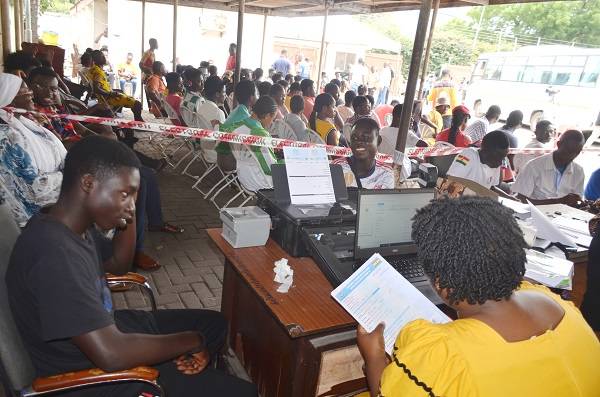
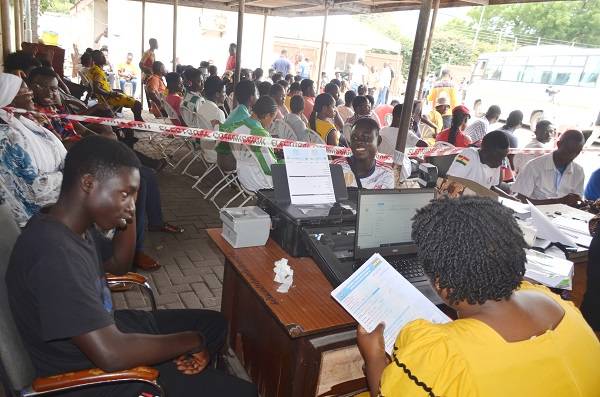
The EC’s decision to conduct the registration solely at its district offices raised concerns and sparked outrage over the potential difficulties that eligible voters in remote areas might face during the registration process. Initially, the registration process experienced a slow start due to challenges related to internet connectivity, resulting in crowded registration centers.
Mr Tettey said the issue of internet connectivity challenges, which was encountered on the first day, was resolved “swiftly”.
“Ninety per cent of applicants registered online whiles only 10 per cent registered offline,” he said..
Mr Tettey said the EC remained in favour of phasing out the guarantor system in the country’s registration process, saying the current system “is fraught with abuse”.
“If we are committed to strengthening our electoral system, the guarantor system should be abolished sooner or later,” he said.
He appealed to the Government to release adequate resources to the National Identification Authority to enable it to deliver cards to applicants quickly.
The Electoral Commission (EC) has initiated the process of replacing the ID cards of the constituents of Guan in preparation for the 2024 general elections.
The Guan constituency is made up of the Santrokofi, Agbafu, Lolobi, and Likpe (SALL) towns, which were excluded from the 2020 elections due to the establishment of the new Oti Region.
A Deputy Chair of the EC, Samuel Tettey, announced this at a press conference in Accra on Tuesday.
“The commission wishes to inform the general public that it has started replacing the ID cards for voters in the Guan District from Tuesday, October 3 to Thursday, November 2. This has become necessary because in 2020, voters in the Guan District registered in the Jasikan District.”
“With the creation of the Guan District, the voter ID cards bearing the Jasikan District have been changed to reflect the code of the Guan District,” he stated.
The Electoral Commission has made a notable advancement in its services by implementing an online payment portal.
This innovative move has been undertaken to enhance and streamline the procedure for individuals seeking to replace their lost voter ID cards.
The primary objective of this initiative is to provide a more convenient and accessible means for citizens to make payments for the replacement of their lost ID cards through an online platform.
In a press statement signed by the head of Public Affairs of the EC, it outlined the steps to make online Payment for Replacement of Lost Voter ID Cards
The steps are as follows:
Dial 2221067# on your mobile phone.
Enter the amount required for the replacement fee.
Input your reference, which should be your full name as a voter.
Review the Transfer Summary presented to you.
Confirm your details by selecting option 1.
Await a prompt to authorize the transaction, or you can check under “My Approvals” on *170#.
Upon the successful completion of the transaction, you will receive an SMS notification containing your payment reference. Please make sure to keep this notification as it will be required when you proceed to make the payment.
The Electoral Commission believes that the introduction of this online payment portal will expedite the payment and replacement process, making it more convenient for individuals in need of a replacement Voter ID card.
The Electoral Commission (EC) has announced that the process of transferring votes and replacing lost or defaced ID cards will commence today, Tuesday, October 3, 2023.
Dr. Bossman Asare, the Deputy Chair in Charge of Corporate Services at the EC, conveyed this information during an interview on Eyewitness News on Citi FM. He encouraged the public to utilize this opportunity to either transfer their voting location or obtain replacements for their lost or damaged ID cards.
“The transfers begin on Tuesday, and we are doing the transfers from October 3 to October 9, which is seven days. So, for anyone who wants to transfer to a district, this is the time to do it. And on Tuesday too, we are doing the replacement of ID cards. So if your ID card is defaced or missing, just go to the district offices. There is a shortcode for you to use to pay your money, and once you pay, you go to any district office and the ID card will be replaced for you.”
“For the replacement of the cards, we have not announced an end date yet. It is only the transfers which are ending on October 9, including Saturdays and Sundays. But for the card replacements, if you go to any of our district offices from Monday to Friday, they should be able to replace it for you once you have evidence of payment.”
The EC in a statement urged applicants who wish to replace their ID cards to do so by dialing Dial *222*1067# and follow the prompts.
The Electoral Commission (EC) has expressed that the guarantor system has become obsolete, necessitating a new system that focuses on registering individuals based on their own qualifications rather than relying on others to vouch for their age and nationality.
This rationale underpins the proposed new Constitutional Instrument (CI), which mandates the utilization of the Ghana Card as the exclusive identification method for prospective voter registration.
“Indeed the Ghana Card shows the age and citizenship of the bearer of the card, making it easier to identify those who are minors and those who are foreigners,” it said.
During a recent press conference in Accra, the Electoral Commission (EC) emphasized the urgency of the government’s support for the National Identification Authority in its efforts to register all eligible individuals before the upcoming voter registration exercise next year.
Dr. Bossman Eric Asare, Deputy Commissioner in charge of Corporate Services, reaffirmed the EC’s dedication to registering every qualified citizen as a voter for participation in the 2023 district level elections and the 2024 general election. He also noted that the ongoing limited registration exercise has been successful, and there is a possibility of surpassing the initial target of 700,000 registrants.
“We may increase the numbers to 800,000 or 900,000 looking at how the registration exercise is going and the number of days left,” Dr Asare said.
Dr. Bossman Eric Asare reported that the Electoral Commission (EC) had successfully registered 673,276 individuals at the moment, and the registration process has been notably productive, with an average of 50,000 registrations occurring daily since the previous week.
He provided a breakdown of the registered voters by age group, revealing that first-time voters make up a significant portion of the total registered voters at 86.1 percent. The distribution by age is as follows:
76 years and above: 376 registrants, or 0.1 percent.
Dr. Asare reaffirmed the EC’s commitment to ensuring a comprehensive and inclusive voter registration process.
Dr Bossman said: “The commission is desirous of registering everyone who is eligible; we reiterate that it is not our intention to disenfranchise anyone.”
In line with that, he said the commission had increased the number of kits at its district offices to accommodate the large numbers at the registration centres, as a result “the registration centres are becoming empty, however, reports reaching us indicate that our officials are fully ready to register all eligible persons who avail themselves at the registration centres before our deadline of October 2, 2023″.
Dr. Bossman emphasized the importance of parents discouraging their children who are under 18 years old from attempting to register, as it could lead to legal consequences for them.
He also discussed the challenges encountered during the registration process, noting that as of the 16th day of registration, the EC had documented 7,561 challenged cases across all registration centers. These cases accounted for 1.12 percent of all registered voters.
“In nominal terms, the Greater Accra Region tops with 1,552 cases while the North East Region is bottom with 14 cases,” he said.
However, in real terms, Dr Bossman said that the Upper West Region leads with 444 cases, constituting 1.9 per cent of registered voters in the region.
Other regions with more challenged cases are the Savannah and Volta with 1.8 per cent and 2.3 per cent respectively.
The Member of Parliament (MP) for Afigya Kwabre North, Collins Adomako-Mensah, from the New Patriotic Party (NPP), has strongly criticized the Electoral Commission of Ghana (EC) for its choice to conduct the ongoing limited voter registration exercise exclusively at its district offices.
He emphasized that the EC made this decision despite receiving advice to the contrary from all political parties, including the NPP, that are part of the Inter-Party Advisory Committee (IPAC).
Furthermore, Adomako-Mensah revealed that due to the EC’s decision, he was compelled to allocate substantial funds, amounting to thousands of Ghana cedis, for the transportation of numerous constituents to the district office to facilitate their registration.
“The EC is supposed to be independent but it must know that it is working for the people of Ghana. So, even if the law says you to be independent, whatever you’re doing should be for the betterment of the Ghanaian people.
“You went to an IPAC meeting and all the political parties there, including my party, were against EC having the registration at just one centre… Why should I be busing people from town to town just to come and register? Why?” he quizzed.
He further stated “My point is that even if you cannot expand the registration centre, increase the number of machines. So, that at every point in time, 10 or 15 people would be registering. If you think it is too expensive to expand the centres, increase the machines. I don’t see why as an MP, I should be spending GH¢20,000, GH¢30,000 just to convey people from one end to the other”.
The legislator representing Afigya Kwabre North expressed further discontent, highlighting an additional complication. He pointed out that some of the registration machines employed by the EC are experiencing functionality issues, exacerbating the challenges faced by constituents.
Moreover, due to the limitations in capacity at the district office, it has become necessary to transport individuals to the center on multiple occasions since not everyone can be registered in a single day.
The Electoral Commission (EC) has revised the number of eligible voters it hopes to register in its ongoing Limited Voter Registration Exercise.
Chairperson of the EC, Madam Jean Mensa, while interacting with the media on September 18, noted that the Commission is targeting 52 per cent of the 1,350,000 persons targeted for registration.
She however revealed that would undertake a continuous registration exercise at all its district offices in 2024 for all eligible Ghanaians who fail to partake in the current exercise to be captured in the poll book.
Madam Jean Mensa indicated that following the current exercise, there would be a mop-up registration for persons in hard-to-reach areas.
The 21-day limited voter registration exercise commenced on Tuesday, September 12.
So far, 182,831 people had been registered as of Saturday, September 16 (six days into the exercise).
Out of the total number of people registered, 53.9 per cent are males, while females constitute 46.1 per cent.
The Ashanti Region has the highest number of registrants with 29,255.
The Greater Accra and Eastern regions with have registered 27,264 and 19,327 individuals respectively.
The Central Region has registered 17,590 eligible voters, followed by the Northern Region with 12,982, the Volta Region with 12,681; the Western Region with 11,644 and the Upper East Region with 8,639.
The Bono East Region has registered 7,291 eligible voters, Western North, 6491; Bono Region, 6580; Upper West Region, 5,241; Savannah Region, 4,655; Ahafo Region, 4,519; Oti Region, 4,427 and North East Region, 4,244.
The founder and president of IMANI Africa, Franklin Cudjoe, has voiced strong criticism against the Electoral Commission (EC) for its refusal to expand the venues for the ongoing voter registration process.
During an interview on Citi TV’s political talk show, The Big Issue, Cudjoe accused the EC of employing a “Machiavellian approach” in its actions, which he argued was disenfranchising a significant portion of the Ghanaian population.
Cudjoe also expressed disapproval of the EC’s decision to revise the expected number of registrants. He questioned the rationale behind such a move and urged the EC to permit registration at multiple centres for the convenience of the public.
He further advised the EC to adopt a more practical approach, commending Joseph Whittal, the head of the Commission on Human Rights and Administrative Justice (CHRAJ), for opposing the EC’s position.
However, Cudjoe criticised the National Commission on Civic Education (NCCE) for not speaking out against the EC’s actions and stance.
“I haven’t seen that of the NCCE. The NCCE has shut its mouth and eyes to all the things that are happening in the EC,” he pointed out.
A portion of the public has expressed dissatisfaction with the Electoral Commission’s decision to restrict voter registration centres to district offices, which are frequently inconveniently situated for numerous eligible voters.
Various civil society organisations and the opposition National Democratic Congress (NDC) have urged the EC to broaden the registration process to more accessible sites.
Despite these calls, the EC has stood firm in its position and continued to conduct registration exclusively at its district offices.
Member of Parliament representing South Dayi under the National Democratic Congress (NDC), Rockson-Nelson Dafeamekpor has expressed his view that the decision of the Electoral Commission (EC) not to conduct the ongoing limited voter registration outside of its district offices is not justifiable.
Mrs. Jean Mensa, the Chairperson of the Electoral Commission, has attributed their inability to expand the voter registration exercise partly to Parliament’s actions, specifically the failure to approve the new Constitutional Instrument (C.I) that the Commission had presented for endorsement.
In addressing the various concerns and criticisms surrounding the ongoing registration process, Mrs. Jean Mensa conveyed that the Commission finds itself in a highly challenging predicament due to these circumstances.
In an interview with Joy News, “As you are all aware, the Commission prepared a draft C.I for continuous registration in all district offices nationwide. This initiative started last year and the registration we were envisioning under the draft C.I was for a sustained long-term basis.
“Indeed, had the C.I been passed we would have had some six months this year to register voters at any time of their choice. Our 2023 budget and work plan were prepared along those lines. Our 2023 work-plan and budget were based on a continuous registration of voters in our district offices nationwide, we did not factor electoral area registration in our 2023 work plan and budget,” she explained.
Mr Dafeamekpor,explained why the EC’s use of the C.I. as an excuse is flawed.
“The EC Commissioner and her deputies lied against the institution of parliament. Sometime in November 2022, after the 2023 budget was read, the EC came to parliament with what they called Medium-Term Expenditure Framework as well as its budgetary expenditure for 2023. The MTEF run from 2023, 2024, 2025, and 2026 as its work program. Parliament never tainted anything in that work program. In addition to that, parliament approved the budget that the EC asked for. The EC actually asked for as much as GHS 386,047,606 as its budget for 2023.
“Out of that budget, the EC specifically asked for GHS 66, 059,846 as the budget for its continuous registration, and that is the language of the C.I. The EC never needs a new law in order to carry out its mandate as this present registration has demonstrated. The position of the minority has always been that you don’t need a new law to carry out your mandate. What does the existing law say about registration? If you go to C.I. 91, Regulation 2, sub-regulation 1(a) which is on registration centres, speaks of the fact that the EC can conduct registration at its district offices.
He further explained that, “in sub-regulation 2(2) it says that the EC in designating other registration centres may take certain factors into consideration especially access and convenience. In sub-regulation 2 sub-regulation 4 of C.1. as amended by C..I. 126, parliament was very clear that in granting that discretion to the Electoral Commission to designate additional registration centres, it could be abused. So what did parliament do? Parliament said, you must take into consideration the existing gazetted polling stations when you want to consider additional registration centers in the district.
The National Democratic Congress (NDC) and five other political parties have already filed a lawsuit against the Electoral Commission (EC) over the choice.
The political parties that are up in arms believe that the EC’s decision to limit the registration centres to district offices could potentially deny many eligible voters their right to register as voters and cast ballots in public elections.
According to Dr. Serebour Quaicoe, director of electoral services for the Commission, eligible voters who are unable to register at one of the Commission’s district offices nationwide will have to do so in the following election.
He stated that once the EC receives parliamentary approval for its Constitutional Instrument, C.I., special arrangements will be made for difficult-to-reach areas. He claims that the Commission will also conduct a continuous registration process in its offices, which will accommodate potential voters whenever they come in.
A member of the opposition National Democratic Congress (NDC), Emmanuel K.K. Anyimah, has accused the Electoral Commission of acting in a manner that is unfair and unjust in the ongoing limited voter registration exercise.
He explained that registrants have been subjected to so much inconvenience, such as bearing the high cost of transportation despite being without jobs, and using an unstable network.
Mr Anyimah noted that it is the mandate of the Electoral Commissioner, Jean Mensa, and her commissioners to serve the country as stipulated in Articles 42 and 45 of the 1992 Constitution and not the other way around.
Speaking on Peace FM, he said: “So those who are registering are not people working. It is those who are 18, 19 years. They don’t work. If you come to our end, most of them don’t have the Ghana Card. So if they are coming they are come with two guarantors. The most annoying part of this thing is, EC uses just one network, MTN.
How many networks are in the country. Some villages only connect to Vodafone, AirtelTigo. So when the network goes bad, we just sit and wait. Why are Jean Mensa and the commissioners so wicked. What wrong have we done them. They have forgotten that their work is stipulated and enshrined in the constitution, Articles 42 and 45.”
Article 42 states that “Every citizen of Ghana of eighteen years of age or above and of sound mind has the right to vote and is entitled to be registered as a voter for the purposes of public elections and referenda”.
Whereas Article 45 lists the functions of the EC, which include:
to compile the register of voters and revise it at such periods as may be determined by law;
to demarcate the electoral boundaries for both national and local government elections;
to conduct and supervise all public elections and referenda;
to educate the people on the electoral process and its purpose;
to undertake programmes for the expansion of the registration of voters; and
to perform such other functions as may be prescribed by law.
Meanwhile, Member of Parliament for North Tongu, Samuel Okudzeto Ablakwa, has issued a warning to the Electoral Commission (EC) regarding its voter registration process, expressing concerns that it could jeopardize the nation’s progress in upholding democracy.
Mr Ablakwa criticized the EC’s choice to limit the registration to its district offices, deeming it undemocratic and potentially leading to the exclusion of numerous eligible voters.
He noted that disenfranchising voters is what has led to the tumbling of many democratic governments in Africa, hence such an approach may not augur well for the country.
“All of us don’t want coups to happen in our jurisdictions,” Ablakwa said. “But you see when public officials refuse to learn, it results in coups. The Gabon coup is an example and has ended in the disruption of their democracy. And we don’t want that in Ghana.”
“Look at the anger and outrage that the youth feel about these policies of Jean Mensa, Very autocratic, very undemocratic, no consultation whatsoever. And she is going ahead.”
In light of this, Mr Ablakwa has urged the Electoral Commission to engage in consultations with all relevant stakeholders regarding the ongoing voter registration process. Additionally, he encouraged the youth to actively register to vote and emphasized their role in holding the EC accountable should any registration issues arise.
Meanwhile, the EC has noted that it does not seek to disenfranchise any Ghanaian eligible to register. Madam Jean Mensa made this known when she engaged the press on Monday, September 18.
The Electoral Commission (EC) office in the Tamale Metropolis has raised serious concerns regarding what it perceives as efforts by political parties to include ineligible voters in the electoral register.
The Director of the Tamale Metro branch of the Commission, Bismark Nteh, expressed dismay over the persistence of this unlawful activity despite numerous engagements with political parties to discourage it.
Mr. Nteh is apprehensive about the potential repercussions for the individuals involved when their falsely claimed ages come back to haunt them in the future. Consequently, he advised parents to discourage their children from engaging in such fraudulent practices.
“I will plead with parents that they shouldn’t allow political parties to deceive them, that because they want a number of people to register, indeed they will have the number, these children are going to suffer in future. One day they will need their actual ages for something and it will affect them,” the Tamale Metro Director of the Electoral Commission in the Northern Region said.
“This is an artificial problem created by the EC, because people come there early, and they don’t get to be registered on time, the entire EC must be blamed,” the NDC Constituency Chairman for Okaikwei North said.
Nonetheless, the Greater Accra Regional Chapter of the NDC has taken the initiative to provide transportation for individuals who may face difficulties accessing registration centers.
Emmanuel Nii Ashie-Moore, the Regional Chairman, explained that this action is essential to ensure that a significant number of party members who are 18 years and older can get registered.
This move comes in response to appeals from various political parties urging the Electoral Commission (EC) to expand the number of registration centers for the upcoming voter registration exercise, scheduled to run from September 12 to October 2, 2023. These parties argued that the 268 EC district offices designated for the exercise were insufficient.
The Electoral Commission (EC) has refuted claims that it is disenfranchising eligible voters in the ongoing Limited Voter Registration Exercise.
The Minority Chief Whip, Governs Agbodza, has accused the Electoral Commission (EC) of intentionally creating difficulties in the limited voter registration exercise held at its district offices.
Agbodza claims that the EC is collaborating with the New Patriotic Party (NPP) to facilitate the introduction of a Constitutional Instrument (CI) in Parliament. This CI would authorize the use of the Ghana Card as the exclusive registration document for the 2024 general elections.
The EC has faced widespread backlash from various political parties, civil society organizations, and the public for insisting on conducting the limited voter registration exercise solely at its district offices.
But engaging the press on Monday, September 18, the Chairperson of the Electoral Commission, Jean Mensa noted that it is not in the interest of the EC to hinder Ghanaians from exercising their rights.
“We have the best interests of Ghanaians at heart. We do not intend to disenfranchise voters,” she said.
She used the opportunity to dispel claims that the EC has deliberately deployed faulty equipment to the stronghold of the National Democratic Congress (NDC).
According to the EC Chair, all regions except the Savannah Region, experienced a delay in registration due to faulty equipment – a situation that has been addressed.
On why the exercise is being conducted at the EC’s district offices, Madam Jean Mensa noted that holding the exercise at the various electoral areas will pose a challenge to the Commission due to its constrained budget.
The EC Chair, however, revealed that it would hold another voter registration aside from its current one ahead of the 2024 general elections.
She says the Commisssion is targeting 700,000 Ghanaians, that is 52 percent of the registrable applicants
According to Madam Jean Mensa, those who are not able to participate in its current exercise will get the opportunity to do so in subsequent exercises. She made mention of the EC taken notice of areas that will not be able to access its district offices.
Meanwhile, the EC has charged Ghanaians to challenge any individual they believe are minors or foreigners who seek to participate in the limited voter registration exercise.
There are reports that National Democratic Congress (NDC) Constituency Youth Organizer, Courage Tetteh, has been arrested at Shai Osudoku Constituency for attempting to register minors.
The Electoral Commission (EC) began the limited voter registration exercise in its municipal and district offices nationwide on September 12, 2023.
The purpose of the exercise is to enroll all citizens who are 18 years and older and of sound mind onto the electoral register, as mandated by the 1992 Constitution. This 21-day registration period is set to conclude on October 2, 2023.
The National Youth Organiser of the New Patriotic Party (NPP), Salam Mustapha, has expressed his satisfaction with the initial week of the limited voter registration exercise.
Commencing on Tuesday, September 12, the Electoral Commission launched this registration effort with the aim of enrolling first-time voters who have yet to obtain their Voter ID cards.
Despite opposition from the National Democratic Congress (NDC) and certain civil society organizations, the registration process has been ongoing at the district offices of the Electoral Commission nationwide.
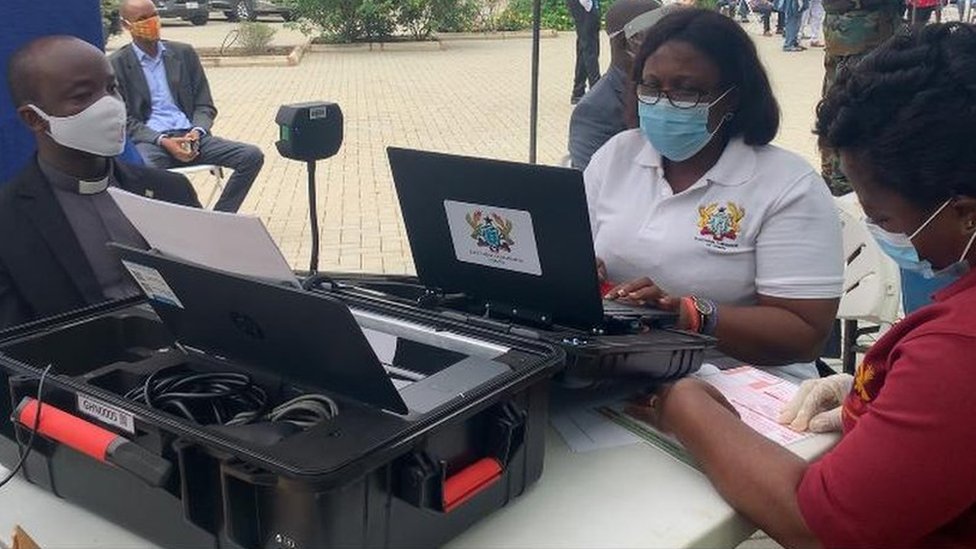
During the first week, there were reports of system failures in some areas, which necessitated the commission’s officers to resort to offline registrations.
Additionally, long queues were observed at certain registration centers, mainly due to the restriction of registration to the commission’s district offices.
Salam Mustapha conducted tours of various centers, including Ada, Sege, and other constituencies in the national capital, and he commended the impressive turnout and performance of the Electoral Commission’s officers.
On the other hand, the National Democratic Congress accused the commission of obstructing registration in its strongholds. The opposition party claimed that the majority of the areas experiencing system challenges were situated in their strongholds exclusively.
However, Salam Mustapha refuted the NDC’s allegations, asserting that the challenges encountered were not limited to any particular district but were widespread. He provided examples from the Ashanti region and other significant NPP strongholds to support his argument.
Director of Elections and Research for the New Patriotic Party (NPP), Evans Nimako, has commended the Electoral Commission (EC) for its management of the ongoing limited voter registration process.
During an interview on Eyewitness News on Citi FM, Nimako expressed his support for the EC’s decision to restrict the registration centers to its district offices.
He argued that expanding the number of centers would only escalate the expenses associated with monitoring the exercise for political parties and other interested parties.
“When you sit back and do the assessment, you may conclude that if the EC opens up more registration centres, it helps but the more centres you have, the more cost you will incur as a party because you will have to put together your agents to observe this process. Either way, you will incur some amount of cost and some burden,” he said.
“The New Patriotic Party put forward the argument that in 2019, additional registration centres were created by the EC for purposes of registration aside from the district offices and so it was our position we stick with the district offices.
“The unfortunate thing is that our colleagues in the NDC have elected themselves not to participate in [Inter Party Advisory Committee] IPAC discussions and the other political parties that participate are labelled as mushroom parties created by the NPP but they are today able to join forces and sue the EC.”
Nimako also refuted claims that the NPP is luring registrants with monetary incentives, masking them as transportation allowances. He emphasized that the party’s primary commitment is to facilitate the registration of all eligible individuals, ensuring their right to vote is upheld.
“The New Patriotic Party is ready to facilitate the registration process for our members who are due [to vote] because the law says once you are eighteen years and above and of sound mind and your name is not already in the register, the EC must ensure that you get your name registered,” he said.
The Chairperson of the Electoral Commission (EC), Jean Adukwei Mensa, was honored at the recently concluded Internal Audit Conference hosted by the Internal Audit Agency at UPSA.
She was presented with the award for Best Head of a Covered Entity that actively supports the Internal Audit Unit (IAU) within the MDA Category.
This recognition was bestowed in acknowledgment of her consistent adherence to audit recommendations and her overall commitment to facilitating internal audit initiatives.
The Board Chairman of the Internal Audit Agency, Joseph Winful, in a plaque citation stated that Madam Mensa “ensured that the Internal Audit Unit was provided with adequate resources, space and logistics to enable it deliver on its mandate in an objective and independent manner devoid of intimidation.”
“Your actions have undoubtedly enhanced the internal control systems of the Electoral Commission of Ghana,” he added.
Managing Editor of the Insight Newspaper, Kwesi Pratt Junior, has noted that the will of the people will prevail irrespective of actions that may seem to undermine the power of the electorate.
Addressing the public at the NDC’s public forum on the operation of the Bank of Ghana on Thursday, August 31, he stressed that the selection of Ghana’s leader will not be determined by the Electoral Commission (EC) but by the average Ghanaian.
“In the final analysis, we are the only people who can choose our leaders, not an Electoral Commission. We will choose our own leaders, and I’m absolutely sure that what we have started in Parliament under the leadership of the Minority and what is continuing in this room today will be successful, no matter the machinations of anybody,” he said.
His comments follow several complaints by the Minority in Parliament over some decisions taken by the EC ahead of the 2024 general elections.
The Electoral Commission (EC) has announced its decision not to add any other identity documents apart from the Ghana Card as the sole identity document for its voter registration exercise.
Speaking to JoyNews, the Director of Electoral Services of the EC, Dr. Serebour Quaicoe insisted that his outfit will not heed the unanimous decision of Parliament to amend the proposed Constitutional Instrument (C.I).
Minority Leader, Dr Ato Forson, noted that Dr Serebour Quaicoe’s statement is most “unfortunate and reckless.” According to the Minority, such an action will disenfranchise many Ghanaians unjustly; hence, they will fight such an attempt.
The electoral commission in Ireland has suggested making changes to the Dáil (the lower house of the Irish parliament) because there are more people now.
These changes mean that there would be more members of parliament, with the number increasing from 160 to 174.
They will be chosen in 43 areas, which is more than the current 39.
The changes are being made because the population in the Republic of Ireland has increased by 8% since 2016, and now there are more than 5. 15 million people living there.
The commission made a recommendation in their Constituency Review 2023 document, which they sent to the Irish parliament, called the Oireachtas.
These changes mean that each TD will now represent around 29,593 individuals on average.
Ireland currently has 160 TDs in the Dáil. This means that there is one TD for every 32,182 people in the country, which is a lot. The number of electoral areas with three seats will go up to 13 from nine.
Some smaller political parties wanted to make more districts with only four or five seats because they believed it would help them and independent candidates.
There are seven areas that have not been changed. These areas are Clare, Cork South West, Donegal, Dublin Central, Kerry, Limerick County, and Waterford.
They suggest creating a new electoral area called Wicklow-Wexford.
The Progressive People’s Party (PPP) has formally appealed to the Electoral Commission (EC) to increase the count of registration centers for the upcoming voter registration process within each district.
This measure aims to alleviate the inconvenience faced by citizens who would otherwise need to travel long distances to register.
Scheduled from September 12 to October 2, 2023, the limited registration exercise is intended for eligible Ghanaians who turned 18 after the 2020 registration, as well as other eligible voters.
The PPP suggests that augmenting the registration centers in each district would enhance accessibility, aligning with their vision of fostering a more inclusive and convenient citizen participation in the democratic process.
According to Jean Mensa, the EC’s Chairperson, the registration exercise will be held at all 268 district offices across the country.
Remy Paa Kow Edmundson, the PPP’s National Secretary, emphasized that this simple solution would significantly improve registration accessibility, encouraging wider participation in the democratic process and ultimately contributing to a more representative electorate.
“The PPP is speaking up and asking the EC to add more registration centres in every District. This way, people won’t have to travel so far and can easily register to vote. It’s a simple solution that will make a big difference,” he stated.
Edmundson further advocated for “a fixed date for the District Level Elections, just like we do for the Presidential and Parliamentary Elections. Right now, the dates for these elections keep changing, and that makes it hard for candidates and voters to plan ahead. If we have a set date, it will make things a lot easier and more organised.”
Meanwhile, seven other political parties in Ghana have also voiced their opposition to the EC’s decision to limit the upcoming voter registration to district offices.
They argue that this would disenfranchise those who have come of voting age.
Instead, they propose conducting the process at electoral areas to ensure wider inclusion.
These parties are the Great Consolidated Popular Party (GCPP), Liberal Party of Ghana (LPG), Convention People’s Party (CPP), People’s National Congress (PNC), All Progressives Congress (APC), National Democratic Party (NDP), and the Ghana Freedom Party (GFP).
The Chairperson of the Electoral Commission (EC), Jean Mensa, has announced that the commission has taken significant measures to eliminate 15,000 names of minors and non-citizens from the voters’ register.
This revelation was made during a press conference called ‘Let the Citizen Know’ held in Accra on Thursday, August 17.
Addressing the matter, she acknowledged that the 2020 registration process had exposed instances in which minors and non-citizens names were featured in the voters’ list by exploiting the guarantor system.
To tackle this issue, the EC established District Registration Review Committees, which diligently worked over several weeks to identify and remove ineligible names from the register.
“Our experience from the 2020 registration highlighted that a number of minors and foreigners utilized the guarantor system to become part of our roll. In order to rectify this and eliminate minors and foreigners from the 2020 register, the EC formed District Registration Review Committees, which worked diligently over several weeks to purge the names,” she explained.
“The process of removing the names of unauthorized individuals from our list was time-consuming and labor-intensive. Throughout the registration, around 40,000 cases involving minors and non-citizens were challenged, resulting in the removal of approximately 15,000 ineligible entries,” she confirmed.
Ms. Mensa stressed that the EC’s decision to adopt the Ghana Card as the sole identification document for voter registration is not intended to disenfranchise citizens. Rather, it’s a strategic move aimed at enhancing the credibility of the electoral roll and preventing similar occurrences.
She clarified that the Commission no longer sees value in maintaining the guarantor system, which has become outdated. Thus, the choice to adopt the Ghana Card as the exclusive identification method for voting.
Furthermore, she elaborated that employing the Ghana Card is the most reliable method to safeguard the integrity of Ghana’s electoral roll.
Chairperson of the Electoral Commission (EC), Jean Mensa, has declared that individuals who vouch for more than ten people are in violation of their regulations and will face legal action.
Mensa clarified that in order to ensure the registration of eligible individuals on the new voters register, it is advisable to set a maximum limit of ten people per vouching individual.
The EC Chairperson pointed out that those who vouch for non-citizens are also contravening the laws and will face appropriate consequences.
During a press briefing on August 17, 2023, Jean Mensa revealed the necessary documents for voter registration and cautioned that those who neglect their guidelines will be held accountable.
“All applicants are to show proof of eligibility by tendering any of the following identification documents on the National Identification Card, also known as the Ghana Card and the Ghana Passport. Applicants who do not have any of the identification documents listed above are required to present two persons who are already registered voters to vouch for their citizenship and age. Per law, a guarantor can guarantee for up to ten applicants.
“It is important to emphasize that it is a criminal offense to guarantee for more than ten applicants and a person who guarantees for more than ten applicants will be prosecuted. It is also a criminal offense for a guarantor to guarantee for non-citizens and minors. I like to call on our media partners to assist us in educating our citizenry on this specific section of the law,” she said.
“They were both conducted in April 2021. As such, their elections would not be held in both districts until 2025. The Commission has developed a comprehensive program of activities for the 2023 district-level elections, and this will be made available to the public shortly.
“As a commission, we encourage voters to take advantage of the voter registration exercise and register to vote. We also entreat the citizenry to participate actively in the district-level elections, which would be held on December 19, 2023,” Jean Mensa said.
Chairperson of the Electoral Commission (EC), Jean Mensa, has emphasized that individuals vouching for more than ten people during the voter registration process will be prosecuted as per its regulations.
To ensure accurate registration, the EC limits each person’s vouching to a maximum of ten individuals.
Additionally, anyone vouching for a foreigner violates the law and will face appropriate action.
During a press briefing on August 17, 2023, Jean Mensa highlighted the required identification documents for voter registration and cautioned that those disregarding the guidelines would face legal consequences.
She urged the media to aid in educating citizens about this aspect of the law.
Mensa also announced that district-level elections, slated for December 19, 2023, will be held across the country, except in the Nkoranza North and South districts, where they will occur in 2025.
She encouraged active participation in these nonpartisan elections, which elect representatives for local government structures.
The district-level elections, held every four years, encompass all 6,272 electoral areas, excluding Nkoranza North and South due to security concerns.
The Chairperson disclosed that the Commission has outlined a comprehensive program for the 2023 district-level elections, to be disclosed soon.
She urged citizens to take advantage of the ongoing voter registration process and actively engage in the upcoming elections on December 19, 2023.
The Chairperson of Ghana’s Electoral Commission (EC), Jean Mensa, has emphasized that the proposed constitutional instrument, aimed at designating the Ghana Card as the exclusive document for voter registration, is not intended to disenfranchise Ghanaians.
Speaking to the media at the Electoral Commission’s headquarters on Friday, Jean Mensa clarified that the Commission is looking to move away from the guarantor system, which she believes has become obsolete.
This is the reason behind the decision to adopt the Ghana Card as the sole identification document for voting purposes.
Jean Mensa went on to elaborate that employing the Ghana Card as the primary means of identification is the most reliable method to safeguard the credibility of Ghana’s electoral roll.
“The current proposal in Parliament, the Constitutional Instrument, does not intend to reintroduce the guarantor system. We have observed that the guarantor system has not been effective. Thirty years ago, when we embarked on this journey without the Ghana Card, it was necessary to implement a system that would enable individuals without documentation to register. Today, with the presence of the Ghana Card, we must depend on it as the most reliable means to maintain the accuracy of our electoral register.”
She contended that the draft Constitutional Instrument, currently under parliamentary consideration, was motivated by the Commission’s commitment to conducting elections that are credible, transparent, fair, and peaceful. This decision arose from the challenges faced by the Commission during the registration process in 2020.
“As a Commission dedicated to organizing elections that are credible, transparent, fair, and peaceful, we sought to establish and uphold the credibility of the foundational document, which is the voters’ register. This is why we proposed the use of the Ghana Card as the sole means of identifying an individual’s citizenship or age.”
“Our experience from the 2020 Registration Exercise highlighted that a number of minors and non-citizens managed to enter the electoral roll through the guarantor system. To eliminate underage individuals and non-citizens from the 2020 register, the Electoral Commission set up District Registration Review Committees, which worked for several weeks to remove such names. It required significant time and effort to rectify the presence of ineligible individuals in our electoral roll. We contested around 40,000 cases involving minors and non-citizens and ultimately removed around 15,000 individuals from the register.”
The Electoral Commission of Ghana’s Chairperson, Jean Mensa, revealed that the work of a review committee the Commission formed resulted in the removal of 15,000 names of minors and foreigners from the voters register.
Following the experience of the Commission in the 2020 elections, the EC established a review commission that worked assiduously to remove the names of illegible voters.
Speaking at a press conference on district-level elections,she added that things like this are the reason the EC proposed the use of the Ghana Card as the sole document for registration onto the voters register.
“Indeed, a credible voters register is (sic) for a credible election. As a Commission that is determined to conduct credible, transparent, fair and peaceful elections, we were keen to establish and uphold the integrity of the foundational document, which is the voters register, hence our proposal to use the Ghana Card as the sole document for identification of a person’s citizenship, as well as age.
“Our experience from the 2020 registrations exercise showed the several minors and foreigners, using the window of the guarantor system, found their way onto our roll. To rid the register of minors and foreigners in 2020, the Electoral Commission established the District Registration Review Committees which worked for several weeks to delete the names of minors and foreigners from the register… during the registration, some 40,000 minors and foreigners were challenged, and we managed to expunge some 15,000 minors and foreigners from the register,” she explained.
The 2023 District Level Elections (DLE) have been scheduled by the Electoral Commission (EC) to take place on Tuesday, December 19, 2023.
The current Assembly Members, who were elected in 2019, are approaching the end of their tenure in December of this year.
This prompts the need for the election of new Assembly Members who will serve for the upcoming four years.
During a press conference held in Accra on Thursday, Mrs. Jean Mensa, the Chairperson of the Commission, disclosed that the registration of new voters will occur from September 12, 2023, to October 2, 2023.
This registration process will be facilitated at the Commission’s 268 District Offices.
The EC’s objective is to achieve a 60 percent voter turnout for this year’s DLE. They have also made an appeal to the media to assist in raising awareness and educating the public about the significance of this electoral exercise.
Mrs. Mensa further conveyed that the DLE will encompass all 6,272 electoral areas, except for Nkoranza North and Nzoranka South located in the Bono East Region.
“This is because the district level elections were not held in 2019 for the said districts due to security reasons but was postponed and conducted in April 2021.
“As such, the elections would not be held in both regions until 2025”, the Chairperson explained.
Mrs. Mensa mentioned that the Commission has meticulously developed a comprehensive schedule of events for the forthcoming DLE, which will be released to the public at an appropriate time.
She extended encouragement to those who are eligible but have not yet been included in the electoral roll to participate in the forthcoming registration drive. This would enable them to cast their votes in the elections scheduled for December 19.
Mrs. Mensa provided assurance that the upcoming voter registration initiative will not be the solitary registration effort leading up to the 2024 General Election.
Regarding individuals who have misplaced their voter ID cards, she explained that these lost cards can be replaced at any of the District Registration Centers for a fee of GHC10.
“We state categorically that persons, who have lost their ID card do not need to register again. They simply have to request for a replacement of their cards,” Mrs Mensa said.
Mr Samuel Tettey, the Deputy Chairman of the EC in Charge of Operations, said the Commission would take steps to ensure high voter participation in the DLE.
“There will be stakeholder engagements with the civil society, security agencies, faith based organisations and a massive awareness in the media and public announcements by district electoral officers,” he said.
During the previous District Level Elections held in 2019, a total of 57,000 candidates participated in the electoral contest across the country’s 6,700 electoral areas.
Since the late 1980s, the DLE has consistently experienced low voter turnout. According to data provided by the EC, the National Average Voter Turnout for the DLE was 59.3 percent in 1988/89, followed by 29.3 percent in 1994, 41.6 percent in 1998, 33.1 percent in 2002, 39.3 percent in 2006, 35.5 percent in 2010, 30.6 percent in 2015, and 33 percent in 2019.