Consultant for the Energy Commission, Dr. Godwin Kafui Ayetor, has called on the government to prioritise alternative power sources to support the country’s rollout of electric vehicles (EVs), citing challenges with Ghana’s EV charging infrastructure.
Speaking at a public forum organised by the Public Interest and Accountability Committee (PIAC) on November 21, 2024, in Kumasi, Dr. Ayetor expressed concern over Ghana’s reliance on the national grid, emphasising its vulnerability to power fluctuations.
He advocated for incentives to encourage private sector investment in renewable energy-powered charging stations to reduce dependence on the grid.
“The current reliance on the national grid is unsustainable given the frequent power fluctuations. Incentivising the private sector to invest in renewable energy-powered charging stations will ensure a more reliable and sustainable EV infrastructure,” Dr. Ayetor stated.
Highlighting the limited infrastructure, he noted that Ghana has only seven charging stations, all situated in Accra, leaving other regions without access and hindering the widespread adoption of EVs.
Dr. Ayetor urged regulators and government agencies to develop a comprehensive framework for strategically placing charging stations across the country. He proposed mapping out key locations in cities like Accra to improve coordination and accessibility.
His remarks come in the wake of concerns raised by the United Nations Development Programme (UNDP) and the Energy Commission (EC) about the infrastructure needed to support Ghana’s EV rollout.
These concerns were outlined during a joint event where the Market Opportunity Study on Electric Vehicle Charging Stations in Ghana was presented.
The report analysed Ghana’s current EV charging and battery swap infrastructure, identifying significant opportunities and challenges in advancing the EV sector.
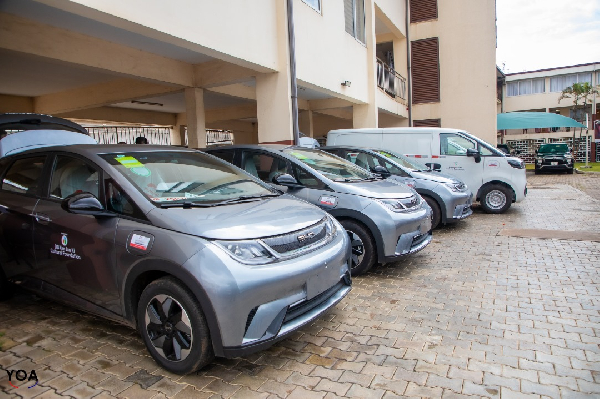
The Korean-based DB Kim Junki Foundation has donated four electric vehicles to the University of Environment and Sustainable Development (UESD) at Bunso through the Ministry of Education in a bid to support the government’s initiatives to promote STEM education in Ghana.
The donation includes three BYD electric sedans and one SAIC Dana electric delivery van. These vehicles are intended to improve transportation logistics, enhance efficiency, and support the distribution of educational materials on the university campus.
Prior to the presentation, the foundation, in collaboration with its local partners Nubemar Limited and Sourcertz Technology, established an Electric Vehicle Charging Bay at the UESD Bunso campus. This facility features dual AC and DC fast-charging options, ensuring compatibility with various electric vehicle models and promoting the use of sustainable energy solutions.
At the handover ceremony held in Accra, Education Minister Dr. Yaw Osei Adutwum expressed his gratitude to the DB Kim Junki Foundation for its valuable contribution.
He highlighted the university’s focus on agriculture, science, and engineering, emphasizing its role as a 21st-century hub for advanced learning.
With phase one of the university’s development complete, Dr. Adutwum reiterated the government’s commitment to strengthening STEM education as a cornerstone for producing globally competitive professionals in key industries.
Dr. Adutwum also extended his thanks to President Nana Addo Dankwa Akufo-Addo for his unwavering support of STEM and TVET initiatives.
He called on stakeholders to continue their efforts in driving educational transformation in the country, underscoring the critical role of education in fostering national development.
The Education Minister, who also serves as the Member of Parliament for Bosomtwe, praised the ongoing advancements in the education sector, describing them as essential steps toward building a prosperous future for Ghana. education sector as critical towards the leapfrogging of the nation’s economy.
Collaboration
TheChief Executive Officer of Nubemar Limited, Mr Inwoo Yoo (Linus), said the company was ready to continue partnering with the government of Ghana to promote the development of the country through the development of education.
Vice President Dr Mahamudu Bawumia has unveiled plans to introduce electric vehicles (EVs) in Ghana’s transportation sector, aiming to significantly reduce the cost of public transportation if his administration is elected in the 2024 elections.
Speaking at a public lecture on February 7, 2024, where he presented his vision as the flagbearer of the New Patriotic Party (NPP), Bawumia emphasized the potential of EVs to cut down transportation costs by 30-40%.
Explaining the rationale behind the initiative, Bawumia highlighted the dominance of fuel prices and spare parts costs in the public transport pricing formula. He emphasized that EVs, which do not rely on petrol or diesel and have minimal spare parts requirements, would lead to stable transport fares and eliminate the frequent and significant fare increases experienced in traditional vehicles.
“The public transport pricing formula is dominated by two key variables; the price of fuel and the price of spare parts. Electric vehicles do not use petrol or diesel and spare parts are minimal. That is what will bring down the fares for EVs. More importantly, transport fares for EVs will be stable and the constant and large increases in fares will become a thing of the past,” he said.
In addition to the adoption of EVs, Bawumia pledged to abolish taxes on electronic transactions, gambling, and emissions if elected president. The government had introduced various taxes, including a 10% gambling tax on all winnings, a 15% Value-Added Tax (VAT) on electricity slated for implementation in January 2024, and an emissions levy for engine vehicles starting from February 2024.
Bawumia’s announcement signals a commitment to leveraging innovative solutions to address pressing economic and environmental challenges in Ghana. The introduction of EVs not only aims to reduce transportation costs but also aligns with efforts to promote sustainability and reduce carbon emissions in the transportation sector.
As the country approaches the general elections, Bawumia’s proposed policies are expected to feature prominently in the political discourse, shaping public opinion and influencing voter decisions.
In the UK,solar-powered metaltrees with a seven-meter canopy may soon be found in parking lots and retail centres.
The structures were created by British startup SolarBotanic Trees as a power source for charging electric vehicles (EV). They will catch the sun’s energy through nano photovoltaic “leaves” and may store it in a battery inserted beneath the tree’s trunk. Before starting commercial production at the end of the year, the company recently finished a half-scale prototype of the gadget and is now planning to develop and test a full-size version.
In the UK, EV charging infrastructure is rapidly growing, with more than 40,000 public charging points installed by the end of April 2023, up 37% from the previous year, according to ZapMap, an EV mapping service. But this still does not keep up with demand, with the UK’s Climate Change Committee estimating that 325,000 charging points will be needed by 2032 to support the growing electric fleet.
“There’s a massive shortfall of (charging) infrastructure in this country, so we are looking to work hand in glove with the EV infrastructure providers,” says Chris Shelley, CEO of SolarBotanic Trees. He adds that the company has already received its first order of 200 trees from the Raw Charging Group, a supplier of EV charging infrastructure, which plans to incorporate the trees as part of its network of charging sites rolled out across the UK and Europe.
A number of companies already offer solar-powered carports, which stretch over car parking spaces and look like a bus shelter topped with solar panels, but there is a lack of aesthetically pleasing solutions, says Shelley. Solar trees, forms of which have previously featured in Singapore’s Gardens by the Bay development and more recently at the Sustainability Pavilion at Expo 2020 Dubai, can offer just that, he says.
But while Dubai’s 18 energy trees are collectively covered in almost 4,000 square meters of solar panels and rotate throughout the day to follow the sun’s arc, SolarBotanic Trees – which will stand around 4.5 meters (15 feet) tall – are more space-efficient so that they can be more easily added to public spaces. Shelley says the solar dome simultaneously provides shade and appeals to luxury hotels, shopping malls, corporate head offices and business parks that want a premium and visible product that shows off their green credentials.
SolarBotanic Trees are likely to cost between £18,000 and £25,000 ($22,000 to $30,000), considerably more than a conventional solar panel source. They will have a power generation capacity of five kilowatts, which is typical for a standard chargepoint according to Energy Saving Trust (EST), a UK organization specializing in low carbon solutions. With this power output it would take almost seven hours to charge a car with a 50 kilowatts battery from 20% to 80%.
“This speed of chargepoint is more suited to when a vehicle is idle for a longer period,” says Rachel Swiatek, program manager of transport at EST, adding that “there are lots of different chargepoint types and power outputs on the market and each is suited to a different type of use.”
The startup is also looking to design a smaller and more affordable version, at 3.2 kilowatts, which Shelley says is likely to cost between £10,000 and £15,000 ($12,000 to $18,000). This model would be suited to university campuses, shopping malls, town centers and other locations and could be used for several applications, from smartphone and laptop charging to LED lighting or electronic advertising. Shelley notes that he is also exploring creating a solar tree solution for powering electric scooter charging hubs.
Each tree will be equipped with an AI-driven energy storage and power management system that can link multiple trees to form local microgrids, or can connect a tree to the national grid, so that any excess energy produced can be fed back into the mains supply. It also means the tree can continue to charge during the night, or on dark winter days when there is no sunlight, by tapping into the grid for power.
However, to reduce the reliance on the grid, the startup is also planning to integrate a battery storage system in the tree trunk, so that any excess energy during the daytime can be stored for use at night.
SolarBotanic Trees has raised £340,000 ($420,000) and is looking to start a funding round at the end of the year following trials of the full-scale prototype. By 2025, Shelley wants to be building at least 1,000 trees a year.
The company will build its first trees in the UK, says Shelley, before looking to expand across Europe and North America.
He claims that the rate of growth of his business, Kantanka Automobile Company Limited, will enable him to realize this prediction.
“Kantanka will produce electric vehicles by the end of this year that can travel between Accra and Kumasi before recharging.
On Starr Chat, he said to Bola Ray, “We’re going to do that before the year is through.
Indigenous car maker Kantanka says it is poised to manufacture electric cars before the end of this year.
Speaking to Bola Ray on Starr Chat Wednesday, Mr. Safo said the company is expanding to other parts of the world with a new office in Dubai.
“By the end of this year, Kantanka will build electric cars that could travel between Accra to Kumasi before recharge. We intend to do that before this year ends.
“Our company is fast growing and currently we have another headquarters at Dubai and the challenge there is healthy for us because they understand luxury and that is good for us,” he said.
The company was later incorporated as a limited liability company in 2001 with the main objective to research the manufacturing of automotive components and their combination with other parts outsourced from component suppliers to form a complete built unit.
Kantanka vehicles are assembled in Ghana from CKD (Complete Knock Down) kits supplied by a Chinese firm, possibly Foday through Chongqing Big Science & Technology.