Tag: electricity

  • Electricity tariffs to drop by 4.81%, water by 3.06% from April 1

    Electricity tariffs to drop by 4.81%, water by 3.06% from April 1

    Electricity and water tariffs will be reduced by 4.81% and 3.06%, respectively, effective Wednesday, April 1, the Public Utilities Regulatory Commission (PURC) has announced. The reduction follows the Commission’s quarterly tariff review. 


    The Public Utilities Regulatory Commission attributed the decision to changes in the Ghanaian Cedi–United States Dollar exchange rate, domestic inflation, electricity generation mix, and the cost of fuel, particularly natural gas used in thermal power plants. This was contained in a statement issued by the Commission on Friday, March 13.

    “The Public Utilities Regulatory Commission (PURC) wishes to inform consumers of electricity and water that the existing electricity and water tariffs have been reviewed downwards to take effect from April 01, 2026.

    “The Commission applied a projected Weighted Average Ghana Cedi-US Dollar Exchange Rate of GHS11.1931/US$1.0000 for the second Quarter of 2026. This projected exchange rate is based on a 3- month Actual Inter-Bank Average Ghana Cedi-US Dollar Selling Exchange Rate for the period December 01, 2025, to February 28, 2026. This indicates a 6.78% reduction from the last Quarter rate of GHS12.0067/ US$1.0000,” the statement said.

    As part of PURC’s multi-year tariff review process covering 2026 to 2030, electricity tariffs were increased by 9.86 percent, while water tariffs were rose by 15.92 percent.

    Justifying the increases, the Public Utilities Regulatory Commission cited the investment requirements of utility providers, the need to ensure industry competitiveness, and the necessity of safeguarding consumer interests. PURC also attributed the adjustments to the cedi–dollar exchange rate, domestic inflation, the electricity generation mix, and rising fuel prices, especially natural gas.

    However, speaking to the media on Tuesday, December 9, GWCL’s Public Relations Officer, Stanley Martey, indicated that the 15.92% tariff increase is inadequate to ensure taps keep flowing often. He stressed that the adjustment fails to provide lasting solutions to GWCL’s major financial and operational problems.

    “Let’s admit that we can only keep the taps on 24/7 when we have built new treatment plants, when we have extended pipelines and all that. This tariff cannot do that,” he said.

    In October, electricity tariffs for all consumer categories increased by 1.14 percent. However, water tariffs saw no increase for the same period. According to a press statement by Acting Executive Secretary Shafic Suleman, the Commission indicated that the adjustment had become necessary due to factors such as the Ghana cedi–US dollar exchange rate, domestic inflation, the electricity generation mix, and fuel prices, especially natural gas.

    The review was in line with the Commission’s Quarterly Tariff Review Mechanism, which tracks key economic factors that affect the cost of delivering utility services.

    The PURC notes that the incoming hike will maintain the real value of tariffs and keep service providers financially stable. The Commission stated that it did not fully recover some costs in the previous quarter (Q3), due to currency changes or other factors.

    It added that it was short of GHS0.3980 per US$1 in the third quarter and therefore incorporated this shortfall into the new tariff.

    Earlier in September this year, the Public Utilities Regulatory Commission (PURC) received proposals from eight utility companies calling for a significant adjustment in utility tariffs to ensure they can fully operate at their capacities.

    Proposals from the electricity distributors and the water provider for the 2025–2029 tariff period cited rising operational costs and the need to maintain efficient service delivery.

    The eight companies include the Electricity Company of Ghana (ECG), Volta River Authority (VRA), Northern Electricity Distribution Company (NEDCo), Ghana Water Limited (GWL), the Ghana Grid Company (GRIDCo), Ghana National Gas Limited, among others.

    ECG pushed for a massive 225% hike in its distribution service charge. For instance, a household consuming 150 kWh monthly would pay an additional GHS64, while a residence using 100 kWh per month would pay about GHS43 more in distribution charges.

    As part of ECG’s request, the current Distribution Service Charge (DSC) of 19 pesewas per kilowatt-hour should be raised to nearly 62 pesewas per kilowatt-hour.

    “The PURC will undertake the major adjustment in the 4th quarter of 2025 to reflect capacity charges, additional liquid fuel usage, and additional capex. The current charge is below industry benchmarks, and cedi depreciation has reduced its value. US$408m spent on network upgrades and smart meters,” parts of ECG’s petition read.

    ECG has emphasised that the adjustment has long been overdue, noting that in 2022 it proposed 39.95 pesewas, but only 19.04 pesewas was approved.

    According to ECG, it has invested $48 million in network upgrades and smart metering systems to enhance power reliability, reduce outages, and align tariffs with international industry standards, yet these efforts have not yielded the expected cost recovery.

    Furthermore, ECG has projected an annual revenue of GHS9.5 billion between 2025 and 2029 if the new charges are approved. The proceeds, according to the utility company, would be allocated to cover operational costs, depreciation of assets, staff salaries, and the recovery of recent capital expenditures.

    VRA sought a 59% increase to cover the rising costs of producing electricity. If approved, the current tariff of 45.0892 Ghana pesewas per kilowatt-hour will be increased to 71.8862 pesewas per kilowatt-hour for the Bulk Generation Charge.

    Speaking during a public hearing on Tuesday, September 9, Senior Economic Analyst at VRA, Evans Somuah Mensah, said, “Over the years, VRA has not been compensated for doing this work to assist the national connectivity system. We are saying that on an annual basis, VRA should be given compensation $30.49 million for Akosombo power generation, and Kpone Thermal plant, a little bit of $30,000.

    “Justification for tariff increase, we are saying that we want to recover the cost of our power supply to the distribution companies, and recover the cost of transmission and also be compensated for the provisions of ancillary services. We are requesting the PURC to increase the existing tariff of BGC from 45.0892 Ghana pesewas per kilowatt-hour to 71.8862 Ghana pesewas per kilowatt-hour.”

    VRA has justified the increase as necessary to fully recover the cost of power generation supplied to distribution companies (DISCOs). It has noted that sustaining reliable electricity generation and meeting its operational and financial obligations will become increasingly difficult if its proposal is rejected.

    Ghana Water Limited has proposed a jump from GH¢5.28 per cubic metre to GH¢20.09 per cubic metre, seeking regulatory approval for a 281% increase in its water tariff.

    NEDCo has also called for its tariff to be increased to 153.03 pesewas per kilowatt-hour from the current 56.474 pesewas, representing a 171% rise. GRIDCo, meanwhile, is demanding that the current 5.6422 pesewas per kilowatt-hour on its transmission service tariff be raised to 12.9768 pesewas per kilowatt-hour.

    Ghana National Gas Limited is proposing to increase its tariff from US$1.10 to US$2.10 per million metric British thermal units (MMBtu). However, the onus lies on PURC to carefully review the requests, assess whether the increases are justified, and determine how the costs will be distributed.

    In July this year, electricity tariffs increased by 2.45% across the board, with no increase in water tariffs.

    The adjustments, according to PURC, were carried out in line with the Commission’s Quarterly Tariff Review Mechanism, which tracks and incorporates movements in key factors beyond the control of the Utility Service Providers (USPs).

    These factors include the exchange rate between the US dollar and the Ghana cedi, the domestic inflation rate, the electricity generation mix, and the cost of fuel, mainly natural gas.

    According to the Commission, additional factors considered before concluding the hike in tariffs include outstanding debt of GHS488 million carried over from the previous three quarters, reserve capacity for grid stability and reliability, and the inclusion of 27% of the cost of alternative fuels such as Distillate Fuel Oil (DFO), Heavy Fuel Oil (HFO), and Light Crude Oil (LCO).

    The Commission expressed gratitude to stakeholders for their support as it continues to implement the Quarterly Tariff Reviews in accordance with its Rate Setting Guidelines to address changes in operational conditions of the service providers.

    Majority Leader Mahama Ayariga justified PURC’s decision to increase electricity tariffs. Speaking on the floor of Parliament on Friday, June 27, he noted that there is a need for ECG to be able to settle its growing debt.

    “You all know that the whole of last year and before that, there was an effort to prevent the PURC from adjusting the tariffs. So that whole period, there was no adjustment, and you know very well that bills were accruing; payments have to be made. ECG is accumulating huge [debt] and it has to be paid, so who is supposed to pay? Is it not the consumer?” he questioned.

    According to him, failure to address ECG’s indebtedness would render the company powerless in supplying power to its consumers.

    “And if you are not adjusting the tariffs to enable ECG to pay, ECG is going to collapse. They are no longer able to buy the input needed to keep the generators on, and we are going to have a power outage; the bills have to be paid.

    “The bill has to be paid. So if PURC is doing its work, I do not think there is a basis for saying that because we have improved the economy, it doesn’t mean that the debt at ECG will just be whisked away. The bill has to be paid partly by consumers,” he asserted.
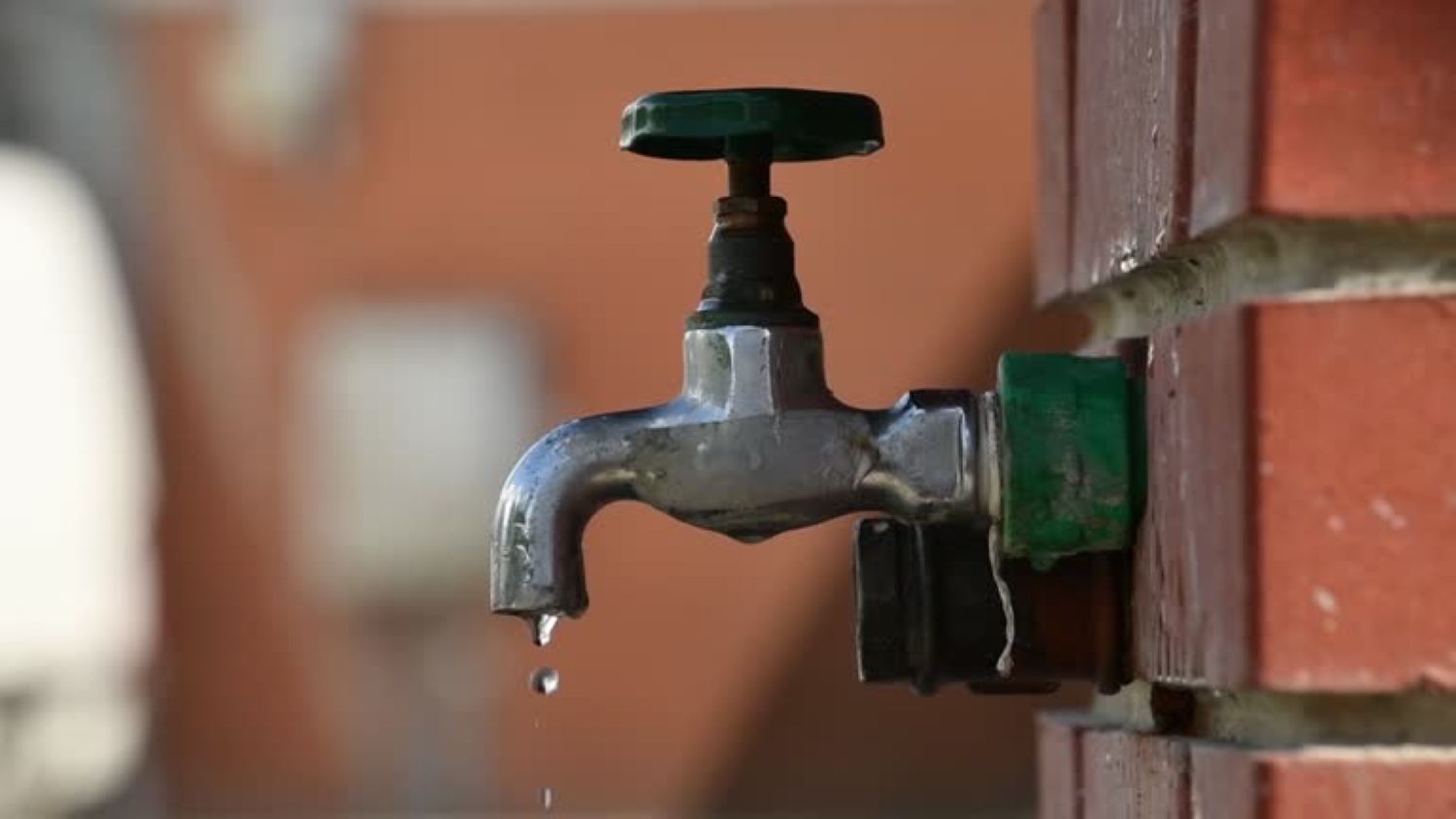

  • 15.92% water tariff for 2026 inadequate to keep taps flowing 24/7 – GWCL PRO

    15.92% water tariff for 2026 inadequate to keep taps flowing 24/7 – GWCL PRO

    The country’s water supplier, Ghana Water Company Limited (GWCL), has responded to the Public Utilities Regulatory Commission’s (PURC) approval of water and electricity tariffs for 2026.

    As part of PURC’s multi-year tariff review process covering 2026 to 2030, electricity tariffs have been adjusted by 9.86 percent, while water tariffs have been increased by 15.92 percent.

    Justifying the increases, the Public Utilities Regulatory Commission cited the investment requirements of utility providers, the need to ensure industry competitiveness, and the necessity of safeguarding consumer interests. PURC also attributed the adjustments to the cedi–dollar exchange rate, domestic inflation, the electricity generation mix, and rising fuel prices, especially natural gas.

    However, speaking to the media on Tuesday, December 9, GWCL’s Public Relations Officer, Stanley Martey, indicated that the 15.92% tariff increase is inadequate to ensure taps keep flowing often. He stressed that the adjustment fails to provide lasting solutions to GWCL’s major financial and operational problems.

    “Let’s admit that we can only keep the taps on 24/7 when we have built new treatment plants, when we have extended pipelines and all that. This tariff cannot do that,” he said.

    In October, electricity tariffs for all consumer categories increased by 1.14 percent. However, water tariffs saw no increase for the same period. According to a press statement by Acting Executive Secretary Shafic Suleman, the Commission indicated that the adjustment had become necessary due to factors such as the Ghana cedi–US dollar exchange rate, domestic inflation, the electricity generation mix, and fuel prices, especially natural gas.

    The review was in line with the Commission’s Quarterly Tariff Review Mechanism, which tracks key economic factors that affect the cost of delivering utility services.

    The PURC notes that the incoming hike will maintain the real value of tariffs and keep service providers financially stable. The Commission stated that it did not fully recover some costs in the previous quarter (Q3), due to currency changes or other factors.

    It added that it was short of GHS0.3980 per US$1 in the third quarter and therefore incorporated this shortfall into the new tariff.

    Earlier in September this year, the Public Utilities Regulatory Commission (PURC) received proposals from eight utility companies calling for a significant adjustment in utility tariffs to ensure they can fully operate at their capacities.

    Proposals from the electricity distributors and the water provider for the 2025–2029 tariff period cited rising operational costs and the need to maintain efficient service delivery.

    The eight companies include the Electricity Company of Ghana (ECG), Volta River Authority (VRA), Northern Electricity Distribution Company (NEDCo), Ghana Water Limited (GWL), the Ghana Grid Company (GRIDCo), Ghana National Gas Limited, among others.

    ECG pushed for a massive 225% hike in its distribution service charge. For instance, a household consuming 150 kWh monthly would pay an additional GHS64, while a residence using 100 kWh per month would pay about GHS43 more in distribution charges.

    As part of ECG’s request, the current Distribution Service Charge (DSC) of 19 pesewas per kilowatt-hour should be raised to nearly 62 pesewas per kilowatt-hour.

    “The PURC will undertake the major adjustment in the 4th quarter of 2025 to reflect capacity charges, additional liquid fuel usage, and additional capex. The current charge is below industry benchmarks, and cedi depreciation has reduced its value. US$408m spent on network upgrades and smart meters,” parts of ECG’s petition read.

    ECG has emphasised that the adjustment has long been overdue, noting that in 2022 it proposed 39.95 pesewas, but only 19.04 pesewas was approved.

    According to ECG, it has invested $48 million in network upgrades and smart metering systems to enhance power reliability, reduce outages, and align tariffs with international industry standards, yet these efforts have not yielded the expected cost recovery.

    Furthermore, ECG has projected an annual revenue of GHS9.5 billion between 2025 and 2029 if the new charges are approved. The proceeds, according to the utility company, would be allocated to cover operational costs, depreciation of assets, staff salaries, and the recovery of recent capital expenditures.

    VRA sought a 59% increase to cover the rising costs of producing electricity. If approved, the current tariff of 45.0892 Ghana pesewas per kilowatt-hour will be increased to 71.8862 pesewas per kilowatt-hour for the Bulk Generation Charge.

    Speaking during a public hearing on Tuesday, September 9, Senior Economic Analyst at VRA, Evans Somuah Mensah, said, “Over the years, VRA has not been compensated for doing this work to assist the national connectivity system. We are saying that on an annual basis, VRA should be given compensation $30.49 million for Akosombo power generation, and Kpone Thermal plant, a little bit of $30,000.

    “Justification for tariff increase, we are saying that we want to recover the cost of our power supply to the distribution companies, and recover the cost of transmission and also be compensated for the provisions of ancillary services. We are requesting the PURC to increase the existing tariff of BGC from 45.0892 Ghana pesewas per kilowatt-hour to 71.8862 Ghana pesewas per kilowatt-hour.”

    VRA has justified the increase as necessary to fully recover the cost of power generation supplied to distribution companies (DISCOs). It has noted that sustaining reliable electricity generation and meeting its operational and financial obligations will become increasingly difficult if its proposal is rejected.

    Ghana Water Limited has proposed a jump from GH¢5.28 per cubic metre to GH¢20.09 per cubic metre, seeking regulatory approval for a 281% increase in its water tariff.

    NEDCo has also called for its tariff to be increased to 153.03 pesewas per kilowatt-hour from the current 56.474 pesewas, representing a 171% rise. GRIDCo, meanwhile, is demanding that the current 5.6422 pesewas per kilowatt-hour on its transmission service tariff be raised to 12.9768 pesewas per kilowatt-hour.

    Ghana National Gas Limited is proposing to increase its tariff from US$1.10 to US$2.10 per million metric British thermal units (MMBtu). However, the onus lies on PURC to carefully review the requests, assess whether the increases are justified, and determine how the costs will be distributed.

    In July this year, electricity tariffs increased by 2.45% across the board, with no increase in water tariffs.

    The adjustments, according to PURC, were carried out in line with the Commission’s Quarterly Tariff Review Mechanism, which tracks and incorporates movements in key factors beyond the control of the Utility Service Providers (USPs).

    These factors include the exchange rate between the US dollar and the Ghana cedi, the domestic inflation rate, the electricity generation mix, and the cost of fuel, mainly natural gas.

    According to the Commission, additional factors considered before concluding the hike in tariffs include outstanding debt of GHS488 million carried over from the previous three quarters, reserve capacity for grid stability and reliability, and the inclusion of 27% of the cost of alternative fuels such as Distillate Fuel Oil (DFO), Heavy Fuel Oil (HFO), and Light Crude Oil (LCO).

    The Commission expressed gratitude to stakeholders for their support as it continues to implement the Quarterly Tariff Reviews in accordance with its Rate Setting Guidelines to address changes in operational conditions of the service providers.

    Majority Leader Mahama Ayariga justified PURC’s decision to increase electricity tariffs. Speaking on the floor of Parliament on Friday, June 27, he noted that there is a need for ECG to be able to settle its growing debt.

    “You all know that the whole of last year and before that, there was an effort to prevent the PURC from adjusting the tariffs. So that whole period, there was no adjustment, and you know very well that bills were accruing; payments have to be made. ECG is accumulating huge [debt] and it has to be paid, so who is supposed to pay? Is it not the consumer?” he questioned.

    According to him, failure to address ECG’s indebtedness would render the company powerless in supplying power to its consumers.

    “And if you are not adjusting the tariffs to enable ECG to pay, ECG is going to collapse. They are no longer able to buy the input needed to keep the generators on, and we are going to have a power outage; the bills have to be paid.

    “The bill has to be paid. So if PURC is doing its work, I do not think there is a basis for saying that because we have improved the economy, it doesn’t mean that the debt at ECG will just be whisked away. The bill has to be paid partly by consumers,” he asserted.
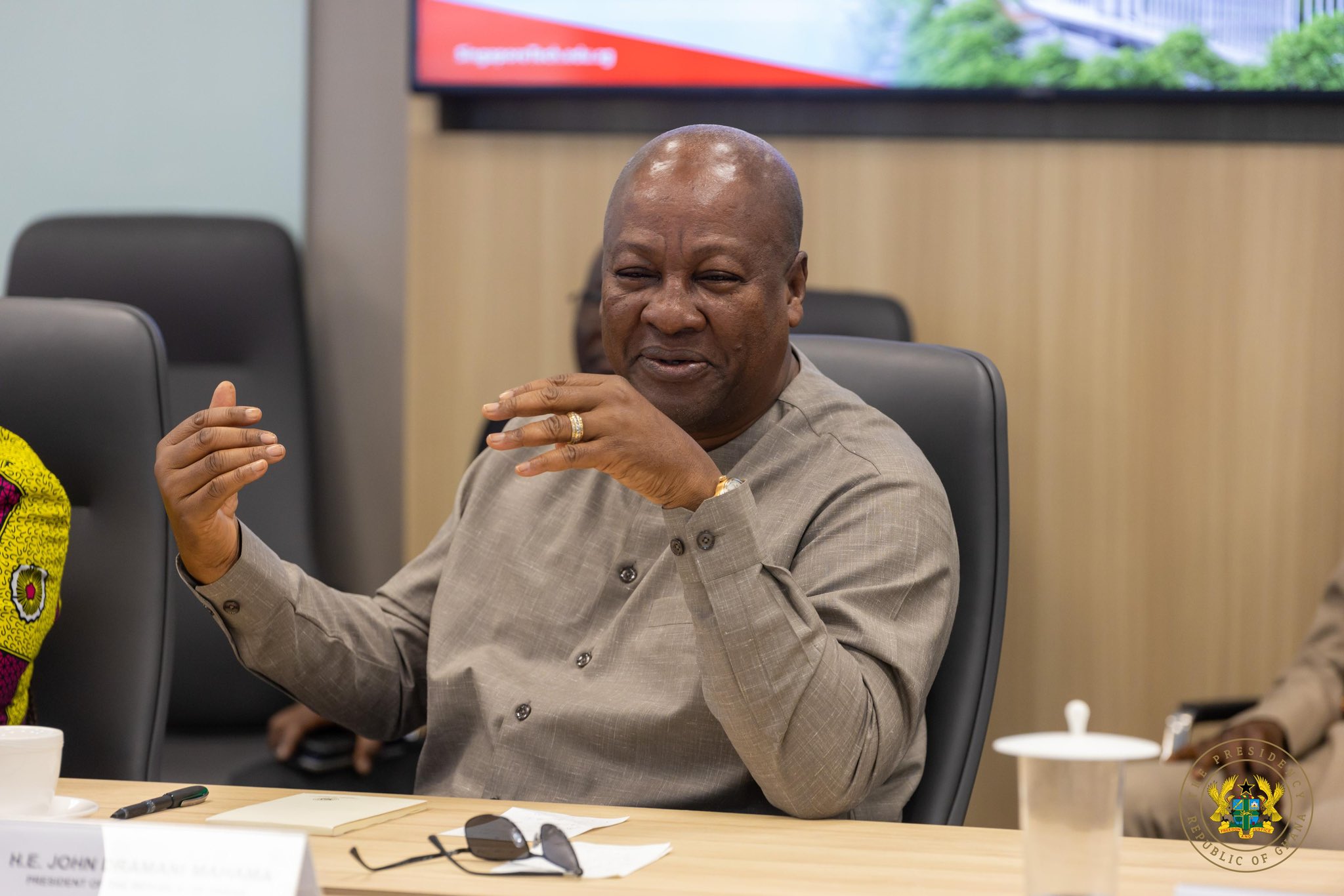
  • Ghanaians to pay more for utilities effective Jan as water to go up 15.92%, electricity 9.86%

    Ghanaians to pay more for utilities effective Jan as water to go up 15.92%, electricity 9.86%

    Effective January 1, 2026, Ghanaians will pay more for water and electricity consumed following new tariff adjustments by the Public Utilities Regulatory Commission (PURC).

    As part of PURC’s multi-year tariff review process covering 2026 to 2030, electricity tariffs have been adjusted by 9.86 percent, while water tariffs have been increased by 15.92 percent.


    Justifying the increases, the Public Utilities Regulatory Commission cited the investment requirements of utility providers, the need to ensure industry competitiveness, and the necessity of safeguarding consumer interests. PURC also attributed the cedi–dollar exchange rate, domestic inflation, the electricity generation mix, and rising fuel prices—especially natural gas.

    In October, electricity tariffs for all consumer categories increased by 1.14 per cent. However, water tariffs saw no increase for the same period.
    According to a press statement by Acting Executive Secretary Shafic Suleman, the Commission indicated that the adjustment has become necessary due to factors such as the Ghana cedi–US dollar exchange rate, domestic inflation, the electricity generation mix, and fuel prices, especially natural gas.


    The review was in line with the Commission’s Quarterly Tariff Review Mechanism, which tracks key economic factors that affect the cost of delivering utility services.

    The PURC notes that the incoming hike will maintain the real value of tariffs and keep service providers financially stable. The Commission stated that it didn’t fully recover some costs in the previous quarter (Q3), due to currency changes or other factors.

    It added that it was short of 0.3980 GHS0.3980 per US$1 in the third quarter as such, it added this shortfall into the new tariff.

    Earlier in September this year, the Public Utilities Regulatory Commission (PURC) received proposals from eight utility companies calling for a significant adjustment in utility tariffs to ensure they can fully operate at their capacities.

    Proposals from the electricity distributors and the water provider for the 2025–2029 tariff period cited rising operational costs and the need to maintain efficient service delivery.

    The eight companies include the Electricity Company of Ghana (ECG), Volta River Authority (VRA), Northern Electricity Distribution Company (NEDCo), Ghana Water Limited (GWL), and the Ghana Grid Company (GRIDCo), Ghana National Gas Limited, among others.

    ECG pushed for a massive 225% hike in its distribution service charge. For instance, a household consuming 150 kWh monthly would pay an additional GHS64, while a residence using 100 kWh per month would pay about GHS43 more in distribution charges.

    As part of ECG’s request, the current Distribution Service Charge (DSC) of 19 pesewas per kilowatt-hour should be raised to nearly 62 pesewas per kilowatt-hour.

    “The PURC will undertake the major adjustment in the 4th quarter of 2025 to reflect capacity charges, additional liquid fuel usage, and additional capex. The current charge is below industry benchmarks, and cedi depreciation has reduced its value. US$408m spent on network upgrades and smart meters,” parts of ECG’s petition read.

    ECG has emphasised that the adjustment has long been overdue, noting that in 2022 it proposed 39.95 pesewas, but only 19.04 pesewas was approved.

    According to ECG, it has invested $48 million in network upgrades and smart metering systems to enhance power reliability, reduce outages, and align tariffs with international industry standards, yet these efforts have not yielded the expected cost recovery.

    Furthermore, ECG has projected an annual revenue of GHS9.5 billion between 2025 and 2029 if the new charges are approved. The proceeds, according to the utility company, would be allocated to cover operational costs, depreciation of assets, staff salaries, and the recovery of recent capital expenditures.

    VRA sought a 59% increase to cover rising costs of producing electricity. If approved, the current tariff of 45.0892 Ghana pesewas per kilowatt-hour will be increased to 71.8862 pesewas per kilowatt-hour for the Bulk Generation Charge.

    Speaking during a public hearing on Tuesday, September 9, Senior Economic Analyst at VRA, Evans Somuah Mensah, said, “Over the years, VRA has not been compensated for doing this work to assist the national connectivity system. We are saying that on an annual basis, VRA should be given compensation $30.49 million for Akosombo power generation, and Kpone Thermal plant, a little bit of $30,000.

    “Justification for tariff increase, we are saying that we want to recover the cost of our power supply to the distribution companies, and recover the cost of transmission and also be compensated for the provisions of ancillary services. We are requesting the PURC to increase the existing tariff of BGC from 45.0892 Ghana pesewas per kilowatt-hour to 71.8862 Ghana pesewas per kilowatt-hour.”

    VRA has justified the increase as necessary to fully recover the cost of power generation supplied to distribution companies (DISCOs). It has noted that sustaining reliable electricity generation and meeting its operational and financial obligations will become increasingly difficult if its proposal is rejected.

    Ghana Water Limited has proposed a jump from GH¢5.28 per cubic metre to GH¢20.09 per cubic metre, seeking regulatory approval for a 281% increase in its water tariff.

    NEDCo has also called for its tariff to be increased to 153.03 pesewas per kilowatt-hour from the current 56.474 pesewas, representing a 171% rise. GRIDCo, meanwhile, is demanding that the current 5.6422 pesewas per kilowatt-hour on its transmission service tariff be raised to 12.9768 pesewas per kilowatt-hour.

    Ghana National Gas Limited is proposing to increase its tariff from US$1.10 to US$2.10 per million metric British thermal units (MMBtu)
    However, the onus lies on PURC to carefully review the requests, assess whether the increases are justified, and determine how the costs will be distributed. In July this year, electricity tariffs increased by 2.45% across the board, with no increase in water tariffs.

    The adjustments, according to PURC, were carried out in line with the Commission’s Quarterly Tariff Review Mechanism, which tracks and incorporates movements in key factors beyond the control of the Utility Service Providers (USPs).

    These factors include the exchange rate between the US dollar and the Ghana Cedi, the domestic inflation rate, the electricity generation mix, and the cost of fuel, mainly natural gas.

    According to the Commission, additional factors considered before concluding the hike in tariffs include outstanding debt of GHS488 million carried over from the previous three quarters, reserve capacity for grid stability and reliability, and the inclusion of 27% of the cost of alternative fuels such as Distillate Fuel Oil (DFO), Heavy Fuel Oil (HFO), and Light Crude Oil (LCO).

    The Commission expressed gratitude to stakeholders for their support as it continues to implement the Quarterly Tariff Reviews in accordance with its Rate Setting Guidelines to address changes in operational conditions of the service providers.

    Majority Leader Mahama Ayariga justified PURC’s decision to increase electricity tariffs. Speaking on the floor of Parliament on Friday, June 27, he noted that there is a need for ECG to be able to settle its growing debt.

    “You all know that the whole of last year and before that, there was an effort to prevent the PURC from adjusting the tariffs. So that whole period, there was no adjustment, and you know very well that bills were accruing; payments have to be made. ECG is accumulating huge [debt] and it has to be paid, so who is supposed to pay? Is it not the consumer?” he questioned.

    According to him, failure to address ECG’s indebtedness would render the company powerless in supplying power to its consumers.

    “And if you are not adjusting the tariffs to enable ECG to pay, ECG is going to collapse. They are no longer able to buy the input needed to keep the generators on, and we are going to have a power outage; the bills have to be paid.”

    “The bill has to be paid. So if PURC is doing its work, I do not think there is a basis for saying that because we have improved the economy, it doesn’t mean that the debt at ECG will just be whisked away. The bill has to be paid partly by consumers,” he asserted.
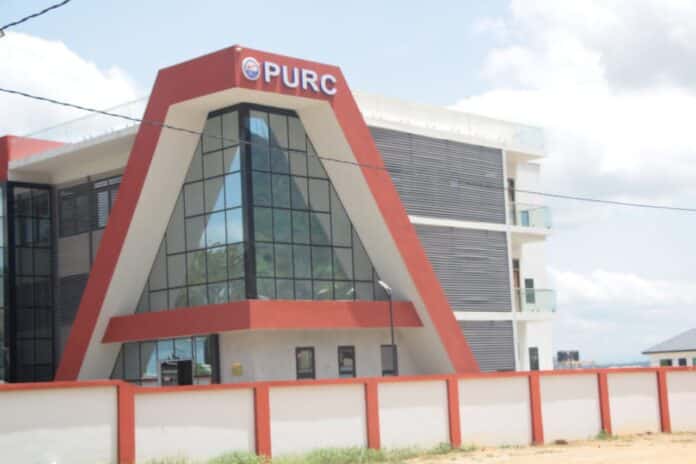
  • Ghana, 16 nations back World Bank, AfDB drive for 2030 electricity access initiative

    Ghana, 16 nations back World Bank, AfDB drive for 2030 electricity access initiative

    The World Bank and African Development Bank-led Mission 300 initiative has received massive support from Ghana. World Bank and African Development Bank-led Mission 300 initiative aims to ensure 300 African countries get access to electricity by 2030.

    Speaking at the Bloomberg Philanthropies Global Forum, President John Mahama expressed his support, stressing that under the National Energy Compacts every Ghanaian home, business, and community will have access to electricity.

    Additionally, he noted that the initiative will assist African countries in eradicating poverty as well as creating massive opportunities.

    “Ghana believes universal energy access is key to empowering businesses, reducing poverty, and creating equal opportunities.This goal can only be achieved through strong government–private sector partnerships, supported by an enabling environment for sustainable investment,” he added.

    The Energy Compacts are detailed guides that show how countries can attract investment, reforms and introduce new ideas to improve their energy sector.

    Ghana joins sixteen other African countries to endorse the National Energy Compacts. So far, 30 million individuals have gained access to electricity, with another 100 million expected to be connected soon.


    Meanwhile, the Electricity Company of Ghana (ECG) has launched the “Operation All Must Pay” initiative to facilitate the retrieval of outstanding debts owed by customers across the nation as well as prosecute offenders involved in illegal connection.


    The exercise, which will come to a close on September 30 after it began on September 9, targets residential, commercial, industrial, and government institutions, such as Ministries, Departments, and Agencies (MDAs).


    A statement released by the Electricity Company of Ghana states, “The exercise will include Bill distribution, Streetlight & SHEP meter capturing & reporting. This exercise will be monitored by special teams who will apprehend and prosecute customers who have connected electricity illegally, or attempt to interfere with the exercise, or undertake illegal self-reconnection after disconnection.”


    ECG further advised customers with arrears to pay their bills immediately to avoid disconnection, and payment of reconnection fees. It added that customers who are unable to access their bills should visit the nearest ECG Office for assistance.


    Customers have been entreated to use their regular channels including the ECG Mobile App to pay their bills. Persons who do not have the App have been directed to download it from Google Play Store, or call the ECG contact centre on 0302611611/Social Media handles, for assistance.

    In October last year, the Africa Centre for Energy Policy (ACEP) raised concerns over the Electricity Company of Ghana’s (ECG) monthly revenue losses, revealing that the company is losing approximately $67 million every month due to unpaid bills.


    ACEP attributed these losses to the ECG’s low revenue recovery rate. Kodzo Yaotse, Policy Lead for Petroleum and Conventional Energy at ACEP, emphasized that improving the ECG’s revenue collection must be a priority for both the government and the company itself.


    He warned that the continued failure to collect these revenues would only worsen Ghana’s growing energy sector debt and strain the Independent Power Producers (IPPs), who are already owed significant sums as part of the country’s legacy energy debt.
    According to reports, the ECG is drowning in debt, amounting to over GHC67 billion.

    The ECG has on numerous occasions embarked on revenue mobilization exercises but is yet to retrieve all the money owed the company.

    Effective Wednesday, October 1, electricity tariffs for all consumer categories will go up by 1.14 per cent, the Public Utilities Regulatory Commission (PURC) has announced. However, water tariffs will see no increase for the same period.


    According to a press statement by Acting Executive Secretary Shafic Suleman, the Commission indicated that the adjustment has become necessary due to factors such as the Ghana cedi–US dollar exchange rate, domestic inflation, the electricity generation mix, and fuel prices, especially natural gas.


    The review was in line with the Commission’s Quarterly Tariff Review Mechanism, which tracks key economic factors that affect the cost of delivering utility services.


    The PURC notes that the incoming hike will maintain the real value of tariffs and keep service providers financially stable. The Commission stated that it didn’t fully recover some costs in the previous quarter (Q3), due to currency changes or other factors.

    It added that it was short of 0.3980 GHS0.3980 per US$1 in the third quarter as such, it added this shortfall into the new tariff.
    Earlier in September this year, the Public Utilities Regulatory Commission (PURC) received proposals from eight utility companies calling for a significant adjustment in utility tariffs to ensure they can fully operate at their capacities.


    Proposals from the electricity distributors and the water provider for the 2025–2029 tariff period cited rising operational costs and the need to maintain efficient service delivery.


    The eight companies include the Electricity Company of Ghana (ECG), Volta River Authority (VRA), Northern Electricity Distribution Company (NEDCo), Ghana Water Limited (GWL), and the Ghana Grid Company (GRIDCo), Ghana National Gas Limited, among others.


    ECG is pushing for a massive 225% hike in its distribution service charge. For instance, a household consuming 150 kWh monthly would pay an additional GHS64, while a residence using 100 kWh per month would pay about GHS43 more in distribution charges.
    As part of ECG’s request, the current Distribution Service Charge (DSC) of 19 pesewas per kilowatt-hour should be raised to nearly 62 pesewas per kilowatt-hour.


    “The PURC will undertake the major adjustment in the 4th quarter of 2025 to reflect capacity charges, additional liquid fuel usage, and additional capex. The current charge is below industry benchmarks, and cedi depreciation has reduced its value. US$408m spent on network upgrades and smart meters,” parts of ECG’s petition read.


    ECG has emphasized that the adjustment has long been overdue, noting that in 2022 it proposed 39.95 pesewas, but only 19.04 pesewas was approved.


    According to ECG, it has invested $48 million in network upgrades and smart metering systems to enhance power reliability, reduce outages, and align tariffs with international industry standards, yet these efforts have not yielded the expected cost recovery.


    Furthermore, ECG has projected an annual revenue of GHS9.5 billion between 2025 and 2029 if the new charges are approved. The proceeds, according to the utility company, would be allocated to cover operational costs, depreciation of assets, staff salaries, and the recovery of recent capital expenditures.

  • Rising tariffs may scare businesses from partaking in 24-hour economy – AGI

    Rising tariffs may scare businesses from partaking in 24-hour economy – AGI

    The Association of Ghana Industries (AGI) is pessimistic about the success of the government’s 24-hour economy policy, pointing to the recent 2.45% increase in electricity tariffs.

    Speaking to Citi News, Greater Accra Regional Chairman of AGI, Tsonam Akpeloo, said businesses that will participate in the programme will run at a loss as they will consume much electricity.

    According to him, “If you’re talking about a 24-hour economy, you’re asking industry to work beyond the usual eight hours and continue through the night. That means higher electricity consumption. The cost of power will increase—possibly doubling what we’ve previously paid.”

    “A 2.5% increase under normal production is one thing, but with extended hours, the actual cost impact will be far greater,” he added.

    The Public Utilities Regulatory Commission (PURC) announced an increase in electricity tariffs of 2.45% across the board, effective Monday, July 1.

    It noted that there will be no increase in water tariffs. According to the Commission, the factors it took into consideration before concluding the hike in tariffs include the exchange rate, inflation rate, price of natural gas, electricity generation mix, outstanding debt of GHC488 million carried over from the previous three quarters.

    Today, the government launched the 24-hour economy policy.

    The policy’s objective is to enhance economic productivity by encouraging businesses to operate continuously, creating more job opportunities, boosting revenue generation, and improving service delivery.

    Sectors such as manufacturing, transportation, retail, healthcare, hospitality, and financial services stand to benefit significantly from this model.

    His Excellency, President John Dramani Mahama, has indicated that the government does not plan to heavily interfere in its flagship programme, the 24-Hour Economy policy.

    “The private sector will lead the 24-Hour Plus programme. Government will facilitate and not dominate,” the President stated.

    According to him, “Any government funding in 24-hour plus will be catalytic, serving as seed funding for the 24-hour plus authority and support bulk infrastructure”.

    Mr Goosie Tanoh, the Presidential Advisor on the 24-hour economy policy, said the programme is expanded into three anchors: “production transformation, supply chain and market efficiency, and human capital development.”

    The three anchors, according to him, are supported by eight sub-programmes.

    “Roll 24 – which is the agricultural component, Make 24 – which is the manufacturing component, Connect 24 – the supply chain component, Aspire 24 – which is the mindset change, the resetting of the Ghanaian and Ghanaian bureaucracy with a strong and powerful attitude to work and productivity,” he explained.

    According to him, the government is set to include strong digital technology training in the TVET curriculum to train and equip an employable workforce with the requisite skills for employment opportunities.

    Another component, dubbed ‘Show Ghana,’ is also set to focus on an intentional effort and approach by the government to give visibility to Ghana’s rich cultural heritage to the rest of the world to attract more tourists and increase revenue generation through tourism.


  • Electricity, water tariffs: PURC’s review meeting ends in stalemate

    Electricity, water tariffs: PURC’s review meeting ends in stalemate

    The Public Utilities Regulatory Commission (PURC) engaged in critical discussions over the quarterly tariff reviews for electricity and water services.

    A meeting held on Friday morning ended without a resolution, resulting in a deadlock. Sources indicate that PURC is considering proposed tariff adjustments of 27% for electricity and 9.5% for water.

    The outcome of these deliberations is expected to have significant implications for households and businesses nationwide, potentially influencing the cost of living and operational expenses.

    The meeting is scheduled to reconvene at 12:00 PM as the Commission seeks to finalize decisions on the proposed increments.

    From October 1, 2024, Public Utilities Regulatory Commission (PURC) announced tariff hikes of 3.02% for electricity and 1.86% for water.

    This increment came after the Commission’s quarterly review, designed to account for fluctuations in critical economic indicators such as the exchange rate, inflation, and the cost of natural gas.

    The PURC emphasized that these adjustments are necessary to maintain the “financial viability and ability of utility service providers to deliver on their mandate,” ensuring uninterrupted utility services. Specifically, the depreciation of the Ghana Cedi against the US Dollar by 4.96% between the second and third quarters of 2024 contributed significantly to the rise in electricity tariffs.

  • Ghana, Japan sign $13.4m deal to enhance electricity supply to Tamale

    Ghana, Japan sign $13.4m deal to enhance electricity supply to Tamale

    Ghana has secured a $13.44 million grant from Japan to improve electricity supply in Tamale, the capital of the Northern Region.

    The funding, facilitated through the Japan International Cooperation Agency (JICA), aims to boost the region’s energy infrastructure, ensuring a more stable and reliable power supply for residents, businesses, and essential services.

    Finance Minister Dr. Cassiel Ato Forson, who announced the agreement on his official Facebook page on Friday, March 14, 2025, described the partnership as a significant investment in Tamale’s power network.

    Under the agreement, Ghana’s government and JICA will collaborate on the construction of a new power substation and the expansion of electricity distribution lines. The initiative is expected to strengthen the region’s energy framework, reducing disruptions and supporting economic growth.

    The signing ceremony saw Dr. Forson represent Ghana, while JICA’s Chief Representative, Her Excellency Suzuki Momoko, signed on behalf of Japan.

    Speaking on the significance of the project, Dr. Forson highlighted its potential to drive economic progress, create jobs, and enhance the overall quality of life in the Northern Region.

    “This project represents a major milestone in our commitment to economic development, job creation, and enhanced livelihoods in the Northern Region.

    “By ensuring uninterrupted electricity supply, we are providing businesses, households, and critical services with the energy security they need to thrive,” he stated.

    He further commended Japan for its ongoing support, emphasizing that strategic collaborations such as this play a vital role in addressing Ghana’s energy challenges and fostering industrialization.

    Upon completion, the project is expected to significantly transform Tamale’s power landscape, supporting local enterprises and improving the region’s overall development.

  • Govt to review electricity tariffs every quarter – Oppong-Nkrumah hints

    Govt to review electricity tariffs every quarter – Oppong-Nkrumah hints

    Electricity tariffs in Ghana will now be reviewed every three months, according to Kojo Oppong-Nkrumah, Ranking Member on Parliament’s Economy and Development Committee.

    He stated that this policy is part of the government’s plan to ensure cost recovery in the energy sector. Addressing journalists at a Minority press conference on Thursday, March 13, Oppong Nkrumah explained that the periodic adjustments are intended to stabilize the financial health of the country’s power industry.

    He clarified that the tariff reviews would reflect fluctuations in production costs, fuel prices, and exchange rates.

    However, he expressed concerns about the potential impact on consumers, particularly households and businesses already struggling with the rising cost of living.

    “The adjustment of electricity tariffs every three months is meant to reflect changes in production costs, fuel prices, and exchange rate fluctuations,” he stated.

    Oppong Nkrumah also criticized the government for failing to introduce measures to cushion consumers against these tariff hikes.

    “While the government argues that this is necessary for sustainability, we must also consider how it affects ordinary Ghanaians. Frequent adjustments could place an additional burden on citizens,” he warned.

    Without a well-planned approach, he cautioned, the policy could lead to economic difficulties and weaken business competitiveness.

    He urged the government to focus on improving efficiency in the energy sector instead of relying on regular tariff increases.

    Additionally, he called for greater transparency in pricing mechanisms and advocated for a broader discussion among stakeholders to find a balance between sustainability and affordability.

  • ECG improves power challenges in Ashanti Region

    ECG improves power challenges in Ashanti Region

    The Electricity Company of Ghana (ECG) in the Ashanti Region has reported a significant improvement in power supply following the resolution of cable faults that had been causing outages.

    The Public Relations Officer for ECG Ashanti West, Benjamin Obeng Antwi, acknowledged persisting issues such as vandalism and illegal connections but assured residents that the company is committed to ensuring a stable electricity supply.

    He also called on the public to assist in protecting ECG’s infrastructure by reporting any acts of theft or interference.

    “One of the problems that we faced had to do with the transformer that was vandalised at the Adum central business district.

    “As we speak, we have rectified the problem and repaired the necessary equipment, and now our customers within that vicinity are enjoying a stable power supply.”

    “But we would like to admonish the public to help us fight against the damage of ECG power installations, which include cables, transformers, and other equipment.

    “This phenomenon is gaining daily momentum in the Ashanti region, and we want to call on all our stakeholders and the public to help curb this menace.”he urged.

  • N-Gas to cease gas supply to Ghana effective March 6 over arrears

    N-Gas to cease gas supply to Ghana effective March 6 over arrears

    N-Gas Limited has officially notified the Volta River Authority (VRA) of its decision to halt gas supply to Ghana effective March 6 due to outstanding arrears worth over $75 million.

    In a letter addressed to the Managing Director of VRA on Tuesday, February 18th, the company noted that despite all the commitments received from VRA, N-Gas is yet to receive any payment from VRA throwing the entire value chain into panic and uncertainty with N-Gas reputation on the line.

    The company noted that it has supplied gas to VRA despite not being able to pay its Gas Suppliers and Transporters since November 2024 due to the high level of debt.

    “However, VRA’s action could soon result in gas supply and transportation reliability issues,” the letter noted.

    According to N-Gas Limited, it has not received either of the committed payments (USD25million on or before 21 February 2025), nor have the stipulated conditions precedent been fulfilled, thereby constituting a material breach of the agreed terms.

    In accordance with Clause 4 (specifically 4.2, 4.4(b), 4.4(e), and 4.4(k)), Clause 14 (specifically 14.1–14.5) and Clause 13.6(a) of the Takoradi Gas Sales Agreement (TGSA), N-Gas shall among other things: “Remove the stay order on the SBLC call and proceed with calling on the Letter of Credit by Monday, 18 February 2025 and dffective 6 March 2025, N-Gas shall cease further gas supply to VRA, in accordance with Clause 13.6(a) of the Takoradi Gas Sales Agreement, which provides for the cessation of gas supply in the event of non-fulfillment of payment obligations by Buyer.”

    To ensure the sanctity of contracts across the value chain, N-Gas says it may demand one month of pre-payment from VRA for continued gas supply.

    This development raises concerns over Ghana’s energy security, as the potential suspension of gas supply could impact power generation. The VRA, which relies on gas from N-Gas to fuel thermal power plants, may be forced to explore alternative arrangements to prevent disruptions to electricity supply.

  • Increasing cases of installation tampering causing power outages in Kumasi – ECG

    Increasing cases of installation tampering causing power outages in Kumasi – ECG

    The Electricity Company of Ghana (ECG) has attributed the recent power outages in the Ashanti Region, Kumasi to the increased cases of installation tampering within the area.


    Speaking to the media on Tuesday, Public Relations Officer for the ECG in the Ashanti West, Benjamin Obeng Antwi, noted that some unknown individuals deliberately destroying critical cables essential for maintaining a stable power in the region.


    He cited a recent incident that occurred on Monday at the Central Business District in Adum, where poles, transformers and cables were tampered with.


    According to him, this trend is severely affecting the operations of the power supply company, as well as causing significant disruptions for traders and business owners in the area.

    “There is a growing trend in the Ashanti Region which is affecting our operations and also our core mandate to deliver quality, reliable and safe electricity services to our cherished customers in the Ashanti Region. Largely the Greater Kumasi Metropolis. You will realize that some people have started vandalizing our installations like poles, transformers and cables, with the latest happening yesterday at Adum Central.

    “You know when you get to Adum, that is more or less a business hub in the Ashanti Region where we have lots of traders and individuals selling their wares over there.

    ” So yesterday our 500 kW transformer set in the central Business District in Adum was damaged by some individuals. We have reported the incident to the police. What happened was they took some fuses, they destroyed cables, plates and even some DPs were destroyed. So this affected our supply to customers within the Adum Business Centre,” he noted.

    He has urged Ghanaians to support efforts in apprehending the individuals responsible for these acts, emphasizing the importance of collective action in safeguarding the region’s power infrastructure.


    Certain areas of Kumasi have experienced extended power outages in recent weeks, with some communities left without electricity for over 24 hours.

    Many Ghanaians have linked the recent power fluctuations to ‘dumsor,’ a term commonly used in Ghana to describe power outages.

    Some have even suggested implementing a timetable to manage the supply more effectively.


    However, the Electricity Company of Ghana (ECG) has maintained that the current issues are not due to a power crisis, but rather the result of technical difficulties that are being addressed.

  • 4 communities in Afigya Kwabre North District cut off the national grid

    4 communities in Afigya Kwabre North District cut off the national grid

    Residents of Amponsahkrom, Prabon, Hobesu, and Kofifofiekrom in the Afigya Kwabre North District of the Ashanti Region have been left in darkness for months due to disruptions in electricity supply, significantly affecting daily life and essential services.

    One of the hardest-hit sectors is healthcare, as professionals at the local CHPS compound struggle to provide quality care, particularly at night. The lack of electricity has made it difficult to administer emergency treatments and conduct routine medical procedures efficiently.

    Health worker Richard Amankwa highlighted the additional challenge of poor internet connectivity, which has delayed the processing of essential documents, including those for the National Health Insurance Scheme (NHIS). “Access to the internet has been challenging, which has hindered our ability to process documents, including NHIS,” he stated, adding that the absence of electricity has only worsened the situation.

    Assembly Member Emmanuel Nomenyo Kwabena explained that although the Electricity Company of Ghana (ECG) had initially installed power lines to connect the four communities to the national grid, unknown individuals have reportedly removed the electricity poles and wires.

    He urged the government and ECG to intervene swiftly to restore electricity to the affected communities, emphasizing that their livelihoods and access to essential services depend on immediate action.

  • ECG embarks on ‘Operation Keep The Lights On’ from Jan 15-31

    ECG embarks on ‘Operation Keep The Lights On’ from Jan 15-31

    The Electricity Company of Ghana Limited (ECG) has announced the commencement of a nationwide revenue mobilisation exercise dubbed “Operation Keep The Lights On,” scheduled from Wednesday, 15th to Friday, 31st January.

    The exercise will cover all ECG operational areas. The focus of this massive campaign will be on recovering arrears from all categories of customers while also inspecting prepaid meters to verify their integrity.

    Customers are reminded that self-reconnection after disconnection is a criminal offence. To ensure full participation, ECG’s regional and district offices will operate with a lean staff pool during the exercise, providing only essential services to customers.

    ECG has emphasized that the Public Utilities Regulatory Commission’s LI (2413) grants them full access to all installations. Customers and the general public are encouraged to cooperate fully with ECG as it fulfills its mandate.

  • Power supply returns to nomalcy as WAPCO restores gas supply – ECG, GRIDCo

    Power supply returns to nomalcy as WAPCO restores gas supply – ECG, GRIDCo

    The Ghana Grid Company Ltd (GRIDCo) and the Electricity Company of Ghana (ECG) have announced the restoration of gas supply from the West African Gas Pipeline Company (WAPCO) to thermal power plants in Tema.

    This development has brought much-needed relief to affected customers, as all previously shutdown power plants have resumed operations, ensuring the restoration of electricity supply across the country.

    In a joint press statement released on Friday, December 13, 2024, the two organizations reassured stakeholders of their commitment to providing uninterrupted power.

    “With the return to normalcy, GRIDCo and ECG wish to assure that we will continue our collaborative efforts to ensure continued reliable supply,” the statement noted.

    GRIDCo and ECG also expressed their appreciation to customers and stakeholders for their patience and understanding during the disruptions caused by the gas supply challenges.

    “We thank our stakeholders and customers for their patience and understanding,” they added.

  • There’d be no power if gov’t stops sacrificing development for payment of bills – ACEP

    There’d be no power if gov’t stops sacrificing development for payment of bills – ACEP

    Benjamin Boakye, Deputy Executive Director of the Africa Center for Energy Policy (ACEP), has warned that Ghana’s electricity supply would be at risk if the government stopped prioritizing the payment of electricity bills over critical development projects.

    Speaking on Joy News’ Newsfile, Boakye stated, “The power situation got out of hand long ago, but because we are dealing with government and government is interested in paying the bills even when they are not supposed to, that is why we see the light on to some extent. But without government sacrificing development to pay for electricity bills, there’d be no power in Ghana.”

    Boakye criticized the government’s focus on bill payments at the expense of essential services, saying, “That is the fundamental truth and we keep saying that government doesn’t need to be paying electricity bills. Even access to hospitals is a challenge, and we are sacrificing that to keep the lights on.”

    This comes as Ghana’s energy sector faces an imminent crisis, with three major power plants on the brink of shutting down due to unpaid debts to Independent Power Producers (IPPs). The government’s inability to settle these arrears threatens the stability of the national grid and could lead to widespread power outages.

    Dr. Elikplim Kwabla Apetorgbor, CEO of the Chamber of Independent Power Producers, Distributors, and Bulk Consumers (CIPDiB), warned that if no intervention occurs by November 22, 2024, three key power plants could cease operations by the following Monday. “I can confirm that all is not well. If there is no intervention before Friday, I can tell you that by Monday, three key power plants will be off the grid. It is a serious matter, not fun,” Apetorgbor said.

    The IPPs are owed $1.7 billion by the Electricity Company of Ghana (ECG), which has hindered their operations. Sunon Asogli, Ghana’s largest IPP, halted operations on October 8 due to the government’s failure to address its debts. Despite efforts to restructure some debt, the financial strain continues to undermine the sector’s stability.

    The ongoing crisis casts doubt on the government’s assurances that new investments would resolve the country’s energy challenges. Apetorgbor remarked, “We have received these assurances several times, so this can’t sway us.”

    With the government’s debt to IPPs reaching $2.3 billion in July 2023, the situation remains dire. IPPs have called on the Ministry of Finance to take urgent action, as the risk of “dumsor” (intermittent power outages) looms, potentially affecting industries and households alike.

  • Electricity bills have increased due to imported oil, gas for production – Bawumia

    Electricity bills have increased due to imported oil, gas for production – Bawumia

    The recent installation of new electricity meters by the Electricity Company of Ghana (ECG) has left many Ghanaians frustrated over increased power bills.

    Individuals and businesses alike have expressed concerns about having to double their expenses to maintain electricity usage.

    Addressing these concerns during a campaign in the Asante Akim South constituency, the New Patriotic Party (NPP) flagbearer, Dr. Mahamudu Bawumia, attributed the rising electricity costs to the reliance on imported oil and gas for power generation.

    Dr. Bawumia proposed solar energy as a long-term solution to reduce electricity costs. He outlined plans to establish solar farms in all districts to cut electricity bills by up to 50%.

    “Ghana has abundant sunlight, and we can harness it to generate solar power for our energy needs,” he stated, emphasizing that this approach could provide a sustainable solution to the country’s high energy costs.

    His remarks have sparked discussions on renewable energy as a viable means of addressing Ghana’s electricity challenges.

    “Our electricity bill has increased, and I want to introduce a policy to take care of that. The bill has increased because we import oil and gas to produce electricity. I thus want us to use solar power to generate electricity,” Dr. Bawumia stated.

    “The technology exists already, and we have enough sunlight to produce solar power. I will create solar farms in all districts, which will reduce the cost of electricity by 50%,” he added.

    The Electricity Company of Ghana (ECG) has explained that the meter replacement exercise is a key component of its Loss Reduction Programme (LRP), designed to enhance energy management by introducing smart meters.

    These advanced meters are intended to address system inefficiencies, ensure precise readings, and resolve billing issues that were common with the previous models.

    Additionally, the meters feature anti-tampering technology to combat illegal connections and minimize losses resulting from electricity theft.

  • Bui Power to explore wind energy generation, expand solar capacity to meet electricity demand

    Bui Power to explore wind energy generation, expand solar capacity to meet electricity demand

    The Bui Power Authority has reaffirmed its commitment to harnessing Ghana’s abundant solar resources to produce renewable energy and meet the nation’s growing electricity demands.

    During a recent visit to the 50MW solar power plant in Yendi, CEO Ing. Samuel Kofi Dzamesi outlined the authority’s strategic initiatives to enhance its solar capacity and investigate alternative energy sources.

    Currently under construction by First Sky Limited, the $59 million solar power plant is expected to become operational within eight years, with repayment handled by the Bui Power Authority. This project is part of the authority’s broader mission to ensure reliable power distribution for Ghanaians.

    Highlighting the project’s importance, Dzamesi stated “So this is what we are doing. Now, this project is not only for the solar. We are also constructing buildings to house the workers.”

    “We have a powerhouse here, which will ensure that the power is evacuated onto the critical line. And I want to say that Bui Power is very strategic in ensuring that we build more solar plants. God has blessed us with the sun and the sun, you don’t need to go and buy it before you produce the power.”

    The CEO expressed optimism about the potential for expansion, saying, “So we hope that here the land is enough to build 100 megawatts. So we are praying that when the contractor completes this first phase and we start selling, we’ll enter into another agreement with him to continue with another 50 megawatts to make it 100 megawatts.”


    “Now, again, the good news is that because it’s a Ghanaian-owned company, everybody here is a Ghanaian. Bui Power has the experience to supervise design and ensure that we have solar plants, no matter the technology in this country.

    “We are going to do that. We have also started to do pilot projects in wind so that we can be able to move fast in the track of renewable energy. And I want to say that we should understand that there is a limitation to solar.”

  • Electricity, water costs to increase from October 1

    Electricity, water costs to increase from October 1

    The Public Utilities Regulatory Commission (PURC) has announced an increase in utility tariffs for the third quarter of 2024, with electricity rates rising by 3.02% and water tariffs by 1.06%, effective from October 1, 2024.

    In a statement issued on Saturday, September 28, 2024, the PURC highlighted that the tariff adjustments were driven by key factors, including inflation, fluctuations in exchange rates, and changes in gas prices.

    The Commission assured that Ghana’s current economic difficulties and their impact on citizens’ living conditions were taken into account during the decision-making process.

    “Following the quarterly tariff review, the Commission wishes to inform the public that there will be a 3.02% increment in electricity tariffs and a 1.86% increment in water tariffs for the Third Quarter of 2024 for all categories of customers.

    “The Commission’s decision is based on changes in some key parameters, such as inflation rate, exchange rate, and the Weighted Average Cost of Gas (WACOG) over the projected Third Quarter. The Commission also considered several other underlying factors, including the current economic conditions and general living standards of Ghanaians, and the competitiveness and sustainability of industries,” the statement read.

    The PURC further explained that the decision was based on key economic indicators such as inflation, the exchange rate, and the Weighted Average Cost of Gas (WACOG) for the projected third quarter, as well as broader economic factors impacting the country’s industries and citizens’ livelihoods.

    These tariff adjustments will affect all consumers nationwide.

  • PURC announces 3.02% increase in electricity tariff, 1.86% for water

    PURC announces 3.02% increase in electricity tariff, 1.86% for water

    Consumers of electricity and water in Ghana are set to experience further economic strain as the Public Utilities Regulatory Commission (PURC) announces tariff hikes of 3.02% for electricity and 1.86% for water, effective October 1, 2024.

    This increment comes after the Commission’s quarterly review, designed to account for fluctuations in critical economic indicators such as the exchange rate, inflation, and the cost of natural gas.

    The PURC emphasized that these adjustments are necessary to maintain the “financial viability and ability of utility service providers to deliver on their mandate,” ensuring uninterrupted utility services. Specifically, the depreciation of the Ghana Cedi against the US Dollar by 4.96% between the second and third quarters of 2024 contributed significantly to the rise in electricity tariffs.

    The exchange rate effect, combined with the Weighted Average Cost of Gas (WACOG), which declined slightly from US$/MMBtu 8.0422 to US$/MMBtu 7.8368, resulted in a total under-recovery of GHS 173.98 million in the electricity sector.

    In its statement, the PURC detailed that the “projected inflation rate for the period declined marginally from 24.38% to 22.27%,” but this was not enough to counterbalance other cost-driving factors. The hydro-thermal generation mix, with hydro sources contributing 34.81% and thermal sources 65.19%, remained unchanged for the period under review.

    On the water side, a revenue gap of GHS 12.01 million led to the 1.86% increment in tariffs. The PURC expressed that the new rates are essential for “cost recovery for the provision of utility services” and to reduce the government’s fiscal burden in subsidizing the electricity and natural gas sectors.

    Utility companies, including the Electricity Company of Ghana (ECG), Ghana Water Limited (GWL), and Northern Electricity Distribution Company (NEDCo), are expected to meet the PURC’s regulatory benchmark of 98% for revenue collection. Failure to do so, the Commission warned, could jeopardize the sustainability of both the energy and water sectors.

    In approving these tariffs, the PURC projected monthly revenues for the third quarter as follows: “GHS 2,024.5 million for ECG, GHS 243.20 million for NEDCo, and GHS 227.40 million for GWL.”

    The Commission stressed that these increases in revenue requirements must correspond with improved revenue collection in line with the 98% benchmark to ensure the utility providers’ financial health and service delivery.

  • NPP govt has been the first in the 4th republic to reduce electricity costs – Majority

    NPP govt has been the first in the 4th republic to reduce electricity costs – Majority

    Majority Leader, Alexander Kwamina Afenyo-Markin, has highlighted the unique achievement of the Akufo-Addo administration in being the sole government in Ghana’s 4th republic to enact a reduction in electricity tariffs.

    He emphasized that this action signifies the government’s dedication to easing the burdens faced by the Ghanaian populace.

    Speaking on the floor of parliament on June 11, he said “This government acknowledges that our people face various forms of challenges. It is in light of this that history will remember this government as the only government in the 4th republic to reduce electricity tariffs. In 2018, the government of Ghana announced various tariff reductions ranging from 18 to 30 per cent. It is a matter of record, and this has never happened in the history of Ghana.”

    Afenyo-Markin also revealed that the government is in the process of introducing a bill to parliament soon to regulate the Free Senior High School (SHS) policy.

    This endeavor is designed to ensure the sustainability of the Free SHS program amidst apprehensions about potential modifications by future administrations.

    The Free SHS policy has been a cornerstone of the Akufo-Addo government’s educational reforms, providing no-cost secondary education to all Ghanaian students.

    The proposed legislation aims to solidify the policy’s framework, shielding it from potential revisions that could undermine its goals.

  • We’re the only gov’t in the 4th Republic to reduce electricity tariffs – Afenyo-Markin

    We’re the only gov’t in the 4th Republic to reduce electricity tariffs – Afenyo-Markin

    Majority Leader Alexander Kwamina Afenyo-Markin has highlighted the Akufo-Addo administration’s unique achievement in Ghana’s 4th republic by implementing a reduction in electricity tariffs.

    He emphasized that this significant action reflects the government’s dedication to easing the burdens faced by the citizens of Ghana.

    Speaking on the floor of Parliament on June 11, he said “This government acknowledges that our people face various forms of challenges. It is in light of this that history will remember this government as the only government in the 4th republic to reduce electricity tariffs. In 2018, the government of Ghana announced various tariff reductions ranging from 18 to 30 per cent. It is a matter of record, and this has never happened in the history of Ghana.”

    His claim is yet to be accepted or debunked by the Minority in Parliament. Presently, the Public Utilities Regulatory Commission (PURC) has announced an increase in Electricity and Water tariffs, effective July 1 to September 30, 2024.

    The Commission has stated that there will be a 3.45% increase in electricity tariffs for lifeline consumers (0-30kWh); a 5.84% increase for all other residential consumers who are not part of the lifeline category bracket (31 kWh and above), as well as the non-residential category.

    In a statement signed by its Executive Secretary Dr Ishmael Ackah, dated Friday, May 31, the PURC explained that consumers in the industrial category will experience an increase in electricity tariffs of 4.92%.

    PURC indicated that Water Tariffs will increase by 5.16% for all customer classes for the period under review.

    Mr Afenyo-Markin also revealed that the government is set to introduce a bill to parliament soon to regulate the Free Senior High School (SHS) policy. This initiative is designed to secure the sustainability of the Free SHS program in light of concerns about potential changes by future administrations.

    The Free SHS policy, a key element of the Akufo-Addo government’s educational reforms, offers free secondary education to all Ghanaian students. The proposed legislation aims to solidify the policy’s framework, protecting it from possible modifications that could jeopardize its goals.

  • I lived in an uncompleted building with no water and electricity for 8months – Bridget Otoo

    I lived in an uncompleted building with no water and electricity for 8months – Bridget Otoo

    Ghanaian broadcaster, Bridget Otoo, has recounted the days she had to find shelter in an uncompleted building without access to water or electricity for eight months.

    In an interview with The KSM Show, she explained that the building was located in a developing area, prompting her to seize the opportunity to start a cement-selling business.


    With guidance from a friend experienced in the industry, she obtained cement bags and learned the ins and outs of the business.

    “Before I went to Metro TV I took a break, so I left TV3 in 2017, during that time I didn’t know what to do. So I tried a few things, maybe get some uber but I realised drivers will give you a headache,  I might have hypertension and die and leave the car for the driver. And a very good friend of mine at GIJ was selling cement and I told I have moved to a developing area living in an uncompleted building with no water and no light. I said I think this area the cement will sell and she said yes.

    Despite facing challenges and financial constraints, Bridget Otoo persisted in her new venture, even working as a salesperson herself due to limited resources.

     “So she taught me how to do it, and so I was able to get some few bags of cement with the help of a man and his wife who brought the goods and I started selling. I couldn’t afford to pay 350 Ghana cedis for a sales girl  at that time so I will sit in the shop and sell as a sales girl.

    She recounted days spent persuading contractors and masons to patronize her business.

    While some potential customers were initially skeptical or even hostile, the journalist, eventually earned their trust and saw success in her business.

    “The first three weeks I made no sales although people came around to make inquiries. I sat on the ‘abobboya’ that belonged to one of the boys and visited some sites in the area to beg people to buy from me,” she stated.   

    She revealed that when her efforts started paying off people thought she was using charm to sell her cements.

    “We have been doing it for 6 years, eventually when it caught on people thought it was a charm, people were buying, we could sell like almost 2,000 bags in a week.

    The first three weeks I made no sales although people came around to make enquiries. I sat on the ‘abobboya’ that belonged to one of the boys and visited some sites in the area to beg people to buy from me.  

    Watch video below:

  • Govt told to prioritize stable electricity for 5G network

    Govt told to prioritize stable electricity for 5G network

    The Government is urged to prioritize immediate actions to ensure stable electricity supply for Ghana’s rollout of 5G mobile broadband services.

    With Next-Gen Infrastructure Company licensed to launch 5G from Q3 2024, the goal is a fully digitized society by 2030 with affordable services.

    The Africa Centre for Digital Transformation (ACDT) highlighted 5G’s importance and called for power crisis resolution to ensure successful implementation.

    A 2021 study noted 5G sites require over 11.5 kilowatts, up 70% from 2G, 3G, 4G sites, due to new components.

    Kwesi Atuahene, ACDT’s Executive Director, urged focus on upgrading and expanding electricity infrastructure, suggesting renewable energy sources like solar and wind, and advanced battery technologies for backup power.

    He warned of slower data speeds, dropped calls, and communication disruptions if power outages persist, affecting sectors like healthcare, manufacturing, and transportation.

    Collaboration among stakeholders is crucial for addressing the power crisis before fully embracing 5G for sustainable development.

  • Bawumia pledges to reduce electricity costs and incorporate 2,000MW of solar power into energy mix

    Bawumia pledges to reduce electricity costs and incorporate 2,000MW of solar power into energy mix

    The New Patriotic Party (NPP) flagbearer, Dr. Mahamudu Bawumia, has vowed to add 2,000 MW of solar power to Ghana’s energy mix if elected President in the upcoming December 7 general elections.

    He expressed confidence that this initiative would enhance the competitiveness of Ghanaian businesses.

    Presently, the high cost of electricity is largely influenced by fuel costs and forex rates.

    During a meeting with clergy in the Volta region, Dr. Bawumia emphasized that adopting green energy would help mitigate these issues.

    “To reduce the cost of living, we must look at our power generation,” he noted, adding: “Ghana currently relies heavily on oil and gas to generate power, and their costs are quite high. So, anytime the prices increase in the Middle East, fuel, electricity, and transport prices also rise. Therefore, I want us to transition from oil and gas to solar power,” he stated.

    “It is crucial for us in the generation of electricity,” Dr. Bawumia emphasized.

    He elaborated that, “My goal, which I have stated, is that in the next four years, Ghana should add 2,000 megawatts of solar power to our power generation. This amount is more than half of our current electricity consumption. Combining that with Akosombo, we could nearly halve the cost of power, which would give our businesses a significant competitive edge.”

  • ECG and GRIDCo collaborate to strengthen electricity distribution networks in Ashanti

    ECG and GRIDCo collaborate to strengthen electricity distribution networks in Ashanti


    The Electricity Company of Ghana‘s (ECG) Ashanti sub-transmission division has entered a collaborative agreement with the Ghana Grid Company (GRIDCo) to enhance supply capacity and meet the rising electricity demand in the region.

    This partnership was formalized during a meeting held at GRIDCo’s headquarters in Anwomaso.

    According to the agreement reached during the meeting, there are plans to install a 145MVA power transformer between GRIDCo and ECG Bulk Supply Points.

    This upgrade aims to replace one of the existing three 50MVA transformers, thereby increasing installed capacity to address growing load demands, particularly during peak hours, typically between 7 pm and 11 pm.

    Previously, the 50MVA transformers at the Anwomaso Bulk Supply Point sometimes operated at maximum capacity during peak periods due to increased demand.

    However, with the planned installation of the 145MVA transformer, the total installed capacity will rise to 245MVA, compared to the current 150MVA provided by three 50MVA transformers.

    Both parties anticipate that this initiative will improve supply capacity and reliability across the region.

    Additionally, discussions during the meeting also focused on upgrading the Obuasi and Konongo Substations with 50/66 MVA transformers to meet growing industrial needs in those areas and enhance supply reliability.

    Further discussions included plans to dispatch another 145MVA transformer to Ridge BSP shortly to increase supply capacity for the station and the broader region.

    Following these discussions, a site visit was conducted to assess suitable installation locations for the new transformer.

    Ing. Peter Kofi Fletcher, General Manager for Ashanti Sub-transmission, and his team collaborated closely with the GRIDCo team to identify optimal sites, aiming to minimize material costs associated with cable laying and civil works.

    Currently, the region is served by two Bulk Supply Points, Anwomaso and Ridge, which distribute high-voltage power to primary substations, subsequently serving local transformers to meet consumer needs.

  • Using sagging electrical conductors in rainy days is dangerous – ECG cautions public

    Using sagging electrical conductors in rainy days is dangerous – ECG cautions public

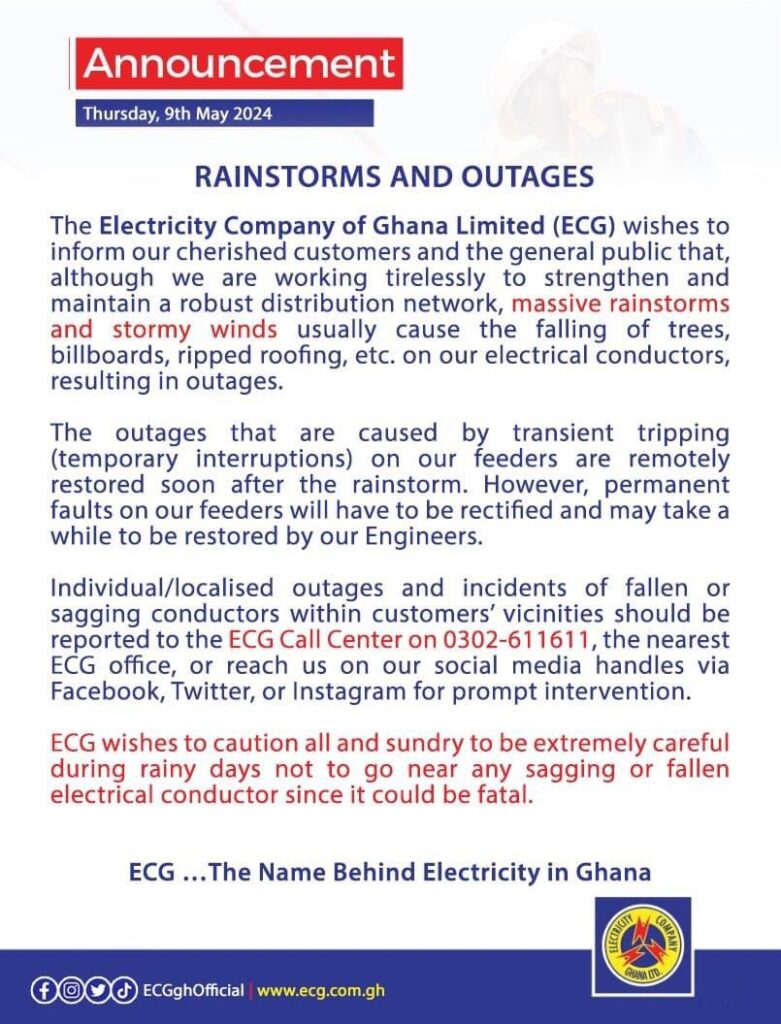
    The Electricity Company of Ghana (ECG) has issued a public warning regarding the dangers posed by sagging or fallen electrical conductors during rainy weather, highlighting the potential for fatal accidents.

    In a statement released on Thursday, May 9, the power distributor emphasized the importance of avoiding contact with any sagging or fallen electrical conductors during rainy days due to the significant risk they pose.

    “ECG wishes to caution all and sundry to be extremely careful during rainy days not to go near any sagging or fallen electrical conductor since it could be fatal,” it stated.

    “Individual/localized outages and incidents of fallen or sagging conductors within customers’ vicinities should be reported to the ECG Call Centre on 0302-611611, the nearest ECG office, or reach us on our social media handles via Facebook, Twitter or Instagram for prompt intervention,” it stated.

    Additionally, the company advised the public to promptly report any incidents of individual or localized power outages, as well as instances of fallen or sagging conductors in their vicinity.

    It urged individuals to contact the ECG Call Centre on 0302-611611, visit the nearest ECG office, or reach out via social media platforms such as Facebook, Twitter, or Instagram for swift intervention.

    The emphasis on safety and the proactive approach to addressing potential hazards underscores ECG’s commitment to ensuring public welfare and minimizing risks associated with electrical infrastructure during adverse weather conditions.

  • 10 tips to lower increasing electricity charges

    10 tips to lower increasing electricity charges

    Throughout Africa, the cost of electricity is steadily increasing, adding to the financial burden of consumers already grappling with inflation and economic pressures.

    Dr. Andrew Dickson, Engineering Executive at CBI-electric: low voltage, emphasizes the importance of proactive energy management to alleviate this strain.

    He has shared 10 ways individuals can leverage smart home technologies to monitor, control, and automate electrical appliances, thereby conserving electricity and saving money.

    Knowledge is power: Understanding appliance energy consumption is crucial for efficient energy use. Smart home technologies offer insights into usage patterns, facilitating targeted energy-saving efforts.


    Load management: Home automation systems can prioritize energy usage, ensuring only one heavy-load appliance operates at a time for optimal energy distribution.


    Setting limits: Users can specify appliance operating durations to conserve energy, such as limiting geyser usage to specific hours.

    Scheduling: Leveraging off-peak hours for appliance usage can reduce electricity costs. Smart technology enables users to schedule appliance operation accordingly.


    Winter consumption: In colder months, energy demand rises due to heating appliances. Smart devices can regulate usage to minimize costs without compromising comfort.


    Environmental responsiveness: Smart technologies can adjust appliance usage based on environmental conditions, optimizing energy use and conservation.

    Remote control: Users can remotely monitor and control connected appliances via smartphones, ensuring energy efficiency even when away from home.


    Standby power management: Smart home solutions can identify and minimize standby power consumption, reducing electricity wastage.

    Renewable energy integration: Smart technologies facilitate the seamless integration of renewable energy sources like rooftop solar, maximizing energy efficiency.


    Voltage protection: Setting voltage range limits safeguards appliances from damage during power fluctuations, ensuring efficient and safe operation.

    Dr. Dickson highlights that implementing smart home technologies doesn’t necessitate rewiring homes. Devices like smart plugs and controllers can be easily installed by electricians, offering cost-effective energy-saving solutions.

    As the cost of living continues to rise, Dr. Dickson encourages Africans to take control of their energy consumption and save where possible.

    For more information, visit https://CBI-LowVoltage.co.za or follow CBI-electric: low voltage on social media platforms.

    About CBI-electric: low voltage:


    Established in 1949, CBI-electric: low voltage specializes in quality low voltage electrical distribution, protection, and control equipment.

    As a subsidiary of Reunert, the company operates internationally, supplying products for diverse applications.

    In 2021, the brand launched its Astute Range of smart IoT home automation products, further enhancing its offerings in the energy management sector.

  • Farouk Mahama commends Akufo-Addo gov’t for achieving 88% electricity coverage

    Farouk Mahama commends Akufo-Addo gov’t for achieving 88% electricity coverage

    Chairman of the Government Assurances Committee, Farouk Aliu Mahama, has highlighted the commendable current electricity coverage of 88.75% but emphasized the need for more efforts to ensure a reliable and consistent power supply nationwide.

    In a Facebook post on Monday, May 6, the Member of Parliament for Yendi praised the Energy Minister for his appearance before the committee on Friday, May 3, where they discussed the electricity situation.

    Energy Minister Dr Matthew Opoku Prempeh dismissed claims that Ghana is in a “dumsor” era. He noted that the current power outages are due to maintenance issues, describing them as ” dum seisie”.

    He applauded the government’s efforts to address the recent power crisis, acknowledging the strategies implemented to mitigate the challenges.

    Mr. Mahama however emphasized the importance of ongoing engagement and proactive measures to maintain a stable electricity supply that meets the needs of all citizens.

    “In accordance with Standing Order 225, the Hon. Minister for Energy, Dr. Mathew Opoku Prempeh, appeared before the Committee on Assurance to update the Ghanaian people on the energy situation in the country and to report on the progress of commitments made to Parliament.”

    “As the Chair of the Committee, I commended the Minister and the government for their remarkable performance in the energy sector. I noted that achieving 88.75% electricity coverage is a significant accomplishment of which we should be proud. However, I also emphasized the need for a more concerted effort to address the recent technical challenges affecting electricity supply in some parts of the country.”

  • Anansi set to deliver affordable, clean, uninterrupted electricity to consumers across Ghana

    Anansi set to deliver affordable, clean, uninterrupted electricity to consumers across Ghana

    NEK Umwelttechnik AG (NEK) has been actively developing six large-scale onshore wind farms in the Greater Accra Region of Ghana over the past few years, all of which are now ready for implementation.

    These projects collectively aim to install approximately 1,300 MW of capacity, offering the potential to generate around 3,400 GWh of renewable electricity annually.

    This significant output will contribute to meeting the growing demand for electricity in Ghana and help address issues like “dumsor.”

    In line with its commitment to providing sustainable energy solutions, NEK has recently established a new renewable energy platform in Accra named Anansi Green Energy Ltd. (Anansi). Anansi is dedicated to delivering affordable, clean, and uninterrupted electricity to consumers across Ghana.

    Anansi’s focus extends beyond wind energy; it plans to expand its portfolio to include solar and biomass plants in addition to taking over NEK’s existing wind farms.

    The establishment of Anansi is a strategic move aimed at maximizing the potential of renewable energy sources in Ghana while ensuring reliability and affordability for consumers.

    Anansi Green Energy Ltd. (Anansi) Sets Stage for Renewable Energy Expansion in Ghana.

    The platform will function as a direct supplier of green electricity to industrial off-takers, serving as a “captive” industrial power generator. It is envisioned that in the future, Anansi will play a pivotal role in positioning Ghana as a renewable energy hub for West Africa.

    This includes the potential to export renewable energy to neighboring countries via the existing WAPP network, further expanding its reach and impact across the region.

    A lot of interested customers

    Anansi is now starting to discuss terms with several interested customers for the delivery of green electricity. The future demand both in the country and in surrounding markets for green energy will likely grow significantly.

    Although there will always be a need for baseload energy capacity in the planning of any energy sector, both for environmental and indeed affordability reasons it will be essential to create a structure through which renewable energy can be developed, without relying on the public sector.

    Mining companies, the concrete sector, steel manufacturers, but also other industries and the mobility sector will demand cheap and green electricity, which can be delivered by Anansi in the very near future.

    No competition to VRA or ECG and no reliance on Government of Ghana

    Anansi will not become a competitor to ECG, VRA, or NEDCo – nor will it be necessary for Anansi to have the traditional “take or pay” PPA with ECG or any support from the Government of Ghana. Anansi will be able to implement its projects without any reliance on the public sector at all. Indeed, the intent will be that Anansi will have, as its partners, VRA/ECG in providing baseload capacity to its customers.

    Green Energy as a Megatrend

    Green energy is enjoying unanimous support and gaining political and business momentum around the globe. The global energy sector is in the midst of a transformation. The global energy transition is now well underway, with ever-increasing clean energy investment and momentum for net-zero targets by mid-century. Energy security and sustainability nowadays go hand in hand and are top of the agenda for many governments worldwide.

    Africa is no exception, with the continent facing rapidly growing energy demand, critical energy access gaps, and an imperative for development. Africa’s imperative to accelerate its socio-economic development in a resilient and sustainable way could immensely benefit from accelerating clean energy deployment, as was stated at the COP28 summit last December.

    Failing to accelerate the development of renewables poses major threats to the continent already suffering the most from the impacts of climate change. Yet, while global renewable energy investments are reaching record-high levels, renewables are still critically underfunded in Africa, signaling urgent work ahead. This also applies for Ghana: Ghana’s energy outlook shows an exponential soaring of future energy demand.

    Thermal generation continues to require high-cost fuel and remains subject to the risks inherent in the ability for such fuel to be continuously delivered. Ghana will require accelerated development of renewable energy, but it will not be able to do so if there remains a reliance on typical grid-connected IPPs with ECG as the sole off-taker and with full Government backing. It is not possible or reasonable for the public sector itself to assume such risks going forward.

    A different rule book now needs to be written, and Anansi has the potential to provide that new way forward right away.

    VALCO modernization and expansion plans

    Volta Aluminum Company Limited (VALCO) has announced its plan to expand operations and seek a strategic partner which would be prepared to invest around USD 600 million to revamp its operations. The goal is to reposition VALCO in a way that retrofitting will transform it from a loss-making entity into a best-in-class, profit-making and shareholder value-maximising entity, thus become the ultra-modern and best smelter in Africa.

    With the projection of the building of 4 operating bauxite mines and 2 refineries under the IAI Masterplan as well as the revival of the downstream sector, the modernisation and expansion of the VALCO smelter is timely, thus creating a new VALCO with much more significance than ever before.

    However, such plans require a lot of additional electricity, which at least for the time being is not available in Ghana. It is estimated that at the end of the retrofitting and extension program, VALCO will require more than 1,000 MW of installed electrical power. “Where do we take this from?”

    The volume of green electricity required by VALCO will be significant with the realistic and probably only solution being the electricity capable of being produced by Anansi. Anansi will look forward to creating a partnership with VALCO and VRA, which could allow VALCO to attract international investment which will require such available green electricity and will also otherwise allow VRA to significantly expand its operations.

    Green Energy, Green Hydrogen and E-Mobility

    Green energy from NEK’s wind farms, as well as other solar plants and biomass facilities through Anansi will provide the cheapest generation costs for electricity in Ghana. While fossil power plants produce energy at approximately 15 US Cents per kWh, NEK’s wind farms will produce energy for less than 8 US Cents per kWh in current pricing. There are possible further savings to these costs as well through the application of carbon credits.

    The renewable projects to be developed by Anansi will be long-term and allow for certainty as to the all-in cost of energy as there will be no relevance or risk for possible fuel price shocks going forward. The available wind and solar irradiation will remain free, and Anansi’s customers will be able to benefit from such.

    In addition to green energy, Ghana should consider developing a ‘Green Hydrogen and Green Fuels’ and an ‘E-Mobility’ policy. The Government should consider key strategies and relevant road maps for the development of the “energy carrier” in the future.

    Green hydrogen and electric vehicles will need significant renewable resources to be available, otherwise, they cannot be called green. A strong political signal will trigger huge investments from abroad in the energy sector of Ghana and business activities relating to these future markets. The key to doing so is the implementation of renewable energy projects.

    Outlook

    Due to the heavily increasing demand for cheap and clean electricity in Ghana and abroad, much more renewable energy even than that capable of being produced in NEK’s planned 6 onshore windfarms, and the other planned Anansi solar projects and biomass facilities will be required within the next 5 – 10 years.

    However, land for such further projects may also become a scarce asset, especially in populated areas. This is one of the reasons why NEK has decided to start the development of two (2) large offshore wind and solar facilities off the coast of Anloga and Ningo.

    These offshore wind and solar parks will have an installed capacity of approximately 3,100 MW and will generate more than 7,500 GWh of clean and reliable power per year. These installations do not require any fuel, LNG, gas, oil, or other fossil, outdated energy sources – the “fuel” is the wind and the sun, which are never-ending, homemade, and always coming back to Ghana for free.

    Anansi Green Energy will play a huge role in the delivery of much needed green energy for Ghana already in the very near future. Now is the time for Anansi to create its positive green web in delivering sustainable and affordable energy to its customers, making Ghana a renewable energy hub in West Africa.

  • Gov’t to procure 1 million modern meters to aid electricity accessibility, revenue generation

    Gov’t to procure 1 million modern meters to aid electricity accessibility, revenue generation

    The Ghanaian government, with support from the World Bank, is set to acquire one million modern meters to improve revenue collection and expand access to electricity across the country.

    Minister-designate of Finance, Dr. Mohammed Amin Adam, made this announcement during a fireside chat at the ongoing World Bank Group/International Monetary Fund (WBG/IMF) Spring Meetings in Washington, USA.

    The procurement of these new meters is part of a broader strategy to boost revenue collection, enhance operational efficiency in the electricity value chain, and address persistent challenges in the sector.

    In a related development, Mr. Sam Dubik Mahama, Managing Director of the Electricity Company of Ghana (ECG), emphasized the importance of consumers promptly settling their bills to improve the company’s operational efficiency.

    Marseille advanced to the Europa League semi-finals by defeating Benfica 4-2 in a penalty shootout at the Stade Velodrome. Substitute Faris Moumbagna scored the only goal of the second leg after 79 minutes, leveling the aggregate score at 2-2 and forcing extra time.

    In the shootout, Marseille converted all of their penalties, while Angel di Maria and Antonio Silva missed for Benfica. Marseille’s victory sets up a semi-final clash with Atalanta, who eliminated Liverpool in the quarter-finals.

    Despite trailing 2-1 after the first leg, Marseille showed attacking intent from the start. As time ran out, Pierre-Emerick Aubameyang set up Moumbagna for the crucial equalizer.

    The Stade Velodrome erupted in celebration as Luis Henrique converted the decisive penalty to send Marseille through.

    The Programme-for-Result financing instruments of the World Bank represent an innovative approach to strengthening institutions, building capacities, and enhancing partnerships.

    This approach links the disbursement of funds directly to the achievement of specific, measurable outcomes.

    The Minister highlighted that Ghana currently has about seven different types of meters that are not compatible with each other.

    The new partnership with the World Bank aims to procure meters that will harmonize the system, improving efficiency and effectiveness in the country’s electricity sector.

    “We want to be able to harmonise and standardise our metering system, and under the PforR the World Bank is supporting us to procure one million standardised meters that would help in improving on the collection,” he said. 

    He expressed confidence in the Programme-for-Result (PforR) scheme also aiding Ghana in achieving universal electricity access by the end of 2024, and bridging the energy sector financing gap of approximately US$1.9 billion.

    Currently, the country has achieved 88.85 percent electricity access, slightly below the 90 percent industry standard, which is a key goal of the Sustainable Development Goals (SDGs).

    SDG seven aims to ensure access to affordable, reliable, and sustainable energy for all, with the African Development Bank (AfDB) estimating that around 90 million people should be connected to electricity annually by 2030.

    The World Bank and AfDB have collaborated to reach approximately 300 million Africans, including Ghanaians, with electricity by 2030 through distributed renewable energy systems and grids. This initiative aims to connect the 600 million Africans currently lacking access to electricity, addressing significant barriers to healthcare, education, productivity, digital inclusivity, and job creation.

    To support this effort, the World Bank, through its concessional arm for low-income countries, the International Development Association (IDA), plans to invest up to US$35 billion, as announced by Mr. Ajay Banga, the Bank’s President.

    “We at the African Development Bank will make sure that we’re able to provide 50 million [people] access [to electricity] by 2030,” said, Dr Akinwumi Adesina, AfDB Group President. 

  • Universal access to electricity will be achieved by end of 2024 – Dr Mohammed Amin

    Universal access to electricity will be achieved by end of 2024 – Dr Mohammed Amin

    The Minister for Finance-designate, Dr Mohammed Amin Adam, has affirmed the government’s commitment to achieving universal access to electricity by the end of the year.

    This goal will be pursued through the use of mini-grids and smaller power generating systems to reach off-grid communities, with the country currently having achieved 88.85% access.

    During a panel discussion on achieving rapid energy access, Dr. Amin emphasized the importance of deliberate and intentional policies and programs to rapidly expand energy access.

    “Right from the 1990s, we were very intentional. The government decided that Ghana must achieve universal access to electricity and so we put in relevant policies and a national electrification scheme, we put in rural electrification programme, and we also put in a self-help electrification programme in which communities and the government shared the cost of electricity access.

    In response to another question regarding pitfalls to avoid, the Minister emphasized the importance of procuring electricity generation through competitive bidding. He cautioned against procuring energy through unsolicited projects, which tend to be extremely expensive.

    “It is important that when you are in crises, you do not acquire as many generating capacity as you would not need, because the tendency for investors to come knocking  on your door and justify why you should acquire more is very high and you acquire it at a very high cost. “

    In response to another question about attracting investors to the sector, the Minister discussed the energy sector reforms the government is undertaking.

    These reforms aim to remove bottlenecks in the system and attract investors. They include tariff reforms, quarterly audits of the cash waterfall program, and the acquisition of one million new meters with the assistance of the World Bank to harmonize and standardize meters.

    The panel discussion, a flagship program at the ongoing IMF/World Bank Spring Meetings, focused on the theme “Energizing Africa: What will it take to achieve universal energy access?”

    It delved into the strategies needed to scale up solutions and investments that will connect millions more Africans to electricity and transform African economies.

    Other panelists included Asay Banga, President of the World Bank, Dr. Akinwunmi Adesina, President of the African Development Bank, as well as ministers of state, energy investors, and stakeholders from both the government and private sectors.

  • Foreign income tax of resident Ghanaians to replace VAT on electricity – GRA

    Foreign income tax of resident Ghanaians to replace VAT on electricity – GRA

    The Ghana Revenue Authority (GRA), under the leadership of Commissioner-General Julie Essiam, has introduced a new compliance measure focusing on the foreign income of resident Ghanaians.

    This initiative is intended to replace the suspended Value Added Tax (VAT) on electricity and is aimed at generating sustainable revenue beyond 2024.

    Commissioner-General Essiam stated that while this measure is not new and has been part of the law for some time, it has not been effectively implemented until now.

    “We [GRA] will specifically speak to the measure that is replacing the VAT on electricity. So, the measure that we put in place is a compliance measure on foreign income of resident Ghanaians.

    “This measure is already in the law, as the minister said, so it is not a new measure. The difference is that its implementation and application have not been implemented effectively,” the GRA Commissioner-General said in her brief remarks at the joint IMF, BoG and Ministry of Finance presser held in Accra on April 13, 2024.

    Essiam added that “The GRA, with support from the Organization for African, Caribbean, and Pacific States (OACD), has refined the processes and structures to ensure effective implementation.”

    “So for us to implement this measure, we have, with the aid and assistance of the OACD, gone through sustainable processes and structures to ensure that when we implement this measure, the sustainability of this measure is going to go beyond 2024 in our revenue numbers.

    “So this is the measure that, together with the Government of Ghana and our mother ministry, the Ministry of Finance, is going to take place or is going to replace the VAT on electricity,” she added.

    This initiative is part of the Ghanaian government’s collaborative efforts with the Ministry of Finance to address the country’s fiscal needs, particularly in revenue mobilization.

    Julie Essiam expressed confidence that this measure will not only be sustainable but will also effectively replace the projected revenue target of GH¢1.8 billion, signifying a significant change in the nation’s tax policy.

  • Electricity has increased by 5.6% from 2017 to date under Akufo-Addo – IES

    Electricity has increased by 5.6% from 2017 to date under Akufo-Addo – IES

    A Research and Policy Analyst at the Institute for Energy Security (IES), Xatse Derick Emmanuel, has highlighted that historical data indicates former President John Dramani Mahama contributed more to Ghana’s national electricity supply than President Akufo-Addo.

    During Mahama’s tenure, Mr Emmanuel noted, access to electricity surged by over 17 percent, soaring from 60.5 percent in 2008 to 83.24 percent in 2016.

    This indicates an annual increase of nearly 3 percent under Mahama’s governance.

    Conversely, Emmanuel pointed out that the Akufo-Addo administration managed to augment access to electricity by less than 6 percent, ascending from 83.24 percent in 2016 to 88.84 percent by February 2024. This signifies an annual increase of less than 1 percent.

    “When Nana Addo took over from 2017, access to national electricity rose from 83.24% (2016) to 88.84 as at February 2024. Meaning they have added 5.61% in 7 years making 0.8% increase per year.

    “Meanwhile, under JM, the NDC took it from 60.5% in 2008 to 83.24% in 2016, an average of 2.8% annual increase by the NDC,” he wrote in a statement.

    He added, “Realistically, if we grow at an average 0.8% by Nana Addo, Ghana will achieve universal access to electricity in 14 years (2038).”

    Meanwhile, Ghana has recently grappled with intermittent power outages, colloquially termed ‘dumsor’. Nonetheless, the Electricity Company of Ghana has rebutted these assertions.

  • GRIDCo’s letter to Energy Minister bid to escape accountability – ACEP

    GRIDCo’s letter to Energy Minister bid to escape accountability – ACEP

    The Executive Director of the Africa Center for Energy Policy (ACEP), Ben Boakye, suggests that the recent letter from the Ghana Grid Company (GRIDCo) to the Minister of Energy, expressing concerns over the Electricity Company of Ghana’s (ECG) failure to provide a load-shedding timetable amidst the ongoing power outages, is an attempt to deflect blame.

    In the letter dated March 28 and addressed to the Minister of Energy, Dr. Matthew Opoku Prempeh, GRIDCo raised serious concerns regarding ECG’s non-compliance with load-shedding management instructions issued by the National System Control Center (NSCC).

    During an interview on the Citi Breakfast Show on Citi FM on Friday, April 5, Ben Boakye elaborated on the contents of GRIDCo’s letter, indicating that it serves as an official attempt by GRIDCo to distance itself from the ongoing power crisis.

    Boakye explained, “GRIDCo acknowledges the existing challenges within the power sector, including the generation deficit. Therefore, the letter to the Energy Minister aims to absolve GRIDCo from any responsibility for the current situation.”

    GRIDCo’s letter highlighted ECG’s failure to adhere to directives from the National System Control Center, warning that this non-compliance poses a significant risk to the stability of the power grid.

    It cited instances where ECG’s actions led to a drop in system frequency in certain areas.

    Additionally, Boakye emphasized the potential negative impact of the power challenges on ECG‘s revenue generation.

    He pointed out that the Burkinabe authorities had recently communicated with their citizens about similar power challenges and mentioned plans to acquire a power plant, which could further exacerbate the situation in Ghana.

    Overall, Boakye’s remarks underscore the complexity of the ongoing power crisis and highlight the need for coordinated efforts to address the underlying issues affecting the sector.

    “GRIDCo is aware of the generational gap in the power sector and all other stakeholders are aware of the challenges affecting the sector so the letter to the Energy Minister is to officially take itself out of what is happening in the sector because the gas to generate the power is not enough.”

    “Burkinabe authorities communicated recently about the power challenges to their people and said they are considering getting a power plant which will be a shoot in our foot.”

  • I will not pay “unreasonable” bill, come and disconnect my electricity – Angry Ameyaw Debrah  tells ECG

    I will not pay “unreasonable” bill, come and disconnect my electricity – Angry Ameyaw Debrah tells ECG


    Ghanaian media personality, Ameyaw Debrah, has taken to social media to express his dismay over an excessively high electricity bill he received from Electricity Company of Ghana (ECG).

    The bill amounted to a staggering GH¢8,777 for just a month’s usage, leaving Debrah and numerous Ghanaians incredulous.

    Mr Debrah didn’t mince words in conveying his frustration.

    He shared a screenshot of the bill on his social media platform, prompting reactions from fellow netizens.

    In the caption accompanying the screenshot, he directly addressed President Akufo-Addo, urging him to intervene and instruct ECG to disconnect his electricity if clarity regarding the bill’s calculation wasn’t provided.

    “Dear@NAkufoAddo please tell ECG to come and disconnect my electricity . I will not pay this bill if I don’t understand how @ECGghOfficial derived it,”he wrote.

    In response to Debrah’s post, many Ghanaians echoed his sentiments, lamenting the escalating cost of living, particularly concerning electricity bills.

    Numerous individuals shared their own encounters with ECG, underscoring the widespread concern over the issue.

  • IPGG applauds Akufo-Addo’s decision to halt electricity export

    IPGG applauds Akufo-Addo’s decision to halt electricity export

    The Chamber of Independent Power Generators Ghana (IPGG) has praised President Akufo-Addo’s directive instructing the Volta River Authority (VRA) to halt the exportation of electricity to neighboring countries.

    Samuel Atta Akyea, Chairman of the Mines and Energy Committee of Parliament, announced the government’s decision on the export during a session in Accra.

    A statement from Dr. Elikplim Apetorgbor, Chief Executive of the IPGG Chamber, expressed gratitude that the President heeded their request to suspend power exportation during a period of domestic power supply challenges.

    The suspension, though not expected to entirely resolve the supply issues, is seen as a step towards stabilizing the domestic power market and increasing supply.

    The statement commended President Akufo-Addo for prioritizing the domestic market during this crucial period.

    The IPGG Chamber also recognized Parliament, the media, and the public for their involvement in the power export matter.

    Furthermore, it praised the VRA for prioritizing the national interest by complying with the President’s directive.

  • Stakeholders in power sector to meet Mines and Energy Committee on Saturday

    Stakeholders in power sector to meet Mines and Energy Committee on Saturday


    Chair of the Mines and Energy Committee of Parliament, Samuel Atta Akyea, has announced plans for the committee to engage with all stakeholders in the power sector.

    The meeting follows President Akufo-Addo’s directive to halt the export of power to neighboring countries until the domestic power situation is resolved.

    Expressing skepticism that any stakeholders would oppose the directive, Atta Akyea emphasized the President’s prioritization of Ghanaian interests.

    He acknowledged potential consequences but argued that safeguarding domestic power needs is paramount.

    During an interview on the mid-day news with Beatrice Adu on 3FM, Atta Akyea remarked, “The President’s concern for the nation is evident. We have encountered unprecedented challenges in recent years, and it’s imperative that we focus on resolving our domestic power issues before considering export. While there may be repercussions, the overarching concern must be the welfare of Ghanaians.”

    He continued, “I believe there will be unanimous support for this decision. It’s regrettable that financial interests may have hindered our ability to address our energy needs effectively, while neighboring countries benefit at our expense.”

    Regarding the timeline for implementation, Atta Akyea indicated that stakeholder engagement scheduled for Saturday would address such operational details.

    The directive to cease power export coincides with comments from Dr. Elikplim Kwabla Apetorgbor, CEO of the Independent Power Generators, Ghana (IPGG), advocating for prioritizing Ghanaian electricity consumers.

    Apetorgbor’s remarks followed the Volta River Authority’s rebuttal of his assertions regarding the impact of power exports on domestic supply.

    In response to VRA’s statement, Apetorgbor underscored the urgency of addressing Ghana’s energy crisis and advocated for redirecting available resources to benefit Ghanaian taxpayers.

    “The attention of the Volta River Authority (VRA) has been drawn to a publication in the electronic media which attempts to suggest that the VRA is not meeting its power supply obligation to the Ghana market due to excessive export of power to neighbouring countries.

    “This assertion which is attributed to the Independent Power Generators Ghana, is not only erroneous but misleading,” the statement by the VRA said.

    It added “The VRA wishes to state that since 1972, the Authority has been supplying power to neighbouring countries without reneging on its mandate to deliver reliable and affordable power to Ghana; and this the Authority continues to do.

    “Also, it is important to mention that the allocation of the power generated from the Akosombo and Kpong hydropower stations is supervised by the Electricity Market Oversight Panel (EMOP) and not the VRA.

    “By this arrangement, the allocation always prioritizes the Ghana market, in accordance with government policies to ensure long-term optimization of the nation’s hydro resources”

    He highlighted disparities in energy tariffs between Ghana and neighboring countries, urging immediate action to halt power export for the benefit of domestic consumers.

    Apetorgbor cautioned against allowing economic interests to overshadow the welfare of Ghanaians and called for unbiased consideration from regulatory authorities, emphasizing the need to address the current energy shortfall affecting citizens and businesses alike.

    “We are currently in crisis, Ghanaians are sleeping in darkness, companies cannot operate with a guaranteed power supply, there is a shortage in supply, etc., making the available cheap hydrogeneration to Ghanaians, the taxpayer, is supreme and must be of prime consideration, irrespective of your survival concerns.

    “Why should jurisdictions that contribute nothing to Ghana’s economy be prospering on a cheap resource? Ghanaians are paying very high tariffs, averaging 14 cents/kWh particularly at peak time, while those neighbouring countries enjoy about half of the tariff. This is not fair to the Ghanaian. Energy Commission will be seen as biased to other participants in the sector, if this export is not stopped immediately for the benefit of the Ghanaian taxpayers. We are aware of situations in the recent past where load shedding is high and at the same time over 200MW of generation capacity is being exported.”

  • Electricity is a privilege comment taken out of context – ECG boss

    Electricity is a privilege comment taken out of context – ECG boss

    The Electricity Company of Ghana (ECG) has clarified the context of a video circulating on social media depicting its Managing Director, Samuel Dubik Mahama, as insensitive to customer difficulties.

    In a statement released on Saturday, the power-distributing company explained that the video is an excerpt from an interview conducted over a year and a half ago.

    The interview took place during the ECG and Manya Krobo dispute, during which ECG staff were reportedly assaulted for requesting payment of bills from customers.

    “We deeply regret the misunderstanding created by the resurfacing of this extract, which has been grossly taken out of context,” portions of the statement read.

    The company emphasized that it empathizes with its customers’ challenges and assured the public that the video “does not reflect the values and commitment of our MD and ECG.”

    Additionally, ECG stated that it is working closely with key industry stakeholders to address the issues and implement sustainable solutions.

  • Federal tax changes could result in higher gas and electricity costs

    Federal tax changes could result in higher gas and electricity costs

    Canada’s electricity agency is worried about a new tax change that could make some private utilities pay millions more in taxes.

    Michael Powell, who is the vice-president of government relations, says that some private electricity and natural gas companies may have to raise the prices they charge customers.

    He says the issue comes from a change to the Income Tax Act that the government wants to make in its upcoming budget.

    This would make Canada have the same tax rules for companies as the United States, the United Kingdom, and Ireland when they do business in more than one country.

    But Powell says those countries did not include private utilities that are regulated by the government because they often have to borrow more money to keep their prices low.

    The new rule would make people with a lot of debt pay more in taxes.

  • We are not operating at optimal level due to lack of funds – ECG

    We are not operating at optimal level due to lack of funds – ECG

    Managing Director (MD) of the Electricity Company of Ghana (ECG), Samuel Dubik Mahama, has acknowledged the operational challenges faced by the company due to inadequate funds.

    Recent power outages in parts of Accra and other regions have been attributed by Mr. Mahama to maintenance issues rather than fuel-related problems. He assured that the company is diligently working to resolve these challenges and restore power to affected areas.

    During an interview on Eyewitness News on Citi FM, Mr. Mahama expressed concern about the payment rate by electricity consumers, mentioning that ECG mostly has to actively pursue consumers to pay their bills.

    “It’s true. ECG is not operating at this top level because we are not getting the requisite funds, especially from our customers.

    “The rate at which we are expecting customers to be honest enough to pay for the electricity they consume it is not it’s not what we get. We have to always go out there and put the requisite manpower that we’re doing something else towards collecting,” he said.

  • We are working on providing electricity to all households in Ghana by end of 2024 – Akufo-Addo

    We are working on providing electricity to all households in Ghana by end of 2024 – Akufo-Addo

    President Akufo-Addo has reaffirmed his government’s commitment to achieving universal electricity access for all households in Ghana by the end of 2024.

    This assurance follows the successful connection of over two hundred communities to the national grid, raising the country’s current electricity access rate to 88.85%.

    To reach this goal, the government aims to connect an additional four hundred communities to the national grid through the Self-Help Electrification Programme (SHEP) and other Turnkey Projects.

    In his address to Parliament, the President noted that: “…I am happy to report that we are making admirable progress in the provision of electricity to all parts of the country,” he said.

    Ghana aims to transition 10% of its energy generation mix to renewable energy sources by the end of 2030. Currently, 3.2% of the country’s energy mix is sourced from solar energy, with a solar Photovoltaic panel constructed on the Bui Reservoir and Kaleo.

    “The Authority is taking steps to relocate the remaining four (4) units before the end of the year,” the President added.

    Ghana aims to transition 10% of its energy generation mix to renewable energy sources by the end of 2030. Currently, 3.2% of the country’s energy mix is sourced from solar energy, with a solar Photovoltaic panel constructed on the Bui Reservoir and Kaleo.

    “…we are also making steady progress in our commitment to increase the component of renewable energy to our energy generation mix.
    A four-megawatt floating solar PV on the Bui Reservoir, as well as the fifteen megawatt (15MW) solar PV at Kaleo, have been completed and are both operational,” he said.

    He further added that: “a one hundred megawatt (100MW) solar PV under is under construction at Bui, as is the Mini-grid Electrification Programme ongoing in the Ada East District”.

  • Govt to provide electricity access to all households in Ghana by close of the year – Akufo-Addo

    Govt to provide electricity access to all households in Ghana by close of the year – Akufo-Addo

    President Akufo-Addo has pledged to achieve nationwide electricity access in Ghana by the close of 2024, with 88.85% already connected.

    The government aims to add 400 communities to the national grid through the Self-Help Electrification Programme (SHEP) and other Turnkey Projects.

    The President reports significant progress during his parliamentary address and emphasizes efforts to enhance power system reliability, including the relocation of the 250MW Ameri Plant.

    “…I am happy to report that we are making admirable progress in the provision of electricity to all parts of the country,” he said.

    Additionally, Ghana aims to transition 10% of its energy mix to renewables by 2030, with 3.2% currently sourced from solar energy.

    Operational projects include a 4MW floating solar PV on the Bui Reservoir and a 15MW solar PV at Kaleo.

    Ongoing initiatives involve a 100MW solar PV at Bui and the Mini-grid Electrification Programme in the Ada East District.

    “the Authority is taking steps to relocate the remaining four (4) units before the end of the year,” the President added.

    Looking forward, Ghana envisions 30% of electricity production from nuclear energy by 2070. The Ghana Nuclear Power Programme Organisation (GNPPO), under the Office of the President, oversees the nuclear energy project.

    President Akufo-Addo emphasized the commitment to providing clean, affordable electricity to support national industrialization and position Ghana as a net power exporter in the ECOWAS region through the West African Power Pool.

  • Residential consumers to pay less for electricity as PURC slashes tariff by 6.56%

    Residential consumers to pay less for electricity as PURC slashes tariff by 6.56%

    The Public Utilities Regulatory Commission (PURC) has announced a marginal reduction in electricity tariffs for residential consumers.

    However, there will be no change (0%) in the prices paid by lifeline consumers (0-30 kWh) and residential consumers within the consumption bracket of 0-300 kWh.

    The slight tariff reduction of 6.56% will benefit residential consumers within the consumption bracket of 301 kWh and above.

    “Tariffs within the 0-300kWh for non-residential class of consumers remains the same with no change in their rates. However, consumers within 301kWh and above class will experience an average reduction of 4.980/0,” it added.

    The Public Utilities Regulatory Commission (PURC) has announced that water tariffs for all customer classes will remain unchanged for the upcoming period.

    This decision was outlined in a press release regarding the commission’s first-quarter tariff review decision for electricity, natural gas, and water. Dr. Ishmael Ackah, Executive Secretary of the PURC, signed the release.

    In its fourth-quarter tariff review in November 2023, the PURC had announced a 0.34% increase in water tariffs and a 1.52% decrease in electricity tariffs, effective December 1, 2023. The water tariff for residential customers had increased from GHS/m³ 4.72 to 4.74, while non-residential customers saw an increase from GHS/m³ 14.13 to 14.19.

    Water sachet producers experienced a tariff hike from GHS/m³ 22.26 to 22.34, and industrial consumers saw their tariff move from GHS/m³ 25.29 to 25.38.

  • PURC slashes electricity tariffs by 6.56% for some residential customers

    PURC slashes electricity tariffs by 6.56% for some residential customers

    Public Utilities Regulatory Commission (PURC) has declared a modest decrease in electricity tariffs for residential consumers.

    However, it clarified that there will be no adjustment (0%) in prices for lifeline consumers (0–30 kWh) and residential consumers using between 0-300 kWh.

    According to PURC, the marginal tariff reduction of 6.56% will specifically benefit residential consumers whose consumption exceeds 301 kWh.

    Public Utilities Regulatory Commission (PURC) has announced that water tariffs for all customer categories will remain unchanged in the upcoming period.

    This decision was conveyed through a press release regarding the commission’s first-quarter tariff review for electricity, natural gas, and water in 2024.

    The release, signed by Dr. Ishmael Ackah, Executive Secretary of the PURC, was disclosed by Citi News.

    In its previous tariff review conducted in the fourth quarter of 2023, which took effect on December 1, 2023, the PURC announced a slight 0.34% increase in water tariffs alongside a 1.52% reduction in electricity tariffs.

    Specifically, residential water tariffs rose from GHS/m³ 4.72 to 4.74, while non-residential tariffs increased from GHS/m³ 14.13 to 14.19.

    Water sachet producers experienced a tariff hike from GHS/m³ 22.26 to 22.34, while industrial consumers saw their tariff move from GHS/m³ 25.29 to 25.38.

    However, in the current review, there will be no adjustments to water tariffs for any customer segment.

  • Electricity tariffs to surge over Emissions Levy implementation – IPPs

    Electricity tariffs to surge over Emissions Levy implementation – IPPs

    Chief Executive Officer (CEO) of the Independent Power Producers (IPPs), Dr. Elikplim Kwabla Apetorgbor, has indicated that the implementation of the Emissions Levy, which came into effect on February 1, 2024, will lead to a rise in the cost of electricity.

    According to his assessment of the Emissions Levy, set at GH₵100 per tonne of carbon dioxide (CO2), Dr. Apetorgbor cautioned that this levy will translate to increased expenses in electricity generation, thereby raising the cost per kilowatt-hour (kWh) and subsequently resulting in higher tariffs for consumers.

    “Every change in law that has cost implications on power generation will definitely have a consequential impact on end-users through the tariff.

    “It is therefore important for our decision-makers to foresee effect of the economic consequences before implementing such laws,” he admonished.

    Dr. Apetorgbor further elaborated on the complexities involved in determining the amount of carbon dioxide (CO2) emitted by a 1MW gas-fired power plant, noting various factors such as plant efficiency, gas type (typically natural gas), and operational load.

    For instance, he explained that a 1MW natural gas-fired power plant, operating at 50 percent efficiency, emits approximately 362 kg of CO2 for every megawatt-hour (MWh) of electricity generated.

    Applying the GH¢100 per tonne of CO2 levy, Dr. Apetorgbor highlighted that this would result in an increase in the cost per kWh for energy consumers by approximately GH¢0.0362. This cost increment resonates across the energy sector.

    Breaking down the levy per kg of CO2, which is GH¢100 per 1,000 kg (or 0.1 GH¢/kg), he calculated that the levy for 362 kg of CO2 amounts to GH¢36.2 for 1MWh of generated electricity, factoring in the CO2 content in the natural gas volume required for 1MWh.

    Translating this to consumer units, he indicated an additional cost per kWh of GH¢0.0362, calculated as GH¢36.2 / 1,000 kWh.

    However, Dr. Apetorgbor cautioned that these calculations are simplified and rely on average values for numerous variables. The actual emissions and costs could vary significantly based on specific plant characteristics, natural gas quality, and operational efficiency.

    Additionally, he shared the annual CO2 emissions determination formula, demonstrating how much CO2 a gas-fired power plant emits each year.

    “Assuming the plant operates at full capacity for 24 hours a day over a year (which is 8,760 hours annually), and using the rough estimate of 0.231kg CO2/kWh, as emission factor, for natural gas: Multiply the power output in megawatts (MW) by the number of hours in a year (8,760), and by the emission factor of 0.231 kg CO2/kWh.”

    Meanwhile, in an earlier statement, the Chamber lamented that per the Power Purchase Agreements (PPAs) the legislation “is a political risk (an increased cost event) mitigated by an increased costs clause in the agreements, which suggests a pass-through mechanism whereby economic consequences go to the end-user”.

    Dr. Apetorgbor highlighted that the recent change in law imposing a legal obligation on power producers is expected to result in an increase in the cost of generating electricity. He emphasized that the management and operation of power plants are highly sensitive to costs, akin to the downstream petroleum sectors.

    “Specifically, the levy will be added to the operational costs build-up of the power plants,” he stated, adding that: “Implementing the Emissions Levy Act, 2023 necessitates an equal measure of review for the electricity generation tariff to ensure predictability of cash flow for the power producers.”

    This adjustment, he noted, is essential to cover the increased operational costs induced by imposition of the Emissions Levy, Act 2023 (Act 1112) to ensure operational reliability and sustainability.

  • Ghanaians to enjoy free electricity under Kyiri Abosom’s administration if elected as President 

    Ghanaians to enjoy free electricity under Kyiri Abosom’s administration if elected as President 

    Ghanaians may find solace if the presidential candidate of the Ghana Union Movement (GUM) secures victory in the upcoming election, as he pledges to provide them with free electricity.

    The flag bearer, Christian Kwabena Andrew, widely recognised as Kyiriabosom, unveiled this commitment during an appearance on Nyankonton Mu Nsem on Rainbow Radio (87.5 FM).

    He outlined that, if elected president, he intends to implement a system where companies and businesses bear the expenses of electricity, while households will enjoy exemption from such costs.

    “If I am elected as the president, Ghanaians will not pay for electricity. This system will require that companies pay for power, but domestic users will not pay for power. That is why, as part of my plans, I want to construct more companies, and after that, I will start the implementation of free electricity.

    This announcement brings a sense of relief to Ghanaians. However, when I hear Mahama promising a 24-hour economy, I feel uneasy because there are no established systems to support business expansion in the country.

    With high youth unemployment rates, such promises seem impractical.

    Nevertheless, I am confident in my victory in the 2024 presidential election.

    My policies and vision are distinctive, aimed at driving economic recovery, tackling youth unemployment, and reducing our reliance on foreign aid.

    “I will encourage Ghanaians not to allow the NDC and the NPP to deceive them. We have tested them, and they have failed. They lack credibility. They are both thieves. They have stolen from us and will continue to steal from us. We have to prevent that,” he said.

  • Protest against 15% VAT on electricity off – Organised Labour announces

    Protest against 15% VAT on electricity off – Organised Labour announces

    Organised Labour has decided to suspend its planned demonstration against the 15 percent Value Added Tax (VAT) on Electricity, which was scheduled for Friday, February 9.

    This decision comes following the government’s recent announcement to halt the implementation of the contentious tax policy.

    During a press conference, Dr. Yaw Baah, the General Secretary of the Trades Union Congress (TUC), warned that the demonstration would proceed if the government did not fully withdraw the policy immediately.

    Dr. Baah emphasized that Organised Labour remains prepared to protest against any future unfavorable tax policies.

    Meanwhile, the Ministry of Finance has officially notified Organised Labour about the suspension of the policy’s implementation.

    In a letter dated Thursday, February 8, the Ministry informed Organised Labour that it had instructed the Electricity Company of Ghana and NEDCO to cease the implementation of the controversial policy.

    The government has directed ECG and NEDCO to suspend the imposition of the tax on electricity consumption by residential customers until further consultations are held with key stakeholders, including Organised Labour.

  • ECG/VRA reportedly issuing bills to victims of Akosombo dam spillage despite no electricity usage

    ECG/VRA reportedly issuing bills to victims of Akosombo dam spillage despite no electricity usage

    Residents of Mepe in the Volta region are reportedly grappling with an unexpected burden in the aftermath of the Akosombo dam spillage that destroyed their livelihoods.

    According to reports emerging from the area, residents are being issued electricity bills for homes left uninhabited due to the disaster.

    Despite the flooding rendering many homes inaccessible and meters submerged, the Electricity Company of Ghana (ECG) in collaboration with the Volta River Authority (VRA) is reportedly issuing bills to affected residents, demanding payment for electricity usage even when none has occurred.

    One resident, who reported the incident on social media, expressed frustration over the situation, stating, “Since this incident occurred till now, some of us have not gained access to our homes again. And this household, both the meter was all drowned in the water and since then till today that I’m talking to you, no one is staying in this house.”

    https://twitter.com/ddhellali/status/1754796935003660707?s=46

    The resident further explained that despite the meters being submerged and rendered inoperative, ECG and VRA have managed to read the meters and billed them for an amount totaling GHs 2,325.98.

    “This months’ bill arrived, meanwhile, the meter is spoiled and nobody is in the house, but they managed to bring this bill to us,” lamented the resident, highlighting the absurdity of the situation.

  • TUC joins 35 other unions to protest against 15% electricity tax on Feb. 13

    TUC joins 35 other unions to protest against 15% electricity tax on Feb. 13

    The Trades Union Congress (TUC) and 35 organized labor unions have declared their intention to stage a demonstration on February 13.

    The decision to protest comes in response to the government’s rejection of their demand to repeal the 15 percent Value Added Tax (VAT) imposed on electricity.

    The TUC and the coalition of 35 labor unions argue that they are already facing substantial burdens, and the introduction of this new VAT on electricity will further exacerbate their financial challenges.

    During crucial meeting on Friday, February 2, the General Secretary of TUC, Dr Anthony Yaw Baah, said “The VAT that the government has imposed that electricity on consumers. We have expected to pay.

    “We have agreed not to pay, so we gave the government until 31[January] to implement changes. If they don’t change we mentioned that we will decide on what to do. Now we have decided to demonstrate on the 13th of February in all regional capitals.”

    “Ghana workers, both formal and informal, in both the public and private sector, have decided to demonstrate in all regional capitals. From Accra to Bolgatanga.”

    Dr. Baah emphasized that if the government does not reconsider its decision to implement a 15 percent VAT on electricity or engage in negotiations with them before Tuesday, the organized labor, including the Trades Union Congress (TUC), intends to proceed with the planned demonstration.

    “If the government does not want us to embark on the demonstration, they should withdraw the letter, and if we don’t hear anything before Tuesday, February 13, we will demonstrate. 

    “The demonstration is to show the government that we will not pay [the VAT]. The country is ours and we say we don’t agree to pay VAT,” he added.

    The VAT is yet to be implemented due to some technical challenges sighted by the Electricity Company of Ghana (ECG).

    Earlier, the Finance Ministry revealed its intention to hold comprehensive meetings with Organised Labour and other crucial stakeholders in the upcoming weeks to incorporate their input into the decision-making process.

    The introduction of the 15% VAT on electricity comes at a time when consumers have experienced continues rise in electricity tariff in 2023 by the Public Utilities Regulations Commission (PURC).

  • We will take action if you fail to revoke VAT on electricity – Organised Labour to govt

    We will take action if you fail to revoke VAT on electricity – Organised Labour to govt

    Organised Labour plans to convene and determine its course of action following the government’s failure to meet the deadline for withdrawing the electricity tax.

    Last week, Organised Labour formally requested the government to retract the proposed electricity tax scheduled for implementation this year. The government argued that the tax aimed to support its COVID-19 recovery efforts.

    In an interview on Wednesday, Joshua Ansah, Deputy Secretary-General of the Trade Union Congress (TUC), stated that if the government does not withdraw the Value Added Tax (VAT) on residential electricity consumption by the end of the day, Organised Labour would reassess its position.

    “We are steadfast in our stance that unless a complete withdrawal is implemented, we maintain our decision that if by the end of today, the government fails to withdraw, Organised Labour will advise itself,” Ansah asserted.

    He further added, “Organised Labour will convene and make a decision if the government remains inactive regarding the total withdrawal.”