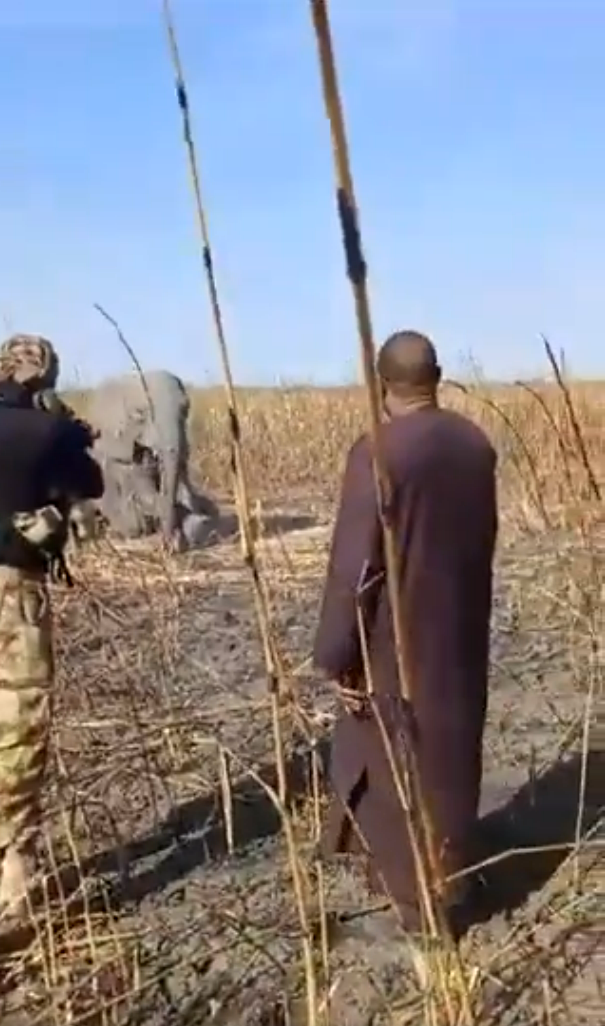
A village near Virunga National Park in eastern Democratic Republic of Congo ate an elephant that had escaped from the park.
“It’s like a gift from above for us,” said happy people from Katwiguru village, according to conservationist group Conserv Congo.
The group, which helps protect the animals in the Congo, said they were not sure if rebels or villagers were responsible for killing the animal.
According to AFP news agency, a fence that was put up around the park a few weeks ago got broken by some young people. As a result, two elephants were able to wander away from the park on Monday. The ICCN stated this information.
We do not know what will happen to the second elephant.
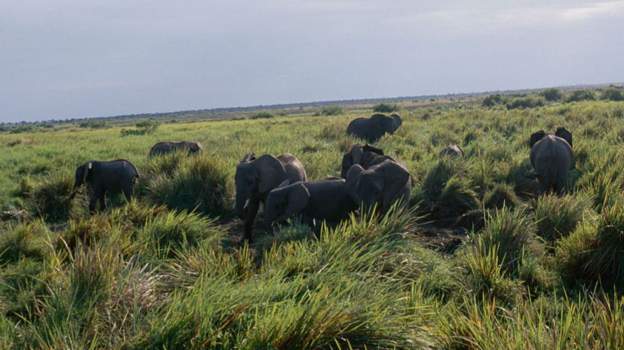
Virunga is a well-known park with animals in an area of fighting, where many groups of soldiers operate near the border of Rwanda and Uganda.
Conservation efforts have successfully removed rebel forces from the park – which covers 7,800 square kilometers (3,000 square miles) – and have made a protected space for elephants.
The park’s website says that in 2020, around 580 elephants moved into the park, and now there is a group of about 700 elephants.
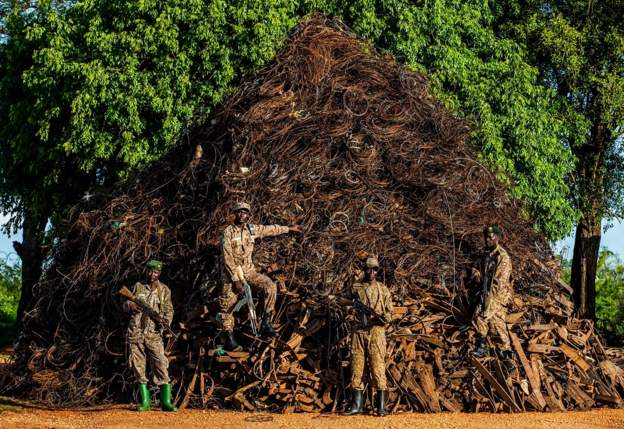
Over the course of a year, park rangers in Uganda‘s Murchison Falls national park accumulated 12 tonnes of traps, which they piled high and dubbed “snare mountain.”
They’re hoping to highlight the devastation to local wildlife by poachers who use these snares to trap lions, elephants and hippos among others.
“Over the past 10 years, we’ve removed about 47 tonnes of snares and bear traps,” says Michael Keigwin, the founder of the Uganda Conservation Foundation charity, as reported by the Guardian newspaper.
There is talk of a poaching crisis fuelled by Uganda’s worsening economy after strict Covid-19 lockdowns, and the charity estimates that more than 60% of the national park’s hippos have been killed in the past few years for their meat and the ivory in their teeth.
Tinashe Farawo had the grim task of delivering the mutilated body of a 30-year-old farmer who had been trampled to death by an elephant in northern Zimbabwe to his distraught family.
It is something that Zimbabwe Parks and Wildlife Management Authority (Zimparks) rangers have to do all too frequently as they police a battle between humans and encroaching wildlife. The farmer from Mbire district was one of 46 people killed by wild animals in Zimbabwe this year.
Hwange National Park, the country’s large nature reserve spanning 14,600 sq km (5,637 sq miles) in north-western Zimbabwe, has the capacity to sustain 15,000 elephants.
Yet officials say the population there now stands at around 55,000, with many straying into surrounding areas in search of food and water.
And the jumbos are greedy – a single elephant consumes up to 200 litres (44 gallons) of water a day and around 400kg (about 62st) of tree leaves and bark – causing great distress to already impoverished subsistence farmers.
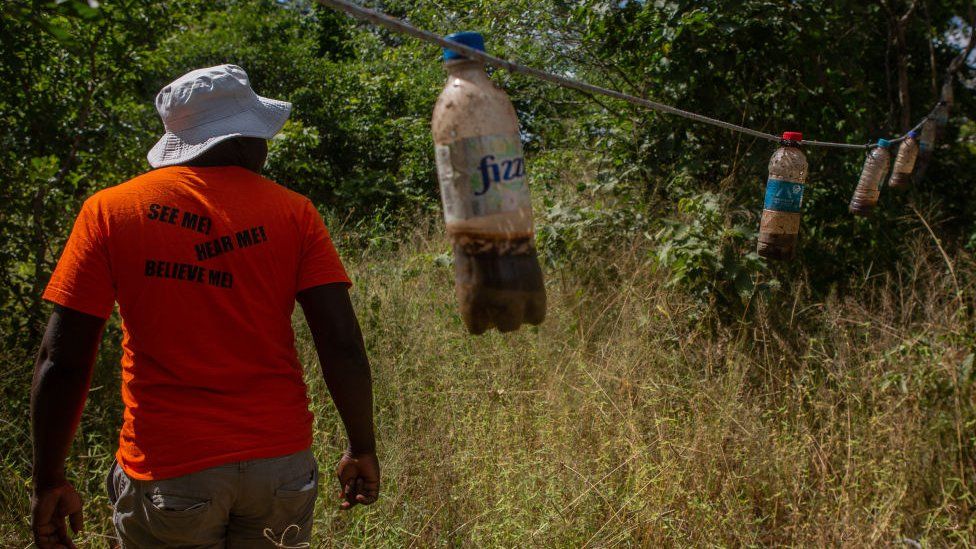
IMAGE SOURCE,GETTY IMAGES Image caption, Farmers near Hwange hang up bottles of a smelly concoction that repels elephants
As delegates from more than 180 countries gather in Panama for the two-week meeting of the Convention on International Trade in Endangered Species (Cites), Mr Farawo believes that communities who live on this frontline are being ignored.
“You cannot always come up with solutions in air-conditioned buildings,” the Zimparks spokesperson told the BBC.
Zimbabwe has proposed to Cites that certain provisions that restrict the trade of raw ivory and elephant leather be relaxed, arguing that the money raised from their sale could support conservation of the growing elephant population.
If those mulling the proposal have never been to Hwange, how can they understand the plight of communities there, Mr Farawo asks.
‘We don’t want aid’
In May, Zimbabwe convened an African Elephant Summitbut failed to unite countries on the continent to fight the ban on the global ivory trade, issued under Cites in 1989.
Only Zambia, Namibia and Botswana backed Zimbabwe’s push for permission sell off its ivory stockpiles, mostly from elephants that had died from natural causes and which would be worth hundreds of millions of dollars.
The same countries also support trophy hunting as a way to finance community projects for those who live close to game parks.
“We don’t want to need aid, we want the chance to trade so we can fund our programmes,” Mr Farawo said.
But Kenya, which opposes both hunting and the sale of ivory, did not attend the summit. The East African country symbolically burnt its ivory stockpile confiscated from poachers and illegal traders in 2016.
While Burkina Faso, Equatorial Guinea, Mali and Senegal have proposed to Cites that the elephants in southern Africa be upgraded to give them “threatened-with-extinction status”, further restricting any trade.
Jim Nyamu, who heads the Kenya-based Elephant Neighbours Centre, argues that lifting the trade in ivory in southern Africa would impact East Africa, where elephant numbers remain a concern.
He points to Cites’ decision to allow a one-off ivory sale from Botswana, Namibia and Zimbabwe to Japan and China in 1997 and 2008, saying it led to an increase in poaching.
“No country should be encouraged to work in insolation,” the anti-poaching campaigner told the BBC.
Mr Nyamu believes in alternatives like eco-tourism, which have the potential to bring in more money to communities than hunting.
Wild animals in towns
But there is little support for this on the ground in Botswana, which controversially resumed trophy hunting in 2019 as a way to reduce its burgeoning 130,000-strong elephant population.
In Botswana’s Chobe district, which borders Zimbabwe, elephants outnumber the population of 28,000 people. Like nearby Hwange, the area’s national park is unfenced.
Chieftainess Rebecca Banika, a Chobe traditional leader, told the BBC that her community received $560,000 from hunting proceeds last year, along with the meat of dead tuskers.
“We are suffering but even though we are angry, we don’t fight the animals because we derive some benefit from them,” she said.
Frank Limbo, a 64-year-old retired banker and now farmer, says sightings of wild animals were rare during his youth but now they are all over the town of Kasane in Chobe.
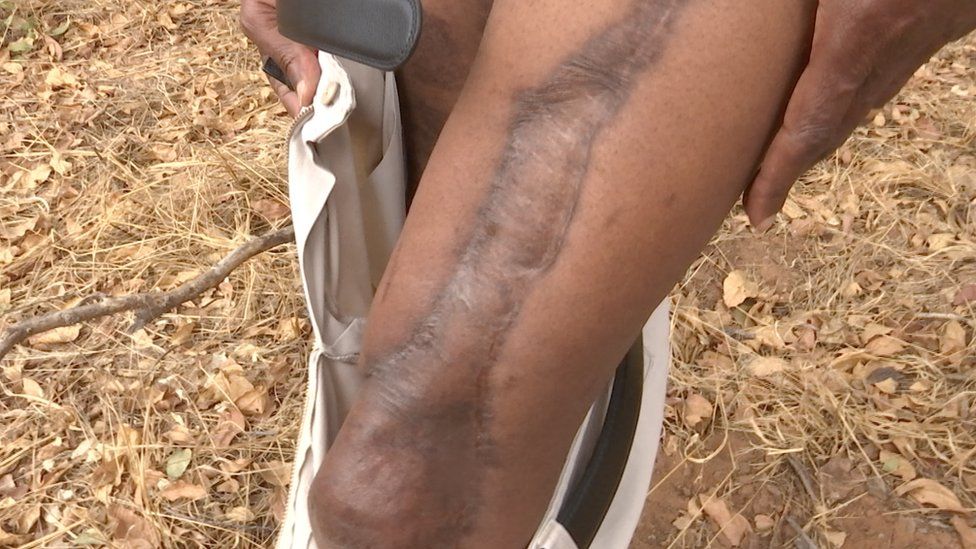
Image caption, Frank Limbo was charged by three elephants in 2015 – one gorged his thigh as he hid behind a tree
They wander into backyards and several of his relatives have been either killed or maimed and entire food harvests destroyed overnight.
He is also the unlikely survivor of two terrifying wildlife attacks.
In 2004 a lioness was chasing down his pet dog on his farm, when it turned on him – luckily for him an armed friend shot her dead.
Eleven years later, while preparing his fields for planting, a herd of elephants wandered past. Moments later three returned and charged him.
“They all came making those the noises they do when they attack – wailing – and I was also yelling and wailing.”
He was saved by running behind a tree: “They couldn’t get to me fully but one gorged me from my knee to my upper thigh. I thought I was dead.”
Some conservationists in southern Africa also question the figures on which decisions about elephants are made.
BBC
“We love them; we can’t do away with them; we have to live side-by-side. But it should be a win-win”
To this end the Kavango-Zambezi Transfrontier Conservation Area (Kaza TFCA), which spans reserves in Angola, Botswana, Namibia, Zambia and Zimbabwe, organised a joint aerial elephant census in August – the figures of which will be released next year.
It followed a decision last year by the International Union for the Conservation of Nature (IUCN), which keeps a “red list” of threatened species, to list the African savanna elephants as endangered.
It cited population decline – a 95% fall over the last century as a result of poaching, shrinking habitats and a growing human population.
Netsai Bollmann from Kaza TFCA says the data used was based on estimates.
The elephant census initiative shows that countries in southern Africa, where elephant populations are growing, want more sovereignty in determining what happens to their wildlife.
In Zimbabwe, which has just approved plans to set up a fund to help people attacked in wildlife attacks, Edson Gandiwa – a wildlife researcher who works at Zimparks – says the problem with the elephant conservation debate is that it is too emotionally charged.
“They are a keystone or flagship species. [But] it’s not only about elephants, it’s about biodiversity. We need all animals to be there,” he told the BBC.
Mr Limbo agrees, saying the 2.5 million people who live near Kaza TFCA wildlife areas deserve to be consulted by international groups before global policies are implemented.
He maintains the attack he suffered has not affected theway he feels about elephants: “It’s part of living in this area, we love them.
“They are our natural resources, we can’t do away with them – we have to live side-by-side. But it should be a win-win.”
East Africa is experiencing its worst drought in 40 years, and Kenyan wildlife is suffering as well.Drought killed 205 elephants and numerous other wildlife in Kenya between February and October, according to tourism minister Peninah Malonza, as much of East Africa experiences its worst drought in 40 years.
Although sporadic rain has begun in the region, Kenya’s meteorological department predicts below-average rainfall for much of the country in the coming months, raising concerns that the threat to Kenya’s wildlife is not over.
“The drought has caused mortality of wildlife … because of the depletion of food resources as well as water shortages,” Malonza, the cabinet secretary for the Ministry of Tourism, Wildlife and Heritage, told a news conference.
Fourteen species have been affected by the drought, she said.
In addition to the dead elephants, 512 wildebeest, 381 common zebra, 12 giraffes, and 51 buffalo have also succumbed to the drought over the same period – some in the national parks that are a major tourist draw for the country.
There have also been 49 deaths of the rare and endangered Grevy’s zebra.
In September, conservation group Grevy’s Zebra Trust said that 40 Grevy’s had died in just a three-month period because of the drought, representing nearly 2 percent of the species’ population.
The figures released on Friday are likely far from comprehensive, the ministry warned in a report, saying carnivores could have devoured some carcasses.
“Thus, there is a possibility of higher mortality,” the report said.
News of the toll on wildlife in Kenya, where tourism contributes about 10 percent of economic output and employs over 2 million people, comes just days before the start of the UN climate conference, COP27.
Egypt, the conference host, has made the issue of “loss and damage”, compensation for losses from climate-related disasters, a focus of the talks. The issue has never been part of the UN talks’ formal agenda, despite being debated for years, as wealthy countries have resisted creating a funding mechanism that could suggest liability for historic climate damages.
The areas most affected by the drought are to the north and south of Kenya, home to the bulk of Kenya’s elephant population.
Last month, the charity Save the Elephants said one famed calf, well-known for being a twin, a rarity for elephants, died during the drought.
The ministryrecommended providing vulnerable wildlife groups with water, salt licks, and food and to increase monitoring and data collection.
A large herd of elephants were on Saturday, April 17, 2021, seen crossing the Bolgatanga-Bawku road, sparking joy among the people living close to the area.
The elephants are part of a transnational migrating elephant population that shift at will between Ghana, Burkina Faso and Togo. In Ghana they migrate along the Red and White Voltas, as well as the Morago and Sisili River Corridors.
The Red Volta elephant range, which includes the Red Volta, White Volta, and Morago River valleys in the Upper East Region of Ghana, harbors the third largest population of African elephant (Loxodonta africana africana) in Ghana. The Red Volta elephant population is considered one of the few viable populations of the savanna elephant in Ghana and there had always been the call to give the priority conservation the needed attention.
Gallery forest reserves along the above-mentioned rivers and bordering savanna woodland/ grassland are the major vegetation types within the elephant range. The forest reserves and bordering savanna vegetation also form an internationally important elephant migratory corridor linking the Red Volta range to elephant ranges in the Republic of Togo and the Republic of Burkina Faso and thereby allowing cross-border movement of elephants among the three countries. The IUCN/AfESG had since proposed the development of a corridor linking the Red Volta Range to the Kabore Tambi National Park and the Nazinga Ranch in southern Burkina Faso, and to the Fosse Aux Lion National Park in northern Togo. The Red Volta range was also being considered by the IUCN as a pilot site for the Monitoring of Illegal Killing of Elephants.
Even though many people were happy when the elephants were spotted crossing over to Ghana, their movement into the unprotected areas raised concern among some members of the public over their safety, especially when the area is noted for elephant crop-raiding.
Factors leading to such human elephant conflict include crop damage by elephants and the killing of elephants by humans. There is also the issue of insufficient understanding among farmers of the raiding movement of elephants in the range and the proximity of farm plots to the forest reserve boundary which forms the core habitat of elephants among many other factors.
We are not herding them but they are safe Speaking in an exclusive interview with ghenvironment.org over the safety of the elephants, the Wildlife Manager in the five Northern Regions including the Upper East Region, Mr Joseph Binlinla assured that, the elephants are safe in the Ghanaian territory.
He said, the Wildlife Rangers in the area are on the ground working to ensure their safety in the country. “We are not herding them but I can assure you that, they are safe because we know where they areâ€, he added.
He said, Ghana is a signatory to the Convention of Migratory Species and it is imperative that, they protect the elephants in the territory of Ghana.
On the possible destruction of food crops in the area, Mr Binlinla indicated that, the Chiefs in the area have been informed of the presence of the elephants to mitigate any elephant crop raiding for the mutual benefit of humans and wildlife, adding that, the traditional leaders are also being engaged to take advantage of the presence of the elephants for eco-tourism.
African elephant species now Endangered and Critically Endangered Following population declines over several decades due to poaching for ivory and loss of habitat, the African forest elephant (Loxodonta cyclotis) is now listed as Critically Endangered and the African savanna elephant (Loxodonta africana) as Endangered on the IUCN Red List of Threatened Species.
The IUCN Red List is the world’s most comprehensive inventory of the global conservation status of biological species, using a set of criteria to evaluate the extinction risk of thousands of species and subspecies.
Before this historic update in March this year, African elephants were treated as a single species, listed as Vulnerable and this is the first time the two species have been assessed separately for the IUCN Red List, following the emergence of new genetic evidence.
The IUCN Red List now includes 134,425 species of which 37,480 are threatened with extinction.
170 elephants in Namibia will soon be giving-up their homes amid pressure from drought and territorial conflict with humans.
The Pachyderms on sale would comprise entire herds in order to preserve the important social structure in elephant communities.
The ministry says the elephants are being sold “due to drought and increase in elephant numbers coupled with human-elephant conflict incidences.”
– Wildlife Export –
For export purposes, the buyers must ensure that CITES requirements are met by both exporting and importing states for the trade to be authorised,
The sparsely-populated semi-arid southern African country has been criticized of recent for shooting elephants to control overpopulation.
According official estimates, Namibia is home to some 28,000 elephants.
Last year the government offered for sale around 1,000 animals including 600 buffalo, 150 springboks, 60 giraffes and 28 elephants.
Namibia has put 170 “high value” wild elephants up for sale due to drought and an increase in elephant numbers, the southern African country’s environmental ministry said on Wednesday.https://t.co/5PSk0ChMxZ
Botswana held its first auctions for the right to hunt elephants since lifting a ban last year.
The country has some 130,000 elephants, the largest population in the world.
The government sold seven hunting licences on Friday, with each allowing hunters to kill 10 elephants in “controlled hunting areas”.
Officials revoked a 2014 ban in May, saying human-elephant conflict and the negative impact on livelihoods was increasing.
The lifting of the ban has been popular with many in rural communities, but has been heavily criticised by conservationists.
How did the auctions work?
Seven packages of 10 elephants each were sold at the auction in the capital Gaborone on Friday afternoon, the BBC’s Southern Africa correspondent Nomsa Maseko reports.
Only companies registered in Botswana were allowed to bid for the licences. Bidders put down a refundable deposit of 200,000 pula ($18,000; £14,000).
The government has issued a quota for the killing of 272 elephants in 2020.
The hunting would help areas most impacted by “human wildlife conflict”, wildlife spokeswoman Alice Mmolawa told AFP news agency.
Why was the ban reversed?
Many rural communities believe a return to commercial hunting will help keep the elephant population away from their villages, and also bring in much-needed income in places not suitable for high-end tourism.
But critics fear it could also drive away luxury-safari goers who are opposed to hunting.
Audrey Delsink, Africa’s wildlife director for the global conservation lobby charity Humane Society International, called the auctions “deeply concerning and questionable”.
“Hunting is not an effective long-term human-elephant mitigation tool or population control method,” she told AFP.
Ross Harvey, an environmental economist in South Africa, told the BBC: “There is no scientific evidence to support the view of there being too many elephants.
“We know that Botswana’s elephant numbers haven’t actually increased over the last five years, we have a stable population. Elephants are critical to Botswana’s ecology.”
President Mokgweetsi Masisi’s predecessor Ian Khama introduced the ban in 2014 to reverse a decline in the population of wild animals.
Botswana will hold its first auction, since a ban was lifted, for trophy hunters with the aim of selling licences to kill 70 elephants.
The government is selling seven hunting packages, with each one containing licences to kill 10 elephants.
Bidders will have to deposit $18,000 (£13,900) in order to take part.
The 2020 hunting season will begin in April with licences to kill another 200 hundred elephants to be issued later.
Botswana had in 2014 issued a blanket ban on the hunting of elephants to protect the animals.
The ban was seen as a conservation success story.
But last year the ban was lifted by President Mokgweetsi Masisi in a move critics say is as an attempt to appeal to rural voters who are more likely to come into conflict with elephants.
Government officials argued that the animals were eating crops and at times trampling on people.
Botswana has the world’s largest number of elephants with an estimated 130,000 within its borders.
Tim – a famous and much loved tusker elephant that roamed Kenya’s southern Amboseli National Park – has died form natural causes at the age of 50, Kenya Wildlife Service (KWS) has said.
He was “unassuming, unpretentious and laid back,” KWS Director Paul Udoto said in a statement.
But Tim did have some scrapes through his long life.
“Some years back he was struck on the head with a large rock and pierced through the ear with a spear which was embedded in his shoulder,” Mr Udoto said.
The elephant was later treated of his injuries.
Tim’s carcass is on its way to the National Museums of Kenya in the capital, Nairobi, for a taxidermist to prepare it for preservation for education and exhibition purposes, the statement said.