Tag: Elizabeth Ohene

  • Coming out of the hotels – Elizabeth Ohene writes

    Coming out of the hotels – Elizabeth Ohene writes

    When it comes to what subjects I write on in my column, it is often as the spirit moves me, always with the understanding that I am not the type of person to write on Ian Smith and Rhodesia on the day that three former heads of state are executed in Ghana.

    Sometimes I do choose to wait out the noise on some subjects and then get onto it when I can see a different path from what had been trodden bare.

    Four Mondays ago, I sent this message to the Editor of the Graphic: “I’m unable to write a column this week. All my instincts are to write about the brouhaha that has started about SSNIT and the hotels.

    Since I chair the SSNIT Board, I feel inhibited, not because I have nothing to say but because I am not clear in my mind about the rules and conventions on going public with Board matters.

    But then, I also don’t really want to write about any other subject and give the impression I am running away from the subject that is dominating discussions. So, I am afraid I am not offering a column this week.”

    I have now gone for three weeks without offering any script for the column, and I am thinking that my continuing silence might be interpreted as disrespect or guilt of whatever I am being accused of.

    Plus, last Friday, I went to the launch of a book, written by one of my favourite people and I really want to write about the book, and I can hardly launch myself back into the column without addressing the subject matter that took me off in the first place. So, here goes.

    When the Board I chair was inaugurated in August 2021, the Director-General I met often said that SSNIT was like the Black Stars in the sentiments of Ghanaians, all 34 million of us have a view on it and with SSNIT, he thought the widespread interest was legitimate because even if you don’t contribute to the scheme yourself, your uncle, or niece or friend does and their tomorrows are at stake. We both agreed that pension funds are sacred.
    Front page

    My constant refrain with my Board of Trustees is we should have at the back of our minds that every step we take and every decision we make, could end up on the front page of the Daily Graphic and we should be comfortable with the ensuing headline. I would then add my own personal credo that I had brought with me to the Board.

    We met lots of outstanding matters that had been unresolved for years. I announced at every opportunity that I was not prepared to kick any problem down the road for the next set of people to resolve.

    We would take decisions and try to resolve issues that come up. Maybe we would make some mistakes and if that is shown up, I would take responsibility, but I would not be paralysed into inaction by the fear of displeasing some people.

    I did not imagine that my theories would be played out so graphically and tested in real time so soon. I am afraid I have not followed, as keenly as I should have, the discussions that have been going on since the Honourable Member for North Tongu started his campaign against what he has variously described as the SSNIT Board and management’s disregard for due process, abuse of power, corruption, lack of transparency, deception, procurement breaches etc. etc. etc.
    Woodin father’s Day

    From what I can work out, there are a number of issues that are being raised about the decision to divest a 60 per cent stake in the shares of the six hotels owned by SSNIT: an ideological resistance to the idea of divesting shares in the hotels to a strategic investor, especially since some of the hotels are said to be profitable; the process through which the preferred bidder, Rock City Limited, was chosen, was corrupt; the owner of Rock City, Bryan Acheampong, is a Minister of State and should therefore not be able to bid for a state asset.

    There are other side issues that come up depending on who is talking and the person’s individual idiosyncrasies. I will not try to lay out the arguments here for the need to divest shares in the ownership of the hotels, I will simply say that I was persuaded by the decision that the SSNIT Board had taken back in 2018 and I determined to make it a reality.

    I am able to say with the utmost certainty that the process that led to the selection of Rock City as the Preferred Bidder was clean, above board and met every rule and regulation and can withstand every scrutiny.

    Mr Okudzeto Ablakwa claims to have God and Ghana on the side of his campaign, and I would hope all of God’s Angels and Ghana’s investigative agencies, temporal and spiritual, would examine the process and tell the world if they find any irregularity or trace of corrupt practice. Indeed, if they should find any evidence of corruption, I will assume and accept responsibility and expect to be prosecuted.
    Political colouration

    I accept that this being an election year, everything takes on a political colouration and Bryan Acheampong being the owner of Rock City is obviously the main reason the decibel level of the discussions has gone so high.

    By all means, let us have a discussion about a company belonging to a Minister of State winning an open, competitive bid, no matter how fairly; but surely that is a different argument from whether SSNIT can, or is allowed to find private sector investment for its hotels and any of its other wholly or majority-owned investments.

    Quite a number of things baffle me, but I will mention two: the suggestion that this was some secret thing being done that has been discovered and the sordid details are being exposed by a Member of Parliament and secondly, the suggestion that the President of the Republic, and by extension, the government took the decision and was in some way, in charge of the divestiture process of the shares in the hotels owned by SSNIT.

    If you want to do something in secret, it would be very strange to announce your intentions with advertisements in the Daily Graphic, the Ghanaian Times and the Economist. And yet, that is exactly what SSNIT did when its Board of Trustees took the decision to seek a strategic investor to take a 60 per cent stake in the six hotels it owns.

    The advertisements were followed by various public statements by SSNIT executives at various stages, once the process got going. Indeed, the last two times that SSNIT appeared before the Public Accounts Committee of Parliament, the subject of trying to find a strategic investor in the hotels came up and SSNIT was urged to hurry with the process and conclude what it was doing.
    Strategic investor

    So, one can safely say that some people in Parliament, at the very least, the members of the Public Accounts Committee were aware that SSNIT was seeking to divest 60 per cent of its stake in the hotels and the members did not sound like they thought it was such a terrible idea, nor that something untoward was going on.

    Suddenly, Ghanaians are being urged to think and believe that getting a strategic investor to take a stake in the hotels amounts to a sordid crime. I am at a total loss to understand how the President and the government got into this.

    Mr Okudzeto Ablakwa appears to know something I don’t. The Board of Trustees certainly did not go to get permission or even inform the President of the Republic or any Minister about the decision to seek a strategic investor to take a stake in the hotels.

    The Board did not need such permission, was not obliged to inform the government and did not do so. I have seen no evidence in the records of past Boards going to the government or the President to get permission to make an investment decision.

    The Board did not involve the President, nor the Minister, nor the government in the process. The Act that governs SSNIT makes no such provision and I had thought it was in everyone’s interest that the pension fund is kept away from government interference.

    Obviously, a demonstration is more sexy when it ends at Jubilee House, but I assure the Honourable Member for North Tongu he was out by a long shot.
  • Anas’ latest video ‘misleading’; Ghanaians deserve a serious explanation – Elizabeth Ohene

    Ace broadcaster Elizabeth Ohene has submitted that investigative journalist Anas Aremeyaw Anas has some serious questions to answer.

    She said this has become necessary due to some grey areas and questions arising out of the ‘Galamsey Economy‘ video he aired at the Accra International Conference Center earlier this week.

    According to the former Information Minister, the name ‘Galamsey’ suggested illegal mining activities was the subject of the video but that was not the case.

    She also questioned why the main corruption video was recorded in February 2018 but released in November 2022, more than 4 years later.

    “I was looking for the definitive exposé that will stop the speculation and leave the authorities with no choice but to move decisively on the problem. It turns out I was wrong and the person that was in the crosshairs of the Anas treatment this time was Charles Adu Boahen, Minister of State at the Ministry of Finance.

    “It is not clear if our intrepid underground investigator was playing on the nickname, GALANSEY, that Mr Adu Boahen has been known and called by his mates since his childhood days,” she said.

    “I believe Anas Aremeyaw Anas and his team owe us some explanations.

    “If, as it turns out, this incident with Charles Adu Boahen was filmed back in 2018, why have they kept it under wraps all this while and why have they chosen this time, November 2022, almost five years later, to release it?

    “If, in their judgement, they saw what transpired in that hotel room in the United Arab Emirates as so reprehensible, why have they kept it for almost five years?

    “They have looked on while Charles Adu Boahen served a full term as Deputy Minister of Finance in the first Akufo-Addo government.

    “They looked on while Charles Adu Boahen was nominated by the re-elected President Akufo-Addo as a Minister of State and vetted by Parliament and sworn into office.

    “They have looked on as Charles Adu Boahen has performed his duties as Minister of State in the Ministry of Finance.

    “In the intervening four plus years, one must wonder what they were doing with their film and what relationship, if any, they had with the Minister of State,” she added.

    Read Elizabeth Ohene reaction to Galamsey Economy

    I have not seen the latest Anas video, dubbed Galamsey Economy. I am following the stories surrounding the video and I acknowledge that many of us had been sent off track when the first announcement of the approach of the video was made.

    I did, like many other people, think that this was going to be a documentary on illegal mining and the devastation being wrought on our lands and water bodies.

    Yes, I was holding my breath to find out the big names that were behind the galamsey phenomenon, the names that people hint at, but do not ever disclose.

    A number of queasy things emerge from the accounts of this video, not sure if it qualifies as a documentary, but that is another story.

    I believe Anas Aremeyaw Anas and his team owe us some explanations.

    If, as it turns out, this incident with Charles Adu Boahen was filmed back in 2018, why have they kept it under wraps all this while and why have they chosen this time, November 2022, almost five years later, to release it?

    If, in their judgement, they saw what transpired in that hotel room in the United Arab Emirates as so reprehensible, why have they kept it for almost five years?

    They have looked on while Charles Adu Boahen served a full term as Deputy Minister of Finance in the first Akufo-Addo government.

    They looked on while Charles Adu Boahen was nominated by the re-elected President Akufo-Addo as a Minister of State and vetted by Parliament and sworn into office.

    They have looked on as Charles Adu Boahen has performed his duties as Minister of State in the Ministry of Finance.

    In the intervening four plus years, one must wonder what they were doing with their film and what relationship, if any, they had with the Minister of State.

    Hello, Mr Adu Boahen, good morning, just calling to check up on you and to make sure you remember your encounter with the Sheikhs in the hotel room.

    Hello, Mr Adu Boahen, good evening, we saw a picture of you today with a high-powered delegation from some foreign country talking high finance and we just remembered your encounter with the Sheikhs in the hotel room in the Emirates.

    Hello Mr Adu Boahen, good afternoon, we do hope you are having a good day, you are on the radio speaking about the government’s plans for the next five years and we thought you might want to remember your encounter with the Sheikhs in the hotel room.

    Hello Mr Adu Boahen, long time, we are doing a clear-out of the closets in our offices and we came across some old canned films and we were wondering if you still remembered your encounter with the Sheikhs in the hotel room so long ago.

    Nobody is ever likely to emerge smelling roses when associated with dollars in black plastic bags and once there is a scene captured on camera of the then deputy minister stuffing monies into a plastic bag, it was fair to conclude his fate was sealed.

    In spite of the fact that he said in the course of his unnecessary premature counting of dividends that he believes in working for his money, that stuffed plastic bag paints a picture of greed.

    It is not disclosed in the video how much there was of the dollars given to him as shopping money and he must have cursed himself a thousand times since that day he didn’t turn down the offer.

    Surely, he didn’t need that money and he could have done without whatever shopping he did that day, but I suppose we can all think of some things we would have done differently and we are just lucky our moments were not captured by hidden cameras.

    Some have made the point that it would have been culturally unacceptable to turn down “shopping money” offered by millionaire Sheikhs in the Emirates. Maybe we should all not be so concerned about upsetting the cultural sensibilities of unknown rich people.

    As far as the parts in the video in which the Vice-President was the subject are concerned, I am going to stick to the then Deputy Finance Minister saying: the Vice-President is not really like that. I am also mindful of the fact that we were taught to resist what lawyers call leading questions when conducting interviews.

    Tiger Eye says this was a documentary aimed at exposing those making Ghana unattractive for investors and cut deals at the expense of the state.

    If indeed, they had managed to “penetrate the modus operandi” of these people and had then kept silent for almost five years, they must be almost guilty of collusion. We need some answers.

  • Taxes with smiles – Elizabeth Ohene writes

    I wish I could say honestly that paying my taxes was one of the happiest things I enjoy doing in my life. I can say, for example, without any hesitation that I enjoy singing, I enjoy driving, I enjoy reading, I enjoy talking, I enjoy arguing, I enjoy listening to the radio.

    I would say I used to enjoy writing a lot because it came to me effortlessly, but I don’t enjoy it quite as much any longer because it now takes me a long time and I struggle to write these days.

    There are things I do that I can’t say I enjoy, but I know they have to be done whether you enjoy doing them or not.

    For the greater part of my life, I cooked, but I can say that it wasn’t something I enjoyed. The kitchen is not my favourite room in the house, I cooked because it was part of growing up and my mother would have been horrified to have a daughter that didn’t know how to cook.

    I discovered it was a useful skill to have and I didn’t need to enjoy doing it to be passably okay at it.

    I am not quite sure where paying taxes fits in this range of things that I do because they have to be done and things I enjoy doing.

    There are things I do that I must confess I do only because I am obliged by the law. For example, I insure my car only because the law says I should. If there weren’t a law that says all vehicles on the roads have to be insured, I would not bother to insure my car.

    So I can safely say that taking an insurance policy on my car and renewing the policy is not something I enjoy doing. I do not believe in the whole business of insurance, I am convinced they rip me off and I can never win in any dispute with an insurance company. But I make sure I insure my car because it is the law.

    So there are things I do that I do not like, never mind, enjoy, but I do them because I would much rather be on the right side of the law.

    Paying taxes does not fall in this category either.

    I happen to believe in the paying of taxes. I happen to believe in the common good and until the experts come up with some other mechanism that will bring revenue to the State, taxes would have to be the way to keep the State running.

    The law obliges me to pay taxes, I do not dislike paying my taxes, but I suspect that part of the unstated reason I don’t mind paying taxes comes from the expectation that this is something all of us must do.

    I have been watching the current events surrounding the GRA with keen interest.

    If restaurant owners and shopkeepers collect VAT from us customers, what they collect cannot fall into the category of the taxes that the restaurant owners and shopkeepers have to pay.

    It is not money that they have to struggle with their conscience or ideology to decide whether to pay or not. It is not part of their profit or investment or operating capital.

    It is money they have collected for the GRA.

    By the time the VAT is collected, all the arguments, questions and hesitations about whether to pay taxes or not would have been concluded.

    I do not understand how it came about that the GRA should be so lax that monies collected for them by shopkeepers and restaurant owners would become subjects over which major operations have to be planned.

    I am hearing stories of shops who regularly make VAT returns of about GH¢30,000 a month, suddenly turning in GH¢1,000,000 once the “invigilation” and “E-VAT” torch is turned on their operations.

    I refuse to believe that such a state of affairs could exist without the active connivance of GRA officials.

    This is money we customers have already factored into our hike in cost of living lamentations; it is money for which we have already cursed the authorities and paid with reluctant smiles.

    In my book, keeping such monies sounds like stealing to me and not the fancy words the GRA is giving it.

    Source: Graphiconline.com

  • From Dos Santos to Mugabe – the burial disputes over ex-leaders

    In our series of letters from African journalists, Ghanaian Elizabeth Ohene writes about the disputes that break out over the final resting sites of African leaders.

    I am not sure I can offer a categorical theory yet, but it does look to me that being a president in Africa means there will be some controversy about your resting place when you die.

    I have been following the dispute over where to bury Angola’s former President José Eduardo dos Santos who died in Spain on 8 July.

    Current President João Lourenço and Mr Dos Santos’s fourth wife want to bring his body home for a state funeral and burial in a mausoleum – what we would call here in Ghana a befitting burial.

    But his daughter Welwitschia “Tchizé” dos Santos wants a private funeral and a discreet grave site in Spain, where his children can visit.

    She says she has the support of some of her siblings who face accusations of corruption in Angola and could be arrested if they return.

    One of the Dos Santos children says the state has no constitutional obligation to assume responsibility for his father’s burial and the decision must rest with the family.

    That argument about the state’s rights to a dead president’s body seems to be a recurring one.

    Back in 2019 there was an eerily similar situation in Zimbabwe when Robert Mugabe died almost two years after his 37 years in power was ended by the current President Emmerson Mnangagwa, with the backing of the military.

    Everybody thought Mr Mugabe would be laid to rest at the national Heroes’ Acre in the capital, Harare.

    After all, Heroes’ Acre had been built by him and he had supervised the burial there of many of his former comrades in the liberation struggle, including Sally, his first wife.

    Mr Mnangagwa started building an impressive mausoleum for the independence leader, but Mr Mugabe’s family would have none of it, not after he had been chased out of power and betrayed by his lieutenants.

    The body, they argued, belonged to the family and after weeks of argument, the family won and Mr Mugabe, the undisputed hero of Zimbabwe’s liberation struggle, was buried in his home village, without any representatives of officialdom present.

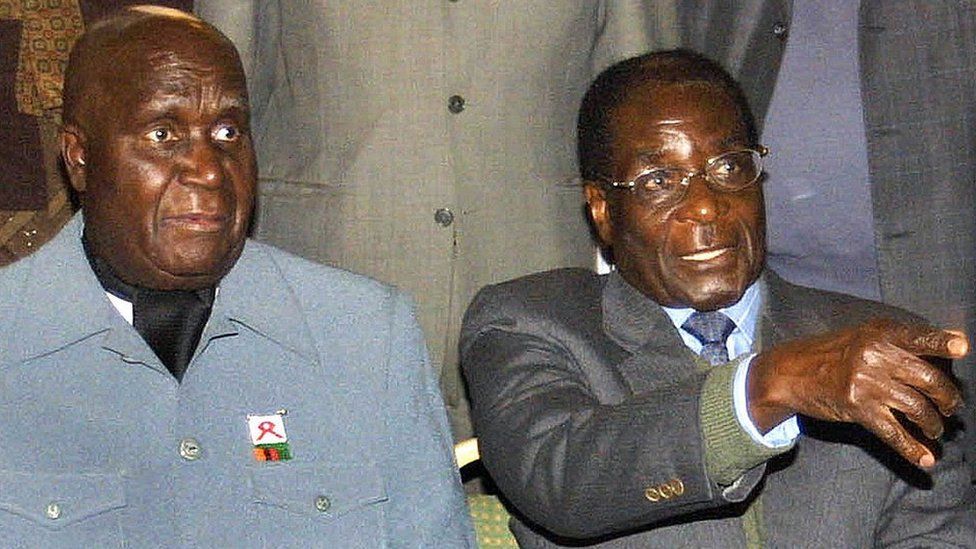
    Former Zambian President Kenneth Kaunda (L) sits next to Zimbabwean President Robert Mugabe in Harare - 17 June 2004

    Even Kenneth Kaunda, Zambia’s first post-independence president and the ultimate peacenik, could not find a resting place last year without a dispute breaking out.

    According to the family, he wanted to be laid to rest next to his wife and not at the official site the government had designated.

    For the moment, the family has not insisted on their rights and “KK” – as the late Mr Kaunda is affectionately known – is lying at the Embassy Memorial Park in the capital, Lusaka.

    From exile to honours

    These disputes about restless dead bodies are not new. Over here in Ghana we are well practised in such matters.

    Our first leader – Kwame Nkrumah – died while receiving medical treatment in Bucharest in Romania.

    He was first buried in Conakry in Guinea, where he had been living in exile. His body was later brought to Ghana. There was a state funeral in the capital, Accra, and he was laid to rest in his home village of Nkroful.

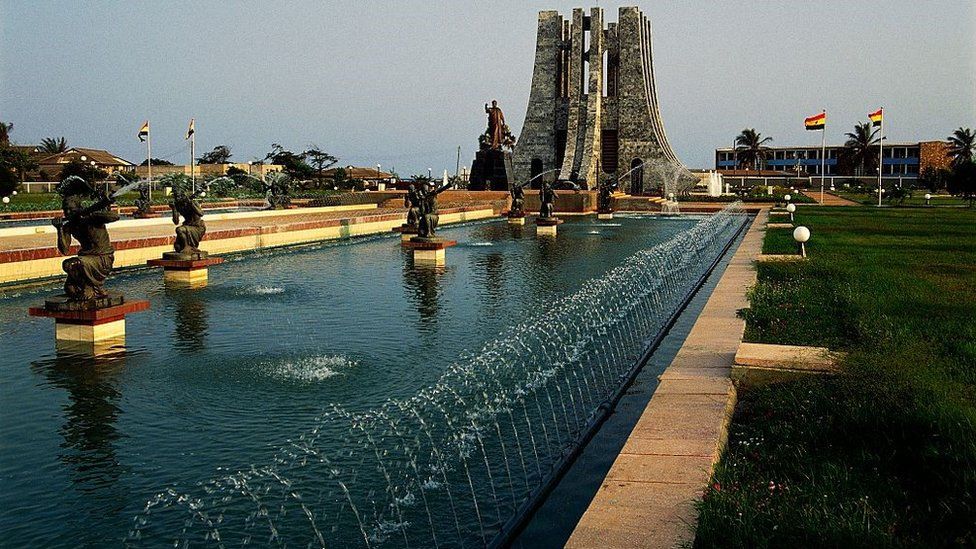
    Years later, a befitting mausoleum was built in Accra and the body was brought and interred there.

    Kwame Nkrumah mausoleum (1909-1972), Accra, Ghana, 20th century

    Every once in a while, there are murmurs from his family in Nkroful asking for his body to be returned to them.

    In 2012, our President John Evans Atta-Mills died in office and finding a resting place for him was not a straightforward issue.

    Some members of his family wanted the body to be sent to his home village for burial, that argument did not find much traction at the time.

    The first place where the government dug a grave for his interment was abandoned as unsuitable. He was eventually laid to rest in a park.

    The understanding then was that the park would serve as the resting place for all presidents of Ghana.

    Since then, another former president – Jerry Rawlings – has died.

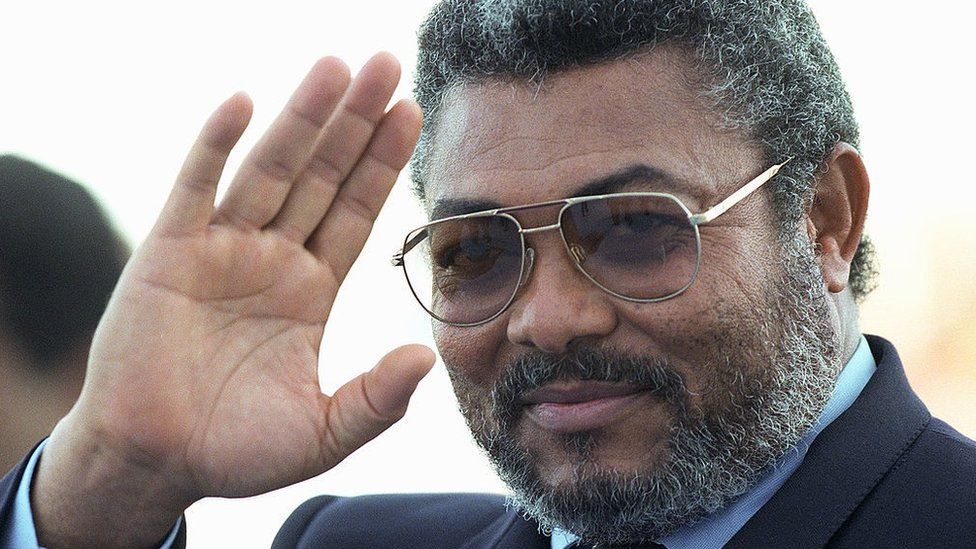
    Jerry Rawlings (September 1999)

    Not only was he not taken to where President Atta-Mills lies, but his family in his home village accused the government of having appropriated the body.

    He was buried at a military cemetery in Accra, with full military honours.

    A few weeks ago, we marked the 10th anniversary of the passing of Atta-Mills.

    There are still arguments about his tomb: who should look after it, and what should be inscribed on it.

    There are also members in his family who still want the body exhumed from the state-sponsored park in Accra and taken to his home village to be laid to rest.

    So I have to conclude that one of the hazards of being a president in Africa is that there will be no resting place for your body when you die.


    Source: BBC