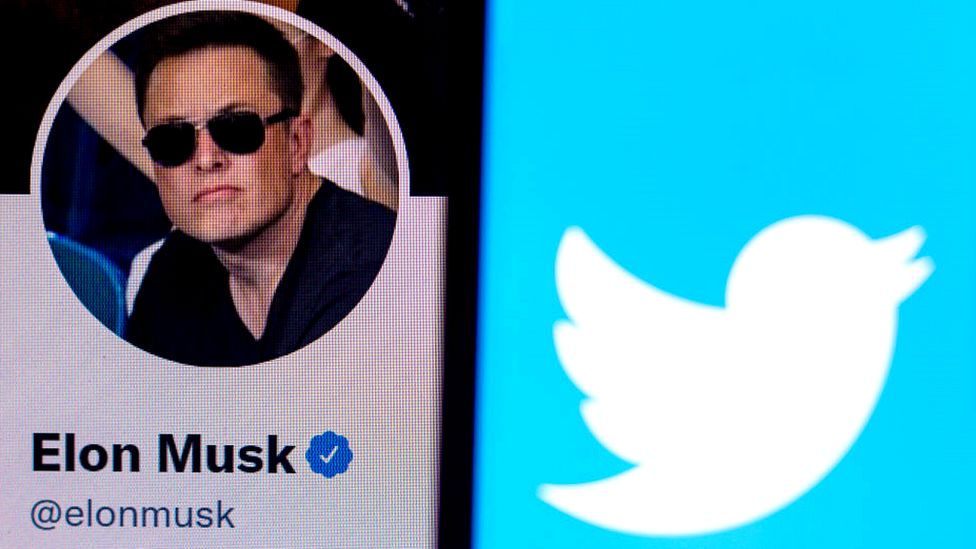
Shortly after taking over as the owner and CEO of Twitter, Elon Musk has scrapped resting days for Twitter employees. According to sources, all days of rest have been eliminated from the calendar of his staff.
The monthly one-paid rest day, which was meant to help reduce burnout among staffers, started during the COVID-19 pandemic and the policy change is an indication that Musk will set new standards for Twitter.
Recall that he had earlier interrupted one of Twitter’s “days of rest” before he became the company’s owner and CEO.
The new CEO is reportedly planning to lay off about half of Twitter’s 7,500-employee workforce, with impacted workers expected to learn their fate on Friday, November 5, according to Bloomberg.
It, therefore, came as great news when, on November 1, 2022, all the Africa staff of the global microblogging and social networking service got to have their first taste of a physical working environment with their colleagues.
The remote operations had ended, and that was supposed to be good news for the staff and the African region, knowing that Twitter had established an office to serve its direct interests, but something big and unexpected hit them some 24 hours after.
By Friday, November 4, 2022, the fates of the Africa HQ staff had been determined: none of them was spared the big cut.
“Your last day of employment will be December 4, 2022. You will be placed on garden leave until your termination date,” the termination notice sent via email to them read.
This was made available by Larry Madowo, a Kenyan journalist working with CNN.
Elon Musk takes over Twitter:
On October 28, 2022, after months of processes for a complete takeover of the microblogging platform, the world’s richest man and billionaire businessman, Elon Musk, earned control of the site after a $44 billion deal.
According to the New York Times, the closing of the billion-dollar deal, amidst a lot of drama and a lot of legal challenges, had “set Twitter on an uncertain course.”
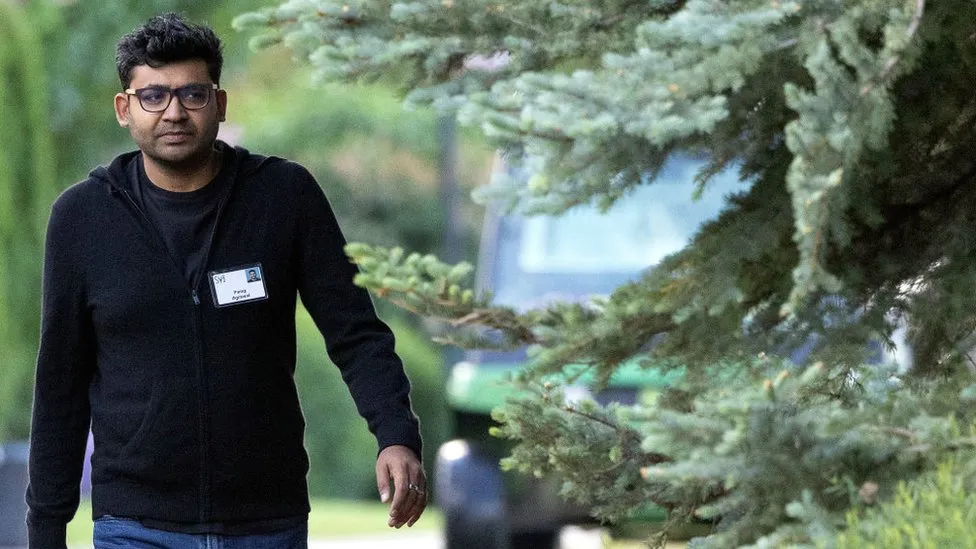
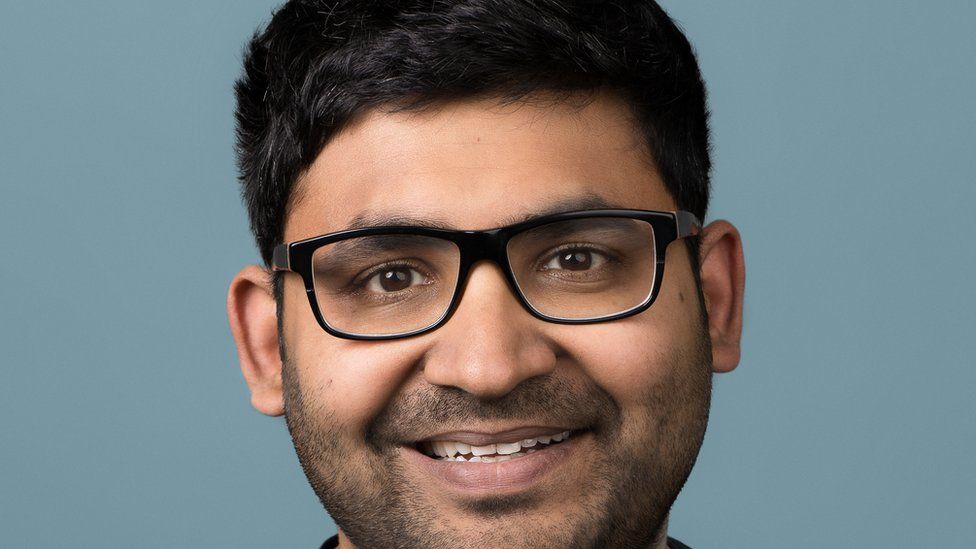
In one of his very first decisions at the helm of the social media giant, Musk fired three top executives, including CEO Parag Agrawal.
How Twitter Africa staff were fired:
Giving further details into the mysterious way the staff of the African office received their termination notices, Larry Madowo said that everything happened in four days.
This, he said, happened after the staff physically moved into their office space in Ghana’s capital, Accra.
He added that this move by Musk, and ultimately Twitter, now question its commitment to the continent because “when it opened the African office in Ghana, Africans – more than a billion of us, felt seen, and now all of that seems to have all gone up in the smoke.
“On Tuesday, after working remotely for about a year, Twitter’s Africa staff in Ghana finally opened the physical. On Friday morning, they were locked out of their email accounts, and their work laptops stopped working.
“They then received email notifications on their personal email accounts that they were getting terminated,” he explained.
The 20-member Africa team of Twitter are not alone, as many of the company’s staff in parts of the world have also been hit with this unexpected blow.
No severance for Twitter Africa staff:
While there has been an understanding communicated to especially staff of Twitter in the United States about receiving certain severances after the termination of their employment, CNN reported that that is not the case too in Africa.
Explaining how this has come to be the case, Larry added that following their termination notifications, the Africa staff are to stay put, doing almost noting until their last day at the company.
“Typically, the remaining employees of Twitter will receive full payment and benefits until December 4 but until that time, they are not allowed to communicate with other staff, suppliers, customers or clients and they are to remain available at Twitter’s disposal in case they need to have a proper handover,” he added.
But again, he said that for the Africa staff, one other thing that has given them a reason to be further worried is that the email they received did not even mention any severances for them.
Larry explained it as, “At least for the African staff, that email did not even mention them by name; it just said ‘see attached.’ And even though Elon Musk said everybody who got fired would be getting at least three months severance above the law – that’s in the US, those in [the] Africa office didn’t get a next step, or if they’re going to get any severance at all, which some lawyers in Ghana are now pointing out could be a violation of Ghanaian employment law.”
It is, however, unclear what the next move by the staff for the Twitter Africa office will be, even as there are suggestions that this termination violates Ghana’s laws.
Facebook’s parent company, whose stock has lost more than two-thirds of its value, also announced plans to cut discretionary spending and extend its hiring freeze into the first quarter.On Wednesday, Meta Platforms Inc announced the layoff of 13% of its workforce, or more than 11,000 employees, in one of the largest technology layoffs this year as the Facebook parent company battles rising costs and a weak advertising market.
The massive layoffs, the first in Meta’s 18-year history, come on the heels of thousands of layoffs at other leading technology companies such as Elon Musk’s Twitter and Microsoft Corp.
The pandemic boom that boosted tech companies and their valuations has turned into a bust this year in the face of decades-high inflation and rapidly rising interest rates.
Meta, whose shares have lost more than two-thirds of their value, said it also plans to cut discretionary spending and extend its hiring freeze through the first quarter.
“Today I’m sharing some of the most difficult changes we’ve made in Meta’s history,” the company’s founder Mark Zuckerberg said in a message to employees announcing the layoffs.
“I want to take accountability for these decisions and for how we got here. I know this is tough for everyone, and I’m especially sorry to those impacted.”
Potential recession
An economic slowdown and a grim outlook for online advertising – by far Meta’s biggest revenue source – have contributed to the company’s woes. This summer, Meta posted its first quarterly revenue decline in history, followed by another, bigger decline in the fall.
Some of the pain is company-specific, while some is tied to broader economic and technological forces.
Last week, Twitter laid off about half of its 7,500 employees, part of a chaotic overhaul as Musk took the helm. He tweeted there was no choice but to cut the jobs “when the company is losing more than $4M/day”, though did not provide details about the losses.
Meta has worried investors by pouring more than $10bn a year into the “metaverse” as it shifts its focus away from social media.
Zuckerberg predicts the metaverse, an immersive digital universe, will eventually replace smartphones as the primary way people use technology.
Meta and its advertisers are bracing for a potential recession. There is also the challenge of Apple’s privacy tools, which make it more difficult for social media platforms such as Facebook, Instagram and Snap to track people without their consent and show them specially tailored advertisements.
Competition from TikTok is also an a growing threat as younger people flock to the video sharing app over Instagram, which Meta also owns.
Meta’s profits fell to $4.4bn in the last quarter, a 52 percent decrease year-on-year.
“Fundamentally, we’re making all these changes for two reasons: our revenue outlook is lower than we expected at the beginning of this year, and we want to make sure we’re operating efficiently,” wrote Zuckerberg.
AMG Beyond Control’s rapper, Medikal, has been controlled on Twitter for what can be described as his stubbornness.
The ‘Stubborn Academy’ rapper jumped on Nana Addo’s ‘sika mp3 dede’ viral comment to drop a rap freestyle. After releasing the song, Medikal who bragsabout being a rich artiste, took to Twitter to make noise about the song.
Unfortunately, that has landed him trouble as his verified Twitter account has been suspended on the blue bird app.
The suspension comes a few days after Elon Musk, the new owner of Twitter, warned users of the ‘freed’ yet seemed caged bird app to desist from impersonating notable personalities on his platform.
“Going forward, any Twitter handles engaging in impersonation without clearly specifying “parody” will be permanently suspended. Previously, we issued a warning before suspension, but now that we are rolling out widespread verification, there will be no warning.
This will be clearly identified as a condition for signing up to Twitter Blue. Any name change at all will cause temporary loss of verified checkmark,” Elon Musk tweeted.
In a bid to draw attention to his ‘Sika Mp3 Dede’ track, Medikal changed his Twitter profile AVI to a photo of H.E Nana Addo. he also changed his username to “Mr President”.
A twitter reported his account to Elon Musk for impersonating Ghana’s President and a few minutes later, his account was suspended. See screenshots of the actions below as shared by Ghanaian blogger, @SikaOfficial1
Activists throughout Asiaare concerned about the social media platform’s future under billionaire Tesla founder Elon Musk.
Singaporean activist and journalist Kirsten Han uses Twitter to discuss topics that the Singapore government would prefer to keep private.
Han’s outspoken posts draw attention to migrant workers’ rights, the government’s denial of racism, and, most frequently, the hundreds of executions of non-violent drug offenders carried out in the city-state over the last few decades.
Han has been condemned on the floor of Singapore’s parliament and targeted by the police for her work, which she also tweets about to her verified account’s 29,000 followers.
In June, Han was required to turn over access to her Twitter, Facebook Instagram accounts when she was investigated under Singapore’s Public Order Act for holding a four-person vigil against the death penalty. Police cited Han’s postings on her social media accounts, including Twitter, as evidence for launching the probe, which is ongoing.
Han has no plans to stop using Twitter, but how she uses it may change as the rules governing the platform face a radical shake-up under new owner Elon Musk.
Musk plans to scrap Twitter’s identity authentication system as soon as this week, offering the distinctive blue check mark, once reserved for verified high-profile users, to anyone willing to pay $8 a month.
While Han is still waiting for the details of the changes to unfold, she is concerned about the prospect of internet trolls impersonating her and sowing confusion among her followers.
“I assume I’m going to lose the blue tick at some point, but then it also seems – as the details come out – that the blue tick verification thing is just going to be available to whoever pays,” Han told Al Jazeera.
More fundamentally, Han worries that Musk does not understand the responsibility that is now on his shoulders.
“He’s a businessman who, just from observation, has a somewhat overinflated sense of how qualified he is to do things,” she said.
“He doesn’t seem qualified or really that knowledgeable about how communication and social media and tech platforms work, and the responsibilities that they have, which is quite worrying.”
Many live in countries where freedom of speech is severely curtailed by authorities. For such users, Twitter can be a vital window to the outside world, a rare platform for open debate – often from behind the veil of anonymity – or both.
For critics, the concerns range from questions about Musk’s ideological leanings and his business interests in countries like China to doubts about his understanding of the complexities of social media.
The Tesla founder, a self-described “free speech absolutist” who has accused Twitter of exhibiting left-wing bias, has pledged to reshape moderation policies on the platform to encourage the airing and debate of a wider spectrum of views.
On Friday, Musk set in motion a radical restructuring of the company by firing about half of Twitter’s 7,500 employees, including the entire human rights team, according to former legal counsel Shannon Raj Singh.
Al Jazeera did not receive a response to requests for comment sent to the Twitter accounts of the company’s communications teams or its head of safety and integrity, Yael Roth.
In countries like Myanmar, where Twitter has played an important role in sharing information since a military coup in 2021, Musk’s takeover has prompted anxiety and concern.
Despite a government crackdown on social media and both domestic and foreign media, anonymous accounts have continued to disseminate information about state-sponsored violence and anti-government protests.
Yadanar Maung, a spokesperson for Justice for Myanmar, an account with 165,000 followers, said Twitter had already been failing to counter psychological warfare and misinformation shared by Myanmar’s military administration on social media.
Now, things could take a turn for the worse as moderation becomes even more sparse and government-linked accounts proliferate, Maung said.
“We are concerned that changes will make Twitter more dangerous for Myanmar users who are under threat from an illegitimate military junta, and that Twitter under Elon Musk could provide greater space for the junta and its supporters to spread disinformation and hate speech,” Maung told Al Jazeera.
Tesla’s largest production facility is located in Shanghai, China [File: Aly Song/Reuters]
Activists are also worried about how Musk, the chief executive of Tesla,SpaceX and Neuralink, could be influenced by China, where he has major business interests.
Tesla has established its biggest production facility in Shanghai and earlier this year opened a showroom in Xinjiang, where Beijing has carried out a lengthy campaign of repression against the Uighurs and other ethnic minority Muslims, even as major Western brands publicly distanced themselves from the region.
“The worry is that if Elon Musk is potentially corrupt or trying to appease the Chinese government, he will be handing over data and he will be giving the Chinese government access to data,” Vicky Xu, an Australia-based researcher and journalist who has documented her harassment by pro-Beijing accounts on social media, told Al Jazeera.
“Twitter is such an important platform for advocacy and dissent. With Elon Musk, even if he’s never going to hand over any data to China, even if the Chinese government was not able to influence him, there’s still a psychological fear that a lot of dissidents or activists feel that this platform is just not as free as before and it is not as impartial as before or not as pro-democracy as before.”
While Twitter, like other Western social media platforms, is blocked in China, Beijing oversees a large number of state-sponsored “wolf warrior” accounts that project its messaging and monitor the social media activity of Chinese dissidents living abroad.
Many of these accounts also harass users who post about issues deemed sensitive to China, such as Taiwan’s political status or political repression in Hong Kong, Xinjiang, and Tibet.
Sandra, a Hong Kong-based Chinese-language Twitter account with more than 47,000 followers, said a concern for dissidents like her is the abuse of Twitter’s function for reporting inappropriate content by state-backed accounts and bots.
The Hong Kong democracy activist said she was suspended from Twitter for 6 months in 2019 after being targeted by pro-Beijing accounts for posting about the city’s anti-government protests.
Sandra said many Chinese dissident accounts have faced similar issues, with appeals taking months to reach a resolution.
It is unclear if the situation will get worse with fewer “guard rails” on the platform, she said, while there is also concern about whether Chinese state media will continue to be clearly labelled as such.
Sandra, who asked to remain anonymous due to the sweeping crackdown on dissent in Hong Kong, said she was still waiting to see how the changes would play out.
“I have not decided yet,” she told Al Jazeera.
Veteran Thai journalist Pravit Rojanaphruk says many Thais are worried about what will happen to their personal data after Musk’s takeover of Twitter [File: AP Photo]
In Thailand, Twitter is one of the few spaces where citizens can take advantage of anonymity to debate the future of the monarchy without risking jail under the country’s tough lèse-majesté laws.
Pravit Rojanaphruk, an award-winning journalist who was previously charged with sedition for criticising the military government, said many Thais are worried about what will happen to their personal data and whether military-backed accounts will proliferate.
“Twitter is one of the two premier or most popular social media apps when it comes to political discussion. It’s the least censored in Thailand, even compared to Facebook. Many of the Thai users are actually using a nom de plume,” Pravit told Al Jazeera.
“They aren’t using a real identity when it comes to sensitive discussions about the monarchy, and we don’t know [how] Elon Musk is going to interpret this debate about using anonymous accounts.”
Twitter seems to be in disarray ever since ElonMusk took over as CEO late last month.
Musk seems to backtracking after declaring late last month that “comedy is now legal on Twitter.”
It took less than two weeks, and Musk doesn’t appear to be laughing anymore, as he has now threatened to “permanently suspend” anyone who impersonates another person without identifying themselves as a “parody” account.
His war on impersonators comes after people have been impersonating him on the platform. Musk recently said Twitter users must pay $7.99 per month for a verification check mark, without detailing how the platform would determine the difference between the actual person and the bad actor. Musk said that if someone with a paid verified account is caught impersonating someone else, their profile will be suspended and their money will be pocketed.
Great question. Twitter will suspend the account attempting impersonation and keep the money!
So if scammers want to do this a million times, that’s just a whole bunch of free money. pic.twitter.com/QUrxqb59I0
Food Network chef Valerie Bertinelli also participated in the Twitter handle trend, but eventually reverted back to her actual name.
Okey-dokey I’ve had my fun and I think I made my point. 😬 I’m just not a ‘trending’ kind of gal. Never have been, never want to be.
Have a safe Sunday everyone! xo 🤍
Meanwhile, after Musk laid off 3,700 employees, slashing the company’s workforce by about half, there seems to be an about-face.
The layoffs were met with a class-action lawsuit which argued that such a move violated the WARN, or federal Worker Adjustment and Retraining Notification Act. The law requires that big companies provide at least a 60-day window before moving forward with sweeping job cuts.
Bloomberg reports some of those workers who were fired are now being asked to return because their dismissal occurred by mistake.
Elon Muskhas stated that Twitter users who engage in impersonation without clearly identifying themselves as a parody account will be permanently suspended.
Twitter had previously issued a warning before suspending accounts, but he announced that there would now be no warning.
A number of accounts that changed their names to Elon Musk and mocked the billionaire have already been suspended or blocked.
Late last month, Twitter’s new billionaire owner took over the company.
He laid off roughly half of the company’s employees at the end of last week.
He has also confirmed plans to allow users to buy blue-tick, verified status.
Detailing the new policy on parody accounts, Mr Musk tweeted: “Previously, we issued a warning before suspension, but now that we are rolling out widespread verification, there will be no warning.”
He added that “any name change at all will cause temporary loss of verified checkmark”.
Going forward, any Twitter handles engaging in impersonation without clearly specifying “parody” will be permanently suspended
The BBC is not responsible for the content of external sites. View original tweet on Twitter
Several accounts that had changed their name to the new Twitter owner have been suspended or placed behind a warning sign, including those of US comedian Kathy Griffin and former NFL player Chris Kluwe.
Other accounts, including one parodying former US President Donald Trump by comedian Tim Heidecker, are yet to be suspended.
Mr Musk has previously said he opposed permanent bans on Twitter, including that of Mr Trump’s official account. Mr Musk said last week that banned accounts would not be reinstated until there was “a clear process for doing so”. He pointed out that he was not banning an account that followed his private plane.
The New York Times reported on Sunday that Twitter was delaying the rollout of verification check marks to subscribers of its new service until after Tuesday’s US midterm elections. At the weekend, the social media site’s website app began offering an update that will charge $8 (£7) a month for its blue, verified checkmark.
On Friday, the billionaire said Twitter was losing more than $4m per day, insisting that this gave him “no choice” over culling around half the company’s 7,500-strong workforce.
The cuts – as well as Mr Musk’s fierce advocacy of free speech – have caused speculation that Twitter could water down its efforts on content moderation.
However, Mr Musk has insisted that the firm’s stance towards harmful material remains “absolutely unchanged”. UN human rights chief Volker Turk wrote him an open letter, warning that Twitter had a responsibility to avoid amplifying harmful content.
Elon Musk says Twitter users engaging in impersonation without clearly specifying it as a parody account will be permanently suspended.
Twitter previously issued a warning before suspending accounts, but there would now be no warning, he announced in a series of tweets.
The company’s new owner laid off around half of the company’s workforce at the end of last week.
He also confirmed plans to allow users to buy blue-tick verified status.
Detailing the new policy on parody accounts, Mr Musk tweeted: “Previously, we issued a warning before suspension, but now that we are rolling out widespread verification, there will be no warning.”
He added that “any name change at all will cause temporary loss of verified checkmark”.
Going forward, any Twitter handles engaging in impersonation without clearly specifying “parody” will be permanently suspended
The BBC is not responsible for the content of external sites.View original tweet on Twitter
Several accounts that had changed their name to Elon Musk and mocked the billionaire have been suspended or placed behind a warning sign, including those of US comedian Kathy Griffin and former NFL player Chris Kluwe.
Other accounts, including one parodying former US President Donald Trump by comedian Tim Heidecker, are yet to be suspended.
Mr Musk has previously said he opposed permanent bans on Twitter, including that of Mr Trump’s official account. Mr Musk said last week that banned accounts would not be reinstated until there was “a clear process for doing so”.
The New York Times reported on Sunday that Twitter was delaying the rollout of verification check marks to subscribers of its new service until after Tuesday’s US midterm elections. At the weekend, the social media site’s website app began offering an update that will charge $8 (£7) a month for its blue, verified checkmark.
On Friday, the billionaire said Twitter was losing more than $4m per day, insisting that this gave him “no choice” over culling around half the company’s 7,500-strong workforce.
The cuts – as well as Mr Musk’s fierce advocacy of free speech – have caused speculation that Twitter could water down its efforts on content moderation.
However, Mr Musk has insisted that the firm’s stance towards harmful material remains “absolutely unchanged”. UN human rights chief Volker Turk wrote him an open letter, warning that Twitter had a responsibility to avoid amplifying harmful content.
Twitter is clearly under heavy financial pressure.
In the week since Elon Musk purchased Twitter for $44 billion, the social media giant has been trying to find ways to cut costs and boost revenue. Musk reportedly told investors he plans to eliminate 3,700 jobs at Twitter Inc., which is about half of the company’s workforce. He’s also announced potential changes to the Twitter Blue subscription service, including the addition of an $8-per-month fee for the highly coveted “verified” badge.
However, the cost-saving ideas don’t end there. According to the New York Times, the company is also working on a paid direct messaging feature focused on “Very Important Tweeters.” Sources “with knowledge of the matter” say the platform could soon charge users to send direct messages to high-profile figures, including celebrities and professional athletes.
Internal documents reviewed by the Times state Twitter points to an early prototype in which a user is shown asking Post Maline about his favorite records.
The message would appear in a special box designated for paid DMs.
The company did not provide the exact cost of each VIT message, but said it could be “as little as a few dollars.”
Twitter’s new owner Elon Musk has defended sacking about half the company’s workforce, saying he had “no choice” as Twitter was losing more than $4m (£3.5m) a day.
A tweet from Yoel Roth, Twitter’s head of safety and integrity, referred to “approximately 50% cuts company-wide”.
But Mr Musk said the social media giant’s commitment to content moderation was “absolutely unchanged”.
Mr Musk, the world’s richest man, took over Twitter in a $44bn (£38.7bn) deal.
The billionaire insisted in his own tweet that all those losing their jobs were offered three months of severance pay, “which is 50% more than legally required”.
As reports emerged on Friday that thousands of staff at Twitter around the world were losing their jobs, questions were asked over the future of employees responsible for taking down harmful material.
Online safety groups and campaigners have suggested Mr Musk might relax moderation policies, making Twitter less effective at removing hate-speech and disinformation from the platform.
Permanent Twitter bans given to controversial figures – including former president Donald Trump – could also be removed.
These concerns were fuelled by Mr Musk’s comments on Friday, which sought to blame Twitter’s “massive drop in revenue” on “activist groups” who were “trying to destroy free speech in America”.
But Mr Roth’s tweet thread, posted later in the day, confirmed that most of the more than 2,000 content moderators working on “front-line review” were not impacted.
He said the “reduction in force” affected around 15% of those working in Twitter’s trust and safety organisation – compared with what he said was a 50% cut seen across the company.
Mr Roth added that combating misinformation remained a “top priority” during the US midterm elections. Most Americans will vote on Tuesday, in a key test for Joe Biden’s presidency.
The president voiced his concern about the takeover on Friday, saying “Elon Musk goes out and buys an outfit that sends – that spews lies all across the world… How do we expect kids to be able to understand what is at stake?”
As the scale of the job cuts became clear, notices provided by Twitter to officials in California revealed that around 983 staff were being laid off in that US state alone.
It concerns 784 employees in San Francisco, 106 in San Jose, and 93 in Los Angeles, according to filings seen by the BBC.
An internal email sent to staff earlier on Friday said the mass job cuts were “unfortunately necessary to ensure the company’s success moving forward”.
Staff confirmed on Twitter they had been logged out of work laptops and Slack, a messaging system.
Many staff revealed that they had been axed in posts on the platform, painting a picture of cuts that spanned the globe and hit departments that ranged from marketing to engineering.
They included communications, content curation and product development employees.
A team that focused on research into how Twitter uses algorithms – an issue that was a priority for Mr Musk – was also sacked, according to a tweet from a former senior manager at the company. But that was later denied.
Almost all of Twitter’s revenue currently comes from advertising, and Volkswagen is among the brands that has stopped spending with it since Mr Musk bought Twitter.
“We are closely monitoring the situation and will decide about next steps depending on its evolvement,” Europe’s biggest carmaker said.
On Thursday, food manufacturer General Mills, which owns brands including Cheerios and Lucky Charms, did the same.
It said it was continuing to monitor Twitter’s “new direction” and wanted to “evaluate [its] marketing spend”.
Other brands to have paused paid activity on the platform include car firms General Motors and Audi, and drugs giant Pfizer.
Mr Musk has been looking for ways to cut costs and make money in different ways from the platform, including plans to charge a monthly subscription fee for users to be verified on the platform.
He also proposed that those paying the $8 per month fee would get their Tweets boosted in replies, mentions, and searches, prompting criticism from some people on Twitter that he was creating a two-tier system that would benefit those willing to pay.
Twitter employees filed a class action lawsuit on Thursday which argued the company was making big job cuts without giving 60 days’ notice, in violation of federal and Californian law.
After a week of suspense over rumoured layoffs after Elon Musk’s takeover last week, the job cuts have become a reality. Unfortunately, Ghana’s own Benard Kafui Sokpe has confirmed his exit from working with the bird app.
Bernard Kafui Sokpe, popularly known as Meistermind on Twitter, senior partner manager for Ghana and Nigeria Twitter partnerships in Ghana, tweeted to confirm his current job status and in solidarity with the thousands of other ex-twitter employees.
Meistermind tweeted: “It’s been a year working at a place I never imagined I’ll ever get to work. I’m glad that I could represent Africa & I didn’t let us down. My best career experience by far & it was beautiful whilst it lasted. Much love to all the amazing tweeps that made it worth it. #OneTeam”
According to a companywide email from Twitter, workers were instructed to go home and not go to the offices on Friday. As badge access was to be revoked until further notice.
“In an effort to place Twitter on a healthy path, we will go through the difficult process of reducing our global workforce. We recognize that this will impact a number of individuals who have made valuable contributions to Twitter, but this action is, unfortunately, necessary to ensure the company’s success moving forward,” the email read.
Twitter email to employees preceding layoffs
However, the email notice did not mention the total number of employees who will lose their jobs. It was also not signed by Elon Musk or any executive. Just a generic “Twitter” signoff.
Mr Elon Musk, after buying Twitter on October 27, 2022, at a whopping $44 billion, fired its chief executive and other top managers. Managers were also asked to reevaluate their team’s performances whilst other executives resigned.
#One Team is currently trending on Twitter as ex-employees share their experiences. Some employees said they couldn’t access the company’s laptops or log in to their official work emails.
These changes are said to have been in effect sometime at 3 am this dawn. Thus, affected employees woke up this morning without a job – and with no warning.
Trevor Noah is the latest to express frustration over Elon Musk’s plans to attach a fee to Twitter verification.
As previously reported by the Verge, Musk wanted to launch a new version of Twitter Blue under which currently verified users would be given 90 days to sign up for a paid subscription or risk losing their blue checkmark. The proposed monthly fee was then reported to be $20, although Musk later suggested $8 instead in response to criticism from author Stephen King. Of course, lowering the amount of any such fee misses the entire point of the argument against the fee itself.
At any rate, the $8 figure has continued to be floated, prompting continued discussion. Addressing the plans during a recent episode of The Daily Show from Atlanta, Noah ultimately delivered a proposal of his own.
“For months now, Musk has said that he wanted to own Twitter, right?” Noah said. “And the reason he wanted to own Twitter is because he wanted to make sure that it became a haven for free speech. He wanted to change it to that. Because let’s be honest, up until now, you know, people have really held back on Twitter. I always find myself scrolling and thinking, ‘But what do you really think? Why are you so reserved, sir?’”
Evidence suggests that bad actors are trying to test the limits on @Twitter. Several posts on 4chan encourage users to amplify derogatory slurs.For example, over the last 12 hours, the use of the n-word has increased nearly 500% from the previous average. pic.twitter.com/mEqziaWuMF
— Network Contagion Research Institute (@ncri_io) October 28, 2022
Musk’s takeover, Noah noted, gave users a sampling of what jokingly referred to as “extra free speech” in recent days.
“In the first 12 hours under Elon’s ownership, the use of the n-word on Twitter shot up 500 percent,” he said.
This figure was also highlighted in a statement from the NAACP on Wednesday. In the statement, the organization confirmed it had recently met with Musk to express its concerns over “the dangerous, life-threatening hate, and conspiracies that have proliferated on Twitter under his watch.”
According to NAACP President Derrick Johnson, who was joined in the meeting by members of the Stop Hate for Profit coalition, not taking “necessary actions” in response will lead to lives being placed at risk.
During his Daily Show monologue, Noah pointed out how many arguments are made under the guise of free speech but are in reality about simply wanting “to hate on people.” He also took issue with Musk’s tweeted rationale for the fee, joking that he should instead charge white people to be racist.
“I think this eight-dollars-a-month thing is ridiculous,” Noah said a little over six minutes into the video below. “If you ask me, if Elon Musk wants to make money from Twitter, what he should do, don’t charge people for blue checkmarks. No. Charge white people to say the n-word. Twitter will be the most profitable company in history. Racists are gonna be taking out loans.”
In a tweet shared Tuesday, Musk himself addressed having met with multiple organizations to discuss what he described as ways to “continue to combat hate [and] harassment” on the platform. In a follow-up message, he also addressed where things stand with regards to previously suspended users potentially being allowed back on the platform. For the time being, Musk said, there is no “clear process” for handling these cases, although such a thing is indeed in the works.
Elon Musk, the new Twitter chief known for his humorous replies, did it again. Replying to an American politician, Musk made it clear that he’s stern about his decision of charging $8 for blue tick.
An American Congress politician Alexandria Ocasio-Cortez taking it to Twitter mocked Elon Musk over the recent announcement that Twitter will now charge eight dollars for ‘blue tick’ verification. The announcement has flooded the microblogging site with reactions since then.
The politician tweeted, “Lmao at a billionaire earnestly attempting to sell people on the concept that ‘free expression’ is actually an $8/month membership plan.”
Musk responded to Cortez’s tweet by saying, “Your feedback is appreciated, now pay $8.” Musk then immediately tweeted again with a screenshot of Cortez’s website charging $58 pointing out that he is costing way much less than Cortez.
Cortez said that her Twitter mentions and notification stopped working after tweeting and later received a text message saying that she “seem to have gotten under a certain billionaire’s skin.”
Musk acknowledged that he has been receiving a lot of criticism after the announcement. He then replied, “To all complainers, please continue complaining, but it will cost $8.”
After Musk revealed that verified users must pay $8 to preserve their ‘elite status symbol,” and the platform descended into chaos. Notably, celebrities, politicians, business leaders, and journalists are all given the verification badge, Republic World reported.
However, a lot of individuals have raised concerns over the decision of charging for verification and the high possibility of the spread of false information.
Within hours of House Speaker Nancy Pelosi‘s husband being attacked by a hammer-wielding intruder at the couple’s home, a slew of unsubstantiated claims began to circulate in fringe far-right circles, contradicting the official police account of what happened.
One of the most widely circulated myths about the attack is that Pelosi and his attacker, David DePape, were in a relationship and had a drunken brawl.
There is also an online claim that both DePape and Pelosi were in their underwear when police arrived, or that the two men knew each other and were friends prior to the attack.
But the FBI complaint against DePape quotes a witness as saying he was dressed “in all black” carrying a large black bag on his back, and, according to the complaint, Pelosi did not know DePape.
Another claim circulating is that two blogs and a Facebook account, which show signs that DePape was radicalised, were fake and only created on the day of the attack to support the narrative that he believed in far-right conspiracy theories.
But the BBC has screenshots of the blogs which show he had made posts as early as August, weeks before the attack.
Many of these misleading claims have since gone viral after being amplified by new Twitter chief Elon Muskand a number of conservative influencers.
Elon Musk has said Twitter will charge $8 (£7) monthly to Twitter users who want a blue tick by their name indicating a verified account.
As part of changes after a $44bn (£38bn) takeover of the social media site, Mr Musk said it was “essential to defeat spam/scam”.
A blue tick mark next to a username – normally for high-profile figures – is currently free.
The move could make it harder to identify reliable sources, say critics.
Mr Musk, the world’s richest person, added that paid users would have priority in replies and searches, and half as many advertisements.
“Power to the people! Blue for $8/month,” the billionaire said on Twitter, criticising the old method of blue tick verification as a “lords and peasants system”.
To all complainers, please continue complaining, but it will cost $8
Twitter’s former method of verifying users for a blue tick included a short online application form, and was reserved for those whose identities were targets for impersonation, such as celebrities, politicians and journalists.
The company introduced the system in 2009, after it faced a lawsuit accusing it of not doing enough to prevent imposter accounts.
But Mr Musk is facing a hefty challenge as he works to overhaul Twitter’s business, which has not posted a profit in years.
He has said he wants to reduce Twitter’s reliance on advertising, even as some companies have grown concerned about advertising on the site under his leadership.
General Motors – a rival of Mr Musk’s electric car company Tesla – said last week it was suspending advertising on the site.
Meanwhile, some other major brands have more quietly put a temporary halt to advertising on the platform as they wait to see how Mr Musk’s changes play out, a media buyer for a leading advertising firm told the BBC.
On Monday, one of the world’s biggest advertising companies, IPG, advised its clients to suspend Twitter adverts for a week, citing a need for more clarity on the Twitter’s plans to ensure “trust and safety” on the platform. IPG is given billions of pounds per year, by some of the world’s biggest brands, to handle their marketing budgets.
The charge for blue tick privileges drew scepticism after original reports that said the charge could be $20 (£18) monthly.
Many on the platform echoed the statement of author Stephen King, who wrote in response to reports of changes that instead Twitter “should pay me”.
Mr Musk wrote to Mr King saying, “We need to pay the bills somehow!”
Before deleting his post, Tesla CEO Elon Musklinked to an unsubstantiated article about Nancy Pelosi’s husband.
Elon Musk, the new owner of Twitter, tweeted an article containing a conspiracy theory about the attack on Nancy Pelosi’s husband before deleting the post hours later.
Musk’s tweet on Sunday linked to an article making unsubstantiated claims about Paul Pelosi’s personal life and the role it may have played in last week’s attack at his and his wife’s home in San Francisco.
Musk tweeted the article by the Santa Monica Observer, a website with a history of publishing misinformation, after Hillary Clinton posted an LA Times article about the suspected attacker, David DePape, and criticised Republicans for spreading “hate and deranged conspiracy theories”.
In response to Clinton’s tweet, Musk posted the article while adding there was a “tiny possibility there might be more to this story than meets the eye”.
US media outlets have linked DePape, who is accused of attacking Pelosi with a hammer, to blog posts espousing far-right and extreme views online, including the QAnon conspiracy theory.
Musk, who has described himself as a “free-speech absolutist”, appeared to have deleted his tweet several hours after posting it without explanation.
The Tesla CEO’s controversial tweet comes as his $44bn purchase of the social media platform is at the centre of a heated debate about the limits of free speech in the digital age.
Musk, the world’s richest man, has criticised Twitter’s moderation policies and accused the social media giant of having a left-wing bias.
The billionaire has stressed the need for a “common digital town square” where a wide range of beliefs can be debated while insisting he does not favour a “free-for-all hellscape”.
Critics have expressed fears that Musk’s ownership of the platform could result in a surge in hate speechand misinformation, while conservatives have heralded the takeover as a corrective to Big Tech censorship.
Elon Muskis wasting no time making changes at his newly-acquired Twitter.
According to The Verge, the tech mogul wants to charge people $19.99 a month for the new Twitter Blue subscription, which currently stands at $4.99 a month. And based on the outlet’s sources, one of the benefits of the new subscription package will include verification on Twitter. For users who are currently verified, they will have to subscribe 90 days after the current plan is put into place, or risk losing their blue checkmark.
Perhaps more jarring than the new subscription model is the deadline that Musk has allegedly put in place. Per The Verge, Musk has given employees until November 7 to put this new plan into place. If they fail to meet that date, they’ll be fired.
While the move may come as a surprise to some, Musk has previously hinted that he would make such a change.
The whole verification process is being revamped right now
“The whole verification process is being revamped right now,” Musk tweeted just days after acquiring Twitter.
While his tenure as Twitter’s head honcho is just days old, Musk is already ruffling feathers. Earlier this week, it was reported that use of the N-word had increased on the platform since Musk’s takeover. That prompted LeBron James to call on Musk to do something.
I dont know Elon Musk and, tbh, I could care less who owns twitter. But I will say that if this is true, I hope he and his people take this very seriously because this is scary AF. So many damn unfit people saying hate speech is free speech. https://t.co/Sy0jvXIBnC
“I don’t know Elon Musk and, tbh, I could care less who owns twitter,” James tweeted. “But I will say that if this is true, I hope he and his people take this very seriously because this is scary AF. So many damn unfit people saying hate speech is free speech.”
Before the council meets, no major decisions or account reinstatement will be made, according to the outspoken billionaire businessman.
Elon Musk has announced his intention to form a “content moderation council with widely diverse viewpoints” at Twitter in his first policy actions since taking over the social media company on Friday while emphasising that no changes to the platform’s moderation policies have been implemented thus far.
“No major content decisions or account reinstatements will happen before that council convenes,” the outspoken billionaire businessman said amid concerns that former US President Donald Trump’s account might be reinstated.
“To be super clear, we have not yet made any changes to Twitter’s content moderation policies,” he added in a later tweet.
Twitter formally became the private property of Musk, CEO of Tesla and SpaceX, on Friday, steering the platform down an uncertain path under the stewardship of one of its most vocal critics.
Scrutiny quickly turned to how the platform will operate under a self-proclaimed free-speech absolutist who some users fear will turn Twitter into a global stage for hate speech and disinformation.
To be super clear, we have not yet made any changes to Twitter’s content moderation policies https://t.co/k4guTsXOIu
Musk’s sealing of the on-again, off-again $44bn deal ended a months-long soap opera of corporate chicanery, involving insults, threats, and lawsuits.
“The bird is free,” tweeted the billionaire Tesla founder and space pioneer in reference to the company’s logo. “Let the good times roll.”
The deal drew contrasting reactions, with former US president Donald Trump cheering the change of leadership on a platform that had banned him, while activists warned of a surge in harassment and misinformation.
European politicians were quick to signal to Musk that the continent had regulations for social media companies.
“In Europe, the bird will fly by our rules,” tweeted Thierry Breton, the EU internal marketcommissioner.
Musk had promised to dial back content moderation and was expected to clear the way for Trump to return to the platform.
The then-president was blocked over concerns he would ignite more violence like the 2021 deadly attack on the US Capitol to overturn his election loss.
Taking to his own Truth Social platform, Trump said he was “very happy that Twitter is now in sane hands” – but gave no commitment to rejoin if allowed.
Far-right users were quick to rejoice at Musk’s ownership, posting comments such as “masks don’t work” and other taunts, under the belief that moderation rules would now be relaxed.
‘A huge responsibility’
Yale University philosophy professor Jason Stanley, who has characterised Trump’s rise as a sign of mounting fascism in the United States, said he would alter his approach to posting.
“For the moment I am staying on Twitter. But I am going to try to be much more careful about what I say now that Elon Musk is in charge. Cascading hate speech targeting can destroy your week,” he said.
Right-wing political commentator Ben Shapiro said he gained 40,000 Twitter followers on Friday, while the actor Mark Hamill, a liberal, said he had lost almost 6,000 followers over the last three days.
Musk reportedly fired Twitter chief executive Parag Agrawal and other senior officials – though the company did not reply to a request for comment and Agrawal still listed himself as CEO on his Twitter profile.
But Ned Segal, Twitter’s chief financial officer since 2017, announced his departure.
“At its best, (Twitter) democratizes communication and knowledge, ensuring accountability and equal distribution of info,” Segal said. “It’s a huge responsibility for everyone that shares in the work. I wish them strength, wisdom, and foresight.”
Musk, who is using a combination of his own money, funds from wealthy investors, and bank loans to finance the deal, has conceded he is overpaying for a company that has regularly posted eye-watering losses.
How to monetize?
Twitter says it has 238 million daily users – dwarfed by the likes of Facebook’s nearly two billion – and has not been able to monetise in the same way as its rivals.
However, it holds an outsized influence on public debate because it is the favoured platform for many companies, politicians, journalists and other public figures.
Though he has promised that Twitter will not become a “free-for-all hellscape,” Musk reportedly plans deep staff cuts that would gut teams that oversee content.
Despite Musk posting a letter to advertisers saying he wants Twitter to be a forum where rival viewpoints can be debated in a “healthy manner”, US auto giant General Motors said on Friday it has “temporarily paused” paid ads on the platform.
“We are engaging with Twitter to understand the direction of the platform under their new ownership,” said a GM spokesman.
Media watchdog Media Matters for America sounded the alarm over the future of a Musk-led Twitter, particularly the effect on imminent US midterm elections.
The platform “is now on a glide path to becoming a supercharged engine of radicalization” and a “fever swamp of dangerous conspiracy theories, partisan chicanery, and operationalized harassment,” the organisation’s head Angelo Carusone said.
Donald Trump has stated that he is “very happy that Twitter is now in sane hands” following Elon Musk’s acquisition of the company.
Musk’s $44 billion purchase of Twitter was completed on Thursday, and he reportedly fired the company’s CEO and two other top executives.
The world’s richest man tweeted “the bird is freed” and “let the good times roll”.
He’s promised to overhaul the service by getting rid of fake accounts and ensuring it’s a place where a “range of beliefs can be debated in a healthy manner”.
Donald Trump – arguably once Twitter’s most famous user – was banned after the siege on the US Capitol in January 2021 for allegedly inciting violence with two of his posts.
His banishment could be about the end, however, as Musk has previously said the ban was a “mistake” and “morally wrong”.
Trump celebrated the takeover on TruthSocial, a conservative social media platform he created, by posting that Twitter “will no longer be run by Radical Left Lunatics and Maniacs that truly hate our country”.
Many on the right of the political spectrum have long argued that Twitter and other social media sites are biased against their views and quick to ‘deplatform’ them.
Musk’s approach to Twitter could allay some of those accusations as he’s described himself as a “free speech absolutist”.
Image:Musk has big plans for his new purchase
However, he also assured advertisers Twitter would not become a “free-for-all hellscape, where anything can be said with no consequences”.
The former president said the service would become “smaller but better” and that it must “work hard to rid itself of all the bots and fake accounts”.
He also claimed his own TruthSocial had become a “phenomena” that last week had “bigger numbers” than TikTok, Twitter, and Facebook.
It’s unclear what figures he’s referring to, but the claim is likely to be false given the huge user base of those services.
Musk’s purchase of Twitter was completed a day before the 28 October deadline to avoid the deal going to court. The company had taken legal action to force the deal through after Musk backed out in July over the number of fake and spam accounts.
Earlier this week, Musk posted a bizarre video of himself entering Twitter’s San Francisco headquarters carrying a sink alongside the message: “Entering Twitter HQ – let that sink in”.
He’s also now updated his Twitter bio to “Chief Twit”.
According to reports, Musk told staff during his visit it was not true he was planning on cutting up to 75% of Twitter staff after acquiring the company.
It was previously reported that Musk told investors he was hoping to cut around three-quarters of the firm’s 7,500 employees.
He has told investors he plans to sell users premium subscriptions to reduce reliance on ads, allow content creators to make money, and enable payments, according to Reuters news agency.
South African-born Elon Musk has completed his $44 billion deal to buy Twitter, a source familiar with the deal told CNN Thursday, putting the world’s richest man in charge of one of the world’s most influential social media platforms.
Musk fired CEO Parag Agrawal and two other executives, according to two people familiar with the decision. Twitter declined to comment.
The deal’s closing removes a cloud of uncertainty that has hung over Twitter’s business, employees and shareholders for much of the year. After initially agreeing to buy the company in April, Musk spent months attempting to get out of the deal, first citing concerns about the number of bots on the platform and later allegations raised by a company whistleblower.
By completing the deal, Musk and Twitter have avoided a trial that was originally set to take place earlier this month. But Musk’s takeover, and the immediate firings of some of its top executives, now raises a host of new questions for the future of the social media platform, and the many corners of society impacted by it. Musk on Thursday also fired CFO Ned Segal and policy head Vijaya Gadde, according to the two sources.
Musk has said he plans to rethink Twitter’s content moderation policies in service of a more maximalist approach to “free speech.”
The billionaire has also said he disagrees with Twitter’s practice of permanent bans for those who repeatedly violate its rules, raising the possibility that a number of previously banned, controversial users could reemerge on the platform.
Perhaps most immediately, many will be watching to see how soon Musk could let former President Donald Trump back on the platform, as he has previously said he would do.
Depending on the timing, such a move could have major implications for the upcoming US midterm elections, as well as the 2024 Presidential campaign.
The $44 billion sale was finalized on October 27, 2022, and according to people familiar with the transaction, the platform will be controlled privately by the billionaire.
Prior to the agreement, Musk and Twitter officials were in court because Musk had initially agreed to buy the platform in April of this year but had subsequently backed out over worries about the amount of bots and charges made by a whistleblower.
The move is expected to further send shockwaves within the company which already has many of its staff in limbo over their future.
According to a Bloomberg report on October 28, Elon Musk is expected to take over the company as CEO and reverse lifetime bans on users who had violated the platform’s policies.
The world’s richest man, Elon Musk, has completed his $44bn (£38.1bn) takeover of Twitter, according to US media and an investor in the firm.
He tweeted “the bird is freed”, in an apparent reference to the deal closing.
A number of top executives, including the boss, Parag Agrawal, have reportedly been fired.
It brings to a close a saga that saw Twitter go to court to hold the multi-billionaire to the terms of a takeover deal that he had tried to escape.
Twitter has not yet confirmed the takeover, but an early investor in the company told the BBC that the deal had been completed.
Mr Musk, a self-styled “free speech absolutist”, has been critical of Twitter’s moderation policies and the news will be greeted with mixed feelings by Twitter users and employees.
Many people on the right of US politics will celebrate the exit of Mr Agrawal as chief executive. They view people like Mr Agrawal, and his predecessor, Jack Dorsey, as liberals who are curtailing free speech.
They also think that under their stewardship, Twitter has censored conservative voices – an accusation that Twitter denied.
Mr Agrawal, chief financial officer Ned Segal, and the firm’s top legal and policy executive, Vijaya Gadde, are no longer with the company, according to US media reports.
Mr Agrawal and Mr Segal were escorted out of Twitter’s San Francisco headquarters after the deal closed, the Reuters news agency reported.
Twitter co-founder Biz Stone thanked Mr Agrawal, Mr Segal and Ms Gadde for their “collective contribution” to the business.
Meanwhile, Bret Taylor – who had served as Twitter’s chairman since last November – updated his LinkedIn profile to indicate that he was no longer in the post.
It is not clear yet whether the reported board clear-out is the opening salvo in company-wide job cuts.
Ross Gerber, president and chief executive of Gerber Kawasaki Wealth and Investment Management, and a shareholder in both Twitter and Mr Musk’s other company Tesla, told the BBC that reports suggesting 75% of staff at the social media company will lose their jobs were “inaccurate”.
He said job losses would depend on “how good the staff is” but and that the original figure mentioned was 50%.
“There are a lot of talented people at Twitter, especially on the engineering side and they want to retain as much of that talent as possible,” Mr Gerber said.
“Really what they’re looking at from the trimming side is management [and] they’ve already started with upper management,” said Mr Gerber. He said cuts are then likely to extend to product managers “and products they’ve been working on that aren’t going anywhere”.
IMAGE SOURCE,GETTY IMAGES
Image caption,
Twitter’s boss Parag Agrawal is already out, reports say
The social media platform’s shares will be suspended from trading on Friday, according to the New York Stock Exchange’s website.
Mr Musk said he bought the social media platform to help humanity and he wanted “civilisation to have a common digital town square”.
Earlier this week, Mr Musk tweeted a video of himself walking into Twitter’s headquarters in San Francisco carrying a kitchen sink with the caption: “let that sink in!”
He also changed his Twitter profile to read “Chief Twit”.
On a recent earnings call, the Tesla owner said Twitter was “an asset that has just sort of languished for a long time, but has incredible potential, although obviously myself and the other investors are overpaying for Twitter right now”.
A long road
Mr Musk’s early investments in Twitter initially escaped public attention. In January, he began making regular purchases of shares, so that by the middle of March he had accumulated a 5% stake in the firm.
In April, he was revealed as Twitter’s largest shareholder, and by the end of the month, a deal was finally reached to buy the company for $44bn.
He said he planned to clean up spam accounts and preserve the platform as a venue for free speech.
But by mid-May Mr Musk, a prolific Twitter user, had begun to change his mind about the purchase, citing concerns that the number of fake accounts on the platform was higher than Twitter claimed.
In July, he said he no longer wished to acquire the company. Twitter, however, argued the billionaire was legally committed to the acquisition and eventually filed a lawsuit to hold him to the deal.
In early October, Mr Musk revived his takeover plans for the company on condition that legal proceedings were paused.
Change ahead
There has been no comment yet from Twitter about its new management team, but whoever becomes its next chief executive, it is clear that Mr Musk will ultimately be in charge of the company.
He fell out with Mr Agrawal in early April – when he sat briefly on Twitter’s board.
In private messages revealed in court filings, Mr Musk talked about how Mr Agrawal didn’t understand how to fix the social media platform’s problems.
It appears now Mr Musk is at the helm, many people who have been banned for hate speech or disinformation may be invited back to the platform.
Mr Musk has described the decision to exclude former US President Donald Trump as “foolish” and said he would reverse it.
Mr Trump was permanently suspended from Twitter in January 2021 following the attack by his supporters on the Capitol building in Washington which resulted in the deaths of five people. Twitter said it wanted to avoid the risk that his tweets would incite further violence.
Mr Trump has insisted he won’t be reactivating his account – preferring instead to post on his own platform Truth Social.
Mr Musk has posted that his plans for Twitter include “X, the app for everything”.
According to the Washington Post, the billionaire tech mogul completed his Twitter acquisition on Thursday night, following months of legal threats and skirmishes. Sources told the outlet that Musk wasted little time making his first big moves as the platform’s sole owner, and immediately terminated some top executives: chief financial officer Ned Segal; Vijaya Gadde, head of legal policy, trust, and safety; and chief executive officer Parag Agrawal. One insider, who spoke on the condition of anonymity, also said Twitter’s general counsel, Sean Edgett, was given the boot.
Earlier this week, Musk was spotted entering the company’s San Francisco headquarters as he prepared to finalize the $44 billion deal. He also updated his Twitter bio to include “Chief Twit,” sparking speculation he would soon fire Agrawal and take over the CEO position.
Last week word arrived that Musk was looking at a layoff of nearly 75 percent of Twitter’s staff, bringing the number from 7,500 to just over 2,000. The company was reportedly looking to lay off 25 percent of its workforce.
The road to Musk’s acquisition has been long and rocky. He inked a deal to purchase the company back in April, but threatened to pull out of the deal just weeks later. Musk accused the platform of misleading him about the actual size of its user base, and claimed it was concealing the actual number of spam accounts. Twitter sued Musk in an effort to enforce the original agreement. Musk responded with a countersuit.
Several weeks ago, a Delaware judge told the parties they had until Oct. 28 to close the acquisition; if they failed to do so, the case would go to trial.
Though the deal has been finalized, uncertainty continues to loom over Twitter’s future. Musk attempted to alleviate those concerns in a lengthy statement shared on Thursday, where he outlined his plans for the platform.
“There is currently great danger that social media will splinter into far right wing and far left wing echo chambers that generate more hate and divide our society,” Musk wrote.
“In the relentless pursuit of clicks, much of traditional media has fueled and catered to those polarized extremes, as they believe that is what brings in the money, but, in doing so, the opportunity for dialogue is lost.”
Elon Musk, the inventor of Tesla, has become increasingly significant in discussions about the Ukraine conflict, amid new accusations that he has communicated with Vladimir Putin.
He drew severe criticism after proposing a peace plan in which Ukraine ceded Crimea to Russia.
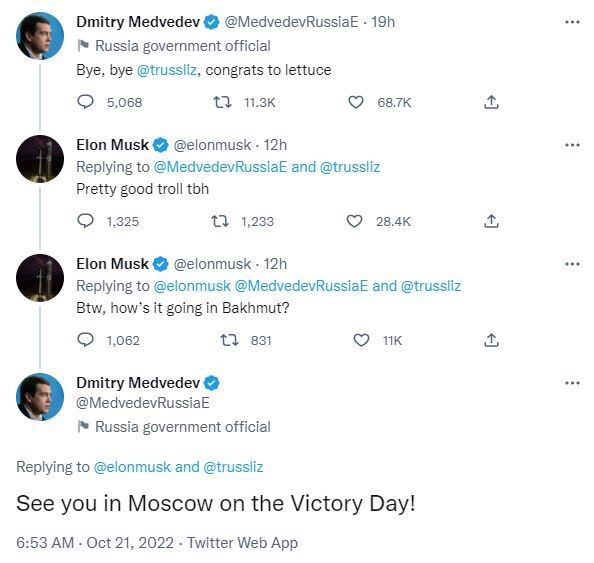
His latest intervention involves a somewhat bizarre Twitter exchange with former Russian prime minister, senior Kremlin official, and prominent Putin ally Dmitry Medvedev.
Musk had complimented Mr Medvedev on a “pretty good troll” after he ridiculed outgoing prime minister Liz Truss.
He then asked the deputy chairman of the Security Council of Russia about it the current situation in Bakhmut, which has faced intense Russian shelling over recent days.
Mr Medvedev concluded (for now at least) the seemingly friendly discussion by suggesting he would see Musk “in Moscow on the Victory Day”.
Elon Musk reportedly plans on making drastic changes to Twitter’s workforce once he finalizes his acquisition of the platform.
According to the Washington Post, Musk informed potential investors that he’s considering a layoff of nearly 75 percent of Twitter’s entire staff, decreasing the number of employees from 7,500 to just over 2,000.
The Post reports Twitter had already been looking to slash its workforce by about 25 percent in an effort to shave $800 million off payroll by the end of 2023. The plan is an indication that the company was struggling with financial issues before Musk came into the picture, and provided a “golden ticket.”
Twitter filed a lawsuit against the 51-year-old in July after he tried to back out of his $44 billion acquisition. The SpaceX and Tesla CEO agreed to finalize their agreement earlier this month, asking the court to give him until Oct. 28 to secure the necessary finances to close the deal.
Before he attempted to terminate his deal with Twitter, Musk seemingly warned the company’s employees during a Q&A session that there would need to be a downsizing of the workforce upon his arrival. He considered the approach to be a “rationalization of headcount,” saying, “Anyone who is a significant contributor should have nothing to worry about.”
WaPo correspondent Elizabeth Dwoskin went on to tweet, “Twitter finally replies to our scoop in an internal note to staff saying the company did not have any confirmation from Musk about his plans and that Twitter’s own, smaller-scale ‘cost savings discussions’ were put on hold once the merger agreement was signed.”
Variety reports Musk acknowledged during a Tesla third-quarter earnings call earlier this week that he was overpaying for Twitter, but also stressed “the long-term potential for Twitter in my view is an order of magnitude greater than its current value.”
Kyiv will find a solution to keep the Starlink internet service operational in Ukraine, according to presidential adviser Mykhailo Podolyak.
Elon Musk previously stated that his rocket firm, SpaceX,could not continue to sponsor Starlink in Ukraine indefinitely.
“Let’s be honest. Like it or not, @elonmusk helped us survive the most critical moments of war. The business has the right to its own strategies.
“Ukraine will find a solution to keep #Starlink working. We expect that the company will provide stable connection till the end of negotiations,” Podolyak wrote on Twitter.
Let’s be honest. Like it or not, @elonmusk helped us survive the most critical moments of war. Business has the right to its own strategies. 🇺🇦 will find a solution to keep #Starlink working. We expect that the company will provide stable connection till the end of negotiations.
Elon Musk, the controversial tech billionaire, has stated that his SpaceX company will no longer provide essential satellite services to Ukraine unless the US military contributes tens of millions of dollars every month, according to CNN.
SpaceX requested that the Pentagon, the headquarters of the United States Department of Defense, take over funding for Ukraine’s government and military usage of Starlink.
SpaceX claims this would cost more than $120m (£106m) for the rest of the year and could cost close to $400m (£355m) for the next 12 months.
“We are not in a position to further donate terminals to Ukraine, or fund the existing terminals for an indefinite period of time,” SpaceX’s director of government sales wrote in the letter.
SpaceX has so far donated 20,000 Starlink satellite units to Ukraine since February.
The satellites have been a vital source of communication for Ukraine’s military since they arrived.
They allow Ukraine to fight and stay connected even as mobile phone and internet networks have been destroyed in its war with Russia.
Reports of the letter come a day after Mr Musk denied reports he has spoken to Russian President Vladimir Putin.
The denial follows a Twitter poll he shared earlier this month where he invited his 107.7 million followers to vote on a suggested “Ukraine-Russia Peace plan”, which included permanently ceding Crimea to Russia.
He said new referendums could be held under UN supervision to determine the fate of Russian-controlled territory, and that Ukraine agree to neutrality.
This drew sharp criticism from Ukrainian President Volodymyr Zelenskyy, who proposed his own Twitter poll: “Which @elonmusk do you like more? One who supports Ukraine (or) one who supports Russia.”
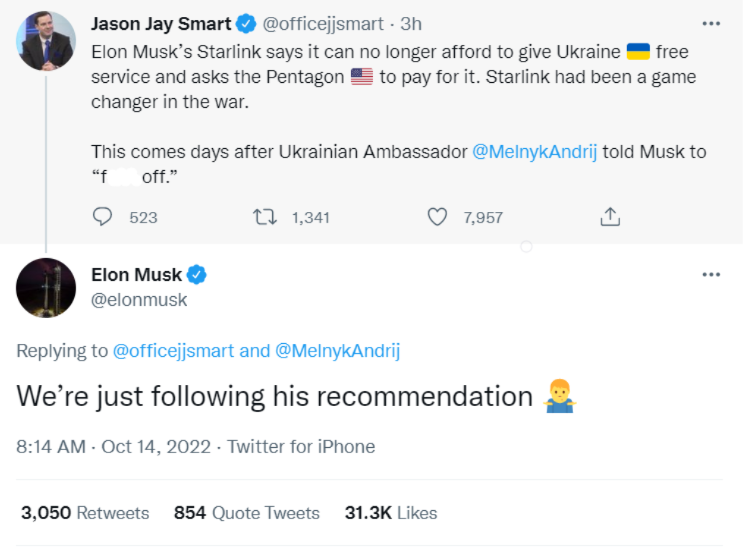
Following reports of SpaceX’s letter to the Pentagon, Kyiv Post correspondent Jason Jay Smartpointed out that it comes days after Ukrainian diplomat Andrij Melynk had tweeted Mr Musk telling him to “f*** off” in response to his Twitter poll.
Mr Musk replied to Mr Smart’s tweet: “We’re just following his recommendation.”
Ukraine-Russia Peace:
– Redo elections of annexed regions under UN supervision. Russia leaves if that is will of the people.
– Crimea formally part of Russia, as it has been since 1783 (until Khrushchev’s mistake).
He said new referendums could be held under UN supervision to determine the fate of Russian-controlled territory, and that Ukraine agree to neutrality.
This drew sharp criticism from Ukrainian President Volodymyr Zelenskyy, who proposed his own Twitter poll: “Which @elonmusk do you like more? One who supports Ukraine (or) one who supports Russia.”
Following reports of SpaceX’s letter to the Pentagon, Kyiv Post correspondent Jason Jay Smart pointed out that it comes days after Ukrainian diplomat Andrij Melynk had tweeted Mr Musk telling him to “f*** off” in response to his Twitter poll.
Mr Musk replied to Mr Smart’s tweet: “We’re just following his recommendation.”
Elon Musk has refuted claims that he communicated with Vladimir Putin before putting his recommendations for stopping Russia’s invasion of Ukraine in a Twitter poll.
Ian Bremmer, head of the Eurasia Group political risk consultancy, alleged that Mr Musk had personally told him about the conversation with Mr Putin.
But Mr Musk has now refuted this.
“I have spoken to Putin only once and that was about 18 months ago. The subject matter was space,” Mr Musk tweeted.
Last week, the Tesla CEO asked his 107.7 million followers to vote on ways to resolve the Ukraine war.
The suggestions included a proposal to hold votes in parts of Ukraine occupied by Russia that the Kremlin says it has annexed. His comments were welcomed by Moscow.
The multi-billionaire said: “Russia leaves if that is the will of the people.”
President Putin has already declared four Ukrainian regions to be part of Russia, following so-called referendumsdenounced as fraudulent by Kyiv and its Western allies. Russia does not fully control any of the four regions.
Mr Musk also suggested the world should “formally” recognise Crimea – illegally annexed by Moscow in 2014 – as part of Russia.
In a newsletter, Mr Bremmer wrote that Mr Musk told him the Russian president was “prepared to negotiate”, but only if Crimea remained under Russian control if Ukraine accepted a form of permanent neutrality, and if Kyiv recognised Russia’s annexation of Luhansk, Donetsk, Kherson, and Zaporizhzhia.
Mr Bremmer said the SpaceX boss told him that Mr Putin said these goals would be accomplished “no matter what” and that there was the potential of a nuclear strike if Ukraine invaded Crimea.
But Mr Musk has since denied the reports.
No, it is not. I have spoken to Putin only once and that was about 18 months ago. The subject matter was space.
Ukrainian Foreign Minister Dmytro Kuleba said people proposing Ukraine give up on its people and land “must stop using the word ‘peace’ as a euphemism to ‘let Russians murder and rape thousands more innocent Ukrainians, and grab more land’”.
Russian chess grandmaster Garry Kasparov called Mr Musk’s tweet “moral idiocy, repetition of Kremlin propaganda, a betrayal of Ukrainian courage & sacrifice”.
Kremlin spokesman Dmitry Peskov welcomed Mr Musk’s suggestions, stating: “It is very positive that somebody like Elon Musk is looking for a peaceful way out of this situation.”
Early in the war, the billionaire gained widespread popularity in Ukraine after sending a number of his Starlink internet terminals to the country. He was subsequently invited to visit by Ukrainian President Volodymyr Zelensky.
But his recent tweets have seen that relationship sour, with Mr Zelensky last week hitting out at his Twitter polls.
US federal law prevents private citizens from conducting foreign affairs without the permission or involvement of the US government.
The Logan Actwas signed into law by President John Adams in 1799, but nobody has ever been prosecuted under it.
Elon Musk says he spoke with the artist formerly known as Kanye West this week about his recent Twitter activity.
As previously reported, Ye’s account was restricted (not permanently suspended) after a tweet shared last week that was widely called out as antisemitic. Ye’s Instagram, which has been a source of continued headlines as of late, was also restricted for violating site policy.
“Talked to ye today & expressed my concerns about his recent tweet, which I think he took to heart,” Musk said on Monday.
Image via Elon Musk on Twitter
Earlier this month, Musk was reported by Bloomberg to have changed his mind about his much-discussed Twitter buyout by offering to buy the company at the originally proposed price. Days later, per the Associated Press, a judge was confirmed to have delayed the kickoff of a trial surrounding the tentative merger.
In lieu of social media on Monday, Ye shared a 30-minute short titled Last Week (but also referred to as War) to YouTube. Meanwhile, criticism over his recent remarks, as well as his featuring of a “white lives matter” design in the YZY SZN 9 show in Paris this month, has continued to mount.
John Legend, for example, shared a tweet about “free, independent thinkers” in which he didn’t mention Ye directly, although the intent was clear. Halloween Ends star Jamie Lee Curtis, Jack Antonoff, and others have also called out Ye in recent days.
After Tesla CEO Elon Muskstated that Taiwan should become a special administrative region of China, Beijing and Taipei expressed their disagreement.
The richest man in the world stated in an interview with the Financial Times that he thought the two countries could come to a “fairly agreeable” agreement.
Musk received praise from China’s ambassador to the US, while his Taiwanese colleague declared that freedom is “not for sale.”
Taiwan rules itself but Beijing claims it as part of its territory.
Last week, Mr Musk also drew criticism for posting a Twitter poll with his suggestions for ending the war between Russia and Ukraine, including Kyiv giving up territory to Moscow.
Mr Musk’s comments come as the electric car maker hit a monthly record for sales in China.
He weighed in on heightened China-Taiwan tensions in a wide-ranging interview with the UK business newspaper the Financial Times, which was published on Friday.
“My recommendation… would be to figure out a special administrative zone for Taiwan that is reasonably palatable, probably won’t make everyone happy,” he said.
“And it’s possible, and I think probably, in fact, that they could have an arrangement that’s more lenient than Hong Kong.”
I would like to thank @elonmusk for his call for peace across the Taiwan Strait and his idea about establishing a special administrative zone for Taiwan. Actually, Peaceful reunification and One Country, Two Systems are our basic principles for resolving the Taiwan question… https://t.co/KYH1Gsu3Um
On Saturday, China’s ambassador to the US Qin Gang welcomed Mr Musk’s suggestion to establish Taiwan as a special administrative zone.
He said on Twitter that “peaceful reunification” and the “one country two systems” model used in governing Hong Kong were China’s “basic principles for resolving the Taiwan question”.
“Provided that China’s sovereignty, security and development interests are guaranteed, after reunification Taiwan will enjoy a high degree of autonomy as a special administrative region, and a vast space for development,” he added.
In response, Hsiao Bi-khim, Taiwan’s de facto ambassador to Washington said on Twitter: “Taiwan sells many products, but our freedom and democracy are not for sale.”
“Any lasting proposal for our future must be determined peacefully, free from coercion, and respectful of the democratic wishes of the people of Taiwan,” Ms Hsiao added.
Shihoko Goto, director for geoeconomics and Indo-Pacific enterprise at the Wilson Center in Washington DC, told the BBC that Mr Musk’s suggestions could hurt his business interests.
“Let’s bear in mind that Elon Musk is supposedly on the brink of purchasing Twitter. Of course, Twitter is banned in China because free speech is not allowed in China,” Ms Goto said.
“So if he is investing in Twitter, his company will probably not be able to operate in Taiwan which is going to be under pressure or under the thumb of China. That would be a suicidal act on the part of Elon Musk,” she added.
China sees self-ruled Taiwan as a breakaway province that will eventually be under Beijing’s control.
Meanwhile, Tesla delivered 83,135 China-made electric vehicles in September, according to a report released on Sunday by the China Passenger Car Association.
That broke the previous record set by the company in June and marked a milestone for Tesla’s factory in Shanghai which has been trying to boost production.
Billionaire Elon Musk has said that he intends to complete buying Twitter by the end of the month, but the firm “will not accept yes for an answer.”
He said in a court document that the social media site had expressed worries about the “theoretical possibility of a future failure to get debt financing” to pay for the deal.
Twitter sued Mr Musk in July after he tried to back out of buying the firm.
Mr Musk asked the court to put that legal fight on hold.
Mr Musk said litigation was no longer necessary after he said in a surprise move this week that he was prepared to go forward with the original takeover plan, pending receipt of the financing and an end to the legal battle.
“There is no need for an expedited trial to order defendants to do what they are already doing,” Mr Musk’s attorneys wrote in a filing.
“Yet, Twitter will not take yes for an answer. Astonishingly they have insisted on proceeding with this litigation, recklessly putting the deal at risk and gambling with their stockholders’ interests.”
In its own filing for Delaware Chancery Court on Thursday, Twitter said it was opposed to suspending litigation, calling such a move “an invitation to further mischief and delay.”
It said it did not trust Mr Musk’s promises, noting that one bank helping to finance the deal had testified this week that it had not received any notice from Mr Musk about plans to move forward.
“Defendants can and should close next week,” the company wrote. “Until defendants commit to close as required, Twitter is entitled to its day in court.”
Mr Musk announced a plan to buy Twitter for $54.20 per share in April. But he backed away from the dealjust a few weeks later saying he was concerned that spam accounts on the platform were higher than Twitter had claimed.
Twitter ultimately sued to force Mr Musk to complete the deal.
In its lawsuit, Twitter argued Mr Musk was worried about the price he had agreed to pay, after a sharp downturn in the value of tech shares, including Tesla, the electric car company he leads and is the base of much of his wealth.
Mr Musk was due to be questioned this week as part of the preparation for the trial, which was scheduled to begin on 17 October. The trial is now postponed to 28 October to allow a deal to close, according to a court filing.
Shares in Twitter ended the day down more than 3%, amid investor doubts the deal will go through.
Billionaire Elon Musk has agreed to follow through with a deal to buy Twitter at the original price, the company disclosed Tuesday, causing Twitter shares to skyrocket and possibly ending a seven-month legal saga just two weeks before the world’s wealthiest man and the social media company were set to meet in court.
KEY FACTS
Musk offered to buy Twitter for $54.20 per share, or $44 billion, matching the terms he agreed to in April before he later attempted to back off the deal, according to a letter dated Monday and filed with the Securities and Exchange Commission.
The brief 177-word note said Musk is willing to move forward with the deal provided there is an immediate stay on Twitter’s lawsuit to push the purchase through ahead of the five-day trial in Delaware slated to begin October 17.
The stock later surged to $52.02—just below Musk’s agreed-upon purchase price—after trading resumed shortly before the market close, a 22.3% daily rise that brought the share price to its highest level since last November.
The company’s intends to “close the transaction at $54.20 per share,” Twitter spokesperson Brenden Lee wrote to Forbes, in a statement mirroring the company’s prior comments on Musk’s hesitation.
KEY BACKGROUND
Twitter accepted Musk’s unsolicited takeover bid on April 25, three weeks after the billionaire disclosed he purchased a 9.2% stake in the company. Musk, a vocal opponent of the platform’s content moderation policy, quickly began to express cold feet and said he had concerns about the number of fake and spam accounts on the site or bots. He formally requested out of the deal on July 8, arguing Twitter has lowballed the number of bot accounts in its public filings.
Twitter sued Musk four days later and argued his reasons for backing out of the deal were invalid. The company pushed a state court in Delaware to force Musk to buy Twitter along the originally agreed-upon terms, setting the stage for a high-stakes trial later this month. As the trial date drew nearer, more revelations about both Twitter and Musk emerged.
Musk’s lawyers suggested last month his case was bolstered by a whistleblower complaint from Twitter’s former head of security, who alleged the company knowingly misled regulators and investors about the number of bots on the site. And last week, hundreds of Musk’s texts with celebrities like Twitter co-founder Jack Dorsey, controversial podcaster Joe Rogan, and Gov. Ron DeSantis (R-Fl.) were disclosed as part of the suit.
Tesla shares fell about 5% in the hour after the report, paring gains earlier in the day, before recovering to a 2.4% gain on the day. Shares of the electric vehicle maker dropped about 20% in April amid a more modest broad market decline.
CRUCIAL QUOTE
“This is a clear sign that Musk recognized heading into Delaware Court that the chances of winning vs. Twitter board was highly unlikely and this $44 billion deal was going to be completed one way or another,” Wedbush analyst Dan Ives wrote in a note to clients Tuesday.
President of Ukraine Volodymyr Zelensky reacted to Elon Musk after the Tesla CEO shared a Twitter poll with his ideas for stopping Russia’s invasion.
Voting options that included giving territory to Russia were put to the vote by Mr. Musk’s 107.7 million followers.
In response, Mr Zelensky posted his own poll asking users if they liked the world’s richest person more when he supported Ukraine.
Other Ukrainians criticized Mr Musk.
Ukraine’s outgoing ambassador to Germany, Andrij Melnyk, used a strong expletive, which he described as his “very diplomatic reply”.
Meanwhile, Russian chess grandmaster Garry Kasparov said: “This is moral idiocy, repetition of Kremlin propaganda, a betrayal of Ukrainian courage & sacrifice.”
Mr Musk’s ideas included votes in parts of Ukraine occupied by Russia that the Kremlin says it is annexing.
The multi-billionaire said: “Russia leaves if that is the will of the people.”
President Vladimir Putin has already declared four Ukrainian regions to be part of Russia, following so-called referendums denounced as fraudulent by Kyiv and its Western allies. Russia does not fully control any of the four regions.
Mr Musk also suggested the worldshould formally recognise Crimea – annexed by Russia in 2014 – as part of Russia. And the world’s richest person in 2022, according to Forbes magazine, cautioned that the conflict could end in nuclear war, though added this was “unlikely”.
This is highly likely to be the outcome in the end – just a question of how many die before then
Earlier in Russia’s invasion, Mr Musk’s satellite internet company sent equipment to Ukraine.
That gained Mr Musk popularity in Ukraine and he was subsequently invited by Mr Zelensky to visit when the war with Russia was over.
The businessman posted his poll during a busy week when he is due to give evidence to lawyers acting for Twitter ahead of a trial set to begin on 17 October. Twitter is suing Mr Musk after he walked away from a $44bn deal to buy the social media platform.
Twitter is hoping the court in Delawarewill order Mr Musk to complete the takeover at the agreed price of $54.20 per share.
Elon Musk’s father felt like Clint Eastwood while taking out a mob of intruders in 1998.
In an interview with The Sun, Errol Musk recalled the 1998 incident, which took place at a rental property he owned in Johannesburg, South Africa. Errol with his daughter, Ali, who was six years old at the time, checking in on a property in the financial district of Sandton.
While painters were finishing up work on the property, a mob of intruders broke into the house. As the gunmen opened fire on Errol, he retreated to the bedroom to retrieve his .357 Magnum. Musk subsequently killed three of the men as he fought off the mob.
“As soon as they saw me, they started shooting at me,” he explained. “They opened up on me. I killed three. One bullet went through two of them.”
Errol continued, “I took the first guy out through the head. The police found him with the top of his head missing. I was using hollow point ammunition, so the round broke up, and the shrapnel hit the guy behind him in the chest. They ran as soon as I fired my first shot.”
Musk survived thanks to an expandable door, which the intruders’ gunfire hit instead of Errol. “The bullet hit it dead center; otherwise, it would have hit me square in the chest,” he said.
When asked if he felt like Clint Eastwood during the shootout, Errol replied, “Well, you can say so. Yeah, why not?”
The internet may have evolved from a niche pastime to an essential part of our day-to-day life but for many, it’s problematic.
The internet in its current form, Web 2.0, has become too centralized with only a handful of big technology companies – and governments – dominating the market.
There’s even a collective name for these giants who have transformed the way we work, shop and socialize: FAANG – Facebook (now Meta), Amazon.com, Apple, Netflix and Google-owner Alphabet.
Web 3.0 is the third generation of the internet, a decentralized online ecosystem based on the blockchain. The term was coined by a computer scientist named Gavin Wood in 2014. Wood co-founded Ethereum, the decentralized blockchain platform behind the cryptocurrency ether (ETH).
In a podcast with CNBC, Wood explained that the biggest issue with Web 2.0 is trusting the people behind the services: “We’ve managed to architect ourselves into this somewhat dystopian version of what the world could be,” he said.
This is why, for many, Web 3.0 is about looking at the internet in a more distributed and democratic way. It’s also a critical building block towards creating the metaverse, an immersive online world. Venture capitalists are investing billions of dollars into this future vision while others remain sceptical, calling Web 3.0 a marketing buzzword and a pyramid scheme.
Both Elon Musk and Jack Dorsey, the former CEO of Twitter, are known to be ‘against’ the concept, Musk tweeting that “Web 3 isn’t real” and that he couldn’t see a compelling use-case for the VR-driven metaverse.
Brian Solis, a world-renowned digital anthropologist and futurist, explains to FORBES AFRICA that even though the promise of the internet that we’re using today was wonderful, it has negative impacts and consequences that we’re only just beginning to understand: “I was one of the biggest champions of social media and I still believe in its promise,” he says.
“I don’t necessarily believe in the capitalism behind it and how it has evolved… but those same principles can apply and should apply to Web 3.0.”
Solis also differentiates between the aspirational sense of what Web 3.0 could be and where we are today. “There are many aspects of the hype cycle in Web 3.0 – the metaverse, blockchain, NFTs, crypto… they lay the foundation for what we can build in terms of utility and scale.”
While global research and consultancy agency Gartner says Web 3.0 won’t necessarily overtake Web 2.0 before the end of the decade, it will enable new business and social models where users own their own data, identity, content and algorithms.
And that is what makes Web 3.0 so valuable – it shifts digital power back into the hands of the user, rather than to a secondary platform, integrating both the physical and digital world.
Will Africa enter the Metaverse?
For Africa, it’s a little different. While the concept of a digital currency may be confusing at first, Africa embraced mobile money in 2007 with M-Pesa. Africa’s willingness to adopt new technologies that benefit its growing population should not be taken for granted – what was once a basic SIM card-based money transfer application is now a fully-fledged financial service.
Liebe Jeannot, the founder and manager partner of Akazi Capital, a blockchain-based impact fund that invests in female entrepreneurs in sub-Saharan Africa, is optimistic about Web 3.0. “We’re still in early days. This is only the beginning of the cycle so I’m excited to see how things will evolve based on what’s happened in the past but also in terms of new entrants coming into the space,” she says.
A study by Chainalysis, a blockchain data platform with an extensive global research hub, found that Africa not only had the third-fastest growing cryptocurrency economy globally in 2021, it led the world in the share of overall crypto transaction volume coming from peer-to-peer. Today, the second-largest bitcoin market can be found in Nigeria, which also happens to be only one of five nations with a government-introduced central bank digital currency.
“Even though there are countries in Africa with really high crypto-adoption rates, so much of the continent hasn’t jumped on board. It speaks to the fact that when we talk about Web 3.0, it’s a concept that’s quite removed from a lot of people in terms of their lives and what they think it can do,” adds Jeannot. “As soon as you can bring those concepts close to home and show them concepts that they can relate to, that’s when you’ll have more people entering the space with things becoming more user-friendly in terms of the way in which we interact with technology.”
Jeannot believes that Africa is ready to unlock Web 3.0. And that this new, future vision for the internet will become a reality in the same way that we use email.
“We don’t have to understand the technology behind it, what goes on behind the scenes in terms of code, but we understand the way we interact with it and how we apply it to our daily life,” she says. “It’s going to be a similar thing with Web 3.0. NFTs, for example, play an interesting role because people relate to art – you collect it or you enjoy it but in order to buy NFTs, it doesn’t have to be complicated,” says Jeannot.
“The space is so diverse with many different projects that speak to different parts of who we are as people. There’s still a lot of room for African projects by Africans and as we start bringing more people from the continent into the space as investors, there’ll be more of an appetite from people wanting to consume and be a part of Web.3.0.”
The CEO of Twitter, Parag Agrawal,will be questioned in a deposition on Monday as part of the ongoing legal action the company is pursuing to compel Elon Musk to finish buying the social media company for $44 billion.
According to a court filing, lawyers for Musk are set to question Agrawal at 9 a.m. PT. Musk himself is set to be deposed by Twitter’s lawyers on Monday and Tuesday, according to an earlier court filing.
The testimony comes as both sides barrel toward a high-profile trial set for mid-October.
Musk has sought to extricate himself from the merger agreement, first by claiming that Twitter’s spam account problem is far greater than it has let on, and later by citing allegations of longstanding unaddressed security vulnerabilities disclosed by the company’s former head of security.
Those allegations, which were also submitted to the US government under a whistleblower process, were first reported by CNN and The Washington Post last month.
Monday’s deposition could force Agrawal to answer questions linked to the whistleblower allegations by Peiter “Mudge” Zatko, who led Twitter’s security team from November 2020 until he was fired this January.
Twitter has previously said that Zatko’s allegations paint a “false narrative” of the company and that Musk’s claims are “factually inaccurate, legally insufficient and commercially irrelevant.”
Earlier this month, leading members of the Senate Judiciary Committee sent Agrawal a letter seeking similar information and requested responses by Sept. 26, but it is not clear whether Twitter has responded to the letter. The committee did not immediately respond to a request for comment.
Twitter on Friday July, 22 blamed uncertainties related to its US$44 billion acquisition Elon Musk and a weakening digital ad market for a surprise fall in quarterly revenue.
Twitter, which has sued Musk for dropping his offer to buy the company, said advertising revenue rose just 2 per cent to US$1.08 billion.
It reported second-quarter revenue of US$1.18 billion, compared with US$1.19 billion a year earlier. Analysts were expecting US$1.32 billion, according to Refinitiv IBES data.
Twitter shares were down 3 per cent in trading before the bell.
The company’s results come after Snapchat parent Snap posted weak results and declined to make a forecast, citing “incredibly challenging” conditions as advertisers cut back on spending.
Twitter and its peers, including Snap and Alphabet, saw an uptick in revenue last year as brands spent heavily on advertising online, eyeing a recovery from the pandemic.
But inflation pressures and fears of a recession this year have forced brands to rethink their marketing budgets.
At the same time, Gen Z-favorite TikTok and tech giant Apple, which gives users the choice to opt of data tracking, are grabbing market share in the digital ad space.
A US judge has ordered that Twitter’s lawsuit against Elon Musk go to trial in October, a blow to the world’s richest man who had asked for a delay.
Mr Musk walked away from his $44bn (£36bn) bid to buy Twitter earlier in July, prompting the company to sue him.
Twitter hopes that the court will order Mr Musk to complete the takeover at the agreed price of $54.20 per share.
The tech billionaire has accused Twitter of withholding information about fake accounts.
His legal team has called for the trial to be held early next year due to its complexities, but Twitter asked for a September date.
On Tuesday, a judge in the state of Delaware agreed with the company and said a delay to the trial would cast a “cloud of uncertainty”.
“Delay threatens irreparable harm,” Chancellor Kathaleen St Jude McCormick said. “The longer the delay, the greater the risk.”
The lawsuit accused Mr Musk of a “long list” of violations ahead of the potential merger and argued that he had “cast a pall” over the company.
At the hearing on Tuesday, Twitter’s lead counsel William Savitt said the ongoing uncertainty about whether the takeover would go forward or not “inflicts harm on Twitter everyday”.
To buy or not to buy?
There is a theory that Musk still wants to buy Twitter, he’s just trying to knock down the price.
If that’s the case, his lawyers are spectacularly good poker players.
Mr Musk’s legal team wanted this trial to happen next year.
They claimed they needed more time to dig through data on spam accounts. Clearly though this is also a stalling strategy.
They repeated Mr Musk’s assertion that Twitter may have more fake accounts than it claims.
That is a hugely damaging accusation – and a strange thing to say if Mr Musk were still interested in purchasing the company at a lower price.
Twitter’s reputation has already taken a huge hit. Twitter’s revenues are almost entirely based on ads. The fewer real people on the platform, the less money it can make. Bots don’t have wallets.
That’s why Twitter wants this process sorted quickly. By far the best case scenario for the company is that Mr Musk buys it for $54.20 a share – and that it happens as soon as possible.
That’s why this judgement is good news for Twitter. The judge sided with Twitter’s lawyers – that a ruling needed to be reached quickly.
It heaps more pressure on Mr Musk, who is faced with the bizarre prospect of having to buy a company he no longer wishes to acquire.
However, in practice this will likely put more pressure on Mr Musk to settle, pay Twitter some money, and move on.
“Musk has been and remains contractually obligated to use his best efforts to close the deal,” Mr Savitt said. “What he’s doing is exactly the opposite. It’s sabotage.”
A lawyer for Mr Musk, Andrew Rossman, argued that he remains one of Twitter’s most significant shareholders. He said the case should go to trial next year on a “sensible” schedule that would give both sides time to prepare.
Since Mr Musk began questioning the number of fake and spam accounts on Twitter’s platform in May, the company has seen its share prices fall from highs of $50 per share.
The company’s shares currently stand at about $39.45 – well below the $54.20 per share at which it hopes to close the merger.
A self-described “free speech absolutist”, Mr Musk has vowed to ease restrictions on content if the company were under his ownership.
He has also called for the company to be more open about how it presents tweets to users and how tweets are promoted to larger audiences.
Elon Musk says Tesla’s new factories in Germany and the US are “losing billions of dollars” due to battery shortages and supply disruptions in China.
The multi-billionaire also called the plants in Berlin and Austin, Texas “gigantic money furnaces”.
Covid-19 lockdowns in China this year, including in Shanghai where Tesla has a huge factory, have made it increasingly difficult for manufacturers to operate.
In recent weeks Mr Musk has been warning of job cuts at the firm.
“Both Berlin and Austin factories are gigantic money furnaces right now. It’s really like a giant roaring sound, which is the sound of money on fire,” said Mr Musk, who is the electric vehicle maker’s chief executive.
The plants are “losing billions of dollars right now. There’s a ton of expense and hardly any output,” he added in an interview with the Tesla Owners of Silicon Valley, a company-recognised club.
Mr Musk said the so-called gigafactories have been struggling to increase production since they were opened earlier this year.
Tesla’s site in Austin currently produces a “tiny” number of cars, partly because some components for its batteries were “stuck” at a Chinese port “with no one to actually move it”, he said.
“This is all going to get fixed real fast but it requires a lot of attention,” Mr Musk added.
The interview was recorded at the end of last month but this part of the conversation was only posted on Wednesday.
Authorities in China locked down a number of its cities earlier this year in response to a surge in Covid-19 infections.
Tough restrictions were imposed on the movement of people and materials including in the financial, manufacturing and shipping hub of Shanghai.
Mr Musk said the shutdown of Shanghai was “very, very difficult” for Tesla, which reportedly halted most of its production at its ‘gigafactory’ in the city for weeks.
The site will largely be closed again for two weeks next month for upgrading works, according to the Reuters news agency, which cited an internal memo.
This is aimed at boosting the site’s output, bringing it closer to the company’s goal of the plant producing 22,000 cars every week, the report said.
Tesla did not immediately respond to a BBC request for comment.
Last week, the company raised the price of its whole range of cars in the US by almost 5%, as the cost of raw materials including aluminium and lithium rose.
This week, Mr Musk said Tesla planned to shed 3.5% of its global workforce after earlier saying that he had a “super bad feeling” about the economy.
Meanwhile, German carmaker BMW said on Thursday that it had formally begun production at its new $2.2bn (£1.8bn) facility in the northeastern Chinese city of Shenyang.
BMW said the plant, which is its third in China, will increase its annual output in the country from 700,000 to 830,000.
The news, which was first reported by Business Insider, was confirmed to the BBC by a spokesperson for Twitter.
The all-hands meeting will be the first time Mr Musk will have spoken directly with the company’s workforce since launching his takeover bid.
Earlier this month, he threatened to walk away from the deal, accusing the social media company of “thwarting” his requests to learn more about its user base.
In a letter filed with regulators, Mr Musk said he was entitled to do his own measurement of spam accounts.
The letter formalised a dispute that had simmered for weeks after he declared the deal “on hold” pending further information.
Analysts have said that Mr Musk might be using the issue to try to renegotiate the price or even walk away from the deal. They said his decision to raise the matter on social media was unconventional, making it difficult to establish how serious he was.
Elon Muskhas threatened to walk away from his $44bn takeover of Twitter, accusing the social media company of “thwarting” his requests to learn more about its user base.
In a letter filed with regulators, Mr Musk said he was entitled to do his own measurement of spam accounts.
The letter formalises a dispute that has simmered for weeks after Mr Musk declared the deal “on hold” pending further information.
Twitter has defended its estimates.
But Mr Musk has said he believes spam and fake accounts represent a far greater share than the less than 5% of daily users that Twitter reports publicly.
“As Twitter’s prospective owner, Mr Musk is clearly entitled to the requested data to enable him to prepare for transitioning Twitter’s business to his ownership and to facilitate his transaction financing. To do both, he must have a complete and accurate understanding of the very core of Twitter’s business model – its active user base,” lawyer Mike Ringler wrote in the letter.
“Based on Twitter’s behaviour to date, and the company’s latest correspondence in particular, Mr Musk believes the company is actively resisting and thwarting his information rights,” the letter said.
“This is a clear material breach of Twitter’s obligations under the merger agreement and Mr Musk reserves all rights resulting therefrom, including his right not to consummate the transaction and his right to terminate the merger agreement.”
The dispute has raised more doubts about the future of the takeover, which Twitter’s board approved in April.
“Twitter has and will continue to cooperatively share information with Musk to consummate the transaction in accordance with the terms of the merger agreement,” the company said in a statement.
Twitter, which has said Mr Musk waived typical rights to due diligence in his eagerness to clinch the deal, added that it intended to complete the takeover at the agreed price and terms.
Mr Musk, who faces a $1bn break-up fee and possible lawsuit if he opts out, first raised the issue of the spam accounts on social media last month, saying the deal was on hold but he remained committed to the acquisition.
Analysts have said the Tesla boss might be using the issue to try to renegotiate the price or even walk away. They said Mr Musk’s decision to raise the issue on social media was unconventional, making it difficult to establish how serious he was.
When Twitter chief executive Parag Agrawal defended the company’s process in a series of tweets, Mr Musk responded with a poo emoji.
Mr Musk has said he believes that bots could account for 20% or more of Twitter users. The letter, filed with the US Securities and Exchange Commission, confirms that the two sides have gone back and forth on the issue since early May.
It says Mr Musk merits “reasonable cooperation” as he tries to line up financing for the deal.
“Twitter’s latest offer to simply provide additional details regarding the company’s own testing methodologies, whether through written materials or verbal explanations, is tantamount to refusing Mr Musk’s data requests,” the letter says.
“Twitter’s effort to characterize it otherwise is merely an attempt to obfuscate and confuse the issue.”
Mr Musk’s plans for the company have drawn intense scrutiny from regulators around the world, while raising some alarm among investors of electric car company Tesla and rocket firm SpaceX, which Mr Musk also leads.
He has lined up outside investors to help pay for the takeover and is also using equity and loans backed by his Tesla shares, which have been hit in recent weeks as market turmoil wipes billions from the values of companies including Tesla.
The decline has also made Mr Musk’s offer of $54.20 per share for Twitter look even more generous. On Monday, Twitter shares were trading below $39, down 3%. They have yet to return to the highs they hit last month shortly after Mr Musk revealed he had purchased about 9% of the firm’s shares.
Susannah Streeter, senior investment and markets analyst at Hargreaves Lansdown, said the letter marked the “strongest signal yet that the Tesla founder is prepared to walk away”.
“This is a move Twitter investors have for weeks been steeling themselves for: the moment when Elon Musk’s haphazard ruminations in tweets have been distilled into an official letter to regulators,” she said. “However, given the added volatility which has hit the tech sector since Mr Musk made his offer, it’s highly likely he’s after a cheaper price even if Twitter does provide the data requested in support of its initial analysis.”
Twitter investors are suing Elon Musk and the social media platform over the handling of the billionaire’s $44bn (£34.9bn) bid for the company.
The case alleges he violated California corporate laws in a number of ways.
It accuses the Tesla bossof “wrongful conduct” as his “false statements and market manipulation have created ‘chaos’ at Twitter’s headquarters in San Francisco”.
Twitter shares are around 27% lower than Mr Musk’s $54.20 offer price.
The lawsuit also claimed Mr Musk benefitted financially by delaying the disclosure of his significant stake in Twitter, and his plan to become a board member of the company.
It also claimed that several tweets posted by Mr Musk, who is a regular Twitter user with more than 95m followers, were “misleading”.
It included a post in which Mr Musk said his takeover bid for the social media firm was on hold because of his doubts over the number of fake accounts on the platform.
The tweet on 13 May “constituted an effort to manipulate the market for Twitter shares as he knew about the fake accounts,” the lawsuit said.
Twitter deal temporarily on hold pending details supporting calculation that spam/fake accounts do indeed represent less than 5% of usershttps://t.co/Y2t0QMuuyn
It also said Mr Musk “doubled down” on his allegations four days later, by stating on Twitter that the deal “cannot go forward”.
On Friday, Frank Bottini, who is one of the lawyers representing the Twitter investors, told the BBC that the lawsuit was filed as Mr Musk “continues to disparage the company he wants to buy for $44bn in an effort to renegotiate the purchase price”.
“The complaint we filed in San Francisco seeks to hold Musk liable for his unlawful conduct,” Mr Bottini said.
Analysts have speculated that Mr Musk may be looking for ways to lower his takeover offer or walk away from the deal.
He has tweeted several times that he was concerned about the number of fake accounts, or bots, on Twitter.
A bot is a software programme that sends out automated posts and is often associated with misinformation on social media platforms.
Mr Musk has also hinted that he may seek to pay less for Twitter than the $44bn agreed with the company’s board in March.
Speaking at a technology conference earlier this month, he said striking a deal at a lower price was “not out of the question”.
The proposed class-action lawsuit was filed this week at the US District Court for the Northern District of California by investor William Heresniak, who said he was acting “on behalf of himself and all others similarly situated”.
A class-action is a lawsuit that has been filed or is defended by an individual acting on behalf of a group of people.
Mr Musk’s lawyers and Tesla did not immediately respond to a BBC request for comment on Friday.
Twitter declined to comment when contacted by the BBC.
Earlier this month, Twitter confirmed that two of its bosses who had been leading its consumer and revenue operations were leaving the company.
The firm has also paused most hiring except for “business critical roles”.
Elon Musk has said his $44bn (£35bn) deal to buy Twitter is on hold after he queried the number of fake or spam accounts on the social media platform.
He said he was waiting for information “supporting [the] calculation that spam/fake accounts do indeed represent less than 5% of users”.
Mr Musk added later that he was “still committed to [the] acquisition”.
However, analysts speculated he could be seeking to renegotiate the price or even walk away from the takeover.
Mr Musk’s tweets sent Twitter’s share price plunging 10% in morning trade in New York.
Twitter deal temporarily on hold pending details supporting calculation that spam/fake accounts do indeed represent less than 5% of usershttps://t.co/Y2t0QMuuyn
Even before his comments, the company’s stock had been selling for less than the $54.20 per share Mr Musk has offered, a sign that the markets were not convinced he would complete the buyout.
Dan Ives, a tech analyst at investment firm Wedbush Securities, said Mr Musk’s comments would “send this Twitter circus show into a Friday the 13th horror show”.
“Many will view this as Musk using this Twitter filing/spam accounts as a way to get out of this deal in a vastly changing market,” he wrote in a note.
“The nature of Musk creating so much uncertainty in a tweet (and not a filing) is very troubling to us… and now sends this whole deal into a circus show with many questions and no concrete answers as to the path of this deal going forward.”
Mr Musk has been vocal about “defeating the spam bots”, identifying it as a key goal following his planned takeover of the company.
Twitter has long faced accusations of not doing enough to address automated, fake accounts posting content.
In a filing more than two weeks ago, Twitter estimated that fake accounts accounted for fewer than 5% of its daily active users during the first three months of this year. It cautioned that the figures were based on estimates and could be higher.
Those claims were not different from what the firm had shared in previous disclosures.
The number of spam bots on the service is a key statistic, as a higher than expected figure could hurt the ability to grow advertising revenue or paid-for subscriptions, said Susannah Streeter, analyst at Hargreaves Lansdown.
But she said it was not clear how genuine Mr Musk’s concerns were.
“There will also be questions raised over whether fake accounts are the real reason behind this delaying tactic, given that promoting free speech rather than focusing on wealth creation appeared to be his primary motivation for the takeover,” she said.
“The $44bn price tag is huge, and it may be a strategy to row back on the amount he is prepared to pay to acquire the platform.”
Weeks of market turmoil in the US have wiped billions off the value of many companies – including once favoured tech firms.
Tesla, the electric car company where Mr Musk serves as chief executive, has also seen its shares plunge – a hit to Mr Musk, whose status as the world’s richest person is bound up in his stake in the company and who had planned to rely on his shares to help finance the Twitter purchase.
Last month, he raised $8.5bn by selling shares. He also planned to use the shares to secure $6.5bn in loans.
After Mr Musk tweeted that the deal was temporarily on hold, Tesla’s share price gained more than 5%.
The board of Twitter has agreed to a $44bn (£34.5bn) takeover offer from the billionaire Elon Musk.
Mr Musk, who made the shock bid less than two weeks ago, said Twitter had “tremendous potential” that he would unlock.
He also called for a series of changes from relaxing its content restrictions to eradicating fake accounts.
The firm initially rebuffed Mr Musk’s bid, but it will now ask shareholders to vote to approve the deal.
Mr Musk is the world’s richest person, according to Forbes magazine, with an estimated net worth of $273.6bn mostly due to his shareholding in electric vehicle maker Tesla which he runs. He also leads the aerospace firm SpaceX.
“Free speech is the bedrock of a functioning democracy, and Twitter is the digital town square where matters vital to the future of humanity are debated,” Mr Musk said in a statement announcing the deal.
“I also want to make Twitter better than ever by enhancing the product with new features, making the algorithms open source to increase trust, defeating the spam bots, and authenticating all humans,” he added.
“Twitter has tremendous potential – I look forward to working with the company and the community of users to unlock it.”
The move comes as Twitter faces growing pressure from politicians and regulators over the content that appears on its platform. It has drawn critics from left and right over its efforts to mediate misinformation on the platform.
In one of its most high-profile moves, last year it banned former US President Donald Trump, perhaps its most powerful user, citing the risk of “incitement of violence”.
At the time Mr Musk observed: “A lot of people are going to be super unhappy with West Coast high tech as the de facto arbiter of free speech.”
News of the takeover has been cheered by the right in the US, although Mr Trump on Monday told Fox News he had no plans to re-join the platform.
The White House declined to comment on the takeover but spokesperson Jen Psaki told reporters: “No matter who owns or runs Twitter, the president has long been concerned about the power of large social media platforms.”
On Twitter, MP Julian Knight, chairman of the UK’s Digital, Culture, Media and Sport Committee, called the deal an “extraordinary development in the world of social media”.
“It will be interesting to see how a privately owned Twitter (run by a man who is an absolutist over free speech) will react to global moves to regulate.”
BBC environment analyst Roger Harrabin says scientists are nervous about the potential impact of the takeover on the climate debate.
He notes that Twitter announced last week it would ban advertisements that deny the scientific consensus on the climate crisis, with the firm admitting that misleading information can undermine efforts to protect the planet.
Image source, Getty Images
Controversial history
Mr Musk, who has more than 80 million followers on Twitter, has a controversial history on the platform himself.
In 2018 US financial regulators accused him of misleading Tesla investors with his tweets, claims that were resolved in a $40 million settlement and that Mr Musk continues to deny.
And in 2019 he was hit with a defamation suit – which he successfully defeated – after calling a diver involved in rescuing schoolboys in Thailand “pedo guy” on the platform.
On Monday, Mr Musk, who has been known to clash with journalists and block critics, suggested that he saw Twitter as a forum for debate.
“I hope that even my worst critics remain on Twitter, because that is what free speech means,” he wrote just hours before the deal was announced.
Can Musk turn Twitter around?
As part of the takeover, which is expected to close later this year, Twitter’s shares will be delisted and it will be taken private.
Mr Musk has suggested this will give him freedom to make the changes he wants to the business.
Among other ideas, he has suggested allowing longer posts and introducing the ability to edit them after they have been published.
Twitter shares on Monday closed more than 5% higher after the deal was announced.
But the price remained lower than Mr Musk’s $54.20 per share offer, a sign that Wall Street believes he is overpaying for the firm.
Mr Musk has said he doesn’t “care about the economics” of the purchase. However, he will take on a company with a chequered record of financial performance.
Despite its influence, Twitter has rarely turned a profit and user growth, particularly in the US, has slowed.
The company, founded in 2004, ended 2021 with $5bn in revenue and 217 million daily users globally – a fraction of the figures claimed by other platforms such as Facebook.
Bret Taylor, chair of Twitter’s board, said it had fully assessed Mr Musk’s offer and it was “the best path forward for Twitter’s stockholders”.
Image source, Twitter Image caption, Parag Agrawal succeeded Twitter co-founder Jack Dorsey in November
It is not clear who will lead the company moving forward. Twitter is currently led by Parag Agrawal, who took over from co-founder and former boss Jack Dorsey last November.
But in his offer document, Mr Musk told Twitter’s board: “I don’t have confidence in management.”
Mr Agrawal told employees on Monday that the future of Twitter is uncertain.
“Once the deal closes, we don’t know which direction the platform will go,” he said, according to the Reuters news agency.
Mr Musk’s targeting of Twitter has moved at remarkable speed. It emerged at the beginning of April that he had become the largest shareholder in the firm with a 9.2% stake.
He was then invited to join Twitter’s board but turned down the offer before launching a surprise bid for the company on 14 April, saying he wanted to “unlock” its potential as a bastion of freedom of speech.
Twitter tried to fend off his bid, threatening to dilute the shareholdings of anyone who bought more than a 15% stake in the firm. However, its stance shifted after Mr Musk revealed more financial details about his proposed bid.
He has secured $25.5bn of financing for the deal and will take a $21bn stake in the business.
The board unanimously approved the bid, which will now be presented to shareholders for a vote.
Elon Musk: Twitter’s new king
The speed this move has happened at had many heads in Silicon Valley spinning.
From nowhere, Elon Musk is the absolute monarch of Twitter.
He himself has said it’s not about the “economics”, this is about power and influence.
By taking the company private he will exercise total control over Twitter.
He has the power to do with the company as he pleases. In practice that will mean a much lighter moderation policy.
He also says that he will make its algorithm public – so that people can better understand how Twitter works.
The move leaves the door open to Donald Trump’s return to the platform, though he apparently says he would rather use his own social media platform Truth Social for now.
For years conservatives have argued that Twitter is biased against them – and the news has left Republicans in the US delighted.
Others have been left dismayed at what Twitter might look like without strong platform moderation.
You only need to look at how much criticism Facebook has received for not taking down groups linked to the QAnon conspiracy theory, or the Stop the Steal movement to imagine how much criticism Elon Musk is in store for.
The danger that Twitter now faces is that unfettered free speech on social media can become very ugly, very quickly.
Launch officials announced at 4:17 p.m. Wednesday that rough weather would prevent a SpaceX rocket and capsule from taking off from a Florida launch pad, carrying NASA astronauts Robert Behnken and Douglas Hurley on the first crewed spaceflight to take off from US soil in nearly a decade.
There are additional launch windows this Saturday and Sunday, a NASA spokesperson said. The next attempt will be on Saturday at 3:22 p.m.
There was a 50% chance the flight would be “scrubbed,” or postponed, due to weather as of Wednesday morning. Rain along the flight path and developing afternoon thunderstorms in the vicinity were the main concerns for the launch, as Florida has faced heavy rain from a tropical disturbance for the last several days.
In case any issues were to arise with the rocket after liftoff, SpaceX’s Crew Dragon capsule has the ability to break away from the rocket and fly the astronauts to safety. But to make sure they’ll have a safe splashdown, SpaceX must monitor the weather conditions through a broad swath of the Atlantic Ocean to prepare for any possible abort scenario.
The 45th Space Wing, an arm of the military that oversees all East Coast rocket launches, monitors the weather and shares its information with NASA and SpaceX.
The launch of SpaceX’s Crew Dragon spacecraft is planned to move forward over the weekend despite the Covid-19 pandemic, which has shuttered both private and government operations across the US. NASA says it must carry on with the mission in order to keep the International Space Station, a giant orbiting laboratory, fully staffed with US astronauts.
The space agency’s top official, Jim Bridenstine, also said he hopes this launch will inspire awe and uplift the general public during the ongoing health crisis.
On the ground in Florida, local authorities were bracing for an expected influx of spectators who were expected to gather on nearby beaches, which were recently reopened after weeks of lockdown amid the battle against Covid-19. But NASA did not welcome any visitors to the launch site. A few dozen journalists were permitted to cover the launch from the press area at Kennedy Space Center, but strict social distancing policies and guidelines around wearing masks were implemented. Bridenstine held most briefings by telephone, for instance, and in-person interviews were conducted one-by-one with news crews.
The launch is also intended to serve as a sort of litmus test for NASA’s push to partner more extensively with the private sector.
SpaceX developed Crew Dragon under NASA’s Commercial Crew Program, which, for the first time in the space agency’s history, handed over much of the design, development and testing of new human-rated spacecraft to the private sector. NASA awarded SpaceX and Boeing fixed-price contracts to get the job done, but that decision wasn’t without controversy, particularly in the Commercial Crew Program’s early days. But if the SpaceX flight is a success, it could be seen as a huge win for people at NASA who hope to rely more extensively on similar contracts to help accomplish the space agency’s goals.
Bridenstine, for example, hopes to rely heavily on private-sector partnerships to accomplish the space agency’s ambitious goal of landing US astronauts on the moon in 2024.
“Ultimately, what we’re trying to achieve is having numerous providers that are competing against each other on costs, innovation and safety. And then NASA can be a customer, one customer of many customers, and we already know that this will save a ton of money over the long term,” Bridenstine told CNN Business’ Rachel Crane.
President Donald Trump sided with Tesla on Tuesday, calling for California authorities to allow the reopening of the electric carmaker’s assembly plant after company chief Elon Musk said he was defying local authorities.
Trump’s comments came a day after Musk said he was restarting production at the plant in Fremont, California and after a series of angry tirades against the state’s lockdown policies to contain the coronavirus pandemic.
“California should let Tesla & @elonmusk open the plant, NOW. It can be done Fast & Safely!” Trump said in a tweet.
Musk said Monday the company was resuming production, defying authorities and escalating a feud over the Pacific state’s pandemic shutdown.
“I will be on the line with everyone else,” Musk tweeted. “If anyone is arrested, I ask that it only be me.”
Musk’s move comes amid rising disputes over the pace of easing the lockdowns imposed by states to contain the deadly coronavirus outbreak.
Over the weekend, Musk threatened to move Tesla’s headquarters and factory out of California as a result of the standoff.
Following Musk’s statement, Alameda County’s office of emergency services said Tesla was only allowed to maintain “minimum basic operations” until officials approve a plan.
“We are addressing using the same phased approach used for other businesses which have violated the (shutdown) order in the past, and we hope that Tesla will likewise comply without further enforcement measures,” the county statement said.
The US administration is pushing a reopening of the world’s largest economy, battered by weeks of lockdown, even as the daily death toll has generally been rising by 1,000 to 2,500 in recent weeks.
Musk has been raging on Twitter for days about his unsuccessful efforts to restart production, claiming the ban violates “our Constitutional freedoms & just plain common sense!”
In late April, he delivered an expletive-laden diatribe during an earnings update call in which he dubbed coronavirus restrictions “fascist.
Electric car-maker Tesla will reduce staff pay and put non-essential workers on furlough while production of its vehicles is stopped due to coronavirus.
Work at its factory in Fremont, California halted on 23 March.
In a letter to staff, the company said it hoped to resume operations on 4 May, “barring any significant changes”.
Most remaining workers will face a pay cut of 10%, while director pay will be cut by 20% and vice-presidents and above will lose 30% of their salary.
The letter was shared with business news site CNBC.
Furloughing is designed to support firms that have been badly hit by coronavirus, and to prevent mass unemployment. Taxpayers’ money will help temporarily pay the wages of people who can’t do their jobs, to help companies retain them.
What does it mean if I’ve been furloughed? “As usual, for those who are on site, if you are sick or are uncomfortable coming to work, please contact your manager and stay at home. We respect your decision and you will not be penalised,” said Tesla’s Valerie Capers Workman in the letter.
The pay cut is expected to last until the end of June.
Production at Tesla’s solar panel facility in New York state has also halted.
However, several of the company’s engineers have been working on developing a ventilator using car parts to help those who fall ill with Covid-19.
On Monday, Tesla shared a video of a prototype on YouTube.
Ford and General Motors have also offered to produce ventilators and other hospital supplies.
Furloughed staff will remain contracted to Tesla but will not be paid until 4 May, should the factories reopen at that time.
“For the vast majority of furloughed employees, unemployment benefits will be roughly equivalent to normal take-home pay,” Ms Capers Workman said in her letter.
Last week, Tesla told staffing agencies that contract work would be suspended until further notice, and hundreds of temporary workers were dismissed.
Tesla’s facility in California is the company’s only car-making facility in the US, and employs more than 10,000 people.
When it closed in March, chief executive Elon Musk told staff: “I will personally be at work, but that’s just me. Totally OK if you want to stay home for any reason.”
The company originally planned to “comfortably exceed” 500,000 vehicle deliveries in 2020 and has not changed its guidance for investors.
Elon Musk’s SpaceX will send astronauts to the International Space Station for the first time in May, NASA said, announcing the first crewed launch from the United States to the platform since 2011.
The tech entrepreneur’s company will launch a Falcon 9 rocket to transport NASA astronauts Bob Behnken and Doug Hurley in a first for the space agency as it looks to cut costs.
“NASA and SpaceX are currently targeting no earlier than mid-to-late May for launch,” the US space agency said in a statement Wednesday.
In March, Musk’s Crew Dragon capsule made a round trip to the ISS, which is in orbit more than 250 miles (400 kilometers) above Earth, with a mannequin on board, before returning to the Atlantic after six days in space.
Since the last US space shuttle mission in 2011, after 30 years of service, only the Russians have been going back and forth to the ISS.
SpaceX has made the trip 15 times since 2012, but only to refuel the station.
It is not the only private company servicing NASA: Boeing has also won a contract and is developing its own Starliner capsule.