Tag: Emmanuel Awhoi

  • Ministry of Health detects poliovirus in Koforidua

    Ministry of Health detects poliovirus in Koforidua

    The Ministry of Health has announced a public health emergency due to the recent detection of poliovirus in Koforidua.

    On September 16, 2024, the ministry reported that routine surveillance uncovered circulating vaccine-derived poliovirus type 2. Environmental samples from the area also tested positive for the virus.

    As a result, the ministry is taking immediate action to prevent a potential outbreak.

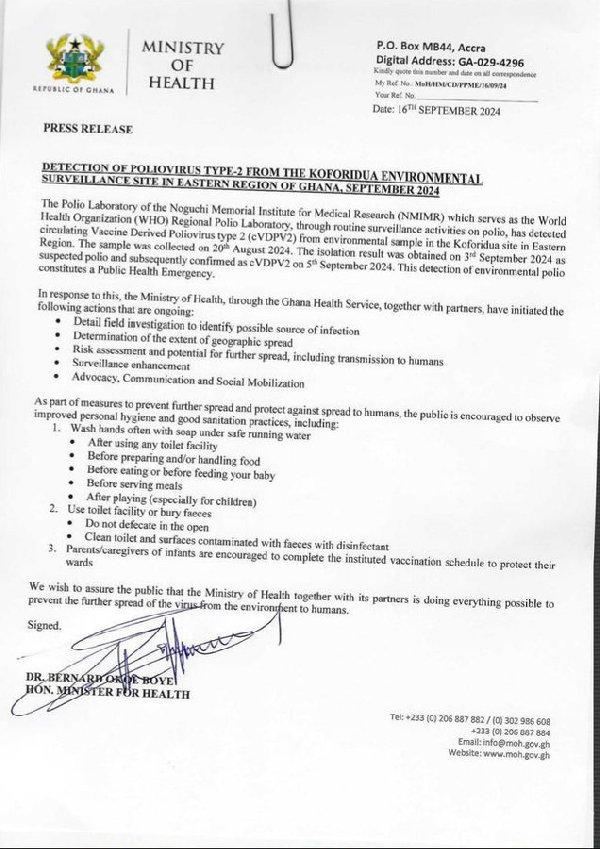
    “The Polio Laboratory of the Noguchi Memorial Institute for Medical Research (NMIMR) which serves as the World Health Organization (WHO) Regional Polio Laboratory, through routine surveillance activities on polio, has detected circulating Vaccine Derived Poliovirus type 2 (cVDPV2) from environmental sample in the Koforidua site in Eastern Region.

    “The sample was collected on 20 August 2024. The isolation result was obtained on 3rd September 2024 as suspected polio and subsequently confirmed as cVDPV2 on 5th September 2024. This detection of environmental polio constitutes a Public Health Emergency,” the statement said.

    Ghanaians are being advised on essential preventive measures to avoid contracting poliovirus.

    Polio is a highly contagious viral illness that, in severe cases, can lead to nerve damage, paralysis, breathing difficulties, and potentially death, especially in children.

    The virus spreads through direct contact with an infected person or, less frequently, via contaminated food and water.

    Individuals infected with poliovirus can transmit the virus through their feces for several weeks.

    Read full statement below

  • All you need to know about mpox terrorizing African countries

    All you need to know about mpox terrorizing African countries

    On Wednesday, August 15, 2024, the World Health Organization (WHO) declared the mpox outbreak in Africa a global health emergency due to its rapid spread, particularly in the Democratic Republic of Congo (DRC) and other African nations.

    WHO Director-General Dr. Tedros Adhanom Ghebreyesus explained that the surge in mpox cases in the DRC and several neighboring countries meets the criteria for a public health emergency of international concern (PHEIC) as per the International Health Regulations (2005).

    In declaring the PHEIC, Dr. Tedros said, “The emergence of a new clade of mpox, its rapid spread in the eastern DRC, and the reporting of cases in several neighbouring countries are very worrying. On top of outbreaks of other mpox clades in the DRC and other countries in Africa, it’s clear that a coordinated international response is needed to stop these outbreaks and save lives.”

    The WHO Regional Director for Africa, Dr. Matshidiso Moeti, said, “Significant efforts are already underway in close collaboration with communities and governments, with our country teams working on the frontlines to help reinforce measures to curb mpox. With the growing spread of the virus, we’re scaling up further through coordinated international action to help countries bring the outbreaks to an end.”

    Since the beginning of the year, Africa has reported over 17,000 mpox cases and more than 500 deaths across 13 countries. The Africa Centres for Disease Control and Prevention has labeled the outbreak as a “very high risk event.”

    What is Mpox?

    Mpox, previously known as monkeypox, is a zoonotic disease transmitted from animals to humans. It is typically found near tropical rainforests where the virus-carrying animals reside. Transmission occurs through contact with bodily fluids, skin lesions, respiratory droplets, and contaminated objects.

    Symptoms

    Mpox symptoms usually appear within 5 to 16 days after exposure but can develop up to 21 days later. Symptoms include fever, headache, muscle aches, swollen lymph nodes, chills, exhaustion, and a rash with lesions that evolve through several stages before healing. Most individuals recover within four weeks, depending on the severity of symptoms.

    Ghana’s Response

    Dr. Franklin Asiedu-Bekoe, Director for Public Health at the Ghana Health Service, announced an increase in surveillance efforts. Health professionals are now actively monitoring for early signs of mpox, with re-trained clinicians on alert.

    Although Ghana has had some cases in the past two years, no new cases have been reported recently.

    Dr. Asiedu-Bekoe noted that Ghana’s reference laboratory capabilities have improved, enhancing case confirmation processes beyond reliance on Noguchi Memorial Institute.

    Clinical epidemiologist Professor Fred Binka emphasized the importance of vigilance.

    “The rate of spread shows that the ‘Clade 1b’ strain is highly infectious so for countries like Ghana, all 16 regions must be ready and looking out for both positive and negative results.

    “In this case, negative results are also important and people must report. Once we suspect that there are cases, we must make sure that we are supplying the facilities with reagents so that they will be able to do the initial diagnosis and then send it to our reference laboratories for confirmation,” he advised.

    He advised the public to seek medical attention for symptoms similar to malaria.

    “When you have a fever, feel nauseous, or have muscle pain, do a test. If it doesn’t confirm malaria, remember that it can be some other disease, like in this case, mpox, and then seek further tests to be done,” he advised.
  • WHO unveils innovative strategy to boost sickle cell disease management

    WHO unveils innovative strategy to boost sickle cell disease management

    The World Health Organization (WHO) in the African Region has unveiled groundbreaking new guidelines aimed at bolstering efforts to tackle the rising threat of sickle cell disease in the region.

    These innovative technical documents are significant for their holistic approach, providing detailed strategies and practical insights to support countries in improving healthcare quality, enhancing treatment accessibility, and boosting overall health outcomes.

    Despite substantial global advancements in sickle cell disease treatment, including newborn screening, hydroxyurea therapy, gene therapy, and improved management strategies, equitable access to these treatments remains a challenge, particularly in low- and middle-income countries across Africa.

    Each year, an estimated 240,000 children are born with sickle cell disease in Africa, with up to 80% succumbing to severe infections or acute chest syndrome before reaching the age of five — the highest mortality rate for sickle cell disease-related childhood deaths globally.

    “As we continue the fight against sickle cell disease, we are confident that this guidance for countries will serve as a valuable new addition to their toolkit, specifically because the guidance is tailored to the African reality, where a multi-faceted approach is key,” said Dr Benido Impouma, Director, Universal Health Coverage/Communicable&Noncommunicable Diseases Programme at WHO Africa.

    Dr. Benido Impouma, Director of the Universal Health Coverage/Communicable & Noncommunicable Diseases Programme at WHO Africa, expressed confidence in the relevance of these guidelines tailored to the African context, stressing the necessity of a multifaceted approach in combating sickle cell disease.

    The newly released WHO Africa guidelines — titled Guidance Framework for Sickle Cell Disease Management and Harmonized Guide for Sickle Cell Disease Management in Africa — provide strategic direction for policy formulation, comprehensive care planning, and advocacy initiatives.

    Together, these documents constitute the WHO SICKLE Package of Interventions for Sickle Cell Disease Management, aimed at offering a comprehensive and integrated approach to managing the disease. The package seeks to ensure access to necessary interventions, promote education and advocacy, improve care quality, and empower patients and communities.

    Developed with financial support from the Government of Monaco and other partners, the package integrates the latest research findings, best practices, and innovative approaches to sickle cell disease management, positioning them as essential resources for healthcare providers, policymakers, and advocates alike.

    Since 2010, WHO Africa has been at the forefront of the battle against sickle cell disease, focusing on disease intervention scaling, enhancing access to innovative treatments, and improving healthcare infrastructure.

    Despite these advancements, significant challenges persist, including limited healthcare infrastructure, low awareness, inadequate access to comprehensive care, limited newborn screening, insufficient research and development, and restricted access to advanced treatments.

    Issued by APO Group on behalf of WHO Regional Office for Africa, these guidelines underscore WHO’s commitment to addressing the multifaceted challenges posed by sickle cell disease across the African Region.

  • Woman evades rituals at Twifo Praso

    Woman evades rituals at Twifo Praso

    A 22-year-old woman, Grace Arthur, has successfully foiled an attack against her life by some unknown individuals at Lomnava in Twifo Praso.

    According to reports, the lady who was training to be a seamstress was given out by her madam to a group of men believed to be family members for rituals.

    Per the narrative, the lady was told to join the brother of her madam to drop off some clothes for a client. She however ended up in the house of one pastor who was apparently supposed to spearhead the rituals.

    “She was learning how to sew and worked with a woman called Delali Fegah popularly known as Mama. This Mama told her that her brother – Nicholas was in town so she should join him on a motorbike and send some clothes to one of her clients.

    “When they got to the place, however, the man went past the client’s house and she began to ask questions but she was scolded by him and told to keep quiet. He later started asking her questions about whether or not she was menstruating and whether she was pregnant till they got to a place close to the nursing training and then she was sent to the house of a pastor there called Emmanuel Awhoi whose church was around the area – Israel House Chapel.

    “She saw 5 men waiting for her, all allegedly her madam’s brothers and they took her to a room where they started performing some rites,” the UTV report said.

    The incessant loud screams of Grace however saved her. After narrating the incident to her madam upon her return, however, she discovered the woman – Mama was the brain behind her capture.

    The case was later reported to the police who referred it to the traditional authorities for judgement.

    “Her madam told her that some gold had been lost in the family and they needed her for some rituals to retrieve that gold.

    “The family members said after she came back and told Mama and she didn’t say anything, they took it to the police station but were told it was a spiritual matter so they should send it to the traditional rulers for judgment,” the reporter said.

    “The case was taken to the Twifo Kaireku palace where the Chief, Nana Kofi Nsiako IV who listened and asked for some items to appease the gods and undo the effect of the rituals,” the report further added.

    Meanwhile, the final cleansing is expected to take place today; 9th May 2023.