Tag: Energy

  • March inflation falls to 3.2% despite global fuel hikes

    March inflation falls to 3.2% despite global fuel hikes

    Despite persistent pressures from rising global fuel prices amid Middle East tensions, Ghana recorded a 3.2 percent inflation rate in March.

    This information was contained in a release from the latest data from the Ghana Statistical Service (GSS)on Wednesday, April 1.

    The figure reflects a decline from 22.4 percent recorded during the same period last year. This represents the 15th consecutive month of decline in Ghana’s inflation rate. February 2026 recorded 3.3 percent in 23.1 percent in February 2025.

    The ongoing tensions between Iran, the U.S., and Israel have been linked to the death of Iran’s Supreme Leader, Ayatollah Ali Khamenei.

    Ayatollah Ali Khamenei was reportedly killed in strikes by the United States (U.S.) and Israel. This development is significantly impacting travelers from Ghana to Asia, Europe, and North America, as Dubai is a major transit hub connecting travelers through the United Arab Emirates.

    Meanwhile, Ghana’s inflation rate stood at 3.8 percent in January 2026, marking the 13th consecutive decline in inflation, with the rate easing from 5.4% in December of the same year.


    The Statistical Service attributed the development to a slower rise in the prices of essential food items, largely due to improved availability. Ghana ended the year with an inflation rate of 5.4 per cent, a 0.9 percentage decline from 6.3 per cent recorded in November 2025.


    The downward trend of inflation has been attributed to easing food prices. Food inflation fell to 4.9 per cent in December, down from 6.6 per cent in November, as price increases for several key food items slowed.


    Also, food inflation was attributed as a major driver in the falling inflation rate, providing some relief to households after months of heightened cost-of-living pressures.


    Charcoal and staple foods such as plantains and bread have been identified as major contributors to the country’s cost-of-living pressures, which pushed up the November 2025 inflation rate.


    According to the last Consumer Price Index breakdown, other factors that affect inflation are basic household goods and utility-related expenses.


    The breakdown highlighted charcoal as the number one inflation driver after its year-on-year contribution increased to 9.2%. The second-largest contributor, smoked herrings, recorded a 7.6% increase in inflation. Unripe plantain, placed third, recorded 6.8%, making it the third biggest contributor to food inflation in November.


    The inflation rate for November 2025 saw a decrease from the 8.0% recorded in October to 6.3% in the same period, according to the Ghana Statistical Service (GSS). This marks the eleventh month in a row since October 2021.


    Addressing the media on Wednesday, December 3, the Government Statistician, Dr. Alhassan Iddrisu, mentioned that broad-based improvements in both food and non-food inflation, supported by stabilising market conditions, significantly caused the decline.


    In October, the GSS announced an 8.0% inflation rate, down from 9.4% recorded in September. The 1.4 percentage point drop from the previous month marks the lowest level since June 2021, sustaining ten consecutive months of consistent decline.


    It also indicates a sharp improvement from the 23.8% recorded in December 2024. Addressing the media in Accra, Government Statistician, Dr. Iddrisu Alhassan, attributed the continuous drop in inflation to the stringent fiscal measures adopted in efforts to stabilise Ghana’s economy.


    “For the first time since June 2021, Ghana has achieved single-digit inflation. This means that the rate at which prices of goods and services are increasing has slowed significantly. We’ve seen improvements across food, transport, and housing categories — key indicators of household welfare,” Dr. Alhassan noted.


    Last month, a report by the Bank of Ghana (BoG) indicated that the government spent less than budgeted between January and July. According to the Bank of Ghana’s September 2025 Monetary Policy Report, the government spent GH¢131.1 billion, which is below the planned amount of GH¢152.6 billion.


    Thus, government spending accounted for 9.4% of GDP, falling short of the target of 10.9%. The report noted that government spending was 14.1% below target but 9.3% higher than during the same period the previous year.


    The BoG attributed the gains to tighter fiscal discipline and improved expenditure control.


    It further stated that, except for compensation of employees, all major spending categories came in below target. Salaries and wages for public sector workers recorded GH¢44.9 billion from the projected amount, while spending on infrastructure and development projects stood at GH¢10 billion, much lower than expected.


    Ghana’s economy is expected to experience significant growth in 2026. Presenting the 2026 Budget Statement and Economic Policy on Thursday, November 11, the Finance Minister, Cassiel Ato Forson, projected a 4.8% increase in the country’s Gross Domestic Product (GDP) for 2026.


    He also forecasted that inflation would drop to 8% by the end of the year. “Right honourable Speaker, for the year 2026, we will achieve the following at a minimum: real GDP growth of at least 4.8%, driven by continued expansion in infrastructure, service sectors, and agriculture as well. … Mr. Speaker, at least 4.9%, and end the inflation for next year will be at least 8% ± 2,” he added.


    The Minister noted that the projected growth would be driven by continued development in infrastructure, the services sector, and agriculture. Ghana recorded a 6.3% Gross Domestic Product (GDP) in the second quarter of 2025.


    The IMF projects a decrease in global inflation while predicting slower economic growth in 2025 for the U.S. and other regions.


    The total value of all commodities bought and sold on Ghana’s Commodity Exchange (GCX) in 2024 amounted to GHS24.23 million, according to the Bank of Ghana’s (BoG) 2024 Financial Stability Review.
    The report attributed the gains to strong demand for maize and soybean contracts, which boosted overall market performance.


    “The Ghana Commodity Exchange (GCX) experienced remarkable growth, reinforcing its role in agricultural trade and market efficiency. Trading volume surged by 107.4 per cent to 5,161.03 metric tonnes in 2024. The total trade value soared by 114.8 per cent, from GH₵11.29 million in 2023 to GH₵24.23 million.


    This growth was driven by several factors, including increased market participation, the strategic use of commodity aggregation funds, a faster settlement cycle (T+1, a day after the transaction date), improved warehouse infrastructure, and enhanced trader confidence.


    Additionally, settlement values grew by 113.3 per cent to GH₵23.31 million, reflecting enhanced liquidity and improved transactional efficiency,” the report stated.

  • Ghana to save 300mw with 23,500 solar streetlight rollout – Energy Minister

    Ghana to save 300mw with 23,500 solar streetlight rollout – Energy Minister

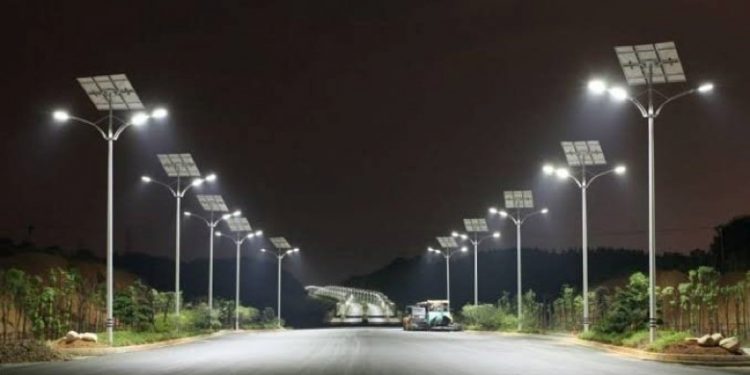
    The government has rolled out 23,500 solar streetlights nationwide to save 300 megawatts of the country’s national electricity grid.

    This is a major transition toward sustainable energy solutions aimed at improving efficiency, reducing grid dependency.

    Speaking during the Government Accountability Series on Wednesday, July 16, the Minister for Energy and Green Transition, John Jinapor, revealed that the installation of solar streetlights has already commenced on various streets across the country.

    According to him, streetlights account for more than 200 megawatts with regard to electricity consumption.

    “As part of our streetlighting project, I’m happy to announce that we’ve commenced the installation of all-in-one solar streetlights. We intend to do 23,500 Units covering a distance of 700km, so that gradually we can take solar as the main focus and move our streetlights away from the grid.

    “The streetlights depend largely on the grid and unfortunately these streetlights come on during the peak period. The difference between the peak period and the off-peak period can range around 400-600 megawatts. And these streetlights alone accounts for more than 200 megawatts,” he noted.

    Street lighting is a crucial part of infrastructure in Ghana, enhancing road safety, reducing crime, and improving the overall quality of life in cities and towns.

    Recognizing its importance, the Government of Ghana has established various programs to ensure the deployment and upkeep of street lighting systems nationwide.

    However, resolving issues with malfunctioning streetlights involves navigating a complex framework of responsibilities and procedures.

    Meanwhile, the Greater Accra Regional Minister, Linda Akweley Ocloo, has announced the successful restoration of 126 streetlights across the region, marking a significant step toward improving visibility and safety in the capital.

    During an assessment tour on March 25, Ocloo revealed the streets and highways that had benefited from the restoration, which includes key areas like the George Walker Bush Highway, ACP to Pokuase, Independence Avenue (Jubilee House), and the New Town Junction to Ashaiman road.

    However, she acknowledged that the restoration of streetlights along the Tema Motorway and the Accra-Tema Beach Road has not yet been completed due to ongoing construction works in those areas.

  • ENI completes major gas supply upgrade – Energy Ministry

    ENI completes major gas supply upgrade – Energy Ministry

    The Ministry of Energy and Green Transition has disclosed that the gas supplier, ENI, has completed a key upgrade on the country’s gas infrastructure.

    In a press statement on Monday, July 14, the ministry noted that the new development raises output from 245 million standard cubic feet per day (MMscfd) to 270 MMscfd.

    As such, the upgrade supports Ghana’s efforts to boost gas supply for power generation and industrial use.

    “This enhancement in gas supply is a significant step towards ensuring a reliable and sustainable energy supply for the nation,” the Ministry stated in an official release issued on Monday, July 14.

    The Ministry has lauded ENI and all stakeholders within the power sector for their collective efforts in bringing the project.

    Before the upgrade, the ministry announced a possible temporary power disruption on Sunday, July 13, to allow ENI to undergo a rehabilitation session.

    “This Sunday, ENI will turn off their valves temporarily to increase gas production to about 270 MM Scarf. It means that we are stabilizing the energy sector. Because the plant will be turned off for a short period within the day for maintenance works, we are likely to experience some interruption of power. It is for a good purpose,” Mr Jinapor said.

    Meanwhile, Finance Minister, Dr. Cassiel Ato Forson, has cautioned that without immediate reforms, the energy sector risks collapsing under the weight of growing debt.

    According to Dr. Forson, ECG successfully collects only 62% of the electricity it supplies, leaving nearly 40% unaccounted for—either lost due to technical faults or unpaid.

    This shortfall has forced the government to provide continuous financial support, with budgetary transfers reaching $2.1 billion over the past two years.

    Dr. Forson emphasized that these inefficiencies are severely impacting the economy, as government support for the energy sector has reached unsustainable levels while ECG continues to struggle with operational and revenue challenges.

    ECG managed to raise GH¢1.6 billion in revenue in the first half of 2025, against a projected target of GH¢2.5 billion.

    However, the Energy Ministry has disclosed the construction of the 161kV Anwomaso to Kumasi transmission line, co-funded by the European Union and the government of France.

    The €8.7 million project is expected to assist in stabilizing the low voltage in Kumasi and Dukwaw mining areas will be constructed by the Ghana Grid Company (GRIDCO).

    It is projected to be completed within 12 months. This will facilitate Ghana’s export of power to Burkina Faso.

    The reconstruction of the transmission line will enable the provision of double-circuit, twin-bundled transmission line of rated capacity to improve power transfer between the Ahodwo (K1BSP) and the Anwomaso (K2BSP) substations.

    On his part, EU Ambassador to Ghana, Mr Irchard Razaly, has noted that the project serves as its commitment to providing greener and more efficient energy for Ghanaians.

  • I was open to serving as Bawumia’s running mate – Dr. Adutwum

    I was open to serving as Bawumia’s running mate – Dr. Adutwum

    The former Education Minister and MP for Bosomtwe, Dr. Yaw Osei Adutwum, acknowledged that he would have been thrilled if chosen as Dr. Mahamudu Bawumia’s running mate for the 2024 elections.

    During an interview on Asaasepa Radio, he expressed his willingness to contribute to both his party and the nation but emphasized that he was not in a hurry, preferring to let fate determine the course of his political career.

    “What I know is that God has His plans for man. When the time is up, nobody can stop what God has caused to happen. But I will not rush ahead of God; I will allow Him to do as He wishes. Whatever He asks me to do, I will obey. God’s time is the best. I have said that I would have been very happy if I was selected as the running mate.”

    Many political analysts had tipped Dr. Osei Adutwum as a strong contender to be Dr. Mahamudu Bawumia’s running mate in the 2024 elections.

    Known for his diligence, composed nature, and widespread admiration across party lines, he had gained significant political recognition.

    Despite this, the party ultimately chose a different path, selecting the former Energy Minister and Manhyia South MP to fill the role.

    This decision, however, did not prevent a crushing defeat for the NPP, which managed to secure only 88 out of 275 parliamentary seats in the 2024 elections.

  • Renewable energy transition in Ghana to be strategic – Dep. Minister Designate for Energy

    Renewable energy transition in Ghana to be strategic – Dep. Minister Designate for Energy

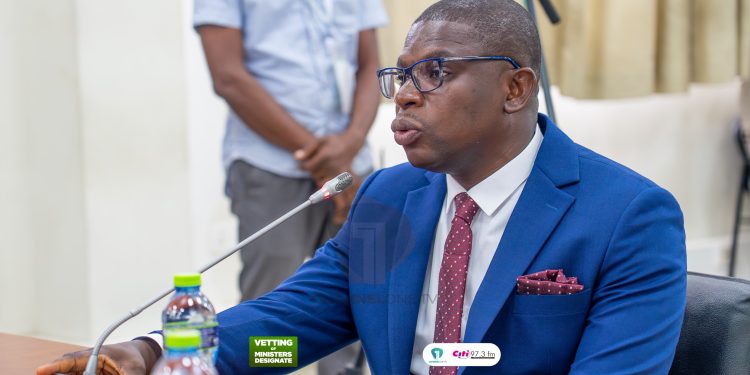
    Ghana’s move towards renewable energy will be a gradual process rather than an abrupt shift, according to Richard Gyan-Mensah, the Deputy Minister Designate for Energy and Green Transition.

    He emphasized the importance of balancing fossil fuel usage with cleaner energy sources to ensure a smooth transition.

    During his vetting before Parliament’s Appointments Committee on Tuesday, February 25, 2025, Gyan-Mensah detailed the government’s strategy for achieving sustainable energy goals.

    He clarified that while the country remains committed to increasing renewable energy adoption, it must also make full use of its existing fossil fuel resources.

    “Moving to renewables doesn’t mean we should abandon fossil fuel, it is a gradual process. So, in the long run, while looking at the bigger picture, we will combine it.

    “Ghana at the moment, we have a lot of fossil fuel or hydrocarbons, which we cannot allow to be stranded.

    Gyan-Mensah highlighted that Ghana is focused on integrating solar, wind, and hydropower into its energy mix while maintaining stability in the sector.

    According to him, government’s plan seeks to achieve net-zero carbon emissions without compromising energy security or economic development.

    “We are still also pursuing the renewables as well to make sure that at the end of the day, we achieve a net-zero carbon,” he stated.

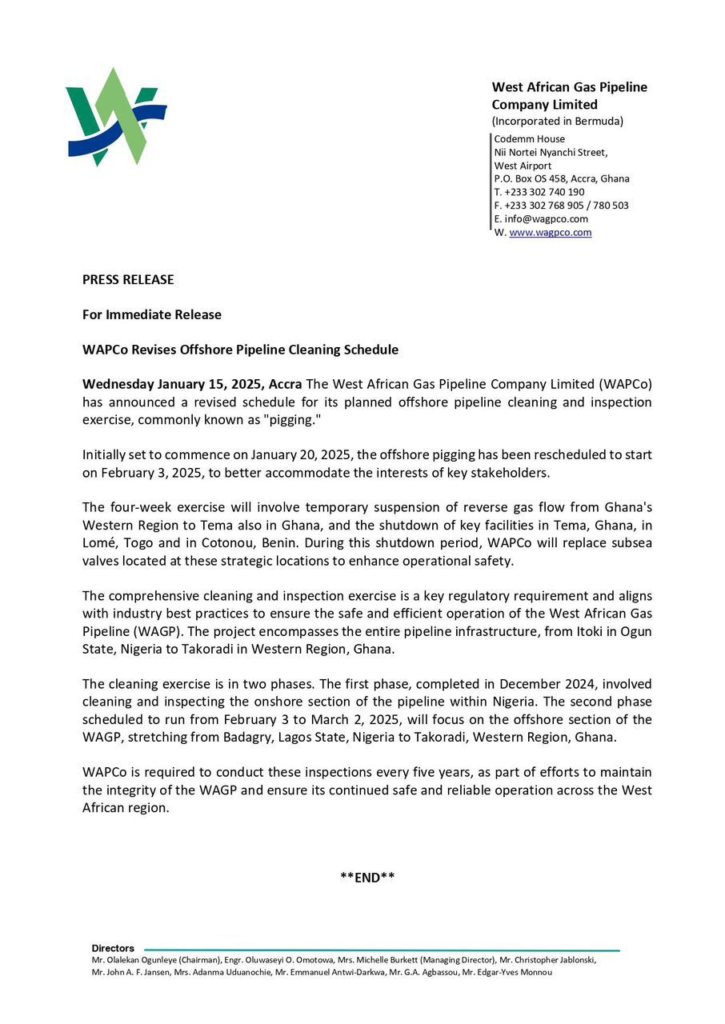
  • WAPCo to undertake maintenance work on Feb 3 to avert   power crisis

    WAPCo to undertake maintenance work on Feb 3 to avert power crisis

    The West African Gas Pipeline Company Limited (WAPCo) has announced the commencement of its offshore pipeline maintenance exercise, commonly referred to as “pigging,” scheduled for February 3.

    The maintenance work aims to prevent a potential power crisis by ensuring the safe and efficient operation of the West African Gas Pipeline (WAGP).

    The four-week offshore pigging exercise, initially planned for January 20, was rescheduled to accommodate key stakeholders’ interests. The activity will result in the temporary suspension of reverse gas flow from Ghana’s Western Region to Tema and the shutdown of critical facilities in Tema, Ghana, Lomé, Togo, and Cotonou, Benin.

    As part of the maintenance, WAPCo will replace subsea valves in these strategic locations to enhance operational safety and pipeline efficiency. The exercise is a regulatory requirement and aligns with global industry standards for pipeline integrity management.

    WAPCo clarified that the maintenance will occur in two phases. The first phase, completed in December 2024, involved cleaning and inspecting the onshore section of the pipeline in Nigeria. The second phase, scheduled from February 3 to March 2, 2025, will focus on the offshore pipeline segment stretching from Badagry, Lagos State, Nigeria, to Takoradi in Ghana’s Western Region.

    The Ghana Grid Company Limited (GRIDCo) has expressed concerns about a possible power crisis, commonly referred to as ‘dumsor,’ due to a looming fuel shortage linked to the maintenance activity. GRIDCo, in a recent report, cautioned that the pipeline shutdown could significantly impact Ghana’s power generation capacity.

    “The exercise, originally planned for October 2024 but rescheduled at the Ministry of Energy’s request, will lead to a significant reduction in natural gas supply,” GRIDCo noted in its report.

    WAPCo has emphasized that the maintenance work is essential for the long-term reliability and safety of the WAGP and is part of a routine inspection conducted every five years. The company reassured the public that it remains committed to minimizing disruptions while ensuring a secure energy supply across the region.

  • Ghana’s energy crisis worsens as IPPs reduce power output due to debt

    Ghana’s energy crisis worsens as IPPs reduce power output due to debt

    Beginning today Monday, November 25, 2024, Ghana’s energy sector is set to experience significant disruptions as key energy suppliers Karpowership Energy, AKSA Energy, and Cenit Energy Limited begin to reduce their power output.

    This development has raised concerns about the potential for widespread blackouts, particularly with the holiday season approaching, a time when businesses and households depend heavily on a reliable electricity supply.

    Per reports both Amandi Energy and Karpowership have completely disconnected from the national grid.

    Additionally, AKSA Energy has slashed its supply from 370MW to just 58MW.

    The resulting shortfall is estimated at approximately 450MW, heightening fears of a power crisis.

    Adding to the challenges, two Independent Power Producers (IPPs) Sunon Asogli and Amandi Energy have ceased operations.

    Sunon Asogli’s shutdown is attributed to the Electricity Company of Ghana’s (ECG) failure to pay off outstanding debts.

    Amandi Energy, on the other hand, claims that its halt in operations is due to ongoing maintenance with no fixed end date.

    CEO of the Chamber of Independent Power Producers, Dr. Elikplim Kwabla Apetorgbor, warned last week that three more power plants are at risk of shutting down unless the government addresses the debt situation.

    The ongoing financial deadlock is exacerbating the power crisis, leading to frequent blackouts, commonly known as “dumsor,” which are impacting economic activities across the country.

    To address this, ECG has reportedly stepped up efforts to tackle the debt crisis by moving from a monthly to a weekly payment cycle in order to pay off arrears with power producers such as Sunon Asogli.

    With the festive season fast approaching, stakeholders are watching closely to see if these measures will restore stability to the power supply and prevent a more severe energy crisis.

  • Africa’s abundant resources can propel sustainable energy for the future – Energy Minister

    Africa’s abundant resources can propel sustainable energy for the future – Energy Minister


    The Energy Minister, Dr. Matthew Opoku Prempeh, has asserted that Africa has the potential to propel itself into a sustainable energy future.

    He highlighted Africa’s abundant natural resources and growing population as key factors that offer a distinct opportunity for embracing energy technologies.

    Dr. Matthew Opoku Prempeh delivered these remarks during his participation in the Africa Energy Technology Conference held in Accra, Ghana.

    He emphasized the importance of a comprehensive approach to energy transition, stressing the integration of energy policy with broader developmental goals such as poverty alleviation, job creation, and environmental sustainability.

  • Investment in key sectors of economy must be priortised – ACEP to government

    Investment in key sectors of economy must be priortised – ACEP to government

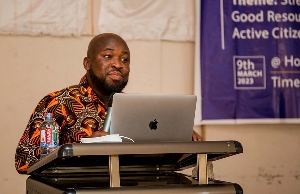
    Policy Lead for Petroleum and Conventional Energy at the African Centre for Energy Policy (ACEP), Kodzo Yaotse, has called on the government to prioritize investments in critical sectors such as health, education, and agriculture for comprehensive economic transformation.

    He emphasized the importance of avoiding excessive reliance on petroleum revenue for the growth of these sectors.

    Mr Yaotse noted that ACEP observed a failure by the government to allocate budgetary funds to these sectors in recent years, attributing it to the belief that extractive sector revenues adequately supported them.

    “The observation we have no­ticed in the data is that, as more resource revenues are allocated to a particular sector then the traditional government revenue that is originally supposed to go there keeps reducing”.

    “Have control over the country’s debt profile and free up more space to be able to carry out other devel­opmental projects to help resolve current challenges,”Mr Yaotse.

    Speaking at an engagement with students of Wisconsin International University College, Ghana (WIUC-Ghana), Mr Yaotse highlighted the need for revenue from the extractive sector to complement other funding sources for key sectors, rather than being the primary source.

    The theme of the engagement focused on strengthening accountability for good resource governance through active citizenship.

    Mr Yaotse cautioned against the trend of allocating more resource revenues to specific sectors, resulting in a reduction of traditional government revenue intended for those sectors.

    He stressed the negative impact such trends could have on the government’s economic recovery program, hindering progress measurement in health, education, and agriculture.

    Mr Yaotse urged the government to manage the country’s debt profile effectively, freeing up resources for other developmental projects to address current challenges.

    He emphasized the importance of tracking and monitoring projects funded by extractive sector revenue, stating that debt declaration alone did not ensure accountability.

    Encouraging students to engage in national policies, Mr Yaotse urged them to contribute through research, advocacy, project tracking, monitoring, reporting, and partnerships.

    The President of WIUC-Ghana, Professor Obeng Mireku, echoed the importance of collective action and shared responsibility in managing the country’s natural resources sustainably.

    Dr. Bright Mawudor, Dean of the School of Business at WIUC-Ghana, called on the government to focus on people, processes, performance, purpose, and planning to maximize the benefits of resource management.

  • Ghana has stopped providing power to Cote d’Ivoire, Burkina Faso – Jinapor

    Ghana has stopped providing power to Cote d’Ivoire, Burkina Faso – Jinapor

    Ghana has officially ceased the provision of electrical power to its West African neighbors, Cote d’Ivoire and Burkina Faso according to the Ranking Member for the Committee on Mines and Energy, John Jinapor.

    Mr Jinapor pointed out that on the same day the president delivered the State of the Nation Address, utility companies were actively shedding load, revealing a worsening situation.

    He alleged that there was a substantial 580 MW deficit, resulting in the cessation of power supply to Cote d’Ivoire, Burkina Faso, and Togo.

    “The very day the president was delivering the State of the Nation Address and boosting, at that very period, the utility companies were shedding load.

    “The situation appears to be exacerbating. Yesterday alone there was a whooping 580MW of deficit culminating in the stop of power supply to Cote d’Ivoire, Burkina Faso and to Togo,” Mr. Jinapor alleged.

    The Opposition in Parliament has called upon the government to urgently address the recent electricity instability plaguing consumers.

    Numerous communities have endured inconsistent power supply for several weeks.

    During a press conference at Parliament,disclosed that a significant reduction of 530 MW occurred on Wednesday.

    This led to consumers experiencing prolonged periods of darkness and disrupted supply to neighboring nations.

    The Member of Parliament for Yapei Kusawgu attributed this issue to a lack of funds for fuel procurement, emphasizing that some thermal plants are also non-operational, indicating a dire state in the country’s power sector.

  • Minister for Energy highlights substantial growth in local petroleum contracts

    Minister for Energy highlights substantial growth in local petroleum contracts

    In the ten years following the Local Content Regulation’s (LI 2204) implementation, locals’ share of petroleum contracts has increased from 6.5% to roughly 20%, according to Energy Minister Dr. Matthew Opoku Prempeh.

    Speaking at the opening of the 2023 Local Content Conference in Takoradi, which was attended by prominent figures from the oil and gas industry, Dr. Opoku Prempeh hailed this as enormous advancement.

    Speaking at the press conference prior to the Local Content exhibition opening, he stated that the discovery of oil was facilitated by the advancement made possible by the enactment of LI 2204.

    “The first oil development prior to the passage of the Local Content Regulation awarded only 6.5% of contracts to Ghanaian companies. After the passage of the regulations, about 20% of the value of contracts have been awarded to Ghanaian companies. We haven’t done bad at all. Let me point out that our drive towards optimal local content and participation also contributes to the successes we have achieved. I’m proud as a Ghanaian even now to say that we have a fully indigenous Ghanaian Exploration and Production company that has drilled and drilled successfully and discovered oil in the deep waters of this country. It’s not any easy feat,” he said.

    The Energy Minister, while praising the achievements of the Petroleum Local Content Conference, which has become a flagship platform where oil and gas industry players meet to discuss the industry, said it is about time the conference is opened to the international community for other experiences to be brought in.

    Also speaking on the theme for this year’s Petroleum Local Content Conference, “10 years of Local Content in Ghana’s Upstream Petroleum Industry: Achievements, Challenges, and Prospects,” the Chief Executive Officer of the Petroleum Commission, Egbert Faibille Jnr., said the implementation of LI 2204 has brought tremendous opportunities for Ghanaian businesses and job opportunities for qualified Ghanaians.

    Egbert Faibille Jnr.-CEO, Petroleum Commission

    In terms of capacity building for locals, the Chief Executive of the Petroleum Commission added that it has also seen growth as ten more Ghanaians would soon be enrolled in pipefitting.

    “Even though all oil and gas pass through pipelines, this country has never had any technical institution teaching and certifying anybody as a qualified pipe-fitter. We have identified that concern, and we have worked with our Minister, and we have sent 9 to Canada to train and are back at Takoradi Technical University, Kikam Technical, TTI, among others. We have also sourced funding of $250,000 from Yinson to start training ten more Ghanaians at a Polytechnic in Singapore in January for a 10-month training period in pipefitting. So by the time they come back, we will have a foundation faculty of 19 to train and certify pipefitting,” he added.

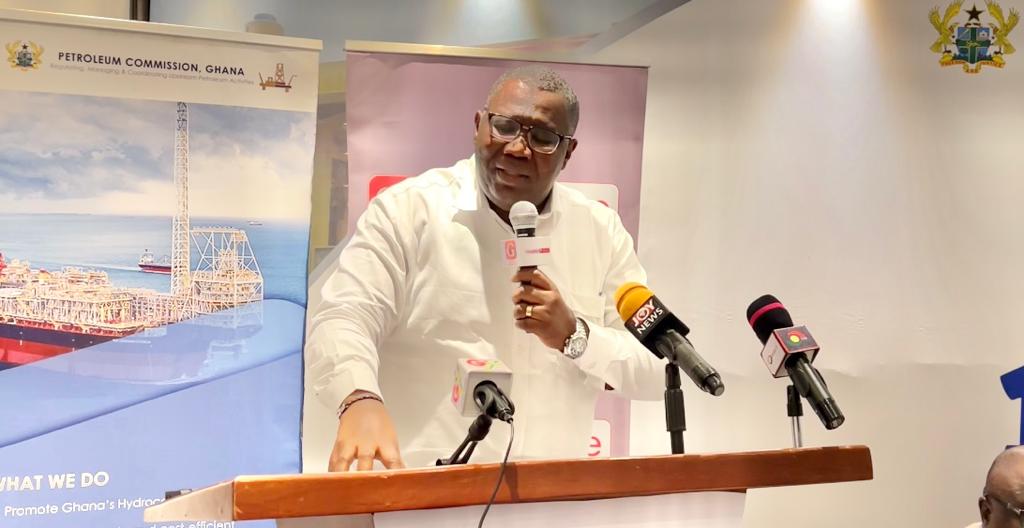
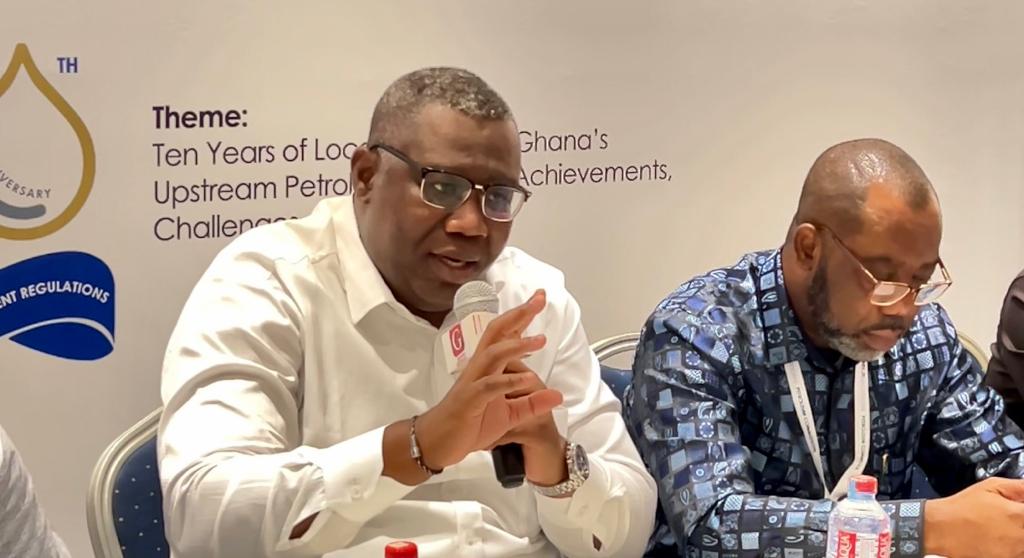
    Chief Executive Officer of the Petroleum Commission, Egbert Faibille Jnr., and Minister for Energy, Dr. Mathew Opoku Prempeh.

    The Petroleum Local Content Conference takes place this year over four days. Stakeholders reflecting on ten years of local content development in Ghana’s upstream petroleum sector, including the MD of Tullow Ghana, Wissam Al Monthiry, MD of ENI, Giuseppe Valenti, CEO of PECAN Energies Ghana, and Kadijah Amoah, among others, will make a variety of presentations on the second day.

  • Ghana Gas CEO urges African leaders to harness resources in tackling energy poverty

    Ghana Gas CEO urges African leaders to harness resources in tackling energy poverty

    CEO of Ghana National Gas Company Limited, Dr. Ben K.D. Asante, has issued a call to African leaders to harness the continent’s abundant resources in order to combat persistent energy poverty. He stressed the need for a strategic balance between resource exports and local utilization to establish a sustainable, affordable, and accessible energy platform.

    Dr. Asante made these remarks during his participation in the 14th Multi-year Expert Meeting of the United Nations Conference on Trade and Development in Geneva, Switzerland.

    He emphasized that prudent resource management, the creation of a conducive fiscal environment to facilitate access to capital, and the development of local intellectual capacity are pivotal factors in driving development across the continent. Dr. Asante highlighted that Africa’s share of the global gas market was 6% in 2021, with expectations of it rising to over 11% by 2050, accompanied by an increase in production from 260 billion cubic meters in 2021 to 585 billion cubic meters in 2050.

    Despite these projections, he acknowledged the challenges associated with the development and utilization of Africa’s energy resources. These challenges encompass a lack of access to capital for projects, insufficient infrastructure, unattractive fiscal regulations, unclear institutional and regulatory frameworks, limited intellectual capacity, inadequate local/private sector participation in the energy sector, and non-cost-reflective commodity prices.

    Dr. Asante also discussed Ghana’s oil and gas industry, specifically mentioning policies aimed at using gas for power generation, particularly to enhance electricity penetration in rural areas. He stressed the importance of formulating country-specific policies to meet the unique needs of citizens.

    Furthermore, Dr. Asante promoted Ghana as an ideal investment destination and encouraged attendees to consider investment opportunities in the country.

    The 14th expert meeting serves as a neutral platform for sharing successful strategies and policies at national, regional, and international levels to effectively manage commodity price volatility. It particularly evaluates the connections between commodity price fluctuations and key macroeconomic indicators in commodity-dependent and developing countries (CDDCs), as well as their impact on food security in net-food-importing countries. The session in Geneva also explored market and technology-based instruments for managing price risks. The next session, for which the Ghana Gas CEO has been invited, is scheduled to take place in Belgium.

  • Allow Africa to benefit from its energy riches for its people – Energy Minister

    Allow Africa to benefit from its energy riches for its people – Energy Minister

    Energy Minister, Dr. Mathew Opoku Prempeh, has emphasized the necessity for Africa to be permitted to utilise all energy resources at its disposal for the benefit of its population.

    Speaking at the 24th World Petroleum Congress (WPC) in Calgary, Canada, the Minister announced this.

    In the wake of the energy transition, he reaffirmed Ghana’s steadfast commitment to fully utilizing its hydrocarbon resources for the shared economic prosperity of its population.

    Dr. Mathew Opoku Prempeh stressed that oil and gas exploration and production will go on for the foreseeable future in order to maintain the supply of natural gas, which is our go-to fuel for transitional purposes.

    Read his full statement below:

    We continue to pitch a strong narrative of Ghana and for that matter Africa being allowed to use every energy resource at its disposal for the benefit of its people.

    For this reason, I did not mince words at a Ministerial session on Monday at the opening of the 24th World Petroleum Congress (WPC) in Calgary, Canada, reiterating Ghana’s firm stance on fully exploiting its hydrocarbon resource for the shared economic prosperity of its citizens in the wake of the energy transition.

    I made the point that oil and gas exploration and production will continue in the next few decades to ensure the availability of natural gas, which for us, is the transition fuel. Cognizant of the impacts of hydrocarbons on the environment, I indicated that we have already included Carbon Capture and Storage and other green interventions in our Energy Transition Framework to duly take care of emissions.

    I further used the opportunity to market Ghana’s sedimentary basins which have huge oil and gas prospects and can be leveraged to develop the clean energy resources and green infrastructure we require.

  • River Pra, Ankobra will be used as hydropower sources by the Bui Power Authority

    River Pra, Ankobra will be used as hydropower sources by the Bui Power Authority

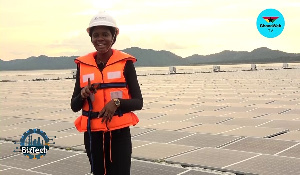
    Director of Renewable Energy at Bui Power Authority (BPA), Wisdom Ahiataku-Togobo, has emphasized the organization’s commitment to harnessing the full spectrum of hydropower resources within the country. Notably, he highlighted the untapped potential of rivers such as the River Pra and River Ankobra as prime sources for hydropower generation, contributing to the production of clean energy.

    During an appearance on GhanaWeb TV’s BizTech program, Wisdom Ahiataku-Togobo articulated that this strategic initiative, when combined with solar energy efforts, would establish a hybrid power generation system for enhanced energy production.

    “What Bui Power Authority is doing is that we are investigating to tap on all the potential hydropower resources in the country; River Pra, River Ankobra and all the other potentials that are in the country, we want to tap those hydro potentials because we are committed to generate electricity from renewables and clean power. So having tapped all these hydro potentials then will add solar to them as a hybrid system,” he told host of the show, Ernestina Serwaa Asante.

    Mr. Ahiataku-Togobo hinted that BPA has formed Nuclear Power Ghana Limited in collaboration with the Volta River Authority and the Ghana Atomic Energy Commission to help fulfill the rising demand.

    He added that they would switch to nuclear power after 2030, when demand would have grown much faster than their aim.

    Mr. Ahiataku-Togobo hinted that BPA has formed Nuclear Power Ghana Limited in collaboration with the Volta River Authority and the Ghana Atomic Energy Commission to help fulfill the rising demand.

    He added that they would switch to nuclear power after 2030, when demand would have grown much faster than their aim.

    “But as our demand grows further, we still need clean energy. So what we are doing is that we have cooperated with the Volta River Authority and the Ghana Atomic Energy Commission to set up Nuclear power Ghana Limited so that in the future, beyond 2030 when demand is growing far more than we can meet, then we’ll transition into nuclear to support the growing demand. So yes, Bui Power has a role to play to contribute to the energy demand. But I will not say that we will solely address all. We have the VRA which is also a state owned agency, we have the independent power producers. All these contribute to generating power to meet the growing demand,” he said on GhanaWeb TV’s BizTech programme.

    Security personnel patrolling on the waters to discourage galamsey

    He mentioned that security forces were watching and patrolling the rivers to stop galamsey activities upstream and spoke briefly about the activities of illegal mining in the Banda district.

    He clarified that the military and naval personnel had been sent out to deter individuals from mining in these waters because it could have an adverse effect on BPA’s hydroelectric plant.

  • NAPO is effectively managing Ghana’s energy sector – NPP

    NAPO is effectively managing Ghana’s energy sector – NPP

    A member of the communications team of the governing New Patriotic Party (NPP), Lawrence Kwesi Botchway Jnr, has lauded the remarkable leadership and lasting impact of the former Minister of Education and current Minister of Energy, Dr. Matthew Opoku Prempeh, on national development.

    He particularly highlighted Dr. Opoku Prempeh’s pivotal role in preventing an electricity crisis in the country.

    In an interview, Botchway described Dr. Opoku Prempeh as the “architect of Ghana’s energy success,” commending his accomplishments in propelling the nation towards a more sustainable economy through effective management of the energy sector.

    He further lauded the minister’s dedication and effectiveness in maintaining continuous power supply, even during the challenges of the COVID-19 pandemic.

    “We must laud the Minister’s dedication and effectiveness in keeping the lights on and the nation running. NAPO’s timely and effective response showcased his mastery of the energy landscape, ensuring uninterrupted power supply till now and even during the challenging COVID-19 epoch. Unlike the past era of ‘dumsor’, Ghana experienced stability and reliability in its power infrastructure, a testament to Dr. Opoku Prempeh’s strategic leadership in the energy sector,” he stated.

    Botchway also emphasized the transformative impact of the Free Senior High School (SHS) policy, which was championed by Dr. Opoku Prempeh and President Akufo-Addo.

    He cited significant statistics, showcasing the substantial increase in student enrollment from 6,000 in 2016 to 1.2 million today.

    Botchway attributed this growth to visionary leadership and not just political maneuvering, highlighting President Akufo-Addo’s role in making education accessible to all students, regardless of their background.

    Botchway concluded by praising President Akufo-Addo’s legacy, which he sees as a gift to Ghana’s future generations.

    He emphasized that the Free SHS policy has dismantled financial barriers, allowing both privileged and disadvantaged students to access quality education.

  • Debt, energy, food security, education take center stage in mid-year review

    Debt, energy, food security, education take center stage in mid-year review

    As the mid-year budget review approaches, a consensus among experts from various sectors is that while it will adhere to the framework of the International Monetary Fund (IMF) program, the government must not overlook a crucial opportunity to address persistent economic issues.

    These experts voiced their opinions during a roundtable discussion hosted by the Economic Governance Platform. The session centered on the theme ‘The 17th IMF bailout: What did Ghana sign up for? Considerations for the 2023 mid-year budget review.’

    They strongly emphasized that neglecting domestic concerns will only worsen negative sentiments and prolong the economic recovery process.

    External debt restructuring in the footsteps of Zambia

    Dr. Theo Acheampong, a petroleum economist and political risk analyst, emphasized that Ghana can draw valuable lessons from Zambia’s recent success in negotiating external debt as discussions with bilateral and private creditors continue.

    Although Zambia’s debt-to-Gross Domestic Product (GDP) ratio did not decrease significantly in nominal terms as a result of the deal, the country secured a three-year grace period for principal repayment and successfully negotiated reduced interest rates ranging from 1% to 2.5%, compared to an average of 9%. These favorable rates will remain in effect until 2037.

    Furthermore, Dr. Acheampong highlighted a novel conditional clause in Zambia’s debt deal, wherein interest rates can increase to 4% if the economy exceeds projections and demonstrates improved debt-carrying capacity. This innovative approach is something that Ghana should seriously consider.

    Dr. Acheampong urged local authorities to promptly initiate negotiations with bilateral and private creditors and strive to conclude such arrangements before the presentation of the 2024 budget.

    “The substance of the deal that Zambia has negotiated is what Ghana can look to emulate. I think we should do the same, and in the next 6 months it is possible for us to put forward and conclude some of these things ahead of the budget for 2024,” he noted.

    Energy sector challenges and the delayed energy sector recovery programme

    Benjamin Boakye, an energy governance expert and Executive Director at the Africa Centre for Energy Policy (ACEP), expressed concerns over the seeming lack of urgency in presenting the Energy Sector Recovery Programme (ESRP II) second phase, which should have been delivered by the end of June – describing it as “alarming”.

    This comes as the potential revenue contributions from energy exports, estimated at approximately US$1.4 billion which could have alleviated the budget deficit, seem unlikely due to the falling prices of oil globally.

    “It baffles me that we have not been aggressive in putting out the programme to improve under-recoveries. Even though government has pledged to address the challenges, there have been no engagements with local stakeholders… Our initial estimate of generating US$1.4billion from energy exports might not be met due to the expected price of US$88/barrel not materialising. As a result, we may face a deficit of approximately US$500million considering our half-year revenue receipts amount to around US$500million,” he elaborated.

    Furthermore, imposition of the 1 percent Growth and Sustainability Levy on the gross production of companies in the extractives industry has caused consternation, as government failed to engage in good faith negotiations with the companies who have stability agreements in place, he added.

    “It would have been expected that there’d be some good faith negotiations to establish a reasonable timeframe for their support in the recovery effort. Unfortunately, the power-play involved seems to have hindered progress,” he said, stating that he expects positive developments in this regard.

    He also expects much-needed clarity on the ‘gold for oil’ programme. Previously, revenues were generated through the purchase of gold with a 1.5 percent tax applied.

    However, this tax has been waived since the Bank of Ghana (BoG) started purchasing gold from the Precious Minerals Marketing Company (PMMC). This move has resulted in a loss of much-needed revenue, Mr. Boakye noted.

    “If we are not careful, we risk institutionalising a process that makes it difficult for us to accurately track the quantity of gold produced. In the past, disparities have been observed between our export data and the import data from other countries involved in gold-buying. It is crucial to address this issue in order to ensure transparency and effective revenue management,” he added.

    Food security and inflation concerns

    Dr. Charles Kwowe Nyaaba, Executive Director-Peasant Farmers Association of Ghana (PFAG), for his part, called for a strong message in the interim budget to address food insecurity.

    He said this is pertinent with as much as 5.2 percent of the population facing severe food insecurity, and 6.5 percent experiencing moderate food insecurity.

    This comes as consumer inflation rose to 42.50 percent in June 2023 from 42.2 percent the previous month, driven primarily by food inflation which accounted for 54.2 percent of the headline inflation figure – further increasing from 51.8 percent in May.

    Education disbursement regime, provision of desks and textbooks

    Kofi Asare, Executive Director of Education Watch (Eduwatch), stressed the need for clarity in the disbursement regime for education grants; saying stakeholders need assurance of a clear disbursement roadmap to address accountability issues. Additionally, accumulated arrears in the education sector need urgent attention as many school administrators face financial challenges due to unpaid loans.

    Mr. Asare emphasized the critical shortage of desks in the basic education sector, which is negatively impacting over two million children.

    The lack of desks presents one of the most significant challenges in the basic education sector, with more than 2 million children affected. To address this pressing issue adequately, an urgent requirement for approximately 1 million dual desks has been identified.

    However, Mr. Asare explained that the approved budget allocated by parliament for desks is only GH¢15 million, which falls short of the funding needed to procure the required number of desks. With this funding, a maximum of 35,000 desks can be purchased, leaving a substantial gap in meeting the students’ needs.

    Furthermore, Mr. Asare highlighted that even after four years into the current basic school curriculum, textbooks are available for only 3 out of 10 subjects, and they are still limited in quantity. This exacerbates the challenges faced in providing quality education to the students.

    “However, a more pressing concern arises at the junior high school level. As we enter year 3, students who are currently in JHS 2 and moving to JHS 3 at the end of this year began their education 2 years ago, yet they have not been provided with any textbooks. It is crucial to address this situation promptly as they will be writing their BECE next year,” he said, adding that the budget must address the “unrealistic” school feeding allocation.

    Campaign funding

    Director of Advocacy and Policy Engagement-Ghana Centre for Democratic Development (CDD-Ghana), Dr. Kojo Asante, stressed the significance of addressing the issue of campaign financing; particularly with the impending elections next year, saying leaving the space unregulated continues to breed corruption and impede economic growth. However, it is not directly within the IMF programme’s purview and is likely not to be mentioned in the upcoming interim budget presentation.

  • 5 best foods that fight fatigue

    5 best foods that fight fatigue

    Fatigue can be further exacerbated by an inadequate diet, and our food choices have the potential to influence the symptoms we experience.

    Chronic fatigue syndrome (CFS) is a multifaceted condition characterized by severe and persistent fatigue that lacks a specific medical explanation.

    Studies have indicated that the food we choose to consume and potential nutrient deficiencies can have a substantial impact on managing fatigue in individuals with CFS.

    The best way to get the most energy from your food is to make sure you’re giving yourself the best food possible.

    Besides what you eat, when you eat can also impact your energy.

    You are what you eat. So, if you want to be healthy, you will have to check what you eat and how you eat.

    Here are some foods to fight fatigue that may help our bodies get back to feeling energised again:

    • Fruits and vegetables

    Fresh fruits and vegetables are full of vital nutrients that help to keep the metabolism going and improve energy levels. The fresher the fruit or vegetable, the better it is for your health. Also, the energy provided is at a more consistent rate, and this helps the body to cope better with demanding mental and physical work. They are ideal foods that prevent fatigue and depression.

    • Nuts and seeds

    If you are feeling tired between meals, the best snacking options are nuts and seeds like almonds, walnuts, Chia seeds, flax seeds, and pistachios. All of these make for healthy foods that fight fatigue. They provide essential nutrients, fibre and a boost of energy to the tired body. Chia seeds have earned the reputation of being a ‘runner’s food’ as they help in improving endurance and enhancing physical performance. Most nuts are rich in magnesium, potassium and other vital nutrients like omega-3 fatty acids that are potent antioxidants. These are the perfect fatigue-fighting foods.

    • Unprocessed foods

    Burgers, pasta, French fries, boxed meals, ready-to-eat snacks, and other such items may seem like enticing options when low on energy, but they are bad for health and provide no nutrition to the body. Instead, they cause sharp spikes and dips in sugar levels leading you to feel a burst of energy and then feeling thoroughly washed out. Choose unprocessed food options like whole grains, brown bread sandwiches or a glass of milk, which are better food options that prevent fatigue.

    • Non-caffeinated beverages

    Caffeine is good when taken in moderation, and it has been shown to have some health benefits. Although it provides a short-term boost, it doesn’t actually provide the body with energy.

    The first sips may give you a jolt, but if you’re not providing your body with good nutrition and balanced meals and snacks, you’ll eventually feel run down.

    If you must have your fix, opt for black coffee or unsweetened tea. Sodas and energy drinks can be full of refined sugar and artificial ingredients that can cause you to crash, and lead to other health issues if overconsuming.

    • Water

    Drinking water is essential for the optimal functioning of the body. Although water doesn’t provide energy in the form of calories, it helps facilitate the energetic processes in the body, which is an energy boost in itself.

    Sip on water throughout the day, and try to swap out sodas, coffee, and other drinks for a glass of water. This simple change can make a big difference, and you’ll feel better before you know it.

  • Aker offloads Pecan Field for US$1 after US$1.3bn GNPC deal collapses

    Aker offloads Pecan Field for US$1 after US$1.3bn GNPC deal collapses

    Following Ghana National Petroleum Corporation’s (GNPC) unsuccessful attempt to acquire shares in two offshore petroleum blocks owned by Aker Energy for US$1.65 billion two years ago, Aker has now entered into an agreement with a subsidiary of its primary creditors. Under this new arrangement, Aker will receive a mere upfront payment of US$1 for one of the blocks. This development raises concerns about GNPC’s earlier expressed intention to purchase the blocks.

    It will be recalled that government and the GNPC mounted a ‘spirited’ bid for the Aker Energy-controlled offshore blocks, South Deepwater Tano and the Deepwater Tano Cape Three Points (DWT/CTP).

    The parliament of Ghana was convinced to grant authorisation for the GNPC to spend a maximum of US$1.1billion – which was to be borrowed in the name of Ghana – on the blocks. Including its plan of development, Aker demanded US$1.65billion from GNPC.

    The development led to some civil society organisations (CSOs), committed to accountability in the energy sector, forming a coalition to block the transaction. They argued that based on available data, the two oil blocks had been ridiculously overpriced.

    Two years later, the SWDT was returned to Ghana for free. However, DWT/CTP – where the Pecan field is located – is said to be now controlled by AFC Equity Investment, a subsidiary of Africa Finance Corporation (AFC). This follows Aker Energy’s default on its commitment with AFC.

    “Aker Norway has more or less defaulted on the loan of US$200million they were given to invest in Pecan, and handed over the asset in a face-saving ‘sale’ for US$1,” said the Civil Society Organisations (CSOs) Coalition on Extractive Governance.

    “Aker will only recoup some of its earlier investment if AFC succeeds in developing the field to the point where it can produce and sell oil to recoup its investment and make some money,” the coalition explained in a statement.

    They said: “The same blocks that barely two years ago were worth more than half the IMF money this country has sweated blood for nearly a year to secure, have either been abandoned or pawned for scraps”.

    The 32-member strong coalition of CSOs, during a press conference in Accra, noted that the sale of Aker’s interest to AFC and subsequent submission of the Plan of Development (PoD) to government raises more questions.

    They alleged that: “Even though Aker has sold their interest in Ghana, they are scheming to stay on the Pecan development through surrogates and Ghanaian collaborators across segments of our society to amass ridiculous benefits from the Pecan field development”.

    Meanwhile, in what is an even more puzzling development, the coalition said Aker Energy in 2021 purchased an FPSO for US$35million: but in its Plan of Development submitted to government, Aker’s previous owners intended to bill Ghana US$1.7billion for the FPSO.

    “We admit that the energy ministry has raised a preliminary objection to the FPSO’s cost. But there is no proposal on what the ministry considers fair value for the FPSO,” they said.

    Also, they indicated that while some technocrats have expressed concerns about the FPSO’s age and recommended caution, there is political pressure to proceed with the deal. “Typically, FPSOs have an average payback period of 5-7 years, varying based on size and configuration. The lease period for rented options is commonly ten years.”

    The CSOs said they are monitoring this keenly and will demand transparency on the ministry’s judgment before the approval is granted: “We demand complete information on the AFC transaction and the actual amount that will constitute petroleum cost… and further demand a full audit of the US$200million expenditure deemed recoverable at the start of production”.

    Furthermore, they also charged GNPC to state its position on the Aker and AFC transaction, particularly explaining why it did not pre-empt sale of the asset for an upfront payment of US$1 – since they were willing to pay US$1.3billion upfront, which parliament reduced to US$1.1 in 2021.

    They also asked for disclosure of the justification to use a 14 year-old FPSO in a field with a minimum production period of 25 years; and the Aker PoD from the Petroleum Commission and government.

    The Norwegian government, they said, should take particular interest in the behaviour of Aker in Ghana to forestall a negative image for the country which hosts a global transparency initiative – the Extractive Industries Transparency Initiative (EITI).

  • South Africa to purchase emergency power to keep lights on – VP

    South Africa to purchase emergency power to keep lights on – VP

    South African Deputy President Paul Mashatile stated that the administration is optimistic that its emergency purchase programs would end the country’s energy problem.

    State-owned power company Eskom’s board has approved three emergency procurement programmes that now only require the approval of the National Energy Regulator of South Africa, which will host hearings on Friday, local media reported.

    “Apart from appointing the minister of electricity, we have announced we are now embarking on procuring emergency power. Government is determined to keep the lights on,” Mr Mashatile said on Thursday.

    He said, in some instances, Eskom would use diesel to keep the lights on, adding that the government was still committed to renewable energy.

    His remarks came shortly after Eskom issued a statement on Wednesday warning that the country’s power system was severely constrained, with a high likelihood of prolonged power outages during winter.

  • Cutting energy prices will take years – power boss

    It “will take years” to get energy prices back to pre-Ukraine war levels, the boss of one of the world’s biggest energy firms has told the BBC.

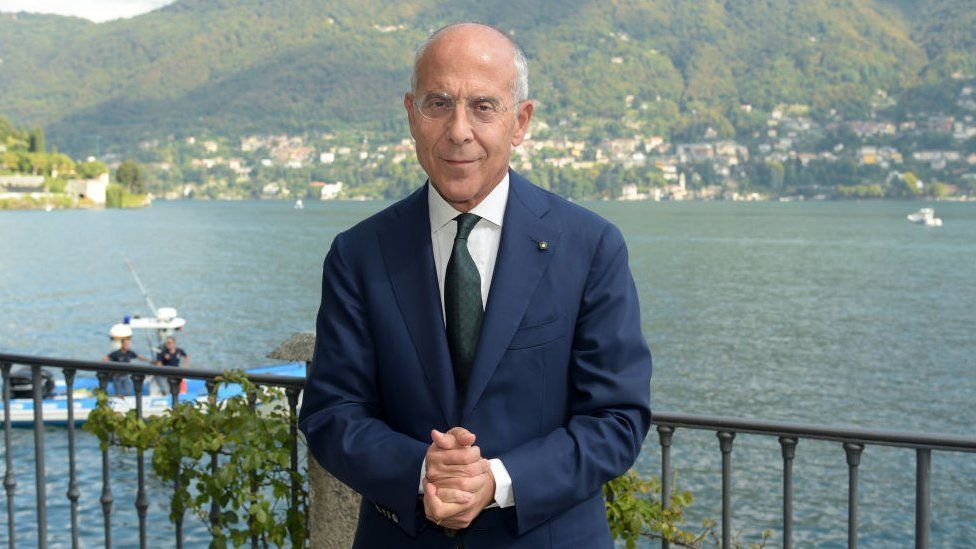
    Enel’s Francesco Starace said bringing prices down depends on new sources of energy such as renewables and heat pumps.

    Governments across Europe are spending billions helping business and households afford energy bills.

    They are also scrambling to secure new supplies.

    Mr Starace said the company, which produces and distributes electricity and gas, tried to shield its 20 million European customers from energy market volatility this year.

    It did its best to stick to the fixed-price contracts it had agreed, he said.

    Breaking customer trust would inflict greater damage on the firm than a hit on one year’s results, he said.

    The Italian energy giant sells power to more than 70 million homes and businesses in over 30 countries.

    But Enel is planning to leave many of those countries as it focuses on renewable energy and becoming carbon neutral by 2040.

    It also wants to cut its huge debts of around $63bn (£52bn).

    It is investing heavily in making solar panels as it expands an existing factory in Sicily and builds a new one in the US.

    Enel CEO Francesco StaraceImage source, Getty Images
    Image caption, Enel’s Francesco Starace says that new supplies of renewable energy are key to cutting prices

    Soaring energy prices have been the biggest contributor to inflation and the cost of living crisis in the UK, the US and the eurozone.

    The global energy crisis triggered by Russia’s invasion of Ukraine “showed very clearly how dependence on one single source of energy is dangerous for Europe”, Mr Starace said.

    The future will be “extremely decarbonised” and depend on nuclear and renewable energy, he said.

    However, that shift to renewables also has risks.

    In July, the International Energy Agency said that China’s dominance of solar and wind turbine production creates “potential challenges that governments need to address”.

    Mr Starace said the West has been over-reliant on China for renewables and other goods.

    “Some rebalancing needs to be happening because it is healthy,” he said, when asked about geopolitical tensions interfering with energy supplies.

    This has helped drive Enel’s investment in solar panels, although the expansion of the Sicilian factory will still meet only 10% of Europe’s needs, he said.

    Political leaders have also acknowledged that Europe needs to get its energy from more places.

    According to the European Council on Foreign Relations, the EU and its member states have signed 56 energy deals with 23 countries this year.

    Among the latest was a 15-year deal for Germany to get liquefied natural gas (LNG) from Qatar through a contract with ConocoPhillips.

    Norway is also boosting natural gas production and the world’s biggest producer, the US, has been pumping out record amounts.

    This means the chances of Europe repeating its dependence on Russia with another country are “quite low”, according to Megan Richards, a former director of energy policy at the European Commission.

    “A lot of work has been done” to replace Russian energy, she added, before warning: “I think Europe will not be completely domestically independent for a very, very long time, if ever” even though “renewables will increase dramatically”.

    You can watch Francesco Starace’s interview in full on Talking Business with Aaron Heslehurst on BBC iPlayer.


    Source: BBC

  • Plan to import affordable fuel set in motion – Kojo Oppong-Nkrumah

    Information Minister, Kojo Oppong-Nkrumah has disclosed that the government has commenced plans to secure cheaper petroleum products onto the Ghanaian market.

    The Minister made this revelation while speaking to Evans Mensah on PM Express on Monday.

    According to him, the National Petroleum Authority (NPA) and the Ministry of Energy will provide further details about the importation of fuel onto the Ghanaian market in the coming days.

    He noted that the Energy Ministry had already begun talks with some major sources and sovereigns in the supply of petroleum products.

    “In President Kufuor’s time, we did it with Nigeria, Sahara lifting for us and you could have supply credit lines and a fixed price that you could bank on and it is a very similar arrangement that has already commenced and I am expecting that in the coming weeks the NPA, the Energy Ministry will have the opportunity to provide the details,” he said on PM Express, Monday.

    “I am saying that the work has already started, I will want them to come and put out those details…I am not going to preempt what the people responsible for the sector are going to do. We are scheduling for all of them to come and provide their detailed presentations and during those presentations, all of the questions can be put to them,” he told Evans Mensah.

    The Minister’s statement comes a day after President Akufo-Addo announced that government is working to secure reliable and regular sources of affordable petroleum products for the Ghanaian market.

    The deal, if successful is expected to put some stability to the escalation of the fuel prices in the country.

    Currently, petrol and diesel prices are being sold at an average of ¢18 and ¢23 per litre, from the previous prices of ¢15 and ¢19 per litre respectively.

    Already, some leading OMCs have adjusted the prices of petroleum products at their pumps.

    Petroleum consumers have lamented the high prices of petroleum products on the market as it has affected businesses and plummeted the cost of living in the country.

    Source: Myjoyonline

  • 8 simple ways you can save energy and power

    This is how you keep the amount somewhat low

    We’ve all noticed it in recent months: energy and power prices have gone through the roof.  Anyone who doesn’t want a sky-high utility bill would do well to save as much as possible. We will help you on your way by listing some handy saving tips for you.

    8. Devices not on standby

    Many electrical appliances automatically go into standby mode when you are not using them.

    That still consumes quite a bit of power and therefore money. By unplugging appliances you are not using, you can save quite a bit. Don’t feel like constantly going through all the appliances? Then buy a “smart plug” that allows you to turn off all appliances at once.

    7. Ensure good insulation

    If you don’t live in a brand-new house, chances are the insulation leaves something to be desired.

    By filling in gaps at doors, windows, the floor and the chimney, you ensure that a lot less air escapes.

    Heat from your stove will then hang around much better. If you don’t want to do it yourself, you can hire a professional to do it. This will save you a lot of energy and money in the long run!

    Wondering what other ways can save you some money? Read on quickly on the next page!

    Source: tips-and-tricks.co

  • Energy use advice campaign pulled as No10 objects

    The government has decided not to launch a public information campaign on reducing energy use this winter after the prime minister’s office raised objections, the BBC has been told.

    A source said there was a “reasonably well-developed plan” to encourage household energy-saving.

    But Climate Minister Graham Stuart denied a Times report that a campaign had been blocked by Downing Street.

    He said UK energy was secure despite a National Grid warning of blackouts.

    Its message about possible power cuts was based on a worst-case scenario of gas shortages if the energy crisis in Europe escalates.

    The Department for Business, Energy and Industrial Strategy (BEIS) was considering plans to encourage households to switch off their appliances and heating to conserve energy whenever possible during winter.

    However, the BBC was told the department was stopped from taking the plan forward because of objections from the prime minister’s office and the Department of Health and Social Care (DHSC).

    DHSC sources said they did not believe they had played any specific role in any decision, but indicated there might be broad “concern about the elderly being afraid to turn on their heating”.

    The Times newspaper reported that Downing Street’s intervention came on Thursday when National Grid issued its warning.

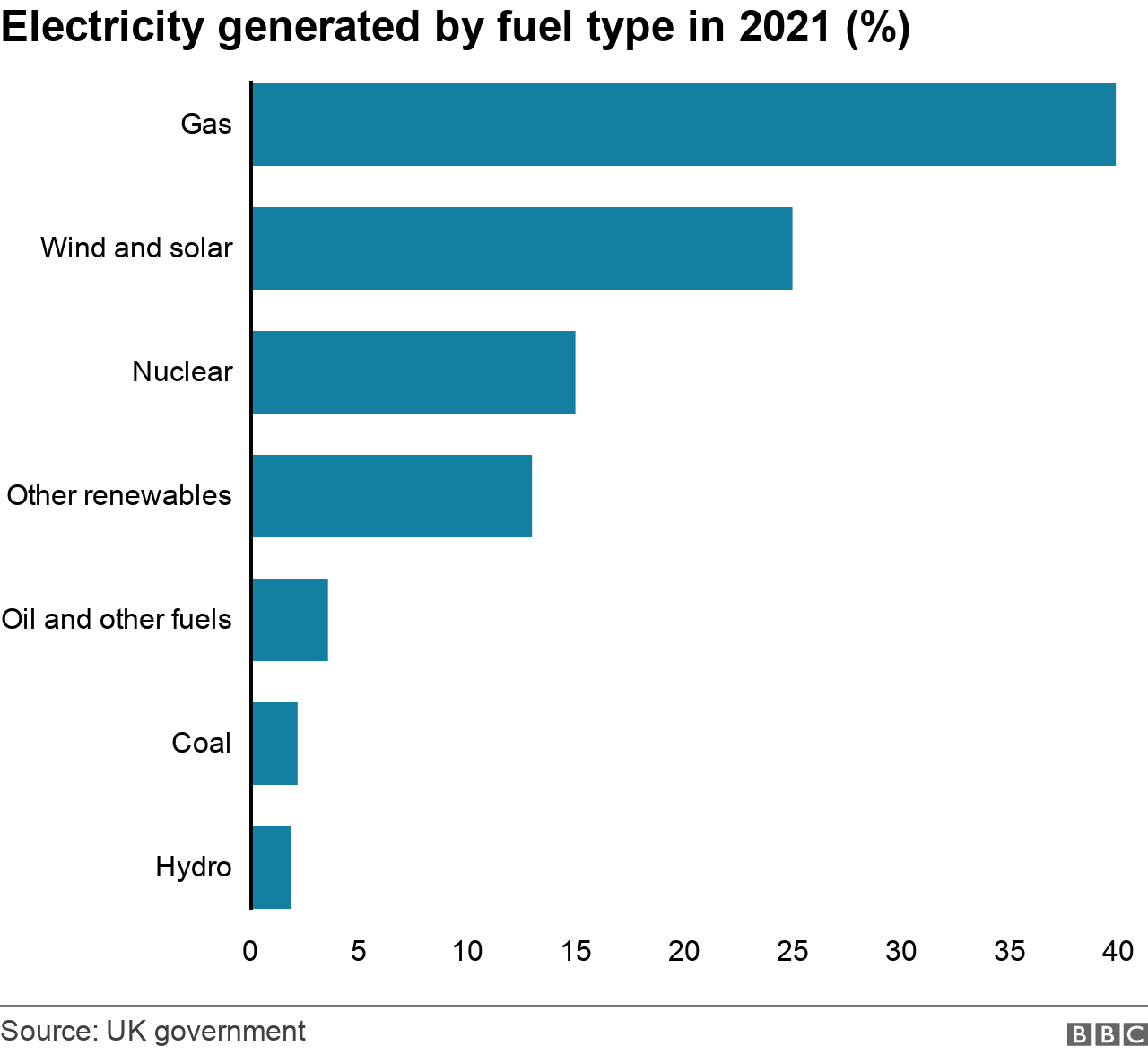
    The UK is heavily reliant on gas to produce electricity, with gas-fired power stations generating more than 40% of the country’s electricity.

    In the “unlikely” event that gas supplies ran extremely low, homes and businesses in the UK could face three-hour planned blackouts, National Grid said.

    The government says National Grid has drawn up plans to launch a voluntary service to reward users who reduce demand at peak times.

    Speaking on BBC Breakfast, Mr Stuart said he was “confident the government has done everything in its power” to make sure energy rationing would not be necessary this winter.

    But he added: “We make plans for all scenarios.”

    During the Conservative leadership campaign, Prime Minister Liz Truss pledged there would be no energy rationing this winter.

    On Thursday, when asked if she could guarantee there would be no blackouts, Ms Truss said: “We do have a good supply of energy in the UK.”

    Electricity generated by fuel type in 2021
    In a statement, BEIS said: “There are no plans for the government to tell the public to reduce usage for the sake of our energy supplies.

    “The UK has a secure and diverse energy system and we are confident that the steps we are taking will protect security of electricity and gas supplies.”

    When asked to comment, Mr Stuart indicated there had been discussions within BEIS, but confirmed there would not be a government-led effort to get people to reduce usage, saying “it has been decided that there will not be a campaign”.

    Mr Stuart also denied that a well-developed campaign had been prepared and then blocked by the prime minister’s team.

    How will the demand flexibility system work?

    National Grid wants to be able to reduce British energy demand at peak times if there is going to be a shortage.

    This winter, starting in November, it is going to have 12 trial days where it asks customers who have signed up via their energy suppliers to reduce the amount of energy they are using at particular times of day.

    They would be given a day’s notice that they would be asked to do this.

    In return, they would be paid for using less energy. National Grid has not yet decided how this will work but has suggested that for the trial days customers might be able to make back £10 a day.

    Expect National Grid to announce more details later this month with customers being able to sign up from 1 November as long as their energy suppliers are participating in the scheme.

    The Times newspaper had reported that the prime minister had rejected plans for a £15m public information campaign, which was signed off by Business Secretary Jacob Rees-Mogg.

    It suggested Ms Truss was “ideologically opposed” to the campaign amid concerns it would be too interventionist.

    In her speech to the Conservative Party conference on Wednesday, the prime minister said her conservatism was about “freedom”.

    “I’m not going to tell you what to do, or what to think or how to live your life,” she said.

    Some question whether a campaign is needed at a time when many people are already changing their behaviour and saving energy where they can.

    But those with knowledge of a campaign say they don’t understand the logic of blocking it. “Slightly mystifying,” they say.

    In a tweet, Conservative MP Guy Opperman said he would he “fully behind” an energy-saving campaign that would help people and the taxpayer save money.

    “This is not Nanny state,” he wrote, arguing it was about “preserving supply, saving money for everyone, and encouraging localism”.

    Stew Horne, head of policy at not-for-profit organisation Energy Saving Trust, said the government needed to consider how to reduce demand this winter to increase energy security.

    He said the European Commission had recently announced plans to reduce peak demand by 5% across EU member states. In Italy, central heating use will be reduced and households have been asked to turn down their thermostats to reduce energy demand.

    Mr Horne said he “would welcome consideration of similar measures to improve energy security”.

    Russia’s invasion of Ukraine has caused turmoil and volatility in the energy markets, sending fuel bills rocketing, and tightening supplies of oil and gas globally.

    Ahead of winter, countries across Europe are scrambling to shore up supplies, as gas flows from Russia are restricted.

    Since taking office Ms Truss’s government has been seeking to boost energy security, with a ban on fracking for shale gas in England lifted last month, and a new oil and gas exploration licensing round launched on Friday.

    This comes after government stepped in with an energy support package to help people with soaring bills.


  • ‘Justified’: Germany’s Olaf Scholz defends energy support plan

    Olaf Scholz, the chancellor of Germany, has defended a costly package designed to shield individuals and businesses from rising energy costs. The strategy, which critics claim will distort competition, is being discussed with Germany, according to the EU.

    The German chancellor on Tuesday said a €200 billion ($198 billion) energy support package was justified and that similar steps were being taken elsewhere.

    The “defensive shield” includes a gas price brake and a cut in fuel sales tax. It is aimed at protecting businesses and households from the impact of rising energy prices.

    “The measures we are taking are not unique but are also being taken elsewhere and rightly so,” Chancellor Olaf Scholz told a press conference in Berlin during the visit of his Dutch colleague Mark Rutte.

    “Some have long been in the process, with major supports and measures, of doing exactly what we have set out to do this year and the next two years,” Scholz said.

    Overall, it’s a “very balanced, a very smart, a very decisive package that serves to keep prices down and bearable for as long as these challenges exist,” Scholz added.

    German Finance Minister Christian Lindner, from the neoliberal Free Democrats, also sought to reassure his EU counterparts at talks in Luxembourg on Tuesday.

    “There had been a misunderstanding. … Our package … is proportionate if you compare the size and the vulnerability of the German economy,” Lindner said.

    ‘Supporting those who need it most’

    Later on Tuesday, Scholz met with Germany’s state premiers. At a press conference following the talks, the chancellor again defended the government’s decision, saying it was their job to “protect jobs” and “support those who need it most.”

    Scholz said that the most recent rescue package would have “dramatic effects” on the people and businesses watching their financial situation suffer.

    He acknowledged that the federal and state governments “were not exactly on the same page,” as struggles continued over who would pay for what. However, he said “I am certain we will come to an agreement.”

    Why is the package controversial?

    Opponents of the package say it will distort competition inside the single market by giving an advantage to German businesses.

    The European Union’s internal market commissioner, Thierry Breton, and economy commissioner, Paolo Gentiloni, from France and Italy, respectively, say the German plan “raised questions” on fairness. They called for an EU-wide measure to be used to help countries.

    The European Commission, which supervises antitrust policy across the EU, said on Monday that it was talking to Berlin about the package.

    “We are fully committed to preserving a level playing field and a single market, and avoiding harmful subsidy races,” a spokesperson for the commission told a news conference.

  • IPPs creating unnecessary tension with threats over monies owed them Deputy Minister

    Government has accused the umbrella body of Independent Power Producers, the Chamber of Independent Power Producers Distributors and Bulk Consumers of exhibiting traits of a pressure group.

    A Deputy Minister for Energy in charge of power, William Owuraku Aidoo says the Chamber is creating unnecessary tension with their threats to interrupt power supply over monies owed them by the government.

    He said it is unfortunate that the Chamber is issuing such threats when the country is heading into elections next month.

    “The Chamber is being used as a pressure institution to pressure government into doing things that it is already doing; having one on one discussions with individual power producers and so on. With three weeks to elections, it is very unfortunate to hear this Chamber of Independent Power Producers coming out to say they will pull the plug on us, creating unnecessary panic within the system. My recent interaction with them shows there is no cause for alarm, so it is very worrying that they will come out and say things the individual power producers are not saying,” he said.

    William Owuraku Aidoo said the government remains committed to settling debt owned Independent Power Producers in the country.

    He explains that the Cash Waterfall Mechanism instituted in 2019 has been instrumental in servicing such legacy debts.

    Source: citinewsroom

  • Renewable energy to rescue economy post coronavirus Analyst

    The government must focus on renewable energy in rebuilding the economy after the coronavirus pandemic, a Research and Policy Analyst, Raymond Nuworkpor, has urged.

    He said the sector has the ability to create more job opportunities for the teeming unemployed youth in the country.

    Solar and wind have also demonstrated to be the cheapest source of electricity that the country can rely on for development, he added.

    “The time is now, this is our biggest opportunity to generate jobs, reduce the cost of electricity, contribute to the climate change agenda and become a hub for energy export to the West African Market,” he said.

    He added: “Every effort by government in restarting the economy after COVID-19 must necessarily make renewable energy its backbone.

    “Solar and wind energy are rapidly becoming the cheapest source of electricity, offering the biggest opportunity to generate jobs and also providing wider benefits to the large ecosystem,” he said.

    The energy market is undergoing a rapid transition from Fossil fuel to Renewable energy as a result of strong climate change policies and rapid advancement in low carbon technology

    Renewable energy has demonstrated during this COVID-19 period that, it is a robust sector, the market is stable & sustainable, profitable and cost-effective.

    Source: Laud Business

  • Energy Ministry invites proposals into review of renewable energy act

    The Ministry of Energy has started inviting members of the general public to make input by way of contributions as the country seeks to review the Renewable Energy Act, 2011 (Act 832).

    The review of the Act, the Ministry said, has become necessary due to the current development in the renewable energy sub-sector.

    A statement signed by John-Peter Amewu, the sector Minister, added that the aim of the amendment and review is to address the challenges in the industry.

    The deadline for the submission of comments or proposals is Friday, June 12, 2020, 17:00hrs GMT.

    Source: goldstreetbusiness.com

  • Power cuts will soon be over; generation plants faced challenges Dep Energy Min.

    energy  a Deputy Energy Minister, William Owuraku-Aidoo, has said.

    He added the lack of supply of gas due to the cleaning out of the pipelines which supplies gas from Nigeria ais lao a factor.

    Mr Owuraku-Aidoo, however, assured that the situation will soon be brought under control.

    “Unfortunately, some of the generation plants that we planned with have encountered some unexpected challenges.”

    He added the peaking exercise has been completed ahead of schedule and will be followed by some analysis.

    “The analysis will hopefully come to an end by tomorrow [Thursday], and gas will be introduced somewhere in the beginning of March [2020] and then it will ramp up until we get the full complement of Gas supply to the Tema enclave,” Mr. Owuraku Aidoo told Accra-based Citi FM Wednesday February 26.

    Source: laudbusiness.com

  • Give us our $1.5bn so we can function well – IPPs to govt

    The Chamber of Independent Power Producers, Distributors and Bulk Consumers (CIPDiB) has called on the government to pay the $1.5 billion debt owed them to guarantee uninterrupted power supply.

    In a statement signed by their CEO Mr. Elikplim Kwabla Apetorgbor, it said its members expected the delays in payment to end with the introduction of private sector participation in the distribution of electricity when Power Distribution Service Ghana Limited came on board but that has not happened.

    Read: Pay us our $1.5bn to avert dumsor IPPs to govt

    “Sadly, the reality we have experienced is that the receivable accounts position of the independent power producers has deteriorated since the PDS arrangement came into effect,” the statement said.

    Mr. Apetorgbor explained further that: “When on the 8th of July 2019 the CIPDiB issued a statement about having gone for four months without any payment, PDS came out in rebuttal, claiming they had honored their obligations to ECG. This was later found out to be untrue.

    “The cumulative outstanding debt position of the GoG/ECG to IPPs alone has escalated to about USD$1.5 billion.

    “The CIPDiB is, once again, compelled to ask that payment of the obligations of GoG/ECG be made as a matter of urgency. Immediate disbursement from funds that have been built up in the PDS accounts is essential to enable us to continue to produce”.

    Below is the full statement

    Strengthening the power sector a national priority.

    Strengthening the power sector, particularly the electricity distribution sub-sector, was a key rationale for private sector participation in ECG. The technical and financial capability of the selected private sector partner would address the need for additional investment in the distribution system complementing the US$500 million that would be provided by the Millennium Challenge Corporation (MCC).

    For us, members of the Chamber of Independent Power Producers, who provide over 2500MW reliable power generation capacity (representing over 60% of the total generation in the power sector of Ghana), there were assurances that with private sector participation in ECG, delays in being paid for the power we generate would be a thing of the past. During countless stakeholder engagement sessions, MiDA and its Transaction Adviser, the International Finance Corporation (IFC), trumpeted these anticipated benefits of private sector participation.

    It was indicated that, under the concession arrangement, the concessionaire would be paying in full all invoices of the power producers within 10 days.

    The concessionaire was also to put in place a revolving letter of credit which could be called upon on the 11th day for settlement of the invoices.

    Furthermore, the concessionaire was expected to replenish the revolving letter of credit in two weeks to ensure that there was always sufficient funding to cover the power produced by the Generators. Sadly, the reality we have experienced is that the receivable accounts position of the Independent Power Producers has deteriorated since the PDS arrangement came into effect!

    When, on the 8th of July 2019, the CIPDiB issued a statement about having gone for four months without any payment, PDS came out in rebuttal claiming they had honoured their obligations to ECG. This was later found out to be untrue!

    The cumulative outstanding debt position of the GoG/ECG to IPPs alone has escalated to about USD$1.5 Billion! The CIPDiB is once again compelled to ask that payment of the obligations of GoG/ECG be made as a matter of urgency. Immediate disbursement from funds that have been built up in PDS accounts is essential to enable us to continue to produce.

    Read: IPPs threaten dumsor over US$1.5bn debt owed by ECG/PDS

    The energy sector is clearly under serious threat and we would urge the Government of Ghana and its agencies, including ECG and MiDA, as well as the MCC to co-operate to ensure that decisions are taken that enable Ghanaians to have access, affordably, to reliable energy supply.

    The CIPDiB, as a key stakeholder in the sector, is willing to engage in consultations about the process of securing private investment in the electricity distribution sub-sector in Ghana, and the interface with the generation sub-sector.

    Our experience in bringing in billions of dollars of private sector investment into power generation in Ghana makes us confident that this can also be done in the distribution subsector.

    With credible, transparent and fair processes, the right calibre of investors can be attracted.

    We remain committed to helping Ghana strengthen its power sector so as to serve the needs of Ghanaians.

    Elikplim Kwabla Apetorgbor

    Chief Executive Officer.


    Source: primenewsghana.com