Tag: Environmental scientists

  • 2024 is going to be hotter than 2023 – Environmental scientist

    2024 is going to be hotter than 2023 – Environmental scientist

    Environmental expert, Professor Chris Gordon has issued a dire warning, forecasting that 2024 will experience higher temperatures compared to previous years as Ghana continues to witness a steady rise in temperatures.

    Highlighting the alarming trend of increasing temperatures both globally and locally, Professor Gordon expressed his concern, particularly amidst the ongoing electricity challenges faced by Ghanaian communities.

    During an interview on the Citi Breakfast Show on Monday, April 8, 2024, Professor Gordon emphasized the significant impact of rising temperatures on the population.

    He referenced a notable incident in January 2021 when Accra recorded an exceptionally high temperature of 39.5 degrees Celsius, well above the usual average.

    Such temperature surges pose a serious threat, especially for residents of informal settlements dealing with inadequate housing and poor ventilation.

    Professor Gordon emphasized the urgent need for action to address the growing challenges of climate change.

    He pointed out a critical flaw in building design, citing inadequate spacing between structures and lack of proper ventilation, making them vulnerable to climatic pressures.

    Furthermore, Professor Gordon highlighted the stark contrast between different housing types, with occupants of air-conditioned homes facing fewer challenges than those residing in informal settlements.

    “Well, unfortunately, 2024 is going to be hotter than 2023. That is the trend globally and nationally. Every year is hotter than the previous year on average. And I should point out that I just checked the record. In January 2021, Accra had a temperature of 39.5 degrees centigrade, which is almost 57 degrees higher than normal. And it is those spikes which are the problem.”

    “Yes, we have made a mess, as I have been saying, for decades now. And we need to solve it. Unfortunately, I was listening to the programme. All the points made by your people in the studio, the people who have phoned in and so forth, they are all valid. The way we design our buildings, we just decimate the space in between buildings. Back in the day, we are supposed to leave 10 feet between your fence wall and the building. ”

    “Now people are building one foot away from the fence wall. We have problems with the glass that you’re talking about. Everything that would make us climate-resilient, we are not doing. This is something that we at my institute, the Institute for Environments and Financial Studies, we sort of anticipated about five, six years ago, and we have developed two projects currently, looking at urban heat and health.”
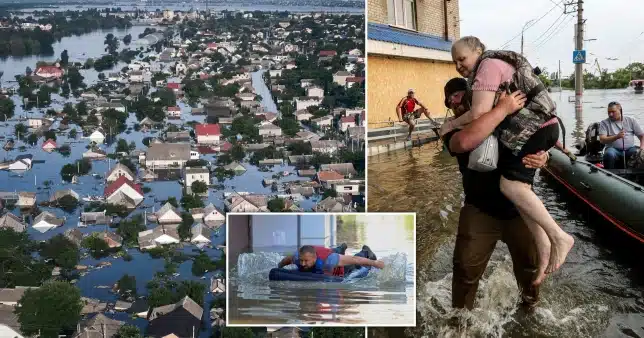
  • Ukraine dam blast equals worst eco-disaster since Chernobyl – Environmental scientists

    Ukraine dam blast equals worst eco-disaster since Chernobyl – Environmental scientists

    Environmental scientists have warned that the collapse of the Nova Kakhovka Dam in Ukraine will have long-term consequences akin to the Chernobyl nuclear accident.

    Kyiv announced Friday night that about 20,000 people had been saved from flooding damage in Kherson, and an additional 40,000 people would need to be evacuated.

    Following the dam’s collapse on Tuesday morning, rescue attempts are still ongoing, and Ukrainians are now attempting to determine the extent of the longer-term harm to the area’s economy and environment.

    Officials and experts have warned that unique ecosystems might be lost, farmland turned into desert, and remaining water supplies contaminated.

    ‘I compare it with the Chernobyl disaster,’ said Maksym Soroka, an environmental safety expert at the Dovkola Network NGO.

    ‘Yes, the consequences are different, but the long-term effect on the population and the territory is the same,’ she told the Financial Times.

    Ukraine’s deputy foreign minister also drew comparisons to the nuclear disaster site, writing on Twitter that the dam collapse was ‘The worst environmental disaster in Europe since the Chernobyl disaster. 

    ‘Only this time Moscow deliberately used this weapon of mass destruction against the Ukrainians, he said. ‘Who else wants to negotiate with Putin?’

    Prior to Russia’s invasion, Kherson was known as a popular nature spot, home to over 70 different species of animals and many endangered creatures.

    But the region’s wildlife population, along with over 300 animals at the Kherson Zoo, has been wiped out after being flooded with 150 million tonnes of polluted floodwater.

    For residents still in the city, evacuation efforts have been hampered by explosions from dislodged landmines and reports of Russian forces shelling Ukrainian emergency workers.

    In Kherson, Ukraine’s deputy premier Oleksandr Kubrakov, said: ‘Infectious diseases and chemicals are getting into the water,’ and instructed local residents not to drink water drawn from wells and ground pumps, as is still common in rural Ukraine.

    Ukraine’s farming minister said 94 per cent of agricultural irrigation systems in Kherson, 74 per cent in Zaporizhzhia and 30 per cent in Dnipropetrovsk would be left without a water source.

    ‘This was a huge irrigation system in which Ukrainian farmers had invested billions of dollars after the fall of the Soviet Union,’ said one executive at a large agricultural company. ‘It is all gone.’ 

    Denys Marchuk, the deputy chair of the Ukrainian Agrarian Council, a trade association, told Ukrainian television the dam’s destruction could cost the country up to 14 per cent of its grain exports. 

    ‘We will not be able to grow anything in the Kherson region until the [dam] is restored,’ Marchuk said. Building a new dam could take several years even without an ongoing war.

    Mayor Yevhen Ryschuk, who left the city after the Russians took control last year, reported three dead and said hundreds of residents need to be evacuated from their roofs. 

    He said 90 per cent of Oleshky is flooded and facing a humanitarian crisis without electricity, potable water and food, as well as possible groundwater contamination.

    Meanwhile, Russian-appointed Mayor Vladimir Leontyev said that the flooding killed thousands of animals in a nature preserve. Hundreds of animals trapped in Oleshky require urgent rescue, volunteers helping a local shelter have claimed.

    Ukrainian president Volodymyr Zelensky said it was impossible to predict how many people would die in Russian-occupied areas due to the flooding, urging a ‘clear and rapid reaction from the world’ to support victims.

    He told the world to respond to the ‘environmental bomb of mass destruction’ unleashed by Vladimir Putin.

    ‘This crime carries enormous threats and will have dire consequences for people’s lives and the environment,’ he said.

    ‘We can only help on the territory controlled by Ukraine. On the part occupied by Russia, the occupiers are not even trying to help. This again demonstrates the cynicism with which Russia treats people whose land it has captured.’

    Russia has continued to deny responsibility for the collapse. However, Western observers are convinced the Kremlin sabotaged the hydro-electric dam with mines put in place early last year.

    Ukraine is poised to begin its big push into Russian-occupied territories and its commanders were not entirely surprised by the attack on the dam.

    Washington think tank the Institute for the Study of War said Russia has ‘a greater and clearer interest in flooding the lower Dnieper despite the damage to their own prepared defensive positions.’