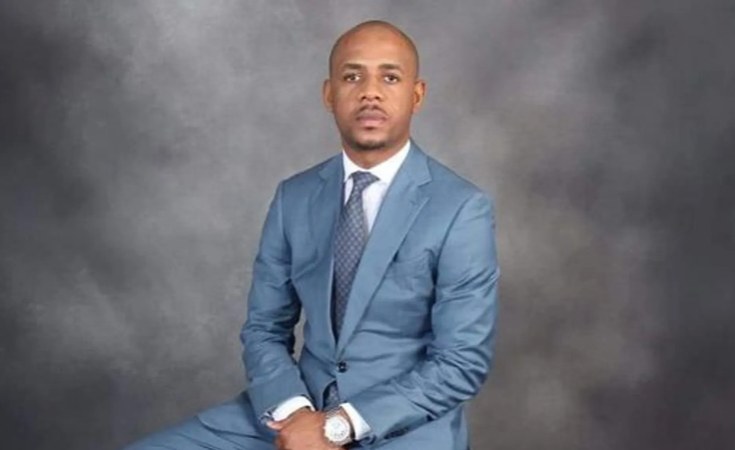
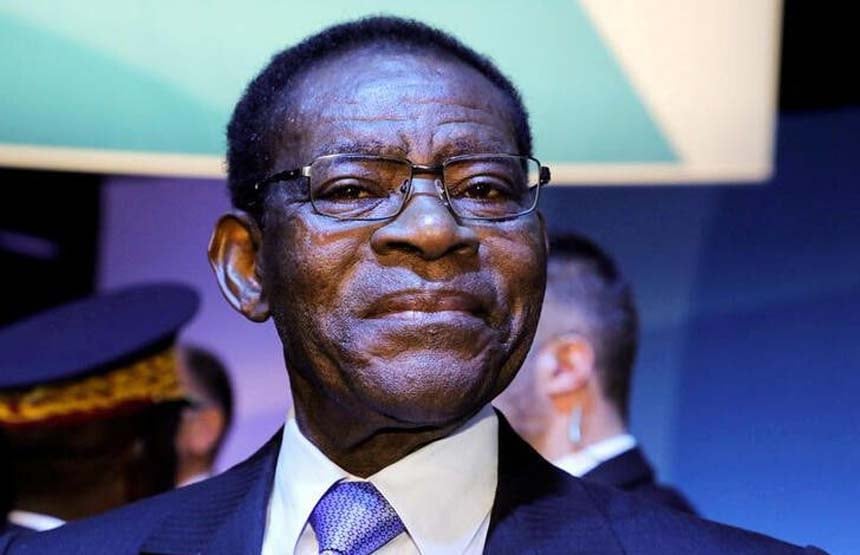
Equatorial Guinea’s President, Obiang Nguema Mbasogo, has dismissed Baltasar Ebang Engonga as Director General of the National Agency for Financial Investigation (ANIF) amid a scandal involving alleged misconduct and inappropriate behaviour.
Engonga’s removal, effective through Decree No. 118/2024 issued on November 4, follows accusations of “irregularities” in his duties, as well as conduct deemed unsuitable for a public official.
The investigation revealed over 400 video recordings found in Engonga’s office, reportedly involving the wives and family members of high-ranking officials, including ministers and police officers, sparking widespread public outrage.
In response, the government has mandated the installation of surveillance cameras across all state offices to monitor officials and deter misconduct. Other implicated officials have also been suspended, reflecting the government’s commitment to enforcing ethical standards and restoring public trust.
Zenón Obiang Obiang Avomo
Zenón Obiang Obiang Avomo has been appointed as the new Director General of ANIF. A seasoned professional with a background in law and finance, Avomo has previously held significant roles, including Magistrate Judge in Malabo, Director General of Contract Studies and State Markets at the Ministry of Finance, and Secretary General for both the Ministry of Finance, Economy and Planning, and the Ministry of Mines, Industry, and Energy.
Equatorial Guinea has launched a crackdown on public officials engaged in sexual misconduct within government offices, spurred by the recent high-profile arrest of Baltasar Engonga, Director General of the National Financial Investigation Agency.
Engonga’s arrest, initiated as part of a fraud probe, revealed over 400 recorded encounters involving prominent officials’ spouses, including ministers and other high-ranking figures.
The scandal unfolded after an impromptu search of Engonga’s home and office by ANIF officials uncovered numerous CDs documenting the encounters, sparking deep concerns within the administration.
In response, Vice President Nguema Mangue announced the immediate suspension of any officials found engaging in inappropriate behaviour in government settings, stressing that such actions violate both the Code of Conduct and Public Ethics Law. He underscored the government’s “zero tolerance” policy on misconduct that undermines public confidence in state institutions.
Attorney General Nzang Nguema emphasized that while consensual relationships are not criminal, the government urges any victims of coercion to report such incidents. This scandal has highlighted the urgent need for stronger accountability and ethical standards across Equatorial Guinea’s public sector, particularly for officials in trusted positions.
Article 34.- Prohibitions for the Employer and their Representatives
Every employer and its representatives are prohibited from the following actions:
a) Deducting, withholding, or offsetting any part of workers’ salaries or cash benefits, except in ways and within limits established by law.
b) Demanding or accepting money or other considerations from workers as a condition for employment or for any other work-related reason.
c) Requiring or encouraging workers to buy consumer goods from specific shops or locations.
d) Influencing the political, religious, or trade union beliefs of workers.
e) Charging interest to workers on any salary advances or anticipated payments.
f) Forcing workers, through coercion or other means, to leave the trade union or association they belong to.
g) Using any form of blacklisting to prevent workers, including those who have retired or been dismissed, from finding employment.
h) Retaining tools or other personal property of the worker as indemnity, guarantee, or by any other means that does not involve a legal transfer of ownership.
i) Conducting collections or mandatory subscriptions within the workplace.
j) Managing or allowing workers to work while intoxicated or under the influence of drugs, narcotics, or any other impairing substances.
k) Carrying weapons within the workplace or enclosed working areas, except with special permission granted for this purpose.
l) Performing any acts that directly or indirectly restrict workers’ rights as provided by this and other applicable laws and regulations.
m) Engaging in any form of harassment, including threats, pressure, coercion, blackmail, or any inappropriate touching of a sexual nature towards a worker of either gender, by the employer’s representative, company heads, or any hierarchical superior.
Equatorial Guinea’s Director General of the National Financial Investigation Agency, Baltasar Engonga, has been arrested following allegations of recording over 400 explicit videos involving the wives of prominent figures in the country.
The scandal surfaced during a fraud investigation targeting the 54-year-old economist, leading ANIF officials to conduct an unannounced search of his home and office, where they discovered numerous CDs revealing his involvement with various married women.
Among those reportedly featured in the footage are high-profile individuals, including the President’s sister, the Director General of Police’s wife, and wives of about 20 ministers, along with Engonga’s own relatives. Although authorities stated that the encounters appeared consensual, the videos have since been leaked online, creating a media storm.
Attorney General Nzang Nguema emphasized that consensual relations are not criminal under the law unless coercion is involved. However, he encouraged any victims of assault to come forward in a supportive environment.
In response, Equatorial Guinea has initiated immediate suspensions for officials engaging in intimate acts within ministry offices, underscoring a “zero tolerance” stance. Vice President Nguema Mangue declared that such conduct violates the Code of Conduct and Public Ethics Law, stressing that ethics and professionalism must guide all public service behavior.
Hoy vamos a procéder a la suspensión inmediata de todos los funcionarios que han tenido relaciones sexuales en las oficinas de los ministerios del país. El Gobierno tomará medidas severas ante estos actos, puesto que constituye una violación flagrante del Código de Conducta y la…
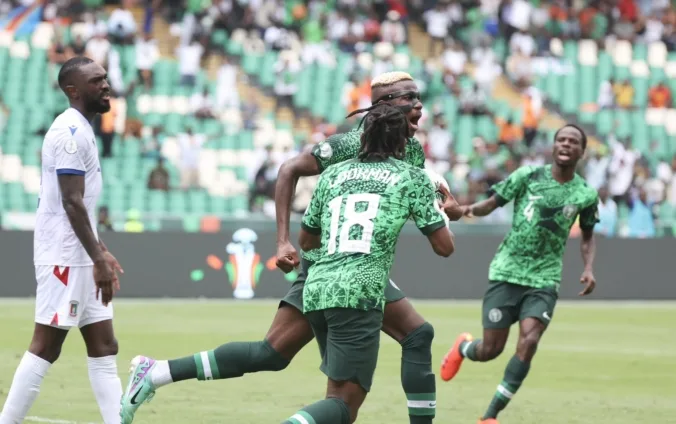
Nigeria narrowly avoided a shock defeat in their opening game of the 2023 Africa Cup of Nations (AFCON) against Equatorial Guinea as Victor Osimhen’s quick response secured a 1-1 draw.
Equatorial Guinea took a surprising lead with Iban Salvador’s classy first-half finish, their only shot on target. Osimhen promptly equalized by heading in Ademola Lookman’s cross right after the underdogs’ opener.
Despite Equatorial Guinea being 46 places below Nigeria in world rankings, they celebrated their lead jubilantly. However, Osimhen’s goal and some crucial saves from goalkeeper Jesus Owono ensured a hard-fought draw for both teams.
The result leaves Nigeria and Equatorial Guinea two points behind Ivory Coast in Group A, with the latter securing a 2-0 win over Guinea-Bissau in the tournament opener. Nigeria will face Ivory Coast in their next match, while Equatorial Guinea will take on Guinea-Bissau.
Gabon’s coup leader has met with Congolese President Denis Sassou Nguesso in an attempt to ease the country’s sanctions.
Gen Brice Oligui Nguema stated on Sunday that his journey to Congo-Brazzaville was to build connections with its neighbor and to remove Gabon’s isolation in the region and globally.
It comes just weeks after Gabon’s membership in the African Union and the central African regional body Eccas was suspended following the coup on August 30.
Following the coup, Eccas relocated its headquarters from Gabon to Equatorial Guinea.
“I have come to consult with the president, who for us is a key in the region, who can relay to global authorities what we have done,” Gen Nguema said after talks with Mr Nguesso.
“It is also to ease the sanctions. We hope to once again take our place among the nations,” he said.
This is Gabon’s second official visit since former President Ali Bongo was deposed in August. In September, he traveled to Equatorial Guinea for the first time.
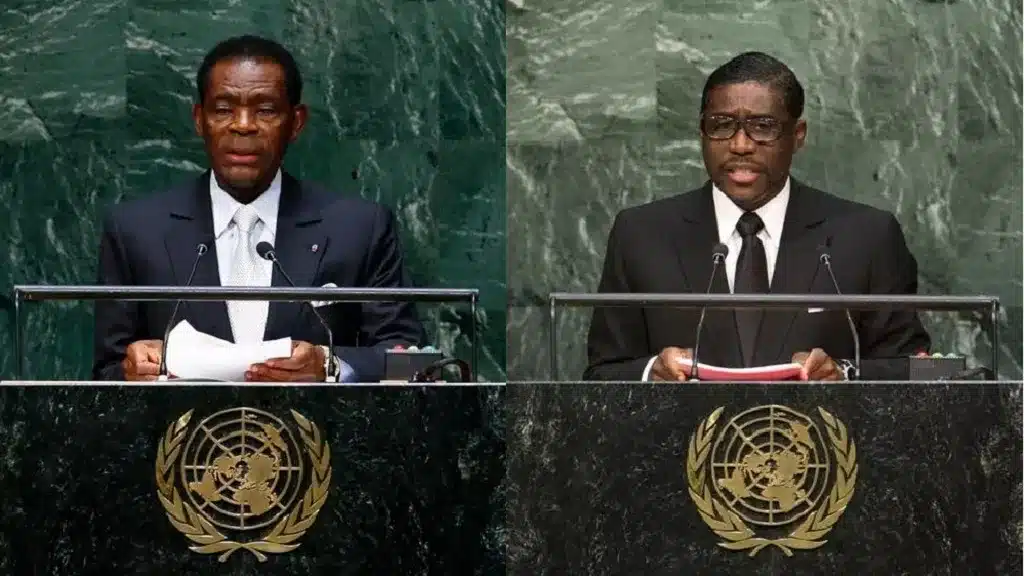
In an announcement made on state television on Wednesday July 2016, President of Equatorial Guinea, elevated his son Teodorin Nguema Obiang to the role of Vice President responsible for security and defense.
The decree from President Obiang stated, “In accordance with the Basic Law of Equatorial Guinea, I appoint His Excellency Teodoro Nguema Obiang Mangue Vice President of the Republic.”
Teodorin Nguema Obiang, a 47-year-old potential successor to his father, served as second vice president from 2012 to the present.
“In accordance with the Basic Law of Equatorial Guinea, I appoint his Excellency Teodoro Nguema Obiang Mangue Vice President of the Republic.”
Following the constitutionally mandated dissolution of the government on June 17 following the April 24 presidential election, President Obiang announced additional appointments.
Later this week, the names of the new government’s remaining members will be made public.
Teodoro Obiang Nguema, the president since 1979, won reelection in April with 93.7% of the vote.
His son went on trial in France for stealing money from the government of Equatorial Guinea in order to gain wealth. Later, the case was dropped.
Societe Generale has recently announced its agreements with two African banking groups to sell four of its subsidiaries located in Congo, Equatorial Guinea, Mauritania, and Chad.
The sale will involve two subsidiaries being acquired by the Vista group in Congo and Equatorial Guinea, while the Coris group will take over the remaining subsidiaries in Mauritania and Chad.
According to a press release by the bank, these two African banking groups will assume all the operations, client portfolios, and employees of Societe Generale in the respective countries.
The move aligns with Societe Generale’s strategy to focus its resources on markets where it can establish itself as one of the leading banks, synergizing with its other business activities.
The bank also announced the initiation of a strategic review of its subsidiary in Tunisia.
The transactions are expected to be completed by the end of the year and involve the complete sale of Societe Generale’s shares in its African subsidiaries: Societe Generale Congo, Societe Generale de Banques en Guinée Equatoriale, Societe Generale Mauritania, and Societe Generale Chad. Currently, Societe Generale holds ownership stakes of 93.5%, 57.2%, 95.5%, and 67.8% in these subsidiaries, respectively.
Furthermore, Societe Generale holds a 52.34% capital share in Union Internationale de Banques (UIB), a subsidiary based in Tunisia.
The bank has announced a strategic evaluation of its participation in this entity as well.
The World Health Organization (WHO) announced on Thursday that there have been eight further confirmed cases of Marburg disease in Equatorial Guinea.
Since the epidemic of the fatal disease comparable to Ebola was identified in February, there have been nine laboratory-confirmed cases and 20 probable cases. There have reportedly been 20 fatalities.
The WHO said in a statement that of the eight new cases, two were reported from the Kie-Ntem province of the Central African nation, four from the Litoral province, and two from the Centre-Sur province.
The areas reporting cases are about 150 kilometres (93 miles) apart, suggesting a wider transmission of the virus, the WHO said.
“The confirmation of these new cases is a critical signal to scale up response efforts to quickly stop the chain of transmission,” WHO Africa Director Matshidiso Moeti said in the statement.
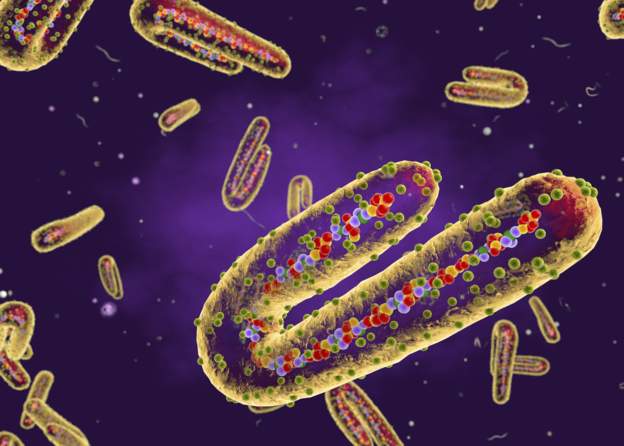
Marburg virus disease is a viral haemorrhagic fever that can have a fatality rate of up to 88%, according to the WHO.
Symptoms include fever, fatigue and blood-stained vomit and diarrhoea. There are no vaccines or antiviral treatments approved to treat it.
Neighbouring Cameroon also detected two suspected cases of Marburg disease last month despite restricting movement along the border to avoid contagion.
Vice president of Equatorial Guinea,Teodoro Nguema Obiang Mangue, has rejected a European Parliament resolution that blames Equatorial Guinean authorities for the death of opposition leader Julio Obama Mefuman.
“The government of Equatorial Guinea vehemently rejects and dismisses the unfounded accusations made by the European Parliament regarding the alleged human rights violations in our country, through its unfortunate resolution,” said Obiang Mangue, in a post on his Twitter account.
In a series of posts, Obiang Mangue, who is also the son of President Teodoro Obiang Nguema Mbasogo, accused the European Parliament of resorting to a “colonial and paternalistic discourse” and of disparaging Equatoguinean institutions and its representatives.
Mr Mefuman, a Spanish national and member of the opposition Movement for the Liberation of the Third Republic of Equatorial Guinea (MLGE3R), was accused by the authorities of plotting to overthrow the government.
According to the MLGE3R, Mr Mefuman and three other dissidents were lured to South Sudan under false pretences and then forcibly flown to Equatorial Guinea where they were tortured over an alleged coup plot.
On 16 January, Equatorial Guinea’s Foreign Minister, Simeon Oyono, stated that Mr Mefuman had died in a hospital in the eastern town of Mongomo in Wele-Nzas province, as a result of an illness he had been suffering from.
The Marburg virus, a highly contagious illness belonging to the same virus family as Ebola, has been reported as having made its first appearance inEquatorial Guinea, according to the country’s authorities on Monday.
In the country’s western Kie Ntem province, the viral hemorrhagic fever is thought to have killed nine people.
One sample that was gathered and sent to the Institut Pasteur in Dakar, Senegal, underwent additional testing, and the results were positive.
According to the World Health Organization, 16 people are currently being held in isolation as suspected contact cases. A team of experts from the health organisation has been sent to the area to assist the medical personnel.
Last week, the country’s Health Minister, Mitoha Ondo’o Ayekaba, said preliminary investigations linked the deaths to people who attended a funeral ceremony.
Movement has been restricted around two villages, where most cases have been reported. Contact tracing is currently ongoing.
This is the first outbreak recorded in the country and the third in West Africa. Ghana confirmed one case last year and Guinea the previous year.
The virus is transmitted to people from fruit bats and spreads between humans through the transmission of bodily fluids.
Although there are no vaccines or treatments, those diagnosed are advised to drink plenty of water as doctors treat a patient’s specific symptoms.
Previous outbreaks and sporadic cases of Marburg in Africa have been reported in Angola, the Democratic Republic of the Congo, Kenya, South Africa, and Uganda.
Authorities in Cameroon stated that the restrictions on border crossing were put in place because of “the high risk of importation” of the unknown illness.
Following “several unexplained deaths” from an unidentified illness that causes hemorrhagic fever, Cameroon has restricted travel along its border with Equatorial Guinea, according to Minister of Public Health Malachie Manaouda on Friday.
He stated in a statement that the restrictions were put in place due to “the high risk of importing this disease and in order to detect and respond to any cases at an early stage.”
With the assistance of specialists from the US Centers for Disease Control and Prevention and the World Health Organization (WHO), investigations are currently underway, and epidemiological surveillance has been strengthened.
“At the current stage … there is no reason to be worried,” Malachie said.
Equatorial Guinea said in a statement on Wednesday that it had registered an “unusual epidemiological situation” over the past weeks in its Nsok Nsomo district, Kie-Ntem province, that caused nine deaths in two adjacent communities over a short space of time.
A crisis commission set up by the health ministry reported a tenth death on Thursday.
The symptoms observed were fever, weakness, vomiting blood and diarrhoea. A team was sent to isolate contact cases and take samples that were sent to a regionalWHO lab for testing. A woman and her two children were taken to hospital, where they recovered after receiving mild treatment, the statement added.
A WHO spokesperson said the agency was supporting the testing of samples to identify what has caused the deaths and should get results within the coming days.
Cameroon said approximately 20 deaths had been recorded on Wednesday in villages in Equatorial Guinea’s Kie-Ntem province, which borders Cameroon’s Olamze district.
The symptoms of the “non-identified illness” were nose bleeds, fever, joint pain and other ailments that caused death within a few hours, the head of health for the district, Ngu Fankam Roland, said in a statement.
He told Reuters on Friday that no cases had been detected or suspected in Cameroon so far.
Equatorial Guinea‘s vice-president has accused French telecom operator Orange SA of “fraudulently” giving the .gq domain name to the Netherlands, forcing the African nation‘s institutions to pay to use the domain.
Teodoro Nguema Obiang Mangue said Equatorial Guinea had “discovered that the French from the Orange company engaged in fraudulent manipulation by ceding our domain #gq to the Dutch.”
“Now, we have to pay them to use our own domain, which makes it challenging to set up an institutional website with gq for the country,” he wrote on Twitter on Thursday.
“What have we done to France for it to plunder African countries in this manner? We are once again hindered by their trickery. The West should stop taking advantage of Africa,” he added.
Orange SA has not responded to the claims.
The vice-president, son of long-serving President Teodoro Obiang Nguema, has previously accused Spain, France and the US of interfering in his country’s internal affairs.
In 2020, a French court fined him 30m euros ($32.9m; £26.6m) for embezzling public funds, giving him a suspended jail term and ordering the confiscation of his assets.
The .gq domain name was launched in 1997 by Equatorial Guinean mobile operator Getesa and is reported to be prone to spam, phishing and other malicious use.
The foreign minister of Equatorial Guinea has refuted reports that a well-known dissident in the nation passed away while serving a 60-year prison term.
Julio Obama Mefuman, 51, “died in Oveng Azem prison”, his MLGE3R movement is quoted as saying by AFP news agency.
It accused the country’s regime, without elaborating, of “torture”.
Informamos a la Comunidad Internacional que,Julio Obama Mefuman un ecuatoguineano que participó en la frustrada intentona golpista del 27 de diciembre de 2017 y que, recibió un juicio justo, ha fallecido en un hospital de Mongomo a causa de una enfermedad que venía padeciendo.
But in a tweet on Monday, the Foreign Minister Simeon Oyono Esono Angue said the dissident died in a hospital and denied accusations of torture.
He said Obama Mefuman “died in a Mongomo hospital due to an illness he had been suffering from”.
The head of Equatorial Guinea’s only authorised opposition party, the Convergence for Social Democracy (CPDS), condemned “Julio Obama’s death in prison.”
“The death of Julio Obama in the Oveng Azém prison is confirmed. CPDS condemns this fact. Obama was a Spanish citizen and the GE government must open an international investigation to clarify what happened and allow all the prisoners to be visited by their families,” party Secretary General Andres Esono Ondo said in a tweet.
Elections since then, according to critics, have been manipulated, with the government and its allies essentially preventing the opposition from participating and controlling the media.
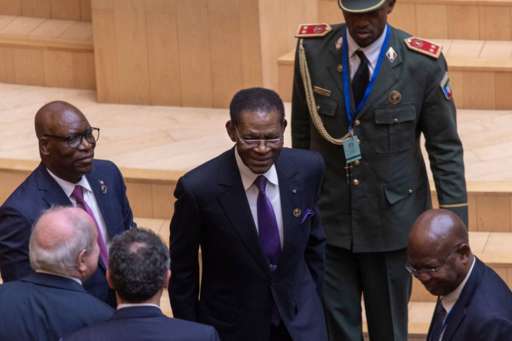
The world’s longest-serving head of state, the president of Equatorial Guinea, has been sworn in for a sixth term in office.
Teodoro Obiang Nguema Mbasogo, who is 80, took the presidential oath before inspecting a military parade.
He declared he was – and always would be – the leader of all Equatorial Guineans.
He first seized power in a coup in 1979.
Critics say elections since then have been rigged, with the opposition largely prevented from taking part and the media controlled by the government and its allies.
The US says it has “serious doubts” about the credibility of Equatorial Guinea’s election resultsthat saw the world’s longest-serving president continue his 43-year-rule.
Teodoro Obiang Nguema Mbasogo, 80, secured almost 95% of votes, according to election officials.
“Given the scale of irregularities observed and the announced results giving the [ruling party] PDGE 94.9% of the vote, we have serious doubts about the credibility of the announced results,” said US State Department spokesman Ned Price.
It said there were credible allegations of “significant election-related irregularities, including documented instances of fraud, intimidation, and coercion”.
President Obiang seized power in 1979 after a military takeover and has survived several coup attempts. He has a strong grip on the oil-rich central African nation.
President of Equatorial Guinea has won re-election for the sixth consecutive time extendig his stay in office to beyond four decades.
Teodoro Obiang Nguema Mbasogo, secured almost 95% of votes, in a vote he was largely expected to win.
Officials results were released over the weekend by the national poll body six days after the vote.
Obiang Nguema is the world’s longest-serving president and is the country’s only second president after overthrowing his uncle to take power in 1979.
“The results prove us right again,” Vice-President Teodoro Nguema Obiang Mangue, the president’s son, said. “We continue to be a great party.”
According to Western media channels like the BBC, President Obiang has a strong grip on the oil-rich central African nation, with family members in key government roles.
He seized power in 1979 after a military takeover and has survived several purported coup attempts.
The world’s longest-serving president has won re-election in Equatorial Guineato continue presiding over his authoritarian regime.
Teodoro Obiang Nguema Mbasogo, 80, secured almost 95% of votes, officials announced six days after the vote.
“The results prove us right again,” Vice-President Teodoro Nguema Obiang Mangue, the president’s son, said. “We continue to be a great party.”
Some opposition candidates stood, but none were expected to win.
President Obiang has a strong grip on the oil-rich central African nation, with family members in key government roles.
He seized power in 1979 after a military takeover and has survived several coup attempts.
Upon gaining office from his predecessor and uncle, Francisco Macias Nguema, he made some reforms but retained Nguema’s absolute control over the nation.
Political opposition is barely tolerated and severely hampered by the lack of a free press, as all broadcast media is either owned outright by the government or controlled by its allies.
It is thought that President Obiang, who has previously denied accusations of human rights abuses and election rigging, intends to use his sixth term to clean up his international reputation.
In September, the government abolished the death penalty, in a move which was praised by the United Nations.
Equatorial Guinea has a history of what critics call fraudulent election results.
Rights groups have labelled the country’s two presidents – Francisco Macias Nguema and Teodoro Obiang Nguema – as some of the worst rights abusers in Africa.
The Spanish, French and Portuguese-speaking country discovered vast oil reserves in 1996, but much of the 1.4 million population has not benefitted from this, with poverty still rampant.
The Interior Minister unveiled the provisional results Monday (Nov 21).
In this race for a sixth seven-year term, Teodoro Obiang Nguema Mbasogo has so far obtained 44.2 % of the votes cast in nearly half of the country’s polling stations.
He is Africa’s longest-serving president and the world longest serving head of state today except for monarchs.
His contenders Andrés Esono Ondo of the CPDS party and former ally Buenaventura Monsuy Asumu of the PCSD each got 1.34% and 0.35% of the vote.
The final results of the one-round election will be announced on November 26.
Obiang’s ruling Democratic Party of Equatorial Guinea (PDGE) holds 99 of the 100 seats in the outgoing National Assembly and all 55 seats in the Senate, which are also up for re-election. Sunday’s polls included municipal elections.
Over 400,000 people registered to vote in the country of about 1.5 million.
Teodoro Obiang Nguema Mbasogo aged 80 took the reins of the country in a coup in 1979.
Preliminary election results released by Equatorial Guinea’s government on Monday, November 21 showed the ruling party winning over 99% of votes counted so far in presidential, legislative, and municipal elections held on Sunday, November 20.
The tiny, authoritarian, oil-producing Central African state is run by President Teodoro Obiang, the world’s longest-ruling head of state, who is seeking to extend his 43 years in office.
“What you sow is what you reap,” said Obiang, 80, who has regularly won more than 90 percent of the votoverducted over the course of five terms since he seized power from his uncle in a coup in 1979.
“I am sure that the victory is for PDGE,” he said, referring to his party.
Two opposition candidates are standing: Buenaventura Monsuy Asumu, who has already stood in the previous five elections, and Andrés Esono Ondo, who is running for the first time.
Early, partial results showed Obiang’s ruling Democratic Party of Equatorial Guinea (PDGE) and coalition with 67,012 votes out of 67,196 counted so far. The count will continue on Monday, said a statement on the government website.
More than 400,000 people registered to vote in the country of about 1.5 million, which is split between the island of Bioko in the Gulf of Guinea and a coastal mainland sandwiched between Cameroon and Gabon.
“It is a total fraud,” Esono Ondo told Reuters by phone, saying his party would challenge the result in court.
He said some semblance of fair voting was taking place in the island capital Malabo, but his party had evidence that officials elsewhere were casting ballots on voters’ behalf or forcing them to votThe governmentruling party.
Government and officials of Equatorial Guinea’s election directorate could not be reached for comment.
Maja Bovcon, a senior Africa analyst at risk intelligence company Verisk Maplecroft, said the election outcome was in no doubt: “The closure of the borders and the harassment and arrests of opposition supporters have been paving the way for the extension of Obiang’s 43-year rule.”
The United States and the European Union called for a free and fair election and raised concern over reports of harassment and intimidation of the opposition and civil society groups. The government ofjected the accusations as interference in its electoral process.
Closing his campaign on Friday, Obiang said he decided to bring the presidential election forward by several months and hold it together with the legislative and municipal elections, to save money due to the economic crisis.
Oil and gas producthree-quartersfor around three quarters of revenues in the OPEC member state. But output has dwindled in recent years to aroundBPD,000 barrels per day (bBPD, from around 160,000 bpd in 2015, as oil fields mature.
Voters are going to the polls this Sunday November 20th to elect a new President of the Republic.
The candidate of the ruling party Teodoro Obiang Nguema will be running for a sixth term as head of state.
He will face Buenaventura Monsuy, candidate of the Social Democratic Coalition party and Essono Ondo Andress, president of the opposition Convergence for Social Democracy.
“These elections, which will take place on 20 November, are taking place in a formal atmosphere….. of international observers, civil society is coming as you yourself have seen in town”, said Equatoguinean journalist Luciano Ndong Alberto.
On the ground, the two opposition partiesare not very visible. The campaign is dominated by the meetings and posters of the outgoing president who has teamed up with 14 opposition parties for these elections.
These are combined elections where deputies, senators and mayors will also be elected.
The opposition believes that the time for change has arrived
“We are convinced that Equatoguineans want to listen to a different message than the one conveyed by the ruling party. They need a message of hope and we can give it to them. They need a message of hope and we can give it to them. We are saying through this election that staying at home will not help to solve our problems” said opposition candidate, Essono Ondo Andress, president of the Convergence for Social Democracy.
This presidential election was brought forward by five months.
The government had justified the anticipation of the elections in Equatorial Guinea by the concern to reduce the costs of organization in a context of economic crisis.
Africanews reporter in Malabo Lambert Ngouanfo adds:
“The electoral campaign is in its final stretch. The closing meetings will be organised this Friday, because Saturday is not a campaign day. On Sunday, the day of the elections, a little more than 427,000 registered voters are expected to go to the polls”.
Campaigning is due to end on Friday for the country’s presidential and legislative elections.
More than 300,000 voters have been registered to take part in the Sunday elections.
Opposition leaders Andrés Esono Ondo and Buenaventura Monsuy Asumu are expected to challenge long-time President Teodoro Obiang Nguema, who is seeking his sixth consecutive term in office.
On Sunday, Equatorial Guinea will hold elections in which the world’s longest-standing president, Teodoro Obiang Nguema, will seek to extend his 43-year authoritarian rule, marked by alleged rights abuses and corruption.
The West African oil-producing nation of about 1.5 million people has had only two presidents since independence from Spain in 1968; Obiang and his uncle Francisco Macias Nguema who he removed in a coup in 1979.
The 80-year-old Obiang, always elected with more than 90 percent of votes in polls international observers have questioned, is vying for a sixth term against two other candidates: Andres Esono Ondo and Buenaventura Monsuy Asumu.
Parliamentary and local elections will be held at the same time.
Oil and gas production accounts for about three-quarters of revenues in the OPEC member state. But output has dwindled in recent years to about 93,000 barrels per day (bpd), from about 160,000 bpd in 2015 due to maturing fields.
Although the tiny Gulf of Guinea nation has seen major investments in infrastructure, critics say under Obiang, oil wealth has lined the pockets of his entourage, who flash luxury lifestyles while most of the population live in poverty.
Obiang is also accused of muzzling dissent and freedom of expression. The government has denied the accusations.
Protests are mostly forbidden, media is heavily controlled, and it is not uncommon for political opponents to be arbitrarily arrested and tortured, rights groups say.
Intimidation has increased in the run-up to the polls, activists say, with authorities targeting civil society groups and critics of the regime.
In September, security forces raided the headquarters of a banned opposition party – the only one with a seat in parliament – and detained at least 100 of its members.
“Whatever It Takes”
Repression before the vote has offset efforts by Obiang to improve his image abroad, the latest seen in a move to abolish the death penalty earlier this year.
“He is washing his face in front of the international community,” said Amnesty International’s Senior Campaigner for West Africa Marta Colomer.
Alleged corruption has also tainted Obiang’s tenure despite several pledges to increase transparency.
His son, Vice President Teodoro Nguema Obiang Mangue, who observers see as a potential successor, was convicted for embezzlement by a French court in 2020.
Assets that foreign powers say he bought with ill-gotten gains include a crystal-covered glove worn by Michael Jackson, an armoured Rolls-Royce limousine and a yacht.
Both father and son have consistently denied wrongdoing.
If re-elected, Obiang will face new challenges. The economy was hit by COVID-19 and although the war in Ukraine has boosted demand for non-Russian oil it has also brought a sharp rise in food prices.
“The opposition does not stand a chance,” Alicante said. “He is going to do whatever it takes not to leave power.”
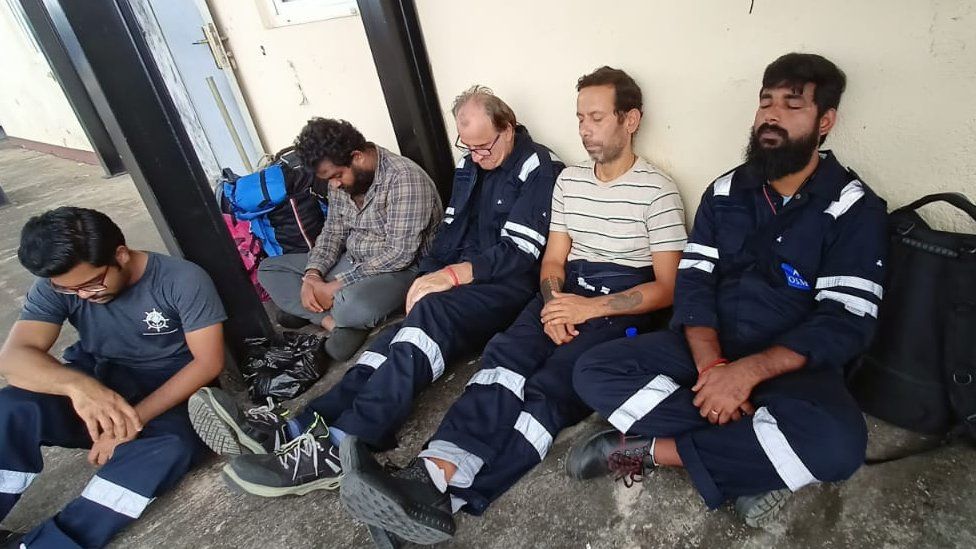
Sixteen Indians who have been detained by Equatorial Guinea‘s navy for three months have petitioned the Indian government to assist them in returning home.
While India has assured their families that it is working hard to ensure their safe return, the sailors have continued to share messages and videos in which they say their situation is becoming desperate.
In mid-August, Equatorial Guinea detained the cargo ship MT Heroic Idun.
The Indians are part of a crew of 26 sailors from various countries.
The ship is managed by Norway’s OSM Maritime Group.
“The vessel and its 26 multinational crew members have now been detained in Equatorial Guinea for more than 80 days,” CEO Finn Amund Norbye said in a statement earlier this week.
“The seafarers have been treated as criminals, without any formal charges or legal process for close to three months,” he alleged. “It is nothing short of a shocking maritime injustice.”
The ship’s crew was en route to pick up crude oil from Equatorial Guinea and Nigeria before heading to deliver it in Rotterdam, Holland.
Sapna Trehan, wife of the ship’s master Tanuj Mehta, says at Nigeria’s AKPO terminal, the ship was told to leave after officials insisted they had no information about their arrival.
As the ship moved towards Equatorial Guinea, it was followed by a vessel claiming to be from the Nigerian navy which alerted Equatorial Guinea, Ms Trehan’s husband told her, adding that the ship was detained on arrival there.
Documents filed in the International Tribunal for the Law of the Sea say that the Equatorial Guinea navy followed a maritime code of conduct and detained the vessel on an alert sent by the Nigerian naval vessel.
Since then, the crew has recorded videos and made phone calls to their families, begging for help.
The government of Equatorial Guinea has not publicly commented on the crew’s detention yet. The BBC has reached out to them for comment.
“The Norwegian [ship] owners also paid €2m ($2.03m; £1.74m) because the ship had not put up the Equatorial Guinea flag when it was in its territorial waters,” Capt Sukhpal Singh, a mariner and friend of the ship master told BBC Hindi.
Ms Trehan said that in the last few days, members of the crew had been separated and her husband’s phone was taken away.
Image caption, The crew members say they are terrified of being taken to Nigeria
“Fifteen of them have been taken away on the Equatorial Guinea naval ship and the others remain on the MT Heroic Idun, all of them are being guarded by Naval officials,” she said.
Earlier this week, concerns grew after the Equatorial Guinea’s vice-president tweeted that the ship would be handed over to Nigeria.
“Everyone was under the impression that the crew and the ship would be released once the fine was paid to Equatorial Guinea on 28 September. But suddenly Equatorial Guinea decided to accept Nigeria’s request,” Capt Rajesh Trehan, a retired mariner and father-in-law of Capt Tanuj Mehta, told the BBC.
In videos shared by families of crew members – which also include sailors from Sri Lanka, Philippines and Poland – they are heard saying, “Please, please, please help. Let us not be taken to Nigeria.”
“One of the primary reasons why there is heightened apprehension among the crew members is because of the previous experiences of crews in Nigeria,” Capt Trehan said.
In 2021, Nigeria released a Swiss tanker three years after it had been first detained.
“These countries have a bad track record [with sailors],” says Capt Singh. “People have just given up their careers after their experience in such countries.”
In a video sent to his wife, Capt Mehta alleges that the sailors “will die” if they are taken to Nigeria and asks the Indian government to bring them home as soon as possible.
In another video, he alleges that the crew members on the ship would be forced to start the engines at gunpoint and taken to Nigeria. “We might never see our families again,” he says.
A video shared by the sailors also says that a crew member had been taken to hospital for poor health.
On Thursday, V Muraleedharan, India’s junior minister for external affairs, told media that several Indian embassies were holding discussions with authorities in Equatorial Guinea for the release of the sailors.
“The Minister for External Affairs [S Jaishankar] is regularly monitoring the situation, the families need not worry,” he said.
“Our efforts are aimed at getting our sailors back home safely,” he added.
The BBC reached out to Arindam Bagchi, Indian foreign ministry spokesman, but did not get a response.
Meanwhile, the sailors’ families remain concerned for their well-being.
Matilda, wife of Chief Officer Sanu Jose, said her husband was very tired and had started feeling weak.
Equatorial Guinea‘s President Teodoro Obiang Nguema Mbasogo, has explained why he is running for a sixth consecutive term in office.
According to an AFP report, the 80-year-old told a rally that his party had chosen him to run “because I am the symbol of peace that reigns in Equatorial Guinea.”
He has ruled the oil-rich Central African country for 43 years, the longest for a serving president.
His party launched their presidential campaign on Thursday with the vote expected to take place on November 20.
Obiang seized power in 1979 from President Francisco Macias Nguema, who was the leader at independence and whose rule prompted a mass exodus and thousands of deaths.
AFP adds that the country has 425,000 registered voters out of a population of around 1.4 million.
Equatorial Guinea’s President Teodoro Obiang Nguema Mbasogo, who has ruled the West African country for 43 years, launched his bid for a sixth term on Thursday.
Mr Obiang, 80, seized power in 1979 from President Francisco Macias Nguema, who was the leader at independence and whose rule prompted a mass exodus and thousands of deaths.
The general elections are scheduled for 20 November.
The president told a rally that his party had chosen him to run “because I am the symbol of peace that reigns in Equatorial Guinea”, the AFP news agency reports.
AFP adds that the country has 425,000 registered voters out of a population of around 1.4 million.
The presidential intervention follows forceful and sometimes brutal expulsion of Cameroonians by the Equato-Guinean authorities.
President Paul Biya of Cameroon has authorised the release of 125 million FCFA (about US$250,000) to be used for the repatriation of an estimated 630 Cameroonians who are being forcefully expelled from Equatorial Guinea.
The presidential intervention follows forceful and sometimes brutal expulsion of Cameroonians by the Equato-Guinean authorities which began on Oct 20.
The government of Equatorial Guinea says most of those being expelled are living illegally in the country.
But some of the Cameroonians who have since succeeded in arriving home say they had their residential papers but were brutally extracted from their homes and forced to leave the country because of growing xenophobia against Cameroonians in Equatorial Guinea.
“I and my entire family were pulled out of my house and forced into a vehicle by police who abandoned us in a football field. By the time I rushed back to my house, I discovered that all my valuable belongings had been carried away by irate Equato-Guinean crowds changing anti-Cameroon slogans”, Fotso Alphonse who said he had just returned from Equatorial Guinea told HumAngle yesterday Sunday Oct 30 in Douala, Cameroon’s economic capital.
A communiqué signed Saturday October 29, 2022 by the Cameroonian ambassador in Equatorial Guinea, Desire Owona Menguele, reveals that the 125 million FCFA would be used in the repatriation of a total of 630 persons drawn from among Cameroonians who have been recently expelled as well as from among some of those who were declared illegal immigrants during a massive expulsion exercise by the Equato-Guinean authorities in November last year.
The mass repatriation exercise is scheduled to begin today, Monday October 31, 2022 with the first 52 Cameroonians, including forty-eight adults and four infants to be transported by Ethiopian Airlines from Malabo. The flight would leave Malabo the Equatorial Guinea capital at 12:30 hours and arrive Douala at 13:25 hours.
Cameroonian consular authorities in Equatorial Guinea say they would assist Cameroonians who wish to remain in the country by facilitating their acquisition of the relevant residential documents.
“For those wishing to remain on Equatorial Guinea territory, the embassy had on Oct 21, forwarded 250 dossiers to the Equatorial Guinea Ministry of Foreign Affairs and Cooperation which demanded for the dossiers with a view to regularising their situation”, the Cameroonian ambassador to Equatorial Guinea revealed.
“The mission has solicited for a three-month period of grace from the Equatorial Guinea authorities counting from the date of the delivery of the new biometric Cameroonian passports established by the consular posts of Bata and Malabo to enable their holders to regularise their situation”, Ambassador Desire Owona Menguele said.
The ambassador also revealed that thirty-one Cameroonians remain captives in the Malabo multipurpose sports complex, among whom are twenty-six men and five women.
It should be recalled that Equatorial Guinea and Gabon are the two of the six member countries of the Economic Community of Central African States, popularly known by the French acronym CEMAC, that have been flouting the CEMAC provision for free movement of goods and persons from member countries within the economic zone, by frequently expelling citizens from other member countries on flimsy excuses bordering on xenophobia.
Cameroonian traders living on the border with Equatorial Guinea are “suffer(ing) a lot” since the closure of Equato-Guinean land borders in preparation for the presidential campaign that will begin on November 3 in this small Central African country.
On October 25, Vice President Teodorin Nguema Obiang justified this measure as a way ‘to prevent the infiltration of groups that may try to destabilise the campaign’, without giving an official date for the reopening of borders and specifying that only airports would remain open.
Many are taking prohibited routes through the bush to attend to their usual errands at the popular Kye Ossi.
Guinea shuts land borders ahead of election campaign
Equatorial Guinea on Monday closed its land borders with Cameroon and Gabon to prevent what it describes as “infiltration” groups intent on “destabilising” the presidential election campaign starting this week.
Vice President Teodoro Nguema Obiang Mangue had said the measure would “prevent the infiltration of groups who may attempt to destabilise the (election) campaign”, which begins on Thursday.
He did not fix a date for the reopening of the borders when he announced last Tuesday that only airports would remain open.
A local official in the northern border town of Ebebiyin told AFP on condition of anonymity that the frontier had been closed since Monday morning.
Initially scheduled for April 2023, the presidential poll was brought forward to November 20 to coincide with legislative, senate and local elections following a decree by long-serving leader Teodoro Obiang Nguema Mbasogo.
The war in Ukraine and the Covid-19 pandemic were cited as the reasons behind the decision to hold the costly votes simultaneously.
The central African nation has heightened border security since what the authorities described as an aborted coup attempt in late 2017 that aimed to kill President Obiang.
The coup was allegedly orchestrated by Equatorial Guineans and foreign mercenaries crossing from Cameroon.
Equatorial Guinea regularly shuts its borders on security grounds despite a regional agreement on the free movement of people and goods with Cameroon, Gabon, Congo-Brazzaville, the Central African Republic and Chad.
The country possesses major oil and gas resources, but a majority of its 1.3 million people live below the poverty line, according to the World Bank.
Authorities have increased arrests of dissidents ahead of the elections next month.
Equatorial Guinea has detained a human rights activist for 18 days after he aided opposition activists during a police siege of their party offices, his lawyer and wife told AFP on Thursday.
The justice ministry refused to comment on the report when contacted by AFP.
Anacleto Micha Nlang, co-founder of the bannedrights group “Guinea is also ours” was arrested on September 25 after returning from the offices of the Citizens for Innovation (CI) party. He had delivered food to families – including women and children – under siege there, his wife Montserrat Mikue and lawyer Evaristo Nguema Elo confirmed to AFP.
The small, Spanish-speaking central African country is one of the most closed and authoritarian in the world. It is led by Teodoro Obiang Nguema Mbasogo, the world’s longest-serving incumbent president, who has been in power since 1979.
In 2021, Reporters Without Borders ranked Equatorial Guinea at 164 among 180 countries in its press freedom index.
With presidential, legislative, and municipal elections just over a month away, authorities have stepped up arrests in recent weeks.
State media has justified the crackdown as a bid to counter a “foiled plot” by the opposition to carry out attacks on embassies, petrol stations and the homes of ministers.
On September 30, after a siege lasting more than a week, security forces stormed the home of CI leader Gabriel Nse Obiang Obono, whose house had also served as an office for the banned party since 2018.
The assault left five dead – four activists and a policeman, according to authorities.
Dozens were injured and more than 150 people were arrested from among the 200 who had camped out there, including Obono.
The authorities said they stormed the building to detain the CI chief who refused to surrender to a court warrant as part of the investigation into the alleged plot.
Nlang was detained at Malabo’s central police station before being transferred on October 11 to Black Beach prison, also in the capital, his lawyer and the Somos+ Sociedad Civil rights group told AFP.
“He has been transferred to the world’s worst prison, Black Beach,” the group said in a statement, alleging a “policy of terror.”
The world’s longest-serving president, Teodoro Obiang of Equatorial Guinea, announced this week that he plans to run again in the polls in November to extend a 43-year rule that started following a coup he led in 1979, bringing attention to African elections once again.
Filipe Nyusi, the president of Mozambique, was elected for a third five-year term this week despite the fact that the country’s constitution only permits a maximum of two mandates.
While his term as the country’s president ends in 2024, Nyusi is expected to lead his party until 2027. Both nations struggle with poverty fueled by widespread corruption despite the wealth of fossil fuels and other minerals which make up a sizable portion of revenues.
Both are also likely to experience some growth as pandemic pains recede and domestic demand improves. The current search for alternatives to Russian gas should also boost FX inflows to gas-rich Mozambique and shore up its reserves.
The sharp decline came even as Nigeria’s central bank hiked rates by 150 basis points to 15.5% as it seeks to combat high inflation, which the bank says has been exacerbated by worsening insecurity, broken critical infrastructure and high import costs on items such as wheat.
Destruction of farmland and livestock due to recent flooding is also threatening shortages of agricultural produce. In the short term, we expect the Naira to continue its depreciation against the dollar amid increased demand for FX in the parallel market.
Cedi at new low as Fitch warns Ghana default ‘probable’
The Cedi dived to a new record low this week, trading at 10.38 from 10.11 at last week’s close. Ghana said it had started discussions with the IMF this week as it seeks to secure a $3bn three-year loan package to stabilise its economy, given that surging borrowing costs have shut the country out of global capital markets.
The IMF is expected to conclude an 11-day mission to the country at the end of next week. Market watchers predict that Ghana will need to restructure its debt to unlock any IMF financing.
Fitch Ratings cut Ghana’s credit rating one notch to CC, signalling a ‘default of some kind appears probable’. Against that backdrop, we expect the Cedi to continue weakening beyond the 10.50 level in the near term.
Rand sinks beyond 18 in ‘risk assets’ selloff
The Rand depreciated against the dollar this week, trading at 18.02 from 17.95 at last week’s close—the first time it has traded weaker than 18 since May 2020. The latest decline came as risk assets continued to sell off following the US Federal Reserve’s 75 basis point rate hike last week.
On the domestic front, South Africa’s economy lost 1.6 million work days in the first half of the year due to strike action, predominantly over wages. Public sector workers may strike for the first time in a decade over poor pay.
Given the global risk-off sentiment and the country’s domestic challenges, we expect the Rand to remain under pressure in the near term.
Egyptian Pound touches all-time low as FX reserves fall
The Pound hit a record low 19.53 against the dollar this week, before recovering to trade at 19.48—marginally stronger than last week’s close of 19.49.
Dollar scarcity is ongoing in the country, with Egypt’s net FX reserves standing at $33bn in August, the lowest level since 2017. The government is seeking to raise up to $6bn by June next year from the partial sale of as-yet-unnamed government-controlled entities through a series of IPOs.
Given the dollar’s strength, increased tensions around Russia’s war in Ukraine and strained economic conditions domestically, we expect the Pound to weaken further in the coming weeks.
Kenyan Shilling at fresh low as dollar soars
The Shilling fell to a fresh low against the dollar this week, trading at 120.50/120.70 from 120.35/120.65 at last week’s close as FX demand remains elevated and the greenback continues strengthening on the back of last week’s US rate hike.
While we expect the Shilling to remain under pressure overall in the week ahead amid month-end dollar demand from importers, Kenya may see some benefit from recent financial turmoil in the UK, which plunged the Pound to a record low against the dollar.
Although Kenyan exports to Britain, such as cut flowers, may fall, the country may see lower costs on imports from the UK including cars, machinery, alcoholic beverages, pharmaceuticals and electronics. Around 2.3% of Kenya’s external debt burden is denominated in Sterling.
Shilling slides amid Uganda Ebola outbreak
The Shilling depreciated against the dollar this week, trading at 3861 from 3820 at last week’s close, pushed lower by the Fed-driven stronger greenback. Ebola infections have risen across the country, with almost two dozen suspected deaths recorded at the start of the week.
Interns at the hospital that is handling the most cases also went on strike this week, citing a lack of appropriate safety gear, risk allowances and health insurance.
Meantime, Uganda said coffee production could hit a record level in the 2022/23 growing season due to better rainfall and crop plantings. Overall, we expect to see the Shilling continue weakening in the near term.
Tanzanian Shilling touches 3-month high
The Shilling touched 2328 this week, its strongest dollar level since June, before dipping back to 2332—in line with last week’s close.
Tanzania this week said it is partnering with India to build irrigation systems across the country to increase agricultural output. It has already started constructing more than a dozen large dams in preparation.
Meantime, the Bank of Tanzania said will continue to gradually reduce liquidity in the market until the end of October to tackle rising inflation. Following a recent US investor trip to Tanzania, we expect inflows to strengthen the Shilling in the near term.
The new penal code will be implemented after 90 days, Reuters reports.
The move comes three years after President Obiang promised to abolish the death penalty.
Mr Obiang’s son, Vice-President Teodoro Nguema Obiang Mangue, described the decision as “historical and memorable,” Reuters news agency reports.
The last execution in the country took place eight years ago.
Capital punishment remains legal in just over 30 African countries, but more than 20 of those have not carried out executions for at least 10 years, according to data provider Statista.
Central African countries including Equatorial Guinea, Cameroon, Gabon, Chad, Angola, Democratic Republic of Congo (DR Congo) and Congo-Brazzaville have signed a deal to boost energy supply in the region through the building of an oil and gas pipeline network, the Reuters news agency reports.
There will be three gas pipelines measuring around 6,500 km (4,000 miles).
Most of the countries that have signed up have oil reserves but do not have sufficient refining capacity, and have been struggling with energy supply after the outbreak of the Ukraine war.
The plan will also include at least three refineries and power plants fired by gas linking 11 countries.
Equatorial Guinea will head to the polls this November to elect its President.
The country’s Parliament has approved the move from 2023 to this year.
This means that political parties have less than four months to prepare.
It follows the Congress’ authorisation for the government to merge the presidential election with legislative and municipal elections.
Congress said this was needed in a context of significant economic constraints.
The 80-year-old President Teodoro Mbatsogo has ruled the country since 1979 and is constitutionally allowed to run for a sixth term, although he is yet to declare his candidacy.
Political opposition is barely tolerated and severely hampered by the lack of a free press, as all broadcast media is either owned outright by the government or controlled by its allies.