No talking to happy people. Leaders will not be seen together in public. There was talk about both Germany and Turkey going to a football match in Berlin together, but it turns out that it’s not happening.
Turkish President Recep Tayyip Erdogan‘s visit to Germany on Friday for a state visit is very quiet and not getting much attention. He will first meet the President of Germany, Frank-Walter Steinmeier and then have dinner with the chancellor, Olaf Scholz.
Two secret meetings and a quiet dinner don’t sound very exciting.
In the middle of the capital, there is very strong security for the visit of Mr. Erdogan, similar to when the US president visits. The German government wants Mr. Erdogan’s visit to not attract much attention.
This event is happening at a really bad time for Germany.
The President of Turkey, Erdogan, has had a hard time getting along with the German government for many years. They often argue with each other. When German government people talk about a “difficult partner,” they mean President Erdogan.
The fighting between Hamas and Israel on 7 October has caused Germany and Turkey to take different sides in the conflict.
In the last month, the President of Turkey has been more and more outspoken in his disapproval of Israel.
He won’t criticize the killings and hostage-taking by Hamas, and he calls them “liberators. ” Hamas is considered a terrorist group by Western countries, like Germany.
He has also seemed to doubt that Israel should exist by saying that Israel’s “own fascism” made it less rightful.
Leaders of the Jewish community in Germany are saying that Mr. Erdogan’s comments are making antisemitism worse. They want the German government to cancel the Turkish president’s visit.
Germany feels responsible for the Holocaust and so they will always support Israel, no matter what. This is really important for their foreign policy.
Both Olaf Scholz and former Chancellor Angela Merkel have said that protecting Israel’s security is very important to Germany. They use the term “reason of state” to show that Germany will always support Israel.
However, as Israel keeps attacking Gaza more and more, and more people are dying, that idea is being tested.
After the surprising Hamas attacks, German newspapers are starting to talk more about the problems facing the people in Gaza. This is making more people in Germany feel worried about what Israel is doing.
In Germany, many people are getting angrier about what Israel is doing, and there have been protests in support of Palestine almost every weekend since October 7th. Germany has many Arab communities who have connections to, or feel sorry for, people in Gaza. Some German left-wing groups have always been very supportive of Palestinians.
There are worries that if President Erdogan talks about the conflict during his visit, it could make the situation worse.
Germany and Turkey rely on each other. Turkey and Germany trade a lot. It also has the biggest group of Turkish people who live away from their homeland, and it’s an important place for President Erdogan’s election campaign. Many German-Turks like him.
About three million people with family roots in Turkey live in Germany, and about half of them have the right to vote. In May, most Turkish voters in Germany voted for Mr. Erdogan in the election.
Berlin needs the help of Turkey to manage the flow of people from the Middle East. Chancellor Scholz wants to make a new agreement with Turkey to send back people seeking asylum and hopes that Turkey will help the West in Russia’s war in Ukraine.
On Friday, the issues will be talked about privately. The German government might worry about what President Erdogan will say in public.
He probably now wishes he hadn’t done it.
Tag: Erdogan
-
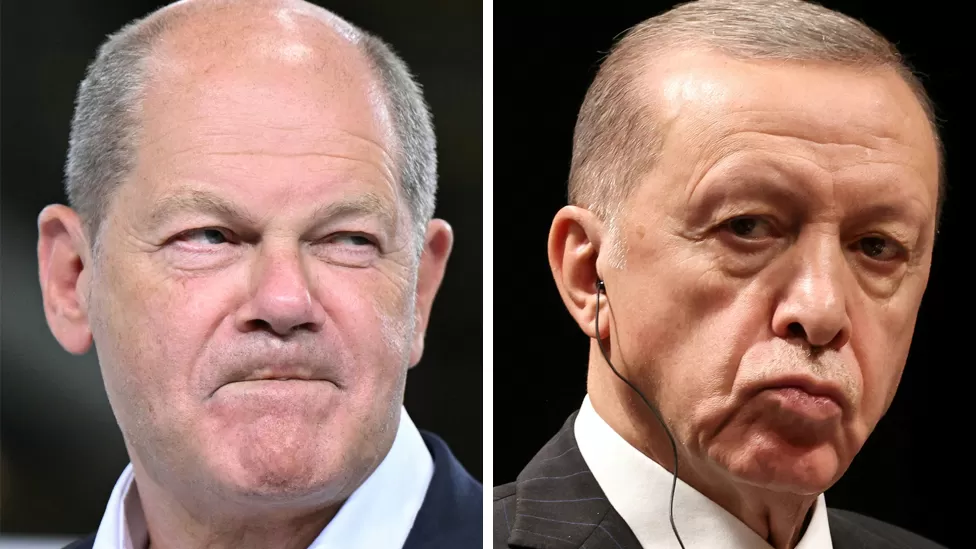
Erdogan on edge in Berlin following harsh criticism from Israel
-
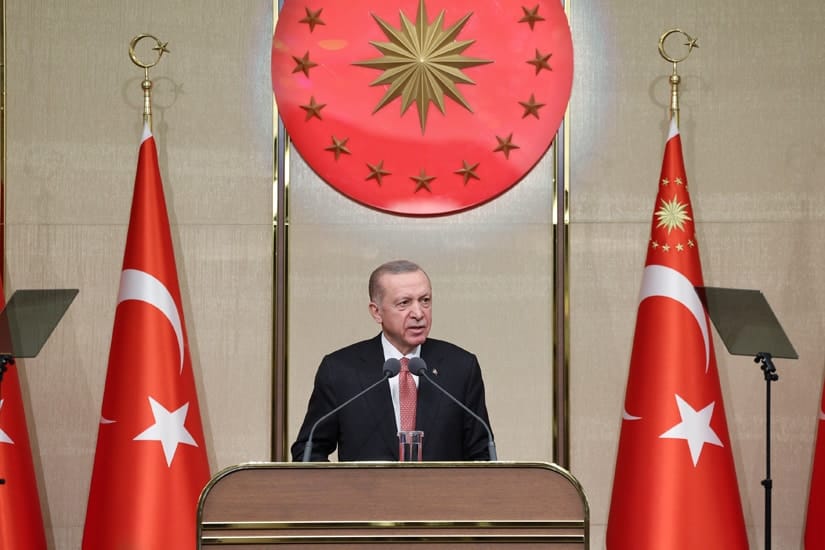
Turkey: President Erdogan beats Kilicdaroglu to retain power
Recep Tayyip Erdogan’s supporters jubilantly celebrated throughout the night after Turkey’s long-serving president secured another five years in power.
“We have won as the entire nation of 85 million,” he declared to exultant crowds outside his immense palace on the outskirts of Ankara.
However, his call for unity rang hollow as he proceeded to mock his opponent, Kemal Kilicdaroglu, while also targeting a jailed Kurdish leader and the LGBT community.
The opposition leader stopped short of explicitly conceding defeat.
Denouncing “the most unjust election in recent years,” Mr. Kilicdaroglu asserted that the president’s political party had employed all the resources of the state against him.
Based on nearly complete unofficial results, President Erdogan obtained just over 52% of the vote. It is important to note that nearly half of the electorate in this deeply divided country did not support his authoritarian vision for Turkey.
Bize yeni bir zafer daha yaşatan milletimiz var olsun. Türkiye Yüzyılı kutlu olsun. Büyük Türkiye zaferimiz hayırlı olsun. 🇹🇷 pic.twitter.com/SRzasZGvuZ
— Recep Tayyip Erdoğan (@RTErdogan) May 28, 2023Ultimately, Mr. Kilicdaroglu proved to be no match for the well-organized Erdogan campaign, even though he managed to force the president into a second-round runoff, a first since the direct election of the post in 2014.
Nonetheless, he made only a slight dent in his rival’s lead from the first round, trailing by over two million votes.
The president made the most of his victory, with an initial speech to supporters atop a bus in Turkey’s biggest city, Istanbul, followed after dark by a balcony address from his palace to an adoring crowd that he numbered at 320,000 people.
“It is not just us who won, Turkey won,” he declared, calling it one of the most important elections in Turkish history.
He taunted his opponent’s defeat with the words “Bye, bye, Kemal” – a chant that was also taken up by his supporters in Ankara.
Mr Erdogan poured scorn on the main opposition party’s increase in its number of MPs in the parliamentary vote two weeks earlier. The true number had fallen to 129, he said, because the party had handed over dozens of seats to its allies.
He also condemned the opposition alliance’s pro-LGBT policies, which he said were in contrast with his own focus on families.
The run-up to the vote had become increasingly rancorous. In one incident, an opposition Good party official was fatally stabbed in front of a party office in the northern coastal town of Ordu.
The motive for Erhan Kurt’s killing was not clear, but a leading opposition official blamed youths celebrating the election result.
Although the final results were not confirmed, the Supreme Election Council said there was no doubt who had won.
It is highly unusual for the palace complex to be opened to the public – but so was this result, extending his period in power to a quarter of a century.
Supporters came from all over Ankara to taste the victory. There were Islamic chants, while some laid Turkish flags on the grass to pray.
For a night, Turkey’s economic crisis was forgotten. One supporter, Seyhan, said it was all a lie: “Nobody is hungry. We are very happy with his economy policies. He will do even better in the next five years.”
But the president admitted that tackling inflation was Turkey’s most urgent issue.
The question is whether he is prepared to take the necessary measures to do so. At an annual rate of almost 44%, inflation seeps into everyone’s lives.
The cost of food, rent and other everyday goods has soared, exacerbated by Mr Erdogan’s refusal to observe orthodox economic policy and raise interest rates.
The Turkish lira has hit record lows against the dollar and the central bank has struggled to meet surging demand for foreign currency.
“If they continue with low interest rates, as Erdogan has signalled, the only other option is stricter capital controls,” warns Selva Demiralp, professor of economics at Koc university in Istanbul.
Economics was far from the minds of Erdogan supporters, who spoke of their pride at his powerful position in the world and his hard line on fighting “terrorists”, by which they meant Kurdish militants.
President Erdogan has accused his opposite number of siding with terrorists, and criticised him for promising to free a former co-leader of Turkey’s second largest opposition party, the pro-Kurdish HDP.
Selahattin Demirtas has been languishing in jail since 2016, despite the European Court of Human Rights ordering his release.
Mr Erdogan said while he was in power, Mr Demirtas would stay behind bars.
He also promised to prioritise rebuilding in areas hit by February’s twin earthquakes and bring about the “voluntary” return of a million Syrian refugees.
Crowds flocked to Istanbul’s Taksim Square, with many coming from the Middle East and the Gulf.
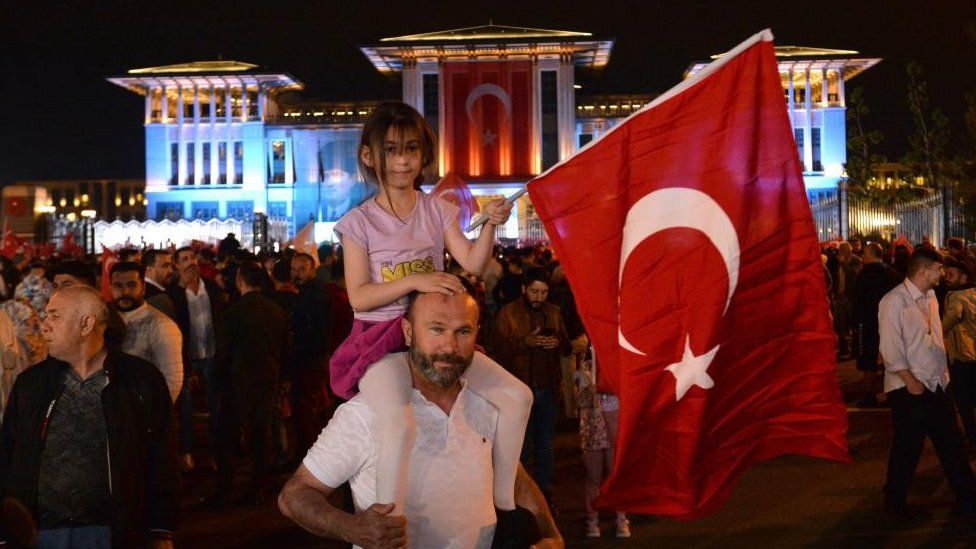
Image caption,Supporters gathered outside the palace from all over Ankara to hear Mr Erdogan Palestinians from Jordan wrapped Turkish flags around their shoulders. A Tunisian visitor, Alaa Nassar, said Mr Erdogan had not just made improvements to his own country, “he is also supporting Arabs and the Muslim world”.
For all the celebrations, the idea of unity in this polarised country seems farther away than ever.
Since a failed coup in 2016, Mr Erdogan has abolished the post of prime minister and amassed extensive powers, which his opponent had pledged to roll back.
One voter outside an Ankara polling station on Sunday said he wanted to see an end to the brain drain that began with the post-coup purge. There is a risk that it may now intensify.
Turkey’s defeated opposition will now have to regroup ahead of local elections in 2024.
Istanbul Mayor Ekrem Imamoglu, a high-profile favourite among opposition supporters, appealed to them not to despair.
He reminded them on Monday that the opposition had defeated the ruling party in Ankara and Istanbul in 2019 months after they had lost the last presidential election.
That was only achieved after they changed strategy and started from scratch, he explained: “We will never expect different results by doing the same things.”
Source: BBC