The government says that the conflict between Ethiopia’s Amhara and Tigray regions will be resolved by holding a vote where people can decide on the result.
The group has promised to disturb the delicate calm after the war in Tigray ended a year ago.
Before the conflict in 2020, Tigray had control over the rich and fertile lands. However, the Amhara forces took over and gained control of these lands.
Rights organizations have accused the forces of clearing out particular ethnic groups in the areas that they are arguing over.
The Amhara regional government said the accusations were not true.
The disputed areas, that are close to the border between Ethiopia and Sudan, caused a lot of problems during the two-year conflict between the Tigray People’s Liberation Front (TPLF) and the government of Ethiopia.
The fighting stopped after a peace deal was signed in South Africa last November.
Many of the one million people who are forced to live in temporary camps in Tigray have left the areas where there is fighting.
The Amhara government says that Tigray took control of the territory in the 1990s without permission when the TPLF was the main political group in Ethiopia.
Last year, Amnesty International and Human Rights Watch wrote a long report. In the report, they said that after talking to people, they found proof that the fighting in the disputed places caused some of the worst crimes. These areas were mostly not paid attention to.
Former Nigerian President Olusegun Obasanjo, who is representing the African Union, stated that approximately 600,000 individuals lost their lives throughout the conflict. Scientists believe that the large number of civilian deaths can be attributed to conflict, hunger, and limited access to medical treatment.
In Monday’s statement evaluating the year since the peace deal, the government said that the people who were forced to leave their homes would be able to go back, and the national military would be in charge of keeping the local area safe.
The government says they have made a decision on how to solve the problem of the disputed areas that will benefit everyone involved.
The government’s communication service said that they have set up a plan for a referendum to take place, following the rules of the constitution.
We don’t know when the referendum will take place.
The message, which was published in both Amharic and English, also praised the advancements made in the past year. These advancements include the establishment of a temporary administration in Tigray. However, it claimed that the government has been moving slowly in fully implementing the peace agreement.
It also indicated that the government was still keeping fighters even though they agreed to give up their weapons.
The Tigrayan forces have given up their big weapons, but they still have small and light guns. The TPLF said last week that the ceasefire was not fully followed because many people were still forced to leave their homes.
This is happening while there is a lot of fighting between soldiers from Ethiopia and local groups in many areas of the Amhara region.
The fighting started in April when the national government told regional forces and armed groups to give up their weapons.
Soldiers from the Fano militia claim that they have taken control of a number of towns in Ethiopia’s second largest region. The government has not said anything about the claims yet.
In August, armed groups took over some of the region’s big cities for a short time. They even managed to capture an airport in the old town of Lalibela, but the military forced them to leave.
The Ethiopian Human Rights Commission (EHRC) says that the government forces have done bad things to people’s rights when fighting with Fano rebels.
The Ethiopian government disagreed with the EHRC report and said it was not fair.
Western countries like Britain and the US have asked for a conversation to happen.
Tag: Ethiopian Human Rights Commission
-

Ethiopia preparing vote to resolve – Tigray-Amhara conflict
-
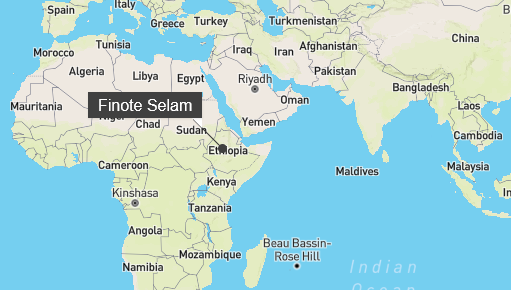
At least 26 killed in an explosion in Ethiopia as violence worsens
In the midst of fierce combat between government forces and a local militia group, an explosion in the town of Finote Selam in northwest Ethiopia has claimed at least 26 lives.
According to Manaye Tenaw, CEO of the Finote Selam General Hospital, an additional 50 persons were hurt in the explosion on Sunday. There may have been more casualties, but these are just the patients being treated at the hospital.
Tenaw claimed to CNN that only one explosion, whose origin is unknown, was heard by witnesses.
He noted that in the days preceding the explosion, the hospital had previously cared for more than 160 patients as severe fighting broke out early this month throughout the Amhara region between government forces and a local militia known as Fano.
The Ethiopian Human Rights Commission (EHRC) expressed “grave concern” over the intense fighting that started on August 3 between the two factions “following months of tension and sporadic clashes,” it said in a statement on Monday.
After days of fighting, the Ethiopian government declared a six-month state of emergency in the Amhara region on August 4.
The government and the Fano militia were formerly allies in the violent two-year fight that ended in November, but relations have soured recently as a result of the militia’s opposition to a federal government initiative to dissolve regional forces.
Nationalists from the Amhara region claim that this will jeopardise local security.
According to the EHRC, there was “heavy fighting in and around cities and towns across the Amhara region, which involved the use of heavy artillery, resulting in the deaths and injuries of civilians.”
“EHRC has also received credible reports of strikes and shelling, including from Debre Birhan, Finote Selam, and Burie resulting in many civilian casualties and damage to residential areas and public spaces,” the organisation stated, noting that comparable reports had been compiled in the region’s two largest cities, Gondar and Bahir Dar.
In the nation’s capital, Addis Abeba, the panel also reported “widespread arrest of civilians who are of ethnic Amhara origin.”
Gondar and Bahir Dar inhabitants told CNN on Monday that the cities are now relatively calm. In a televised statement on Friday, a government spokesperson said that federal soldiers had “freed” cities in Amhara.
While intense conflict has decreased in major urban centres after August 9, 2023, it is still a serious issue in other sections of the region until a long-term solution is found, according to the EHRC.
Asserting that “previous states of emergency have been accompanied by violations of human rights,” the United Nations “called on all sides to respect human rights and take steps to deescalate the situation” in a statement released on Friday.
In a joint statement released on Friday, the governments of Australia, Japan, New Zealand, the United Kingdom, and the United States of America highlighted the civilian deaths and urged all parties to “protect civilians, respect human rights, and to work together to address complex issues in a peaceful manner.”
The federal administration, the Ethiopian National Defence Forces, and the Amhara regional government have all been contacted by CNN for comment.
US Secretary of State Antony Blinken stated in March that the country has publicly concluded that war crimes have been perpetrated by armed troops on all sides of the conflict in northern Ethiopia.
At a press conference for the release of the State Department’s 2022 Human Rights Report, Blinken stated, “After the department’s careful review of the law and the facts, I’ve determined that members of the Ethiopian National Defence Forces, Eritrean Defence Forces, Tigray People’s Liberation Front forces, and Amhara forces committed war crimes during the conflict in northern Ethiopia.”