Tag: Ethiopian

  • Ethiopian authorities repatriates 70,000 stranded migrants from Saudi Arabia

    Ethiopian authorities repatriates 70,000 stranded migrants from Saudi Arabia

    On Friday, Ethiopian authorities initiated the repatriation of stranded migrants from the oil-rich kingdom of Saudi Arabia, facilitating the return of 842 individuals through flights.

    The objective of the third phase of this program is to repatriate 70,000 people within four months, achieved through the operation of 12 flights per week.

    According to the government, the migrants faced dire circumstances, with many being undocumented and enduring incarceration in prisons and detention centers within Saudi Arabia.

    However, there remains a significant risk of these individuals returning to Saudi Arabia, given the annual migration of thousands seeking improved living conditions.

    Earlier this week, Ethiopian officials reported the tragic loss of 38 migrants, including children, in a shipwreck off the coast of Djibouti, prompting speculation that they may have been en route to Saudi Arabia.

    Reports suggest that Saudi Arabia hosts approximately 750,000 Ethiopian migrants, with more than half believed to have entered the country unlawfully.

  • 13 suspects in police grips over   murder of top Ethiopian opposition leader

    13 suspects in police grips over murder of top Ethiopian opposition leader

    Police in the tumultuous Oromia region have arrested thirteen individuals in connection with the murder of prominent Ethiopian opposition figure Bate Urgessa, according to reports.

    While authorities have not disclosed the identities of the suspects, they have confirmed the initiation of a criminal inquiry into the matter.

    Mr. Bate, a key member of the Oromo Liberation Front (OLF) opposition party, was fatally shot earlier this week. His body was discovered on Wednesday morning near a dumpster in his hometown of Meki.

    Family members informed local media that he had been forcibly taken from his hotel room on Tuesday night by individuals resembling government security personnel.

    The regional government of Oromia has refuted any involvement of its security forces in the incident.

    Medical sources revealed to the BBC that Mr. Bate’s body displayed multiple gunshot wounds.

    Although he was laid to rest on Thursday, concerns persist regarding the adequacy of forensic examinations conducted.

    Both the US and UK governments have urged for an impartial investigation into the assassination.

  • Ethiopian government acknowledges fatalities from famine

    Ethiopian government acknowledges fatalities from famine

    Nearly 400 people have died in Ethiopia’s Tigray and Amhara regions because of lack of food caused by drought, the government’s Federal Ombudsman Institute reported on Tuesday.

    The comments go against what federal authorities said before, that they didn’t have confirmation of anyone dying from not having enough food in any part of the country.

    People had died in different areas, but there wasn’t a complete record of all the deaths.

    The institute found that millions of people were affected in the two areas and tens of thousands had already been forced to leave their homes.

    The boss of the institute, Endale Haile, told the media that the deaths happened in the last six months.

    In December, leaders in the war-torn Tigray region said a severe food shortage, like the one Ethiopia had in the 1980s, could happen soon if we don’t act fast.

    The government said there is not going to be a famine in Ethiopia, but they recognized that a lack of rain is causing problems in some parts of the country.

    The Ombudsman Institute is telling government agencies to not waste time on words and instead focus on helping people.

    The government said last week that they found over six million people who need urgent help because of a drought in the next three months.

  • Widespread positive reaction to the Ethiopian ceasfire agreement

    There has been widespread positive reaction to the ceasefire agreement reached between the Ethiopian government and Tigrayan rebels.

    World leaders have hailed the agreement signed in the South African capital, Pretoria, as a positive step towards bringing peace to the region.

    However, they have encouraged further negotiations in order to reach a permanent ceasefire agreement and launch broader political talks.

    But this week’s truce brings an end to two years of a devastating conflict that has left thousands dead, displaced millions, and left hundreds of thousands facing famine.

    Ethiopians welcome peace deal

    On the streets of the capital, Addis Ababa, residents have welcomed the deal with a sigh of relief that the hostilities are over and that peace can be restored.

    ‘Peace is better than war. But the truce must be carefully implemented so we don’t relapse back into war,’ says banker, Degswe Assefa.

    His sentiments are echoed by many others in the city who were unhappy with both the economic and humanitarian impact of the internal war.

    ‘It is pleasing to return to our previous peaceful life. Even our economy has been affected because of the war,’ says fellow banker, Selam Worku.

    The origins of the conflict are complex. Prime Minister Abiy came to power in April 2018, pledging a raft of political and economic reforms in Ethiopia after almost three decades of government dominated by the Tigray People’s Liberation Front (TPLF).

    But in November 2020 he sent troops in to topple the TPLF in their regional stronghold after accusing it of attacking federal army camps.

    While this new agreement does not address the deeper political tensions that contributed to the conflict, it’s hoped that the truce will hold, and lead to durable and inclusive peace and political stability in the country, for all Ethiopians.


    Source: Africanews.com

  • Ethiopian Yehualaw is the youngest winner of the London Marathon

    Ethiopian Yalemzerf Yehualaw became the youngest winner of the London Marathon on Sunday recording the third fastest time in the women’s competition’s history.

    The 23-year old beat last year’s winner, Kenyan Joyciline Jepkosgei and fellow Ethiopian Alemu Megertu, second and third, respectively.

    “I’m so happy to win the London Marathon. This is the first time I come. The London people are very shouting, that’s inspiring me. Thank you London Marathon and London people. I’m so happy to win the London Marathon”, said London Marathon champion, Yelamzerf Yehualaw, after the race. 

    The Ethiopian runner appeared to trip on a speed bump with 10 km remaining, banging her head and hurting her hip and knee.

    But she somehow recovered to re-join the leading pack and crossing the line in 2:17.25, the third fastest time at the event.


    Source: Africa news

  • The Ethiopian League is more lucrative than the GPL- Kennedy Ashia

    Former Ghana youth forward Kennedy Ashia insists the Ethiopian topflight league is more lucrative than the Ghana Premier League despite the abundance of talents in the West African nation.

    The 25-year-old, whose contract with Ethiopian outfit Welwalo Adigrat ended after the cancellation of the season, insists the the East African’s have made their league attractive enough for players from all over Africa to join.

    “Ghana is blessed with talent but the Ethiopian League is lucrative than the Ghana Premier League,” he told Sikka Sports. “Their League is well branded,” he added.

    Several Ghanaian players ply their trades in the Ethiopian league, including former Ghana World Cup star Lee Addy.

    Ashia joined Welwalo from Darbandikhan SC in 2019, but his first season in Ethiopia was ended abruptly by the outbreak of COVID-19.

    The former Liberty Professionals player revealed he is in talks with two clubs after his contract with Adigrat ended.

    “My contract has elapsed with Welwalo Adigrat University FC and my agents are working to get me a new club. Two clubs have shown interest,” said Ashia.

    Source: Ghana Soccernet

  • Ethiopian minister denies ‘dam filling’ comment

    The filing of the controversial Grand Ethiopian Renaissance Dam has not begun, Ethiopia’s Water Minister Sileshi Bekele has told the Associated Reports (AP), denying earlier reports attributed to him.

    He had been quoted as telling the state broadcaster that the latest satellite images showing water levels rising at the dam was as a result of the filling, reports said.

    However, Mr Sileshi has now told AP that the images reflected water collected after heavy rains and that the inflow was greater than the outflow.

    Ethiopia sees the hydro-electric project as crucial for its economic growth.

    But Egypt and Sudan, which are downstream, fear the large dam will greatly reduce their access to water.

    Years of fraught negotiations have failed to reach a consensus on how and when to fill the reservoir, and how much water it should release.

    Egyptian Foreign Minister Sameh Shoukry has previously warned that filling and operating the dam without an agreement “would heighten tensions and could provoke crises and conflicts that further destabilise an already troubled region”.

    A conflict between Egypt and Ethiopia, which are both US allies, would put millions of civilians at risk.

    Source: bbc.com

  • Ethiopian army accused of killings in rebel crackdown

    Amnesty International has accused Ethiopia’s military of extrajudicial killings, mass detentions and torture.

    It has released a report that documents crimes allegedly committed by soldiers throughout 2019, the same year Ethiopia’s Prime Minister Abiy Ahmed was awarded the Nobel Peace Prize for his efforts to reform the country.

    Amnesty says the army executed 39 people in Oromia state since January 2019 – the victims included four members of the same family.

    It says the killings were carried out by forces from an military command post created to combat the Oromo Liberation Army – a rebel group operating in the region.

    The report also details mass arrests and re-education programmes for suspected supporters of the armed group.

    Amnesty has also documented the alleged role of security forces in inter-communal violence in the north-western Amhara state.

    It says at least 130 people were killed in January 2019 in inter-communal clashes between the Amhara and Qimant communities.

    Source: bbc.com

  • Embassy confirms death of 64 Ethiopians in cargo container

    Ethiopian embassy in South Africa has confirmed that all those who have suffocated to death in a lorry are Ethiopians.

    64 Ethiopians have died due to asphyxiation as they were transported on Tuesday from Malawi to Mozambique in a cargo container loaded on to a truck.

    About 14 people have survived the horrible condition and they are being provided with assistance via the embassy, government of Mozambique, IOM office and Ethiopian community in Mozambique.

    Prime Minister Dr. Abiy Ahmed and Foreign Minister Gedu Andargachew expressed their condolences.

    The Prime Minister said, “I learned with a heavy heart of the deaths of many en route to Mozambique from Malawi.”

    Foreign Affairs, Gedu Andargachew, also extended his sincere condolences to the families of the deceased and Ethiopians over the tragic loss.

    Source: fanabc.com

  • Dutch government returns stolen 18th-century ‘precious crown’ to Ethiopia

    The Dutch government returned a stolen ceremonial crown to the Ethiopian government Thursday.

    The 18th-century crown, which has great religious significance, went missing from a church in Ethiopia 21 years ago, the Dutch government said in a statement.

    Sirak Asfaw, a Dutch national of Ethiopian origin who emigrated to the Netherlands in the late 1970s, said in a video recording that the crown “came into his hands” in 1998.

    Asfaw, a former refugee, told the AFP in an interview that he found the crown in a suitcase left behind by a guest to his apartment.

    However, he kept the priceless object hidden for 21 years.

    He said he was reluctant to return “looted heritage to the same regime as the one during which it was stolen…That is why I have waited for 21 years and have safeguarded it all those years,” he said in a video posted when news of the crown emerged in October 2019.

    CNN was not able to reach Asfaw for comment before publishing.

    Special handover ceremony

    Asfaw added that he was also concerned that the Dutch authorities would offer to loan the crown to Ethiopia, as happened with a Nigerian Benin bronze which the British Museum had offered to return temporarily to its owners.

    However, last year Asfaw approached the Dutch Ministry of Foreign Affairs to let them know he was in possession of the object.

    “Last year Asfaw got in touch through the mediation of art detective Arthur Brand, to discuss how to return this important cultural artefact to Ethiopia,” the Ministry said in a statement.

    This kick-started a series of conversations that culminated in a special handover ceremony on Thursday where the Ethiopian President Abiy Ahmed officially received the artifact.

    He thanked the Dutch government for bringing the “precious crown” home at an event that was also attended by Asfaw and Sigrid Kaag, Netherlands foreign trade and development cooperation minister.
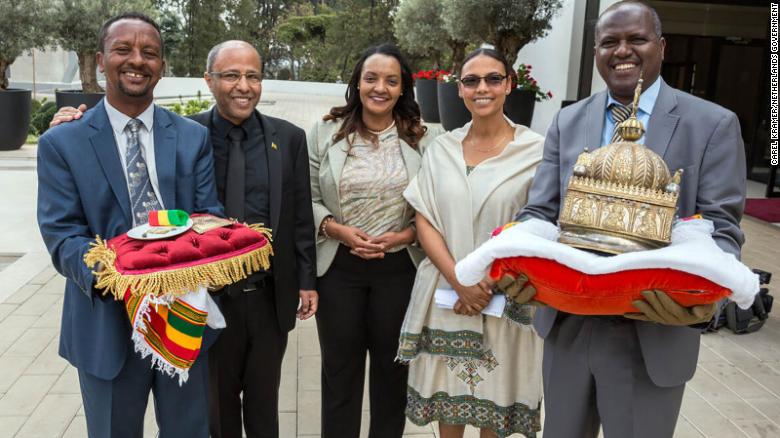
    Kaag said the government was pleased to have expedited the “rightful return” of the artifact to Ethiopia.

    “We’re honoured and delighted to have been able to facilitate the rightful return. This is the crowning achievement of returning this heritage to its rightful place,” Kaag said in a statement.


    More western governments have pledged to return stolen African artifacts that were looted from the continent centuries ago.

    In November, France handed a historical sword stolen from Senegal to the government and it says it plans to permanently repatriate more artifacts looted from Africa during its colonial rule to their original owners.

    French collections house at least 90,000 pieces originating from sub-Saharan Africa with around 70,000 works in Paris’ Quai Branly museum alone, according to a 2018 report on stolen artifacts from the continent.

    Source:

  • Stolen 18th Century crown returns to Ethiopia

    The Ethiopian government has received an 18th Century crown that had been stolen then hidden in a flat in the Netherlands for 21 years.

    The crown is thought to be one of just 20 in existence. It has depictions of Jesus Christ, God and the Holy Spirit, as well as Jesus’ disciples, and was likely gifted to a church by the powerful warlord Welde Sellase hundreds of years ago.

    Ethiopian Sirak Asfaw, who lives in the Netherlands, discovered the crown in the suitcase of a visitor he was hosting.

    Upon realising that it was stolen he held onto it until 2018 when Prime Minister Abiy Ahmed was elected to office. He then reached out to art historian Arthur Brand and Dutch police to help keep it safe until its return home to Ethiopia.

    On Thursday, Mr Abiy tweeted photos of him receiving the crown from a delegation that included Dutch Minister for Foreign Trade and Development Cooperation Sigrid Kaag:

    Source: bbc.com

  • Ethiopian Airlines records $US4.2 billion dollars in revenue

    Ethiopia Airlines has revealed that it has generated 114.6 billion birr (about US$4.2 billion dollars) in revenue during the fiscal year ending July 7, 2019.

    The largest aviation group in Africa generated the revenue from transporting passengers and goods as well as providing other services such as training and catering.

    Ethiopian Airlines annual revenue up 29%

    The Ethiopian Public Enterprises Assets and Administration Agency, which evaluated the performance of the Group, copied to the Ghana News Agency, said of the total revenue the company generated, US$3.9 billion dollars was collected in hard currency from international customers.

    The report said the state-owned company had made a total profit of 8.9 billion birr (US$326 million dollars) before tax.

    It said during the current Ethiopian fiscal year 2012, which started July 8, 2019, Ethiopian Airlines Group had planned to collect total revenue of 155 billion birr (US$5.7 billion dollars) at the prevailing exchange rate.

    Ethiopia army arrests Islamic State members recruiting, arming locals

    The Aviation Group aims to report a gross profit of 19 billion birr (696 million dollars) at the prevailing exchange rate at the end of the year July 7, 2020, the report said.

    It is recalled that the Government of Ethiopia has announced plans to partially privatize Ethiopian Airlines Group, Ethio telecom, Ethiopia Shipping Lines and other big state enterprises including railways and electric services.