The European Commission wants the European Union to start talks with Bosnia and Herzegovina about joining.
On Tuesday, President Ursula von der Leyen said the EU will ask countries to start talks with Sarajevo, even though there are still ethnic divisions in the Western Balkans. This is because the West is concerned about the increasing influence of Russia and China in the region.
Bosnia, along with five other countries (Albania, Serbia, Kosovo, Montenegro, and North Macedonia) in the Western Balkans, are working to join the European Union.
In the 1990s, there were some attempts to bring six countries together to stop the wars and problems in the region. But people are getting impatient because there hasn’t been much progress for a long time.
However, Russia’s attack on Ukraine and efforts by Moscow and Beijing to gain more influence are making the West pay more attention and are encouraging EU officials to speed up the process.
“We have learned that we can’t just wait for the Western Balkans to get closer to us,” von der Leyen told the European Parliament. “We can’t just say the door is open. ” We should also support them in every way on their journey to join our group.
EU leaders will talk about the suggestion at a meeting in Brussels next week. There’s a chance that the member states won’t support it because Milorad Dodik, a pro-Russian leader who wants to separate Bosnia, is still working against the presidency and other government jobs in the country.
Bosnia is still divided into different ethnic groups, even after the war in the 1990s. In December, Dodik said he wanted to continue making the country weaker until it breaks apart.
The European Commission plans to suggest that the European Union start talking with Bosnia and Herzegovina about joining.
On Tuesday, President Ursula von der Leyen said the EU wants to start talks with Sarajevo, even though there are still divisions between ethnic groups in the Western Balkans. This is because the West is concerned about Russia and China’s increasing influence in the region.
Bosnia is one of six countries in the Western Balkans that are in the process of joining the EU. The other countries are Albania, Serbia, Kosovo, Montenegro, and North Macedonia.
In the 1990s, people tried to bring six countries together to stop the wars and problems in the region. But now, people are getting frustrated because there hasn’t been any progress for a long time.
But Russia entering Ukraine and gaining influence is making Western countries pay more attention and pushing EU officials to speed up their work.
“We have found that we can’t just sit and wait for the Western Balkans to get closer to us,” said von der Leyen to the European Parliament. “It’s not okay to just say the door is open. ” We must help and support them as they work towards joining our union.
EU leaders are going to talk about the suggestion at a meeting in Brussels next week. Member states may not approve it because Milorad Dodik, a pro-Russian, separatist Bosnian Serb leader, keeps working against the presidency and other political roles in the country.
Bosnia is still divided by different ethnic groups, even many years after the war in the 1990s. In December, Dodik said he wanted to keep making the country weaker until it breaks apart.
Bosnia became a candidate to join the EU in 2022. Countries who want to join the group must follow a long process to make sure their laws and standards are the same and show that their government and economy are fair and follow the rules of democracy.
Von der Leyen said Bosnia still needs to improve but has also made big progress.
She said that more has been accomplished in a little over a year than in more than ten years. “First, Bosnia and Herzegovina now completely agrees with our foreign and security plans, which is very important in times of political unrest. ”
She also said good things about the country for working hard to stop illegal money activities, supporting terrorism, and controlling how people move into the country.
“The country is proving that it meets the requirements for membership and that its people want to be part of our family,” she said. “The message from Bosnia and Herzegovina is easy to understand. ” We need to make sure our message is easy to understand. The future of Bosnia and Herzegovina depends on us working together.
Bosnia is maybe the weakest of the Balkan countries. There are still problems between different ethnic groups even after the 1992-95 war, where many people died and millions had to leave their homes.
Tag: European Commission
-

European Commission to suggest EU-Bosnia accession negotiations
-

EU to postpone tariffs on electric vehicles in UK until 2027
The European Commission has suggested delaying tariffs on electric cars traded between the UK and EU for three years.
Car manufacturers from both the UK and EU said they are not prepared for the new trade rules that will start after Brexit in January.
The rules were supposed to help the car industry in the EU, but the 10% tariffs would probably make things very expensive.
EU countries must still say yes to the plan at a meeting next week.
The Commission said no to waiting to make the rules, even though car makers and the UK government asked them to.
On Wednesday, the Commission said the EU needs more time to help its car industry because it is still facing problems from the pandemic, Russia’s invasion of Ukraine, and competition from US subsidies.
According to EU “rules of origin,” cars made in the EU or UK would need to be mostly made from local parts to avoid tariffs, starting in January.
The goal was to keep European industry safe from cheaper products coming from countries like China, which has become a big player in the global electric vehicle market.
However, when it comes to trading between the UK and EU, electric vehicles would have needed to have batteries made in either the UK or the EU. Many car makers said they would have trouble meeting this requirement.
Battery production in the local area has been slower than we thought, so the manufacturers have to depend on getting batteries from other places.
Expensive expenses
Trade groups worried that the new rules would make European companies lose £3. 75 billion in the next three years.
There were worries that high taxes could make it harder to make electric cars and might raise prices.
The UK government asked the EU to delay the rules.
The carmakers on both sides of the Channel will be happy because the Commission’s decision means they don’t have to pay tariffs that were supposed to start in January.
European makers send the most vehicles to the UK, with 1. 2 million cars being shipped to UK ports last year. The UK sells more cars to the EU than any other place.
The European Commission wants to delay the rules for three years, but it also wants to add a rule to the Brexit trade deal that says the delay cannot be longer than that. It said that its rules of origin would stay the same from 2027.
The Commission will give €3bn to European battery makers over the next three years to help them grow.
The new deadline is making people pay attention to making electric cars in the UK. Companies like Jaguar Land Rover are planning to build big factories to make car batteries, but they haven’t started making any batteries yet.
There are still questions about a place in Blyth, Northumberland that has been chosen to make car batteries. -
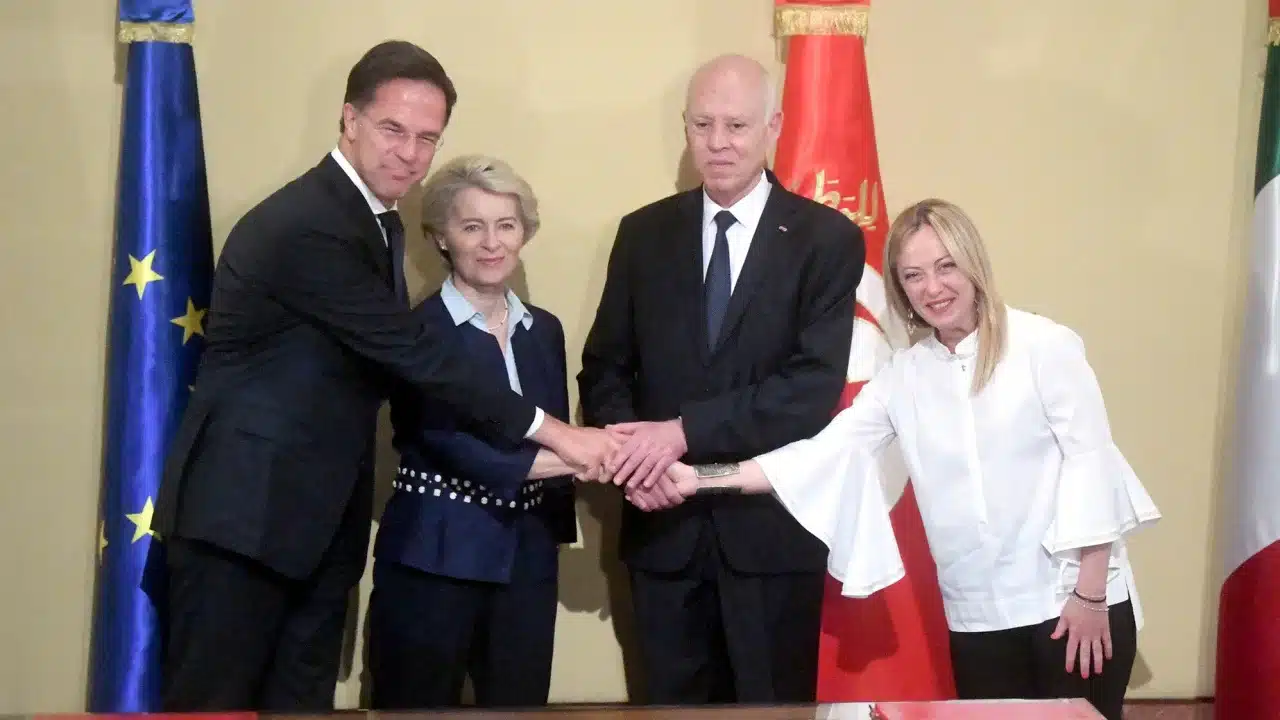
President of Tunisia charged with authoritarianism and bigotry
A significant agreement between the European Union and Tunisia was reached on Sunday, guaranteeing the North African nation up to €1 billion ($1.12 bn) in investment, financial assistance, and loans in exchange for restrictions on migrants arriving in Europe from Tunisia.
The agreement is a big victory for Tunisia’s President Kais Saied, an increasingly autocratic figure who has spent the last few years destroying his nation’s democracy – ten years after a revolution there deposed a longtime leader and ignited a regional uprising against dictatorship.
The sole democracy to have emerged from the 2011 Arab Spring movement was previously stated to be Tunisia.
“Since 2011, the European Union has been supporting Tunisia’s journey of democracy,” said European Commission President Ursula von der Leyen after signing the agreement. “It is a long, sometimes difficult road. But these difficulties can be overcome.”
Several European lawmakers and human rights organizations have warned that any agreement that doesn’t include human rights assurances would be seen as an endorsement of Saied’s anti-democratic policies.
“In short, we are doing a deal with a dictator who is cruel and unreliable,” Dutch Member of the European Parliament Sophie in ‘t Veld said at a meeting of the body’s Committee on Civil Liberties, Justice and Home Affairs on Tuesday. “This deal does not align with our values, it will not be effective, and it is not concluded in a transparent and democratic way.”
That the EU signed it anyway is a testament to how desperate some European leaders have become to curb migration, analysts say.
“This is an agreement with a leader who is showing increasingly authoritarian tendencies,” Camille Le Coz, a senior policy analyst at the Migration Policy Institute in Brussels, told CNN. “The priority is given to fixing the problem in the short term, and curbing arrivals. Values lose.”
Saied rose to power in 2019 after the death of Tunisia’s first democratically elected president Beji Caid Essebsi.
Running as an independent, he won a landslide victory after positioning himself as a political newcomer standing up to a corrupt elite.
But democratic ideals were pushed aside in 2021, when the president embarked on a major power grab at the height of the Covid-19 crisis. He ousted the government, dissolved parliament, and began ruling by decree.
Since then, he has cracked down on freedom of the press and judicial independence, even appointing himself as attorney general. Last year, he forced through a new constitution that cemented his one-man rule and dissolved any last hopes for a democratic government. He has also been accused of being responsible for the wave of anti-Black racism in the country amid an influx of migrants.
But Tunisia’s descent into authoritarianism was not on the agenda during the high-profile European visit over the weekend and journalists were not allowed to ask questions during the event.
Instead, Saied was all smiles while posing for photos alongside von der Leyen, Italian Prime Minister Georgia Meloni and Dutch Prime Minister Mark Rutte after signing the agreement.
Rutte’s presence was particularly striking. Just days before the trip to Tunis, he announced that he would be leaving Dutch politics after his government collapsed over migration policy.
A spokesperson for the European Commission told CNN the agreement signed with Tunisia “focused on macro-economic stability, trade and investment, green energy transition, people-to people contacts, and migration” and that the EU is addressing human rights issues in Tunisia through other channels.
The EU has long championed democracy in the Arab world, describing itself as a “firm promoter and defender of human rights and democracy across the world.” But it has in the past decade witnessed a flood of irregular migration that has seen it prioritize reducing numbers, analysts say, sometimes at the expense of its goal to promote human rights.
Around 100,000 people have crossed the Mediterranean Sea to get to Europe so far this year, most of them arriving in Italy, according to the UN Refugee Agency.
Many made the dangerous journey on small boats operated by people smugglers who have little regard for safety. Since 2015, more than 23,000 people have either died or gone missing while trying to reach Europe, according to the UN.
The issue has pitted EU member states against each other. On one side are receiving countries like Italy that have seen an influx of tens of thousands of people per year and have asked the EU for help to resettle them. On the other side are states like Hungary and Poland which refuse to cooperate and take their share of refugees. Both countries are governed by populist right-wing leaders who argue that they should have control over whom they admit to their territory
But whether the deal with Tunisia could actually lead to a meaningful result is another question.
For one, the pact remains vague. While von der Leyen promised last month the agreement would be worth as much €1 billion in financial aid and loans, the text doesn’t mention that figure.
“The agreement that has been published is almost entirely numberless, and it is extremely broad and unspecific, despite the fact that it is covering a lot of topics where the devil really is in the details,” Max Gallien, a research fellow at the Institute of Development Studies at the University of Sussex in the UK, told CNN.
To dispense a substantial amount of money to Tunisia, the European Commission would also need to get support from the European Parliament and the European Council, which is made up of representatives of all EU member states.
That could be tricky. The parliament has repeatedly criticized the Tunisian leader, even adopting a resolution in March to express concern about what it called “President Saied’s authoritarian drift” and his “racist discourse against sub-Saharan migrants.”
There are also questions about the Commission’s mandate. The agreement hints that the EU will make it easier for Tunisians to get visas to come to Europe legally.
“This is a prerogative of EU member states. So the Netherlands and the [European] Commission can go to Tunis and commit to this and say the EU is going to make Vague progress on this, but if France or Germany decides that they don’t feel like it, well, they just won’t do it,” Le Coz said.
Gallien said that the lack of exact commitments in the text of the agreement means the deal is mostly symbolic.
“It is designed to show progress, to signal that they’re working together on these issues, because both sides have domestic audiences that have an interest in this, but I think it is very doubtful or very unclear at this point how much will come out of it,” he said.
But signals matter, critics say. The EU is cooperating with Tunisia on migration despite serious allegations of human rights abuses against migrants on Tunisia’s part. Tunisian forces have been accused of arbitrary detentions and inhuman treatment of migrants. And Saied himself has stoked tensions by describing migration into Tunisia from other parts of Africa as “criminal enterprise hatched at the beginning of this century to change the demographic composition of Tunisia.”
The Tunisian government didn’t respond to CNN’s request for comment.
This isn’t the first time the EU has struck a deal with a North Afrian regime that has been accused of human rights abuses in order to stem migration. It brokered a similar agreement with Libya in 2017 despite documented human rights violations there. It announced additional support for Libya last year.
Gallien said Europe’s position on Tunisia’s descent into autocracy is worrying.
“We should not fall into the trap of just looking at other countries in the region and going ‘well, you know, there’s a lot of authoritarianism and consequently, Tunisia’s authoritarianism is less concerning’,” he said.
Tunisia’s democracy was not perfect, Gallien said, but “it did have a genuine attempt at developing democratic institutions.”
“This is a genuine destruction of something that has been built and consequently a narrowing of the options of a country of over 10 million people,” he added. “So, I think that is that is one reason we should be very concerned.”
-

France bans short distance flights where trains suffice
France has become the first nation to outlaw short-distance, domestic flights to locations where rail transport is an alternative.
In 2021, lawmakers decided to eliminate train routes that could transport travellers there in under 2.5 hours.
However, a few airlines formally requested that the European Commission examine the decision’s legality, and as a result, it has only now been effective.
However, connecting flights using these airports won’t be impacted by the new law, which will eliminate services between Paris, Nantes, Lyon, and Bordeaux.
The law specifies that train services serving the same route must be frequent, timely and well-connected enough to meet the needs of people who would otherwise travel by air.
Critics have called the enforcement of the ban merely ‘symbolic’, especially as these routes have not been served by any airlines since 2020, when the pandemic devastated the travel industry.
However, more journeys could be included in the future, with the EU having stipulated that the law should reviewed after three years.

A group created by president Emmanuel Macron originally put forward a harsher ban (Picture: Shutterstock) The interim head of industry group Airlines for Europe, Laurent Donceel, told AFP governments should rather support ‘real and significant solutions’ to combat the effect of carbon emissions.
He added that Brussels found ‘banning these trips will only have minimal effects’ on CO2 output.
And yet, some environmentalists feel the measures do not go far enough, including France’s Citizens’ Convention on Climate.
The group, which was created by French president Emmanuel Macron in 2019, had originally called for the government to scrap plane routes where train journeys under four hours existed.
But this limit was reduced to the current one of two and a half hours, after objections from some of the regions affected and at least one airline.
French consumer group UFC-Que Choisir, who backed the four-hour plan, said: ‘On average, the plane emits 77 times more CO2 per passenger than the train on these routes, even though the train is cheaper and the time lost is limited to 40 minutes.’
Conversely, the UK government seems to be moving in the opposite direction – halving domestic air duty (APD) to £6.50 from April 1.
When the then-chancellor Rishi Sunak announced the change in October 2021, he said: ‘Right now, people pay more for return flights within and between the four nations of the United Kingdom than they do when flying home from abroad.’
Short haul flights are seen as one of the worst offenders for CO2 because take-off and landing uses the most fuel.
But Mr Sunak previously argued that most emissions come from international, rather than domestic trips.
French politicians are also currently debating how to reduce emissions from private jets.
-
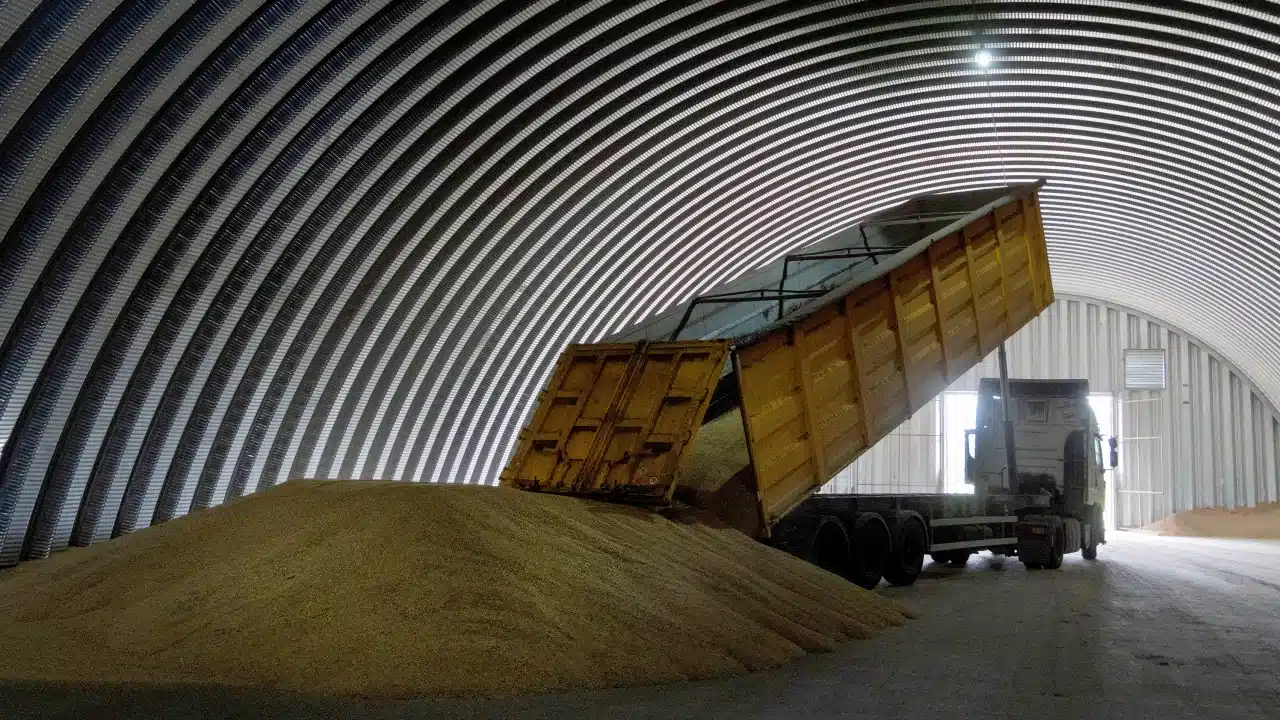
Ukrainian grain banned in Poland and Hungary due to local surplus
Following a boom in inexpensive commodities, Poland and Hungary have banned the importation of grain and other food items from Ukraine.
The goal of the action, according to the Polish prime minister’s office, was “to protect the Polish agricultural market against destabilization.”
In response, Ukraine stated that it “regrets the decision of its Polish counterparts” and was prepared to assist Poland in an inquiry into any potential abuses.
István Nagy, the minister of agriculture for Hungary, declared on Sunday that the country will temporarily outlaw the import of grain, oil seeds, and other agricultural products from Ukraine, claiming the action was required “in the absence of meaningful EU measures.”
The European Commission condemned the move, saying it was not for individual members to decide trade policy.
“It is important to underline that trade policy is of EU exclusive competence and, therefore, unilateral actions are not acceptable,” the commission’s Arianna Podestà told CNN.
When Russia invaded Ukraine it blocked ports and sea routes used to export Ukrainian grain to Africa and the Middle East.
Fearing widespread famine, the European Union lifted duties on grain from Ukraine to ease distribution to those global markets.
Ukrainian grain has since flowed into Poland but much of it has remained in the country, bringing down the price and causing Polish farmers to suffer significant financial losses.
Farmers across central and eastern Europe have been demonstrating against Ukrainian grain imports.
Protesters blocked traffic and border checkpoints with tractors along the border between Romania and Bulgaria, in an effort to prevent Ukrainian trucks from entering their country.
Local producers say they cannot compete with the price of Ukrainian grain and have demanded compensation from the European Commission.
Anger grew after the European Commission announced a draft decision to extend duty-free and quota-free imports of Ukrainian grain until June 2024, prompting the resignation of the Polish agriculture minister.
There has been similar opposition in Bulgaria, where producers have complained of warehouses full of products they cannot sell.
“Bulgaria is in solidarity with Ukraine, but a local glut is being created on the agricultural market, because instead of export corridors our countries are becoming warehouses,” Bulgaria’s agriculture minister Yavor Gechev said.
-

Ukrainian farmers’ demonstrates over glut of cheap grain
This week, farmers in central and eastern Europe demonstrated against the negative effects of cheap grain imports from Ukraine that have lowered domestic prices and decreased sales for regional producers.
In the border between Romania and Bulgaria, protesters used tractors to obstruct traffic and border checkpoints in an effort to stop Ukrainian trucks from entering their nation, according to local news sources.
Local grain farmers claim they are unable to compete with Ukrainian grain prices and have requested compensation from the European Commission.
Ukraine, often called the “breadbasket of Europe” due to the vast quantities of grain it produces, had its Black Sea ports blockaded by Russia following the invasion in February 2022.
Fearing that the situation was “threatening global food security,” the European Commission set up what it called “solidarity lanes” in May to facilitate exports.
The Commission also temporarily eliminated all duties and quotas on Ukraine’s exports, allowing a glut of cheap Ukrainian grain to flow into Europe.
This has caused “huge market distortions” in neighboring countries, according to European farmers’ association Copa-Cogeca.
Pekka Pesonen, Secretary General of Copa-Cogeca, told CNN “the EU needs to address the severe consequences that open borders and unmanaged imports of some agricultural goods have caused to the bordering EU member states.”
“We call for stabilizing import volumes to match our EU capacity to absorb the inflow of goods,” he added.
Anger grew after the European Commission announced a draft decision to extend duty-free and quota-free imports of Ukrainian grain until June 2024, prompting Polish agriculture minister Henryk Kowalcyzk to resign from his post Wednesday.
In Kowalczyk’s resignation statement, he said that the Polish government – along with those of Slovakia, Romania, Hungary and Bulgaria – had submitted a request to the European Commission to “activate the protection clause in the field of duty-free and quota-free imports of grain from Ukraine.”
“Bulgaria is in solidarity with Ukraine, but a local glut is being created on the agricultural market, because instead of export corridors our countries are becoming warehouses,” Bulgaria’s agriculture minister Yavor Gechev said.
The National Association of Bulgarian Grain Producers said “Bulgarian farmers’ warehouses are full of stagnant produce. There is no market for Bulgarian grain.”
According to their data, 40% of last year’s grain and sunflower harvest remains unsold.
Romanian farmers are also feeling the strain. At protests in Bucharest on Friday, Liliana Piron, executive director of the League of Romanian Agriculture Producers’ Associations, said farmers have “reached a point where they feel they can no longer face the costs” of “unfair competition” from Ukraine.
“We are less than three months away from the new harvest and the danger is real, that the goods we will have ready this season will not be able to be sold at prices above production costs,” Piron said, according to RadioFree Europe.
“We will witness a chain of bankruptcies of Romanian farmers,” she added.
In response to the growing unrest, the European Commission last month proposed support measures worth 56.3 million euros (around $61.3 million) for Bulgarian, Polish and Romanian farmers “to compensate affected farmers for the economic loss due to increased imports.”
“The trade disruptions incurred by the Russian aggression should not take place at the expense of farmers from neighboring countries,” the Commission said in a statement.
-

Diluting 10 different honey brands in the UK with inexpensive sugar syrup
According to a recent study, at least 10 different types of honey shipped from the UK contain “illegal, inexpensive additives.”
A random sample of imported honey samples was chosen for a research by the European Commission that was conducted across the continent to determine their purity.
Tests on ten UK brands revealed that all had been diluted with sugar syrup.
The source withheld the brand names, however it is probable that all are available in UK stores.
The brand names were not revealed in the report, but it is likely all are on sale in UK shops.
The EU Honey Directive requires ‘honey shall not have added to it any food ingredient, including food additives, nor shall any other additions be made other than honey’.
The UK Government will now investigate the research, reports MailOnline.
The study found that overall 46% of honey products tested across the EU had sugar added.

The European-wide study randomly sampled 320 honey consignments imported into 20 countries (Picture: Getty Images) The commission said the UK brands were the ‘likely the result of honey produced in other countries and further blended in the UK’.
The highest number of contaminated honeys came from the UK’s largest supplier, China. But the highest proportion showings signs of sugar added were from Turkey at 93%.
Sixteen EU countries, plus Switzerland and Norway, took part in the testing campaign. A total of 320 honey consignments – imported from 20 countries – were randomly sampled between November 2021 and February 2022.
Samples of these shipments were then sent for analysis, which identified that 147 samples (46%) were thought to be adulterated and therefore non-compliant with the general provision of the EU Honey Directive.
The British Beekeepers Association (BBKA) said it’s important firms label their honey with its country of origin to enable ‘consumers to choose honey from sources where adulteration is less likely’.
Diane Drinkwater, chair of the BBKA, said: ‘To meet demand, around 90% of the honey we eat in the UK is imported. There is legitimate concern among UK beekeepers and honey producers about honey imports from countries where honey may be adulterated on an industrial scale.
‘BBKA are keen for the public to be given accurate information about where their honey comes from. BBKA would like all countries where the honey originated from to be listed on the label.
‘The general public knows where our broccoli and cabbage comes from, often down to the county, so why shouldn’t they know where the supermarket honey comes from?’
Currently the country of origin on honey labels can be replaced, if the honey originates from multiple countries, with ‘blend of EU/non-EU honeys’.
Ms Drinkwater continued: ‘We believe this is insufficient to allow consumers to make an informed choice. All countries where the honey originated should be listed.’
The organisation launched a petition just under six months ago calling the government to make it mandatory for the honey’s origin to be included on the label. It has more than 12,000 signatures so far and closes on April 13.
The Government responded to the petition on January 31 with: ‘The Government takes food fraud seriously and is working to ensure honey meets our high standards. Country of origin labelling is not a suitable means for determining if a food is subject to fraud.’
In 2013 the UK and other parts of Europe were rocked by the horse meat scandal.
A number of products on the market were found to contain horsemeat despite not being declared on the label. It sparked outcry and numerous products were taken off the shelves.
-
Ursula von der Leyen arrives to complete the Brexit agreement
On Monday, when the head of the European Commission traveled to London to discuss the protocol with the prime minister, Rishi Sunak might reach an agreement on a Brexit settlement involving Northern Ireland.
After months of negotiations, Mr. Sunak is reportedly approaching “final talks” with Ursula von der Leyen, which could result in a breakthrough, according to Downing Street.
Early in the morning, Mrs. von der Leyen arrived in London.Before disclosing the specifics of any reached agreement to voters and Lawmakers, Mr. Sunak intends to brief his Cabinet.
However, if the deal doesn’t meet the requests of the Democratic Unionist Party (DUP), the party could continue to prevent a Northern Ireland devolved government from forming.
The deal could also pit the prime minister against hardline Brexiteers on his own backbenches.
MPs may get to vote on “part of the deal”, according to reports, but Downing Street has not fully committed to giving Parliament a vote.
-
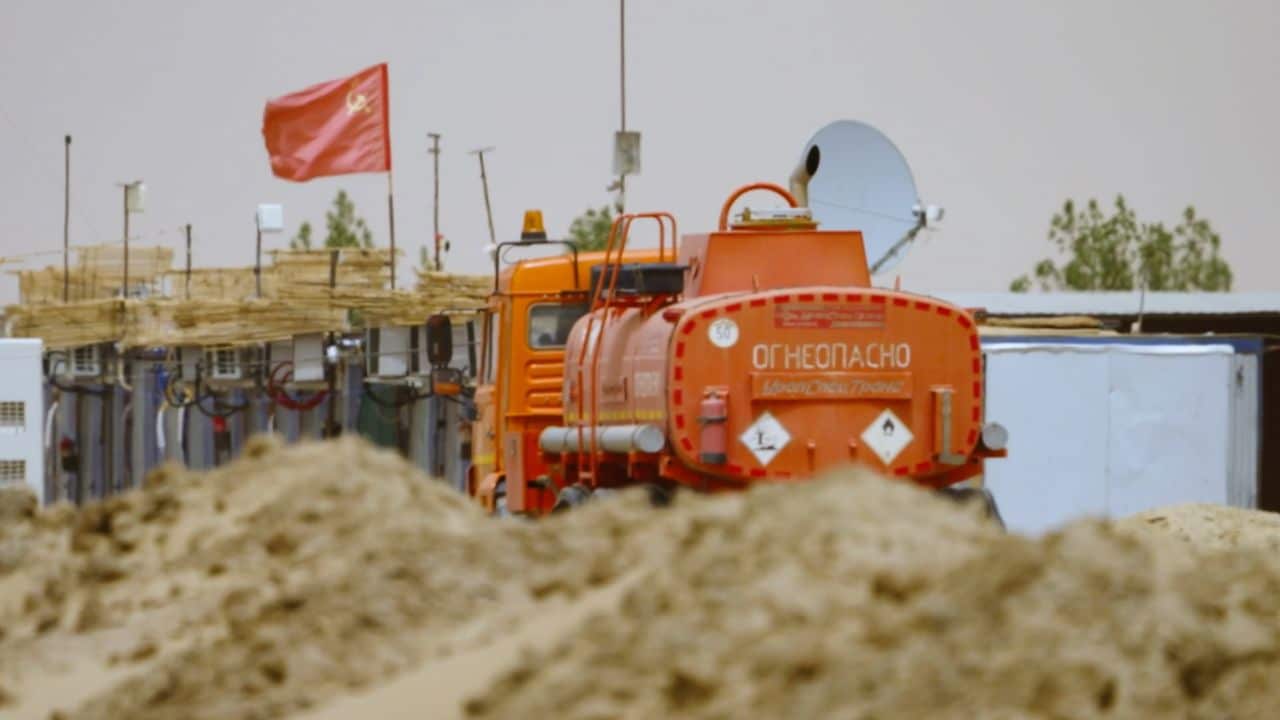
EU sanctions Wagner subsidiary following investigations by CNN
Following a CNN investigation into the group’s operations in July of last year, the European Commission sanctioned a Russian individual and Meroe Gold, a subsidiary of Russia’s Wagner Group, for assisting the exploitation of Sudan’s gold resources.
According to a statement posted on the EC’s legal platform EUR-LEX on Saturday, the EU named a Russian national named Mikhail Potepkin and Yevgeny Prigozhin’s Wagner Group subsidiary in Sudan, Meroe Gold, listing them “for serious human rights abuses, including torture and extrajudicial, summary or arbitrary executions and killings, in several countries, including Sudan.”
“Mikhail Potepkin is the director of Meroe Gold, a front company for the Wagner Group’s operations in Sudan, and is involved in the activities of M-Invest, Meroe’s parent company. He has a leadership role in the Wagner Group in Sudan and has close ties to Yevgeny Prigozhin,” according to a statement from the European Council.
A CNN investigation last July was the first to expose the mechanism by which Wagner and Meroe Gold were operating in Sudan, circumventing US sanctions on the group.
Multiple interviews with high-level Sudanese and US officials and troves of documents reviewed by CNN last summer painted a picture of an elaborate Russian scheme to plunder Sudan’s riches in a bid to fortify Russia against increasingly robust Western sanctions and to buttress Moscow’s war effort in Ukraine.
The evidence also suggested that Russia colluded with Sudan’s beleaguered military leadership, enabling billions of dollars in gold to bypass the Sudanese state and to deprive the poverty-stricken country of hundreds of millions in state revenue.
In exchange, CNN’s investigation found, Russia lent powerful political and military backing to Sudan’s increasingly unpopular military leadership as it violently quashes the country’s pro-democracy movement
Despite Yevgeny Prigozhin’s denials, the European Council has now confirmed CNN’s findings, stating that Meroe Gold continued to operate in Sudan as a “hedge for the Wagner Group’s operations” via a Sudanese shell company.
“Through its affiliation with the Sudanese army, the Wagner Group has secured the right to mine Sudanese gold and export it to Russia,” the Saturday statement by the European Council said.
-

European Commission staff banned from using TikTok
Due to concerns about Chinese eavesdropping, the European Commission has prohibited officials from using the TikTok video-sharing app.
Employees were informed that if they did not remove the Chinese-owned social media website by March 15, they would lose access to their email accounts and video conferencing systems.
“To protect the Commission’s data and increase its cybersecurity, the EC [European Commission] Corporate Management Board has decided to suspend the TikTok application on corporate devices and personal devices enrolled in the Commission mobile device services,” bosses told staff in an email message.
TikTok is allegedly intended to collect more personal data than any other social media app or messaging service, according to experts.
Potential security risk
The platform has twice as many trackers built into it than the industry average, according to Internet 2.0, a cybersecurity firm.
This has sparked fears within Western governments that TikTok poses a potential security risk because of concerns over its Chinese parent company’s close relationship with Beijing.
The EU ban will also apply to its staffs’ personal phones if they have work-related applications installed on them.
It follows a decision by the US Congress to restrict TikTok usage on federal government devices.
The Dutch intelligence agency has also launched a probe into the risks posed by government workers with the app installed on their mobile phones.
Time for UK Government ban?
But as it stands, no European government has followed the US lead in officially banning the app.
Last year, TikTok admitted that the personal data of their users could be accessed in the Chinese headquarters.
At the time, Forbes reported the application was being used to spy on journalists covering its parent company ByteDance.
On Thursday, TikTok said that a decision by the European Commission to ban the video-sharing app on its staff’s official devices was based on mistaken ideas about its platform.
“We are disappointed with this decision, which we believe to be misguided and based on fundamental misconceptions,” a spokesperson for the Chinese-owned company said, after the Commission cited data protection concerns.
-
UK, EU to collaborate to find solutions to the Northern Ireland Protocol
The European Commission and UK leaders have agreed to collaborate to address “very real problems” with the post-Brexit trade deal.
According to Sunak’s office, Britain’s Prime Minister Rishi Sunak and European Commission Chief Ursula von der Leyen have agreed to work together to resolve issues with the Northern Ireland Protocol – the post-Brexit trade deal.
The discussion at the COP27 conference in Egypt on Monday came as Britain renewed its call to Brussels to end a delay in granting access to European Union scientific research, as agreed in the post-Brexit trade deal.
Sunak inherited from his predecessors the problem of the Northern Ireland Protocol, which was designed to prevent a return to violence in Ireland by avoiding a hard border between Northern Ireland and the Republic of Ireland.
Thus, although Northern Ireland remains part of Britain, it remains part of the EU’s trade bloc. But that means curtailment in its trade with the rest of Britain, which is vocally opposed by unionists who claim it cuts off the region from the rest of Britain.
The post-Brexit solution is cited as the Democratic Unionist Party’s main reason for refusing to return to power-sharing.
The instability in Northern Ireland has raised concerns in Dublin, Brussels and Washington and the row between Britain and the EU shows few signs of coming to a rapid conclusion, despite indications of a more positive tone from the British side in recent weeks.
‘Good first meeting’
A Downing Street spokesperson said: “The prime minister reiterated the need to find solutions to the very real problems it had created on the ground in Northern Ireland. They agreed on the importance of working together to agree a resolution.”
Von der Leyen called it a “good first meeting”.
“We face many common challenges, from tackling climate change and the energy transition to Russia’s war against Ukraine,” she tweeted. She said she looked forward to “constructive cooperation” between the two countries.
This comes as Britain’s Europe minister, Leo Docherty, in an address to British and European parliamentarians at Westminster, is expected to say that, in continuing to deny access to research programmes such as Horizon, the EU is failing to fulfil its part of the agreement.
He will say that both sides stand to gain from cooperation on shared challenges, from climate change to global health and energy security.
“The UK’s participation would be a clear win-win for the UK and the EU, but the UK cannot wait much longer,” he will say, according to advance extracts of his address.
“The EU’s approach is causing intolerable uncertainty for our research and business communities.”
Working together
Although differences over the implementation of the Northern Ireland Protocol have dominated the recent dialogue between London and Brussels, Docherty’s comments underline that other sources of friction remain.
In his speech, he will, however, emphasise how the war in Ukraine has demonstrated the importance of the two sides working together.
“A clear lesson from the last nine months has been that, despite the challenges in our relationship, the UK and EU are effective allies where it matters most,” he will say.
“The Ukrainians have stood firm against Vladimir Putin, in part because of the actions of our government and those across the EU.
“That action has been stronger because it has been coordinated between us.
“I urge our European friends to continue to work with us in providing more weapons, imposing more sanctions, and backing Ukraine to push Russian forces out.”
-
Arindam Bagchi: India ‘deeply concerned’ about escalation in Ukraine
The foreign ministry of India has expressed its grave worry about the conflict’s escalation in Ukraine after dozens of Russian missiles have struck different cities.
Spokesman Arindam Bagchi said India is willing to support “all attempts” at de-escalation in the coming weeks.
“We reiterate that escalation of hostilities is in no one’s interest,” he said.
“We urge immediate cessation of hostilities and the urgent return to the path of diplomacy and dialogue.”
The European Commission earlier condemned the strikes as “heinous” as it emerged at least 11 people had died in the blasts, with upwards of 64 injured.
-
EU wants to attach conditions for border protection aid in Greece
The European Commission plans to make further financial support to protect the European Union’s external borders in Greece conditional on protecting human rights, said a commissioner.
“We have said that such a payment should be linked to the establishment of a mechanism to monitor fundamental rights,” European Commissioner for Internal Affairs Ylva Johansson told Der Spiegel news magazine.
She said a working group had been established and that progress was expected in this area.
Greek border guards have repeatedly been accused of illegally pushing back migrants who try to reach the country by crossing the Mediterranean, sending them back to Turkey.
The Greek government denies that illegal pushbacks are taking place.
At the height of the refugee crisis six years ago, more than 850,000 migrants crossed the Mediterranean from Turkey into Greece – and the European Union – within the space of a year, with much-fleeing war and poverty in the Middle East.
Only 1,800 people have reached Greece by boat this year, according to the UN Refugee Agency’s data up to August 22.
Some 45 per cent of those fleeing were from Afghanistan, according to recent figures.
Source: GNA