Tag: European Space Agency

  • Indian Sun mission to arrive at its destination in few hours

    Indian Sun mission to arrive at its destination in few hours

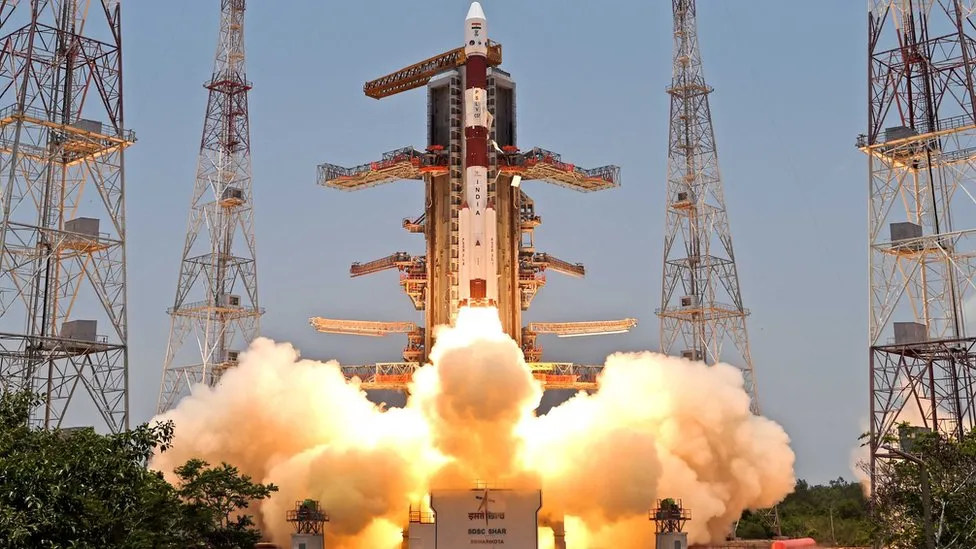
    India’s first sun-observing mission is about to arrive at its last stop in a few hours.

    Isro will try to put Aditya-L1 in a place in space on Saturday. From there, it can always see the Sun.

    The spaceship has been flying towards the Sun for four months since it launched on 2 September.

    It was launched a few days after India made history by being the first to land close to the Moon’s south pole.

    India is sending its first mission to study the biggest thing in our solar system, the sun. It is named after Surya, the Hindu god of the sun, also known as Aditya. L1 stands for a specific point in space between the Sun and Earth where the spacecraft is going.

    The European Space Agency says a Lagrange point is a place where the gravity from two big things, like the Sun and the Earth, cancels out. This makes it possible for a spaceship to stay in one place without moving.

    L1 is 1% of the distance from Earth to the Sun, and it’s 1. 5 million km away from Earth. That’s about 932,000 miles. Isro said the spacecraft is close to reaching its destination.

    An official from Isro told the BBC that they will make a last adjustment to Aditya’s orbit on Saturday at around 4:00pm in India (10:30 GMT) to put it in L1’s orbit.

    The head of Isro, S Somanath, said they will steer the craft into orbit and have to make adjustments from time to time to keep it in position.

    Once Aditya-L1 reaches this “parking spot” it will orbit the Sun at the same speed as the Earth. From here, it can keep an eye on the Sun all the time, even during eclipses and occultations, and do science research.

    The orbiter has seven tools to look at and learn about the sun’s outer layer, its surface, and the thin layer between them.

    After the spaceship launched on 2 September, it circled the Earth four times before finally leaving Earth’s gravity on 30 September. In early October, Isro made a small change to the path of their spacecraft to make sure it was heading in the right direction towards its final destination.

    The agency says that some of the tools on the ship have already begun working, collecting information and taking pictures.

    Just a few days after the spacecraft launched, Isro shared the first pictures it received from the mission. One picture showed the Earth and the Moon together, and the second was a photo of two scientific instruments.

    Last month, the agency shared the first pictures of the whole Sun in different colors. They said the images give us new information about the details of the Sun’s surface and outer layer.

    Researchers believe that the mission will allow them to learn about solar activity and how it affects Earth’s weather, as well as weather in space.

    The Sun’s radiation, heat, particles, and magnetic fields always affect the weather on Earth. They also affect the weather in space, where almost 7,800 satellites, including over 50 from India, are located.

    Experts say that Aditya can help us understand and predict solar winds and eruptions a few days before they happen. This will help India and other countries move their satellites to safety.

    Isro has not told us how much the mission cost, but some reports in India say it’s about 3. 78 billion rupees, which is equal to about $46 million or £36 million.

    If Saturday’s plan works, India will be part of a small group of countries that are studying the Sun.

    Nasa, Japan, and ESA have been looking at the Sun for a long time. Nasa started in the 1960s, Japan in 1981, and ESA in the 1990s.

    In February 2020, Nasa and ESA worked together to send a Solar Orbiter into space. This spacecraft is getting up close to the Sun and collecting information. Scientists believe this will help them learn more about what makes the Sun act the way it does.

    In 2021, Nasa’s new spacecraft Parker Solar Probe was the first to fly through the corona, the Sun’s outer atmosphere, which is a big deal.

  • Russia finally launches Luna 25 mission to the moon 

    Russia finally launches Luna 25 mission to the moon 

    Russia successfully launched Luna 25, the nation’s first lunar lander in 47 years.

    The unmanned spacecraft took launched from the Vostochny Cosmodrome in the Russian Amur Oblast. At 7:10 p.m. ET on Thursday, Luna 25 launched into space on a Soyuz-2 Fregat rocket at 8:10 a.m. local time on Friday.

    According to Reuters, there is a “one in a million chance” that one of Luna 25’s rocket stages may land there, thus residents of a Russian village were temporarily evacuated on Friday morning.

    The spacecraft is anticipated to first enter an orbit around Earth before changing to a lunar orbit and eventually dropping to the moon’s surface. On August 18, 1976, Luna 24, Russia‘s final lunar lander, touched down there.

    According to Reuters, there is a race to see which nation will arrive first when India’s Chandrayaan-3 mission and Luna 25 both intend to touch down at the lunar south pole on August 23. However, Roscomos stated that because their exact landing zones differ, it is not anticipated that the two missions will interfere with one another, according to Reuters.

    For one year, Luna 25, also known as the Luna-Glob-Lander, will investigate the elements that make up the lunar polar soil as well as the plasma and particles that make up the moon’s meagre atmosphere.

    According to NASA, the four-legged lander is equipped with landing rockets, fuel tanks, solar panels, computers, a robotic arm with a scoop to gather lunar samples, as well as a variety of equipment to analyse the samples and the exosphere.

    Initially, Luna 25, Luna 26, Luna 27, and the ExoMars rover were all going to be jointly developed by Roscosmos and the European Space Agency.

    But after Russia invaded Ukraine in April 2022, this collaboration came to an end, and the ESA Council decided to “discontinue cooperative activities with Russia.”

    Chandrayaan-3, which launched on July 14 and entered lunar orbit over the weekend, consists of a lander, rover, and propulsion module.

    India’s effort to make a landing at the lunar south pole follows Chandrayaan-2’s moon crash in September 2019. If the new mission is successful, India would become just the fourth nation, after the United States, the former Soviet Union, and China, to accomplish the challenging accomplishment. Chandrayaan-3 will spend a few weeks on the moon’s surface performing a number of scientific investigations to find out more about the moon’s makeup.

    In late 2025, during the Artemis III mission, NASA intends to place a woman and a person of colour on the moon for the first time at the lunar south pole.

    Due to its prospective riches, this region of the moon has been the subject of numerous missions. A crucial factor to take into account as organisations like NASA look to stably study the moon for extended lengths of time in the future is the possibility that deep, permanently shadowed craters in the lunar south pole contain ice that might be utilised for fuel, oxygen, and drinking water.

    “We’re going to see several spacecraft, some perhaps from other nations, that are going to be landing on the south pole in the near future,” NASA Administrator Bill Nelson said during a news conference on Tuesday. “There is a resurgence of interest in the moon, which is naturally due to the possibility of water. To prepare for a trip to Mars and a safe return, we’re travelling back to Earth to study how to survive in a deep space environment for extended periods of time.

    Nelson responded, “We wish them well,” when questioned about the forthcoming Luna 25 launch, stating that NASA and its Russian counterpart had been working together since 1975, going back to the Soviet era.

  • 37 boulders detected by Hubble in the area of the DART-hit asteroid

    37 boulders detected by Hubble in the area of the DART-hit asteroid

    A cluster of rocks has been seen by the Hubble Space Telescope surrounding the asteroid Dimorphos, which NASA’s DART probe purposefully collided with last autumn.

    On September 26, 2022, the Double Asteroid Redirection Test spacecraft, which weighs roughly 1,200 pounds (544 kilogrammes), collided with Dimorphos head-on at a speed of 13,000 miles per hour (20,921 km per hour) to alter the space rock’s velocity.

    The results demonstrated how this kinetic impact technique could be used to divert asteroids that may be on a collision course with Earth. It was the first time humans attempted to alter the motion of a celestial object. There is no danger to Earth from either Dimorphos or Didymos, the larger asteroid it circles.

    The DART impact was successful, changing Dimorphos’ orbital period around Didymos by 33 minutes. This first test of planetary defense, which took place 7 million miles (11.3 million kilometers) from Earth, also released over 1,000 tons of material into space.

    Some of that material includes 37 boulders, ranging in size from 3 feet to 22 feet (0.9 meters to 6.7 meters) in diameter, according to new data captured by Hubble. The rocks, likely shaken loose from Dimorphos’ surface after impact, are drifting away from the asteroid at about a 0.5 mile per hour (0.8 kilometer per hour), or the walking speed of a giant tortoise, according to a Hubble news release.

    Scientists estimate the boulders represent about 0.1% of Dimorphos’ mass.

    “This is a spectacular observation — much better than I expected. We see a cloud of boulders carrying mass and energy away from the impact target. The numbers, sizes, and shapes of the boulders are consistent with them having been knocked off the surface of Dimorphos by the impact,” said planetary scientist David Jewitt, a distinguished professor at the University of California, Los Angeles, in a statement.

    “This tells us for the first time what happens when you hit an asteroid and see material coming out up to the largest sizes. The boulders are some of the faintest things ever imaged inside our solar system.”

    Jewitt and his colleagues have used Hubble to track changes in Dimorphos both during and after the DART impact, but another mission will take an even closer look.

    The European Space Agency’s Hera mission is set to launch in 2024. The spacecraft, along with two CubeSats, is expected to arrive at the asteroid system in late 2026.

    Hera will study both asteroids, measure physical properties of Dimorphos, and examine the DART impact crater and the moon’s orbit, with the aim of establishing an effective planetary defense strategy.

    “The boulder cloud will still be dispersing when Hera arrives,” Jewitt said.
    “It’s like a very slowly expanding swarm of bees that eventually will spread along the binary pair’s orbit around the Sun.”

    Surface boulders and other possible theories

    Researchers believe the boulders were already sitting on the surface of Dimorphos, based on the final close-up photos taken by the DART spacecraft before impact. It’s much less likely that the rocks are shattered pieces of the asteroid, according to the Hubble observation team monitoring Dimorphos.

    Jewitt estimated that 2% of the boulders on the surface were released into space after the crash. The rocks were likely ejected at the same time as the debris trail, also captured by Hubble. It’s also possible that a seismic wave from the impact lifted the rocks.

    “The boulders could have been excavated from a circle of about 160 feet across (the width of a football field) on the surface of Dimorphos,” he said.

    Future observations from Hera could help scientists pin down the actual size of the impact crater left by DART.

    Scientists think Dimorphos may have formed from material shed by Didymos as it collided with another object, according to the European Space Agency. The material from Didymos would have formed a ring that eventually came together due to gravity, so Dimorphos may be what’s known as a rubble pile asteroid — rocky debris loosely held together by gravity, rather than a solid space rock.

    Studying the DART experiment’s aftermath can help space agencies determine whether this impactor technology is the right approach to deflecting asteroids that may pose a threat to Earth in the future — or if it may result in creating more rocky hazards heading toward the planet.

  • More than 500 people evacuated after heatwave in Spain caused large wildfire

    More than 500 people evacuated after heatwave in Spain caused large wildfire

    On the Spanish island of La Palma, a forest fire forced the evacuation of more than 500 residents.

    The unfathomable Cerberus heatwave has been roasting Southern Europe, and a second heatwave dubbed Charon is hot on its heels, bringing even more terrible weather, like wildfires.

    Since a volcanic eruption in 2021, this is the island’s first major natural disaster.

    The Canary Island‘s El Pinar de Puntagorda, a forested region, is where the fire first broke out this morning.

    Fernando Clavijo, president of the Canary Islands, said: ‘The number of people who need to be evacuated could reach 1,000. It depends on whether we can bring these strong winds under control.’

    Around 346 acres have been destroyed in the blaze.

    Island authorities have been forced to seek help from other territories in the archipelago, such as Gomera and Tenerife.

    The second heatwave has been named after a Greek god who ferries souls into the underworld.

    One man died in northern Italy due to the Cerberus weather front, named after the three-headed dog who guards the gates of the underworld in Greek mythology.

    The European Space Agency warned: ‘Temperatures are expected to climb to 48°C on the islands of Sicily and Sardinia – potentially the hottest temperatures ever recorded in Europe.’

    epa10747502 Flames and smoke rise from a forest fire in Punta Gorda, La Palma Islands, Canary Islands, Spain, 14 July 2023 (issued 15 July 2023). Canary Islands Government issued a Level 2 emergency alert over forest fire that erupted in early hours of 15 July which includes evacuating of residents from endangered areas. EPA/MIGUEL CALERO
    Around 346 acres have been destroyed in the blaze (Picture: EPA)

    Health authorities have issued a red alert warning for 10 Italian cities, including Rome, Florence and Bologna.

    ‘Heat is a silent killer. So this is the main concern that people’s lives are at risk,’ said climate scientist Hannah Cloke.

    Emergency measures have also been introduced for workers in Greece, while wildfires have broken out across the country, as well as in Croatia.

  • Southern Europe experiencing extreme heat as Italy prepares for record high temperatures

    Southern Europe experiencing extreme heat as Italy prepares for record high temperatures

    As the deadly Cerberus heatwave grips Europe, another is expected, and temperatures in Italy are expected to be at their highest ever.

    The scorching heatwave, which was called after the three-headed dog that guards the gates of hell in Greek mythology, has already claimed the life of one man in the country’s north.

    The European Space Agency warned that Italy is experiencing “a major heatwave” and that temperatures on Sicily and Sardinia could reach 48°C, which would be among the warmest readings ever recorded in Europe.

    A second blistering heatwave, named Charon, is expected to follow on Cerberus’s tail, bringing yet more unbearable conditions.

    Health authorities have issued a red alert warning for 10 Italian cities for the next two days, including Rome, Florence and Bologna.

    ‘Heat is a silent killer. So this is the main concern that people’s lives are at risk,’ said climate scientist Hannah Cloke.

    Emergency measures have also been introduced for workers in Greece and devastating wildfires have spread across Croatia.

    British tourists going on holiday in the Mediterranean have been urged to take extreme care.

    Live Feed

    The second wave of the Cerberus heatwave is set to strike Italy in a few days time.

    Sicily and Sardinia are expected to endure temperatures of up to 48°C over the coming days, edging closer to the continent’s record high of 48.8°C set in 2019.

    Meteorologist Luca Lombroso, affiliated with Italy’s AMPRO group, warns, ‘Next week, we will experience an even more intense heatwave than the current one. Some areas in the central south will witness truly extraordinary temperatures.’

    Lombroso also predicts that Rome and Florence will likely exceed 40 degrees Celsius between Tuesday and Wednesday, with similar conditions approaching the northern regions.

    Meanwhile, in Greece, the government has taken swift action to combat the scorching temperatures. Work has been suspended between midday and 5 pm in areas facing a high risk of heat-related issues. Additionally, private sector employees with health conditions have been advised to work remotely.

    To mitigate the risk of wildfires, access to nature reserves and forests has been strictly prohibited by authorities. These measures aim to safeguard the environment and ensure public safety in the face of the impending heatwave.

    Spain has experienced two blistering heatwaves so far this summer, with highs of up to 60C reported in some parts of the country.

    But forecasters say yet another heatwave is still on the horizon, with the hottest weather still yet to come.

    The Aemet state weather agency expects the next prolonged period of hot weather is set to begin on Sunday.

    A British family on holiday in Murcia have spoken to Metro about what it’s like to experience the heatwve first-hand. Read our exclusive here:

    Greece has witnessed a staggering 52 forest fires in the past 24 hours, averaging more than two fires per hour.

    These incidents occurred between 6pm yesterday and 6pm today, local time (4pm to 4pm, UK time).

    The country’s fire department promptly tackled most of the blazes at their initial stage, as stated on their website.

    As temperatures rise across Greece, courtesy of the Cerberus weather system sweeping through southern Europe, the situation becomes more critical.

    This surge of fires serves as a stark reminder of the devastating wildfires that struck Greece last year, causing significant damage and necessitating evacuations in certain areas.

    The risk of forest fires in Spain caused by the heatwave is considered to be ‘extreme’, Sky News reports.

    Data from the Copernicus Emergency Management Service suggests that a number of wooded areas in mainland Spain and throughout the Canary Islands are at ‘High Extreme Risk’ of catching ablaze, with most of the country considered to be in moderate or very high danger of falling victim to forest fires.

    In the Canary Islands, Las Palmas in Gran Canaria, is the area most at risk of forest fires, with Tenerife and Fuerteventura also displaying extreme levels of heat.

    On the mainland, the northern coast has offered some respite from the beating heat, with some tourists cancelling their day trips to take respite from the sun in the cooling sea.

  • The frozen ocean worlds of Jupiter will soon be reached by the Juice mission

    The frozen ocean worlds of Jupiter will soon be reached by the Juice mission

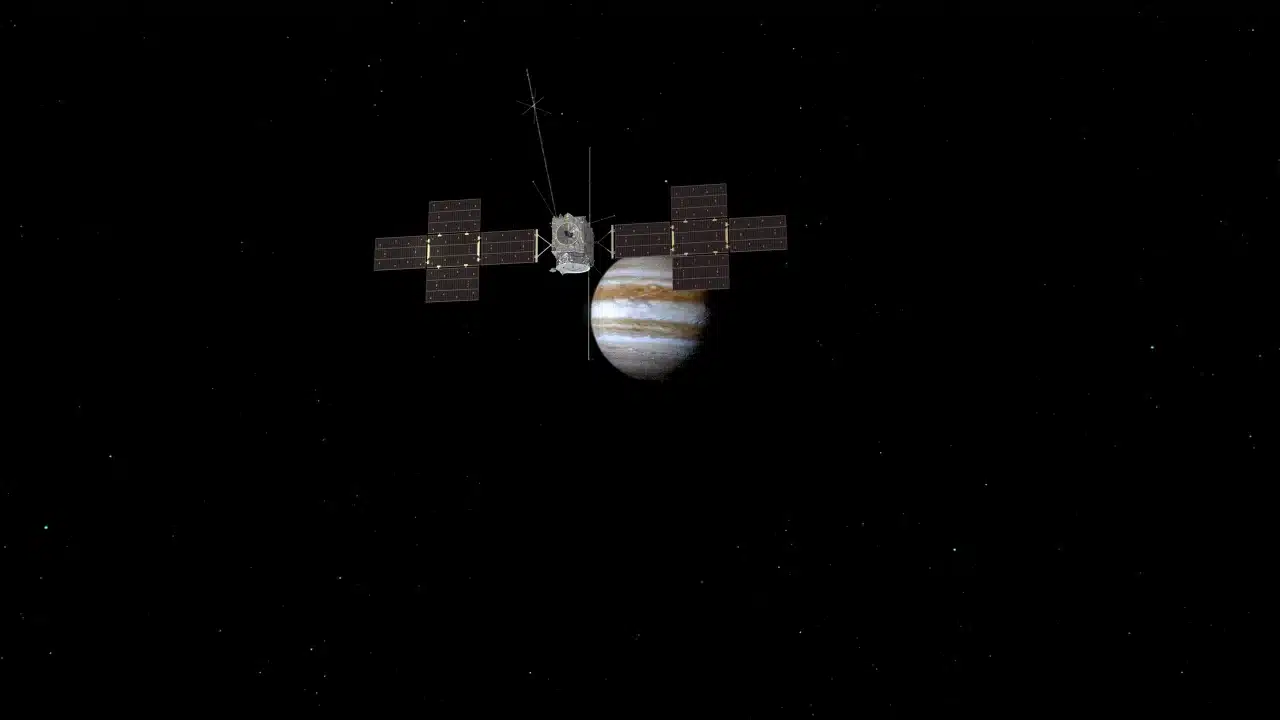
    A mission to investigate Jupiter and three of its largest and most intriguing moons is ready to be launched by the European Space Agency.

    The Ariane 5 rocket will carry the Jupiter Icy Moons Explorer mission, also known as Juice, into space on Thursday at 8:15 a.m. ET from Europe’s Spaceport in Kourou, French Guiana. On the ESA website or YouTube channel, you may watch the launch live.

    About 28 minutes after liftoff, the spacecraft will detach from the Ariane 5 launch vehicle. Juice will install its solar arrays, antennas, and other instruments over the period of 17 days. Then, the equipment will undergo three months of testing and preparation.

    Juice will take eight years to reach Jupiter, the largest planet in our solar system. During its lengthy cruise, the spacecraft will utilize some gravitational slingshots as it flies by Earth, our moon and Venus to help with the journey.

    INTERACTIVE: The search for life in our solar system

    Once Juice arrives at Jupiter in July 2031, the spacecraft will spend about three and a half years orbiting the gas giant and conducting flybys of three of its moons: Ganymede, Callisto and Europa. Toward the end of the mission, Juice will focus solely on orbiting Ganymede, making it the first spacecraft to ever orbit a moon in the outer solar system.

    Ganymede, Callisto and Europa are ice-covered worlds that may contain subsurface oceans that are potentially habitable for life.

    Meanwhile, NASA’s Europa Clipper mission, launching in 2024, is expected to reach Jupiter in April 2030 and conduct nearly 50 flybys of Europa, eventually reaching just 16 miles (25 kilometers) above the moon’s surface.

    Together, the two missions could unlock some of the biggest mysteries about Jupiter and its moons.

    Exploration of Jupiter began with NASA’s Pioneer and Voyager missions in the 1970s, followed by dedicated Jupiter missions like Galileo and the Juno probe. Juno has been orbiting Jupiter and flying by some of its moons since 2016.

    The Juice mission has five main objectives, including using its powerful suite of 10 instruments to characterize the three icy moons and determine if they harbor oceans, uncover what makes Ganymede so unique and determine if the moons are potentially habitable for life.

    Planetary scientists want to know how deep the oceans are, if they contain salty or fresh water and how that water interacts with the ice shell of each moon. Ganymede, Callisto and Europa also have different surfaces. Juice could reveal what kind of activity has caused some of them to look dark and cratered or paler and grooved.

    Ganymede is the largest moon in the solar system, larger than Pluto and Mercury, and it’s the only one that has a magnetic field similar to Earth. Juice’s instruments can reveal the moon’s rotation, gravity, shape, interior structure, composition and peer through its icy crust using radar.

    Juice will also conduct a detailed analysis of Jupiter to determine how the complex magnetic and radiation environment around this massive planet shaped its moons, as well as how Jupiter formed in the first place. Understanding more of Jupiter’s origin story can help scientists apply those findings to Jupiter-like planets found outside of our solar system.

    Jupiter’s magnetic field is 20 times stronger than Earth’s and it has a harsh radiation environment, both of which impact its moons. The Juice mission was designed to unravel what takes place as Jupiter interacts with its moons, including auroras, hot spots, radio emissions and waves of charged particles.

    Although the three moons are encased in thick ice shells, interior heating could be taking place at each moon’s core — and that warmth could make the interior oceans possible habitats for past or existing life.

    Juice can search the moons for evidence of the building blocks of life, including elements like carbon, oxygen, nitrogen, iron and magnesium.

    Previous missions like Galileo and Cassini, which visited Saturn and its moons, confirmed that liquid water can be found on planets and moons far away from the sun — and that water is likely to exist under the surface.

    “I think Juice is a confirmation that our understanding of where to search for potential habitability has changed in the last 20 years,” said Michele Dougherty, Royal Society research professor at Imperial College London and principal investigator of Juice’s magnetometer.

    Life as we understand it on Earth requires liquid water, a heat source and organic material — “and then you need those first three ingredients to be stable enough over a long enough period of time that something can actually happen,” Dougherty said.

    “With Juice, we want to confirm there’s liquid water in these moons, confirm their heat sources. Other instruments will be able to remotely sense whether there’s organic material on the surface as well. And so it’s putting all of those ingredients together,” she said.

    Juice’s truck-size spacecraft has been designed to survive a long journey to Jupiter — and it has to survive the extremes of the gas giant’s environment once it arrives. Two cross-shaped solar arrays will provide the spacecraft with power and lead-lined vaults protect its most sensitive electronics.

    The ESA-led mission includes contributions from NASA and the Japanese Aerospace Exploration Agency. Testing and modeling of Jupiter’s radiation belts allowed engineers to prepare for what Juice will encounter.

    “A key achievement of this model for us was to show that what at first seemed to be a dangerous place was not completely out of reach,” said Christian Erd, Juice spacecraft and system manager, in a statement. “Around three and a half years at Jupiter will involve the equivalent radiation exposure of a telecommunications satellite in geostationary Earth orbit for 20 years – which we have plenty of experience in managing.”

    In order to help Juice survive, its trajectory was designed to fly past Callisto 21 times but only swing by Europa twice. Europa is the closest to Jupiter and sits well within its radiation halo. Just two orbits of the moon will cause the spacecraft to experience a third of its overall radiation exposure.

    Some of Juice’s instruments are shielded, while others will be exposed to the elements to probe the atmospheres of Jupiter and its moons. Multiple imagers and sensors will capture and send back data across different wavelengths of light.

    Given the eventual distance between the spacecraft and Earth, it will take 45 minutes to send a one-way signal to Juice. But that’s nothing compared to the years-long wait for Juice to arrive at Jupiter.

    Scientists are already anticipating the unique data Juice will return.

    “I think the most critical time is the first flyby we have of Ganymede,” Dougherty said. “The first one or two flybys is when we are going to confirm the existence of an ocean.”

  • British paralympian: John McFall, is European Space Agency’s first disabled astronaut

    The 41-year-old, from Frimley in Surrey, lost his right leg in a motorcycle accident when he was 19 and went on to compete for Great Britain at the Paralympic Games.

    A Briton will be the European Space Agency‘s first disabled astronaut.

    John McFall, from Frimley in Surrey, was selected by the ESA to join its training programme and could be the first disabled person to go into space.

    The 41-year-old lost his right leg in a motorcycle accident when he was 19 and went on to compete for Great Britain and Northern Ireland at the Paralympic Games.

    No major Western space agency has ever put a “para-astronaut” into space, according to the ESA.

    Mr McFall will join the space training corps to see if he can be the first disabled person to go into space.

    He said the opportunity was “inspiring and exhilarating”.

    He added: “With my broad scientific background and a vast range of experiences, I felt compelled to try and help ESA answer this question: Can we get someone with a physical disability to do meaningful work in space?”

    British astronomer Rosemary Coogan has also been named as a member of the new cohort.

    Ms Coogan has two master’s degrees from the University of Durham and a doctorate in astronomy from the University of Sussex.

    She is among six career astronauts to join the ESA workforce as permanent staff members.

    The career astronauts also include Sophie Adenot from France, Pablo Alvarez Fernandez from Spain, Raphael Liegeois from Belgium and Marco Sieber from Switzerland.

    Rosemary Coogan
    Image: Rosemary Coogan

    Meganne Christian, who was born in the UK and studied in Australia, successfully completed the astronaut selection process and will become a member of the ESA’s astronaut reserve.

    The reserve team consists of candidates who were successful throughout the entire selection process and were not recruited.

    Sophie Adenot
    Image:Sophie Adenot

    They were among over 22,500 candidates who applied, a list which included more women than ever and some 200 people with disabilities.

    Some 1,361 were invited to phase two of ESA’s astronaut selection following a comprehensive screening phase. The pool was narrowed to just over 400 candidates during phase three.

    During the ESA’s last call for astronauts in 2008, 8,413 provided a medical certificate and finalised their online application.

    Among them was Tim Peake, who became the first British astronaut to be part of the ESA corps.

    The finalist candidates have undergone intensive screening over the past year.

    Dr Paul Bate, chief executive of the UK Space Agency, said: “This is a momentous day for the UK Space Agency, our space sector and the country as a whole.

    “Through our investment in the European Space Agency, the UK is playing a leading role in space exploration and collaborating with international partners to use the unique vantage point of space to benefit life on Earth.”

    “Space has an incredible power to inspire and I am sure Rosemary, John and Meganne will become heroes for many young people and inspire them to shoot for the stars.

    “It’s also important to remember that, behind every astronaut, there is a dedicated team of people, including in the UK, working behind the scenes to achieve the incredible.”