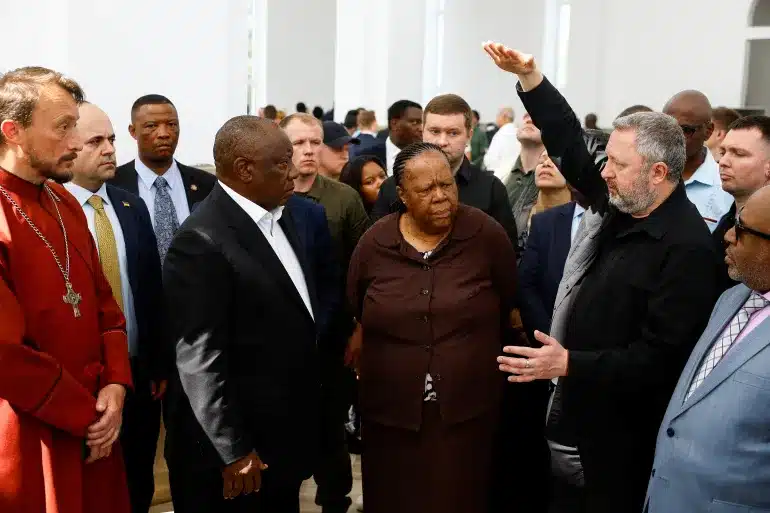
Explosions rang out as five African leaders, including South African President Cyril Ramaphosa and African Union chairwoman and Union of Comoros President Azali Assoumani, arrived in Ukraine as part of an African peace mission.
Air raid sirens also blared in Kyiv as the visit began, the latest in a series of twists as the mission gets underway.
The leaders who are expected to meet Ukrainian President Volodymyr Zelenskyy on Friday and then travel to Russia for talks with President Vladimir Putin in St Petersburg on Saturday, took cover in a bomb shelter.
The South African presidency posted footage of Ramaphosa arriving by train in the Bucha area near Kyiv after travelling from Poland.
Ramaphosa is heading a delegation, which also includes Assoumani and leaders from Zambia, Senegal, and Egypt’s prime minister.
Presidents Yoweri Museveni of Uganda, Denis Nguesso of the Republic of the Congo and Abdel Fattah el-Sisi of Egypt were also meant to go along, but they pulled out of the trip and sent representatives.
The peace mission could propose a series of “confidence-building measures” during initial efforts at mediation, according to a draft framework document seen by the Reuters news agency.
The document stated that the objective of the mission is “to promote the importance of peace and to encourage the parties to agree to a diplomacy-led process of negotiations”.
Its measures could include a Russian pullback, removal of tactical nuclear weapons from Belarus and suspension of the implementation of an International Criminal Court arrest warrant targeting Putin.
A ceasefire could follow and would need to be accompanied by negotiations between Russia and the West, the document stated.
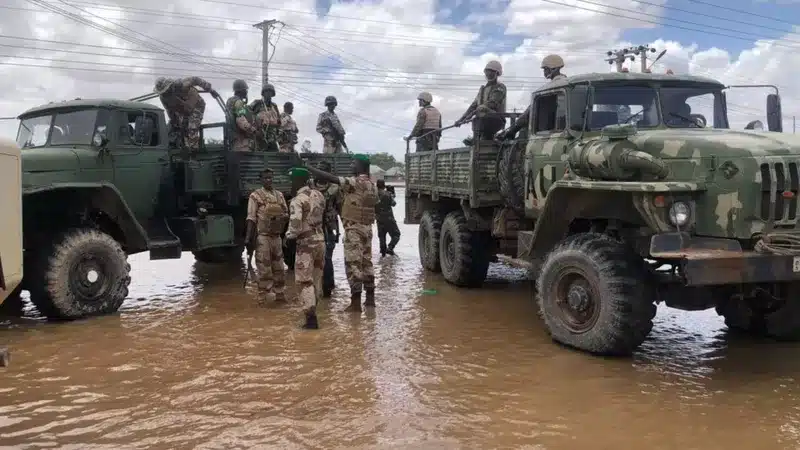
Explosions occur as Ugandan forces combat militas.On Friday morning, the extremist al-Shabab organization launched an attack on a Ugandan soldier post of the African Union Transition Mission (ATMIS) in Bulla Mareer district, Lower Shabelle region, Somalia.The attack began immediately after morning prayers.
It started with a large explosion, believed to be an explosives-laden vehicle.Buulo Mareer is about 110km (68 miles) from the capital, Mogadishu.
Residents reported that after the big explosion, two more explosions occurred in the camp, before a fight started between the Ugandan troops and the attackers.Al-Shabab said they captured the camp and killed dozens of ATMIS soldiers, but there has been no independent confirmation of the group’s claim.
ATMIS says its forces are currently assessing the security situation in the area but no word yet from the Somali government regarding the attack.Ugandan army spokesperson Felix Kulayigye told Kenya’s Daily Nation that the military was probing the attack. He blamed “foreign insurgents” for the raid without giving further details.
The actual damage caused by the attack is not yet known. Civilians have remained inside their houses and though some of the bullets being fired hit their houses, no damage has been reported.
Some residents in Bulo Mareer told the BBC that they could hear the sound of helicopters hovering over.
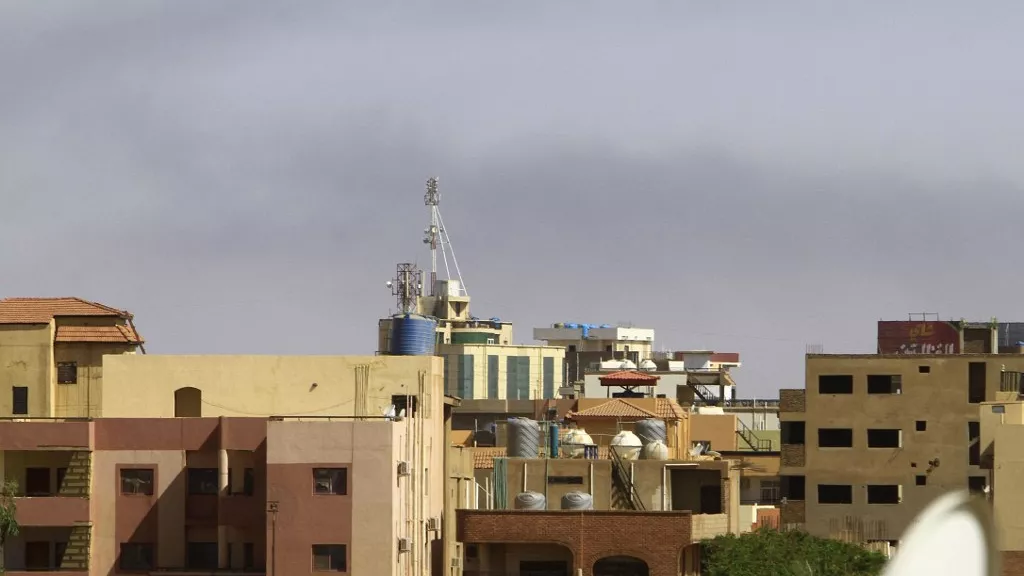
On the 26th day of the conflict between military and paramilitaries in Sudan, powerful explosions rumble across Khartoum early on Wednesday. The two camps’ negotiators have not yet agreed upon a humanitarian corridor.
“We were awakened by explosions and heavy artillery fire,” a resident of Omdurman, a city on the outskirts of Khartoum, told AFP.
Overnight, other witnesses in different neighbourhoods of Khartoum reported two huge explosions heard across the capital, which has a population of five million. Residents of El-Obeid, 350 km west of the capital, also reported fighting and explosions in their town.
General Abdel Fattah al-Burhane ‘s army and General Mohamed Hamdane Daglo ‘s dreaded paramilitary Rapid Support Forces (RSF) sent negotiators to Saudi Arabia on Saturday for only ” technical” ” pre-discussions ” on corridors secured for humanitarian aid.
But so far no announcement has been made in Jeddah, on the Red Sea, where the talks are taking place.
The head of the UN for humanitarian affairs, Martin Griffiths, who arrived in Jeddah on Sunday, has already left. He proposed to the two parties to commit to “guarantee the passage of humanitarian aid” via a declaration of principle, according to the UN.
Since its beginning on April 15, the conflict has left more than 750 dead and 5,000 injured.
Nearly 150,000 refugees have fled to neighbouring countries, according to the UN, while the number of internally displaced people in Sudan now exceeds 700,000, more than double the 340,000 counted a week ago.
Those who remain in Khartoum live barricaded in their homes. Without water or power, with almost dry food stocks and less and less cash, they survive in the scorching heat thanks to networks of solidarity between neighbours and relatives.
Before going to war, Generals Burhane and Daglo had together ousted civilians from power with their 2021 putsch. Two years earlier, the army had agreed under street pressure to dismiss dictator Omar al-Bashir, who had been in power for 30 years.
Explosions could be heard during the early hours of Russia’s full-scale invasion of Ukraine when Miia Mitskevych was born.
Several commentators predicted that in a matter of days, the Kremlin’s tanks would roll into Kyiv as she opened her eyes in a maternity hospital.
Miia spent her first night of existence in a bomb bunker beneath the hospital, where workers kept the facility running even as missiles pounded the city.
Svitlana, 38, and Igor, 47, will celebrate their daughter’s birthday with cake and a wish for “calm skies” one year from today.
Svitlana, a lawyer, recalled a family life which had been insulated from news of the massing Russian forces
‘We were the happiest ever,’ she says. ‘We were shopping, decorating the room… Igor, my husband, kept me away from the news about the war.
‘Therefore it was shocking for me.’
Miia was born after her parents made a dash to a maternity hospital while air sirens rang out (Picture: Svitlana Mitskevych/Facebook)
In the early hours of February 24, the family, also including their son, Maksym, then aged eight, were awoken by the sound of an explosion outside the windows of their 15-floor apartment in Kyiv.
‘I screamed and jumped out of bed,’ Svitlana says.
‘Then I ran to the next room to calm the eldest son. The explosion was very powerful, I had the feeling that there were planes dropping bombs.’
The family dressed, took food and water and went down to an underground car park which is used as the apartments’ bomb shelter.
Svitlana felt stressed and realised that she was having contractions.
They had the choice of the baby being delivered with the help of a next-door neighbour, a surgeon with no specialism in maternity, or to make the dash to the Kyiv Perinatal Centre.
They struggled to get network coverage but Igor managed to connect after going back upstairs to the apartment and calling their doctor at the hospital, who said Svitlana could be admitted.
Miia and Maksym meet for the first time in a car park used as a shelter under the family’s apartment (Picture: Svitlana Mitskevych/Facebook)
As air raid sirens rang out, the couple made the trip by car and she gave birth in a delivery room while rockets exploded in and around the city.
Miia was born at 6.55pm. Her first journey was seven floors down to the hospital’s bomb shelter, where the trio spent the night while Maskym was at home with his grandparents and hamster.
Despite power outages and the barrages of missiles, shells and kamikaze drones, the centre has continued operating 24/7 since the outset of hostilities. Eight days before the invasion, staff gathered to sing the national anthem in a show of solidarity for their homeland.
Svitlana is expectant in a loving embrace with her son Maksym and husband Igor before the full-scale invasion (Picture: Svitlana Mitskevych/Facebook)Svitlana is preparing to mark her daughter Miia’s first birthday with a cake and a wish for her to live in peace (Picture: Svitlana Mitskevych/Facebook)
‘Doctors are heroes for whom I will pray all my life,’ Svitlana says.
‘They left their own families and came to the hospital in order to save other people’s lives.’
The next day Miia had her first car trip and got acquainted with her brother, who turns 10 on Monday. The family spent the first week in Kyiv where they were afraid to go near the windows in their home, with Russian cruise missiles slamming into residential buildings in the city.
On March 3, Igor drove Svitlana and the children to the relative safety of the Zakarpattia region in western Ukraine.
A month later he returned to Kyiv to continue working as an IT specialist.
Svitlana stayed until the summer and while she felt safe she wanted to reunite the family after months on her own with the two children.
Miia sleeps in the car park during an air raid alert in Kyiv (Picture: Svitlana Mitskevych/Facebook)Svitlana has adapted to family life in wartime conditions (Picture: Svitlana Mitskevych/Facebook)
‘It was important for me to preserve the integrity of our family,’ she says.
‘In September my husband persuaded me to return to Kyiv, although I did not understand how I could live under the missile strikes.’
In October, Russia began to strike Ukraine’s civilian infrastructure, causing power outages across the country in an apparent attempt by Vladimir Putin to freeze the population into submission.
‘We were not prepared for the blackout, even for four hours, but you can get used to everything,’ Svitlana says.
Svitlana and the children on the way to the Zakarpattia region in western Ukraine (Picture: Svitlana Mitskevych/Facebook)
‘We have learned to live without electricity. We bought a charging station, autonomous lamps, additional power banks and a gas stove to heat food for Miia. It is difficult, but these are not the same difficulties as our soldiers suffer in the trenches, without proper water and food.
‘This price we pay is worth being at home.
‘No matter wherever you are, under what conditions, your city, Kyiv, gives you strength, energy and motivation for life.’
After a year of war, the couple feel ‘stronger and braver’ and hope that Miia will have a future in a free, independent country.
‘The most terrible thing about February 2022 was the uncertainty,’ Svitlana says.
‘At the time, we didn’t even know what a missile strike sounded like.
‘Today we know everything Russia is capable of but we are ready for it.
‘We are stronger and braver and remain irrepressible, because we feel the support of the strongest countries in the world. And we are grateful to them, especially to Great Britain, for protecting us.’
Maskym shows his affection for his new sister in the relative safety of the Zakarpattia region (Picture: Svitlana Mitskevych/Facebook)
Svitlana has only one birthday wish for her daughter.
‘I wish my daughter a peaceful sky, because she has never seen it,’ she says.
‘This is the most important thing. We will be able to give her everything else.
‘I will pray for this heaven every day of my life until it become reality.’
The one-year anniversary falls at a time when intense fighting continues to rage in the east of Ukraine, with both sides expected to launch major assaults as spring approaches.
Svitlana prays that Miia will one day live in an independent Ukraine which is free from war (Picture: Svitlana Mitskevych/Facebook)
‘We can’t celebrate when our country is at war,’ Svitlana says.
‘We will not have guests because they are far away. But we will be together; the godmother and grandparents will come. I will bake a cake.’
The anniversary itself brings mixed emotions.
‘The day of February 24 is the most terrible for us as well as for all Ukrainians,’ Svitlana reflects.
‘But it’s one of the happiest days in our life at the same time.
‘Nothing in the world is absolutely black or absolutely white. It will forever remain a combination of opposite emotions which we experienced that day.
‘But Miia’s birth for us is a ray of hope that life goes on and we will win.’
Ukrainian strikes on Crimea are having major psychological and operational effects on Moscow’s forces, Western officials have told journalists.
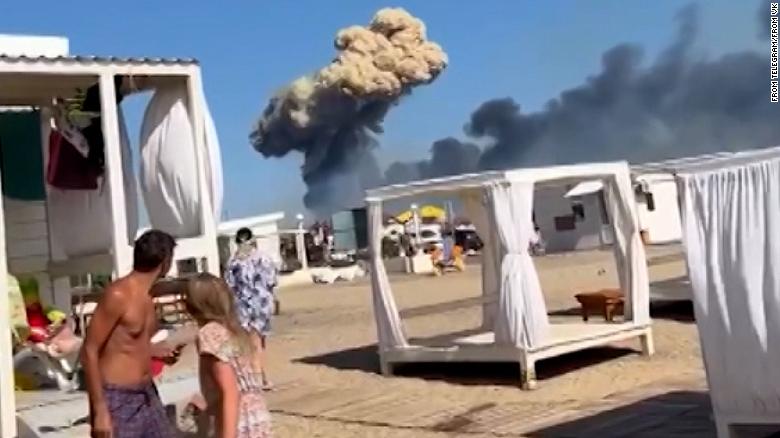
Explosions at the Saki airbase on 9 August and other assaults have put more than half of the Black Sea fleet’s naval jets out of action, they said.
The fleet has a revered history, but it has suffered a series of humiliations since the invasion began in February.
Officials said the setbacks have forced it to adopt a defensive posture.
In March, the fleet’s flagship, the cruiser Moskva, was sunk by Ukraine. The 510-crew missile cruiser had led Russia’s naval assault on Ukraine, and its sinking was a major symbolic and military blow.
At the time, the Russian defense ministry said ammunition on board the Moskva exploded in an unexplained fire, and the ship tipped over while being towed back to port.
In June, the fleet suffered another embarrassment when it was forced to abandon Snake Island, a tiny outpost in the north-west of the Black Sea seized by Russia on the first day of its invasion, after coming under sustained Ukrainian bombardment.
In recent weeks, the fleet’s home in the Crimean peninsula, which Russia annexed in 2014, has come under attack from Ukrainian forces.
At least eight fighter jets were destroyed in the bombardment of Saki airbase on 9 August.
Following the attacks, scores of holidaymakers were seen fleeing the peninsula, which was previously untouched by fighting. Images acquired by the BBC showed queues of traffic on roads leading out of Crimea three days after the attack.
The 9 August strikes were not the only apparent Ukrainian strikes in Crimea.
In July, Russian officials alleged that a Ukrainian drone attack forced an end to Navy Day celebrations in Sevastopol, and on 16 August there were explosions at at arms depot on the peninsula.
Ukraine was behind three explosions that rocked Russian military facilities in the annexed province of Crimea this past week, including an explosion at a Russian air base on the peninsula’s west coast that wrecked several airplanes, according to a Ukrainian government report circulated internally and shared with CNN by a ​Ukrainian official. ​
The official requested anonymity because they were not authorized to share the information with the media.
The report describes the Saki airbase, which was rocked by explosions last Tuesday, as a hard but one-time loss for Russian military infrastructure in the peninsula, with subsequent attacks as proof of Ukraine’s systematic military capability in targeting Crimea.
The August 9 incident at Saki airbase, which destroyed at least seven military aircraft, severely damaged the base, and killed at least one person​.
Russia claimed it was a result of an accident and Ukrainian officials have so far declined to confirm on the record that they were responsible. What caused the explosions remains unclear.
In a speech following the incident, Ukrainian President Volodymyr Zelensky said the war “began with Crimea and must end with Crimea — its liberation.”​
Another set of explosions were reported in Crimea this week, on August 16, this time at an ammunition depot in Maiske and at an airfield in Gvardeyskoe.
Russian officials said the incident in Maiske had been the result of sabotage​, but they did not specify the kind of sabotage, or whom they believed was responsible.
What do we know about other recent incidents?
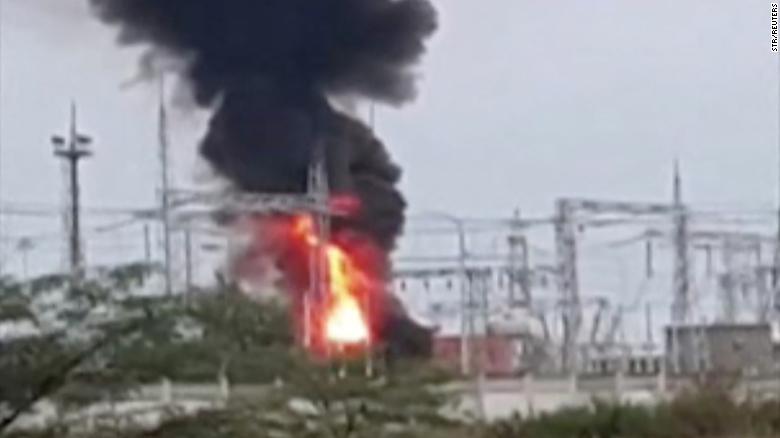
On Tuesday, a fire and smoke plume were seen rising from an electrical substation 12 miles away from Maiske’s ammunition depot, according to social media footage. The cause of the fire, and smoke, at the substation remains unclear.
The incidents both took place around the Dzhankoi area, described by the British Ministry of Defence as “a key road and rail junction that plays an important role in supplying Russia’s operations in southern Ukraine.”
The attacks come at a time when nascent resistance movement in Russian occupied areas appears to have been carrying out acts of sabotage.
Over the weekend, Ukrainian officials said that a railway bridge near the southeastern Ukrainian city of Melitopol, used by Russians to transport military equipment and weapons from occupied Crimea, was blown up by Ukrainian partisans. Melitopol has for months been a center of underground resistance to Russian occupation.
As analysts speculate that there is a campaign to degrade Russia’s military capability in Crimea, Zelensky warned Ukrainians living in occupied areas on Tuesday to stay clear of Russian forces’ military facilities.
What do the blasts mean for Putin’s ambitions?
The explosions at Saki airbase jolted sunbathers lounging in beach-side cabanas last week, and marked the start of a series of mysterious incidents on the Ukrainian peninsula that threatens the jewel of President Vladimir Putin’s revanchist ambitions.
Western officials and analysts have since offered competing explanations about the cause.
In any event, the Cavell Group said, the “Saki attack was audacious and highly effective in both damaging Russian reinforcements and striking a significant psychological blow to morale amongst the Russian military and civilians.”
Whatever caused the explosions, they could have significant implications for the overall conflict, especially if the attack were to have been carried out with any new long-range weapon system that Ukraine has developed.
The UK Ministry of Defence says that the loss of combat jets represents a minor proportion of the overall fleet of aircraft Russia has available to support the war.
But it noted that Saki is the main base for supporting the Russian navy in the Black Sea. “The fleet’s naval aviation capability is now significantly degraded. The incident will likely prompt the Russian military to revise its threat perception,” it said.
It may also cause a re-evaluation of the threat to Crimea which “has probably been seen as a secure rear-area,” the ministry said.