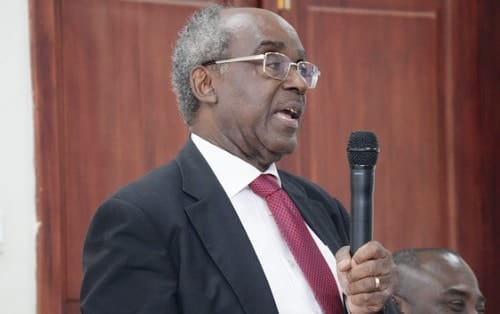
Professor Justice Samuel Date-Bah, a former Supreme Court justice, has said that removing all provisions that make false reports illegal would be dangerous.
According to him, such laws were put in place to control mischief, therefore any discussions of getting rid of them had to go through a procedure to determine whether their intended use still applied under the current legal system.
Yesterday, the Directorate of Research, Innovation and Development (DRID) of the University of Media, Arts and Communication in Accra hosted a lecture, which Prof. Date-Bah presided over.
It was dubbed: “The legal regulation of hate speech, fake news, etc. Is it desirable? Is it possible?”
The lecture, which attracted students and staff from various faculties of the school, discussed in detail the issue of hate speech and the nature of language used in the media and public discourse.
Issues such as ethics, fake news and language use took centre stage in a bid to promote decent and non-harmful language in media commentary.
Context
Two legal provisions — the Electronic Communications Act and the Criminal Code, specifically Section 208 of the Criminal and Other Offences Act, 1960 (Act 29) — have been criticised lately as stifling freedom of speech.
Promoters of such calls include the Ghana Journalists Association (GJA), the Media Foundation for West Africa (MFWA), the Ghana Independent Broadcasters Association (GIBA) and the Private Newspaper Publishers Association (PRINPAG).
The President of the GJA, Albert Dwumfour, at the commemoration of the World Press Freedom Day in Accra last Wednesday, said the arbitrary application of those laws only served to instill fear in the populace.
“As critical stakeholders in the media industry, we cannot remain unconcerned as these laws are used to arrest citizens and journalists and criminal charges preferred over civil remedies for press and speech offences that are merely defamatory,” he said.
It was based on this that the General Secretary of the GJA, Kofi Yeboah, sought Prof. Date-Bah’s thought on the matter at yesterday’s public lecture.
Complex
Prof. Date-Bah explained that the issue of free speech and fake news within the current legal dispensation was a complex one, saying there were forces which had to be reconciled.
“If we want to domesticate the discussions, clearly it is not a simple matter.
“There has to be a process of discussion to arrive at a conclusion which reflects our culture,” he said.
He added that the provisions needed to be subjected to a process to ascertain if they served the purpose for which they existed, stressing that a blanket repeal of such provisions would only pave the way for mischief without any regulation.
Law enforcement
The main speaker, Dr Venkat Lyer, a barrister and academic from Northern Ireland, explained that laws on hate speech needed to be applied sparingly to ensure that people were able to express themselves freely.
He said law enforcement officers needed to be generous when applying such laws to avoid self-censorship.
He, however, cautioned against the abuse of free speech.
On fake news, Dr Lyer said in spite of other jurisdictions drafting fake news laws, it was not easy to define fake news.
That, he said, was a danger as people could be unfairly convicted under such laws, adding: “If the law is couched loosely, there will be wrong convictions”.
He further called for a strong judicial protection regime and capacity-building for lawyers in order to interpret the laws appropriately to ensure fairness.
