Tag: February

  • Ghana’s inflation dropped to 3.3% in February – GSS

    Ghana’s inflation dropped to 3.3% in February – GSS

    The latest Consumer Price Index (CPI) data from the Ghana Statistical Service (GSS) shows that Ghana’s year-on-year inflation rate fell to 3.3 percent in February, down sharply from 23.1 percent in February 2025.

    Ghana’s inflation rate stood at 3.8 percent last month, marking the 13th consecutive decline in inflation, with the rate easing from 5.4% in December of the same year.

    The Statistical Service attributed the development to a slower rise in the prices of essential food items, largely due to improved availability. Ghana ended the year with an inflation rate of 5.4 per cent, a 0.9 percentage decline from 6.3 per cent recorded in November 2025.


    The downward trend of inflation has been attributed to easing food prices. Food inflation fell to 4.9 per cent in December, down from 6.6 per cent in November, as price increases for several key food items slowed.


    Also, food inflation was attributed as a major driver in the falling inflation rate, providing some relief to households after months of heightened cost-of-living pressures.


    Charcoal and staple foods such as plantains and bread have been identified as major contributors to the country’s cost-of-living pressures, which pushed up the November 2025 inflation rate.

    According to the last Consumer Price Index breakdown, other factors that affect inflation are basic household goods and utility-related expenses.


    The breakdown highlighted charcoal as the number one inflation driver after its year-on-year contribution increased to 9.2%. The second-largest contributor, smoked herrings, recorded a 7.6% increase in inflation. Unripe plantain, placed third, recorded 6.8%, making it the third biggest contributor to food inflation in November.


    The inflation rate for November 2025 saw a decrease from the 8.0% recorded in October to 6.3% in the same period, according to the Ghana Statistical Service (GSS). This marks the eleventh month in a row since October 2021.


    Addressing the media on Wednesday, December 3, the Government Statistician, Dr. Alhassan Iddrisu, mentioned that broad-based improvements in both food and non-food inflation, supported by stabilising market conditions, significantly caused the decline.


    In October, the GSS announced an 8.0% inflation rate, down from 9.4% recorded in September. The 1.4 percentage point drop from the previous month marks the lowest level since June 2021, sustaining ten consecutive months of consistent decline.


    It also indicates a sharp improvement from the 23.8% recorded in December 2024. Addressing the media in Accra, Government Statistician, Dr. Iddrisu Alhassan, attributed the continuous drop in inflation to the stringent fiscal measures adopted in efforts to stabilise Ghana’s economy.


    “For the first time since June 2021, Ghana has achieved single-digit inflation. This means that the rate at which prices of goods and services are increasing has slowed significantly. We’ve seen improvements across food, transport, and housing categories — key indicators of household welfare,” Dr. Alhassan noted.


    Last month, a report by the Bank of Ghana (BoG) indicated that the government spent less than budgeted between January and July. According to the Bank of Ghana’s September 2025 Monetary Policy Report, the government spent GH¢131.1 billion, which is below the planned amount of GH¢152.6 billion.


    Thus, government spending accounted for 9.4% of GDP, falling short of the target of 10.9%. The report noted that government spending was 14.1% below target but 9.3% higher than during the same period the previous year.


    The BoG attributed the gains to tighter fiscal discipline and improved expenditure control.


    It further stated that, except for compensation of employees, all major spending categories came in below target. Salaries and wages for public sector workers recorded GH¢44.9 billion from the projected amount, while spending on infrastructure and development projects stood at GH¢10 billion, much lower than expected.


    Ghana’s economy is expected to experience significant growth in 2026. Presenting the 2026 Budget Statement and Economic Policy on Thursday, November 11, the Finance Minister, Cassiel Ato Forson, projected a 4.8% increase in the country’s Gross Domestic Product (GDP) for 2026.


    He also forecasted that inflation would drop to 8% by the end of the year. “Right honourable Speaker, for the year 2026, we will achieve the following at a minimum: real GDP growth of at least 4.8%, driven by continued expansion in infrastructure, service sectors, and agriculture as well. … Mr. Speaker, at least 4.9%, and end the inflation for next year will be at least 8% ± 2,” he added.


    The Minister noted that the projected growth would be driven by continued development in infrastructure, the services sector, and agriculture. Ghana recorded a 6.3% Gross Domestic Product (GDP) in the second quarter of 2025.


    The IMF projects a decrease in global inflation while predicting slower economic growth in 2025 for the U.S. and other regions.

    The total value of all commodities bought and sold on Ghana’s Commodity Exchange (GCX) in 2024 amounted to GHS24.23 million, according to the Bank of Ghana’s (BoG) 2024 Financial Stability Review.


    The report attributed the gains to strong demand for maize and soybean contracts, which boosted overall market performance.

    “The Ghana Commodity Exchange (GCX) experienced remarkable growth, reinforcing its role in agricultural trade and market efficiency. Trading volume surged by 107.4 per cent to 5,161.03 metric tonnes in 2024. The total trade value soared by 114.8 per cent, from GH₵11.29 million in 2023 to GH₵24.23 million.


    This growth was driven by several factors, including increased market participation, the strategic use of commodity aggregation funds, a faster settlement cycle (T+1, a day after the transaction date), improved warehouse infrastructure, and enhanced trader confidence.


    Additionally, settlement values grew by 113.3 per cent to GH₵23.31 million, reflecting enhanced liquidity and improved transactional efficiency,” the report stated.

  • February breaks climate records as warmest month on record – EU’s climate service

    February breaks climate records as warmest month on record – EU’s climate service

    The EU’s climate service, has it that last month marked the warmest February on record in modern times, continuing a streak of nine consecutive months setting new temperature highs. Since June 2023, each month has surpassed previous records for the respective time of year.

    Notably, global sea surface temperatures have reached unprecedented levels, while Antarctic sea-ice extent has once again plummeted to exceptionally low levels.

    While the ongoing El Niño weather phenomenon in the Pacific Ocean continues to contribute to elevated temperatures, it is clear that human-induced climate change remains the primary driver of this sustained warmth.

    “Heat-trapping greenhouse gases are unequivocally the main culprit,” stresses Prof Celeste Saulo, Secretary General of the World Meteorological Organization.

    Carbon dioxide concentrations have reached their highest levels in at least two million years, as reported by the UN’s climate body, and experienced near-record increases over the past year.

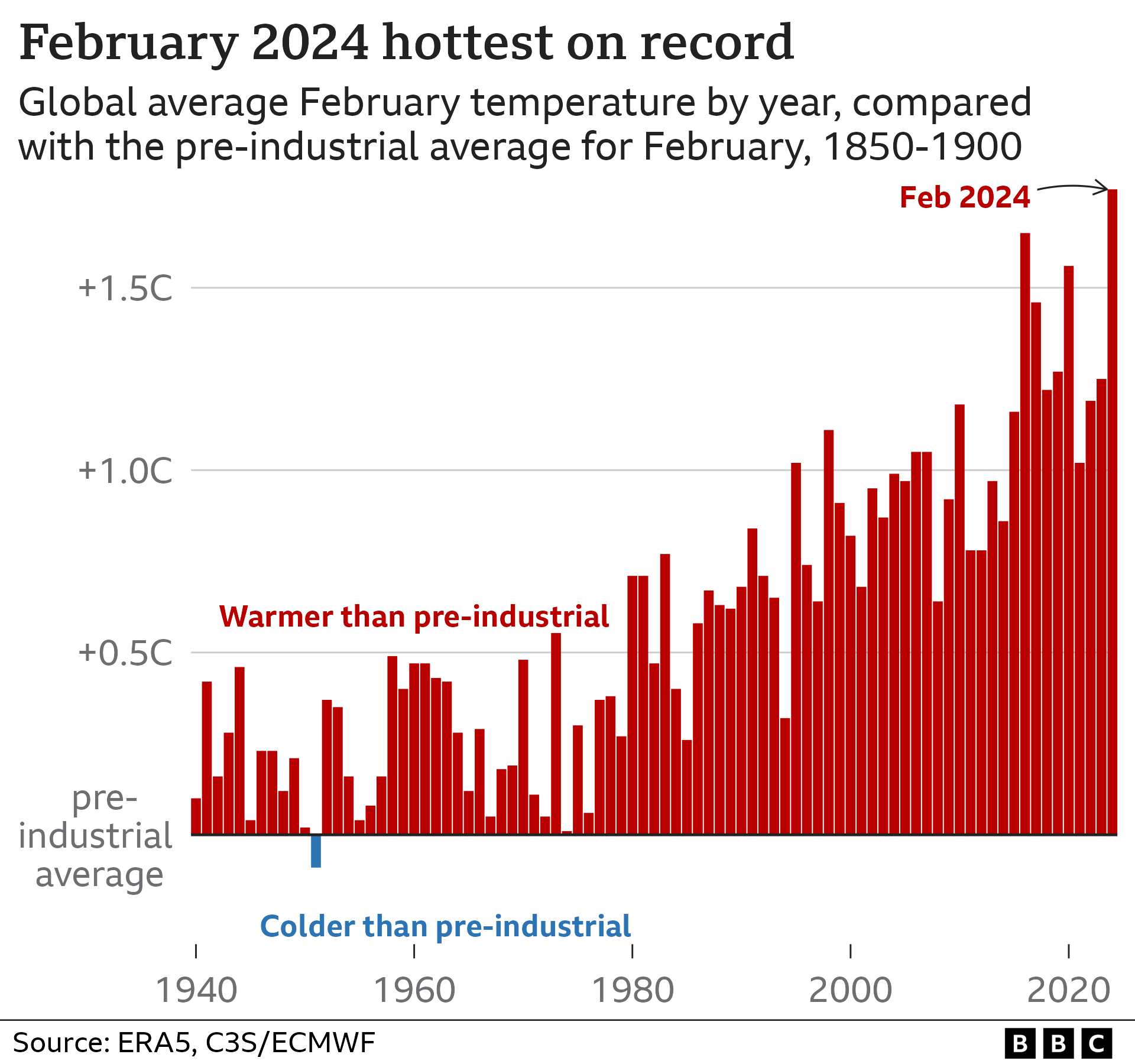
    The accumulation of these warming gases contributed to February 2024 being approximately 1.77°C warmer than “pre-industrial” times, defined as the period before significant human activity led to extensive burning of fossil fuels, according to the EU’s Copernicus Climate Change Service. This surpasses the previous record set in 2016 by approximately 0.12°C.

    The elevated temperatures led to severe heatwaves affecting regions including western Australia, southeast Asia, southern Africa, and South America.

    Bar chart of global average February temperatures against pre-industrial levels, 1940 to 2024. February 2024 is the hottest on record at 1.77C above pre-industrial, and their has been an increasing trend over time.


    The current 12-month average temperature stands at 1.56°C above pre-industrial levels, following the confirmation of the first year-long breach of 1.5°C warming last month.

    In the 2015 Paris Agreement, nearly 200 countries committed to limiting the increase in global warming to below 1.5°C to mitigate the most severe climate impacts.

    While this threshold in the Paris agreement is typically understood as a 20-year average and has not yet been exceeded, the consistent succession of record-breaking temperatures highlights the imminent proximity to reaching this critical mark.

    Recent records haven’t just been limited to air temperatures. Countless climate metrics are far beyond levels seen in modern times.

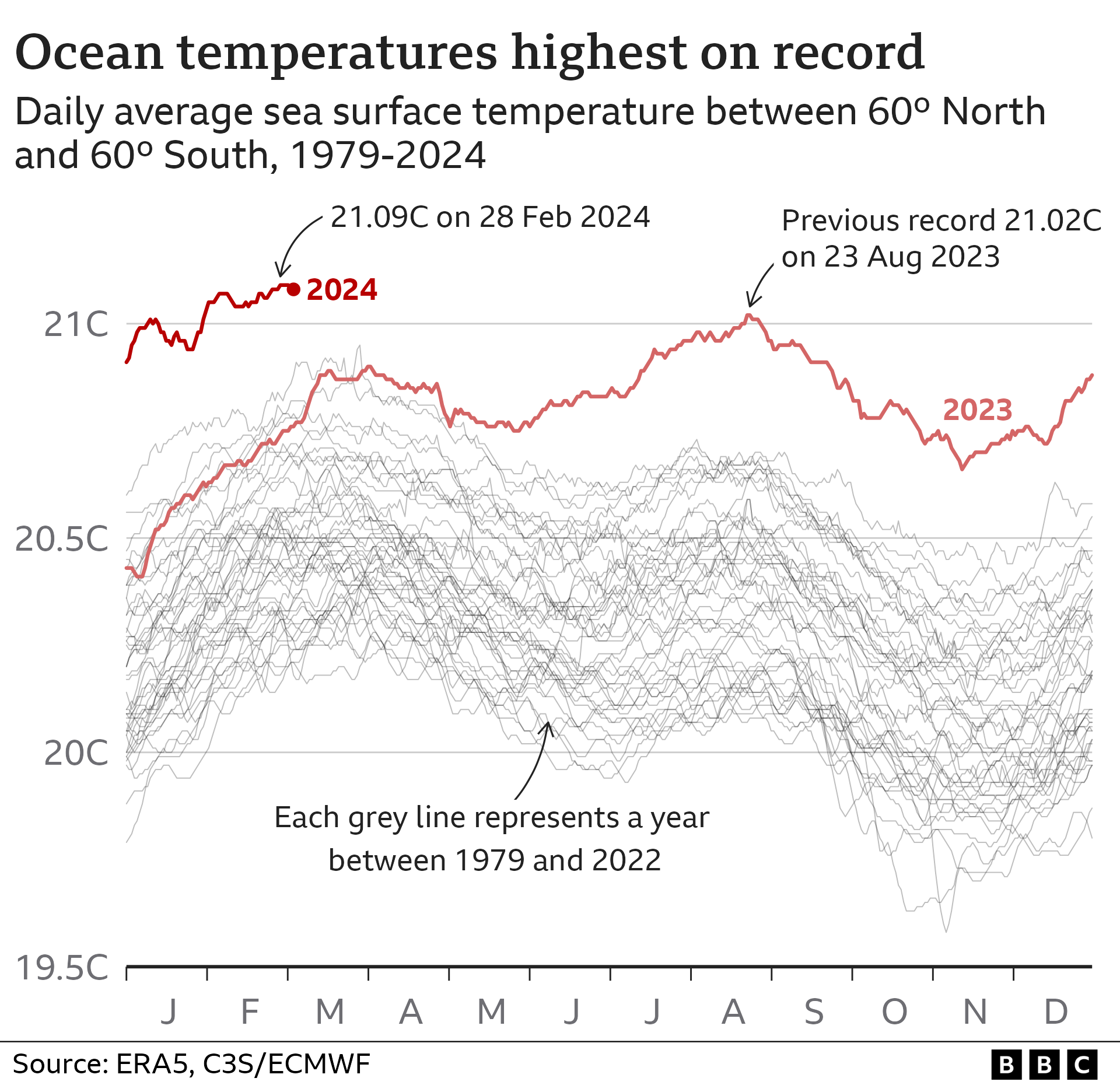
    One of the most notable is sea surface temperatures. As the graph below shows, the margin of records in recent months has been particularly striking.

    Multiple line chart of global average sea surface temperatures from 1979 to 2024. Sea surface temperatures have been at their highest on record in February 2024, with 28 February showing 21.09C.

    Researchers are keen to stress that the scale and extent of the oceanic heat is not simply a consequence of the natural weather event known as El Niño, which was declared in June 2023.

    “Ocean surface temperatures in the equatorial Pacific clearly reflect El Niño. But sea surface temperatures in other parts of the globe have been persistently and unusually high for the past 10 months,” explains Prof Saulo.

    “This is worrying and cannot be explained by El Niño alone.”

    Ocean warming has prompted concerns about the mass bleaching of coral reefs. It also raises global sea-levels and can help to fuel higher intensity hurricanes.

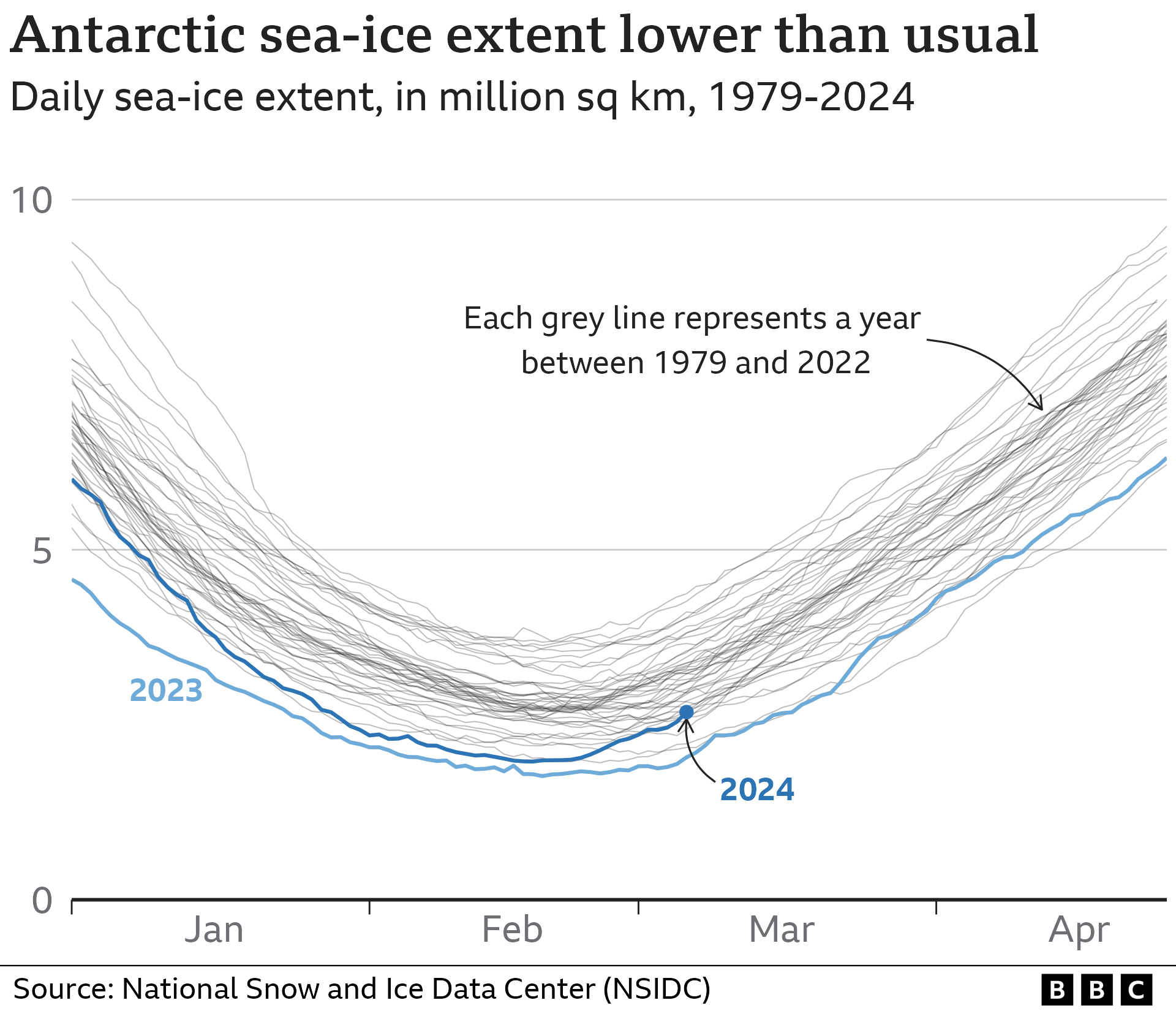
    Unusually warm waters may also have been a factor in another exceptional month for Antarctic sea-ice. The three lowest minimum extents in the satellite era have now occurred in the last three years.

    Multiple line chart of Antarctic daily sea-ice extent, 1979 to 2024, between the months of January and April. After record lows in 2023, 2024 has also been exceptionally low.

    Scientists are struggling to explain exactly what’s going on.

    Until 2017, Antarctic sea-ice had defied predictions that it would shrink, unlike in the Arctic, where the downward trend has been much clearer.

    The apparent recent shift – occurring at the same time as other records are being broken around the planet – adds to concerns that Antarctic sea-ice may finally be waking up to climate change.

    “I don’t think you can say it’s coincidental,” Prof Martin Siegert, a glaciologist at the University of Exeter, told BBC News.

    “It’s absolutely frightening. The records are just off [the] scale.”

    There are signs that the run of global temperature records may finally come to an end in the months ahead.

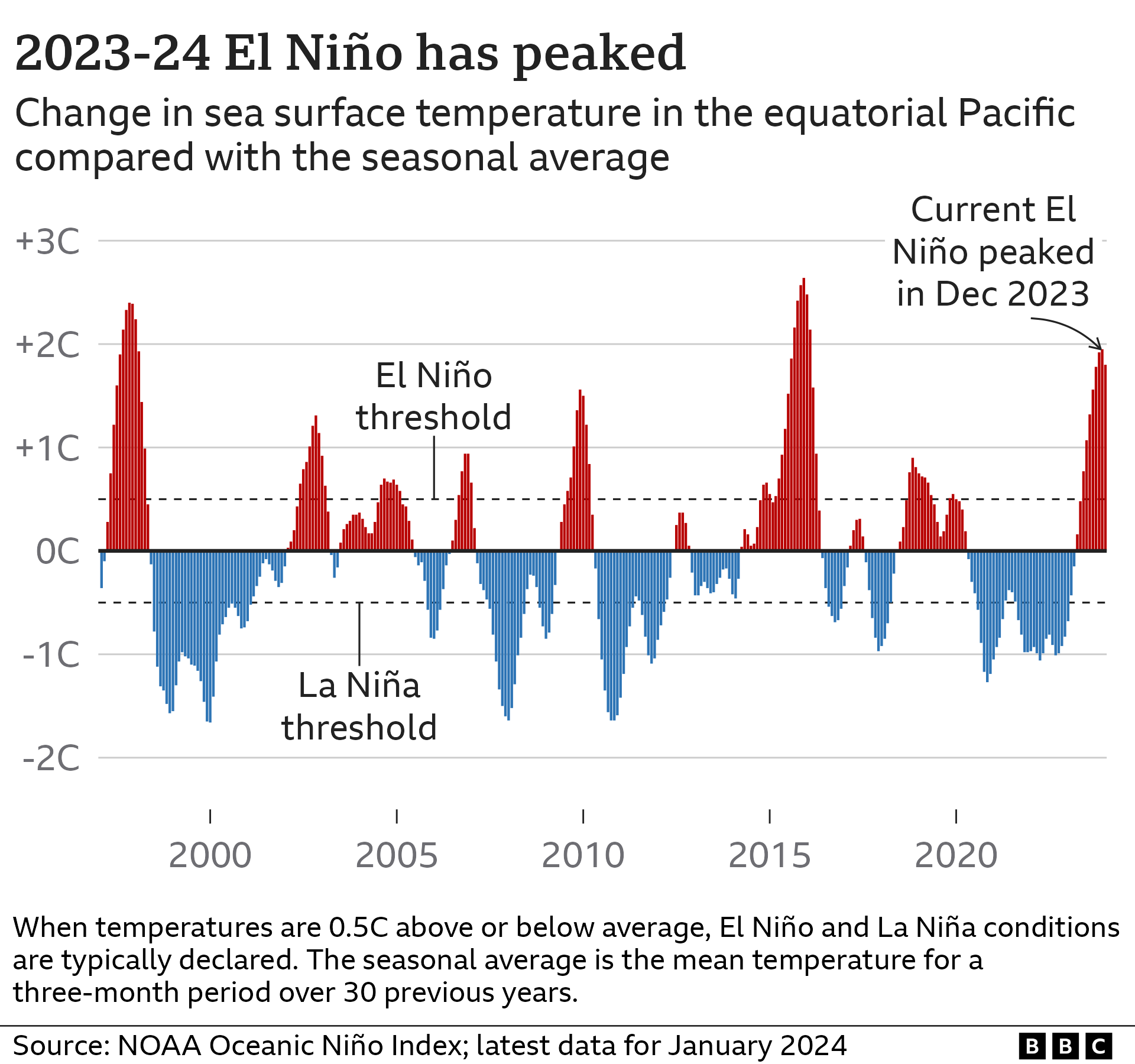
    The 2023-24 El Niño has been one of the five strongest such events on record, the World Meteorological Organization announced on Tuesday, but it is gradually weakening.

    Chart showing average seasonal sea surface temperatures in the equatorial Pacific compared with the long-term average. When temperatures are 0.5C above or below the average, they are considered to be El Niño or La Niña conditions respectively. Recent months have shown El Niño conditions, but these now appear to have peaked.

    El Niño will continue to have an effect on temperatures and weather patterns for the next few months.

    “We would expect [El Niño] to continue to keep 2024 temperatures elevated at least through the first half of the year,” Dr Colin Morice, a senior scientist at the UK’s Met Office Hadley Centre, told BBC News.

    However, a switch to neutral conditions in the Pacific is likely between April and June, according to US science body NOAA, and a further switch to the cool phase known as La Niña could then happen between June and August.

    This would likely put a temporary lid on global air temperatures, with a cooler sea surface in the East Pacific allowing less heat to escape and warm the air.

    But as long as human activities keep releasing huge amounts of greenhouse gases, temperatures will continue rising in the long-term, ultimately leading to more records and extreme weather.

    “We know what to do – stop burning fossil fuels and replace them with more sustainable, renewable sources of energy,” says Dr Friederike Otto, senior lecturer in climate science at Imperial College London.

    “Until we do that, extreme weather events intensified by climate change will continue to destroy lives and livelihoods.”