Ecuador has experienced the assassination of a local party leader, making two politicians in a week.
At his residence in the northern Esmeraldas province, Pedro Briones was fatally shot by motorcycle-riding assailants.
Only five days had passed since presidential contender Fernando Villavicencio was shot and killed in Quito.
As local gangs formed partnerships with global crime cartels, the murder rate in Ecuador increased.
The assassinations of leaders have shook the nation ahead of the impromptu presidential elections on August 20.
In Esmeraldas, Mr. Briones was the chairman of the left-leaning Citizen Revolution Party. Party members sent their sympathies to the man’s family.
Luisa González, the party’s presidential candidate, claimed that Ecuador was experiencing “its bloodiest period.”
The Citizen Revolution Party was created by former president Rafael Correa, who wrote: “They killed another of our compatriots in Esmeraldas. “I’ve had enough!”
Although the police have not yet made an official statement regarding the slaying, local media outlets claimed that the two shooters left on a motorbike after killing Mr Briones in San Mateo, a city south of Esmeraldas.
What the motivation might have been is still a mystery.
One of the worst affected provinces by the nationwide wave of violence is Esmeraldas, which shares a border with Colombia.
Drug traffickers who transport cocaine from Colombia via Ecuador to the US and Europe find the region attractive due to its porous border with Colombia and its location on the Pacific coast.
However, Esmeraldas has not been the only victim of the violence. The mayor of the port city of Manta in the province of Manab was assassinated last month while visiting a public works project.
Fernando Villavicencio, an outspoken journalist who exposed corruption scandals and criticised connections between organised crime and public authorities, has been the most well-known casualty to date.
Six males, all citizens of Colombia, have been detained in relation to his murder.
Sunday saw the arrival of FBI officers from the US, who are working with Ecuadorean authorities to look into the death of Fernando Villavicencio.
A politician from Ecuador who was assassinated will run for president by his running companion.
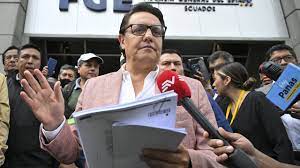
After an event in Quito for his campaign, Fernando Villavicencio was shot three times in the head. Police claim that all suspects are from Colombia.
His Constructe party announced that Andrea Gonzalez would be their nominee for president.
The party also stated that selecting a vice presidential candidate for the August 20 election was in underway.
The capital’s Sunday presidential debate will feature Ms. Gonzalez, 36, whose career has primarily focused on environmental issues.
According to the party’s social media posts, “millions of Ecuadorians will accompany her in this purpose” and she will “guarantee the legacy” of Mr. Villavicencio.
According to the party, “the most trusted of those who have shared the struggles of comrade Fernando Villavicencio” will be the candidate for vice-presidency.
As he exited a public event in the nation’s capital on Wednesday, Mr. Villavicencio, 59, a former journalist and member of the national assembly, was shot three times in the head.
In a gunfight with the police, one attacker was killed while several others managed to flee.
His passing has shaken a country that, for the most part, has avoided the decades of drug-gang violence, cartel battles, and corruption that have plagued many of its neighbours. However, crime has dramatically increased recently due to the expansion of the Mexican and Colombian drug cartels.
Mr. Villavicencio was one of just a few candidates to claim ties between organised crime and government officials in Ecuador during his campaign, which concentrated on corruption and gangs.
His widow, Veronica Sarauz, stated during a news conference on Saturday that she held the government accountable for her husband’s passing.
His personal guards didn’t do their duty, according to the woman, and the state still needs to provide numerous explanations for all that occurred.
“I don’t want to believe they sold my husband to be killed in this notorious way,” she said.
Ms. Sarauz also expressed her disappointment that Ms. Gonzalez had been chosen to run for president in place of her husband.
Six Colombians who belonged to organised criminal organisations have reportedly been detained, according to Interior Minister Juan Zapata.
The FBI has been requested by Ecuadorian President Guillermo Lasso to assist in the investigation of Mr. Villavicencio’s death.
Meanwhile, three criminals from a maximum security prison in the port city of Guayaquil who were deemed to be very dangerous by Ecuadorian officials have been transferred.
Among them was Jose Adolfo Macias, or “Fito,” the head of one of Ecuador’s most important organised criminal organisations, from whom Mr. Villavicencio claimed he had received death threats.
Despite not being in the lead and polling in the centre of the pack, Mr. Villavicencio, a married father of five, was one of eight candidates in the first round of voting.
“This crime can’t go unpunished,” his sister Patricia Villavicencio remarked. There is no justice, no protection, and we are in pain with a damaged soul.
In a private ceremony held on Friday night in the nation’s capital, the body of the assassinated Ecuadorian presidential candidate Fernando Villavicencio was laid to rest.
According to his campaign staff, the 59-year-old was buried in the Monteolivo cemetery in Quito’s north.
They claimed that the funeral took place in complete secrecy, with police officers and his nearest family accompanying the casket.
Villavicencio, an anti-corruption activist and congressman who spoke out against the carnage brought on by drug trafficking in the nation, was shot and killed on Wednesday during a campaign rally in Quito.
Villavicencio was assassinated just 10 days before the first round of the presidential election was scheduled to take place. Villavicencio belonged to the Movimiento Construye political party.
Six suspects, all of whom are gang members and citizens of Colombia, were reportedly detained by authorities on Thursday in connection with his murder. Although it is yet unknown what country the suspected shooter was from, he passed away earlier while in police custody.
The Andean country, which was until a few years ago a relatively calm country, is now afflicted by a worsening security crisis caused by drug trafficking and a turf war between competing criminal organisations.
As criminal organisations compete to control and distribute narcotics, particularly cocaine, the Pacific coast of Ecuador has seen the most violence.
The assassination sparked a global outcry of disapproval, notably from the UN Human Rights chief, the United States, and the European Union.
During the course of the inquiry, investigators confiscated two motorcycles, a stolen car that was thought to have been utilised by the suspects, a rifle, a machine gun, four handguns, three grenades, two rifle magazines, and four boxes of ammunition.
President Guillermo Lasso also requested assistance from the US Federal Bureau of Investigation in response to the incident, and he tweeted earlier that a mission would soon be in the nation.
Authorities have revealed that six of the individuals detained in connection with the murder of Ecuadorian presidential candidate Fernando Villavicencio are citizens of Colombia and are members of gangs. This comes as a former vice president has called for action to stop the country’s spiralling violence.Villavicencio, a legislator and anti-corruption activist who frequently spoke out against the carnage brought on by drug trafficking in the nation, was fatally shot on Wednesday during a campaign rally in the nation’s capital Quito.Ten days prior to the first round of the presidential election, the 59-year-old was assassinated. As Ecuador’s violence has increased in recent years, Villavicencio’s campaign promises to crack down on crime and corruption.
After exchanging gunfire with security forces, the alleged shooter passed away in police custody, according to Ecuador’s Attorney General’s Office on Wednesday.
Six other people were detained in relation to the murder. Juan Zapata, the interior minister for Ecuador, stated during a news conference on Thursday that there is early evidence the suspects are associated with organised crime gangs.
A rifle, a machine gun, four handguns, three grenades, two rifle magazines, four boxes of ammo, two motorcycles, and a stolen car suspected to have been used by the guys were discovered by officials during nocturnal raids, according to Zapata.
Ecuador’s President Guillermo Lasso tweeted that a mission from the US Federal Bureau of Investigation would soon be arriving in the nation after the attack prompted him to ask for assistance.
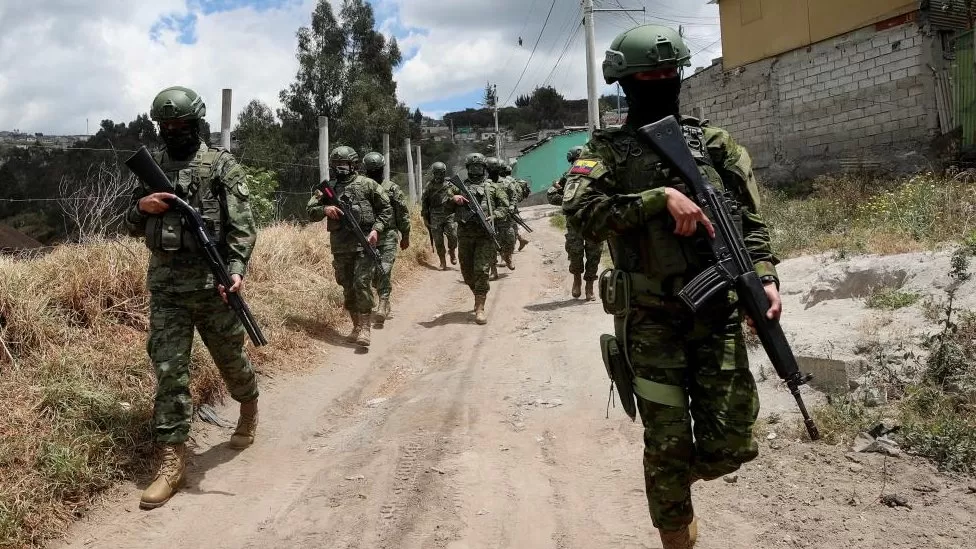
In addition, Lasso declared a 60-day state of emergency, an immediate nationwide mobilisation of the military, and three days of national mourning.
The assassination sparked a global outcry of disapproval, notably from the UN Human Rights chief, the United States, and the European Union.
In an exclusive interview with CNN on Thursday, former vice president of Ecuador and current presidential hopeful Otto Sonnenholzner claimed that the degree of violence in Ecuador is “something we have never seen before.”
It’s a novel idea. Maybe a year and a half or two years ago, it began. It’s an uncontrollable spiral of violence that needs immediate government response, but we aren’t seeing it, Sonnenholzner added.
The Andean country, which was previously relatively quiet, is currently affected by a deepening security crisis brought on by drug trafficking and a turf war between competing criminal organisations.
As criminal organisations compete for possession and distribution of narcotics, mainly cocaine, violence has been most pronounced along Ecuador’s Pacific coast.
Additionally, the nation no longer has authority over its overcrowded jails, which are frequently run by criminal gangs. Between these opposing groups, horrific prison riots have claimed the lives of hundreds of prisoners.
Sonnenholzner claimed that “the gangs are controlling crime in the streets from the jails.” “There is a lot of influence of drug dealers and traffickers in different institutions in the country,” he added, adding that corruption has a negative impact on the judiciary, some police, and even local administrations in Ecuador.
According to Sonnenholzner, Villavicencio had received threats from Ecuadorian organised criminal groups two weeks prior, but he had not been shielded.
According to interior minister Zapata, Villavicencio did have a security detail at the time of the incident that included five police officers, numerous patrol cars, and his own armoured vehicle, however he pointed out that the armoured vehicle was not deployed in Quito.
According to local media, Zapata said earlier this week that seven of Ecuador’s eight presidential contenders were being guarded by police.
Every day, gun control fails totally. The offenders’ firearms are comparatively recent. The six attackers who were caught yesterday had grenades and machine guns, and Ecuador has historically been a fairly peaceful nation,” Sonnenholzner added.
Sonnenholzner announced that he had stopped participating in public campaign events “for the next few days” and hired his own private protection.
Sonnenholzner claimed that in order to give Villavicencio’s political party, Movimiento Construye, time to locate a replacement candidate, he has asked that the Sunday, television-only presidential discussion be postponed.
Villavicencio, he pointed out, had originally come to prominence as an investigative journalist who campaigned against power abuse and corruption.
Sonnenholzner declared that his “fight against corruption should be his legacy.”
In the midst of a fatal rise in crime and violence that has gripped the South American nation, Fernando Villavicencio, a contender in the 2017 presidential election in Ecuador, was killed at a campaign event in the capital on Wednesday.
The murder would not go unpunished, Ecuador’s President Guillermo Lasso warned, adding that “organised crime has come a long way, but the full weight of the law will fall on them.” Three days of national mourning were also declared, along with a 60-day state of emergency and an urgent military mobilisation nationwide.
Ten days before the first round of the presidential election was scheduled to take place on August 20, Villavicencio was shot and assassinated as he was leaving a campaign gathering at a school north of the capital Quito.
He was a member of the National Assembly and had been outspoken about the violence brought on by drug trafficking and corruption in the nation, telling CNN En Espaol Conclusiones in May that Ecuador had turned into a “narco state” and offering to lead an effort to combat the “political mafia.”
The Attorney General’s Office of Ecuador announced the death of the alleged shooter in custody after exchanging gunfire with security personnel on X, formerly known as Twitter.
The attack, which left nine people injured, including a candidate for the National Assembly and two police officers, has been the subject of an investigation.
The Ecuadorian Prosecutor’s Office later said that six persons had been detained during raids in the Quito neighbourhoods of Conocoto and San Bartolo, and that Villavicencio’s body had been taken to a mortuary for an autopsy.
Social internet videos purport to capture the moment Villavicencio was fatally shot.
The video appears to show Villavicencio leaving the campaign event and heading towards a car while being surrounded by numerous law enforcement personnel and onlookers. At least 12 gunshots can be heard as he climbs into the rear seat of the car. Villavicencio’s security detail is among the numerous people spotted seeking refuge from the gunfire as a police officer swiftly slams the door behind him.
Sister Patricia Villavicencio, who was present at the gathering, claimed to have been standing next to the murdered lawmaker when he was assassinated.
She informed reporters outside the school that she held the Interior Ministry and the national government accountable for her brother’s passing.
She questioned, “Where is the security?”
Seven of the eight candidates, including Villavicencio, were reportedly under police protection, according to Ecuador’s interior minister Juan Zapata earlier this week, local media reported Tuesday.
The opposition-led congress was dissolved in May by President Lasso, who declared himself “outraged and shocked” by Villavicencio’s murder. This opened the door for early elections.
Due to allegations of embezzlement made by opposition lawmakers before he assumed government, which Lasso denies, he was up for impeachment. His resignation has been demanded more frequently recently as the nation struggled with a high cost of living and a rise in violent crime.
The murder occurs as Ecuador battles a deteriorating security situation brought on by drug trafficking and a turf war between competing criminal organisations.
The Andean nation, formerly referred to as the “isla de paz” or “island of peace,” has recently recorded some of the highest homicide rates in the region.
Despite not having a history of producing cocaine or coca, its main constituent, Ecuador is sandwiched between Peru and Colombia, the two countries with the highest rates of drugs production worldwide.
Security analysts claim that Ecuador has grown to play a crucial role in the lucrative routes used to transport cocaine from South America to North America and Europe. The country’s Pacific coast has seen the most violence as criminal organisations compete for control of the drug trade.
Additionally, the nation no longer has authority over its overcrowded jails, which are frequently run by criminal gangs. According to Ecuadorian officials, security services have had difficulty dealing with gangs within jails where convicts frequently seize control of prison facilities and manage criminal networks from solitary confinement. Brutal prison riots between opposing gangs have resulted in the deaths of hundreds of prisoners.
Agustin Intriago, the mayor of the coastal city of Manta, was shot and killed in July, along with Ariana Chancay, a young athlete he was chatting with.
All of the contenders for president of Ecuador have vowed to stop the violence from getting worse.
However, as security and the economy worsen, more Ecuadorians are leaving the country. According to data, hundreds have travelled through the perilous Darien Gap this year in an attempt to reach the United States.
Michael J. Fitzpatrick, the US ambassador to Ecuador, issued a statement on X saying he is “deeply shocked” by the murder and referring to Villavicencio as a “fighter against the corrupt and narco-criminals who have done so much damage to Ecuador.” He declared that the US “strongly condemns” the attack and extended an offer of US government support for the inquiry.