Tag: filmmaker

  • Your craft becomes sharper when you grow through pain – Leila on script writing

    Ghanaian filmmaker Leila Djansi has reflected on her journey as a script doctor, stating that personal challenges have strengthened her craft and shaped her approach to storytelling.

    In a Facebook post sighted by The Independent Ghana, she disclosed that her work in the film industry over the past three years has focused largely on script doctoring, which involves reading, editing, rewriting and producing speculative drafts for filmmakers. She noted that the process demands consistency and emotional stamina.

    “And when you remove your ego, apathy, and worry from the work, the characters begin to speak.”

    “When you allow yourself to grow through pain and discipline instead of collapsing under it, your craft becomes sharper and your voice becomes clearer.”

    Leila explained that navigating difficult personal moments while working on multiple scripts has not been easy. However, she described the period as the most rewarding phase of her career, stressing that growth often emerges from uncomfortable seasons.

    According to her, the experience has taught her humility and discipline, especially in an industry where it is easy to critique other people’s work without acknowledging one’s own limitations. She added that the challenges she encountered have sharpened her writing skills and deepened her understanding of character development.

    Leila encouraged creatives to embrace the refining process that comes with their craft, saying it ultimately produces better work and richer stories.

    A couple of months ago, the award-winning filmmaker stressed that filmmakers cannot thrive as both filmmakers and film distributors.

    She encouraged filmmakers to tell employ the services of professional distributors and include the as part of their entire project.

    “In Ghana, filmmakers are forced to play both creator and distributor.That’s unsustainable. Your job is to make the film. Get someone else to sell it. Collaborate. Build distribution networks across West Africa, into the diaspora, and then let streamers become an option, not a lifeline,” she said in a post sighted by MyNewsGh.

    Djansi explained that from the script stage, filmmakers must think about their marketing and distribution strategy, ie, Cinema → TV → SVOD → AVOD/FAST, which ensures the film earns over the years, not just once.”

    The renowned Ghanaian filmmaker sparked debate among industry players, questioning whether they will continue making excuses for the state of Ghana’s film industry or take action to improve it.

    “Good and bad can coexist in anything. But at what point do we stop excusing the bad and start fixing it?” she asked in a Facebook post, calling for a shift from complacency to progress.

    Djansi criticized the industry’s reluctance to embrace constructive criticism, urging filmmakers to compare their work with productions from other African countries such as Nigeria, Zambia, Kenya, and South Africa.

    “Take two of your most recent critically acclaimed films from the previous three years and compare them to two from Nigeria, Zambia, Kenya, and South Africa. Look at them side by side and ask yourself if we are actually gaining any momentum,” she challenged.

    She lamented that since Azali’s Oscar submission in 2018, Ghana’s subsequent entries have not been up to standard.

    “In 2018, we got Azali for the Oscars, and since then, every single submission has been a joke. A literal joke. Some of the films would convince you to burn your Ghana card,” she stated.

    Djansi stressed that the problem is not a lack of talent but an unwillingness to elevate the industry through hard work and innovation.

    Sharing a personal experience, she recalled how a Creative Artists Agency (CAA) agent once critiqued her storytelling approach. Instead of dismissing the feedback, she took it as an opportunity to grow.

    “What he actually said to me was, ‘Go take risks with your storytelling.’ I grew up,” she revealed.

    She urged filmmakers to stop dismissing criticism as hate or jealousy and instead use it as a tool for improvement.

    “Stop enduring mediocrity, please. Instead of these knee-jerk reactions, instead of acting like people just want to hate, forget the who and the how and actually listen. Sit with the criticism. Use it to rise,” Djansi advised.

    With her bold remarks, Djansi hopes to ignite a mindset shift in the Ghanaian film industry, pushing creatives to move beyond excuses and take the necessary steps to compete on the global stage.

    On a seperate matter, Leila asserted that YouTube will soon become a thing of the past due to saturation by filmmakers.

    She further argued that a government-backed film fund would be wasted if movies are only released on YouTube.

    She added that piracy also undermines the platform’s viability for film distribution.

    “Personally, I don’t believe the film fund. I really don’t. I think it is premature because there is no distribution. If you give the film fund how are they gonna [make profit].”

    People think that we are just gonna put it on YouTube. I’m sorry YouTube is gonna collapse very soon. There is so much congestion on YouTube and they are always changing their policies. So if you go in now a I think it is seriously over-saturated. If you over-saturate it, they’re gonna reduce the earning. So how much are you gonna earn if you just put your film on YouTube,” she said.

    Meanwhile, James Gardiner, a leading Ghanaian actor, recently discussed the crucial role social media, particularly YouTube, plays in boosting the Ghanaian film industry.

    In an interview with media figure Doreen Avio, the star of ‘Taste of Sin’ pointed out that many are not fully harnessing the potential of these digital platforms.

    Gardiner emphasized that YouTube remains underutilized, despite its potential for significant impact.

    He noted that individual productions can amass millions of views, potentially translating into considerable earnings.

    “YouTube is a goldmine that’s being overlooked. The fact that just one of our productions can hit around 29 million views indicates that African films are resonating widely,” he said.

    While acknowledging the importance of major streaming services like Netflix, Gardiner stressed the value of concentrating efforts on YouTube.

    He shared insights from his recent experiences in Nigeria, highlighting how Nigerian TV stations swiftly adopt and popularize films from YouTube, further amplifying their reach.

    “Work is thriving in Nigeria, and it’s not just Ghanaian audiences that are engaged. In fact, Nigerian platforms quickly pick up new releases from YouTube, often within 20 to 30 minutes, which boosts viewership numbers,” Gardiner observed.

    Despite the hurdles the Ghanaian film industry faces, Gardiner remains hopeful about its future.

    He believes that with a positive outlook and persistent effort, the industry is poised for continued growth and success.

    Popular Nollywood actress Ruth Kadiri recently shared her insights on why she chose YouTube as the platform to showcase her movies.

    In an interview with BBC Pidgin, she highlighted YouTube’s significance as a major income source for independent filmmakers and content creators, emphasizing its pivotal role in sustaining livelihoods within the industry.

    Kadiri emphasized that YouTube has become indispensable, stating that without it, many individuals, not just filmmakers, would face financial hardships. She underscored the platform’s contribution to feeding people by providing opportunities for filmmakers to monetize their content effectively.

    Reflecting on her journey into YouTube, Kadiri revealed her frustration with the constraints of traditional production processes, which motivated her to seek a space where she could freely express her creativity. She discussed her desire to explore and implement innovative ideas without excessive regulations, noting that YouTube offered the flexibility she craved.

    Despite encountering skepticism and discouragement from others, Kadiri viewed YouTube as a platform for reaching a broader audience and honing her skills. Her decision to venture into YouTube was fueled by a passion for storytelling and a determination to overcome challenges, even if it meant learning from initial setbacks.

    Kadiri’s experience on YouTube has been marked by the production of several films, each contributing to her growth as a filmmaker and entrepreneur. Her journey exemplifies the evolving landscape of film distribution and the opportunities that digital platforms like YouTube offer to aspiring creators.

    The surge and mass production of AI-generated content on YouTube has prompted the video-sharing platform to announce a review and update of its monetisation policy under the YouTube Partner Program (YPP).

    The YouTube Partner Program is how creators earn money from their content.

    In a formal statement shared on July 7 on YouTube’s Support page- a platform where the company shares updates and announcements- it spelt out modifications concerning content and its monetisation policy.

    “We’re updating our guidelines to better identify mass-produced and repetitive content. This update better reflects what inauthentic content looks like today,” parts of the statement read.

    According to the statement, effective July 15, content would now be subjected to strict scrutiny, and those found as repetitive with no intention to educate or entertain would be demonetised.

    “On July 15, 2025, we’re updating our guidelines to better identify mass-produced and repetitive content. This update better reflects what inauthentic content looks like today”, it continued.

    Also, content that has been created with heavy use of AI with little to no human effort would be demonetised.

    “AI-assisted content is acceptable, but only if it includes considerable human input. Content created with little to no human effort may not be eligible for monetisation.”

  • Taxes imposed on creative economy barring growth – Filmmaker tells Tourism Minister

    Taxes imposed on creative economy barring growth – Filmmaker tells Tourism Minister

    Ghanaian filmmaker Peter Sedufia has expressed strong dissatisfaction with the high taxes placed on business activities within the creative economy.

    In an open letter to the Minister of Tourism, Culture, and Creative Arts, Abla Dzifa Gomashie, Peter pointed out the damaging impact these taxes are having on their businesses.

    “The taxes imposed on the creative economy are a great disincentive. It makes it extremely difficult to keep pursuing anything creative art in Ghana,” Peter noted.

    This concern follows widespread calls from creatives urging the government to address and reduce the burden of these taxes on their work.

    Read Peter Sedufia’s letter to Honourable Abla Dzifa Gomashie below:

    Dear Honourable Abla Dzifa Gomashie, Good morning, Mamaga.

    I want to use this morning to publicly congratulate you on your appointment as the substantive minister for a sector that I belong to – the ministry of Tourism, Culture and Creative Arts . A sector that arguably provides more employment to individuals outside the government employment architecture. I’ll not waste time beating about the bush.

    The taxes imposed on the creative economy are a great disincentive. It makes it extremely difficult to keep pursuing anything creative art in Ghana. I’m sure being a former partaker of the industry yourself, you’re no stranger to this. I don’t know how things are working in the music side, so I’ll stick with the film industry where I belong.

    Let me quickly bring to your attention that as things stand, for every 100% sale we make in the already scanty/very limited cinemas, the government takes about 30%. The remaining 70% is then shared between the filmmaker and the cinema owners 35% each. That’s even for the first week. The filmmaker’s share drops further as the weeks go by.

    Let me put this into money terms: For every Ghc 100,000 a Ghanaian filmmaker makes at the cinema, the government takes Ghc 30,000, the cinema owner takes Ghc 35,000, and the filmmaker takes 35,000.

    It is said that for any filmmaker to break even at the Box Office (cinema), the film must make at least 3 times its investment. On average, a decent Ghanaian film would cost Ghc 400,000 (excluding marketing cost). There’s only one major cinema chain in Ghana (Silverbird Cinemas) with two sites – Accra mall and West Hills mall. Each location has about 1,200 seats, making 2,400 in total. Granted that a filmmaker is successful at filling all the halls with the traditional 2 shows for the opening day, that’ll be 4,800 admissions (this rarely happens, by the way. Only two Ghanaian filmmakers have been successful at this).
    So, let’s say the total admits for the entire cinema run of the film is 5,000, with the ticket price being Ghc 100. That’ll make Ghc 500,000 gross revenue.

    This implies that the government will make a non-negotiable Ghc 150,000. Mind you, as the weeks go by, the cinema owner’s sharing ratio with the filmmaker increases. So, the cinema owner may end up with Ghc 200,000, and the filmmaker would have to settle with the remaining Ghc 150,000. The story would have been different if there were more cinemas across the country to fully exploit the film theatrically.

    In contrast, however, for every Ghc 100,000 equivalent I make in Nigeria, I’m paying far less than 15% in taxes – less than Ghc 15,000. Plus, they have over 80 cinema locations to shore up the numbers, compared to the about 5 we have in Ghana.

    Nigeria’s population is about 7 times more than Ghana’s. But then, they have over 16 times more cinemas than us. Shouldn’t we match up/ catch up by the population ratio?

    I honestly don’t know what you’ll do with this information, but I just thought to bring it to your attention.

    I wish you all the best in your new role. You’re one of us – our own. We’ll keep praying and supporting you to succeed, so we can also succeed!

  • Filmmaker Morton refutes claims that Ghanaian film editors are lazy

    Filmmaker Morton refutes claims that Ghanaian film editors are lazy

    Renowned filmmaker, Gabriel Mortinno Morton has debunked assertions that Ghanaian film editors are lazy and inefficient in their work.

    His comments come after some key stakeholders in the movie industry labeled local film editors as unserious, inefficient, and lazy as they preferred to work with foreign editors.

    According to Mortinno Morton, who recently won the Best Video Editor of the Year at this year’s Film Crew Association of Ghana Awards, low budget allocations to big productions do affect the efficiency of film editors.

    He noted that the lack of better remuneration and underpaying editors due to friendship do affect their work.

    Mortinno Morton urged film producers to be more realistic with their timelines when working with film editors so that they would be able to do a better job.

    “I urge all producers to know this, editing takes time, so they should stop treating editors like we just have to blow air on our machines and the editing is done.

    “Editing a finished work depends on the type of work an editor is receiving and the type of editor. This also includes the number of days it took to shoot the film, how many hours of footage have been shot, and the producer’s budget for post-production,” he said in an interview.

    Mortinno Morton is a Ghanaian freelance film director, editor, and content developer and the founder of ‘mXquared Studios,” a film production company in Ghana.

    His experience covers documentaries and fiction films such as Unplugged, God is African, the Ghana by Card comedy special, If Only, and The Burial of Kojo, among others.

    Some of his works have been recognized at film festivals and ceremonies such as the Africa Movie Academy Awards, Ghana Movie Awards, Montreal film festival, Accra indie film fest, Australia Inspirational Film Festival, and Cannes Film Festival.

  • Filmmaker uses Hot Wheels model vehicles to create stop-motion chase scenes

    Filmmaker uses Hot Wheels model vehicles to create stop-motion chase scenes

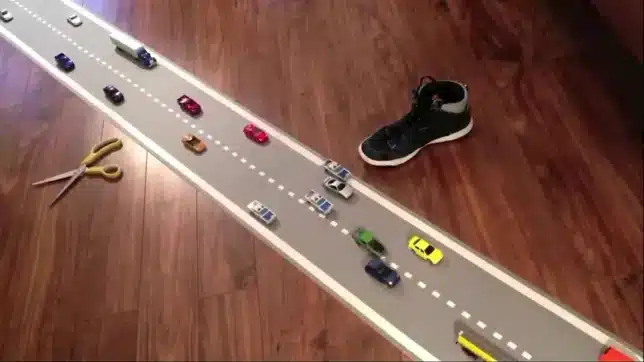
    Using Hot Wheels toy vehicles, a filmmaker produced amazing stop motion miniature chase scenes.

    2013 saw Paul Greer devote six months to making his first stop-motion movie.

    “I was strolling through a Waitrose when I saw some toy cars, so I thought, I could do something with this,” the filmmaker and producer, who is from Richmond, London, said.

    To create his first film, Paul built a custom camera rig and used an iPhone to record the scenes.

    He enlisted the help of four friends and spent up to six hours a day working on the project.

    The process proved gruelling and only produced about between five and 10 seconds of footage for a day’s work.

    But six months and more than 1,000 hours of work later, ‘Nitro Warriors’ was born.

    Latest London news

    Paul Greer working behind the scenes (Picture: Paul Greer/SWNS)
    To create his first film, Paul built a custom camera rig and used an iPhone to record the scenes (Picture: Paul Greer/SWNS)
    He enlisted the help of four friends (Picture: Paul Greer/SWNS)
    Paul spent up to six hours a day working on the project (Picture: Paul Greer/SWNS)
    The film proved a huge hit (Picture: Paul Greer/SWNS)

    The film proved a huge success.

    Paul was contacted by the French video-sharing technology platform DailyMotion to create a sequel.

    Soon after, Hot Wheels also reached out to him and asked him to create an advert for their toys.

    Paul has now created more than 10 films and founded a stop motion studio called Vanguard Pictures.

    He said: ‘I take breaks from my regular career to work on this and work solely on this.

    ‘It’s so all-encompassing that you need to dedicate yourself to it completely.

    ‘I still don’t know why I did it. It’s something that I’ve fallen into. It was mostly to have a little fun and see it how it would work out.

    Paul Greer working behind the scenes (Picture: Paul Greer/SWNS)

    ‘The most overwhelming thing was when Hot-Wheels came and said, “We have a lot of money, and we want you to promote out entire line of toys”.

    ‘I had to create and design the sets and convince all the bigwigs at Mattel.

    ‘I’m the most prominent person in this field now. There are others in stop motion, but I’m the most prominent person in this niche.

    ‘For me, the biggest reward is that there are people out there enjoying what I make.’

  • The right way to tell your story is through film – Akofa Edjeani

    Filmmaker, Pan Africanist and executive of the Ghana Culture Forum, Akofa Edjeani, has disclosed that one of the ways people can share their stories is through movies.

    She noted that it is always right to tell “your story yourself because if you leave it for others to tell it for you, they will twist it and tell it to favor them.”

    In an interview with Eunice Toryni on e.tv Ghana’s ‘African Women’s Voices’, she said, “So you have to tell your own story because you will be accurate and you will know how to tell it better than anyone else. We need to tell our stories and the best and right ways to do it is through film.”

    According to her, one of the ways colonial masters used to teach their colonies was through film.

    “They used film to teach us how to drink tea, how to dress or what to wear and till date, we’re still doing everything they taught us because they were able to change and manage our perception through filmmaking,” she said.

    She emphasized that this is why she always pays attention to what she wears as an icon in the creative space.

    “Also, I take culture very seriously. For the past 30 years or more, 98% of the time, I make sure that I’m dressed in African wear or Ghanaian accessories and people know me for that. So it’s a conscious choice I make and when I make a movie, I make sure I project these things in there because I know what my country stands to benefit from doing that and Africa as a continent,” she added.

    She furthered that this is why if Ghanaians want to tell their story right, “it’s up to our directors and producers to have that consciousness when making a movie and agree on what they want out there it.

    People are afraid of what they don’t know and one of the ways to let people love and understand where you’re coming from and where you want to go is through film. So, the things you say and project in your film is how you brand your country and yourself,” she stated.

    Source:ghanaweb.com