Tag: First Lady

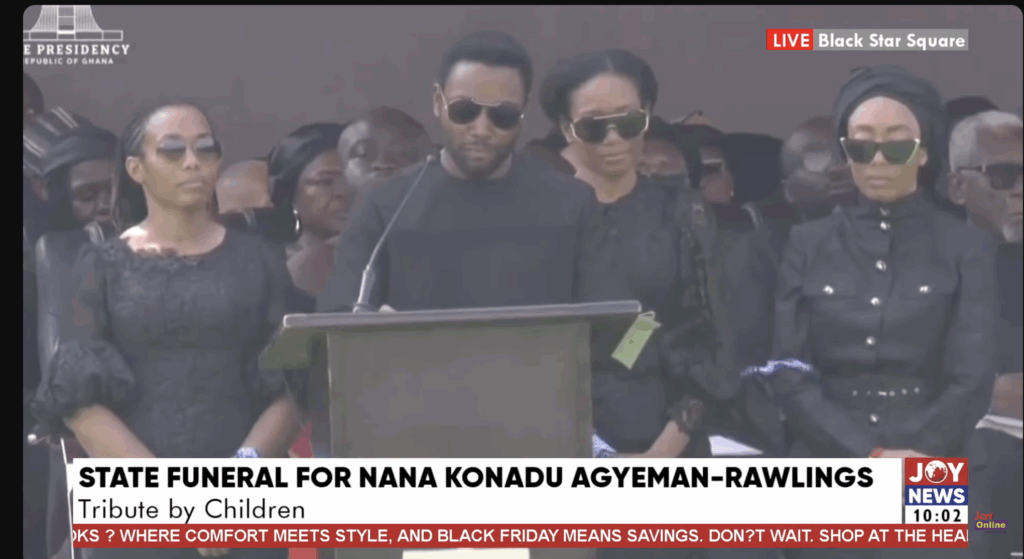
  • “You were a protector, advocate and confidant”- Children’s tribute to  Konadu Agyeman-Rawlings 

    “You were a protector, advocate and confidant”- Children’s tribute to Konadu Agyeman-Rawlings 

    A tribute delivered by the children of former First Lady Nana Konadu Agyeman-Rawlings has proven that no matter how far she rose, the late stateswoman remained an actively present mother.

    They fondly recalled her humour, animated storytelling, “occasional blastings,” and her passion for music and dance. According to them, her joy was rooted in the simple pleasures of family and togetherness.

    “For us, your four children, we will set our feet into the footsteps of your gallant place and with divine grace, emulate your dignified dance through life. We love and miss you, Mom; we love and miss you, Dad. So much,” they said at the tail end of the tribute.

    They described her as a tireless patriot, a woman who lived her values with unshakable conviction.

    Her children said she embodied a life of purpose and steadfast devotion to the nation.

    According to them, “yours was the consummate life of a tireless patriot, a woman who loved her country and celebrated it every opportunity she got.”

    They remembered a mother who faced every challenge head-on, believing that no problem was too small or beneath her attention.

    As President of the 31st December Women’s Movement, they said she “ignited a force that transformed the landscape of women’s rights and education that still resonates today.”

    Ghana has lost one of its most remarkable political figures, Nana Konadu Agyeman-Rawlings, whose passing today (Thursday, October 23) brings to an end a defining era in the nation’s political and social landscape.

    Known widely as the Iron Lady of Ghanaian politics, she rose to prominence in the 1980s and 1990s through her bold activism and fearless advocacy. Beyond being a former First Lady, she made history as the first woman to contest for the presidency in Ghana—an achievement that solidified her reputation as a pioneer.

    Her life reflected unwavering dedication to women’s empowerment and a determination to challenge established norms, leaving behind a lasting legacy as one of the most influential female leaders in Ghana’s post-independence history.

    The Longest Serving First Lady

    Nana Konadu Agyeman, born on November 17, 1948, in Cape Coast, Central Region, began her education at Achimota School, where she would later meet her husband, Flt. Lt. Jerry John Rawlings.

    She pursued Art and Textiles at the Kwame Nkrumah University of Science and Technology (KNUST) and furthered her studies abroad, earning a diploma in Interior Design from the London College of Arts in 1975. Her quest for knowledge continued with a diploma in Advanced Personnel Management and a certificate in Development from GIMPA, underscoring her intellectual curiosity and commitment to personal growth.

    Her marriage to Rawlings in 1977 marked the beginning of her deep involvement in Ghana’s political evolution. As First Lady, she served during two significant phases of Ghana’s governance—first in 1979 under the Armed Forces Revolutionary Council (AFRC) and later from 1981 to 2001 under the PNDC and the Fourth Republic.

    Her 20-year tenure as First Lady, the longest in Ghana’s history, provided her with a unique platform to drive social transformation and advocate for national progress.

    The Engine of Women’s Empowerment: 31st DWM

    Nana Konadu Agyeman-Rawlings is widely recognised as the founder and president of the 31st December Women’s Movement (31st DWM), which she established in 1982.

    Far from being a symbolic organisation, the movement became a dynamic grassroots force dedicated to mobilising and empowering women across Ghana, particularly in rural areas, inspired by her conviction that women held the key to breaking the cycle of poverty.

    Its achievements were visible and far-reaching, transforming women’s roles from passive beneficiaries of aid to active participants in the country’s political and economic development.

    Grassroots Mobilisation: It mobilised an estimated two million women across the country, encouraging their participation in community and national decision-making. The Movement established over 870 pre-schools across the regions to free women to engage in economic activities.

    Economic Projects: The 31st DWM supported numerous income-generating activities and small-scale, village-level economic projects, encouraging women to save money for community development.

    Education and Health: It ran extensive functional adult literacy programmes to tackle high illiteracy rates among rural women and implemented public health programmes focusing on nutrition and immunisation.

    Legal and Political Reform: She was instrumental in advocating for legal changes, including the crucial role she played in the adoption of the Intestate Succession Law (PNDCL 111), which drastically improved the inheritance rights of widows and children—a vital shift away from traditional barriers where women often had no rights of inheritance upon the death of their husbands. Furthermore, through her efforts, Ghana became the first nation in the world to approve the United Nations Convention on the Rights of the Child (UNCRC) in 1991.

    Agyeman-Rawlings often framed the movement as an essential political tool: “Before December 31, 1981, they had no power of influence in law or politics… I can see from the self-esteem and near arrogance of the women that now we’ve actually been able to break through this thick wall,” she once noted, highlighting the movement’s mission to empower.

  • Samira Bawumia would have “slayed a lot” if NPP had won the elections – Krontihene of Akyem Asoum

    Samira Bawumia would have “slayed a lot” if NPP had won the elections – Krontihene of Akyem Asoum

    The Krontihene of Akyem Asoum, Nana Boadi Amponim Abodade III, has revealed that Samira Bawumia, wife of the NPP’s presidential candidate, was notably disheartened following her husband’s defeat to John Mahama in the presidential race.

    During a recent interview, Nana Boadi elaborated that Samira had been deeply committed to her husband’s campaign, imagining herself as the First Lady, poised to make a lasting impression with her elegance, style, and public engagement.

    “Dr. Bawumia is not happy; he did his best and was desperate for the position,” Nana Boadi said.

    “But somebody else was even more unhappy—Samira. She was so desperate for the position.”

    Nana Boadi emphasized that Samira Bawumia assumed a prominent and commanding role during the NPP campaign, often commanding attention at the forefront.

    He attributed this to her aspirations to secure the role of First Lady, using her striking fashion choices and magnetic personality to enchant the public.

    “You know, our good old Auntie Rebecca [Akufo-Addo], she was not that outgoing, and so Samira was mostly at the forefront. She longed to be the First Lady,” he said.

    He added, “If the NPP had won, she would have slayed a lot. ‘She will slay aaah Ghanaian ladies all go bore die,’” he quipped, suggesting her style would have set trends and perhaps even drawn envy.

    Nana Boadi suggested that Samira’s apparent disillusionment mirrored the general sentiment within the Bawumia household after the election defeat.

    “She is very unhappy,” he stated.

  • Former Zambian First Lady apprehended for alleged fraud offenses

    Former Zambian First Lady apprehended for alleged fraud offenses

    Former Zambian First Lady Esther Lungu and her daughter Chiyeso Katete, along with a close relative Charles Phiri, were apprehended in Lusaka on Thursday for suspected possession of properties believed to be acquired through illegal means.

    According to authorities, Ms. Lungu failed to provide a satisfactory explanation for the acquisition of a $1.5 million estate in the capital.

    Former President Edgar Lungu vowed to challenge the charges in court, alleging government victimization as he prepares for the 2026 elections.

    This arrest follows previous allegations against Ms. Lungu last September regarding corruption charges, including theft of motor vehicles and title deeds, which she denied.

    It said Ms Lungu owned “15 white double storey flats” situated in State Lodge area of Lusaka’s Chongwe town, “reasonably suspected to be proceeds of crime”.

    The Drug Enforcement Commission (DEC) stated that the precise acquisition date of the property, jointly owned with undisclosed individuals, remained unclear but was purchased between 2015 and 2023.

    Additionally, the DEC noted that her daughter faced further allegations concerning the acquisition of an additional three-flat estate in Lusaka, suspected to have been obtained through fraudulent means.

    “Further, she was arrested for possession of 1 high-cost house, four chicken runs, and associated external works in the property,” the agency added.

    Mr. Lungu disclosed that they were all released on bond and assured that they were safe at home following hours of questioning by DEC officials on Thursday.

    Separately, another daughter of Ms. Lungu, Tasila, is facing related charges, as per the DEC’s announcement.

    She has been summoned to appear at the DEC on Monday, as directed by her legal representatives.

    While the accused individuals refrained from commenting on the allegations, the former president issued a brief statement asserting that the family would contest them in court.

    However, it remains uncertain when or if they will appear in court.

    Mr. Lungu declared his return to politics in October last year, prompting the government to revoke his retirement benefits.

    Having stepped down from office after losing the presidency to Hakainde Hichilema in 2021, Mr. Lungu left Zambia grappling with substantial debt and a fragile economy.

    Zambia’s investigative agencies have scrutinized several former ministers, government officials, and members of Mr. Lungu’s family as part of President Hichilema’s anti-corruption initiative.

    President Hichilema has pledged to reclaim all allegedly misappropriated resources during Mr. Lungu’s tenure.

    Critics argue that the anti-corruption campaign is politically motivated.

  • Ghana will have a “Zongo First Lady” someday – Akufo-Addo

    Ghana will have a “Zongo First Lady” someday – Akufo-Addo


    President Akufo-Addo has highlighted a potential historic achievement if his Vice President, Mahamadu Bawumia, secures victory in the 2024 presidential elections.

    Akufo-Addo pointed out that a Bawumia presidency would result in Ghana having its first Zongo First Lady, referring to the Muslim-dominated inner-city areas scattered across the country.

    During a speech in Nima, a suburb of Accra, Akufo-Addo declared, “If, by the grace of God, Mahamadu Bawumia wins the presidency in December 2024, we will have a Zongo First Lady in Ghana.”

    The individual in question is the current Second Lady, Samira Bawumia.

    In addition to acknowledging the historic significance of Samira Bawumia’s potential rise to the position of First Lady, Akufo-Addo also spoke about his personal connection with Nima during a speech at the coronation of a new paramount chief for Nima, Mohammed Saini Farl, also known as Nii Futa.

    The President, who has a private residence in the Nima enclave, emphasized his ties to the area and recounted spending some of his happiest days as a young person in the Muslim-dominated community.

    He expressed the importance of the day, which had been designated as Nima Day by the new paramount chief, coinciding with his mother’s birthday on December 17.

    “Nii Futa has chosen this day to be henceforth known as Nima Day, it is a very important day in my life because it is the birthday of my mother, the 17th of December, and she was a big maghajia of Nima as you know.

    “I grew up here, I came here when I was 12 years old, our father moved us here. I don’t think there is any part of this area that I don’t know, I know this area like the back of my hand. I enjoyed some of the happiest days of my youth right here in Nima.

    “So it is important that I be here on such a day because I am one of you, because I, too, I am a Nima boy,” he stated to applause from the gathering,” Akufo-Addo shared.

    Bawumia, elected as the New Patriotic Party (NPP) flagbearer on November 4 for the 2024 polls, will face former President John Dramani Mahama in the upcoming elections.

    Mahama, making his fourth consecutive bid for the presidency, won his first attempt and lost the second and third to Akufo-Addo.

  • Oluremi Tinubu: The woman who brought God to the presidential villa

    Oluremi Tinubu: The woman who brought God to the presidential villa

    Africa’s most populous country, Nigeria, has its first-ever pastor First Lady.

    Mrs Oluremi Tinubu, the wife of the President Bola Ahmed Tinubu, today, 29 May 2023, has her name in history as holding such a title.

    She was ordained a pastor in August 2018 by The Redeemed Christian Church of God (RCCG) and her ordination took place at the Old Arena of the RCCG, Lagos/Ibadan Expressway.

    The 62-year-old began her political career in 2011 after being elected senator for Lagos Central in the 8th Assembly. But prior to this, she was regarded as the First Lady of Lagos when her husband became governor from 1999 to 2007.

    During these periods, 1172 people have benefited from her Youth Empowerment and Skill Acquisition Scheme (YESAS), which has amalgamated with the Good Boys and Girls Empowerment Scheme (GBGES).

    Through this programme, 144 young people received training in a variety of skills as well as company start-up kits worth N40,000 each.

    Under the Annual Elderly Citizens Assistance Scheme (ECAS), she celebrates 1300 elderly citizens aged 65 and above with cash and material gifts. 7,800 have benefited so far.

    Since 1985, Nigeria has seen seven First Ladies. Maryam Babangida, being the first, was the wife of Gen. (rtd.) Ibrahim Babangida who ruled the country from 1985 to 1993. She was a housewife.

    The second, Mariam Abacha (1993–1998), was married to Sani Abacha, Nigeria’s military ruler from 1993 to 1998. Her profession cannot be confirmed yet, but she was not a pastor.

    After the sudden death of Sani Abacha in 1998, Abdusalami Abubakar took over the reins of power. His wife, Justice Fati Abubakar, a High Court judge, then became the First Lady.

    Nigeria returned to democracy in 1999 under the governance of Olusegun Obasanjo, which saw Stella Obasanjo as First Lady.

    Turai Yar’Adua, who was married to Umaru Musa Yar’Adua, Nigeria’s president, was First Lady from 2007 to 2010.

    Then came Patience Jonathan, who was married to Goodluck Jonathan, who governed for five years.

    The current First Lady is Aisha Buhari who is betrothed to Muhammadu Buhari, Nigeria’s President.

    Although the First Lady is not an elected official, she wields enough power just by being affiliated with the President. Due to her pastorship, Nigeria is expecting some changes under the leadership of the Tinubus.

    But Mr Bola Tinubu, in his victory speech delivered on Wednesday morning, 1 March 2023 ,suggested that his wife won’t be making a comeback to the senate ,as she’ll be occupied with more wifely responsibilities at home .

    “To my lovely wife ,Oluremi Tinubu ,you senators don’t expect her back ,she’s going to be my housewife and First Lady .”

    Source: The Independent Ghana

  • Nigeria charges student with ‘criminal defamation’ over tweet about first lady

    A Nigerian student has appeared before a criminal court in Abuja on charges of defaming the head of the state’s wife over a tweet deemed offensive to her, his lawyer said on Thursday.

    According to court documents consulted by AFP, Aminu Adamu, born in 1998 and a student at the Federal University of Dutse, in northern Nigeria, was arrested on November 18 and transferred to Abuja, five months after posting the message in which he commented on the physical appearance of the First Lady, Aisha Buhari, and criticized her for “eating the money of the poor.

    His arrest, strongly condemned by Amnesty International, followed a preliminary investigation by the police after the filing of a complaint by the wife of President Muhammadu Buhari, a judicial source revealed.

    The young man “was brought before a Federal Capital Territory (FCT) Magistrate’s Court on Tuesday,” his lawyer Chijioke Agu told AFP by telephone. “The charge is defamation,” he said.

    According to the Nigerian criminal code, Mr. Adamu faces up to two years in prison.

    The hearing has been adjourned to January 30, Agu said, adding that he had applied for bail for his client, who is being held in Suleja prison, northwest of Abuja.

    According to court documents seen by AFP, the student admitted posting the offending message on Twitter, which included a photo of Mrs. Buhari and a comment in Hausa, the most widely spoken language in northern Nigeria.

    In a statement released on Sunday, Amnesty International said Adamu’s family and relatives said he was “subjected to beatings, torture and other ill-treatment.

    Amnesty also denounced an “illegal arrest” and called for his “immediate” and “unconditional” release.

    On Thursday, one of Nigeria’s most significant student associations (Nans) called on students to demonstrate nationwide next Monday in support of Mr. Adamu. “Our demonstrations must continue until his unconditional release,” Nans wrote in a statement.

    Under the constitution, Buhari must leave office in 2023 after serving two terms as Nigeria’s president. In recent years, human rights organizations have increased their criticism of the government, which they accuse of repeated attacks on freedom of expression and opinion.

    Many opponents and journalists have been arrested, demonstrations have been bloodily suppressed and the social network Twitter was banned for seven months in 2021.


    Source: African News

  • Olena Zelenska: We will endure

    Ukrainian first lady Olena Zelenska tells the BBC that Ukraine will endure this coming winter despite the cold and the blackouts caused by Russian missiles, and will keep fighting what she describes as a war of world views, because “without victory there can be no peace”.

    We meet in a storied city where a winter’s chill is biting, where charming street lamps are dimmed, where buildings are going dark and cold in the midst of blackouts as Russia keeps striking Ukraine’s energy grid. The Ukrainian people have won plaudits for standing their ground against Russia’s blistering assault. But this is yet another painful test of fortitude.

    “We are ready to endure this,” Olena Zelenska asserts when we sit down in a heavily secured compound tucked inside a sandbagged labyrinth of buildings in Kyiv.

    “We’ve had so many terrible challenges, seen so many victims, so much destruction, that blackouts are not the worst thing to happen to us.” She cites a recent poll where 90 % of Ukrainians said they were ready to live with electricity shortages for two to three years if they could see the prospect of joining the European Union.

    That seems like an awfully long cold road, and she knows it.

    “You know, it is easy to run a marathon when you know how many kilometres there are,” she says. In this case, though, Ukrainians don’t know the distance they have to run. “Sometimes it can be very difficult,” she says. “But there are some new emotions that help us to hold on.”

    All Ukrainians will become stronger because of this war, Ukraine’s first lady stoically predicts.

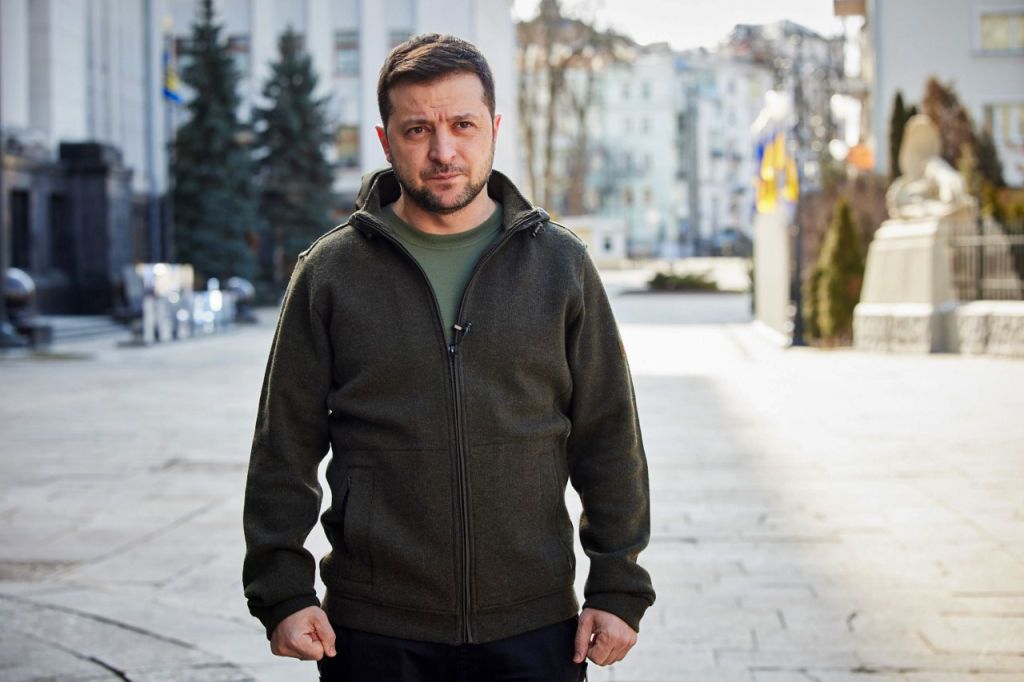
    President Volodymyr Zelensky now lives in his office on Bankova Street (left)Image source, Getty Images
    Image caption, President Zelensky now lives at 10 Bankova Street (left), opposite the House of Chimaeras (right)

    Our wide-ranging almost hour-long interview, recorded for the BBC’s annual 100 Women season, takes place in the iconic House of Chimaeras, adorned with elephant-head gargoyles and sculptures of mythical creatures, facing 10 Bankova Street – Ukraine’s version of 10 Downing Street. The building formed the backdrop for President Zelensky’s famous 26 February speech to rally Ukrainians, filmed on his phone two days after Russian tanks rolled across the border. “I’m here. We won’t lay down our arms,” he declared.

    The night before, in one of what became nightly addresses, he had announced in another selfie video that Russia “has designated me as target number one, and my family as target number two”.

    “And so it was from the first day and it continues now,” Olena Zelenska recalls, her words barely hiding the enormous strain that her family, like all Ukrainian families now ripped apart, are going through.

    Media caption, Olena Zelenska says her family misses spending time together

    A few walls of sandbags and circles of security checks away, President Zelensky carries on, around the clock. So close and yet so far. She won’t give an exact date for when they last had dinner together with their children, 18-year-old Oleksandra and nine-year-old Kyrylo. “It’s very rare nowadays. Very rare,” she says.

    “I live separately with my children and my husband lives at work,” she explains. “Most of all, we miss simple things – to sit, not looking at the time, as long as we want.”

    Every Ukrainian’s life has been turned inside out – from engineers to ballerinas now fighting on front lines, to some eight million, mainly women and children, forced to flee into new lives across the border.

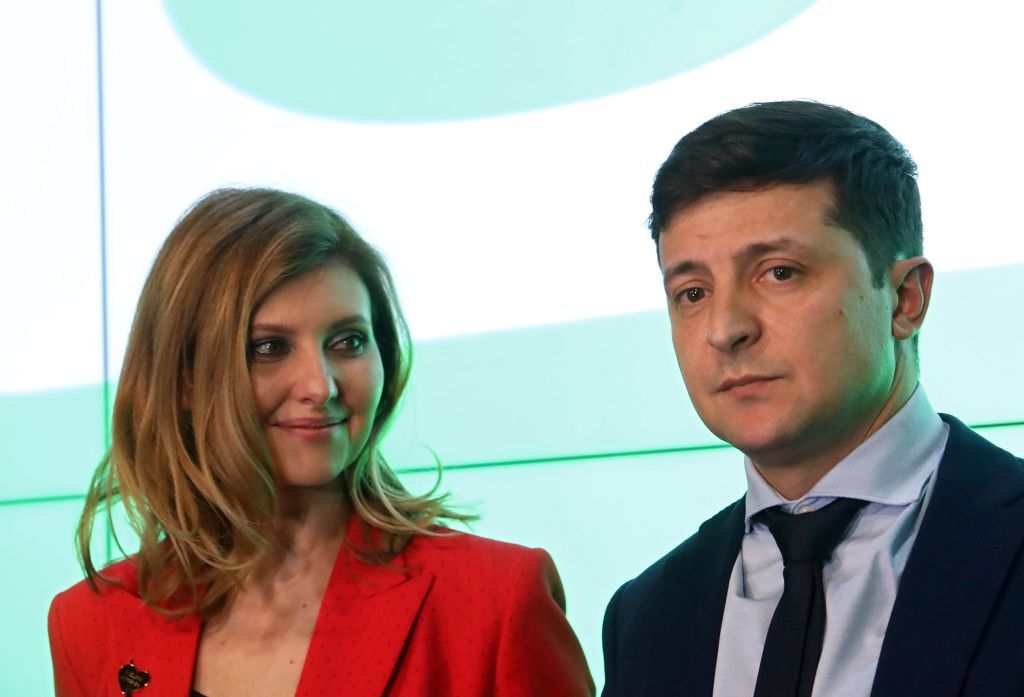
    The president and first lady’s lives have long been entwined. High school sweethearts, they went on to work together in a comedy troupe and TV studio, he a comic actor and she, backstage, a scriptwriter. When he ran for president three years ago, she made it clear this wasn’t a life she wanted. But this war has thrust her into the spotlight, on a global stage.

    Olena Zelenska and Volodymyr Zelensky as exit polls came out indicating he had made it to the final round of the 2019 presidential electionImage source, Getty Images
    Image caption, Olena Zelenska advised her husband not to run for president

    After Russia missiles started whistling into Kyiv in the early hours of 24 February, Olena Zelenska spent months in hiding in secret locations with her children. She emerged on 8 May – Mothers’ Day this year in Ukraine, and many other countries – when she joined the US First Lady Jill Biden at a shelter for the displaced in the relatively safe western Ukrainian city of Lviv.

    Now she keeps popping up in speeches on zoom, or at times in person, with her smartly styled hair and classic shirts or jackets, with a shy smile which gives way to strongly worded speeches which come from “a mother, a daughter, a first lady”.

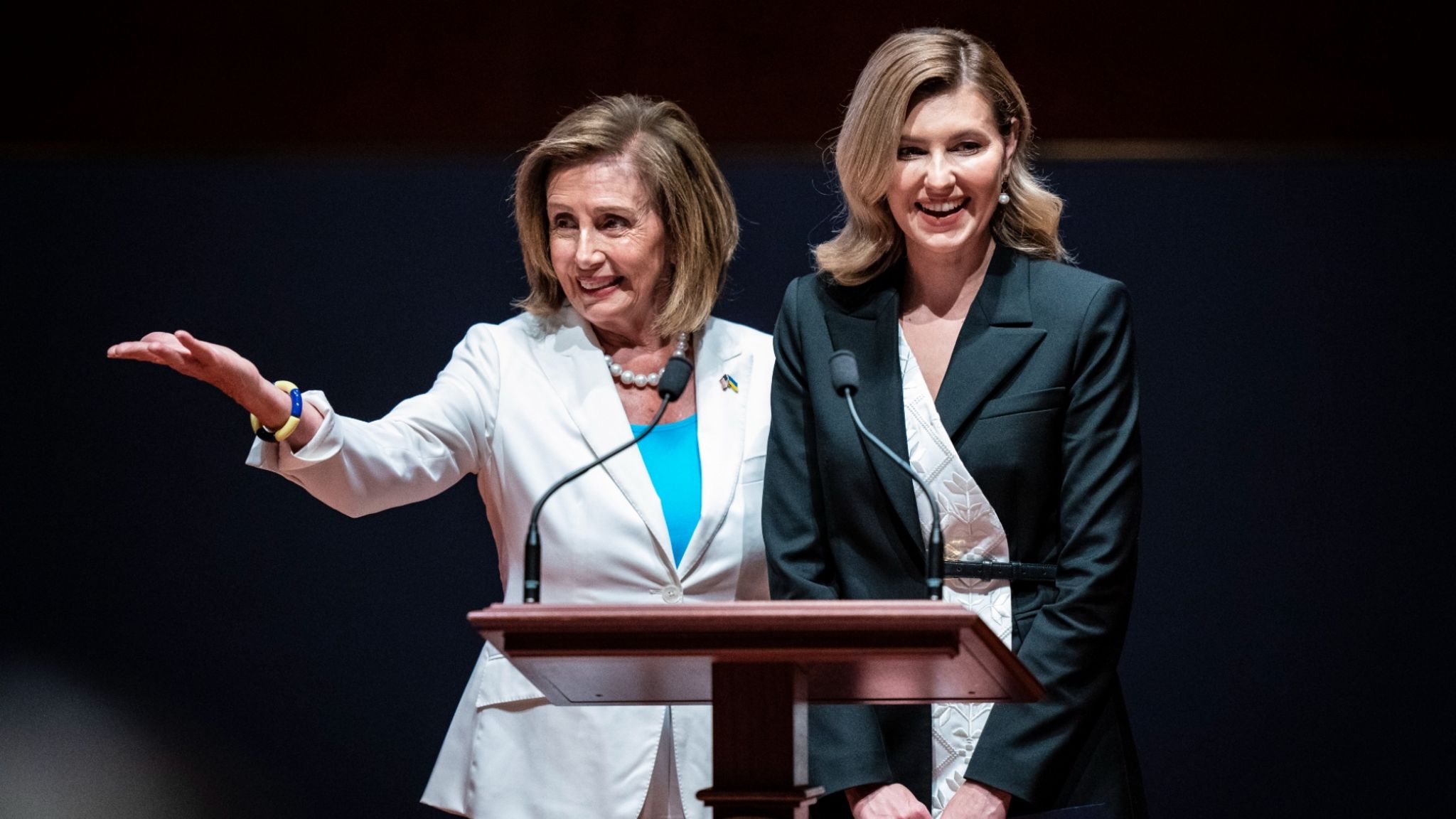
    When the US Congress gave a standing ovation, twice, for a Ukrainian leader in July, it wasn’t President Zelensky at the podium – he hasn’t travelled since Russia invaded – it was his wife. And the first foreign first lady granted the privilege of addressing the US legislature never liked public speaking.

    In an exclusive interview in Kyiv, Ukraine’s first lady talks to the BBC’s Lyse Doucet about the impact of war on mental health, the new roles Ukrainian women are taking on, and what victory would look like.

    “I was scared,” she admits. “But I understood this mission… it was impossible to miss this chance.”

    She emphasised, as she always does, the profound suffering of Ukrainian children, condemning what she called Russia’s “hunger games”. Then, she went much further, asking the US Congress to send weapons.

    Had a first lady, without official powers, crossed a line? “It was not politics, it was what I had to say,” she says. “I asked for weapons, not to attack, but to prevent our children from being killed in their homes.”

    Olena Zelenska (right) with Nancy Pelosi, speaker of the House of Representatives, at the US CongressImage source, Getty Images
    Image caption, Olena Zelenska – pictured with House speaker Nancy Pelosi – never liked public speaking

    The year before these momentous months, Olena Zelenska had already established a Summit of First Ladies and Gentlemen. Now it’s a powerful global network which has helped evacuate Ukrainian children needing cancer treatment and provide opportunities for education. It has arranged access to Ukrainian books in the countries that have welcomed millions of Ukrainian women and children forced to flee – without their husbands, who are barred from leaving in a time of war.

    I ask whether she now senses a certain “fatigue” in other capitals, as this crisis pushes up energy and food prices beyond the borders. “I don’t feel they are tired of us. They all understand that this is not just a war in Ukraine. It is a war of world views.”

    Her prominent role makes her the most visible face of a shattered society where women are taking up new roles everywhere, from fighting on front lines to taking charge as single parents. Check any UN document about Ukrainian society pre-war and it uses language like “patriarchal”, “traditional”, with women’s roles limited by gender.

    Olena Zelenska is adamant that Ukrainian society was changing even before war overwhelmed everything, and that this change is now accelerating. “Kitchen, children, church – this is not for our society any more. A woman who has lived through this will not take a step back.”

    Her newly formed Olena Zelenska Foundation deals with the toughest of challenges including mental health and domestic violence. As much as war can toughen individuals, it can also tear them apart.

    In a reflection of the hardening public view as allegations and evidence of Russian war crimes keep emerging, as entire cities and towns are pummelled to the ground, she insists, “We cannot betray those who are now in occupied territories. We cannot leave people who are waiting for liberation.”

    She hastens to add: “This is not a political position of the president or the government. This is the position of Ukrainians.”

    Carefully stepping through this political minefield, the first lady is categorical. “We all understand that without victory, there will be no peace. It would be a false peace and wouldn’t last long.”

    And what does “victory” mean to her?

    She answers without hesitation. “A return to a normal life… sometimes it seems we have put everything on pause.” That includes a different kind of life with her husband. “We’re not just spouses. I can safely say we are best friends,” she says.

    My first question to the first lady had been, “How are you?” She replied that, for all Ukrainians, their answer was, “We are holding on.”

    But, for how long? It’s a question no-one can answer.

    Olena Zelenska is one of the BBC’s 100 Women for 2022 – the others will be announced at the launch of the season on Tuesday 6 December

    Source: BBC

  • Be measured in your response to the pressure UG Lecturer to 1st and 2nd Ladies

    Director at Centre for Asian Studies-University of Ghana, Dr Lloyd Amoah has asked the First and Second Ladies Rebecca Akufo-Addo and Samira Bawumia respectively, to be guided in their responses to the public outcry against the allowances they were paid.

    His comments come after Mrs Akufo-Addo has refunded all the allowances paid her since 2017.

    On Tuesday July 13, she issued a Consolidated Bank Ghana Limited cheque for GH¢899,097.84 as a refund of all allowances received since 2017.

    She had announced on Monday, July 12, that due to the “extremely negative opinions” which have laced conversations on her allowances, she was refunding every pesewa.

    She also served notice not to receive any monies that have been allocated to be paid to her pursuant to recommendations of the Professor Yaa Ntiamoa Baidu Committee, which was tasked in 2019 to review emoluments of Article 71 office holders.

    She found the public debate “distasteful, seeking to portray her as a venal, self-serving and self-centred woman who does not care about the plight of ordinary Ghanaian.”

    Barely 24 hours after that, her office wrote to the Chief of Staff, Frema Osei Opare, to present the cheque number for the full refund of the monies.

    “Her Excellency, the First Lady remains committed to her role as First Lady and is devoted to her charity work championing the wellbeing of women and children in Ghana,” wrote Mrs Shirley Laryea of the Office of the First Lady.

    Second Lady Samira Bawumia has also announced that she will refund all allowances paid her since 2017, when her husband became the Vice President of Ghana.

    A statement issued by her office on Tuesday, July 13 also indicated that Mrs Bawumia will not accept any monies allocated her as per recommendations by the Professor Yaa Ntiamoa Baidu Committee.

    “Mrs Bawumia continues to be committed to the service of the nation,” the statement noted.

    It added that she stays committed “to deliver humanitarian interventions and initiatives in the areas of health, education and economic development”.

    In a Facebook post reacting to this development, Dr Amoah said “What if we also decide to reject your services from 2017 to date? The responses to these things must be measured. Pay attention.”

    Founder of the All Peoples Congress (APC), Hassan Ayariga, has also disagreed with the decision of Mrs Akufo-Addo to refund all the allowances paid her.

    Mr Ayariga stated that First Ladies play an important role in the governance of the country through the emotional and physical support they give to the president.

    Therefore, he said, they deserve to be paid the allowances.

    “First, I think it is a wrong idea that she [Rebecca Akufo-Addo] refunded the money,” he said on Good Evening Ghana on Tuesday July 13.

    “If the president is not well the First Lady is the first person to know,” he further stated while explaining the role of the First Lady.

    Source: 3news.com

  • The African Child should never feel threatened in wanting a better life First Lady

    First Lady Rebecca Akufo-Addo has said that the African Child should never have to feel threatened in wanting a better life.

    She said this in a statement to mark the Day of The African Child, on Wednesday June 16.

    She said “it is a poignant reminder to us of the horrors the African Child has encountered throughout history.

    “Whether in demanding better education, nutrition or any other necessities of basic living, the African Child should never have to feel threatened in wanting a better life.

    “At the Rebecca Foundation, we work to ensure that we create fighters and champions for the young ones. All organizations and civil society must use this day as an opportunity to reflect and restrategize on how to create a better and more secure future for the African child.

    “I join all well meaning Africans in remembrance of this day.”

    Source: 3news.com

  • First Lady commissions computerised library in Moree

    First Lady of the Republic, Rebecca Akufo-Addo on Tuesday, August 18, 2020, commissioned a forty-seater computerised library facility in Moree in the Central region.

    The library is stocked with modern computers and books on different subjects and will serve as an attractive and welcoming environment for the youth to develop the habit of reading.

    Her foundation, the Rebecca Foundation has so far built three of such computerized libraries in the Dafiama Bissue Issah in the Upper West Region, Sefwi Debiso in the Western North Region, Wenchi in the Bono Region.

    The Foundation will soon construct three more libraries at Kumawu in the Ashanti region, Krachi East in the Oti Region and Achimota school in the Greater Accra Region.

    She expressed gratitude to all donors and sponsors who have contributed towards the construction of the libraries.

    Source: rainbowradioonline.com

  • Read a book each day First Lady to children

    The First Lady Rebecca Akufo-Addo has identified reading as the panacea to enhancing the quality of education and deepening the intellect of the youth.

    According to Mrs Akufo-Addo, people with high literacy skills are better positioned to expedite the development of a country and meet its challenges, stating, “a literate population and communities are in a far better position to develop and innovate than less literate societies”.

    Mrs Akufo-Addo who is also the Executive Director of the Rebecca Foundation, made these comments when she opened a 40-seater computerised library facility in Moree in the Central region.

    The library, stocked with modern computers and books on different subjects is expected to serve as an attractive and welcoming environment for the youth to develop the habit and delight in reading.

    Stressing on the importance of reading and its many benefits Mrs Akufo-Addo said, in a growing competitive world where life-long learning has become the only way to grow intellectually and build a wealth of knowledge, many children in sub-Saharan Africa struggle at the lower primary level to read in the official or any local language and in instances where they can read, they are unable to understand what they read.

    She said a vast amount of information in the world is spread through written works and considering the impact of newspapers, books, and the internet in our daily lives, anyone with limited literacy skills is virtually excluded from written information that can change their lives.

    Mrs Akufo-Addo stated that it is this plethora of benefits inherent in the ability and habit of reading that informed the Rebecca Foundation to come up with the “Learning to Read, Reading to Learn” initiative, a two-part concept made up of a television reading programme, now in its second season, and provision of much-needed libraries in some school clusters across the country.

    She said the Rebecca Foundation has so far built three of such computerised libraries in the Dafiama Bissue Issah in the Upper West Region, Sefwi Debiso in the Western North Region, Wenchi in the Bono Region and will soon construct three more libraries at Kumawu in the Ashanti Region, Krachi East in the Oti Region and Achimota school in the Greater Accra Region.

    The First Lady charged the youth to strive to read as many books as possible stating, “when I launched the Learning to Read, Reading to Learn initiative, I charged our children to read a book each day. I repeat this charge today. Read, learn new words, learn new things and consider writing your own little stories”.

    Mrs Akufo-Addo also urged the Ministry of Education to incorporate library services as a critical component of the educational reforms for basic schools as research has shown the significant role of school libraries in building a reading culture.

    On behalf of The Rebecca Foundation, the First Lady extended her profound gratitude to the Ghana Library Authority, Ghana Book Development Council, Metropolitan and District Assemblies, the Ghana Education Service and donors for assisting the Foundation in its literacy enhancing endeavours.

    Source: Class FM

  • First Lady cuts sod for Anafo market

    The First Lady, Mrs. Rebecca Akufo-Addo has cut sod for the construction of the Anafo Market in the Cape Coast South Constituency.

    The project, which is funded by the Coastal Development Authority (CODA), is being implemented under the Infrastructure for Poverty Eradication Programme (IPEP) of the Ministry for Special Development Initiatives.

    Speaking at the event, CEO of CODA, Jerry Ahmed Shaib thanked President Akufo-Addo for allocating one million dollars to each constituency for special development projects such as the construction of the market. He also thanked traditional leaders of the area for warmly receiving the First Lady and supporting the project.

    Mr Shaib also announced the establishment of the CODA Credit Union to provide fisherfolk, petty traders, mechanics, commercial drivers and other small-scale businesses in the informal sector with credit facilities to empower them to grow their businesses. This intervention is expected to empower these traders and business persons to be independent to cater for their families and boost their businesses. CODA has also procured 1,300 outboard motors for distribution to fishermen to boost their trade.

    After completion, the market will be managed by the Cape Coast South Municipal Assembly.

    The sodcutting was marked by a colourful event with the crème-de-la-crème of Cape Coast South Constituency in attendance. Among the dignitaries were the Municipal Chief Executive for Cape Coast South Municipal Assembly, Ernest Arthur, Nana Kwesi Attah, Paramount Chief of Cape Coast traditional area, other traditional and religious leaders, as well as representatives of community based organisations.

    Source: classfmonline.com

  • Witness in first lady’s murder case ‘fears for life’

    A key witness in the murder case against Lesotho’s first lady has told the BBC she has fled to neighbouring South Africa because she fears for her life, and is seeking refugee status.

    First Lady Maesaiah Thabane has been charged with the murder of the prime minister’s previous wife, Lipolelo Thabane.

    She has also been charged with the attempted murder of Thato Sibolla – a family friend who had been travelling with the deceased when gunmen opened fire on their vehicle two days before Thomas Thabane’s inauguration as prime minister in 2017.

    The first lady has not yet been asked to plead. The case was postponed to 28 February and she is out on bail of about $67 (£52).

    In an interview with the BBC’s Pumza Fihlani, Ms Sibolla said she did not feel safe in Lesotho because “they may come for me in order to stop the case or to destroy the case”.

    She added:

    “I’m pursuing protection, like refugee status, not just in South Africa, I’m attempting even in Botswana, anywhere I can go. I don’t think I will ever lead a normal life in Lesotho.”

    “When justice has been served I will feel much better. I think it will be closure for me at least, even though I can never forget about this but at least I will feel a sense of relief.”

    Source: bbc.com