Tag: food inflation

  • Ghana’s 28.3% food inflation rate ranked highest among Lower Middle Income African countries – World Bank report

    Ghana’s 28.3% food inflation rate ranked highest among Lower Middle Income African countries – World Bank report

    Ghana recorded the highest food inflation rate among lower middle-income countries in Africa, according to the World Bank’s Food Security Update for February 2025. 

    The report revealed that Ghana’s food inflation rate surged to 28.3% in December 2024, surpassing all its regional peers in this economic category.

    Egypt followed in second place with a food inflation rate of 20.8%, while Zambia secured third with 19.2% as of December 2024.

    The World Bank highlighted that domestic food price inflation, measured as the year-on-year change in the food component of a country’s Consumer Price Index (CPI), remains significantly high across several economies.

    “Information from the latest month between October 2024 and January 2025 for which food price inflation data is available shows high inflation in many low- and middle-income countries, with inflation higher than 5.0% in 73.7% of low-income countries, 52.2% of lower-middle-income countries, 38.0% of upper middle-income countries (no change), and 5.6% of high-income countries (1.8 percentage points lower),” the Bretton Woods institution noted.

    The report further revealed that food inflation has outpaced overall inflation in 56% of the 164 countries where both food and general CPI data were available.

    Global Agricultural Commodity Trends

    On the global stage, the World Bank observed an upward shift in agricultural and export prices since its January 2025 update. Agricultural and export price indices climbed by 3% and 6%, respectively.

    Cereal prices remained stable overall, though specific grains saw varied movements. Maize prices increased by 3%, while wheat experienced a 5% rise. In contrast, rice prices declined significantly, falling by 10%.

    Year-on-year comparisons showed maize prices up by 10%, while wheat and rice prices were down by 6% and 19%, respectively. When compared to January 2020, maize prices have surged by 27%, wheat prices have fallen by 2%, and rice prices have climbed by 14%.

    The World Bank also emphasized that real food inflation, which measures the gap between food inflation and overall inflation, remains a pressing concern for many economies.

  • Planting for Food and Jobs a key factor in reducing food inflation – Finance ministry

    Planting for Food and Jobs a key factor in reducing food inflation – Finance ministry

    Minister of State-designate at the Finance Ministry, Abena Osei-Asare, has asserted that the government’s flagship program, Planting for Food and Jobs, is addressing the issue of food inflation in the country.

    The Planting for Food and Jobs policy, introduced in 2017 by the current government, aims to reform the agricultural sector, reduce rice imports by 70%, and improve the welfare of farmers.

    It was implemented to counteract declining food production and unemployment rates. Despite its implementation, food inflation soared to over 50% in 2022.

    However, during her parliamentary ministerial vetting, the current deputy finance minister emphasized that the introduction of the Planting for Food and Jobs policy has significantly contributed to reducing food inflation.

    She noted that food inflation decreased from 54.1% in December 2022 to 28.7% in December 2023.

    “Quickly we realized that the food component played a huge role in inflation and the government quickly put some measures in place and revived the planting for food and jobs. And so, as we speak, the food components of inflation which was around 59.7% in December 2022 has declined to 28.7% in December 2023. So clearly, we have put measures in place.”, she told the committee.

    “We are doing everything possible Mr. Chairman. We are not there yet but we are doing everything possible to stabilize these important components of the macro economy and to make sure our people are best served in the way they need to be served”

    The Atiwa East MP further affirmed that the economy is on the right path due to the effective measures implemented by the NPP-led government.

    Meanwhile, the Ghana Statistical Service reported an increase in monthly food inflation in February 2024, despite an overall decline in inflation for the month.

    Over the past 12 months, both food and non-food inflation have marginally decreased to 27.0% and 20.0% respectively. However, month-on-month food inflation increased from 1.6% to 2.0% in February, driven by rising prices of vegetables, tubers, plantains, fish, and seafood.

  • World Bank projects high food inflation globally in 2024

    World Bank projects high food inflation globally in 2024

    In its latest Food Security Update report, the World Bank has forecasted continued high food prices throughout 2024.

    The report also highlights significant inflationary pressures across different income brackets in 2023.

    According to the Washington-based institution, inflation surpassed 5% in 63.2% of low-income countries in 2023, marking a 1.3% increase compared to the previous update in January 2023. In lower-middle-income countries, inflation remained above 5% in 73.9% of nations, while in upper-middle-income countries, it affected 48% of the countries, showing no change from the previous update.

    High-income countries also experienced food inflation above 5% in 44.4% of cases, which represents a 1.9% decrease compared to the previous update. Additionally, in a substantial majority (71%) of the 165 countries surveyed, food price inflation outpaced overall inflation rates.

    The International Food Policy Research Institute (IFPRI) has attributed a recent 40% decline in trade volumes in the Suez Canal to attacks by Houthi rebels in the Red Sea. This disruption has heightened concerns about global food security.

    The World Bank’s Global Economics Prospects 2024 report has underscored the significant challenge of food insecurity amidst various global challenges.

    “In 2023, food prices, a significant component of the agricultural price index, declined by 9% because supplies of major crops were ample, except for rice, which declined by 27%. Food prices are expected to decline further in 2024 and 2025, although potential risks such as energy cost increases, adverse weather events, trade restrictions, and geopolitical uncertainty could affect them”, it stated.

    The report continued that a blog post from the World Bank Agriculture and Food Global Practice discussed the urgent need for circular food systems to address environmental challenges.

  • GAWU warns of massive food inflation over plan to restrict importation of 21 items

    GAWU warns of massive food inflation over plan to restrict importation of 21 items

    The General Agriculture Workers Union (GAWU) is cautioning against a potential significant increase in the prices of food items if the proposed policy on import restrictions for 21 items is implemented.

    The government is seeking parliamentary approval to limit the importation of these 21 goods, aiming to reduce the country’s import bill and promote local manufacturing.

    The items include rice, poultry, animal and vegetable oil, margarine, fruit juices, soft drinks, mosquito coils and insecticides, soaps and detergents, fish, clothing and apparel, and cement.

    However, GAWU is expressing concerns that this move could lead to artificial food shortages in the market. GAWU General Secretary, Edward Kareweh, states that existing government policies have already undermined production.

    “When you were putting in place measures on the back of government-owned policies which have undermined production, then you create a very big situation in the economy.”

    “For instance, the discounted benchmark value policy was implemented by the government since 2019. For all these years, it has undermined domestic production. So a year after you used the policy to weaken the capacity of domestic industries to produce, you quickly come back and say I’m going to restrict imports”, he argued.

    “When you do that, the likely of prices going up is very high because you have not actually supported the domestic producers to increase their capacity to be able to meet the shortfall that the imports will bring,” he added.

    The government’s proposal for import restrictions on certain items is designed to find a balance between safeguarding domestic industries and ensuring a sufficient supply of essential goods.

  • World Bank ranks Ghana among top 10 countries with highest food inflation

    World Bank ranks Ghana among top 10 countries with highest food inflation

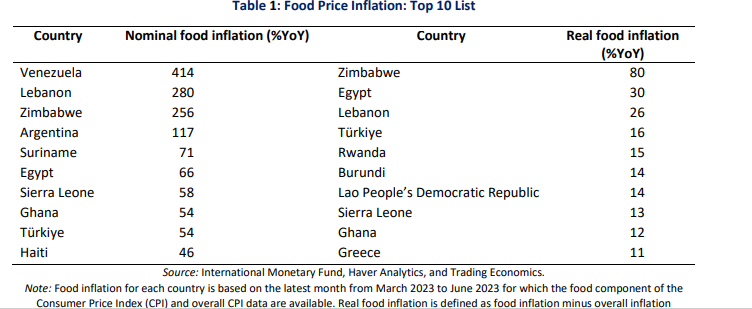
    Ghana has secured a position among the top 10 countries globally grappling with the most significant food inflation.

    As outlined in a Food Security Report published by the World Bank, Ghana’s Nominal Food Inflation (year-on-year) of 54% has placed the nation at the 8th rank in this distressing scenario.

    Conversely, its Real Food Inflation (year-on-year) of 12% has positioned it at the 9th spot.

    Leading the Nominal Food Inflation category is Venezuela, with a staggering year-on-year inflation rate of 414%. Following suit are Lebanon (280%), Zimbabwe (256%), Argentina (117%), Suriname (71%), Egypt (66%), and Sierra Leone (58%), in the 2nd, 3rd, 4th, 5th, 6th, and 7th places, respectively.

    Regarding Real Food Inflation, the top positions are seized by Zimbabwe (80%), Egypt (30%), Lebanon (26%), Turkey (16%), Rwanda (15%), Burundi (14%), Lao (14%), and Sierra Leone (13%), holding the 1st, 2nd, 3rd, 4th, 5th, 6th, 7th, and 8th positions respectively for the highest food inflation rates.

    The recent report covers data from February 2023 to May 2023, reflecting the prevailing situation regarding food price inflation. The findings reveal a notable surge in inflation rates across various low- and middle-income nations.

    In particular, a substantial 63.2% of low-income countries, 79.5% of lower-middle-income countries, and 67.0% of upper-middle-income countries are grappling with inflation rates exceeding 5%, with many facing double-digit inflation figures.

    Remarkably, even among high-income nations, a significant 78.9% are contending with elevated levels of food price inflation. This global trend is particularly pronounced in diverse regions including Africa, North America, Latin America, South Asia, Europe, and Central Asia.

    Furthermore, in terms of real value adjustments, food price inflation has outpaced the broader inflation rate (measured by the year-on-year alteration in the Consumer Price Index) in a substantial 80.1% of the 166 countries covered in the report, where both food CPI and overall CPI indexes are available.

    The report also disclosed an uptick in maize and wheat prices, concluding at 12% and 14% higher, respectively, following their decline in the initial half of July 2023. This shift played a pivotal role in driving up the cereal price index, while rice prices, in contrast, have maintained their stability.

    When considering a year-on-year comparison, maize and wheat prices have witnessed a decrease of 15% and 17% respectively, whereas rice prices have exhibited a 16% increase. Moreover, in comparison to January 2021, maize, wheat, and rice prices have escalated by 8%, 11%, and 3% respectively.

    The 2023 State of Food Insecurity and Nutrition in the World report spotlights the global landscape of hunger and food insecurity, while also addressing the challenges and prospects associated with urbanization within agrifood systems.

    The report has voiced concern over Russia’s withdrawal from the Black Sea Grain Initiative (BSGI) within the global markets.

  • Ghana among top 10 countries with highest food inflation – World Bank report

    Ghana among top 10 countries with highest food inflation – World Bank report

    Ghana is facing a serious food inflation crisis, as it ranks among the top 10 countries in the world with the highest increase in food prices, according to a new report by the World Bank.

    The report, titled Food Security Update: World Bank Response to Rising Food Insecurity, shows that Ghana’s nominal food inflation (year-on-year) was 54% as of May 2023, placing it at the eighth position globally.

    Its real food inflation (year-on-year), which takes into account the overall inflation rate, was 12%, placing it at the ninth position.

    The report attributes the high food inflation in Ghana and other low- and middle-income countries to various factors, such as supply chain disruptions, currency depreciation, fuel price hikes, weather shocks, and COVID-19 pandemic impacts.

    The report warns that high food inflation could worsen poverty, hunger, and malnutrition among vulnerable populations.

    The report also provides data on global food commodity prices, which have increased significantly since January 2021. The report notes that maize and wheat prices rose by 12% and 14%, respectively, in July 2023, while rice prices remained stable.

    On a year-on-year basis, maize and wheat prices were 15% and 17% lower, while rice prices were 16% higher.

    The report also highlights the state of global hunger and food insecurity, citing the latest edition of the State of Food Insecurity and Nutrition in the World report by the Food and Agriculture Organization (FAO) and other UN agencies.

    The report estimates that around 811 million people suffered from chronic hunger in 2020, an increase of 118 million from 2019. The report also projects that around 660 million people will still face hunger by 2030, even if current trends are reversed.

    The report also discusses the challenges and opportunities that urbanization presents for food systems, especially in Africa and Asia. The report argues that urbanization can create new markets and jobs for rural producers and processors, as well as improve access to diverse and nutritious foods for urban consumers.

    However, urbanization can also pose risks for food security and nutrition, such as increased dependence on food imports, exposure to price shocks, loss of agricultural land, and environmental degradation.

    The report also mentions the recent interruption of the Black Sea Grain Initiative (BSGI), an agreement among Russia, Ukraine, Turkey and the UN to facilitate the safe transportation of grain and foodstuffs from Ukrainian ports amid the ongoing war.

    The report expresses concern about the potential impact of Russia’s withdrawal from the BSGI on global food markets and prices, as Ukraine is one of the world’s largest grain exporters.

    The report concludes by outlining the World Bank’s response to rising food insecurity, which includes providing financial and technical support to countries to address immediate and long-term challenges.

    The report also calls for more coordinated and inclusive actions from all stakeholders to transform food systems and achieve the Sustainable Development Goals.

  • The cost of supermarket commodities increased by 21%

    The cost of supermarket commodities increased by 21%

    The poorest people are bearing the burden of food inflation because the cost of the cheapest items at supermarkets has increased by an astounding 21.6% in only one year.

    According to a Which? survey, the cost of value items has been rising more rapidly than total grocery inflation, which was 15.9% across all major supermarkets.

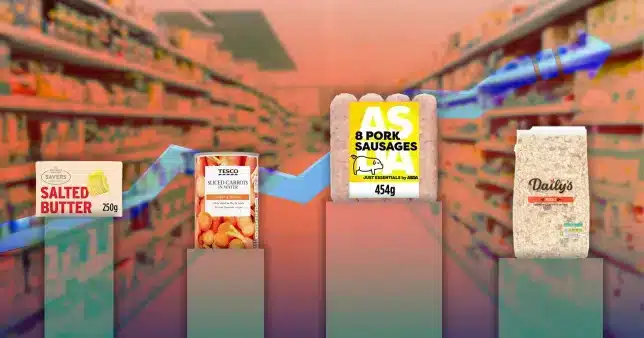
    This includes the average cost of milk, which increased by 26.1%, and the increase in price of pork sausages at Asda from 80p to £1.27.

    Other big price increases include Sainsbury’s muesli rising from £1.20 to £2.25, and tins of sliced carrots up 63% from 20p to 33p at Tesco.

    The price of cheese went up by 23.8% overall, but some individual examples surged by as much as 96.6%.

    The findings suggest those who are likely to be already struggling to feed their families and pay their bills during the cost-of-living crisis are being hit disproportionately with the sharpest food increases.

    In comparison, branded goods rose by 13.2% over the year, own-label premium ranges were up 13.4% and standard own-brand items increased 18.9%.

    Woman shopping milk in grocery store
    The average price of milk has risen by a staggering 26.1%

    However, Which? found the discounters were generally still cheaper than their competitors.

    Sue Davies, Which? head of food policy, said: ‘It’s clear that food costs have soared in recent months, but our inflation tracker shows how households relying on supermarket value ranges are being hit the hardest.

    ‘Supermarkets need to act and Which? is calling for them to ensure everyone has easy access to basic, affordable food ranges at a store near them, particularly in areas where people are most in need.

    ‘Supermarkets must also do more to ensure transparent pricing enables people to easily work out which products offer the best value and target their promotions to support people who are really struggling.’

  • Work closely with various agric stakeholders to reduce food inflation – Prof. Osei-Assibey to Govt

    Work closely with various agric stakeholders to reduce food inflation – Prof. Osei-Assibey to Govt

    The government has been entreated to work closely with the various stakehold­ers to bring down food inflation.

    According to a Senior Lecturer at the Department of Economics of the University of Ghana, Pro­fessor Eric Osei-Assibey, this was a smart way of reducing inflation.

    Recent data from the Ghana Statistical Service showed that food inflation went up to 61 per cent in January 2023, from 59.7 per cent in December 2022.

    Professor Osei-Assibey said, “This requires the adoption of such policy to bring the rate of food inflation down”.

    Speaking at the launch of the American Chamber of Com­merce-Ghana 2023 Economic Outlook Report, he said the gov­ernment should be deliberate in its attempt to support the agriculture value chain.

    “Looking at the current hike in food inflation, it has to do with our inability to produce enough for what we consume which is serious. So I am of the view that if we are able to come out of this crisis, we need to be deliberate on our approach for good policies to support farming on a large scale,” he stated He called for investments in the sector and requested banks to review a number of the sector’s support initiatives.

    He again urged the government to step up efforts to raise domestic tax collection.

    “When we have banks support­ing agriculture, I think it will help to ensure a robust economy. We need investment at this point in the agriculture value chain. There is also the need for the government to rake in more revenue to support various sectors of the economy,” he added.

    The American Chamber of Commerce Ghana 2023 Economic Outlook report provided insight into government’s tax provisions, fiscal and monetary development, debt sustainability, and key macro­economic performance and targets.

  • Ghana ranked 1st with highest food inflation of 122% in Sub-Saharan Africa

    Ghana has the highest food inflation rate in sub-Saharan Africa, according to the World Bank’s October 2022 Africa Pulse report.

    According to the report, food prices in Ghana increased by 122% between January and October of this year.

    The rate presented by the Bretton Wood institution, although alarming, comes as no surprise.

    The Ghana Statistical Service (GSS) recently revealed that food inflation is one of the factors exacerbating the national inflation rate, which currently stands at 33.9%.

    Food inflation has been on the rise since January 2022 (13.7%). In February, the figure rose to 17.4%, 22.4% in March and then 26.6% in April.

    May recorded a 30.1% food inflation rate, indicating a 3.5% hike within a month. In June, it rose to 30.7%. And then in July and August, it climbed up to 32.3% and 34.4%, respectively.

    The second country in sub- Saharan Africa where food prices are exponentially rising is Senegal.

    Senegal has recorded a food inflation rate of 110% between January and October 2022, followed by Uganda with 107%, Nigeria with 106.5%, Kenya with 104%, South Africa with 102%, Angola with 101.5%, Mozambique with 101%, Zambia with 100.5%, and Congo with 100%.

    According to the World Bank’s report, rising global food prices, which were already observed in the pre-pandemic period, “have accelerated since the onset of the Russian Federation’s invasion of Ukraine and the lockdowns due to the zero-COVID-19 policy followed by China amid new COVID-19 outbreaks.”

    Food inflation has therefore become inevitable, as “many countries in Africa are dependent on food and fuel imports.”

    The report further explained that the reason the impact of COVID-19 and the ongoing Russia-Ukraine war is distinct with every country mentioned “can be attributed to differences in the economic structure and coping policies to deal with food and fuel prices.”

    Source: The Independent Ghana