Tag: food prices

  • Food prices to soon decrease by 50% – Agric Minister predicts

    Food prices to soon decrease by 50% – Agric Minister predicts

    The Minister for Food and Agriculture, Dr. Bryan Acheampong, has announced an expectation of more than a 50% reduction in food prices in the upcoming months.

    He explained that this projection stems from various government measures designed to boost food production and assist farmers who have been negatively impacted by the recent dry spell.

    “Because of this, we are expecting prices to go down, up to April next year, and this is based on verifiable data at the Agric Ministry”, he said.

    “We are beginning to see the results of prices of some foodstuffs going down around March and April this year”, he added.

    Dr. Acheampong made this announcement during the PM EXPRESS Business Edition on October 10, 2024, in a conversation with host George Wiafe.

    The discussion focused on Ghana’s food security status and the government’s recent initiatives to address the impact of the dry spell.

    He revealed that the government has provided farmers with 200,000 metric tonnes of fertilizer as part of these efforts.

    “Government is also working to invest about 80-million-dollar worth of inputs into the market, that will help keep prices at some very low levels going forward”, he added.

    Dr. Acheampong assured that the government is making significant efforts to deliver relief specifically to farmers impacted by the recent dry spell.

    “Over the years, the Agric Ministry has led a lot of initiatives that extend support to farmers and the data is there for everyone to verify the beneficiaries”, he said.

    He pledged that all farmers impacted by the dry spell would receive adequate support to enhance the country’s food supply.

    “We have instituted several measures that will ensure that the affected persons get the inputs needed”.
    Speaking on the interest-free loans extended to farmers, Dr Acheampong said the aid will go to commercial farmers who suffered from the dry spell.

    “We have about GH₵50 million and the government is planning to use that to take up the interest cost on these loans”, he revealed.

    He emphasized that the loans would not be mere “handouts” but would be funneled through the Agricultural Development Bank to assist farmers.

    Rejecting claims of a bleak food supply outlook, he maintained that the future appears promising.

    He revealed that the ministry has successfully secured approximately GH₵3.6 billion of the GH₵8 billion target.
  • GAWU warns of continuous spike in food prices

    GAWU warns of continuous spike in food prices

    The General Agriculture Workers Union (GAWU) has predicted a sustained rise in food prices in the coming months, despite government policy interventions.

    This follows a recent increase in inflation, which rose to 21.5 percent in September 2024 from 20.4 percent in August, according to the Ghana Statistical Service (GSS). The spike has been largely attributed to a rise in food inflation.

    Reacting to the development, Edward Kareweh, a former General Secretary and a member of GAWU, cautioned that consumers should brace for further price hikes in foodstuffs. He pointed to several factors, including the ongoing illegal mining (galamsey) and recent dry spells, as key challenges facing farmers.

    “This year, 2024, we are not going to have any significant increase in food production in the country. If total output is going to fall, it will push food inflation up. From now till December and in the early part of 2025, we should expect food inflation to push the national inflation up,” he warned.

    Although the government has introduced measures to mitigate the impact, Kareweh emphasized that these interventions will have limited success if galamsey is allowed to continue. He expressed concern over the destruction of water bodies and farmlands, which poses a serious threat to the country’s food security.

    He further cautioned that if illegal mining is not addressed, the prices of basic foodstuffs will continue to surge.

    Year-on-year inflation for September 2024 has increased to 21.5 percent, up from 20.4 percent in August. The GSS identified food inflation as the driving force behind this increase. Food inflation surged to 22.1 percent, compared to 19.1 percent in August 2024.

    In contrast, non-food inflation declined slightly to 20.9 percent from 21.5 percent in the previous month. Prior to this rise, inflation had been on a downward trend for five consecutive months.

    The report also revealed that inflation for both locally produced and imported items increased during this period.

  • Global food prices to drop by 6% in 2024 – World Bank

    Global food prices to drop by 6% in 2024 – World Bank

    The World Bank‘s April 2024 Commodity Outlook Report predicts a significant decline in global food prices, with a projected 6 per cent decrease in 2024 and an additional 4 per cent decline in 2025.

    The drop is mainly attributed to lower prices for grains, oils, and meals, while other foods are expected to see price gains in 2024. However, 2025 is projected to bring broad-based declines in food prices.

    The report forecasts an 11 per cent decrease in the grains price index in 2024, driven by higher global grain supplies. Wheat prices are expected to decline by 15 per cent in 2024 due to elevated production, with a further 2 per cent decrease in 2025.

    These projections come amidst strong export competition and marginally higher production, countered by somewhat greater consumption and the lowest end-of-season stocks-to-use ratio in eight years.

    Global maize production is set to reach an all-time high in the 2023–24 seasons, while global rice production in 2023-24 remains flat, with the stock-to-use ratio falling to the lowest level in three years.

    Rice prices are forecast to rise by 8 per cent (year-on-year) in 2024 due to tight global markets and India’s export restrictions.

    In Ghana, however, the food inflation rate has increased, moving from 27.0 per cent in February to 29.6 per cent in March 2024.

    This rise in food inflation is concerning amidst ongoing concerns about food insecurity in the sub-Saharan region. The impact of these global food price changes on Ghana’s food market and overall food security situation remains to be seen.

  • GAWU attributes inflation surge to lean season, lack of rainfall

    GAWU attributes inflation surge to lean season, lack of rainfall

    General Secretary of the Ghana Agriculture Workers Union (GAWU), Edward Karewah, has cautioned that the recent surge in food prices across the country is likely to persist until the arrival of the harvest season in June 2024.

    Speaking to Joy Business in an interview, Karewah emphasized that the ongoing inflation in food prices, which saw a consecutive six-month increase to 27.1% in January 2024, is directly linked to the lean season of production. He explained that until crops such as maize and rice are harvested, the availability of fresh produce will remain limited.

    “The price of food will not get better anytime soon,” Karewah stated. “We are entering into or are already in the lean season of production, and no part of the country is experiencing a harvest of foodstuff, particularly the major staples.”

    He pointed out that the lack of rainfall in various regions has hindered farming activities, leading to a reliance on last year’s crops. Karewah noted that while farms are preparing for the upcoming planting season, the current supply of food remains largely unchanged.

    “During this season, all the foodstuff we are eating is from last year. So don’t expect food prices to come down now,” he cautioned. “We expect that by the middle to the end of March [2024], food prices will go up and stay high like that until we begin to harvest around June/July in the Southern parts of the country.”

    Meanwhile, recent inflation figures revealed that several divisions recorded rates higher than the national average. These include Alcoholic Beverages, Tobacco, and Narcotics (38.5%), Personal Care, Social Protection, and Miscellaneous Goods and Services (32.0%), and Restaurants and Accommodation Services (29.2%).

    Other divisions with above-average inflation rates include Furnishings, Household Equipment, and Routine Household Maintenance (27.7%), Food and Non-Alcoholic Beverages (27.1%), Health (26.6%), and Recreation, Sports, and Culture (24.9%).

    As Ghanaians grapple with the impact of rising food prices, Karewah’s warning underscores the urgent need for measures to address the challenges faced by the agricultural sector and ensure food security for the nation.

  • Nigerians have yet to learn hardship the way Ghanaians have – Bright Simons

    Ghanaian social innovator and entrepreneur, Bright Simons, has sparked a debate on social media after he compared the prices of some basic goods in Ghana and Nigeria.

    Simons, who is the president of mPedigree Network, a platform that fights counterfeit products, tweeted that Nigerians were complaining of unprecedented hardship in recent months due to price hikes.

    He added that he had always argued that Nigerians had yet to learn hardship the way Ghanaians mastered it since the 80s.

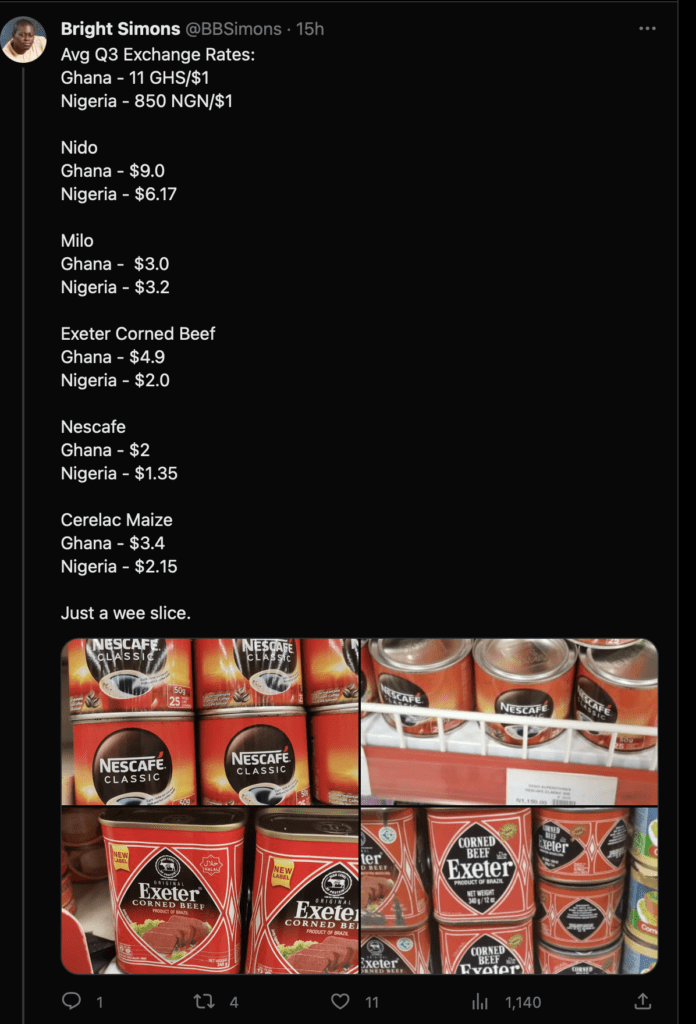
    He then provided a list of some identical goods sold in the same retail chains in Accra and Lagos, and showed how much more expensive they were in Ghana than in Nigeria.

    According to Simons, the average exchange rates for the third quarter of 2023 is 11 Ghanaian cedis per US dollar and 850 Nigerian naira per US dollar.

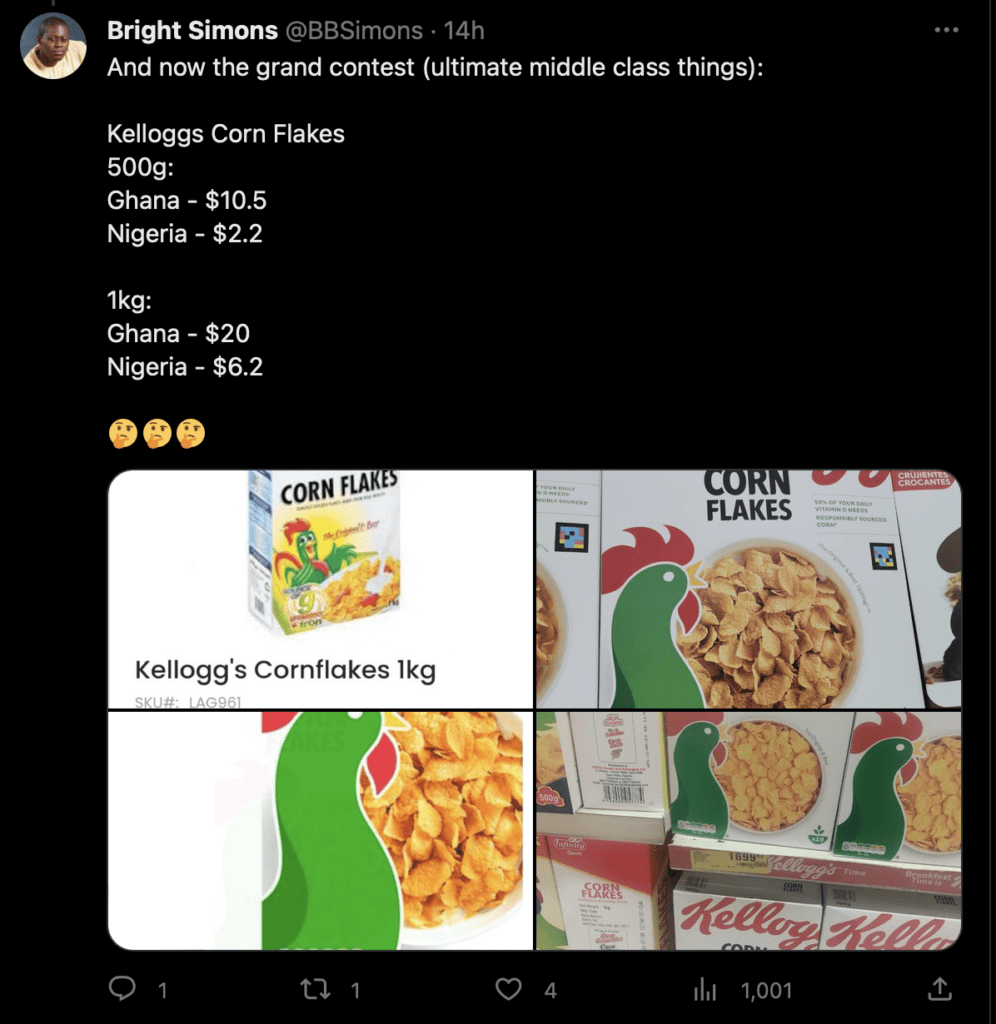
    He then gave examples of some products such as Nido milk powder, Milo chocolate drink, Exeter corned beef, Nescafe coffee, Cerelac maize cereal, and Kelloggs corn flakes.

    He claimed that these products were significantly cheaper in Nigeria than in Ghana, with some having more than four times the price difference.

    He concluded his tweet by saying “Just a wee slice” and “And now the grand contest (ultimate middle class things)”.

    Simons’ tweet generated mixed reactions from his followers, with some agreeing with his point and others challenging his data and methodology.

    Some Nigerians argued that Simons was not taking into account other factors such as insecurity, income levels, purchasing power parity, inflation rates, taxes, subsidies, and quality standards.

    They also pointed out that Nigeria had a larger population and market size than Ghana, which could affect the economies of scale and supply and demand.

    They also asked him to consider other aspects of living standards such as health care, education, security, infrastructure, and governance.

    Simons defended his tweet by saying that he was not trying to make a value judgment or a political statement, but rather to highlight a factual observation.

    He said that he was interested in understanding why there was such a huge price gap between the two countries, and what implications it had for their economic development and regional integration.

    He also said that he was open to constructive feedback and criticism, and invited his followers to share their views and insights on the issue.

    Source: The Independent Ghana| P.M.A Roberts

  • Food basket still a major source of price pressure; inflation to decline in July – Report

    Food basket still a major source of price pressure; inflation to decline in July – Report

    A research by GCB Capital has it that Ghana’s inflation may decline in July 2023, but the threat posed by rising food costs is still very real.

    Even if noon-food inflation may be slowing down, the report claims that this may not have a big impact on inflation relief.

    The report titled: “Policy Insights: Ghana’s June -23 Inflation Update” said, “While the disinflation process could resume in July 2023, the food basket remains a significant source of price pressure.”

    The analysis also implied that the new tariff measures’ diminishing impact would contribute to lower inflation in July 2023.

    “We expected the waning lagged impact of the revenue and utility tariff measures and the favourable base effects to reset inflation on the downward path from July 23 and reinforce low inflation expectations, all things being equal. We flag the simmering food price pressures as a near-term upside risk to inflation, which could moderate the pace of disinflation,” it added.

    Inflation rate for June increases marginally to 42.5%

    Ghana’s inflation rate for June has increased marginally to 42.5% from the 42.2 % recorded in May 2023.

    This means that this is the rate at which prices of goods and services increased in June.

    It also indicates that in the month of June 2023, the general price level was 42.5 percent higher than in June 2022.

    The Ghana Statistical Service announced this on July 12, 2023. Also, month-on-month inflation between May 2023 and June 2023 was 3.2 percent.

    Food inflation remains high at 54.2% but higher than the 51.8% recorded last month while non-food inflation saw a marginal decrease to 33.4% from 34.6% last month.

    Inflation for locally produced items and imported items was 35.9% and 44.5% respectively.

  • Food prices, transport fares push inflation to 19.4%; highest since August 2009

    Rising cost of food prices pushed inflation rate in the month of March 2022 to 19.4%, the highest since August 2009, the Ghana Statistical Service has revealed.

    Foodstuffs such as Oil and Fats (28.2%), Water (27.1%), Cereal Products (25.0%), Vegetables (23.8%), Fish and Other Seafood (23.7%), Fruits and Nuts (22.1%), Soft Drinks (20.5%) and Live Animals and Meat (20.2%) recorded inflation rate, higher than the national average.

    According to the figures, food inflation recorded a rate of 22.4% in March 2022, compared to 17.4% in February 2022.

    Non-food inflation however recorded a rate of 17.0% in March 2021, from 14.5% recorded in February 2022.

    Transport including fuel recorded the highest inflation rate of 27.6%, followed by Housing with an inflation rate of 21.4%.

    Month-on-month inflation between February 2022 and March 2022 was 4.0%. However, on a month-on-month basis, food inflation exceeded non-food inflation by 0.8 percentage points.

    Also, local inflation shot up to 20% in March 2022, as against 17.3% of imported goods or inflation.

    The rising inflation means interest rates will continue to surge, whilst cost of credit will also go up.

    Bono Ahafo region records highest regional inflation of 23.3%

    For the first time in a while, the Bono Ahafo region recorded the highest rate of inflation of 23.3% in the country.

    Upper East region recorded the lowest rate of inflation of 12.5%.

    Globally, inflation rate has been surging because of the Russian/Ukraine war which has impacted negatively on cereals and grains as well as supply of fertilizer.

    The rate of inflation in USA and UK currently stands at 8.5% and 7% in March 2022.

    Source: myjoyonline.com

  • Bag of ‘pure water’ to be sold at GH¢8 effective April 1

    The National Association of Sachet and Packaged Water Producers (NASPAWAP) has announced that effective April 1, 2022, prices of packaged water will experience some “slight” adjustments.

    In a press statement signed by its President Magnus Nunoo, the association stated that this has become necessary due to the cedi’s depreciation and the increase in the price of fuel which is a major part of the distribution process.

    It also noted that the cost of inputs has also shot up leading to an increase in related products.

    These, according to them have necessitated that, ice bottled water 500ml be retailed at GH¢2.00, and iced bottled water, 750ml or medium size, be retailed at GH¢2.50 and 1.5L bottled water at GH¢3.50. Iced sachet water remains unchanged at 40p.

    A bag of sachet water, 500ml by 30pcs, will now sell at GH¢6.00 maximum from the retail trucks. Mini shops will now retail a bag of sachet at GH¢8.00 per bag maximum.

    Read the full statement below:

    Press Release on packaged water price review.

    The National Executive Committee (NEC) of the National Association of Sachet and Packaged Water Producers (Naspawap) in consultation with stakeholders wishes to recommend the following price reviews of bottled and sachet water.

    These reviews serve as a guide to all Regional Associations and to ensure uniformity across the country. The NEC also cautions that there might be slight variations in prices across the regions due to haulage to remote and distant areas.

    It is recommended that ice bottled water 500ml be retailed at 2.00 ghc, and iced bottled water, 750ml or medium size, be retailed at 2.50 ghc and 1.5L bottled water at 3.50 ghc. Iced sachet water remains unchanged at 40p.

    A bag of sachet water, 500ml by 30pcs, will now sell at 6.00 ghc maximum from the retail trucks. Mini shops will now retail a bag of sachet at 8.00 ghc per bag maximum.

    These new prices take effect from Friday, April 01, 2022. The price reviews have been necessitated by the rising cost of inputs, such as fuel and packaging materials which are mainly imported and produced from petroleum sources.

    In our previous review, the exchange rate of the dollar was in the region of 6.50 ghc. Currently, it is inching up to 8.50 ghc. Fuel which forms a major cost of distributing the products to the market centers has significantly gone up since our last review. It was 6.50 ghc per liter and now it is above 11 ghc per liter, which is averaging 69.2% change since Jan 1 2022 when the old prices were implemented.

    The National Executive Committee (NEC) wishes to again plead with government and its agencies to take a second look at many fees and taxes on the packaged water industry to help reduce the financial burden to save the industry and protect jobs for the youths along the value chain from production to consumption of the packaged water. Also considering the significant impact of the packaged water industry on the eradication of water-borne diseases and the achievement of the SDG goals on water.

    Signed (Director of Corporate Affairs – NEC of NASPAWAP)

    +233 24 814 5549 President- NASPAWAP, Mr. Magnus Nunoo

    Source: www.ghanaweb.com

  • Prices of foodstuffs on the increase in Upper East

    Prices of foodstuffs such as rice, beans and maize have increased significantly across market centres in the Upper East Region in the first quarter of 2021.

    According to traders at the Bolgatanga foodstuff market, prices of foodstuff have increased drastically because farmers prefer to sell them directly to middlemen to make more profit than selling it to the market women.

    The traders say a bag of maize which sold at GH¢230 cedis a week ago is now selling at 270 cedis, a bag of Guinea Corn which was being sold for GH¢300 cedis is now selling at GH¢320 cedis while a bag of beans and gari which sold for GH¢500 cedis and GH¢550, however, remain unchanged.

    A bag of beans that used to go for 450 Ghana cedis is now selling at GH¢700 Ghana cedis. Soya beans are selling at 450 Ghana cedis instead of the usual GH¢300 Ghana cedis.

    A bag of groundnuts depending on the size of the bag which used to go for GH¢120 and GH¢400 is now selling at GH¢250 and GH¢600 Ghana cedis.

    The traders attributed the increasing cost of maize and guinea corn to the operation of a beer factory in neighbouring Burkina Faso whose middlemen come to the Bolgatanga market to buy maize and guinea corn to feed the factory.

    Some market women at the Bolgatanga market gave further details about the prices of foodstuffs.

    The market men and women advised farmers to consider restraining themselves from selling to people whose aim is to export which is contributing to the high cost of foodstuff prices which led to hardship.

    The market men and women said the poor rainfall pattern coupled with the smuggling of fertilizer for the Planting for Food and Jobs initiative is likely to cause poor yield this year.

    They appealed to the government to offer the Planting for Food and Jobs fertilizer directly to the farmers instead of dealing with agents.

    Currently, the price of 50kg fertilizer in the open market in the Upper East region ranges between GH¢200 and GH¢220 cedis. The Planting for Food and Jobs fertilizer is currently in short supply.

    Source: gbcghanaonline.com

  • Price of eggs goes up following rising cost of feed

    The price of eggs in the Bono Region, considered to be one of the hubs for the production of the commodity, has risen by about 50 per cent within the last two months, causing concerns among poultry industry players.

    The price of a crate of egg, which was between GH¢13 and GH¢18 in November last year, depending on the size of the eggs, is now between GH¢20 and GH¢25.

    Wholesalers in the region have expressed concern about the situation, especially the decision by customers in Accra and Tamale not to allow them to deliver their weekly consignments due to the high price of the product, which includes transportation, handling and other associated costs.

    Apart from the wholesalers, boiled and fried egg vendors on the streets, markets and lorry stations are also complaining about low patronage.

    Madam Grace Osei Tutu, a wholesaler at the Sunyani Market, told the Daily Graphic that “many of us are not able to sell to our customers in the other regions as it used to be”.

    She explained that the price was increased due to the high cost of maize, soybeans and other ingredients used in the production of poultry feed.

    Another dealer at the Chiraa Station in Sunyani, Ms Felicia Biyaa, suggested to the government to subsidise the price of maize and soybeans.

    “Egg is not only a delicacy; it is also a source of protein for the poor, children, the youth and the aged,” she said, adding that the escalating price of the commodity was gradually making it a preserve for the rich.

    For her part, the Sunyani Market Egg Queen, Madam Deborah Gyamfi, urged the government to reduce the exportation of maize to neighbouring countries.

    “In the past, I was able to sell about six crates of boiled eggs a day, but patronage is very slow now, making it very difficult for me to sell even two crates a day,” a vendor, Ama, said.

    She said before November last year, a boiled egg was sold at 60Gp or 70Gp and a crate about GH¢15, but “now a boiled egg is GH¢1 and a crate GH¢23”.

    When contacted, an executive member of the Dormaa Poultry Farmers Association, Nana Afosi Ababio, said a 130-kilogramme bag of maize, which used to sell at GH¢150 before November last year, was currently being sold at GH¢250.

    Besides, he said, a 50-kilogramme bag of soybeans, which sold at GH¢150, now went for GH¢210, and attributed the rise in price to low yield by farmers during the dry season last year.

    Nana Ababio explained that between 55 and 60 per cent of poultry feed (concentrate) was maize, compelling farmers to increase the price of eggs to cover the cost.

    On the way forward, he called on the government to either scrap or reduce import duties on maize and soybeans to encourage importers to bring in more of the staples into the country.

    “We are now in January; we have a long way to go before the harvest of maize in the main season in 2021. If nothing is done about the situation, we will be compelled to further increase the current price of eggs and other poultry products,” he said.

    Nana Ababio further called on the Ministry of Food and Agriculture to put in measures to mitigate the situation, saying “the poultry industry will be doomed if the prices of maize and soybeans continue to rise”.

    Source: Graphic.com.gh

  • Uganda food prices collapse in wake of pandemic

    Farmers in Uganda have produced a bumper harvest, but disruption of transport and reduced demand for their crops has led to a collapse in food prices.

    Agriculture continued throughout the coronavirus pandemic, but now farmers are being forced to sell their produce at almost giveaway prices, because shops and traders have cut the amount of food they are buying.

    It is common to see food dumped around marketplaces and farms in Uganda, as prices of fruit and vegetables are half what they were five months ago.

    Dr James Kanyije, the Chief Executive of KK Fresh Foods, which exports food to Europe, has told the BBC that the industry has been hit hard by rising costs and disruptions to transport.

    He is especially concerned about the high costs of sending food to Europe by air cargo.

    “The exports and prices of food have fallen due to high costs of flights into the European Union and the demand yield has been affected by late movement of products due to transport,” he said.

    He also reminded us about the impact of telling people to stay at home, as part of measures to contain the spread of COVID-19.

    “In April it was almost 90 percent reduction due to total lockdown of all transport means.”

    Mr Kanyjie is also hopeful of recovery for exports of food when aviation is fully reopened, saying “it will only increase when the airports and all value chains are reinstated across the world.”

    Source: bbc.com

  • Food prices to remain low esoko

    Commodity prices will continue to fall this month, agricultural research firm, esoko has projected.

    According to esoko, “this is because it is still the harvest season for most of the commodities grown down south of the country. This is going to increase the volumes that are supplied to the market causing prices to fall.”

    Esoko reported that at the end of trading in the month of August, there was a general drop in commodity prices.

    Tomato prices plunged by 41.69 percent to close at GH¢330.50 per crate. Pona followed with a drop of 9.07 percent to close at GH¢815.50 per 100 tubers.

    The price of gari reduced by 6.02 percent to close the month at GH¢223.14 per bag with fresh cassava also losing 4.12 percent to close at GH¢139.50 per bag. A bag of maize lost 1.13 percent to close at GH¢162.43.

    Some commodities however made gains. Cowpea (beans) gained 5.83 percent to close at GH¢469.57 with local rice also making a gain of 4.99 to close at GH¢363.57. Soya gained 3.36 percent to close at GH¢286.00 per bag with millet gaining 2.63 percent to close at GH¢256.00 per bag.

    Maize

    The average price for a bag of maize lost 1.13 percent to close the month at GH¢162.43. The highest price of GH¢200.00 was recorded at Dambai. The lowest price of GH¢110.00 was recorded at Bawku. It is expected that the price of the commodity will continue to fall further as more is supplied to the market.

    Local Rice

    The average price for a bag of local rice gained 4.99 percent to close the month at GH¢363.57. The highest price GH¢460.00 was recorded at Dambai with the lowest price of GH¢300 recorded at Takoradi. Prices will begin to fall when major producing areas harvest and supply the market.

    Source: thefinderonline.com

  • Food prices in Kumasi remain generally stable

    Food prices in the major and satellite markets in the Kumasi Metropolis, have generally remained stable over the past few weeks, despite the recent increases in lorry fares across the country.

    A market survey conducted by the Ghana News Agency in Kumasi has indicated that prices of most vegetables and foodstuffs, which are in abundance in the markets, have remained the same for some time now, and in some markets, even cheaper.

    At the Bantama, Asafo and Abinkyi markets, where a team of GNA reporters visited on Monday and Tuesday this week, a bunch of medium-sized plantain, which is now scarce in the markets, ranges from GH¢15.00 to GH¢25.00.

    Four medium sizes of fresh yam (Pona) is selling at GH¢10.00. However, prices of mini bags of other root and tuber crops such as cassava and cocoyam, have gone up slightly, ranging from GH¢96.00 to GH¢100.00.

    Madam Abenaa Antwiwaa, who sells cocoyam and cassava at the Bantama market, said prices of cocoyam, cassava and other tubers, always become slightly high, during the new yam season, which were associated with a bumper harvest.

    This in her view, she explained, was because the farmers did not want the food crops to flood the markets to force the prices to be very low.

    “This is to protect their business,” she added.

    Prices of vegetables such as carrots, cucumber, cabbage, garden eggs and other leafy vegetables are generally very cheap and affordable.

    The same goes for pepper, both green and red, with “Olonka” of each going for GH¢4.00.

    A bag of onion has however, gone up to GH¢300.00 from GH¢260.00.

    Prices of tomatoes and okra are generally becoming cheap, with a medium-sized basket going between GH¢20.00 and GH¢30.00, as compared to GH¢50.00 of the same quantity about a month ago.

    For grains and cereals, millet is sold at GH¢280.00 per bag, while the ‘olonka’ is going for GH¢9.00.

    Wheat is sold at GH¢280 per bag, with ‘olonka’ going for GH¢7.00.

    Local rice (Asante moo), 50KG sold at GH¢196.00 per bag, with a cup is going for GH¢2.50ps.

    Maize is selling at GH¢203.00 per bag, with ‘olonka’ going for GH¢8.00.

    Prices of frozen fish, ‘Kpanla’ is sold for GH¢60.00 for a five kilogramme weight, and red fish goes for GH¢90.00 for a five kilogramme weight depending on the size and type.

    Source: Business Ghana

  • World food prices dip in Aug for third month running – U.N. FAO

    World food prices fell for a third month running in August, pushed down by a sharp drop in the prices of sugar, wheat and maize, the United Nations food agency said on Thursday.

    The Food and Agriculture Organization (FAO) food price index, which measures monthly changes for a basket of cereals, oilseeds, dairy products, meat and sugar, averaged 169.8 points last month from an upwardly revised 171.7 points in July.

    That figure was previously given as 170.9.

    FAO also predicted that cereal supplies would be more abundant in the 2019/20 period than previously expected.

    Read:France puts up food and drink prices under new law

    The FAO cereal price index plunged 6.4% in August month-on-month thanks to big drops in the prices of wheat and major course grains, especially maize. By contrast, rice prices rose.

    Sugar prices also fell markedly in August, dropping 4% on the previous month “largely on the back of a weakening Brazilian real, which tends to incentivize sugar exports,” FAO said.

    These drops failed to offset climbs in other indices, with the vegetable oil price index gaining 5.9% and both meat and dairy prices posting increases of 0.5%.

    Read:Millions malnourished in Pakistan despite abundance of food

    FAO said global cereal supplies in 2019/20 were expected to be higher than previously anticipated at 2.708 billion tonnes, up 23 million tonnes on the last estimate posted in July and some 55.4 million tonnes up on 2018 levels.

    “Almost the entire monthly increase is on account of an upward revision made to the forecast for world maize production,” FAO said.

    “These more buoyant expectations mostly stem from improved yield prospects in the United States, despite excessive rainfall through much of the planting season.”

    This expected increase outweighed an anticipated reduction in global wheat production in 2019, which FAO now sees at 767 million tonnes, 4 million tonnes lower than in the last forecast posted in July.

    Source: reuters.com