Tag: France

  • Stonebwoy delivers stunning performance to sell-out crowd at No Logo Festival, France

    Stonebwoy was captured in a video not only delivering a strong performance but managing to keep the crowd engaged in his performance as well.

    For Ghanaian acts performing abroad to largely foreign crowds, it can be a huge challenge to get them invested in your performance.

    Just ask Sarkodie, who had to perform to a dead crowd during a recent U.S show.

    Stonebwoy somehow beat that as he transmitted his energy and forced the crowd to go along with his flow.

    The video of the performance showed an impressive outing by the BHIM Nation boss.

    Check it out below…


    View this post on Instagram


    A post shared by Phylx (@iamphylxgh_)

    Whilst some Ghanaians praised him for his performance, others called him out!

    One fan said Stonebwoy was trying too hard to emulate Burna boy with his performance.

    “Chairman wan copy wat burnaboy go do,” he said.

    This triggered a BHIM fan to come at him hard!

    “U people always talk nonsense why do God even create blacks because we are full of bitterness u will not support him but trying to downplay his effort to I can see u are jobless,” he fired.

    Source: GhanaCelebrities.Com

  • Gideon Mensah signs contract with Ligue 1 side Auxerre in France

    Ghanaian defender Gideon Mensah has returned to France and has signed a contract with newly promoted Ligue 1 club Auxerre.

    According to Joy Sports, The left-back, who can also play in central defence, has signed a three-year contract.

    His time with Red Bull Salzburg in Austria has come to an end as a result. Mensah joined them from Leifering in 2019.


    Last season, he was on loan at Bordeaux. The 24-year-old put in a good performance, but it wasn’t enough as the club was relegated.

    Mensah had two assists in 23 games for Bordeaux.

    Reading, Preston North End, and Gaziantepspor were all interested in Mensah but he opted for France.

    Mensah passed his Auxerre medicals and signed the contract.

    Auxerre have been promoted to Ligue 1 for the first time in 10 years, and Mensah is the club’s ninth signing of the summer.


  • We will be competitive for the World Cup – Black Princesses coach assures after France loss

    Black Princesses head coach, Ben Fokuo has assured that his players will be on a competitive level for the FIFA U-20 World Cup after their heavy defeat to France in a pre-World Cup friendly.

    Fokuo promised to intensify the training routines and sharpened the team to reach the level he demands before the tournament starts on August 10, 2022.

    The former Ghana U-17 men’s coach said the Black Princesses have had good recovery sessions after the 4-0 defeat on July 29, 2022.

    “We will train hard and make sure our strength and fitness level is on the level we want it to be at.”


    “After the France game, we had recovery training and the girls are responding to treatment and picking up gradually after the loss against France.”

    Fukuo pointed out that the tempo of the friendly against France took the Black Princesses by surprise but the technical team are working on getting the team to a competitive level.

    “The tempo of the game with France was totally different from what we expected but now we have seen the problems and with training sessions we had, you can see that the players are picking up quickly and making sure they get their strength to the level of the competition”.

    Ghana are paired with the USA, Japan and Netherlands in Group D of the World Cup.

    The Black Princesses will begin their campaign against the USA on August 11, before facing Japan on August 14 and then conclude the group stages 3 days later against the Netherlands.

    Source: Ghanaweb

  • Eurotunnel and Dover queues: Drivers warned of summer of Channel traffic delays

    People hoping to cross the Channel to France this weekend are being warned it will be very busy again, after three days of queues and delays.

    And that pattern could continue with drivers warned by the AA they could face a summer of repeat delays.

    Vehicles are flowing freely on Monday after a weekend that saw miles of tailbacks build up in Kent.

    Kent Resilience Forum’s Toby Howe said it was a “very vulnerable situation” and took little to cause congestion.

    Queues of lorries have begun to build at Dover, although the port said traffic was flowing normally.

    Despite the improved traffic flow a major incident declared over the weekend has remained in force.

    Ferry operator DFDS told passengers there were “queues of around an hour” for French border checks, while P&O Ferries said queues had picked up.

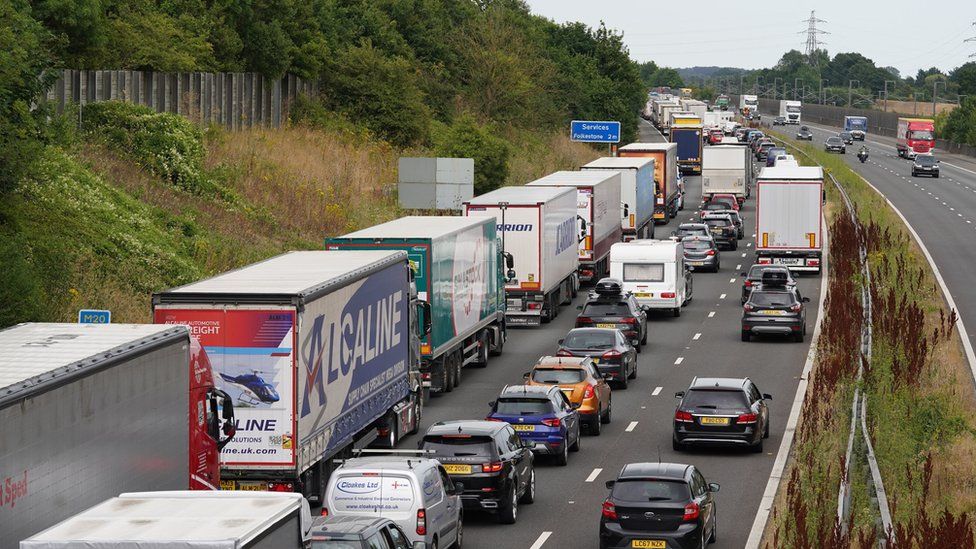
    Over the weekend traffic built up on the roads leading to the Eurotunnel terminal in Folkestone and Port of Dover after the M20 motorway through Kent to the south coast was closed to cars from Maidstone to Folkestone because of Operation Brock, which sees lorries diverted to park on the motorway.

    With the motorway shut, car drivers were diverted to smaller roads which then got jammed with miles of tailbacks.

    Some people reported sleeping overnight in their cars, while one tired family said the last three miles of their journey took 21 hours.

    Mr Howe said things were back to “business as normal” but remained “on a knife edge” with not much needed to create congestion.

    He told BBC Radio 4’s Today programme the coming weekend was expected to be the second busiest getaway weekend of the summer holidays and, with traffic crossing the Channel back to pre-pandemic levels and additional checks at the border since the UK left the European Union, it took “very little to cause those tailbacks”.

    He said on Friday the Port of Dover had issues with a lack of resources, which was compounded by a crash on the motorway.

    “You only need another crash on the road or maybe a train breakdown or a power failure somewhere for it to then become a big problem.”

    Mr Howe said there needed to be more infrastructure in place to take traffic off the roads, such as lorry parks.

    “We shouldn’t really have to have queues of traffic due to all of this, so we need more infrastructure in place,” he said.

    The AA’s head of roads policy Jack Cousens said it had been an “incredible weekend of traffic jams” but warned the group was concerned “we could be in for a repeat of this congestion across the summer”.

    John Keefe, director of public affairs for Getlink – which operates the Eurotunnel between Folkestone and Calais, said the issue over the weekend had been caused by the expected “very heavy traffic of passengers” getting away on holidays alongside an unexpected amount of truck traffic, which would normally have crossed to France earlier but had been delayed by an accident on the motorway.

    He said there were several factors that could help ease the situation, including bringing in digital technology to speed up border checks, increasing the resilience of the road network – with two of the UK’s biggest ports served by the same motorway – and improving the Channel tunnel railway network.

    Mr Keefe added: “There are definitely solutions. These solutions are not new. They’ve been on the table for many, many years.

    Lorries and cars queuing on the M20 near FolkestoneImage source, PA Media
    Image caption, Lorries and cars queuing on the M20 near Folkestone on Friday

    “But hopefully something like this will actually focus attention.”

    The Dover delays led to a war of words between French and UK officials, with both sides blaming the other.

    The UK government said French authorities failed to provide enough border staff to check passports at Dover over the weekend, while the French transport minister Clement Beaune highlighted additional border checks brought on by Brexit.

    Travel journalist Simon Calder said we were seeing the impact of leaving the EU for the first time during peak summer travel season as passenger numbers returned to pre-pandemic levels.

    Whereas in the past passport control had been able to wave travellers through with a flash of their passport at their discretion during busy times, he said, now they had to check and stamp every passport.

    Mr Calder said on average it was taking about a minute and a half for them to process a family of four.

    Over the weekend the Port of Dover said it handled almost 142,000 passengers.

    National Highways re-opened the coastbound M20 between junctions 9 and 11 in Kent shortly after 01:00 BST on Monday, but it remains closed to non-freight traffic between junctions 8 and 9 as part of Operation Brock.

    Dover MP Natalie Elphicke said the “entire discreditable episode” highlighted the need to make Kent’s roads as resilient as possible.

    She called for more investment in border systems and upgrades to the A2 and lorry parks.

    Source: BBC

     
  • Citizens mobilise to help fight fires in France, Portugal and Spain


    Firefighters in western Europe continue to battle forest fires raging across tens of thousands of hectares. Citizens in France, Portugal and Spain have been volunteering to help fire services with the heatwave’s blazes.

    France: ‘We arrived with five tankers’

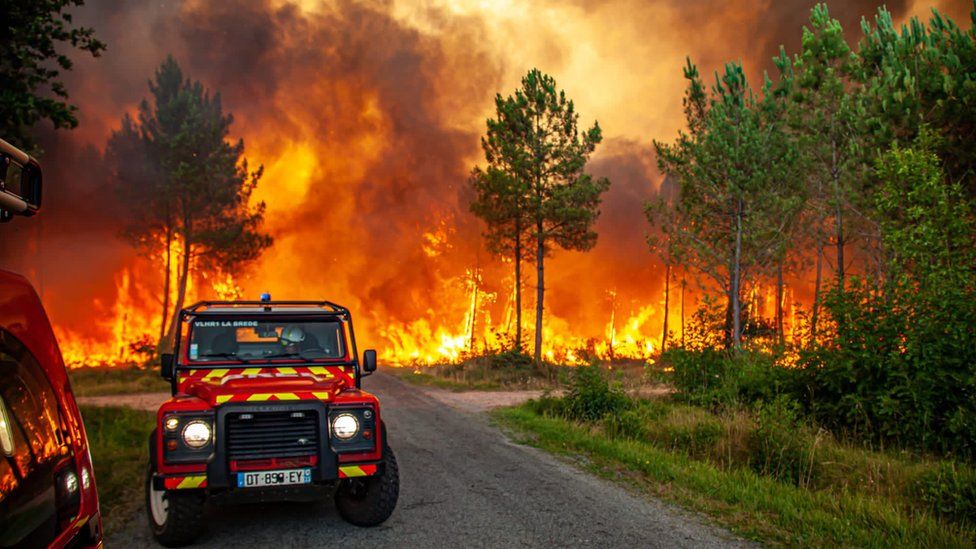
    In Gironde, southwest France, 19,300 hectares have gone up in smoke. Nearly 2,000 firefighters from all over France, supported by significant air resources, have been mobilised to tackle two giant blazes in La Teste-de-Buch and Landiras.

    Several images shared online show the extent of these fires, such as this video of the Dune du Pilat on fire on July 18.

    Amid the heatwave, farmers from the commune of Duras, in the departément (administrative unit) of Lot-et-Garonne, set off in the direction of the Gironde departément on July 15 to provide assistance to the fire brigade. They transported thousands of litres of water in tankers.

    We spoke to farmer Anthony Jouguet, who is at the heart of this initiative:

    A group of local farmers’ and foresters’ companies got together to find a way to help and address the fires.

    First, we asked the prefecture how we could support the fire brigade, but they told us we had to wait. But we couldn’t afford to wait … because the fires arrive very quickly. So we called the mayors in Gironde, who told us to come straight away.

    We left on Friday evening (July 15) and after a three-hour drive, we arrived with five tanks, a forestry grinder and a firewall. Our aim is to connect the fire line to water. We are all working together in a friendly and supportive atmosphere, even if it’s not easy.

    It’s not a pretty sight. The fire is causing a lot of damage. Everything is burned, there is ash everywhere, there are no animals, no birds. It is very sad. It’s a desert.

    Since we arrived, we have been working day and night, doing our best to help the firemen and to stop the fires. I am often scared, I’m not used to dealing with fire. Sometimes it can be very challenging because the roads aren’t very wide and we could get stuck.

    What gives me hope is the number of people and companies that have been providing support to local populations and fire brigades.

    Portugal: ‘Fire departments are exhausted’

    In Portugal, more than 1,000 firefighters were on duty on the evening of July 18 to tackle six major fires in the north of the country.

    Paulo J. Bento and volunteers at his NGO ‘Projeto Solidario’ in Loures, near Lisbon, have been providing fire crews with food in danger zones across the country. Paulo posted pictures of exhausted firemen and volunteers on the organisation’s Facebook page.

    The firefighters are extremely tired. In the town of Fundão, we saw firemen we had already seen ten days earlier … They go from fire to fire.

    It’s difficult to imagine what it’s like to spend so many hours in front of a fire: the heat, the smoke, the exhaustion. They don’t have time to go back to the fire station to get water. But they need it on the field to survive. We bring them water, juice, milk, chocolate (…) just 1 km from the fire.

    We left four tonnes of essential goods at the Fundão fire station. For an association like ours, which isn’t subsidised by the state, that’s a big deal.

    On July 18, the Civil Protection announced the death of two elderly people in the Vila Real region. The couple, who were trying to escape the flames, were found inside their vehicle.

    Meanwhile, on July 15, the pilot of a Portuguese firefighting plane died when his plane crashed while on a firefighting operation.

    Since the beginning of 2022, almost 44,000 hectares of forest have been ravaged by fire in Portugal, according to figures from the Institute for Nature and Forest Conservation (ICNF) published on July 18. The numbers are higher than in 2017, a year marked by forest fires that killed around 100 people.

    Spain: A man narrowly escapes a fire

    Since July 10, dozens of fires have also been raging in Spain, scorching more than 25,000 hectares. Two people, trapped in the flames, lost their lives in the Zamora region in the northwest of the country.

    On July 18, an impressive video showing a train stopping in the middle of a fire was shared on social media.

    On the same day, in the municipality of Tábara, a man almost died trying to protect his village. Angel Martin Arjona was trying to dig a trench in a field with his backhoe to prevent the fire from advancing. Reuters images posted on social networks show that the man barely managed to get out of his digger. Nicknamed the “hero of Tábara”, Arjona was airlifted to hospital in a critical condition.

    In the province of Malaga, residents also tried to extinguish a fire, as shown in images posted online on July 16 that have gone viral.

    But on Twitter, Antonio Maldonado, a member of a forestry brigade and of the Iberian Cenre for the Investigation and Fighting of Forest Fires (CILIFO) stressed the dangers of such initiatives: “It’s not helping. You are putting yourself and us in even more danger if we have to rescue you.” In another tweet, however, he praised the commitment of several residents of the town of Alhaurín el Grande, who were involved in a coordinated initiative alongside the fire brigade.

    Source: CNN

  • Europe heatwave: Thousands escape wildfires in France, Spain and Greece

    Residents and holidaymakers have fled towns and villages in France as fires are whipped up by high winds and tinder-dry conditions in several countries in Europe.

    More than 10,000 people have been forced to leave the south-western Gironde region in the past few days.

    Dozens of fires are burning in Portugal and Spain where temperatures have surged above 40C.

    At least 281 deaths in the two countries were linked to the heatwave.

    Several towns in western Spain have been evacuated.

    The head of France’s firefighters’ federation has warned of the impact global warming is having on civil protection. “It’s firefighters, civil security who deal with the effects on a daily basis – and these effects aren’t in 2030, they’re right now,” said Grégory Allione.

    Heatwaves have become more frequent, more intense, and last longer because of human-induced climate change. The world has already warmed by about 1.1C since the industrial era began and temperatures will keep rising unless governments around the world make steep cuts to emissions.

    Firefighters in Spain fought to protect the town of Monsagro as fires erupted further south in the Monfragüe national park, home to rare species of birds. The main N-5 route in Cáceres just east of the park was cut off when a forest fire reached the road.

    Temperatures were set to top 40C in large areas of western Spain as well as Portugal on Friday. At Pinhão in the north, 47C was recorded on Thursday, a record high for July in mainland Portugal.

    However, forecasters in Spain said temperatures would begin to fall on Friday.

    The Carlos III Health Institute said on Thursday that at least 43 people had died during the first two days of the latest heatwave, on Sunday and Monday, because of the heat.

    Health officials in Portugal recorded 238 deaths more than normal since 7 July which they attributed to the very hot and very dry conditions. The worst affected are the elderly, children and people with chronic diseases.

    More than 30 fires were active in Portugal on Friday morning, including one in a forest at Pombal in the central region of Leiria which has lasted a week. More than 300 sq km have been torched this year, a bigger area than in all of 2021.

    The EU’s Copernicus emergency management service tweeted a map showing the biggest fire risks across Southern Europe and Morocco.

    Police in south-west Francewent from door to door in an effort to evacuate 4,000 residents from the Cazaux district south-west of Bordeaux. Smoke could be seen close to the town of La Teste-de-Buch and there were long queues of traffic as people tried to leave and police blocked entrances to stop drivers getting in.

    One holidaymaker, Matthias, told BFMTV how he and his son had been told to escape immediately: “We started packing our things but the lady told us, no, you have to leave everything as it is. You try to keep calm but it’s hard not to be scared because it happens so fast.”

    Firefighters tried to stop the flames reaching La Teste-de-Buch and thousands of residents were told to leave
    IMAGE SOURCE,SDIS33/FRENCH FIRE SERVICE Image caption, Firefighters tried to stop the flames reaching La Teste-de-Buch and thousands of residents were told to leave

    An estimated 73 sq km of pine forest has burned down in recent days, including around Arcachon and Landiras. Temperatures are set to reach 40C in some areas and the head of the national firefighters’ federation warned there were still two months of summer to go.

    “The situation is highly complex. Our morale is still good but fatigue sets in fast. That’s why we’re calling for a target of 250,000 volunteer firefighters,” Mr Allione told RMC TV.

    Italy and Croatia have also reported forest fires this week, and strong winds have greatly increased the risk of wildfires in five regions in Greece, civil protection officials have warned.

    Central Greece, Attica and Create are among the areas most at risk and officials have appealed to Greeks not to do anything that could spark a fire.

    Fires were reported in Crete and on the mainland in Attica on Friday. Emergency services issued an urgent appeal to residents south-east of Athens to flee the village of Feriza Saronikos for the coast.

    Source: BBC


  • Europe heatwave: Outdoor events banned in parts of France

    Outdoor public events have been banned in an area of France as a record breaking heatwave sweeps across Europe.

    Concerts and large public gatherings have been called off in the Gironde department around Bordeaux.

    On Thursday, parts of France hit 40C earlier in the year than ever before, with temperatures expected to peak on Saturday.

    Scientists say periods of intense heat are becoming more frequent and longer lasting as a result of global warming.

    Spain, Italy and the UK are also experiencing high temperatures.

    In Gironde, officials said public events, including some of the official 18 June Resistance celebrations, will be prohibited from Friday at 14:00 (12:00 GMT) “until the end of the heat wave”. Indoor events at venues without air-conditioning are also banned.

    Private celebrations, such as weddings, will still be allowed.

    “Everyone now faces a health risk”, local official Fabienne Buccio told France Bleu radio.

    The French interior ministry warned people to be extremely careful and not expose themselves to the weather.

    State forecaster Meteo France said it was the earliest hot spell ever to hit the country, which has been caused by a mass of hot air moving from north Africa.

    A festival goer cools down with fresh water while taking part in the Hellfest metal music festival on June 17, 2022 in Clisson
    IMAGE SOURCE,GETTY IMAGES Image caption, Outdoor events continued in other areas of France – this man cooled down at a music festival in Clisson
    This photograph taken on June 17, 2022 shows a pharmacy sign displays the temperature of 44 Celsius degrees in the city of Montpellier in France
    IMAGE SOURCE,GETTY IMAGES Image caption, Temperatures have reached 44C in Montpellier in France

    Temperatures could hit 39C in Paris and droughts have also raised the risk of wildfires, the forecaster said.

    “I’m 86 years old, I was born here, but I think this is the worst heatwave I’ve ever seen,” Jacqueline Bonnaud told the AFP news agency in the southern city of Toulouse.

    The increased use of air-conditioners and fans was forcing France to import electricity from neighbouring countries, grid operator RTE said.

    Forest fires in Catalonia
    IMAGE SOURCE,AFP VIA GETTY IMAGES Image caption, There have been forest fires in Catalonia

    In Spain, which has just experienced its hottest May since the beginning of the century, temperatures are forecast to hit highs of 43C this weekend, the Aemet weather service said.

    There have been forest fires in Catalonia, including one which could grow to 20,000 hectares before it’s contained, the regional government said.

    Water is so low in large stretches of Italy’s largest river, the Po, that locals can walk through the middle of the expanse of sand and wartime shipwrecks are resurfacing.

    In the UK, temperatures are expected to reach 33C in southern England, while a level three heat-health alert has been issued for London.

    The river bed of the Po in Boretto, Italy, has dried up
    IMAGE SOURCE,AFP VIA GETTY IMAGES Image caption, The river bed of the Po in Italy has dried up

    Extreme heat isn’t confined to Europe this week.

    On Wednesday a third of the entire population of the United States were advised to stay indoors due to record temperatures. In India, Delhi has recorded a maximum temperature of at least 42C on 25 days this summer, the India Meteorological Department reported.

    Climate change is causing global temperatures to rise. Greenhouse gases, like carbon dioxide, released into Earth’s atmosphere in large volumes are trapping the sun’s heat, causing the planet to warm.

    This has brought more extreme weather, including record-breaking high temperatures across the world.

    Source: BBC

  • Fully-vaccinated people travelling to France will no longer need PCR tests done Statement

    The Ministry of Foreign Affairs and Regional Integration has announced for the attention of the public that anyone travelling from Ghana to France and has fully vaccinated will no longer have to do any PCR test in addition.

    By that, all persons who have been vaccinated by vaccines authorized by the European Medicines Agency (EMA) are thereby eligible to benefit from this new arrangement.

    “The Republic of France has issued the following guidelines for travelers to and from France. Fully vaccinated travelers can now travel to France with no other health-related restrictions. No PCR Test is required prior to departure or on arrival.

    “All vaccines authorised by the European Medicines Agency (EMA) are accepted: Pfizer (Comirnaty), Moderna, AstraZeneca (Vaxzevria), Johnson & Johnson (Janssen), AstraZeneca (Covishield),” a statement said.

    Also, the statement said listed out other requirements needed for eligible travellers.

    “Vaccine certificates must have QR codes and are considered valid for travel: 7 days after the second shot for two-shot vaccines (Pfizer, Moderna, AstraZeneca (Vaxevria and Covishield)); 4 weeks after the shot for one-shot vaccine (Johnson & Johnson); 7 days after the shot for vaccines administered to people who have already contracted COVID-19 (Only one dose is necessary),” it said.

    The statement, signed by the Director/Information and Public Affairs Unit, Worwornyo Agyeman (Mrs.), on behalf of the minister, however, clarified, “Non-vaccinated travelers must have a compelling reason to travel (health, business or family emergency) and must provide a less than 72 hours negative PCR test. Based on proof of this compelling reason, the French Immigration will issue a laisser-passer and the traveler must pledge to self-isolate for 7 days,” it said.

    Source: www.ghanaweb.com

  • Adopt French language to deepen formal trade ties Akufo-Addo urges Ghanaians

    President Nana Addo Dankwa Akufo-Addo has urged Ghanaians to take up learning of the French language in order to deepen trade ties among African countries.

    This he believes is vital towards the implementation of the free trade pact for the African Continental Free Trade Agreement with Ghana already selected as the host secretariat.

    In an interaction with the French Ambassador to Ghana, Anne Sophie Ave on the Touch of France show, President Akufo-Addo explained this was necessary to encourage bilingualism between Ghana and its neighbours.

    “As a necessary consequence, the language will have to be a determinant of that [trade] and it will be a very important incident of our capacity to trade effectively,” President Akufo-Addo said on the show.

    “As the trade becomes more and more formalised, I think the necessity for both sides; both the French people and the English-speaking people to be able to exchange information in the languages that they speak is going to be almost irresistible,” he added.

    Meanwhile, there are some 29 countries in Africa that speak French as their official language.

    Watch the video below:

    Source: www.ghanaweb.com

  • France urged to intervene on Ivorian leader third term bid

    French President Emmanuel Macron has been urged to intervene on Ivory Coast’s President Alassane Ouattara’s bid for a third term in October’s election – which his opponents say is unconstitutional.

    Former Ivory Coast rebel leader Guillaume Soro has told President Macron in a letter that “Ivorians have noticed France’s deafening silence” on the matter.

    He said France had hailed Mr Ouattara’s initial announcement that he would not seek re-election, but had been quiet after the president accepted his party’s nomination for a third term.

    Mr Soro and former President Laurent Gbagbo have been barred from vying because of their previous convictions.

    Mr Soro was convicted in absentia in April 2020 of embezzlement and money laundering, while Mr Gbagbo was sentenced in absentia in November 2019 for the “looting” of a local branch of the Central Bank of West African States.

    Source: bbc.com

  • Rwanda arrest warrant for genocide suspect in France

    Rwanda has issued an international arrest warrant for a former senior Rwandan military official, Aloys Ntiwiragabo, who is under investigation in France for his alleged role in the country’s 1994 genocide.

    France opened a probe after a French publication, Mediapart, found Mr Ntiwiragabo in the city of Orleans.

    He had been identified by the International Criminal Tribunal for Rwanda (ICTR) as one of the architects of the genocide.

    Neither the ICTR, Interpol, France nor Rwanda were actively seeking him, having dropped arrest warrants years earlier.

    The revelation of Mr Ntiwiragabo’s whereabouts came barely two months after another suspected genocide architect, Felicien Kabuga, was arrested on the fringes of Paris.

    Source: bbc.com

  • Macron announces coronavirus bonus for France’s homecare workers

    France’s 320,000 homecare workers will be granted COVID-19 bonuses under a €160 million package unveiled by French President Emmanuel Macron on Tuesday.

    “These men and women were the forgotten ones of the Covid bonus”, Macron said in the southern city of Toulon on Tuesday, referring to bonuses previously awarded to healthcare workers on the front line of the pandemic.

    Speaking before an audience of homecare workers, the president said the sum would allow those professionals “to have the €1,000 bonus that the others received”.

    Macron said the French state would put up €80 million and local governments the other half of the package.

    The announcement comes two months after the government issued decrees enacting exceptional bonuses of €1,000 to €1,500 for hospital staff and nursing home workers.

    Last month, unions signed up to a deal giving over €8 billion in pay rises for health workers, with the government admitting the move was overdue in view of the coronavirus pandemic.

    The bulk of the package comprises €7.5 billion in pay increases for nurses and careworkers, who will get an average monthly raise of €183.

    There is also €450 million for doctors, intended to bolster wages for those working solely in the public sector. The move is aimed at luring doctors from more lucrative private clinics.

    But some unions, including the hardline CGT, refrained from signing the accords, an indication that tensions over the issue may not yet be resolved.

    Source: france24.com

  • France could lose control of virus spread – Science Council

    France could “at any moment” lose control over the spread of the Coronavirus, the government’s COVID-19 scientific council warned Tuesday as official data showed the first rise in intensive care patients since April.

    In an opinion prepared for policy-makers, the council warned “the virus has recently been circulating more actively, with an increased loss of distancing and barrier measures” since France emerged from a strict two-month lockdown in May.

    “The balance is fragile and we can change course at any time to a less controlled scenario like in Spain, for example,” it said.

    And the council warned of a possible “resumption of circulation of the virus at a high level” by autumn 2020, after the August summer holidays.

    In the short term, retaining control is largely in the hands of citizens, it said.

    The message was underscored by President Emmanuel Macron who urged the French public on Tuesday to remain “vigilant” and continue applying anti-infection measures such as keeping a safe distance from others, regular hand-washing, and wearing masks in public spaces.

    Data released by the health department on Monday showed the number of people in intensive care had risen by 13 over the weekend, breaking a downward trend observed since April, when the country was under strict stay-at-home orders to curb the spread of the virus.

    Twenty-nine new deaths were reported over the same period, bringing the country’s toll to 30,294.

    At the height of the outbreak in April, more than 7,100 people were at one point receiving intensive care in French hospitals, which had 5,000 intensive care beds available when the crisis hit.

    The country registered thousands of confirmed new infections last week, prompting some cities and regions to impose local restrictions amid reports of people ignoring social distancing and public mask-wearing guidelines.

    ‘Probable second wave’

    The rate of confirmed infections has exceeded 1,000 per day since late July.

    Prime Minister Jean Castex on Monday urged France “not to let down its guard” in order to prevent a new national lockdown.

    “We are seeing an increase in the figures for the epidemic which should make us more attentive than ever,” Castex said.

    “I call on every French person to remain very vigilant. The fight against the virus depends of course on the state, local communities, institutions, but also on each of us,” he added.

    The southern city of Toulouse joined the ranks of local authorities Tuesday taking steps to oblige people to wear masks outdoors in certain situations, on top of the national requirement to cover up in shops and other shared spaces indoors.

    The science council said the government’s response to a “probable second wave” of coronavirus infections will have to be different to the first.

    It urged the authorities to put in place “prevention plans” for the France’s largest and most densely-populated metropolitan areas, with localised home-confinement strategies to be tightened or loosened in step with epidemic development.

    Yonathan Freund, an emergency doctor at Paris’s Pitie-Salpetriere hospital, is among experts to caution against over-reacting.

    “The situation in France today does not justify saying there has been a worsening,” he told AFP.

    “If there are 1,000 cases per day, it is because the virus is still in circulation, and it is normal,” he said.

    And epidemiologist Antoine Flahault said the focus of authorities seems to have shifted from preventing another run on hospital beds – an acceptable risk approach – to suppressing virus circulation to the lowest possible level, or a doctrine of “zero risk”.

    Source: france24.com

  • French police use ‘legitimate violence’ – New Interior Minister

    France’s recently installed interior minister dismissed on Tuesday the term “police violence” and told lawmakers the police exercise “legitimate violence”.

    “When I hear the term ‘police violence’, personally I choke,” said Gérard Darmanin, whose predecessor lost his job three weeks ago after becoming embroiled in a controversy over police use of a restraint method known as a chokehold.

    Deaths in custody of two men of African origin in separate incidents sparked widespread fury and led Darmanin’s predecessor Christophe Castaner to ban police use of the chokehold.

    But Castaner had to backtrack in the face of protests by the police and was later replaced.

    “The police do exercise violence, but legitimate violence,” Darmanin told a committee in the National Assembly.

    “They must do it in a proportional way, they must do it in a controlled way. If a few people do it outside the rules of professional ethics, the punishment must be immediate.”

    Darmanin’s appointment earlier this month outraged feminist campaigners as he is facing a renewed investigation into a 2009 rape allegation — which he denies.

    His use of the word “choke” concerning police violence was widely criticised by his opponents on social media.

    Darmanin and President Emmanuel Macron visited two police units in Paris earlier and announced a 10 million euros ($11.7 million) funding boost in a move designed to show solidarity with the force, according to the presidency.

    Police in France have been contending with regular demonstrations by anti-government “yellow vests”, groups opposing pension reforms and those angry at perceived racism in France generally and among the police in particular.

    Macron has promised a night work allowance for France’s police force, after officers demanded greater government backing in the face of protests over claims of brutality and racism in their ranks.

    On the surprise late-night visit to two specialised police units in the French capital overnight Monday to Tuesday, Macron promised a budget of 10 million euros ($11.7 million) for officers who work at night, the interior ministry announced.

    Source: france24.com

  • French health minister says observing social distancing ‘vital’ to avoid new lockdown

    France’s health minister urged the country on Wednesday not to drop its guard against COVID-19, saying it faced a long battle and that observing social distancing rules was vital to avoiding a new national lockdown.

    France reported 14 new deaths from the novel coronavirus on Tuesday, a figure twice as high as the daily average increase of seven seen over the previous week. A total of 30,223 people have now died of COVID-19 in France, health authorities said.

    “We are not facing a second wave, the epidemic is continuing… Some people do not respect the rules. We must not let down our guard,” Health Minister Olivier Véran told LCI television.

    “We do not want to resort to another lockdown, we are examining the situation on a case-by-case basis. The war is not over… People must understand that we are going to live with this virus for a fairly long time.”

    Véran was asked whether he would advise against going on holiday in the Brittany resort of Quiberon after a COVID-19 cluster was reported there last week and local authorities ordered a night curfew for beaches.

    “On Quiberon, there is a cluster of about 50 people. We are looking at the situation. It will depend on the spread of the virus. If we need to take other measures, we will take them,” he said.

    The Quiberon prefecture later said there were now 72 confirmed cases, mostly people aged 18 to 25.

    Source: france24.com

  • Virus sparks bitter rift in France’s champagne industry

    France’s coronavirus crisis has sparked a fierce battle in its hallowed champagne industry over this season’s harvest, with producers and growers at loggerheads over how much bubbly should be put into bottles.
    The main production houses are demanding a sharp reduction in harvest yields as sales plunge amid the COVID-19 pandemic. Growers say this would decimate their revenues.

    Traditionally, both sides negotiate how many grapes are harvested by the hundreds of champagne growers each year, many of whom sell to merchants including big-name brands like Veuve Clicquot or Pommery.

    The goal is to limit the risks from poor harvests and drastic price swings that could put many players out of business.

    But merchants say they are already loaded with stocks and with revenues hit hard by the crisis they cannot afford to produce more bottles than they can sell.

    “The growers want 8,500 kilogrammes per hectare [about 7,600 pounds per acre] and the houses want just 6,000 to 7,000 kilos,” said Bernard Beaulieu, a grower in Mutigny, a village amid rolling vineyards south of Reims, the capital of France’s Champagne region.

    With the price per kilo expected to remain relatively strong this year at roughly 6.50 euros, the stakes are high.

    “Not having a deal with harvests just a month away, this hasn’t happened since after World War II,” Beaulieu said.

    The Union des Maisons de Champagne (UMC) trade body, however, expects to sell 100 million fewer bottles this year, an unheard-of hit that will slash overall sales to 3.3 billion euros ($3.9 billion) — down 34 percent from 2019.

    And they say over one billion bottles are currently waiting in champagne cellars, representing several years of potential sales.

    The UMC’s director general, David Chatillon, told AFP he would not comment on the dispute before an August 18 meeting of the Champagne Committee, which groups both growers and merchants.

    ‘Roll of the dice’
    Growers are especially furious because this year’s harvest, to begin on August 20, is set to be “exceptionally good, with vines able to yield up to 16,000 kilos per hectare”, Beaulieu said.

    Maxime Toubart, head of the SGV grower’s association, accused merchants of putting livelihoods at risk by trying to take advantage of a crisis to reduce storage costs.

    “Growers are demanding a yield level that covers 2020 shipments while ensuring survival for vineyards,” Toubart said.

    The situation for growers is all the more alarming, he said, since the SGV has not obtained additional payroll tax exemptions from the government to weather the coronavirus slump.

    For Yves Couvreur of the FRVIC federation of independent growers, which groups some 400 vineyards that also produce their own champagne, “9,000 kilos per hectare is the limit, we can’t go any lower than that”.

    To cope with a crisis that could last “two or three years,” he is pushing for a suspension of uniform harvest yields so that the different players could adapt as they see fit.

    “The break-even point isn’t the same for people who sell their grapes, and those who make a living off of their brands,” he said.

    Couvreur also wants more leverage against merchants by allowing growers to let their wines mature in cellars longer, up to 18 or even 24 months instead of 15 currently.

    “Any proposal that prevents a flooding of the market is good,” he said.

    For now, if no deal is reached on yields, the decision will be left with France’s National Institute of Origin and Quality (INAO), which governs the country’s wine appellations.

    “And if that happens, it’s a roll of the dice for both sides,” Beaulieu warned.

    Source: AFP

  • France to allow up to 5,000 fans to watch sport in stadiums

    Stadiums will re-open to fans in France from 11 July as the country continues to lift coronavirus restrictions.

    Up to 5,000 fans will be allowed in arenas to watch live sport – a figure that may increase later in the summer.

    It means football’s French Cup and League Cup finals could be played in front of supporters after both were postponed to a date yet to be decided because of the pandemic.

    The Ligue 1 and 2 seasons were cancelled in April.

    The French government said: “A further review of the national epidemiological situation will be carried out in mid-July to decide whether a loosening is possible for the second half of August.”

    In April, Prime Minister Edouard Philippe put a blanket ban on all sport until September but collective sports can now resume from Monday.

    Source: bbc.com

  • Grand reopening? France 24 and Deutsche Welle at France-Germany border

    A new phase begins: on the day when many EU nations are lifting coronavirus travel restrictions, The FRANCE 24 Debate host François Picard is in Schoeneck and Deutsche Welle’s Melinda Crane in Sarrebrücken at the common border between France and Germany. There, locals on the French side are still bitter about Berlin’s unilateral decision to erect barriers they hadn’t seen in decades. As Emmanuel Macron and Angela Merkel now join forces to propose EU-wide stimulus plans, what do citizens want?

    To answer this and many more questions, the hosts will interview Rainer Hoffman, President of the Confederation of German Trade Unions; and Ludovic Subran, Chief Economist, Allianz Insurance and Asset Management.

    Disclaimer : “Opinions expressed in this article are the sole responsibility of the author(s) and do not in any way reflect those of backend.theindependentghana.com. Our outfit will hereby not be liable for any inaccuracies contained in this article.”

    Source: france24.com

  • France, Belgium, Greece lift restrictions for EU travel as members chart sundry course

    The bloc has recommended that the member states fully reopen their frontiers with each other on June 15, and many countries are planning to relax controls on that date.

    But the border reopenings have been far from harmoniously coordinated.

    Early birds… and those that never closed

    Italy, which has been among the world’s hardest hit by the new coronavirus pandemic, reopened its borders on June 3, lifting all restrictions for travellers from within Europe.

    Bulgaria, Croatia, Hungary, Latvia, Lithuania, Estonia, Slovakia and Slovenia have also already begun to lift restrictions for foreigners entering their countries but excluded those from nations they deem as not safe — in many cases that list includes Sweden and the UK.

    Poland has reopened its borders to all fellow EU members and the UK from June 13.

    Sweden meanwhile never closed its borders to EU countries.

    Neither did tiny Luxembourg — but quickly found all its neighbours closing their borders instead.

    EU’s mid-June plans

    In line with the EU’s plans to reopen borders in the bloc by mid-June, Belgium, France and Greece are lifting restrictions on Monday for travel within Europe.

    Paris, however, has specified it wants reciprocity and so may impose restrictions on those countries blocking travellers from France.

    Greece, on the other hand, has gone further, also allowing travellers from farther afield, such as Australia, New Zealand, Japan, South Korea, China, Israel and Lebanon.

    Germany is due to end land border checks on June 15, while the Dutch government has announced it would ease warnings against non-essential foreign travel from the same date.

    Austria, which has already opened its borders to most of its neighbours, will on June 16 lift travel restrictions with a total of 31 countries — but has excluded Portugal, Spain, Sweden and the United Kingdom.

    The Czech Republic is also allowing free travel with a number of European countries from Monday, but restrictions are still in place with those deemed a risk due to their levels of coronavirus infections.

    Hold outs

    Spain will only lift travel restrictions on June 21, re-establishing free travel with fellow EU countries.

    The land border with Portugal will however remain closed until July 1. Portugal has suffered a much lower death rate than Spain from the coronavirus epidemic.

    However, Spain’s Balearic Islands will see an earlier contingent of foreign guests when they welcome 11,000 Germans from June 15 in a pilot project for the revival of the crucial tourism sector.

    Romania has not yet announced when it will re-open its borders to foreigners without restrictions.

    Meanwhile, others are lifting border controls, but are still doing so more gradually.

    Denmark opens its borders to Germany, Norway and Iceland for visitors from Monday as long as they can show they plan to stay outside the capital Copenhagen for at least six consecutive nights

    Source: france24.com

  • Rwanda, France launch digital project to curb coronavirus

    Rwanda Biomedical Center (RBC) on Thursday, June 11, 2020, launched a project aimed at equipping community health workers with digital technology and data tools to facilitate response and prevention of Coronavirus.

    This project, which is worth Rwf 223 million, is co-funded by the French Agency for Research on AIDS and viral hepatitis (ANRS) and by the French Embassy.

    Two other French research institutes namely Institut Pasteur and INSERM will take part in the project implementation and evaluation.

    RBC said the project will promote wider and faster detection of cases, help in contact tracing, support social reintegration of recoveries and ensure a link between the population and the health system in Rwanda.

    The project is an outcome of a collaboration between the Medical Research Unit from RBC and the Nancy Center for Clinical Investigation based in France, according to the French Embassy.

    The project will be piloted in four districts across the country: two in Kigali, as well as the districts of Gicumbi and Nyamasheke. It will see 400 community health workers equipped with a smartphone application that enables larger and quicker detection of cases, especially in rural areas.

    Over three months, the mobile app is expected to strengthen the surveillance of pandemic and patient care. After assessment from the Health Ministry, the technology will be rolled out across the country.

    Rwanda’s use of digital technology in the health system has been on the rise since the virus broke out. This project adds to the use of robots, drones, data modules among other new technologies currently used in the national strategy against Covid-19.

    The project designers said it will rely on the network of the community-based health practitioners whose role in primary health care is remarkable. Also, with their Ebola experience, they are identified as health heroes who can play an undisputed role in the control and prevention of the pandemic.

    Jeremie Blin, the Chargé d’Affaires of France to Rwanda said in a statement the project will strengthen cooperation between both countries, especially in the health field as the entire world grapples with unprecedented effects of the virus.

    The Health sector, he added, is one of the bilateral priorities of the French Embassy in Rwanda, in regard with this year’s signing of a memorandum of understanding between the French Institute of Health and Medical Research (INSERM) and the Rwandan Ministry of Health.

    Source: allafrica.com

  • Coronavirus: France’s virus-tracing app ‘off to a good start’

    France’s digital minister has said its coronavirus contact-tracing app has been downloaded 600,000 times since it became available on Tuesday afternoon.

    StopCovid France is designed to prevent a second wave of infections by using smartphone logs to warn users if they have been near someone who later tested positive for the virus.

    But a last-minute launch delay led some citizens to download the wrong product.

    England has yet to confirm when its own app will roll out nationwide.

    Health Secretary Matt Hancock had originally said it would be by 1 June, and then later suggested it would be around the middle of next week.

    But the BBC has learned that it is now unlikely to be before 15 June and could be as late as July.

    That is in part because of delays in releasing a second version of the software to the Isle of Wight, where it is being trialled.

    The update will add symptoms including the loss of taste and smell to a self-diagnosis questionnaire next week, or soon after.

    It will also start giving at-risk users a code to enter into a separate website when they book a medical test. This will allow the result, saying whether they tested positive or negative, to be delivered back to them via the app.

    Rival models
    Both the UK and France have created apps of their own based on a “centralised” design.

    By contrast, Latvia, Italy and Switzerland have released apps based on a “decentralised” technology developed by Apple and Google.

    Advocates of the centralised approach says it gives epidemiologists more data to analyse, helping them better target the contagion alerts. They are also not limited by rules imposed by the two tech companies, such as a ban on being able to gather location data.

    Supporters of the decentralised model say it better protects users’ anonymity and privacy.

    StopCovid France’s rollout has caused controversy.

    Hundreds of academics signed a letter in April raising concerns that gathered data could be repurposed for mass surveillance purposes.

    There was then a row over the government’s refusal to give MPs a vote on the matter, which was only resolved after ministers gave the Senate and National Assembly non-binding votes.

    They both ultimately gave the app the green light. And the country’s data privacy watchdog also approved the rollout after carrying out its own review, although it did ask for some changes to the app’s wording.

    But questions remain about how many people will voluntarily install it – the more that do so, the better it should work.

    Digital Minister Cedric O indicated that he was pleased with the initial uptake.

    “As of this morning, 600,000 people managed to download the app, so it’s a very very good start,” he told the TV channel France 2.

    “We are very happy with his start, but obviously several million French people need to have it.”

    He declined to give an exact target. But he had previously said a publicity campaign would initially focus on city-dwellers – particularly those using public transport, restaurants and supermarkets at peak times – as they were among those most likely to spread Covid-19.

    Source: bbc.com

  • French anti-racism protests defy police ban

    Thousands of people have joined protests in France over the 2016 death of a black man in police custody, defying police orders not to assemble due to coronavirus restrictions.

    The death of Adama Traoré, 24, has been likened to the killing of George Floyd in the US, whose death has sparked protests across the country.

    Police clashed with protesters in the Paris suburbs on Tuesday.

    The Paris police chief has rejected charges of racism against his force.

    About 20,000 people defied the order on mass gatherings to join the protest. Initially peaceful, the march turned violent, with stones thrown at police and tear gas fired back.

    There were also demonstrations in other cities, including Marseille, Lyon and Lille. Some of the demonstrators carried Black Lives Matter placards – the movement that began in the US and has spread internationally.

    Mr Traoré died in a police station after being apprehended by officers in the Paris suburbs and losing consciousness in their vehicle.

    One of the officers told investigators that he and two colleagues pinned down Mr Traoré using their bodyweight.

    Official reports indicate he died of heart failure, possibly due to an underlying health condition. Last Thursday, the officers who detained Mr Traoré were exonerated by a police investigation.

    Following his death in 2016, violent protests were seen in Paris for several days.

    His case has become a rallying cry against police brutality in France, which young ethnic minority communities say targets them.

    On Tuesday campaigners defied authorities, after their request for permission to protest was denied by police.

    Public gatherings are limited to 10 people to control the spread of coronavirus.

    Video showed police firing tear gas at crowds in Paris, as well as several fires and blocked roads.

    “Today we are not just talking about the fight of the Traoré family. It is the fight for everyone. When we fight for George Floyd, we fight for Adama Traoré,” his sister, Assa, told the protest, according to AFP.

    Paris police chief Didier Lallement defended his force against allegations of brutality and racism.

    In a letter to police officers, he said he sympathised with the “pain” they must feel “faced with accusations of violence and racism, repeated endlessly by social networks and certain activist groups”.

    Source: bbc.com

  • Hydroxychloroquine is no longer authorized to treat coronavirus in France

    The French government on Wednesday repealed the regulations authorizing the prescription of hydroxychloroquine against Covid-19 in hospitals in France, following an unfavorable opinion from the High council for public health, according to a decree in the Official Journal, reports the Sputnik news agency, citing AFP.

    Since the end of March, hydroxychloroquine – a drug derived from the anti-malarial drug chloroquine – could be prescribed as an exception to the hospital and only for severely ill patients, on the collective decision of the doctors.

    WHO director-general Tedros Adhanom Ghebreyesus announced Monday that tests for hydroxychloroquine and chloroquine in the fight against Covid-19 have been temporarily suspended by the organization.

    He noted that these drugs were still considered to be safe for patients with autoimmune diseases and malaria.

    According to Sputnik, the Medicines Agency also said Tuesday, “wishing to suspend” clinical trials with this molecule in France, following the decision of the WHO. The High Council of Public Health has also recommended limiting its use.

    For his part, Didier Raoult, who defends the use of hydroxychloroquine in the treatment of the disease, condemned recent studies, skeptical about its effectiveness, declaring that they were based on a “big data badly controlled”.

    Source: GNA

  • China warns France against selling weapons to Taiwan

    China warned France on Wednesday not to “harm Sino-French relations” by selling arms to neighbouring Taiwan, which is planning to buy weapons as part of an upgrade to a French-made warship fleet bought 30 years ago.

    China says that Taiwan is part of “one China” and that this principle must be accepted by any country with which it has diplomatic relations. Arms sales to Taiwan are always highly sensitive and regularly prompt a strong reaction from Beijing.

    Taiwan is mostly equipped with US-made weapons, but in 1991 France sold Taiwan six Lafayette frigates, to China’s anger. France also sold Taiwan 60 Mirage fighter jets in 1992.

    Since then, China has vastly expanded its economic and military capabilities, and has grown more assertive in its efforts to thwart such sales.

    Taiwan last month said it was seeking to buy equipment from France to upgrade the ships’ missile interference system.

    Speaking in Beijing, Chinese Foreign Ministry spokesman Zhao Lijian said China resolutely opposed any arms sales to Taiwan.

    “We have already expressed our serious concern to France,” he told a daily news briefing.

    “We again urge the French side to abide by the one China principle and withdraw the arms sale plan to Taiwan to avoid harming Sino-French relations,” the spokesman added.

    Focus on Covid-19, says France

    France has rejected Chinese criticism of the planned weapons deal with Taiwan, saying everyone’s focus at this time should be on fighting the coronavirus epidemic.

    “France strictly respects the contractual agreements that it formed with Taiwan and nothing has changed in its position since 1994,” the French foreign ministry said in a statement on Wednesday, referring to a 1994 agreement re-establishing ties with Beijing.

    “Faced with the Covid-19 crisis, all our attention and all our efforts should be focused on the fight against the pandemic,” the ministry added.

    Taiwan says it needs to upgrade its armed forces to deal with the growing threat from China, which has in recent months stepped up its military drills near the democratic, self-governing island.

    China describes Taiwan as its most sensitive and important territorial issue, and has never renounced the use of force to bring the island under its control. Taiwan has shown no interest in being ruled by autocratic China.

    Source: france24.com

  • Air France-KLM reports €815 million first-quarter operating loss

    Two weeks of Coronavirus shutdown were enough to hit Air France-KLM with an 815 million-euro ($880 million) first-quarter operating loss, the airline group said on Thursday – predicting demand could take “several years” to recover.

    In the month of March there was an “abrupt plunge in revenue that will obviously extend through the second quarter,” Chief Financial Officer Frederic Gagey warned.

    Many major airlines have sought government help as they struggle to slash costs and conserve cash in response to the unprecedented global crisis.

    Air France-KLM, which has received 7 billion euros in French-backed rescue aid and Dutch pledges for a further 2 billion to 4 billion, expects to reduce monthly cash burn to 400 million euros in the second quarter thanks to cost-cutting and state-funded furloughs that save 350 million euros a month.

    But operating losses will widen “significantly” in April-June with 95% of flights expected to remain grounded by a combination of travel restrictions designed to contain the pandemic and collapsed demand.

    Capacity will still be down 80% in the third quarter, the group predicted, with customers returning only gradually.

    Airline group expects full-year loss

    Air France-KLM’s revenue fell 15.5% to 5.02 billion euros in the first quarter. Its net loss widened to 1.8 billion euros from 324 million, also swollen by a 455 million-euro impact from over-hedged fuel.

    While the initial virus outbreak in China impacted Asia traffic early in the quarter, the full effect of European lockdowns and travel bans was not felt until the second half of March.

    The group now expects a full-year loss in operating earnings before interest, tax, depreciation and amortization (EBITDA) – the first in its history, CFO Gagey said.

    Demand is “not expected to recover to pre-crisis levels before several years,” the company also warned.

    Formally withdrawing its pre-crisis 2020 guidance, Air France-KLM said it now planned to reduce its aircraft fleet by 20% in 2021. Chief Executive Ben Smith will present an updated “transformation plan” to investors within months, it said.

    Source: reuters.com

  • France could ease limits on religious services early

    France could allow religious services to resume earlier than planned if the easing of the lockdown this month does not result in an increase in the infection rate of coronavirus.

    France is set to ease its lockdown on 11 May but it had been indicated that religious ceremonies would still be banned until at least 2 June.

    The Christian holy day of Pentecost, celebrated 50 days after Easter Sunday, falls on 1 June

    Source: bbc.com

  • Coronavirus: France’s first known case ‘was in December’

    A patient diagnosed with pneumonia near Paris on 27 December actually had the coronavirus, his doctor has said.

    This means the virus may have arrived in Europe almost a month earlier than previously thought.

    Dr. Yves Cohen said a swab taken at the time was recently tested and came back positive for Covid-19.

    The patient, who has since fully recovered, said he had no idea where he caught the virus as he had not been to any infected areas.

    Knowing who was the first case is key to understanding how the virus spread.

    What do we know about the new case? Dr Cohen, head of emergency medicine at Avicenne and Jean-Verdier hospitals near Paris, said the patient was a 43-year-old man from Bobigny, north-east of Paris.

    He told the BBC’s Newsday program that the patient must have been infected between 14 and 22 December, as coronavirus symptoms take between five and 14 days to appear.

    He was admitted to hospital on 27 December exhibiting what later became to be known as the main coronavirus symptoms, including a dry cough, a fever and trouble breathing.

    This was four days before the World Health Organization’s China country office was informed of cases of pneumonia of unknown cause being detected in the Chinese city of Wuhan.

    The patient, Amirouche Hammar,told French broadcaster BFMTV that he had not travelled before falling sick.

    Dr Cohen said two of the patient’s children had also fallen ill but that his wife had not shown any symptoms. But Dr Cohen pointed out that the patient’s wife worked at a supermarket near Charles de Gaulle airport and could have come into contact with people who had recently arrived from China.

    The patient’s wife said that “often customers would come directly from the airport, still carrying their suitcases”.

    “We’re wondering whether she was asymptomatic,” Dr Cohen said. He called for the potential link to be investigated further.

    What does it tell us?

    Could coronavirus have been circulating in Europe in late 2019, many weeks before it was officially recognised and declared a threat there? That is the suggestion being made after a French doctor has revealed that he treated a patient in Paris with all of the symptoms of coronavirus just after Christmas.

    How does this change what we know about the pandemic? It might be that the test result is an error and so does not change a thing.

    But it if is correct, it could mean spread of the disease was going unchecked in Europe while all eyes were on the East in Wuhan.

    Certainly, any laboratories in Europe with samples from patients sick with similar symptoms around that time might want to run a test for coronavirus to see what it reveals so that we can learn more about this new disease.

    Why does it matter?

    Until now, what were thought to have been the country’s first three cases of coronavirus were confirmed on 24 January.

    Of those, two had been to Wuhan – where the outbreak was first detected – and the third was a close family member.

    This positive test result suggests the virus was present in France much earlier and will change the understanding of how it spread.

    “This case will allow us to better understand the evolution of the virus on French soil,” Dr Cohen told the BBC.

    Rowland Kao, a professor of veterinary epidemiology and data science at the University of Edinburgh, said that if confirmed, this case highlighted the speed at which an infection starting in a seemingly remote part of the world could quickly seed infections elsewhere.

    “It means that the lead time we have for assessment and decision-making can be very short, emphasising the need for preparedness, planning and rapid global communication of disease threats,” Prof Kao said.

    Jonathan Ball, professor of molecular virology at the University of Nottingham, urged further research: “Sequencing any virus in the sample might give you insight into whether or not the virus truly was an early isolate or likely contamination.”

    Prof Ball said that sequencing the virus could be prove difficult, however, as it looked from the data that the amount of virus in the sample was low.

    The first human-to-human transmission within Europe had until now thought to have been a German man who was infected by a Chinese colleague who visited Germany between 19 and 22 January.

    The United States also recently had to revise its coronavirus timeline. A post-mortem examination carried out in California revealed that the first coronavirus-related death in the country was almost a month earlier than previously thought.

    Source: bbc.com

  • Coronavirus: France’s first known case ‘was in December’

    A patient diagnosed with pneumonia near Paris on 27 December actually had the coronavirus, his doctor has said.

    Dr Yves Cohen told French media a swab taken at the time was recently tested, and came back positive for Covid-19.

    The patient, who has since fully recovered, said he had no idea where he caught the virus as he had not been to any infected areas.

    This news means the virus may have arrived in France almost a month earlier than previously thought.

    What do we know about the new case?

    Dr Cohen, head of emergency medicine at Avicenne and Jean-Verdier hospitals near Paris, said the patient was a 43-year-old man from Bobigny, north-east of Paris.

    He was exhibiting what later became to be known as the main symptoms of coronavirus, including a dry cough, a fever and trouble breathing.

    He was admitted to hospital on 27 December, four days before the World Health Organization’s China country office was informed of cases of pneumonia of unknown cause being detected in the Chinese city of Wuhan.

    The French patient told French broadcaster BFMTV that he had not travelled before falling sick.

    Dr Cohen said two of the patient’s children had fallen ill but that the wife had not shown any symptoms. But Dr Cohen pointed out that the patient’s wife worked at a supermarket near Charles de Gaulle airport and could have come into contact with people who had recently arrived from China.

    The patient’s wife said that “often customers would come directly from the airport, still carrying their suitcases”.

    “We’re wondering whether she was asymptomatic,” Dr Cohen said. He called for the potential link to be investigated further.

    Why does it matter?

    Until now, the country’s first three cases of coronavirus were confirmed on 24 January.

    Of those, two had been to Wuhan – where the outbreak was first detected – and the third was a close family member.

    This positive test result suggests the virus was present in France much earlier and will change the understanding of how it spread.

    The first human-to-human transmission within Europe had until now thought to have been a German man who was infected by a Chinese colleague who visited Germany between 19 and 22 January.

    The United States also recently had to revise its coronavirus timeline. A post-mortem examination carried out in California revealed that the first coronavirus-related death in the US was almost a month earlier than previously thought.

    How was the new case found?

    Dr Cohen told BFMTV that he recently went over the files of patients admitted with flu-like symptoms in December and January.

    In total he tested the swabs of 14 patients, he said.

    “We re-tested the nasal swabs which were conducted at the time in relation to another diagnosis, to try and find traces of coronavirus,” he said.

    “Out of 14 patients, one tested positive. We tested it two more times to make sure there was no mistake. And twice, it came back positive.”

    Dr Cohen said he had alerted the National Health Agency (ARS), and was urging other virologists to re-test swabs in their hospitals for Covid-19.

    A full report is due later this week, and will be published by the International Journal of Antimicrobial Agents, he added.

    Source: bbc.com

  • Coronavirus: Theft suspects tried in France over fake police checks

    Four alleged fraudsters are being tried in France, accused of conducting fake police checks on people’s permits to leave home during the lockdown.

    The woman and three men allegedly posed as officers and robbed victims after asking them to produce the official form people must carry away from home.

    It is believed they stole €25,000 (£22,000; $27,000).

    The four, who are all Iranian nationals, are being tried as France prepares to ease its lockdown curbs.

    ince 17 March, people across the country have only been allowed to leave their homes to go to work, shop, exercise, seek care or conduct urgent family business.

    While out, they are required to carry a certificate stating the reason for their trip.

    Police say the gang impersonated officers and approached people wearing face masks. After asking to see their victims’ forms, they allegedly searched bags and took whatever cash or valuables they could find.

    In an interview with France Info radio, Police Commissioner Nathan Bauer said the suspects “did not speak very good French” and targeted foreigners.

    He added that police had identified seven victims, and that €12,000 had been stolen from one of them.

    The four are to be tried in the city of Meaux, east of Paris.

    The coronavirus outbreak has been linked to about 25,000 deaths in France. But with falling numbers of new fatalities and cases, the government has announced plans to lift some restrictions from 11 May.

    Source: bbc

  • Coronavirus: France offers subsidy to tempt lockdown cyclists

    France is encouraging people to cycle to keep pollution levels low once lockdown restrictions end.

    Under the €20 million (£17m; $21.7m) scheme, everyone will be eligible for bike repairs of up to €50 at registered mechanics.

    The funding will also help pay for cycle training and temporary parking spaces.

    Nations worldwide are grappling with ways to change urban transport in light of the coronavirus.

    Emergency planners in London fear the Tube will not be able to cope once lockdown is lifted. A report seen by the BBC says that social distancing rules would reduce capacity to 15% of normal levels, and 12% on buses.

    Moreover, pollution levels have dropped worldwide, and many are seeking to keep those levels low.

    On Thursday the International Energy Agency (IEA) forecast a 6% drop in energy demand for the year – it said this would lead to a drop in carbon dioxide emissions of 8%, six times larger than the biggest fall in 2009 which followed the financial crash.

    What are the proposals?

    Elisabeth Borne, Minister for Ecological Transition, said the move was aimed at reducing driving when commuting or for short journeys to keep air pollution levels down once restrictions are lifted.

    In normal times, 60% of journeys made in France are less than 5 kilometres [3 miles] – making bicycles “a real transport solution”, she said.

    France has announced plans to slowly wind down its restrictions from 11 May. Latest figures on Wednesday showed a recorded death toll of 24,087, with close to 130,000 confirmed cases.

    Ms Borne announced the scheme in association with the Federation of Bicycle Users (FUB) on Wednesday.

    They will register a network of more than 3,000 repairmen on the FUB website who will agree to fix any bike for up to €50, such as changing tyres or old chains.

    Citizens will not receive a printed cheque, but will go to these registered mechanics who will then be reimbursed by the state. People will have to pay any additional costs out of their own pockets.

    The rest of the funding will go towards temporary bike racks and cycling training and refresher courses. Local governments are also being encouraged to lay down bike lanes across the country.

    What are European cities doing?

    The French capital Paris is barring private cars from one of its major central roads, the Rue de Rivoli, which will instead have separate lanes for bicycles and for buses, taxis, emergency vehicles and certain deliveries.

    The measures will remain in place for the duration of the pandemic but should they prove successful they will be made permanent, Mayor Anne Hidalgo said on Thursday.

    Paris is also aiming to create cycle routes along the paths of its three busiest Metro lines, she said.

    The aim was to prevent the city being “swamped by cars, synonymous with pollution”, she was quoted by Le Monde newspaper as saying.

    The Belgian capital Brussels on Wednesday announced the creation of 40km of additional cycle paths to ensure fewer people use public transport as restrictions are relaxed.

    And the Italian city of Milan, which is in the worst-affected region of Lombardy, has begun reallocating space on some of its major roads for walking and cycling.

    It is widening pavements, adding 35km of cycle lanes and encouraging the use of scooters as a way of pushing alternatives to car use. The Milan subway’s capacity is to be reduced by up to 30% to ensure all passengers are able to stay a metre away from each other.

    And in the German capital Berlin, the authorities have temporarily widened some cycle lanes.

    Source: bbc.com

  • France enters recession as GDP falls by record 5.8% in first quarter

    France’s gross domestic product contracted 5.8 percent in the first quarter and is officially in a recession, mainly because of the coronavirus lockdown imposed since mid-March, the national statistics agency said Thursday.

    The drop is the biggest since quarterly GDP evaluations began in 1949, exceeding the third quarter 1.6 percent drop in 2009 and the 5.3 percent contraction in the second quarter of 1968, the agency said.

    Following the 0.1 percent French GDP fall in the last quarter of 2019, the result confirms that France is in a recession.

    The drop in activity “is mainly linked to the stop in non-essential activities as part of the lockdown imposed from mid-March”, the agency said.

    The evaluation falls in line with that of France’s central bank, which in early April estimated a contraction of around six percent in the first quarter.

    Source: france24.com

  • Coronavirus: France mandates masks for schools and transport

    France will make face masks compulsory on public transport and in secondary schools when it starts easing its coronavirus lockdown on 11 May, Prime Minister Edouard Philippe has said.

    Schools will resume classes gradually, starting with kindergartens and primary schools.

    Middle schools in districts with milder outbreaks may follow from 18 May, and high schools at the end of the month.

    Shops and markets will also reopen from 11 May, but not bars and restaurants.

    Stores will have the right to ask shoppers to wear masks, and should ensure they remain a metre (3ft) apart, the prime minister said.

    Face masks will also be compulsory in school for children aged over 11.

    In a relief to many, the French will be able to go outside again without a certificate confirming their intentions, and public gatherings of up to 10 people will be allowed. Crèches will also reopen – but with a maximum of 10 children in each group.

    France has suffered one of the highest Covid-19 death rates in Europe, along with the UK, Italy and Spain.

    On Tuesday the number of people who have died with the virus rose by 367 to 23,660, the country’s health ministry said. Some 129,859 people have been infected.

    Hospital admissions and the number of patients in intensive care have been falling, however, giving cause for cautious optimism.

    Addressing parliament, Mr Philippe said the lockdown had saved an estimated 62,000 lives in France in a month, but that it was time to ease measures to avoid an economic collapse.

    “We will have to learn to live with the virus,” he said, until a vaccine or effective treatment is available.

    He summed up France’s priorities as “protect, test, isolate”.

    Parliament was scheduled to vote on the government’s proposed measures after a debate. Only 75 of almost 600 French MPs were allowed into the chamber for reasons of social distancing, with others voting by proxy.

    Will the lockdown definitely be lifted? Mr Philippe stressed that France must take strict precautions to avoid a second wave of coronavirus infections.

    “The risk of a second wave, which would strike a weakened hospital fabric, which would impose a ‘re-confinement’, which would ruin the efforts and sacrifices made during these eight weeks, is a serious risk,” he said.

    The lockdown will not be eased on 11 May if new cases don’t stay below 3,000 a day, he added.

    France has seen about 2,162 new cases a day on average over the past two weeks.

    The government has set a target to carry out at least 700,000 coronavirus tests per week from 11 May, the prime minister said, and will cover the cost of testing.

    “Once a person has tested positive, we will begin to identify and test all those, symptomatic or not, who have had close contact with them. All these contact cases will be tested and will be asked to isolate themselves,” he said.

    Mr Philippe said that where possible, people should keep working from home beyond 11 May

    Source: bbc.com

  • Ligue 1 and 2: France’s top two divisions will not resume this season

    The Ligue 1 and Ligue 2 seasons will not resume after France banned all sporting events, including behind closed doors, until September.

    Prime Minister Edouard Philippe said the 2019-20 sporting season is over as he announced plans to ease France’s coronavirus lockdown on 11 May.

    French football’s governing body had hoped to resume the season on 17 June and finish the campaign on 25 July.

    Football was suspended indefinitely in France on 13 March.

    Source: bbc.com

  • French police officers suspended for using racist slur in viral video

    Two police officers in Paris have been suspended after being filmed using an extremely offensive racist slur.

    The officers used a derogatory term for North Africans to mock a man they were arresting, and repeated a racist trope about him being unable to swim.

    The footage went viral on social media and has sparked outrage across France.

    Interior Minister Christophe Castaner also strongly criticised the officers involved, saying there was “no place” for racism in the police force.

    He also announced that the IGPN internal police watchdog had been notified and would launch an investigation.

    The police commissioner also tweeted: “With the approval of the interior minister, the chief of police Didier Lallemant has asked the head of the national police to suspend the two officers involved in uttering racial comments heard on a video circulated on social media on 26 April.”

    The incident took place in the early hours of Sunday morning in the Seine-Saint-Denis suburb, north of Paris.

    A man who was suspected of theft had jumped into the river Seine, reportedly to avoid arrest, and was then pulled out by the police.

    As they escorted the man to the police van, one of the officers called the man the racist slur and added: “He doesn’t know how to swim.”

    His colleague then laughed, and replied: “You should have tied a weight to his foot.”

    The exchange was filmed by journalist and anti-racism activist Taha Bouhafs, who then posted it on Twitter. So far it has been viewed more than 1.8 million times.

    In response, Mr Castaner tweeted: “All light will be shed on the matter… Racism has no place in the Republic’s police force.”

    Source: bbc.com

  • Amazon France CEO hopes can reopen warehouses ‘very quickly’

    Amazon (AMZN.O) does not know when its warehouses in France might reopen but hopes it can be soon, the head of its French business said on Friday.

    Frederic Duval also told BFM TV that an appeal procedure would take place next week against a French court decision ordering the e-commerce giant to focus only on delivering essential items such as food while it revised health protocols.

    “I do not know and that makes me sad…I hope we can find a solution very quickly,” Duval said, when asked when Amazon France could reopen its warehouses.

    Amazon closed six French warehouses used to stock and package goods for shipment on Thursday until at least April 20, in one of the biggest fallouts yet from a growing stand-off with its workers over safety measures during the pandemic.

    Source: reuters.com

  • Coronavirus: France death toll passes 10,000

    The number of people in France who have died from the coronavirus has now risen above 10,000.

    Latest figures show 10,238 people died from the virus since 1 March. In the past 24 hours, 607 deaths have been recorded in hospitals.

    A further 820 deaths were recorded in nursing homes. However, they may have taken place over several days and are only now being added to the toll.

    France has been under lockdown since 15 March, with fines for violations.

    On Tuesday, Paris said it would ban people from exercising outdoors between 10:00 and 19:00 local time.

    The new restriction came after a sunny weekend marked by large groups of people running and walking in the city’s parks, despite police controls.

    In the last 24 hours, 607 people died in French hospitals – almost exactly the same number as in the previous 24 hours – and 820 deaths were reported from care homes. However, this last figure is difficult to assess because it probably includes deaths that took place over the weekend or in care homes that have only now been able to provide their figures.

    The epidemic is still in its “upward phase,” Director of Health Jérôme Salomon said, with the number of daily deaths, hospitalisations and critical cases still going up. “The peak has not been reached,” he said.

    However, there are signs that the rate of growth is slowing. The number of critical cases was up only 59 on the previous day, because the rise in new cases (518) was largely compensated by people coming off the critical list.

    Doctors have expressed cautious hope that the worst scenario – of hospitals being overwhelmed – has been avoided.

    But Mr Salomon said that talk of ending confinement was premature. “Letting off the pressure now would be dangerous,” he said, echoing Prime Minister Édouard Philippe, who earlier said that national quarantine was “going to last”.

    There is widespread expectation that the government will extend confinement beyond the current end date of 15 April.

    Earlier on Tuesday, French President, Emmanuel Macron visited the Paris suburb of St Denis, one of the worst-affected areas in the country.

    It is the poorest administrative department in urban France, and the number of deaths rose by 63% in the last two weeks of March. The reasons are unclear.

    Source: bbc.com

  • France records 471 more virus deaths in hospitals as total toll tops 5,000

    France recorded 471 new coronavirus hospital deaths and 884 deaths in retirement homes, the country’s chief medical adviser told a press conference on Thursday.

    France’s Director General of Health, Jérôme Salomon, announced the figures during a daily press conference making for the first time a distinction between deaths recorded in hospitals and those in retirement homes.

    He said that a provisional tally showed that around 884 people in total had died in nursing homes.

    He added that the number of coronavirus-related deaths in hospitals rose 12 percent on Thursday to 4,503 from Wednesday.

    This makes for a total of 5,387 lives lost to coronavirus in France, so far.

    Salomon cautioned that coronavirus deaths in retirement homes could turn out to be higher than the reported number, as authorities were still gathering data from across the country.

    Salomon said that the number of known infections rose nationwide to 59,105 from 56,989. The number of patients requiring life support rose to 6,399 from 6,017 on Wednesday.

    In a televised interview on TF1 Thursday night, Prime Minister Édouard Philippe urged the French to continue to comply with mandatory lockdown measures imposed since March 17, to ensure a levelling off of new cases of the virus. He conceded these measures “would probably be extended” beyond the current deadline of April 15.

    According to the Johns Hopkins University Coronavirus Resource Center, the global death toll from the virus on Thursday topped 50,000 with total infections surpassing one million.

    Source: France24

  • Coronavirus death toll in France surges past 3,500

    The new coronavirus killed an additional 499 people in France on Tuesday as it continues to take a devastating toll on the country, said the health authorities.

    The death toll surged to 3,523 and a total of 52,128 cases of infection were recorded, according to the Health Ministry.

    The French National Assembly observed a moment of silence midday for all those who perished in the pandemic.

    In the morning hours, President Emmanuel Macron visited a factory producing medical masks to both show support and announce an additional €4 billion ($4.4 billion) to fund the production of masks, respirators, and supplies.

    The production of masks will reach 15 million per week by end of April, Macron promised.

    The factory Macron visited, PME Kolmi-Hopen, is the largest of four companies in France producing surgical and filtering face masks. They are operating round-the-clock to meet the demand.

    An Air France cargo plane also landed at Paris-Vatry Airport on Tuesday carrying 10 million masks purchased from China for nationwide use. Additional medical supplies were also on board.

    After first appearing in Wuhan, China, last December, the virus has spread to at least 179 countries and regions, according to the U.S-based Johns Hopkins University database.

    More than 826,000 cases of coronavirus have been reported worldwide, with the death toll over 40,700 and over 174,000 recoveries.

    Despite the severity of the virus, most people experience mild symptoms and recover in due time.

    Source: www.aa.com.tr

  • France’s Euro 84-winning coach Michel Hidalgo dies aged 87

    Michel Hidalgo, the coach of the great France team that won the 1984 European Championship, has died at the age of 87, the French players union and the French Football Federation said on Thursday.

    Hidalgo, who had been ill for a number of years, died “naturally of exhaustion” at home in Marseille, his family told radio station France Info.

    He is best remembered for his eight years in charge of Les Bleus, which culminated with the great team of Michel Platini, Alain Giresse and Jean Tigana winning Euro 84 on home soil, beating Spain 2-0 in the final in Paris. It was their first ever major tournament success.

    Prior to that, his France team had reached the semi-finals of the 1982 World Cup, losing on penalties to West Germany.

    “As coach, Michel took the France team to its greatest heights, opting for a beautiful style of football which allowed each one of us to fully express our individual talents,” said Platini in a statement.

    “Michel Hidalgo left a considerable legacy. He rebuilt French football at international level.

    “His vision and his work still resonate today in every match our national team plays.”

    Hidalgo also enjoyed a richly successful playing career.

    He played for the great Reims side of the 1950s, featuring, and scoring, when they lost 4-3 to Real Madrid in the first ever European Cup final in 1956.

    Hidalgo went on to win two league titles and two French Cups with Monaco in the early 1960s.

    Source: bbc.com

  • France to shut ‘non-essential’ public places – PM

    France on Saturday drastically stepped up its measures against the spread of the coronavirus, announcing the closure of all non-essential public places including restaurants and cafes from midnight (2300 GMT).

    “I have decided on the closure until further notice from midnight of places that receive the public that are non-essential to the life of the country,” Prime Minister Edouard Philippe told reporters.

    “This includes notably cafes, restaurants, cinemas and discos.”

    Top health official Jerome Salomon meanwhile announced that the death toll from COVID-19 had risen by 12 over the last day in France to 91, with the total number of infected standing at 4,500.

    Salomon added that France was from now at its highest sanitary alert level of stage three, which means that the virus is now circulating actively across French territory.

    He added that the number of those infected had doubled over the last 72 hours.

    Philippe said that the new measures were being adopted after the first measures announced in France to fight the virus were “imperfectly applied”.

    Places of worship would stay open but all services and ceremonies would have to be postponed, he said.

    Shops would also have to close with the exception of essential services like supermarkets and pharmacies, he added.

    Public transport would continue to run, but Philippe urged the French to “limit their movements” and avoid inter-city travel.

    But he insisted that despite the strict new rules, the first round of local elections would go ahead as planned on Sunday while “respecting strictly the guidelines of distancing”.

    “I know the French will show their calm, their civic mentality and their ability to obey the rules we have set out for their own security,” Philippe said.

    Later Saturday, the tiny principality of Monaco, which lies on the Mediterranean coast and borders France, announced similar measures.

    Non-essential public spaces would be closed until further notice, said a government statement. Food markets, pharmacies, petrol stations and banks would remain open.

    Source: France24

  • Anxious France defies virus to hold local polls

    France goes to the polls Sunday in nationwide local elections, defying a mounting health crisis caused by the coronavirus outbreak that still risks keeping many voters at home.

    President Emmanuel Macron, for whom the two-round polls are a crucial mid-term test, has insisted that the polls to elect mayors and municipal councils must go ahead to assure democratic continuity in the country.

    And despite fresh restrictions announced Saturday evening, including the closure of non-essential public places such as cafes, restaurants, cinemas and gyms, the elections will go ahead.

    Officials have insisted that voting will take place under the tightest sanitary conditions, despite widespread fear that polling stations are ideal germ-spreading venues and a particular risk for older people.

    The president said Thursday that scientists had assured him “there is nothing to prevent the French, even the most vulnerable, from going to the ballot box”, provided everyone observes basic infection-prevention rules.

    Municipalities have announced various measures to try and keep voters infection-free, including regular disinfection of voting booths, ensuring a safe personal distance between voters waiting in line, and providing sanitising hand gels on entry and exit.

    A second round is also due on March 22.

    – ‘Continuity of democratic life’ –

    But observers say many are bound to shun the democratic exercise for fear of contamination with the novel virus that has killed dozens and infected thousands more in France alone.

    A recent opinion poll said 28 percent of potential voters in France were “concerned” about the risk posed by mingling at polling stations, often hosted by schools.

    “It is important at this time, following the advice of scientists as we have done, to ensure the continuity of our democratic life and that of our institutions,” Macron said.

    Some 47.7 million people are registered to vote in some 35,000 municipalities in a country where mayors and local councillors enjoy high popularity compared to other levels of government.

    The election will be a key test for Macron, whose party swept Paris in the 2017 presidential election, but has since lost popularity in part due to its leader’s perceived autocratic leadership style and lack of common touch.

    The French capital will be the main battleground, with incumbent socialist mayor Anne Hidalgo challenged by right-wing heavyweight Rachida Dati and Macron’s candidate Agnes Buzyn — who was parachuted in after his chosen hopeful, Benjamin Griveaux, pulled out over a sex-tape scandal.

    – ‘Many will be dissuaded’ –

    Many in France have questioned the wisdom of holding the vote even as the country indefinitely closed all creches, schools and universities, banned gatherings of more than 100 people, and urged residents to limit their movements.

    Britain on Friday postponed its own May local elections for a year citing the coronavirus.

    But French Interior Minister Christophe Castaner defended his government’s decision, saying there were about 1,000 voters to every French polling station on average.

    And even if the participation rate is 60 percent — which is high — that would mean 600 people spread over 10 to 12 hours depending on the district.

    The risk from voting for the elderly was no greater “than going shopping”, insisted Jean-Francois Delfraissy, chairman of France’s coronavirus science council.

    “It is certain that many people will be dissuaded from voting,” political historian Jean Garrigues of the University of Orleans told AFP.

    Polls showed that young people — who are not at high risk of dying from COVID-19 — are most likely to hold it up as a reason not to vote.

    Even if this is just a pretext for the politically apathetic, it could impact parties that young people are more likely to support — the Greens and the far-left France Unbowed, said Garrigues.

    Older people, even though they are more motivated to vote, may end up staying away out of fear, thus robbing parties such as the right-wing Republicans or Macron’s centre-right Republic on the Move (LREM) of votes.

    This means that the political repercussions of high voter abstention among the young and the old could cancel each other out, said Garrigues.

    Source: France24

  • John Boye is best defender in France – Statistics report

    Ghana defender John Boye has beaten some of the highest paid centre-backs in the world as he is best the defender in France, statistics have shown after 24 matches played in the French top-flight league.

    According to statistics revealed by the globally respected agency Wyscout, the central defender is better than all the top defenders in top sides like PSG, Marseille and Lyon in the ongoing league.

    The 32-year-old, who plays for Metz, has grown into a fearsome defender not only at the club, but also in the Ligue 1 per statistics disclosed by data collectors Wyscout.

    According to Wyscout, the Ghana international has made a staggering 7.1 interceptions after matchday 24 of the league while Toulouse left-back Issiaga Sylla coming closest with 6.97.

    Boye has also clocked 84% pass completion, and kept 9 clean sheets.

    This has made him the best defender in the French top-flight so far this season despite the presence of some top players in the Ligue 1.

    Boye has established himself as an important figure at FC Metz since joining as a free-agent in 2018 after failing to extend contract with Turkish side Sivasspor.

    The towering guardsman played a key role in the Maroons promotion to the elite league two seasons ago.

    He was however linked with a return to Turkey at the start of the season but the move did not materialize as FC Metz decided against cashing on him in the last minute.

    Wyscout designs detailed reports about matches, teams, and players with complete game stats, as well as pre-match reports for coaches and journalists.

    Boye has churned out the most appearances (21) for the club in the ongoing season after goalkeeper Alexandre Oukidja (24)

    He has scored one goal and picked 8 yellow cards in the season.

    Source: GHANAsoccernet.com

  • 36 evacuated from China to France show virus symptoms – Minister

    Thirty six people aboard an evacuation flight from China that landed in France on Sunday showed symptoms of the coronavirus, which has killed more than 360 people, Health Minister Agnes Buzyn said.

    In all, 254 people arrived in France from the Chinese city of Wuhan, where the deadly virus was first detected, on the second such flight.

    “About 20 people who presented symptoms have stayed on the tarmac” at Istres airport in the south of France to undergo further testing, Buzyn told journalists. They included French and non-European nationals.

    Tests were carried out to establish whether they had the coronavirus and the results will be known on Monday, the health ministry told AFP.

    A further 16 foreign nationals displaying symptoms were flown back to their respective countries.

    The second evacuation flight was carrying people of 30 different nationalities, most of them European. Sixty five of the returnees were French.

    A total of 124 non-French evacuees swiftly travelled on to their home countries, according to military sources in Istres.

    Nine Belgians and three of their partners as well as 15 Dutch citizens and their two Chinese partners were isolated after travelling on from Istres to a military airport near Brussels, according to Belga news agency.

    However, 60 others from Mexico, Rwanda, Brazil and Georgia remained on French soil, Buzyn told reporters.

    Some of the returnees will be quarantined for 14 days while others would be allowed to head back to their home countries if they showed no symptoms of the virus, Foreign Minister Jean-Yves Le Drian told French broadcaster RTL.

    The first planeload of evacuees from China arrived on Friday and are in quarantine at a resort on the Mediterranean coast.

    Two passengers from that flight were identified as possible cases of coronavirus, but tests on them came back negative.

    Le Drian hailed the “remarkable” cooperation by the Chinese authorities which has allowed all the French nationals who wanted to return home to do so.

    The health minister assured that the arrival of more people from Wuhan presented no extra risk of contagion of the virus.

    France and its fellow G7 countries will discuss a joint response to the coronavirus epidemic, Germany’s health minister said on Sunday.

    So far in France, only six cases of coronavirus have been detected.

    Source: France24

  • France to send 600 more troops to Sahel

    France has announced it is sending an extra 600 troops to Africa’s Sahel region, boosting the total number of French forces to 5,100.

    Most of them will be deployed to the border regions between Niger, Mali and Burkina Faso – an area especially badly hit by jihadist attacks.

    But regional and international forces, plus armed drones and other forms of support, seem incapable of stemming the violence.

    Attacks by militants linked to al-Qaeda and the Islamic State group have significantly increased in the past year, causing more than half a million people to flee their homes.

    The Sahel region, a semi-arid stretch of land just south of the Sahara Desert, has been a frontline in the war against Islamist militancy for almost a decade.

    French President Emmanuel Macron last month hosted a summit with his counterparts from the Sahel belt of western Africa to discuss the military campaign against jihadist militants.

    Source: bbc.com