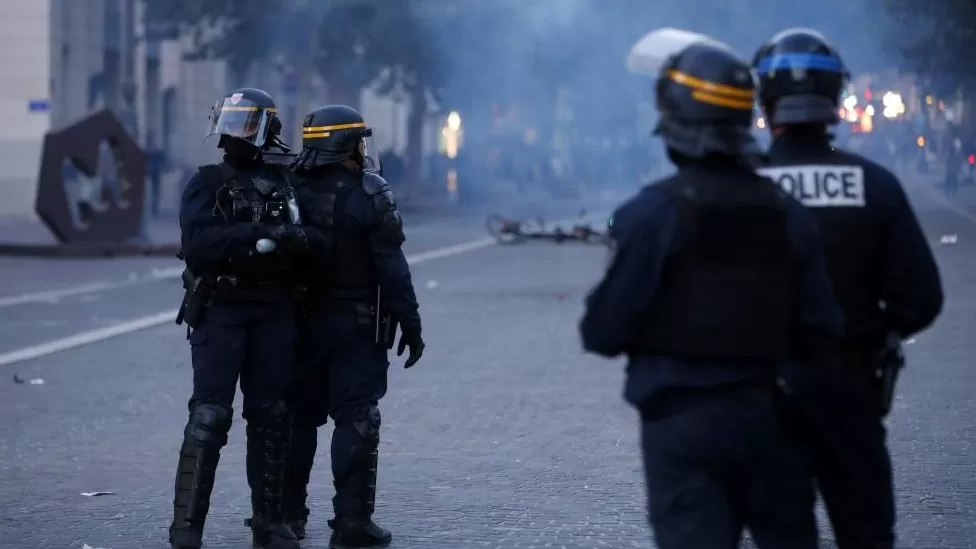
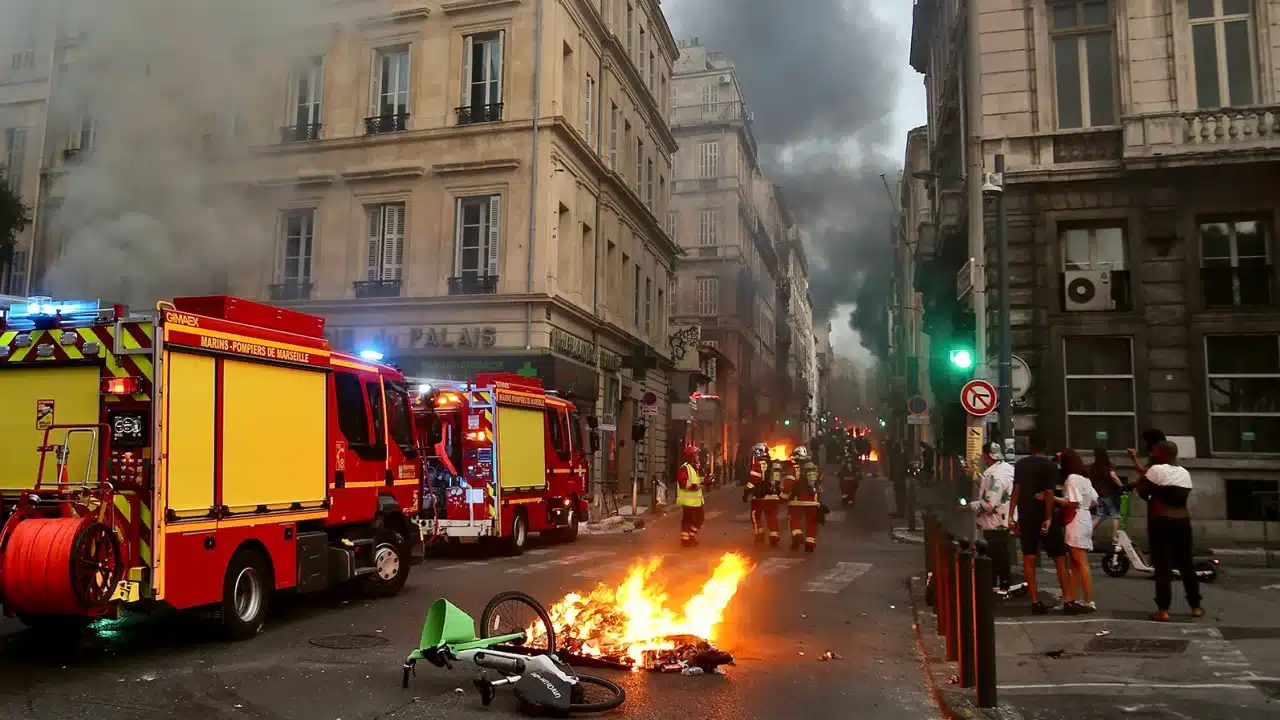
A French policeman who is suspected of opening fire while Marseille was experiencing riots a month ago has admitted shooting a 22-year-old man in the head with a rubber bullet.
Hedi, an assistant restaurant manager, suffered severe injuries and disfigurement as a result of the “flash ball”.
Since the officer has been detained for weeks, colleagues in Marseille and elsewhere have expressed outrage.
On Thursday, the public defender requested that the court retain him in custody.
The officer’s attorney has filed an appeal for his release, but the prosecutor said that it was necessary to consider the possibility of “fraudulent collusion” among coworkers.
The suspect is one of four police officers who are being investigated for their alleged involvement in riots that broke out across France at the beginning of July.
After a 17-year-old named Nahel was fatally shot by a police during a traffic stop in Nanterre, close to Paris, they broke out.
Hedi, a North African immigrant who was hit in the head but survived, suffered headaches, lost vision in his left eye, and had to walk with a helmet on. He also lost a portion of his skull.
The officer, known only as Christophe, said in a statement to the court in Aix-en-Provence that he made the decision to fire once with his LBD launcher when he noticed two people in hood.
When asked by his attorney if Hedi was hit by the shot, the officer responded, “There’s no proof.”
Although the officer’s version was wholly nonsensical, Hedi’s attorney Jacques Preziosi later said that “finally we have a confession that he fired the LBD… until now everyone denied it.”
Olivier Véran, a government spokesman, called Hedi earlier this week to wish him well.
The 22-year-old has described to French media how he met his friend Lilian after finishing work at a restaurant early on July 2. Four members of a police anti-crime brigade (BAC) confronted them as they were walking along the riot’s edge.
We wished the officers a good night but soon discovered they were agitated and uninterested in speaking.
Hedi was shot in the head and collapsed on the ground while his friend was able to escape. He recalls being tortured for as long as five minutes while being dragged around the ground and beaten: “I felt something enormous in my skull that was burning me.”
One of the four police officers engaged in the Marseille incident was remanded by magistrates, which was a rare decision that has infuriated other cops.
In response to his imprisonment, an estimated 5% of officers have either used their sick days or worked on call.
According to Frédéric Veaux, the national police chief, cops shouldn’t be regarded like criminals or thugs.
“A police officer has no place in prison before an eventual trial, even if he may have committed faults or grave error in his work,” he stated.
While acknowledging the strong feelings among officers, President Emmanuel Macron declared that “no one in the Republic is above the law.”
The incident has once again brought attention to French police’s controversial use of “flash-ball” rubber bullets, which have resulted in numerous fatalities and life-altering injuries in recent years.
Mohamed Bendriss, 27, was shot in the chest during the protests in Marseille the same evening that Hedi was hurt. He had a heart arrest and passed away.
Although two marks on the scooter delivery driver’s chest and thigh that are consistent with the impact of a “flash ball” were discovered, prosecutors are still looking into whether an LBD was to blame for his demise.
Abdelkarim, his cousin, may lose one of his eyesight after being struck in the eye the previous evening.
During a protest in Nantes in April against the government’s pension reforms, a man lost a testicle.
Two fundraisers were organised after a French policeman killed unarmed 17-year-old Nahel Merzouk during a traffic stop in Paris last week. One, to assist the mother of the teenager. The other was given to the victim’s killer police officer’s family.
Early on Wednesday morning, more than €1.6 million ($1.7 million) had been raised for the police officer’s benefit, while more than €400,000 ($450,000) had been raised for Nahel. Just over 21,000 people had contributed to Nahel, compared to over 85,000 for the police officer.
Why does this difference exist? What does it reveal about French politics, if anything?
The fundraiser for the police officer, who has been charged with voluntary homicide, was set up by French media personality and former politician Jean Messiha.
Having previously stood as a candidate for the National Rally – the far-right party led by Marine Le Pen – Messiha later worked as spokesperson for the party of Eric Zemmour, another far-right candidate in last year’s presidential election, whose platform was more extreme than Le Pen’s.
French lawmakers have criticized the fundraiser and questioned the motives of the organizers.
“Everyone can express their feelings and contribute to a fund… But I think, in this case, that it doesn’t go in the direction of appeasement,” Justice Minister Eric Dupond-Moretti said in an interview with France Inter on Monday.
“I ask myself if behind all this there isn’t an instrumentalization (of the killing),” he added.
Despite the criticism, host website GoFundMe has refused to remove the campaign.
“Currently, this fund complies with our terms of use because the funds will be paid directly to the family in question. The family has been added as a beneficiary and therefore the funds will be paid directly to them,” said a GoFundMe spokesperson to CNN affiliate BFMTV.
On Tuesday evening, Messiha announced on Twitter that the fundraiser would close at midnight local time (6 p.m. ET), but urged that its supporters continued the “national momentum” the campaign had built.
The killing of Nahel, who was of Algerian origin, and the riots his death incited, provoked a “typical, traditional far-right” reaction, according to Philippe Marliere, a professor of French politics at University College London.
Many far-right sympathizers took the protests as proof that the rioters “disrespect France, they hate it, they don’t want to integrate, they’re riff-raffs,” and as another example of how “France’s multiculturalism has failed,” Marliere told CNN.
But while this rhetoric proliferated online, the fundraiser itself used more measured language.
“Support for the family of the Nanterre police officer, Florian.M, who did his job and is now paying a high price. MASSIVELY support him and our police forces!” it read.
This language “is designed to appeal to a much broader audience than typical far-right voters. This sort of statement could appeal to a majority of French people – and most of them would never contemplate voting for the National Rally,” Marliere said. The fundraiser is hence helping to bring the politics of the far right into the mainstream, he added.
Le Pen also tempered her rhetoric in response to this crisis, in what Marliere said was an attempt to appeal to more middle-of-the-road voters. Rather than capitalizing on the traditional far-right rallying calls of “riots, ethnic minorities, rebelling against public authority, the police, burning down public buildings,” and more, she has adopted a more moderate tone than she has in the past, and far more so than Zemmour.
While Zemmour called the rioters “scum” and called for some of their requests for French nationality to be refused, Le Pen spoke more sympathetically about the victim. “The death of a young man of 17 cannot leave anyone indifferent,” she said in a tweet.
According to Marliere, Le Pen’s “low-key” response to the crisis is part of a “long-term strategy of coming across no longer as a far-right politician, but as someone who eventually – in four years’ time – could be seen as a credible replacement for Macron.”
Since Le Pen lost the presidential election to Emmanuel Macron in 2022, French politics has grown increasingly fractious. Macron faced huge protests in March and April over his controversial pension reforms, and there is a sense that he has struggled to regain his domestic footing since then.
Many have noted that Le Pen’s decision to temper her rhetoric echoes that of Italian Prime Minister Georgia Meloni. Both politicians, attempting to cast a sheen of electability over their far-right parties, have used a more moderate tone to appeal to the mainstream.
“The Meloni strategy is very much what Le Pen is trying to follow in France,” Marliere said.
“This is politics: You instrumentalize a political event, a tragic political and social event, and you try to score political points with it.”
But, for the message to resonate, it has to be grounded in the public’s experience.
Joseph Downing, a senior lecturer in politics and international relations who has lived in Marseille for more than a decade, says he has witnessed the decline of security in the city, which has left whole areas virtually unpoliced.
According to Downing, the success of the fundraiser for the police officer shows “the key reason why Le Pen, and to a lesser extent Zemmour, were both successful in the presidential election campaign, because they spoke about security.”
“If you speak to people on the ground, they constantly complain about the deterioration of safety in French cities. This has been something that’s been taking place over the last decades,” Downing told CNN.
In some areas of France, police simply “don’t exist,” he said. In their place, gangs armed with Kalashnikovs have been allowed to proliferate.
“Nanterre (the Paris suburb where Nahel was killed) is a good example of this. The police themselves are scared. And the police know, in Nanterre, in Clichy-sous-Bois, in the northern quarters of Marseille, there are people that are armed. And there are people that are armed with bigger guns than they have,” Downing said.
While the absence of police is felt most keenly in Marseille, Downing says the feeling of insecurity has started to trickle into Paris.
“On French voters’ minds – and it’s not being addressed unfortunately by the mainstream – is the question of a banal, day-to-day insecurity,” Downing said.
He thinks the police officer’s fundraiser reveals some of these feelings of insecurity. The riots that rocked several French cities were a short burst of anguish whose peak has passed, according to comments made Tuesday by Macron. But the fundraiser was growing at a rapid rate before Messahi’s announcement, pulling in more than €500,000 (€545,000) since Monday afternoon.
The difference between the two fundraisers also shows the different levels of organization across the French political spectrum. Those who took to the streets to protest police violence “might use Snapchat, but they wouldn’t be aware of a GoFundMe,” said Downing. Meanwhile, the cause of law and order has appealed to the “more engaged” right. “The right is much more mobilized and is much richer generally in France,” he said.
Having faced two huge waves of protests this year, Macron has been left weakened. While the nature of the two crises were very different, both have contributed to the growing image of a president detached from his people, who feels more comfortable before a global audience than a domestic one.
“It’s easier to grandstand on the international stage than it is to try to sort out very complex, intractable problems at home,” Downing told CNN.