Tag: French Senate

  • French Senate supports constitutionally enshrining right to abortion

    French Senate supports constitutionally enshrining right to abortion

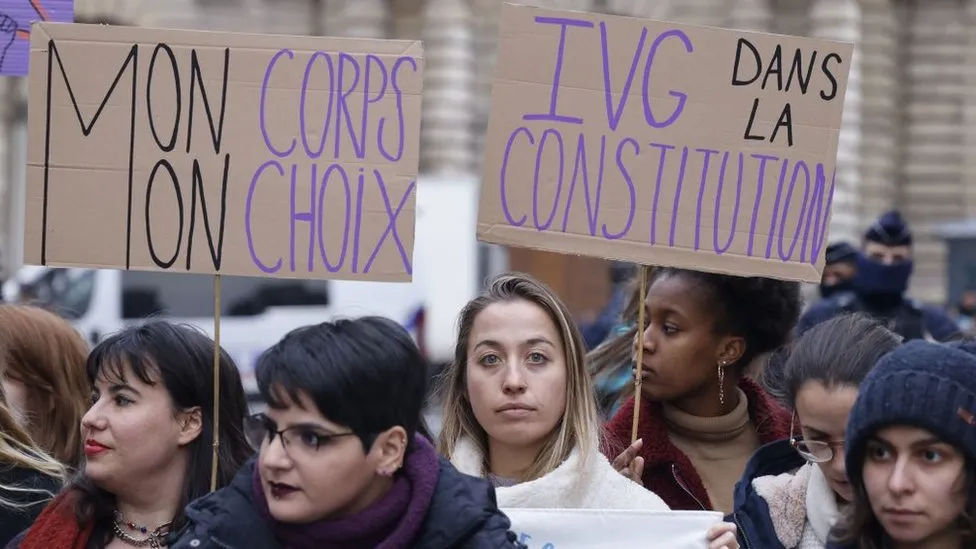
    The Senate in France voted heavily in favor of making women’s right to abortion a part of the country’s constitution.

    Since 1974, abortion has been permissible in France, but there is growing pressure to enhance and make it a more enduring legal protection.

    The suggestion was supported by 267 votes to 50 on Wednesday. It was approved by the lower house, the National Assembly. Many people are worried that in countries like the US and Poland, the right to end a pregnancy is being taken away.

    French President Emmanuel Macron wants to have another important vote on Monday. Both the Senate and the National Assembly will meet together in Versailles,outside of Paris.

    If most of the members of the joint session agree to change the constitution, there won’t be a need to ask the public to vote on it. In November 2022, a survey by Ifop found that 86% of people supported the amendment while the National Assembly was voting on the legislation.

    All of the important political parties in the country support abortion rights. The words used in the amendment about abortion were changed after the 2022 vote, when the National Assembly approved the “right” to abortion.

    Last month, the government voted to support the right to have an abortion, after Mr Macron’s government requested changes to the constitution to guarantee women’s freedom to have an abortion.

    The Senate approved the new wording about “guaranteed freedom” on Wednesday.

    Mr Macron said on X that he is dedicated to making it impossible to take away women’s right to have an abortion by putting it in the constitution.

    In response to the vote, the Justice Minister Eric Dupond-Moretti said that France is soon going to have a “historic day” because it will be the first country in the world to protect women’s freedom to decide what happens to their bodies in its constitution.

    Several conservative senators told the AFP news agency that they felt pressured to agree to the amendment.

    I was told that if I don’t vote for it, my daughters won’t come for Christmas anymore.

    The argument about abortion has been going on in the US since the Supreme Court took away the right for women to have an abortion in June 2022.

    Last month, 21 out of 50 states in the country have made laws against abortion. Some of these laws are very strict and could result in doctors and others helping with the procedure facing severe penalties like going to jail,paying a lot of money, and losing their medical licenses.

    In2020,Poland’s highest court made a decision to almost completely ban abortion in the country. Now, it is only allowed in situations where a woman has been sexually assaulted, has a serious health risk during pregnancy, or when her life is in danger.

  • Anti-gay law apologies to be debated by French Senate

    Anti-gay law apologies to be debated by French Senate

    It was really bad for me. It was very embarrassing.

    Bernard Bousset talks about the things that happened and how they made a big impact on his life. He speaks clearly, but it’s clear to see that he is still very upset about it, even after all these years.

    In 1964, a man he stayed with took his watch and some money while he was sleeping. After filing a theft report, the police accused Mr. Bousset of having sex with a minor. This was based on a law from Vichy France that discriminated, having different ages for gay and straight sex.

    Mr Bousset, who is 82 years old now, was given a big fine. However, what was even worse was how the media reported about the conviction, which made it known to everyone around him. He remembers that the outcomes were very bad. Back then, people did not think positively about homosexuality. My family stopped talking to me. I felt very embarrassed.

    “If you are gay, you might get fired and lose your place to live. ” “You had no freedom to do anything. ”

    Mr Bousset is one of around 10,000 people, mostly gay men, who were found guilty of breaking laws meant to punish homosexuals between 1942 and 1982.

    On Wednesday, the French Senate will talk about a law to say sorry to people who were hurt by unfair anti-gay laws.

    If the bill is approved, it will give money to people who were hurt by two unfair laws. During the Vichy era, the law said 21-year-olds could have sex with people of the same gender, while 13-year-olds could have sex with people of the opposite gender. After the Nazis left in 1945, the new government kept the law.

    A law passed in 1960 made it illegal to be gay, along with alcoholism, drug use, and prostitution. Antoine Idier, an associate professor at a political sciences university, says that judges had a lot of freedom to go after gay people using laws that punish public indecency.

    MrIdier says that people who were affected by the unfair laws often had their lives destroyed. People might have to pay money or go to jail for a few months. When they came out, many people were shunned by society. Some people lost their jobs or had to leave their homes and move to a new city. He also mentioned that sometimes people even commit suicide.

    Charles Trenet, the singer of La Mer and Douce France, was accused of trying to get young men to do something wrong in 1963. He was found guilty and spent 28 days in prison. Although the charges were eventually dismissed, the well-known case made Mr. Trenet’s homosexuality public, which he had kept private.

    Hussein Bourgi, a politician from the Socialist party, said it’s time to help the people who were hurt by a law that caused a lot of problems for them and their families.

    If the new law is approved, it would make France do the same thing as other European countries. They have said sorry to the people who were hurt by laws against gay people.

    In 2017, the UK passed a law called the “Turing Law” which pardoned gay men who were convicted under unfair laws. In the same year, Germany said sorry to the people hurt by laws that targeted gay people during the time of the Nazis. This continued even after the war ended.

    “According to Régis Schlagdenhauffen, an assistant professor at EHESS, France is behind other countries in addressing this issue of persecution of gay people. ” “But it needs to acknowledge the unfairness while some people who were hurt are still alive. ”

    “He says France will be better because of this. ”

    The law might not be approved. At first, some senators weren’t sure about the idea of giving €10,000 to living victims. Even if the Senate agrees to it, it still has to be approved by the National Assembly to become a law.

    Mr Idier thinks the bill is not good enough as it is. He says the law should also consider people who were found guilty before 1942. The laws at that time did not specifically aim at homosexuals, but judges had the power to use them against gay people.

    Mr Bousset thinks the bill is good, but he feels like France should have tried to deal with its past sooner.

    “It won’t make the pain I went through, and that many gay people still experience, go away,” he said. “It’s hard to believe, but even now, I feel embarrassed when I’m around straight people. ”

    I always had this strong belief that I couldn’t get rid of. “It’s inside me. “