His colleagues said he was trying to lure the lion into the cage with food at the time of the attack.
He entered an area separated from the main lion enclosure through a gate, which could not be locked.
Norichika Kumakubo, vice president of the park, said: “This process includes opening the door and ordering food. After placing food, the door must be closed and locked.
But “at that moment, the door was open,” he added.
Kato was described as a beloved veteran of the zoo who worked there for 27 years and had experience with dangerous animals such as lions, tigers and bears.
Kumakubo added that “We deeply apologize to Mr. Kato and his family.
“We take this extremely seriously. We will take measures to prevent similar accidents.
The people of Japan have expressed their dissatisfaction to China as they received numerous impolite phone calls due to the Fukushima incident.
The calls originate from phone numbers associated with Chinese area codes. A restaurant chain in Fukushima said they received over 1,000 phone calls since last Thursday. Tokyo has told people to be careful and not speak Japanese loudly if they visit China.
Beijing has been the main voice of disapproval for the release of treated waste water last week.
Tokyo has been giving daily updates, stating that there is no sign of radio activity in the seawater near the nuclear plant.
The Japanese government says that after releasing water, they received phone calls from Chinese numbers. These calls were made to government offices, schools, and even an aquarium.
The people on the phone speak in Chinese, Japanese and English – and sometimes say mean and hurtful things. They talk about how they disagree with Japan’s choice to release the treated nuclear water.
China said that the discharge was a very selfish and irresponsible thing to do.
On Thursday, it announced it will stop allowing seafood from Japan to be brought into the country.
At the moment, Tokyo wants to do regular checks for radiation in the water near the plant to calm down worries from nearby countries and fishing organizations.
The test scores will be made available every week for the next three months.
In the next 30 years, over 1 million tonnes of water stored at the nuclear plant will be released.
It has been adding up since 2011 when the plant was severely harmed by a big wave.
Japan says the water is not harmful and the United Nations’ nuclear watchdog supports this decision. However, some people who disagree believe that the release of the water should be stopped.
The water is being cleaned to take out most radioactive substances and then mixed with other substances to make the amount of a radioactive form of hydrogen called tritium lower. Tritium is hard to separate from water.
The Environment Ministry found that tritium levels in samples taken from 11 places near the plant were very low, below the minimum limit that can be detected.
According to the statement, the water will not harm humans or the environment.
There are people who disagree with letting water out in South Korea. On Thursday, there were people in Seoul who tried to enter the Japanese embassy in protest.
South Korea sent nuclear experts to Fukushima on Sunday to watch how they released radioactive materials into the environment.
The Fukushima nuclear plant’s operator asserts that the seawater in the vicinity of the facility poses no danger.
Tepco, the company in Japan, announced their testing results one day after they let out treated contaminated water. This water comes from a plant that got destroyed by a tsunami in 2011.
The waste released into the Pacific Ocean has caused people to protest and angered Beijing.
Japan advised its people residing in China to behave inconspicuously on Friday, which includes speaking softly in public.
“When you go out, try to be careful and avoid speaking Japanese loudly when it’s not necessary,” advised the Japanese embassy in Beijing. It also advised people to be careful and aware of the area around the embassy if they are planning to visit.
Japan’s consulate in Hong Kong, which is under Chinese rule, has issued a notice about upcoming protests regarding the water release. This comes after around 100 people expressed their objections by protesting on the streets last Thursday.
Chinese officials criticized Japan’s choice to release the water, calling it very selfish and irresponsible, even though the United Nations’ nuclear watchdog has given the plan its approval.
Beijing, which buys a lot of seafood from Japan, stopped importing seafood from Japan after the water was released.
People are buying a lot of sea salt because they’re afraid it might become unsafe to use in the future.
China’s largest salt producer, the government-owned National Salt Industry Group, announced that it was increasing the amount of salt available because some people in certain areas of the country were rushing to buy more salt after the water was released.
However, Tepco stated that the levels of radioactivity in samples of seawater taken on Thursday afternoon were not causing harm and were considered safe.
“We have verified that the measured amount is the same as the calculated concentration and it is less than 1,500 bq/L,” said Tepco spokesperson Keisuke Matsuo during a press conference.
Becquerels per litre, also known as bq/L, is a way of measuring how radioactive something is. The safety standard for the country is 60,000.
Mr Matsuo said that the results were like our previous simulation and below the safety limit.
He said Tepco will keep analyzing every day for the next month and even after that, they will continue to analyze.
Japan’s environment ministry collected samples of seawater from 11 places on Friday. They will share the results on Sunday.
Over the next 30 years, more than a million tonnes of water stored at Fukushima will be released or let out.
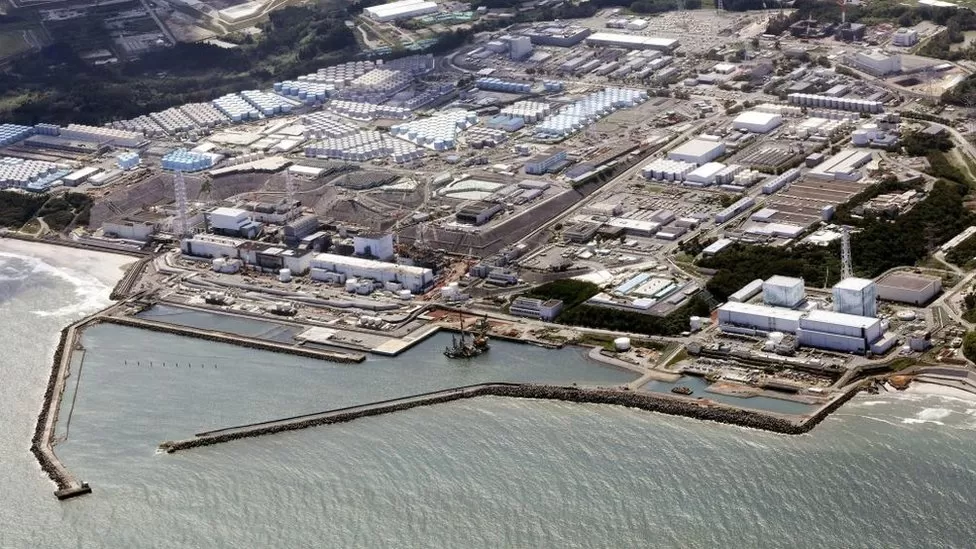
Since 2011, Tepco has been adding water to cool down the parts that are left from three reactors. The dirty water is cleaned and kept in over 1,000 big tanks.
The person in charge of the plant said that the water has been cleaned to remove all radioactive substances except for tritium, and it is now considered safe.
The International Atomic Energy Agency (IAEA) said on Thursday that the samples taken from the first amount of water that was made less strong to be discharged showed that the tritium levels were very safe.
Many scientists agree, but a group called Greenpeace, which focuses on the environment, says that the filtration process (called ALPS) does not work. They believe that a large amount of harmful radiation will be released into the ocean.
Japan is going to start putting treated radioactive water from Fukushima into the ocean soon, on Thursday. This was announced by officials on Tuesday. People have been worried and many nearby countries have also disagreed with this decision.
Prime Minister Fumio Kishida said that if there are no problems, the release will happen on August 24. The government decided this after having a meeting to talk about the issue.
The powerful earthquake and tsunami in Japan in 2011 made the water in the Fukushima nuclear plant dirty with very dangerous radioactive material. Since then, we have been pumping new water to cool down the fuel debris in the reactors. However, water from the ground and rain has been leaking in, which is making the wastewater more radioactive.
All the dirty water has been cleaned and kept in huge containers. However, there is not enough space, so they need to remove the water to safely shut down the plant. This is why they have a plan to release the water into the ocean, which has caused a lot of disagreement and debate.
In July, a group called the International Atomic Energy Agency (IAEA) approved Japan’s plan because it meets global safety rules and would have very little harmful effect on people and the environment. They confirmed this again on Tuesday after the government’s announcement, stating that they had carefully studied the plan for two years.
But this has not made many of Japan’s neighboring countries feel better, as officials from China and the Pacific Islands are expressing worry and disagreement with the plan.
In South Korea, some people have protested on the streets against the release, but the country’s leaders have shown their support for Japan. On Tuesday, the main opposition party in South Korea criticized the government for its stance. They believed that releasing this would cause a lot of damage to all the countries near Japan.
Right now, fishing communities in Japan and South Korea are concerned that the release of wastewater could destroy their way of making a living. People in the region are already starting to avoid seafood from Japan and the waters nearby, and some governments are even prohibiting imported food from certain regions in Japan, like Fukushima.
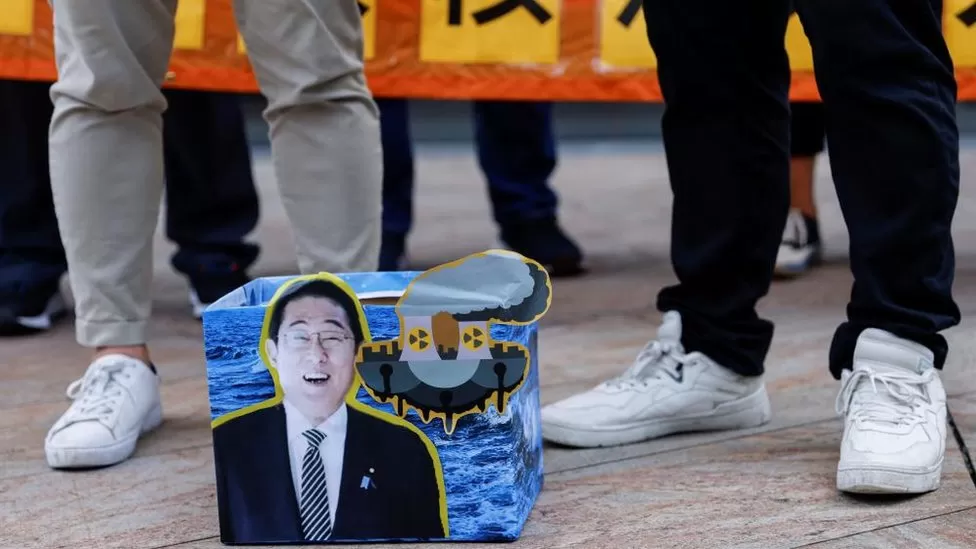
On Monday, Kishida met with the head of a group that represents fishermen from all over the country. The chairman told the prime minister that the group is still against the plan. On Tuesday, a group of people gathered outside Kishida’s office to protest against the release. They held signs and banners to show their disagreement.
According to the Tokyo Electric Power Company (TEPCO), most of the dangerous elements in radioactive wastewater can be removed through different treatment processes.
The main problem is a hydrogen type called radioactive tritium that cannot be removed. Right now, there is no technology that can do that.
Officials say that the Fukushima wastewater will be mixed with a lot of clean water and let out little by little over many years. This means that the amount of tritium released will be very small and will follow the rules set by the international community.
Many other countries, like the United States, often let out water that has been cleaned but still contains a little bit of a radioactive substance called tritium from their nuclear power plants.
TEPCO, Japan’s government, and the IAEA say that tritium is found naturally in the environment, like rain and tap water, so releasing the wastewater should be okay.
But some experts think that there is a risk while others do not. Most experts believe that a little bit of tritium is not very harmful, but it could be dangerous if a lot of it is consumed.
Some scientists are concerned that making the wastewater less concentrated could hurt marine life. This could happen because harmful chemicals could build up in the weak ecosystem. A knowledgeable person, who assisted Pacific Island nations in evaluating the plan to release wastewater, told CNN that it was not a good idea and too early to do so.
Some people believe that there aren’t enough studies or data available yet to understand the long-term impact of being exposed to tritium.
The water with less salt will be let out from a tunnel underwater near the coast into the Pacific Ocean. Other organizations like the IAEA will watch over the release of the discharge both during and after it happens.
Kinzaburo Shiga, 77, returns to Onahama harbor in the early hours of the morning after catching a trawler full of fish off the eastern coast of Japan.
The third-generation fisherman, though, won’t go right to the market. He will first check his catch for radioactivity.
Since a horrific earthquake and tsunami in 2011 caused a nuclear meltdown at the Fukushima Daiichi power plant, releasing deadly toxic particles into the surrounding area, he has been performing it as part of a ritual.
Three prefectures that had previously supplied Japan with half of its catch had their fishing operations off their coasts suspended as a result of radiation leaks from the damaged nuclear facility.
That ban lasted over a year and even after it was lifted, Fukushima-based fishermen like Shiga were for years mostly limited to collecting samples for radioactivity tests on behalf of the state-owned electricity firm Tokyo Electric Power Company, or TEPCO, rather than taking their catches to market.
Ocean currents have since dispersed the contaminated water enough that radioactive Cesiumis nearly undetectable in fishfrom Fukushima prefecture.Japan lifted its last remaining restrictions on fish from the area in 2021,and mostcountries have eased import restrictions.
Shiga and others in the industry thought they’d put the nightmare of the past years behind them.
So when Japan followed through on plans to gradually release more than 1 million metric tons of filtered wastewaterinto the Pacific Ocean from the summer of 2023 – an action the government says is necessary to decommission the plant safely – the industry reeled.
The Japanese government and the International Atomic Energy Agency (IAEA), a United Nations body promoting the peaceful use of nuclear energy, say the controlled release, which is expected to take decades, will meet international safety regulations and not harm the environment, as the water will be treated to remove radioactive elements – with the exception of tritium – and diluted more than 100 times.
But with the deadline for the planned water release looming this summer, Fukushima’s fishermen fear that– whether the release is safe or not – the move will undermine consumer confidence in their catches and once again threaten the way of life they have fought so hard to recover.
A year before the 2011 disaster, government data shows Fukushima’s coastal fishing industry landed catches worth around $69 million. By 2018, that figure had dwindled to little more than $17 million. By 2022, while it had recovered somewhat to around $26 million, it was still just a fraction of what it once was.
“I know that the government has decided to go ahead with the policy of releasing treated wastewater into the sea, but for us fishers, it really feels like they made this decision without our full consent,” said Shiga, adding that it made his “blood boil.”
In 2011, the earthquake and tsunami cut off the power supply to the Fukushima plant,disabling its cooling systems. This caused the reactor cores to overheat and contaminate water within the plant with highly radioactive material.
Since then, new water has been pumped in to cool fuel debris in the reactors. At the same time, ground and rainwater have leaked in, creating more radioactive wastewater that now needs to be stored and treated.
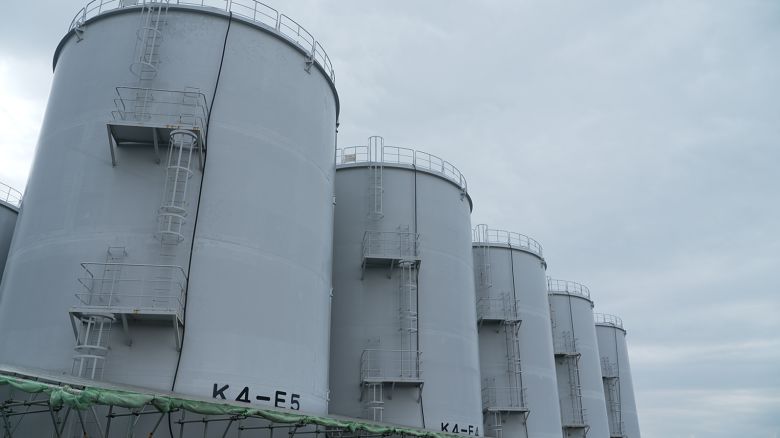
TEPCO has built over 1,000 massive tanks on the site to store what is now 1.32 million metric tonsof wastewater – enough to fill more than 500 Olympic pools.
But space is running out and the company says building more tanks isn’t an option. As decommissioning work approaches a critical stage, it says it needs to free up space to store the fuel debris from the stricken plant.
A Trade Ministry officialtold CNN the government considered five options, including hydrogen release, underground burial and vapor release, which would have seen wastewater boiled and released into the atmosphere, but in April 2021, officialsapproved the controlled release of the water into the sea. They reasoned that other nuclear facilities around the world had done this and it would be easier to monitor.
The IAEA told CNN it will also monitor and review the release for as long as necessary, at the request of the Japanese government.
While radioactive wastewater contains dangerous elements including Cesium and Strontium, TEPCO says the majority of those particles can be separated from the water and removed. TEPCO claims its filtering system, called advanced liquid processing (ALPS), can bring down the amount of those elements far below regulatory standards.
But one hydrogen isotope cannot be taken away, as there is currently no technology available to do so. Thisisotope is radioactive tritium, and the scientific community is divided on the risk its dissemination carries.
TEPCO and the Japanese government say that tritium occurs naturally in the environment. They say that the concentration of tritiated water it plans to discharge would be on par or lower than the amount other countries allow. Since 2021, they’ve been on a mission to promote public awareness about the wastewater and their plans for it, releasing videos and creating a multilingual portal.
The IAEA also says that releasing small amounts of tritium can be safe because it is already present in small quantities in everything from rain and sea water to tap water; small amounts even exist naturally in the human body.
However, experts are divided over the concept of “safe” radiation, with some arguing it is to a large extent a political rather than a scientific concept.
“For decades, nuclear power plants worldwide – including in the United States, Canada, Britain, France, China and South Korea – have been releasing waste contaminated with tritium, each under its own national quota,” said Tim Mousseau, an environmental scientist at the University of South Carolina.
But Mousseau argues tritium is overlooked because many countries are invested in nuclear energy, and “there’s no way to produce it without also generating vast amounts of tritium.”
“If people started picking on TEPCO in Fukushima, then the practice of releasing tritium to the environment in all of these other nuclear power plants would need to be examined as well. So, it opens up a can of worms,” he said, adding the biological consequences of exposure to tritium have not been studied sufficiently.
In 2012, a French literature review study said tritium can be toxic to the DNA and reproductive processes of aquatic animals, particularly invertebrates, and the sensitivity of different species to various levels of tritium needs to be further investigated.
TEPCO’s website states that it started assessing the effect of tritium on fish from Fukushima last year. A technical document published by the company in 2022 stated that “fish tritium measurement is very difficult.” It says “there are only a few analysis agencies capable of performing this measurement,” and they do not all produce the same findings.
Currently, countries set different standards for the concentration of tritium allowed in drinking water. For example. Australia, which has no nuclear power plants, allows more than 76,000 becquerel per liter, a measure used to gauge radioactivity, while the WHO’s limit is 10,000. Meanwhile, the US and the European Union have much more conservative limits – 740 and 100 becquerel per liter respectively.
Ian Fairlie, an independent consultant on radioactivity in the environment, told CNN that “two wrongs don’t make a right” when it comes to Japan’s decision to release tritiated water. He argues TEPCO should build more storage tanks to allow for the decay of the radioactive tritium, which has a half-life of 12.3 years.
In Japan, the Fukushima wastewater issue has become highly contentious due to a lack of trust among influential advocates of nuclear energy, or what’s locally known as the “nuclear village.”
The informal group includes members of Japan’s ruling party (the Liberal Democratic Party), the Ministry of Economy Trade and Industry and the nuclear industry.
“(The nuclear village) used to tell us that nuclear energy is 100% safe – but it wasn’t, as the Fukushima Daiichi plant accident revealed,” said Koichi Nakano, a political scientist at Sophia University, in Tokyo.
A series of missteps after the disasterfurther eroded public trust, according to a 2016 report written by Kohta Juraku, a researcher at Tokyo Denki University.
For instance, in 2012, the government and TEPCO presented a proposed action plan to local fishing representatives that involved pumping up groundwater before it flooded into the nuclear reactor buildings and releasing it into the sea. Fishing bodies were on board but the plan was it postponed until 2014 after 300 tons of radioactive water leaked from the plant into the sea, infuriating fishers.
Standing between the towering wastewater tanks, Kenichi Takahara, a risk communicator at TEPCO told CNN that the company is aware that people in Japan and overseas are skeptical of the company’s assurances.
“While TEPCO has been promoting nuclear safety in the first place, the nuclear accident happened in 2011. So, we understand that there are many people who can’t trust us,” said the TEPCO official.
“We are hoping that if the IAEA and other organizations can show them that there is no problem, people will understand us,” Takahara added.
Japanese officials told CNN that they have taken the voices of locals in Fukushima into consideration and will send a message to other nations andconsumers around the world that the treated water is safe to release.
Tokyo has also created a fund of 30 billion yen ($225 million) to buy and store freezable seafood if consumer confidence takes a hit following the release, an official from the Ministry of Economy, Trade and Industry told CNN.
And in an effort to convince both fishermen and consumers that the water to be released is safe, in March 2022 TEPCO started conducting tests on the tritium concentrations in fish, shellfish and seaweed reared in regular seawater as compared to those raised in ALPS-treated water.
But Satsuki Takahashi, an anthropologist specializing in sustainability studies at Hosei University, warned that changing mindsets is no easy feat.
“From the consumer’s perspective, whether it’s processed or not, this is wastewater. It’s hard for (people) to grasp what safety means or what risks mean,” she said.
“One of the biggest issues in terms of this wastewater, for those who used to purchase the fish from Fukushima before the disaster, is whether they are going to come back and buy the fish once the label states its provenance.”
For fishers like Shiga, the work to restore their way of life is far from over.
“We’re taking the initiative and appealing to consumers so they understand (our products are safe), but we have a hard time reaching them,” said Shiga, who fears that countries may reimpose bans on imports of Fukushima fish following the wastewater release.
“If the government releases the water into the sea off Fukushima now, everything we’ve done so far and our current efforts will be wasted,” he said.