Tag: Fumio Kishida

  • Japan earthquake: Japan earthquake zone impacted by fires and aftershocks

    Japan earthquake: Japan earthquake zone impacted by fires and aftershocks

    Rescuers are still working to help people in Japan after a strong earthquake on New Year’s Day killed at least 62 people.

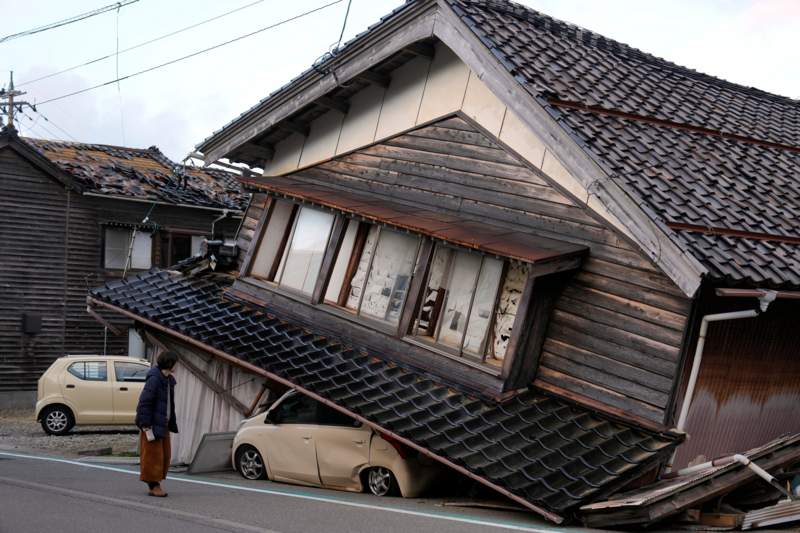
    Houses fell down, buildings started burning, and roads were badly broken, making it hard for rescue teams to help.

    The middle of the big earthquake was in the Noto peninsula in central Japan.

    The Prime Minister, Fumio Kishida, said that emergency teams are working quickly to save people who are still alive.

    He also said that 3,000 people are trying to reach parts of the Noto peninsula to try to help. “Helicopter surveys revealed lots of fires and damage to buildings and infrastructure. ” Wajima, a city at the top of Noto, can’t be reached by road.

    In Suzu, a city by the coast in Ishikawa prefecture, almost all of the homes were “completely or nearly completely destroyed”, according to the mayor, Masushiro Izumiya, who told the news outlet Kyodo.

    The Japanese army is giving things like food, water, and blankets to people who had to leave their homes. The government said 57,360 people had to leave their homes.

    Tens of thousands of meals are being brought to the area where people need them.

    Aftershocks kept happening on Tuesday. Yoshimasa Hayashi, the top government official, told people to watch out for more strong earthquakes in the next week.

    Ishikawa, which is 155 kilometers (96. 3 miles) south of the Noto peninsula, had a 4. 9 earthquake on Tuesday afternoon.

    The big tsunami warnings from Japan’s government on Monday were changed to be less serious later. By Tuesday, all warnings about a tsunami along the Sea of Japan were taken away, so there was no more danger of a tsunami happening.

    People living in the area of Japan that was affected by the earthquake have been talking about what happened during the quake, which went on for a few minutes.

    An 82-year-old man from Nanao named Toshio Iwahama said to the BBC that his old wooden house partially fell down. He said that even though he had been through many earthquakes, he had never felt one as strong as this.

    41-year-old Emma Ward from Britain was on a skiing holiday in a place called Hakuba. She said that the earthquake hit suddenly and they had to take cover under a table in a cafe. She said to the BBC that the shaking was so strong that people ran out of the building. “The scariest part of the earthquake was not knowing how bad it was going to get. ” “It’s really scary,” said Ms.

    Many people also said that the earthquake made them think of the terrible earthquake and tsunami in 2011. That one killed 18,000 people and caused a nuclear accident in Fukushima.

    A Japan Airlines plane caught fire on Tuesday because it crashed into a coastguard aircraft at Tokyo’s Haneda airport. This happened as the plane was heading to help with the earthquake relief.

    Five people on the coastguard plane died, but all 379 passengers and crew from the Japan Airlines plane were able to get away safely.

    Japan has a lot of earthquakes because it’s on the Pacific Ring of Fire where tectonic plates meet.

    Japan has made a really good warning system for tsunamis because they are always worried about earthquakes.

  • Japan: Fundraising scandal forces four cabinet ministers to resign

    Japan: Fundraising scandal forces four cabinet ministers to resign

    Four important government leaders in Japan resigned on Thursday because of a problem with raising money for the ruling party’s strongest group.

    It is claimed that over 500 million yen (equivalent to £2. 8 million or $3. 4 million) was put into secret funds between 2017 and 2022.

    Tokyo prosecutors are investigating corruption, according to Nikkei.

    The Japan Prime Minister Fumio Kishida‘s government is becoming more unpopular and his approval ratings are dropping. This is another setback for him.

    A new survey from NHK showed that the support for the ruling Liberal Democratic Party (LDP) has dropped to under 30%. This is the first time it has been this low since 2012. The LDP has been in power for a long time, since 1955.

    Voters are upset about prices going up and they are also angry about how Mr. Kishida dealt with past problems.

    Hirokazu Matsuno, a top government spokesman and close advisor to Mr Kishida, was the most well-known of the four ministers. On Thursday, the Economy and Industry Minister, the Internal Affairs Minister, and the Agriculture Minister all resigned.

    New people to take their place will be announced by the end of today.

    Also, five high-ranking deputy ministers and one deputy minister from the same group, previously led by the late PM Shinzo Abe, also resigned.

    The LDP now has no members from its biggest and most powerful group in the government because they have all quit.

    Mr Kishida, who started his job in October 2021, said on Wednesday that he will address the accusations directly.

    The group didn’t tell the authorities about the money they raised.

    The Seiwa policy group set limits on how many tickets its members could sell for party fundraising events.

    When they sold more than expected, the members got extra money. This itself does not break Japanese law.

    However, in this case, it is suggested that the extra money was not recorded and instead put into secret funds, due to a criminal complaint.

    Mr Matsuno is being accused of not reporting over 10 million yen in income.

    Other big groups in the LDP, like the one Mr Kishida used to lead, are also being accused of not reporting all the money they raised.

    On Wednesday, the lower house of Japan’s government voted against a motion to remove Mr Kishida’s cabinet, which was proposed by the opposition party.

    The LDP will choose new leaders in September. There will be a big vote in 2025.

    Some people think that even if Mr. Kishida keeps his job, the scandal will still make people less likely to trust him.

    Kishida will continue as the president for now because no one else is an obvious choice for the next president. “But if someone else becomes a real competitor, they might consider replacing Kishida,” said Yu Uchiyama, a professor at the University of Tokyo, to Reuters.

  • Akufo-Addo ‘begs’ Japan’s PM to help Ghana obtain $3bn IMF deal

    Akufo-Addo ‘begs’ Japan’s PM to help Ghana obtain $3bn IMF deal

    In order to assist Ghana in reaching a deal with the International Monetary Fund (IMF) Board for the 3 billion dollar balance of payment support, President Akufo-Addo has solicited the backing of Japan.

    According to Akufo-Addo, Japan which is a member of the Paris Club has a major role to play in Ghana securing the IMF deal.

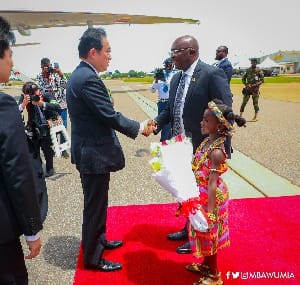
    Speaking at a meeting with the Japanese Prime Minister, Fumio Kishida who made a stopover at the Jubilee House Tuesday evening, Mr Akufo-Addo said Ghana will repay Japan’s support.

    “Ghana is also counting on the support of Japan in reaching a favourable agreement with the International Monetary Fund which will pave the way for the robust recovery of Ghana’s economy,” President Akufo-Addo said.

    In July 2022, Ghana requested for a three-year, US$3bn extended credit facility (ECF) from the IMF. An arrangement was agreed with the IMF in December 2022, with the aim of restoring credibility among investors, building reserve buffers and improving fiscal and debt sustainability.

    However, debt restructuring needs to be agreed upon with Ghana’s external creditors before the IMF’s Executive Board can sign off on the ECF.

    Meanwhile, Ghana’s hope of securing an IMF board approval is expected to delay owing to prolonged external debt-restructuring negotiations, and the involvement of numerous stakeholders in the process, according to the Economic Intelligence Unit (EIU).

    The EIU in its 2023 Country Report on Ghana, stated that it anticipates Ghana to secure restructuring agreements on its public external debt during 2023-24, involving official and private creditors alike.

    It however, notes that, given the country’s pressing macroeconomic crisis, “the conclusion of a domestic debt-swap operation in February and increasing international attention on speeding up external debt restructurings, our core forecast remains that the IMF programme will be approved by mid-2023.”

    “We expect Ghana to secure restructuring agreements on its public external debt during 2023-24, involving official and private creditors alike. This will include a combination of write-offs, maturity extensions and reductions in interest rates. We expect official creditors to agree to a deal in 2023, and this, combined with the domestic debt restructuring that has already been secured, should provide enough reassurance to reduce Ghana’s risk of debt distress and allow the IMF to approve the agreed programme”.

    “However, there is a material risk that IMF board approval will be delayed owing to prolonged external debt-restructuring negotiations, given the involvement of multiple stakeholders in the process,” it noted.

  • Japanese Prime Minister in Ghana

    Japanese Prime Minister in Ghana

    The prime minister of Japan, Fumio Kishida, is in Ghana for a two-day state visit.

    The Japanese Prime Minister is expected to hold a bilateral talks with President Akufo-Addo at the Jubilee House.

    The Asian country seeks to deepen her strong economic ties and further promote business and investment relations in Ghana, being one of the leading economic centres in West Africa.

    Japan has been supporting Ghana’s infrastructure development, especially roads, to improve the country’s transport connectivity.

    The Asian country has high hopes for Ghana, which hosts the Secretariat of the African Continental Free Trade Area (AfCFTA), to play a critical role in promoting regional integration and trade facilitation.

    The development of the bilateral relations cannot be discussed without acknowledging the achievements of Dr Hideyo Noguchi, a Japanese who had played a vital role in the healthcare sector of both countries.

    Japan is contributing to the health and medical fields in Ghana and the West African sub- region through the establishment of the Noguchi Memorial Institute for Medical Research and technical cooperation.

    The country has also supported Africa’s efforts to achieve peace and stability under the New Approach for Peace and Stability in Africa (NAPSA).

    The Japanese Prime Minister’s visit will provide an opportunity for the two countries to discuss ways to maintain peace and stability in the Sub-region.

    As the country holding the G7 Presidency, Japan is also committed to carefully listening to the voices of African countries.

  • Japanese, Chinese leaders emphasise importance of relations

    To commemorate the 50th anniversary of the normalization of diplomatic relations, Japanese Prime Minister Fumio Kishida and Chinese President Xi Jinping had a phone conversation. Relations between the two nations have historically been tense.

    Both nations have strong trading connections.

    China and Japan’s respective presidents emphasized the need to move relations in a constructive direction on the occasion of the 50th anniversary of established diplomatic relations between the two countries.

    Chinese President Xi Jinping and Japanese Prime Minister Fumio Kishida spoke on the phone on Thursday.

    Xi told Kishida that he attached “great importance” to the development of China-Japan ties and that he was willing to expand the relationship, reported China’s state channel CCTV.

    “Japan and China share a great responsibility to achieve peace and prosperity in the region and world. In view of the next 50 years … I hope to work with you to build constructive and stable Japan-China relations” Kishida told Xi.

    There was no formal event to celebrate the occasion. However, messages from both leaders were read out at an event in Tokyo backed by the government and the Chinese embassy.

    What have China-Japan ties been like?

    China and Japan have had strained relations due to multiple issues, including disputed islands and regional influence.

    Japan is concerned by Chinese activity around the disputed Tokyo-controlled Senkaku Islands, which Beijing claims and calls the Diaoyus.

    After US House of Representatives Speaker Nancy Pelosi’s visit to Taiwan, Beijing launched missiles near Taiwan into Japan’s exclusive economic zone, heightening tensions.

    The war in Ukraine also has Japan and China on opposing sides.

    However, the world’s second and third largest economies are key trade partners. China is Japan’s largest trading partner and Japan is China’s second-largest partner, after the United States.

    “I believe what we decided 50 years ago is that Japan and China do not fight and that we cooperate with each other to build relations of peace and stability,” former Japanese Prime Minister Yasuo Fukuda said at the Tokyo event with 850 business executives and politicians.

    “We need to recollect the ties that were agreed upon 50 years ago and pour our full energy into maintaining those relations for another 50, 100 years. There just can be no other way,” he said.