Tag: Galamsey

  • Family of four drowns in abandoned galamsey pit at Wassa Dankwa

    Family of four drowns in abandoned galamsey pit at Wassa Dankwa

    A 42-year-old mother and her three children have been confirmed dead after drowning in a water-filled galamsey pit at Wassa Dunkwa in the Amenfi West Municipality of the Western Region on Saturday, February 28.


    The family of four had gone near the abandoned illegal mining site in search of firewood. The eldest child, aged 14, reportedly led his younger siblings into the water-filled pit.

    The boys became trapped and were unable to escape. In an attempt to rescue her children, the 42-year-old mother also entered the pit but tragically drowned.

    The bodies of the four family members have been deposited at the Catholic Hospital morgue. Abandoned illegal mining pits have claimed the lives of Ghanaians in recent times.

    Galamsey pit collapse at Atta Ne Atta in Asutifi South has claimed the lives of nine individuals, with four others currently receiving treatment at St. Elizabeth Catholic Hospital in Hwidiem following the incident, which occurred on Monday, March 2.


    Recently, a 20-year-old student, Evans Allotey, of Okomfo Anokye Senior High School (SHS), died after falling into an abandoned mining pit on Tuesday, February 17, 2026, at Manso Akwesiso, Amansie South District of the Ashanti Region.


    The unfortunate incident reportedly occurred while he was attempting to flee military personnel who had visited the site to crack down on illegal mining activities. In reaction to the unfortunate incident, residents staged a protest to express their dissatisfaction.


    In 2025, a pit collapse at an illegal mining site at Kasotie in the Atwima Mponua District of the Ashanti Region claimed the lives of seven illegal miners who were trapped underground.

    The pit collapse, which occurred on Wednesday night, October 1, also left four injured, while several miners were trapped.


    For years, the country’s efforts to nip the canker in the bud have not yielded the needed results. Among recent measures taken to protect water bodies from illegal miners is the deployment of the National Anti-Illegal Mining Operations Secretariat (NAIMOS).


    The Secretariat includes the Ghana Armed Forces, the Ghana Police Service, the Ghana Immigration Service, the National Intelligence Bureau (NIB), the Narcotics Control Commission, and the National Security Secretariat.


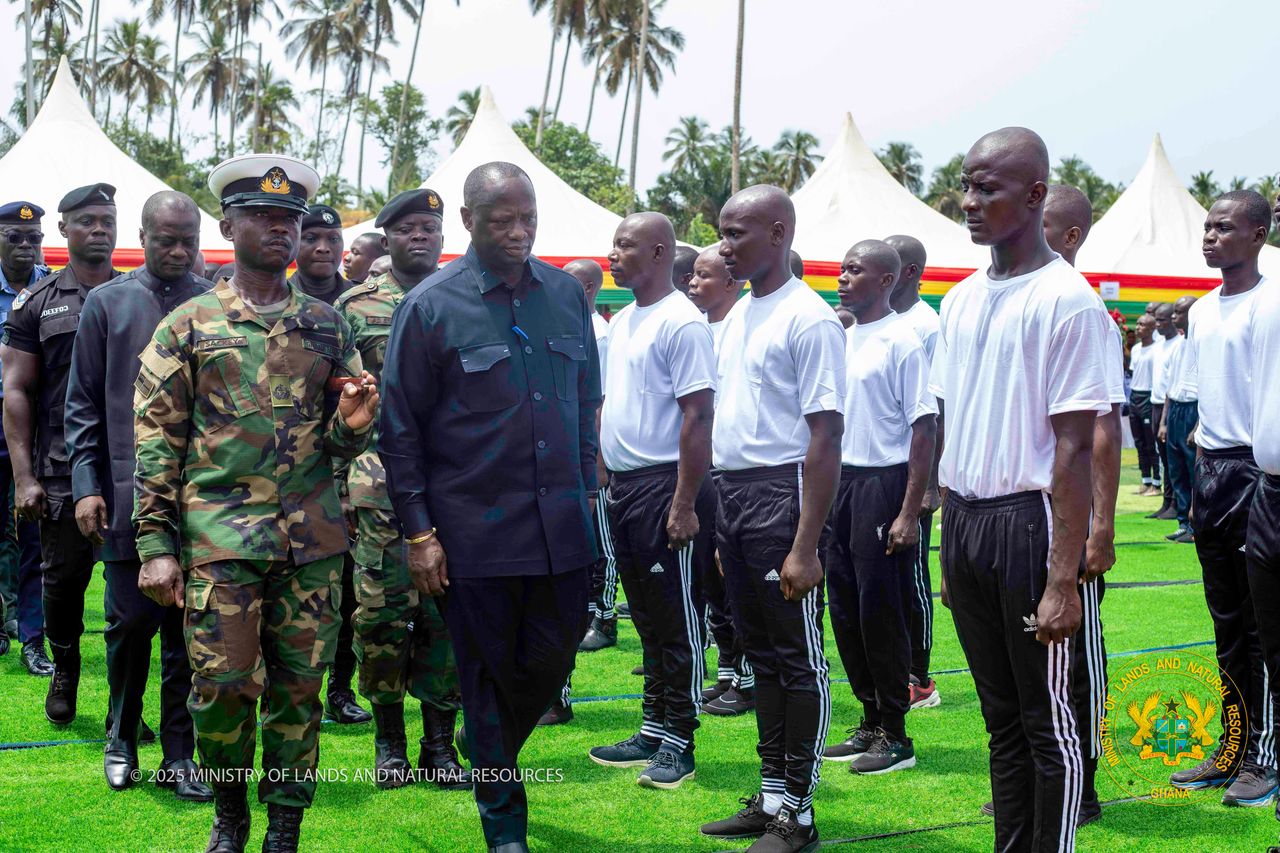
    Addressing the security forces, the Minister for Lands and Natural Resources, Emmanuel Amarh Kofi-Buah, directed the team to ruthlessly counter the activities of galamsey operators as they are the enemies of the state.


    “Any recalcitrant entering into these zones is not merely a trespasser. They are an enemy of the state. You are to be firm. You are to be resolute. You are to be ruthless.


    “And please, take it from me, you will take no obstructionist instruction from any big man. Remember, the biggest man in Ghana is the President of the Republic, and he’s the one who has sent you,” Mr Kofi-Buah charged.


    Government deployed soldiers to permanently guard 44 galamsey hotspots, including waterbodies and areas threatened by galamsey activities.


    Speaking to the media on Tuesday, September 16, the Minister of State in charge of Government Communications, Felix Kwakye Ofosu, noted, “All the 44 areas that are threatened by galamsey, there is going to be a permanent military presence”.


    According to statistics from the Lands Minister, 1,400 persons have been arrested from January to August this year in the government’s efforts to crack down on galamsey.


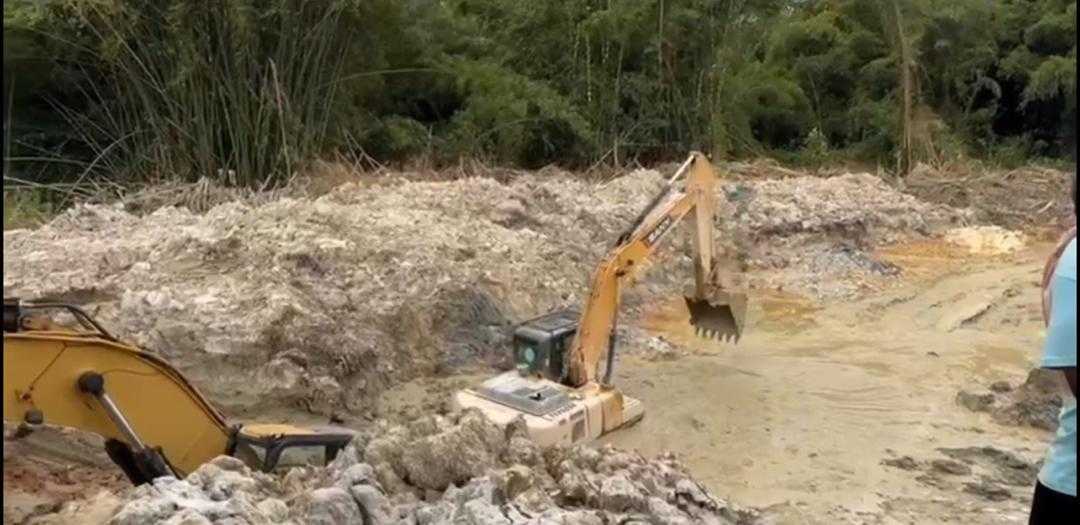
    According to him, the achievement was attained through the government’s renewed efforts. He noted that the government has seized 440 excavators and more than 800 changfans.


    “We have seized 440 excavators and more than 800 changfans. We have mobilised Blue Water Guards in key regions, and they are making a difference,” Mr. Buah stated.


    The government’s move is a response to mounting calls to declare a state of emergency over galamsey. The river guards are selected from communities most affected by illegal mining, ensuring they have a deep understanding of the local landscape and challenges.


    The government has issued an official order requiring all machinery used in mining operations to be registered with the Driver and Vehicle Licensing Authority (DVLA) by August 1st.


    A statement issued by the Ministry of the Interior on Tuesday, July 15, states that the state will proceed with confiscating unregistered mining equipment after the deadline.


    “The Government, as part of efforts to reform the mining sector in the country, requires that all machinery used in mining activities must be registered with the Driver and Vehicle Licensing Authority (DVLA) by 1st August 2025. Equipment that remains unregistered after this deadline will be confiscated by the State,” the Ministry stated on its website.


    Mr Mubarak has empowered the Ghana Police Service and DVLA to begin strict enforcement of the new rule from August 2. “The Ghana Police Service and DVLA have been directed to enforce this directive from 2nd August 2025 onward rigorously. The general public, especially those who use mining machinery, is advised to take note and comply with the directive,” he wrote.


    The Ministry reiterates its resolve to maintain national peace through effective internal security and law enforcement. Meanwhile, a similar directive came in months ago, where excavator owners and operators were asked to register their machines with the Driver and Vehicle Licensing Authority (DVLA) within two weeks or risk losing them to the state, as the government intensifies efforts to clamp down on illegal mining activities.


  • Asutifi South: Pit collapse at Atta Ne Atta leaves 9 dead

    Asutifi South: Pit collapse at Atta Ne Atta leaves 9 dead

    An illegal mining (galamsey) pit collapse at Atta Ne Atta in Asutifi South has claimed the lives of nine individuals, with four others currently receiving treatment at St. Elizabeth Catholic Hospital in Hwidiem following the incident, which occurred on Monday, March 2.

    Recently, a 20-year-old student, Evans Allotey, of Okomfo Anokye Senior High School (SHS), died after falling into an abandoned mining pit on Tuesday, February 17, 2026, at Manso Akwesiso, Amansie South District of the Ashanti Region.

    The unfortunate incident reportedly occurred while he was attempting to flee military personnel who had visited the site to crack down on illegal mining activities. In reaction to the unfortunate incident, residents staged a protest to express their dissatisfaction.

    In 2025, a pit collapse at an illegal mining site at Kasotie in the Atwima Mponua District of the Ashanti Region claimed the lives of seven illegal miners who were trapped underground. The pit collapse which occurred on Wednesday night, October 1, also left four injured, while several miners trapped.

    For years, the country’s efforts to nip the canker in the bud have not yielded the needed results. Among recent measures taken to protect water bodies from illegal miners is the deployment of the National Anti-Illegal Mining Operations Secretariat (NAIMOS).

    The Secretariat includes the Ghana Armed Forces, the Ghana Police Service, the Ghana Immigration Service, the National Intelligence Bureau (NIB), the Narcotics Control Commission, and the National Security Secretariat.

    Addressing the security forces, the Minister for Lands and Natural Resources, Emmanuel Amarh Kofi-Buah, directed the team to ruthlessly counter the activities of galamsey operators as they are the enemies of the state.

    “Any recalcitrant entering into these zones is not merely a trespasser. They are an enemy of the state. You are to be firm. You are to be resolute. You are to be ruthless.

    “And please, take it from me, you will take no obstructionist instruction from any big man. Remember, the biggest man in Ghana is the President of the Republic, and he’s the one who has sent you,” Mr Kofi-Buah charged.

    Government deployed soldiers to permanently guard 44 galamsey hotspots, including waterbodies and areas threatened by galamsey activities.

    Speaking to the media on Tuesday, September 16, the Minister of State in charge of Government Communications, Felix Kwakye Ofosu, noted, “All the 44 areas that are threatened by galamsey, there is going to be a permanent military presence”.

    According to statistics from the Lands Minister, 1,400 persons have been arrested from January to August this year in the government’s efforts to crack down on galamsey.

    According to him, the achievement was attained through the government’s renewed efforts. He noted that the government has seized 440 excavators and more than 800 changfans.

    “We have seized 440 excavators and more than 800 changfans. We have mobilised Blue Water Guards in key regions, and they are making a difference,” Mr. Buah stated.

    The government’s recent move is a response to mounting calls for the declaration of a state of emergency on galamsey.The river guards are selected from communities most affected by illegal mining, ensuring they have a deep understanding of the local landscape and challenges.

    The government has issued an official order requiring all machinery used in mining operations to be registered with the Driver and Vehicle Licensing Authority (DVLA) by August 1st.

    A statement issued by the Ministry of the Interior on Tuesday, July 15, states that the state will proceed with confiscating unregistered mining equipment after the deadline.

    “The Government, as part of efforts to reform the mining sector in the country, requires that all machinery used in mining activities must be registered with the Driver and Vehicle Licensing Authority (DVLA) by 1st August 2025. Equipment that remains unregistered after this deadline will be confiscated by the State,” the Ministry stated on its website.

    Mr Mubarak has empowered the Ghana Police Service and DVLA to begin strict enforcement of the new rule from August 2. “The Ghana Police Service and DVLA have been directed to enforce this directive from 2nd August 2025 onward rigorously. The general public, especially those who use mining machinery, is advised to take note and comply with the directive,” he wrote.

    The Ministry reiterates its resolve to maintain national peace through effective internal security and law enforcement. Meanwhile, a similar directive came in months ago, where excavator owners and operators were asked to register their machines with the Driver and Vehicle Licensing Authority (DVLA) within two weeks or risk losing them to the state, as the government intensifies efforts to clamp down on illegal mining activities.

    The Chief Executive Officer (CEO) of the DVLA, Julius Neequaye Kotey, issued the directive in Accra, warning that effective June 1, any excavator not registered with the DVLA will be confiscated.

    Speaking at a press briefing, Mr. Kotey announced that the Ghana Police Service and the DVLA’s operational team commenced a nationwide enforcement after the deadline, arresting and impounding excavators being used at mining sites or for commercial purposes without proper documentation.

    “This exercise will help identify every excavator that enters the country and trace how it is being used. The goal is to ensure we can monitor and hold people accountable,” Mr. Kotey said.

    The directive fell in line with Section 38 of the Road Traffic Act, 2004 (Act 683), which mandates the registration of all motor vehicles and trailers, including farm and heavy-duty equipment.

    Despite the law, the DVLA found many unregistered excavators operating in mining areas, some of which have been used in illegal activities.Mr Kotey emphasised that the DVLA, with its 34 offices nationwide, could register all excavators and farm machinery within two weeks and was ready to strictly enforce the directive.

    “Excavators in the hands of illegal miners have worsened the destruction of our environment. This is why we must act,” Mr Kotey said.To further control the situation, the DVLA, in collaboration with key agencies like the Minerals Commission, National Security, the Ghana Ports and Harbours Authority (GPHA), and the Customs Division of the Ghana Revenue Authority (GRA), commenced tagging all newly imported excavators.

    In addition to tagging new imports, the Minerals Commission was tasked with leading a team to tag all excavators already in the country. Legal small-scale mining sites have also been geo-fenced, with their site coordinates integrated into the Ghana Mine Repository and Tracking software for better oversight.

    The move is part of the government’s broader efforts to combat illegal mining. Three months ago, Lands and Natural Resources Minister Emmanuel Armah-Kofi Buah announced the rollout of a system to monitor excavator imports and usage, involving port tagging and digital tracking in partnership with several state agencies.

    According to the sector minister. The third most valuable item imported into this country is excavators, and it is worth GHC6.2 billion. In April, a total of 47 individuals were arrested for engaging in illegal mining activities along the Tano River and within the Aboi, Subri, and Nimiri forests in the Western Region.

    This followed a special four-day intelligence-led operation that commenced on April 17, within the Samreboi enclave.

    According to the Ghana Police Service, the suspects include 39 Ghanaians and 8 Chinese nationals. The Police indicated that a significant amount of equipment and materials believed to have been used for the mining operations were retrieved.

    These include seventeen excavators, one bulldozer, four motorbikes, two Toyota Hilux vehicles, one Rav4 vehicle, four pump-action guns, one single-barreled gun, fifty-four live BB cartridges, and eight pumping machines.

    Prosecution began for the arrested suspects. On Tuesday, 41 of them were arraigned, with 29 remanded into Police custody to reappear before the court on April 30, 2025. Twelve others were also remanded to return to court on May 2, 2025.

    The remaining seven were put before the court on April 23, 2025. Two coordinated operations conducted on Friday, June 20, at Nikanika and Adeade in the Central Region led to the arrest of 3 suspects and the seizure of several pieces of mining equipment.

    The operations were executed by the Ghana Police Service through its Special Anti-Galamsey Task Force. The task force proceeded to a mining site at Nikanika. Although no operators were found at the scene, the team retrieved a single-barrel shotgun loaded with a cartridge and three water-pumping machines.

    The task force extended its operation to Adeade, where three suspects, Prosper Quansah, Chrispin Nartey, and Owusu Gambra, were arrested with an excavator on a lowbed trailer. One SANY excavator, four unregistered Haojin motorbikes, and one lowbed vehicle with registration number GN 2136-24 were seized from the scene.All exhibits were secured in police custody.

    Some 12 accused persons standing trial for engaging in illegal mining activities at Tumetu near Princess Town in the Ahanta West Municipality of the Western Region have been remanded into prison custody.

    While 10 of the accused persons were arrested at a palm plantation, two were arrested at the Elluabo Chavene Ghana Rubber Estate Limited (GREL) plantation.This was due to a coordinated police intelligence-led operation within the Ahanta West Municipality.

    The accused persons are Lord Yankey, Caleb Adu Kwaw, Stephen Agyei, Ebenezer Barnes, Mathew Somagevi, Paa Grant, Bashiru Kaviru, Joseph Borney, Aminu Issah, Kofi Sogah, Albert Normah, and Robert Mensah.Four water pumping machines, one tricycle with registration number M-20-WR 1045, and two motorbikes were retrieved from the sites, according to the police.

    All twelve accused persons admitted to the offence during police interrogations. They were subsequently put before the Takoradi Harbour Area Circuit Court ‘A’, and were remanded into prison custody at Sekondi and reappeared before the court on Tuesday, July 8.Also, fifteen individuals are in police custody for engaging in illegal mining activities at Manso Adubia.

    They were arrested following a special intelligence-led operation at Watreso and Preacher Krom.The suspects include Tahiru Ibrahim (24), Shaibu Idrissu, (23), Boateng Emmanuel (27), Jamon Kwaku Samuel (21), Yaro Patrick (29), Kofi Boakye (21), Gubong Mathew (45), Fatawu Zackari Seidu (26), and Abdul Malik Seidu (22).The others are Dauda Tahiru (23), Sampson Grace (21), Boolangkpuo Freda (24), Arima Hagar (26), Kwarteng Vasco (30), and Kwame Adutwum (24).

    Two excavator control boards, two automatic pump-action guns, two Musler 12 firearms, 59 BB cartridges, three AA cartridges, one water pumping machine, two power generators, one vulcanizing machine, and one Apsonic motorbike were seized from the site.
  • Eastern Region: 38, including teenagers, arrested in Birim North for galamsey activities

    Eastern Region: 38, including teenagers, arrested in Birim North for galamsey activities

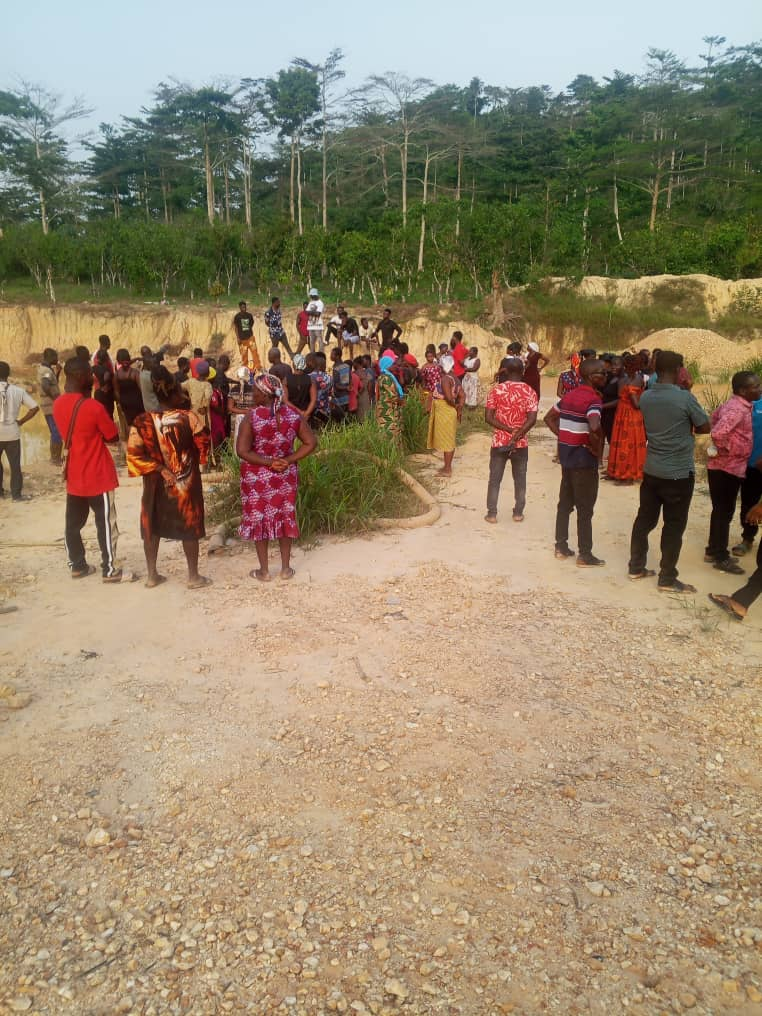
    Thirty-eight (38) individuals have been arrested by the Eastern South Regional Police Command for engaging in illegal mining activities at Ntoranang on the outskirts of New Abirem on Friday, February 27.

    Their arrest comes after the police received an intelligence over their illegal activities at a palm plantation in the area.

    The police disclosed that of the 38 arrested, 17 are Burkinabe nationals and 21 are Ghanaians, including 9 juveniles aged 13-17.

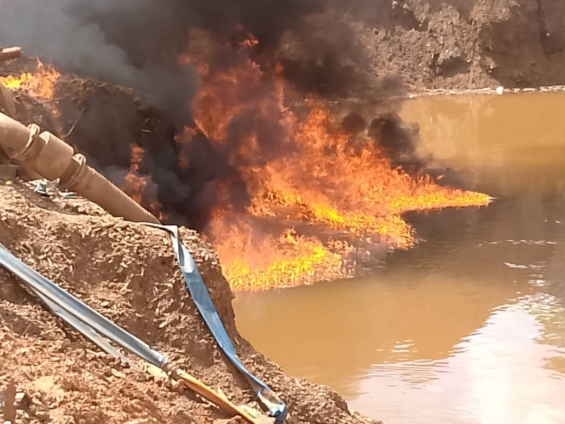
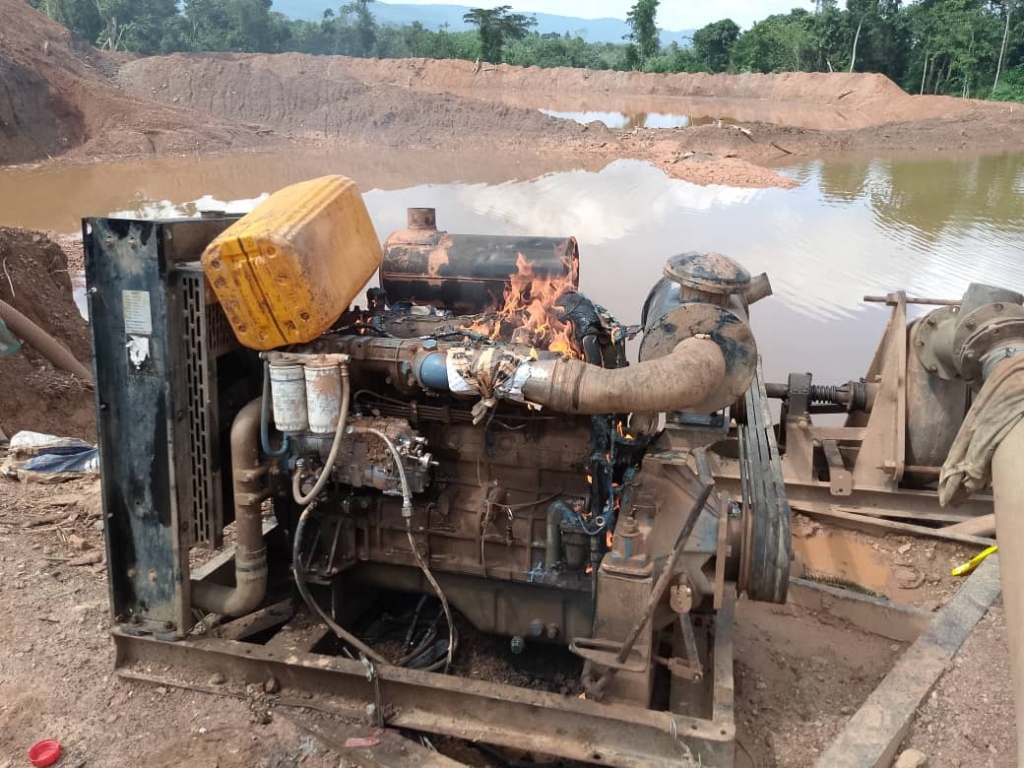
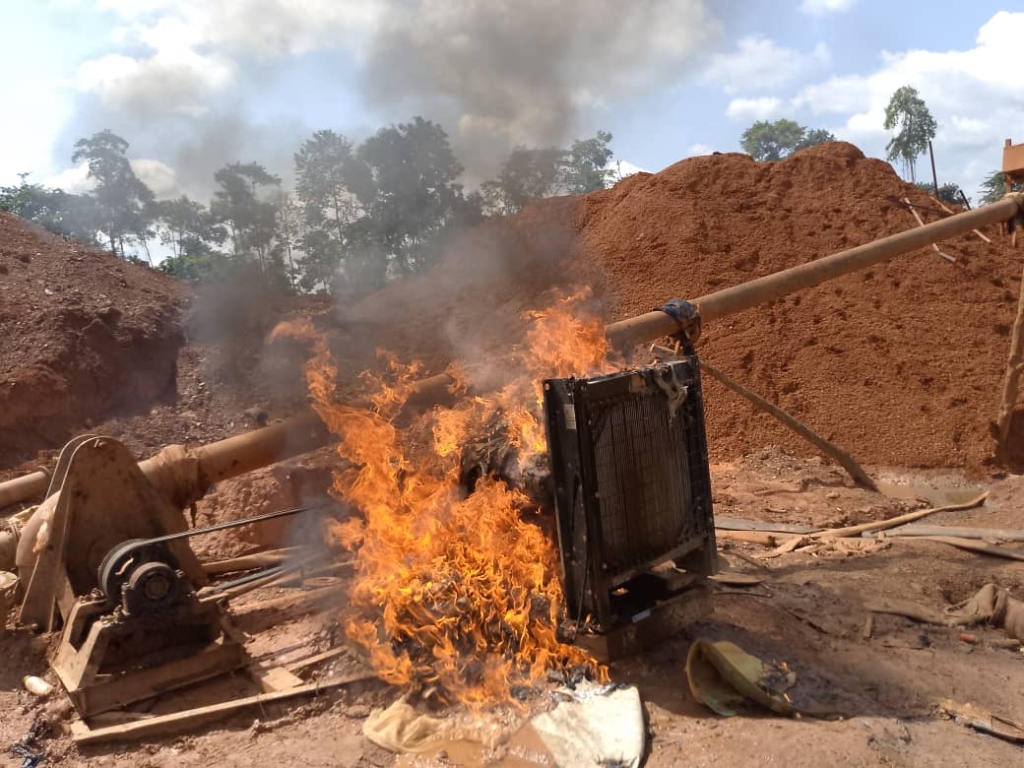
    The police destroyed items used by the suspects in their operations; including water pumping machines, power plants, water hoses and makeshift shelters.

    All 38 suspects will be arraigned before the court on Monday, March 2, for prosecution.

    Illegal mining continues to pose a major challenge to the country, with several foreign nationals implicated and multiple arrests made. In June, NAIMOS warned criminal groups to vacate galamsey areas.

    Weeks ago, the Commanding Officer of NAIMOS, Colonel Dominic Buah, signaled an imminent and aggressive crackdown on illegal miners.

    “I would like to send this warning to illegal miners, their assignees, and financiers that they are the first or prime enemies of the state, and they will be dealt with as such. There will be no room for them to escape or to hide. NAIMOS will smoke them out very soon. There’s no resting place for them,” he said at a stakeholder engagement at the Jubilee House on October 3, 2025.

    Meanwhile, President John Dramani Mahama has emphasized that his government is not backing down in its fight against the longstanding menace of illegal mining (galamsey).

    According to the President, the country will soon be cleared of the menace as the government plans to launch a programme in the coming days to reclaim degraded lands.

    He added that youths in affected communities will be employed under the programme, each receiving a monthly stipend of GH₵1,500.

    “We’re restoring degraded lands while creating thousands of jobs for young people in affected communities. I have asked the Minister of Finance to increase the budget allocation so that we can recruit more youth into forest tree planting and the Blue Water Guard to safeguard our water bodies.

    “These youth are to be recruited from affected communities, and they will receive a monthly stipend of GHC1,500. I wish to commend journalists who persist in exposing environmental crime at great personal risk. Your bravery is noted, and it’s patriotic. I wish to assure you, as the President, that I will never give up the fight,” President Mahama said.

    President Mahama made the remarks at the 2025 GJA/KGL National Awards held at the Manhyia Palace on Saturday, November 8.

    Speaking at a stakeholder engagement in Accra on October 3, the President said: “There are new chemicals that have come that allow you to treat water and take out the toxins and the heavy metals. One of them is called dowtine. The people came, and we sent them there. They took samples, tested. We are waiting for them to bring the results back.”

    President Mahama urged patience in the long-running battle against galamsey, noting that declaring a state of emergency alone will not end the menace.

    He said government advisors believe the country can overcome galamsey by adopting best practices in small-scale mining and technologies that neutralize or remove harmful chemicals from water bodies.

    He also pledged to act on calls for a state of emergency if his advisors recommend it.

    “While we are fighting the menace, I am also saying we should uptake technology in order to protect the environment. So yes, let’s fight the illegal mining but at the same time, let’s bring the new technology that will help us protect our environment.

    “Now with the elephant in the room, state of emergency, yes, I have the power to do it, but the president acts on the advice of the National Security Authority, and as at now, this moment, the National Security Authority believes that we can win the fight against galamsey without declaring a state of emergency. I want to assure you that the day they advise me otherwise, that boss, now we need a state of emergency, I won’t hesitate,” he added.

    Despite renewed efforts, the canker continues to wreak havoc.

    The National Anti-Illegal Mining Operations Secretariat (NAIMOS) task force narrowly escaped death in a mob assault at Hwidiem in the Ahafo Region on Saturday, November 1, during an operation that resulted in several arrests, including a Burkinabe national.

    Locals were seen in a viral video confronting the NAIMOS team and demanding the release of those arrested. NAIMOS spokesperson Paa Kwesi Schandorf described the attack as “extremely and profoundly disappointing,” saying the officials “survived clearly by the mercy of God. If you look at how they were charged, the rest of the team could have lost their lives.”

  • Fake NAIMOS officers arrested for allegedly extorting miners

    Fake NAIMOS officers arrested for allegedly extorting miners

    Four individuals posing as officials of the National Anti-Illegal Mining Operations Secretariat (NAIMOS) and extorting money from miners have been arrested by the police.

    The quartet reportedly approached miners at various mining sitesin the Atwima Nwabiagya South Municipality of the Ashanti Region, demandingmoney under the pretext of enforcing anti-galamsey laws.

    According to reports, the suspects used a private pump-action gun and a vehicle reportedly belonging to the National Democratic Congress (NDC) Chairman for the Atwima Kwanwoma Constituency, Simon Alolga, to carry out their operations. Impersonating security operatives remains a serious criminal offence in Ghana.

    In 2025, the Ministry of Lands and Natural Resources revealed plans to introduce an identification system to address concerns of impersonation affecting the work of the task force combatting illegal mining activities (galamsey) in the country.

    Engaging the media, Director of Communications at the Ministry of Lands and Natural Resources, Mawusi Mawuenyaefia, stated that this will aid in distinguishing between legitimate individuals and those impersonating them.

    “As part of our efforts to clamp down on illegal mining, we are working closely with local communities and have engaged regional ministers. We will soon introduce an identification system to clearly distinguish legitimate taskforce members,” she said.

    The recent decision comes after the Ghana National Association of Small Scale Miners (GNASSM) reported persistent intimidation and extortion by alleged task force.

    Speaking to the media on Monday, June 30, the Ashanti Regional Secretary of the Association, Michael Adu-Gyamfi, said these individuals act in the guise of working with the National Anti-Illegal Mining Operation Secretariat.

    “I have five zones under my jurisdiction. Each zone is a full district, and on some days, you can have three or four different teams showing up at a site, all claiming to be there for inspections”.

    “Some say they’re from the national level, others from the region or district. This unregulated situation has led to intimidation and extortion of our members,” he added.

    The government set up the National Anti-Galamsey Taskforce to tackle the menace of illegal mining.

    Efforts by the task force are aimed at regulating the mining industry to ensure operations are both responsible and environmentally sustainable.

    The Ministry of Lands and Natural Resources, Emmanuel Armah-Kofi Buah, has revealed that over 500 arrests have been made from January to May this year in response to efforts to combat illegal mining, locally known as galamsey.

    He attributed the achievement to the government’s renewed efforts.

    According to him, the previous government faced challenges due to its inability to convict the suspects.

    “From 2022 to 2024, out of 845 arrests we made, we couldn’t even prosecute. Only 35 were prosecuted, and that is 4%, and that is really the challenge we had to face,” he noted.

    The government recently announced that it has reclaimed eight out of nine forest reserves that are known as no-go zones and controlled by illegal miners (galamseyers).

    Speaking at the Global Mining Summit on Monday, June 2, President Mahama noted that the recent development marks a significant milestone in Ghana’s ongoing efforts to rehabilitate mined lands and foster sustainable mining practices.

    “Let me be clear at this juncture: artisanal miners are not enemies of the state. If properly trained and supported, they can be allies in our development. Working together with the small-scale mining sector, we will reclaim our forest reserves and restore the purity of our water bodies,” the President said.

    According to President John Dramani Mahama, the government plans to reclaim 10,000 hectares of mined-out lands from illegal mining activities.

    The Ghana Police Service, in recent times, has embarked on several operations to crack down on illegal mining activities.

    Its special Anti-Galamsey Taskforce seized more than 100 excavators, along with weapons, chanfang machines, bulldozers, and other illegal mining equipment.

    The police’s efforts have also resulted in the arrest of numerous individuals who are undergoing legal proceedings.

    Meanwhile, President John Dramani Mahama has announced that the government, in the coming days, will approve the importation of excavators except through a valid permit.

    “We will track excavators to know whether they are being used for illegal mining. Ghana currently has more excavators than the rest of Africa combined. The new permitting regime will not allow you to import any excavator unless you have a valid permit to do so,” President Mahama stated.

    A few months ago, the Lands and Natural Resources Minister, Emmanuel Armah-Kofi Buah, announced the rollout of a system to monitor excavator imports and usage, involving port tagging and digital tracking in partnership with several state agencies.

    The third most valuable item imported into this country is excavators, and it is worth GHC6.2 billion, according to the sector minister.

    The joint Military-Forestry Commission task force that conducted targeted operations in high-risk districts across the Ashanti, Western, and Western North Regions led to the seizure of 100 excavators, three bulldozers, and four vehicles.

    Excavator owners and operators who have failed to register their machines with the Driver and Vehicle Licensing Authority (DVLA) risk losing them to the state, as the government intensifies efforts to clamp down on illegal mining activities.

    The Chief Executive Officer (CEO) of the DVLA, Julius Neequaye Kotey, issued the directive in Accra, warning that effective June 1, any excavator not registered with the DVLA will be confiscated.

    Speaking at a press briefing, Mr. Kotey announced that the Ghana Police Service and the DVLA’s operational team will begin nationwide enforcement after the deadline, arresting and impounding excavators being used at mining sites or for commercial purposes without proper documentation.

    “This exercise will help identify every excavator that enters the country and trace how it is being used. The goal is to ensure we can monitor and hold people accountable,” Mr. Kotey said.

    The directive falls in line with Section 38 of the Road Traffic Act, 2004 (Act 683), which mandates the registration of all motor vehicles and trailers, including farm and heavy-duty equipment. Despite the law, the DVLA has found many unregistered excavators operating in mining areas, some of which have been used in illegal activities.

    Mr. Kotey emphasized that the DVLA, with its 34 offices nationwide, has the capacity to register all excavators and farm machinery within the two-week period and is ready to strictly enforce the directive.

    He stressed the environmental toll caused by unregulated excavator use in illegal mining, saying, “Excavators in the hands of illegal miners have worsened the destruction of our environment. This is why we must act.”

    To further control the situation, the DVLA, in collaboration with key agencies like the Minerals Commission, National Security, the Ghana Ports and Harbours Authority (GPHA), and the Customs Division of the Ghana Revenue Authority (GRA), has started tagging all newly imported excavators.

    In addition to tagging new imports, the Minerals Commission has been tasked to lead a team that will tag all excavators already in the country. Legal small-scale mining sites have also been geo-fenced, with their site coordinates integrated into the Ghana Mine Repository and Tracking software for better oversight.

  • 20-year-old dies after falling in abandoned mining pit

    20-year-old dies after falling in abandoned mining pit

    A 20-year-old student, Evans Allotey, of Okomfo Anokye Senior High School (SHS), has died after falling into an abandoned mining pit on Tuesday, February 17, 2026, at Manso Akwesiso, Amansie South District of the Ashanti Region. 

    The unfortunate incident reportedly occurred while he was attempting to flee military personnel who had visited the site to crack down on illegal mining activities. In reaction to the unfortunate incident, residents staged a protest to express their dissatisfaction.  

    In 2025, a pit collapse at an illegal mining site at Kasotie in the Atwima Mponua District of the Ashanti Region claimed the lives of seven illegal miners who were trapped underground. The pit collapse which occurred on Wednesday night, October 1, also left four injured, while several miners trapped. 

    For years, the country’s efforts to nip the canker in the bud have not yielded the needed results. Among recent measures taken to protect water bodies from illegal miners is the deployment of the National Anti-Illegal Mining Operations Secretariat (NAIMOS).

    The Secretariat includes the Ghana Armed Forces, the Ghana Police Service, the Ghana Immigration Service, the National Intelligence Bureau (NIB), the Narcotics Control Commission, and the National Security Secretariat.

    Addressing the security forces, the Minister for Lands and Natural Resources, Emmanuel Amarh Kofi-Buah, directed the team to ruthlessly counter the activities of galamsey operators as they are the enemies of the state.

    “Any recalcitrant entering into these zones is not merely a trespasser. They are an enemy of the state. You are to be firm. You are to be resolute. You are to be ruthless.

    “And please, take it from me, you will take no obstructionist instruction from any big man. Remember, the biggest man in Ghana is the President of the Republic, and he’s the one who has sent you,” Mr Kofi-Buah charged.

    Government deployed soldiers to permanently guard 44 galamsey hotspots, including waterbodies and areas threatened by galamsey activities.

    Speaking to the media on Tuesday, September 16, the Minister of State in charge of Government Communications, Felix Kwakye Ofosu, noted, “All the 44 areas that are threatened by galamsey, there is going to be a permanent military presence”.

    According to statistics from the Lands Minister, 1,400 persons have been arrested from January to August this year in the government’s efforts to crack down on galamsey.

    According to him, the achievement was attained through the government’s renewed efforts. He noted that the government has seized 440 excavators and more than 800 changfans.

    “We have seized 440 excavators and more than 800 changfans. We have mobilised Blue Water Guards in key regions, and they are making a difference,” Mr. Buah stated.

    The government’s recent move is a response to mounting calls for the declaration of a state of emergency on galamsey.The river guards are selected from communities most affected by illegal mining, ensuring they have a deep understanding of the local landscape and challenges.

    The government has issued an official order requiring all machinery used in mining operations to be registered with the Driver and Vehicle Licensing Authority (DVLA) by August 1st.

    A statement issued by the Ministry of the Interior on Tuesday, July 15, states that the state will proceed with confiscating unregistered mining equipment after the deadline.

    “The Government, as part of efforts to reform the mining sector in the country, requires that all machinery used in mining activities must be registered with the Driver and Vehicle Licensing Authority (DVLA) by 1st August 2025. Equipment that remains unregistered after this deadline will be confiscated by the State,” the Ministry stated on its website.

    Mr Mubarak has empowered the Ghana Police Service and DVLA to begin strict enforcement of the new rule from August 2. “The Ghana Police Service and DVLA have been directed to enforce this directive from 2nd August 2025 onward rigorously. The general public, especially those who use mining machinery, is advised to take note and comply with the directive,” he wrote.

    The Ministry reiterates its resolve to maintain national peace through effective internal security and law enforcement. Meanwhile, a similar directive came in months ago, where excavator owners and operators were asked to register their machines with the Driver and Vehicle Licensing Authority (DVLA) within two weeks or risk losing them to the state, as the government intensifies efforts to clamp down on illegal mining activities.

    The Chief Executive Officer (CEO) of the DVLA, Julius Neequaye Kotey, issued the directive in Accra, warning that effective June 1, any excavator not registered with the DVLA will be confiscated.

    Speaking at a press briefing, Mr. Kotey announced that the Ghana Police Service and the DVLA’s operational team commenced a nationwide enforcement after the deadline, arresting and impounding excavators being used at mining sites or for commercial purposes without proper documentation.

    “This exercise will help identify every excavator that enters the country and trace how it is being used. The goal is to ensure we can monitor and hold people accountable,” Mr. Kotey said.

    The directive fell in line with Section 38 of the Road Traffic Act, 2004 (Act 683), which mandates the registration of all motor vehicles and trailers, including farm and heavy-duty equipment.

    Despite the law, the DVLA found many unregistered excavators operating in mining areas, some of which have been used in illegal activities.Mr Kotey emphasised that the DVLA, with its 34 offices nationwide, could register all excavators and farm machinery within two weeks and was ready to strictly enforce the directive.

    “Excavators in the hands of illegal miners have worsened the destruction of our environment. This is why we must act,” Mr Kotey said.To further control the situation, the DVLA, in collaboration with key agencies like the Minerals Commission, National Security, the Ghana Ports and Harbours Authority (GPHA), and the Customs Division of the Ghana Revenue Authority (GRA), commenced tagging all newly imported excavators.

    In addition to tagging new imports, the Minerals Commission was tasked with leading a team to tag all excavators already in the country. Legal small-scale mining sites have also been geo-fenced, with their site coordinates integrated into the Ghana Mine Repository and Tracking software for better oversight.

    The move is part of the government’s broader efforts to combat illegal mining. Three months ago, Lands and Natural Resources Minister Emmanuel Armah-Kofi Buah announced the rollout of a system to monitor excavator imports and usage, involving port tagging and digital tracking in partnership with several state agencies.

    According to the sector minister. The third most valuable item imported into this country is excavators, and it is worth GHC6.2 billion. In April, a total of 47 individuals were arrested for engaging in illegal mining activities along the Tano River and within the Aboi, Subri, and Nimiri forests in the Western Region.

    This followed a special four-day intelligence-led operation that commenced on April 17, within the Samreboi enclave.

    According to the Ghana Police Service, the suspects include 39 Ghanaians and 8 Chinese nationals. The Police indicated that a significant amount of equipment and materials believed to have been used for the mining operations were retrieved.

    These include seventeen excavators, one bulldozer, four motorbikes, two Toyota Hilux vehicles, one Rav4 vehicle, four pump-action guns, one single-barreled gun, fifty-four live BB cartridges, and eight pumping machines.

    Prosecution began for the arrested suspects. On Tuesday, 41 of them were arraigned, with 29 remanded into Police custody to reappear before the court on April 30, 2025. Twelve others were also remanded to return to court on May 2, 2025.

    The remaining seven were put before the court on April 23, 2025. Two coordinated operations conducted on Friday, June 20, at Nikanika and Adeade in the Central Region led to the arrest of 3 suspects and the seizure of several pieces of mining equipment.

    The operations were executed by the Ghana Police Service through its Special Anti-Galamsey Task Force. The task force proceeded to a mining site at Nikanika. Although no operators were found at the scene, the team retrieved a single-barrel shotgun loaded with a cartridge and three water-pumping machines.

    The task force extended its operation to Adeade, where three suspects, Prosper Quansah, Chrispin Nartey, and Owusu Gambra, were arrested with an excavator on a lowbed trailer. One SANY excavator, four unregistered Haojin motorbikes, and one lowbed vehicle with registration number GN 2136-24 were seized from the scene.All exhibits were secured in police custody.

    Some 12 accused persons standing trial for engaging in illegal mining activities at Tumetu near Princess Town in the Ahanta West Municipality of the Western Region have been remanded into prison custody.

    While 10 of the accused persons were arrested at a palm plantation, two were arrested at the Elluabo Chavene Ghana Rubber Estate Limited (GREL) plantation.This was due to a coordinated police intelligence-led operation within the Ahanta West Municipality.

    The accused persons are Lord Yankey, Caleb Adu Kwaw, Stephen Agyei, Ebenezer Barnes, Mathew Somagevi, Paa Grant, Bashiru Kaviru, Joseph Borney, Aminu Issah, Kofi Sogah, Albert Normah, and Robert Mensah.Four water pumping machines, one tricycle with registration number M-20-WR 1045, and two motorbikes were retrieved from the sites, according to the police.

    All twelve accused persons admitted to the offence during police interrogations. They were subsequently put before the Takoradi Harbour Area Circuit Court ‘A’, and were remanded into prison custody at Sekondi and reappeared before the court on Tuesday, July 8.Also, fifteen individuals are in police custody for engaging in illegal mining activities at Manso Adubia.

    They were arrested following a special intelligence-led operation at Watreso and Preacher Krom.The suspects include Tahiru Ibrahim (24), Shaibu Idrissu, (23), Boateng Emmanuel (27), Jamon Kwaku Samuel (21), Yaro Patrick (29), Kofi Boakye (21), Gubong Mathew (45), Fatawu Zackari Seidu (26), and Abdul Malik Seidu (22).The others are Dauda Tahiru (23), Sampson Grace (21), Boolangkpuo Freda (24), Arima Hagar (26), Kwarteng Vasco (30), and Kwame Adutwum (24).

    Two excavator control boards, two automatic pump-action guns, two Musler 12 firearms, 59 BB cartridges, three AA cartridges, one water pumping machine, two power generators, one vulcanizing machine, and one Apsonic motorbike were seized from the site.

  • Illegal miners flee as NAIMOS confiscates guns, others in Ashanti Region

    Illegal miners flee as NAIMOS confiscates guns, others in Ashanti Region

    The crackdown on illegal mining activities in the Ashanti Region has taken heightened momentum, as security forces intensify operations against illegal miners operating across forest reserves and along major river bodies.

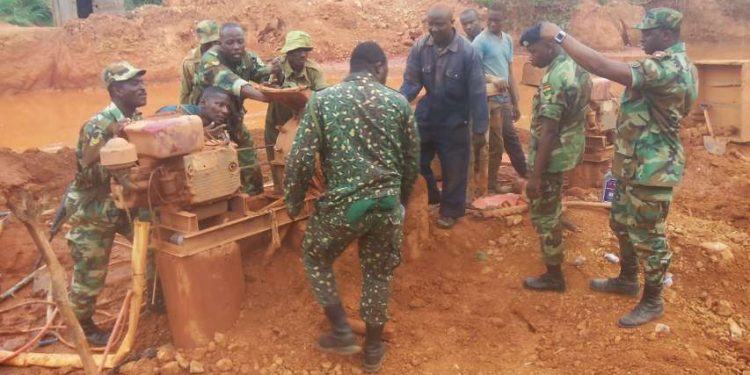
    On February 14 and 15, the National Anti-Illegal Mining Operations Secretariat (NAIMOS) stormed multiple galamsey sites in the Ashanti Region, seizing heavy equipment such as guns, excavators and other equipment used for illegal mining activities.

    The exercise was conducted in Edwinase in the Bekwai Municipality and Wromanso in the Amansie Central District along the River Offin. According to reports, several miners fled upon seeing the approaching vehicles of the taskforce.

    Illegal mining continues to pose a major challenge to the country, with several foreign nationals implicated and multiple arrests made. Meanwhile, scientific tests are underway on new chemicals that could help restore polluted water bodies and rivers affected by galamsey.

    Speaking at a stakeholder engagement in Accra on October 3, the President said: “There are new chemicals that have come that allow you to treat water and take out the toxins and the heavy metals. One of them is called dowtine. The people came, and we sent them there. They took samples and tested. We are waiting for them to bring the results back.”

    John Dramani Mahama urged patience in the long-running battle against galamsey, noting that declaring a state of emergency alone will not end the menace.

    He said government advisors believe the country can overcome galamsey by adopting best practices in small-scale mining and technologies that neutralise or remove harmful chemicals from water bodies. He also pledged to act on calls for a state of emergency if his advisors recommend it.

    “While we are fighting the menace, I am also saying we should uptake technology in order to protect the environment. So yes, let’s fight the illegal mining but at the same time, let’s bring the new technology that will help us protect our environment.

    “Now with the elephant in the room, state of emergency, yes, I have the power to do it, but the president acts on the advice of the National Security Authority, and as at now, this moment, the National Security Authority believes that we can win the fight against galamsey without declaring a state of emergency. I want to assure you that the day they advise me otherwise, that boss, now we need a state of emergency, I won’t hesitate,” he added.

    Despite renewed efforts, the canker continues to wreak havoc. The newly established NAIMOS task force narrowly escaped death in a mob assault at Hwidiem in the Ahafo Region on Saturday, November 1, during an operation that resulted in several arrests, including a Burkinabe national.

    Locals were seen in a viral video confronting the NAIMOS team and demanding the release of those arrested. NAIMOS spokesperson Paa Kwesi Schandorf described the attack as “extremely and profoundly disappointing,” saying the officials “survived clearly by the mercy of God. If you look at how they were charged, the rest of the team could have lost their lives.”

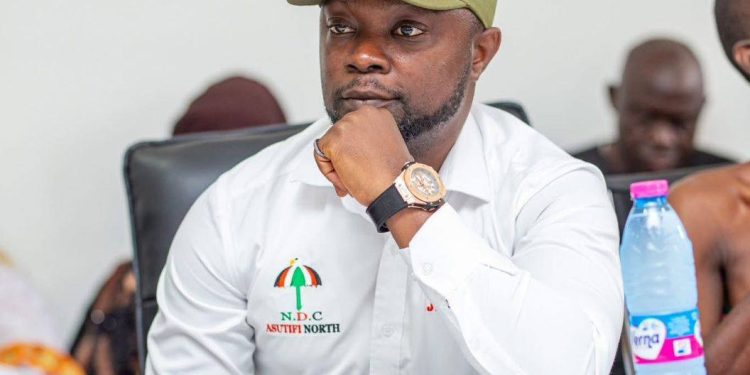
    The Member of Parliament for Asutifi North, Ebenezer Kwaku Addo, was, however, accused of inciting the mob against the NAIMOS team.

    NAIMOS has been active across the country, including raids in the Offin Shelterbelt Forest Reserve (Ashanti Region), Apemkro and Anwiafutu, and Ataso, where the team seized two excavators and destroyed water pumps and other illicit mining tools.

    In the Western Region, an intelligence-led operation on October 5, 2025, saw NAIMOS demolish a notorious illegal mining base at Aboso — known as ‘Gunway’ — dismantling makeshift structures used as hideouts and drug dens and confiscating mining equipment and quantities of hard drugs, including seven parcels of Indian hemp.

    In June, NAIMOS warned criminal groups to vacate galamsey areas. Weeks ago, the Commanding Officer of NAIMOS, Dominic Buah, signalled an imminent and aggressive crackdown on illegal miners.

    “I would like to send this warning to illegal miners, their assignees and financiers that they are the first or prime enemies of the state, and they will be dealt with as such. There will be no room for them to escape or to hide. NAIMOS will smoke them out very soon. There’s no resting place for them,” he said at a stakeholder engagement at the Jubilee House on October 3, 2025.

  • Galamsey: Farmers in Wa West receive seized water pumping machines from govt

    Galamsey: Farmers in Wa West receive seized water pumping machines from govt

    The government has handed over 50 water pumping machines seized during illegal mining operations to farmers in Siiru in the Wa West District of the Upper West Region to support irrigation activities. The donation, made by the Ministry of Lands and Natural Resources, is aimed at helping farmers boost irrigation and improve agricultural production in the area.

    Minister for Food and Agriculture (MoFA), Mr Eric Opoku in 2025 announced that farmers in nine regions will each receive 100 water-pumping machines seized from galamsey sites to support the implementation of the government’s Feed Ghana Programme.

    He made this known while presenting the machines at the Agricultural Engineering Service Directorate Office at Amrahia in Accra last week.

    According to him, nine hundred (900) machines were seized by a task force in the fight against galamsey and will be handed to farmers in Upper East, Upper West, North East, Savannah, Northern, Greater Accra, Volta, Oti, and Bono East for agricultural use following a court order.

    “We wanted to avoid a situation where these machines, after being distributed, end up at galamsey sites again. That is why we deliberately chose regions without active illegal mining operations,” Mr. Opoku explained.

    Mr. Opoku stated that the equipment had undergone inspection by the Ministry of Food and Agriculture’s technical personnel, who found them in safe condition for use on farms.

    Speaking on behalf of the beneficiary regions, the Northern Regional Minister, John Ali Adolf, assured that the machines would be used for their intended purposes and would never be returned to any galamsey site. He added that, as regional ministers, they would periodically monitor the use of the machines.

    “We wouldn’t want anyone, for any reason, to ever attempt galamsey activities in our regions. These machines will be used to help farmers on their farms so that they can water crops across the seasons, especially during the dry season,” he explained.

    Mr. Adolf expressed gratitude to President John Dramani Mahama for his dedication to the fight against galamsey in the country.

    Government’s efforts to clamp down on illegal mining activities

    The government has rolled out an official order requiring all machinery used in mining operations to be registered with the Driver and Vehicle Licensing Authority (DVLA) by August 1. A statement issued by the Ministry of the Interior on Tuesday, July 15, states that the state will confiscate unregistered mining equipment after the deadline.

    “The Government, as part of efforts to reform the mining sector in the country, requires that all machinery used in mining activities must be registered with the Driver and Vehicle Licensing Authority (DVLA) by 1st August 2025. Equipment that remains unregistered after this deadline will be confiscated by the State,” the Ministry stated on its website.

    Mr. Mubarak empowered the Ghana Police Service and DVLA to begin strict enforcement of the new rule from August 2. “The Ghana Police Service and DVLA have been directed to enforce this directive from 2nd August 2025 onward rigorously. The general public, especially those who use mining machinery, are advised to take note and comply with the directive,” he wrote.

    The Ministry reiterated its resolve to maintain national peace through effective internal security and law enforcement. Meanwhile, a similar directive was issued months ago, asking excavator owners and operators to register their machines with the DVLA within two weeks or risk losing them to the state as the government intensifies efforts to clamp down on illegal mining activities.

    The Chief Executive Officer (CEO) of the DVLA, Julius Neequaye Kotey, issued the directive in Accra, warning that effective June 1, any excavator not registered with the DVLA would be confiscated. Speaking at a press briefing, Mr. Kotey announced that the Ghana Police Service and the DVLA’s operational team had commenced nationwide enforcement after the deadline, arresting and impounding excavators being used at mining sites or for commercial purposes without proper documentation.

    “This exercise will help identify every excavator that enters the country and trace how it is being used. The goal is to ensure we can monitor and hold people accountable,” Mr. Kotey said.

    The directive aligns with Section 38 of the Road Traffic Act, 2004 (Act 683), which mandates the registration of all motor vehicles and trailers, including farm and heavy-duty equipment. Despite the law, the DVLA found many unregistered excavators operating in mining areas, some of which had been used in illegal activities.

    Mr. Kotey emphasized that the DVLA, with its 34 offices nationwide, could register all excavators and farm machinery within two weeks and was ready to strictly enforce the directive. “Excavators in the hands of illegal miners have worsened the destruction of our environment. This is why we must act,” Mr. Kotey said.

    To further control the situation, the DVLA, in collaboration with key agencies like the Minerals Commission, National Security, the Ghana Ports and Harbours Authority (GPHA), and the Customs Division of the Ghana Revenue Authority (GRA), commenced tagging all newly imported excavators.

    In addition to tagging new imports, the Minerals Commission was tasked with leading a team to tag all excavators already in the country. Legal small-scale mining sites have also been geo-fenced, with their site coordinates integrated into the Ghana Mine Repository and Tracking software for better oversight.

    The move is part of broader government efforts to combat illegal mining. Three months ago, Lands and Natural Resources Minister Emmanuel Armah-Kofi Buah announced the rollout of a system to monitor excavator imports and usage, involving port tagging and digital tracking in partnership with several state agencies. According to the sector minister, the third most valuable item imported into the country is excavators, worth GHC6.2 billion.

    Crackdown on illegal mining activities

    In April, a total of 47 individuals were arrested for engaging in illegal mining activities along the Tano River and within the Aboi, Subri, and Nimiri forests in the Western Region. This followed a special four-day intelligence-led operation that commenced on April 17 within the Samreboi enclave.

    According to the Ghana Police Service, the suspects included 39 Ghanaians and 8 Chinese nationals. The Police indicated that a significant amount of equipment and materials believed to have been used for the mining operations were retrieved, including seventeen excavators, one bulldozer, four motorbikes, two Toyota Hilux vehicles, one Rav4 vehicle, four pump-action guns, one single-barrel gun, fifty-four live BB cartridges, and eight pumping machines.

    Prosecution began for the arrested suspects. On Tuesday, 41 of them were arraigned, with 29 remanded into police custody to reappear before the court on April 30, 2025. Twelve others were also remanded to return to court on May 2, 2025. The remaining seven were put before the court on April 23, 2025.

    Two coordinated operations conducted on Friday, June 20, at Nikanika and Adeade in the Central Region led to the arrest of three suspects and the seizure of several pieces of mining equipment. The operations were executed by the Ghana Police Service through its Special Anti-Galamsey Task Force.

    The task force proceeded to a mining site at Nikanika. Although no operators were found at the scene, the team retrieved one single-barrel shotgun loaded with a cartridge and three water-pumping machines. The task force extended its operation to Adeade, where three suspects—Prosper Quansah, Chrispin Nartey, and Owusu Gambra—were arrested with an excavator on a lowbed trailer.

    One SANY excavator, four unregistered Haojin motorbikes, and one lowbed vehicle with registration number GN 2136-24 were seized from the scene. All exhibits were secured in police custody.

    Some 12 accused persons standing trial for engaging in illegal mining activities at Tumetu near Princess Town in the Ahanta West Municipality of the Western Region were remanded into prison custody. While 10 of the accused persons were arrested at a palm plantation, two were arrested at the Elluabo Chavene Ghana Rubber Estate Limited (GREL) plantation.

    This was due to a coordinated police intelligence-led operation within the Ahanta West Municipality. The accused persons are Lord Yankey, Caleb Adu Kwaw, Stephen Agyei, Ebenezer Barnes, Mathew Somagevi, Paa Grant, Bashiru Kaviru, Joseph Borney, Aminu Issah, Kofi Sogah, Albert Normah, and Robert Mensah. Four water-pumping machines, one tricycle with registration number M-20-WR 1045, and two motorbikes were retrieved from the sites, according to the police.

    All twelve accused persons admitted to the offence during police interrogations. They were subsequently put before the Takoradi Harbour Area Circuit Court ‘A’ and remanded into prison custody at Sekondi, reappearing before the court on Tuesday, July 8.

    Additionally, fifteen individuals are in police custody for engaging in illegal mining activities at Manso Adubia. They were arrested following a special intelligence-led operation at Watreso and Preacher Krom.

    The suspects include Tahiru Ibrahim (24), Shaibu Idrissu (23), Boateng Emmanuel (27), Jamon Kwaku Samuel (21), Yaro Patrick (29), Kofi Boakye (21), Gubong Mathew (45), Fatawu Zackari Seidu (26), Abdul Malik Seidu (22), Dauda Tahiru (23), Sampson Grace (21), Boolangkpuo Freda (24), Arima Hagar (26), Kwarteng Vasco (30), and Kwame Adutwum (24).

    Two excavator control boards, two automatic pump-action guns, two Musler 12 firearms, 59 BB cartridges, three AA cartridges, one water-pumping machine, two power generators, one vulcanizing machine, and one Apsonic motorbike were seized from the site.

  • 320 hectares of land reclaimed from illegal miners in Ashanti Region – Lands Minister

    320 hectares of land reclaimed from illegal miners in Ashanti Region – Lands Minister


    320 hectares of degraded land at Manso Nyankomanse in the Ashanti Region have been reclaimed as part of the government’s efforts to crack down on illegal mining activities, also known as galamsey.

    Speaking to the media, the Minister for Lands and Natural Resources, Emmanuel Armah-Kofi Buah, explained that 240 hectares were retrieved at Nyankomanse (Site One) and 80 hectares at Asare (Site Two).


    According to him, these reclaimed lands will help restore ecological balance, improve land productivity, and contribute to the long-term socio-economic development of the affected communities.


    In January this year, the minister noted that when he assumed office, enforcement officers of the Forestry Commission were poorly equipped and demoralised, making it difficult for them to effectively protect forest reserves.

    He explained that the situation required urgent intervention to strengthen their capacity and morale.

    “We are also working with the Forestry Commission. One of the things we met when we came was that the Forestry Commission law enforcement forestry guards were completely on their knees. And so we had to retool them. We had to start motivating them and give them the tools they need,” he told Vice President, Professor Jane Naana Opoku-Agyemang during her visit to the Ministry on Tuesday, January 27.

    Mr Buah noted that these measures are beginning to show results, particularly in areas previously classified as high-risk zones. He expressed satisfaction with the progress made so far, indicating that several forest reserves have been recovered.

    “I am happy that we are making a lot of progress. And I can tell you that the nine forest reserves have been reclaimed from the red zones and they are now in the save zone,” the minister added.

    Meanwhile, the Minister has disclosed that the Blue Water Guard initiative is yielding positive results. 

    The Minister noted that the presence of guards is intimidating illegal miners, especially those in the water and river bodies in communities, resulting in a decline in their operations.

    Illegal mining continues to pose a major challenge to the country, with several foreign nationals implicated and multiple arrests made. Meanwhile, scientific tests are underway on new chemicals that could help restore polluted water bodies and rivers affected by galamsey.

    Speaking at a stakeholder engagement in Accra on October 3, the President said: “There are new chemicals that have come that allow you to treat water and take out the toxins and the heavy metals. One of them is called dowtine. The people came, and we sent them there. They took samples and tested. We are waiting for them to bring the results back.”

    President Mahama urged patience in the long-running battle against galamsey, noting that declaring a state of emergency alone will not end the menace.

    He said government advisors believe the country can overcome galamsey by adopting best practices in small-scale mining and technologies that neutralise or remove harmful chemicals from water bodies. He also pledged to act on calls for a state of emergency if his advisors recommend it.

    “While we are fighting the menace, I am also saying we should uptake technology in order to protect the environment. So yes, let’s fight the illegal mining but at the same time, let’s bring the new technology that will help us protect our environment.

    “Now with the elephant in the room, state of emergency, yes, I have the power to do it, but the president acts on the advice of the National Security Authority, and as at now, this moment, the National Security Authority believes that we can win the fight against galamsey without declaring a state of emergency. I want to assure you that the day they advise me otherwise, that boss, now we need a state of emergency, I won’t hesitate,” he added.

    Despite renewed efforts, the canker continues to wreak havoc. The newly established National Anti-Illegal Mining Operations Secretariat (NAIMOS) task force narrowly escaped death in a mob assault at Hwidiem in the Ahafo Region on Saturday, November 1, during an operation that resulted in several arrests, including a Burkinabe national.

    Locals were seen in a viral video confronting the NAIMOS team and demanding the release of those arrested. NAIMOS spokesperson Paa Kwesi Schandorf described the attack as “extremely and profoundly disappointing,” saying the officials “survived clearly by the mercy of God. If you look at how they were charged, the rest of the team could have lost their lives.”

    The Member of Parliament for Asutifi North, Ebenezer Kwaku Addo, was, however, accused of inciting the mob against the NAIMOS team.

    NAIMOS has been active across the country, including raids in the Offin Shelterbelt Forest Reserve (Ashanti Region), Apemkro and Anwiafutu, and Ataso, where the team seized two excavators and destroyed water pumps and other illicit mining tools.

    In the Western Region, an intelligence-led operation on October 5, 2025, saw NAIMOS demolish a notorious illegal mining base at Aboso — known as ‘Gunway’ — dismantling makeshift structures used as hideouts and drug dens and confiscating mining equipment and quantities of hard drugs, including seven parcels of Indian hemp.

    In June, NAIMOS warned criminal groups to vacate galamsey areas. Weeks ago, the Commanding Officer of NAIMOS, Colonel Dominic Buah, signalled an imminent and aggressive crackdown on illegal miners.

    “I would like to send this warning to illegal miners, their assignees and financiers that they are the first or prime enemies of the state, and they will be dealt with as such. There will be no room for them to escape or to hide. NAIMOS will smoke them out very soon. There’s no resting place for them,” he said at a stakeholder engagement at the Jubilee House on October 3, 2025.

  • Blue Water Guard initiative is achieving results against galamsey – Lands Minister

    Blue Water Guard initiative is achieving results against galamsey – Lands Minister

    The Blue Water Guard initiative, introduced by the government as part of efforts to fight illegal mining locally known as galamsey, is yielding positive results, according to the Minister for Lands and Natural Resources, Emmanuel Armah Kofi Buah.


    Speaking to the media, the Minister noted that the presence of guards is intimidating illegal miners, especially those in the water and river bodies in communities, resulting in a decline in their operations.

    Illegal mining continues to pose a major challenge to the country, with several foreign nationals implicated and multiple arrests made. Meanwhile, scientific tests are underway on new chemicals that could help restore polluted water bodies and rivers affected by galamsey.


    Speaking at a stakeholder engagement in Accra on October 3, the President said: “There are new chemicals that have come that allow you to treat water and take out the toxins and the heavy metals. One of them is called dowtine. The people came, and we sent them there. They took samples and tested. We are waiting for them to bring the results back.”


    President Mahama urged patience in the long-running battle against galamsey, noting that declaring a state of emergency alone will not end the menace.


    He said government advisors believe the country can overcome galamsey by adopting best practices in small-scale mining and technologies that neutralise or remove harmful chemicals from water bodies. He also pledged to act on calls for a state of emergency if his advisors recommend it.


    “While we are fighting the menace, I am also saying we should uptake technology in order to protect the environment. So yes, let’s fight the illegal mining but at the same time, let’s bring the new technology that will help us protect our environment.


    “Now with the elephant in the room, state of emergency, yes, I have the power to do it, but the president acts on the advice of the National Security Authority, and as at now, this moment, the National Security Authority believes that we can win the fight against galamsey without declaring a state of emergency. I want to assure you that the day they advise me otherwise, that boss, now we need a state of emergency, I won’t hesitate,” he added.


    Despite renewed efforts, the canker continues to wreak havoc. The newly established National Anti-Illegal Mining Operations Secretariat (NAIMOS) task force narrowly escaped death in a mob assault at Hwidiem in the Ahafo Region on Saturday, November 1, during an operation that resulted in several arrests, including a Burkinabe national.


    Locals were seen in a viral video confronting the NAIMOS team and demanding the release of those arrested. NAIMOS spokesperson Paa Kwesi Schandorf described the attack as “extremely and profoundly disappointing,” saying the officials “survived clearly by the mercy of God. If you look at how they were charged, the rest of the team could have lost their lives.”


    The Member of Parliament for Asutifi North, Ebenezer Kwaku Addo, was, however, accused of inciting the mob against the NAIMOS team.


    NAIMOS has been active across the country, including raids in the Offin Shelterbelt Forest Reserve (Ashanti Region), Apemkro and Anwiafutu, and Ataso, where the team seized two excavators and destroyed water pumps and other illicit mining tools.


    In the Western Region, an intelligence-led operation on October 5, 2025, saw NAIMOS demolish a notorious illegal mining base at Aboso — known as ‘Gunway’ — dismantling makeshift structures used as hideouts and drug dens and confiscating mining equipment and quantities of hard drugs, including seven parcels of Indian hemp.


    In June, NAIMOS warned criminal groups to vacate galamsey areas. Weeks ago, the Commanding Officer of NAIMOS, Colonel Dominic Buah, signalled an imminent and aggressive crackdown on illegal miners.


    “I would like to send this warning to illegal miners, their assignees and financiers that they are the first or prime enemies of the state, and they will be dealt with as such. There will be no room for them to escape or to hide. NAIMOS will smoke them out very soon. There’s no resting place for them,” he said at a stakeholder engagement at the Jubilee House on October 3, 2025.

  • Govt’s efforts against galamsey are paying off – President Mahama

    Govt’s efforts against galamsey are paying off – President Mahama

    President John Dramani Mahama has indicated that the government’s interventions are gradually producing lasting solutions in the battle against illegal mining, known as galamsey.

    The president disclosed while speaking at the Ghana Military Academy Graduation on Friday, January 30, 2026. According to him, “Our natural resources are a sacred trust, yet illegal mining has caused severe damage to our rivers, forests, and farmlands.

    In response, my government established NAIMOS and implemented a comprehensive strategy centred on strict enforcement, public education, alternative livelihoods, technology, and institutional coordination. These measures are producing results”.


    He added that “to further intensify the fight against this menace, it will continue to be confronted head-on without fear or favour, but it requires national unity. It is a moral, civic and generational duty, and I call on all Ghanaians to stand together to protect our land,” he said.


    “Forests and river bodies are pronounced security zones, permanent military bases have been established, and offenders have been arrested and are being prosecuted. Rivers such as the Ankobra and Offin are gradually recovering”.


    Illegal mining continues to pose a major challenge to the country, with several foreign nationals implicated and multiple arrests made. Meanwhile, scientific tests are underway on new chemicals that could help restore polluted water bodies and rivers affected by galamsey.


    Speaking at a stakeholder engagement in Accra on October 3, the President said: “There are new chemicals that have come that allow you to treat water and take out the toxins and the heavy metals. One of them is called dowtine. The people came, and we sent them there. They took samples, tested. We are waiting for them to bring the results back.”


    President Mahama urged patience in the long-running battle against galamsey, noting that declaring a state of emergency alone will not end the menace.


    He said government advisors believe the country can overcome galamsey by adopting best practices in small-scale mining and technologies that neutralise or remove harmful chemicals from water bodies. He also pledged to act on calls for a state of emergency if his advisors recommend it.


    “While we are fighting the menace, I am also saying we should uptake technology in order to protect the environment. So yes, let’s fight the illegal mining but at the same time, let’s bring the new technology that will help us protect our environment.

    “Now with the elephant in the room, state of emergency, yes, I have the power to do it, but the president acts on the advice of the National Security Authority, and as at now, this moment, the National Security Authority believes that we can win the fight against galamsey without declaring a state of emergency. I want to assure you that the day they advise me otherwise, that boss, now we need a state of emergency, I won’t hesitate,” he added.


    Despite renewed efforts, the canker continues to wreak havoc. The newly established National Anti-Illegal Mining Operations Secretariat (NAIMOS) task force narrowly escaped death in a mob assault at Hwidiem in the Ahafo Region on Saturday, November 1, during an operation that resulted in several arrests, including a Burkinabe national.

    Locals were seen in a viral video confronting the NAIMOS team and demanding the release of those arrested. NAIMOS spokesperson Paa Kwesi Schandorf described the attack as “extremely and profoundly disappointing,” saying the officials “survived clearly by the mercy of God. If you look at how they were charged, the rest of the team could have lost their lives.”


    The Member of Parliament for Asutifi North, Ebenezer Kwaku Addo, was, however, accused of inciting the mob against the NAIMOS team.


    NAIMOS has been active across the country, including raids in the Offin Shelterbelt Forest Reserve (Ashanti Region), Apemkro and Anwiafutu, and Ataso, where the team seized two excavators and destroyed water pumps and other illicit mining tools.

    In the Western Region, an intelligence-led operation on October 5, 2025, saw NAIMOS demolish a notorious illegal mining base at Aboso — known as ‘Gunway’ — dismantling makeshift structures used as hideouts and drug dens and confiscating mining equipment and quantities of hard drugs, including seven parcels of Indian hemp.


    In June, NAIMOS warned criminal groups to vacate galamsey areas. Weeks ago, the Commanding Officer of NAIMOS, Colonel Dominic Buah, signalled an imminent and aggressive crackdown on illegal miners.

    “I would like to send this warning to illegal miners, their assignees and financiers that they are the first or prime enemies of the state, and they will be dealt with as such. There will be no room for them to escape or to hide. NAIMOS will smoke them out very soon. There’s no resting place for them,” he said at a stakeholder engagement at the Jubilee House on October 3, 2025.

  • Illegal mining activities along Kumasi-Sunyani Highway halted by NAIMOS

    Illegal mining activities along Kumasi-Sunyani Highway halted by NAIMOS

    A series of raids conducted by the National Anti-Illegal Mining Operations Secretariat (NAIMOS) on Saturday, January 17, halted the operations of illegal miners along the Kumasi–Sunyani Highway.

    The exercise, which began from Bronikrom, close to Mankraso, through to Adugyama, saw illegal miners fleeing the scene upon seeing the operatives and leaving behind their merchandise.

    The operation led to the destruction of water hoses, makeshift structures, 1 Chanfang, 8 tricycles, 14 motors, 2 heavy-duty grinders, 2 heavy-duty water pumping machines, and a metallic gold washing platform.

    Other items seized included 2 excavator batteries, 1 drum of diesel fuel, 1 excavator monitor, 4 cartridges of pump-action gun, a wooden gold washing platform, 5 water jumping machines, and a box of assorted tools.

    Illegal mining activities continue to pose a major challenge to the country. Several Chinese nationals have been involved in such illegal operations, leading to multiple arrests.

    Meanwhile, President John Dramani Mahama has disclosed that scientific tests are being carried out on new chemicals that could help restore polluted water bodies and rivers affected by illegal mining, popularly known as galamsey. Speaking at a high-level stakeholder engagement on galamsey in Accra on Friday, October 3, with members of Civil Society Organisations (CSOs), President Mahama said,

    “There are new chemicals that have come that allow you to treat water and take out the toxins and the heavy metals. One of them is called dowtine. The people came, and we sent them there. They took samples, tested. We are waiting for them to bring the results back.”

    He has asked Ghanaians to exercise patience regarding the longstanding battle against illegal mining (galamsey) activities. During a meeting with Civil Society Organisations (CSOs), President Mahama said declaring a state of emergency will not end the menace.

    According to him, government advisors believe the country can overcome galamsey by adopting best practices in small-scale mining, including technologies that help neutralize or remove harmful chemicals from water bodies.

    Additionally, the President pledged to honor the calls of many Ghanaians by declaring a state of emergency when his advisors give him the nod to do so. President Mahama believes that the country can eradicate the long-term canker if it deploys more troops and invests additional resources in the fight. He concluded that the battle seems to be a long one, but his administration is committed to ending it.

    “While we are fighting the menace, I am also saying we should uptake technology in order to protect the environment. So yes, let’s fight the illegal mining but at the same time, let’s bring the new technology that will help us protect our environment.

    “Now with the elephant in the room, state of emergency, yes, I have the power to do it, but the president acts on the advice of the National Security Authority, and as at now, this moment, the National Security Authority believes that we can win the fight against galamsey without declaring a state of emergency. I want to assure you that the day they advise me otherwise, that boss, now we need a state of emergency, I won’t hesitate,” he added.

  • Ghana steps up galamsey fight with deployment of 636 additional Blue Water guards

    Ghana steps up galamsey fight with deployment of 636 additional Blue Water guards

    The government has intensified the fight against illegal mining, locally known as galamsey, with the deployment of 636 additional Blue Water Guards personnel nationwide. This brings the total number of trained and deployed guards, as part of efforts to eradicate the menace, to 1,700.

    The Ministry of Lands and Natural Resources made the disclosure during the passing-out ceremony of the third batch of Blue Water Guards on Saturday, December 12, at the Ghana Navy Forward Operating Base in Ezilebo, Western Region. Speaking at the event, the Minister for Lands and Natural Resources, Emmanuel Armah-Kofi Buah, indicated that the ministry is working on diverse initiatives to ensure a lasting solution to the canker.

    He added, “The Blue Water Guards have become a critical frontline force in the fight against water pollution. They are working tirelessly to disrupt illegal mining activities along our rivers and streams.”

    “So far, we have trained about 1,700 Blue Water Guards across nearly seven regions. We are very proud of the pioneers who began this work. They are standing in the way of galamsey operators and making their activities increasingly difficult. We will remain resolute and continue this fight until our waters are restored.”

    The President John Dramani Mahama-led administration launched the Blue Water River Guard training programme in March, aimed at protecting the country’s water bodies. Under the initiative, 2,000 young men and women will be equipped with the skills necessary to combat illegal mining and preserve Ghana’s vital rivers.

    Illegal mining continues to pose a major challenge to the country, with several foreign nationals implicated and multiple arrests made. Meanwhile, President Mahama has disclosed that scientific tests are underway on new chemicals that could help restore polluted water bodies and rivers affected by galamsey.

    Speaking at a stakeholder engagement in Accra on October 3, the President said: “There are new chemicals that have come that allow you to treat water and take out the toxins and the heavy metals. One of them is called dowtine. The people came, and we sent them there. They took samples, tested. We are waiting for them to bring the results back.”

    President Mahama urged patience in the long-running battle against galamsey, noting that declaring a state of emergency alone will not end the menace.

    He said government advisers believe the country can overcome galamsey by adopting best practices in small-scale mining and technologies that neutralise or remove harmful chemicals from water bodies. He also pledged to act on calls for a state of emergency if his advisers recommend it.

    “While we are fighting the menace, I am also saying we should uptake technology in order to protect the environment. So yes, let’s fight the illegal mining, but at the same time, let’s bring new technology that will help us protect our environment.

    “Now with the elephant in the room, state of emergency, yes, I have the power to do it, but the President acts on the advice of the National Security Authority, and as at this moment, the National Security Authority believes that we can win the fight against galamsey without declaring a state of emergency. I want to assure you that the day they advise me otherwise, that boss, now we need a state of emergency, I won’t hesitate,” he added.

    According to him, his government is not backing down in its fight against the longstanding menace. Despite renewed efforts, the canker continues to wreak havoc. The newly established National Anti-Illegal Mining Operations Secretariat (NAIMOS) task force narrowly escaped death in a mob assault at Hwidiem in the Ahafo Region on Saturday, November 1, during an operation that resulted in several arrests, including a Burkinabe national.

    Locals were seen in a viral video confronting the NAIMOS team and demanding the release of those arrested. NAIMOS spokesperson, Paa Kwesi Schandorf, described the attack as “extremely and profoundly disappointing,” saying the officials “survived clearly by the mercy of God. If you look at how ]they were charged, the rest of the team could have lost their lives.”

    Meanwhile, the Member of Parliament for Asutifi North, Ebenezer Kwaku Addo, has been accused of inciting the mob against the NAIMOS team.

    NAIMOS has been active across the country, including raids in the Offin Shelterbelt Forest Reserve in the Ashanti Region, Apemkro and Anwiafutu, and Ataso, where the team seized two excavators and destroyed water pumps and other illicit mining tools.

    In the Western Region, an intelligence-led operation on October 5, 2025, saw NAIMOS demolish a notorious illegal mining base at Aboso — known as ‘Gunway’ — dismantling makeshift structures used as hideouts and drug dens, and confiscating mining equipment and quantities of hard drugs, including seven parcels of Indian hemp.

    In June, NAIMOS warned criminal groups to vacate galamsey areas. Weeks ago, the Commanding Officer of NAIMOS, Colonel Dominic Buah, signalled an imminent and aggressive crackdown on illegal miners.

    “I would like to send this warning to illegal miners, their assignees and financiers that they are the first or prime enemies of the state, and they will be dealt with as such. There will be no room for them to escape or to hide. NAIMOS will smoke them out very soon. There’s no resting place for them,” he said at a stakeholder engagement at the Jubilee House on October 3, 2025.

  • NAIMOS officials who suffered injuries after accident have fully recovered – Spokesperson

    NAIMOS officials who suffered injuries after accident have fully recovered – Spokesperson

    All four officials of the National Anti-Illegal Mining Operations Secretariat (NAIMOS), who sustained injuries in the accident on Wednesday, November 19, have fully recovered, according to Spokesperson Paa Kwesi Schandorf. NAIMOS’ Spokesperson made the disclosure in a Facebook post on Sunday, November 23.

    According to him, “While we continue to mourn the death of the NAIMOS soldier, a pleasant news to share is that the other four injured personnel are now recovered and discharged. Hon. Buah remains committed to the safety of all frontline actors in the galamsey fight.”

    On Wednesday, November 19, NAIMOS was hit by tragedy following an accident near the Obuasi Airport area in the Ashanti Region that claimed the life of one taskforce member and left four others seriously injured. The incident occurred while the team was carrying out a major anti-galamsey operation aimed at tackling illegal mining within the enclave.

    Confirming the development in a statement issued on November 19, 2025, the Ministry’s Media Relations Officer, Paa Kwesi Schandorf, said, “Tragically, one member of the taskforce has been confirmed dead, while the remaining four sustained serious injuries and are currently receiving medical care.”

    “The Ministry of Lands and Natural Resources regrets to announce that a team of five (5) members of the National Anti-Illegal Mining Operations Secretariat (NAIMOS) was involved in a fatal motor accident today near the Obuasi Airport area,” the statement added.

    Meanwhile, the Ministry expressed deep sorrow over the death of the NAIMOS task force member. Lands Minister Emmanuel Armah-Kofi Buah extended his profound sympathies to the family of the deceased and offered heartfelt wishes for the speedy recovery of the injured officers.

    “We remain steadfast in our commitment to safeguarding the welfare of all frontline personnel and will ensure they receive the utmost support and care,” the statement concluded.

    Days ago, the NAIMOS task force seized illegal mining equipment in a major swoop in Obuasi, in the Amansie Central District of the Ashanti Region. Equipment seized during the operation conducted on Monday, November 17, included motorbikes, vehicles, water pumps, and other tools used for illegal mining activities. Makeshift shelters and assorted equipment at the site were also destroyed.

    The task force also stormed a concession at Anyankyireml, a site legally owned by Asante Gold Corporation but occupied by illegal miners, forcing the rightful owners to flee. However, the intervention of the NAIMOS team drove out the miners and secured the land for its rightful owners. Illegal mining continues to pose a major challenge to the country, with several foreign nationals implicated and multiple arrests made. In June, NAIMOS warned criminal groups to vacate galamsey areas.

    The John Dramani Mahama-led government established the National Anti-Illegal Mining Operations Secretariat in July as part of efforts to curb illegal mining activities in the country. Speaking during an update on Wednesday, July 23, the Minister for Lands and Natural Resources, Emmanuel Armah-Kofi Buah, disclosed that the newly established Secretariat would act as the brain of Ghana’s anti-illegal mining operations.

    “To coordinate the efforts of the military, police, and other security agencies, the ministry has established the National Anti-Illegal Mining Operations Secretariat (NAIMOS) as the operational nerve-centre for Ghana’s fight against illegal small-scale mining,” he stated.

    The Secretariat’s responsibility is to collaborate with other key institutions such as the Ministry of Transport, the Ministry of Finance (GRA–Customs Division), and the Ghana Ports and Harbours Authority. This collaboration is expected to ensure that excavators and other earth-moving equipment entering the country are not diverted for illegal mining activities.

    “In collaboration with the Ministry of Transport and the Ministry of Finance (GRA–Customs Division), and the Ports and Harbours Authority, we have initiated a proactive tracking of all imports of excavators and earth-moving equipment from the point of entry,” he added.

    Illegal mining activities continue to pose a major challenge to the country. Several Chinese nationals have been involved in such illegal operations, leading to multiple arrests.

    Meanwhile, President John Dramani Mahama disclosed that scientific tests are being carried out on new chemicals that could help restore polluted water bodies and rivers affected by illegal mining, popularly known as galamsey. Speaking at a high-level stakeholder engagement on galamsey in Accra on Friday, October 3, with members of Civil Society Organisations (CSOs), President Mahama said,

    “There are new chemicals that have come that allow you to treat water and take out the toxins and the heavy metals. One of them is called dowtine. The people came, and we sent them there. They took samples, tested. We are waiting for them to bring the results back.”

    He has asked Ghanaians to exercise patience regarding the longstanding battle against illegal mining (galamsey) activities. During a meeting with Civil Society Organisations (CSOs), President Mahama said declaring a state of emergency will not end the menace.

    According to him, government advisors believe the country can overcome galamsey by adopting best practices in small-scale mining, including technologies that help neutralize or remove harmful chemicals from water bodies.

    Additionally, the President pledged to honor the calls of many Ghanaians by declaring a state of emergency when his advisors give him the nod to do so. President Mahama believes that the country can eradicate the long-term canker if it deploys more troops and invests additional resources in the fight. He concluded that the battle seems to be a long one, but his administration is committed to ending it.

    “While we are fighting the menace, I am also saying we should uptake technology in order to protect the environment. So yes, let’s fight the illegal mining but at the same time, let’s bring the new technology that will help us protect our environment.

    “Now with the elephant in the room, state of emergency, yes, I have the power to do it, but the president acts on the advice of the National Security Authority, and as at now, this moment, the National Security Authority believes that we can win the fight against galamsey without declaring a state of emergency. I want to assure you that the day they advise me otherwise, that boss, now we need a state of emergency, I won’t hesitate,” he added.

  • A/R:  NAIMOS task force member dead, four others seriously injured in fatal accident at Obuasi

    A/R:  NAIMOS task force member dead, four others seriously injured in fatal accident at Obuasi

    The National Anti-Illegal Mining Operations Secretariat (NAIMOS) has been hit by tragedy following an accident near the Obuasi Airport area in the Ashanti Region that claimed the life of one taskforce member and left four others seriously injured.

    The incident occurred on Wednesday, November 19, 2025, while the team was carrying out a major anti-galamsey operation aimed at tackling illegal mining within the enclave.

    Confirming the development in a statement issued on November 19, 2025, the Ministry’s Media Relations Officer, Paa Kwesi Schandorf, said “tragically, one member of the taskforce has been confirmed dead, while the remaining four sustained serious injuries and are currently receiving medical care.”

    “The Ministry of Lands and Natural Resources regrets to announce that a team of five (5) members of the National Anti-Illegal Mining Operations Secretariat (NAIMOS) was involved in a fatal motor accident today near the Obuasi Airport area,” the statement added.

    The Ministry has expressed deep sorrow over the death of the NAIMOS taskforce member.

    Lands Minister Emmanuel Armah-Kofi Buah extended his profound sympathies to the family of the deceased and offered heartfelt wishes for the speedy recovery of the injured officers.

    A full investigation has also been launched to determine the circumstances that led to the accident.

    “We remain steadfast in our commitment to safeguarding the welfare of all frontline personnel and will ensure they receive the utmost support and care,” the statement concluded.

    Days ago, NAIMOS task force seized illegal mining equipment in a major swoop in Obuasi in the Amansie Central District of the Ashanti Region.

    Equipment seized during the operation conducted on Monday, November 17, included motorbikes, vehicles, water pumps, and other tools used for illegal mining activities. Makeshift shelters and assorted equipment at the site were also destroyed.

    The task force also stormed a concession at Anyankyireml, a site that had been taken over by groups of illegal miners. Although the concession is legally owned by Asante Gold Corporation, it has been occupied by these illegal miners, forcing the rightful owners to flee the site.

    However, the intervention of the NAIMOS team drove out the miners and securing the land for its rightful owners. Illegal mining continues to pose a major challenge to the country, with several foreign nationals implicated and multiple arrests made. In June, NAIMOS warned criminal groups to vacate galamsey areas.

    The John Dramani Mahama-led government established the National Anti-Illegal Mining Operations Secretariat in July as part of efforts to curb illegal mining activities in the country.

    Speaking during an update on Wednesday, July 23, the Minister for Lands and Natural Resources, Emmanuel Armah-Kofi Buah, disclosed that the newly established Secretariat would act as the brain of Ghana’s anti-illegal mining operations.

    “To coordinate the efforts of the military, police, and other security agencies, the ministry has established the National Anti-Illegal Mining Operations Secretariat (NAIMOS) as the operational nerve-centre for Ghana’s fight against illegal small-scale mining,” he stated.

    The Secretariat’s responsibility is to collaborate with other key institutions such as the Ministry of Transport, the Ministry of Finance (GRA–Customs Division), and the Ghana Ports and Harbours Authority as part of its mandate.

    This collaboration is expected to ensure that excavators and other earth-moving equipment entering the country are not diverted for illegal mining activities.

    “In collaboration with the Ministry of Transport and the Ministry of Finance (GRA–Customs Division), and the Ports and Harbours Authority, we have initiated a proactive tracking of all imports of excavators and earth-moving equipment from the point of entry,” he added.

    Illegal mining activities continue to pose a major challenge to the country. Several Chinese nationals have been involved in such illegal operations, leading to multiple arrests.

    Meanwhile, President John Dramani Mahama has disclosed that scientific tests are being carried out on new chemicals that could help restore polluted water bodies and rivers affected by illegal mining, popularly known as galamsey.

    Speaking at a high-level stakeholder engagement on galamsey in Accra on Friday, October 3, with members of Civil Society Organisations (CSOs), President Mahama said, “There are new chemicals that have come that allow you to treat water and take out the toxins and the heavy metals. One of them is called dowtine. The people came, and we sent them there. They took samples, tested. We are waiting for them to bring the results back.”

    He has asked Ghanaians to exercise patience regarding the longstanding battle against illegal mining (galamsey) activities. During a meeting with Civil Society Organisations (CSOs), President Mahama said declaring a state of emergency will not end the menace.

    According to him, government advisors believe the country can overcome galamsey by adopting best practices in small-scale mining, including technologies that help neutralize or remove harmful chemicals from water bodies.

    Additionally, the President pledged to honor the calls of many Ghanaians by declaring a state of emergency when his advisors give him the nod to do so.

    President Mahama believes that the country can eradicate the long-term canker if it deploys more troops and invests additional resources in the fight. He concluded that the battle seems to be a long one, but his administration is committed to ending it.

    “While we are fighting the menace, I am also saying we should uptake technology in order to protect the environment. So yes, let’s fight the illegal mining but at the same time, let’s bring the new technology that will help us protect our environment.

    “Now with the elephant in the room, state of emergency, yes, I have the power to do it, but the president acts on the advice of the National Security Authority, and as at now, this moment, the National Security Authority believes that we can win the fight against galamsey without declaring a state of emergency. I want to assure you that the day they advise me otherwise, that boss, now we need a state of emergency, I won’t hesitate,” he added.

  • NAIMOS cracks down on galamsey in Obuasi, impounds equipment

    NAIMOS cracks down on galamsey in Obuasi, impounds equipment

    The National Anti-Illegal Mining Operations Secretariat (NAIMOS) task force has seized illegal mining equipment in a major swoop in Obuasi in the Amansie Central District of the Ashanti Region. 


    Equipment seized during the operation conducted on Monday, November 17, included motorbikes, vehicles, water pumps, and other tools used for illegal mining activities. Makeshift shelters and assorted equipment at the site were also destroyed.

    The task force also stormed a concession at Anyankyireml, a site that had been taken over by groups of illegal miners. Although the concession is legally owned by Asante Gold Corporation, it has been occupied by these illegal miners, forcing the rightful owners to flee the site.


    However, the intervention of the NAIMOS team drove out the miners and securing the land for its rightful owners. Illegal mining continues to pose a major challenge to the country, with several foreign nationals implicated and multiple arrests made. In June, NAIMOS warned criminal groups to vacate galamsey areas.


    The John Dramani Mahama-led government established the National Anti-Illegal Mining Operations Secretariat in July as part of efforts to curb illegal mining activities in the country.


    Speaking during an update on Wednesday, July 23, the Minister for Lands and Natural Resources, Emmanuel Armah-Kofi Buah, disclosed that the newly established Secretariat would act as the brain of Ghana’s anti-illegal mining operations.


    “To coordinate the efforts of the military, police, and other security agencies, the ministry has established the National Anti-Illegal Mining Operations Secretariat (NAIMOS) as the operational nerve-centre for Ghana’s fight against illegal small-scale mining,” he stated.


    The Secretariat’s responsibility is to collaborate with other key institutions such as the Ministry of Transport, the Ministry of Finance (GRA–Customs Division), and the Ghana Ports and Harbours Authority as part of its mandate.


    This collaboration is expected to ensure that excavators and other earth-moving equipment entering the country are not diverted for illegal mining activities.


    “In collaboration with the Ministry of Transport and the Ministry of Finance (GRA–Customs Division), and the Ports and Harbours Authority, we have initiated a proactive tracking of all imports of excavators and earth-moving equipment from the point of entry,” he added.


    Illegal mining activities continue to pose a major challenge to the country. Several Chinese nationals have been involved in such illegal operations, leading to multiple arrests.


    Meanwhile, President John Dramani Mahama has disclosed that scientific tests are being carried out on new chemicals that could help restore polluted water bodies and rivers affected by illegal mining, popularly known as galamsey.


    Speaking at a high-level stakeholder engagement on galamsey in Accra on Friday, October 3, with members of Civil Society Organisations (CSOs), President Mahama said, “There are new chemicals that have come that allow you to treat water and take out the toxins and the heavy metals. One of them is called dowtine. The people came, and we sent them there. They took samples, tested. We are waiting for them to bring the results back.”


    He has asked Ghanaians to exercise patience regarding the longstanding battle against illegal mining (galamsey) activities. During a meeting with Civil Society Organisations (CSOs), President Mahama said declaring a state of emergency will not end the menace.


    According to him, government advisors believe the country can overcome galamsey by adopting best practices in small-scale mining, including technologies that help neutralize or remove harmful chemicals from water bodies.


    Additionally, the President pledged to honor the calls of many Ghanaians by declaring a state of emergency when his advisors give him the nod to do so.


    President Mahama believes that the country can eradicate the long-term canker if it deploys more troops and invests additional resources in the fight. He concluded that the battle seems to be a long one, but his administration is committed to ending it.


    “While we are fighting the menace, I am also saying we should uptake technology in order to protect the environment. So yes, let’s fight the illegal mining but at the same time, let’s bring the new technology that will help us protect our environment.


    “Now with the elephant in the room, state of emergency, yes, I have the power to do it, but the president acts on the advice of the National Security Authority, and as at now, this moment, the National Security Authority believes that we can win the fight against galamsey without declaring a state of emergency. I want to assure you that the day they advise me otherwise, that boss, now we need a state of emergency, I won’t hesitate,” he added.

  • Galamsey kingpin arrested by Bunso by NAIMOS

    Galamsey kingpin arrested by Bunso by NAIMOS

    A notorious galamsey operator, Iddrisu Zakari, also known as Yaayaa, who carries out illegal mining activities in the Osino area, has been apprehended by the National Inter-Ministerial Committee on Illegal Mining (NAIMOS).

    His arrest, which occurred on Monday, November 10, at around 6:06 pm, came after he met with NAIMOS operatives to discuss the release of his associates. Iddrisu Zakari is currently in the custody of the Ghana Police Service for further interrogation.

    Illegal mining continues to pose a major challenge to the country, with several foreign nationals implicated and multiple arrests made. In June, NAIMOS warned criminal groups to vacate galamsey areas.

    Weeks ago, the Commanding Officer of NAIMOS, Colonel Dominic Buah, signaled an imminent and aggressive crackdown on illegal miners.

    “I would like to send this warning to illegal miners, their assignees, and financiers that they are the first or prime enemies of the state, and they will be dealt with as such. There will be no room for them to escape or to hide. NAIMOS will smoke them out very soon. There’s no resting place for them,” he said at a stakeholder engagement at the Jubilee House on October 3, 2025.

    Meanwhile, President John Dramani Mahama has emphasized that his government is not backing down in its fight against the longstanding menace of illegal mining (galamsey).

    According to the President, the country will soon be cleared of the menace as the government plans to launch a programme in the coming days to reclaim degraded lands.

    He added that youths in affected communities will be employed under the programme, each receiving a monthly stipend of GH₵1,500.

    “We’re restoring degraded lands while creating thousands of jobs for young people in affected communities. I have asked the Minister of Finance to increase the budget allocation so that we can recruit more youth into forest tree planting and the Blue Water Guard to safeguard our water bodies.

    “These youth are to be recruited from affected communities, and they will receive a monthly stipend of GHC1,500. I wish to commend journalists who persist in exposing environmental crime at great personal risk. Your bravery is noted, and it’s patriotic. I wish to assure you, as the President, that I will never give up the fight,” President Mahama said.

    President Mahama made the remarks at the 2025 GJA/KGL National Awards held at the Manhyia Palace on Saturday, November 8. Speaking at a stakeholder engagement in Accra on October 3, the President said: “There are new chemicals that have come that allow you to treat water and take out the toxins and the heavy metals. One of them is called dowtine. The people came, and we sent them there. They took samples, tested. We are waiting for them to bring the results back.”

    President Mahama urged patience in the long-running battle against galamsey, noting that declaring a state of emergency alone will not end the menace.

    He said government advisors believe the country can overcome galamsey by adopting best practices in small-scale mining and technologies that neutralize or remove harmful chemicals from water bodies. He also pledged to act on calls for a state of emergency if his advisors recommend it.

    “While we are fighting the menace, I am also saying we should uptake technology in order to protect the environment. So yes, let’s fight the illegal mining but at the same time, let’s bring the new technology that will help us protect our environment. Now with the elephant in the room, state of emergency, yes, I have the power to do it, but the president acts on the advice of the National Security Authority, and as at now, this moment, the National Security Authority believes that we can win the fight against galamsey without declaring a state of emergency. I want to assure you that the day they advise me otherwise, that boss, now we need a state of emergency, I won’t hesitate,” he added.

    Despite renewed efforts, the canker continues to wreak havoc. The newly established National Anti-Illegal Mining Operations Secretariat (NAIMOS) task force narrowly escaped death in a mob assault at Hwidiem in the Ahafo Region on Saturday, November 1, during an operation that resulted in several arrests, including a Burkinabe national. Locals were seen in a viral video confronting the NAIMOS team and demanding the release of those arrested. NAIMOS spokesperson Paa Kwesi Schandorf described the attack as “extremely and profoundly disappointing,” saying the officials “survived clearly by the mercy of God. If you look at how they were charged, the rest of the team could have lost their lives.”

  • Galamseyers attack EPA team at Obuasi, two journalists sustain injuries

    Galamseyers attack EPA team at Obuasi, two journalists sustain injuries

    Two journalists have sustained severe injuries following an alleged violent attack by a group of miners at Dadwene, a community near Obuasi in the Ashanti Region.


    The victims were among a team of journalists who had accompanied the Environmental Protection Agency (EPA) on an anti-illegal mining operation at Dadwene.

    The operation resulted in the closure of many shops at Anhwia Nkwanta. Speaking to the media, the EPA’s Chief Executive Officer (CEO), Professor Nana Ama Klutse, noted that as a result of the violent incident, the EPA officers and journalists were forced to retreat for safety, heading toward their vehicles.

    However, one of the vehicles was involved in a collision after the team made their way through Afari. Giving further details, the EPA’s CEO disclosed that they were unable to retreat despite being accompanied by a military escort. She explained that the army officers could not retaliate due to the intensity of the situation.


    According to her, the military escort advised them to flee the scene because their opponents were heavily armed illegal miners.


    She added, “So we closed down many shops at Anhwia Nkwanta, and today (Thursday, November 6) we were on another route to close down some other shops. On our way near Obuasi, we saw galamsey happening on the ground, so we decided to have a look at what they were doing. When we stopped and walked into the area, as we were getting closer, they were running away, and all of them had left by the time we got there.


    “So we looked around for what we could pick, and we did pick. While leaving, we saw that there were actually more of the excavators—three—that were inside a river body; they had mined in the river and blocked it in such a way that it had taken different tributaries around the area and flooded some places. It was messy. It was really a bad situation. So we had actually gone to the car and used another route to the place, and while we were there, the people also ran. We called them to come, and just before we could have a conversation, they sent news around, and soon we saw built men; a number of them came with guns.


    “We had the military with us, and the national security was also with us, but then we saw that we couldn’t exchange fire or fight them, so we had to run for our lives. In the course of running and speeding on the road, we encountered this accident.


    “One of the cars, which had some EPA staff and some of the journalists, had a head-on collision with a truck that was actually carrying some pipes for galamsey operations. Some of the heavily built men were dressed in black with ‘CID’ written at the back. The soldiers and the national security men asked them for their ID cards, but it became confrontational, and so we had to leave because they said they could not overpower them, so we had to leave.


    “While they were having the confrontation, we got intel from Accra that we should leave immediately—where we were—and that even the route we planned to take, we should not use it again, and we should not return on the same route we came from Kumasi to Obuasi. So we had to use another route altogether, much longer, through the Western Region and the Central Region to Kumasi. But just before we reached Kumasi, that’s when we had the head-on collision.”

    The Ashanti Regional Correspondent for Media General, Ibrahim Abubakar, reportedly escaped the incident. Adom News reporter and Channel One TV’s Ashanti Regional Correspondent, Doris Lonta, were also part of the team.

    On Saturday, November 1, the Director of Operations at NAIMOS and his team narrowly escaped death in a mob assault at Hwidiem in the Ahafo Region. The officials came under violent attack while carrying out their day-to-day activities as part of efforts to crack down on illegal mining in the region.

    Exhibits retrieved from the scene included a side-hand bag containing one (1) Smith & Wesson pistol, two (2) pistol magazines, twenty-one (21) rounds of 9mm ammunition, an unregistered Range Rover vehicle, an unregistered Toyota RAV4 vehicle, and several mobile phones. The operation also resulted in the arrest of several miners, including a Burkinabe national.

    However, locals were seen in a video that has since gone viral, confronting the anti-mining task force and calling for the release of those arrested during the operation. Speaking to the media, NAIMOS spokesperson Paa Kwesi Schandorf described the attack as “extremely and profoundly disappointing,” adding, “It was a huge surprise that the locals became agitated, demanding the release of those arrested, and then began attacking the NAIMOS team.”

    On Monday, November 3, the Inspector-General of Police (IGP), Mr. Christian Tetteh Yohuno, ordered an investigation into the incident.“The Inspector-General of Police (IGP), Mr. Christian Tetteh Yohuno, has directed the Criminal Investigations Department (CID) Headquarters to take over investigations into the attack on the Director of Operations of the National Anti-Illegal Mining Operations Secretariat (NAIMOS) and his team by thugs at Hwidiem in the Ahafo Region. The Member of Parliament for Asutifi North, Hon. Ebenezer Kwaku Addo, who is alleged to have incited the mob and obstructed the NAIMOS team, has been invited to assist in the ongoing investigation into the incident,” part of the statement read.

    The John Dramani Mahama-led government established the National Anti-Illegal Mining Operations Secretariat in July as part of efforts to curb illegal mining activities in the country.

    Speaking during an update on Wednesday, July 23, the Minister for Lands and Natural Resources, Emmanuel Armah-Kofi Buah, disclosed that the newly established Secretariat would act as the brain of Ghana’s anti-illegal mining operations.

    “To coordinate the efforts of the military, police, and other security agencies, the ministry has established the National Anti-Illegal Mining Operations Secretariat (NAIMOS) as the operational nerve-centre for Ghana’s fight against illegal small-scale mining,” he stated.

    The Secretariat’s responsibility is to collaborate with other key institutions such as the Ministry of Transport, the Ministry of Finance (GRA–Customs Division), and the Ghana Ports and Harbours Authority as part of its mandate.

    This collaboration is expected to ensure that excavators and other earth-moving equipment entering the country are not diverted for illegal mining activities.

    “In collaboration with the Ministry of Transport and the Ministry of Finance (GRA–Customs Division), and the Ports and Harbours Authority, we have initiated a proactive tracking of all imports of excavators and earth-moving equipment from the point of entry,” he added.

    Illegal mining activities continue to pose a major challenge to the country. Several Chinese nationals have been involved in such illegal operations, leading to multiple arrests.

    Meanwhile, President John Dramani Mahama has disclosed that scientific tests are being carried out on new chemicals that could help restore polluted water bodies and rivers affected by illegal mining, popularly known as galamsey.

    Speaking at a high-level stakeholder engagement on galamsey in Accra on Friday, October 3, with members of Civil Society Organisations (CSOs), President Mahama said, “There are new chemicals that have come that allow you to treat water and take out the toxins and the heavy metals. One of them is called dowtine. The people came, and we sent them there. They took samples, tested. We are waiting for them to bring the results back.”

    He has asked Ghanaians to exercise patience in the ongoing battle against illegal mining (galamsey). During a meeting with Civil Society Organisations (CSOs), President Mahama said declaring a state of emergency would not end the menace.

    According to him, government advisors believe the country can overcome galamsey by adopting best practices in small-scale mining, including technologies that help neutralize or remove harmful chemicals from water bodies.

    Additionally, the President pledged to honour the calls of many Ghanaians by declaring a state of emergency when his advisors give him the nod to do so.

    President Mahama believes that the country can eradicate the long-term canker if it deploys more troops and invests additional resources in the fight. He concluded that the battle seems to be a long one, but his administration is committed to ending it.

    “While we are fighting the menace, I am also saying we should uptake technology in order to protect the environment. So yes, let’s fight the illegal mining but at the same time, let’s bring the new technology that will help us protect our environment.

    “Now with the elephant in the room, state of emergency, yes, I have the power to do it, but the president acts on the advice of the National Security Authority, and as at now, this moment, the National Security Authority believes that we can win the fight against galamsey without declaring a state of emergency. I want to assure you that the day they advise me otherwise, that boss, now we need a state of emergency, I won’t hesitate,” he added.

  • Galamsey claimed 17 lives between Jan-June 2025 – Minority

    Galamsey claimed 17 lives between Jan-June 2025 – Minority

    Illegal mining activities, popularly known as galamsey, have claimed at least 17 lives between January and July 2025, according to the Minority in Parliament.

    The Deputy Ranking Member on the Lands and Natural Resources Committee, Akwasi Konadu, in a statement on the floor of Parliament on Wednesday, November 5, noted that the deaths resulting from galamsey operations stem from the government’s failure to adopt strategic and effective measures to curb the menace.

    He further urged the government to take decisive action and implement long-lasting solutions, as the challenge continues to threaten both lives and the environment.

    He added, “From January to July 2025, Ghana recorded at least 17 deaths linked directly to galamsey activities. These are not mere statistics; these are Ghanaian lives — breadwinners, mothers, sons, and daughters lost to the reckless pursuit of unregulated mineral wealth.”

    In October, a pit collapse at an illegal mining site at Kasotie in the Atwima Mponua District of the Ashanti Region on Wednesday night, October 1, claimed the lives of seven illegal miners who were trapped underground.

    According to reports, the pit collapse, which occurred on Wednesday night, October 1, also left four injured, while several miners were feared trapped. Meanwhile, rescue efforts were undertaken by the National Disaster Management Organisation (NADMO) in collaboration with emergency services and local volunteers.

    For years, the country’s efforts to nip the canker in the bud have not yielded the needed results. Among the recent measures taken to protect water bodies from illegal miners is the deployment of the National Anti-Illegal Mining Operations Secretariat (NAIMOS).

    The Secretariat includes the Ghana Armed Forces, the Ghana Police Service, the Ghana Immigration Service, the National Intelligence Bureau (NIB), the Narcotics Control Commission, and the National Security Secretariat.

    Addressing the security forces, the Minister for Lands and Natural Resources, Emmanuel Amarh Kofi-Buah, directed the team to ruthlessly counter the activities of galamsey operators as they are the enemies of the state.

    “Any recalcitrant entering into these zones is not merely a trespasser. They are an enemy of the state. You are to be firm. You are to be resolute. You are to be ruthless.

    “And please, take it from me, you will take no obstructionist instruction from any big man. Remember, the biggest man in Ghana is the President of the Republic, and he’s the one who has sent you,” Mr. Kofi-Buah charged.

    The Ministry of Lands and Natural Resources on the other hand has reported that the government made over 500 arrests were made from January to May this year in response to efforts to combat illegal mining.

    The sector minister, Emmanuel Armah-Kofi Buah, attributed the achievement to the government’s renewed efforts.According to him, the previous government faced challenges due to its inability to convict the suspects.

    “From 2022 to 2024, out of 845 arrests we made, we couldn’t even prosecute. Only 35 were prosecuted, and that is 4%, and that is really the challenge we had to face,” he noted.

    The John Dramani Mahama led government established the National Anti-Illegal Mining Operations Secretariat in July as part of efforts to curb illegal mining activities in the country. Speaking during an update on Wednesday, July 23, the Minister for Lands and Natural Resources, Emmanuel Armah-Kofi Buah, disclosed that the newly established Secretariat will act as the brain of Ghana’s anti-illegal mining operations.

    “To coordinate the efforts of the military, police, and other security agencies, the ministry has established the National Anti-Illegal Mining Operations Secretariat (NAIMOS) as the operational nerve-centre for Ghana’s fight against illegal small-scale mining,” he stated.

    The Secretariat’s responsibility is to collaborate with other key institutions such as the Ministry of Transport, the Ministry of Finance (GRA–Customs Division), and the Ghana Ports and Harbours Authority as part of its mandate.This collaboration is expected to ensure that excavators and other earth-moving equipment entering the country are not diverted for illegal mining activities.

    “In collaboration with the Ministry of Transport and the Ministry of Finance (GRA–Customs Division), and the Ports and Harbours Authority, we have initiated a proactive tracking of all imports of excavators and earth-moving equipment from the point of entry,” he added.

    Illegal mining activities continue to pose a major challenge to the country. Several Chinese nationals have been involved in such illegal operations, leading to multiple arrests.

    Meanwhile, President John Dramani Mahama has disclosed that scientific tests are being carried out on new chemicals that could help restore polluted water bodies and rivers affected by illegal mining, popularly known as galamsey.

    Speaking at a high-level stakeholder engagement on galamsey in Accra on Friday, October 3, with members of Civil Society Organisations (CSOs), President Mahama said, “There are new chemicals that have come that allow you to treat water and take out the toxins and the heavy metals. One of them is called dowtine. The people came, and we sent them there. They took samples, tested. We are waiting for them to bring the results back.”

    He has asked Ghanaians to exercise patience regarding the longstanding battle against illegal mining (galamsey) activities. During a meeting with Civil Society Organisations (CSOs), President Mahama said declaring a state of emergency will not end the menace.

    According to him, government advisors believe the country can overcome galamsey by adopting best practices in small-scale mining, including technologies that help neutralize or remove harmful chemicals from water bodies.

    Additionally, the President pledged to honor the calls of many Ghanaians by declaring a state of emergency when his advisors give him the nod to do so.

    President Mahama believes that the country can eradicate the long-term canker if it deploys more troops and invests additional resources in the fight. He concluded that the battle seems to be a long one, but his administration is committed to ending it.

    “While we are fighting the menace, I am also saying we should uptake technology in order to protect the environment. So yes, let’s fight the illegal mining but at the same time, let’s bring the new technology that will help us protect our environment.

    “Now with the elephant in the room, state of emergency, yes, I have the power to do it, but the president acts on the advice of the National Security Authority, and as at now, this moment, the National Security Authority believes that we can win the fight against galamsey without declaring a state of emergency. I want to assure you that the day they advise me otherwise, that boss, now we need a state of emergency, I won’t hesitate,” he added.

  • I never incited the mob against NAIMOS – Asutifi North MP on Hwidiem incident

    I never incited the mob against NAIMOS – Asutifi North MP on Hwidiem incident

    The Member of Parliament (MP) for Asutifi North, Ebenezer Kwaku Addo, has distanced himself from allegations of inciting residents of his constituency against members of the National Anti-Illegal Mining Operations Secretariat (NAIMOS) task force at Hwidiem in the Ahafo Region.

    His clarification comes in response to claims that the MP conspired with his constituents to attack the officials and obstruct the operations of the NAIMOS team.

    However, the Member of Parliament for Asutifi North has debunked these allegations, emphasizing that he only found himself at the center of the recent confrontation between residents of his constituency because he decided to intervene to calm tensions.

    According to his statement, “I am compelled to address the recent unfortunate incident between some residents of Asutifi South and the Military Taskforce deployed on National Assignment (NAIMOS). Chronology of what transpired: On 1st November, 2025, whiles en route to a funeral at Acherensua in the Asutifi South Constituency”.

    “I inquired from Hon. Collins Dauda, the MP for the Asutifi South Constituency whether he was available so we could move together. Hon. Dauda indicated that he is currently not in the country so I could represent him. Upon reaching Hwidiem I realized there was tension in town so I inquired and was told there was a Military Operations going on at a gold extraction site. I quickly called back Hon. Dauda to inform him of the development”.

    On Saturday, November 1, Officials of the National Anti-Illegal Mining Operations Secretariat (NAIMOS) narrowly escaped death in a mob assault at Hwediem in the Ahafo Region.

    The officials came under violent attack while carrying out their day-to-day activities as part of efforts to crack down on illegal mining in the Ahafo Region.The operation resulted in the arrest of several miners, including a Burkinabe national.

    Locals were seen in a video that has since gone viral confronting the anti-mining task force and calling for the release of those arrested during the operation.

    Speaking to the media, NAIMOS spokesperson, Paa Kwesi Schandorf, described the attack as “extremely and profoundly disappointing,” adding, “It was a huge surprise that the locals became agitated, demanding the release of those arrested, and then began attacking the NAIMOS team.”

    Read the full statement of the MP below: 

    OFFICE OF THE MEMBER OF PARLIAMENT

    HON. EBENEZER KWAKU ADDO

    ASUTIFI NORTH CONSTITUENCY

    E-Mail: ebenezerkwaku57@gmail.com

    Tel: +233-547631870/0534068635

    Date: 3rd November,2025

    PARLIAMENT x

    OF GHANA

    PRESS RELEASE

    TO THE GOOD PEOPLE OF ASUTIFI NORTH AND THE GENERAL PUBLIC

    I am compelled to address the recent unfortunate incident between some residents of Asutifi South and the Military Taskforce deployed on National Assignment (NAIMOS).

    Chronology of what transpired: On 1st November, 2025, whiles en route to a funeral at Acherensua in the Asutifi South Constituency, I inquired from Hon. Collins Dauda, the MP for the Asutifi South Constituency whether he was available so we could move together. Hon. Dauda indicated that he is currently not in the country so I could represent him. Upon reaching Hwidiem I realized there was tension in town so I inquired and was told there was a Military Operations going on at a gold extraction site. I quickly called back Hon. Dauda to inform him of the development.

     He asked me to go to the site to enable him speak with the Team to ascertain what was going on because one of the Assembly members who he sent wasn’t spoke to by the Military team.

    Upon reaching the site with my constituency Vice Chairman and driver, I introduced myself to the leader and asked that he speaks to the person on the phone.

    Having arrived at the place I saw some youth at the site whiles others gradually massed up. The only advise I could give was for us to move to the police station to officially make a statement and subsequently hand over items and suspects to the police to calm tensions

    Upon reaching the police station, it was seen that the major road had been blocked preventing vehicular movement. 

    Together with the Military, Regional Police Crime Officer, NIB operatives, Kenyasi Police Commander, we all remained in the police charge office whiles statements were being taking. I went further to call in the Zongo Chief of Hwidiem to assist us in calming the situation and he came.

     Having finalized the handing over of items to the Regional Crime Officer, the Zongo Chief volunteered to pick the Military officers into his Toyota Sequoia vehicle because the pick up of the military had been tampered with 

    The Toyota vehicle of the Zongo Chief had its glasses smashed at the back, by then I had left to attend other funerals in Ntotroso,Gyedu and Wamahinso.

    I wish to state that under no circumstance will I incite the youth against security officers and any government planned agenda.

    As a responsible lawmaker, I offered my support to ensure there is calmness in the area and will always work together with every security agency to maintain law and order.

    It is quite unfortunate that the police in their sitrep failed to acknowledge my contribution towards ensuring that calmness prevail.

    I urge the public to disregard the false narratives aimed at tarnishing my reputation and undermining my efforts to serve my constituents.

    As your Member of Parliament, I want to assure you that I remain committed to the welfare and safety of the Ghanaian citizens and other State Institutions.

    SIGNED

    EBENEZER KWAKU ADDO (MP)

    END

    The John Dramani Mahama led government established the National Anti-Illegal Mining Operations Secretariat in July as part of efforts to curb illegal mining activities in the country. Speaking during an update on Wednesday, July 23, the Minister for Lands and Natural Resources, Emmanuel Armah-Kofi Buah, disclosed that the newly established Secretariat will act as the brain of Ghana’s anti-illegal mining operations.

    “To coordinate the efforts of the military, police, and other security agencies, the ministry has established the National Anti-Illegal Mining Operations Secretariat (NAIMOS) as the operational nerve-centre for Ghana’s fight against illegal small-scale mining,” he stated.

    The Secretariat’s responsibility is to collaborate with other key institutions such as the Ministry of Transport, the Ministry of Finance (GRA–Customs Division), and the Ghana Ports and Harbours Authority as part of its mandate.This collaboration is expected to ensure that excavators and other earth-moving equipment entering the country are not diverted for illegal mining activities.

    “In collaboration with the Ministry of Transport and the Ministry of Finance (GRA–Customs Division), and the Ports and Harbours Authority, we have initiated a proactive tracking of all imports of excavators and earth-moving equipment from the point of entry,” he added.

    Illegal mining activities continue to pose a major challenge to the country. Several Chinese nationals have been involved in such illegal operations, leading to multiple arrests.

    Meanwhile, President John Dramani Mahama has disclosed that scientific tests are being carried out on new chemicals that could help restore polluted water bodies and rivers affected by illegal mining, popularly known as galamsey.

    Speaking at a high-level stakeholder engagement on galamsey in Accra on Friday, October 3, with members of Civil Society Organisations (CSOs), President Mahama said, “There are new chemicals that have come that allow you to treat water and take out the toxins and the heavy metals. One of them is called dowtine. The people came, and we sent them there. They took samples, tested. We are waiting for them to bring the results back.”

    He has asked Ghanaians to exercise patience regarding the longstanding battle against illegal mining (galamsey) activities. During a meeting with Civil Society Organisations (CSOs), President Mahama said declaring a state of emergency will not end the menace.

    According to him, government advisors believe the country can overcome galamsey by adopting best practices in small-scale mining, including technologies that help neutralize or remove harmful chemicals from water bodies.

    Additionally, the President pledged to honor the calls of many Ghanaians by declaring a state of emergency when his advisors give him the nod to do so.

    President Mahama believes that the country can eradicate the long-term canker if it deploys more troops and invests additional resources in the fight. He concluded that the battle seems to be a long one, but his administration is committed to ending it.

    “While we are fighting the menace, I am also saying we should uptake technology in order to protect the environment. So yes, let’s fight the illegal mining but at the same time, let’s bring the new technology that will help us protect our environment.

    “Now with the elephant in the room, state of emergency, yes, I have the power to do it, but the president acts on the advice of the National Security Authority, and as at now, this moment, the National Security Authority believes that we can win the fight against galamsey without declaring a state of emergency. I want to assure you that the day they advise me otherwise, that boss, now we need a state of emergency, I won’t hesitate,” he added.

  • Video: Angry mob assaults NAIMOS officials at Hwediem

    Video: Angry mob assaults NAIMOS officials at Hwediem

    Officials of the National Anti-Illegal Mining Operations Secretariat (NAIMOS) narrowly escaped death in a mob assault at Hwediem in the Ahafo Region on Saturday, November 1.

    The officials came under violent attack while carrying out their day-to-day activities as part of efforts to crack down on illegal mining in the Ahafo Region.The operation resulted in the arrest of several miners, including a Burkinabe national.


    Locals were seen in a video that has since gone viral confronting the anti-mining task force and calling for the release of those arrested during the operation.


    Speaking to the media, NAIMOS spokesperson, Paa Kwesi Schandorf, described the attack as “extremely and profoundly disappointing,” adding, “It was a huge surprise that the locals became agitated, demanding the release of those arrested, and then began attacking the NAIMOS team.”


    According to him, the officials “survived clearly by the mercy of God. If you look at how they were charged, the rest of the team could have lost their lives.”

    Meanwhile, the Member of Parliament (MP) for Asutifi North, Ebenezer Kwaku Addo, has been accused of inciting the mob against the NAIMOS team.


    Last month, NAIMOS stormed the Offin Shelterbelt Forest Reserve in the Ashanti Region, where it targeted and destroyed makeshift camps set up in the forest. Recently, the task force also carried out several raids in the Apemkro and Anwiafutu areas, pulling down mining camps that were damaging the forest in the hunt for gold.


    In their latest mission at Ataso, the team seized two excavators and destroyed water pumps and other tools used for illegal mining activities. Unfortunately, the illegal miners managed to flee the area before their arrest.


    NAIMOS has also destroyed a well-known illegal mining base at Aboso in the Western Region, referred to as ‘Gunway.’ ‘Gunway’ is a neighbourhood known for harboring hardened illegal miners. It was raided through an intense intelligence-led operation on Monday, October 5, 2025.


    The operation resulted in the demolition of several makeshift structures that served as drug dens and hideouts within the crime-infested enclave at Aboso in the Prestea-Huni Valley District.


    Beyond the demolition, the task force confiscated multiple pieces of mining equipment used for illicit operations that have been destroying the environment.


    During the raid, some residents engaged in illegal mining, gambling, drug use, and narcotics trading surrendered to NAIMOS officers on site. Authorities also recovered quantities of hard drugs from the suspects, including seven parcels of Indian hemp.


    A similar operation was conducted by NAIMOS in June this year, during which criminal groups were warned to vacate the galamsey areas. However, despite persistent appeals from traditional leaders and locals, the offenders continued their illegal activities.


    Weeks ago, the Commanding Officer in charge of Ghana’s National Anti-Illegal Mining Operations Secretariat (NAIMOS), Colonel Dominic Buah, signaled an imminent and aggressive crackdown on illegal miners in the country.According to him, they are among the most wanted offenders in the country. Therefore, his outfit will support efforts to expose individuals destroying Ghana’s water bodies.


    “I would like to send this warning to illegal miners, their assignees and financiers that they are the first or prime enemies of the state, and they will be dealt with as such.”There will be no room for them to escape or to hide. NAIMOS will smoke them out very soon. There’s no resting place for them,” he said at a stakeholder engagement with Civil Society Organisations (CSOs) at the Jubilee House on Friday, October 3, 2025.


    The government established the National Anti-Illegal Mining Operations Secretariat in July as part of efforts to curb illegal mining activities in the country. Speaking during an update on Wednesday, July 23, the Minister for Lands and Natural Resources, Emmanuel Armah-Kofi Buah, disclosed that the newly established Secretariat will act as the brain of Ghana’s anti-illegal mining operations.


    “To coordinate the efforts of the military, police, and other security agencies, the ministry has established the National Anti-Illegal Mining Operations Secretariat (NAIMOS) as the operational nerve-centre for Ghana’s fight against illegal small-scale mining,” he stated.


    The Secretariat’s responsibility is to collaborate with other key institutions such as the Ministry of Transport, the Ministry of Finance (GRA–Customs Division), and the Ghana Ports and Harbours Authority as part of its mandate.This collaboration is expected to ensure that excavators and other earth-moving equipment entering the country are not diverted for illegal mining activities.


    “In collaboration with the Ministry of Transport and the Ministry of Finance (GRA–Customs Division), and the Ports and Harbours Authority, we have initiated a proactive tracking of all imports of excavators and earth-moving equipment from the point of entry,” he added.


    Illegal mining activities continue to pose a major challenge to the country. Several Chinese nationals have been involved in such illegal operations, leading to multiple arrests.


    Meanwhile, President John Dramani Mahama has disclosed that scientific tests are being carried out on new chemicals that could help restore polluted water bodies and rivers affected by illegal mining, popularly known as galamsey.

    Speaking at a high-level stakeholder engagement on galamsey in Accra on Friday, October 3, with members of Civil Society Organisations (CSOs), President Mahama said, “There are new chemicals that have come that allow you to treat water and take out the toxins and the heavy metals. One of them is called dowtine. The people came, and we sent them there. They took samples, tested. We are waiting for them to bring the results back.”


    He has asked Ghanaians to exercise patience regarding the longstanding battle against illegal mining (galamsey) activities. During a meeting with Civil Society Organisations (CSOs), President Mahama said declaring a state of emergency will not end the menace.


    According to him, government advisors believe the country can overcome galamsey by adopting best practices in small-scale mining, including technologies that help neutralize or remove harmful chemicals from water bodies.


    Additionally, the President pledged to honor the calls of many Ghanaians by declaring a state of emergency when his advisors give him the nod to do so.


    President Mahama believes that the country can eradicate the long-term canker if it deploys more troops and invests additional resources in the fight. He concluded that the battle seems to be a long one, but his administration is committed to ending it.


    “While we are fighting the menace, I am also saying we should uptake technology in order to protect the environment. So yes, let’s fight the illegal mining but at the same time, let’s bring the new technology that will help us protect our environment.


    “Now with the elephant in the room, state of emergency, yes, I have the power to do it, but the president acts on the advice of the National Security Authority, and as at now, this moment, the National Security Authority believes that we can win the fight against galamsey without declaring a state of emergency. I want to assure you that the day they advise me otherwise, that boss, now we need a state of emergency, I won’t hesitate,” he added.

  • NAIMOS storms Hwediem galamsey site, arrests Burkinabe

    NAIMOS storms Hwediem galamsey site, arrests Burkinabe

    A fresh crackdown on illegal mining, popularly known as galamsey, in the Ahafo Region, specifically the Bronikrom–Hwediem area, has resulted in the arrest of several miners, including a Burkinabe national.

    The operation was carried out by the National Anti-Illegal Mining Operations Secretariat (NAIMOS) on Sunday, November 2.

    Last month, NAIMOS stormed the Offin Shelterbelt Forest Reserve in the Ashanti Region, where it targeted and destroyed makeshift camps set up in the forest. Recently, the task force also carried out several raids in the Apemkro and Anwiafutu areas, pulling down mining camps that were damaging the forest in the hunt for gold.

    In their latest mission at Ataso, the team seized two excavators and destroyed water pumps and other tools used for illegal mining activities. Unfortunately, the illegal miners managed to flee the area before their arrest.

    NAIMOS has also destroyed a well-known illegal mining base at Aboso in the Western Region, referred to as ‘Gunway.’
    ‘Gunway’ is a neighbourhood known for harboring hardened illegal miners. It was raided through an intense intelligence-led operation on Monday, October 5, 2025.

    The operation resulted in the demolition of several makeshift structures that served as drug dens and hideouts within the crime-infested enclave at Aboso in the Prestea-Huni Valley District.

    Beyond the demolition, the task force confiscated multiple pieces of mining equipment used for illicit operations that have been destroying the environment.

    During the raid, some residents engaged in illegal mining, gambling, drug use, and narcotics trading surrendered to NAIMOS officers on site. Authorities also recovered quantities of hard drugs from the suspects, including seven parcels of Indian hemp.

    A similar operation was conducted by NAIMOS in June this year, during which criminal groups were warned to vacate the galamsey areas. However, despite persistent appeals from traditional leaders and locals, the offenders continued their illegal activities.

    Weeks ago, the Commanding Officer in charge of Ghana’s National Anti-Illegal Mining Operations Secretariat (NAIMOS), Colonel Dominic Buah, signaled an imminent and aggressive crackdown on illegal miners in the country.
    According to him, they are among the most wanted offenders in the country. Therefore, his outfit will support efforts to expose individuals destroying Ghana’s water bodies.

    “I would like to send this warning to illegal miners, their assignees and financiers that they are the first or prime enemies of the state, and they will be dealt with as such.
    “There will be no room for them to escape or to hide. NAIMOS will smoke them out very soon. There’s no resting place for them,” he said at a stakeholder engagement with Civil Society Organisations (CSOs) at the Jubilee House on Friday, October 3, 2025.

    The government established the National Anti-Illegal Mining Operations Secretariat in July as part of efforts to curb illegal mining activities in the country. Speaking during an update on Wednesday, July 23, the Minister for Lands and Natural Resources, Emmanuel Armah-Kofi Buah, disclosed that the newly established Secretariat will act as the brain of Ghana’s anti-illegal mining operations.

    “To coordinate the efforts of the military, police, and other security agencies, the ministry has established the National Anti-Illegal Mining Operations Secretariat (NAIMOS) as the operational nerve-centre for Ghana’s fight against illegal small-scale mining,” he stated.

    The Secretariat’s responsibility is to collaborate with other key institutions such as the Ministry of Transport, the Ministry of Finance (GRA–Customs Division), and the Ghana Ports and Harbours Authority as part of its mandate.
    This collaboration is expected to ensure that excavators and other earth-moving equipment entering the country are not diverted for illegal mining activities.

    “In collaboration with the Ministry of Transport and the Ministry of Finance (GRA–Customs Division), and the Ports and Harbours Authority, we have initiated a proactive tracking of all imports of excavators and earth-moving equipment from the point of entry,” he added.

    Illegal mining activities continue to pose a major challenge to the country. Several Chinese nationals have been involved in such illegal operations, leading to multiple arrests.

    Meanwhile, President John Dramani Mahama has disclosed that scientific tests are being carried out on new chemicals that could help restore polluted water bodies and rivers affected by illegal mining, popularly known as galamsey.
    Speaking at a high-level stakeholder engagement on galamsey in Accra on Friday, October 3, with members of Civil Society Organisations (CSOs), President Mahama said, “There are new chemicals that have come that allow you to treat water and take out the toxins and the heavy metals. One of them is called dowtine. The people came, and we sent them there. They took samples, tested. We are waiting for them to bring the results back.”

    He has asked Ghanaians to exercise patience regarding the longstanding battle against illegal mining (galamsey) activities. During a meeting with Civil Society Organisations (CSOs), President Mahama said declaring a state of emergency will not end the menace.

    According to him, government advisors believe the country can overcome galamsey by adopting best practices in small-scale mining, including technologies that help neutralize or remove harmful chemicals from water bodies.

    Additionally, the President pledged to honor the calls of many Ghanaians by declaring a state of emergency when his advisors give him the nod to do so.

    President Mahama believes that the country can eradicate the long-term canker if it deploys more troops and invests additional resources in the fight. He concluded that the battle seems to be a long one, but his administration is committed to ending it.

    “While we are fighting the menace, I am also saying we should uptake technology in order to protect the environment. So yes, let’s fight the illegal mining but at the same time, let’s bring the new technology that will help us protect our environment.


    “Now with the elephant in the room, state of emergency, yes, I have the power to do it, but the president acts on the advice of the National Security Authority, and as at now, this moment, the National Security Authority believes that we can win the fight against galamsey without declaring a state of emergency. I want to assure you that the day they advise me otherwise, that boss, now we need a state of emergency, I won’t hesitate,” he added.

  • GodBod’s website has no proof it is abiding by the law in it’s operations – Minority

    GodBod’s website has no proof it is abiding by the law in it’s operations – Minority

    The Minority in Parliament has accused the Ghana Gold Board (Goldbod) of failing to to meet basic legal obligations under Section 42 of its establishing Act in it operation.

    According to Chairman of Parliament’s Subsidiary Legislation Committee, Patrick Boamah, the GoldBod came into being in April, and “we are now at the end of October that is well over a quarter.”

    Thus, all legal document and guidelines that binds GoldBod operations must be reflected on their website.

    “What the law requires them to do hasn’t been complied with, and that is very dangerous. “This is happening at a time when the World Bank, the European Union and other international bodies are watching how Ghana is heading to in the fight against galamsey,” he told the media.

    Patrick Boamah has also raised concerns about the legitimacy of GoldBod’s operations.

    According to him, a letter from the Ministry of Finance confirmed that no allocations have been made to the Board.

    Yet, the Board has been seen “appointing brand ambassadors, delivering pickups to institutions and making public donations.”

    “Where is the Gold Board getting all that gold from? Is it from responsible mining? Is it from small-scale miners? Or is it from galamsey sites? The Ministry has not received, transferred, or made any allocation to the Gold Board. So now the question is, how is the GoldBod being funded? Is it from the Central Bank? Is the Bank of Ghana printing money to fund the GoldBod? Why must the Bank of Ghana be doing that?” he told the media.

    Mr Boamah is therefore, demanding immediate answers to ensure the state is not indirectly fuelling illegal mining.

    Meanwhile, a US$1 billion Memorandum of Understanding  (MoU) has been signed by Ghana Gold Board (GoldBod) and Goldstream Global DMCC for the purpose of developing more than 300 responsible mines across the country.

    The Memorandum of Understanding will be centered on working with concession owners to develop reserved mineral-rich zone, however, it  is expected to transform into a commercial agreement by November 2025

    CEO of GoldBod, Sammy Gyamfi, stated that the initiative will promote sustainable mining and bolster Ghana’s gold output with the support of the Ministry of Lands and Natural Resources and its relevant agencies.

    “Under this program, GoldBod will collaborate with the Ministry of Lands and Natural Resources and its allied agencies, such as the Minerals Commission of Ghana, to develop mineralised areas. We will also partner with concession owners and local communities to maximise Ghana’s gold output through sustainable mining,” he said, while announcing the signing at the maiden Mining and Minerals Convention on September 8, 2025.

    Mr Sammy Gyamfi further introduced a Mining Support Program designed to generate employment for young people and enhance mining operations across the country.

    “This crucial Mining Support Program (MSP) will increase national gold output and create thousands of jobs within the mining ecosystem for our teeming unemployed youth. The Minerals Commission has released ten blocked-out mineralised areas to GoldBod for this program and has pledged to release more in the coming weeks,” he added.

    The Minerals Commission has so far allocated ten areas to GoldBod for the first phase of this project.

    In April this year, the Gold Board (GoldBod) successfully secured an agreement with nine large-scale mining companies to purchase 20 percent of their gold output locally, as part of a national effort to strengthen Ghana’s gold reserves and reduce foreign dependency.

    The strategic pact follows extensive negotiations between GoldBod officials and mining companies outside the scope of the Bank of Ghana’s Domestic Gold Purchase Program.

    The companies participating in this initiative include Golden Team Mining Company Limited, Akroma Gold Limited, Adamus Resources Limited, Cardinal Namdini Mining Limited, Goldstone Akrokeri Limited, Earl International Group (GH) Limited, Xtra Gold Mining Limited, Prestea Sankofa Gold Limited, and Gan He Mining Resource Development Limited.

    According to the agreement, each of the nine companies was required to deliver 20% of any gold they intend to export to GoldBod in the form of doré bars. These deliveries were said to be made at a designated collection point, Assay Laboratory at the Kotoka International Airport.

    Payments for the gold were made in Ghana cedis, calculated using the London Bullion Market Association (LBMA) AM spot price with a 1% discount, and settled within two working days of delivery. The prevailing Daily Interbank FX (Weighted Median) Rate, as published by the Bank of Ghana, were be used as the standard exchange rate.

    Acting Chief Executive Officer of the GoldBod, Mr. Sammy Gyamfi Esq., expressed appreciation to the mining firms and the Ghana Chamber of Mines for their support and alignment with the government’s strategic objectives.

    He remarked, “This agreement is part of the GoldBod’s bid to boost gold and foreign reserve accumulation by the Bank of Ghana in line with the vision of the President.”

    Mr. Gyamfi further lauded the companies for their willingness to contribute to President John Dramani Mahama’s broader goal of ensuring the nation derives optimal value from its mineral wealth.

    To formalize this new framework, all parties involved were expected to sign the official agreement on May 15 as the program officially began on June 1.

    In a contrasting development, the Ghana Gold Board (GoldBod) implemented a significant regulatory change aimed at tightening control over the country’s artisanal and small-scale mining (ASM) gold trade.

    Effective immediately, all current gold trading licenses issued by the Precious Minerals Marketing Company (PMMC) or the Minister for Mines, with the exception of those held by large-scale mining companies, were considered invalid.

    This decision was supported by the Ghana Gold Board Act (Act 1140), which was approved by Parliament on March 29 and received the President’s assent on April 2.

    Under the new framework, GoldBod assumed exclusive authority as the official buyer, seller, assayer, and exporter of all gold produced by licensed Artisanal and Small-Scale Mining (ASM) operators in Ghana.

    This measure is intended to combat illegal activities, improve trade efficiency, and ensure comprehensive government oversight of the ASM industry.

    “No individual or entity, other than the Ghana Gold Board, is authorized to export ASM gold from the country,” the statement clarified.

    To ensure a smooth transition, GoldBod announced a grace period for holders of existing licenses. 

    These entities continued their operations until April 30, 2025. However, starting May 1, 2025, engaging in gold transactions without a GoldBod-issued license was treated as a criminal offense.

    In a bid to enforce monetary control and encourage domestic transactions, the new directive required  all licensed local gold buyers to conduct business exclusively in Ghanaian cedis, with exchange rates sourced from the Bank of Ghana’s official website.

    In a significant shift, foreign nationals were required to exit the local ASM gold trading market by April 30, 2025. While foreign entities were permitted to still apply to GoldBod for the right to purchase gold, they were no longer allowed to operate independently within the ASM trade.

    “It is important to note that beginning May 1, 2025, purchasing or trading in gold within Ghana without a valid GoldBod license will constitute a punishable offense,” the statement emphasized.

    Starting April 22, 2025, Ghanaian citizens and wholly Ghanaian-owned companies wishing to enter the gold trade were permitted to apply for new licenses through the GoldBod Licensing and Regulations office in Accra or via their online portal.

    This overhaul of the regulatory framework was intended to increase transparency, eliminate illegal players, and enhance government revenue from Ghana’s booming ASM gold industry, which contributes over 30% to the nation’s total gold production.

  • Court decision to arrest Chairman Wontumi reversed

    Court decision to arrest Chairman Wontumi reversed

    The High Court in Accra has reversed it decision to arrest  Ashanti Regional Chairman of the New Patriotic Party (NPP), Bernard Antwi Boasiako, popularly known as Chairman Wontumi, who is facing trial by the state for allegedly engaging in illegal mining activities(galamsey).

    According to his lawyer, Andy Appiah-Kubi, their absence was due to misinformation regarding the time trials were expected to start as  they thought the case was going to start at 10:00 am, but it started at 9:00 am.

    A report by TV3 also said, the judge indicated that even though the time for Tuesday’s trial was not advertised, he expected Wontumi and his lawyer to be in court at 9:00 am, because that is the time the court sitting starts.

    To this end, the decision to arrest Chairman Wontumi was reversed on the basis that, he and his lawyer were inadequately informed on when they were expected to show up.

    Chairman Wontumi, who is the owner of Akonta Mining Company Limited in the Western Region, is standing trial for allegedly aiding individuals to conduct unlicensed mining operations at the Samreboi concession.

    He is on bail of GHC15 million with three sureties granted by the High Court in Accra. During his first court appearance, Justice Audrey Kocuvie-Tay directed that two out of the three guarantors must justify their bail with ownership of land or property within the court’s jurisdiction.

    Prosecutors have accused Chairman Wontumi, who doubles as the owner of Akonta Mining, and his co-director, Kwame Antwi, of illegally authorizing mining operations without the necessary licenses. The case relates to activities that took place in 2024. Meanwhile, Wontumi has pleaded not guilty to the charges.

    Deputy Attorney-General, Dr. Srem-Sai, has asked the court to impose stringent bail conditions to prevent him from fleeing.

    “Gold mining is a capital-intensive business, and by their own admission, the accused is a man of substance. It is common knowledge that persons of substance are often greater flight risks,” Dr. Srem-Sai argued.

    On Monday, October 6, Chairman Wontumi appeared at the CID with his lawyer, Andy Appiah-Kubi, following an order from the Attorney-General (A-G), Dr. Dominic Ayine. On Friday, October 3, Dr. Ayine had threatened to arrest him if he failed to surrender to the CID.

    According to the Attorney-General, little progress had been made in investigating the allegations, as key documents were withheld by some officials of the previous administration.

    In April, the Minister for Lands and Natural Resources, Emmanuel Armah-Kofi Buah, revoked Akonta Mining’s license for illegally mining within the Tano Nimiri Forest Reserve in the Western North Region.

    The Minister noted that the company had extended its illegal activities to both the Aboi and Tano Nimiri Forest Reserves, despite possessing a valid license to operate outside forest reserves.

    In response, the company refuted the claims, stating in a press release: “We are not responsible for the activities in the Tano Nimiri Forest Reserve. That responsibility lies solely with the Forestry Commission and the Ministry of Lands and Natural Resources.”

    The company added that the accusations were “a deliberate attempt by the Minister to tarnish the reputation of the company. The decision by the Minister to publicly accuse us and call for the revocation of our license without any investigation or hearing is not just unfair, it is a clear breach of natural justice and a politically motivated act.”

    Chairman Wontumi’s expected reappearance comes amid mounting pressure on the Mahama-led administration to end illegal mining activities in the country. The menace continues to threaten Ghana’s water bodies, food crops, forest reserves, and energy infrastructure.

    In a meeting with Civil Society Organisations (CSOs) on Friday, October 3, President John Dramani Mahama noted that he can only declare a state of emergency over the issue when his government’s advisors approve it.

    According to him, the advisors believe the country can overcome galamsey by adopting best practices in small-scale mining, including technologies that help neutralize or remove harmful chemicals from water bodies.

    President Mahama added that the country could eradicate the long-term problem if it deployed more troops and invested more resources in the fight. “While we are fighting the menace, I am also saying we should uptake technology in order to protect the environment. So yes, let’s fight illegal mining, but at the same time, let’s bring the new technology that will help us protect our environment.

    “Now with the elephant in the room, state of emergency, yes, I have the power to do it, but the president acts on the advice of the National Security Council. As of now, this moment, the National Security Council believes that we can win the fight against galamsey. Declaring a state of emergency… I want to assure you that the day they advise me otherwise, that boss, now we need a state of emergency, I won’t hesitate,” he said.

    Meanwhile, the Parliamentary Select Committee on Energy has issued a stern warning about the potential future repercussions of galamsey if the country fails to find a lasting solution. During a visit to the Anwomaso Thermal Power Station in Kumasi on Wednesday, October 1, Deputy Ranking Member Collins Adomako-Mensah revealed how Ghana’s power installations are being tampered with by illegal miners.

    According to him, electricity generation authorities—including the Ghana Grid Company (GRIDCo), the Bui Power Authority (BPA), WAPCO Gas Pipeline, and the Volta River Authority—risk shutting down due to attacks on their infrastructure.

    “When we were engaging the other participants, two things came up—one has to do with galamsey, and it is having a heavy, heavy toll on the energy sector, not just about water. GRIDCo complained about galamsey.

    “Their pylons, people are digging where they have a lot of their pylons. Yesterday we were at Bui, and the Bui water situation is deteriorating because of the galamsey situation surrounding their water bodies,” he said.

    In September, GRIDCo expressed grave concern over the encroachment on its transmission tower sites by galamsey operators, who are digging dangerously close to the foundations.

    Acting Deputy Chief Executive Officer of Engineering and Operations, Frank Otchere, stated that maintenance teams now face attacks when attempting to access certain areas.

    “Unfortunately, there are some areas that even when our maintenance teams go there, they get shot at. And some of them have had to run away,” he disclosed, adding that the situation has made it impossible for GRIDCo to operate in certain locations without security support.

    He added that galamseyers are weakening the towers, which are carefully engineered to withstand immense weight and pressure, and appealed for urgent assistance from national security agencies to protect transmission corridors and avert potential collapses.

    “This engagement aims to provide a platform for frank and constructive dialogue between the Government and civil society on the menace of illegal mining, with a view to harnessing collective expertise, perspectives, and solutions to address this national challenge,” the letter stated.

    Ongoing research by a forensic histopathologist and former Head of Pathology at KNUST and Komfo Anokye Teaching Hospital (KATH), Prof. Dr. Paul Poku Sampene Ossei, has revealed alarming trends in rising cases of spontaneous abortions among pregnant women in Ghana.

    Approximately 500 cases have been recorded, linked to severe contamination of placentas and the presence of heavy metals such as lead and mercury, resulting from galamsey activities. A spontaneous abortion is the unintentional expulsion of an embryo or fetus from the uterus before it is viable.

    Speaking on JoyNews’ Newsfile on Saturday, September 27, Prof. Sampene warned that galamsey is poisoning unborn babies and endangering mothers. “I have about 500 cases where women go to the hospital and abort their babies because of the concentration of these heavy metals in their placenta,” he disclosed.

    According to him, his research involved over 4,000 placentas examined from different regions across Ghana. The results showed dangerous levels of heavy metal contamination on both the maternal and fetal sides. “The placentas are all contaminated, polluted with heavy metals,” he said.

    The dangers extend beyond pregnancy losses. Another effect of galamsey is the excessive use of alum to address the increasing turbidity of water. Ghana Water Company Limited, the nation’s largest water supplier, has resorted to using higher concentrations of alum. Prof. Sampene cautioned that high levels of aluminium hydroxide pose serious health risks.

    “One of the consequences of excessive alum use is kidney disease, which is already on the rise. Of course, people are talking about turbidity, and then the Water Company is saying that they are using more alum.

    “Alum is aluminium hydroxide. When taken at higher concentrations over a long period, it can cause kidney problems, irritate the respiratory tract, and lead to neurological defects. All these things have been proven, and we have to be very careful about them now. This goes apart from the effects we are seeing around,” he explained.

    Among recent measures to protect water bodies from illegal miners is the deployment of the National Anti-Illegal Mining Operations Secretariat (NAIMOS).

    The Secretariat includes the Ghana Armed Forces, the Ghana Police Service, the Ghana Immigration Service, the National Intelligence Bureau (NIB), the Narcotics Control Commission, and the National Security Secretariat.

    Addressing the security forces, the Minister for Lands and Natural Resources, Emmanuel Armah Kofi-Buah, directed the team to ruthlessly counter galamsey operators as they are enemies of the state.

    “Any recalcitrant entering into these zones is not merely a trespasser. They are an enemy of the state. You are to be firm. You are to be resolute. You are to be ruthless. And please, take it from me, you will take no obstructionist instruction from any big man. Remember, the biggest man in Ghana is the President of the Republic, and he’s the one who has sent you,” Mr. Kofi-Buah charged.

  • Galamsey: Ghana risks losing access to EU markets over heavily contaminated foods – Ambassador warns

    Galamsey: Ghana risks losing access to EU markets over heavily contaminated foods – Ambassador warns

    Over the past two years, the Food and Drugs Authority (FDA), environmentalists, and other stakeholders have repeatedly raised concerns in public forums and the media about the increasing pollution and contamination of food products such as vegetables and fruits.

    These are largely linked to chemicals like mercury and lead used in galamsey (illegal mining) activities, which have found their way into the food chain. Among the potential consequences of this contamination is a blacklisting from European markets.

    Highlighting these warnings, the European Union Ambassador to Ghana, Rune Skinnebach, during an appearance on JoyNews’ AM Show on Tuesday, October 28, stated clearly that the EU would be forced to suspend all vegetable and fruit imports from Ghana if traces of lead, mercury, or any other harmful metals are detected in exports to European markets. He emphasised the EU’s readiness to protect its citizens from food poisoning and to safeguard its market interests.

    According to him, while the EU remains a strong trade partner with Ghana and is committed to supporting the country’s interests, it will not tolerate contaminated food products entering its markets. These remarks were made in response to questions about measures the EU might take to compel Ghana to address the menace of galamsey more urgently and prevent further deterioration.

    “First of all, I want to reiterate that we, as a longstanding partner to Ghana, stand ready to support. At the same time, it is clear that with galamsey, the moment pollution affects the vegetables Ghana exports to the EU, there will be dire consequences.

    It is not that we are sanctioning Ghana, but we do not want Ghanaian consumers, and certainly not European consumers, to eat sweet potatoes with mercury residues in them. So, there will be a stop to the export of such products to the EU,” Rune stressed.

    He added that such a move “is something Ghana doesn’t want to see, and we don’t want to see it either. But we must protect our people, that’s our role, so there will be scenarios we may want to avoid.”

    The Ambassador continued, “While the EU is the number one donor to Ghana, it is also the number one trading partner and investor. Those elements, especially trade and investment, are what I intend to focus on during my tenure here. We have many treaties we look forward to exploring to the benefit of both Ghana and the EU.”

    He further expressed the EU’s readiness to support Ghana with logistics, intelligence, and technical assistance once the country takes concrete steps to tackle galamsey.

    “When it comes to galamsey, ultimately, these are issues that must be addressed politically, and that’s not my field. But I can step in to offer support. The moment there’s a need for regulatory frameworks or equipment to monitor pollution and control development, that’s where we can assist,” he said.

    Heavy metals such as lead, mercury, and cadmium, mostly traced to illegal mining activities, have gradually crept into the food chain, causing devastating effects on both the born and unborn.

    Ongoing research by Prof. Dr Paul Poku Sampene Ossei, a forensic histopathologist and former Head of Pathology at KNUST and Komfo Anokye Teaching Hospital (KATH), has revealed alarming trends in the rising cases of spontaneous abortions among pregnant women in Ghana.

    Approximately 500 miscarriage cases have been recorded in research linking these losses to severe contamination of placentas with heavy metals such as lead and mercury, resulting from galamsey activities.

    A spontaneous abortion is the unintentional expulsion of an embryo or fetus from the uterus before it is viable.

    Speaking on JoyNews’ Newsfile on Saturday, September 27, Prof. Sampene warned that galamsey is poisoning unborn babies and endangering mothers’ lives.

    “I have about 500 cases where women went to the hospital and lost their babies because of the concentration of heavy metals in their placentas,” he disclosed.

    His research, involving over 4,000 placentas from different regions across Ghana, revealed dangerous levels of heavy metal contamination on both the maternal and fetal sides.

    “The placentas are all contaminated, polluted with heavy metals,” he said.

    The dangers of these metals extend beyond pregnancy losses. Another consequence of galamsey is the excessive use of alum to address the increasing turbidity of water. The Ghana Water Company Limited (GWCL) has resorted to using higher concentrations of alum, a situation Prof. Sampene warns could lead to serious health risks, including kidney disease.

    “People are talking about turbidity, and the Water Company says they are using more alum. Alum is aluminium hydroxide, and at high concentrations over time, it causes kidney problems, respiratory irritation, and neurological defects. All these effects have been scientifically proven, and we must take them seriously,” he cautioned.

    He expressed deep concern about the impact of these metals on children, whose developing organs cannot effectively filter toxins.

    “Do we have what it takes to handle the rise in kidney diseases? Dialysis is expensive, and children are now being diagnosed with chronic kidney disease. These are the realities we must face,” he said.

    Prof. Sampene further revealed that birth deformities are increasingly being recorded in mining areas, although some doctors are reluctant to speak publicly.

    “Since I raised this issue, doctors in mining areas tell me they’re seeing many deformities in babies. Most are afraid to speak out, but it’s happening,” he revealed.

    Galamsey remains one of Ghana’s most severe environmental challenges, an ongoing cancer eating into the nation’s ecosystem. The fight against it has been long and difficult, with limited positive results, though successive governments have remained determined to confront the menace.

    In August, Ghana lost several gallant men who perished in a tragic plane crash in Adansi while on their way to an anti-galamsey event. Their remains, burned beyond recognition, had to be collected in cocoa sacks for forensic examination.

    Their deaths have since intensified calls from officials, citizens, and stakeholders urging President Mahama to take a tougher stance, including declaring a state of emergency.

    However, President Mahama has said he can only declare such a measure upon the advice of his government’s advisors.

    During a meeting with Civil Society Organisations (CSOs) on Friday, October 3, he explained that acting without the National Security Council’s approval would breach governance procedures.

    President Mahama pledged to heed public calls for a declaration of emergency when advised to do so.

    According to him, government advisors believe the country can overcome galamsey by adopting best practices in small-scale mining, including technologies that neutralise or remove harmful chemicals from water bodies.

    “While we are fighting the menace, I am also saying we should adopt technology to protect the environment. Let’s fight illegal mining, but at the same time, bring in technologies that safeguard our environment.

    “Now, regarding the state of emergency, yes, I have the power to do it, but I act on the advice of the National Security Council. As of now, they believe we can win this fight without declaring one. But the day they advise me otherwise, I won’t hesitate,” he stated.

    President Mahama expressed confidence that Ghana can eradicate the menace through stronger military deployment and greater resource investment. He concluded that although the battle is a long one, his administration remains committed to winning it.

  • National Security operative sacked for involvement in galamsey

    National Security operative sacked for involvement in galamsey

    The appointment of an operative of the National Security Coordinating Secretariat (NSCS) has been revoked over suspicion of involvement in illegal mining activities (galamsey).

    Issah Yakubu’s alleged activities were uncovered following an operation conducted on October 23 by the National Anti-Illegal Mining Operations Secretariat (NAIMOS) in collaboration with the Ashanti Regional Security Council (REGSEC). He is said to have been engaged in illegal mining activities within the Oda River Forest Reserve.

    During the operation, authorities arrested 15 illegal miners and nine armed individuals posing as National Security operatives after destroying  a well-organised illegal mining network in the reserve.

    Meanwhile, two of the suspects posing as National Security operatives have been detained and are assisting authorities with investigations.

    The galamsey menace continues to threaten not only Ghana’s water bodies, food crops, and forest reserves but also the country’s energy infrastructure. Earlier this month, Ghana Water Limited and the Electricity Company of Ghana (ECG) blamed illegal mining activities for the 200% tariff increment proposal under the 2025–2030 Multi-Year Tariff Order. The Director of Communications for ECG, William Boateng, made this publicon Tuesday, October 14.

    “They are digging and moving towards the roads and trenches, which is very dangerous. Anytime we have the slightest rainfall, the poles come down because the base has been weakened. That affects the stability of power supply.

    “It costs us more money to fix the fallen poles and restore the line. Beyond that, we are also losing unserved energy power that we’ve already purchased but cannot deliver to customers,” Mr. Boateng noted.In September, the Public Utilities Regulatory Commission (PURC) received proposals from eight utility companies calling for a significant adjustment in utility tariffs to ensure they can fully operate at capacity.Proposals from the electricity distributors and the water provider for the 2025–2029 tariff period cite rising operational costs and the need to maintain efficient service delivery.

    The eight companies include the Electricity Company of Ghana (ECG), Volta River Authority (VRA), Northern Electricity Distribution Company (NEDCo), Ghana Water Limited (GWL), Ghana Grid Company (GRIDCo), and Ghana National Gas Limited, among others.

    ECG is pushing for a massive 225% hike in its distribution service charge. For instance, a household consuming 150 kWh monthly would pay an additional GHS64, while a residence using 100 kWh per month would pay about GHS43 more in distribution charges. As part of ECG’s request, the current Distribution Service Charge (DSC) of 19 pesewas per kilowatt-hour should be raised to nearly 62 pesewas per kilowatt-hour.

    “The PURC will undertake the major adjustment in the fourth quarter of 2025 to reflect capacity charges, additional liquid fuel usage, and additional capex. The current charge is below industry benchmarks, and cedi depreciation has reduced its value. US$408 million spent on network upgrades and smart meters,” parts of ECG’s petition read.

    ECG has emphasized that the adjustment has long been overdue, noting that in 2022 it proposed 39.95 pesewas, but only 19.04 pesewas was approved.

    According to ECG, it has invested $48 million in network upgrades and smart metering systems to enhance power reliability, reduce outages, and align tariffs with international industry standards, yet these efforts have not yielded the expected cost recovery.

    Furthermore, ECG has projected an annual revenue of GHS9.5 billion between 2025 and 2029 if the new charges are approved. The proceeds, according to the utility company, would be allocated to cover operational costs, depreciation of assets, staff salaries, and the recovery of recent capital expenditures.

    Despite mounting pressure on government, President John Mahama insists that Ghana can eradicate the long-term canker if it deploys more troops and invests more resources in the fight. He concluded that the battle may be a long one, but his administration is committed to winning it.

    According to him, government advisors believe the country can overcome galamsey by adopting best practices in small-scale mining, including technologies that help neutralize or remove harmful chemicals from water bodies.

    “While we are fighting the menace, I am also saying we should uptake technology in order to protect the environment. So yes, let’s fight the illegal mining but at the same time, let’s bring in new technology that will help us protect our environment.

    “Now, with the elephant in the room State of Emergency yes, I have the power to do it, but the President acts on the advice of the National Security Council. And as at now, this moment, the National Security Council believes that we can win the fight against galamsey without declaring a State of Emergency. I want to assure you that the day they advise me otherwise that, boss, now we need a State of Emergency I won’t hesitate,” he added.

    Meanwhile, the Managing Director of Ghana Water Limited (GWL), Adam Mutawakilu Mutawakilu, has indicated that the declaration of a State of Emergency is not the remedy to ending illegal mining activities (galamsey) in the country.

    At a press conference in Accra on Monday, October 20, he stated that such a measure will escalate tensions in the country rather than provide a lasting solution to the galamsey menace.

    He explained that declaring a State of Emergency would only push illegal miners to other parts of the country, forcing the government to extend the declaration to all regions. This, he argued, would be unrealistic and unsustainable. To prevent that, he called on the government to introduce lasting solutions rather than temporary ones.

    “First and foremost, I don’t think that a State of Emergency will stop illegal mining. If you declare a State of Emergency in one area, they [illegal miners] would migrate to another area. At the end of the day, the whole of Ghana will be in a State of Emergency.

    “You declare a State of Emergency for how many years? There must be pragmatic measures, as President Mahama has outlined, to ensure sustainability. From my position at Ghana Water, I don’t believe a State of Emergency is the answer,” he said.


  • Declaring State of Emergency won’t end galamsey activities – GWL MD

    Declaring State of Emergency won’t end galamsey activities – GWL MD

    The Managing Director of Ghana Water Limited (GWL), Adam Mutawakilu Mutawakilu, has indicated that the declaration of a State of Emergency is not the remedy to ending illegal mining activities (galamsey) in the country.


    At a press conference in Accra on Monday, October 20, he stated that such a measure will escalate tensions in the country rather than provide a lasting solution to the galamsey menace.


    He explained that declaring a State of Emergency would only push illegal miners to other parts of the country, forcing the government to extend the declaration to all regions. This, he argued, would be unrealistic and unsustainable. To prevent that, he called on the government to introduce lasting solutions rather than temporary ones.


    “First and foremost, I don’t think that a State of Emergency will stop illegal mining. If you declare a State of Emergency in one area, they [illegal miners] would migrate to another area. At the end of the day, the whole of Ghana will be in a State of Emergency.


    “You declare a State of Emergency for how many years? There must be pragmatic measures, as President Mahama has outlined, to ensure sustainability. From my position at Ghana Water, I don’t believe State of Emergency is the answer,” he said.


    His comment comes amid mounting pressure on the Mahama-led government to declare a State of Emergency on the matter. However, President John Dramani Mahama, at a meeting with Civil Society Organizations (CSOs), emphasized that he will only declare a State of Emergency when his government’s advisors give him the nod.


    According to him, government advisors believe the country can overcome galamsey by adopting best practices in small-scale mining, including technologies that help neutralize or remove harmful chemicals from water bodies.


    “While we are fighting the menace, I am also saying we should uptake technology in order to protect the environment. So yes, let’s fight the illegal mining but at the same time, let’s bring in new technology that will help us protect our environment.

    “Now, with the elephant in the room State of Emergency yes, I have the power to do it, but the President acts on the advice of the National Security Council. And as at now, this moment, the National Security Council believes that we can win the fight against galamsey without declaring a State of Emergency. I want to assure you that the day they advise me otherwise that, boss, now we need a State of Emergency I won’t hesitate,” he added.


    President Mahama believes that the country can eradicate the long-term canker if it deploys more troops and invests more resources in the fight. He concluded that the battle may be a long one, but his administration is committed to winning it.


    The menace continues to threaten not only Ghana’s water bodies, food crops, and forest reserves but also the country’s energy infrastructure. Earlier this month, Ghana Water Limited and the Electricity Company of Ghana (ECG) blamed illegal mining activities for the 200% tariff increment proposal under the 2025–2030 Multi-Year Tariff Order. The Director of Communications for ECG, William Boateng, made this publicon Tuesday, October 14.


    “They are digging and moving towards the roads and trenches, which is very dangerous. Anytime we have the slightest rainfall, the poles come down because the base has been weakened. That affects the stability of power supply.


    “It costs us more money to fix the fallen poles and restore the line. Beyond that, we are also losing unserved energy power that we’ve already purchased but cannot deliver to customers,” Mr. Boateng noted.
    In September, the Public Utilities Regulatory Commission (PURC) received proposals from eight utility companies calling for a significant adjustment in utility tariffs to ensure they can fully operate at capacity.
    Proposals from the electricity distributors and the water provider for the 2025–2029 tariff period cite rising operational costs and the need to maintain efficient service delivery.


    The eight companies include the Electricity Company of Ghana (ECG), Volta River Authority (VRA), Northern Electricity Distribution Company (NEDCo), Ghana Water Limited (GWL), Ghana Grid Company (GRIDCo), and Ghana National Gas Limited, among others.


    ECG is pushing for a massive 225% hike in its distribution service charge. For instance, a household consuming 150 kWh monthly would pay an additional GHS64, while a residence using 100 kWh per month would pay about GHS43 more in distribution charges. As part of ECG’s request, the current Distribution Service Charge (DSC) of 19 pesewas per kilowatt-hour should be raised to nearly 62 pesewas per kilowatt-hour.


    “The PURC will undertake the major adjustment in the fourth quarter of 2025 to reflect capacity charges, additional liquid fuel usage, and additional capex. The current charge is below industry benchmarks, and cedi depreciation has reduced its value. US$408 million spent on network upgrades and smart meters,” parts of ECG’s petition read.


    ECG has emphasized that the adjustment has long been overdue, noting that in 2022 it proposed 39.95 pesewas, but only 19.04 pesewas was approved.


    According to ECG, it has invested $48 million in network upgrades and smart metering systems to enhance power reliability, reduce outages, and align tariffs with international industry standards, yet these efforts have not yielded the expected cost recovery.


    Furthermore, ECG has projected an annual revenue of GHS9.5 billion between 2025 and 2029 if the new charges are approved. The proceeds, according to the utility company, would be allocated to cover operational costs, depreciation of assets, staff salaries, and the recovery of recent capital expenditures.

  • Illegal miners flee, NAIMOS destroys illegal mining camps at Offin Shelterbelt Forest Reserve

    Illegal miners flee, NAIMOS destroys illegal mining camps at Offin Shelterbelt Forest Reserve

    The National Anti-Illegal Mining Operations Secretariat (NAIMOS) has resumed it campaign to fight illegal mining (galamsey) in the Offin Shelterbelt Forest Reserve in the Ashanti Region.

    The taskforce targeted and destroyed makeshift camps set up in the forest.

    Recently, the task force carried out several raids in the Apemkro and Anwiafutu areas, pulling down mining camps that were damaging the forest in the hunt for gold.

    In their latest mission at Ataso, the team took possession of two excavators and destroyed water pumps and other tools used for the illegal mining activities.

    Unfortunately, the illegal miners managed to flee the vicinity.

    NAIMOS has also destroyed a well-known illegal mining base at Aboso in the Western Region, referred to as ‘Gunway.’

    ‘Gunway’ is a neighbourhood known for harboring hardened illegal miners. It was raided through an intense intelligence effort on Monday, October 5, 2025.

    The operation resulted in the demolition of several makeshift structures that served as drug dens and hideouts within the crime-infested enclave at Aboso in the Prestea-Huni Valley District.

    Beyond the demolition, the taskforce confiscated multiple pieces of mining equipment used for illicit operations that have been destroying the environment.

    During the raid, some residents engaged in illegal mining, gambling, drug use, and narcotics trading surrendered to the NAIMOS officers on site.

    Authorities also recovered quantities of hard drugs from the suspects, including seven parcels of Indian hemp.

    A similar operation was conducted by NAIMOS in June this year, during which criminal groups were warned to vacate the ‘Galamsey’ area.

    However, despite persistent appeals from traditional leaders and locals, the offenders continued their illegal activities.

    Weeks ago, the Commanding Officer in charge of Ghana’s National Anti-Illegal Mining Operations Secretariat (NAIMOS), Colonel Dominic Buah, signaled an imminent and aggressive crackdown on illegal miners in the country.

    According to him, they are the most wanted offenders in the country. Thus, his outfit would support the exposure of individuals destroying the country’s water bodies.

    “I would like to send this warning to illegal miners, their assignees and financiers that they are the first or prime enemies of the state, and they will be dealt with as such.

    “There will be no room for them to escape or to hide. NAIMOS will smoke them out very soon. There’s no resting place for them,” he said at a stakeholder engagement with Civil Society Organisations (CSOs) at the Jubilee House on Friday, October 3, 2025.

    Meanwhile, President John Dramani Mahama has disclosed that scientific tests are being carried out on new chemicals that could help restore polluted waterbodies and rivers due to illegal mining, popularly known as galamsey.

    Speaking at a high-level stakeholder engagement on Galamsey in Accra on Friday, October 3, with members of the Civil Society Organisations (CSOs), President Mahama said, “There are new chemicals that have come that allow you to treat water and take out the toxins and the heavy metals. One of them is called dowtine. The people came, and we sent them there. They took samples, tested. We are waiting for them to bring the results back.”

    He has asked Ghanaians to exercise patience regarding the longstanding battle against illegal mining (galamsey) activities. During a meeting with Civil Society Organisations (CSOs), President Mahama said declaring a state of emergency will not end the menace.

    According to him, government advisors believe the country can overcome galamsey by adopting best practices in small-scale mining, including technologies that help neutralize or remove harmful chemicals from water bodies. Additionally, the President pledged to honor scores of Ghanaians’ calls by declaring a state of emergency when his advisors give him the nod to do so.

    President Mahama believes that the country can eradicate the long-term canker if it deploys more troops as well as invests more resources in the fight. He concluded that the battle seems to be a long one, but his administration is committed to fighting it.

    “While we are fighting the menace, I am also saying we should uptake technology in order to protect the environment. So yes, let’s fight the illegal mining but at the same time, let’s bring the new technology that will help us protect our environment.

    “Now with the elephant in the room, state of emergency, yes, I have the power to do it, but the president acts on the advice of the National Security Authority, and as at now, this moment, the National Security Authority believes that we can win the fight against galamsey without declaring a state of emergency. I want to assure you that the day they advise me otherwise, that boss, now we need a state of emergency, I won’t hesitate,” he added.

  • Deploying soldiers to galamsey sites won’t yield results – National Coalition to govt

    Deploying soldiers to galamsey sites won’t yield results – National Coalition to govt

    The National Coalition on Mining has advised the government to explore alternative approaches in its fight against illegal mining, popularly known as galamsey.

    Speaking to the media on Sunday, October 19, a member of the Coalition noted that involving the military and police in the fight will not achieve lasting results.


    He explained that Ghana has witnessed similar interventions under former Presidents Kufuor and Akufo-Addo, yet they did not yield any positive outcomes. As such, he urged the current government to implement strategic and sustainable measures in ending the menace.

    “Under former President Kufuor, we had Operation Flashout. During President Mahama’s first term, there was Operation Cowleg. Under President Akufo-Addo, we’ve had Operation Vanguard, Operation Halt One, and Operation Halt Two. If the military could stop galamsey, we wouldn’t still be having this conversation. That’s why we are calling for a shift in the measures being applied to tackle this problem,” he added.

    The menace continues to threaten not only Ghana’s waterbodies, food crops and forest reserves but also the country’s energy infrastructure.In a meeting with Civil Society Organisations (CSOs)on Friday, October 3, President John Dramani Mahama noted that he can only declare a state of emergency over the issue when his government’s advisors approve it.


    According to him, government advisors believe the country can overcome galamsey by adopting best practices in small-scale mining, including technologies that help neutralize or remove harmful chemicals from water bodies.


    President Mahama believes that the country can eradicate the long-term canker if it deploys more troops as well as invests more resources in the fight. He concluded that the battle seems to be a long one, but his administration is committed to fighting it.


    “While we are fighting the menace, I am also saying we should uptake technology in order to protect the environment. So yes let’s fight the illegal mining but at the same time, let’s bring the new technology that will help us protect our environment.


    “Now with the elephant in the room, state of emergency, yes, I have the power to do it, but the president acts on the advice of the National Security Council, and as at now, this moment, the National Security Council believes that we can win the fight against galamsey, declaring a state of emergency. I want to assure you that the day they advise me otherwise, that boss, now we need a state of emergency, I won’t hesitate,” he added.


    Meanwhile, the Parliamentary Select Committee on Energy has given a stern warning about the potential future repercussions of galamsey if the country fails to find a lasting solution to the menace.


    During a visit to the Anwomaso Thermal Power Station in Kumasi on Wednesday, October 1, Deputy Ranking Member, Collins Adomako-Mensah, startling revelation about how Ghana’s power installations are being tampered with by illegal miners.


    According to him, the country’s electricity generation authorities, including the Ghana Grid Company (GRIDCo), the Bui Power Authority (BPA), WAPCO Gas Pipeline, and the Volta River Authority, risk shutting down over attacks on their infrastructure.


    “When we were engaging the other participants, two things came up- one has to do with galamsey, and it is having a heavy, heavy toll on the energy sector, not just about water. Gridco complained about galamsey.


    Their pylons, people are digging where they have a lot of their pylons. Yesterday we were at Bui and the Bui water situation is deteriorating because of the galamsey situation surrounding their water bodies.


    He added, “Gridco complained about galamsey. Their pylons, people are digging where they have a lot of their pylons. Yesterday we were at Bui and the Bui water situation is deteriorating because of the galamsey situation surrounding their water bodies.”


    In September, GRIDCo expressed grave concern over the encroachment on its transmission tower sites by galamsey operators, who are digging dangerously close to the foundations.
    Acting Deputy Chief Executive Officer of Engineering and Operations, Frank Otchere, made this known at GRIDCo headquarters in Tema on Thursday, September 25.


    Mr. Otchere stated that maintenance teams now face attacks when they attempt to access certain areas.

    “Unfortunately, there are some areas that even when our maintenance teams go there, they get shot at. And some of them have had to run away,” he disclosed, adding that the situation has made it impossible for GRIDCo to operate in certain locations without security support.


    He added that the galamseyers are weakening the towers, which are carefully engineered to withstand immense weight and pressure.

    He appealed for urgent assistance from national security agencies to protect transmission corridors and avert the potential collapse of towers.


    “This engagement aims to provide a platform for frank and constructive dialogue between the Government and civil society on the menace of illegal mining, with a view to harnessing collective expertise, perspectives, and solutions to address this national challenge,” the letter stated.


    Ongoing research by a forensic histopathologist and former Head of Pathology at KNUST and Komfo Anokye Teaching Hospital (KATH), Prof. Dr Paul Poku Sampene Ossei, has revealed alarming trends in the rising cases of spontaneous abortions among pregnant women in Ghana.


    Approximately five hundred cases of spontaneous abortions (miscarriages) have been recorded in research that links these cases to severe contamination of placentas and the presence of heavy metals, such as lead and mercury, resulting from galamsey activities.


    A spontaneous abortion is the unintentional expulsion of an embryo or fetus from the uterus before it is viable.Speaking on JoyNews’ Newsfile on Saturday, September 27, Prof. Sampene warned that galamsey is poisoning unborn babies and endangering the lives of mothers.


    “I have about 500 cases where women go to the hospital and abort their babies because of the concentration of these heavy metals in their placenta,” he disclosed.


    According to him, his research involved over 4,000 placentas examined from different regions across Ghana. The results showed dangerous levels of heavy metal contamination on both the maternal and foetal sides. “The placentas are all contaminated, polluted with heavy metals,” he said.


    The dangers of these metals extend beyond pregnancy losses. Another effect of galamsey is the excessive use of alum to address the increasing turbidity of water.


    Ghana Water Company Limited, the nation’s largest water supplier, has resorted to using higher concentrations of alum. Prof. Sampene cautioned that high levels of aluminium hydroxide pose serious health risks.


    According to him, one of the consequences of excessive alum use is kidney disease, which is already on the rise. He warned that if left unchecked, “Ghana will be in big trouble.”


    “Of course, people are talking about turbidity, and then the Water Company is saying that they are using more alum. Alum is aluminium hydroxide, that is the full name, aluminium hydroxide, and this aluminium hydroxide, when taken for a long period, in fact at higher concentration, has a lot of what you call health effects. One of them is kidney problems.


    “When you use alum, that’s aluminium hydroxide, which is used to purify the water, especially when they are using that concentration, which I believe is so high, it’s going to cause kidney problems, it’s going to irritate the respiratory tract, and it’s going to cause what we call neurological defects.


    “All these things have been proven, have been studied, and proven to be important, and we have to be very careful about them now. This goes apart from the effects that we are seeing around,” he explained.


    Among the recent measures taken to protect water bodies from illegal miners is the deployment of the National Anti-Illegal Mining Operations Secretariat (NAIMOS).


    The Secretariat includes the Ghana Armed Forces, the Ghana Police Service, the Ghana Immigration Service, the National Intelligence Bureau (NIB), the Narcotics Control Commission, and the National Security Secretariat.


    Addressing the security forces, the Minister for Lands and Natural Resources, Emmanuel Amarh Kofi-Buah, directed the team to ruthlessly counter the activities of galamsey operators as they are the enemies of the state.


    “Any recalcitrant entering into these zones is not merely a trespasser. They are an enemy of the state. You are to be firm. You are to be resolute. You are to be ruthless. And please, take it from me, you will take no obstructionist instruction from any big man. Remember, the biggest man in Ghana is the President of the Republic, and he’s the one who has sent you,” Mr Kofi-Buah charged.

  • Galamsey inflating our operational costs – ECG, GWL defend 200% tariff proposal

    Galamsey inflating our operational costs – ECG, GWL defend 200% tariff proposal

    The Ghana Water Limited (GWL) and the Electricity Company of Ghana (ECG) have blamed illegal mining activities (galamsey) for the 200% tariff increment proposal under the 2025–2030 Multi-Year Tariff Order. This was made public by the Director of Communications for ECG, William Boateng on Tuesday, October 14.


    “They are digging and moving towards the roads and trenches, which is very dangerous. Anytime we have the slightest rainfall, the poles come down because the base has been weakened. That affects the stability of power supply.

    “It costs us more money to fix the fallen poles and restore the line. Beyond that, we are also losing unserved energy power that we’ve already purchased but cannot deliver to customers,” Mr. Boateng noted.

    In September, the Public Utilities Regulatory Commission (PURC) received proposals from eight utility companies calling for a significant adjustment in utility tariffs to ensure they can fully operate at their capacities.


    Proposals from the electricity distributors and the water provider for the 2025–2029 tariff period cite rising operational costs and the need to maintain efficient service delivery.


    The eight companies include the Electricity Company of Ghana (ECG), Volta River Authority (VRA), Northern Electricity Distribution Company (NEDCo), Ghana Water Limited (GWL), and the Ghana Grid Company (GRIDCo), Ghana National Gas Limited, among others.


    ECG is pushing for a massive 225% hike in its distribution service charge. For instance, a household consuming 150 kWh monthly would pay an additional GHS64, while a residence using 100 kWh per month would pay about GHS43 more in distribution charges.
    As part of ECG’s request, the current Distribution Service Charge (DSC) of 19 pesewas per kilowatt-hour should be raised to nearly 62 pesewas per kilowatt-hour.


    “The PURC will undertake the major adjustment in the 4th quarter of 2025 to reflect capacity charges, additional liquid fuel usage, and additional capex. The current charge is below industry benchmarks, and cedi depreciation has reduced its value. US$408m spent on network upgrades and smart meters,” parts of ECG’s petition read.


    ECG has emphasised that the adjustment has long been overdue, noting that in 2022 it proposed 39.95 pesewas, but only 19.04 pesewas was approved.


    According to ECG, it has invested $48 million in network upgrades and smart metering systems to enhance power reliability, reduce outages, and align tariffs with international industry standards, yet these efforts have not yielded the expected cost recovery.


    Furthermore, ECG has projected an annual revenue of GHS9.5 billion between 2025 and 2029 if the new charges are approved. The proceeds, according to the utility company, would be allocated to cover operational costs, depreciation of assets, staff salaries, and the recovery of recent capital expenditures.


    VRA is seeking a 59% increase to cover the rising costs of producing electricity. If approved, the current tariff of 45.0892 Ghana pesewas per kilowatt-hour will be increased to 71.8862 pesewas per kilowatt-hour for the Bulk Generation Charge.


    Speaking during a public hearing on Tuesday, September 9, Senior Economic Analyst at VRA, Evans Somuah Mensah, said, “Over the years, VRA has not been compensated for doing this work to assist the national connectivity system. We are saying that on an annual basis, VRA should be given compensation $30.49 million for Akosombo power generation, and Kpone Thermal plant, a little bit of $30,000.


    “Justification for tariff increase, we are saying that we want to recover the cost of our power supply to the distribution companies, and recover the cost of transmission and also be compensated for the provisions of ancillary services. We are requesting the PURC to increase the existing tariff of BGC from 45.0892 Ghana pesewas per kilowatt-hour to 71.8862 Ghana pesewas per kilowatt-hour.”


    VRA has justified the increase as necessary to fully recover the cost of power generation supplied to distribution companies (DISCOs). It has noted that sustaining reliable electricity generation and meeting its operational and financial obligations will become increasingly difficult if its proposal is rejected.


    Ghana Water Limited has proposed a jump from GH¢5.28 per cubic metre to GH¢20.09 per cubic metre, seeking regulatory approval for a 281% increase in its water tariff.


    NEDCo has also called for its tariff to be increased to 153.03 pesewas per kilowatt-hour from the current 56.474 pesewas, representing a 171% rise. GRIDCo, meanwhile, is demanding that the current 5.6422 pesewas per kilowatt-hour on its transmission service tariff be raised to 12.9768 pesewas per kilowatt-hour.


    Ghana National Gas Limited is proposing to increase its tariff from US$1.10 to US$2.10 per million metric British thermal units (MMBtu)
    However, the onus lies on PURC to carefully review the requests, assess whether the increases are justified, and determine how the costs will be distributed. In July this year, electricity tariffs increased by 2.45% across the board, with no increase in water tariffs.


    The adjustments, according to PURC, were carried out in line with the Commission’s Quarterly Tariff Review Mechanism, which tracks and incorporates movements in key factors beyond the control of the Utility Service Providers (USPs).


    These factors include the exchange rate between the US dollar and the Ghana Cedi, the domestic inflation rate, the electricity generation mix, and the cost of fuel, mainly natural gas.


    According to the Commission, additional factors considered before concluding the hike in tariffs include outstanding debt of GHS488 million carried over from the previous three quarters, reserve capacity for grid stability and reliability, and the inclusion of 27% of the cost of alternative fuels such as Distillate Fuel Oil (DFO), Heavy Fuel Oil (HFO), and Light Crude Oil (LCO).


    The Commission expressed gratitude to stakeholders for their support as it continues to implement the Quarterly Tariff Reviews in accordance with its Rate Setting Guidelines to address changes in operational conditions of the service providers.


    Majority Leader Mahama Ayariga justified PURC’s decision to increase electricity tariffs. Speaking on the floor of Parliament on Friday, June 27, he noted that there is a need for ECG to be able to settle its growing debt.

    “You all know that the whole of last year and before that, there was an effort to prevent the PURC from adjusting the tariffs. So that whole period, there was no adjustment, and you know very well that bills were accruing; payments have to be made. ECG is accumulating huge [debt] and it has to be paid, so who is supposed to pay? Is it not the consumer?” he questioned.


    According to him, failure to address ECG’s indebtedness would render the company powerless in supplying power to its consumers.


    “And if you are not adjusting the tariffs to enable ECG to pay, ECG is going to collapse. They are no longer able to buy the input needed to keep the generators on, and we are going to have a power outage; the bills have to be paid.”


    “The bill has to be paid. So if PURC is doing its work, I do not think there is a basis for saying that because we have improved the economy, it doesn’t mean that the debt at ECG will just be whisked away. The bill has to be paid partly by consumers,” he asserted.

  • Govt granted 343 mining licences in 2024, generating over one million jobs

    Govt granted 343 mining licences in 2024, generating over one million jobs

    A report from the office of the National Development Planning Commission (NDPC) has suggested a significant growth in Ghana’s mining and extractive industries in 2024, continuing their upward trend.

    According to the NDPC, the government granted 343 new mineral rights to different companies to support mining activities. Before the government granted the new mineral rights in 2024, the total number of mineral rights stood at 1,251. The new additions brought the cumulative total to 1,594 by the end of that year.

    Mineral rights in Ghana refer to the legal authority granted by the state to individuals or companies to explore, develop, and extract mineral resources from the land. These rights are issued and regulated by the Minerals Commission under the Minerals and Mining Act, 2006 (Act 703).

    The increase in mining licenses, according to NDPC, resulted in a significant increase in production of minerals such as gold, among other minerals, positioning Ghana atop among other neighbours in the region as Africa’s leading gold producer in 2024. Gold output rose sharply to 5,059,239 ounces, compared to 3,989,792 ounces in 2023, marking about 27 percent.

    Diamond, bauxite, and manganese also went up by 54.6 percent. Altogether, Ghana’s mineral production was valued at USD 11.9 billion in 2024.

    “ A total of 343 mineral rights were granted to companies in 2024. Illegal mining (Galamsey) remains a challenging environmental issue in 2024. Ghana was Africa’s leading gold producer in 2024 (2024: 5,059,239 ounces; 2023: 3,989,792 ounces). The total value of mineral production (comprising gold, diamond, bauxite, and manganese) experienced exceptional growth, increasing by 54.6 percent to USD 11.9 billion in 2024. A total of 1,135,242 jobs were created by the extractive industry in 2024”, parts of the report read.

    Given Ghana’s current unemployment rate—estimated at about 3.1% as of mid-2025, according to projections by Fitch Solutions and Trading Economics—the extractive sector has made a significant contribution through the jobs it created in 2024.

    While the industry’s growth has contributed significantly to the country’s economy, NDPC highlighted the damage currently being caused by the hike in illegal small-scale mining activities, popularly known as “galamsey”

    It said this illegal activity threatens sustainable development, even as more legal mining investments are made.

    Earlier this year, the government revoked all small-scale mining licences granted after December 7, 2024, due to procedural lapses in their issuance.

    Minister for Lands and Natural Resources, Emmanuel Armah-Kofi Buah, announced the decision during a joint press briefing on March 19, 2025, emphasizing the need for regulatory compliance in the sector.

    “Now, we are going full steam ahead to revoke all licences based on the findings. Even all licences, it’s mostly licences that were issued from December 7, that is hereby revoked, whether you have EPA licences or not, because the finding is very clear. Those licences from December 7 were rushed. Review processes were not followed; the right things were not done,” Mr. Buah stated.

    The move follows recommendations from key regulatory institutions, including the Environmental Protection Agency (EPA), the Forestry Commission, and the Water Resources Commission. Authorities say the decision aligns with the government’s broader crackdown on illegal mining, popularly known as galamsey, which has contributed to environmental degradation.

    Under Legislative Instrument (L.I.) 2462, which was passed in November 2022 during the tenure of former President Nana Akufo-Addo, the government had the authority to issue mining licences in forest reserves. During his administration, over 2,100 mining-related permits were granted, including a sharp increase of 318 licences in the final week of his presidency. The law faced heavy criticism for allegedly facilitating environmental destruction tied to unregulated mining activities.

    With the revocation now in effect, the Ministry of Lands and Natural Resources is expected to implement stricter measures to ensure that future mining permits adhere to due process and environmental guidelines.

    The move, which authorities claimed formed part of the government’s efforts to crack down on illegal mining, which causes damage to our water bodies and vegetation.

    Galamsey is one major challenge and a cancer eating into the country’s ecosystem. The fight against it is a long-standing one with little to no positive and generally significant and impressive effect; however, past and present administrations remain relentless in the fight against the environmental demon.

    Ghana in August lost right gallant men who were en route to an event on anti-galamsey in a gory and heart-wrenching plane crash on August 6, in Adansi.

    They were burned beyond recognition while on their way to an event to dissuade Ghanaians from engaging in illegal mining activities. Their remains had to be collected in cocoa sacks for forensic examination.

    Consequently, their death heightened calls from officials, concerned citizens and other stakeholders on President Mahama to be fierce and stern in his fight against the menace.

    Stakeholders, including chiefs, religious leaders, as well as Civil Society organisations (CSOs), have heightened calls for the declaration of a state of emergency by the government.

    However, in response, President John Dramani Mahama stated that he can only declare a state of emergency when his government’s advisors give him the approval.

    During a meeting with Civil Society Organisations (CSOs)on Friday, October 3, President Mahama said he cannot act ahead of his advisors, as that would go against established governance procedures.

    President Mahama pledged to honor scores of Ghanaians’ calls by declaring a state of emergency when his advisors give him the nod to do so.

    According to him, government advisors believe the country can overcome galamsey by adopting best practices in small-scale mining, including technologies that help neutralize or remove harmful chemicals from water bodies.

    “While we are fighting the menace, I am also saying we should uptake technology in order to protect the environment. So yes let’s fight the illegal mining but at the same time, let’s bring the new technology that will help us protect our environment.

    “Now with the elephant in the room, state of emergency, yes, I have the power to do it, but the president acts on the advice of the National Security Council, and as at now, this moment, the National Security Council believes that we can win the fight against galamsey, declaring a state of emergency. I want to assure you that the day they advise me otherwise, that boss, now we need a state of emergency, I won’t hesitate,” he added.

    President Mahama believes that the country can eradicate the long-term canker if it deploys more troops as well as invests more resources in the fight. He concluded that the battle seems to be a long one, but his administration is committed to fighting it.

    “While we are fighting the menace, I am also saying we should uptake technology in order to protect the environment. So yes let’s fight the illegal mining but at the same time, let’s bring the new technology that will help us protect our environment.

    “Now with the elephant in the room, state of emergency, yes, I have the power to do it, but the president acts on the advice of the National Security Authority, and as at now, this moment, the National Security Authority believes that we can win the fight against galamsey, declaring a state of emergency. I want to assure you that the day they advise me otherwise, that boss, now we need a state of emergency, I won’t hesitate,” he added.

  • Gov’t to outlaw mining in water bodies and forest reserves

    Gov’t to outlaw mining in water bodies and forest reserves

    The government has beefed up its measures in response to illegal mining activities, locally known as galamsey, which are posing a serious threat to Ghanaian citizens.

    Addressing the Ghanaian community in Belgium, the Vice President, Prof. Naana Jane Opoku-Agyemang, indicated that the government will soon roll out a law that will prohibit all mining activities in Ghana’s water bodies and forest reserves.

    Ghana’s laws allow individuals to mine near water bodies; however, the Vice President emphasized that the proposed law will ensure that persons who flout it will be held accountable.

    “We’re working towards banning mining in water bodies. A bill is being prepared to reverse what you saw and to ensure that the people are moved out of these areas and properly placed.
    “What is even more disturbing is the fact that when some mine, they just leave the place bare,” she said.

    President John Dramani Mahama has asked Ghanaians to exercise patience regarding the longstanding battle against illegal mining (galamsey) activities. During a meeting with Civil Society Organisations (CSOs), President Mahama said declaring a state of emergency will not end the menace.

    According to him, government advisors believe the country can overcome galamsey by adopting best practices in small-scale mining, including technologies that help neutralise or remove harmful chemicals from water bodies.

    Additionally, the President pledged to honor the calls of many Ghanaians by declaring a state of emergency when his advisors give him the nod to do so.

    President Mahama believes that the country can eradicate the long-term canker if it deploys more troops as well as invests more resources in the fight. He concluded that the battle seems to be a long one, but his administration is committed to fighting it.

    “While we are fighting the menace, I am also saying we should uptake technology in order to protect the environment. So yes, let’s fight the illegal mining but at the same time, let’s bring the new technology that will help us protect our environment.
    “Now, with the elephant in the room, the state of emergency, yes, I have the power to do it, but the President acts on the advice of the National Security Authority, and as at now, this moment, the National Security Authority believes that we can win the fight against galamsey without declaring a state of emergency. I want to assure you that the day they advise me otherwise—that, boss, now we need a state of emergency—I won’t hesitate,” he added.

    Individuals present at the meeting included government officials and civil society leaders. The engagement comes at a time when there is mounting pressure on the Mahama-led administration to declare a state of emergency regarding the issue, due to its adverse effects on the environment.

    The menace continues to threaten not only Ghana’s water bodies, food crops, and forest reserves but also the country’s energy infrastructure. The Parliamentary Select Committee on Energy has given a stern warning about the potential future repercussions of galamsey if the country fails to find a lasting solution to the menace.

    During a visit to the Anwomaso Thermal Power Station in Kumasi on Wednesday, October 1, Deputy Ranking Member Collins Adomako-Mensah made a startling revelation about how Ghana’s power installations are being tampered with by illegal miners.

    According to him, the country’s electricity generation authorities, including the Ghana Grid Company (GRIDCo), the Bui Power Authority (BPA), WAPCO Gas Pipeline, and the Volta River Authority (VRA), risk shutting down over attacks on their infrastructure.

    “When we were engaging the other participants, two things came up—one has to do with galamsey, and it is having a heavy, heavy toll on the energy sector, not just about water. GRIDCo complained about galamsey. Their pylons—people are digging where they have a lot of their pylons. Yesterday we were at Bui, and the Bui water situation is deteriorating because of the galamsey situation surrounding their water bodies.”

    He added, “GRIDCo complained about galamsey. Their pylons—people are digging where they have a lot of their pylons. Yesterday we were at Bui, and the Bui water situation is deteriorating because of the galamsey situation surrounding their water bodies.”

    In September, GRIDCo expressed grave concern over the encroachment on its transmission tower sites by galamsey operators who are digging dangerously close to the foundations. Acting Deputy Chief Executive Officer of Engineering and Operations, Frank Otchere, made this known at the GRIDCo headquarters in Tema on Thursday, September 25.

    Mr. Otchere stated that maintenance teams now face attacks when they attempt to access certain areas.
    “Unfortunately, there are some areas that even when our maintenance teams go there, they get shot at. And some of them have had to run away,” he disclosed, adding that the situation has made it impossible for GRIDCo to operate in certain locations without security support.

    He added that the galamseyers are weakening the towers, which are carefully engineered to withstand immense weight and pressure. He appealed for urgent assistance from national security agencies to protect transmission corridors and avert the potential collapse of towers.

    “This engagement aims to provide a platform for frank and constructive dialogue between the Government and civil society on the menace of illegal mining, with a view to harnessing collective expertise, perspectives, and solutions to address this national challenge,” the letter stated.

    Ongoing research by a forensic histopathologist and former Head of Pathology at KNUST and Komfo Anokye Teaching Hospital (KATH), Prof. Dr. Paul Poku Sampene Ossei, has revealed alarming trends in the rising cases of spontaneous abortions among pregnant women in Ghana.

    Approximately five hundred cases of spontaneous abortions (miscarriages) have been recorded in research that links these cases to severe contamination of placentas and the presence of heavy metals such as lead and mercury, resulting from galamsey activities.

    A spontaneous abortion is the unintentional expulsion of an embryo or fetus from the uterus before it is viable. Speaking on JoyNews’ Newsfile on Saturday, September 27, Prof. Sampene warned that galamsey is poisoning unborn babies and endangering the lives of mothers.

    “I have about 500 cases where women go to the hospital and abort their babies because of the concentration of these heavy metals in their placenta,” he disclosed.

    According to him, his research involved over 4,000 placentas examined from different regions across Ghana. The results showed dangerous levels of heavy metal contamination on both the maternal and foetal sides. “The placentas are all contaminated, polluted with heavy metals,” he said.

    The dangers of these metals extend beyond pregnancy losses. Another effect of galamsey is the excessive use of alum to address the increasing turbidity of water.

    Ghana Water Company Limited, the nation’s largest water supplier, has resorted to using higher concentrations of alum. Prof. Sampene cautioned that high levels of aluminium hydroxide pose serious health risks.

    According to him, one of the consequences of excessive alum use is kidney disease, which is already on the rise. He warned that if left unchecked, “Ghana will be in big trouble.”

    “Of course, people are talking about turbidity, and then the Water Company is saying that they are using more alum. Alum is aluminium hydroxide, that is the full name, aluminium hydroxide, and this aluminium hydroxide, when taken for a long period—in fact, at higher concentration—has a lot of what you call health effects. One of them is kidney problems.
    “When you use alum, that’s aluminium hydroxide, which is used to purify the water, especially when they are using that concentration, which I believe is so high, it’s going to cause kidney problems, it’s going to irritate the respiratory tract, and it’s going to cause what we call neurological defects.
    “All these things have been proven, have been studied and proven to be important, and we have to be very careful about them now. This goes apart from the effects that we are seeing around,” he explained.

    Among the recent measures taken to protect water bodies from illegal miners is the deployment of the National Anti-Illegal Mining Operations Secretariat (NAIMOS). The Secretariat includes the Ghana Armed Forces, the Ghana Police Service, the Ghana Immigration Service, the National Intelligence Bureau (NIB), the Narcotics Control Commission, and the National Security Secretariat.

    Addressing the security forces, the Minister for Lands and Natural Resources, Emmanuel Amarh Kofi-Buah, directed the team to ruthlessly counter the activities of galamsey operators as they are the enemies of the state.

    “Any recalcitrant entering into these zones is not merely a trespasser. They are an enemy of the state. You are to be firm. You are to be resolute. You are to be ruthless.
    “And please, take it from me, you will take no obstructionist instruction from any big man. Remember, the biggest man in Ghana is the President of the Republic, and he’s the one who has sent you,” Mr. Kofi-Buah charged.

    Currently, more than 2,100 mining licences issued between 2017 and 2024 are under review by the Deputy Minister for Foreign Affairs, James Gyakye Quayson. However, the Deputy Minister has pledged to prosecute all persons found guilty of illegal mining.

  • Govt will spend $200k to decontaminate metal-polluted rivers – EPA

    Govt will spend $200k to decontaminate metal-polluted rivers – EPA

    Discussions regarding the government’s response to the rise in illegal mining, commonly referred to as ‘galamsey’, have increased significantly due to the severe environmental damage it is causing in the country, particularly the pollution of our water bodies. 

    Recent researches report that 60% of Ghana’s major rivers have been destroyed by galamsey, with heavy presence of metals which have found their way into our food chain, claiming lives and causing deformities, particularly among babies.

    As part of measures to deal with this deadly destruction, the Environmental Protection Agency (EPA) has proposed a modern science-backed technological solution to reverse the devastation caused by illegal mining (galamsey).

    With what they describe as the ‘nano technology, ‘ the EPA is confident that the dechemicalization solution, featuring a copper-based ‘nano liquid,’ has been laboratory-tested and proven effective in purifying heavily contaminated rivers.

    Speaking on The Probe on Joy News on Sunday, October 5, Prof. Nana Ama Browne Klutse, Executive Director of the EPA, dismissed public despondency, insisting that the crisis is solvable through advanced science, provided the government secures the immediate funding for a large-scale demonstration, which will cost over 200,000 dollars for the piloting phase.

    According to her, “I want to tell my fellow Ghanaians that there is still hope, because we are in a technology age. To do pilots to show to Ghanaians and even the president that this is doable. We need 200,000 USD; if I get it today, we will do the pilot for every Ghanaian to see that with the flowing river, this particular technology can be used.” Prof. Klutse declared, shifting the focus from failed military operations to chemical innovation.

    Prof. Klutse revealed that the EPA has identified and tested at least two viable technologies, including one that has been successfully deployed in other international contexts, specifically citing success in Greece.

    She also admitted that these technologies she is advocating for to strip pollutants from our rivers are something she has witnessed for herself, their efficacy and effectiveness in restoring Ghana’s rivers. According to her, nanotechnology is just one among the many technological tests they are exploring to heal Ghana’s galamsey-polluted water bodies.

    “Yes, there’s a nano liquid that is copper-based that can be used. That’s just one. We have tried this, which has been tested in Greece. I have seen for myself. We have done the test in the lab for the EPA and advised the government on this; we have tested it, and it works, and it’s doable,” the University of Ghana Professor said.

    She said that even though the new technology has worked well in tests, Ghana will only use it after checking whether it is worth the money, i.e., to check whether it will work efficiently, not just something cheap.

    “We are looking at all of the options, and we will have to decide on the one that is more affordable, not just cheap affordable, because it’s effective and also cost-effective.”

    Contamination from galamsey has introduced highly dangerous levels of arsenic and mercury, genotoxic agents that pose a direct, non-threshold cancer risk, forcing the frequent shutdown of water treatment plants serving major cities.

    The EPA boss’s remarks come just two days after President John Mahama spoke at a high-level stakeholder engagement on Galamsey in Accra on Friday, October 3, with members of the Civil Society Organisations (CSOs). President Mahama said, “There are new chemicals that have come that allow you to treat water and take out the toxins and the heavy metals. One of them is called dowtine. The people came, and we sent them there. They took samples, tested. We are waiting for them to bring the results back.”

    He has asked Ghanaians to exercise patience regarding the longstanding battle against illegal mining (galamsey) activities. During a meeting with Civil Society Organisations (CSOs), President Mahama said declaring a state of emergency would not end the menace.

    According to him, government advisors believe the country can overcome galamsey by adopting best practices in small-scale mining, including technologies that help neutralise or remove harmful chemicals from water bodies. Additionally, the President pledged to honour scores of Ghanaians’ calls by declaring a state of emergency when his advisors give him the nod to do so.

    President Mahama believes that the country can eradicate the long-term canker if it deploys more troops as well as invests more resources in the fight. He concluded that the battle seems to be a long one, but his administration is committed to fighting it.

    “While we are fighting the menace, I am also saying we should adopt technology to protect the environment. So yes, let’s fight the illegal mining, but at the same time, let’s bring the new technology that will help us protect our environment.

    “Now with the elephant in the room, state of emergency, yes, I have the power to do it, but the president acts on the advice of the National Security Authority, and as at now, this moment, the National Security Authority believes that we can win the fight against galamsey, declaring a state of emergency. I want to assure you that the day they advise me otherwise, that boss, now we need a state of emergency, I won’t hesitate,” he added.

    In addition, an ongoing research by a forensic histopathologist and former Head of Pathology at KNUST and Komfo Anokye Teaching Hospital (KATH), Prof. Dr Paul Poku Sampene Ossei, has revealed alarming trends in the rising cases of spontaneous abortions among pregnant women in Ghana.

    Approximately five hundred cases of spontaneous abortions (miscarriages) have been recorded in research that links these cases to severe contamination of placentas and the presence of heavy metals, such as lead and mercury, resulting from galamsey activities.

    A spontaneous abortion is the unintentional expulsion of an embryo or fetus from the uterus before it is viable. Speaking on JoyNews’ Newsfile on Saturday, September 27, Prof. Sampene warned that galamsey is poisoning unborn babies and endangering the lives of mothers.

    “I have about 500 cases where women go to the hospital and abort their babies because of the concentration of these heavy metals in their placenta,” he disclosed.

    According to him, his research involved over 4,000 placentas examined from different regions across Ghana. The results showed dangerous levels of heavy metal contamination on both the maternal and foetal sides. “The placentas are all contaminated, polluted with heavy metals,” he said.

    The dangers of these metals extend beyond pregnancy losses. Another effect of galamsey is the excessive use of alum to address the increasing turbidity of water. Ghana Water Company Limited, the nation’s largest water supplier, has resorted to using higher concentrations of alum. Prof. Sampene cautioned that high levels of aluminium hydroxide pose serious health risks.

    According to him, one of the consequences of excessive alum use is kidney disease, which is already on the rise. He warned that if left unchecked, “Ghana will be in big trouble.”

    “Of course, people are talking about turbidity, and then the Water Company is saying that they are using more alum. Alum is aluminium hydroxide, that is the full name, aluminium hydroxide, and this aluminium hydroxide, when taken for a long period, in fact at higher concentration, has a lot of what you call health effects. One of them is kidney problems.

  • Wontumi appears in court today over illegal mining charges

    Wontumi appears in court today over illegal mining charges

    The Ashanti Regional Chairman of the New Patriotic Party (NPP), Bernard Antwi Boasiako, popularly known as Chairman Wontumi, is expected to appear before the court today, Tuesday, October 7, over alleged illegal mining (galamsey) activities involving his company, Akonta Mining Limited.

    On Monday, October 6, he was granted bail in the sum of GH¢1 million with two sureties.

    Chairman Wontumi made an appearance at the Criminal Investigations Department (CID) of the Ghana Police Service with his lawyer, Andy Appiah-Kubi, on Monday, October 6, after an order from the Attorney General (A-G) Dr. Dominic Ayine.

    On Friday, October 3, Dr. Dominic Ayine threatened to arrest him if he failed to surrender himself to the CID. According to the Attorney General, little progress has been made in investigating the allegations as key documents have been withheld by some officials of the previous administration.

    In April, the Minister for Lands and Natural Resources, Emmanuel Armah-Kofi Buah, revoked the company’s mining license for illegally mining within the Tano Nimiri Forest Reserve in the Western North Region.

    The Minister explained that Akonta Mining has extended its illegal activities to the Aboi and Tano Nimiri Forest Reserves despite possessing a valid license to operate outside of forest reserves. Reacting to the Minister’s statement, the company refuted claims leveled against its operations.

    It emphasised in a press statement, “We are not responsible for the activities in the Tano Nimiri Forest Reserve. That responsibility lies solely with the Forestry Commission and the Ministry of Lands and Natural Resources”.

    The company added that such claims are a deliberate attempt by the Minister to tarnish the reputation of the company.

    “The decision by the Minister to publicly accuse us and call for the revocation of our license without any investigation or hearing is not just unfair, it is a clear breach of natural justice and a politically motivated act,” the company said.

    Chairman Wontumi’s expected reappearance comes at a time when there is mounting pressure on the Mahama-led administration to end illegal mining activities in the country.

    The menace continues to threaten not only Ghana’s waterbodies, food crops and forest reserves but also the country’s energy infrastructure.In a meeting with Civil Society Organisations (CSOs)on Friday, October 3, President John Dramani Mahama noted that he can only declare a state of emergency over the issue when his government’s advisors approve it.

    According to him, government advisors believe the country can overcome galamsey by adopting best practices in small-scale mining, including technologies that help neutralize or remove harmful chemicals from water bodies.

    President Mahama believes that the country can eradicate the long-term canker if it deploys more troops as well as invests more resources in the fight. He concluded that the battle seems to be a long one, but his administration is committed to fighting it.

    “While we are fighting the menace, I am also saying we should uptake technology in order to protect the environment. So yes let’s fight the illegal mining but at the same time, let’s bring the new technology that will help us protect our environment.

    “Now with the elephant in the room, state of emergency, yes, I have the power to do it, but the president acts on the advice of the National Security Council, and as at now, this moment, the National Security Council believes that we can win the fight against galamsey, declaring a state of emergency. I want to assure you that the day they advise me otherwise, that boss, now we need a state of emergency, I won’t hesitate,” he added.

    Meanwhile, the Parliamentary Select Committee on Energy has given a stern warning about the potential future repercussions of galamsey if the country fails to find a lasting solution to the menace.

    During a visit to the Anwomaso Thermal Power Station in Kumasi on Wednesday, October 1, Deputy Ranking Member, Collins Adomako-Mensah, startling revelation about how Ghana’s power installations are being tampered with by illegal miners.

    According to him, the country’s electricity generation authorities, including the Ghana Grid Company (GRIDCo), the Bui Power Authority (BPA), WAPCO Gas Pipeline, and the Volta River Authority, risk shutting down over attacks on their infrastructure.

    “When we were engaging the other participants, two things came up- one has to do with galamsey, and it is having a heavy, heavy toll on the energy sector, not just about water. Gridco complained about galamsey.

    Their pylons, people are digging where they have a lot of their pylons. Yesterday we were at Bui and the Bui water situation is deteriorating because of the galamsey situation surrounding their water bodies.

    He added, “Gridco complained about galamsey. Their pylons, people are digging where they have a lot of their pylons. Yesterday we were at Bui and the Bui water situation is deteriorating because of the galamsey situation surrounding their water bodies.”

    In September, GRIDCo expressed grave concern over the encroachment on its transmission tower sites by galamsey operators, who are digging dangerously close to the foundations.

    Acting Deputy Chief Executive Officer of Engineering and Operations, Frank Otchere, made this known at GRIDCo headquarters in Tema on Thursday, September 25.

    Mr. Otchere stated that maintenance teams now face attacks when they attempt to access certain areas.

    “Unfortunately, there are some areas that even when our maintenance teams go there, they get shot at. And some of them have had to run away,” he disclosed, adding that the situation has made it impossible for GRIDCo to operate in certain locations without security support.

    He added that the galamseyers are weakening the towers, which are carefully engineered to withstand immense weight and pressure. He appealed for urgent assistance from national security agencies to protect transmission corridors and avert the potential collapse of towers.

    “This engagement aims to provide a platform for frank and constructive dialogue between the Government and civil society on the menace of illegal mining, with a view to harnessing collective expertise, perspectives, and solutions to address this national challenge,” the letter stated.

    Ongoing research by a forensic histopathologist and former Head of Pathology at KNUST and Komfo Anokye Teaching Hospital (KATH), Prof. Dr Paul Poku Sampene Ossei, has revealed alarming trends in the rising cases of spontaneous abortions among pregnant women in Ghana.

    Approximately five hundred cases of spontaneous abortions (miscarriages) have been recorded in research that links these cases to severe contamination of placentas and the presence of heavy metals, such as lead and mercury, resulting from galamsey activities.

    A spontaneous abortion is the unintentional expulsion of an embryo or fetus from the uterus before it is viable.Speaking on JoyNews’ Newsfile on Saturday, September 27, Prof. Sampene warned that galamsey is poisoning unborn babies and endangering the lives of mothers.

    “I have about 500 cases where women go to the hospital and abort their babies because of the concentration of these heavy metals in their placenta,” he disclosed.

    According to him, his research involved over 4,000 placentas examined from different regions across Ghana. The results showed dangerous levels of heavy metal contamination on both the maternal and foetal sides. “The placentas are all contaminated, polluted with heavy metals,” he said.

    The dangers of these metals extend beyond pregnancy losses. Another effect of galamsey is the excessive use of alum to address the increasing turbidity of water.

    Ghana Water Company Limited, the nation’s largest water supplier, has resorted to using higher concentrations of alum. Prof. Sampene cautioned that high levels of aluminium hydroxide pose serious health risks.

    According to him, one of the consequences of excessive alum use is kidney disease, which is already on the rise. He warned that if left unchecked, “Ghana will be in big trouble.”

    “Of course, people are talking about turbidity, and then the Water Company is saying that they are using more alum. Alum is aluminium hydroxide, that is the full name, aluminium hydroxide, and this aluminium hydroxide, when taken for a long period, in fact at higher concentration, has a lot of what you call health effects. One of them is kidney problems.

    “When you use alum, that’s aluminium hydroxide, which is used to purify the water, especially when they are using that concentration, which I believe is so high, it’s going to cause kidney problems, it’s going to irritate the respiratory tract, and it’s going to cause what we call neurological defects.

    “All these things have been proven, have been studied, and proven to be important, and we have to be very careful about them now. This goes apart from the effects that we are seeing around,” he explained.

    Among the recent measures taken to protect water bodies from illegal miners is the deployment of the National Anti-Illegal Mining Operations Secretariat (NAIMOS).

    The Secretariat includes the Ghana Armed Forces, the Ghana Police Service, the Ghana Immigration Service, the National Intelligence Bureau (NIB), the Narcotics Control Commission, and the National Security Secretariat.

    Addressing the security forces, the Minister for Lands and Natural Resources, Emmanuel Amarh Kofi-Buah, directed the team to ruthlessly counter the activities of galamsey operators as they are the enemies of the state.

    “Any recalcitrant entering into these zones is not merely a trespasser. They are an enemy of the state. You are to be firm. You are to be resolute. You are to be ruthless.

    “And please, take it from me, you will take no obstructionist instruction from any big man. Remember, the biggest man in Ghana is the President of the Republic, and he’s the one who has sent you,” Mr Kofi-Buah charged.+

  • Akonta Mining: CID probes Wontumi today over galamsey allegations

    Akonta Mining: CID probes Wontumi today over galamsey allegations

    The investigation into the alleged illegal mining activities of Akonta Mining Limited, involving the Ashanti Regional Chairman of the New Patriotic Party (NPP), Bernard Antwi Boasiako, popularly known as Chairman Wontumi, has begun.

    Wontumi is expected to appear before the Criminal Investigations Department (CID) of the Ghana Police Service today, Monday, October 6, for interrogations. On Monday, May 26, this year, the CID summoned Chairman Wontumi who is the owner of Akonta Mining over over allegations of illegal mining activities linked to the company’s operations.

    His legal counsel, former Attorney General Godfred Yeboah Dame, and the former Member of Parliament for Asante-Akim North, Andy Appiah-Kubi accompanied him when he made his first appearance at the CID.

    The Minister for Lands and Natural Resources, Emmanuel Armah-Kofi Buah in April revoked the company’s mining license for illegal mining activities within the Tano Nimiri Forest Reserve in the Western North Region.

    The Minister explained that Akonta Mining has extended its illegal activities to the Aboi and Tano Nimiri Forest Reserves in the despite possessing a valid license to operate outside of forest reserves. Reacting to the Minister’s statement, the company refuted claims leveled against its operations.

    It emphasised in a press statement, “We are not responsible for the activities in the Tano Nimiri Forest Reserve. That responsibility lies solely with the Forestry Commission and the Ministry of Lands and Natural Resources”.

    The company added that such claims is a deliberate attempt by the Minister to tarnish the reputation of the company.

    “The decision by the Minister to publicly accuse us and call for the revocation of our license without any investigation or hearing is not just unfair, it is a clear breach of natural justice and a politically motivated act,” the company said.

    Chairman Wontumi’s expected reappearance comes at a time when there is mounting pressure on the Mahama-led administration to end illegal mining activities in the country.

    The menace continues to threaten not only Ghana’s waterbodies, food crops and forest reserves but also the country’s energy infrastructure.

    In a meeting with Civil Society Organisations (CSOs)on Friday, October 3, President John Dramani Mahama noted that he can only declare a state of emergency over the issue when his government’s advisors approve it.

    According to him, government advisors believe the country can overcome galamsey by adopting best practices in small-scale mining, including technologies that help neutralize or remove harmful chemicals from water bodies.

    President Mahama believes that the country can eradicate the long-term canker if it deploys more troops as well as invests more resources in the fight. He concluded that the battle seems to be a long one, but his administration is committed to fighting it.

    “While we are fighting the menace, I am also saying we should uptake technology in order to protect the environment. So yes let’s fight the illegal mining but at the same time, let’s bring the new technology that will help us protect our environment.

    “Now with the elephant in the room, state of emergency, yes, I have the power to do it, but the president acts on the advice of the National Security Council, and as at now, this moment, the National Security Council believes that we can win the fight against galamsey, declaring a state of emergency. I want to assure you that the day they advise me otherwise, that boss, now we need a state of emergency, I won’t hesitate,” he added.

    Meanwhile, the Parliamentary Select Committee on Energy has given a stern warning about the potential future repercussions of galamsey if the country fails to find a lasting solution to the menace.

    During a visit to the Anwomaso Thermal Power Station in Kumasi on Wednesday October 1, Deputy Ranking Member, Collins Adomako-Mensah, starling revelation about how Ghana’s power installations are being tempered with by illegal miners.

    According to him, the country’s electricity generation authorities including the Ghana Grid Company (GRIDCo), the Bui Power Authority (BPA), WAPCO Gas Pipeline and the Volta River Authority risk shutting down over attacks on their infrastructure.

    “When we were engaging the other participants, two things came up- one has to do with galamsey and it is having a heavy, heavy toll on the energy sector, not just about water. Gridco complained about galamsey. Their pylons, people are digging where they have a lot of their pylons. Yesterday we were at Bui and the Bui water situation is deteriorating because of the galamsey situation surrounding their water bodies.

    He added, “Gridco complained about galamsey. Their pylons, people are digging where they have a lot of their pylons. Yesterday we were at Bui and the Bui water situation is deteriorating because of the galamsey situation surrounding their water bodies.”

    In September, GRIDCo expressed grave concern over the encroachment on its transmission tower sites by galamsey operators, who are digging dangerously close to the foundations.

    Acting Deputy Chief Executive Officer of Engineering and Operations, Frank Otchere, made this known at GRIDCo headquarters in Tema on Thursday, September 25.

    Mr. Otchere stated that maintenance teams now face attacks when they attempt to access certain areas.

    “Unfortunately, there are some areas that even when our maintenance teams go there, they get shot at. And some of them have had to run away,” he disclosed, adding that the situation has made it impossible for GRIDCo to operate in certain locations without security support.

    He added that the galamseyers are weakening the towers, which are carefully engineered to withstand immense weight and pressure. He appealed for urgent assistance from national security agencies to protect transmission corridors and avert the potential collapse of towers.

    “This engagement aims to provide a platform for frank and constructive dialogue between the Government and civil society on the menace of illegal mining, with a view to harnessing collective expertise, perspectives, and solutions to address this national challenge,” the letter stated.

    Ongoing research by a forensic histopathologist and former Head of Pathology at KNUST and Komfo Anokye Teaching Hospital (KATH), Prof. Dr Paul Poku Sampene Ossei, has revealed alarming trends in the rising cases of spontaneous abortions among pregnant women in Ghana.

    Approximately five hundred cases of spontaneous abortions (miscarriages) have been recorded in research that links these cases to severe contamination of placentas and the presence of heavy metals, such as lead and mercury, resulting from galamsey activities.

    A spontaneous abortion is the unintentional expulsion of an embryo or fetus from the uterus before it is viable.Speaking on JoyNews’ Newsfile on Saturday, September 27, Prof. Sampene warned that galamsey is poisoning unborn babies and endangering the lives of mothers.

    “I have about 500 cases where women go to the hospital and abort their babies because of the concentration of these heavy metals in their placenta,” he disclosed.

    According to him, his research involved over 4,000 placentas examined from different regions across Ghana. The results showed dangerous levels of heavy metal contamination on both the maternal and foetal sides. “The placentas are all contaminated, polluted with heavy metals,” he said.

    The dangers of these metals extend beyond pregnancy losses. Another effect of galamsey is the excessive use of alum to address the increasing turbidity of water.

    Ghana Water Company Limited, the nation’s largest water supplier, has resorted to using higher concentrations of alum. Prof. Sampene cautioned that high levels of aluminium hydroxide pose serious health risks.

    According to him, one of the consequences of excessive alum use is kidney disease, which is already on the rise. He warned that if left unchecked, “Ghana will be in big trouble.”

    “Of course, people are talking about turbidity, and then the Water Company is saying that they are using more alum. Alum is aluminium hydroxide, that is the full name, aluminium hydroxide, and this aluminium hydroxide, when taken for a long period, in fact at higher concentration, has a lot of what you call health effects. One of them is kidney problems.

    “When you use alum, that’s aluminium hydroxide, which is used to purify the water, especially when they are using that concentration, which I believe is so high, it’s going to cause kidney problems, it’s going to irritate the respiratory tract, and it’s going to cause what we call neurological defects.

    “All these things have been proven, have been studied and proven to be important, and we have to be very careful about them now. This goes apart from the effects that we are seeing around,” he explained.

    Among the recent measures taken to protect water bodies from illegal miners is the deployment of the National Anti-Illegal Mining Operations Secretariat (NAIMOS).

    The Secretariat includes the Ghana Armed Forces, the Ghana Police Service, the Ghana Immigration Service, the National Intelligence Bureau (NIB), the Narcotics Control Commission, and the National Security Secretariat.

    Addressing the security forces, the Minister for Lands and Natural Resources, Emmanuel Amarh Kofi-Buah, directed the team to ruthlessly counter the activities of galamsey operators as they are the enemies of the state.

    “Any recalcitrant entering into these zones is not merely a trespasser. They are an enemy of the state. You are to be firm. You are to be resolute. You are to be ruthless.

    “And please, take it from me, you will take no obstructionist instruction from any big man. Remember, the biggest man in Ghana is the President of the Republic, and he’s the one who has sent you,” Mr Kofi-Buah charged.

  • Ghanaians will experience no change after repealing LI 2462 – Martin Kpebu

    Ghanaians will experience no change after repealing LI 2462 – Martin Kpebu

    The government’s decision to repeal the LI 2462, which allows mining in forest reserves, has been downplayed by private legal practitioner Martin Kpebu.

    According to him, the move will not introduce anything new in the fight against illegal mining, also known as galamsey.

    “This repeal is not as if it’s going to bring anything new. Even before this, the president had announced on more than three occasions that there would be no more mining in forest reserves. That, for me, is the big-ticket item. That is what stops the bleeding,” he said on TV3’s KeyPoints on October 4 in response to the government’s engagement with civil society organizations (CSOs) on the matter.

    Mr Kpebu mentioned that many of the commitments highlighted by President John Mahama were already in motion before the recent meeting.

    He said the President’s consistent assurance to end mining in forest reserves signals a major policy change within the country’s mining industry.

    He described the move as “huge,” especially given past instances where mining licenses were freely issued in restricted areas.

    “From the very beginning, there were nine forest reserves invaded by illegal miners. Now, we have security forces stationed there permanently. For me, this is commendable, and it shows government is responding to citizen advocacy,” he noted.

    He explained that maintaining a permanent police presence in the forest offers more effective and lasting solution than deploying the military.

    Referring to Ghana’s Constitution, he emphasized that the 5responsibility for maintaining internal law and order lies with the police, not the army.

    Although several activists have welcomed the repeal of the law, Kpebu maintained that it should be viewed as “icing on the cake” rather than the main core solution to the problem.

    “The repeal is not the beginning of action. It’s not a magic wand. What matters more is enforcement of existing laws and sustained monitoring. As we speak, government has already reclaimed two more forest reserves, bringing the total number secured to 11. That’s progress,” he said.

    He added that instead of completely abolishing existing laws, efforts should focus on refining them to enhance regulation and close existing gaps.

    Kpebu also rejected ongoing demands for a state of emergency, insisting that the government already possesses the necessary legal instruments to take action.

    “Some people speak as if until we declare a state of emergency, nothing can be done. But as we’ve seen, without such a declaration, police and security officials are already stationed in the forests, and illegal mining has been pushed back. The laws we have are enough to act decisively,” he said.

    To drive home his argument, Kpebu drew an analogy from a well-known incident during university days, where a rule banning nighttime visitors sparked protests. However, once officials clarified that daytime visits were still permitted, the agitation quickly subsided.

    “It’s the same here—we don’t need a state of emergency before we take action. The laws already empower us,” he explained.

    Despite acknowledging progress, Kpebu emphasized the need for ongoing citizen vigilance and periodic engagement with the presidency to sustain pressure and ensure accountability.

    “Maybe in the next three months, CSOs should meet the president again. That way, he will be compelled to seek updates and refine strategies. Vigilance, vigilance, vigilance, that’s what will keep this fight alive,” he concluded.

    The Minister for Environment, Science, Technology, and Innovation, Dr. Murtala Mohammed, has confirmed that steps are in progress to nullify Legislative Instrument (LI) 2462, which permits mining in forest reserves.

    This revocation, pledged by President John Mahama, is expected to be completed within the stipulated 120-day period.

    In an interview on Joy FM’s Top Story on Monday, March 17, Dr. Mohammed revealed that consultations with parliamentary leadership and relevant stakeholders have already been conducted.

    He emphasized that these discussions have laid the foundation for the repeal process, which is anticipated to be concluded soon.

    “We have actually started the process. I engaged the Ranking Member on Subsidiary Legislation, Hon Patrick Boamah, and other leadership members. We have agreed to lay it very soon. One thing I can assure the public is that we will meet the 120-day promise made by the President,” Dr. Mohammed stated.

    He noted that, in light of the ongoing budget negotiations, the choice was made to bypass the pre-laying process to accelerate the amendment.

    “Hopefully, we will have it laid tomorrow (Tuesday) or by Wednesday at the latest,” he added.

    In response to whether the government should declare a state of emergency over the devastating effects of illegal mining on water bodies, Dr. Mohammed stated that the decision rests with security agencies.

    However, he reaffirmed the government’s dedication to combating environmental degradation.

    “I am not in a position to determine whether the security situation warrants a state of emergency—that decision lies with the leadership of the security agencies. However, if they deem it necessary, why not? What I can say is that this is a fight we will not relent on. We will not spare anyone, whether directly or indirectly involved in the destruction of our water bodies, habitats, and environment,” he declared.

  • I’m not personally involved in galamsey, I don’t gain any benefit – President Mahama

    I’m not personally involved in galamsey, I don’t gain any benefit – President Mahama

    President John Dramani Mahama has intensely dismissed claims that he is benefiting from illegal mining, also known as galamsey.

    His comment comes to rebuild public trust and counter political narratives that accuse the ruling administration of serving as a cover-up for illegal mining kingpins.

    During a critical stakeholder engagement with Civil Society Organisations (CSOs) at the Jubilee House in Accra yesterday, October 3, the President sought to calm public doubts and reassure civil groups of his full dedication to tackling the issue, even as calls grew for him to declare a state of emergency.

    “We will continue to fight. I believe we will win the fight against galamsey. We have nothing to hide; I don’t gain anything from galamsey. I’m not personally involved in galamsey. I have no interest in galamsey continuing,” the President stated emphatically.

    Meanwhile, the Government has announced that 600 suspects are currently standing trial for their alleged involvement in illegal mining mining popularly known as galamsey.

    According to the Attorney-General (A-G) and Minister for Justice, Dr. Dominic Ayine, his department is currently managing court cases from 65 different files, several of which include more than one accused person.

    While addressing a high-level stakeholder forum on illegal mining in Accra on Friday, October 3, Dr. Ayine disclosed;

    “Currently, we have initiated prosecutions in 65 dockets, and there is a difference. When we say 65 dockets, it is not 65 individual persons who are being prosecuted,” Dr. Ayine clarified, highlighting the scale and complexity of the cases before the courts.

    The Attorney General further revealed that some files cover over 10 accused persons.

    Adding that one notable case in the Western North Region involves the prosecution of 28 suspects under a single charge sheet.

    “By my calculation, the 65 dockets contain about 600 illegal miners that are being prosecuted,” he stated.

    Meawhile President Mahama has responded to calls, urging him to declare a state of emergency over the grave damages illegal mining has brounght to the nation’s water bodies.

    The President noted that he can only declare a state of emergency when his government’s advisors give him the approval.

    During a meeting with Civil Society Organisations (CSOs)on Friday, October 3, President Mahama said he cannot act ahead of his advisors, as that would go against established governance procedures.

    President Mahama pledged to honor scores of Ghanaians’ calls by declaring a state of emergency when his advisors give him the nod to do so.

    According to him, government advisors believe the country can overcome galamsey by adopting best practices in small-scale mining, including technologies that help neutralize or remove harmful chemicals from water bodies.

    “While we are fighting the menace, I am also saying we should uptake technology in order to protect the environment. So yes let’s fight the illegal mining but at the same time, let’s bring the new technology that will help us protect our environment.

    “Now with the elephant in the room, state of emergency, yes, I have the power to do it, but the president acts on the advice of the National Security Council, and as at now, this moment, the National Security Council believes that we can win the fight against galamsey, declaring a state of emergency. I want to assure you that the day they advise me otherwise, that boss, now we need a state of emergency, I won’t hesitate,” he added.

    President Mahama believes that the country can eradicate the long-term canker if it deploys more troops as well as invests more resources in the fight. He concluded that the battle seems to be a long one, but his administration is committed to fighting it.

    “While we are fighting the menace, I am also saying we should uptake technology in order to protect the environment. So yes let’s fight the illegal mining but at the same time, let’s bring the new technology that will help us protect our environment.

    “Now with the elephant in the room, state of emergency, yes, I have the power to do it, but the president acts on the advice of the National Security Authority, and as at now, this moment, the National Security Authority believes that we can win the fight against galamsey, declaring a state of emergency. I want to assure you that the day they advise me otherwise, that boss, now we need a state of emergency, I won’t hesitate,” he added.

    Individuals present at the meeting include government officials and civil society leaders. The engagement comes at a time when there is mounting pressure on the Mahama-led administration to declare a state of emergency regarding the issue, due to its adverse effects on the environment.

    The menace continues to threaten not only Ghana’s waterbodies, food crops and forest reserves but also the country’s energy infrastructure.

    Parliamentary Select Committee on Energy has given a stern warning about the potential future repercussions of galamsey if the country fails to find a lasting solution to the menace.

    During a visit to the Anwomaso Thermal Power Station in Kumasi on Wednesday October 1, Deputy Ranking Member, Collins Adomako-Mensah, starling revelation about how Ghana’s power installations are being tempered with by illegal miners.

    According to him, the country’s electricity generation authorities including the Ghana Grid Company (GRIDCo), the Bui Power Authority (BPA), WAPCO Gas Pipeline and the Volta River Authority risk shutting down over attacks on their infrastructure.

    “When we were engaging the other participants, two things came up- one has to do with galamsey and it is having a heavy, heavy toll on the energy sector, not just about water. Gridco complained about galamsey. Their pylons, people are digging where they have a lot of their pylons. Yesterday we were at Bui and the Bui water situation is deteriorating because of the galamsey situation surrounding their water bodies.

    He added, “Gridco complained about galamsey. Their pylons, people are digging where they have a lot of their pylons. Yesterday we were at Bui and the Bui water situation is deteriorating because of the galamsey situation surrounding their water bodies.”

    In September, GRIDCo expressed grave concern over the encroachment on its transmission tower sites by galamsey operators, who are digging dangerously close to the foundations.

    Acting Deputy Chief Executive Officer of Engineering and Operations, Frank Otchere, made this known at GRIDCo headquarters in Tema on Thursday, September 25.

    Mr. Otchere stated that maintenance teams now face attacks when they attempt to access certain areas.

    “Unfortunately, there are some areas that even when our maintenance teams go there, they get shot at. And some of them have had to run away,” he disclosed, adding that the situation has made it impossible for GRIDCo to operate in certain locations without security support.

    He added that the galamseyers are weakening the towers, which are carefully engineered to withstand immense weight and pressure. He appealed for urgent assistance from national security agencies to protect transmission corridors and avert the potential collapse of towers.

    “This engagement aims to provide a platform for frank and constructive dialogue between the Government and civil society on the menace of illegal mining, with a view to harnessing collective expertise, perspectives, and solutions to address this national challenge,” the letter stated.

    Ongoing research by a forensic histopathologist and former Head of Pathology at KNUST and Komfo Anokye Teaching Hospital (KATH), Prof. Dr Paul Poku Sampene Ossei, has revealed alarming trends in the rising cases of spontaneous abortions among pregnant women in Ghana.

    Approximately five hundred cases of spontaneous abortions (miscarriages) have been recorded in research that links these cases to severe contamination of placentas and the presence of heavy metals, such as lead and mercury, resulting from galamsey activities.

    A spontaneous abortion is the unintentional expulsion of an embryo or fetus from the uterus before it is viable.Speaking on JoyNews’ Newsfile on Saturday, September 27, Prof. Sampene warned that galamsey is poisoning unborn babies and endangering the lives of mothers.

    “I have about 500 cases where women go to the hospital and abort their babies because of the concentration of these heavy metals in their placenta,” he disclosed.

    According to him, his research involved over 4,000 placentas examined from different regions across Ghana. The results showed dangerous levels of heavy metal contamination on both the maternal and foetal sides. “The placentas are all contaminated, polluted with heavy metals,” he said.

    The dangers of these metals extend beyond pregnancy losses. Another effect of galamsey is the excessive use of alum to address the increasing turbidity of water.

    Ghana Water Company Limited, the nation’s largest water supplier, has resorted to using higher concentrations of alum. Prof. Sampene cautioned that high levels of aluminium hydroxide pose serious health risks.

    According to him, one of the consequences of excessive alum use is kidney disease, which is already on the rise. He warned that if left unchecked, “Ghana will be in big trouble.”

    “Of course, people are talking about turbidity, and then the Water Company is saying that they are using more alum. Alum is aluminium hydroxide, that is the full name, aluminium hydroxide, and this aluminium hydroxide, when taken for a long period, in fact at higher concentration, has a lot of what you call health effects. One of them is kidney problems.

    “When you use alum, that’s aluminium hydroxide, which is used to purify the water, especially when they are using that concentration, which I believe is so high, it’s going to cause kidney problems, it’s going to irritate the respiratory tract, and it’s going to cause what we call neurological defects.

    “All these things have been proven, have been studied and proven to be important, and we have to be very careful about them now. This goes apart from the effects that we are seeing around,” he explained.

    Among the recent measures taken to protect water bodies from illegal miners is the deployment of the National Anti-Illegal Mining Operations Secretariat (NAIMOS).

    The Secretariat includes the Ghana Armed Forces, the Ghana Police Service, the Ghana Immigration Service, the National Intelligence Bureau (NIB), the Narcotics Control Commission, and the National Security Secretariat.

    Addressing the security forces, the Minister for Lands and Natural Resources, Emmanuel Amarh Kofi-Buah, directed the team to ruthlessly counter the activities of galamsey operators as they are the enemies of the state.

    “Any recalcitrant entering into these zones is not merely a trespasser. They are an enemy of the state. You are to be firm. You are to be resolute. You are to be ruthless.

    “And please, take it from me, you will take no obstructionist instruction from any big man. Remember, the biggest man in Ghana is the President of the Republic, and he’s the one who has sent you,” Mr Kofi-Buah charged.

  • Over 600 suspects on trial for illegal mining – Attorney-General

    Over 600 suspects on trial for illegal mining – Attorney-General

    Government has announced that 600 suspects are currently standing trial for their alleged involvement in illegal mining, popularly known as galamsey.

    According to the Attorney-General (A-G) and Minister for Justice, Dr. Dominic Ayine, his department is currently managing court cases from 65 different files, several of which include more than one accused person.

    While addressing a high-level stakeholder forum on illegal mining in Accra on Friday, October 3, Dr. Ayine disclosed;

    “Currently, we have initiated prosecutions in 65 dockets, and there is a difference. When we say 65 dockets, it is not 65 individual persons who are being prosecuted,” Dr. Ayine clarified, highlighting the scale and complexity of the cases before the courts.

    The Attorney General further revealed that some files cover over 10 accused persons.

    Adding that one notable case in the Western North Region involves the prosecution of 28 suspects under a single charge sheet.

    “By my calculation, the 65 dockets contain about 600 illegal miners that are being prosecuted,” he stated.

    Meawhile President Mahama has responded to calls, urging him to declare a state of emergency over the grave damages illegal mining has brounght to the nation’s water bodies.

    The President noted that he can only declare a state of emergency when his government’s advisors give him the approval.

    During a meeting with Civil Society Organisations (CSOs)on Friday, October 3, President Mahama said he cannot act ahead of his advisors, as that would go against established governance procedures.

    President Mahama pledged to honor scores of Ghanaians’ calls by declaring a state of emergency when his advisors give him the nod to do so.

    According to him, government advisors believe the country can overcome galamsey by adopting best practices in small-scale mining, including technologies that help neutralize or remove harmful chemicals from water bodies.

    “While we are fighting the menace, I am also saying we should uptake technology in order to protect the environment. So yes let’s fight the illegal mining but at the same time, let’s bring the new technology that will help us protect our environment.

    “Now with the elephant in the room, state of emergency, yes, I have the power to do it, but the president acts on the advice of the National Security Council, and as at now, this moment, the National Security Council believes that we can win the fight against galamsey, declaring a state of emergency. I want to assure you that the day they advise me otherwise, that boss, now we need a state of emergency, I won’t hesitate,” he added.

    President Mahama believes that the country can eradicate the long-term canker if it deploys more troops as well as invests more resources in the fight. He concluded that the battle seems to be a long one, but his administration is committed to fighting it.

    “While we are fighting the menace, I am also saying we should uptake technology in order to protect the environment. So yes let’s fight the illegal mining but at the same time, let’s bring the new technology that will help us protect our environment.

    “Now with the elephant in the room, state of emergency, yes, I have the power to do it, but the president acts on the advice of the National Security Authority, and as at now, this moment, the National Security Authority believes that we can win the fight against galamsey, declaring a state of emergency. I want to assure you that the day they advise me otherwise, that boss, now we need a state of emergency, I won’t hesitate,” he added.

    Individuals present at the meeting include government officials and civil society leaders. The engagement comes at a time when there is mounting pressure on the Mahama-led administration to declare a state of emergency regarding the issue, due to its adverse effects on the environment.

    The menace continues to threaten not only Ghana’s waterbodies, food crops and forest reserves but also the country’s energy infrastructure.

    Parliamentary Select Committee on Energy has given a stern warning about the potential future repercussions of galamsey if the country fails to find a lasting solution to the menace.

    During a visit to the Anwomaso Thermal Power Station in Kumasi on Wednesday October 1, Deputy Ranking Member, Collins Adomako-Mensah, starling revelation about how Ghana’s power installations are being tempered with by illegal miners.

    According to him, the country’s electricity generation authorities including the Ghana Grid Company (GRIDCo), the Bui Power Authority (BPA), WAPCO Gas Pipeline and the Volta River Authority risk shutting down over attacks on their infrastructure.

    “When we were engaging the other participants, two things came up- one has to do with galamsey and it is having a heavy, heavy toll on the energy sector, not just about water. Gridco complained about galamsey. Their pylons, people are digging where they have a lot of their pylons. Yesterday we were at Bui and the Bui water situation is deteriorating because of the galamsey situation surrounding their water bodies.

    He added, “Gridco complained about galamsey. Their pylons, people are digging where they have a lot of their pylons. Yesterday we were at Bui and the Bui water situation is deteriorating because of the galamsey situation surrounding their water bodies.”

    In September, GRIDCo expressed grave concern over the encroachment on its transmission tower sites by galamsey operators, who are digging dangerously close to the foundations.

    Acting Deputy Chief Executive Officer of Engineering and Operations, Frank Otchere, made this known at GRIDCo headquarters in Tema on Thursday, September 25.

    Mr. Otchere stated that maintenance teams now face attacks when they attempt to access certain areas.

    “Unfortunately, there are some areas that even when our maintenance teams go there, they get shot at. And some of them have had to run away,” he disclosed, adding that the situation has made it impossible for GRIDCo to operate in certain locations without security support.

    He added that the galamseyers are weakening the towers, which are carefully engineered to withstand immense weight and pressure. He appealed for urgent assistance from national security agencies to protect transmission corridors and avert the potential collapse of towers.

    “This engagement aims to provide a platform for frank and constructive dialogue between the Government and civil society on the menace of illegal mining, with a view to harnessing collective expertise, perspectives, and solutions to address this national challenge,” the letter stated.

    Ongoing research by a forensic histopathologist and former Head of Pathology at KNUST and Komfo Anokye Teaching Hospital (KATH), Prof. Dr Paul Poku Sampene Ossei, has revealed alarming trends in the rising cases of spontaneous abortions among pregnant women in Ghana.

    Approximately five hundred cases of spontaneous abortions (miscarriages) have been recorded in research that links these cases to severe contamination of placentas and the presence of heavy metals, such as lead and mercury, resulting from galamsey activities.

    A spontaneous abortion is the unintentional expulsion of an embryo or fetus from the uterus before it is viable.Speaking on JoyNews’ Newsfile on Saturday, September 27, Prof. Sampene warned that galamsey is poisoning unborn babies and endangering the lives of mothers.

    “I have about 500 cases where women go to the hospital and abort their babies because of the concentration of these heavy metals in their placenta,” he disclosed.

    According to him, his research involved over 4,000 placentas examined from different regions across Ghana. The results showed dangerous levels of heavy metal contamination on both the maternal and foetal sides. “The placentas are all contaminated, polluted with heavy metals,” he said.

    The dangers of these metals extend beyond pregnancy losses. Another effect of galamsey is the excessive use of alum to address the increasing turbidity of water.

    Ghana Water Company Limited, the nation’s largest water supplier, has resorted to using higher concentrations of alum. Prof. Sampene cautioned that high levels of aluminium hydroxide pose serious health risks.

    According to him, one of the consequences of excessive alum use is kidney disease, which is already on the rise. He warned that if left unchecked, “Ghana will be in big trouble.”

    “Of course, people are talking about turbidity, and then the Water Company is saying that they are using more alum. Alum is aluminium hydroxide, that is the full name, aluminium hydroxide, and this aluminium hydroxide, when taken for a long period, in fact at higher concentration, has a lot of what you call health effects. One of them is kidney problems.

    “When you use alum, that’s aluminium hydroxide, which is used to purify the water, especially when they are using that concentration, which I believe is so high, it’s going to cause kidney problems, it’s going to irritate the respiratory tract, and it’s going to cause what we call neurological defects.

    “All these things have been proven, have been studied and proven to be important, and we have to be very careful about them now. This goes apart from the effects that we are seeing around,” he explained.

    Among the recent measures taken to protect water bodies from illegal miners is the deployment of the National Anti-Illegal Mining Operations Secretariat (NAIMOS).

    The Secretariat includes the Ghana Armed Forces, the Ghana Police Service, the Ghana Immigration Service, the National Intelligence Bureau (NIB), the Narcotics Control Commission, and the National Security Secretariat.

    Addressing the security forces, the Minister for Lands and Natural Resources, Emmanuel Amarh Kofi-Buah, directed the team to ruthlessly counter the activities of galamsey operators as they are the enemies of the state.

    “Any recalcitrant entering into these zones is not merely a trespasser. They are an enemy of the state. You are to be firm. You are to be resolute. You are to be ruthless.

    “And please, take it from me, you will take no obstructionist instruction from any big man. Remember, the biggest man in Ghana is the President of the Republic, and he’s the one who has sent you,” Mr Kofi-Buah charged.

  • Galamsey: I will declare a state of emergency if my advisors tell me to – President Mahama

    Galamsey: I will declare a state of emergency if my advisors tell me to – President Mahama

    President John Dramani Mahama has noted that he can only declare a state of emergency when his government’s advisors give him the approval.

    During a meeting with Civil Society Organisations (CSOs)on Friday, October 3, President Mahama said he cannot act ahead of his advisors, as that would go against established governance procedures.

    President Mahama pledged to honor scores of Ghanaians’ calls by declaring a state of emergency when his advisors give him the nod to do so.

    According to him, government advisors believe the country can overcome galamsey by adopting best practices in small-scale mining, including technologies that help neutralize or remove harmful chemicals from water bodies.

    “While we are fighting the menace, I am also saying we should uptake technology in order to protect the environment. So yes let’s fight the illegal mining but at the same time, let’s bring the new technology that will help us protect our environment.

    “Now with the elephant in the room, state of emergency, yes, I have the power to do it, but the president acts on the advice of the National Security Council, and as at now, this moment, the National Security Council believes that we can win the fight against galamsey, declaring a state of emergency. I want to assure you that the day they advise me otherwise, that boss, now we need a state of emergency, I won’t hesitate,” he added.

    President Mahama believes that the country can eradicate the long-term canker if it deploys more troops as well as invests more resources in the fight. He concluded that the battle seems to be a long one, but his administration is committed to fighting it.

    “While we are fighting the menace, I am also saying we should uptake technology in order to protect the environment. So yes let’s fight the illegal mining but at the same time, let’s bring the new technology that will help us protect our environment.

    “Now with the elephant in the room, state of emergency, yes, I have the power to do it, but the president acts on the advice of the National Security Authority, and as at now, this moment, the National Security Authority believes that we can win the fight against galamsey, declaring a state of emergency. I want to assure you that the day they advise me otherwise, that boss, now we need a state of emergency, I won’t hesitate,” he added.

    Individuals present at the meeting include government officials and civil society leaders. The engagement comes at a time when there is mounting pressure on the Mahama-led administration to declare a state of emergency regarding the issue, due to its adverse effects on the environment.

    The menace continues to threaten not only Ghana’s waterbodies, food crops and forest reserves but also the country’s energy infrastructure.

    Parliamentary Select Committee on Energy has given a stern warning about the potential future repercussions of galamsey if the country fails to find a lasting solution to the menace.

    During a visit to the Anwomaso Thermal Power Station in Kumasi on Wednesday October 1, Deputy Ranking Member, Collins Adomako-Mensah, starling revelation about how Ghana’s power installations are being tempered with by illegal miners.

    According to him, the country’s electricity generation authorities including the Ghana Grid Company (GRIDCo), the Bui Power Authority (BPA), WAPCO Gas Pipeline and the Volta River Authority risk shutting down over attacks on their infrastructure.

    “When we were engaging the other participants, two things came up- one has to do with galamsey and it is having a heavy, heavy toll on the energy sector, not just about water. Gridco complained about galamsey. Their pylons, people are digging where they have a lot of their pylons. Yesterday we were at Bui and the Bui water situation is deteriorating because of the galamsey situation surrounding their water bodies.

    He added, “Gridco complained about galamsey. Their pylons, people are digging where they have a lot of their pylons. Yesterday we were at Bui and the Bui water situation is deteriorating because of the galamsey situation surrounding their water bodies.”

    In September, GRIDCo expressed grave concern over the encroachment on its transmission tower sites by galamsey operators, who are digging dangerously close to the foundations.

    Acting Deputy Chief Executive Officer of Engineering and Operations, Frank Otchere, made this known at GRIDCo headquarters in Tema on Thursday, September 25.

    Mr. Otchere stated that maintenance teams now face attacks when they attempt to access certain areas.

    “Unfortunately, there are some areas that even when our maintenance teams go there, they get shot at. And some of them have had to run away,” he disclosed, adding that the situation has made it impossible for GRIDCo to operate in certain locations without security support.

    He added that the galamseyers are weakening the towers, which are carefully engineered to withstand immense weight and pressure. He appealed for urgent assistance from national security agencies to protect transmission corridors and avert the potential collapse of towers.

    “This engagement aims to provide a platform for frank and constructive dialogue between the Government and civil society on the menace of illegal mining, with a view to harnessing collective expertise, perspectives, and solutions to address this national challenge,” the letter stated.

    Ongoing research by a forensic histopathologist and former Head of Pathology at KNUST and Komfo Anokye Teaching Hospital (KATH), Prof. Dr Paul Poku Sampene Ossei, has revealed alarming trends in the rising cases of spontaneous abortions among pregnant women in Ghana.

    Approximately five hundred cases of spontaneous abortions (miscarriages) have been recorded in research that links these cases to severe contamination of placentas and the presence of heavy metals, such as lead and mercury, resulting from galamsey activities.

    A spontaneous abortion is the unintentional expulsion of an embryo or fetus from the uterus before it is viable.Speaking on JoyNews’ Newsfile on Saturday, September 27, Prof. Sampene warned that galamsey is poisoning unborn babies and endangering the lives of mothers.

    “I have about 500 cases where women go to the hospital and abort their babies because of the concentration of these heavy metals in their placenta,” he disclosed.

    According to him, his research involved over 4,000 placentas examined from different regions across Ghana. The results showed dangerous levels of heavy metal contamination on both the maternal and foetal sides. “The placentas are all contaminated, polluted with heavy metals,” he said.

    The dangers of these metals extend beyond pregnancy losses. Another effect of galamsey is the excessive use of alum to address the increasing turbidity of water.

    Ghana Water Company Limited, the nation’s largest water supplier, has resorted to using higher concentrations of alum. Prof. Sampene cautioned that high levels of aluminium hydroxide pose serious health risks.

    According to him, one of the consequences of excessive alum use is kidney disease, which is already on the rise. He warned that if left unchecked, “Ghana will be in big trouble.”

    “Of course, people are talking about turbidity, and then the Water Company is saying that they are using more alum. Alum is aluminium hydroxide, that is the full name, aluminium hydroxide, and this aluminium hydroxide, when taken for a long period, in fact at higher concentration, has a lot of what you call health effects. One of them is kidney problems.

    “When you use alum, that’s aluminium hydroxide, which is used to purify the water, especially when they are using that concentration, which I believe is so high, it’s going to cause kidney problems, it’s going to irritate the respiratory tract, and it’s going to cause what we call neurological defects.

    “All these things have been proven, have been studied and proven to be important, and we have to be very careful about them now. This goes apart from the effects that we are seeing around,” he explained.

    Among the recent measures taken to protect water bodies from illegal miners is the deployment of the National Anti-Illegal Mining Operations Secretariat (NAIMOS).

    The Secretariat includes the Ghana Armed Forces, the Ghana Police Service, the Ghana Immigration Service, the National Intelligence Bureau (NIB), the Narcotics Control Commission, and the National Security Secretariat.

    Addressing the security forces, the Minister for Lands and Natural Resources, Emmanuel Amarh Kofi-Buah, directed the team to ruthlessly counter the activities of galamsey operators as they are the enemies of the state.

    “Any recalcitrant entering into these zones is not merely a trespasser. They are an enemy of the state. You are to be firm. You are to be resolute. You are to be ruthless.

    “And please, take it from me, you will take no obstructionist instruction from any big man. Remember, the biggest man in Ghana is the President of the Republic, and he’s the one who has sent you,” Mr Kofi-Buah charged.

  • We can win galamsey fight without declaring a state of emergency – President Mahama

    We can win galamsey fight without declaring a state of emergency – President Mahama

    President John Dramani Mahama has asked Ghanaians to exercise patience regarding the longstanding battle against illegal mining (galamsey) activities. During a meeting with Civil Society Organisations (CSOs), President Mahama said declaring a state of emergency will not end the menace.

    According to him, government advisors believe the country can overcome galamsey by adopting best practices in small-scale mining, including technologies that help neutralize or remove harmful chemicals from water bodies. Additionally, the President pledged to honor scores of Ghanaians’ calls by declaring a state of emergency when his advisors give him the nod to do so.

    President Mahama believes that the country can eradicate the long-term canker if it deploys more troops as well as invests more resources in the fight. He concluded that the battle seems to be a long one, but his administration is committed to fighting it.

    “While we are fighting the menace, I am also saying we should uptake technology in order to protect the environment. So yes let’s fight the illegal mining but at the same time, let’s bring the new technology that will help us protect our environment. 

    “Now with the elephant in the room, state of emergency, yes, I have the power to do it, but the president acts on the advice of the National Security Authority, and as at now, this moment, the National Security Authority believes that we can win the fight against galamsey, declaring a state of emergency. I want to assure you that the day they advise me otherwise, that boss, now we need a state of emergency, I won’t hesitate,” he added.

    Individuals present at the meeting include government officials and civil society leaders. The engagement comes at a time when there is mounting pressure on the Mahama-led administration to declare a state of emergency regarding the issue, due to its adverse effects on the environment.

    The menace continues to threaten not only Ghana’s waterbodies, food crops and forest reserves but also the country’s energy infrastructure.

    Parliamentary Select Committee on Energy has given a stern warning about the potential future repercussions of galamsey if the country fails to find a lasting solution to the menace.

    During a visit to the Anwomaso Thermal Power Station in Kumasi on Wednesday October 1, Deputy Ranking Member, Collins Adomako-Mensah, starling revelation about how Ghana’s power installations are being tempered with by illegal miners.

    According to him, the country’s electricity generation authorities including the Ghana Grid Company (GRIDCo), the Bui Power Authority (BPA), WAPCO Gas Pipeline and the Volta River Authority risk shutting down over attacks on their infrastructure.

    “When we were engaging the other participants, two things came up- one has to do with galamsey and it is having a heavy, heavy toll on the energy sector, not just about water. Gridco complained about galamsey. Their pylons, people are digging where they have a lot of their pylons. Yesterday we were at Bui and the Bui water situation is deteriorating because of the galamsey situation surrounding their water bodies.

    He added, “Gridco complained about galamsey. Their pylons, people are digging where they have a lot of their pylons. Yesterday we were at Bui and the Bui water situation is deteriorating because of the galamsey situation surrounding their water bodies.”

    In September, GRIDCo expressed grave concern over the encroachment on its transmission tower sites by galamsey operators, who are digging dangerously close to the foundations.

    Acting Deputy Chief Executive Officer of Engineering and Operations, Frank Otchere, made this known at GRIDCo headquarters in Tema on Thursday, September 25.

    Mr. Otchere stated that maintenance teams now face attacks when they attempt to access certain areas.

    “Unfortunately, there are some areas that even when our maintenance teams go there, they get shot at. And some of them have had to run away,” he disclosed, adding that the situation has made it impossible for GRIDCo to operate in certain locations without security support.

    He added that the galamseyers are weakening the towers, which are carefully engineered to withstand immense weight and pressure. He appealed for urgent assistance from national security agencies to protect transmission corridors and avert the potential collapse of towers.

    “This engagement aims to provide a platform for frank and constructive dialogue between the Government and civil society on the menace of illegal mining, with a view to harnessing collective expertise, perspectives, and solutions to address this national challenge,” the letter stated.

    Ongoing research by a forensic histopathologist and former Head of Pathology at KNUST and Komfo Anokye Teaching Hospital (KATH), Prof. Dr Paul Poku Sampene Ossei, has revealed alarming trends in the rising cases of spontaneous abortions among pregnant women in Ghana.

    Approximately five hundred cases of spontaneous abortions (miscarriages) have been recorded in research that links these cases to severe contamination of placentas and the presence of heavy metals, such as lead and mercury, resulting from galamsey activities.

    A spontaneous abortion is the unintentional expulsion of an embryo or fetus from the uterus before it is viable.Speaking on JoyNews’ Newsfile on Saturday, September 27, Prof. Sampene warned that galamsey is poisoning unborn babies and endangering the lives of mothers.

    “I have about 500 cases where women go to the hospital and abort their babies because of the concentration of these heavy metals in their placenta,” he disclosed.

    According to him, his research involved over 4,000 placentas examined from different regions across Ghana. The results showed dangerous levels of heavy metal contamination on both the maternal and foetal sides. “The placentas are all contaminated, polluted with heavy metals,” he said.

    The dangers of these metals extend beyond pregnancy losses. Another effect of galamsey is the excessive use of alum to address the increasing turbidity of water.

    Ghana Water Company Limited, the nation’s largest water supplier, has resorted to using higher concentrations of alum. Prof. Sampene cautioned that high levels of aluminium hydroxide pose serious health risks.

    According to him, one of the consequences of excessive alum use is kidney disease, which is already on the rise. He warned that if left unchecked, “Ghana will be in big trouble.”

    “Of course, people are talking about turbidity, and then the Water Company is saying that they are using more alum. Alum is aluminium hydroxide, that is the full name, aluminium hydroxide, and this aluminium hydroxide, when taken for a long period, in fact at higher concentration, has a lot of what you call health effects. One of them is kidney problems.

    “When you use alum, that’s aluminium hydroxide, which is used to purify the water, especially when they are using that concentration, which I believe is so high, it’s going to cause kidney problems, it’s going to irritate the respiratory tract, and it’s going to cause what we call neurological defects.

    “All these things have been proven, have been studied and proven to be important, and we have to be very careful about them now. This goes apart from the effects that we are seeing around,” he explained.

    Among the recent measures taken to protect water bodies from illegal miners is the deployment of the National Anti-Illegal Mining Operations Secretariat (NAIMOS).

    The Secretariat includes the Ghana Armed Forces, the Ghana Police Service, the Ghana Immigration Service, the National Intelligence Bureau (NIB), the Narcotics Control Commission, and the National Security Secretariat.

    Addressing the security forces, the Minister for Lands and Natural Resources, Emmanuel Amarh Kofi-Buah, directed the team to ruthlessly counter the activities of galamsey operators as they are the enemies of the state.

    “Any recalcitrant entering into these zones is not merely a trespasser. They are an enemy of the state. You are to be firm. You are to be resolute. You are to be ruthless.

    “And please, take it from me, you will take no obstructionist instruction from any big man. Remember, the biggest man in Ghana is the President of the Republic, and he’s the one who has sent you,” Mr Kofi-Buah charged.

  • 16% of forest reserves had been invaded when I took office – Lands Minister

    16% of forest reserves had been invaded when I took office – Lands Minister

    Illegal mining activities, locally known as galamsey, have destroyed one out of every six of Ghana’s 288 forest reserves.

    According to the Minister of Lands and Natural Resources, Emmanuel Armah-Kofi Buah, the destruction of forty-four (44) occurred before he assumed office.

    “44 of the 288 forest reserves that have been kept for years have been completely destroyed, with 16%,” he added.

    This was made known by the Minister of Lands and Natural Resources, Emmanuel Armah-Kofi Buah, on Friday, October 3, during a dialogue between President John Dramani Mahama and Civil Society Organisations (CSOs), aimed at countering.

    According to him, more than three million Ghanaians are legally employed in small-scale mining, the Minister of Lands and Natural Resources, Emmanuel Armah-Kofi Buah has revealed. According to the Minister, these individuals are located in the rural communities, where small-scale is a major source of livelihood.

    “Small-scale mining is the largest gold producer in Ghana. 52% of the gold in Ghana is produced by small-scale mining, and large-scale mining 48%. Mining is the lifeline for 3million+ Ghanaians, especially in rural communities. Small-scale mining used to be an informal economic sector that has persisted for centuries,” he added.

    Individuals present at the meeting include government officials and civil society leaders. The engagement comes at a time when there is mounting pressure on the Mahama-led administration to declare a state of emergency regarding the issue, due to its adverse effects on the environment.

    The menace continues to threaten not only Ghana’s waterbodies, food crops and forest reserves but also the country’s energy infrastructure.

    Parliamentary Select Committee on Energy has given a stern warning about the potential future repercussions of galamsey if the country fails to find a lasting solution to the menace.

    During a visit to the Anwomaso Thermal Power Station in Kumasi on Wednesday October 1, Deputy Ranking Member, Collins Adomako-Mensah, starling revelation about how Ghana’s power installations are being tempered with by illegal miners.

    According to him, the country’s electricity generation authorities including the Ghana Grid Company (GRIDCo), the Bui Power Authority (BPA), WAPCO Gas Pipeline and the Volta River Authority risk shutting down over attacks on their infrastructure.

    “When we were engaging the other participants, two things came up- one has to do with galamsey and it is having a heavy, heavy toll on the energy sector, not just about water. Gridco complained about galamsey. Their pylons, people are digging where they have a lot of their pylons. Yesterday we were at Bui and the Bui water situation is deteriorating because of the galamsey situation surrounding their water bodies.

    He added, “Gridco complained about galamsey. Their pylons, people are digging where they have a lot of their pylons. Yesterday we were at Bui and the Bui water situation is deteriorating because of the galamsey situation surrounding their water bodies.”

    In September, GRIDCo expressed grave concern over the encroachment on its transmission tower sites by galamsey operators, who are digging dangerously close to the foundations.

    Acting Deputy Chief Executive Officer of Engineering and Operations, Frank Otchere, made this known at GRIDCo headquarters in Tema on Thursday, September 25.

    Mr. Otchere stated that maintenance teams now face attacks when they attempt to access certain areas.

    “Unfortunately, there are some areas that even when our maintenance teams go there, they get shot at. And some of them have had to run away,” he disclosed, adding that the situation has made it impossible for GRIDCo to operate in certain locations without security support.

    He added that the galamseyers are weakening the towers, which are carefully engineered to withstand immense weight and pressure. He appealed for urgent assistance from national security agencies to protect transmission corridors and avert the potential collapse of towers.

    “This engagement aims to provide a platform for frank and constructive dialogue between the Government and civil society on the menace of illegal mining, with a view to harnessing collective expertise, perspectives, and solutions to address this national challenge,” the letter stated.

    Ongoing research by a forensic histopathologist and former Head of Pathology at KNUST and Komfo Anokye Teaching Hospital (KATH), Prof. Dr Paul Poku Sampene Ossei, has revealed alarming trends in the rising cases of spontaneous abortions among pregnant women in Ghana.

    Approximately five hundred cases of spontaneous abortions (miscarriages) have been recorded in research that links these cases to severe contamination of placentas and the presence of heavy metals, such as lead and mercury, resulting from galamsey activities.

    A spontaneous abortion is the unintentional expulsion of an embryo or fetus from the uterus before it is viable.Speaking on JoyNews’ Newsfile on Saturday, September 27, Prof. Sampene warned that galamsey is poisoning unborn babies and endangering the lives of mothers.

    “I have about 500 cases where women go to the hospital and abort their babies because of the concentration of these heavy metals in their placenta,” he disclosed.

    According to him, his research involved over 4,000 placentas examined from different regions across Ghana. The results showed dangerous levels of heavy metal contamination on both the maternal and foetal sides. “The placentas are all contaminated, polluted with heavy metals,” he said.

    The dangers of these metals extend beyond pregnancy losses. Another effect of galamsey is the excessive use of alum to address the increasing turbidity of water.

    Ghana Water Company Limited, the nation’s largest water supplier, has resorted to using higher concentrations of alum. Prof. Sampene cautioned that high levels of aluminium hydroxide pose serious health risks.

    According to him, one of the consequences of excessive alum use is kidney disease, which is already on the rise. He warned that if left unchecked, “Ghana will be in big trouble.”

    “Of course, people are talking about turbidity, and then the Water Company is saying that they are using more alum. Alum is aluminium hydroxide, that is the full name, aluminium hydroxide, and this aluminium hydroxide, when taken for a long period, in fact at higher concentration, has a lot of what you call health effects. One of them is kidney problems.

    “When you use alum, that’s aluminium hydroxide, which is used to purify the water, especially when they are using that concentration, which I believe is so high, it’s going to cause kidney problems, it’s going to irritate the respiratory tract, and it’s going to cause what we call neurological defects.

    “All these things have been proven, have been studied and proven to be important, and we have to be very careful about them now. This goes apart from the effects that we are seeing around,” he explained.

    Among the recent measures taken to protect water bodies from illegal miners is the deployment of the National Anti-Illegal Mining Operations Secretariat (NAIMOS).

    The Secretariat includes the Ghana Armed Forces, the Ghana Police Service, the Ghana Immigration Service, the National Intelligence Bureau (NIB), the Narcotics Control Commission, and the National Security Secretariat.

    Addressing the security forces, the Minister for Lands and Natural Resources, Emmanuel Amarh Kofi-Buah, directed the team to ruthlessly counter the activities of galamsey operators as they are the enemies of the state.

    “Any recalcitrant entering into these zones is not merely a trespasser. They are an enemy of the state. You are to be firm. You are to be resolute. You are to be ruthless.

    “And please, take it from me, you will take no obstructionist instruction from any big man. Remember, the biggest man in Ghana is the President of the Republic, and he’s the one who has sent you,” Mr Kofi-Buah charged.

  • LIVESTREAMING: President Mahama meets CSOs today on galamsey fight

    LIVESTREAMING: President Mahama meets CSOs today on galamsey fight

    President John Dramani Mahama will today, Friday, October 3, hold a crucial meeting at the Jubilee House with major civil society organisations (CSOs).

    The meeting will bring together government officials and civil society leaders to find lasting solutions to illegal mining activities locally known as galamsey.

    The engagement comes at a time when there is mounting pressure on the Mahama-led administration, declaring a state of emergency regarding the issue, due to its adverse effects on the environment.Galamsey activities have caused and continue to destroy water bodies, farmlands, and forest reserves.

    For years, the country’s efforts to nip the canker in the bud have not yielded the needed results.

    Watch the livestream below:

    Among the recent measures taken to protect water bodies from illegal miners is the deployment of the National Anti-Illegal Mining Operations Secretariat (NAIMOS).

    The Secretariat includes the Ghana Armed Forces, the Ghana Police Service, the Ghana Immigration Service, the National Intelligence Bureau (NIB), the Narcotics Control Commission, and the National Security Secretariat.

    Addressing the security forces, the Minister for Lands and Natural Resources, Emmanuel Amarh Kofi-Buah, directed the team to ruthlessly counter the activities of galamsey operators as they are the enemies of the state.

    “Any recalcitrant entering into these zones is not merely a trespasser. They are an enemy of the state. You are to be firm. You are to be resolute. You are to be ruthless.

    “And please, take it from me, you will take no obstructionist instruction from any big man. Remember, the biggest man in Ghana is the President of the Republic, and he’s the one who has sent you,” Mr Kofi-Buah charged.

    Earlier this month, the government announced plans to deploy soldiers to permanently guard 44 galamsey hotspots, including waterbodies and areas threatened by galamsey activities.

    Speaking to the media on Tuesday, September 16, the Minister of State in charge of Government Communications, Felix Kwakye Ofosu, noted, “All the 44 areas that are threatened by galamsey, there is going to be a permanent military presence,” he added.

    According to statistics from the Lands Minister, 1,400 persons have been arrested from January to August this year in the government’s efforts to crack down on galamsey.

    According to him, the achievement was attained through the government’s renewed efforts. He noted that the government has seized 440 excavators and more than 800 changfans.

    “We have seized 440 excavators and more than 800 changfans. We have mobilised Blue Water Guards in key regions, and they are making a difference,” Mr. Buah stated.

    The government’s recent move is a response to mounting calls for the declaration of a state of emergency on galamsey. Illegal mining activities continue to regress the country’s development, as they lead to the loss of lives, destruction of properties and the environment, and water bodies, among others.

    For years, the country’s efforts to nip the canker in the bud have not yielded the needed results. Among measures taken to protect water bodies from illegal miners is the deployment of river guards.

    The river guards are selected from communities most affected by illegal mining, ensuring they have a deep understanding of the local landscape and challenges.

    The government has issued an official order requiring all machinery used in mining operations to be registered with the Driver and Vehicle Licensing Authority (DVLA) by August 1st.

    A statement issued by the Ministry of the Interior on Tuesday, July 15, states that the state will proceed with confiscating unregistered mining equipment after the deadline.

    “The Government, as part of efforts to reform the mining sector in the country, requires that all machinery used in mining activities must be registered with the Driver and Vehicle Licensing Authority (DVLA) by 1st August 2025. Equipment that remains unregistered after this deadline will be confiscated by the State,” the Ministry stated on its website.

    Mr Mubarak has empowered the Ghana Police Service and DVLA to begin strict enforcement of the new rule from August 2. “The Ghana Police Service and DVLA have been directed to enforce this directive from 2nd August 2025 onward rigorously. The general public, especially those who use mining machinery, is advised to take note and comply with the directive,” he wrote.

    The Ministry reiterates its resolve to maintain national peace through effective internal security and law enforcement. Meanwhile, a similar directive came in months ago, where excavator owners and operators were asked to register their machines with the Driver and Vehicle Licensing Authority (DVLA) within two weeks or risk losing them to the state, as the government intensifies efforts to clamp down on illegal mining activities.

    The Chief Executive Officer (CEO) of the DVLA, Julius Neequaye Kotey, issued the directive in Accra, warning that effective June 1, any excavator not registered with the DVLA will be confiscated.

    Speaking at a press briefing, Mr. Kotey announced that the Ghana Police Service and the DVLA’s operational team commenced a nationwide enforcement after the deadline, arresting and impounding excavators being used at mining sites or for commercial purposes without proper documentation.

    “This exercise will help identify every excavator that enters the country and trace how it is being used. The goal is to ensure we can monitor and hold people accountable,” Mr. Kotey said.

    The directive fell in line with Section 38 of the Road Traffic Act, 2004 (Act 683), which mandates the registration of all motor vehicles and trailers, including farm and heavy-duty equipment.

    Despite the law, the DVLA found many unregistered excavators operating in mining areas, some of which have been used in illegal activities.Mr Kotey emphasised that the DVLA, with its 34 offices nationwide, could register all excavators and farm machinery within two weeks and was ready to strictly enforce the directive.

    “Excavators in the hands of illegal miners have worsened the destruction of our environment. This is why we must act,” Mr Kotey said.To further control the situation, the DVLA, in collaboration with key agencies like the Minerals Commission, National Security, the Ghana Ports and Harbours Authority (GPHA), and the Customs Division of the Ghana Revenue Authority (GRA), commenced tagging all newly imported excavators.

    In addition to tagging new imports, the Minerals Commission was tasked with leading a team to tag all excavators already in the country. Legal small-scale mining sites have also been geo-fenced, with their site coordinates integrated into the Ghana Mine Repository and Tracking software for better oversight.The move is part of the government’s broader efforts to combat illegal mining.

    Three months ago, Lands and Natural Resources Minister Emmanuel Armah-Kofi Buah announced the rollout of a system to monitor excavator imports and usage, involving port tagging and digital tracking in partnership with several state agencies.

    According to the sector minister. The third most valuable item imported into this country is excavators, and it is worth GHC6.2 billion. In April, a total of 47 individuals were arrested for engaging in illegal mining activities along the Tano River and within the Aboi, Subri, and Nimiri forests in the Western Region.

    This followed a special four-day intelligence-led operation that commenced on April 17, within the Samreboi enclave.According to the Ghana Police Service, the suspects include 39 Ghanaians and 8 Chinese nationals. The Police indicated that a significant amount of equipment and materials believed to have been used for the mining operations were retrieved.

    These include seventeen excavators, one bulldozer, four motorbikes, two Toyota Hilux vehicles, one Rav4 vehicle, four pump-action guns, one single-barreled gun, fifty-four live BB cartridges, and eight pumping machines.Prosecution began for the arrested suspects.

    On Tuesday, 41 of them were arraigned, with 29 remanded into Police custody to reappear before the court on April 30, 2025. Twelve others were also remanded to return to court on May 2, 2025.

    The remaining seven were put before the court on April 23, 2025. Two coordinated operations conducted on Friday, June 20, at Nikanika and Adeade in the Central Region led to the arrest of 3 suspects and the seizure of several pieces of mining equipment.

    The operations were executed by the Ghana Police Service through its Special Anti-Galamsey Task Force. The task force proceeded to a mining site at Nikanika. Although no operators were found at the scene, the team retrieved a single-barrel shotgun loaded with a cartridge and three water-pumping machines.

    The task force extended its operation to Adeade, where three suspects, Prosper Quansah, Chrispin Nartey, and Owusu Gambra, were arrested with an excavator on a lowbed trailer. One SANY excavator, four unregistered Haojin motorbikes, and one lowbed vehicle with registration number GN 2136-24 were seized from the scene.

    All exhibits were secured in police custody. Some 12 accused persons standing trial for engaging in illegal mining activities at Tumetu near Princess Town in the Ahanta West Municipality of the Western Region have been remanded into prison custody.

    While 10 of the accused persons were arrested at a palm plantation, two were arrested at the Elluabo Chavene Ghana Rubber Estate Limited (GREL) plantation.This was due to a coordinated police intelligence-led operation within the Ahanta West Municipality.

    The accused persons are Lord Yankey, Caleb Adu Kwaw, Stephen Agyei, Ebenezer Barnes, Mathew Somagevi, Paa Grant, Bashiru Kaviru, Joseph Borney, Aminu Issah, Kofi Sogah, Albert Normah, and Robert Mensah.Four water pumping machines, one tricycle with registration number M-20-WR 1045, and two motorbikes were retrieved from the sites, according to the police.

    All twelve accused persons admitted to the offence during police interrogations. They were subsequently put before the Takoradi Harbour Area Circuit Court ‘A’, and were remanded into prison custody at Sekondi and reappeared before the court on Tuesday, July 8.Also, fifteen individuals are in police custody for engaging in illegal mining activities at Manso Adubia.

    They were arrested following a special intelligence-led operation at Watreso and Preacher Krom.The suspects include Tahiru Ibrahim (24), Shaibu Idrissu, (23), Boateng Emmanuel (27), Jamon Kwaku Samuel (21), Yaro Patrick (29), Kofi Boakye (21), Gubong Mathew (45), Fatawu Zackari Seidu (26), and Abdul Malik Seidu (22).The others are Dauda Tahiru (23), Sampson Grace (21), Boolangkpuo Freda (24), Arima Hagar (26), Kwarteng Vasco (30), and Kwame Adutwum (24).

    Two excavator control boards, two automatic pump-action guns, two Musler 12 firearms, 59 BB cartridges, three AA cartridges, one water pumping machine, two power generators, one vulcanizing machine, and one Apsonic motorbike were seized from the site.

  • Galamsey fight: President Mahama to meet CSOs tomorrow for deliberations

    Galamsey fight: President Mahama to meet CSOs tomorrow for deliberations

    President John Dramani Mahama is expected to hold a crucial meeting with major civil society organisations (CSOs) to find lasting solutions to illegal mining activities locally known as galamsey tomorrow Friday, October 3, at the Jubilee House.

    The meeting scheduled for 12:00 pm, will bring together government officials and civil society leaders. This information was contained in a letter issued by the Secretary to the President, Dr Callistus Mahama.

    “This engagement aims to provide a platform for frank and constructive dialogue between the Government and civil society on the menace of illegal mining, with a view to harnessing collective expertise, perspectives, and solutions to address this national challenge,” the letter stated.

    The engagement comes at a time when there is mounting pressure on the Mahama-led administration, declaring a state of emergency regarding the issue, due to its adverse effects on the environment.Galamsey activities have caused and continue to destroy water bodies, farmlands, and forest reserves.

    For years, the country’s efforts to nip the canker in the bud have not yielded the needed results. Among the recent measures taken to protect water bodies from illegal miners is the deployment of the National Anti-Illegal Mining Operations Secretariat (NAIMOS).

    The Secretariat includes the Ghana Armed Forces, the Ghana Police Service, the Ghana Immigration Service, the National Intelligence Bureau (NIB), the Narcotics Control Commission, and the National Security Secretariat.

    Addressing the security forces, the Minister for Lands and Natural Resources, Emmanuel Amarh Kofi-Buah, directed the team to ruthlessly counter the activities of galamsey operators as they are the enemies of the state.

    “Any recalcitrant entering into these zones is not merely a trespasser. They are an enemy of the state. You are to be firm. You are to be resolute. You are to be ruthless.

    “And please, take it from me, you will take no obstructionist instruction from any big man. Remember, the biggest man in Ghana is the President of the Republic, and he’s the one who has sent you,” Mr Kofi-Buah charged.

    Earlier this month, the government announced plans to deploy soldiers to permanently guard 44 galamsey hotspots, including waterbodies and areas threatened by galamsey activities.

    Speaking to the media on Tuesday, September 16, the Minister of State in charge of Government Communications, Felix Kwakye Ofosu, noted, “All the 44 areas that are threatened by galamsey, there is going to be a permanent military presence,” he added.

    According to statistics from the Lands Minister, 1,400 persons have been arrested from January to August this year in the government’s efforts to crack down on galamsey.

    According to him, the achievement was attained through the government’s renewed efforts. He noted that the government has seized 440 excavators and more than 800 changfans.

    “We have seized 440 excavators and more than 800 changfans. We have mobilised Blue Water Guards in key regions, and they are making a difference,” Mr. Buah stated.

    The government’s recent move is a response to mounting calls for the declaration of a state of emergency on galamsey. Illegal mining activities continue to regress the country’s development, as they lead to the loss of lives, destruction of properties and the environment, and water bodies, among others.

    For years, the country’s efforts to nip the canker in the bud have not yielded the needed results. Among measures taken to protect water bodies from illegal miners is the deployment of river guards.

    The river guards are selected from communities most affected by illegal mining, ensuring they have a deep understanding of the local landscape and challenges.

    The government has issued an official order requiring all machinery used in mining operations to be registered with the Driver and Vehicle Licensing Authority (DVLA) by August 1st.

    A statement issued by the Ministry of the Interior on Tuesday, July 15, states that the state will proceed with confiscating unregistered mining equipment after the deadline.

    “The Government, as part of efforts to reform the mining sector in the country, requires that all machinery used in mining activities must be registered with the Driver and Vehicle Licensing Authority (DVLA) by 1st August 2025. Equipment that remains unregistered after this deadline will be confiscated by the State,” the Ministry stated on its website.

    Mr Mubarak has empowered the Ghana Police Service and DVLA to begin strict enforcement of the new rule from August 2. “The Ghana Police Service and DVLA have been directed to enforce this directive from 2nd August 2025 onward rigorously. The general public, especially those who use mining machinery, is advised to take note and comply with the directive,” he wrote.

    The Ministry reiterates its resolve to maintain national peace through effective internal security and law enforcement. Meanwhile, a similar directive came in months ago, where excavator owners and operators were asked to register their machines with the Driver and Vehicle Licensing Authority (DVLA) within two weeks or risk losing them to the state, as the government intensifies efforts to clamp down on illegal mining activities.

    The Chief Executive Officer (CEO) of the DVLA, Julius Neequaye Kotey, issued the directive in Accra, warning that effective June 1, any excavator not registered with the DVLA will be confiscated.

    Speaking at a press briefing, Mr. Kotey announced that the Ghana Police Service and the DVLA’s operational team commenced a nationwide enforcement after the deadline, arresting and impounding excavators being used at mining sites or for commercial purposes without proper documentation.

    “This exercise will help identify every excavator that enters the country and trace how it is being used. The goal is to ensure we can monitor and hold people accountable,” Mr. Kotey said.

    The directive fell in line with Section 38 of the Road Traffic Act, 2004 (Act 683), which mandates the registration of all motor vehicles and trailers, including farm and heavy-duty equipment.

    Despite the law, the DVLA found many unregistered excavators operating in mining areas, some of which have been used in illegal activities.Mr Kotey emphasised that the DVLA, with its 34 offices nationwide, could register all excavators and farm machinery within two weeks and was ready to strictly enforce the directive.

    “Excavators in the hands of illegal miners have worsened the destruction of our environment. This is why we must act,” Mr Kotey said.To further control the situation, the DVLA, in collaboration with key agencies like the Minerals Commission, National Security, the Ghana Ports and Harbours Authority (GPHA), and the Customs Division of the Ghana Revenue Authority (GRA), commenced tagging all newly imported excavators.

    In addition to tagging new imports, the Minerals Commission was tasked with leading a team to tag all excavators already in the country. Legal small-scale mining sites have also been geo-fenced, with their site coordinates integrated into the Ghana Mine Repository and Tracking software for better oversight.The move is part of the government’s broader efforts to combat illegal mining.

    Three months ago, Lands and Natural Resources Minister Emmanuel Armah-Kofi Buah announced the rollout of a system to monitor excavator imports and usage, involving port tagging and digital tracking in partnership with several state agencies.

    According to the sector minister. The third most valuable item imported into this country is excavators, and it is worth GHC6.2 billion. In April, a total of 47 individuals were arrested for engaging in illegal mining activities along the Tano River and within the Aboi, Subri, and Nimiri forests in the Western Region.

    This followed a special four-day intelligence-led operation that commenced on April 17, within the Samreboi enclave.According to the Ghana Police Service, the suspects include 39 Ghanaians and 8 Chinese nationals. The Police indicated that a significant amount of equipment and materials believed to have been used for the mining operations were retrieved.

    These include seventeen excavators, one bulldozer, four motorbikes, two Toyota Hilux vehicles, one Rav4 vehicle, four pump-action guns, one single-barreled gun, fifty-four live BB cartridges, and eight pumping machines.Prosecution began for the arrested suspects.

    On Tuesday, 41 of them were arraigned, with 29 remanded into Police custody to reappear before the court on April 30, 2025. Twelve others were also remanded to return to court on May 2, 2025.

    The remaining seven were put before the court on April 23, 2025. Two coordinated operations conducted on Friday, June 20, at Nikanika and Adeade in the Central Region led to the arrest of 3 suspects and the seizure of several pieces of mining equipment.

    The operations were executed by the Ghana Police Service through its Special Anti-Galamsey Task Force. The task force proceeded to a mining site at Nikanika. Although no operators were found at the scene, the team retrieved a single-barrel shotgun loaded with a cartridge and three water-pumping machines.

    The task force extended its operation to Adeade, where three suspects, Prosper Quansah, Chrispin Nartey, and Owusu Gambra, were arrested with an excavator on a lowbed trailer. One SANY excavator, four unregistered Haojin motorbikes, and one lowbed vehicle with registration number GN 2136-24 were seized from the scene.

    All exhibits were secured in police custody. Some 12 accused persons standing trial for engaging in illegal mining activities at Tumetu near Princess Town in the Ahanta West Municipality of the Western Region have been remanded into prison custody.

    While 10 of the accused persons were arrested at a palm plantation, two were arrested at the Elluabo Chavene Ghana Rubber Estate Limited (GREL) plantation.This was due to a coordinated police intelligence-led operation within the Ahanta West Municipality.

    The accused persons are Lord Yankey, Caleb Adu Kwaw, Stephen Agyei, Ebenezer Barnes, Mathew Somagevi, Paa Grant, Bashiru Kaviru, Joseph Borney, Aminu Issah, Kofi Sogah, Albert Normah, and Robert Mensah.Four water pumping machines, one tricycle with registration number M-20-WR 1045, and two motorbikes were retrieved from the sites, according to the police.

    All twelve accused persons admitted to the offence during police interrogations. They were subsequently put before the Takoradi Harbour Area Circuit Court ‘A’, and were remanded into prison custody at Sekondi and reappeared before the court on Tuesday, July 8.Also, fifteen individuals are in police custody for engaging in illegal mining activities at Manso Adubia.

    They were arrested following a special intelligence-led operation at Watreso and Preacher Krom.The suspects include Tahiru Ibrahim (24), Shaibu Idrissu, (23), Boateng Emmanuel (27), Jamon Kwaku Samuel (21), Yaro Patrick (29), Kofi Boakye (21), Gubong Mathew (45), Fatawu Zackari Seidu (26), and Abdul Malik Seidu (22).The others are Dauda Tahiru (23), Sampson Grace (21), Boolangkpuo Freda (24), Arima Hagar (26), Kwarteng Vasco (30), and Kwame Adutwum (24).

    Two excavator control boards, two automatic pump-action guns, two Musler 12 firearms, 59 BB cartridges, three AA cartridges, one water pumping machine, two power generators, one vulcanizing machine, and one Apsonic motorbike were seized from the site.

  • A/R: 7 dead, several trapped in galamsey pit collapse

    A/R: 7 dead, several trapped in galamsey pit collapse

    A pit collapse at an illegal mining site at Kasotie in the Atwima Mponua District of the Ashanti Region on Wednesday night, October 1, has claimed the lives of seven illegal miners who were trapped underground. 

    According to reports, the pit collapse which occurred on Wednesday night, October 1, also left four injured, while several miners are feared trapped. Meanwhile, rescue efforts are ongoing by the National Disaster Management Organisation (NADMO) in collaboration with emergency services and local volunteers.

    For years, the country’s efforts to nip the canker in the bud have not yielded the needed results. Among recent measures taken to protect water bodies from illegal miners is the deployment of the National Anti-Illegal Mining Operations Secretariat (NAIMOS).

    The Secretariat includes the Ghana Armed Forces, the Ghana Police Service, the Ghana Immigration Service, the National Intelligence Bureau (NIB), the Narcotics Control Commission, and the National Security Secretariat.

    Addressing the security forces, the Minister for Lands and Natural Resources, Emmanuel Amarh Kofi-Buah, directed the team to ruthlessly counter the activities of galamsey operators as they are the enemies of the state.

    “Any recalcitrant entering into these zones is not merely a trespasser. They are an enemy of the state. You are to be firm. You are to be resolute. You are to be ruthless.

    “And please, take it from me, you will take no obstructionist instruction from any big man. Remember, the biggest man in Ghana is the President of the Republic, and he’s the one who has sent you,” Mr Kofi-Buah charged.

    Earlier this month, the government announced plans to deploy soldiers to permanently guard 44 galamsey hotspots, including waterbodies and areas threatened by galamsey activities.

    Speaking to the media on Tuesday, September 16, the Minister of State in charge of Government Communications, Felix Kwakye Ofosu, noted, “All the 44 areas that are threatened by galamsey, there is going to be a permanent military presence,” he added.

    According to statistics from the Lands Minister, 1,400 persons have been arrested from January to August this year in the government’s efforts to crack down on galamsey.

    According to him, the achievement was attained through the government’s renewed efforts. He noted that the government has seized 440 excavators and more than 800 changfans.

    “We have seized 440 excavators and more than 800 changfans. We have mobilised Blue Water Guards in key regions, and they are making a difference,” Mr. Buah stated.

    The government’s recent move is a response to mounting calls for the declaration of a state of emergency on galamsey. Illegal mining activities continue to regress the country’s development, as they lead to the loss of lives, destruction of properties and the environment, and water bodies, among others.

    For years, the country’s efforts to nip the canker in the bud have not yielded the needed results. Among measures taken to protect water bodies from illegal miners is the deployment of river guards.

    The river guards are selected from communities most affected by illegal mining, ensuring they have a deep understanding of the local landscape and challenges.

    The government has issued an official order requiring all machinery used in mining operations to be registered with the Driver and Vehicle Licensing Authority (DVLA) by August 1st.

    A statement issued by the Ministry of the Interior on Tuesday, July 15, states that the state will proceed with confiscating unregistered mining equipment after the deadline.

    “The Government, as part of efforts to reform the mining sector in the country, requires that all machinery used in mining activities must be registered with the Driver and Vehicle Licensing Authority (DVLA) by 1st August 2025. Equipment that remains unregistered after this deadline will be confiscated by the State,” the Ministry stated on its website.

    Mr Mubarak has empowered the Ghana Police Service and DVLA to begin strict enforcement of the new rule from August 2. “The Ghana Police Service and DVLA have been directed to enforce this directive from 2nd August 2025 onward rigorously. The general public, especially those who use mining machinery, is advised to take note and comply with the directive,” he wrote.

    The Ministry reiterates its resolve to maintain national peace through effective internal security and law enforcement. Meanwhile, a similar directive came in months ago, where excavator owners and operators were asked to register their machines with the Driver and Vehicle Licensing Authority (DVLA) within two weeks or risk losing them to the state, as the government intensifies efforts to clamp down on illegal mining activities.

    The Chief Executive Officer (CEO) of the DVLA, Julius Neequaye Kotey, issued the directive in Accra, warning that effective June 1, any excavator not registered with the DVLA will be confiscated.

    Speaking at a press briefing, Mr. Kotey announced that the Ghana Police Service and the DVLA’s operational team commenced a nationwide enforcement after the deadline, arresting and impounding excavators being used at mining sites or for commercial purposes without proper documentation.

    “This exercise will help identify every excavator that enters the country and trace how it is being used. The goal is to ensure we can monitor and hold people accountable,” Mr. Kotey said.

    The directive fell in line with Section 38 of the Road Traffic Act, 2004 (Act 683), which mandates the registration of all motor vehicles and trailers, including farm and heavy-duty equipment.

    Despite the law, the DVLA found many unregistered excavators operating in mining areas, some of which have been used in illegal activities.Mr Kotey emphasised that the DVLA, with its 34 offices nationwide, could register all excavators and farm machinery within two weeks and was ready to strictly enforce the directive.

    “Excavators in the hands of illegal miners have worsened the destruction of our environment. This is why we must act,” Mr Kotey said.To further control the situation, the DVLA, in collaboration with key agencies like the Minerals Commission, National Security, the Ghana Ports and Harbours Authority (GPHA), and the Customs Division of the Ghana Revenue Authority (GRA), commenced tagging all newly imported excavators.

    In addition to tagging new imports, the Minerals Commission was tasked with leading a team to tag all excavators already in the country. Legal small-scale mining sites have also been geo-fenced, with their site coordinates integrated into the Ghana Mine Repository and Tracking software for better oversight.

    The move is part of the government’s broader efforts to combat illegal mining. Three months ago, Lands and Natural Resources Minister Emmanuel Armah-Kofi Buah announced the rollout of a system to monitor excavator imports and usage, involving port tagging and digital tracking in partnership with several state agencies.

    According to the sector minister. The third most valuable item imported into this country is excavators, and it is worth GHC6.2 billion. In April, a total of 47 individuals were arrested for engaging in illegal mining activities along the Tano River and within the Aboi, Subri, and Nimiri forests in the Western Region.

    This followed a special four-day intelligence-led operation that commenced on April 17, within the Samreboi enclave.

    According to the Ghana Police Service, the suspects include 39 Ghanaians and 8 Chinese nationals. The Police indicated that a significant amount of equipment and materials believed to have been used for the mining operations were retrieved.

    These include seventeen excavators, one bulldozer, four motorbikes, two Toyota Hilux vehicles, one Rav4 vehicle, four pump-action guns, one single-barreled gun, fifty-four live BB cartridges, and eight pumping machines.

    Prosecution began for the arrested suspects. On Tuesday, 41 of them were arraigned, with 29 remanded into Police custody to reappear before the court on April 30, 2025. Twelve others were also remanded to return to court on May 2, 2025.

    The remaining seven were put before the court on April 23, 2025. Two coordinated operations conducted on Friday, June 20, at Nikanika and Adeade in the Central Region led to the arrest of 3 suspects and the seizure of several pieces of mining equipment.

    The operations were executed by the Ghana Police Service through its Special Anti-Galamsey Task Force. The task force proceeded to a mining site at Nikanika. Although no operators were found at the scene, the team retrieved a single-barrel shotgun loaded with a cartridge and three water-pumping machines.

    The task force extended its operation to Adeade, where three suspects, Prosper Quansah, Chrispin Nartey, and Owusu Gambra, were arrested with an excavator on a lowbed trailer. One SANY excavator, four unregistered Haojin motorbikes, and one lowbed vehicle with registration number GN 2136-24 were seized from the scene.All exhibits were secured in police custody. 

    Some 12 accused persons standing trial for engaging in illegal mining activities at Tumetu near Princess Town in the Ahanta West Municipality of the Western Region have been remanded into prison custody.

    While 10 of the accused persons were arrested at a palm plantation, two were arrested at the Elluabo Chavene Ghana Rubber Estate Limited (GREL) plantation.This was due to a coordinated police intelligence-led operation within the Ahanta West Municipality. 

    The accused persons are Lord Yankey, Caleb Adu Kwaw, Stephen Agyei, Ebenezer Barnes, Mathew Somagevi, Paa Grant, Bashiru Kaviru, Joseph Borney, Aminu Issah, Kofi Sogah, Albert Normah, and Robert Mensah.Four water pumping machines, one tricycle with registration number M-20-WR 1045, and two motorbikes were retrieved from the sites, according to the police.

    All twelve accused persons admitted to the offence during police interrogations. They were subsequently put before the Takoradi Harbour Area Circuit Court ‘A’, and were remanded into prison custody at Sekondi and reappeared before the court on Tuesday, July 8.Also, fifteen individuals are in police custody for engaging in illegal mining activities at Manso Adubia. 

    They were arrested following a special intelligence-led operation at Watreso and Preacher Krom.The suspects include Tahiru Ibrahim (24), Shaibu Idrissu, (23), Boateng Emmanuel (27), Jamon Kwaku Samuel (21), Yaro Patrick (29), Kofi Boakye (21), Gubong Mathew (45), Fatawu Zackari Seidu (26), and Abdul Malik Seidu (22).The others are Dauda Tahiru (23), Sampson Grace (21), Boolangkpuo Freda (24), Arima Hagar (26), Kwarteng Vasco (30), and Kwame Adutwum (24).

    Two excavator control boards, two automatic pump-action guns, two Musler 12 firearms, 59 BB cartridges, three AA cartridges, one water pumping machine, two power generators, one vulcanizing machine, and one Apsonic motorbike were seized from the site.
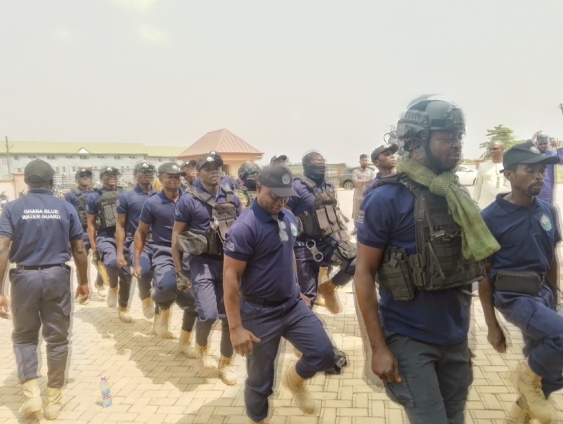
  • Ghana’s energy sector at risk due to galamsey activities – Parliament’s energy committee

    Ghana’s energy sector at risk due to galamsey activities – Parliament’s energy committee

    Illegal mining activities, locally known as galamsey continue to threaten not only Ghana’s waterbodies, food crops and forest reserves but also the country’s energy infrastructure. The Parliamentary Select Committee on Energy has given a stern warning about the potential future repercussions of galamsey if the country fails to find a lasting solution to the menace. 

    During a visit to  the Anwomaso Thermal Power Station in Kumasi on Wednesday October 1, Deputy Ranking Member, Collins Adomako-Mensah, starling revelation about how Ghana’s power installations are being tempered with by illegal miners.

    According to him, the country’s electricity generation authorities including the Ghana Grid Company (GRIDCo), the Bui Power Authority (BPA), WAPCO Gas Pipeline and the Volta River Authority risk shutting down over attacks on their infrastructure. 

    “When we were engaging the other participants, two things came up- one has to do with galamsey and it is having a heavy, heavy toll on the energy sector, not just about water. Gridco complained about galamsey. Their pylons, people are digging where they have a lot of their pylons. Yesterday we were at Bui and the Bui water situation is deteriorating because of the galamsey situation surrounding their water bodies.

    He added, “Gridco complained about galamsey. Their pylons, people are digging where they have a lot of their pylons. Yesterday we were at Bui and the Bui water situation is deteriorating because of the galamsey situation surrounding their water bodies.”

    In September, GRIDCo expressed grave concern over the encroachment on its transmission tower sites by galamsey operators, who are digging dangerously close to the foundations. Acting Deputy Chief Executive Officer of Engineering and Operations, Frank Otchere, made this known at GRIDCo headquarters in Tema on Thursday, September 25.

    Mr. Otchere stated that maintenance teams now face attacks when they attempt to access certain areas.

    “Unfortunately, there are some areas that even when our maintenance teams go there, they get shot at. And some of them have had to run away,” he disclosed, adding that the situation has made it impossible for GRIDCo to operate in certain locations without security support.

    He added that the galamseyers are weakening the towers, which are carefully engineered to withstand immense weight and pressure. He appealed for urgent assistance from national security agencies to protect transmission corridors and avert the potential collapse of towers. 

    “This engagement aims to provide a platform for frank and constructive dialogue between the Government and civil society on the menace of illegal mining, with a view to harnessing collective expertise, perspectives, and solutions to address this national challenge,” the letter stated.

    Ongoing research by a forensic histopathologist and former Head of Pathology at KNUST and Komfo Anokye Teaching Hospital (KATH), Prof. Dr Paul Poku Sampene Ossei, has revealed alarming trends in the rising cases of spontaneous abortions among pregnant women in Ghana.

    Approximately five hundred cases of spontaneous abortions (miscarriages) have been recorded in research that links these cases to severe contamination of placentas and the presence of heavy metals, such as lead and mercury, resulting from galamsey activities.

    A spontaneous abortion is the unintentional expulsion of an embryo or fetus from the uterus before it is viable.

    Speaking on JoyNews’ Newsfile on Saturday, September 27, Prof. Sampene warned that galamsey is poisoning unborn babies and endangering the lives of mothers.

    “I have about 500 cases where women go to the hospital and abort their babies because of the concentration of these heavy metals in their placenta,” he disclosed.

    According to him, his research involved over 4,000 placentas examined from different regions across Ghana. The results showed dangerous levels of heavy metal contamination on both the maternal and foetal sides. “The placentas are all contaminated, polluted with heavy metals,” he said.

    The dangers of these metals extend beyond pregnancy losses. Another effect of galamsey is the excessive use of alum to address the increasing turbidity of water. Ghana Water Company Limited, the nation’s largest water supplier, has resorted to using higher concentrations of alum. Prof. Sampene cautioned that high levels of aluminium hydroxide pose serious health risks.

    According to him, one of the consequences of excessive alum use is kidney disease, which is already on the rise. He warned that if left unchecked, “Ghana will be in big trouble.”

    “Of course, people are talking about turbidity, and then the Water Company is saying that they are using more alum. Alum is aluminium hydroxide, that is the full name, aluminium hydroxide, and this aluminium hydroxide, when taken for a long period, in fact at higher concentration, has a lot of what you call health effects. One of them is kidney problems.

    “When you use alum, that’s aluminium hydroxide, which is used to purify the water, especially when they are using that concentration, which I believe is so high, it’s going to cause kidney problems, it’s going to irritate the respiratory tract, and it’s going to cause what we call neurological defects. All these things have been proven, have been studied and proven to be important, and we have to be very careful about them now. This goes apart from the effects that we are seeing around,” he explained.

    The Mahama-led administration is under pressure to declare a state of emergency in response to illegal mining activities. 

    For years, the country’s efforts to nip the canker in the bud have not yielded the needed results. Among the recent measures taken to protect water bodies from illegal miners is the deployment of the National Anti-Illegal Mining Operations Secretariat (NAIMOS).

    The Secretariat includes the Ghana Armed Forces, the Ghana Police Service, the Ghana Immigration Service, the National Intelligence Bureau (NIB), the Narcotics Control Commission, and the National Security Secretariat.

    Addressing the security forces, the Minister for Lands and Natural Resources, Emmanuel Amarh Kofi-Buah, directed the team to ruthlessly counter the activities of galamsey operators as they are the enemies of the state.

    “Any recalcitrant entering into these zones is not merely a trespasser. They are an enemy of the state. You are to be firm. You are to be resolute. You are to be ruthless.

    “And please, take it from me, you will take no obstructionist instruction from any big man. Remember, the biggest man in Ghana is the President of the Republic, and he’s the one who has sent you,” Mr Kofi-Buah charged.

    Meanwhile, President John Dramani Mahama is expected to hold a crucial meeting with major civil society organisations (CSOs) to find lasting solutions to illegal mining activities on Friday, October 3 at the Jubilee House.

    The meeting scheduled for 12:00pm, will bring together government officials and civil society leaders. This information was contained in a letter issued by the Secretary to the President, Dr Callistus Mahama.

    “This engagement aims to provide a platform for frank and constructive dialogue between the Government and civil society on the menace of illegal mining, with a view to harnessing collective expertise, perspectives, and solutions to address this national challenge,” the letter stated.

  • Galamsey fight: President Mahama to meet CSOs on Oct 3

    Galamsey fight: President Mahama to meet CSOs on Oct 3

    President John Dramani Mahama is expected to hold a crucial meeting with major civil society organisations (CSOs) to find lasting solutions to illegal mining activities locally known as galamsey on Friday, October 3 at the Jubilee House.


    The meeting scheduled for 12:00pm, will bring together government officials and civil society leaders. This information was contained in a letter issued by the Secretary to the President, Dr Callistus Mahama.


    “This engagement aims to provide a platform for frank and constructive dialogue between the Government and civil society on the menace of illegal mining, with a view to harnessing collective expertise, perspectives, and solutions to address this national challenge,” the letter stated.

    The engagement comes at a time when there is mounting pressure on the Mahama-led administration, declaring a state of emergency regarding the issue, due to its adverse effects on the environment.
    Galamsey activities have caused and continue to destroy water bodies, farmlands, and forest reserves.

    For years, the country’s efforts to nip the canker in the bud have not yielded the needed results. Among the recent measures taken to protect water bodies from illegal miners is the deployment of the National Anti-Illegal Mining Operations Secretariat (NAIMOS).


    The Secretariat includes the Ghana Armed Forces, the Ghana Police Service, the Ghana Immigration Service, the National Intelligence Bureau (NIB), the Narcotics Control Commission, and the National Security Secretariat.


    Addressing the security forces, the Minister for Lands and Natural Resources, Emmanuel Amarh Kofi-Buah, directed the team to ruthlessly counter the activities of galamsey operators as they are the enemies of the state.


    “Any recalcitrant entering into these zones is not merely a trespasser. They are an enemy of the state. You are to be firm. You are to be resolute. You are to be ruthless.


    “And please, take it from me, you will take no obstructionist instruction from any big man. Remember, the biggest man in Ghana is the President of the Republic, and he’s the one who has sent you,” Mr Kofi-Buah charged.


    Earlier this month, the government announced plans to deploy soldiers to permanently guard 44 galamsey hotspots, including waterbodies and areas threatened by galamsey activities.

    Speaking to the media on Tuesday, September 16, the Minister of State in charge of Government Communications, Felix Kwakye Ofosu, noted, “All the 44 areas that are threatened by galamsey, there is going to be a permanent military presence,” he added.


    According to statistics from the Lands Minister, 1,400 persons have been arrested from January to August this year in the government’s efforts to crack down on galamsey.


    According to him, the achievement was attained through the government’s renewed efforts. He noted that the government has seized 440 excavators and more than 800 changfans.


    “We have seized 440 excavators and more than 800 changfans. We have mobilised Blue Water Guards in key regions, and they are making a difference,” Mr. Buah stated.


    The government’s recent move is a response to mounting calls for the declaration of a state of emergency on galamsey. Illegal mining activities continue to regress the country’s development, as they lead to the loss of lives, destruction of properties and the environment, and water bodies, among others.


    For years, the country’s efforts to nip the canker in the bud have not yielded the needed results. Among measures taken to protect water bodies from illegal miners is the deployment of river guards.


    The river guards are selected from communities most affected by illegal mining, ensuring they have a deep understanding of the local landscape and challenges.


    The government has issued an official order requiring all machinery used in mining operations to be registered with the Driver and Vehicle Licensing Authority (DVLA) by August 1st.


    A statement issued by the Ministry of the Interior on Tuesday, July 15, states that the state will proceed with confiscating unregistered mining equipment after the deadline.


    “The Government, as part of efforts to reform the mining sector in the country, requires that all machinery used in mining activities must be registered with the Driver and Vehicle Licensing Authority (DVLA) by 1st August 2025. Equipment that remains unregistered after this deadline will be confiscated by the State,” the Ministry stated on its website.


    Mr Mubarak has empowered the Ghana Police Service and DVLA to begin strict enforcement of the new rule from August 2. “The Ghana Police Service and DVLA have been directed to enforce this directive from 2nd August 2025 onward rigorously. The general public, especially those who use mining machinery, is advised to take note and comply with the directive,” he wrote.


    The Ministry reiterates its resolve to maintain national peace through effective internal security and law enforcement. Meanwhile, a similar directive came in months ago, where excavator owners and operators were asked to register their machines with the Driver and Vehicle Licensing Authority (DVLA) within two weeks or risk losing them to the state, as the government intensifies efforts to clamp down on illegal mining activities.


    The Chief Executive Officer (CEO) of the DVLA, Julius Neequaye Kotey, issued the directive in Accra, warning that effective June 1, any excavator not registered with the DVLA will be confiscated.

    Speaking at a press briefing, Mr. Kotey announced that the Ghana Police Service and the DVLA’s operational team commenced a nationwide enforcement after the deadline, arresting and impounding excavators being used at mining sites or for commercial purposes without proper documentation.


    “This exercise will help identify every excavator that enters the country and trace how it is being used. The goal is to ensure we can monitor and hold people accountable,” Mr. Kotey said.


    The directive fell in line with Section 38 of the Road Traffic Act, 2004 (Act 683), which mandates the registration of all motor vehicles and trailers, including farm and heavy-duty equipment. Despite the law, the DVLA found many unregistered excavators operating in mining areas, some of which have been used in illegal activities.


    Mr Kotey emphasised that the DVLA, with its 34 offices nationwide, could register all excavators and farm machinery within two weeks and was ready to strictly enforce the directive.“Excavators in the hands of illegal miners have worsened the destruction of our environment. This is why we must act,” Mr Kotey said.


    To further control the situation, the DVLA, in collaboration with key agencies like the Minerals Commission, National Security, the Ghana Ports and Harbours Authority (GPHA), and the Customs Division of the Ghana Revenue Authority (GRA), commenced tagging all newly imported excavators.


    In addition to tagging new imports, the Minerals Commission was tasked with leading a team to tag all excavators already in the country. Legal small-scale mining sites have also been geo-fenced, with their site coordinates integrated into the Ghana Mine Repository and Tracking software for better oversight.


    The move is part of the government’s broader efforts to combat illegal mining. Three months ago, Lands and Natural Resources Minister Emmanuel Armah-Kofi Buah announced the rollout of a system to monitor excavator imports and usage, involving port tagging and digital tracking in partnership with several state agencies.


    According to the sector minister. The third most valuable item imported into this country is excavators, and it is worth GHC6.2 billion. In April, a total of 47 individuals were arrested for engaging in illegal mining activities along the Tano River and within the Aboi, Subri, and Nimiri forests in the Western Region.

    This followed a special four-day intelligence-led operation that commenced on April 17, within the Samreboi enclave. According to the Ghana Police Service, the suspects include 39 Ghanaians and 8 Chinese nationals.

    The Police indicated that a significant amount of equipment and materials believed to have been used for the mining operations were retrieved.

    These include seventeen excavators, one bulldozer, four motorbikes, two Toyota Hilux vehicles, one Rav4 vehicle, four pump-action guns, one single-barreled gun, fifty-four live BB cartridges, and eight pumping machines.


    Prosecution began for the arrested suspects. On Tuesday, 41 of them were arraigned, with 29 remanded into Police custody to reappear before the court on April 30, 2025. Twelve others were also remanded to return to court on May 2, 2025.


    The remaining seven were put before the court on April 23, 2025. Two coordinated operations conducted on Friday, June 20, at Nikanika and Adeade in the Central Region led to the arrest of 3 suspects and the seizure of several pieces of mining equipment.


    The operations were executed by the Ghana Police Service through its Special Anti-Galamsey Task Force. The task force proceeded to a mining site at Nikanika. Although no operators were found at the scene, the team retrieved a single-barrel shotgun loaded with a cartridge and three water-pumping machines.


    The task force extended its operation to Adeade, where three suspects, Prosper Quansah, Chrispin Nartey, and Owusu Gambra, were arrested with an excavator on a lowbed trailer. One SANY excavator, four unregistered Haojin motorbikes, and one lowbed vehicle with registration number GN 2136-24 were seized from the scene.


    All exhibits were secured in police custody. Some 12 accused persons standing trial for engaging in illegal mining activities at Tumetu near Princess Town in the Ahanta West Municipality of the Western Region have been remanded into prison custody.

    While 10 of the accused persons were arrested at a palm plantation, two were arrested at the Elluabo Chavene Ghana Rubber Estate Limited (GREL) plantation.


    This was due to a coordinated police intelligence-led operation within the Ahanta West Municipality. The accused persons are Lord Yankey, Caleb Adu Kwaw, Stephen Agyei, Ebenezer Barnes, Mathew Somagevi, Paa Grant, Bashiru Kaviru, Joseph Borney, Aminu Issah, Kofi Sogah, Albert Normah, and Robert Mensah.

    Four water pumping machines, one tricycle with registration number M-20-WR 1045, and two motorbikes were retrieved from the sites, according to the police.


    All twelve accused persons admitted to the offence during police interrogations. They were subsequently put before the Takoradi Harbour Area Circuit Court ‘A’, and were remanded into prison custody at Sekondi and reappeared before the court on Tuesday, July 8.


    Also, fifteen individuals are in police custody for engaging in illegal mining activities at Manso Adubia. They were arrested following a special intelligence-led operation at Watreso and Preacher Krom.

    The suspects include Tahiru Ibrahim (24), Shaibu Idrissu, (23), Boateng Emmanuel (27), Jamon Kwaku Samuel (21), Yaro Patrick (29), Kofi Boakye (21), Gubong Mathew (45), Fatawu Zackari Seidu (26), and Abdul Malik Seidu (22).The others are Dauda Tahiru (23), Sampson Grace (21), Boolangkpuo Freda (24), Arima Hagar (26), Kwarteng Vasco (30), and Kwame Adutwum (24).


    Two excavator control boards, two automatic pump-action guns, two Musler 12 firearms, 59 BB cartridges, three AA cartridges, one water pumping machine, two power generators, one vulcanizing machine, and one Apsonic motorbike were seized from the site.
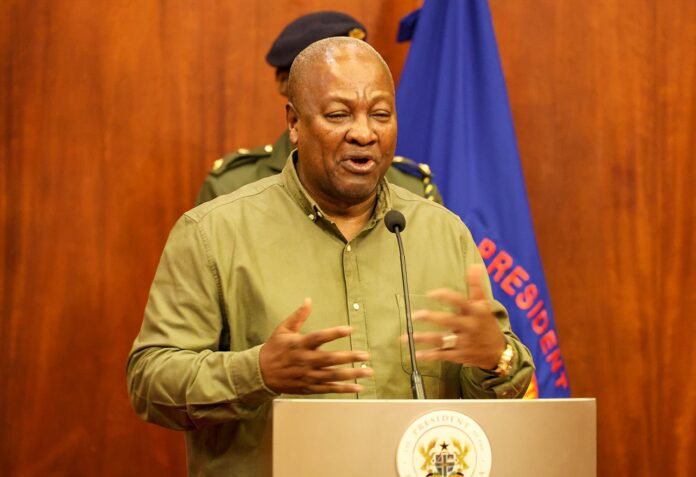
  • Galamseyers are enemies of our state, deal ‘ruthlessly’ with them – Lands Minister directs security forces

    Galamseyers are enemies of our state, deal ‘ruthlessly’ with them – Lands Minister directs security forces

    The newly established National Anti-Illegal Mining Operations Secretariat (NAIMOS), tasked by the government to fight illegal mining activities (galamsey), has been instructed not to be biased in executing its duties. The Secretariat includes the Ghana Armed Forces, the Ghana Police Service, the Ghana Immigration Service, the National Intelligence Bureau (NIB), the Narcotics Control Commission, and the National Security Secretariat. 

    Addressing the security forces, the Minister for Lands and Natural Resources, Emmanuel Amarh Kofi-Buah, directed the team to ruthlessly counter the activities of galamsey operators as they are the enemies of the state.

    “Any recalcitrant entering into these zones is not merely a trespasser. They are an enemy of the state. You are to be firm. You are to be resolute. You are to be ruthless.

    “And please, take it from me, you will take no obstructionist instruction from any big man. Remember, the biggest man in Ghana is the President of the Republic, and he’s the one who has sent you,” Mr Kofi-Buah charged.

    Earlier this month, the government announced plans to deploy soldiers to permanently guard 44 galamsey hotspots, including waterbodies and areas threatened by galamsey activities.
    Speaking to the media on Tuesday, September 16, the Minister of State in charge of Government Communications, Felix Kwakye Ofosu, noted, “All the 44 areas that are threatened by galamsey, there is going to be a permanent military presence,” he added.


    According to statistics from the Lands Minister, 1,400 persons have been arrested from January to August this year in the government’s efforts to crack down on galamsey.


    According to him, the achievement was attained through the government’s renewed efforts. He noted that the government has seized 440 excavators and more than 800 changfans.


    “We have seized 440 excavators and more than 800 changfans. We have mobilised Blue Water Guards in key regions, and they are making a difference,” Mr. Buah stated.

    The government’s recent move is a response to mounting calls for the declaration of a state of emergency on galamsey. Illegal mining activities continue to regress the country’s development, as they lead to the loss of lives, destruction of properties and the environment, and water bodies, among others.

    For years, the country’s efforts to nip the canker in the bud have not yielded the needed results. Among measures taken to protect water bodies from illegal miners is the deployment of river guards.

    The river guards are selected from communities most affected by illegal mining, ensuring they have a deep understanding of the local landscape and challenges.


    The government has issued an official order requiring all machinery used in mining operations to be registered with the Driver and Vehicle Licensing Authority (DVLA) by August 1st.

    A statement issued by the Ministry of the Interior on Tuesday, July 15, states that the state will proceed with confiscating unregistered mining equipment after the deadline.


    “The Government, as part of efforts to reform the mining sector in the country, requires that all machinery used in mining activities must be registered with the Driver and Vehicle Licensing Authority (DVLA) by 1st August 2025. Equipment that remains unregistered after this deadline will be confiscated by the State,” the Ministry stated on its website.


    Mr Mubarak has empowered the Ghana Police Service and DVLA to begin strict enforcement of the new rule from August 2. “The Ghana Police Service and DVLA have been directed to enforce this directive from 2nd August 2025 onward rigorously. The general public, especially those who use mining machinery, is advised to take note and comply with the directive,” he wrote.


    The Ministry reiterates its resolve to maintain national peace through effective internal security and law enforcement.

    Meanwhile, a similar directive came in months ago, where excavator owners and operators were asked to register their machines with the Driver and Vehicle Licensing Authority (DVLA) within two weeks or risk losing them to the state, as the government intensifies efforts to clamp down on illegal mining activities.


    The Chief Executive Officer (CEO) of the DVLA, Julius Neequaye Kotey, issued the directive in Accra, warning that effective June 1, any excavator not registered with the DVLA will be confiscated.
    Speaking at a press briefing, Mr. Kotey announced that the Ghana Police Service and the DVLA’s operational team commenced a nationwide enforcement after the deadline, arresting and impounding excavators being used at mining sites or for commercial purposes without proper documentation.


    “This exercise will help identify every excavator that enters the country and trace how it is being used. The goal is to ensure we can monitor and hold people accountable,” Mr. Kotey said.


    The directive fell in line with Section 38 of the Road Traffic Act, 2004 (Act 683), which mandates the registration of all motor vehicles and trailers, including farm and heavy-duty equipment. Despite the law, the DVLA found many unregistered excavators operating in mining areas, some of which have been used in illegal activities.


    Mr Kotey emphasised that the DVLA, with its 34 offices nationwide, could register all excavators and farm machinery within two weeks and was ready to strictly enforce the directive.“Excavators in the hands of illegal miners have worsened the destruction of our environment. This is why we must act,” Mr Kotey said.


    To further control the situation, the DVLA, in collaboration with key agencies like the Minerals Commission, National Security, the Ghana Ports and Harbours Authority (GPHA), and the Customs Division of the Ghana Revenue Authority (GRA), commenced tagging all newly imported excavators.


    In addition to tagging new imports, the Minerals Commission was tasked with leading a team to tag all excavators already in the country. Legal small-scale mining sites have also been geo-fenced, with their site coordinates integrated into the Ghana Mine Repository and Tracking software for better oversight.


    The move is part of the government’s broader efforts to combat illegal mining. Three months ago, Lands and Natural Resources Minister Emmanuel Armah-Kofi Buah announced the rollout of a system to monitor excavator imports and usage, involving port tagging and digital tracking in partnership with several state agencies.


    According to the sector minister. The third most valuable item imported into this country is excavators, and it is worth GHC6.2 billion. In April, a total of 47 individuals were arrested for engaging in illegal mining activities along the Tano River and within the Aboi, Subri, and Nimiri forests in the Western Region. This followed a special four-day intelligence-led operation that commenced on April 17, within the Samreboi enclave.


    According to the Ghana Police Service, the suspects include 39 Ghanaians and 8 Chinese nationals. The Police indicated that a significant amount of equipment and materials believed to have been used for the mining operations were retrieved.


    These include seventeen excavators, one bulldozer, four motorbikes, two Toyota Hilux vehicles, one Rav4 vehicle, four pump-action guns, one single-barreled gun, fifty-four live BB cartridges, and eight pumping machines.


    Prosecution began for the arrested suspects. On Tuesday, 41 of them were arraigned, with 29 remanded into Police custody to reappear before the court on April 30, 2025. Twelve others were also remanded to return to court on May 2, 2025.


    The remaining seven were put before the court on April 23, 2025. Two coordinated operations conducted on Friday, June 20, at Nikanika and Adeade in the Central Region led to the arrest of 3 suspects and the seizure of several pieces of mining equipment.


    The operations were executed by the Ghana Police Service through its Special Anti-Galamsey Task Force. The task force proceeded to a mining site at Nikanika. Although no operators were found at the scene, the team retrieved a single-barrel shotgun loaded with a cartridge and three water-pumping machines.


    The task force extended its operation to Adeade, where three suspects, Prosper Quansah, Chrispin Nartey, and Owusu Gambra, were arrested with an excavator on a lowbed trailer. One SANY excavator, four unregistered Haojin motorbikes, and one lowbed vehicle with registration number GN 2136-24 were seized from the scene.


    All exhibits were secured in police custody. Some 12 accused persons standing trial for engaging in illegal mining activities at Tumetu near Princess Town in the Ahanta West Municipality of the Western Region have been remanded into prison custody.
    While 10 of the accused persons were arrested at a palm plantation, two were arrested at the Elluabo Chavene Ghana Rubber Estate Limited (GREL) plantation.


    This was due to a coordinated police intelligence-led operation within the Ahanta West Municipality. The accused persons are Lord Yankey, Caleb Adu Kwaw, Stephen Agyei, Ebenezer Barnes, Mathew Somagevi, Paa Grant, Bashiru Kaviru, Joseph Borney, Aminu Issah, Kofi Sogah, Albert Normah, and Robert Mensah.
    Four water pumping machines, one tricycle with registration number M-20-WR 1045, and two motorbikes were retrieved from the sites, according to the police.


    All twelve accused persons admitted to the offence during police interrogations. They were subsequently put before the Takoradi Harbour Area Circuit Court ‘A’, and were remanded into prison custody at Sekondi and reappeared before the court on Tuesday, July 8.


    Also, fifteen individuals are in police custody for engaging in illegal mining activities at Manso Adubia. They were arrested following a special intelligence-led operation at Watreso and Preacher Krom.The suspects include Tahiru Ibrahim (24), Shaibu Idrissu, (23), Boateng Emmanuel (27), Jamon Kwaku Samuel (21), Yaro Patrick (29), Kofi Boakye (21), Gubong Mathew (45), Fatawu Zackari Seidu (26), and Abdul Malik Seidu (22).
    The others are Dauda Tahiru (23), Sampson Grace (21), Boolangkpuo Freda (24), Arima Hagar (26), Kwarteng Vasco (30), and Kwame Adutwum (24).


    Two excavator control boards, two automatic pump-action guns, two Musler 12 firearms, 59 BB cartridges, three AA cartridges, one water pumping machine, two power generators, one vulcanizing machine, and one Apsonic motorbike were seized from the site.
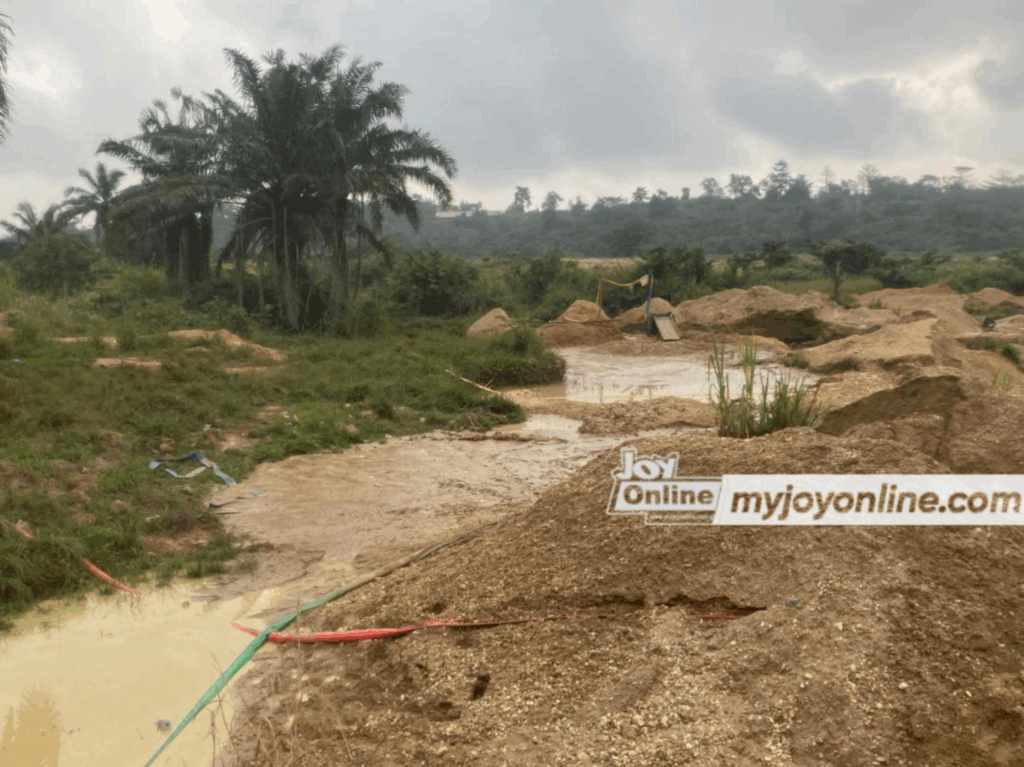
  • Galamsey: About 500 women lost pregnancies due to heavy metals in placenta – KATH pathologist

    Galamsey: About 500 women lost pregnancies due to heavy metals in placenta – KATH pathologist

    Heavy metals like lead, mercury, and cadmium chemicals, mostly traced to illegal mining activities (galamsey), have gradually crept into our food chain, causing devastating effects on both the born and unborn.

    Ongoing research by a forensic histopathologist and former Head of Pathology at KNUST and Komfo Anokye Teaching Hospital (KATH), Prof. Dr Paul Poku Sampene Ossei, has revealed alarming trends in the rising cases of spontaneous abortions among pregnant women in Ghana.

    Approximately five hundred cases of spontaneous abortions (miscarriages) have been recorded in research that links these cases to severe contamination of placentas and the presence of heavy metals, such as lead and mercury, resulting from galamsey activities.

    A spontaneous abortion is the unintentional expulsion of an embryo or fetus from the uterus before it is viable.

    Speaking on JoyNews’ Newsfile on Saturday, September 27, Prof. Sampene warned that galamsey is poisoning unborn babies and endangering the lives of mothers.

    “I have about 500 cases where women go to the hospital and abort their babies because of the concentration of these heavy metals in their placenta,” he disclosed.

    According to him, his research involved over 4,000 placentas examined from different regions across Ghana. The results showed dangerous levels of heavy metal contamination on both the maternal and foetal sides. “The placentas are all contaminated, polluted with heavy metals,” he said.

    The dangers of these metals extend beyond pregnancy losses. Another effect of galamsey is the excessive use of alum to address the increasing turbidity of water. Ghana Water Company Limited, the nation’s largest water supplier, has resorted to using higher concentrations of alum. Prof. Sampene cautioned that high levels of aluminium hydroxide pose serious health risks.

    According to him, one of the consequences of excessive alum use is kidney disease, which is already on the rise. He warned that if left unchecked, “Ghana will be in big trouble.”

    “Of course, people are talking about turbidity, and then the Water Company is saying that they are using more alum. Alum is aluminium hydroxide, that is the full name, aluminium hydroxide, and this aluminium hydroxide, when taken for a long period, in fact at higher concentration, has a lot of what you call health effects. One of them is kidney problems.

    “When you use alum, that’s aluminium hydroxide, which is used to purify the water, especially when they are using that concentration, which I believe is so high, it’s going to cause kidney problems, it’s going to irritate the respiratory tract, and it’s going to cause what we call neurological defects. All these things have been proven, have been studied and proven to be important, and we have to be very careful about them now. This goes apart from the effects that we are seeing around,” he explained.

    He expressed particular concern about the effects of these metals on children, whose developing organs and systems are unable to filter them effectively.

    “Do we have what it takes to even solve the kidney diseases that are coming out now? Dialysis is very expensive, and nobody gets it for free. Children are also being diagnosed with chronic kidney disease. These are the realities we have to face,” he said.

    Prof. Sampene further disclosed that birth deformities are increasingly being recorded in mining areas, though some doctors are hesitant to speak out publicly.

    “Ever since I drew attention to this, doctors in mining areas tell me they are recording a lot of deformities in babies. Most of them fear coming out, but it is happening,” he revealed.

    Reports linking birth deformities in children to galamsey (illegal mining) activities began gaining public attention around 2019. In August 2024, toxicologist Yakubu Adam published a detailed feature article on Modern Ghana titled Galamsey and Its Associated Congenital Anomalies: A Public Health Concern in Ghana.” It highlighted the role of mercury exposure, particularly methylmercury, in causing congenital anomalies such as microcephaly, cerebral palsy, and developmental delays.

    Given the devastating and fatal effects galamsey is having in Ghana, Prof. Sampene expressed concern about the lack of urgency, especially on the part of the government, and criticised the politicisation of the fight.

    “And so, oh yes, sometimes it’s so saddening, like I said earlier, that when we see politicians trying to equalise or trying to trivialise the whole thing, it’s so sad. And of course, it’s something that people are playing with. In fact, for me, I’m not interested in whether the government or the president declares a state of emergency. But the most important thing is that the galamsey activity is really killing us,” he lamented.

    Prof. Sampene also cited additional dangers, referencing KATH data, which showed that between 2019 and 2021, drowning accounted for 40% of unnatural deaths in the Ashanti Region, with 25% of these linked to abandoned galamsey pits.

    “The next thing is drowning. These abandoned pits collect a lot of water, and children, for some reason, like to go and swim in them, and then, in attempting to swim, they drown. In Konfo alone, I think between 2019 and 2021, I carried out that research by going through the data in Konfo, and then I was trying to compare the profile of unnatural death in the Ashanti Region, especially the northern part.

    “What it showed me was that drowning alone took in fact, the total was 2,470 drowning alone was 40%. Road traffic accidents took the highest number, poisoning and so forth were there, but drowning alone accounted for 40%. And out of the 40%, the ones that came from galamsey abandoned pits alone were 25%,” he added.

    He further appealed to both the National Democratic Congress (NDC) and the New Patriotic Party(NPP) to rise above partisanship and address what he described as a national health emergency.

    “I would have wished that the two main political parties, NDC and NPP, come together and say enough is enough. Otherwise, if care is not taken, we will soon see people walking but with very high cognitive impairment. Mercury inhalation alone can damage the brain. We are seriously in trouble,” he warned.

    His remarks come after President Mahama called for patience and calm following the growing pressure on him from stakeholders and citizens to declare a state of emergency over the devastating and deadly effects of galamsey.

    Speaking during his first media encounter on September 10, the President explained that the government doesn’t need to declare a state of emergency to fight illegal mining because the laws already give us enough power to act; we just need to enforce them more vigorously.

    “I’ve been reluctant to implement a state of emergency in the galamsey fight because we’ve not exhausted the powers we even have without a state of emergency. We have the opportunity to arrest anybody, to confiscate any such thing. The laws for forest protection and all that give us enough powers to be able to act,” he said.

    Galamsey is one major challenge and a cancer eating into the country’s ecosystem. The fight against it is a long-standing one with little to no positive and generally significant and impressive effect; however, past and present administrations remain relentless in the fight against the environmental demon.

    Ghana in August lost right gallant men who were en route to an event on anti-galamsey in a gory and heart-wrenching plane crash on August 6, in Adansi.

    They were burned beyond recognition while on their way to an event to dissuade Ghanaians from engaging in illegal mining activities. Their remains had to be collected in cocoa sacks for forensic examination.

    Consequently, their death heightened calls from officials, concerned citizens and other stakeholders on President Mahama to be fierce and stern in his fight against the menace.

  • Galamsey: Lands Minister reports 1,400 arrests in 8 months

    Galamsey: Lands Minister reports 1,400 arrests in 8 months

    1,400 persons have been arrested from January to August this year in the government’s efforts to crack down illegal mining (galamsey). This information was made known while the Minister for Lands and Natural Resources, Emmanuel Armah-Kofi Buah was engaging the media on Thursday, September 24.

    According to him, the achievement was attained through the government’s renewed efforts. He noted that the government has seized 440 excavators and more than 800 changfans.

    “We have seized 440 excavators and more than 800 changfans. We have mobilised Blue Water Guards in key regions, and they are making a difference,” Mr. Buah stated.

    Earlier this month, the government announced plans to deploy soldiers to permanently guard 44 galamsey hotspots, including waterbodies and areas threatened by galamsey activities.

    Speaking to the media on Tuesday, September 16, The Minister of State in charge of Government Communications, Felix Kwakye Ofosu, noted “All the 44 areas that are threatened by galamsey, there is going to be a permanent military presence,” he added.


    The government’s recent move is a response to mounting calls for the declaration of a state of emergency on galamsey. Illegal mining activities continue to regress the country’s development, as they lead to the loss of lives, destruction of properties and the environment, and water bodies, among others. For years, the country’s efforts to nip the canker in the bud have not yielded the needed results.


    Among measures taken to protect water bodies from illegal miners is the deployment of river guards. The river guards are selected from communities most affected by illegal mining, ensuring they have a deep understanding of the local landscape and challenges.


    The government has rolled out an official order requiring all machinery used in mining operations to be registered with the Driver and Vehicle Licensing Authority (DVLA) by 1st August.
    A statement issued by the Ministry of the Interior on Tuesday, July 15, states that the state will go ahead to confiscate unregistered mining equipment after the deadline.


    “The Government, as part of efforts to reform the mining sector in the country, requires that all machinery used in mining activities must be registered with the Driver and Vehicle Licensing Authority (DVLA) by 1st August 2025. Equipment that remains unregistered after this deadline will be confiscated by the State,” the Ministry stated on its website.


    Mr Mubarak has empowered the Ghana Police Service and DVLA to begin strict enforcement of the new rule from August 2. “The Ghana Police Service and DVLA have been directed to enforce this directive from 2nd August 2025 onward rigorously. The general public, especially those who use mining machinery, is advised to take note and comply with the directive,” he wrote.


    The Ministry reiterates its resolve to maintain national peace through effective internal security and law enforcement.
    Meanwhile, a similar directive came in months ago, where excavator owners and operators were asked to register their machines with the Driver and Vehicle Licensing Authority (DVLA) within two weeks or risk losing them to the state, as the government intensifies efforts to clamp down on illegal mining activities.


    The Chief Executive Officer (CEO) of the DVLA, Julius Neequaye Kotey, issued the directive in Accra, warning that effective June 1, any excavator not registered with the DVLA will be confiscated.


    Speaking at a press briefing, Mr. Kotey announced that the Ghana Police Service and the DVLA’s operational team commenced a nationwide enforcement after the deadline, arresting and impounding excavators being used at mining sites or for commercial purposes without proper documentation.


    “This exercise will help identify every excavator that enters the country and trace how it is being used. The goal is to ensure we can monitor and hold people accountable,” Mr. Kotey said.


    The directive fell in line with Section 38 of the Road Traffic Act, 2004 (Act 683), which mandates the registration of all motor vehicles and trailers, including farm and heavy-duty equipment.
    Despite the law, the DVLA found many unregistered excavators operating in mining areas, some of which have been used in illegal activities.


    Mr. Kotey emphasized that the DVLA, with its 34 offices nationwide, could register all excavators and farm machinery within two weeks and was ready to strictly enforce the directive.
    “Excavators in the hands of illegal miners have worsened the destruction of our environment. This is why we must act,” Mr Kotey said.


    To further control the situation, the DVLA, in collaboration with key agencies like the Minerals Commission, National Security, the Ghana Ports and Harbours Authority (GPHA), and the Customs Division of the Ghana Revenue Authority (GRA), commenced tagging all newly imported excavators.


    In addition to tagging new imports, the Minerals Commission was tasked with leading a team to tag all excavators already in the country. Legal small-scale mining sites have also been geo-fenced, with their site coordinates integrated into the Ghana Mine Repository and Tracking software for better oversight.


    The move is part of the government’s broader efforts to combat illegal mining. Three months ago, Lands and Natural Resources Minister Emmanuel Armah-Kofi Buah announced the rollout of a system to monitor excavator imports and usage, involving port tagging and digital tracking in partnership with several state agencies.


    According to the sector minister. The third most valuable item imported into this country is excavators, and it is worth GHC6.2 billion.


    In April, a total of 47 individuals were arrested for engaging in illegal mining activities along the Tano River and within the Aboi, Subri, and Nimiri forests in the Western Region. This followed a special four-day intelligence-led operation that commenced on April 17, within the Samreboi enclave.


    According to the Ghana Police Service, the suspects include 39 Ghanaians and 8 Chinese nationals. The Police indicated that a significant amount of equipment and materials believed to have been used for the mining operations were retrieved.


    These include seventeen excavators, one bulldozer, four motorbikes, two Toyota Hilux vehicles, one Rav4 vehicle, four pump-action guns, one single-barreled gun, fifty-four live BB cartridges, and eight pumping machines.


    Prosecution began for the arrested suspects. On Tuesday, 41 of them were arraigned, with 29 remanded into Police custody to reappear before the court on April 30, 2025. Twelve others were also remanded to return to court on May 2, 2025.


    The remaining seven were put before the court on April 23, 2025. Two coordinated operations conducted on Friday, June 20, at Nikanika and Adeade in the Central Region led to the arrest of 3 suspects and the seizure of several pieces of mining equipment.


    The operations were executed by the Ghana Police Service through its Special Anti-Galamsey Task Force. The task force proceeded to a mining site at Nikanika. Although no operators were found at the scene, the team retrieved a single-barrel shotgun loaded with a cartridge and three water-pumping machines.


    The task force extended its operation to Adeade, where three suspects—Prosper Quansah, Chrispin Nartey, and Owusu Gambra—were arrested with an excavator on a lowbed trailer.
    One SANY excavator, four unregistered Haojin motorbikes, and one lowbed vehicle with registration number GN 2136-24 were seized from the scene.

    All exhibits were secured in police custody. Some 12 accused persons standing trial for engaging in illegal mining activities at Tumetu near Princess Town in the Ahanta West Municipality of the Western Region have been remanded into prison custody.

    While 10 of the accused persons were arrested at a palm plantation, two were arrested at the Elluabo Chavene Ghana Rubber Estate Limited (GREL) plantation.


    This was due to a coordinated police intelligence-led operation within the Ahanta West Municipality. The accused persons are Lord Yankey, Caleb Adu Kwaw, Stephen Agyei, Ebenezer Barnes, Mathew Somagevi, Paa Grant, Bashiru Kaviru, Joseph Borney, Aminu Issah, Kofi Sogah, Albert Normah, and Robert Mensah.


    Four water pumping machines, one tricycle with registration number M-20-WR 1045, and two motorbikes were retrieved from the sites, according to the police.


    All twelve accused persons admitted to the offence during police interrogations. They were subsequently put before the Takoradi Harbour Area Circuit Court ‘A’, and were remanded into prison custody at Sekondi and reappeared before the court on Tuesday, July 8.


    Also, fifteen individuals are in police custody for engaging in illegal mining activities at Manso Adubia. They were arrested following a special intelligence-led operation at Watreso and Preacher Krom.
    The suspects include Tahiru Ibrahim (24), Shaibu Idrissu, (23), Boateng Emmanuel (27), Jamon Kwaku Samuel (21), Yaro Patrick (29), Kofi Boakye (21), Gubong Mathew (45), Fatawu Zackari Seidu (26), and Abdul Malik Seidu (22).


    The others are Dauda Tahiru (23), Sampson Grace (21), Boolangkpuo Freda (24), Arima Hagar (26), Kwarteng Vasco (30), and Kwame Adutwum (24).


    Two excavator control boards, two automatic pump-action guns, two Musler 12 firearms, 59 BB cartridges, three AA cartridges, one water pumping machine, two power generators, one vulcanizing machine, and one Apsonic motorbike were seized from the site.
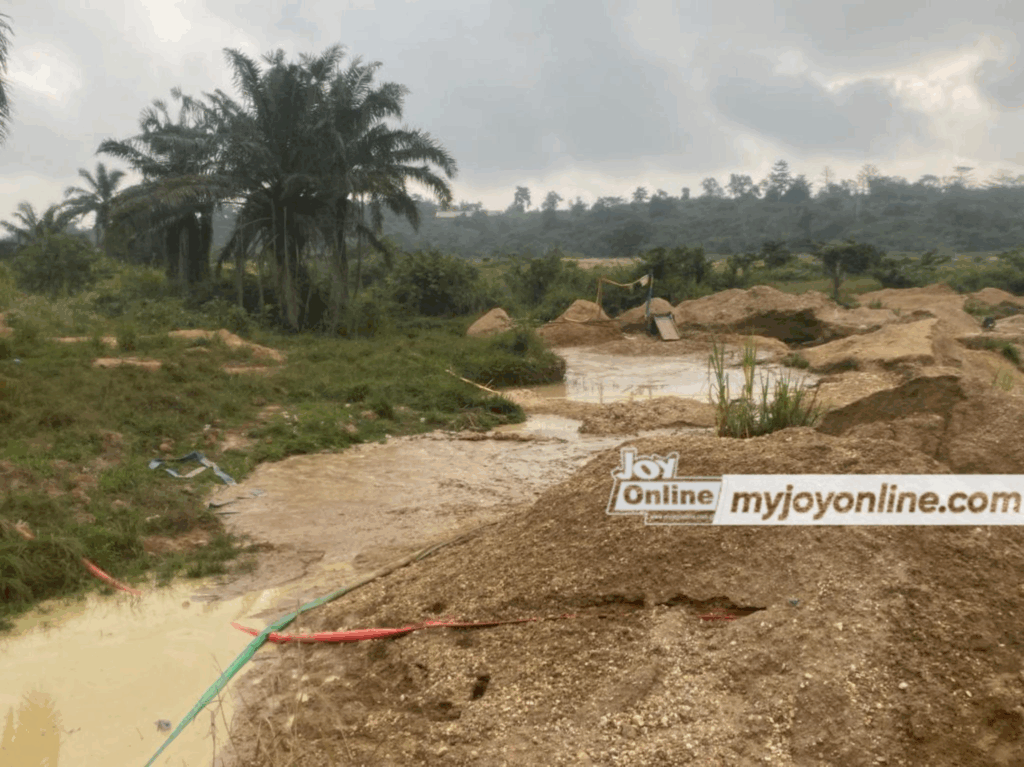
  • #StopGalamseyNow demo underway

    #StopGalamseyNow demo underway

    Scores of Ghanaians are marching through the streets of the capital today, Monday, September 22, in protest, demanding that the President Mahama-led government tackle the galamsey menace with strategic measures.

    They began the march from Spanner Junction, Accra, through  other areas of the Capital in the morning. The protest which is spearheaded by the Democracy Hub started with a vigil on Sunday, September 21 scores of Ghanaians gathered at the Revolution Square in Accra. 

    Taking to the X platform (formerly Twitter), on Monday, September 15, the group’s convenor, Oliver Barker-Vormawor, stressed that the solution to end the menace requires collective efforts, hence, he called on all and sundry to participate in the upcoming vigil and the march sessions.

    “On Sunday 21st September, we will have a vigil at the Revolution Square, and on Monday 22nd (a holiday), there will be a march, calling attention to the urgency of our environmental crisis.“The responsibility to protect and preserve the environment is by divine assignment, ours as a people,” he wrote, adding that the issue transcends electoral politics.Our responsibility to end galamsey does not end at elections. Nor does it begin after our party loses one. This is bigger than petty politics”.

    Illegal mining activities continue to retrogress the country’s development, as they lead to the loss of lives, destruction of properties and the environment, and water bodies, among others.For years, the country’s efforts to nip the canker in the bud have not yielded the needed results. Among measures taken to protect water bodies from illegal miners is the deployment of river guards.

    The river guards are selected from communities most affected by illegal mining, ensuring they have a deep understanding of the local landscape and challenges.

    The government has rolled out an official order requiring all machinery used in mining operations to be registered with the Driver and Vehicle Licensing Authority (DVLA) by 1st August.

    A statement issued by the Ministry of the Interior on Tuesday, July 15, states that the state will go ahead to confiscate unregistered mining equipment after the deadline.

    “The Government, as part of efforts to reform the mining sector in the country, requires that all machinery used in mining activities must be registered with the Driver and Vehicle Licensing Authority (DVLA) by 1st August 2025. Equipment that remains unregistered after this deadline will be confiscated by the State,” the Ministry stated on its website.

    Mr Mubarak has empowered the Ghana Police Service and DVLA to begin strict enforcement of the new rule from August 2. “The Ghana Police Service and DVLA have been directed to enforce this directive from 2nd August 2025 onward rigorously. The general public, especially those who use mining machinery, is advised to take note and comply with the directive,” he wrote.

    The Ministry reiterates its resolve to maintain national peace through effective internal security and law enforcement. Meanwhile, a similar directive came in months ago, where excavator owners and operators were asked to register their machines with the Driver and Vehicle Licensing Authority (DVLA) within two weeks or risk losing them to the state, as the government intensifies efforts to clamp down on illegal mining activities.

    The Chief Executive Officer (CEO) of the DVLA, Julius Neequaye Kotey, issued the directive in Accra, warning that effective June 1, any excavator not registered with the DVLA will be confiscated.

    Speaking at a press briefing, Mr. Kotey announced that the Ghana Police Service and the DVLA’s operational team commenced a nationwide enforcement after the deadline, arresting and impounding excavators being used at mining sites or for commercial purposes without proper documentation.

    “This exercise will help identify every excavator that enters the country and trace how it is being used. The goal is to ensure we can monitor and hold people accountable,” Mr. Kotey said.The directive fell in line with Section 38 of the Road Traffic Act, 2004 (Act 683), which mandates the registration of all motor vehicles and trailers, including farm and heavy-duty equipment.

    Despite the law, the DVLA found many unregistered excavators operating in mining areas, some of which have been used in illegal activities. Mr. Kotey emphasized that the DVLA, with its 34 offices nationwide, could register all excavators and farm machinery within two weeks and was ready to strictly enforce the directive.

    “Excavators in the hands of illegal miners have worsened the destruction of our environment. This is why we must act,” Mr Kotey said.

    To further control the situation, the DVLA, in collaboration with key agencies like the Minerals Commission, National Security, the Ghana Ports and Harbours Authority (GPHA), and the Customs Division of the Ghana Revenue Authority (GRA), commenced tagging all newly imported excavators.

    In addition to tagging new imports, the Minerals Commission was tasked to lead a team that would tag all excavators already in the country. Legal small-scale mining sites have also been geo-fenced, with their site coordinates integrated into the Ghana Mine Repository and Tracking software for better oversight.

    The move is part of broader government efforts to combat illegal mining. Three months ago, Lands and Natural Resources Minister Emmanuel Armah-Kofi Buah announced the rollout of a system to monitor excavator imports and usage, involving port tagging and digital tracking in partnership with several state agencies.

    According to the sector minister. The third most valuable item imported into this country is excavators, and it is worth GHC6.2 billion. In April, a total of 47 individuals were arrested for engaging in illegal mining activities along the Tano River and within the Aboi, Subri, and Nimiri forests in the Western Region. This followed a special four-day intelligence-led operation that commenced on April 17, within the Samreboi enclave.

    According to the Ghana Police Service, the suspects include 39 Ghanaians and 8 Chinese nationals. The Police indicated that a significant amount of equipment and materials believed to have been used for the mining operations were retrieved.

    These include seventeen excavators, one bulldozer, four motorbikes, two Toyota Hilux vehicles, one Rav4 vehicle, four pump-action guns, one single-barreled gun, fifty-four live BB cartridges, and eight pumping machines.

    Prosecution began for the arrested suspects. On Tuesday, 41 of them were arraigned, with 29 remanded into Police custody to reappear before the court on April 30, 2025. Twelve others were also remanded to return to court on May 2, 2025.

    The remaining seven were put before the court on April 23, 2025. Two coordinated operations conducted on Friday, June 20, at Nikanika and Adeade in the Central Region led to the arrest of 3 suspects and the seizure of several pieces of mining equipment. The operations were executed by the Ghana Police Service through its Special Anti-Galamsey Task Force.

    The task force proceeded to a mining site at Nikanika. Although no operators were found at the scene, the team retrieved a single-barrel shotgun loaded with a cartridge and three water-pumping machines.

    The task force extended its operation to Adeade, where three suspects—Prosper Quansah, Chrispin Nartey, and Owusu Gambra—were arrested with an excavator on a lowbed trailer. One SANY excavator, four unregistered Haojin motorbikes, and one lowbed vehicle with registration number GN 2136-24 were seized from the scene. All exhibits were secured in police custody.

    Some 12 accused persons standing trial for engaging in illegal mining activities at Tumetu near Princess Town in the Ahanta West Municipality of the Western Region have been remanded into prison custody.

    While 10 of the accused persons were arrested at a palm plantation, two were arrested at the Elluabo Chavene Ghana Rubber Estate Limited (GREL) plantation. This was due to a coordinated police intelligence-led operation within the Ahanta West Municipality.

    The accused persons are Lord Yankey, Caleb Adu Kwaw, Stephen Agyei, Ebenezer Barnes, Mathew Somagevi, Paa Grant, Bashiru Kaviru, Joseph Borney, Aminu Issah, Kofi Sogah, Albert Normah, and Robert Mensah.

    Four water pumping machines, one tricycle with registration number M-20-WR 1045, and two motorbikes were retrieved from the sites, according to the police.

    All twelve accused persons admitted to the offence during police interrogations. They were subsequently put before the Takoradi Harbour Area Circuit Court ‘A’, and were remanded into prison custody at Sekondi and reappeared before the court on Tuesday, July 8.

    Also, fifteen individuals are in police custody for engaging in illegal mining activities at Manso Adubia. They were arrested following a special intelligence-led operation at Watreso and Preacher Krom. The suspects include Tahiru Ibrahim (24), Shaibu Idrissu (23), Boateng Emmanuel (27), Jamon Kwaku Samuel (21), Yaro Patrick (29), Kofi Boakye (21), Gubong Mathew (45), Fatawu Zackari Seidu (26), and Abdul Malik Seidu (22).

    The others are Dauda Tahiru (23), Sampson Grace (21), Boolangkpuo Freda (24), Arima Hagar (26), Kwarteng Vasco (30), and Kwame Adutwum (24).

    Two excavator control boards, two automatic pump-action guns, two Musler 12 firearms, 59 BB cartridges, three AA cartridges, one water pumping machine, two power generators, one vulcanizing machine, and one Apsonic motorbike were seized from the site.

  • NPP terribly failed its fight against galamsey – UTAG-KNUST President

    NPP terribly failed its fight against galamsey – UTAG-KNUST President

    The President of the University Teachers Association of Ghana (UTAG) at the Kwame Nkrumah University of Science and Technology (KNUST), Professor Eric Avabare, has described the New Patriotic Party (NPP) as hypocritical over its recent interest in fighting illegal mining, popularly known as galamsey.


    Taking to Facebook on Monday, September 22, Prof. Avabare criticised the NPP for failing to address the menace during its tenure, only to now pretend to show concern. However, he was quick to jab the ruling National Democratic Congress (NDC) for slacking in its efforts to implement sustainable measures against illegal mining. He added that both political parties had failed the nation.


    “I am surprised the NPP suddenly appears concerned about the galamsey menace, but they were terribly worse than the devil himself. They passed the mining law LI 2462, oversaw the building of chanfangs, and issued more mining licenses than all previous administrations combined since independence.


    “These two destructive parties have destroyed Ghana in a literal sense because they are clueless about what they are doing. I blame Ghanaians squarely for knowing what they know about these two parties and still queuing to vote for them, while drinking poisoned water,” he added.


    He concluded that President John Dramani Mahama is confronting the menace with excuses rather than showing work. “President JDM looked into the eyes of Ghanaians and told them they had short memories, and yet when he returned promising to solve galamsey, they voted for him again. Instead, he gave weak excuses for why he could not stop the destruction of water bodies, forest reserves, and farmlands,” he wrote.


    The University Teachers Association of Ghana (UTAG), University of Ghana chapter, earlier called for decisive action to end the devastating impact of illegal mining, known locally as galamsey.


    Speaking to the media on Monday, September 15, Dr. Jerry Joe Harrison, General Secretary of UTAG-UG, warned that the growing menace could end the lives of citizens if the remain unchecked.


    “If we don’t do what we are supposed to do now, we will all die. The water situation is causing havoc in people’s homes. Many areas, including Kwanyako, don’t have access to clean water. People can’t even afford to buy water for their households,” he added.


    According to him, some citizens continue to consume water, which will eventually cause long-term health issues, such as cancers and neurological diseases.


    Democratic“People have had to consume these waters, and they are going to have cancers and neuro diseases by all means. Is that not an emergency enough for you?. So, what do you prefer — that we sit down for 5%, 10% of the population to begin to have visible neurological symptoms before we take action? No,” he added.


    Illegal mining activities continue to regress the country’s development, as they lead to the loss of lives, destruction of properties and the environment, and water bodies, among others.

    For years, the country’s efforts to nip the canker in the bud have not yielded the needed results. Among measures taken to protect water bodies from illegal miners is the deployment of river guards.

    The river guards are selected from communities most affected by illegal mining, ensuring they have a deep understanding of the local landscape and challenges.


    The government has rolled out an official order requiring all machinery used in mining operations to be registered with the Driver and Vehicle Licensing Authority (DVLA) by 1st August.


    A statement issued by the Ministry of the Interior on Tuesday, July 15, states that the state will go ahead to confiscate unregistered mining equipment after the deadline.


    “The Government, as part of efforts to reform the mining sector in the country, requires that all machinery used in mining activities must be registered with the Driver and Vehicle Licensing Authority (DVLA) by 1st August 2025. Equipment that remains unregistered after this deadline will be confiscated by the State,” the Ministry stated on its website.
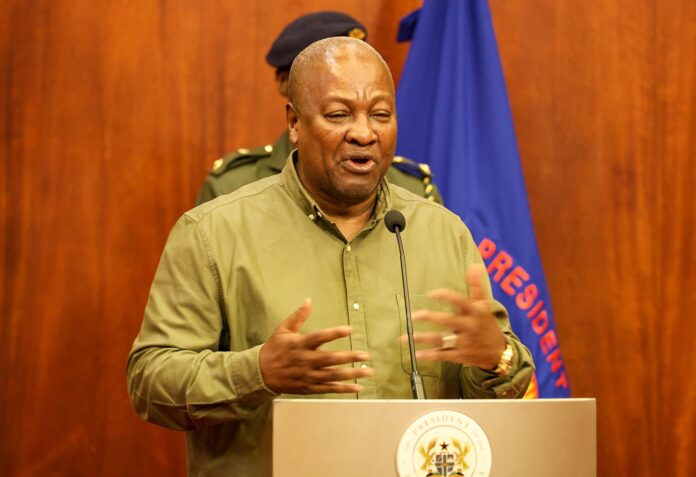

    Mr Mubarak has empowered the Ghana Police Service and DVLA to begin strict enforcement of the new rule from August 2. “The Ghana Police Service and DVLA have been directed to enforce this directive from 2nd August 2025 onward rigorously. The general public, especially those who use mining machinery, is advised to take note and comply with the directive,” he wrote.


    The Ministry reiterates its resolve to maintain national peace through effective internal security and law enforcement. Meanwhile, a similar directive came in months ago, where excavator owners and operators were asked to register their machines with the Driver and Vehicle Licensing Authority (DVLA) within two weeks or risk losing them to the state, as the government intensifies efforts to clamp down on illegal mining activities.


    The Chief Executive Officer (CEO) of the DVLA, Julius Neequaye Kotey, issued the directive in Accra, warning that effective June 1, any excavator not registered with the DVLA will be confiscated.


    Speaking at a press briefing, Mr Kotey announced that the Ghana Police Service and the DVLA’s operational team commenced a nationwide enforcement after the deadline, arresting and impounding excavators being used at mining sites or for commercial purposes without proper documentation.


    “This exercise will help identify every excavator that enters the country and trace how it is being used. The goal is to ensure we can monitor and hold people accountable,” Mr Kotey said.


    The directive fell in line with Section 38 of the Road Traffic Act, 2004 (Act 683), which mandates the registration of all motor vehicles and trailers, including farm and heavy-duty equipment.


    Despite the law, the DVLA found many unregistered excavators operating in mining areas, some of which have been used in illegal activities. Mr Kotey emphasised that the DVLA, with its 34 offices nationwide, could register all excavators and farm machinery within two weeks and was ready to strictly enforce the directive.


    “Excavators in the hands of illegal miners have worsened the destruction of our environment. This is why we must act,” Mr Kotey said.
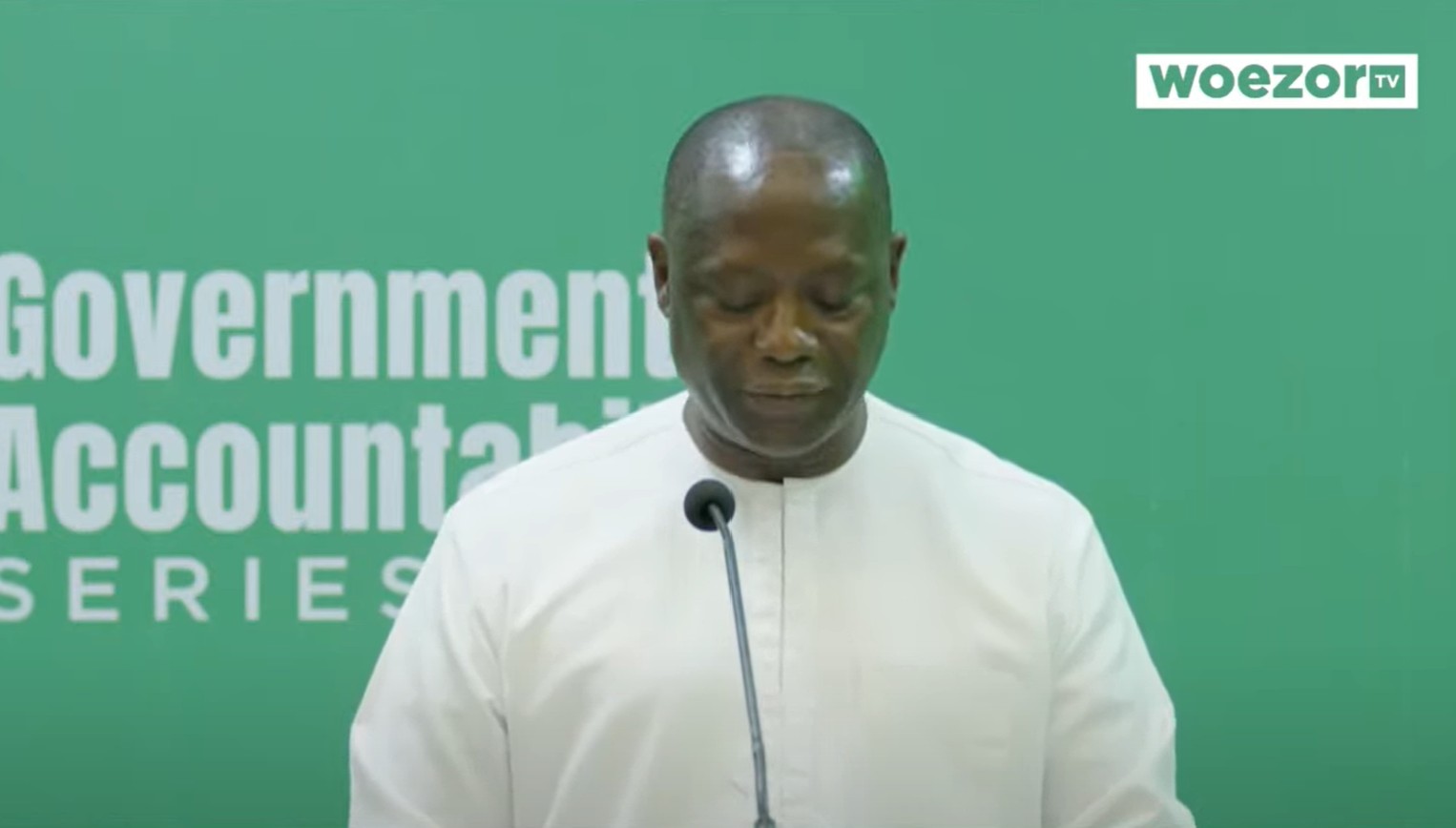
    To further control the situation, the DVLA, in collaboration with key agencies like the Minerals Commission, National Security, the Ghana Ports and Harbours Authority (GPHA), and the Customs Division of the Ghana Revenue Authority (GRA), commenced tagging all newly imported excavators.


    In addition to tagging new imports, the Minerals Commission was tasked with leading a team to tag all excavators already in the country. Legal small-scale mining sites have also been geo-fenced, with their site coordinates integrated into the Ghana Mine Repository and Tracking software for better oversight.


    The move is part of the government’s broader efforts to combat illegal mining. Three months ago, Lands and Natural Resources Minister Emmanuel Armah-Kofi Buah announced the rollout of a system to monitor excavator imports and usage, involving port tagging and digital tracking in partnership with several state agencies.


    According to the sector minister. The third most valuable item imported into this country is excavators, and it is worth GHC6.2 billion. In April, a total of 47 individuals were arrested for engaging in illegal mining activities along the Tano River and within the Aboi, Subri, and Nimiri forests in the Western Region.

    This followed a special four-day intelligence-led operation that commenced on April 17, within the Samreboi enclave. According to the Ghana Police Service, the suspects include 39 Ghanaians and 8 Chinese nationals.

    The Police indicated that a significant amount of equipment and materials believed to have been used for the mining operations were retrieved.

    These include seventeen excavators, one bulldozer, four motorbikes, two Toyota Hilux vehicles, one Rav4 vehicle, four pump-action guns, one single-barreled gun, fifty-four live BB cartridges, and eight pumping machines.


    Prosecution began for the arrested suspects. On Tuesday, 41 of them were arraigned, with 29 remanded into Police custody to reappear before the court on April 30, 2025. Twelve others were also remanded to return to court on May 2, 2025.


    The remaining seven were put before the court on April 23, 2025. Two coordinated operations conducted on Friday, June 20, at Nikanika and Adeade in the Central Region led to the arrest of 3 suspects and the seizure of several pieces of mining equipment.


    The operations were executed by the Ghana Police Service through its Special Anti-Galamsey Task Force. The task force proceeded to a mining site at Nikanika. Although no operators were found at the scene, the team retrieved a single-barrel shotgun loaded with a cartridge and three water-pumping machines.


    The task force extended its operation to Adeade, where three suspects—Prosper Quansah, Chrispin Nartey, and Owusu Gambra—were arrested with an excavator on a lowbed trailer.


    One SANY excavator, four unregistered Haojin motorbikes, and one lowbed vehicle with registration number GN 2136-24 were seized from the scene. All exhibits were secured in police custody.


    Some 12 accused persons standing trial for engaging in illegal mining activities at Tumetu near Princess Town in the Ahanta West Municipality of the Western Region have been remanded into prison custody. While 10 of the accused persons were arrested at a palm plantation, two were arrested at the Elluabo Chavene Ghana Rubber Estate Limited (GREL) plantation.


    This was due to a coordinated police intelligence-led operation within the Ahanta West Municipality. The accused persons are Lord Yankey, Caleb Adu Kwaw, Stephen Agyei, Ebenezer Barnes, Mathew Somagevi, Paa Grant, Bashiru Kaviru, Joseph Borney, Aminu Issah, Kofi Sogah, Albert Normah, and Robert Mensah.


    Four water pumping machines, one tricycle with registration number M-20-WR 1045, and two motorbikes were retrieved from the sites, according to the police.


    All twelve accused persons admitted to the offence during police interrogations. They were subsequently put before the Takoradi Harbour Area Circuit Court ‘A’, and were remanded into prison custody at Sekondi and reappeared before the court on Tuesday, July 8.


    Also, fifteen individuals are in police custody for engaging in illegal mining activities at Manso Adubia. They were arrested following a special intelligence-led operation at Watreso and Preacher Krom.


    The suspects include Tahiru Ibrahim (24), Shaibu Idrissu (23), Boateng Emmanuel (27), Jamon Kwaku Samuel (21), Yaro Patrick (29), Kofi Boakye (21), Gubong Mathew (45), Fatawu Zackari Seidu (26), and Abdul Malik Seidu (22).


    The others are Dauda Tahiru (23), Sampson Grace (21), Boolangkpuo Freda (24), Arima Hagar (26), Kwarteng Vasco (30), and Kwame Adutwum (24).


    Two excavator control boards, two automatic pump-action guns, two Musler 12 firearms, 59 BB cartridges, three AA cartridges, one water pumping machine, two power generators, one vulcanizing machine, and one Apsonic motorbike were seized from the site.