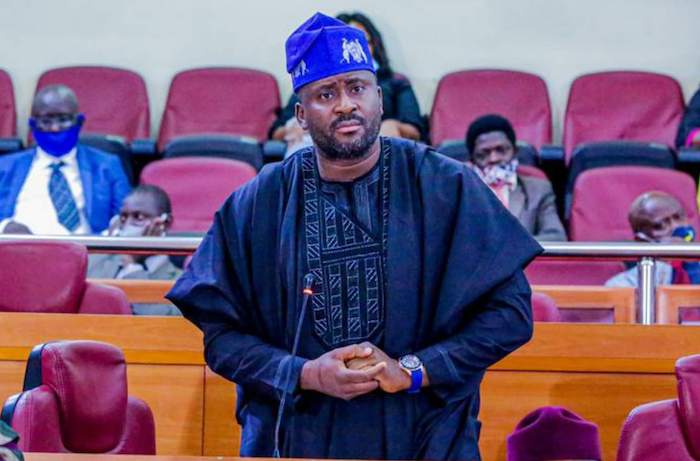
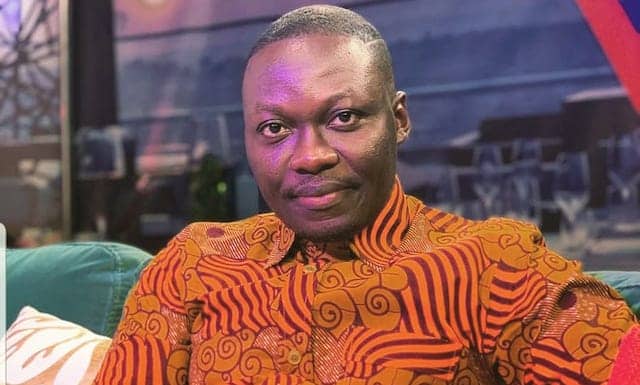
Nollywood actor-turned-politician, Desmond Elliot, has dismissed rumours claiming he is gay.
In a recent interview with TVC, he stated that he is heterosexual and insisted that such reports should be ignored and regarded with the disdain they warrant.
Elliot explained that he felt the article wasn’t worth responding to, which is why he chose to remain silent about the matter.
“Why would I respond to allegations made against me when it did not reduce or increase my life? Secondly, it is an opinion that is being conceived. And I don’t think it is necessary for me to come out and say it’s true or not true; as long as I’m affecting people positively, I’m good.”
Encouraging tolerance, Elliot stated that while everyone has the right to live as they see fit within legal boundaries, mutual respect should remain a priority.
He explained, “If you feel you identify as something, as long as it’s within the law, people don’t have to accept it, do you? So let me say right here, I’m straight… you can never have anyone straighter than me.
If some people want to enjoy themselves through publicity, that’s left to them, but I don’t care really. Do you and enjoy yourself, but do it within the law and with respect to your neighbours.”
The sponsors of the Human Sexual Rights and Family Values Bill, commonly referred to as the Anti-Gay Bill, have outlined plans for a peaceful protest march to the Supreme Court.
This action is intended to express their dissatisfaction with the prolonged delay in resolving a case related to the bill.
According to a statement, the bill’s supporters will gather at Kwame Nkrumah Circle in Accra on Tuesday, October 8, 2024, before marching to the Supreme Court to present a petition to Attorney General Godfred Yeboah Dame and Chief Justice Gertrude Torkonoo.
The protest, which aims to push for the swift passage of the bill that has been stalled since Parliament passed it on February 28, 2024, will involve various religious groups and key stakeholders.
Originally scheduled two months ago, the march is part of broader efforts to expedite the process.
This decision to protest follows the Supreme Court’s ruling on July 17, 2024, which deferred judgment on anti-gay cases until all related legal matters are resolved. The Human Sexual Rights and Family Values Bill seeks to criminalize LGBTQ+ activities in Ghana.
As part of the protest, the sponsors intend to petition Chief Justice Torkonoo to set a date for the final ruling, underscoring the ongoing debate surrounding LGBTQ+ rights in the country.
Emil Wood, also known as Nana Tonardo, has recently announced plans to publish a tell-all book titled ‘The Sins of My Best Friend.’
In this upcoming book, Tonardo intends to reveal scandalous secrets about a former close celebrity friend.
Among the shocking allegations hinted at are claims that the friend, who owns a restaurant, had a relationship with a 21-year-old waiter who is allegedly gay.
According to Tonardo, this relationship purportedly led to two pregnancies, one resulting in an abortion and the other in childbirth.
“In light of the current trend where everyone is airing secrets about their friends, I feel compelled to join in. However, I intend to document everything in a book titled ‘The Sins of My Best Friend.’ Within its pages, you will learn about a purported celebrity’s sexual escapades with her waiter.
“In this book, you’ll discover that this individual had a relationship with her 21-year-old waiter, who is reportedly gay. Allegedly, she became pregnant by him, underwent an abortion at one point, and later gave birth to a child with him,” he revealed.
Tonardo expressed his motivation to join the trend of public disclosures among celebrities, stating that his book will challenge perceptions and deliver hard-hitting revelations.
While some have shown curiosity and support for the book’s release, others have criticized Tonardo’s decision as unnecessary amidst recent public disputes among other celebrities.
This development adds to the ongoing trend of airing personal grievances and secrets on social media, sparking widespread interest and debate among fans and the public alike.
“The revelations in my book will be hard-hitting, so stay tuned. It’s coming out soon, and it will change how you see people,” Tonardo added.
A High Court in Ireland has upheld a decision by the International Protection Appeal Tribunal to deny refugee status and subsidiary protection to a Ghanaian man who claimed he faced persecution as an openly gay individual back home.
Mr. Justice Barry O’Donnell dismissed the appeal of the divorced father-of-three, highlighting that the tribunal’s rejection of his refugee claim was neither unreasonable nor irrational.
The tribunal had expressed doubts about the credibility of his accounts of persecution and his assertion of being openly gay.
Acknowledging the sensitivity of assessing claims related to sexual orientation, Mr. Justice O’Donnell emphasized the necessity of thorough evaluation in such cases.
He noted that while Ghana poses risks of severe discrimination and homophobia against gay men, the tribunal had diligently scrutinized the applicant’s narrative against established standards.
The tribunal found aspects of the applicant’s story, including his previous marriage, children, divorce, and subsequent relationship with a man, to be unconventional given Ghana’s societal norms.
Despite arriving in Ireland seeking international protection in February 2020 and undergoing interviews over the following 26 months, he was denied status in June 2022, a decision later upheld in November 2022.
The man argued in judicial review proceedings that the tribunal’s credibility findings were legally flawed and based on assumptions about gay men’s experiences, claiming procedural unfairness.
However, Mr. Justice O’Donnell concluded that the tribunal had acted lawfully, fairly, and reasonably, providing ample opportunity for the applicant to clarify his circumstances before making its decision.
A man living in the United States of America (USA) recently got fired from his job.
The Christian man said to be a former homosexual, believes he was relieved of his duties for posting recordings that focused on Jesus Christ at the workplace.
In a video on Instagram, he recounted the events that led to his sacking and the probable reasons.
“So I just got fired from my job for my social media. Like I am not crying or mad or upset. I am just like this is wild and this is expected and there is nothing I talk about on my social media except for Jesus and so obviously that has to be the only reason.”
“Now they talked about me recording some things in the conference rooms and my mindset was this is a big place, it’s not that serious. I’m gonna try to really not have the logo be in anything. They said the logo was in one of my videos. I don’t recall but they said in general overall. It’s against their social media policy which is very interesting.”
He continued, “I know places and occupations and jobs, they have, you know take the videos like if there’s like educational purposes but obviously don’t have kids there or whatever. This only happens when you stand in truth and here is what I’m gonna do.”
According to the black man, “I know the Lord is gonna provide for me but I just wanted y’all to know. This is what happens when you love Jesus and I’m not gonna stop loving Jesus and I’m gonna bless them. I hope they do well but this means my time here is up and there is something else that the Lord needs me to do. So give me your prayers.”
Meanwhile, his story has received divided opinions from users.
A user wrote: “You were not fired for these reasons. You were fired because you did your recordings in company and probably had their logo on as they say. Your personality, sexuality and personal religious beliefs have nothing to do with your company. If you have proof then you can sue else move along. Every work place has their own policy. Some allow you to record some don’t.”
Another said, “Normally you will get a better job …Anything you give up for Jesus ❤️🩹, be rest assured he pays you back in double … lived by the faith for years now , it works ! Just put Jesus ❤️🩹 first.”
The Ghana AIDS Commission has expressed concern over the low rate of condom use among sexually active individuals, citing it as a contributing factor to the recent increase in HIV infections in the country.
According to the Commission, the rise in HIV cases is particularly noticeable among men who have sex with men, where condom use is reportedly low.
This population group is seen as a “bridging population,” potentially spreading the virus to others in the community through bisexual behavior.
“For instance, if we take men who have sex with men, the survey we conducted shows that about 50% of them are young people who are bisexuals. So they may be sleeping with men but are also sleeping with women and those women have other partners and they continue to spread HIV. So, the reality is that HIV is an issue in Ghana. We have not ended it yet, it has not stopped and transmission is still occurring,” he said.
Dr. Stephen Ayisi Addo, Programmes Manager of the National AIDS Control Programme, highlighted the need for increased education on the importance of condom use and HIV prevention.
He noted that while progress has been made in HIV awareness and treatment, there is still a lack of understanding among the youth about the seriousness of the disease.
The Commission’s concerns come as Ghana recorded 17,000 new HIV infections and 12,000 related deaths in 2023. Dr. Addo emphasized the importance of addressing these issues to prevent further transmission and reduce the impact of HIV/AIDS in Ghana.
Ghanaian cross-dresser, Headucator, has shared his experiences as an effeminate man during his high school days at St. Augustine’s College (Augusco) in Cape Coast, Central Region.
In an interview with Surgeonline, he expressed that life at Augusco presented challenges as he had to constantly suppress his feminine identity.
He explained that conforming to masculine behavior was necessary to avoid discrimination and unwanted attention.
“I went to ST Augustine College, biologically I am a Augusco boy but delusionally I am GeyHey. Life at Augusco was a little bit tough because I tried so much to put this female aulter ego down. I had a few dates in Augusco. I was always trying to act like a boy,” he added.
Earlier this year, the gay man publicly disclosed the alleged bedroom encounter with one Twitter influencer, Nhyira Hayford.
@Heducator alleges that Hayford promised to pay Ghc 1,500 in exchange for intimate services.
However, Hayford purportedly fled the scene after the encounter and has since avoided all communication attempts.
The aggrieved party asserts that despite numerous calls and text messages requesting the agreed-upon payment, there has been no response from Hayford for months.
Frustrated by what he perceives as evasion and betrayal, @Heducator has chosen to publicize the matter.
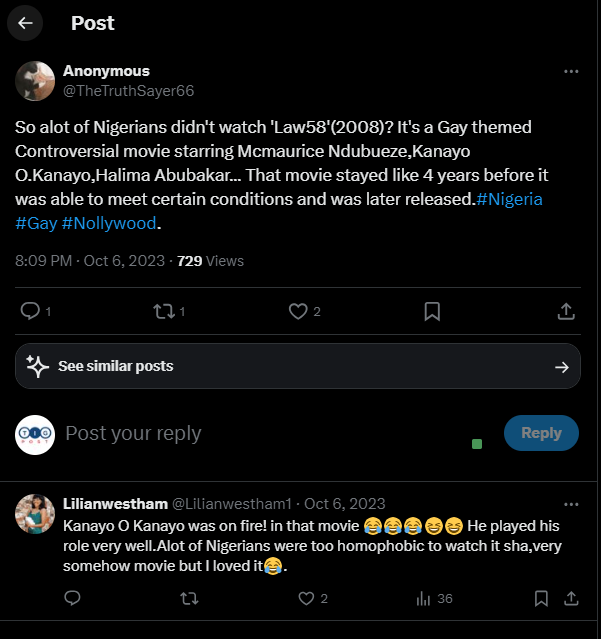
In January 2012, movie producer and director, Dickson Iroegbu released a gay movie titled “Law58” which caused ripples in Nigeria.
The movie told the story of the practice of homosexuality in Nigeria, its consequences on traditional African society and it starred popular actor, Anayo Modestus Onyekwere MFR popularly known as Kanayo O. Kanayo.
According to reports, Dickson initially contacted Desmond Elliot and Mike Ezuruonye for the film but they rejected the offer.
In the movie, Kanayo O. Kanayo and Mcmaurice Ndubueze play gay lovers. Kanayo gets furious after he catches his lover in bed with another man.
https://www.youtube.com/watch?v=I0Hpq8pHUfk
The movie was released a short period Nigerian lawmakers passed a bill against the practice of same sex marriage in Nigeria, putting a 14-year jail term on those caught involved in the act.
Homosexuality has been regarded as un-African and as an abomination. It is generally regarded as an element of Western culture that has been transported into Africa.
A 25-year-old man has shared how his male biology teacher back at Senior High School (SHS) allegedly initiated him into homosexuality.
In an interview on Onua FM, Kofi (not his real name) disclosed that he was the teacher’s favorite student as he performed well in class, hence preferential treatments did not cause him to be alarmed.
“I was a very intelligent student, so he became fond of me, the same as some other teachers. He often sends me to get something for him, or he asks that I escort him to places. He also sometimes supports me financially.”
But the advances became clear when he was in his final year at age 16, when he had to reside on campus despite being a day student.
Per his account, one night, he was invited by his teacher for dinner, a gesture he believed was the kindness of his tutor. Apparently, that day was when his teacher made a pass on him and eventually had sexual intercourse with him.
He narrated, “After we were done eating, I told him I had to go home and prepare because I would be returning for preps. He told me there was no need for me to go home and return to school, as I could shower at his place and even have my prep time in his bungalow, after which I could return home. So, I went to his bathroom to take my bath, and while there, he joined me naked. Because he was my teacher, I sought to cover myself because I was shy around him, but he told me not to worry,” he stated.
According to Kofi, his teacher sought his consent but could not tell how he gave in to his request as he was shell-shocked.
“… At that instant, he began to fondle my penis. At that instance, it did not occur to me that he was gay and he could have sex with me. All of a sudden, he held my penis into his mouth and was licking it. He asked me if I could have sex with him. I stood quiet for a long time because I didn’t know what to say, and then it happened. It was a painful experience, but he was my teacher, and he helped me sometimes, so whatever he said, I did,” he added.
Per the man’s narration, he was not defiled.
The Criminal Offences Act, 1960 defines defilement in Section 101(2) of Act 29 as natural or unnatural carnal knowledge of a child under sixteen years of age with or without the child’s consent.
But this revelation comes at a time when Ghana is close to criminalising the activities of the LGBTQ+ community.
A 25-year-old man narrates his wild story of how his Senior High School (SHS) biology teacher introduced him to h0m0se×uality through p0rn0gr@phy during his high school days when he was only 16 years old. pic.twitter.com/R9H4E0LgpK
National laws criminalizing consensual same-sex relations between adults exist in a minimum of 67 countries.
These laws may specifically target certain sexual acts, and in some cases, they are general and open to interpretation.
Penalties range from fines to life imprisonment and, in extreme cases, the death penalty.
Law enforcement agencies in certain places actively pursue and prosecute individuals suspected of being lesbian, gay, bisexual, or transgender.
In other instances, while the laws are rarely enforced, they still have severe consequences for LGBTQ+ people, affecting their access to employment, health services, and police protection.
Furthermore, at least nine countries have national laws criminalizing forms of gender expression that disproportionately impact transgender and gender nonconforming individuals. For example:
Southern and Western Asia (Brunei and Oman) criminalize “posing as” or “imitating” a person of a different sex.
2.Saudi Arabia routinely arrests people based on their gender expression.
3. Malaysia penalizes “posing as” a different sex in its Sharia codes.
3. Nigeria criminalizes transgender and gender nonconforming people in its northern states under Sharia.
4. South Sudan applies such laws only to men who “dress as women.”
5. Malawi criminalizes men who wear their hair long.
6. Tonga prohibits any “male person” from presenting as a female while “soliciting for an immoral purpose.”
7. The United Arab Emirates (UAE) has laws prohibiting men from “posing as” women in women-only spaces, which they have used to prosecute gay and transgender people even in mixed-gender spaces.
Additionally, 15 countries maintain unequal ages of consent, imposing a higher bar for same-sex couples than different-sex couples or for anal sex compared to vaginal sex.
This includes countries like Canada and Chile.
In 11 states of the United States, unenforceable laws prohibiting consensual same-sex conduct remain on the books despite a 2003 Supreme Court decision that found such laws unconstitutional.
However, in Ghana, the law to criminalize lesbian, gay, bisexual, and transgender (LGBT) activities and criminalizes their promotion, advocacy, and funding in the country awaits approval from President Akufo-Addo .
Nasir and his “lover” were assaulted by his childhood friends upon discovery, leading security officials to intervene with a warning shot, dispersing the enraged crowd.
Now stabilized at the hospital, Nasir tearfully considers reporting the incident to the police for protection and seeking justice.
“I was there for antenatal care when they brought him to the hospital reception. It was a really bad sight. I don’t know what could have happened if he had not been rescued early,” a pregnant woman who was an eyewitness recounted.
“Now that LGBQT has been declared illegal by the law, it is only right that we report any suspects to the police rather than continue this barbaric act of instant justice. It most often leads to attacking innocent people,” one of the doctors advised.
In Ghanaian society, homosexuality is considered an abomination, a sentiment exacerbated by the recent passage of the anti-gay bill.
However, Winnie Byanyima, the Executive Director of UNAIDS, has voiced serious apprehensions regarding Ghana’s endorsement of the anti-gay legislation.
In a statement, UNAIDS cautioned that if enacted, the bill could fuel violence, obstruct access to vital services, and undermine basic freedoms, potentially impeding Ghana’s developmental trajectory.
Byanyima underscored the detrimental effects on the fight against AIDS and public health in general.
The statement emphasized the potential infringement on individual liberties and the broader efforts to address health challenges.
Chaos is said to have erupted at Dr. Kofi Boateng Memorial Hospital in Kasoa, near Accra, when a young man named Silas was rushed to the hospital in a delicate state.
Per reports, he suffered a brutal attack by his Muslim brothers over allegations of being gay.
Nasir’s childhood friends assaulted him and another, suspected to be his lover . It is said that it took the efforts of security officials to disperse the angry mob.
“I was there for antenatal care when they brought him to the hospital reception. It was a really bad sight. I don’t know what could have happened if he had not been rescued early,” a pregnant woman who was an eyewitness recounted.
“Now that LGBTQ has been declared illegal by the law, it is only right that we report any suspects to the police rather than continue this barbaric act of instant justice. It most often leads to attacking innocent people,” one of the doctors advised.
Homosexuality is considered an abomination in the Ghanaian community, a sentiment exacerbated by the recent approval of the anti-gay bill.
Winnie Byanyima, the Executive Director of UNAIDS, has expressed serious concerns about Ghana’s approval of the bill. In a statement, UNAIDS warned that if enacted, the bill could incite violence, impede access to life-saving services, and undermine fundamental liberties, potentially hindering Ghana’s developmental progress.
Byanyima emphasized the adverse impact of the bill on the fight against AIDS and overall public health. The statement highlighted the potential harm that such legislation could cause to individual freedoms and broader efforts to combat health challenges.
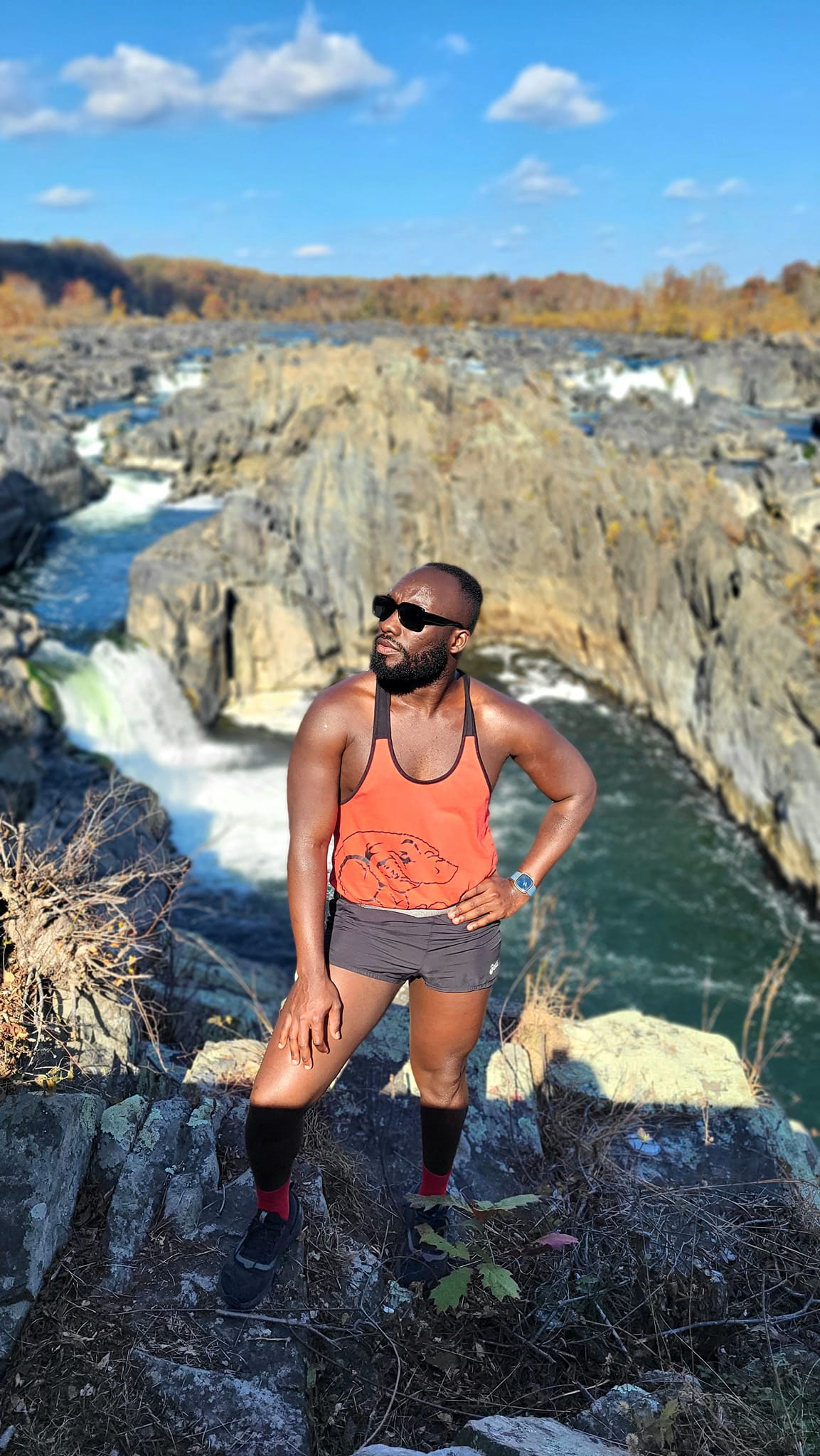
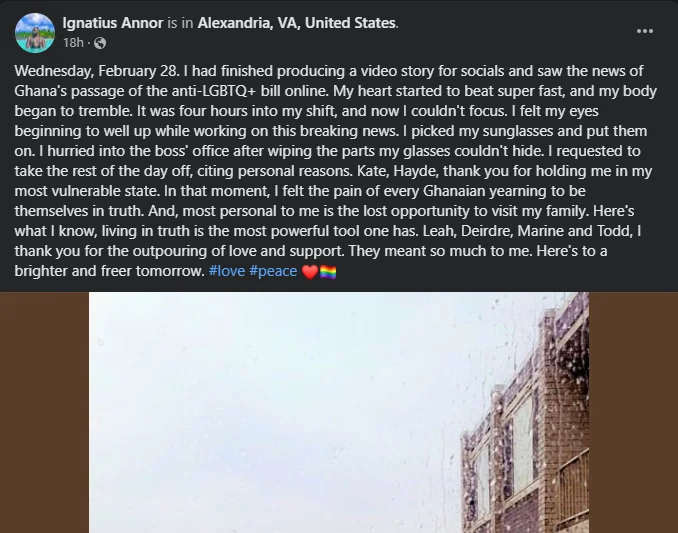
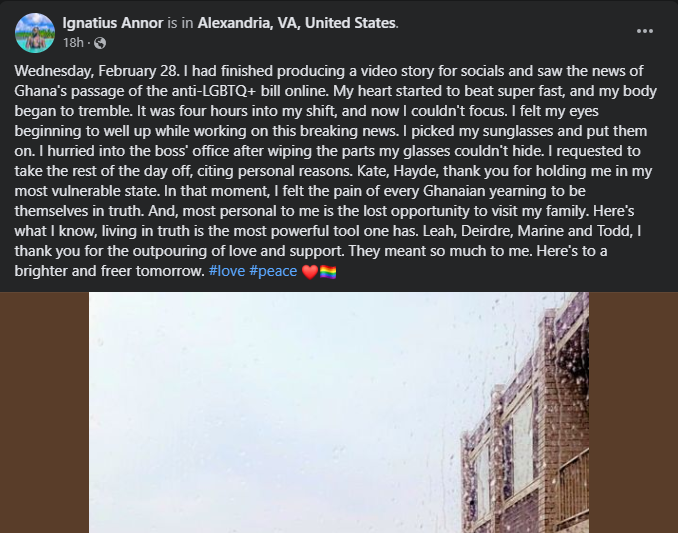
Ignatius Annor, a Ghanaian journalist based in the US who identifies as gay, has reacted to the passing of Ghana’s anti-LGBTQ+ bill by parliament.
Mr Annor, who publicly revealed his sexual orientation years ago, described feeling disoriented upon hearing the news. He also mentioned the challenge of reporting on the topic for his media outlet.
“My heart started to beat super fast, and my body began to tremble,” he narrated as he sought and was granted the day off to deal with the overflow of emotions.
In addition to the general concern it raised for him and the entire same-sex community back home, Annor also expressed personal frustration with a specific aspect of the bill.
He revealed his apprehension about being unable to visit his family in Ghana due to the law.
“And, most personal to me is the lost opportunity to visit my family. Here’s what I know: living in truth is the most powerful tool one has. Leah, Deirdre, Marine, and Todd, I thank you for the outpouring of love and support. They meant so much to me,” his February 29, 2024 post on X read.
Parliament has passed the Promotion of Proper Human Sexual Rights and Ghanaian Family Values Bill also known as the anti-LGBTQ bill after three years following its introduction.
During Wednesday’s Parliamentary session Majority Leader Alexander Afenyo-Markin sought to make amendments to the bill during the second consideration stage citing human right infringement.
Parliament has passed the Promotion of Proper Human Sexual Rights and Ghanaian Family Values Bill also known as the anti-LGBTQ bill after three years following its introduction.
During Wednesday’s Parliamentary session Majority Leader Alexander Afenyo-Markin sought to make amendments to the bill during the second consideration stage citing human right infringement.
However, the Minority rejected his request, prompting the Speaker to push for the third consideration stage,.
Speaker Alban Bagbin put the bill to a voice vote and the ayes had it.
As it stands now, Parliament has tabled the bill to the President’s desk for President Akufo-Addo to assent to the bill to become law.
The Anti-LGBTQ+ bill aims to criminalize LGBTQ+ activities in Ghana. It proposes strict penalties, including imprisonment, for individuals engaged in activities related to homosexuality and LGBTQ+ advocacy.
Additionally, the bill seeks to prohibit the promotion of LGBTQ+ rights, organizations, and events in Ghana.
Prior to its passage, there had been several amendments to the bill. After deliberation, Parliament decided that the minimum custodial sentence has been set at three years, with a maximum of five years for promoters and sympathisers.
Additionally, individuals caught directly engaging in these activities will face a minimum sentence of six months, extendable to a maximum of three years.
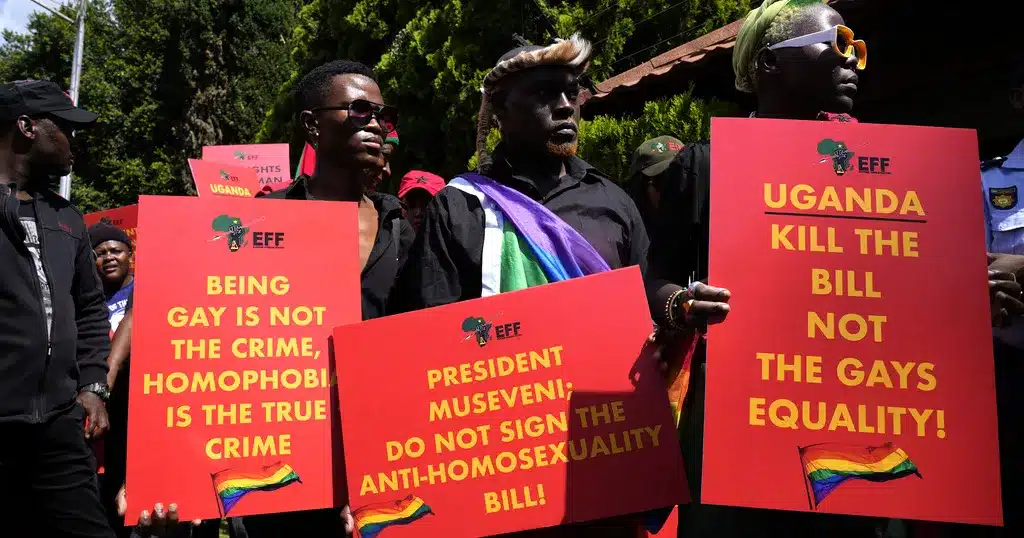
Ghana is among many African countries that are working to rid LGBTQ activities in the society. Uganda enacted one of the world’s harshest anti-gay laws in May, which calls for the death penalty for certain same-sex acts.
However, the Minority rejected his request, prompting the Speaker to push for the third consideration stage,.
Speaker Alban Bagbin put the bill to a voice vote and the ayes had it.
As it stands now, Parliament has tabled the bill to the President’s desk for President Akufo-Addo to assent to the bill to become law.
The Anti-LGBTQ+ bill aims to criminalize LGBTQ+ activities in Ghana. It proposes strict penalties, including imprisonment, for individuals engaged in activities related to homosexuality and LGBTQ+ advocacy.
Additionally, the bill seeks to prohibit the promotion of LGBTQ+ rights, organizations, and events in Ghana.
Prior to its passage, there had been several amendments to the bill. After deliberation, Parliament decided that the minimum custodial sentence has been set at three years, with a maximum of five years for promoters and sympathisers.
Additionally, individuals caught directly engaging in these activities will face a minimum sentence of six months, extendable to a maximum of three years.
Ghana is among many African countries that are working to rid LGBTQ activities in the society. Uganda enacted one of the world’s harshest anti-gay laws in May, which calls for the death penalty for certain same-sex acts.
Ignatius Annor, a US-based Ghanaian journalist who identifies as gay, has responded to Ghana’s parliament passing the anti-LGBTQ+ bill.
Mr Annor, who publicly came out about his sexual orientation years ago, expressed feeling disoriented when he heard the news. He also mentioned having to report on the same topic for his media outlet.
“My heart started to beat super fast, and my body began to tremble,” he stated as he sought and was granted the day off to deal with the overflow of emotions.
He expressed personal frustration with a part of the bill aside from the general worry it caused him and the entire same-sex community back home.
“And, most personal to me is the lost opportunity to visit my family. Here’s what I know: living in truth is the most powerful tool one has. Leah, Deirdre, Marine, and Todd, I thank you for the outpouring of love and support. They meant so much to me,” his February 29, 2024 post on X read.
Annor is concerned that he cannot visit his family in Ghana because of the law.
President of the Ghana Catholic Bishops’ Conference, Rev. Matthew Kwasi Gyamfi, has criticized the imprisonment penalties outlined in the newly passed anti-LGBTQI bill. He believes that incarcerating individuals based on their sexual orientation will not resolve the issue but rather exacerbate it.
Speaking on Accra-based Citi FM, Rev. Gyamfi reiterated the church’s endorsement of the bill but called for a reconsideration of the punitive measures. He emphasized the importance of implementing more rehabilitative and corrective measures.
“We think that in the case of this particular law and the way it is being implemented, being placed in prison as the punishment that they have chosen, it is not going to solve the problem.
Because you see if you round up same-sex people and you know our prisons, they are going to end up in the same room and what is going to prevent them from going through these activities in the prison?
“And you are not going to put them there forever because they are going to be there for three months to six months. And then they practice this and come out as more experts at it than when you sent them there. Then you release them back into society. So, what is going to happen?
“That is why we were concerned about a punishment that will correct them, that will reform them. So if the government is going this way or if the parliament is going this way that is why we are suggesting that in the prison there, they should add more of the corrective and reformative measures,” he stated.
On Wednesday, February 28, 2024, Parliament approved the Proper Human Sexual Rights and Family Values bill, popularly known as the anti-LGBTQ bill.
This law prohibits LGBTQ activities, including their promotion, advocacy, and financial support.
Those convicted could be sentenced to imprisonment for six months to three years, while those promoting or sponsoring such activities could face three to five years in jail.
A viral video from South Africa has sparked a range of reactions, capturing the moment a heartbroken man interrupts his boyfriend’s wedding.
In the footage, the distraught man, who is gay, can be seen and heard expressing his anguish as his boyfriend exchanges vows with a woman. He laments being used and discarded after a relationship of over 5 years.
Despite efforts by bystanders to calm him down, he continues to voice his frustrations loudly, expressing his intent to disrupt the entire event.
Ghana is currently in the spotlight over its legislation that seeks to criminalize the identification and activities of the LGBTQ community, as well as its promoters and sponsors.
Parliament passed the controversial Proper Human Sexual Rights and Family Values bill on Wednesday, and since then, several international communities such as the UN Human Rights and the US have called on President Akufo-Addo not to assent to the bill.
Some Ghanaians, especially the Minority in Parliament, are skeptical of President Akufo-Addo appending his signature to the bill to become law.
Not many citizens are pleased by this and want the president to make his stance known, just like his predecessors did. A video of the late John Evans Fifi Atta Mills has resurfaced.
Thirteen years ago, then President John Evans Fifi Atta Mills assured that Ghana would not legalize same-sex activities under his watch.
In an interview on November 2, 2011, he said, “(But) I as president of this nation, I will never initiate or support any attempts to legalise homosexuality in Ghana.”
Throwback to when Ghana’s late President H.E Evans Attah Mills gave a clear and unwavering verdict on LGBTQ+. pic.twitter.com/HDWOjNVRSW
During that period, Britain had warned it would review aid to countries that persecute homosexuals. It had suspended £19 million in aid to Malawi because of concerns including its treatment of gays.
Now, Ghana faces the same threat as Uganda has been hit with sanctions by the US for passing one of the world’s harshest anti-Gay bill.
The most recent health survey carried out by the Ghana Statistical Service (GSS) has raised concerns as Ghana is now categorized among countries experiencing a rapid increase in HIV infections.
Alarming statistics from the 2022 national and sub-national HIV/AIDS estimates and projections reveal a total of 16,574 new HIV infections in the country. Among these, 10,927 cases were reported among females and 5,647 among males.
Dr. Kyeremeh Atuahene, the Director General of the Ghana Aids Commission, attributes this classification to a surge in new infections.
In an interview with JoyNews on January 31, Dr. Atuahene highlighted the contributing factors to the spread, pointing specifically to individuals involved in same-sex marriages—an activity considered illegal in Ghana. He emphasized that the criminalization of such activities has hindered affected individuals from seeking essential treatment.
“The people who contribute a significant amount of new infections in the country are criminalized; men who have sex with men, sex workers, people who inject drugs, their activities are criminal in the country,” Dr Atuahene emphasized. He highlighted the resultant underground nature of these high-risk groups, hindering their access to crucial HIV prevention and treatment services.
In the midst of the escalating HIV crisis, Dr. Atuahene unveiled plans to enlist influential figures in society to enhance awareness about HIV and AIDS.
He underscored a crucial gap, noting the absence of active participation by high-profile Ghanaians living with HIV in campaigns against stigma.
Dr. Atuahene suggested that involving business executives, celebrities, sports personalities, traditional authorities, and even priests could play a significant role in diminishing the stigma and discrimination associated with HIV.
Given the urgency of the situation, there is a pressing need for prompt and targeted measures to curb the increasing number of new HIV infections and prioritize the well-being of at-risk populations in Ghana.
The University of Ghana (UG) has strongly condemned the assault on a young man suspected to be homosexual at its Legon campus, as depicted in a circulating video on social media.
In an official statement released on Tuesday, January 16, UG’s management affirmed its unwavering commitment to the safety and well-being of all individuals within its community.
The statement reads, “The University of Ghana strongly denounces the assault and denigration perpetrated by the prospects seen in the videos posted on social media, and strongly condemns such acts of lawlessness. The University of Ghana would like to affirm its commitment to the safety, dignity and inclusivity of all persons.”
“Management takes its commitment to the enforcement of the rules and regulations governing the university seriously and any member of the university community identified to be involved in this cruel incident will be appropriately sanctioned,” it stated.
It further emphasized that management takes its commitment to the enforcement of the rules and regulations governing the university seriously, and any member of the university community identified to be involved in this incident will face appropriate sanctions.
UG assured the public of its collaboration with the police for a thorough investigation into the matter to ensure the safety of all members of the university community and visitors to its campuses.
READ THE FULL STATEMENT ON THE ASSAULT HERE
Meanwhile, Africa Education Watch (Eduwatch), an education-focused think tank has condemned the assault.
Eduwatch in a statement issued on Tuesday, January 16 said it “condemns in no uncertain terms this criminal, inhuman and degrading act which violates the individual’s right to dignity and freedom from inhuman and degrading treatment, as enshrined in Article 15 of the 1992 Constitution.”
“Eduwatch wishes to remind all and sundry that, Ghana is a country governed by Laws which abhors instant injustice.”
It called on the Vice Chancellor of UG and the Ghana Police Service to initiate rapid investigations into the act, bring the perpetrators to justice, identify the victim and provide the necessary health support.
“We call for increased security on our tertiary campuses to ensure the safety of human lives,” it added.
Additionally, Africa Education Watch (Eduwatch), an education-focused think tank, condemned the assault in a statement issued on the same day.
Eduwatch expressed firm opposition to the criminal and inhumane act, emphasizing that it violates the individual’s right to dignity and freedom from inhuman and degrading treatment.
Eduwatch called on the Vice Chancellor of UG and the Ghana Police Service to swiftly initiate investigations, bring the perpetrators to justice, identify the victim, and provide necessary health support. The think tank also urged increased security on tertiary campuses to ensure the safety of human lives.
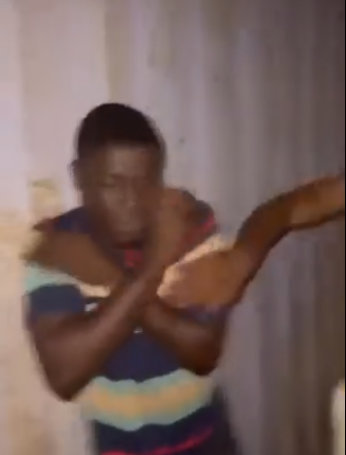
A young man, suspected to be a homosexual has been assaulted on the campus of the University of Ghana, Legon.
In a video making rounds on social media, a group of young men can be seen following the suspected gay who had been stripped naked; one flogging him with a stick, while the others followed closely.
In other videos, students are heard making fun of the young man, while they looked on for him to be assaulted.
An audio disclosing a conversation between Ghanaian open transgender musician and LGBTQ+ activist, Angel Maxine, and a purported Member of Parliament has surfaced.
The genesis of the conversation is unknown, but the brief conversation sees the male voice pleading with Angel to think about something he has requested. He further went on to assure her that her safety is guaranteed, as he has done on several occasions.
“Angel, please, you think about it. I’ve defended you, protected you before. Angel, don’t do this to me,” a male voice says in an Instagram post shared by Angel Maxine.
In her post, she also warned that all legislators and religious leaders will be dragged into the mud should Parliament pass the Promotion of Proper Human Rights and Ghanaian Family Values Bill.
“We’re going down together, including the religious leaders,” she wrote.
Her warnings come in the wake of recent remarks by the Speaker of Parliament, Alban S.K. Bagbin, affirming that the anti-LGBTQ+ bill will indeed be approved before Parliament adjourns for the Christmas break.
In an earlier post, she cautioned the MPs seeking to criminalise LGBTQ activities to be wary and focus on helping their constituents. She also accused some politicians of heavily engaging in same-sex activities.
“President Nana Akufo-Addo, check the Jubilee House well if there are no LGBTQ+ people working there. All you these so called politicians, you drive your cars, go and park at Labone secondary school, PRESEC, UPS and your pimps will arrange the boys and bring to you. They are peoples kids, yet their parents are on social media attacking queer people. Do you think we don’t know? People you have abused, people you have molested, people who are hurt, everything is on this paper and they’re ready to talk,” she alleged.
“Pass the bill and I will show you your MPs who are LGBTQ+. You think I have not seen gay politicians? All the MPs who have been texting people to get them boys to sleep with. All of the politicians who have been begging pimps to hook them up with boys. All your chats and conversations are here (points to a pile of documents). Pass the bill and I will expose your family members and children who are queer people. All those queer celebrities, also cannot speak for themselves,” she added.
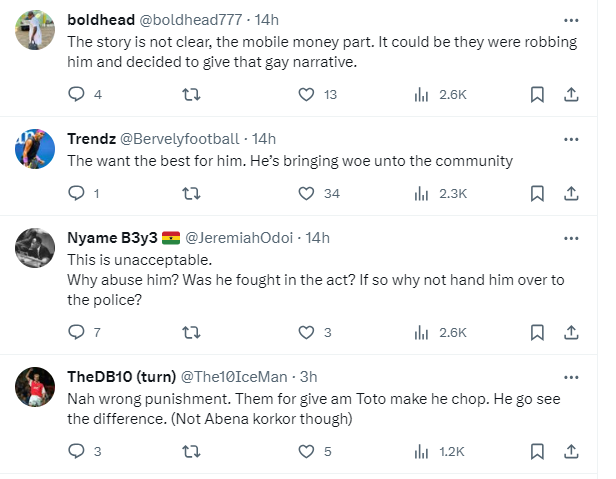
Some X users have reacted to the incident. While some questioned why one would decide to be gay, others could not comprehend why the group demanded to know the mobile money details of the victim in question.
The assault on alleged gays in Ghana is a new phenomenon in Ghana. It is believed that such incidents have heightened as the country seeks to pass into law the Human Sexual Rights and Ghanaian Family Values bill, drafted in August 2021, which seeks to criminalise the activities and promotion of the LGBTQ community.
Meanwhile, the Ghana Catholic Bishops has warned against the abuse of members of the LGBTQ community.
“The intrinsic dignity of each person must always be respected in word, in action and in law. Homosexuals must be accepted with respect, compassion and sensitivity. According to Pope Francis, the homosexual person needs to be “respected in his or her dignity and treated with consideration, and ‘every sign of unjust discrimination’ is to be carefully avoided, particularly any form of aggression or violence” (Amoris Laetitia 250). Families with LGBT members need “respectful pastoral guidance” from the church and its pastors so that gays and lesbians can fully carry out God’s will in their lives (Amoris Laetitia 250)” the Ghana Catholic Bishops’ letter to Parliament read.
The Ghana Catholic Bishops is however in support of the passing of the bill into law.
A 33-year-old Nigerian man, Saheed Azeez, who secured refugee status in the UK under the pretext of being gay has not only had three children with different women, but has also orchestrated a £220,000 parcel fraud via Facebook and eBay.
Saheed Azeez, who claimed he faced persecution by Boko Haram militants in his home country, was sentenced to six years in prison at Bolton Crown Court after admitting conspiracy to commit fraud by false representation and plotting to possess criminal property.
Azeez, residing in Wigan, collaborated with Nigerian fraudsters to establish an intricate network for a well-resourced scam.
The modus operandi involved convincing sellers on eBay, Facebook Marketplace, and WhatsApp to send high-value items to various addresses with the promise of payment upon delivery.
However, Azeez would intercept the goods, selling them through his brother’s electronics shop.
Over 14 months, Azeez, in collaboration with his associates, persuaded up to 272 victims to send goods worth a total of £220,000 to strangers’ homes. These individuals were promised a share of the proceeds in exchange for receiving the fraudulently obtained items.
Azeez was tracked down by the police while dropping off one of his young sons at a primary school. During the arrest, he reportedly concealed three smartphones, integral to the scam, in the child’s school bag.
The phones reportedly contained incriminating videos, including one sent to an underworld contact named ‘Baddest Boy,’ showcasing stolen smartphones.
Having admitted to conspiracy to commit fraud by false representation and plotting to possess criminal property, Azeez is set to be sentenced next week, facing a potential six-year jail term.
Nine individuals who allowed their addresses to be used as ‘drops’ in the scam will, according to reports, be sentenced next year.
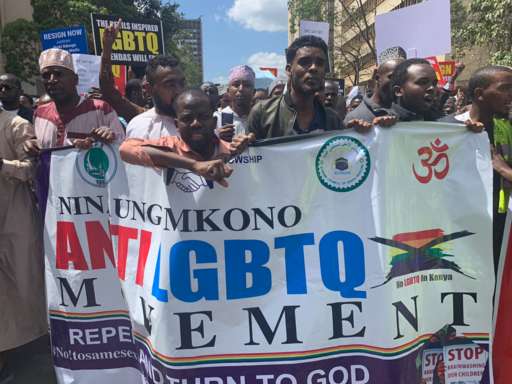
An anti-gay demonstration is currently underway outside the Supreme Court in Nairobi, Kenya’s capital.
Numerous civil society and religious organizations are venting their frustration over a recent court ruling permitting the registration of gay and lesbian associations within the country.
Among the protesters, some are brandishing signs demanding the resignation of the Supreme Court judges.
A decade ago, a government-funded entity rejected the registration of an LGBTQ rights organization, citing the promotion of same-sex conduct in a nation where homosexual activity remains illegal.
However, this year, judges overturned that decision.
Kenya’s President, William Ruto, has called on religious leaders to advocate for what he terms as traditional values.
The top court of Mauritius has changed the law to make gay sex legal. They said that the previous ban was based on old rules from when Mauritius was a colony, and not on the country’s own beliefs and customs.
British colonialists made it illegal to engage in “sodomy” in 1898, but authorities have not been enforcing this law in recent times.
The man who likes other men and took the matter to court said he can now love whomever he wants without being scared.
This decision is made when there is more hate towards gay people and stricter laws against them in some African countries.
Uganda’s President Yoweri Museveni signed a law in May that is against homosexuals. This law says that people who have sex with children or rape someone will be punished with death.
Many people in Uganda and other African countries believe that homosexuality is not a part of their African culture and goes against their religious beliefs.
This case in Mauritius was brought by Abdool Ridwan Firaas Ah Seek. He argued that the law against same-sex relationships violated his basic rights, such as the right to freedom.
The highest court in Mauritius said that the law was not based on the beliefs and customs of the indigenous people of Mauritius, but was instead passed down from British colonial rule.
The judges said that the decision to implement this was not based on what the people wanted, but was forced upon Mauritius and other colonies by the British government.
This decision means that individuals cannot be arrested for engaging in gay sex anymore, but the law still needs to be officially removed by the parliament in order to make it legally accepted.
In legal documents, the state said it wasn’t being unkind to the LGBT community, but the laws can only be changed by parliament when society is ready for it.
Mauritius became independent in 1968, but continued to prohibit gay sex.
Religious groups are strongly against getting rid of it.
Abdool Ridwan Firaas Ah Seek stated that the decision would allow upcoming generations in Mauritius to comfortably and openly accept their sexuality without the worry of being taken into custody.
The Human Dignity Trust (HDT) stated that it brings an end to over a hundred years of discrimination against LGBT individuals in Mauritius.
The ruling told African countries that still make same-sex relationships illegal to get rid of these laws.
In Mauritius, the law says that having gay sex can lead to being put in jail for up to five years. However, the HDT says that this law is mostly not followed anymore.
There are 64 countries around the world where being gay is against the law, and almost half of them are in Africa.
A court in Nigeria has granted bail to 69 individuals who were arrested last month following a police raid on what was described as a “gay wedding.”
Homosexuality is widely considered immoral in Nigeria, and the country has stringent laws against same-sex marriage.
The defense lawyer confirmed that all 69 clients would be released on bail but were required to pay more than $600 (£480) each to the court.
The raid on a hotel in Warri city last month occurred based on a police tip-off regarding a gay wedding.
Human Rights Watch criticized the Nigerian police for publicly parading the suspects before the media and interrogating them about the accusations.
Despite international condemnation, Nigeria passed legislation nearly a decade ago criminalizing public displays of same-sex relationships, carrying a prison sentence of up to 10 years, and up to 14 years for those convicted of same-sex marriage.
In 2019, police in Lagos State prosecuted 47 men under the law, but the case was dismissed because the police failed to appear and present witnesses.
A proposed legislation in Kenya, known as the Family Protection Bill 2023, is advocating for severe penalties, including 50 years of imprisonment, for non-consensual sexual acts involving gays and lesbians. The draft law, introduced by Homa Bay Town legislator Peter Kaluma, aims to outlaw homosexuality, same-sex unions, and all LGBTQ-related activities and advocacy.
Additionally, the bill seeks to prohibit gay parades, gatherings, and demonstrations in public spaces, as well as cross-dressing in public.
“A person who engages in sexual act with a person of the same sex without the consent of the other person shall upon conviction be sentenced to imprisonment for a term of not less than 10 years and not exceeding 50 years,” says the bill.
If the bill is enacted, individuals who own properties used for same-sex activities will be subject to a fine of $14,000 (£11,000) or could potentially face a seven-year prison sentence.
Last week, religious leaders and certain civil society organizations organized anti-LGBTQ demonstrations in the coastal city of Mombasa.
This protest followed a reaffirmation by Kenya’s Supreme Court of a decision made in mid-September to permit the registration of LGBTQ non-governmental organizations (NGOs).
The Kenya NGO Coordinating Board had previously refused to register the National Gay and Lesbian Rights Commission, citing its promotion of same-sex behavior and dragging the case for a decade.
However, earlier this year, the Supreme Court deemed this action discriminatory and unconstitutional, thereby granting LGBTQ organizations the right to register in a groundbreaking ruling.
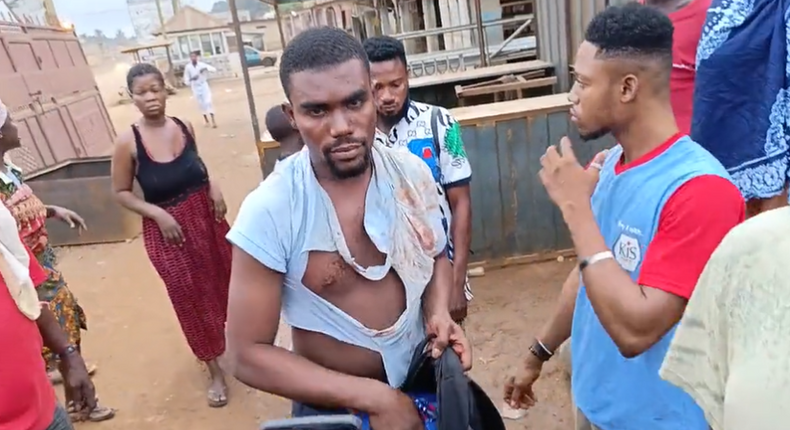
An unsettling incident involving an alleged assault on a male teacher has raised significant concerns regarding LGBTQ+ tensions in the town of Blue Town, located in Prestea, Western Region. The incident, captured in a viral social media video, has ignited discussions about discrimination, intolerance, and the broader LGBTQ+ rights debate in Ghana.
In the video, the victim, whose identity has been concealed, is shown with torn clothing and blood visibly seeping from a wound behind his ear. A narrator in the background provides commentary, suggesting that the man had “turned himself into a woman” and engaged in sexual activity with another man.
The incident sheds light on the deep-seated biases and prejudices that persist in Ghanaian society, particularly in smaller communities like Blue Town. While details remain unclear about how the mob learned of the alleged incident or the whereabouts of the other individual involved, the violent response underscores the challenges faced by LGBTQ+ individuals.
This incident has broader implications within the context of LGBTQ+ rights in Ghana. The country is currently grappling with a contentious private bill known as the Human Sexual Rights and Family Values Bill, which aims to criminalize LGBTQ+ activities. The bill’s potential enactment has stirred heated debates and raised concerns about human rights violations.
The incident in Blue Town highlights the urgent need for dialogue, education, and understanding surrounding LGBTQ+ issues. Advocates emphasize the importance of fostering an inclusive and tolerant society, where individuals are respected regardless of their sexual orientation.
As the news of the assault spreads, attention turns to law enforcement and the justice system. While it remains uncertain whether a formal complaint has been filed with the police, the video evidence captures the faces and scene of the attack, prompting expectations for a swift and thorough investigation.
Beyond the immediate violence, the incident serves as a poignant reminder of the challenges faced by LGBTQ+ individuals in communities where prejudice and discrimination persist. It calls for a broader conversation about creating safe spaces, combating intolerance, and upholding the values of equality and human rights for all.
A young man who was suspected of being gay was forcibly stripped of his clothes and made to walk through the streets of the Bibiani Ahwiaso Bekwai Municipality in the Western North Region.
The victim was allegedly confronted by a group of young men who accused him of engaging in a “demonic act.”
According to reports by oyerepafmonline.com, the victim, identified as a resident of Bibiani Old Compound, had travelled to the community of Hwenampori in the Bibiani township to meet another young man with whom he had expressed interest.
The young man who lured the victim to the location revealed his perspective on the incident.
He stated, “I was buying rice one day when he approached me… when I went to listen to him, he claimed he lost my contact, and I willingly gave it to him despite not knowing him before.
“He told me that he wanted to date me and take care of me… so I asked him how and at the time I was coughing, so he said he could get me drugs and other things…”
We later arranged for him to visit me so that we can have a sexual encounter, the victim added, stating that he had set up gadgets to record the guy in question.
“My friends were there but I was recording him at the time, so he came and as he was about to remove his dress my friends came there and stripped him naked, so we took him through the entire town and the boys wanted to beat him to death but one of my friends saved him and we handed him to the police.”
The victim was injured, and it took the intervention of another community leader, Sibo, who told the attackers not to attack him but rather hand over to the police for the law to
Entertainment analyst Arnold Asamoah has weighed in on the ongoing exchange between renowned Ghanaian broadcaster Kwasi Kyei-Darkwah (KKD) and his critics concerning the revelation of his son’s homosexuality.
In July 2023, images and videos surfaced on social media showing Darkwah Kyei-Darkwah, KKD’s son, leading a demonstration advocating for gay rights in the UK.
Subsequently, KKD publicly defended his son’s sexual orientation, emphasizing that he has no influence over his son’s sexuality and urging an end to the criticisms.
During a conversation with MzGee on the United Showbiz program on UTV, Arnold commented that the continuous criticisms appear to stem from KKD’s previous criticisms of the government.
“These are the repercussions of him being a sound critic of the government. He has criticized the government on many occasions, so if they want to get back to KKD, they will hit him where it hurts most. If really, he wants to continue to criticize the government, there will always be attacks on his son, so he should be ready,” he said.
Chairman of Parliament’s Constitutional, Legal and Parliamentary Affair Committee, Kwame Anyimadu-Antwi, has provided staggering statistics with regards to the activities of the LGBTQ+ community in the country.
On Wednesday, July 5, Mr Anyimadu-Antwi informed the house of a report by the Ghana AIDS Commission which captured the sexual activities of gay men over a lustrum ago.
Per the said report, 54,759 men living in Ghana engaged in same-sex sexual intercourse in 2017.
“Out of this number, 9,857 representing 18.1 per cent were found to live with HIV. According to the Commission, although the number represents only 2% of the HIV population in the country, the 18% prevalence rate is enough for disease to grow exponentially,” he said while citing the report.
Mr Anyimadu-Antwi capitalised on the report to highlight the health dangers the activities of the LGBTQ+ community he said pose to the society at large.
Proponents of the anti-LGBTQ+ bill, officially known as the Promotion of Proper Human Sexual Rights and Ghanaian Family Values Bill 2021 have argued that the legislation is necessary to protect public health and promote Ghanaian family values.
However, opponents of the bill highlight the importance of human rights, equality, and non-discrimination in addressing these concerns.
Meanwhile, the Constitutional, Legal, and Parliamentary Affair committee has presented a report on the Promotion of Proper Human Sexual Rights and Ghanaian Family Values Bill 2021, commonly known as the anti-LGBTQ+ bill to the plenary.
Uganda’s new anti-gay law has sparked a range of emotions in the East African country. President Yoweri accepted the revised measure on Monday, causing the United States and European countries to threaten sanctions and aid cuts.
A section of Ugandans say the anti-homosexuality legislation is the least of the country’s priorities.
“It is not what we need right now. The kind of rights, we cannot be talking about such rights when fundamental rights like human rights, rights to access to education, access to health services we have not fought for such rights and we go for that other right,” said Shem Luyombya, a Kampala resident.
But some Ugandans said the law is an unnecessary provocation against donor countries.
“If sanctions can affect a country like Russia then who are we to say that we are not going to be affected by it? The world is a global village so if they cut you off you are actually going to suffer some repercussions but then again it comes to the point of how far can someone else influence how you run your country?,” wondered Jonathan Owot, a Kampala resident.
LGBTQ rights campaigners say the new legislation is unnecessary in a country where homosexuality has long been illegal under a colonial-era law criminalising sexual activity “against the order of nature.”
The punishment for that offense is life imprisonment.
Amnesty International and a Nairobi-based gay rights organization, has indicated in a joint report that LGBTQ refugees and asylum seekers in Kenya face serious human rights violations, including rape.
The report released on Friday said hundreds of gay people, who are among more than 200,000 refugees and asylum seekers in north-western Kakuma camp, experience “extreme discrimination and violence”.
“Perpetrators of violence and intimidation targeting LGBTI individuals can commit their crimes with almost total impunity, enabled by the lack of adequate responses from the police,” Amnesty and the National Gay and Lesbian Human Rights Commission (NGLHRC) said in a statement.
Researchers interviewed 41 people between 2018 and February 2023 who described facing “hate crimes, violence, including rape, and other serious human rights abuses”.
Most of the refugees and asylum seekers interviewed reported having suffered assaults, threats and intimidation in Kakuma camp, most of them more than once, because of their sexual orientation.
Based on the findings, Amnesty International and NGLHRC said that the Kakuma refugee camp complex was not safe for LGBTQ asylum seekers and refugees.
The rights organisations urged the Kenyan government to uphold the rights to life, protection against inhuman treatment and freedom from non-discrimination of everyone, including LGBTQ people.
Two purported gay men were beaten up at Ayeduase in Kumasi by individuals who are thought to be residents of the Glory be to God hostel nearby.
Ola Michaels, a reporter with Neat FM narrated what led to the attack on the alleged homosexuals and its aftermaths.
“There is a hostel called the Glory of God or Glory be to called which is closer to the Wisconsin junction. There are some boys from the hostel who come across the street to buy fried egg and these two boys who were tagged as gays, indeed they looked like girls also came to that same place to buy fried egg and drinks. Then these boys who saw them asked why they were behaving as women and that was it”.
Ola Michael went ahead to explain how the said men severely beat the acclaimed gay persons as though they were thieves.
“These gay boys were beaten for a very long time, dumped in the gutter and were also stoned while in the gutter as if they are thieves”, he stated.
The revelation comes on the back recent development in Ghana’s quest to cripple activities of the LGBTQI+ community in the country.
A bill to criminalize activities of LGBTQI+ is currently in Parliament.
Four men violently attacked by a mob at Ayeduase in Kumasi, after they were labelled as gay for being 'effeminate'
According to Neat FM journalist, Ola Michael, who is aware of the case, the incident has left the victims hospitalised as they were pushed into a gutter and stoned. pic.twitter.com/RKTDKcNMYG
A gay, whose identity has been withheld, has disclosed the main reason for his lack of preference for women.
Speaking exclusively to Etsey Atisu on ‘Say it Loud’, he averred that he finds women physically attractive yet emotionally retarded.
He said although he has been with a few women in the past, his taste still tilts toward men.
“I have been with a few women. I once told my father that I find women physically attractive but emotionally retarded. That is the reason why I am gay. I prefer and love the company of men to women. That is a reason to tell you that being with a woman is too much for me.
“To me, it just doesn’t make sense. It’s like forcing me to do something against my will. It’s like you not hating men but you just can’t have sex with them,” he established.
The young man stated that if ever he is forced to settle down with a woman, it will be as a result of societal pressures, owing to the part of the world he hails from.
He said should that happen; he will definitely cheat on the ‘unlucky wife’ with a male partner.
“If I am ever to marry a woman, it will be due to the pressure of society. If I am to marry in Africa, It will mean marrying a woman but that wouldn’t stop me from sleeping with other men which I don’t think is fair to anyone’s daughter.
“To be honest, I have been with a lot of married men, whose wives think they are in a happy marriage but their husbands come to me before even going home to them,” he added.
When asked if his father has accepted his new LGBTQ status, he answered:
“When it comes to being gay, my dad has been very loving, caring, and supportive. He is the one that gave birth to me and blood is thicker than water.”
Meanwhile, Parliament is expected to debate and pass the anti-gay bill.
This comes after the Legal and Parliamentary Affairs Committee of Parliament presented the final draft of the bill, which was sponsored by a group of bi-partisan Members of Parliament, to the plenary.
An anonymous homosexual man has revealed that many Ghanaian men swindle their wives under the guise of marriage to hide their actual sexual orientation.
According to Stephen (not his real name), his numerous sexual escapades have been with married men who are yet to come out of the closet or come to terms with their sexuality.
Speaking with GhanaWeb, he noted that these men pretend to be happy at home in order not to appear suspicious, but engage in same-sex activities in the shadow.
“Because, I’ve had instances where I’ve been with married men – a lot of married men, to be honest, a whole lot: who have their wives thinking they are in a happy home but then at the end of the day, when they pick their bags to go to work, they come to me before they go home,” he narrated.
Stephen’s revelation comes at a time when talks of criminalizing same-sex activities (LGBTQ activities) have heightened.
Parliament is considering Promotion of Proper Human Sexual Rights and Ghanaian Family Values Bill also known as the anti-LGBT bill which would ban one from identifying as a member of the LGBTQ+ community and its related activities when it becomes law. Culprits would risk jail term.
Due to the high possibility of the passage of the bill which has been recommended for approval by the Legal and Parliamentary Affairs Committee of Parliament, Stephen says he would get involved in a heterosexual relationship to stay off the radar – an action he considers unfair on the part of the woman.
He however noted that he would secretly continue having same-sex relations.
“A typical example, if I’m to marry in Africa, I will definitely marry a woman… I’ll still do men even in the absence of my wife; in secrecy, I’ll still do men, which I don’t think is fair to anyone’s daughter,” he said.
Nonetheless, Stephen insisted that in order not to “put your sister or anyone through such; I’d rather live my truth.”
Chairman of the Constitutional, Parliamentary, and Legal Affairs Committee of Parliament has raised doubts about the implementation of the Proper Human Sexual Rights and Ghanaian Family Values Bill, 2021 (anti-LGBTQI bill), which Parliament is considering.
According to Kwame Anyimadu Antwi, the Member of Parliament (MP) for Asante Akim Central, even though the bill has been fine tuned to ensure that it conforms with the 1992 Constitution of Ghana, implementing it will be very difficult if it is passed into law.
Speaking in an interview on Neat FM on Friday, monitored by GhanaWeb, the New Patriotic Party (NPP) explained that prosecuting LGBTI activities in Ghana will be difficult because these activities are not done in the public.
“This bill tells the public that Ghanaians do not condone LGBTQ+ activities, but from where I stand, I think that the enforcement of this law will be very difficult.
“Because if people are engaging in these activities in their rooms, it will be difficult for them to be dealt with. Unless they come out to say they engaged in these acts, what evidence can you provide for their prosecution?” he said in Twi.
He added that the country already has a law which forbids ‘unnatural carnal knowledge’ and that the house will be considering issues surrounding people of the same sex adopting children, among others.
Meanwhile, Parliament is expected to debate and pass the anti-gay bill. This is after the Legal and Parliamentary Affairs Committee of Parliament presented the final draft of the, which was sponsored by a group of bi-partisan Members of Parliament, to the plenary.
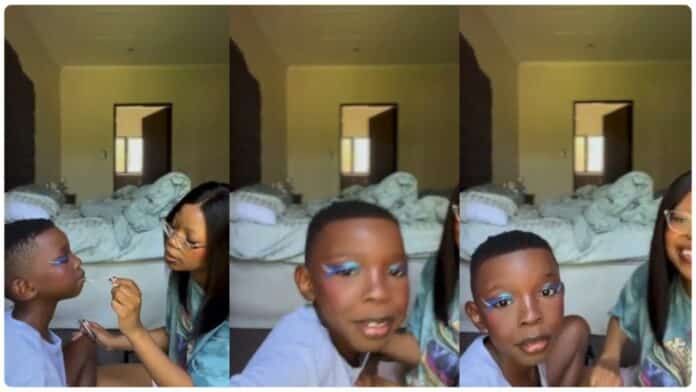
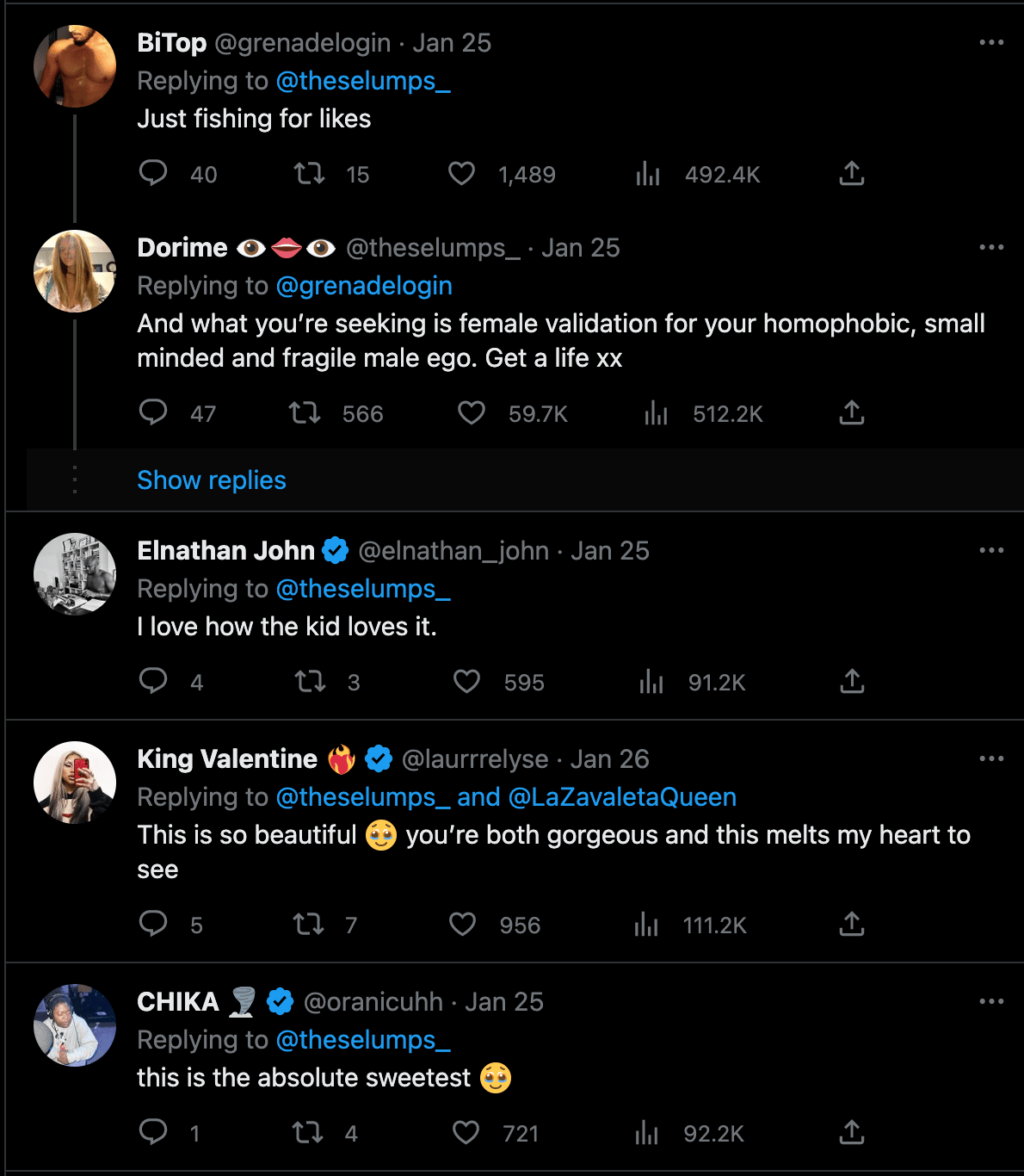
Concerns have been raised about a video of a lady applying makeup on a boy’s face.
Many who have come into contact with the post have reacted with disdain and abhorrence.
According to them, the lady is imbibing into the poor boy’s homosexual tendencies, which would eventually result in her deciding to be a woman.
While the lady has stiffly defended herself by stating that she was just having fun with her cousin, social media users are calling her out.
Sensitive homophobic comments have been passed, with most of these people exhibiting little or no tolerance for her actions.
She has been chastised for incorrectly influencing her and recklessly exposing her to the dangers of homosexuality at such a young and vulnerable age.
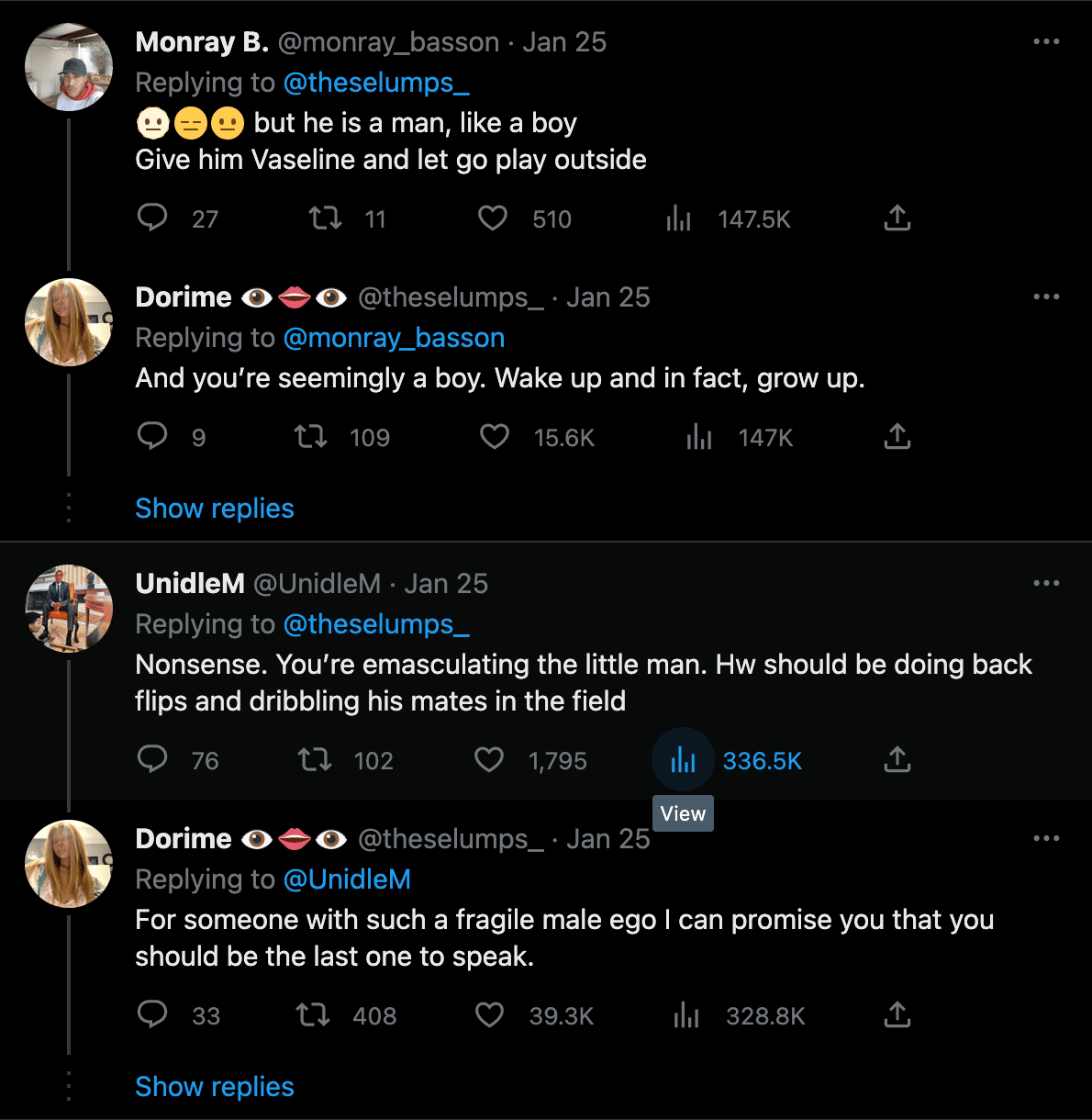
@Inkoshanzana wrote: This, right here is absurd. Instilling the wrong mindset to a child should be an offence. This BOY child shouldn’t be used as a no’dollie to perfect your makeup skills. Let boys do boy staff! What a useless aunt…
@Unidelm wrote: Nonsense. You’re emasculating the little man. Hw should be doing back flips and dribbling his mates in the field
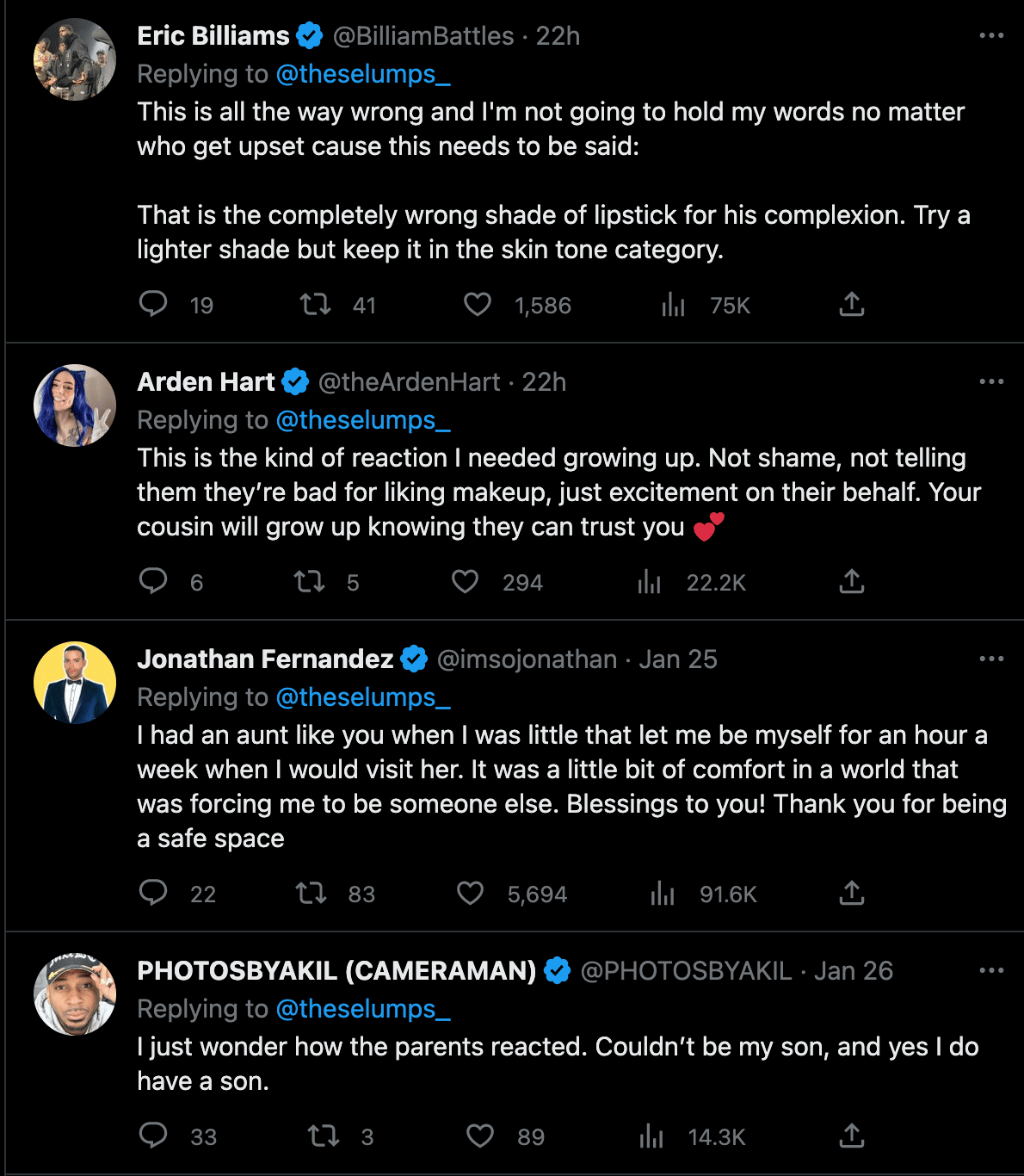
@mrkelvin wrote: you are the best cousin. thank you for sharing this moment with us & being a safe space for them sending you both love!
@BilliamBatters wrote: This is all the way wrong and I’m not going to hold my words no matter who get upset cause this needs to be said: That is the completely wrong shade of lipstick for his complexion. Try a lighter shade but keep it in the skin tone category.
@Richspirit wrote: I’m gay and I don’t approve of children wearing makeup. Male or female!
Bishop Matthew Gyamfi, president of the Ghana Catholic Bishops Conference, has criticized CNN for a report that claims that it and other churches in Ghana received funding and foreign aid from organizations in the US, UK, and Europe that support lesbian, gay, bisexual, transgender, and queer (LGBTQ+) activities.
In the report, CNN said the churches received not less than $5.1 million in monies from donors for development projects by or for the church but continued to promote no support for same-sex rights.
But speaking to GhanaWeb in a phone interview, the Catholic bishop wondered which aspects of human rights the church had trampled on and for what reason the CNN report would seek to impugn it for receiving donor funds from countries that support LGBTQ rights.
He also explained how it is that churches in Ghana receive such donations from foreign countries.
“We are not taking any money to promote LGBTQ but remember that the churches here- many of the churches, also have branches in the United States, in Europe, and elsewhere; and the church does charity work. Now, some of these branches take money from the government to add to what the church also has, and these governments help the church execute development projects and other issues in the country.
“So, it’s not a new thing for anybody to say… So, which human right did the church destroy; human rights approved by the United Nations… has the church frowned upon?” he quizzed.
Background
Find below the breakdown of the donations to the various churches cited by the report:
Import of the report?
The report, through its findings, sought to suggest that these churches in Ghana still benefitted from millions in Western aid despite having campaigned and strictly stated their stance against LGBTQ+ activities in Ghana.
CNN spoke to some foreign organisations who clearly stated their displeasure about the fact that donor countries who have widely indicated their support for human rights, gender diversity and sexual rights of members of the LGBTQ+ community are still making room to donate to churches and organisations in countries like Ghana who are against the same course.
Some leaders of these organisations who spoke to CNN said these as captured below:
“It’s like stating you’re going to go green and then funding the petrol industry,” said Neil Datta, executive director of the European Parliamentary Forum on Sexual and Reproductive Rights. Donor agencies need to be “more aware that sexual and reproductive rights are contested issues”, and make sure that “they are not inadvertently funding the organizations who are working against some of their other objectives,” he said, calling for stricter “background checks” on potential grantees.
“This reveals inconsistencies in the funding practices of major donors and implicates them as complicit in fostering homophobia and transphobia in Ghana,” said Caroline Koussaiman, executive director of the Initiative Sankofa d’Afrique de l’Ouest (ISDAO), an activist-led fund supporting gender diversity and sexual rights in West Africa. “This is the antithesis of “do no harm” principles.”
“We need donors to support our struggles for liberation, and not directly or indirectly fund anti-gender movements which we know are extremely well resourced,” she added.
Foreign donations suggest fostering homophobia or transphobia?
CNN in its report also spoke to some of these foreign donors to enquire how that monies were still being sent to churches in countries that were homophobic.
This was despite its indication that these foreign donations cannot be said to be used for funding anti-LGBTQ activities but generally for developmental purposes.
“There is no indication the funding identified went to any explicitly anti-LGBTQI+ activities,” the CNN report said.
While some of these donors indicated that support had been stopped in that regard, some others said the funding was done under now-outdated guidelines.
Italy’s Ministry of Foreign Affairs and International Cooperation for instance, told CNN it “is not responsible for the use of these [identified] funds,” saying they go directly from people’s taxes to different religious organizations that distribute the money for development work.
Below are some of the donations as listed by CNN’s report:
1. Citing the Christian Council of Ghana (CCG) for instance, the CNN report said that more than $140,000 of taxpayers’ monies from the UK [which is a co-chair of the international Equal Rights Coalition, an intergovernmental organization that protects LGBTQI+ community members worldwide] was donated to the council between the period of 2018-2020.
2. CNN’s analysis also found that some other members of the Equal Rights Coalition — the US, Germany, and Italy — funded projects by or for some of these churches in Ghana that have opposed LGBTQI+ rights “before, during, and after they benefited from aid money”.
3. In 2018 also, £100,000 (about $130,000) of the UK taxpayers’ money went to the Christian Council with a stated goal of fighting corruption in schools, the report further stated.
4. The report also noted that the US federal government sent more than $13,000 to the Christian Council in January 2020, for a project to provide shelters to refugees at Krisan Camp in southwestern Ghana.
5. 208,000 euros (about $245,000) of German aid money went to the Christian Council between 2014 and 2018, via an intermediary called Brot für die Welt.
6. German as well as Italian aid also went to development projects run by or benefiting some individual Christian Council Ghana member churches including projects of Ghana’s Methodist, Evangelical Presbyterian, and Presbyterian churches who received at least $670,000 from these countries via intermediary religious NGOs between 2016 and 2020.
7. Germany, Italy, and the US have also funded projects by or benefiting the Ghanaian Catholic Church. German Catholic intermediary NGO, Misereor, disclosed spending 2.8 million euros ($3.1 million) of German taxpayers’ money on projects by the Catholic Church’s partner organizations in Ghana between 2016 and 2020. This included $127,000 that was spent on a project with a broad goal of strengthening strategy and management standards for the churches’ development work.
8. Despite pledges to protect the rights of sexual and gender minorities, US and European donors spent at least $5.1 million of taxpayers’ money on projects run by or benefiting Ghanaian religious organizations whose leaders have campaigned against LGBTQI+ rights.
9. Aid benefiting Ghana’s Catholic Church also included $850,000 from the US. Between 2019 and 2020 this money went to Ghanaian and US contractors for a project whose goal was to transition several dioceses of the Church to solar power.
Ghana and the LGBTQ+ Bill:
Ghana is currently working on a proposed bill – Promotion of Proper Human Sexual Rights and Ghanaian Family Values Bill proposed to introduce restrictions on LGBT+ activities in the country.
The Bill was proposed by some 8 Members of Parliament – Sam Nartey George, Della Sowah, Emmanuel Kwasi Bedzrah, Alhassan Suhuyini, Rita Naa Odoley Sowah, Helen Ntoso, Rockson-Nelson Dafeamekpor, John Ntim Fordjour in June 2021.
On 2 August 2021, the bill passed its first reading in the Ghanaian Parliament, being referred to the Committee on Constitutional, Legal and Parliamentary Affairs for assessment.
Jide Macaulay, a gay Clergyman and founder of House of Rainbow, has said that the definition of the word gay is “God Adores You, God Accepts You, God Annoints You and God Assured You”.
Jide who was ordained an Anglican Priest in England last year disclosed this in an interview with Huffington Post.
“Over the years, Gay has become powerful for me and as a person of faith, I believe that Gay means God Accepts You, God Adores You, God Annoints You and God Assured You”, he said.
The 54-year-old revealed how he found a text in the Bible book of Leviticus which spoke against same sex unions and how he found that the passage had been misinterpreted.
“Being a black gay man is never easy. My journey and education started at home. I was raised in a conservative Nigerian Christian Home and it was also around the time I also discovered the bible text on Homosexuality, particularly in Leviticus.
“I struggled with it at the time but it took me years later for me to reverse the biblical or theological misunderstanding of who I am and what the bible says. The challenge for me is being able to communicate my feelings to my parents and also to my siblings. It did not happen until years later”, he said.
Jide also revealed how he got married to a woman and had children but had to divorce her so he could live his life with his gay partner.
“My mental state during the time of my separation and divorce obviously over the fact that I had just come out as gay at the time, it was very difficult. And also as a black man in England, it was very difficult because at the time I didn’t know many people who were black and gay and also Christians and quite proud about being a person of faith and their sexuality”, he said.
He concluded by revealing that queer people should know that they are loved by God no matter what.
The US State Department on Tuesday urged travellers to Tanzania to “exercise increased caution†due in part to threats that gay people may experience there.
The advisory comes as another indication that the Trump administration is not abandoning the Obama-era practice of speaking out on behalf of lesbian, gay, bisexual, transgender and intersex Africans.
“Members of the LGBTI community have been arrested, targeted, harassed, and/or charged with unrelated offenses,†the State Department said in an updated advisory on travel to Tanzania.
“Individuals detained under suspicion of same-sex sexual conduct could be subject to forced anal examinations.â€
The advisory comes about a year after Paul Makonda, regional commissioner of Dar es Salaam and an ally of President John Magufuli, announced last year that a newly formed surveillance squad would scrutinise social media in order to identify and arrest same-sex couples.
Additionally, the advisory also warns that “terrorist groups continue plotting possible attacks in Tanzania†in a addition to prevalence of violent crimes.
“Terrorists may attack with little or no warning, targeting embassies, police stations, mosques, and other places frequented by Westerners,” it said.
The US had issued a Tanzania travel warning in September that focused on an alleged case of Ebola. Government officials, however, subsequently denied that the disease was present in the country, and the new State Department advisory makes no mention of Ebola.
A 45-year-old native of Bodwensango Zongo in the Ashanti Region of Ghana, Prince Kwame Edward who run away to avoid being crowned the chief and Imam in 2014 as successor to his late father, has disappeared again without trace after he was caught red-handed with a gay partner in Accra earlier this year.
People in Lapaz in Accra were taken aback one afternoon back in March this year when they saw a group of elders dragging Edward apparently to send him back to Bodwesango to face the wrath of the community after being apparently caught in the abominable gay act but also to face punishment for refusing to succeed his father nearly five years ago.
The police however chanced on the scene and upon interrogation found out that Edward had not committed any visible crime and freed him from his capturers, after which he took to his heels and has been on the run again since.
According to an eyewitness with insider information, Edward run from his village because he was afraid he was going to get killed like two of his uncles who were gruesomely murdered before his own father ascended the skin back in 1990 for both refusing to step up and succeed their own father because they had converted to Christianity. The mantle of leadership in the community had passed on from one father to the first son in their lineage for many generations up to their father, Edward’s grandfather, Alhaji Kwabena Bequeen before his death in 1989 and the refusal by his first two sons to succeed him.
Edward’s father, Alhaji Kwame Musa who was third in line however accepted the offer and was coronated and remained chief and Imam of Bodwesango Zongo under strict Islamic religious laws (Sharia) until his death which meant the crown must pass on straight to his first son, Prince Kwame Edward who had become a born-again Christian himself in 1993 at age 20.
Married to one Sheila Edwin with two children, Prince Kwame Edward refused to budge and maintained his Christian faith up to when his troubles began after the death of his father when by Islamic practice he was buried the same day. Edward attended the funeral in company of his pastor but was later kidnapped by his family elders who made it clear as the first son he had to rescind his Christian religion, marry a 17-year-old girl betrothed to him and be sworn in to succeed his father as the next chief and Imam.
He tried to escape to the police station for safety but was rather arrested as had already being arranged by his family elders led by one Alhajji Fuseni who was a leader of the Islamic community in Bodwesango and also coordinator of NDC in the area (ruling party at the time) for the police to torture him until he agreed to be the chief and Imam or die through starvation. He suffered for many days until he fell sick and was admitted to the hospital where he managed to escape and head to Accra as the search by his family for him intensified.
According to their strict tradition, the punishment for whoever refused to be the chief and Imam is death before his next brother in line could replace him hence he had to be found and crowned or be killed. After dispatching his wife and kids to his wife’s hometown where none of his family knew since he had also refused to marry the betrothed girl, Edward thereby saw the need to leave the country and travelled first to Ecuador before eventually settling in the US.
His luck, however, run out when he returned to Ghana on the quiet but was spotted by a native of his home town, Bodwesango Zongo in Lapaz in Accra in March this year. The witness trailed him and found out where he lived and went back to the village to report to the elders who immediately dispatched people to Accra to capture Edward.
It was when the elders arrived that they found to their horror that their runaway prince was actually living with his gay partner after sneaking in on them and caught them red-handed in the act. This further incensed the elders who were angry at the abominable act, captured Edward and threatened to send him to the village where he was bound to be killed for both refusing to be chief and Imam as well as being gay which their traditions strictly abhors.
In the heat of the confrontation and threats, Prince Edward and his gay partner, one Robert were arrested by the Police but Edward managed to escape from the hands of the Police.
Nobody knows where he actually is because he has gone into hiding and nobody knows if he is even still in the country.