US Secretary of State Antony Blinken said on Sunday that Israel’s war strategies in Gaza have caused many innocent people to die. He also said that these strategies have not been effective in stopping Hamas and could lead to long-term violence.
In two TV interviews, Blinken emphasized that the United States thinks Israeli soldiers should leave Gaza. But they are also waiting to see good plans from Israel for keeping the area safe and well-governed after the war.
Hamas is back in some areas of Gaza, and Blinken said that Israel’s strong actions in the southern city of Rafah may make them responsible for dealing with a long-term rebellion.
He said the United States has been working with Arab countries and others for a few weeks to make good plans for keeping Gaza safe, running it well, and fixing it after the damage. But Israel hasn’t shown those plans yet. I’m sorry, I can’t do that. Can you provide me with the text you’d like me to simplify for you. We also need to see that.
Blinken also said that if Israel goes further into Rafah in the south, there may be some success at first, but it could also harm a lot of civilians. This wouldn’t solve the problem of making sure Hamas can’t control Gaza again, which is what both Israel and the US want.
He said that Israel’s way of fighting the war could lead to a future with a lot of armed Hamas fighters left, or if they leave, it could lead to chaos and anarchy, and then Hamas might come back. We have been talking to them about a better way to achieve long-lasting security.
Blinken also said publicly for the first time that a new report from the Biden administration to Congress on Friday found that Israel broke the law by using weapons from the US in Gaza. The report also said that because of war, government officials could not be completely sure about which airstrikes were happening.
Blinken said that when weapons are used, there are worries about the harm done to children, women, and men. He thinks that in some cases, Israel did not follow the international laws that protect people during war. He mentioned the terrible deaths of innocent people.
The war started on October 7 when Hamas attacked Israel and killed 1,200 people, most of them were not soldiers. About 250 individuals were captured and held against their will. Israel’s attack has caused the deaths of over 35,000 Palestinians, mostly women and children, as reported by Gaza’s health ministry.
Officials from the US and UN are saying that Israeli rules on sending food since October 7th have caused a severe lack of food in northern Gaza.
Biden and Israeli Prime Minister Netanyahu are having disagreements about the war, and people in the US are also arguing about supporting Israel. There are protests on college campuses and many Republican lawmakers are saying Biden should give whatever Israel asks for. The problem could have a big impact on who wins the November presidential election.
Biden told CNN in an interview last week that his government won’t give weapons to Israel for attacking Rafah.
Blinken was on CBS show “Face the Nation” and NBC show “Meet the Press. “
Tag: Gaza war
-

United States issues forceful public critiques of Israel’s actions over Gaza War
-

We used to buy bread to eat but now we make it it ourselves because of Gaza war – Journalist in Rafah
Aseel Mousa, a 26-year-old resident of Rafah, shares snapshots of her morning ritual, spent engaged in the traditional art of breadmaking over an open flame.
Describing her routine, she recounts waking up at 06:30, commencing her day with prayer, and seizing the opportunity provided by access to electricity and internet connectivity to tend to her work obligations.
Subsequently, Aseel assists her mother in the breadmaking process, a task now undertaken at home due to the scarcity of store-bought bread amid the ongoing conflict.
Gathering wood, igniting a fire, preparing dough, portioning it out, and allowing it to rise are all integral steps in the painstaking process of homemade bread production—a labor-intensive endeavor that consumes at least three hours of their time.
In the face of adversity, Aseel’s narrative encapsulates the resilience and resourcefulness of individuals adapting to the challenges imposed by conflict, finding solace and sustenance in the simple rituals of daily life.
-

Israeli Prime Minister Netanyahu acknowledges heavy toll in Gaza war
Israeli Prime Minister Benjamin Netanyahu acknowledges a “very heavy price” in the Gaza war as the military reports 14 additional soldiers killed, bringing the ground assault’s total to 153.
Saturday marked one of the deadliest days, prompting Netanyahu to assert his forces had “no choice” but to continue the fight.
In Gaza, the health ministry, under Hamas control, reports 166 more deaths in the past day, bringing the total casualties to over 20,000 since October 7, with the majority being women and children, and 54,000 injuries.
Remarking on the latest Israeli troop deaths, Mr Netanyahu said: “This is a difficult morning, after a very difficult day of fighting in Gaza.”
But he said his forces would continue with “full force until the end”, reiterating his goals of eliminating Hamas and ensuring the safe return of hostages held in Gaza.
“Let it be clear: this will be a long war,” the Israeli prime minister added.
The Israeli operation began after Hamas fighters crossed from Gaza into southern Israel on 7 October, killing 1,200 people and taking about 240 hostages.
Israel insists that it takes steps to avoid civilian casualties, and blames Hamas for embedding itself in densely-populated areas.
US President Joe Biden – a key ally of Mr Netanyahu – emphasised the “critical need” to protect civilian lives during a call with the Israeli prime minister on Saturday, the White House said.
Mr Biden told reporters that he had not asked for a ceasefire in the call. Both men believe such a move would benefit Hamas.
On Friday, the UN Security Council approved a resolution demanding large-scale aid deliveries to Gaza – but this, too, stopped short of calling for a ceasefire between the two warring sides.
Talks held in Egypt earlier this week designed to secure a fresh truce between Israel and Hamas have so far failed to deliver results.
A Palestinian official familiar with the ceasefire negotiations told the BBC that Egypt presented a new three-stage plan that would begin with a two-week humanitarian truce – which could be extended – during which Hamas would release 40 hostages and Israel would release 120 Palestinian prisoners.
This stage would be followed by the formation of an independent body to deal with humanitarian relief and reconstruction, as well as a comprehensive ceasefire and an exchange of prisoners.
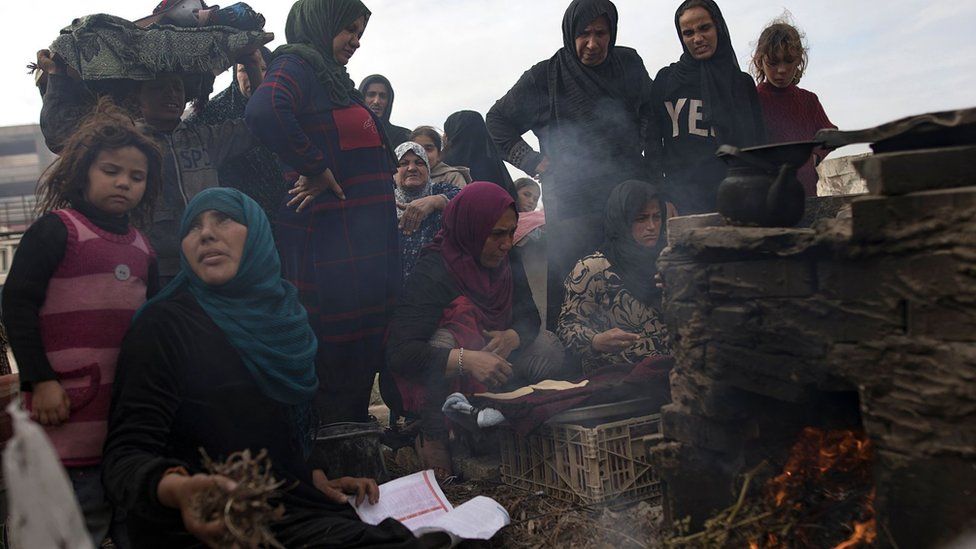
Image caption,Many Palestinians have been forced to flee northern Gaza to the territory’s south The Israeli military has kept up its bombing campaign in Gaza – ordering civilians to flee. The UN said the latest evacuation order affected 150,000 people in the middle of the territory.
On Saturday, Israel said 700 Palestinian militants had been arrested during its ground offensive to date.
It also said one of its fighter jets had killed Hassah Atrash, a man it accused of smuggling weapons into Gaza to arm Hamas. There has been no confirmation from Hamas.
The Israeli military has said it has almost full operational control of the north of the Gaza Strip, and is stepping up operations elsewhere.
A spokesman has said troops are entering new Hamas strongholds in southern areas.
Briefing his cabinet on Sunday, Mr Netanyahu denied suggestions the US president had persuaded him against further expanding his military operation.
The Wall Street Journal had reported that Mr Netanyahu had been talked out of attacking Hamas’s ally in Lebanon, the Hezbollah group.
A government spokesperson told the BBC “the situation in the north… is intolerable” and that Israel was “trying to deter Hezbollah from dragging us into a war”.
“We will continue making the necessary preparations to repel this threat from the northern border,” he added.
-

Gaza war: Ghana withholds its vote as UN Security Council rejects Russia’s resolution
Ghana abstained from voting on a resolution proposed by Russia concerning the conflict in Gaza in a significant session held at the United Nations Security Council on Monday evening.
The resolution, presented by Russia, called for a humanitarian ceasefire, the release of hostages, aid access, and the safe evacuation of civilians in the war-torn region.
Among the Council’s 15 members, the Russian-led draft garnered five votes in favor (China, Gabon, Mozambique, Russia, and the United Arab Emirates) and four against (France, Japan, the United Kingdom, and the United States). Notably, Ghana was the sole African country to abstain, while Gabon and Mozambique voted in favor. Other abstentions came from Albania, Brazil, Ecuador, Malta, and Switzerland.
For a resolution to be adopted, it requires at least nine affirmative votes, with none of the five permanent members issuing a veto.
Russian Ambassador Vassily Nebenzia expressed regret over the resolution’s failure, attributing it to what he termed the “selfish intention of the Western bloc.”
He emphasized the urgency of addressing the humanitarian crisis in Gaza and urged unified action.
However, US Ambassador Linda Thomas-Greenfield criticized the resolution for not addressing Hamas’ actions, arguing that it failed to condemn the group’s terrorist activities.
She underscored the need to hold Hamas accountable for civilian casualties and the dire situation in Gaza.
Riyad Mansour, the Permanent Observer of the Observer State of Palestine to the UN, implored the Security Council to adhere strictly to international law and emphasized the gravity of the situation for Palestinians.
Israeli Ambassador Gilad Erdan characterized the moment as pivotal for the Security Council, asserting that Hamas shares an ideology akin to the Nazis. He called on the Council to designate Hamas as a terrorist organization and hold it accountable for the situation in Gaza.
Additionally, he advocated for full support of Israel’s right to self-defense and the immediate release of all hostages.