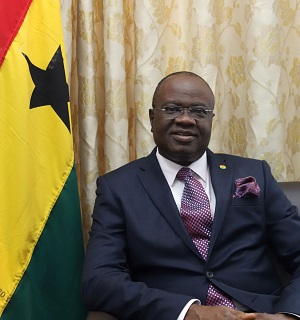
The incumbent Member of Parliament (MP) for the Asante Mampong Constituency in the Ashanti region, Kwaku Ampratum-Sarpong, has been re-elected as the New Patriotic Party (NPP) parliamentary candidate for the upcoming December 7 general election.
The Asante Mampong constituency parliamentary primary faced a temporary suspension due to a court injunction challenging the credibility of the constituency album intended for use in the election conducted on January 27, 2024, nationwide.
The resolution of the issue in court, facilitated by the party’s general secretary, Justin Frimpong Koduah, led to the fixing of a new election date on February 17, 2024.
The closely contested election featured a competition between the former Ashanti Regional Communications Director, Denis Kwakwa, and the incumbent Member of Parliament and Deputy Minister of Foreign Affairs, Kwaku Ampratum-Sarpong.
Following the contest, the incumbent MP secured a comfortable 555 votes, while his contender, Denis Kwakwa, managed 167 out of the total 727 votes cast, with 5 votes rejected. Despite expectations favoring the former Ashanti Regional Youth Organizer, the incumbent MP emerged victorious in the election.
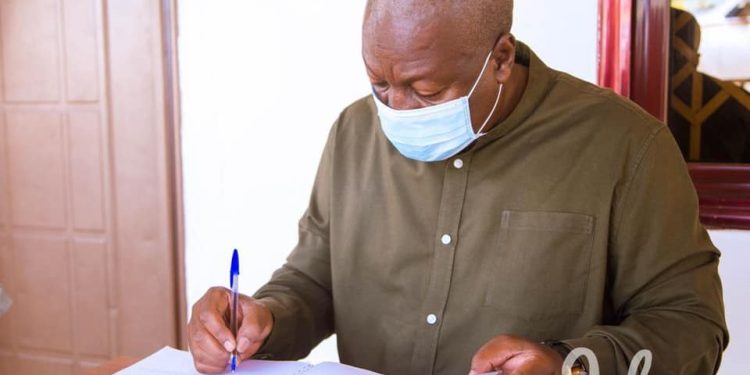
John Dramani Mahama, a candidate for the National Democracy Congress‘ (NDC) flagbearer position, will submit his nomination Tuesday, March 21 in order to participate in the May 13th primary elections.
Originally planned for Monday, the John Mahama Campaign says it is “very sorry for the postponement, which is in response to a request from the party to reschedule because of the presentation of the party’s True State of the Nation Address on Monday.”
Mr. Mahama will however continue his first phase tour of the Ashanti Region, which ends today, a statement by the aide to the former President, Joyce Bawah Mogtari, said.
John Mahama who is a one-term former president is seeking to return to power after he was defeated by Akufo-Addo in the 2016 and 2020general elections.
Mr. Mahama believes the Akufo-Addo government has put the country into reverse gear.
Below is the full statement from Mahama’s campaign team:
PRESS RELEASE
John Mahama to file nomination on Tuesday
National Democratic Congress (NDC) aspiring presidential candidate, John Dramani Mahama, will file his nomination to contest the 13th May 2023 primaries on Tuesday at 1.00pm.
Originally planned for Monday, the John Mahama Campaign says it is very sorry for the postponement, which is in response to a request from the party to reschedule because of the presentation of the party’s True State of the Nation Address on Monday.
President Mahama will however continue his first phase tour of the Ashanti Region, which ends today.
Joyce Bawah Mogtari Spokesperson Sunday, March 19, 2023.
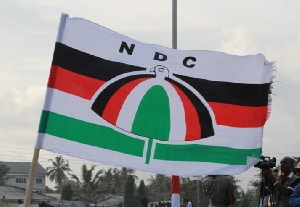
The main opposition National Democratic Congress (NDC) is actively gearing up for a busy 2023 ahead of crucial 2024 General Elections as they look to wrestle power from the governing New Patriotic Party (NPP).
It will be the first major test for the newly-elected batch of executives led by National Chairman Johnson Asiedu Nketiah, who until December 2022 had served for 17 years as the party’s General Secretary.
Asiedu Nketiah, along with his successor Fifi Fiavi Kwetey and members of the National Executive body are gunning for early victory by way of leading the NDC into the Jubilee House after eight years in opposition.
The party on Wednesday, January 18, 2023 released detailed guidelines on how its presidential and parliamentary primaries will be conducted later this year.
GhanaWeb looks at the major highlights contained in both processes.
Major modalities for the presidential primary
Date and venues:
The election of the Presidential Candidate shall be held on Saturday, 13th May, 2023 at Voting Centers in all 276 Constituencies of the NDC which includes the SALL/Guan catchment area.
The National Headquarters of the NDC shall constitute an additional voting center for all delegates from external branches of the party.
Nomination process and completing forms:
Nominations shall be opened between 22nd and 24th March, 2023
A candidate must be proposed by a party member in good standing and endorsed by five others in each constituency in each region across the country.
Candidates shall be subjected to a vetting process which is expected to take place at the party Headquarters on a specified date.
Cost of forms and submission:
Nomination forms shall be made available in the office of the General Secretary for purchase at a non-refundable fee of Thirty thousand Ghana Cedis (Gh¢30,000.00) paid by bankers’ draft.
The completed forms (Nomination and endorsement forms) are to be returned to the General Secretary of the Party with evidence of the payment of a non-refundable filing fee of Five hundred thousand Ghana Cedis (Gh¢500,000.00) via bankers’ draft.
Female candidates and Persons with Disabilities shall pay fifty percent (50%) of the filing fees
Election Day:
The presidential primary will take place concurrently with the parliamentary primary with the party’s national headquarters serving as the collation center.
A candidate will require 50% plus one to win a first-round victory.
Major modalities for the parliamentary primary
Date and place:
It shall be held on same day as the presidential primary (May 13, 2023). The election shall be held at a venue within the Constituency as determined by the Constituency Executive Committee in consultation with the Regional Executive Committee (REC) of the respective region.
Nomination forms
Forms shall be made available online for download on www.ghanandc.com and a non-refundable fee of Five thousand Ghana Cedis (Gh¢5,000.00) paid online via the stipulated momo or bank card.
The completed forms (nomination and endorsement) shall be completed and submiited to the Elections Directorate of the constituency after the payment of a non-refundable filing fee of Forty thousand Ghana cedis (Gh¢40,000.00) via Bank Card on www.ghanandc.com.
Completing forms:
Each contestant must be proposed by one person and seconded by three (3) persons all of whom must be members of good standing of the party in different branches of the constituency.
Each prospective candidate shall be endorsed by at least one branch executive member of the party from 50 percent of the total branches in the constituency.
Day of voting:
All rules as applies in national elections shall be applicable along with any other rules as communicated by the National Executive Committee (NEC).
Candidates can appoint agents to monitor the process. Ballots shall be counted and collated immediately after the process and winner shall be declared on the basis of first past the post – aspirant with highest number of votes.
Key timelines for the process:
OPENING OF NOMINATIONS MONDAY 22ND – 24TH FEBRUARY, 2023
SUBMISSION OF FORMS/ FILING OF NOMINATION MONDAY 20TH – 22ND MARCH 2023
On Wednesday (Nov 23), Zimbabwean president Emmerson Mnangagwa officially opened the Fifth Session of the Ninth Parliament of Zimbabwe.
He delivered his State of the Nation address in a newly built Parliament. The multimillion-dollar building was gifted by the Asian economic giant China.
Mnangagwa called for peace as the country prepares for general elections.
“Political players seeking the people’s mandate during the upcoming 2023 harmonized general elections must maintain and consolidate the current peace, unity, harmony, and love that we have built.”
In late October, Zimbabwe’s ruling party, ZANU-PF, endorsed the president as the sole party candidate ahead of next year’s polls.
80-year-old, Emmerson Mnangagwa, came to power in 2017 after toppling long-time ruler Robert Mugabe in a coup backed by the army.
Speaking before lawmakers, Mnangagwa also reiterated calls for an end to economic sanctions.
“The need for the unconditional removal of sanctions which have constrained socio-economic growth for decades remains urgent and imperative,” he pleaded.
The UN Special Rapporteur on the negative impact of unilateral coercive measures on the enjoyment of human rights issued a report in October recommending: the “lifting unilateral sanctions in line with the principles of international law”.
As well as “avoiding de-risking policies and over compliance in accordance with the due diligence rule; and engaging in meaningful structured discussions on political reform, the rule of law and human rights.”
Mette Frederiksen bypasses vote of no confidence over handling of mass cull by calling 1 November ballot.
Denmark’s prime minister, Mette Frederiksen, has called a general election for 1 November after a member of her ruling coalition threatened to withdraw its support over her handling of the country’s controversial Covid mass mink cull.
The Social Liberal party issued an ultimatum demanding that Frederiksen, the center-left leader who became Denmark’s youngest prime minister in 2019 aged 41, call elections before parliament’s first debate on 6 October, seven months before they were due.
“I have today informed the Queen that elections to the Folketing [parliament] will be held,” she told a press conference on Wednesday. “We want a broad government with parties on both sides of the political centre line.”
Polls show the race is too close to call, with the “red bloc” of left-leaning parties led by Fredriksen’s Social Democrats on 47-50% and its rival “blue bloc”, which includes the Liberal and Conservative parties and three nationalist parties, on 49-50%.
Frederiksen’s popularity has slipped after the government’s 2020 decision to cull Denmark’s entire captive mink population of 15 million for fear of a Covid-19 mutation moving from the animals to humans that could jeopardize future vaccines.
A parliament-appointed commission said in June that the government had lacked legal justification for the cull and made “grossly misleading” statements when it ordered Europe’s first compulsory shutdown of an entire farm sector.
While the cull was illegal, the commission agreed with Frederiksen that she had not broken the law intentionally. The decision devastated Denmark’s mink industry. The country was previously one of the world’s biggest exporters of furs.
Denmark is the focal point of a global political crisis after two pipelines carrying gas from Russia to Europe across the Baltic Sea were last week damaged in what world leaders have called an act of sabotage.
Frederiksen conceded on Wednesday that it was “peculiar to have a general election in the middle of an international crisis”, but has been speaking openly for some time about governing with center-right opposition parties.
She said a broad government would “get us through uncertain times”, adding that the time had come “to try a new form of government in Denmark. We are ready for both compromise and collaboration.”
President Akufo-Addo has refuted suggestions that his government is not committed to the fight against illegal small-scale mining (‘galamsey’).
According to Akufo-Addo, his government has been committed to the fight against the menace since his first day in office and its determination to curb it even cost his party; the New Patriotic Party (NPP) some votes in the 2020 General Elections.
The president, who made these remarks at a meeting with the National House of Chiefs and some Municipal Metropolitan and District Chief Executives (MMDCEs) in Kumasi, intimated that the votes he and his party lost showed that he really put his presidency on the line to fight ‘galamsey’.
“Since I took office on January 7th, 2017, nearly six years ago, I have made it a central feature of my presidency to lead in the fight to rid our country of this menace, which we all now call galamsey. Indeed, it was an important aspect of my inaugural address that day. It has not been easy; it has not been popular and we have not gotten the immediate results that I was looking for.
“Indeed, in the last election of 2020, my stance on the issue cost my party and I significant losses in the mining communities. It turned out that my statement that I was putting my presidency on the line in the fight against galamsey was neither bumbazed nor reckless. It was the simple truth,” he said.
Akufo-Addo also urged chiefs across the country to get themselves in the fight against illegal small-scale mining since they are the custodians of lands in the country.
“80 percent of the lands in this country continue to be under your custody, much of it having been acquired through the blood and sacrifices of your ancestors. The remainder of 20 percent which I hold in trust of the people of Ghana, derived from state acquisition from you.
“What this means is that ultimately, the welfare of the state of the lands is our joint responsibility, although by statute the minerals in the soil belong to the president in trust for the people,” he noted.