Tag: Germany

  • ‘Encourage’ China to support Ghana’s debt restructuring – Akufo-Addo to Germany

    ‘Encourage’ China to support Ghana’s debt restructuring – Akufo-Addo to Germany

    On Friday, Ghana’s president, Nana Addo Dankwa Akufo-Addo, requested Germany to “encourage” China, an adhoc member of the Paris Club, to support Ghana’s debt-restructuring efforts.

    He stressed the importance of the Paris Club quickly forming a creditors committee with the participation of other official creditors in order to support the initiatives that would allow Ghana to resume economic growth.

    The President made the call after receiving a visit from the German Finance Minister, Christian Lindner, at Jubilee House in Accra.

    “We now have our relations with the Paris club and the common framework, and we are looking for as quickly as possible a creditor committee to be established, so we will have the body with whom we can engage to bring those discussions as quickly as possible.

    “We have good relations with China. We will like you to encourage China to participate in these programmes as quickly as possible…A very important consideration for us is the financial stability fund that has been promised us as one of the key outcomes of these negotiations and definitely once again, your voice in trying to bring that into being is something that we would appreciate very much,” President Akufo-Addo told Finance Minister Lindner.

    Linden, who was at the head of a delegation from his country, held bilateral talks with the President aimed at boosting relations and economic ties between the two nations. President Akufo-Addo told the minister that the main concern for his government was to conclude negotiations with the International Monetary Fund (IMF), particularly at the Board Level and seal a deal with the Bretton Woods institution by mid-March this year.

    “Our main concern right now is the arrangements that we are in the process of concluding with the IMF…and the specific assistance that will be useful to us and help us fast-track the process.

    “Our target is that by the middle of March, we should be before the Board for the full agreement. We have already taken one important step forward in concluding a staff-level agreement with the IMF and we are now looking to go the full haul in concluding the agreement. We are hoping that it will be done by the middle of March.

    “One of the steps towards that has been the domestic debt exchange programme that we are on, which fortunately, we have quite a lot of difficulties, has now been virtually concluded,” he stated.

    However, President Akufo-Addo stressed, that there was a vital need for other creditors to support the efforts that his government was undertaking to restructure both the external and domestic debts of the country, to enable the IMF deal to fall through quickly.

    The President thanked the German government for providing assistance to Ghana in order to help that country get through its current economic challenges. He claimed that the German administration had established itself as a dependable ally and that Ghana will continue to view Germany as “a privileged partner” while it applies for an IMF bailout.

    In order to address Ghana’s debt hardship, the IMF and Ghana struck a staff-level agreement on a $3 billion, three-year Extended Credit Facility. However, ratification of the plan is contingent on Ghana restructuring its internal and external debts completely.

  • German envoy summoned by Turkey over consulate closure

    German envoy summoned by Turkey over consulate closure

    This week, a number of European nations, including Germany, temporarily closed their consulates in Istanbul due to security reasons. But Turkey says this is part of their “psychological warfare,”

    The Turkish government strongly rebuked foreign diplomatic missions on Friday who had warned of terrorist threats following Quran burnings at demonstrations against Ankara’s stance on NATO expansion abroad.

    “If they want to create the image that Turkey is unstable and that there is a danger of terrorism, then that is incompatible with friendship and partnership,” Foreign Minister Mevlut Cavusoglu said after summoning Germany’s ambassador — the ninth envoy to receive a summons this week.
    On Thursday, Turkey summoned several ambassadors following the temporary closure of a number of European consulates in Istanbul.

    According to a diplomatic source cited by the AFP news agency, envoys from Germany, Belgium, Britain, France, Italy, the Netherlands, Switzerland, Sweden and the United States were called to attend a meeting at the Foreign Ministry.

    Germany shut its Istanbul consulate on Wednesday, citing a heightened risk of terror attacks following Quran-burning incidents in some European countries. At least six other countries took the same step as a precaution.

    The US consulate remains open, as the complex is not in Istanbul’s city center and is therefore considered to be a less vulnerable target. Washington has, however, joined a number of other governments in issuing travel warnings advising citizens to be vigilant and avoid tourist hotspots.

    Why are there security concerns?

    Tensions between Turkey and Western countries have been rising over Ankara’s refusal to approve Sweden and Finland’s NATO membership bids.

    Recent protests in Denmark, Sweden and the Netherlands, at which far-right activists burned or desecrated copies of the Quran, the Muslim holy book, have only strained ties further.

    The actions have infuriated Muslims in Turkey and other parts of the world.

    Norwegian police said Thursday they had canceled a planned anti-Islam protest in Oslo, saying security could not be ensured. The group behind the protest had reportedly planned to burn the Quran outside the Turkish Embassy.

    The German Foreign Ministry on Friday confirmed that Berlin’s ambassador to Turkey had been summoned for talks after Germany closed its consulate.

    The ambassador was summoned together with counterparts from several other countries, a ministry spokesperson said.

    Turkey alleges ‘psychological warfare’

    Turkish officials have reacted angrily to the Quran burnings and travel warnings, and the government on Friday issued a strong rebuke over the closure of the foreign diplomatic missions.

    Speaking Thursday, Interior Minister Suleyman Soylu called the measures an attempt to meddle in Turkey’s election campaign ahead of presidential and parliamentary votes on May 14.

    “They are waging psychological war against Turkey,” Soylu told Turkey’s NTV news channel. “They are trying to destabilize Turkey.”

    Soylu, who is known for his anti-Western rhetoric, said the travel alerts and consulate closures were part of a plot to prevent Turkey’s tourism sector from rebounding after the coronavirus pandemic.

    Meanwhile, the chief spokesman for President Recep Tayyip Erdogan’s ruling party said Turkey was a safe country and that the security alerts from the West were “irresponsible.”

    “Some embassies and consulates are making statements to raise concerns about our country’s security conditions,” spokesman Omer Celik tweeted. “This type of irresponsible behavior is unacceptable.”

    In apparent retaliation for the security alerts from Western countries, Turkey issued its own warnings over the weekend. It told its citizens there was a risk of “possible Islamophobic, xenophobic and racist attacks” in the US and Europe.

  • Germany closes its consulate in Istanbul due to “risk of attack”

    Germany closes its consulate in Istanbul due to “risk of attack”

    The German Consulate in Istanbul warned citizens to avoid central areas of Turkey’s largest city and avoid crowds. Several European countries have warned of an increased risk of attacks in the wake of Quran burnings.

    Germany temporarily closed its consulate in Istanbul on Wednesday, citing a heightened risk of attack in the Turkish city.

    The move comes amid rising tensions after right-wing extremist and anti-Islam activists burned or destroyed Qurans in several European cities in recent weeks.

    What did German officials say?

    In posts on the consulate’s social media channels, German officials announced the consulate would be closed on Wednesday and that all visa appointments had been canceled.

    “Following recent cases in several European capitals where the Quran was publicly burned or destroyed, security agencies believe the risk of terrorist attacks in Istanbul has increased,” officials said in a statement.

    The statement advised German citizens to avoid Istanbul’s central district of Beyoglu and the popular Taksim Square. German officials also advised citizens to avoid areas with “international crowds” and steer clear of busy public places in general.

    The German Embassy in Ankara remained open on Wednesday. It was unclear whether the consulate in Istanbul would remain closed later this week.

    Both the Swedish Embassy in Ankara and the country’s consulate in Istanbul were also closed to visitors, a Foreign Ministry spokesperson in Stockholm told news agency dpa.

    The British Consulate in Istanbul is also “currently not open to the public as a precaution,” according to a UK government travel advisory.

    Tensions between Turkey and Europe

    The warnings of potential attacks come after right-wing extremists repeatedly destroyed the Quran, the holy book of the Muslim faith, in several European cities.

    The actions have sparked outrage in Turkey, particularly after the right-wing extremist Rasmus Paludan set fire to a Quran in front of a mosque in the Swedish capital of Stockholm. The Danish-Swedish politician later repeated the act in Copenhagen. 

    He threatened to continue until Turkey accepted Sweden’s bid to join the NATO military alliance.

    Similar protests where a Quran was desecrated and torn up in the Netherlands prompted Turkey to summon the Dutch ambassador.

    Several countries — including Germany, Sweden, Norway, Denmark and the United States — issued warnings last week of an increased risk of attacks in Turkey.

    Turkey, in turn, also issued a travel alert for its nationals in Europe  — saying that the recent anti-Muslim and anti-Turkish acts show the “dangerous level of religious intolerance and hatred” on the continent. 

    Both Sweden and Finland announced their intention to join NATO in the aftermath of Russia’s invasion of Ukraine. All current members of the trans-Atlantic military alliance must approve their membership bids, but Turkey and Hungary have not yet approved.

  • Abrams and Leopard tanks: Are they really that important to Ukraine?

    Abrams and Leopard tanks: Are they really that important to Ukraine?

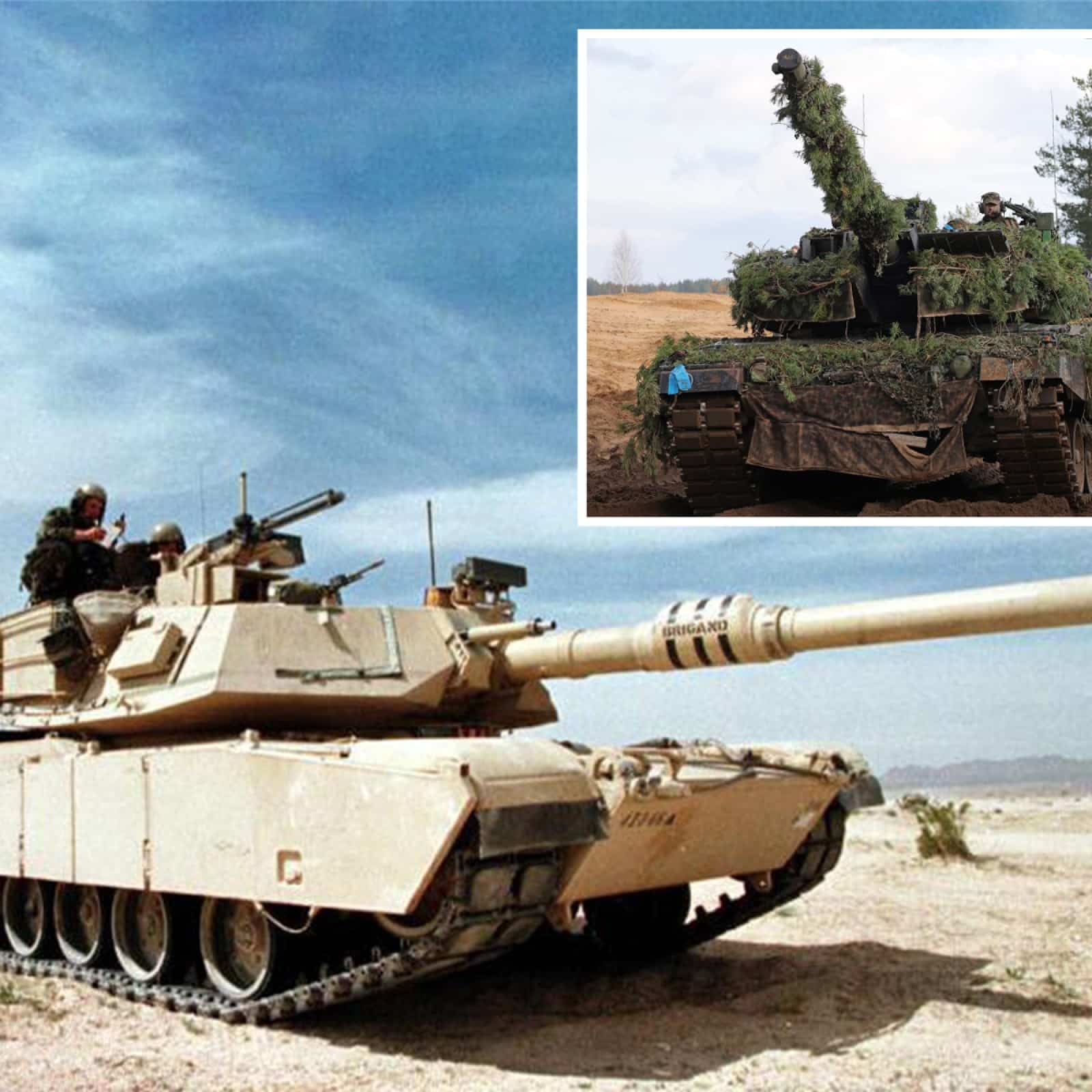
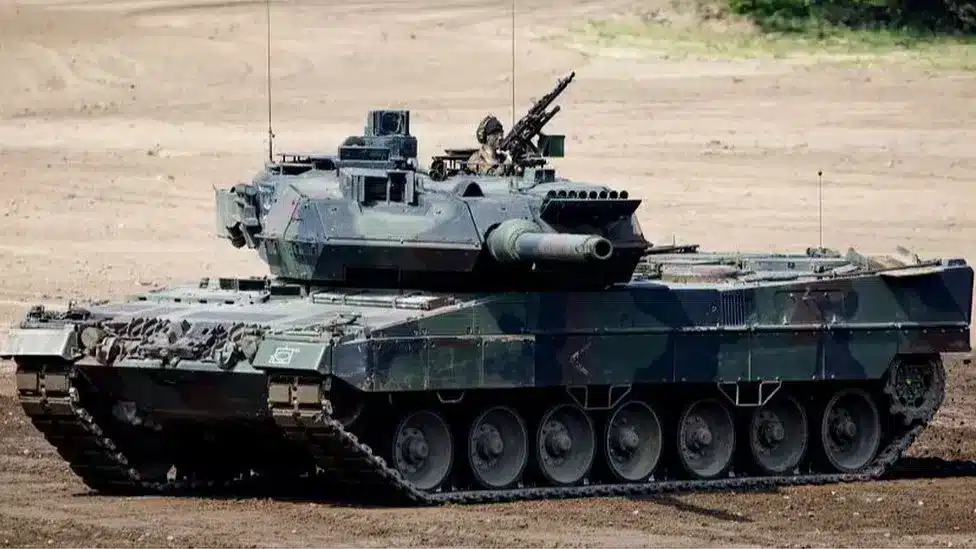
    While the US is finalising plans to send about 30 Abrams tanks to Ukraine, Germany has agreed to send Leopard 2 aircraft to that country.

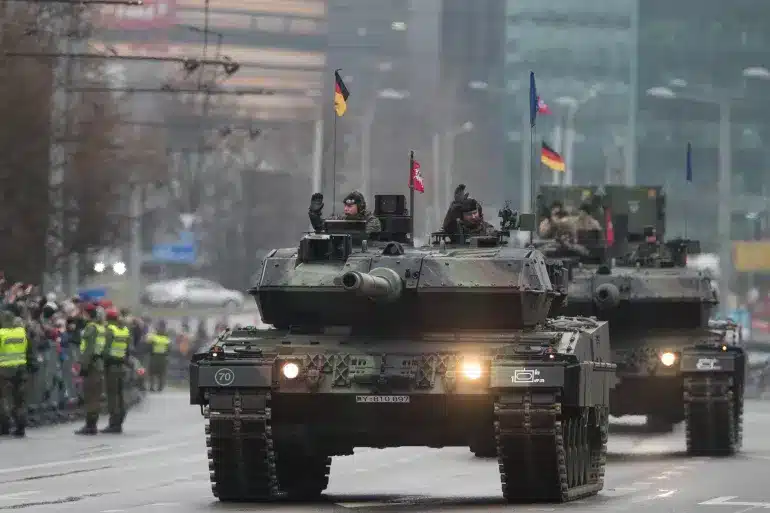
    Olaf Scholz, the chancellor of Germany, has approved sending its Leopard 2 battle tanks to Ukraine.

    The announcement coincides with rumours that Washington is preparing to send dozens of M1 Abrams tanks to the front lines in Ukraine.

    The United States had been on the fence, just like Germany.

    While Washington cited the logistical and maintenance difficulties the Ukrainians might encounter if they were to receive the Abrams, Berlin worried about the war’s potential to escalate.

    Both armoured vehicles are considered state-of-the-art and are more powerful than many Soviet-era tanks fielded by both Russian and Ukrainian forces.

    “The Leopard and American Abrams are actually twins,” Sydney Freedberg, contributing editor of the digital magazine, Breaking Defence, told Al Jazeera.

    The Leopard 2 was first produced in 1979 by Krauss-Maffei for the German Ministry of Defence.

    They are in service with the armies of Austria, Canada, Chile, Denmark, Finland, Germany, Greece, the Netherlands, Norway, Poland, Portugal, Singapore, Switzerland, Sweden, Spain and Turkey.

    The first M1 tank was manufactured by General Dynamics Land Systems (GDLS) in 1978 and was delivered to the US Army in 1980.

    “They are very similar. Big vehicles, heavily armoured. Much better protected than anything the Soviets built, or anything the Russians currently have,” said Freedberg.

    The main difference between the Abrams and the Leopard is the engine.

    The Leopard 2 has a diesel-powered MTU MB 873 engine, which is much easier to maintain and more widely used across Europe, while the Abrams uses a more powerful and more complex turbine engine.

    According to Freedberg, because the Abram tanks are used significantly less across Europe, Ukraine may struggle to cope with logistic infrastructure such as obtaining spare parts, warehousing and general maintenance. The four-person tank will also require additional training on the complex machinery.

    Russia’s ambassador to the US said the possible delivery of Abrams tanks to Kyiv by Washington would be “another blatant provocation” against Moscow and that the West would regret its “delusion” that Ukraine can win on the battlefield against Russia.


    According to Alex Gatopoulos, Al Jazeera’s defence analyst, the latest-generation main battle tanks are vital for Ukraine if it wants to punch holes in Russian defensive lines and retake territory that Russian forces seized in the opening weeks of the invasion.

    Southern Ukraine is flat and ideal tank territory. Russia has been building rows of trenches and fortified bunkers to stop a Ukrainian advance in the area.

    In a Ukrainian offensive, tanks and troops protected by infantry fighting vehicles like the American Bradley, German Mardar and even the Russian-made BMP-2 would advance.

  • US and Germany ready to send tanks to Ukraine – Reports

    US and Germany ready to send tanks to Ukraine – Reports

    The US and Germany apparently intend to send tanks to Ukraine after months of delaying the move, which Kyiv hopes will shift the combat dynamic.

    US President Joe Biden’s administration is expected to announce plans to send at least 30 M1 Abrams tanks.

    German Chancellor Olaf Scholz has also reportedly decided to send at least 14 Leopard 2 tanks. He is set to speak in parliament on Wednesday morning.

    Russia’s ambassador to the US said the news was “another blatant provocation”.

    And the Kremlin spokesman said Germany’s reported decision would “bring nothing good” and leave “a lasting mark” on relations with Russia.

    Ukrainian officials say they are urgently in need of heavier weapons, and say sufficient battle tanks could help Kyiv’s forces seize back territory from the Russians.

    But until now, the US and Germany have resisted internal and external pressure to send their tanks to Ukraine.

    Washington has cited the extensive training and maintenance required for the high-tech Abrams.

    Germans have endured months of painful political debate amid concerns that sending tanks would escalate the conflict and make Nato a direct party to the war with Russia.

      US media is reporting that an announcement regarding Abrams shipments to Ukraine could come as soon as Wednesday, with unnamed officials cited as saying at least 30 could be sent.

      However the timing remains unclear, and it could take many months for the US combat vehicles to reach the battlefront.

      German officials had reportedly been insisting they would only agree to the transfer of Leopard 2s to Ukraine if the US also sent M1 Abrams.

      “If the Germans continue to say we will only send or release Leopards on the conditions that Americans send Abrams, we should send Abrams,” Democratic Senator Chris Coons, a Biden ally, told Politico on Tuesday.

      Britain has already said it will send Challenger Two tanks to Ukraine.

      Poland – one of 16 European and Nato countries that has German-made Leopard 2 tanks – has been pushing to send the vehicles to Ukraine, but under export rules needs Berlin’s permission.

      Ukraine is still unlikely to get the 300 modern main battle tanks it says it needs to win the war.

      But if half a dozen Western nations each provide 14 tanks, then that would bring the total to nearly 100 – which could make a difference.

      Western tanks – including the UK’s Challenger 2, Germany’s Leopard 2 and the US-made Abrams – are all seen as superior to their Soviet-era counterparts, like the ubiquitous T-72.

      They will provide Ukrainian crews with more protection, speed and accuracy.

      But Western modern main battle tanks are not a wonder weapon or game-changer on their own. It’s also what’s being supplied alongside them.

      In recent weeks, there’s been a step change in heavy weapons being supplied by the West – including hundreds more armoured vehicles, artillery systems and ammunition.

      Combined together, they are the kind of military hardware needed to punch through Russian lines and to retake territory.

      If Ukrainian troops can be trained and the weapons delivered in time, they could form key elements of any spring offensive. A missing element for offensive operations is still air power.

      Ukraine has been asking for the West to provide modern fighter jets since the war began. So far, none has been delivered.

      While there has been no official statement from the German government, Marie-Agnes Strack-Zimmermann of the liberal FDP party, who chairs the defence committee of the German parliament, welcomed the reports.

      “The decision was tough, it took far too long, but in the end it was unavoidable,” she said, adding that it would come as a relief to “the battered and brave Ukrainian people”.

      https://emp.bbc.com/emp/SMPj/2.47.2/iframe.htmlMedia caption,

      Watch: Poland’s PM: “Free world cannot afford not to send Leopard tanks”

      Allied nations had become frustrated at what they perceived as German reluctance to send the armoured vehicles in recent days.

      German Defence Minister Boris Pistorius earlier said that Berlin had given other nations the green light to train Ukrainians to use Leopard 2 tanks, but did not commit to sending their own.

      The Ukrainian president’s chief of staff, Andriy Yermak, on Tuesday called on Western countries to give Kyiv hundreds of tanks to form a “crushing fist” against Russia.

      “Tanks are one of the components for Ukraine to return to its 1991 borders,” he wrote on Telegram.

      Anatoly Antonov, the Russian ambassador to Washington, wrote on Telegram: “If the United States decides to supply tanks, then justifying such a step with arguments about ‘defensive weapons’ will definitely not work.

      “This would be another blatant provocation against the Russian Federation.”

      Source: BBC

    • Ukraine war: ‘Frank’ talks as Ukraine pushes Germany for tanks

      Ukraine war: ‘Frank’ talks as Ukraine pushes Germany for tanks

        Ukraine’s defence minister has said he had a “frank discussion” with his German counterpart about German Leopard 2 tanks, which Kyiv is urgently requesting to confront Russian armour.

        Germany has not yet decided whether to send the tanks to Ukraine, or allow other countries to donate theirs, despite pressure on Berlin to act.

        “We had a frank discussion on Leopards 2. To be continued,” Oleksii Reznikov said after meeting Western allies.

        Kyiv is to get many other Nato weapons.

        The meeting at Ramstein Air Base in Germany did bring an agreement to supply more armoured vehicles, air defence systems and ammunition.

        But the Leopard 2 is seen as a potential game-changer for Ukraine, as it is easy to maintain and designed specifically to compete with the Russian T-90 tanks, which are being used in the invasion.

          German Defence Minister Boris Pistorius said opinions remained divided over supplying Leopards, and he denied that Berlin was blocking such a move.

          Under German export laws, other countries who want to supply Leopards – like Poland and Finland – are unable to do so until Berlin gives the all-clear.

          ‘A decision must be made’

          Ukrainian President Volodymyr Zelensky praised the Nato partners for their military assistance, but said “we will still have to fight for the supply of modern tanks”.

          “Every day we make it more obvious that there is no alternative, that a decision about tanks must be made.”

          Ukraine’s current tanks are mostly old Soviet models, often outnumbered and outgunned by Russian firepower.

          More than 2,000 Leopards are sitting in warehouses all over Europe. President Zelensky believes about 300 of them could help to defeat Russia.

          Mr Pistorius said Berlin was prepared to move quickly if there was consensus among allies, though he could not say when a decision on the tanks might be made.

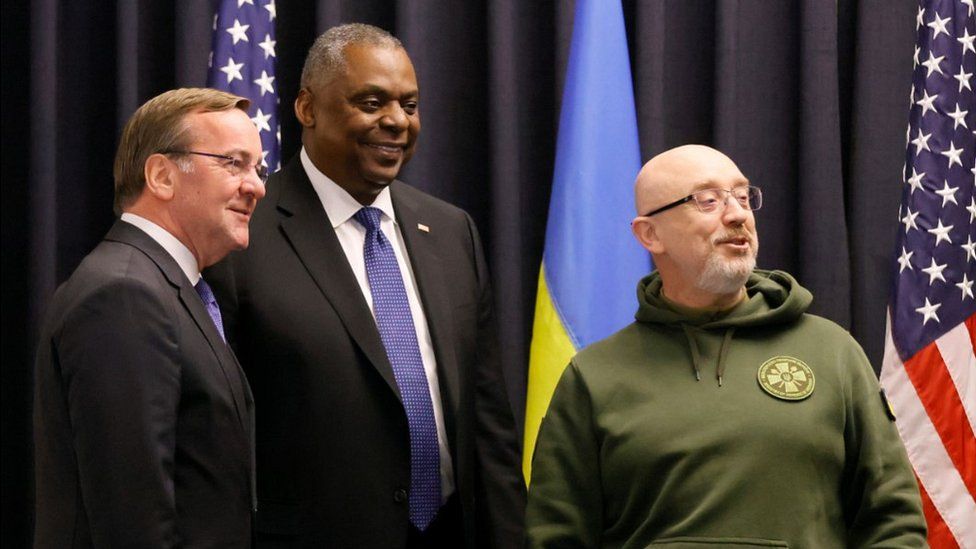
          Ukraine's Defence Minister Oleksii Reznikov (R) with US Defence Secretary Lloyd Austin (C) and German Defence Minister Boris Pistorius
          Image caption,Ukraine’s Defence Minister Oleksii Reznikov (R) with Kyiv’s US and German allies in Ramstein

          Germany’s standoff

          Germany has found itself in this standoff due to several factors including international diplomacy and the legacy of World War Two.

          It used to have a policy of not sending arms to conflict zones, but that was reversed last February after Russia’s invasion.

          Late last year, Nato chief Jens Stoltenberg said Germany was now “among the allies providing most military, financial and humanitarian aid to Ukraine”, by supplying artillery, air defence systems and Marder infantry fighting vehicles.

          But Germany is reluctant to send Leopards unless they are part of a wider Nato package that preferably includes America’s powerful M1 Abrams tanks. The US has rejected this, saying the Abrams tanks are impractical for Ukraine’s forces because they are difficult and expensive to maintain.

          Regardless, there has been pressure in some corners for the US to send its tanks, to get Germany to do the same.

          US Defence Secretary Lloyd Austin denied Berlin was waiting on the US to make the first move. “This notion of unlocking – in my mind it’s not an issue,” he said after Friday’s meeting of 54 countries at Ramstein Air Base.

          Germany also remains haunted by the Nazi-era devastation it caused in World War Two, and Chancellor Olaf Scholz is believed to be cautious about having anything to do with an escalation in Ukraine.

          A leading opposition Christian Democrat (CDU) politician in Germany, Johann Wadephul, condemned the government’s “policy of refusal” on the Leopards, saying it would affect Germany’s international reputation. “What is Scholz waiting for?” he asked.

          Poland’s Foreign Minister Zbigniew Rau also criticised Germany’s reluctance.

          “Arming Ukraine in order to repel the Russian aggression is not some kind of decision-making exercise. Ukrainian blood is shed for real. This is the price of hesitation over Leopard deliveries. We need action, now,” he tweeted.

          Western countries have committed billions in other weaponry – but without Germany’s commitment on tanks, it was not the result Ukraine was hoping for.

          Other countries have committed to sending tanks, including the UK, which will send 14 Challenger 2s.

          The US announced fresh support worth more than $2.5bn (£2bn) this week, including armoured vehicles.

          The Pentagon promised an extra 59 Bradley armoured vehicles, 90 Stryker personnel carriers and Avenger air defence systems, among other supplies.

          Nine European nations have also promised more support of their own after meeting on Thursday in Estonia. They included:

          • UK – 600 Brimstone missiles
          • Denmark – 19 French-made Caesar self-propelled howitzers (cannon)
          • Estonia – howitzers, ammunition, support vehicles and anti-tank grenade launchers
          • Latvia – Stinger air-defence systems, two helicopters, and drones
          • Lithuania – anti-aircraft guns and two helicopters
          • Poland – S-60 anti-aircraft guns with 70,000 pieces of ammunition
          • Czech Republic – produce further large calibre ammunition, howitzers and APCs.

          Source: BBC

        • Germany getting ready for a fight over tanks for Ukraine

          Germany getting ready for a fight over tanks for Ukraine

          A day before allies gather to discuss military assistance, US Defense Secretary Lloyd Austin will meet with the new German Defense Minister.

          As the defence chiefs of the United States and Germany prepare for a showdown over weapons that Kyiv claims could determine the outcome of the war, Ukraine has stepped up its call for the West to finally send heavy tanks.

          A day before they host a meeting of dozens of allies to pledge weapons for Ukraine, US Defense Secretary Lloyd Austin will visit Germany on Thursday to meet its new defence minister.

          The aim of the meeting, which will take place at the US Ramstein air base in Germany, is to provide the weapons necessary to change the course of the war by 2023.

          Top of the agenda is heavy tanks, which Kyiv says it needs to fend off a new Russian onslaught and launch counter-offensives to recapture its occupied territory.

          “We have no time, the world does not have this time,” Andriy Yermak, head of the Ukrainian presidential administration, wrote on the Telegram messaging app on Thursday.

          “The question of tanks for Ukraine must be closed as soon as possible,” he said.

          “We are paying for the slowness with the lives of our Ukrainian people. It shouldn’t be like that.”

          German leopard tanks
          A Leopard 2 tank is pictured during a demonstration event held for the media by the German Bundeswehr in Munster near Hannover, Germany, September 28, 2011 [Michael Sohn, AP Photo]

          Ukrainian President Volodymyr Zelenskyy made a similar plea by video link to leaders gathered at the World Economic Forum in Davos on Wednesday, urging them to supply his country before Russia mounts its next missile and armoured ground attacks.

          “The supplies of Western tanks must outpace another invasion of Russian tanks,” Zelenskyy said.

          But for the West to send tanks, Washington will have to resolve a standoff with Berlin, which has so far demurred from authorising countries to send its Leopard 2 tanks, the workhorse of militaries across Europe.

          Washington and many Western allies say the Leopards – which Germany made in the thousands during the Cold War and exported to its allies – are the only suitable option available in big enough numbers.

          A German government source said Berlin would lift its objections if Washington sends its own Abrams tanks.

          But US officials say the Abrams is inappropriate for Ukraine because it runs on turbine engines that use too much fuel for Kyiv’s strained logistics system to keep them supplied at the front.

          Poland and Finland have already said they would send Leopards if Germany lifts its veto, and other countries have indicated they are ready to do so as well.

          Britain added to the pressure by breaking the taboo on heavy tanks last week, offering a squadron from its fleet of Challengers, though far fewer of these are available than Leopards.

          Colin Kahl, the Pentagon’s top policy adviser, said on Wednesday Abrams tanks were not likely to be included in Washington’s next $2bn military aid package, which will include Stryker armoured vehicles.

          “I just don’t think we’re there yet,” Kahl said.

          “The Abrams tank is a very complicated piece of equipment. It’s expensive. It’s hard to train on. It has a jet engine.”

          Germany replaced its defence minister this week and said the tank decision is the first item on the agenda of the new minister, Boris Pistorius, due to meet Austin.

          Ukraine, which has relied primarily on Soviet-era T-72 tank variants, says the new tanks would give its troops the mobile firepower to drive out Russian troops in decisive battles.

          Western tanks have more effective armour and better guns than Soviet-era counterparts, which have been destroyed in their hundreds on both sides during the 11 months of war in Ukraine.

          Fighting has been concentrated in the south and east of Ukraine after Russia’s initial assault from the north aimed at taking Kyiv was thwarted during the first months Russia’s “special military operation”.

          After major Ukrainian gains in the second half of 2022, the front lines have largely been frozen in place over the past two months, with neither side making big gains despite heavy casualties in intense trench warfare.

          “The situation on the front line remains tough,” Zelenskyy said in a video address on Wednesday.

          “We are seeing a gradual increase in the number of bombardments and attempts to conduct offensive actions by the invaders.”

        • Kimmich pessimistic about Germany’s trophy chances

          Kimmich pessimistic about Germany’s trophy chances

          Joshua Kimmich joked he may have to play until the age of 45 to lift an international trophy as he rued Germany’s dire showing at the 2022 World Cup.  

          Having been eliminated in the group stage at Russia 2018 and fallen to England in the last 16 at Euro 2020, Germany arrived in Qatar in the midst of a dismal run of tournament showings.

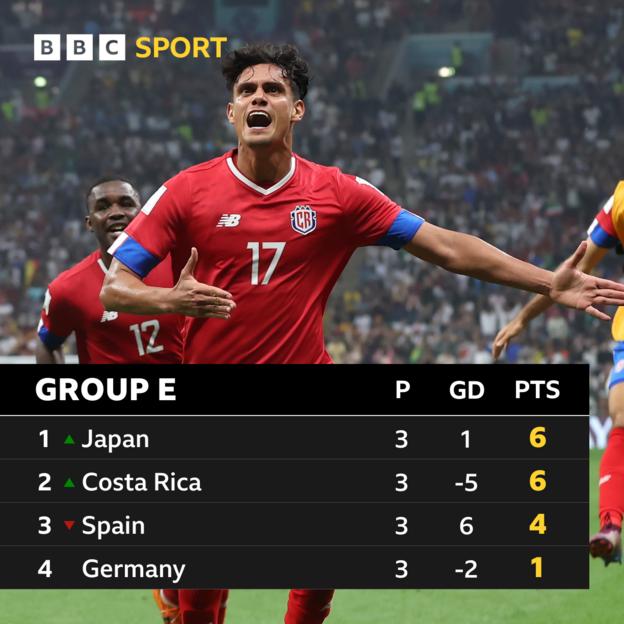
          Hansi Flick’s side were left with a familiar sinking feeling as they failed to recover from a shock defeat to Japan in their Group E opener, missing out on a place in the round of 16 despite taking four points from games against Spain and Costa Rica.

          Bayern Munich midfielder Kimmich has now been a Germany regular at four major tournaments, and their shortcomings have left him with a “bitter” taste.

          Kimmich is back in Doha for a mid-season training camp with Bayern, and asked in a press conference about Germany’s chances of winning a major trophy as they look ahead to hosting Euro 2024, he said: “I just have to keep playing until I’m 45, then we will, hopefully.”

          Reflecting on Germany’s World Cup exit, the 27-year-old added: “We had big objectives and wanted to reach something. 

          “Eventually, we got knocked out early again. After 2018, the Euros and now another tournament like this, it is very bitter.

          “You don’t get that many chances with the national team, so this is not something you can just easily forget and move on from because it is what it is.”

          Kimmich believes Germany could have grown into the tournament had they qualified from their group, but he acknowledges other sides – including eventual champions Argentina – arrived in Qatar in better form.

          “I thought that in 2018, many things weren’t working, also internally on our team. Against England [at Euro 2020], it felt like a 50-50 game,” Kimmich said.

          “Last year, I don’t want to say everything was great but in the end, those 30 minutes against Japan cost us the tournament. If we had drawn there, we would definitely have progressed

          “We were also missing self-confidence, especially when I look at other teams. Italy before the Euros had a long streak of unbeaten games, Argentina as well [before the World Cup].

          “This is something we have to aim for. We can’t just start with that once the tournament starts. We should start that in March. 

          “We have to win our games, gain self-confidence and gain some self-understanding for our processes. Then we have to also bring that to the pitch and be able to rely on that.”

        • Germany returns looted Bronze Sculptures to Nigeria, Foreign Minister says move was ‘Long Overdue’

          Germany has returned multiple historic sculptures to Nigeria after they were stolen more than a century ago.

          The sculptures in question, widely referred to as the Benin bronzes, were the subject of a joint declaration between the two governments earlier this year. That agreement established plans to begin transferring the pieces back to Nigeria following their initial seizure by British forces in 1897.

          According to a report from the Guardian on Tuesday, more than 20 sculptures were returned this week, with Germany’s foreign minister Annalena Baerbock and Nigeria’s culture minister Lai Mohammed appearing together alongside other officials during a return-celebrating ceremony. Notably, many stolen Benin bronzes remain in a British Museum collection.

          “We are taking a long overdue step,” Baerbock acknowledged in a statement shared earlier this week. “It will not heal all the wounds of the past. But together with the Länder, cities and museums we are showing that Germany is taking seriously its efforts to address its dark colonial history.”

          The pieces returned as part of Baerbock’s visit are the first of what the government says are five total collections from the country.

          “By addressing colonial injustice, we are opening a new chapter of intensified cooperation with Nigeria,” Baerbock said over the weekend.

          Source: Complex.com

        • Nazi typist: Irmgard Furchner found guilty of complicity in the murder of 10,500 people

          More than 10,505 people were killed, and a former secretary who worked for the head of a Nazi concentration camp has been found guilty of complicity.

          Irmgard Furchner, now 97, worked at Stutthof as a teenage typist from 1943 to 1945.

          Furchner, one of the few women to face Nazi-related charges in decades, received a two-year sentence with a suspended sentence.

          Despite the fact that she was a civilian employee, the judge found that she was fully informed of all activities at the camp.

          According to estimates, 65,000 people—including Jewish prisoners, non-Jewish Poles, and captured Soviet soldiers—died at Stutthof in appalling conditions.

          The court at Itzenhoe in northern Germany heard from survivors of the camp, some of whom have died during the trial.

          When the trial began in September 2021, Irmgard Furchner went on the run from her retirement home and was eventually found by police on a street in Hamburg.

          Stutthof commandant Paul-Werner Hoppe was jailed in 1955 for being an accessory to murder and he was released five years later.

          A series of prosecutions have taken place in Germany since 2011, after the conviction of former Nazi death camp guard John Demjanjuk set the precedent that being a guard was sufficient evidence to prove complicity.

          That ruling also meant that civilian worker Furchner could stand trial, as she worked directly to the camp commander, dealing with correspondence surrounding Stutthof detainees.

          It took 40 days for her to break her silence in the trial, when she told the court “I’m sorry about everything that happened”.

          As she was under 21 at the time, the trial took place in a special juvenile court. “I regret that I was in Stutthof at the time – that’s all I can say,” she said.

          Her defence lawyers argued she should be acquitted because of doubts surrounding what she knew, as she was one of several typists in Hoppe’s office.

          However, historian Stefan Hördler played a key role in the trial, accompanying two judges on a visit to the site of the camp. It became clear from the visit that Furchner was able to see some of the worst conditions at the camp from the commandant’s office.

          The historian told the trial that 27 transports carrying 48,000 people arrived at Stutthof between June and October 1944, after the Nazis decided to expand the camp and speed up mass murder with the use of Zyklon B gas.

          Mr Hördler described Hoppe’s office as the “nerve centre” for everything that went on at Stutthof.

          Nazi crime cases since 2011

          • John Demjanjuk – jailed in 2011 for five years for his part in the murder of more than 28,000 Jews at the Sobibor death camp but released pending an appeal and died the following year aged 91
          • Oskar Gröning – the “Bookkeeper of Auschwitz”, sentenced in 2015 as an accessory to the murder of 300,000 Jews. He never went to jail, dying in 2018 aged 96 during the appeals process
          • Reinhold Hanning – former SS guard at Auschwitz convicted of helping to commit mass murder in June 2016 but died a year later aged 95 with appeals still pending
          • Friedrich Karl Berger – former guard at the Neuengamme concentration camp, deported to Germany from the US in February 2021 aged 95. German prosecutors dropped charges against him and his current fate is unknown
          • Josef S – jailed for five years in June 2022 for assisting in the murder of more than 3,500 prisoners in Sachsenhausen concentration camp. Aged 101, he is the oldest person to be convicted for Nazi-era war crimes in Germany, but because of age and ill health is unlikely to spend any time in prison

          Furchner’s trial could be the last to take place in Germany into Nazi-era crimes, although a few cases are still being investigated.

          Two other cases have gone to court in recent years for Nazi crimes committed at Stutthof.

          Last year a former camp guard was declared unfit for trial even though the court said there was a “high degree of probability” he was guilty of complicity.

          In 2020, another SS camp guard, Bruno Dey, was given a two-year suspected jail term for complicity in the murder of more than 5,000 prisoners.

          Source: BBC.com 


        • Celebrity chef Frank Heppner allegedly a “suspect” in a coup by German far-right

          The local press reports that a celebrity chef is one of the individuals detained in connection with an alleged plot by a far-right terrorist organization to topple the German government.

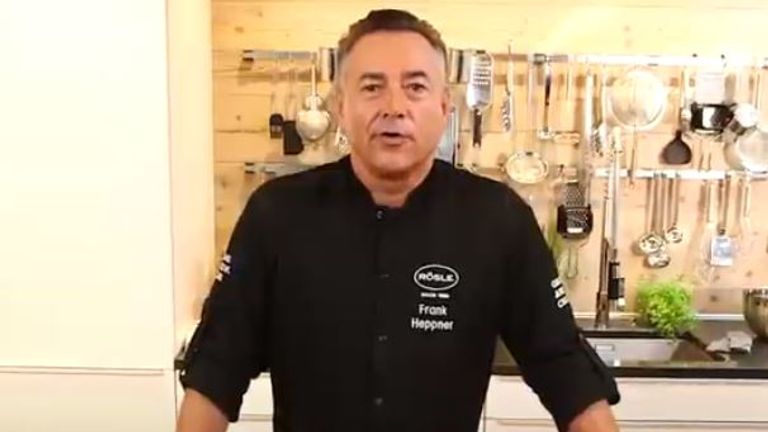
          According to reports, 62-year-old Frank Heppner, the father of Real Madrid star David Alaba’s girlfriend, was detained in Kitzbuhel, an Austrian ski resort where he owns a restaurant.

          The largest-ever nationwide police operation against right-wing extremism was sparked by the unsuccessful Reichsburger coup attempt, also known as the Reich Citizens movement.

          German celebrity chef Frank Heppner. Pic: YouTube
          Image: German celebrity chef Frank Heppner. Pic: YouTube

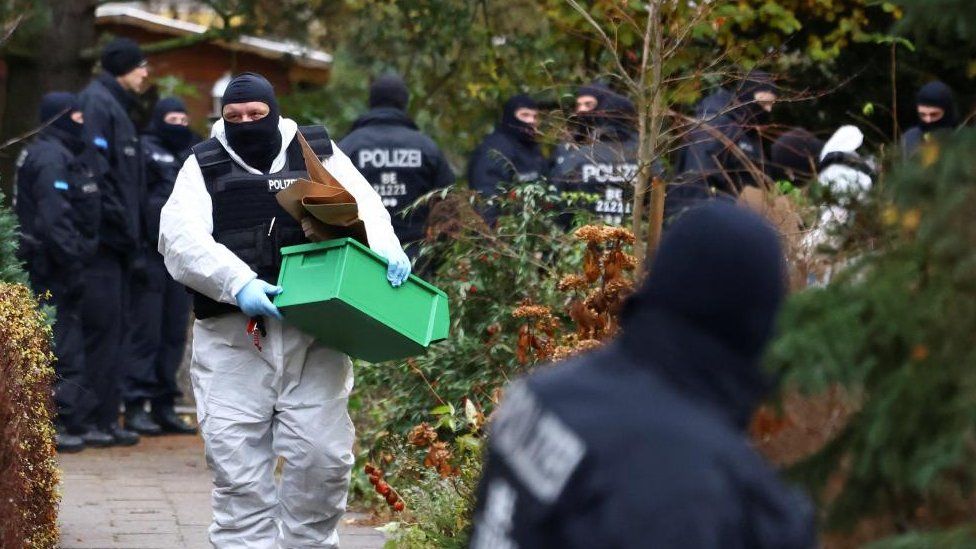
          The raids took place in 11 of the country’s 16 states last week, with 3,000 armed police storming up to 100 properties across Baden-Wuerttemberg, Bavaria, Berlin, Hesse, Lower Saxony, and Thuringia, as well as in Kitzbuhel and the Italian city of Perugia.

          The plotters allegedly wanted to install Heinrich XIII Prince Reuss, a 71-year-old businessman, as the head of a new government. He was among those arrested.

          Prosecutors said the group planned to install him as Germany’s new leader.

          Heppner’s role, should the alleged coup have been successful, would have been to “take over the canteens of the new German Reich” and supply their troops, according to Austria’s Die Presse.

          A specialist in Euro-Asian cuisine, Heppner has previously worked in five-star hotels all over the world.

          David Alaba and Shalimar Heppner at FC Bayern Munich Christmas party in 2018
          Image:David Alaba and Shalimar Heppner at FC Bayern Munich Christmas party in 2018

          His daughter, Shalimar Heppner, 28, has a son with Real Madrid’s Alaba. Sky News has contacted him for comment.

          Twenty-three suspected members and supporters of the group have been arrested according to German authorities.

          Prosecutors said 22 German citizens, and one Russian woman were detained during the raids. They said the extradition of two other people detained in Italy and Austria.

          The Reichsburger movement brings together several far-right groups whose aim is to get rid of the current government and replace it with their own.

          According to the authorities, members of the Reichsburger group have been preparing to “carry out actions based on their ideology” since November 2021.

          Following the raids, German interior minister Nancy Faese said the raids showed the country “fighting back against the enemies of democracy”.

          The case has put a spotlight once more on the far-right Alternative for Germany party. A female judge – identified by prosecutors as Birgit M-W – who is understood to have links with the party was also detained during the raids.

          Known by its German acronym AfD, the party has increasingly come under scrutiny by German security services due to its ties with extremists.


        • The self-proclaimed kingdom that doesn’t recognise Germany

          The so-called Kingdom of Germany is a self-proclaimed state, complete with its own monarch

          ]In the depths of the countryside in eastern Germany, there’s an invisible border.

          The turrets of an imposing castle loom out of the treetops. A sign on its front door solemnly informs the visitor that they’ve entered – in effect – a new country.

          The “Königreich Deutschland” (Kingdom of Germany) is a self-proclaimed independent state – complete with its own self-appointed king.

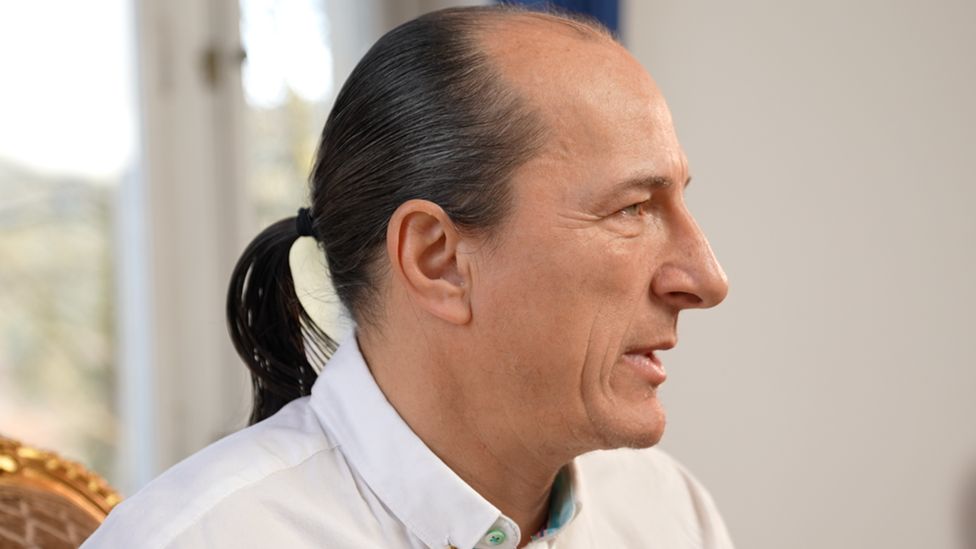
          Peter the First, as he prefers to be known, receives us in a rather gloomy wood-panelled hall.

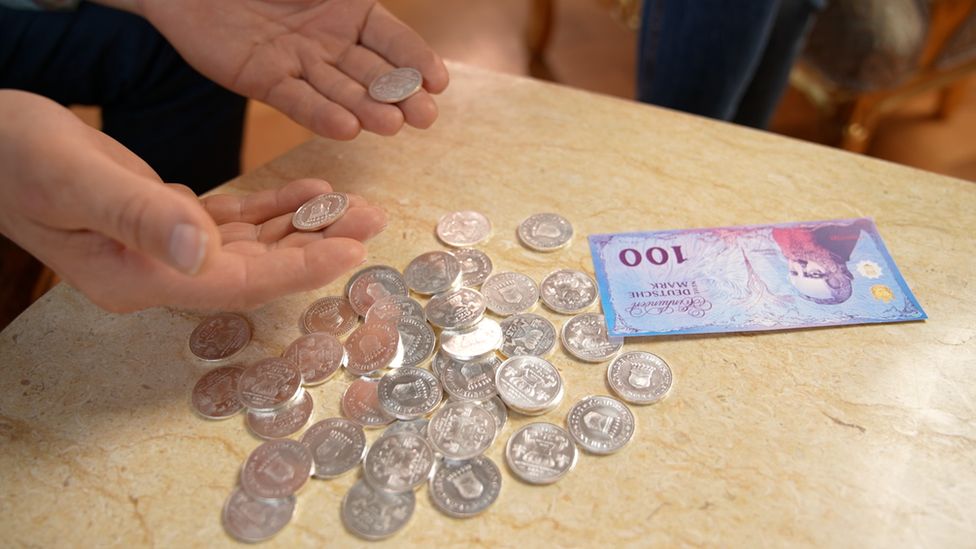
          It’s about a decade since his coronation – there was a ceremony, complete with orb and sceptre – and the foundation of his so-called kingdom, which mints its own money, prints its own ID cards and has its own flag.

          He’s what’s known in Germany as a “Reichsbürger” (Citizen of the Reich), one of an estimated 21,000 people who are defined by the country’s intelligence agencies as conspiracy theorists who don’t recognise the legitimacy of the post-war German state.

          King Peter says he has no such violent intentions.

          But he does believe the German state to be “destructive and sick”.

          “I have no interest in being part of this fascist and satanic system,” he says.

          "King of Germany"
          Image caption, King Peter told the BBC his kingdom now has 5,000 citizens

          We settle in another room to talk, on plush armchairs under a glittering chandelier.

          But this is no salon; we’re surrounded by lights and cameras. This is King Peter’s own TV studio – he hopes to start a TV channel – and I learn that one of his subjects will be recording every moment of our interaction.

          He felt, he said, that he had no choice but to found his kingdom, having tried, unsuccessfully, to run as a mayor and a member of the German parliament.

          “People who are corrupt, criminal or willing to be used thrive in the German system and those with an honest heart, who want to change the world for the better, in the interests of the common good, don’t have a chance.”

          His real name is Peter Fitzek, and his activities have brought him into frequent conflict with the German law.

          Germany doesn’t recognise the kingdom or its documents: Mr Fitzek has several convictions for driving without a licence and running his own health insurance programme. He also went to prison for several years for embezzling his citizens’ money but the conviction was later quashed.

          The regional intelligence service, which has been watching him and his kingdom for nearly two years, told us they regarded it as a threat. They liken it to a cult which exposes people to conspiracy theories and extremist ideology.

          Such theories and ideology have proliferated in Germany in recent years, fuelled by the pandemic. And Covid-19 appears to have increased support and membership of the kingdom.

          Mr Fitzek tells us he has about 5,000 citizens. He’s expanding the kingdom, buying up land in Germany in order to set up a number of communities in which those people can ultimately live.

          Reichsbürger cash
          Image caption, The self-proclaimed kingdom has even minted its own currency

          We visited one such outpost about 150 miles (240km) away from the king’s castle.

          Ancient trees surround the site of another old castle in the village of Bärwalde, an hour and a half’s drive south of Berlin. Around 30 people live on the site either in the main building or caravans which scatter the lawn along the main driveway.

          Despite the faded beauty of the castle, it’s a bleak place. They’re still renovating the buildings and clearing the grounds. Tree trunks still grow through the skeleton of an old greenhouse.

          But the people here are proud of their home which they also consider to be kingdom territory.

          Citizens don’t pay German tax and won’t send their children to school, which is illegal in Germany. They are bound by their own legal structure – presided over, I’m told, by King Peter – and ultimately they intend to have their own healthcare system.

          “The kingdom can provide everything that you need in daily life. Food and nourishment, social security, all these systems are there,” says Benjamin, who recently moved in with his young family and is responsible for PR.

          For all their plans to build a sustainable green community, using modern technologies, citizens appear to have little faith in modern medicine.

          No-one here is vaccinated against Covid-19, Benjamin told me. It’s a common position for Reichsbürger, many of whom joined protests against measures to control the pandemic.

          “People who think for themselves today will often be condemned as conspiracy theorists,” says Benjamin. “But it’s a fact that these are often the people who stay up at night thinking about problems, not just their own but those of society and politics.”

          As we left the commune and drove back through the village, a neighbour was standing on his front lawn.

          When I asked what he thought of his neighbours, he frowned. They should pay tax he said. After all, they still accessed Germany’s resources. But what worried him the most, he added, were his own children. “What kind of influence will this lot have on them?”

          For many years Reichsbürger were a bit of a national joke. Germany is learning to take them seriously.


          Source: BBC

        • Germany arrests 25 accused of plotting coup

          Twenty-five people have been arrested in raids across Germany on suspicion of plotting to overthrow the government.

          The group of far-right and ex-military figures are said to have prepared for a “Day X” to storm the Reichstag parliament building and seize power.

          A man named as Heinrich XIII, from an old aristocratic family, is alleged to have been central to their plans.

          According to federal prosecutors, he is one of two alleged ringleaders among those arrested across 11 German states.

          The plotters are said to include members of the extremist Reichsbürger [Citizens of the Reich] movement, which has long been in the sights of German police over violent attacks and racist and antisemitic conspiracy theories.
          They also refuse to recognise the modern German state.

          Other suspects came from the QAnon movement who believe their country is in the hands of a mythical “deep state” involving secret powers pulling the political strings.

          Interior Minister Nancy Faeser assured Germans that authorities would respond with the full force of the law “against the enemies of democracy”.

          An estimated 50 men and women are said to have been part of the group, which allegedly plotted to overthrow the republic and replace it with a new state modelled on the Germany of 1871 – an empire called the Second Reich.
          “We don’t yet have a name for this group,” said a spokeswoman for the federal prosecutor’s office. The interior minister said it was apparently made up of an organisation “council” and a military arm.

          Wednesday’s dawn raids are being described as one of the biggest anti-extremism operations in modern German history.

          Three thousand officers took part in 150 operations in 11 of Germany’s 16 states, with two people arrested in Austria and Italy.

          Almost half of arrests took place in southern states of Baden-Württemberg and Bavaria. More than one in five Reichsbürger are thought to be based in the south-western state of Baden-Württemberg alone.
          Justice Minister Marco Buschmann tweeted that a suspected “armed attack on constitutional bodies was planned”. Ms Faeser said later that the investigation would peer into the “abyss of a terrorist threat from the Reichsbürger scene”.

          Who are the Reichsbürger?
          So-called Citizens of the Reich reject Germany’s modern democracy and refuse to pay taxes
          Once seen as harmless cranks, they are very active and pose a high level of danger, says BfV intelligence chief Thomas Haldenwang
          Last year they numbered some 21,000, but they have since grown significantly
          10% are thought to be violent, and antisemitism and conspiracy theories are widespread

          The federal prosecutor’s office said the group had been plotting a violent coup since November 2021 and members of its central “Rat” (council) had since held regular meetings.

          They had already established plans to rule Germany with departments covering health, justice and foreign affairs, the prosecutor said. Members understood they could only realise their goals by “military means and violence against state representatives”, which included carrying out killings.
          Investigators are thought to have got wind of the group when they uncovered a kidnap plot last April involving a gang who called themselves United Patriots.

          They too were part of the Reichsbürger scene and had allegedly planned to abduct Health Minister Karl Lauterbach while also creating “civil war conditions” to bring about an end to Germany’s democracy.

          A former far-right AfD member of the lower house of parliament, the Bundestag, is suspected of being part of the plot, and of being lined up as the group’s justice minister.

          Birgit Malsack-Winkemann, who was among the 25 people arrested, returned to her role as judge last year and a court has since turned down attempts to dislodge her.
          A prominent lawyer was pencilled in to handle the group’s foreign affairs, with 71-year-old Heinrich XIII as leader.

          Public Prosecutor General Peter Frank said Heinrich was among the suspects whom investigating judges had asked to be held in custody.

          Heinrich XIII styles himself as a prince and comes from an old noble family known as the House of Reuss, which ruled over parts of the modern eastern state of Thuringia until 1918.

          Descendants still own a few castles and Heinrich himself is said to have a hunting lodge at Bad Lobenstein in Thuringia.
          The rest of the family have long distanced themselves from the minor aristocrat, with one spokesman telling local broadcaster MDR during the summer that Heinrich was an “at times confused” man who had fallen for “misconceptions fuelled by conspiracy theories”.

          As well as a shadow government, the plotters allegedly had plans for a military arm run by a second ringleader identified as Rüdiger von P.

          They were made up of active and former members of the military, officials believe, and included ex-elite soldiers from special units. The aim of the military arm was to eliminate democratic bodies at local level, prosecutors said.

          Rüdiger von P is suspected of trying to recruit police officers in northern Germany and of having an eye on army barracks too. Bases in the states of Hesse, Baden-Württemberg and Bavaria were all inspected for possible use after the government was overthrown, officials said.

          One of those under investigation had been a member of the Special Commando Forces, and police searched his home and his room at the Graf-Zeppelin military base in Calw, south-west of Stuttgart.

          Another suspect has been identified as Vitalia B, a Russian woman who was asked to approach Moscow on Heinrich’s behalf. The Russian embassy in Berlin said in a statement that it did not “maintain contacts with representatives of terrorist groups and other illegal entities”.

          Several violent attacks have been linked to Germany’s far-right in recent years. In 2020, a 43-year-old man shot dead nine people of foreign origin in the western town of Hanau, and a Reichsbürger member was jailed for killing a policeman in 2016.

          The Reichsbürger movement is estimated to have as many as 21,000 followers, of whom around 5% are considered to belong to the extreme right.

          Source: BBC

        • Germany’s Scholz: Threat of Russia using nuclear weapons has decreased

          German Chancellor Olaf Scholz says, the risk of nuclear weapons being used in the Ukraine conflict has decreased “for the time being.”

          “In response to the international community drawing a line, Russia has stopped threatening to use nuclear weapons,” Mr Scholz said.

          Russia’s Vladimir Putin said on Wednesday that nuclear weapons would only be used in retaliation.

          However, the United States condemned the remarks as “loose talk.”

          Mr Scholz said in an interview on Thursday that his recent trip to China helped “put a stop” to the threat of nuclear escalation.

          He stated that he and Chinese President Xi Jinping agreed that “nuclear weapons must not be used,” and that the G20 countries quickly reaffirmed this position.


          The German chancellor’s comment came the day after President Putin said that the risk of nuclear war is “growing – it would be wrong to hide it”.

          Speaking at a televised meeting of his human rights council, the Russian leader asserted that Russia would “under no circumstances” use the weapons first and would not threaten anyone with its nuclear arsenal.

          “We have not gone mad, we are aware of what nuclear weapons are,” he said, adding: “We aren’t about to run around the world brandishing this weapon like a razor.”

          In the interview, Mr Scholz also addressed comments made by French President Emmanuel Macron that it would be necessary to provide “guarantees for its own security to Russia, the day it returns to the table” of negotiations.

          “The priority now is for Russia to end the war immediately and withdraw its troops,” he said, adding that “of course we are ready to talk with Russia about arms control in Europe. We offered this before the war, and this position has not changed.”

          Despite Mr Scholz’s assessment that the risk has been lowered thanks to Western pressure, the US criticised Mr Putin’s comments, which it said amounted to “loose talk” and “nuclear sabre-rattling”.

          “It is dangerous and it goes against the spirit of that statement that has been at the core of the nuclear non-proliferation regime since the Cold War,” said a US state department spokesman.

          Mr Scholz – who on Thursday marks one year since being elected chancellor – also touched upon the domestic defence issues that have been in the spotlight since the start of the war in Ukraine.

          Shortly after Russia invaded the country, he announced a major defence policy shift by committing to spend €100bn (£86.4bn) on the Germany army and ramping up defence spending to above 2% of Germany’s GDP.

          Now Mr Scholz has said he hopes to develop a missile defence shield in the next five years and signalled that the German government is already in talks with manufacturers of various defence systems “to get ready for concrete decisions”.

        • Germany arrests 25 accused of plotting coup

          Twenty-five people have been arrested in raids across Germany on suspicion of plotting to overthrow the government.

          The group of far-right and ex-military figures are said to have prepared for a “Day X” to storm the Reichstag parliament building and seize power.

          A minor aristocrat named as Prince Heinrich XIII, 71, is alleged to have been central to their plans.

          According to federal prosecutors, he is one of two alleged ringleaders among those arrested across 11 German states.

          The plotters are said to include members of the extremist Reichsbürger [Citizens of the Reich] movement, which has long been in the sights of German police over violent attacks and racist and antisemitic conspiracy theories. They also refuse to recognise the modern German state.

          Other suspects came from the QAnon movement who believe their country is in the hands of a mythical “deep state” involving secret powers pulling the political strings.

          Interior Minister Nancy Faeser assured Germans that authorities would respond with the full force of the law “against the enemies of democracy”.

          Plotters prepared to kill for their ends

          An estimated 50 men and women are alleged to have been part of the group, said to have plotted to overthrow the republic and replace it with a new state modelled on the Germany of 1871 – an empire called the Second Reich.

          “We don’t yet have a name for this group,” said a spokeswoman for the federal prosecutor’s office. The interior minister said it was apparently made up of an organisation “council” and a military arm.

          Wednesday’s dawn raids are being described as one of the biggest anti-extremism operations in modern German history. Three thousand officers took part in 150 operations in 11 of Germany’s 16 states, with two people arrested in Austria and Italy.

          Almost half of arrests took place in southern states of Baden-Württemberg and Bavaria.

          More than 3,000 police took part in the raids on 130 properties across Germany (file pic)
          Image source, Reuters Image caption, Police carried out raids across 11 of Germany’s 16 states

          Justice Minister Marco Buschmann tweeted that a suspected “armed attack on constitutional bodies was planned”. Ms Faeser said later that the investigation would peer into the “abyss of a terrorist threat from the Reichsbürger scene”.

          The federal prosecutor’s office said the group had been plotting a violent coup since November 2021 and members of its central “Rat” (council) had since held regular meetings.

          They had already established plans to rule Germany with departments covering health, justice and foreign affairs, the prosecutor said. Members understood they could only realise their goals by “military means and violence against state representatives”, which included carrying out killings.

          Investigators are thought to have got wind of the group when they uncovered a kidnap plot last April involving a gang who called themselves United Patriots.

          They too were part of the Reichsbürger scene and had allegedly planned to abduct Health Minister Karl Lauterbach while also creating “civil war conditions” to bring about an end to Germany’s democracy.

          A former far-right AfD member of the lower house of parliament, the Bundestag, is suspected of being part of the plot, and of being lined up as the group’s justice minister. Birgit Malsack-Winkemann, who was among the 25 people arrested, returned to her role as judge last year and a court has since turned down attempts to dislodge her.

          Nancy Faeser
          Reuters The suspected terrorist group uncovered today is – according to the current status of the inquiry – driven by fantasies of violent overthrow and conspiracy ideologies Nancy Faeser German Interior Minister

          1px transparent line

          A prominent lawyer was pencilled in to handle the group’s foreign affairs, with Prince Heinrich as leader.

          Public Prosecutor General Peter Frank said Heinrich was among the suspects whom investigating judges had asked to be held in custody.

          Aristocrat ‘fuelled by conspiracy theories’

          Heinrich XIII comes from an old noble family known as the House of Reuss, which ruled over parts of the modern eastern state of Thuringia until 1918. All the male members of the family were given the name Heinrich as well as a number.

          Descendants still own a few castles and Heinrich himself is said to have a hunting lodge at Bad Lobenstein in Thuringia.

          The rest of the family have long distanced themselves from the minor aristocrat, with one spokesman telling local broadcaster MDR during the summer that Heinrich was an “at times confused” man who had fallen for “misconceptions fuelled by conspiracy theories”.

          As well as a shadow government, the plotters allegedly had plans for a military arm run by a second ringleader identified as Rüdiger von P.

          They were made up of active and former members of the military, officials believe, and included ex-elite soldiers from special units. The aim of the military arm was to eliminate democratic bodies at local level, prosecutors said.

          Rüdiger von P is suspected of trying to recruit police officers in northern Germany and of having an eye on army barracks too. Bases in the states of Hesse, Baden-Württemberg and Bavaria were all inspected for possible use after the government was overthrown, officials said.

          One of those under investigation had been a member of the Special Commando Forces, and police searched his home and his room at the Graf-Zeppelin military base in Calw, south-west of Stuttgart.

          Another suspect has been identified as Vitalia B, a Russian woman who was asked to approach Moscow on Heinrich’s behalf. The Russian embassy in Berlin said in a statement that it did not “maintain contacts with representatives of terrorist groups and other illegal entities”.

          Several violent attacks have been linked to Germany’s far-right in recent years. In 2020, a 43-year-old man shot dead nine people of foreign origin in the western town of Hanau, and a Reichsbürger member was jailed for killing a policeman in 2016.

          The Reichsbürger movement is estimated to have as many as 21,000 followers, of whom around 5% are considered to belong to the extreme right.

          Source: BBC

        • Wenger suggests ‘political demonstrations’ contributed to Germany’s shock World Cup exit

          Germany’s decision to participate in “political demonstrations” in Qatar, according to Arsene Wenger, may have contributed to their early exit from the World Cup.

          Germany failed to bounce back from a shocking 2-1 loss to the Samurai Blue on matchday one, exiting the group stage for the second time in a row as Japan and Spain advanced.

          Before the match, Germany’s players protested FIFA’s decision to forbid captain Manuel Neuer from donning the OneLove armband, which was meant to spread a message against discrimination in Qatar, where homosexuality is prohibited. The players covered their mouths in the team photo.

          A statement from the team said “denying us the armband is the same as denying us a voice”, but some – most notably Belgium winger Eden Hazard – claimed the protest may have distracted Germany’s players.

          Wenger, the head of FIFA’s Technical Study Group for the tournament, agreed with that suggestion, saying: “When you go to a World Cup, you know you can’t lose the first game.

          “The teams who have the experience to perform in tournaments like France and England played well in the first game.

          “The teams who were mentally ready, with a mindset to focus on competition, and not the political demonstrations.”

          Speaking after the defeat to Japan, Germany coach Hansi Flick insisted his players were “not at all” distracted by their decision to take a stand on the OneLove debate.

          Germany were one of several European teams to initially commit to wearing the armband, but each backed down ahead of the World Cup after facing the apparent threat of sporting sanctions.


        • World Cup 2022: Did it cross the line? Germany out as Japan and Spain progress


          That is the age-old World Cup question for Germany, who crashed out as Japan beat Spain thanks to an opinion-dividing winner that left many scratching their heads.

          Kaoru Mitoma’s cutback for Ao Tanaka’s tap-in happened just after the ball looked to have crossed the byeline.

          Even after cropping and zooming it looked incredibly close. Eventually it was ruled that the ball had not fully crossed the line.

          In other words, if you drew an imaginary line upwards at 90 degrees from the far edge of the whitewash, it would have still passed through the curve of the ball – albeit only just – even though the part of the ball that touched the ground had fully crossed the line.

          The goal was initially ruled out by the assistant referee after a long pause, then the video assistant referee (VAR) intervened and ultimately Japan’s lead would stand – and they would go on to win.

          “I have seen a photo that must have been tampered with, it cannot be that this photo is real. It has to be manipulated,” said Spain boss Luis Enrique.

          “I felt that something fishy was going on when the VAR took as much time as it did to decide… I have nothing to say.

          “Luckily, the team only goes into collapse mode once every four years, otherwise I wouldn’t be able to cope.”

          The controversy evoked memories of Frank Lampard’s “ghost goal” against Germany in 2010, when England went out in the last 16, and – no doubt for German fans of a certain vintage – of 1966 and Geoff Hurst’s extra-time effort when England won the World Cup.

          In Qatar, those three points for Japan meant Germany were out, the four-time winners falling at the group stage for a second consecutive tournament.

          It was just one moment on a World Cup night full of spinetingling drama.

          A rollercoaster night in Group E

          It was a frantic and thrilling Thursday night which began with Belgium, the side ranked second in the world, being eliminated by a goalless draw with Croatia in Group F.

          And halfway through the second half of the late games, both Germany and 2010 winners Spain were set for an early exit.

          At the break Germany had a comfortable 1-0 lead over Costa Rica, with Spain also winning 1-0 as both European sides seemed to be cruising into the last 16.

          Then the drama unfolded. Japan levelled against Spain four minutes into the second period.

          Then, incredibly, 142 seconds later they were in front. Japan and Spain, despite trailing, were heading through. With just under 40 minutes to go Germany and Costa Rica were going out.

          “The Japan fans around me can barely believe their eyes,” said BBC Sport’s Chris Bevan. “An incredible turnaround from their team, with the added drama of a long VAR delay.”

          “Japan are a completely different animal,” added former England defender Matthew Upson.

          Defeat for Spain wasn’t a disaster, unless Costa Rica – then 1-0 down to Germany – took the lead.

          But Costa Rica equalised in the 58th minute, and after 70 minutes they were ahead. At 2-1 Costa Rica were suddenly set to advance with Japan at Spain’s expense.

          However, that lead lasted for only three minutes before Kai Havertz levelled for Germany.

          Group E in the second half
          For three second-half minutes Costa Rica were heading through and Spain were going out

          “Germany desperately needed that,” said BBC Radio 5 Live’s Connor McNamara. “It may not be enough for them but it could save Spain.”

          “It’s hard to keep up with what is happening at the moment,” added Bevan. “There were huge roars here from the Japan fans when the big screen flashed up what the group looked like with Costa Rica winning… but then seconds later the Spain fans to my right celebrated wildly after hearing that Germany had equalised.”

          ‘The tension is unbearable’

          Germany would hit two further goals to win 4-2. But, as long as Japan held on to all three points against Spain, the champions in 2014 would go out.

          “The tension is unbearable,” chuckled Upson.

          Spain kept on coming but Japan, dodgy goal or not, survived until full-time, winning 2-1. They and Spain, despite their defeat, reached the last 16. Germany and Costa Rica were out.

          Spain boss Enrique said he was not aware his side were on course to head out of the tournament when Costa Rica led Germany.

          “If I had found out, I would have had a heart attack,” he confessed.

          For Germany forward Thomas Muller, the night had turned into an “absolute catastrophe”.

          “It is unbelievably bitter for us because our result would have been enough,” he added. “It’s a feeling of powerlessness.”

          Team-mate Havertz, meanwhile, said it was “like watching a horror movie”.

          “For the second tournament in a row, Germany go out in the group stages,” added McNamara. “One of the really big guns, one of the four-time winners of the World Cup, they are out of Qatar 2022. It’s one of those nights where it just hasn’t been enough.”

          “Incredible doesn’t do it justice,” said BBC Radio 5 Live chief football reporter Ian Dennis. “The drama fluctuated throughout the course of the second half.

          “We’ve had a game that was the football equivalent of snakes and ladders.”

          However, former England goalkeeper Karen Bardsley summed it up best – simply saying: “It was chaos.”


          Source: BBC

        • Muller suggests Germany retirement after World Cup exit

          Thomas Muller strongly hinted at his impending retirement from international competition when he called Germany’s World Cup performance in Qatar a “utter disaster.”

          While Hansi Flick’s team triumphed in their final match, defeating Costa Rica 4-2, Japan’s unexpected 2-1 victory against Spain resulted in yet another World Cup group-stage exit.

          Germany had not lost in the group stage at a World Cup since 1954 before the 2018 event in Russia, but they have now suffered an early exit in the last two competitions.

          Muller, a member of the team that triumphed in Brazil in 2014, acknowledged that he was unsure of his next steps and that this might be his last participation on the world scene.

          “It’s an absolute disaster! I don’t know what happens next,” he told ARD after the match.

          “If this was my last game, then I would like to say a few words to the German football fans.”

          He continued: “It was an enormous pleasure, dear people. We experienced great moments. I tried to keep my heart on the pitch in every game.

          “I have always delivered commitment and sometimes there were tears of joy from my actions, sometimes the spectators also had pain in their faces.

          “Even if I did not succeed in all actions, I did it with love. I’ll have to see about everything else.”

          The 33-year-old has earned 121 caps for Germany, joint-fourth all-time for his nation, netting 44 goals, putting him seventh in the scoring charts.

        • Busquets denies Spain will benefit from kind World Cup draw

          Sergio Busquets refuted claims that Spain was happy to avoid playing Brazil in a potential World Cup quarterfinal after La Roja came through a major scare to advance from Group E.

          Alvaro Morata handed Spain an early lead against Japan at the Khalifa International Stadium on Thursday, putting them on track to win the group. However, Ao Tanaka responded to Ritsu Doan’s equalizer within 142 seconds to propel the Samurai Blue to the top spot.

          As Germany defeated Costa Rica 4-2 in the group’s second match, Spain’s loss allowed them to advance on goal differential. La Roja was briefly on the verge of an astonishing group-stage elimination when Los Ticos lead Hansi Flick’s squad with 20 minutes remaining.

          However, Busquets was dismissive when asked if that represented a positive outcome, saying: “It has nothing to do with it.

          “We wanted to win and be first. We go to the other side of the bracket, but that does not guarantee that it will be easier or more difficult.

          “We didn’t want this to happen, our intention was to win. To continue, we have the round of 16 against Morocco, which is going to be a very difficult match.

          “We were not comfortable. They closed the pass between the lines very well and it was very difficult for us to connect and create danger.

          “We knew it was going to be like that, it’s a shame about the goals. We have to continue, try to correct the mistakes, and go through the knockouts.”

          Spain dropped to third place when Manuel Neuer’s own goal put Costa Rica 2-1 up against Germany at Al Bayt Stadium, before the four-time winners levelled the scores through Kai Havertz three minutes later.

          Busquets’ midfield partner Pedri revealed Spain were made aware of their perilous situation during that brief period, as he emphasised the need to improve against Morocco.

        • Bierhoff ‘angry’ after Germany crash out of World Cup

          Oliver Bierhoff is aware that Germany‘s failure to advance past the group stage of the World Cup on Thursday was entirely their own fault.

          At Al Bayt Stadium, Hansi Flick’s team defeated Costa Rica 4-2 in their final Group E encounter, but it wasn’t enough to advance them to the round of 16.

          The Samurai Blue took first spot because to Japan’s unexpected 2-1 victory over Spain, while Luis Enrique’s team came in second thanks to a better goal differential than Germany.

          Germany was left speechless after falling short once more in Qatar, four years after failing to advance from their group in Russia.

          Germany suffered a disappointing 2-1 loss to Japan in their initial game, but they held Spain to a draw before winning their first match of the competition against Japan in what turned out to be their final match.

          Bierhoff, Germany’s national team managing director, said: “We’re extremely disappointed. We’re angry too because we had things in our own hands in all three games.

          “Ultimately, football is a simple game. You have to score lots of goals and concede as few goals as you can, which we didn’t manage to do.

          “We could have put more pressure on Spain tonight if we had taken our chances and scored more goals. A trend of the last few years has been us throwing away games we’ve controlled.”

          Japan will face Croatia for a place in the quarter-final next Monday, with Spain taking on Morocco 24 hours later.

        • World Cup exit ‘the most difficult day of my career’ – Kimmich

          After a thrilling Group E final on Thursday, Japan and Spain advanced, and Joshua Kimmich referred to Germany’s devastating World Cup departure as the worst moment of his career.

          Hansi Flick’s team kept their half of the deal with a 4-2 victory over Costa Rica in their penultimate match, knowing that a victory would likely advance them to the round of 16 if Japan were to lose to Spain.

          However, Japan mounted a dramatic comeback to defeat La Roja, ensuring they emerged as a surprise group winner and ruining Germany’s hopes of winning a sixth World Cup. Ritsu Doan and Ao Tanaka scored in the process.

          Kimmich is devastated because Germany has now failed to go past the group stage at two World Cups in a row after doing so on each of their previous 16 visits at the competition.

          “For me personally, this is the worst day of my career. I’m afraid I’ll fall into a hole,” Kimmich told reporters. “It makes you think these failures are connected to my person.

          “This is definitely the most difficult day of my career for me. The second time being eliminated at a World Cup, in between we had the Euros, where we were eliminated early.

          “That is bitter and there have been many missed opportunities within the last four years.”

          Germany reached the semi-finals of Kimmich’s first major tournament at Euro 2016, but they have since fallen at the first hurdle at two World Cups and suffered a last-16 defeat to England at Euro 2020.

          Costa Rica briefly took a surprise lead when Manuel Neuer put through his own net with 20 minutes remaining on Thursday, and Germany have now gone 12 major tournament games without a clean sheet (World Cup/Euros) – their longest ever streak.

          Kimmich’s fellow midfielder Ilkay Gundogan hit out at Die Nationalmannschaft’s defending as he called on his team-mates to reflect on their shortcomings.

          “We concede goals too easily, we lose balls too easily and up front we miss goalscoring chances too easily,” Gundogan said.

          “Of course, as Germany, we have to have different aspirations, so we have to take a good look at ourselves.

          “We just didn’t manage to do our best as a group, or maybe individually. We have to question what the reasons were and everyone has to look in the mirror and tell themselves that it wasn’t enough.”


        • Ukraine war: Germans struggling to cope with influx of Ukrainian refugees

          Almost 1,000 people sleep in giant heated tents on an old airfield on Berlin’s outskirts. The German capital is struggling to house Ukraine’s refugees properly.

          As winter deepens and Russia continues to attack Ukraine’s energy infrastructure, authorities here are rushing to build more emergency shelters in preparation for the arrival of up to 10,000 more people.

          According to the most recent figures, a million Ukrainians have fled to Germany since the beginning of the war.

          This has brought back memories of 2015 and 2016, when a comparable number of people sought asylum in the United States.

          Germany, as before, extended a warm welcome. However, there are growing concerns about how to best accommodate such a large population.

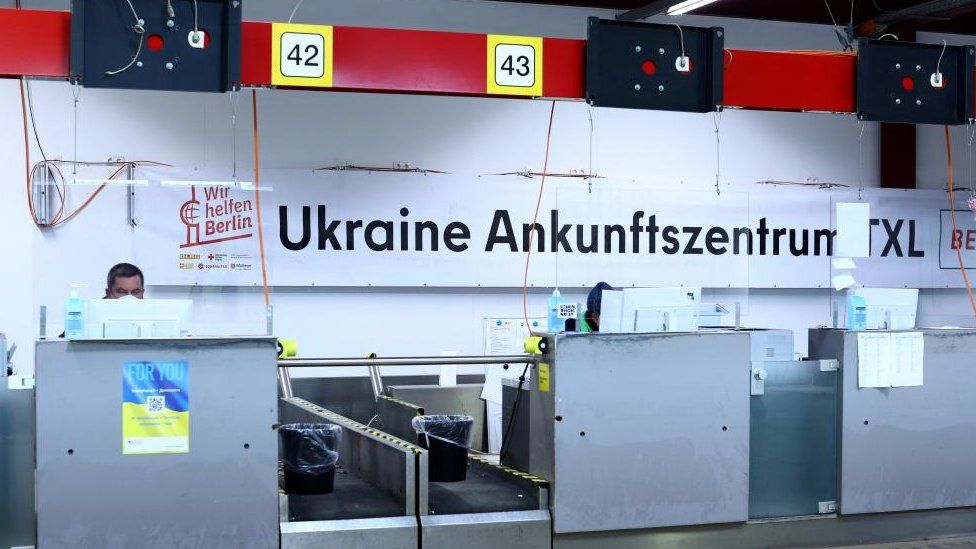
          In Berlin, around 100 Ukrainians arrive every day at the city’s main reception centre for refugees which is sited in a terminal at a converted former airport.

          Workers in brightly coloured tabards lead them past defunct baggage carousels to the old departure halls which are now filled with crowded trestle tables.

          There’s food here, medical aid and a bed for a few nights.

          It’s designed to be temporary; strangers sleep in bunks in shared cubicles or tents.

          But many of the people here will stay longer; it’s getting harder to find permanent accommodation in a city where the rental market is under pressure, and sending people on to other parts of Germany is getting harder too.

          An employee sits on a desk at an accommodation centre for refugees, including Ukrainians, inside former Tegel airport in Berlin, Germany November 9, 2022
          IMAGE SOURCE,REUTERS Image caption, Germany is now housing many refugees at Berlin’s former Tegel airport

          Operations manager Kleo Tümmler admits it’s a challenge: “We are built to take care of people for a few days. Sometimes they have to stay here for two weeks, maybe three weeks.”

          Despite the logistical difficulties, there’s a relaxed atmosphere in the centre.

          Ms Tümmler and her colleagues appear committed to making life as easy and comfortable as possible for the people here.

          They’re trying to adapt to the needs of longer-term guests. They’ve bought washing machines, they’re trying to provide some entertainment, and they’re extending the educational facilities for the 300 children on site, some of whom are home-schooling via video link to their Ukrainian schools.

          They have learnt, they say here, from the experience of 2015.

          But their positivity is not mirrored elsewhere.

          One politician from northwest Germany recently used an editorial in a national newspaper to warn that communities like his were “massively challenged” by numerous Ukrainian refugees as well as a growing influx of asylum seekers.

          The number of people seeking asylum has indeed risen, fuelled largely by people from Syria and Afghanistan.

          Refugees arrive in Berlin (file pic)

          Getty Images
          I expect tens, if not hundreds of thousands more Ukrainian women and children… already more migrants are living in many communities than in the year of the 2015-16 refugee crisis
          Frederik Paul
          CDU politician writing in Die Welt
          1px transparent line

          Frederik Paul said he was reminded of the atmosphere during the migrant crisis when an initially warm welcome gave way to a bitter national debate over how much support Germans could and should offer to those seeking asylum.

          He echoed comments made earlier in the year by Martina Schweinsburg, a district councillor from Thuringia, who said her area had relied on private landlords to house Ukrainians – mainly women, children and elderly people at first – but were now reluctant to do so.

          Turning over school gyms for emergency accommodation was, she said, something the public increasingly considered unacceptable.

          “Our capacities are exhausted,” she said. “Our backs are against the wall.”

          The mood is darkening; the authorities recorded 65 attacks on refugee accommodation so far this year, a significant increase on 2021.

          A Ukrainian flag flies from a building opposite a hotel used to house refugees from Ukraine that is now a charred ruin following what police suspect was an arson attack days before in the hamlet of Gross Stroemkendorf on October 24, 2022 n
          IMAGE SOURCE,GETTY IMAGES Image caption, This hotel sheltering Ukrainian refugees was burned down in a suspected arson attack last month

          And a recent survey for the national broadcaster found that concerns about immigration had increased in the last year: 53% of those asked were concerned that too many people were coming to Germany, up by 11% from September 2021.

          Those fears and that social division are exactly what Russia’s Vladimir Putin has sought to exploit in his latest campaign to render Ukraine uninhabitable and drive yet more of its citizens into Europe.

          That will test the tolerance of this German government, which came to power with a far more liberal attitude towards refugees than its predecessor.

          How this country, itself much changed by the experience of the migrant crisis, reacts will matter.

        • World Cup 2022: Flick hopes to stay in charge even if Germany suffer early exit

          Even if Germany is unexpectedly eliminated early from the World Cup, Hansi Flick plans to stay in charge for the Euro 2024 on home soil.

          After losing 2-1 to Japan and tying 1-1 with Spain in their first two games, Germany is currently last in Group E going into the final round of games.

          Following Josef Herberger, Flick is the only manager of Germany to have lost his first two World Cup games; no other manager has lost their first three games in charge.

          To ensure a spot in the round of 16, the four-time world champions must now defeat Costa Rica and hope Spain defeats Japan.

          If Spain and Japan play to a tie or a win for the latter, the outcome would come down to goal differential if Germany wins all three of its games against Costa Rica.

          Flick’s decision to stay in the position would be called into doubt if he dropped out of the race at the first hurdle, but he has no plans to do so.

          “I don’t know what else will happen, but from my side, my contract runs to 2024 and I’m looking forward to the Euros,” he said at Wednesday’s pre-match press conference.

          “But we have a while to go until then. We go into the Costa Rica match trying to make things clear from the start, to exert pressure – these are our intentions.

          “Of course we know it’ll be difficult against a team who normally defends. We need to adopt the same mentality as we showed against Spain.”

          Germany failed to reach the knockout round in Russia four years ago and exited Euro 2020 at the last-16 stage in last year’s rescheduled tournament.

          Flick, who took over on the back of those disappointments, is hoping to avoid more major competition disappointment on Thursday.

          When asked to explain why Germany have underwhelmed at recent tournaments, Flick said: “Maybe you can ask me this question tomorrow, though I hope not.

          “Normally I’m an optimist who thinks positively. I’m not considering anything like [exiting the tournament] for the time being.

          “We know it’s not entirely in our own hands and it goes without saying we didn’t get the result we wanted in the first game.

          “But we’re here to reach the knockouts and we’ll play our next match with confidence. Whatever happens, happens. Like after the Japan loss, I’m not feeling any pressure.

          “We’re heading in the right direction. Things are getting better in training and we’re continuing to learn. We’re finding solutions with the ball and that’s why I think we’re improving.”

          Germany are facing Costa Rica at the World Cup for just a second time, having previously won 4-2 in the opening match of the 2006 edition when hosting the tournament.

          They have won six of their eight World Cup matches against CONCACAF nations, though their only loss in that run was in their last such match against Mexico in 2018.

          Costa Rica have won just one of their past 11 World Cup games against European nations, meanwhile, with that including a 7-0 loss to Spain in their opening group match.

          However, Luis Fernando Suarez’s side beat Japan last time out and can themselves reach the last 16 by defeating Germany at Al Bayt Stadium.

          A draw would also be enough if Spain overcome Japan, as many expect, and Flick expects Costa Rica to set out defensively in order to take a point.

          “If we look at the table then Costa Rica has an opportunity to go last 16 if they draw, so I assume they’ll try to defend as much as possible as they did against Japan,” he said.

          “It’s important for us to find a solution. It’s our own fault we’re in this situation and now we have to do what we can. It’s about giving 100 per cent and performing on the day.”

        • Morata ready for ‘tough’ Japan clash after Germany draw

          Alvaro Morata promises that Spain won’t be taking their World Cup chances for granted when they take on Japan on Thursday.

          This comes after a 1-1 draw with Germany.

          On Sunday at Al Bayt Stadium, Morata scored his second goal of the competition after coming off the bench to give Spain the lead. However, Germany’s substitute Niclas Fullkrug scored a late equalizer to earn his team a point.

          Spain, who is currently in first place in Group E, merely needs a point against Japan on Thursday to advance, while Germany must defeat Costa Rica and hope Luis Enrique’s team can help them out.

          Striker Morata stressed there is no chance Spain will take Japan lightly at Khalifa International Stadium.

          Japan is a tough team, they run a lot, they are good tactically. It’s another tough game, it’s a World Cup.” he said.

          The Atletico Madrid frontman says he has no problem with being among the substitutes again after also finding the back of the net in a 7-0 rout of Costa Rica.

          “We are on the bench for this [to score]. Germany are a great team, this match could have been a semi-final or final in the World Cup,” he said.

          “It’s the same [starting of being a substitute], the most important thing is to win. They scored an amazing goal, so we didn’t have the victory, but we keep training and pushing with good vibes and positivity.”

          Morata has scored eight goals at European Championships and World Cups, at least double the amount of any other player for Spain since 2016.

        • Neuer glad Germany are ‘still alive’ in World Cup after Spain draw

          Following Sunday’s 1-1 draw with Spain, Manuel Neuer expressed relief that Germany is “still alive” in the World Cup.

          Germany’s unexpected loss to Japan in their opening encounter ended their chances of making it to the round of 16.

          However, Costa Rica bounced back from a 7-0 drubbing at the hands of Spain by defeating Japan 1-0, leaving everything up for grabs in Group E’s remaining matches.

          In the clash of the Group E powerhouses at Al Bayt Stadium, Alvaro Morata gave Spain the lead. However, Niclas Fullkrug, who came off the substitute, equalized and gave Germany its first point.

          Hansi Flick’s Germany team needs to defeat Costa Rica in their last group game on Thursday in order to advance, and they also need to pray that Spain wins against Japan.

          Goalkeeper Neuer is just happy that Germany still has a chance of avoiding a second consecutive World Cup loss at the group stage after Dani Olmo palmed his effort against the crossbar to deny him an early goal.

          “It was a tough match against a very good Spain side,” said the Germany captain. “We took on the fight and didn’t allow them many chances over the 90 minutes.

          “Our defensive work was superb from front to back. Our compactness made it difficult for them to score a goal against us. Their goal was simply quality and very hard to defend against. Nevertheless, we continued to believe in ourselves.

          “The main thing is that we’re still alive. The thing we can have influence over is getting three points against Costa Rica.”

          After receiving a last-minute call-up to the team, Fullkrug only recently made his full international debut for Germany and scored his first goal in a competitive match.

          The 29-year-old Werder Bremen striker said: “We were determined to get a result from the game, and it was very important for our confidence.

          “We still have room for improvement. We don’t need to get carried away, but we can go into the final game with hope that we can make it through.”

        • 2022 World Cup: Japan stage incredible comeback win over Germany

          Japan stunned Germany in the 2022 FIFA Group E opener to kickstart their campaign on a stunning note.

          The Blue Samurai came from a goal down to beat the four-time champions 2-1 at the Khalifa International Stadium.

          Doan and Asano scored two brilliant second-half goals after Gundogan had given Germany the lead in the first half.

          Germany made a strong start, taking the lead from the penalty spot after Nico Schlotterbeck was brought down by goalkeeper Gonda.

          Gundogan made no mistake, sending Gonda in the wrong direction. On the stroke of halftime, Kai Havertz doubled the lead but his goal was chopped off for an offside.

          Japan turned the game on its head and took it to Germany after the introduction of Takehiro Tomiyasu, Kaoru Mitoma, and Takuma Asano.

          Ritsu Doan gave them a deserving equalizer in the 75th minute of a round after Mitoma forced Neuer into a brilliant save.

          Bochum striker, Asano completed the comeback with seven minutes left on the clock with a stunning finish from a tight angle.

          Japan goes top of the group following its staggering victory over Germany.

          The second game in the group between Sapin and Costa Rica is scheduled for a late kick-off.

        • ‘Utter nonsense’: Germany refutes Johnson’s claim it wanted Ukraine war to be over quickly

          Boris Johnson’s claim that Germany wanted Ukraine to “fold” in its war with Russia is “utter nonsense”, a German government spokesman has said.Earlier today, the former prime minister claimed other European nations took very different views on the war in Ukraine, with Germany allegedly preferring a quick Ukrainian defeat over a long conflict.

          He told CNN Portugal: “This thing was a huge shock… we could see the Russian battalion tactical groups amassing, but different countries had very different perspectives.

          “The German view was at one stage that if it were going to happen, which would be a disaster, then it would be better for the whole thing to be over quickly, and for Ukraine to fold.”

          The ex-PM also said France was in denial “right up until the last moment” when Russian forces crossed the border.

          However, Chancellor Olaf Scholz’s spokesman, Steffen Hebestrei, has refuted the claims and said Berlin had swiftly decided to send arms to Ukraine after Moscow launched its invasion.

          “We know that the very entertaining former prime minister always has a unique relationship with the truth; this case is no exception,” he said.

          Mr Hebestreit added: “This is utter nonsense.”

          Source: Skynews.com 

        • Germany 1-2 Japan: Bundesliga duo stun Die Mannschaft with late show

          Japan staged a sensational fightback to deal Germany a shock 2-1 defeat in their World Cup opener as Bundesliga players Ritsu Doan and Takuma Asano came off the bench to stun the four-time winners.

          Germany made headlines by covering their mouths in a pre-match protest against FIFA’s decision to ban Manuel Neuer from wearing the OneLove armband, and they looked set to make a positive start in Group E when Ilkay Gundogan converted a first-half penalty.

          Hansi Flick’s side then squandered several golden opportunities to put the game to bed before Freiburg forward Doan made them pay from a rebound 15 minutes from time.

          With Germany chasing a winner, there was to be one final twist as Asano raced onto a long ball before firing beyond Neuer, leaving Die Mannschaft under huge pressure ahead of Sunday’s meeting with Spain.

          Germany were saved by the offside flag when Daizen Maeda prodded Daichi Kamada’s early cross home, but Japan were masters of their own downfall when Flick’s team went ahead after 33 minutes.

          Goalkeeper Shuichi Gonda committed a clumsy foul on David Raum to hand Germany a spot-kick, which Gundogan coolly converted.

          A VAR review denied Germany a second as Kai Havertz tapped home from an offside position after Gonda saved from Joshua Kimmich, before Gundogan hit the base of the post after the restart.

          Gonda denied Gnabry three times in quick succession as Germany continued to create chances, but Japan stunned them at the other end as Doan capitalised on a rebound to fire into the roof of the net.

          Japan completed the turnaround with seven minutes left as Niklas Sule’s woeful positioning allowed Asano to stay onside from a long ball, and he hammered beyond Neuer to seal a famous win.

          What does it mean? Germany under pressure after collapse

          The identity of Germany’s second opponents in Group E – Luis Enrique’s Spain – made a positive result in Wednesday’s opener crucial, but a combination of dire defending and efficient attacking play from Japan cost them three points.

          Germany’s loss was their first after building a half-time lead at the World Cup since 1978 (a 3-2 loss to Austria), snapping a run of 21 such games without defeat.

          Flick’s team also became the first side since records began to lose a World Cup game when accumulating over three expected goals (xG).

          Started from the Bochum now he’s here

          Bochum winger Asano has failed to hit the net in six Bundesliga appearances this season, but the 28-year-old changed the game following his 57th-minute introduction at the Khalifa International Stadium.

          Despite his limited time on the field, Asano led his team-mates for shots (five) and touches in the Germany area (five), and he showed no sign of nerves when one-on-one with Neuer as he fired Japan to victory.

          Blue Samurai strike on the break

          Germany were always expected to dictate the tempo in their first major tournament outing under former Bayern Munich coach Flick, and Japan were limited to just 26.2 per cent possession on Wednesday.

          That figure is the second-lowest recorded by the winning team in a World Cup match, with South Korea having just 26 per cent when they recorded their own upset against Germany in 2018.

          Key Opta Facts:

          – Japan picked up their first victory against Germany (D1 L1), with nine of the 10 total goals in this fixture being scored in the second half.
          – Germany have lost a World Cup game in which they led at half time for the first time since 1978 (2-3 vs Austria), having gone unbeaten in their previous 21 such matches before today.
          – Japan came from behind to win a World Cup match for the very first time, having drawn two and lost 11 of their 13 matches when they had trailed before today.
          – Having lost their opening game at just one of their first 18 World Cup tournaments (W13 D4), Germany have lost their first game at each of the last two World Cups.

          What’s next?

          Germany face Spain in a crucial Group E match on Sunday, while Japan take on Costa Rica on the same day.

          Source: Livescore

        • Germany protest FIFA’s OneLove ban at World Cup opener

          Germany’s players protested FIFA’s decision to ban Manuel Neuer from wearing the OneLove armband by covering their mouths ahead of their World Cup opener, as the team declared: “Denying us the armband is the same as denying us a voice.”

          Germany were among several European sides to commit to wearing the armband in order to promote an anti-discriminatory message in Qatar, where same-sex relationships are criminalised.

          However, the teams backed down ahead of their opening World Cup fixtures after being threatened with sporting sanctions by FIFA, which German Football Association (DFB) president Bernd Neuendorf suggested were more significant than a yellow card for the affected captains.

          After taking to the pitch for their Group E meeting with Japan at the Khalifa International Stadium, Germany’s players covered their mouths for the traditional pre-match photo to protest FIFA’s handling of the row.

          The team subsequently released a statement via social media, which read: “We wanted to use our captain’s armband to take a stand for values that we hold in the Germany national team: diversity and mutual respect.

          “Together with other nations, we wanted our voice to be heard.

          “It wasn’t about making a political statement – human rights are non-negotiable. That should be taken for granted, but it still isn’t the case. That’s why this message is so important to us.

          “Denying us the armband is the same as denying us a voice. We stand by our position.”

          Germany captain Neuer was seen to have his armband checked by referee Ivan Barton Cisneros ahead of Wednesday’s game.

          Die Mannschaft also warmed up for the match wearing training shirts featuring rainbow-coloured trim in another apparent show of support for LGBTQ+ rights.

          Source: Livescore


        • Sane ruled out of Germany’s World Cup opener with knee injury

          Leroy Sane will miss Germany’s World Cup opener against Japan with a knee injury, the German Football Association (DFB) has confirmed.

          The Bayern Munich winger was absent from Die Mannschaft’s final training session in preparation for the Group E fixture at Khalifa International Stadium on Wednesday.

          The rest of Germany‘s squad took part in the session.

          A DFB statement read: “The German national team must be without Leroy Sane in their World Cup opening game against Japan on Wednesday.

          “The 26-year-old attacking player from champions FC Bayern Munich is unavailable against the four-time Asian champions due to knee problems. The remaining 25 players of the German World Cup squad took part in the final training session in Al-Shamal.

          “After lunch, the four-time world champions’ squad head to Qatar’s capital, Doha, where captain Manuel Neuer and company will spend the night before the opening game.”

          While the loss of Sane, who has scored 11 times in 45 appearances for his country, obviously represents a blow, head coach Hansi Flick does have a wealth of attacking options to choose from with Serge Gnabry, Julian Brandt, Mario Gotze, Kai Havertz and Jamal Musiala all available.

          Source: Livescore


        • Musiala admits it’s a ‘big honour to be compared to Messi’

          Jamal Musiala admits being compared to Lionel Messi is a “big honour” as the Germany midfielder prepares for his World Cup bow.

          The Bayern Munich star, who played just nine minutes at Euro 2020, has enjoyed an impressive start to the Bundesliga season, scoring nine goals and providing six assists.

          The 19-year-old’s 15 goal involvements are the most registered by any teenager across Europe’s top five leagues and just two shy of Messi’s tally for Paris Saint-Germain (seven goals, 10 assists).

          “I think it’s a big honour to be compared to Messi,” said Musiala, who will hope to feature in Germany’s Group E opener against Japan at the Khalifa International Stadium on Wednesday.

          “He has been playing at the top level for his entire career. It’s always hard to compare yourself to others. I prefer to focus on myself and on where I can improve.

          “It’s important to remain relaxed about what’s happening and to not put too much pressure on yourself. You also have to have some fun, and then everything will work out.

          Die Mannschaft team-mate Niklas Sule, who was part of the side that exited the group stage in Russia four years ago, hopes Musiala can maintain his solid form at the finals.

          “I much prefer to play alongside him, instead of against him. But, I also know how to defend against him,” the Borussia Dortmund defender laughed.

          “We played a friendly [against Bayern’s under-19s side] one time, and you could already see what an exceptional talent he is. He then deservedly moved up to the first team.

          “I don’t want to praise him too much, because I don’t want him to get too full of himself. But, I’m not worried that that will happen. I hope that his strong form at Bayern will carry over to this tournament.”

          Source: Livescore


        • England, Germany and other European nations will not wear OneLove armband

          England and six other nations have confirmed their players will not wear the OneLove armband at the World Cup.

          The move comes after FIFA threatened to book captains if they broke regulations and made their own statements on social issues, rather than following guidelines from the game’s governing body.

          OneLove, which promotes “inclusion and sends a message against discrimination of any kind”, has grown in significance in the build-up to the tournament in Qatar, a country in which homosexuality is illegal.

          But, following extensive discussions between FIFA and an alliance of football associations – England, Wales, Belgium, Germany, Denmark, Switzerland and the Netherlands – the armband will now not be worn.

          A joint statement read: “FIFA has been very clear that it will impose sporting sanctions if our captains wear the armbands on the field of play.

          “As national federations, we can’t put our players in a position where they could face sporting sanctions including bookings, so we have asked the captains not to attempt to wear the armbands in FIFA World Cup games.

          “We were prepared to pay fines that would normally apply to breaches of kit regulations and had a strong commitment to wearing the armband. However, we cannot put our players in the situation where they might be booked or even forced to leave the field of play.

          “We are very frustrated by the FIFA decision which we believe is unprecedented – we wrote to FIFA in September informing them of our wish to wear the One Love armband to actively support inclusion in football, and had no response.

          “Our players and coaches are disappointed – they are strong supporters of inclusion and will show support in other ways.”

          England open their World Cup campaign against Iran later on Monday.

          In a separate statement, the Dutch FA (KNVB) – the OneLove campaign originated in the Netherlands – expressed its anger and disappointment at FIFA’s stance.

          It read: “The KNVB and the players of the Dutch national team would like to convey a positive message with OneLove and against all forms of discrimination.

          “We wanted to do that at the World Cup together with England, Wales, Belgium, Switzerland, Germany and Denmark.

          “The UEFA working group, of which the KNVB is part, asked FIFA on September 19 to embrace the OneLove captain’s armband. Today, hours before the first match, FIFA has (officially) made it clear to

          us that the captain will receive a yellow card if he wears the OneLove captain’s armband.

          “We deeply regret that is has not been possible to reach a reasonable solution together.

          “We stand with the OneLove message and continue to carry it out, but our first priority at the World Cup is to win matches. You don’t want the captain to start the match by getting a yellow card. That is why we had to decide with pain in our hearts – as a UEFA working group, the KNVB and as a team – to abandon our plan.

          “As previously announced, the KNVB would have paid a possible fine for wearing the OneLove captain’s armband but that FIFA would punish us for this on the field was not expected.

          “This goes against the spirit of our sport which connects millions of people. In the coming period, together with the other countries involved, we will take a critical look at our relationship with FIFA.”

          Source: Livescore

        • Traces of explosives found at Nord Stream pipelines, Sweden says

          Investigators have found traces of explosives at the site of the damaged Nord Stream pipelines, confirming that sabotage had taken place, a Swedish prosecutor said on Friday.

          Swedish and Danish authorities are investigating four holes in the Nord Stream 1 and 2 pipelines which link Russia and Germany via the Baltic Sea and have become a flashpoint in the Ukraine crisis.

          Denmark last month said a preliminary investigation had shown that the leaks were caused by powerful explosions.

          “Analysis that has now been carried out shows traces of explosives on several of the objects that were recovered,” the Swedish Prosecution Authority said in a statement.

          “The investigation is highly complex and comprehensive. The ongoing probe will determine whether any suspects can be identified,” it added.

          The prosecutor’s office declined to give further comment.

          Source: CNN.com 


        • Climate disaster aid scheme ‘Global Shield’ launched at COP27

          The G7-led plan aims to rapidly provide prearranged insurance and protection funding after devastating events occur.

          A G7-led plan dubbed “Global Shield” to provide funding to countries suffering climate disasters has been launched at the United Nations COP27 summit, although some questioned the effectiveness of the planned scheme.

          Coordinated by Group of Seven president Germany and the Vulnerable Twenty (V20) group of climate-vulnerable countries, the plan launched on Monday aims to rapidly provide prearranged insurance and disaster protection funding after events such as floods, droughts and hurricanes hit.

          Backed by 170 million euros ($175m) in funding from Germany and 40 million euros ($41m) from other donors including Denmark and Ireland, the Global Shield will in the next few months develop support to be deployed in countries including Pakistan, Ghana, Fiji and Senegal when events occur.

          Some countries and campaigners were cautious, however, concerned that the plan risked damaging efforts to secure a substantive deal on financial help for so-called “loss and damage” – the UN jargon for irreparable damage wrought by global warming.

          German Development Minister Svenja Schulze said the Global Shield aimed to complement, not replace, progress on loss and damage.

          “It is not a kind of tactic to avoid formal negotiation on loss and damage funding arrangements here,” Schulze said. “Global Shield isn’t the one and only solution for loss and damage. Certainly not. We need a broad range of solutions.”

          Some research suggests that by 2030, vulnerable countries could face $580bn per year in climate-linked “loss and damage”.

          Ghana’s Finance Minister Ken Ofori-Atta, who chairs the V20 group of vulnerable countries, called the creation of the Global Shield “long overdue”.

          “It has never been a question of who pays for loss and damage, because we are paying for it,” he said in recorded remarks at the summit in the Egyptian resort town of Sharm el-Sheikh.

          “Our economies pay for it in lost growth prospects, our enterprises pay for it in business disruption, and our communities pay for it in lives and livelihoods lost.”

          ‘We are not yet persuaded’

          Yet some vulnerable countries questioned the scheme’s focus on insurance, with insurance premiums adding another cost to cash-strapped countries that have low carbon emissions and contributed least to the causes of climate change.

          “We are not yet persuaded, especially of the insurance elements,” Avinash Persaud, the special envoy on climate finance to Barbados Prime Minister Mia Mottley, told the Reuters news agency.

          “Using insurance is a method in which the victim pays, just in installments in the beginning,” he said, adding that loss and damage finance should be grant-based.

          It was not immediately clear how much of the Global Shield funding announced so far was in grant form.

          Michai Robertson, a negotiator for the Alliance of Small Island States – which is championing calls for a new UN loss and damage fund in the talks this week – said even subsidised insurance premiums could enable insurance companies in wealthy countries to profit off poor and vulnerable nations’ suffering.

          “There’s an inherent injustice about them profiting off of our loss and damage,” he said.

          ‘Life and death’

          A formal loss and damage funding stream would likely go further, also covering longer-onset climate impacts such as sea level rise and threats to cultural heritage.

          The V20 bloc, made up of 58 developing nations, released research this year that estimated countries had lost some $525bn to climate impacts since 2000.

          Ninety-eight percent of the nearly 1.5 billion people in V20 countries do not have financial protection, it said.

          “We’re talking about people living under the poverty line; they’re not going to be buying insurance,” Rachel Cleetus, lead economist at the Union of Concerned Scientists’ climate programme, told the AFP news agency.

          “Insurance can help you up to a point but climate change is now creating conditions in many parts of the world that are beyond the bounds of what’s insurable,” she said, referring to sea level rise, desertification and the mass displacement of populations.

          Teresa Anderson of ActionAid International said the scheme showed that the global community recognised the need to act on loss and damage, but said it was a “distraction” from negotiations on a dedicated funding mechanism for climate damages.

          “Everyone knows that insurance companies, by their very nature, are either reluctant to provide coverage, or reluctant to pay out,” she said.

          “But when it comes to loss and damage, this is a matter of life and death.”

          Source: Aljazeera.com

        • Distinct air of optimism around Denmark team at World Cup 2022

          Denmark head into the tournament buoyed by impressive performances at Euro 2020 and the Nations League.

          Previous World Cup appearances: 1986, 1998, 2002, 2010, 2018
          Titles: 0
          Best finish: Quarter-finals (1998)
          World Cup record: W9 D5 L6
          World Cup goals: 30
          Biggest win: 6-1 vs Uruguay (1986)
          Player to watch: Christian Eriksen
          Ranking: 10
          Group stage fixtures: Tunisia (November 22), France (November 26), Australia (November 30)

          There is a distinct air of optimism surrounding the Danish team heading to Qatar.

          Last year, it demonstrated remarkable tenacity in recovering from an opening-day defeat to Finland in the delayed 2020 European Championships, a game marred by the on-field cardiac arrest suffered by their star player, Christian Eriksen.

          The same team would reach the semi-finals, where it would eventually be knocked out by a controversial extra-time Harry Kane penalty.

          Christian Eriksen Denmark
          Paramedics attend to Christian Eriksen after he collapsed during a match against Finland in Copenhagen [Friedemann Vogel/POOL/AFP]

          This year, the Danes have recorded impressive results in the Nations League, including two wins over current world champions France. FIFA currently ranks them 10th in the world.

          ‘Danish Dynamite’

          For a country of fewer than six million people, Denmark’s men’s national football team has punched above its weight.

          The team, and the nation, announced themselves on the world stage in the ’80s and ’90s, earning the nickname “Danish Dynamite” and picking up a bronze in the 1984 European Championships before eventually winning the tournament in 1992.

          It was also during this period that several Danish players broke onto the international scene, including the Laudrup brothers, who between them won five La Liga titles and two Seria A titles, as well as Peter Schmeichel, widely considered one of the best goalkeepers of all time.

          However, success at the European Championships failed to translate to the World Cup. The Danes first qualified for the tournament in 1984 but would only make it past the round of 16 once in 1998 when they were beaten by a star-studded Brazil team 3-2 in a scintillating quarter-final.

          Combination of experience, new talent

          The current Danish squad boasts a healthy balance of experience and exciting new talent.

          In goal, they have the ever-reliable Kasper Schmeichel, who plays for Premier League side Leicester City and is the son of legend Peter.

          Denmark England Euro 2020
          Kasper Schmeichel saves a shot from England’s Harry Maguire in the Euro 2020 semi-final at Wembley Stadium on July 7, 2021 [File: REUTERS/Carl Recine]

          At center-back, Denmark’s manager Kasper Hjulmand will likely pick the tried-and-tested duo of AC Milan’s Simon Kjaer and FC Barcelona’s Andreas Christensen. Joakim Mæhle, the Atalanta full-back who impressed during the 2020 European Championships with his trademark lung-bursting runs down the touchline and precise passing is also expected to make the starting XI.

          In defensive midfield, Denmark can call on their stalwart Thomas Delaney, who currently plies his trade for Spanish side Sevilla. He will be joined by Tottenham Hotspur’s Pierre-Emile Kordt Højbjerg and Manchester United’s Eriksen.

          Thomas Delaney
          Thomas Delaney celebrates after Denmark’s Euro 2020 quarter-final win over the Czech Republic in Baku, Azerbaijan, on July 3, 2021 [File: REUTERS/Naomi Baker]

          Upfront Hjulmand has regularly fielded Kasper Dolberg, a 25-year-old forward currently on loan at Sevilla. Mikkel Damsgaard, who plays for Premier League side Brentford, will likely be deployed as a traditional winger on the left side. Veteran striker Martin Braithwaite, who recently moved from FC Barcelona to rivals Espanyol, is also likely to make an appearance.

          Denmark should progress from Group D, which includes Australia, France and Tunisia.

          They can draw confidence from recent victories over France and will fancy themselves against Australia.

          Tunisia could prove formidable opposition depending on what team turns up on the day. The Eagles of Carthage have experienced an unpredictable form of late, reaching the 2021 Arab Cup Final but then crashing out of the African Cup of Nations quarter-finals to Burkina Faso a month later.

          If Denmark progress as runners-up in Group D, they could face Argentina, one of the tournament’s favourites.

          Qatar 2022 football World Cup Match Schedule


          Source: Aljazeera.com


        • Girl hidden in Germany for years by family compels investigation

          The mother and grandparents of an eight-year-old girl are being investigated after German prosecutors claim she was imprisoned for seven years.

          She was finally released from the house at the end of September and is now being cared for in foster care.

          According to welfare officials, she has difficulty with everyday tasks such as climbing the stairs. According to German reports, she had never seen a forest or a meadow.

          Her mother lied to the authorities by claiming that they had relocated to Italy.

          The house in Attendorn in the Sauerland area of western Germany is unremarkable. A short flight of steps leads to a brown front door.

          But behind these white painted walls, prosecutors say, a mother and her parents kept the girl locked away from the world for seven years. During that time, they believe, she had no contact with another person, never went to school, never spent time outdoors.

          They say there’s no evidence that she was physically abused or malnourished.

          The head of the local child welfare department, Michael Färber, says she can read and do maths, but struggles with more day-to-day tasks: “We’ll have to see how that works out.”

          She’s now under the care of child psychologists. An expert from the national Child Protection Association told German media: “The world is now upside down for the child. It will feel like being on another planet.”

          Prosecutors are now trying to determine what happened – and how. They say the mother and grandparents have remained silent about the case and that they’ve not yet been able to establish a motive.

          But it’s widely assumed that the mother may have been trying to keep the child away from her father, from whom she’d separated shortly before the girl was born.

          She’d reportedly forbidden him from having contact with the child and when he turned to the family courts, they awarded joint custody in 2016.

          By then, German authorities – and the father – believed the mother had left the country with her daughter.

          In 2015, she officially notified them that she had moved to Italy. Prosecutors now believe that in reality, she never left and they were living with the girl’s maternal grandparents who, it appears, helped her to maintain the pretence.

          There is widespread disbelief that a child could remain hidden, apparently unnoticed, for so long in a small town of 24,000 people.

          It has emerged that the authorities received two tip-offs about the girl in recent years, but they say that when they investigated, there was no solid evidence that a child was being kept at the property.

          It was in June this year that a couple reported having seen the little girl, triggering an investigation that established she and her mother had never lived in Italy, and that led to their discovery at the grandparents’ house.

          The grandparents and the mother are being investigated on suspicion of unlawful imprisonment and abuse. Prosecutors say the mother could face up to 10 years in jail, but to date, no charges have been brought.

        • Warner Bros. Discovery Lost $2.4 Billion and Lionsgate Lost $1.8 Billion and It’s Not Even Dinnertime

          Remember when companies used to make money?

          It’s 5 o’clock somewhere — and boy, could the executives at Warner Bros. Discovery and Lionsgate use a drink. But first, they’ve got to get through these earnings conference calls. Perhaps we should refer to this round as “losses conference calls.”

          On Thursday afternoon, within a span of 15 minutes, Warner Bros. Discovery revealed it lost $2.3 billion in the July-September quarter of 2022 and Lionsgate reported an operating loss of $1.8 billion from the same time period. Better make it a double.

          The good news for Warner Bros. Discovery is that a loss of $2.3 billion is better than a loss of $3.4 billion, which is the unfortunate figure it posted last quarter. It’s pricey to merge two major media companies, and so far, not so good.

          WBD ended the third quarter with 94.9 million combined direct-to-consumer subscribers. That all-in number includes linear HBO and streaming services HBO Max and Discovery+, and represented an additional 2.8 million subs from the end of the prior quarter. The timeline to combine HBO Max and Discovery+ has been moved up from Summer 2023 to Spring 2023, Warner Bros. Discovery’s president and CEO David Zaslav said on his company’s Q3 conference call.

          Before the call, in a prepared statement accompanying the disappointing financials, Zaslav again touted his company’s content. He also found another $500 million in synergies between WarnerMedia and his former Discovery, Inc.

          “At Warner Bros. Discovery, we have one of the strongest portfolio of assets and IP across sports, news, and entertainment, and the best leadership team in media executing against the right strategy and financial framework to drive profitability, generate meaningful shareholder value, and ultimately position us for long-term success,” Zaslav said. “We are reimagining and transforming the organization for the future while driving synergy enterprise-wide, increasing our target to at least $3.5 billion, and making significant progress on our combined DTC product. While we have lots more work to do, and there are some difficult decisions still to be made, we have total conviction in the opportunity ahead.”

          There was no way to spin company revenue. Warner Bros. Discovery suffered an 11 percent decline in Q3 ad sales and saw an 8 percent drop in overall revenue, posting $9.82 billion vs. a market forecast of $10.36 billion. After sharing an already rough Thursday with the rest of the stock market, shares in WBD declined a few percentage points more in after-hours trading.

          CLERKS III, from left: Brian O'Halloran, Jeff Anderson, 2022. © Lionsgate / Courtesy Everett Collection

          “Clerks III”

          Lionsgate/courtesy Everett Collection

          Here we should admit that it’s a bit unfair to lump Lionsgate’s second (fiscal) quarter in with Warner Bros. Discovery. Lionsgate’s wasn’t so bad — it beat on both revenue estimates and adjusted earnings per share — and its stock is moving in the right direction following the market close. (Before the market closed, shares in both companies sank 6 percent.) But still.

          Lionsgate will exit seven Lionsgate+ (the former StarzPlay International) territories — France, Germany, Italy, Spain, Benelux, the Nordics, and Japan — to “streamline the business,” in their words. That streamlining cost Lionsgate $218.9 million in content write-offs. Tack that on to the $1.48 billion (non-cash) write-off from the Starz acquisition, reflecting changes to future free cash-flow projections, and boy would they have liked to sell that thing.

          The Lionsgate earnings call has yet to begin — it’s set for 6 p.m. ET. In the interest in fairness, we’ll give CEO Jon Feltheimer his say.

          “We reported another strong library performance and continued growth in Lionsgate Television series deliveries as our studio businesses continued to perform in line with expectations in the quarter,” Feltheimer said in a prepared statement included in the financials. “Economic and industry headwinds are having the greatest impact at Starz, where we are exiting seven international territories.  This will allow us to streamline Starz’s international business and return it to profitability more quickly while continuing to build on the opportunities created by a strong Starz original series slate and focused content strategy domestically.”

          Now, if he can only sell the Lionsgate studio…

        • Neuer set to make Bayern return at Hertha Berlin

          Manuel Neuer is expected to return from his seven-match injury absence for Bayern Munich‘s trip to Hertha Berlin on Saturday, according to Julian Nagelsmann.

          A shoulder injury has kept Neuer sidelined since Bayern’s dramatic 2-2 draw with Bundesliga rivals Borussia Dortmund last month, causing concern for both club and country.

          While the goalkeeper’s absence led to speculation he could miss Germany’s World Cup opener against Japan on November 23, Nagelsmann repeatedly dismissed those concerns while urging caution over his return.

          That approach looks to have paid off, with Nagelsmann revealing on Friday that Neuer was likely to replace Sven Ulreich between the sticks in the German capital.

          “If the final training session goes well, Manu will come along and also play,” he said at a pre-match news conference. “I assume it will, but we’ll see how the shoulder reacts. This week went well.

          “We didn’t consciously wait longer, we just waited until he was pain-free. When you start again after an injury, there is always some risk, but I don’t calculate that, it’s the doctors.

          “If they give the clearance, [the risk] is obviously so small so that he can play, but anything can happen when you have a bruised shoulder. Football is a contact sport, so you can never rule everything out.”

          While Neuer’s return is a huge boost for Bayern – who are one point adrift of surprise Bundesliga leaders Union Berlin, they will be without Thomas Muller and Matthijs de Ligt at the Olympiastadion.

          “Thomas and Matthijs are still out. Matthijs’ knee reacted again, so we could not increase [his workload],” Nagelsmann added.

          “It was originally the idea [for De Ligt to return], but unfortunately it doesn’t work. That’s why he won’t be flying to Berlin, the same with Thomas. The plan is for them to come back during the week.”

          Bayern finished their Champions League group-stage campaign with maximum points by beating Inter 2-0 last time out, becoming the first side to achieve that feat in consecutive seasons.

          That means Bayern will be paired with one of Liverpool, Club Brugge, Milan or Paris Saint-Germain in Monday’s last-16 draw, and Nagelsmann believes none of those sides will want to face them.

          Asked about the prospect of meeting Liverpool, he said: “There are easier draws, but you can also turn the tables. There aren’t too many teams who want to play against us.

          “It’s all very hypothetical, the next Champions League game is in a few months. The current form of Liverpool, or us, or Milan, or PSG or Brugge is not decisive.

          “Until then, a lot will happen. I also read all of this, I know who our potential opponents are and I have an opinion on all of them. But I’m not making the choice, so we’ll wait and see.”


          Source: Livescore


        • Scholz in China advocates for economic ties ‘as equals’

          During Chancellor Olaf Scholz’s visit to China, China’s Xi Jinping urged deeper economic cooperation with Germany.

          Following the Chinese leader’s consolidation of power, the trip has sparked controversy in Germany and concern throughout Europe.

          Mr Scholz mentioned “economic ties as equals, with reciprocity.”

          President Xi stated that the two countries should collaborate during “times of change and turmoil.”

          The chancellor’s visit – the first by a G7 leader since the coronavirus pandemic – follows an extraordinary and bitter row within the Berlin government.

          It had emerged that a Chinese company was poised to buy a significant stake in a part of the port of Hamburg. No fewer than six government ministers reacted furiously.

          The deal, they argued, would give China significant influence over critical German infrastructure. Germany’s security services also urged caution.

          But the German chancellor appeared insistent the deal should go ahead. He reportedly pushed through an agreement, albeit one that limited the size and influence of the stake, reducing it to 24.9%.

          No-one is quite sure why he seemed so determined. A former mayor of Hamburg, Mr Scholz remains close to the city authorities who argued that the deal represented vital investment.

          But plenty of other commentators suspect an ulterior motive; that Olaf Scholz did not want to turn up in Beijing without a “gift” for Xi Jinping.

          That has raised both eyebrows and concerns.

          Olaf Scholz

          Reuters
          We will seek co-operation where it lies in our mutual interest, but we will not ignore controversies… When I travel to Beijing as German chancellor, I do so also as a European
          Chancellor Olaf Scholz
          In Frankfurter Allgemeine Zeitung
          1px transparent line

          As has the chancellor’s decision to take with him a delegation of German business executives. That was standard practice for his predecessor, Angela Merkel, who pursued a policy of “Change through Trade”, believing that economic ties could influence political relations with countries like China and Russia.

          The chancellor’s visit comes hard on the heels of the National Congress of the Chinese Communist Party, at which President Xi tightened his grip on power and raised concerns in the West about his intentions towards Taiwan.

          “The signal that’s being sent is that we want to extend and intensify our economic co-operation – that must be questioned,” says Felix Banazsak, a politician from the Green Party, a partner in Mr Scholz’s coalition government.

          The Greens have long sought a tougher line on China. Just a few days ago the party’s foreign minister, Annalena Baerbock, sternly and publicly reminded him that his government came to power promising to readjust its China strategy.

          Mr Banazsak says his country must learn from its previous dependence on Russian energy: “We must make ourselves as independent as possible from individual states, particularly if these are states which do not share our values.”

          But Olaf Scholz will be painfully aware of the complexity and depth of his country’s ties with China, which remains Germany’s largest trading partner, although Germany imports more than it exports.

          More than a million German jobs depend on that relationship. Take as an example car giant Daimler, which sells more than a third of its vehicles in China.

          A quality inspector makes the final inspection of a Daimler axle housing before packing it for export at the Daimler axle housing production plant in Qingdao, Shandong Province, China, January 20, 2022
          IMAGE SOURCE,GETTY IMAGES Image caption, German company Daimler is expanding its resources in China

          In the first half of this year, German businesses invested more in China than ever before. Chemical company BASF has just opened a new plant in south China and expects to invest €10bn (£8.6bn; $9.9bn) in the site by the end of this decade.

          On the eve of the visit, the head of the German Automotive Industry Association pointed to Germany’s reliance on China for raw materials and warned that “de-coupling” would be an economic and geo-strategic mistake.

          Her counterpart at the Association of Small and Medium Businesses also advised against a sudden change in course, saying “the advice can only be not to smash any Chinese porcelain now”.

          Chancellor Scholz is spending less than 12 hours in Beijing. His aim, he said ahead of his journey, was to find out how much co-operation was still possible – because “the world needs China” in the fight against the global pandemic and climate change.

          “If China is changing, then our approach to China must change,” he said.

          Many in Berlin and beyond will be looking for evidence of that Mr Scholz’s response to a shifting China may yet come to be the defining test of his chancellorship.

          Scholz trip ruffles feathers in Europe

          Germany is the EU’s most powerful economy and arguably most influential member, so what it says and does matters.

          I once suggested former Angela Merkel could be viewed at times like a European Donald Trump for the way she tended to put Germany first.

          Wider EU concerns were ignored in favour of lucrative German energy and trade contracts with Russia and China. She demanded EU austerity measures for Mediterranean member states during the eurozone crisis to protect German taxpayers from incurring shared debt.

          Olaf Scholz is Mrs Merkel’s successor in far more than just name, in the minds of many EU leaders.

          His massive aid package to help German businesses with high energy prices is viewed as giving them an unfair competitive advantage on the European single market.

          And his trip to China, announced but not co-ordinated with others in the EU, has ruffled feathers Europe-wide. France’s Emmanuel Macron recently warned Mr Scholz he risked becoming isolated.

          As Europe, and Germany first and foremost, weans itself off its dependency on Russian gas, the question is this: Is Berlin, blinded by the prospect of business deals, binding itself too close to China?

          French President Emmanuel Macron has been pushing for years for the EU to become less beholden to Beijing. Critics accused him of protectionism.

          But after global supply-chain breakdowns during the Covid-19 pandemic, the “weaponisation” of energy imports/exports after Russia’s invasion of Ukraine and Donald Trump’s presidency, it became clear Europe should no longer rely so heavily on the US in terms of security.

          With Mr Macron’s insistence on the continent becoming more cohesive and self-reliant, diversifying its trade partners began to seem sensible to Brussels. Olaf Scholz is viewed as worryingly out of step.

        • Gospel musician Mike of Willie & Mike music group fame ordained as man of God

          Michael Adomako, better known by his stage name Mike of the award-winning gospel duet Willie & Mike, was ordained and consecrated as a minister last Saturday at the Paintsil & Associates School of Ministry at Hyatt Regency, New Jersey, United States.

          Many people in Burkina Faso, South Africa, the Netherlands, Denmark, Germany, Sweden, North America, and other regions of Africa have been moved by his music.

          When asked about what being called into the ministry would mean for his music ministry, the successful musician said he sees it not as a setback but as an opportunity to reach more people for Christ via his songs.

          Mike has served as a minister for 27 years and counting.

          “This honor is humbling to me. Because I know that this is not going to be an easy road, but because I also know that God’s love and mercy will carry me through any difficulty that may arise, I am asking for greater prayers and support and seeking God’s direction.”

          Several well-known gospel artists, such as Rev. Graceman, Mary Agyemang, Nana Yaw de Worshiper, the Lord of No Tribe Group, and many more dignitaries from over the globe attended the coronation basically to show their support for their fellow minister friend.

          The worship leader thanked God for the day, his family, Apostle Dr. Steve Paintsil, his fellow members of the gospel music community, and everyone who had prayed for him and supported him over the years.

          PHOTOS BELOW:

          Source:ghbase.com

        • Inflation in eurozone has reached a new high of 10.7 percent

          Consumer price growth in the eurozone’s 19 member countries accelerated in October, putting the ECB under pressure.

          Government bond yields in the Eurozone have risen after data showed consumer prices rose at a record pace in October, putting pressure on the European Central Bank to maintain aggressive policy tightening.

          Consumer price growth in the 19 countries that use the euro as their monetary unit accelerated to 10.7 percent in October, up from 9.9 percent the previous month, according to data released on Monday.

          Inflation excluding unprocessed food and energy accelerated to 6.4 percent from 6 percent, while an even narrower measure that also filters out alcohol and tobacco rose to 5 percent from 4.8 percent.

          The data points to further rate increases from the European Central Bank (ECB) in an attempt to bring inflation back down toward its target.

          “The ECB’s goal of pushing the inflation rate back to just under 2 percent on a sustainable basis seems a long way off,” Commerzbank senior economist Christoph Weil said, noting the ECB forecast inflation at 9.2 percent in the final quarter of 2022.

          “This also increases the pressure on the ECB Governing Council to further raise key rates sharply,” Weil added.

          Germany’s 10-year yield

          By 10:27 GMT, Germany’s 10-year yield, the benchmark for the euro area, was up 6 basis points (bps) to 2.147 percent.

          Germany’s two-year yield was up 4 bps to 1.968 percent.

          The ECB policy meeting on Thursday had pushed investors to bet on a slower pace of rate hikes, but policymaker comments since the meeting and elevated price pressures suggest the central bank remains in tightening mode.

          Money markets are pricing in a 50 bps rate hike at the December meeting, with about 140 bps of further tightening priced in for this cycle, according to data from Refinitiv.

          On Sunday, ECB governing council member Klaas Knot helped push back expectations for a slower pace of tightening, saying it was likely the next hike would be a choice of 50 or 75 bps.

          Italy’s 10-year government bond yield rose 9 bps to 4.243 percent, pushing the spread between Italian and German 10-year yields wider by 3.5 bps to about 209 bps.

          Black Sea grain deal

          Eyes were also on the inflationary effect of Russia suspending participation in an UN-brokered Black Sea grain deal.

          Chicago wheat futures jumped almost 6 percent on Monday and corn rose more than 2 percent as Russia’s withdrawal from the agreement raised concerns over global supplies.

          “Food inflation has been a big deal and any decline in grain shipments from Ukraine is not going to help the inflation issue,” said Lyn Graham-Taylor, senior rates strategist at Rabobank.

          “It’s another wrinkle to add to the many inflationary issues out there.”

          Looking further ahead, investor focus looks set to turn to the Federal Reserve policy meeting on Wednesday.

          The Fed is likely to raise rates by 75 bps at the meeting but is seen slowing the pace of hikes from December.

          “We’re of the view that no one is going to be pivoting yet. Any confirmation around that view will be pretty significant,” Rabobank’s Graham-Taylor added.


        • news Namibia asks to renegotiate genocide deal with Germany

          Namibia wants Germany back at the negotiating table to discuss the genocide agreement reached last year between the two governments.

          “Technical committees of Namibia and Germany discussed the issue and proposed that amendments be made to the joint declaration in the form of an addendum which was submitted to the German government,” Namibia’s vice president Mbumba told a meeting of traditional leaders in the capital Windhoek, on Thursday (Oct 27).

          No details of the changes being sought were given. Namibia now awaits a response from Germany.

          The request to review the deal was made in July following discussions in the Namibian National Assembly. The government was coming under mounting criticism from the opposition.

          Germany acknowledged in May last year that it had committed “genocide” in the southern African territory which it colonised between eighteen eithy four and 1915.

          After over 5 years of negotiations, Germany offered about a billion dollar in development aid spread over 30 years to benefit descendants of the Herero and Nama ethnic groups. Stressing it would be paid on a “voluntary basis” and that the agreement was not comparable to “reparations”.

          Many Namibians rejected the agreement, arguing that the descendants of the Herero and Nama had not been sufficiently involved in the talks.

          At least 60,000 Hehero and about 10,000 Nama were killed between 1904 and 1908.

          Source: African News

        • COVID-19: A new report predicts the number of daily cases by February

          Infections are predicted to increase by about two million per day globally, but only by a fraction of what was recorded last winter.

          Global coronavirus cases are expected to gradually increase in the coming months, reaching approximately 18.7 million per day by February.

          The current daily average is around 16.7 million, according to the University of Washington report.

          It is far fewer than last winter when the Omicron variant pushed the estimated peak daily average to about 80 million – and the increase is also not expected to cause a big increase in deaths.

          The university’s Institute for Health Metrics and Evaluation (IHME) forecasts average deaths will rise from about 1,660 now to 2,748 on 1 February.

          COVID infections in the US are predicted to rise by a third to more than a million per day over the same period, driven by factors such as people being inside more over the winter.

          But a surge in Germany has already peaked, according to the study’s authors, who expect cases there to fall by more than a third to about 190,000.

          The IHME suggests the recent rise in cases and hospitalisations in Germany could be down to Omicron subvariants BQ.1 or BQ.1.1, and that it might spread to other parts of Europe in the coming weeks.

          Another Omicron subvariant called XBB is also driving a surge in admissions in Singapore, according to the analysis.

          The University of Washington researchers say the variant is more transmissible but less severe.


        • Ford to stop producing Fiesta cars as it expands its electric vehicle lineup

          Ford has announced the end of the Fiesta, one of the most popular cars ever sold in the United Kingdom.

          No more Fiestas will be produced in the manufacturer’s factory in Cologne, Germany, by the end of June next year.

          Since 1976, more than 22 million have been produced worldwide, and the model has been sold in over 50 countries.

          The withdrawal of the popular vehicle comes as Ford makes changes to its portfolio to make space for more electric cars.

          Production of the S-MAX and Galaxy models will also end in Ford’s factory in Valencia, Spain, by next April.

          Ford is to only produce electric cars by 2030 and all vehicles it makes are to be electric by 2035.

          Three new electric car models and four commercial vehicles are to be launched in Europe by 2024, Ford said.

          The plans are part of the maker’s aim to sell more than 600,000 electric vehicles in the region by 2026.


        • I would have died like Osinachi if I stayed in my previous marriage – Esther Smith

          Veteran gospel musician, Esther Smith, has disclosed why she left her marriage and travelled to Germany.

          In an interview with YouTuber One Ghana TV, Esther disclosed she was abused in her marriage.

          She added that her son was diagnosed with a hole in his heart during that period.

          “You know, my child I gave birth to in Dutchland, some people turned it around and said I had given my child to another man, and the person perpetrating those lies was someone close to me. The person was creating an impression.

          “My situation would have turned out just like the lady who died in Nigeria, Osinachi’s death. So I had to quit. I had to quit because God has given us brains and sense. You have to apply it,” she divulged.

          Esther also disclosed that when she left her marriage, her ex-husband made up stories that shocked her to the extent that she couldn’t defend herself until this day.

          “It is not about what people are saying or doing, but then you need to think and say, where are things headed? I think I can die. So you have to quit and if you quit, it won’t make the person happy, so they will have to frame stories to tarnish your image when you know nothing about it. Since I am not good at talking too much, I had to keep quiet. That was what happened,” she explained.

          She added that God has favoured each and everybody with intelligence when confronted with difficulty, but not stay in it and endure.

          The ‘Onyame Ye Nyame’ artiste in 2012 disclosed that her former husband, Rev. Ahenkan Bonsu, used her as a punching bag during their four years of marriage.

          On April 8, 2022, Nigerian gospel artiste, Osinachi Nwachukwu, known for her popular song ‘Ekwueme’ passed on after her husband allegedly kicked her in the chest multiple times.

          Source:ghanaweb.com

        • Climate activists arrested after throwing mashed potatoes at $110 million monet painting

          Two protesters were arrested after hurling mashed potatoes at a Claude Monet painting inside the Museum Barberini in Potsdam, Germany, NBC News reports.

          The museum released a statement via Twitter declaring “Grainstacks,” the 1890 painting from Monet which was targeted in the protest, was not damaged after undergoing an “immediate conservation investigation.” The pair was eventually charged with trespassing and property damage.

          According to Reuters, “Grainstacks” was sold for a record $110.7 million at an auction in 2019.

          The German climate activist group the Last Generation took responsibility for the incident. “If it takes a painting—with #MashedPotatoes or #TomatoSoup thrown at it—to make society remember that the fossil fuel course is killing us all,” the tweet reads. “Then we’ll give you #MashedPotatoes on a painting.”

          “While I understand the activists’ urgent concern in the face of the climate catastrophe, I am shocked by the means with which they are trying to lend weight to their demands,” Ortrud Westheider, director of Museum Barberini, said in a statement, obtained by USA Today. “It is in the works of the Impressionists that we see the intense artistic engagement with nature.”

          A similar incident occurred earlier this month when two protesters, who claimed to be from the group “Just Stop Oil,” flung tomato soup at Vincent van Gogh’s 1888 painting “Sunflower” at the National Gallery in London’s Trafalgar Square.

          The two were charged with criminal damage and aggravated trespassing, but the painting did not sustain any damage.

          Source: Complex.com

        • Don’t panic over Cedi depreciation – Ofori Atta

          Minister of Finance, Ken Ofori-Atta has urged Ghanaians not to panic over the high depreciation of the Cedi.

          The woes of the Ghana Cedi continue to deepen as the currency has depreciated further about GHC14.50 to 1$ less than a day after reaching GHC13.5 to 1$ on October 20.

          This is equivalent to about 13% depreciation in only four days of this week.

          But Ken Ofori Atta believes the economy will bounce back soon and the Cedi stabilized following measures being put in place by the government.

          “…It is a bit perplexing but as you know, typically we go to market at the beginning of the year and get our 2 billion, this we were not able to do. We were able to get our 750 from AfroExim and in the summer – August or so things stabilized a bit. Then we moved on traditionally as we do with the ASL (Annual Syndicated Loan) of COCOBOD and that came in very strongly. So it’s a bit perplexing to see where it’s going.”

          “Of course, typically in October, people are importing for Christmas, and maybe there’s a rush for that. But my expectation is that once we also conclude with the Fund, that will lead to the Fund’s disbursement early next year. With the support we are getting from countries like Germany, France etcetera, we are confident that we’ll get the resources needed. So we really will want people not to panic or be rushing for that pressure on the currency. I think it is unnecessary and we are in good shape,” Mr Ofori Atta said in an interview in Washington.

        • Germany to discontinue its hryvnia-to-euro exchange programme

          Germany will discontinue a programme to assist refugees in converting their Ukrainian hryvnia into cash into euros on October 30, according to a joint statement from the finance ministry and the central bank.

          The move was agreed upon with Ukraine’s central bank on Monday.

          The move came after demand diminished considerably, and few transactions have been carried out recently, said the statement.


        • EU foreign ministers to agree on training 15,000 Ukrainian soldiers

          When EU foreign ministers gather in Luxembourg next month, they are expected to agree on a mission to train 15,000 Ukrainian soldiers as well as an additional 500 million euros ($48.7 million) in funding for military transfers to Kyiv.

          Two senior EU officials said the military training would start in mid-November and take place on EU territory at one hub in Poland and another in Germany.

          Previously, several EU countries have already been instructing Ukrainian troops on how to use specific weapons, which will continue.

          The ministers are also expected to add a further 500 million euros to a fund that reimburses EU member states for arms delivered to Ukraine, bringing the total amount earmarked for arms for Kyiv to more than 3 billion euros.


        • Germany: Customs officials find roasted antelopes in Ghanaian’s bag

          Customs officials in Munich, Germany, confiscated two roasted whole antelopes found inside an air passenger’s luggage from Ghana.

          The passenger – a Ghanaian woman claimed she needed them as a ‘snack’ after the officials found the carcass when she was checked through security and customs at the airport.

          As her bag was x-rayed, officials were shocked to see two roasted antelope bodies crushed so they would fit inside the bag.

          The Mirror reports that Photos taken of the antelopes show one of their legs crushed and twisted, as well as its head pulled back.

          The passenger explained to customs that antelopes are considered a delicacy in her country and claimed that she had packed the animals as a snack for the long journey.

          But due to the animal health regulations in Germany, custom officers were required to confiscate the antelope for immediate destruction.

          A spokesperson for the Customs Headquarters in Munich Thomas Meister said in a statement: “Such a seizure is something extraordinary.”

          Antelope meat is highly popular and is served like any other meat dish. Antelope meat can be served as a stew, made into meatballs, or as a kebab. But it is most well known to be hunted and either smoked or dried.

          Source: Graphic.com