Ahmed Ogwell Ouma, the acting head of the African Centres for Disease Control (CDC), has returned to Kenya after allegedly being mistreated by immigration officials at Frankfurt Airport in Germany over the weekend.
He said the immigration officials “imagine I want to stay back illegally”.
Dr Ogwell was due to attend the World Health Summit in the German capital, Berlin, which began on Sunday and finishes on Tuesday.
Following the incident, he said his “attendance was in doubt” despite having a visa and an invitation to the summit.
On Monday he tweeted: “I’m safely back in Africa home to the most resilient human beings I know.”
He also shared some lessons:
“A visa often means little when you are carrying an African passport – regular or diplomatic”
“Don’t reduce your dignity to fit someone else’s prejudices – you’ll be feeding a wolf that will one day devour you”
“Very many decent people are mistreated every day and don’t have the microphone to let the world know – I empathize with ALL of you”
“Home is best – Mama Afrika remains my refuge (and 1.5 billion others!) so I must take care of her. And so should you.”
Frankfurt airport apologised for the Saturday incident.
“As an international airport, we welcome all passengers and do not tolerate any form of discrimination or racism.We would like to have more information about this incident,” it tweeted after Dr Ogwell had shared his ordeal at the airport.
Ghanaian Musician, Esther Smith, has opened up about circumstances that led her to relocate to Germany.
According to her, she had to relocate from Ghana to Germany because of her son’s heart condition.
She says a machine was placed in her son’s heart in order to enable him to live so she had to relocate so he could get proper medical care.
Relocating she says helped her receive the best medical care and now her son is a footballer who is gradually making a good name for himself.
“I relocated from Ghana because of my son’s heart condition. My son had a battery in his heart and when the battery went off, it meant his life was being cut short. But now, he is safe and plays football.
“My son is doing well now and I’m happy about it,” she said.
Esther Smith said even away from Ghana and her son’s condition, she joined the Church of England Choir and kept on performing and that did not set her back.
Ghanaian Musician Esther Smith says she had to relocate from Ghana to Germany because of her son’s heart condition.
She says a machine was placed in her son’s heart in order to enable him to live so she had to relocate so he could get proper medical care.
Relocating she says helped her receive the best medical care and now her son is a footballer who is gradually making a good name for himself.
“I relocated from Ghana because of my son’s heart condition. My son had a battery in his heart and when the battery went off, it meant his life was being cut short. But now, he is safe and plays football.
“My son is doing well now and I’m happy about it,” she said.
Esther Smith said even away from Ghana and her son’s condition, she joined the Church of England Choir and kept on performing and that did not set her back.
The Russian leader also chided Germany for canceling the Nord Stream 2 gas project following Russia’s invasion of Ukraine, about which he said he had “no” regrets.
Putin’s comments on Friday focused on Germany were thinly veiled admonishments of disapproval
Russian President Vladimir Putin said at a press conference in the Kazakh capital of Astana Friday that Germany had made a “mistake” in siding with NATO in the war in Ukraine.
He claimed that the decision to cancel the Nord Stream 2 pipeline was a German one and that it was an error to prioritize NATOand European security over what Moscow believes to be Germany’s national interest.
“German citizens, businesses, and its economy are paying for this mistake because it has negative economic consequences for the eurozone as a whole, and in Germany,” he said, in reference to Nord Stream 2.
By contrast, Putin believes Russia “is doing everything right” in its stalled effort to conquer Ukraine, which has led Russia to be accused of frequent rights abuses, war crimes and violations of international law.
What else did Putin say about NATO?
Any direct confrontation between NATO forces and Russian troops would be a “global catastrophe,” he said.
Putin relayed that he had no regrets about his decision to invade Ukraine despite the hugely unpopular mobilization and Russia’s minimal battlefield gains in the months since the war began.
He added he would want the humanitarian corridors for Ukrainian grain closed should it emerge they are being used for what he termed “acts of terror.” Turkey, a NATO member state, and the UN brokered a deal to bring Ukrainian grain to world markets in July.
Earlier this month, the Kerch Bridge connecting Russia to Crimea, which Moscow illegallyannexed in 2014, was targeted by a truck bomb Russia has since blamed on Ukraine.
While Kyiv residents and government officials celebrated the act of sabotage and the Ukrainian postal service ordered up commemorative stamps, Ukraine did not formally claim its forces were behind the attack. Russia has blamed Ukraine’s military intelligence.
What else did Putin say about Ukraine?
At the news conference following the summit of the Collective Security Treaty Organization (CSTO), Putin claimed that the partial mobilization he ordered would be over in two weeks.
He added that there are no future plans at present for further call-ups. Sixteen thousand reservists are currently engaged in military activities, he noted.
“Nothing additional is planned. No proposals have been received from the defense ministry and I don’t see any additional need in the foreseeable future,” he said.
Though Putin once said the invasion and capture of Ukraine would be over swiftly, he ordered 300,000 reservists be called up to fight in Ukraine last month. Nearly as many men of military age left the country than to avoid mobilizing.
Mobilized Russian soldiers lack equipment, food
And he said there was no need for massive strikes on Ukraine “for now,” following a week of missile barrages on Ukrainian towns and cities.
“Our aim is not to destroy Ukraine,” Putin said.
What does Putin say about other countries’ perceptions of Russia’s war on Ukraine?
Putin noted that China and India favor a “peaceful dialogue” over Ukraine after their leaders clashed with him at a different summit in Uzbekistan last month.
While some countries once occupied by the Soviet Union are “worried,” Putin said he believes there has been no change in “the character and depth of the Russian Federation’s relations with these countries.”
The Collective Security Treaty Organizationconsists of Russia and five other countries that were once considered part of the Soviet Union: Armenia, Belarus, Kazakhstan, Kyrgyzstan, and Tajikistan.
As with the Warsaw Pact that once existed in satellite countries under Russian tutelage during the Cold War, members of the organization have only seen Russian forces be used to suppress civil disturbances in their countries.
The Russian leader also said he finds “no need” for future talks with US President Joe Biden, who earlier in the week dismissed the idea of dialogue with Putin.
Putin said he has not made a decision yet on whether to attend the G20 summit in Bali next month, which would be his first encounter with leaders who stand vehemently opposed to his war against Ukraine.
In order to jointly acquire air defence systems that shield allied territory from missiles, Germany and more than a dozen NATO allies have their sights set on the Israeli Arrow 3 system, the US Patriot, and German IRIS-T units, among other options.
“With this initiative, we are living up to our joint responsibility for security in Europe – by bundling our resources,” Christine Lambrecht, Germany’s defence minister, said during a ceremony at NATO’s Brussels headquarters where 14 countries signed a letter of intent.
Estonia wasn’t present at the event but will also be part of the initiative, dubbed “European Sky Shield”. In total it comprises half of NATO’s members – including Germany, the United Kingdom, Slovakia, Norway, Latvia, Hungary, Bulgaria, Belgium, Czechia, Finland, Lithuania, the Netherlands, Romania, and Slovenia.
Ground-based air defence systems such as Raytheon’s Patriot units or the more recently developed IRIS-T are in short supply in many Western nations, which were reluctant to invest too much money in military capabilities after the end of the Cold War.
Even though a new liquefied natural gas project off the western coast of Africa is barely 80 percent finished, the potential of a new energy source has already attracted the attention of the governments of Poland and Germany.
The initial field near Senegal and Mauritania’s coastlines is expected to contain about 15 trillion cubic feet (425 billion cubic meters) of gas, five times more than what gas-dependent Germany used in all of 2019. But production isn’t expected to start until the end of next year.
That won’t help solve Europe’s energy crisis triggered by Russia’s war in Ukraine. Still, Gordon Birrell, an executive for project co-developer BP, says the development “could not be more timely” as Europe seeks to reduce its reliance on Russian natural gas to power factories, generate electricity, and heat homes.
“Current world events are demonstrating the vital role that [liquid gas] can play in underpinning the energy security of nations and regions,” he told an energy industry meeting in West Africa last month.
While Africa’s natural gas reserves are vast and North African countries like Algeria have pipelines already linked to Europe, a lack of infrastructure and security challenges have long stymied producers in other parts of the continent from scaling up exports.
Established African producers are cutting deals or reducing energy use so they have more to sell to boost their finances, but some leaders warn that hundreds of millions of Africans lack electricity and supplies are needed at home.
Challenges to exports
Nigeria has Africa’s largest natural gas reserves, said Horatius Egua, a spokesman for the petroleum minister, though it accounts for only 14 percent of the European Union’s imports of liquefied natural gas, or LNG, that comes by ship.
Projects face the risk of energy thefts and high costs. Other promising countries like Mozambique have discovered large gas reserves only to see projects delayed by violence from armed groups.
Europe has been scrambling to secure alternative sources as Moscow has reduced natural gas flows to EU countries, triggering soaring energy prices and growing expectations of a recession. The 27-nation EU, whose energy ministers are meeting this week to discuss a gas price cap, is bracing for the possibility of a complete Russian cutoff but has still managed to fill gas reserves to 90 percent.
European leaders have flocked to countries like Norway, Qatar, Azerbaijan, and especially those in North Africa, where Algeria has a pipeline running to Italy and another to Spain.
Italy signed a $4bn gas deal with Algeria in July, a month after Egypt reached an agreement with the EU and Israel to boost sales of LNG. Angola also has signed a gas deal with Italy.
While an earlier agreement allowed Italy’s biggest energy company to start production at two Algerian gas fields this week, it wasn’t clear when flows would start from the July deal because it lacked specifics, analysts said.
Fossil fuels vs gas reserves
African leaders like Senegalese President Macky Sall want their countries to cash in on these projects even as they’re dissuaded from pursuing fossil fuels. They don’t want to export it all either — an estimated 600 million Africans lack access to electricity.
“It is legitimate, fair and equitable that Africa, the continent that pollutes the least and lags furthest behind in the industrialisation process should exploit its available resources to provide basic energy, improve the competitiveness of its economy and achieve universal access to electricity,” Sall told the UN General Assembly last month.
Algeria is a major supplier — it and Egypt accounted for 60 percent of the natural gas production in Africa in 2020 — but it can’t offset Russian gas to Europe at this stage, said Mahfoud Kaoubi, professor of economics and specialist in energy issues at the University of Algiers.
“Russia has an annual production of 270 billion cubic meters [9.5 trillion cubic feet]— it’s huge,” Kaoubi said. “Algeria is 120 billion cubic meters [4.2 trillion cubic feet], of which 70.50 percent is intended for consumption on the internal market.”
This year, Algeria is forecast to have piped exports of 31.8 billion cubic meters (1.1 trillion cubic feet), according to Tom Purdie, a Europe, Middle East, and Africa gas analyst with S&P Global Commodity Insights.
“The key concern here surrounds the level of production step-up that can be achieved, and the impact domestic demand could have” given how much gas Algeria uses at home, Purdie said.
Cash-strapped Egypt also is looking to export more natural gas to Europe, even regulating air conditioning in shopping malls and lights on streets to save energy and sell it instead.
Prime Minister Mostafa Madbouly said that Egypt hopes to bring in an additional $450 million a month in foreign currency by rerouting 15 percent of its domestic gas usage for export, state media reported.
More than 60 percent of Egypt’s natural gas consumption still is used by power stations to keep the country running. Most of its LNG goes to Asian markets.
A new, three-party deal will see Israel send more gas to Europe via Egypt, which has facilities to liquefy it for export by sea. The EU said it will help the two countries increase gas production and exploration.
In Nigeria, ambitious plans have yet to yield results despite years of planning. The country exported less than 1 percent of its vast natural gas reserves last year.
A proposed 4,400-kilometre-long (2,734-mile-long) pipeline that would take Nigerian gas to Algeria through Niger has been stalled since 2009, mainly because of its estimated cost of $13bn.
Many fear that even if completed, the Trans-Sahara Gas Pipeline would face security risks like Nigeria’s oil pipelines, which have come under frequent attacks from armed groups and vandals.
The same challenges would hinder increased gas exports to Europe, said Olufola Wusu, a Lagos-based oil and gas expert.
“If you look at the realities on the ground — issues that have to do with crude oil theft — and others begin to question our ability to supply gas to Europe,” he said.
Wusu urged pursuing LNG, calling it the “most profitable” gas strategy so far.
Even that isn’t without issues: In July, the head of Nigeria LNG Limited, the country’s largest natural gas firm, said its plant was producing at just 68 percent of capacity, mainly because its operations and earnings have been stifled by oil theft.
In the south, Mozambique is slated to become a major exporter of LNG after significant deposits were found along its Indian Ocean coast in 2010. France’s TotalEnergies invested $20bn and started work to extract gas that would be liquefied in a plant it was building in Palma, in the northern Cabo Delgado province.
But violence from armed groups forced TotalEnergies to indefinitely scupper the project last year. Mozambican officials have pledged to secure the Palma area to allow work to resume.
Italian firm Eni, meanwhile, pressed ahead with plans to pump and liquefy some of its gas deposits discovered in Mozambique in 2011 and 2014. Eni established a platform in the Indian Ocean 50 miles (80 kilometres) offshore, away from the violence in Cabo Delgado.
It’s the first floating LNG facility in the deep waters off Africa, Eni said, with a gas liquefaction capacity of 3.4 million tonnes per year.
The platform liquefied its first gas on October 2, according to Africa Energy, and the first shipment is expected to depart for Europe in mid-October.
The Russian leader says a mothballed pipeline can ferry energy exports west if it is proven safe following a spate of recent explosions.
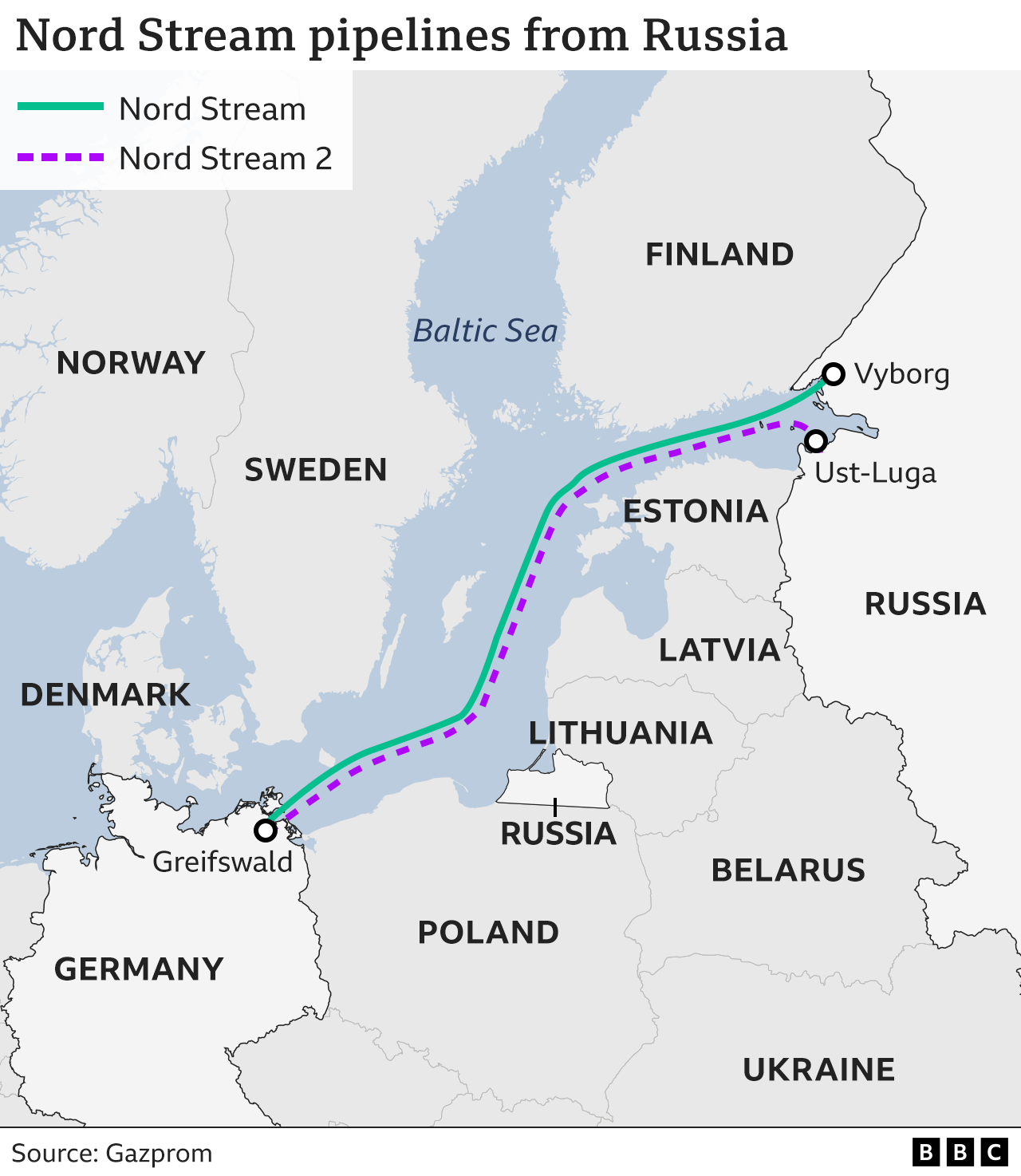
Russian President Vladimir Putin has said Moscow is ready to resume gas supplies to the European Union via a link of the Germany-bound Nord Stream 2 pipeline under the Baltic Sea – an offer quickly rejected by Berlin.
Speaking at a Moscow energy forum on Wednesday, Putin said that one of the two links of the pipeline remained pressurised despite a series of ruptures last month which caused major leaks, sending gas spewing out off the coast of Denmark and Sweden.
TheNord Stream 1pipeline was also ruptured by powerful underwater explosions in September.
Western officials have linked the incidents to “sabotage” but have held back from attributing responsibility for the blasts while investigations by German, Danish and Swedish officials continue.
Putin said that if checks prove the Nord Stream 2 link is safe to operate, Russia stands ready to use the pipeline to pump gas to Europe, adding its capacity stands at 27 billion cubic meters (bcm) a year.
The Nord Stream 2 pipeline has never brought natural gas to Europe because Germany prevented the flows from ever starting just before Russia launched military action in Ukraine on February 24.
Putin also repeated an earlier accusation that the United States was likely behind the blasts on the Nord Stream pipelines, without providing any evidence to support his claim, and floated the idea of creating an alternative European gas hub via Turkey.
“The act of sabotage of the Nord Stream 1 and 2 is an act of international terrorism aimed at undermining energy security of the entire continent by blockingsupplies of cheap energy,” Putin said, alleging that the US wants to force Europe to switch to importing more expensive liquefied natural gas.
In Germany, officials say they’re planning to send Ukraine new air defence systems.
Known as IRIS-T SLMs, they’re used to “protect the population, important buildings, objects as well as ground troops against attacks from the air”, according to Diehl BGT Defence, their manufacturer.
This is exactly the sort of system Ukraine has been asking for since the beginning of this conflict.
The system uses GPS and INS navigation, and receives frequent target positional data from its base station, guiding it toward the threat.
It also has an infrared seeker as an additional feature and is effective against helicopters, aircraft, cruise missiles, air-to-surface weapons, and anti-ship weapons. Crucial to all this is how many will be delivered – and when. It’s all part of the gradual Westernisation of Ukraine’s armed forces, following Russia’s invasion in February.
Currently, Ukraine has Soviet-era surface-to-air (SAM) systems, comprising S-300 for long-range and Buk-M1 SAMs for shorter-range. The German systemwould be a significant upgrade.
The US has provided the greatest amount of weaponry so far – totalling more than $17bn (£15bn), while the UK has supplied the country with the Starstreak anti-aircraft missile system, and other systems, as part of an assistance package worth £2.3bn.
DISCLAIMER: Independentghana.com will not be liable for any inaccuracies contained in this article. The views expressed in the article are solely those of the author’s, and do not reflect those of The Independent Ghana
The building housing the German consulate in Kyiv has been by a Russian missile strike, according to Germany’s foreign ministry.
There have been no casualties reported. It has emerged that the building has not been in use by Germany since the war broke out.
The former chairman of the Böll Foundation in Kyiv, Sergei Sumlenny, posted photos on Twitter and said addressing Chancellor Olaf Scholz (64, SPD) and Foreign Minister Annalena Baerbock (41, Greens):
“The building where the visa office of the German embassy in Kyiv was located was hit by Russians today. Maybe some Leopards can be sent to check the situation on the ground?”
European countries will learn their fate in Sunday’s Euro 2024 qualifying draw at 11:00 BST in Frankfurt.
Of Uefa’s 55 countries, 53 will be drawn – with hosts Germany qualifying automatically and Russia excluded because of the invasion of Ukraine.
Twelve teams, including Scotland, are already guaranteed at least a play-off place through the Nations League.
The recent Nations League also decided the seeds for the Euros qualifiers, with England not in the top pot.
England, Wales and Scotland are all in the second group of seeds, with Northern Ireland in pot five of six.
You will be able to hear from Gareth Southgate, Steve Clarke, Rob Page and Ian Baraclough, the managers of the four home nations, on BBC Radio 5 Live afterwards.
How does it work?
There will be seven groups with five countries – and three groups with six teams in them. The four Nations League finalists – Croatia, the Netherlands, Italy and Spain – will go into the smaller groups.
The top two teams in each of the 10 groups qualify directly for Euro 2024.
Germany automatically qualify as hosts, while the remaining three teams will come via the Nations League play-offs.
The groups start on 23 March and end on 21 November 2023.
Who are in what pot?
Nations League pot (top seeds that have to go in smaller groups): Netherlands, Croatia, Spain, Italy.
Pot 1 (the other top seeds): Denmark, Portugal, Belgium, Hungary, Switzerland, Poland.
Pot 2: France, Austria, Czech Republic, England, Wales, Israel, Bosnia-Herzegovina, Serbia, Scotland, Finland.
Pot 3: Ukraine, Iceland, Norway, Slovenia, Republic of Ireland, Albania, Montenegro, Romania, Sweden, Armenia.
Pot 4: Georgia, Greece, Turkey, Kazakhstan, Luxembourg, Azerbaijan, Kosovo, Bulgaria, Faroe Islands, North Macedonia.
Pot 5: Slovakia, Northern Ireland, Cyprus, Belarus, Lithuania, Gibraltar, Estonia, Latvia, Moldova, Malta.
Pot 6: Andorra, San Marino, Liechtenstein.
There are several restrictions that prevent some countries from being paired together.
For political reasons, Armenia and Azerbaijan will be kept apart, as will Belarus and Ukraine and Gibraltar and Spain. Kosovo cannot be in a group with Bosnia-Herzegovina or Serbia.
Only two Nordic or Baltic countries can be drawn together because of severe winter conditions.
Because of the locations of Kazakhstan, Azerbaijan and Iceland on the far edges of Europe – they can only be drawn with one team from the opposite side of the continent.
Who are in the play-offs?
The 12 teams who won their group in Leagues A, B and C in the Nations League are guaranteed at least a Euro 2024 play-off place.
They will play for three places at the Euros – with semi-finals on 21 March and the finals on 26 March.
In the almost-certain event that some of the teams finish in the top two in their Euro 2024 qualifying group, their play-off place will go to the next best team in their Nations League group (although Estonia from League D will be given a place if most League A teams qualify for the Euros).
These are the teams guaranteed a play-off place…
League A: Croatia, Spain, Italy, the Netherlands
League B: Scotland, Israel, Bosnia-Herzegovina, Serbia
Olaf Scholz, the chancellor of Germany, has defended a costly package designed to shield individuals and businesses from rising energy costs. The strategy, which critics claim will distort competition, is being discussed with Germany, according to the EU.
The German chancellor on Tuesday said a €200 billion ($198 billion) energy support package was justified and that similar steps were being taken elsewhere.
The “defensive shield” includes a gas price brake and a cut in fuel sales tax. It is aimed at protecting businesses and households from the impact of rising energy prices.
“The measures we are taking are not unique but are also being taken elsewhere and rightly so,” Chancellor Olaf Scholz told a press conference in Berlin during the visit of his Dutch colleague Mark Rutte.
Overall, it’s a “very balanced, a very smart, a very decisive package that serves to keep prices down and bearable for as long as these challenges exist,” Scholz added.
German Finance Minister Christian Lindner, from the neoliberal Free Democrats, also sought to reassure his EU counterparts at talks in Luxembourg on Tuesday.
“There had been a misunderstanding. … Our package … is proportionate if you compare the size and the vulnerability of the German economy,” Lindner said.
‘Supporting those who need it most’
Later on Tuesday, Scholz met with Germany’s state premiers. At a press conference following the talks, the chancellor again defended the government’s decision, saying it was their job to “protect jobs” and “support those who need it most.”
Scholz said that the most recent rescue package would have “dramatic effects” on the people and businesses watching their financial situation suffer.
He acknowledged that the federal and state governments “were not exactly on the same page,” as struggles continued over who would pay for what. However, he said “I am certain we will come to an agreement.”
Why is the package controversial?
Opponents of the package say it will distort competition inside the single market by giving an advantage to German businesses.
The European Union’s internal market commissioner, Thierry Breton, and economy commissioner, Paolo Gentiloni, from France and Italy, respectively, say the German plan “raised questions” on fairness. They called for an EU-wide measure to be used to help countries.
The European Commission, which supervises antitrust policy across the EU, said on Monday that it was talking to Berlin about the package.
President of Ukraine Volodymyr Zelensky reacted to Elon Musk after the Tesla CEO shared a Twitter poll with his ideas for stopping Russia’s invasion.
Voting options that included giving territory to Russia were put to the vote by Mr. Musk’s 107.7 million followers.
In response, Mr Zelensky posted his own poll asking users if they liked the world’s richest person more when he supported Ukraine.
Other Ukrainians criticized Mr Musk.
Ukraine’s outgoing ambassador to Germany, Andrij Melnyk, used a strong expletive, which he described as his “very diplomatic reply”.
Meanwhile, Russian chess grandmaster Garry Kasparov said: “This is moral idiocy, repetition of Kremlin propaganda, a betrayal of Ukrainian courage & sacrifice.”
Mr Musk’s ideas included votes in parts of Ukraine occupied by Russia that the Kremlin says it is annexing.
The multi-billionaire said: “Russia leaves if that is the will of the people.”
President Vladimir Putin has already declared four Ukrainian regions to be part of Russia, following so-called referendums denounced as fraudulent by Kyiv and its Western allies. Russia does not fully control any of the four regions.
Mr Musk also suggested the worldshould formally recognise Crimea – annexed by Russia in 2014 – as part of Russia. And the world’s richest person in 2022, according to Forbes magazine, cautioned that the conflict could end in nuclear war, though added this was “unlikely”.
This is highly likely to be the outcome in the end – just a question of how many die before then
Earlier in Russia’s invasion, Mr Musk’s satellite internet company sent equipment to Ukraine.
That gained Mr Musk popularity in Ukraine and he was subsequently invited by Mr Zelensky to visit when the war with Russia was over.
The businessman posted his poll during a busy week when he is due to give evidence to lawyers acting for Twitter ahead of a trial set to begin on 17 October. Twitter is suing Mr Musk after he walked away from a $44bn deal to buy the social media platform.
Twitter is hoping the court in Delawarewill order Mr Musk to complete the takeover at the agreed price of $54.20 per share.
On the anniversary of the unificationof the former West and East Germany, Germany’s leading politicians gathered in the city of Erfurt to encourage unity amid a range of challenges.
Germany’s celebrated its 32nd Unity Day on Monday. But this year, the tone of the festivities was more muted than in previous celebrations as the effects of the war in Ukraine and the cost of living crisis are felt more keenly across the country every day.
The national holiday marks when the formerly divided Germany became one country again in 1990.
Chancellor Olaf Scholz arrived at the ceremony in Erfurt, the capital of the eastern state of Thuringia, looking gaunt and pale after recently recovering from COVID-19.
In a short speech, he recalled the words of former West German Chancellor Willy Brandt, also a Social Democrat (SPD), who said that things “must grow together that belong together.” Scholz also sought to assuage worries about a looming energy crisis, promising continued government involvement to protect consumers as much as possible.
Like Scholz, Bundestag President Bärbel Bas used the occasion to call for solidarity in trying times.
“Since 1990, we Germans have overcome many crises and upheavals,” she said. “The most important reason for that was and is: We stick together!”
Bas acknowledged that “the celebrations come at a difficult time this year,” as inflation nears 10%.
“The consequences of the war in Ukraine and of climate change are causing many people to worry,” she said, but added, “How we treat one another shows the strength of our country. We have to look after each other.”
Polish Foreign Minister Zbigniew Rau formalized Poland’s demand for reimbursement before a visit by Berlin’s top diplomat by signing a diplomatic note to Germany on World War II reparations.
The action on Monday comes after Poland’s ruling nationalists claimed that Germany owed their nation 6.2 trillion zlotys ($1.26 trillion) in debt last month.
“[The note] expresses the position of the Polish minister of foreign affairs that the parties should take immediate steps to permanently and effectively … settle the issue of the consequences of aggression and German occupation,” Rau told a news conference.
Lukasz Jasina, Poland’s foreign ministry spokesman, told reporters that Rau would raise the issue with his German counterpart Annalena Baerbock during her visit to Warsaw on Tuesday.
The damages
About six million Poles, including three million Polish Jews, were killed during the war, and Warsaw was razed to the ground following a 1944 uprising in which about 200,000 civilians died.
In 1953, Poland’s then-communist rulers relinquished all claims to war reparations under pressure from the Soviet Union, which wanted to free East Germany, also a Soviet satellite, from any liabilities.
Poland’s ruling nationalists Law and Justice (PiS) say that agreement is invalid because Poland was unable to negotiate fair compensation.
It has revived calls for compensation since it took power in 2015 andhas made the promotion of Poland’s wartime victimhood a central plank of its appeal to nationalism.
The combative stance towards Germany, often used by PiS to mobilise its constituency, has strained relations with Berlin.
The Lyman’s capture by Ukraine was praised as hopeful by US Secretary of Defense Lloyd Austin. UK Defense Intelligence described it as a significant political setback for Russia in the meantime.
US Defense Secretary Lloyd Austin on Saturday cheered Ukraine’s capture of the key bastion of Lyman from Russia in eastern Ukraine, saying it was an encouraging battlefield success that would create new dilemmas for Russia’s military.
“Absolutely, it’s significant. We’re very encouraged by what we’re seeing right now,” Austin told reporters at a news conference in Hawaii.
Austin noted that Lyman was positioned across supply lines Russia has used to push its troops and materiel down to the south and to the west as the Kremlin presses its more than seven-month-long invasion of Ukraine.
“Without those routes, it will be more difficult,” Austin added. “It presents a sort of a dilemma for the Russians going forward.”
Meanwhile, US Secretary of State Antony Blinken spoke by phone with his Ukrainian counterpart, Dmytro Kuleba, and “reiterated President Biden’s message that the United States will always honor Ukraine’s internationally recognized borders.”
“We will continue to support Ukraine’s efforts to regain control of its territory by strengthening its hand militarily and diplomatically,” Blinken said.
The capture of Lyman came just a day after Putin proclaimed the annexation of four Ukrainian regions — including Donetsk, where the city is located. The proclamation of Russian rule over 15% of Ukraine was roundly rejected by Ukraine and Western countries as illegal.
It ordered that all the imitation bunnies be destroyed, but suggested the chocolate needn’t be wasted and could be melted for use in other products.
“Destruction is proportionate, especially as it does not necessarily mean that the chocolate as such would have to be destroyed,” it said in a summary of its verdict on Thursday.
It said that even though there are some differences between the two products, there was still the possibility of confusion for consumers.
Lindt’s bunny has a red bow and bell,while Lidl’s has a green bow and bell. The colour of the foil is similar as are the illustrations of the features.
In September, the inflation rate in Germany reached a new high of 10%. The announcement follows economic forecasts that the GDP will contract in 2019.
High energy and food prices pushed inflation in Germany to 10% in September. In August, the figure was 7.9%.
Rising energy costs, which have skyrocketed since Russia’s invasion of Ukraine, were fueling inflation.
According to the federal statistical office, Destatis, energy prices were 43.9% higher in September 2022 this year than in the same month last year.
Destatis said the end of a fuel subsidy and the €9 public transport ticket “presumably had an impact on the inflation rate in September.”
German Chancellor Olaf Scholz announced on Thursday plans for an energy relief package worth €150-200 billion ($145-194 billion).
“The German government will do everything so that prices sink,” Scholz said in a press conference.
Germany expected to enter a recession
The inflation announcement follows a forecast by a leading group of think tanks earlier on Thursday that painted a bleak picture for Germany’s future economic prospects.
According to the think tanks’ projections, the crisis in the gas markets, spiraling energy prices, and a massive drop in purchasing power would push the German economy into recession.
The high cost of energy was the leading factor “driving Germany toward recession,” said Torsten Schmidt, head of economic research at the RWI think tank.
Schmidt told a media briefing that Europe’s largest economy would shrink over the second half of 2022.
Incomplete recovery from the global pandemic wasamong the factors contributing to Germany’s economic future.
Munich’s ifo Institute said in a statement earlier on Thursday that inflation would likely average at 8.8% in the coming year.
Inflation is expected to settle down in 2024 — “to be only slightly above the ECB’s target rate of 2%.”
German GDP is also expected to shrink by 0.4% in 2023, down from April’s estimate of 3.1% growth, before rebounding back to a state of growth in 2024.
The forecasts came Thursday as part of the so-called Joint Economic Forecast, which is prepared twice a year by the Ifo Institute in Munich, the Kiel Institute for the World Economy, the Halle Institute for Economic Research (IWH), and the RWI — Leibniz Institute for Economic Research.
Germany is not alone in the economic challenges it is facing. According to the joint statement, the global economy is in a downturn, with Russia’s war against Ukraine and subsequent Western sanctions against Moscow fueling the level of inflation for energy commodities.
The high levels of inflation have prompted the US Federal Reserve, along with many other central banks, to tighten monetary policy.
The joint report also pointed to China’s zero-COVID strategy,which prohibits economic activity during periods of lockdown, and a bubbling real estate crisis as having impacts on the economy.
Former Germany defender Jerome Boatenghas laughed off criticism of the national team ahead of the World Cup in Qatar, joking there are “80 million national coaches”.
Germany’s 3-3 Nations League draw with Englandon Monday meant they finished third in Group A3, having won just one of their six matches.
Their shaky recent performances and failure to reach the Nations League’s final four have led to questions being asked of manager Hansi Flick.
But Boateng, who played 76 times for Germany between 2009 and 2018, believes fans should reserve judgement of the team until the World Cup is over.
“Shortly before the World Cup we have 80 million national coaches again,” Boateng wrote in an Instagram story, alongside a laughing emoji.
“We have a strong team, we can beat any opponent and become world champions. We have young players in all positions.
“How about approaching the World Cup in a positive way and not criticising the team and bringing in unrest?
“Stay positive and support the team together. After the World Cup you can add your two cents again.”
Helmut Kohl became the German chancellor about 40 years ago. In his honour, a new political foundation is launching. But if it isn’t renamed, his widow will file a lawsuit.
However, the event took place amid a threatfrom Kohl’s second wife and widow, Maike Kohl-Richter, to launch legal action unless the new foundation was renamed.
Merz said that the peaceful, free, and democratic post-Cold War Europe, which he said Kohl played a key role in establishing, “is more seriously threatened than ever in its history” amid Russia’s war of aggression in Ukraine.
Merz also praised Kohl for his role in German reunification and the collapse of the Soviet Union, saying the former chancellor “first recognized and then seized on the changes in the global history of his era earlier than others.”
The opposition leader said Russia’s invasion has shown the need for leadershipin Europe: “Not leadership in the sense of dominance and dictating, but leadership in the sense of responsibility.”
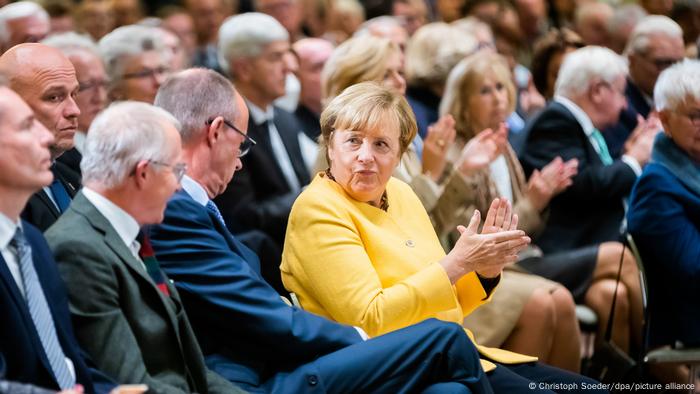
Merz and Merkel both praised the man who led the CDU/CSU in Germany before them at Tuesday’s event
A yacht associated with a Russian oligarch has been searched by investigators as part of a money laundering investigation. The yacht is the largest recreational boat in the world in terms of tonnage.
More than 60 police officers raided a luxury yacht in northern Germany tied to a Russian businessman accused of breaching sanctions and money laundering, Frankfurt prosecutors said Tuesday.
Authorities identified the suspect only as a 69-year-old Russian businessman but did say he was the target of the same investigation last week.
At that time, police raided a lakeside villa registered to Alisher Usmanov — a close ally of Vladimir Putin’s. They also searched 24 other properties connected to him in the German states of Baden-Württemberg, Bavaria, Hamburg, and Schleswig-Holstein.
Prosecutors say they are investigating the funneling of several million euros acquired in illegal activities, including tax evasion. In a statement, they said this involved an “extensive and complex network of companies and corporations.”
They said the yacht raid was also carried out to comply with a request for help from the US Justice Department, which has launched a probe of its own.
In a statement on Monday, representatives of Usmanov called the charges “baseless and defamatory.”
Who is Alisher Usmanov?
The UK’s Sunday Times newspaper ranked Usmanov at No. 6 in a list of the world’s richest people in 2021. He was one of the dozens of Russian billionaires to be hit by Western sanctions after Russia invaded Ukraine.
He is possibly best known for his metals and mining interests, for owning the Kommersant publishing house in Russia, and for owning Russia’s second-largest mobile phone operator, Megafon. He also was formerly a major stakeholder in Premier League football giants Arsenal.
Usmanov is said to be worth an estimated net of $16.2 billion (€16.9 billion). He has 49% economic interest and 100% voting rights in the global conglomerate and holding company USM.
While the United States has blocked his personal assets, it has kept companies controlled by him off its list of sanctions in a bid not to drive up commodity prices. He is thought to presently be living in his native Uzbekistan.
The Official Journal of the European Union describedUsmanov in March as a “pro-Kremlin oligarch with particularly close ties to Russia’s President Vladimir Putin.”
But Usmanov disputes this. Along with former Chelsea Football Club owner Roman Abramovich, he is one of the oligarchs appealing his inclusion on the EU sanctions lists, at the bloc’s General Court.
The yacht that was searched — the “Dilbar” — is the world’s largest yacht by tonnage and is officially owned by Usmanov’s sister.
The 155-meter (500-foot) vessel was named after Usmanov’s mother. It is valued at some $600 million and was previously docked in a Hamburg shipyard since October 2021 for repairs. The vessel is now moored in the northern port city of Bremen.
The nationalist Alternative for Germany party hopes to capitalise on economic unease to achieve similar electoral success as far-right groups do so across the EU. The results of the polls imply that the plan is effective.
Earlier this month, during a Bundestag debate on the potentially devastating situation for businesses and families amid soaring inflation and an energy crunch, AfD lawmaker Harald Weyel was caught on a hot mic saying he hoped that the situation would continue to deteriorate.
This harks back to 2015 when the far-right populist Alternative for Germany (AfD) utilized fears of a massive refugee influx to stage protests, especially in the east of the country. It went on to become the most successful far-right party in the country since World War II.
Since then, however, the AfD has struggled to find a rallying cry that connected with as many voters. They took to the streets in protest against COVID-19 restrictions but failed to stop a decline in support, especially in the West of the country.
The AfD was founded in 2013 as a euroskeptic party. And still, their position is that Germany should leave the EU, even as other nationalist parties, like the Sweden Democrats and the Brothers of Italy, have quietly abandoned such stances.
“Now, they are focusing on the government’s sanctions against Russia,” Wolfgang Schroeder, a political science professor at the University of Kassel, told DW. “They are saying that corrupt lawmakers are ignoring the needs of the people. They’re arguing that elites in Moscow aren’t the victims of these sanctions policies, but the German people are.”
The message that the AfD is trying to send to the governing coalition of the center-left Social Democrats (SPD), the Green Party and the neoliberal Free Democrats (FDP) is clear: “You are not in charge of Russia — you’re in charge of this country.”
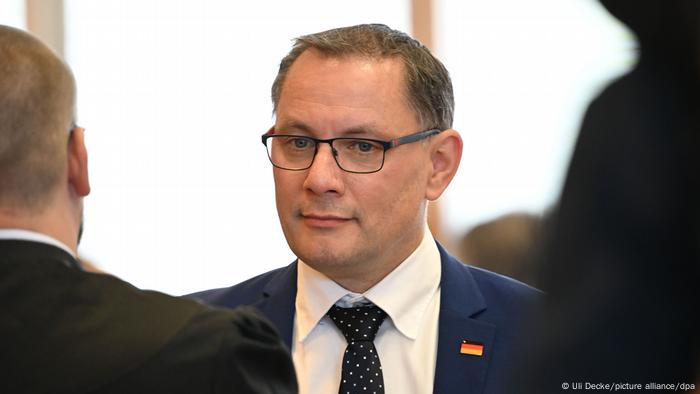
Indeed, AfD co-chair Tino Chrupalla has repeatedly accused Chancellor Olaf Scholz’s government of fighting an “economic war” against Germans as inflation has risen to over 10%. The sanctions “are not in Germany’s interest,” Chrupalla has insisted, predicting that “throughout the fall, support for the government’s policies will continue to sink.”
Chrupalla’s projections are echoed in opinion polls. According to figures published by research firm INSA, national support for Scholz’s party has fallen from 25.7% in last year’s federal election to 18% on Monday, the FDP has been reduced by half to 7% and even the Green Party is now experiencing a backlash against their plans to mitigate the gas shortage.
As households across Germany are shocked to receive their heating bills, the right-wing populists see golden opportunities ahead. The situation calls to mind another hot mic moment. In 2020, former spokesman Christian Lüth was caught by a documentary team saying “the worse things are for Germany, the better things are for the AfD.”
Chrupalla has accused the government of being responsible for soaring energy costs
Scholz’s communication problem
Schroeder said the biggest mistake Scholz’s coalition had made was its lack of coherent communication.
“They have not offered clear answers about what people are actually gaining from domestic relief packages,” Schroeder said, nor exactly how sanctions affect Russian President Vladimir Putin and his war machine. “The government has left communication gaps for right-wing populists like the AfD to jump into.”
Schroeder feels that the SPD, Green Party, and FDP should put some of the principles aside that were enshrined in the 2021 coalition agreement.
Last year’s plans have “become outdated since February 24, 2022,” the day Russia invaded Ukraine, the political analyst said. “The invasion has changed everything: It is now what is steering our policy” — and the parties need to recognize that priorities have shifted significantly.
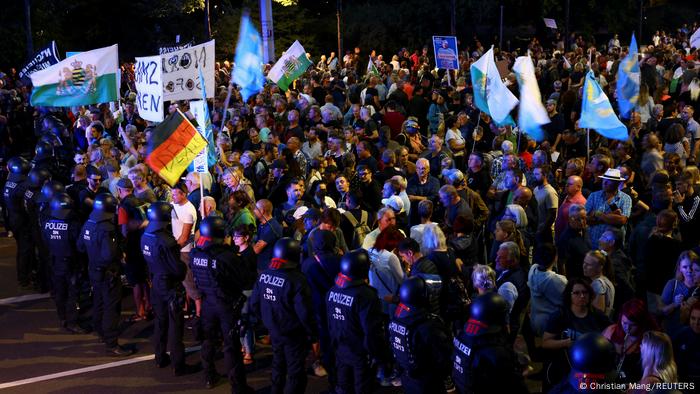
Thousands have taken to the streets over the past few weeks, protesting against price hikes
Deep divisions likely to stymie success
Schroeder does not expect the AfD’s popularity to soar. He does not see the current situation panning out like the xenophobic sentiment in 2015, “when opposing a refugee influx was something that spoke to people across the entire country.”
“The AfD is deeply divided between those who are pro-Russia and those who aren’t,” Schroeder said, “and this is creating a rift between their supporters in the west of Germany and the east, where they are more friendly to Moscow.”
The party has indeed been hemorrhaging membership since 2020.
For now, however, AfD leaders have seized the opportunity offered by Germany’s edging closer to a recession to foment discontent by encouraging protests throughout the fall.
Under the slogan “a hot autumn against cold feet,” the AfD has announced plans to hold weekly anti-government marches in the coming months, alluding to mass protests that helped bring down the communist regime in East Germany at the end of the Cold War. Across eastern Germany, tens of thousands have taken to the streets to protest government policy.
The AfD leader announced a concerted protest movement against the government’s energy and Russian policies. From October, the AfD wants to take to the streets with the rallying cry “Our country first!” Chrupalla declined to confirm that this was modeled on Donald Trump’s “America first” campaign.
“Demonstrations are already taking place in many places. In this respect, Monday is a good time to stretch your legs after the weekend,” he said.
German politicians of differing political hues reacted with concern on Monday, with Georgia Meloni likely to become Italy’s first far-right leader since World War II.
Meloni’s Brothers of Italy — a successor parties to the MSI movement founded by former officials loyal to fascist leader Benito Mussolini — scooped a larger share of the vote that any other party in Sunday’s election.
Katharina Barley, a vice president of the European Parliament and a member of Chancellor Olaf Scholz’s center-left Social Democrats (SPD), was concerned that Meloni would align herself with Hungary and Poland. Leaders of both countries have clashed with Brussels over the issue of rule of law, with Hungary keen to dilute sanctions against Vladimir Putin’s Russia.
Barley said she was not fully reassured by an apparent softening of Meloni’s euroskeptic stance.
“I’m not convinced yet. Of course, if she becomes prime minister, she will have the benefit of the doubt,” Barley said.
The vote provided the bloc lead by Giorgia Meloni with a clear majority
“The EU can only work if you try to apply common solutions that fit everyone,” she added. “That means compromise. Our experiences with this sort of government is that they do not engage in compromises at all.”
Junior coalition members fearful
Members of the SPD’s two junior coalition partners also said they were anxious about the likelihood of Meloni coming to power.
Alexander Graf Lambsdorff, of the neoliberal Free Democrats (FDP), echoed the sentiment that decision-making processes at the EU level could be made more difficult.
“It is becoming more and more laborious,” Lambsdorff told the German public broadcaster ARD on Monday, referring to the issues of migration, financial reform, and the internal market.
Omid Nouripour, the co-leader of the environmentalist Greens, Germany’s other junior coalition partner, described the election results as “worrying.”
Far-right heading for power after Italy vote
He said it was well known that there are “very close ties with the Kremlin” within the right-wing alliance.
The leaders of the other two parties within the alliance, Matteo Salvini and Silvio Berlusconi have previously sought a close relationship with Russian President Vladimir Putin. Salvini’s League has called for a weakening of Western sanctions against Russia, and Berlusconi has long been friends with the Kremlin leader.
Meloni has said she is steadfast in her support for Ukraine and strongly supports the European Union’s sanctions.
‘Openly post-fascist statements’
On the opposition seats in parliament,the Christian Democrat lawmaker and foreign policy expert Jürgen Hardt said he was troubled by Meloni’s “openly post-fascist statements.”
“Racism and the exclusion of minorities can no longer have a place in Europe,” Hardt told the German news agency dpa.
“In Germany and Brussels, the new Italian government will be judged on its contribution to the future of Europe, compliance with the sanctions against Russia, and progress in rebuilding the Italian economy,” Hardt said.
Members of the far-right Alternative for Germany (AfD) were jubilant at Meloni’s election success.
“We celebrate with Italy!” AfD lawmaker Beatrix von Storch tweeted. “Sweden in the north, Italy in the south: left-wing governments are yesterday’s news,” she wrote, referring to the success of right-wing populist Sweden Democrats in elections earlier this month.
The government in Berlin wants to reduce dependence on the country’s most important trading partner. But German businesses are not convinced.
The Port of Hamburg, Germany’s biggest seaport, is considered the country’s gateway to the world. But above all, it is a gateway to China, which is the port’s largest customer. In the first half of 2022 alone, more than 1.3 million containers from China arrived here.
Now, Chinese shipping giant COSCO wants to take a 35% stake in the harbor, and its operators would like that, too. They say this would make the container terminal a prime transshipment hub in Europe for the world’s largest shipping company. But the Economy Ministry in Berlin has reservations and may not approve COSCO’s investment in the Hamburg Port. The dispute over COSCO’s involvement illustrates how rethinking ties with China impacts the German economy.
Germany’s dependence on Russian gas has proved to be a weak point following Russia’s invasion of Ukraine. This realization has led the government to revisit the country’s relationship with China as well. Some 5,000 German companies operate in China today.
How to deal with an autocracy that has been Germany’s largest trading partner for years? How to deal with the country that EU documents refer to as a “partner,” a “competitor” and “strategic rival” — with the balance shifting toward the latter?
‘End of naivety’
German Economy Minister and Vice-Chancellor, Robert Habeck from the Green Party, has already announced a “more robust trade policy” toward China. “The time of naivety toward China is over,” Habeck declared in mid-September after a meeting of G7 economy ministers.
Back in May, Habeck denied the VW Group guarantees for investments in China. That came as a shock: For decades, German companies’ business in China had been backed by guarantees on both investments and exports.
“In the near future, if German companies want to invest, if they trade with China, they are likely to do so at their own risk and will no longer be able to rely on government guarantees and safeguards,” says China expert Tim Rühlig of the German Council on Foreign Relations (DGAP). He sees a change of course: the German government “no longer wants to provide incentives for German companies to expand business in China,” Rühling tells DW in an interview.
But that does not stop them from doing so anyway. According to a study by Jürgen Matthes, an economist with the German Economic Institute (IW), the German industry invested around €10 billion in China in the first half of this year alone — a record figure.
Car manufacturers and chemical companies in particular are continuing to seek a foothold in the Chinese market. According to a study published by the Rhodium Group in mid-September, the four German industrial giants — carmakers VW, BMW, Mercedes and chemical company BASF — alone account for a third of European direct investment in China.
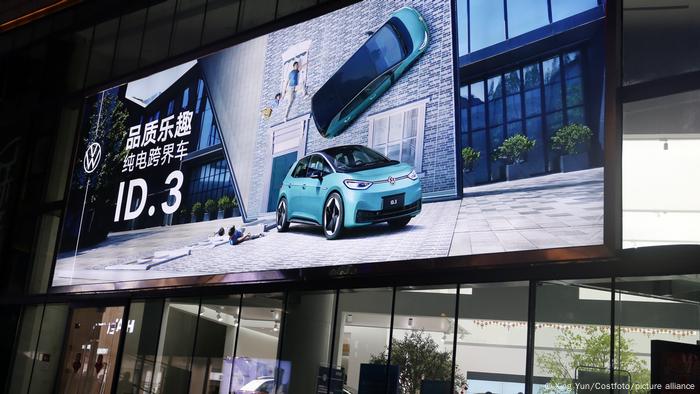
Volkswagen is one of the major German investors in China
Or is the dependence overestimated?
80% of European investments are made by just 10 large European companies, according to Jörg Wuttke, president of the European Chamber of Commerce in China. “The others are not leaving China, but are currently interested in other countries for new investments and are also thinking about diversification,” Wuttke observes.
Europe’s top ten companies, however, are heavily reliant on China, he warns, pointing to dependence on China for imports of rare-earth elements, preliminary products for the pharmaceutical industry, and photovoltaic systems. But dependence on China is fundamentally different from reliance on Russian energy, he says: “We have a pipeline with oil and gas from Russia. But from China, we have a ‘pipeline’ with toys, furniture, sports equipment, clothing, and shoes. Most of those products — I would say 90% of them — are easily replicable elsewhere.”
Around 3% of German jobs depend on exports to China, economist Matthes points out. “That’s over 1 million jobs. That is a considerable number, but over 45 million people are employed in Germany today,” he says, and concludes: “On a macroeconomic level, the dependence on China as an export market is relevant, but it’s not as huge as media reports often make it out to be.”
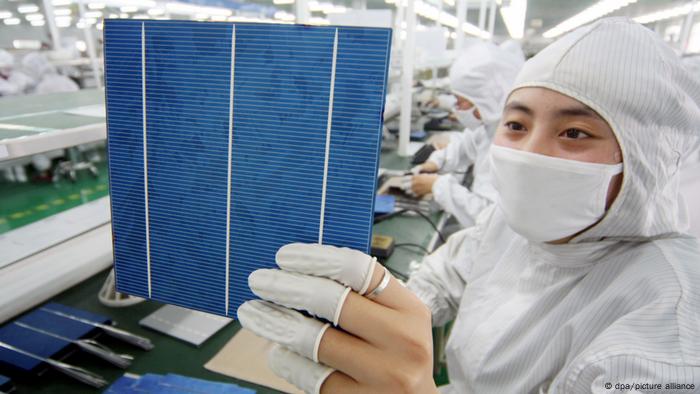
Important for the energy transition: Solar cells from China
Pressure from the Green Party
Nevertheless, within Germany’s new center-left coalition government of Social Democrats (SPD), neoliberal Free Democrats (FDP), and environmentalist Greens, the latter in particular are putting pressure on companies to rethink their ties with China.
At the beginning of September, Foreign Minister Annalena Baerbock told business leaders: “We can’t afford to just hope that things won’t be so bad after all with these autocratic regimes.” The Green Party politician, who stands for “a values-based and feminist foreign policy,” announced the development of a new China strategy as part of a new National Security Strategy. “It is important to the German government and to me personally that we transfer what we have learned from our dependence on Russia to our new China strategy,” she says.
The Economy Ministry is considering ways to encourage companies to turn to other Asian countries, instead of China. Government investment and export guarantees are being reappraised. The government-owned KfW Bank is to examine whether it could scale back its China program and instead offer more loans for business in countries including Indonesia.
Last year, the Federation of German Industries (BDI) was already debating rules for foreign trade policy cooperation with autocracies. It suggested a “concept of responsible coexistence in foreign economic policy and clear boundaries for any cooperation.”
For many managers, however, the change of course in the Economy Ministry goes too far.
“Government support and protection of German companies’ business in China must remain, in principle,” Friedolin Strack, chief executive of the Asia-Pacific Committee of German Business (APA), told the news agency Reuters.
Chinese investments should be welcome in Germany and Europe, he insisted. Whether this should also apply to the specific case of COSCO’s entry into the Hamburg Port, however, Strack did not want to say.
There were mixed feelings from the German camp after Monday’s dramatic 3-3 draw against Englandin the Nations League, with manager Hansi Flick calling it “a good test”.
Germany led 2-0 after a 52nd minute penalty from Ilkay Gundogan and a goal from Kai Havertz in the 67th, but that advantage was wiped out in just over 15 minutes.
Luke Shaw struck in the 72nd, Mason Mount equalised three minutes later, and a penalty to Harry Kane put the English up 3-2 in the 83rd.
Ultimately, an 87th-minute leveller from Havertz saw the two sides share the points, and it gave Flick some mixed emotions.
“The first half was balanced, in the second we deservedly led 2-0 – then we made individual mistakes,” he said. “It must not happen that we give up a lead like that.
“But we came back, that’s the positive. It was a good test, we take a lot of positive things with us, but also negative things. There’s some work for us to do, but we’re optimistic, otherwise we could stay at home.”
Midfielder Joshua Kimmich provided a little more insight into exactly what went wrong to allow such a rapid collapse.
“We had everything under control and deservedly led 2-0 – then we became far too passive,” he said. “No longer pushing through consistently, defending far too deep, no longer having the courage to play against the ball… but in terms of body language and engagement, it was an improvement.
“Everyone now has six weeks to get a good feeling and then we will attack.”
💬 @JamalMusiala: “We should have controlled the game more at 2-0. We created a number of openings and ought to have been more incisive in our attacking.”#ENGGERpic.twitter.com/YIPzSJArEc
After scoring two goals, Havertz said to only get a draw from a match like that “must of course worry you” but suggested that it “was another good game to learn from”.
Meanwhile, Gundogan was not afraid to talk about Germany’s lofty goals, saying they are heading to Qatar with the plan of making the final.
“It’s not unrealistic,” he said. “Of course, a lot has to come together. I don’t see a team that is miles ahead.
“We have shown over long periods that we can do it at the highest level. We have to try to do that for 90 minutes. At a World Cup you have much less leeway to make mistakes than today.”
Hansi Flick warned his Germanyside individual errors will be “deadly” at the World Cup after an entertaining back-and-forth Nations League encounter against England at Wembley.
The visitors led by two goals after Ilkay Gundogan’s penalty and Kai Havertz’s expert long-range finish punished the Three Lions.
However, three goals in the space of 12 minutes from Luke Shaw, Mason Mount and Harry Kane had already-relegated Englandin front with seven minutes to play.
An error from goalkeeper Nick Pope allowed Havertz to make it 3-3 late on, but head coach Flick acknowledged Germany must be better at protecting a lead in Qatar.
“The result is very disappointing. I think we were very stable after 2-0 and we made individual mistakes, and you have to say that England brought in two fresh players who then also played a part in making England more effective offensively,” Flick said.
“We made individual mistakes and that’s why it’s disappointing.
“You have to look at the whole game and I think we did many things well, really well. In a phase where we got the three goals, that shouldn’t happen to us, because especially at a World Cup, things like that are of course deadly and you’re eliminated faster than you think.
“Therefore, if you look at it positively, you simply have to say that we know what we can work on.
“We’ll analyse the game properly again because, of course, at first glance, I’ve seen the goals conceded, just once or twice now, and that’s partly individual, where we sometimes made the mistakes. And everyone has to do their job over 90 minutes and we have to work on that.”
💬 Hansi Flick: “There are a lot of positives we can take from the game, but some negatives too that we will have to address. It was positive that we came back again at the end. It was a good test.”#ENGGERpic.twitter.com/0tpnLfyVDR
Flick, though, was effusive in his praise of Bayern Munich star Jamal Musiala, who was a constant thorn in England’s side and drew the foul from Harry Maguire for Germany’s opener from the spot.
“Jamal just showed why he is an exceptional talent. He got us the second goal from in his own half and he’s both defensive and offensive, I think he’s a player that’s good for us,” Flick added.
“And simply by his dribbling ability, he can pull out situations like penalties, but of course also he can move opponents around, one or two players are out of position and then it’s a different situation.
“Then we have more room, more space and those are the things that are good for us.”
Kai Havertz’s late equaliser denied England a stunning comeback victory as Germany concluded their Nations League campaign with an entertaining 3-3 draw at Wembley.
After a goalless first half, Ilkay Gundogan broke the deadlock from the penalty spot, before Havertz doubled the lead with a stunning 25-yard effort.
But the Three Lions turned the contest on its head with three goals in the space of 12 minutes. Luke Shaw and substitute Mason Mount dragged the hosts level, before Harry Kane’s penalty completed the turnaround.
However, Germanyensured a share of the spoils with three minutes remaining when Havertz tucked home from close range following a goalkeeping error from Nick Pope.
The best opportunity of the first half came following a swift counter in the 24th minute with Shaw’s delicious through-ball picking out Raheem Sterling, who was denied by Marc-Andre ter Stegen after cleverly escaping his marker.
The visitors took the lead seven minutes after the restart; Gundogan calmly slotting past Nick Pope from the penalty spot after Harry Maguire clumsily felled Jamal Musiala.
Havertz doubled the advantage 15 minutes later as he rounded off a quickfire counter by brilliantly bending a curling 25-yard effort in off the post.
But England hit back with two goals in the space of five minutes. Shaw halved the deficit from Reece James’ cross, before Mount wonderfully swept past Ter Stegen following a jinking run from Bukayo Saka.
The Three Lions edged their noses ahead when Kane slammed home his penalty after Nico Schlotterbeck’s rash challenge on Jude Bellingham, but Havertz had the final say after Pope fumbled Serge Gnabry’s initial strike.
What does it mean? Winless streaks continue despite Wembley thriller
England demonstrated character to overturn the 2-0 deficit with their first goals from open play of this Nations League campaign, a goalless run spanning 520 minutes, but the Three Lions have now gone six games without victory for the first time since 1993.
Meanwhile, despite stretching their unbeaten run to nine away matches, Germany have now drawn four in a row on the road for the first time.
6 – England are winless in their last six games in all competitions (D3 L3), their longest run since April-June 1993 (also six). It’s their longest ever winless run going into a major tournament. Countdown. pic.twitter.com/cVvIHeUIwn
Kane completed the turnaround with an emphatic penalty – his 51st international goal – and is now just two shy of equalling Wayne Rooney’s all-time England record.
That came on the day the striker became the fifth player to start 50 games as captain of the Three Lions after Bobby Moore (90), Billy Wright (90), Bryan Robson (64) and David Beckham (59).
Havertz hits a stunner
The pick of the six goals came courtesy of Havertz, who made it 2-0 when he bent a wonderful 25-yard strike beyond the helpless Pope.
Havertz also grabbed the equaliser with his third shot of the match – a tally only matched by Jude Bellingham throughout the contest – in what was a lively outing for the Chelsea forward.
Key Opta Facts
– Having kept six clean sheets and conceded just twice in their first eight games under Hansi Flick, Germany have conceded in each of their past seven games in all competitions (10 goals conceded).
– England have conceded at least three goals in consecutive home games for the first time since June 1995 (v Sweden and Brazil). Meanwhile, this was their highest scoring game that was goalless at half-time since October 2008 (5-1 v Kazakhstan).
– The Three Lions have failed to score in the first half of six consecutive games for the first time in their history, while Shaw’s second-half strike ended the Three Lions’ run of 520 minutes without a non-penalty goal in all competitions.
– There were just 186 seconds between Luke Shaw pulling one back and Mason Mount equalising for England (2-2), with the latter ending a run of 16 games without a goal for England.
– Germany’s Havertz became the first player to score twice against England in a match at Wembley since Alexis Sanchez for Chile in November 2013.
What’s next?
Germany complete their World Cup preparations with a friendly against Oman on November 15, before playing Japan in their Group E opener eight days later. England launch their tournament on November 21 against Iran in Group B.
Denmark’s energy agency has ordered ships to keep five nautical miles away from Bornholm in response to the midnight leak. The leak was regarded as “dangerous for ship traffic.”
A gas leak from the defunct Russian-owned Nord Stream 2 pipeline has led the Danish authorities to issue a warning to ships in the Baltic Sea.
Following the overnight leak, Denmark’s energy agency has asked ships to stay five nautical miles clear of the island of Bornholm.
It described the leak as being “dangerous for ship traffic”.
The German government and local law enforcement officials are also workingto find out what caused pressure in the pipeline to plummet suddenly.
“We are currently in contact with the authorities concerned in order to clarify the situation,” said a statement from the German economy ministry.
“We still have no clarity about the causes and the exact facts.”
Nord Stream 2’s operator said pressure in the pipeline, which had some gas sealed inside despite never becoming operational, dropped from 105 to seven bars overnight.
The pipeline has been one of the flashpoints in an escalating energy war between Europe and Moscow since Russia’s invasion of Ukraine in February has sent gas prices soaring.
Intended to double the volume of gas flowing from St Petersburg under the Baltic Sea to Germany, it had just been completed and filled with 300 million cubic meters of gas when Germany canceled it days before the invasion.
European countries have resisted Russian calls to allow the Nord Stream 2 pipeline to operate and accused Moscow of using energy as a weapon.
Russia denies doing so and blames the West for gas shortages.
The official line from Germany – as we reported earlier – is one that suggests the expectation of a “Europe-friendly country”.
However, most politicians who have commented on Giorgia Meloni’s Brothers of Italy’s predicted win have expressed concern or alarm. The only German party to welcome the result is the far-right AfD.
Jürgen Hardt, the foreign policy politician with the conservative Christian Democrat CDU, expressed worry about Meloni’s “openly post-fascist comments” and the “hair-raising views” of her party’s members.
He told the DPA news agency that “racism and the exclusion of minorities should no longer have any place in Europe”.
Katarina Barley, EU Parliament Vice-President and leading politician within Olaf Scholz’s center-left Social Democrat SPD, told German newspaper Die Welt that Meloni’s “electorally tactical lip service to Europe” can’t hide the fact she represents a danger to constructive co-operation in Europe.
Barley said Meloni was worrying because her “political role models are Viktor Orban and Donald Trump”.
Omid Nouripour, chairman of the German Green Party, described the result as “alarming”.
In an interview on German television, he said it was well-known that people in her right-wing nationalist coalition had “very close relations with the Kremlin”.
He said it couldn’t be ruled out that in Moscow yesterday evening, people were also “cracking open the champagne”.
Leading AfD politician Beatrix von Storch meanwhile tweeted: “We are celebrating with Italy! My heartfelt congratulations to the whole center-right coalition.”
She wrote she hoped that together with “our friends around Salvini”, Meloni would “build a strong right-wing government. Sweden in the north, Italy in the south: left-wing governments are so yesterday.”
Jamal Musiala has no regrets and is “very happy” with his decision to represent Germany over England ahead of Monday’s Nations League clash at Wembley.
Born in Stuttgart, Musiala spent a significant part of his childhood in England and was with Chelsea from 2011 until 2019, while he also captained the Three Lions at youth level.
However, he returned to Germany in 2019 to join Bayern Munich and elected to represent Hansi Flick’s side last year.
Musiala will now face off against the side he could have represented on Monday and made it clear he has no regrets about the decision on his international allegiance.
“I feel good to be here in England. I am very motivated. England are a very strong team and my past makes me want to play even more,” he said.
“I don’t know exactly how many times I’ve played at Wembley. I’ve been to school tournaments here before and made it to a final there twice. The atmosphere at Wembley is always great.
“It wasn’t an easy decision and I thought about it for a long time. In the end it was a decision I made with my family and I’m very happy with. Some England fans are definitely not happy with my decision but that shows that I play well.”
Flick has confirmed Musiala will start for Germany in their Nations League dead rubber at Wembley and heaped praise upon the 19-year-old.
“When he trained for the first time, you immediately noticed what a talent he is. His development is fantastic,” he declared.
“He can hold his own well in a small space and has a strong feeling for the space. He is also very strong at dribbling, which is why he can solve situations for us.
“In addition, he is very skilled defensively and has many ball wins. I’m glad he’s playing for Germany.”
In an effort to ensure energy supply amid the conflict in Ukraine, Germany will nationalize gas company Uniper.
The deal will see the German government take on a 98.5% stake in the firm at a cost of €8.5bn (£7.4bn).
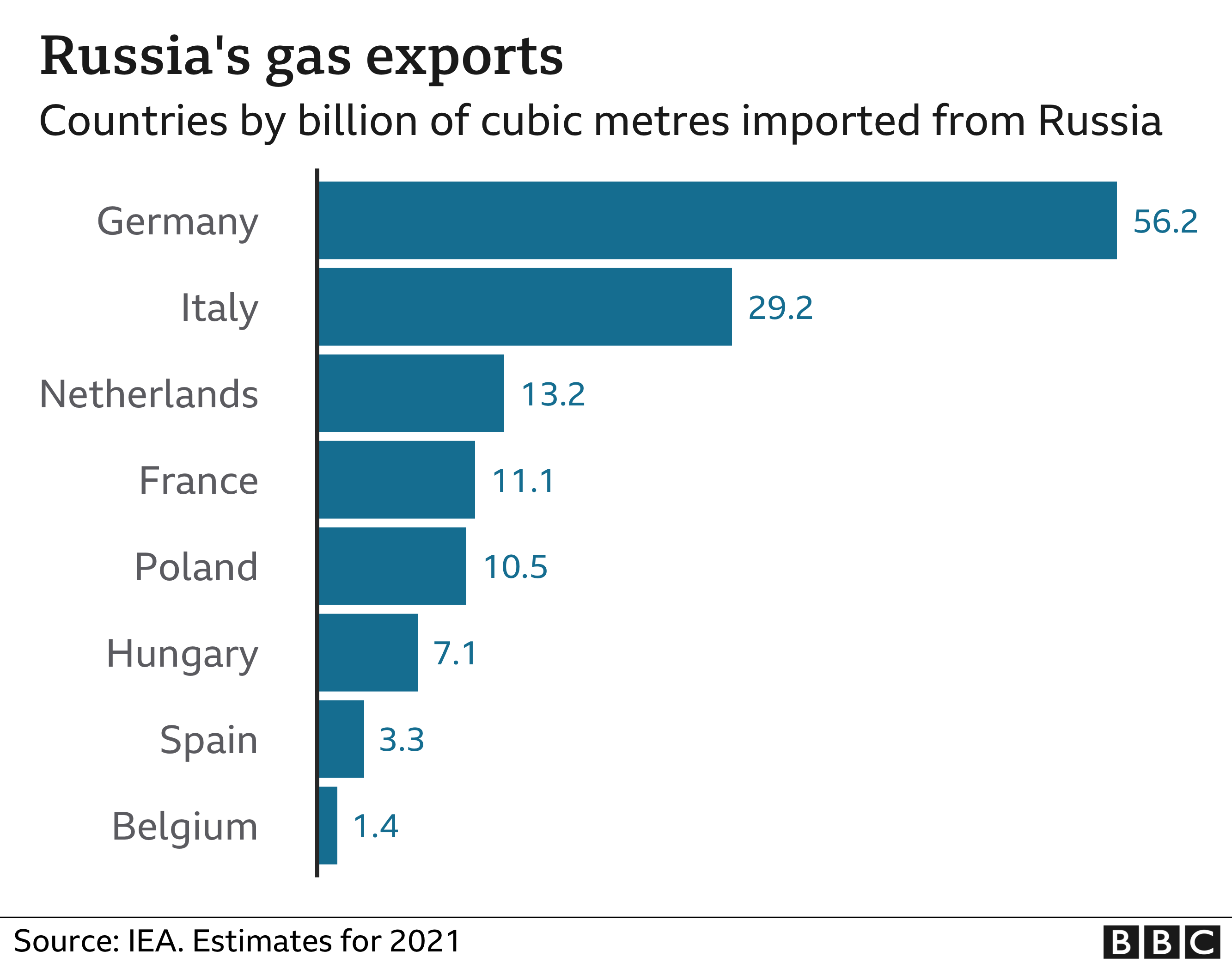
Germany is Europe’s biggest importer of Russian gas, and has been particularly squeezed as Russia has reduced supplies in recent months.
Chief executive Klaus-Dieter Maubach said the deal would help Uniper’s role as “a system-critical energy supplier”.
Before Russia’s invasion of Ukraine it supplied Europe with about 40% of its natural gas, and has responded to Western sanctions by gradually cutting off supplies.
At the start of this month, it halted supplies through the Nord Stream 1 pipeline, claiming repairs were needed – but later said supplies would not resume until sanctions were lifted.
Uniper is the biggest buyer of Russian gas in Germany. In recent months it has had to replace Russian supplies with alternatives from the open market, where prices have soared.
Uniper’s Finnish owner Fortum said the company has accumulated close to €8.5bn (£7.4bn) in gas-related losses “and cannot continue to fulfil its role as a critical provider of security of supply as a privately-owned company”.
“The role of gas in Europe has fundamentally changed since Russia attacked Ukraine, and so has the outlook for a gas-heavy portfolio,” Fortum chief executive Markus Rauramo said in a statement.
“As a result, the business case for an integrated group is no longer viable.”
Under the terms of the deal, the German government will buy Fortum’s shares in Uniper for €500m (£437m) and inject €8.0bn (£7.0bn) of cash into the business.
The government had already taken on a 30% stake of Uniper as part of a bailout agreement in July.
Earlier this month, it also entered discussions with another major gas supplier, VNG, over a possible bailout package.
Economy minister Robert Habeck said nationalising Uniper was a “necessary” step that would help “ensure security of supply for Germany”.
He also said that, despite the loss of Russian supplies, Germany had succeeded in filling its gas storage facilities to over 90% capacity ahead of winter.
“This means that, as a whole, we have coped quite well with the situation,” he said. “But for Uniper the situation became significantly more dramatic and significantly worse.”
At the start of September, Germany introduced a series of measures intended to cut energy use and stave off shortages over the coming months.
Businesses are no longer allowed to keep their doors open throughout the day to reduce the need for heating, and illuminated advertising must be switched off after 10pm.
The halls and corridors of most public buildings will no longer be heated, and offices can only be heated to a maximum of 19C.
In July, energy ministers across Europe also agreed to reduce their natural gas consumption by 15%.
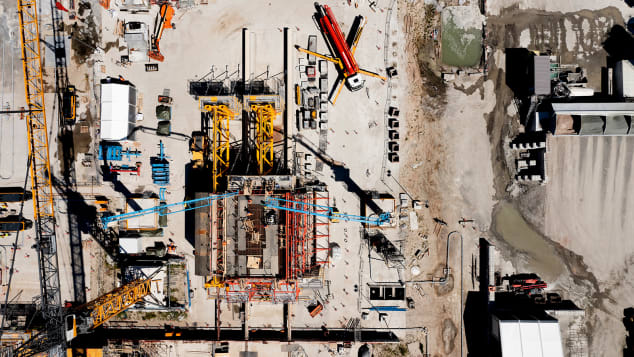
Descending up to 40 meters beneath the Baltic Sea, the world’s longest immersed tunnel will link Denmark and Germany, slashing journey times between the two countries when it opens in 2029. After more than a decade of planning, construction started on the Fehmarnbelt Tunnel in 2020 and in the months since a temporary harbor has been completed on the Danish side. It will host the factory that will soon build the 89 massive concrete sections that will make up the tunnel.
“The expectation is that the first production line will be ready around the end of the year, or beginning of next year,” said Henrik Vincentsen, CEO of Femern A/S, the state-owned Danish company in charge of the project. “By the beginning of 2024 we have to be ready to immerse the first tunnel element.” The tunnel, which will be 18 kilometers (11.1 miles) long, is one of Europe’s largest infrastructure projects, with a construction budget of over 7 billion euros ($7.1 billion).
By way of comparison, the 50-kilometer (31-mile) Channel Tunnel linking England and France, completed in 1993, cost the equivalent of £12 billion ($13.6 million) in today’s money. Although longer than the Fehmarnbelt Tunnel, the Channel Tunnel was made using a boring machine, rather than by immersing pre-built tunnel sections. It will be built across the Fehmarn Belt, a strait between the German island of Fehmarn and the Danish island of Lolland, and is designed as an alternative to the current ferry service from Rødby and Puttgarden, which carries millions of passengers every year.
Where the crossing now takes 45 minutes by ferry, it will take just seven minutes by train and 10 minutes by car.
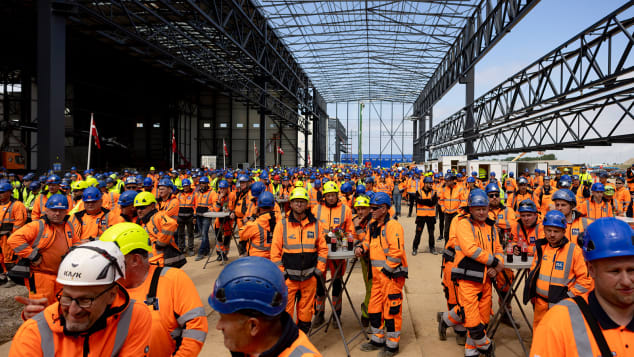
The roof of the first production hall where the tunnel sections will be built in Denmark was completed on June 8, 2022. Femern A/S
Faster journey
The tunnel, whose official name is Fehmarnbelt Fixed Link, will also be the longest combined road and rail tunnel anywhere in the world. It will comprise two double-lane motorways — separated by a service passageway — and two electrified rail tracks. “Today, if you were to take a train trip from Copenhagen to Hamburg, it would take you around four and a half hours,” says Jens Ole Kaslund, technical director at Femern A/S, the state-owned Danish company in charge of the project. “When the tunnel will be completed, the same journey will take two and a half hours.
“Today a lot of people fly between the two cities, but in the future it will be better to just take the train,” he adds. The same trip by car will be around an hour faster than today, taking into account time saved by not lining up for the ferry. Besides the benefits to passenger trains and cars, the tunnel will have a positive impact on freight trucks and trains, Kaslund says, because it creates a land route between Sweden and Central Europe that will be 160 kilometers shorter than today.
At the moment, traffic between the Scandinavian peninsula and Germany via Denmark can either take the ferry across the Fehmarnbelt or a longer route via bridges between the islands of Zealand, Funen and the Jutland peninsula.
Work begins
The project dates back to 2008, when Germany and Denmark signed a treaty to build the tunnel. It then took over a decade for the necessary legislation to be passed by both countries and for geotechnical and environmental impact studies to be carried out.
While the process completed smoothly on the Danish side, in Germany a number of organizations — including ferry companies, environmental groups and local municipalities — appealed against the approval of the project over claims of unfair competition or environmental and noise concerns.
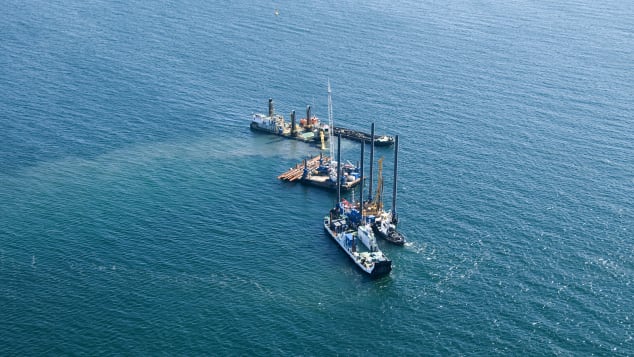
Dredging works started off the German coast in the fall of 2021. Femern A/S
In November 2020 a federal court in Germany dismissed the complaints: “The ruling came with a set of conditions, which we kind of expected and we were prepared for, on how we monitor the environment while we are constructing, on things like noise and sediment spill. I believe that we really need to make sure that the impact on the environment is as little as possible,” says Vincentsen. Now the temporary harbor on the Danish site is finished, several other phases on the project are underway, including the digging of the actual trench that will host the tunnel, as well as construction of the factory that will build the tunnel sections. Each section will be 217 meters long (roughly half the length of the world’s largest container ship), 42 meters wide and 9 meters tall. Weighing in at 73,000 metric tons each, they will be as heavy as more than 13,000 elephants. “We will have six production lines and the factory will consist of three halls, with the first one now 95% complete,” says Vincentsen. The sections will be placed just beneath the seabed, about 40 meters below sea level at the deepest point, and moved into place by barges and cranes. Positioning the sections will take roughly three years.
A wider impact
Up to 2,500 people will work directly on the construction project, which has been impacted by the global supply chain woes. “The supply chain is a challenge at the moment, because the price of steel and other raw materials has increased. We do get the materials we need, but it’s difficult and our contractors have had to increase the number of suppliers to make sure they can get what they need. That’s one of the things that we’re really watching right now, because a steady supply of raw materials is crucial,” says Vincentsen.
Michael Svane of the Confederation of Danish Industry, one of Denmark’s largest business organizations, believes the tunnel will be beneficial to businesses beyond Denmark itself.
This full-scale trial cast of a tunnel element was built in July 2022. Femern A/S
“The Fehmarnbelt tunnel will create a strategic corridor between Scandinavia and Central Europe. The upgraded railway transfer means more freight moving from road to rail, supporting a climate-friendly means of transport. We consider cross-border connections a tool for creating growth and jobs not only locally, but also nationally,” he tells CNN. While some environmental groups have expressed concerns about the impact of the tunnel on porpoises in the Fehmarn Belt, Michael Løvendal Kruse of the Danish Society for Nature Conservation thinks the project will have environmental benefits.
“As part of the Fehmarnbelt Tunnel, new natural areas and stone reefs on the Danish and German sides will be created. Nature needs space and there will be more space for nature as a result,” he says. “But the biggest advantage will be the benefit for the climate. Faster passage of the Belt will make trains a strong challenger for air traffic, and cargo on electric trains is by far the best solution for the environment.”
Monday’s nonstop coverage of the Queen’s funeral meant that several other stories, including the conflict in Ukraine,received less attention than they would have.
The most recent episode of the pro-Kremlin television show 60 Minutes gave Russian State Duma member and retired major general Andrey Gurulyov the chance to make even more grave nuclear assault threats against the UK and Germany.
Referring to US President Joe Biden’s warning to Russia over the use of nuclear weapons in Ukraine, the pro-Putin lawmaker said: “We may use them, but definitely not in Ukraine.”
Having suggested Moscow could target Berlin with a nuclear strike, he goes on to discuss the likely US response in the event of an attack on the UK.
Referring to NATO’s Article 5, which states that an attack on any member of the bloc is considered an act of violence against all the allies, he says: “If we turn the British Isles into a Martian desert in three minutes flat, using tactical nuclear weapons, not strategic ones, they could use Article 5, but for whom?
“A non-existent country, turned into a Martian desert? They won’t respond. We shouldn’t be afraid of that.”
Host Olga Skabeeva then joked: “We should have done it today, all the best people are there for the funeral.”
Notorious for its frequently misleading information about the war in Ukraine, 60 Minutes is routinely used as a vehicle for pro-Russian propaganda.
Meanwhile in Russia, more of the usual: nuclear threats against Germany and Britain, cautioning NATO against going into Ukraine. This directly clashes with their lies, constantly spewed by state TV, that Russia is already at war with NATO & “uniformed NATO troops” are in Ukraine. pic.twitter.com/ioMgbrzhbF
As Europe struggles with scarce supplies after Russia’s invasion of Ukraine, Germany has announced a €65bn (£56.2bn) package of measures to ease the threat.
The package from Germany will include one-off payments to the most vulnerable and tax breaks to energy-intensive businesses.
There is rising energy costs in Europe. Energy prices have soared since the February invasion because energy was being provided by Russia.
In his nightly address on Saturday, he said Russia was preparing a “decisive energy attack on all Europeans”, and only unity among European countries would offer protection.
And in a BBC interview broadcast on Sunday, his wife Olena said that if support for Ukraine was strong the crisis would be shorter. She reminded Britons that while rising living costs were tough, Ukrainians were paying with their lives.
According to website Politico, European Union officials have warned there is likely to be a crunch point in the coming months when countries start to feel acute economic pain while also still being asked to help the Ukrainian military and humanitarian effort.
There are already small signs of discontent, with protesters taking to the streets of the Czech capital Prague on Sunday, rallying against high energy prices and calling for an end to sanctions against Russia. Police said about 70,000 people, mainly from far-right and far-left groups were in attendance.
Meanwhile, several hundred protesters gathered at Lubmin in north-eastern Germany, the terminal of the Nord Stream gas pipeline from Russia.
They were calling for the commissioning of Nord Stream 2, a new pipeline which was about to go online but was blocked by the German government after the invasion.
Two days ago, Russia said it was suspending gas exports to Germany through the already operating Nord Stream 1 pipeline indefinitely.
The stand-off with Russia has forced countries like Germany to find supplies elsewhere, and its stores have increased from less than half full in June to 84% full today.
German Chancellor Olaf Scholz told journalists Germany would get through the winter, adding that Russia was “no longer a reliable energy partner”.
He said the government would make one-off payments to pensioners, people on benefits and students. There would also be caps on energy bills.
Some 9,000 energy-intensive businesses would receive tax breaks to the tune of €1.7bn.
A windfall tax on energy company profits would also be used to mitigate bills, Mr Scholz said.
IMAGE SOURCE,EPA Image caption, The energy crisis has forced Germany to bring this coal-fired power station back onto the grid
The latest package brings the total spent on relief from the energy crisis to almost €100bn, which compares to about €300bn spent on interventions to keep the German economy afloat during the Covid-19 pandemic.
Countries across Europe are considering similar measures.
UK Tory leadership hopeful Liz Truss has said she will announce a plan to deal with energy costs within a week if she becomes prime minister on Tuesday.
And EU energy ministers are due to meet on 9 September to discuss how to ease the burden of energy prices across the bloc.
A document released about the meeting says the agenda will include price caps for gas and emergency liquidity support for energy market participants, Reuters news agency reported.
The news comes amid growing fears that families in the EU will not be able to afford the cost of heating this winter.
Energy prices have soared since Russia invaded Ukraine and scarce supplies could push up the cost even further.
Europe is attempting to wean itself off Russian energy in an effort to reduce Moscow’s ability to finance the war, but the transition may not come quickly enough.
EU Council President Charles Michel said the Russian move was “sadly no surprise”.
“Use of gas as a weapon will not change the resolve of the EU. We will accelerate our path towards energy independence. Our duty is to protect our citizens and support the freedom of Ukraine,” he tweeted.
It has blamed the sanctions for holding up routine maintenance of Nord Stream 1, but the EU says this is a pretext.
Germany’s network regulator, the Bundesnetzagentur, said the country was now better prepared for Russian gas supplies to cease, but it urged citizens and companies to cut consumption.
Gazprom’s announcement came shortly after the G7 nations agreed to cap the price of Russian oil in support of Ukraine.
The G7 (Group of Seven) consists of the UK, US, Canada, France, Germany, Italy, and Japan.
Their introduction of a price cap means countries that sign up to the policy will be permitted to purchase only Russian oil and petroleum products transported via sea that are sold at or below the price cap.
However, Russia says it will not export to countries that participate in the cap.
The gas pipeline stretches from the Russian coast near St Petersburg to north-easternGermany and can carry up to170 million cubic metres of gas a day.
It is owned and operated by Nord Stream AG, whose majority shareholder is Gazprom.
Germany had also previously supported the construction of a parallel pipeline – Nord Stream 2 – but the project was halted after Russia invaded Ukraine.
Gazprom said the fault had been detected at the Portovaya compressor station, with the inspection carried out alongside workers from Siemens, the German firm that maintains the turbine.
It said that fixing oil leaks in key engines was only possible in specialized workshops, which had been hindered by Western sanctions.
However, Siemens itself said: “Such leaks do not normally affect the operation of a turbine and can be sealed on site. It is a routine procedure within the scope of maintenance work.”
This is not the first time since the invasion that the Nord Stream 1 pipeline has been closed.
In July, Gazprom cut off supplies completely for 10 days, citing “a maintenance break”. It restarted again 10 days later, but at a much-reduced level.
Speaking to the BBC from the Swiss capital Bern, an economist and energy analyst, Cornelia Meyer, said the gas shutdown would have a major impact on employment and prices.
“That really has huge ramifications for gas in Europe which is about four times more expensive than it was a year ago and this cost of living crisis will really soar because it’s not just gas,” she said. “Gas becomes fertilizer and it’s used in many industrial processes, so that will affect jobs, and it will affect costs.”
The flow of gas through Nord Stream 1 had already been reduced to a relative trickle. Now, once again, it has been halted completely.
An oil leak, claims Gazprom – which has previously attributed reduced flows through the pipeline to technical issues related to sanctions.
Europe, though, believes President Putin is weaponizing gas supplies – deliberately limiting flows through the pipeline to push up prices, in order to test the resolve of Russia’s critics.
The result, as we’ve already seen, is soaring energy costs – with businesses and consumers paying a heavy price.
The timing of Gazprom’smove is certainly interesting. It comes on the same day the G7 announced moves to cap the price of Russia’s oil exports.
But it also comes shortly after Germany – which is heavily reliant on Russian gas – revealed that its winter storage was filling up faster than expected.
A cynic might say this was the last opportunity to tighten the screw, in order to inflict maximum damage over the colder months.
Germany and France have issued a joint warning against a ban on tourist visas for Russians, saying such a step, advocated by other European Union member states, would be counter-productive.
The split on tourist visas will be at the heart of a meeting of the bloc’s foreign ministers in Prague on Tuesday and Wednesday, as they discuss what further steps they can take to sanction Russia for its six-month old invasion of Ukraine.
Defence ministers meeting in Prague are likely to agree in principle on the less controversial step of organising joint military training missions for Ukrainian troops.
“We caution against far-reaching restrictions on our visa policy, in order to prevent feeding the Russian narrative and trigger unintended rallying-around the flag effects and/or estranging future generations,” France and Germany said in the joint memo seen by Reuters.
The bloc’s two leading countries argue for close scrutiny of visa applications for security risks, but believe visas should still be issued.
“We must not give up on supporting pro-democratic elements with Russian society,” they said. “Our visa policies should reflect that and continue to allow for people to people contacts in the EU with Russian nationals not linked to the Russian government.
“We should not underestimate the transformative power of experiencing life in democratic systems at first-hand, especially for future generations,” they added.
Clear Message
Others, in particular eastern and Nordic member states, have argued strongly for a ban. “It is very provocative to me that you see Russian men on European beaches in Southern Europe and at the same time Ukrainian men between 18 and 60 years cannot even leave their country but have to fight for their freedom,” Denmark’s Foreign Minister Jeppe Kofod said last week.
“We think it is right that we together in Europe can limit and cut off tourists from Russia and it would send a clear message to (President) Putin.”
An EU diplomat said the foreign ministers might agree in principle to suspend a visa facilitation agreement with Russia, which would mean Russians face a longer procedure and pay 80 euros instead of 35 for EU visas, but that divisions over tourism visa bans were too deep for any agreement on that.
Russians mostly enter the EU via the land borders of Estonia, Latvia, Lithuania, Poland and Finland, Lithuanian Foreign Minister Gabrielius Landsbergis said last week, adding that these countries may act on their own if the EU does not agree on a union-wide ban.
Meanwhile, EU foreign policy chief Josep Borrell said he hoped defence ministers would give him a green light to start working on an EU military training mission for Ukraine.
“A number of EU countries are already hosting training facilitation for Ukrainians but I think it would be good to … ensure that the EU collectively is doing that in an organised way that can last for some time,” Ireland’s Foreign Minister Simon Coveney said in Prague.
The Netherlands also backed the idea, saying it was working on de-mining training along with Germany.
Nigeria and Germany have reached an agreement that enables the latter to transfer ownership of 512 Benin Bronzes to the former.
Foundation of Prussian Cultural Heritage (SPK) and Nigeria’s National Commission for Museums and Monuments (NCMM) signed the agreement.
The transfer has been hailed as the largest return of cultural artefacts looted from the continent in the 19th Century.
A statement by the Foundation revealed that the first objects will be returned to Nigeria this year from the Ethnological Museum in Berlin.
“Around a third of the objects transferred will remain in Berlin on loan for an initial period of ten years and will be exhibited in the Humboldt Forum,” it added.
The Benin Bronzes consist of thousands of metal sculptures and ivory carvings seized from the West African kingdom of Benin – in what is today Edo State in southern Nigeria – by a British military force in 1897.
Most ended up in European museums after being sold by businessmen and dealers.
In April 2021, the German government said it wanted to give back hundreds of Benin Bronzes.
The service members are in Germany for training on Gepard tanks. Chancellor Olaf Scholz has vowed to send even more heavy weapons to Ukraine in the coming months.
Chancellor Olaf Scholz visited Ukrainian soldiers in northern Germany on Thursday, expressing his admiration for their “courage.” The service members are in the northern state of Schleswig-Holstein for training on German Gepard tanks.
Germany, Scholz said, wants to ensure that the soldiers have the support they need. He praised the Bundeswehr for providing the training.
The chancellor met with the officers heading up the training before inspecting the Gepard tanks and posing for a photo op inside one.
Scholz reiterated that Germany would deliver other heavy weapons systems to Ukraine, namely self-propelled howitzers, multiple rocket launchers and the Iris-T air defense system, which is capable of “performing the defense of the airspace of an entire city.”
Scholz pledges E500 million
The trip marked a stark contrast from the early weeks of the war, when Scholz was accused of dithering about whether to send heavy weapons to Kyiv. Two days earlier, Scholz had promised Ukraine further arms deliveries worth more than E500 million.
Germany is providing modern and effective weapons “because Ukraine has the right to defend its own country, integrity, independence and sovereignty” against Russian aggression, Scholz said.
In response to the inflation crisis, the German Finance Ministry has unveiled a plan to reduce income taxes. However, critics claim the measures would benefit top earners the most, and squeeze public spending.  Â
The price of food, as well as energy, has increased with inflation hitting its highest in decades
German Finance Minister Christian Lindner on Wednesday announced measures to raise tax thresholds and increase child benefits slightly.
The plans are intended to help ease the burden of rising inflation for households, amid rising food and energy prices.
The Finance Ministry is set to raise the tax-free allowance from €10,347 (roughly $10,550) currently to €10,632 next year and €10,932 in 2024. People start paying income tax on earnings after this figure.
The top tax rate, which currently kicks in from €58,597 at present will increase to €61,972 next year and from €63,515 in 2023.
Meanwhile, child benefit payments for the first two children are set to rise by €8 to €227 per month, along with other increases for families with more than two children.
As a result, the Finance Ministry expects tax revenue to drop by €10.12 billion next year, and by €17.5 billion in 202
Politicians from fellow junior coalition partners the Greens have attacked the plans as regressive, saying they provide the greatest advantage to the already wealthy.
“Billions in tax relief from which high earners benefit three times as much in absolute terms than those with lower incomes — that is not in keeping with the times,” Katharina Beck, the Green Party spokeswoman on financial affairs, told the RND newsgroup.
“The opposite would be the right thing. Strong shoulders should have to bear more than those on a low income and should not be disproportionately relieved. These really hard times especially affect those who have little money.”
There was also criticism from Berlin Mayor Franziska Giffey, of Olaf Scholz’s Social Democrats — the leading coalition partner — who said more targeted relief was needed. She told the Welt news channel that tax cuts and across-the-board child benefit increases would not help those most in need.
“Another child benefit increase is nice for those who get it. But again, it doesn’t help pensioners, and it doesn’t help students either.”
Weak euro Good news for who?
Lindner defends measures
Speaking in response to the criticism, Lindner said that, in all, some 48 million would benefit from the tax changes.
He said the changes were aimed at relieving the pressure on people whose income was pushed into taxation at higher rates as salaries rise because of inflation. This, combined with higher living costs, would effectively push down their spending power — a phenomenon known as “cold progression.”
The measures would provide relief to those taxpayers with an annual income below €62,000, Lindner said.
“This is not about a relief, but about removing a burden,” Lindner said. The minister said he was also in favor of “strong shoulders bearing more than narrow shoulders.”
However, he said, the cold progression would also “burden people whose shoulders have not become broader at all.”
Left Party urges spending, not cuts
The chairman of the socialist Left Party, Martin Schirdewan, said the plan would squeeze public spending at the expense of ordinary people.
“Because Lindner refuses to give the rich and crisis profiteers a greater part in financing the costs of the crisis — and at the same time sticks to the debt brake, or better put, the investment brake — predictably money will be lacking for necessary social spending and investments,” Schirdewan told the AFP news agency.
“Those who unilaterally cut taxes also dry up the state budget and create a pressure to save money, usually at the expense of the general public and urgent public tasks.”
Englandhave won their first major women’s tournament after beating Germany at the Euro 2022 final.
The eight-time champions Germany lost at Wembley on Sunday.
Substitute Chloe Kelly poked home a loose ball from a corner to send the raucous record crowd of 87,192 into a frenzy with ten minutes of extra time remaining.
She waited for confirmation of the goal before taking off her shirt and waving it around her head, while being lifted by her team-mates in a moment of pure elation.
On a monumental day in English football history, Sarina Wiegman’s side showed they were equal to anything a strong and physical Germany team threw at them.
Ella Toone had earlier come off the bench to score the opener in normal time before Germany’s Lina Magull set up a nervous ending when she equalised in the 79th minute.
There were scenes of jubilation in the stands and an outpouring of emotion by players on the pitch at full-time as the magnitude of their achievement sank in.
The final was advertised as a battle between the competition’s two best-performing sides, and for large parts they cancelled each other out – but the biggest crowd in the history of a men’s or women’s Euros was given their money’s worth.
Striker Ellen White missed a few chances in the first half, Lucy Bronze was denied with a header, Germany’s Magull struck wide and England defender Leah Williamson had to scramble a corner off the line before Toone was introduced to break the deadlock.
She had given England fans the winning taste before Magull stunned the home crowd, though it would only delay the celebrations that Kelly, who only returned to football in April after suffering an anterior cruciate ligament (ACL) injury, gave them.
England did what no other nation had done before – beat serial winners Germany in a European Women’s Championship final, and the feeling was sweet.
It comes 56 years after England’s men beat West Germany in the 1966 World Cup final, the only previous major trophy won by a men’s or women’s England senior team.
The players fell to the ground at full-time in tears of joy, in scenes which will be remembered and replayed for years to come on one of the greatest nights in English sport.
Perfect ending for hosts England
It was a final like no other in every sense – the build-up was on a scale above anything seen in women’s football in Great Britain, and it provided the perfect ending.
Male fans were sporting England shirts with their female icons’ names on the back on the London Underground on the way to the match, while fan parks around the country were filled with supporters watching the final on big screens.
Wembley Way was already packed on Sunday morning and there were boos when Germany were announced on the stadium tannoy before kick-off.
And it looked like things were going England’s way when Germany’s lethal striker Alexandra Popp, joint-top scorer in the tournament going into the final, picked up an injury and dropped out of the starting XI just before kick-off.
The feistiness off the pitch translated on to it too – referee Kateryna Monzul awarded two early yellow cards for innocuous fouls by England, and the crowd were frustrated for much of the first half when decisions didn’t go their way.
Russia cut gas imports to Germany via the Nord Stream 1 pipeline to just over 14-kilowatt hours (kWh) per hour on Wednesday, roughly 20% of the capacity of the pipeline.
While 27 million kWh of gas arrived at the German terminal in Lubmin between 6 am (0400 GMT) and 7 am, the volume had decreased to 17 million kWh between 8 am and 9 am and then sank to just over 14 million kWh from 9 am.
This is the level at which deliveries are expected to remain for the rest of the day, according to the Nord Stream 1 website.
The move had been announced by the Russian gas company Gazprom, which said it would cut down the volume of gas deliveries via Nord Stream 1 from 40% to 20% of capacity.
Russia is blaming the reduced volume of gas deliveries on technical issues resulting from the sanctions imposed on Moscow by the West.
However, the German government is among those who see the lower gas deliveries as Moscow exploiting its leverage against the heavily reliant German – and, indeed, European – energy market for political purposes.
The chief of the German Federal Network Agency, Klaus Müller, accused Russia of weaponizing its gas supply in an interview with German broadcaster Deutschlandfunk on Wednesday.
The dwindling gas supply from Russia is raising concerns that the German government may have to take control of the gas supply in the coming winter. As gas is also used for heating, demand is much higher in cold weather.
Experts, including German energy economist Claudia Kemfert, said that it is crucial for the country to start saving its gas now, in order to fill up its stocks before the winter.
Kemfert spoke out in favour of a scheme in which companies can apply for compensation for saving on gas, and for more help for households to save gas.
She warned that Germany was already running late with its efforts to save enough gas for the winter.
Households should also prepare for higher prices; according to the energy expert of the North-Rhine Westphalia consumer advice centre, Udo Sieverding, 1 kWh of gas could soon go up in price from around 5 cents to 25 cents.
German gas stocks are at 66.4% as of Tuesday. The government plans to reach 75% by September 1, 85% by October 1, and 95% by November 1, in order to avert a situation where households and industry would compete for the limited supply.
However, it is unclear how gas imports will continue. Russia has shown itself to be an unreliable source; “[Russian President Vladimir] Putin is playing a perfidious game,” said Economic Minister Robert Habeck.
Gas prices have soared after Russia cut gas supplies to Germany and other central European countries after threatening to earlier this week. Further
European gas prices rose 9%, trading close to their earlier all-time high after Russia invaded Ukraine.
Critics accuse the Russian government of using gas as a political weapon.
Russia has been cutting flows through the Nord Stream 1 pipeline to Germany, with it now operating at less than a fifth of its normal capacity.
Germany imports 55% of its gas from Russia and most of it comes through Nord Stream 1 – with the rest coming from land-based pipelines.
Russian energy firm Gazprom has sought to justify the latest cut by saying it was needed to allow maintenance work on a turbine.
The German government, however, said there was no technical reason for it to limit the supply.
Ukraine has accused Moscow of waging a “gas war” against Europe and cutting supplies to inflict “terror” on people.
The latest reduction in flows puts pressure on EU countries to reduce their dependence on Russian gaseven further, and will likely make it more difficult for them to replenish their gas supplies ahead of winter.
Since the invasion of Ukraine European leaders has held talks over how to reduce its dependence on Russian fossil fuels.
On Tuesday, theEuropean Unionagreed to cut gas use in case Russia halts supplies but some countries will have exemptions to avoid rationing.
EU members have now agreed to voluntarily reduce 15% of gas use between August and March.
However, the deal was watered down after previously not having exemptions.
The EU has said its aim of the deal is to make savings and store gas ahead of winter, warning that Russia is “continuously using energy supplies as a weapon”.
The voluntary agreement would become mandatory if supplies reach crisis levels.
The EU agreed in May to ban all Russian oil imports which come in by sea by the end of this year, but a deal over gas bans has taken longer.
Since Russia invaded Ukraine in February the price of wholesale gas has already soared, with a knock-on impact on consumer energy bills across the globe.
The Kremlin blames the price hike on Western sanctions, insisting it is a reliable energy partner and not responsible for the recent disruption to gas supplies.
While the UK would not be directly impacted by gas supply disruption, as it imports less than 5% of its gas from Russia, it would be affected by prices rising in the global markets as demand in Europe increases.
UK gas prices rose 7% on Wednesday, almost six times higher than a year ago, but still 20% below the peak seen in the aftermath of Russia’s invasion of Ukraine.
UK energy bills increased by an unprecedented £700 in April, and are expected to rise again to £3,244 a year for a typical household in October.
Gas prices have soared after Russia further cut gas supplies to Germany and other central European countries after threatening to earlier this week.
European gas prices rose 9%, trading close to their earlier all-time high after Russia invaded Ukraine.
Critics accuse the Russian government of using gas as a political weapon.
Russia has been cutting flows through the Nord Stream 1 pipeline to Germany, with it now operating at less than a fifth of its normal capacity.
Germany imports 55% of its gas from Russia and most of it comes through Nord Stream 1Â – with the rest coming from land-based pipelines.
Russian energy firm Gazprom has sought to justify the latest cut by saying it was needed to allow maintenance work on a turbine.
The German government, however, said there was no technical reason for it to limit the supply.
Ukraine has accused Moscow of waging a “gas war” against Europe and cutting supplies to inflict “terror” on people.
The latest reduction in flows puts pressure on EU countries to reduce their dependence on Russian gas even further, and will likely make it more difficult for them to replenish their gas supplies ahead of winter.
Since the invasion of Ukraine European leaders has held talks over how to reduce its dependence on Russian fossil fuels
On Tuesday, the European Union agreed to cut gas use in case Russia halts supplies but some countries will have exemptions to avoid rationing.
EU members have now agreed to voluntarily reduce 15% of gas use between August and March.
However, the deal was watered down after previously not having exemptions.
The EU has said its aim of the deal is to make savings and store gas ahead of winter, warning that Russia is “continuously using energy supplies as a weapon”.
The voluntary agreement would become mandatory if supplies reach crisis levels.
The EU agreed in May to ban all Russian oil imports which come in by sea by the end of this year, but a deal over gas bans has taken longer.
Since Russia invaded Ukraine in February the price of wholesale gas has already soared, with a knock-on impact on consumer energy bills across the globe.
The Kremlin blames the price hike on Western sanctions, insisting it is a reliable energy partner and not responsible for the recent disruption to gas supplies.
While the UK would not be directly impacted by gas supply disruption, as it imports less than 5% of its gas from Russia, it would be affected by prices rising in the global markets as demand in Europe increases.
UK gas prices rose 7% on Wednesday, almost six times higher than a year ago, but still 20% below the peak seen in the aftermath of Russia’s invasion of Ukraine.
UK energy bills increased by an unprecedented £700 in April, and are expected to rise again to £3,244 a year for a typical household in October.
Heat records tumbled and firefighters faced new blazes as much of Western Europe baked in a gruelling heatwave.
The UK, normally used to milder climates, saw temperatures of more than 40C (104F) for the first time.
Germany saw its hottest day of the year so far while Portugal raised its death toll after days of excess heat.
Deadly wildfires have swept the continent. The UN’s World Meteorological Organization (WMO) warned there was worse to come.
Heatwaves have become more frequent and more intense, and last longer because of human-induced climate change.
“In the future these kinds of heatwaves are going to be normal, and we will see even stronger extremes,” WMO chief Peterri Taalas said.
In addition to record temperatures in the UK, several fire services declared major incidents after a surge in fires.
A major blaze in Wennington, east London, set homes alight. Residents who had to be evacuated told the BBC that some eight homes and possibly a local church had been destroyed in the fire, while a firefighter at the scene described it as “absolute hell”.
In France, 64 different areas registered record-high temperatures on Monday.
Although the all-time high for mainland France has not been topped, the south-west of the country has experienced its biggest wildfires in more than 30 years. Since 12 July, fires have engulfed more than 20,300 hectares (49,400 acres) of the wine-growing Gironde region.
Nearly 37,000 people had to be evacuated from their homes.
Cooler weather has now returned to the UK and France.
In Belgium, a fire broke out in dunes at the Belgian resort of De Haan, setting several vehicles alight. But following the ferocious heat, the country is now bracing itself for thunderstorms that could lead to 20-30mm of rain in some region, Le Soir newspaper reports.
Weather warnings are still in place in Germany as the heatwave continues to move north and east.
On Tuesday, the country experienced its hottest day of 2022. The national weather service recorded 39.5C in the western city of Duisburg. The Netherlands also reached the same high of 39.5C in Maastricht, forecasters said.
Temperatures in Portugal have decreased significantly. However, more than 1,000 heatwave-related deaths have been recorded since last week.
Wildfires have become a common consequence of these extreme temperatures across Europe.
Central and north-western Spain has also been ravaged by wildfires.
The Copernicus monitoring service – part of the EU’s Earth observation programme – said total carbon emissions from wildfires between June and July are the highest seen in Spain for the period since 2003.
In Belgium, a fire broke out in dunes at the Belgian resort of De Haan, setting several vehicles alight. But following the ferocious heat, the country is now bracing itself for thunderstorms that could lead to 20-30mm of rain in some region, Le Soir newspaper reports.
Weather warnings are still in place in Germany as the heatwave continues to move north and east.
On Tuesday, the country experienced its hottest day of 2022. The national weather service recorded 39.5C in the western city of Duisburg. The Netherlands also reached the same high of 39.5C in Maastricht, forecasters said.
Temperatures in Portugal have decreased significantly. However, more than 1,000 heatwave-related deaths have been recorded since last week.
Wildfires have become a common consequence of these extreme temperatures across Europe.
Central and north-western Spain has also been ravaged by wildfires.
The Copernicus monitoring service – part of the EU’s Earth observation programme – said total carbon emissions from wildfires between June and July are the highest seen in Spain for the period since 2003.
In Greece, a wildfire fuelled by gale-force winds raged on the mountainous region of Penteli, near Athens. It has damaged homes and and prompted local authorities to evacuate at least four areas and a hospital.
Forecasters in Italy are warning of temperatures as high as 40-42C between Wednesday and Friday.
Several wildfires have already been reported in the country, and blazes that broke out on Monday evening in Tuscany were still raging on Tuesday afternoon.
The government is following through on its pledge to decriminalize abortion.
Officials plan to abolish a law that subjects doctors who publish information on abortion procedures to prosecution.
Women in Germany have been protesting for abortion to be decriminalized
“I really struggled to find information online,” said Verena, who was 22 when she found herself dealing with an unwanted pregnancy. “There was no easy way to find out which doctors perform abortions, where they are or how the procedure is performed.”
Abortion is illegal in Germany and punishable by up to three years in prison. But the women and their doctors do not face penalties if the pregnancy poses a health risk to the woman or in cases of rape. Otherwise, an abortion may be carried out within the first 12 weeks of pregnancy (14 weeks since the last period) after mandatory counseling. However, many barriers remain.
One of the biggest hurdles to obtaining an abortion in Germany was paragraph 219a of the criminal code, which has its origins in Nazi-era social policy. It stated that anyone who publicly “offers, announces [or] advertises” abortion services can face penalties of up to two years’ imprisonment or a fine.
Gynecologist Kristina Hänel was found guilty of ‘advertising’ abortions under §219a
Although a reform three years ago allowed doctors to state that they perform the procedure on their websites, they were still banned from giving medical detail.
But on Friday, Germany’s coalition government of the center-left Social Democrats and Greens and neoliberal Free Democrats pushed the motion to scrap 219a through parliament.
Under 219a, Kristina Hänel, a gynecologist in the western German city of Giessen who has performed abortions for 30 years, was sentenced in 2017 to pay a fine of €6,000 ($6,926) for offering abortion services on her website. The case triggered a heated debate in the country.
“If 219a is scrapped now, Germany takes a step in the right direction of providing information for patients,” Hänel told DW ahead of the decision.
Abortions don’t have to involve surgery — many can be done with medication
Five years ago, Verena found that the lack of readily available information meant hours of fruitless searching before calling a local clinic, where she was cryptically told to get in touch with one of three doctors in her area. But then she found there was no way to get information such as: are these doctors well-rated by fellow patients? What is the difference between a medical and surgical abortion? What is the after-care process like, and what are the possible side effects?
“When you Google abortion, you’re taken to websites that warn you you’ll definitely be depressed, traumatized and infertile. That isn’t medical advice — it just makes you feel like the worst person in the world,” she said, emphasizing the emotional toll of seeking even the most basic information.
Verena said she had no idea about the many hurdles to abortion until she sought one herself
Jana Maeffert, a gynecologist with the reproductive rights organization Doctors for Choice Germany, said the dearth of information could create dire circumstances for patients, who may find out too late that a clinic doesn’t offer what they are looking for. For example, doctors cannot state on their website “whether they offer medical or surgical abortions or both. They can’t say that you only operate until the 10th week of pregnancy, so a woman might drive all the way to your practice only to find out she cannot obtain an abortion there anymore,” because she has already passed that point in her pregnancy.
Jana Maeffert is a gynecologist with a reproductive rights organization
Less access to abortion
To perform an abortion, the doctor needs to see a certificate proving that the pregnant woman has undergone counseling at least three days prior in a state-approved counseling center. There are numerous organizations offering counseling, during which the woman is informed of her options, where she might find additional psychological and financial help if she decides to have the baby or how to go about adoption.
Verena said getting an appointment for the mandatory counseling was nearly impossible. She recalled making call after call. This can turn out to be so time-consuming that it risks taking the pregnant woman over the line of her first trimester.
Finding a counseling appointment and a doctor is far from a given for many German women. Since 2003, the number of doctors willing to perform an abortion in Germany has tumbled by 40% — there are now only 1,200 practices in the country where a woman can legally obtain one, down from 2,000 some 20 years ago.
“In Germany, abortion is a taboo topic. For patients, and for doctors, too,” said Maeffert. “If you practice medicine in a small town, you may well decide not to offer pregnancy termination because then you’re labeled the ‘abortion doctor’ in your small community.”
“Only one in 10 gynecologists in Germany performs abortions,” Maeffert said, “not necessarily because they’re against it, but because the barriers are so high.”
Some patients, Maeffert said, “must travel 150 kilometers” (90 miles) to find a doctor, especially in rural and Catholic regions such as Bavaria. But, even in some major cities, the situation is critical. According to local media reports, in Stuttgart, not a single hospital offers abortions. In the city of Münster, the last doctor who offered pregnancy termination went into retirement in 2019.
Abortion rates at 25-year low
As the number of practices providing legal abortions has dwindled, fewer and fewer women have gotten one. The year 2021 saw the lowest rate of abortions in Germany since 1996, the first year statistics were collected on the subject. According to the Federal Statistical Office, some 94,000 abortions were carried out in 2021, a decrease in 5.4% on the previous year and part of a decadelong downward trend.
Meanwhile, doctors who perform abortions in Germany have begun to face the onslaught of active anti-choice activists who protest outside clinics, hold marches across major cities, send hate mail and take to social media with aggressive comments.
Maeffert, in Berlin, said she herself had not yet experienced such attacks. “But, for example, in parts of Bavaria … protesters stand in front of the clinic all the time. … It’s horrible for the patients and the doctors,” she said.
Political will for change
Some medical students have taken matters into their own hands, and have found creative ways to get the relevant training on how to perform the procedure. The so-called “Papaya Workshops,” for example, use the fruit as a model for the female reproductive system.
While attending such a workshop is not sufficient for a doctor to be certified to perform surgical abortions, it closes a gap in German medical education, where students say that abortion is “discussed for 10 minutes, if at all,” according to the advocacy group Medical Students for Choice.
According to Berlin’s public broadcaster, rbb, the workshops are fully booked. One participant told rbb that she felt the workshop had given her “a better idea of how the procedure goes, what tools you use. I had imagined it as being a lot harder. I’m not so scared of it now.”
Some doctors in Germany are also now prescribing the pills needed for medical abortion in a telemedicine project where the pregnant person takes medications at home under supervision by a doctor to induce a miscarriage and negate the need for surgery. This is not to be confused with the morning-after pill, which has been freely available in Germany since 2015.
Germany has taken a step closer to gas rationing after a drop in supplies from Russia.
The country has triggered the “alarm” stage of an emergency gas plan to deal with shortages, Germany’s economy ministry said.
It is the latest part of a standoff between the European Union and Russia over its invasion of Ukraine.
German economy minister Robert Habeck said Russia was using gas “as a weapon” in response to EU sanctions.
“We must not fool ourselves. The cut in gas supplies is an economic attack on us by [Russian President Vladimir] Putin,” Mr Habeck said, adding Germans would have to reduce consumption.
Mr Habeck said there would “hopefully never” be a need to ration gas for German industry, but he added: “Of course, I can’t rule it out.”
Emergency plan
Germany has now moved to the second stage of its three-part emergency plan, which is triggered when there is disruption or very high demand for gas.
The government will provide €15bn (£13bn) of loans to try to fill gas storage facilities, and will start auctioning gas to industry to encourage big businesses to use less.
Moving to stage two of the plan puts more pressure on suppliers and network operators to balance out disruption by taking measures such as finding alternative sources for gas.
However, the country stopped short of letting utilities pass on soaring costs to customers, although that is theoretically possible under stage two.
Gas firms already had to ensure supplies under the first stage of the emergency plan, while gas network operators were reporting to the Economy Ministry at least once a day, and electricity grid operators had to ensure grid stability.
State intervention would happen under the third stage when there is a significant disruption to supply which the market cannot cope with, meaning supplies are rationed.
In the third stage, supply to industry would be restricted first, while households and critical institutions such as hospitals would continue to get available gas.
Twelve European Union countries have now been affected by cuts to gas supply from Russia, EU climate policy chief Frans Timmermans said on Thursday.
Russia cut flows through its Nord Stream 1 pipeline to 40% of capacity last week citing problems with equipment, affecting countries including Germany.
Nord Stream 1 is due to undergo maintenance from 11 to 21 July when flows will stop.
The head of the International Energy Agency, Fatih Birol, has warned that Russia may cut off gas supplies to Europe entirely and that Europe needs to prepare now.
Russia has already cut gas supplies to Poland, Bulgaria, the Netherlands, Denmark and Finland over their refusal to comply with a new payment scheme.
Germany is ready to increase its military contingent in Mali as part of the UN mission Minusma, a government spokeswoman announced Wednesday.
“The current number of 1,100 soldiers has been increased by 300” to an authorized ceiling of 1,400, in particular to compensate for the departure of French forces, Christiane Hoffmann said at a regular press briefing.
She was speaking at the end of a meeting of the Council of Ministers which endorsed the extension of the mandate until May 31, 2023.
The German deputies must still give their green light to this decision.
Until April, the German army was involved in two missions in Mali: 328 soldiers are participating in the European Union Training Mission in Mali (EUTM), and about 1,100 in the United Nations Multidimensional Integrated Stabilization Mission in Mali (UNMISMA).
But the European Union stopped training the army and the national guard in April. The training mission will resume elsewhere in the Sahel, however, “with an emphasis on Niger,” the spokeswoman said.
The future of UNMISMA itself also does not appear to be fully guaranteed after the withdrawal of French forces, Hoffmann acknowledged.
Several countries have undertaken to review their participation in the Minusma. The West has denounced the presence of mercenaries from the Russian group Wagner, who came to Mali at the call of the junta.
In Mali, where violence by jihadist groups and militias has killed thousands since 2012, the military took power in two coups in August 2020 and May 2021.
German health officials said on Monday that the country had registered 9,847 new coronavirus infections and 302 deaths in the last 24 hours.
The country’s infectious disease agency, the Robert Koch Institute (RKI) noted that diminished counting at the tail end of the New Year’s holiday might be distorting the data.
Overall, the country has recorded 1,775,513 cases, with 34,574 deaths and 1,401,200 people who have recovered.
Meanwhile, nationwide restrictions designed to curb the spread of the novel coronavirus appear all but certain to continue. Chancellor Angela Merkel is due to meet the 16 state premiers on Tuesday to discuss the next steps.
Germany enacted sweeping closures and restrictions across the country in mid-December, tightening a partial lockdown initiated in early November that failed to reverse the country’s rising trend in infections.
The tougher lockdown is to stay in place until at least January 10.
Police break up church service with 86 people in Essen-Germany.
In a private church building of the original Ghanaian congregation “The Church of Pentecost”, the members celebrated Sunday mass.
In a private church building of the originally Ghanaian congregation “The Church of Pentecost”, the members celebrated Sunday mass.
Police had to stop a church service in Essen-Kray on Sunday because of Corona violations.
At around 1.50 pm on Sunday, officers broke up a service of the Ghanaian “Church of Pentecost”, a free church Pentecostal congregation originating in Ghana.
The officers found 56 adults and 30 children celebrating mass on the premises of the street “Schwelmhöfe”. Charges were filed against the adults.
Turkey forced German soldiers to abandon an operation aimed at enforcing the Libya arms embargo in the Mediterranean, the Bundeswehr Military said.
According to the Joint Military Command, German marines boarded a suspicious Turkish cargo ship on Sunday to check its cargo. But shortly afterwards, Turkey as the flag state vetoed the search and the German soldiers then had to abort the mission.
The German Defence Ministry said that “no forbidden goods were detected onboard the carrier” up until the point the check was called off.
Germany has since August been part of the European Union’s Irini mission, which seeks to stop shipments of weapons to conflict-ridden Libya.
The mission also seeks to tackle the smuggling of oil and fuel.
German marines abseiled down onto the vessel from a helicopter about 200 kilometres north of Benghazi, after no objection was voiced to the search by Turkey within four hours, a Defence Ministry spokesman said on Monday in Berlin.
He stressed that the decision to search the vessel had not been taken on board Germany’s Hamburg frigate, but by the Irini mission command in Rome. Since there had been no objection at first, “everything had gone smoothly in terms of procedure,” said a spokeswoman for the Foreign Office.
Libya has been in turmoil since long-time ruler Moamer Gaddafi was toppled in 2011. The country became a proxy battleground for rival forces and foreign powers have been drawn into the conflict.
Turkey is the main backer of Libya’s UN-backed Government of National Accord (GNA) in Tripoli, led by Prime Minister Fayez Serraj, and has sent military personnel and equipment to back it up.
Serraj’s rival, military strongman Khalifa Haftar, is backed by Russia, Egypt, Jordan and the United Arab Emirates, with reports suggesting he also receives military support.
The warring parties in Libya this month began UN-brokered direct political talks in a bid to find a time frame for national elections.
German government spokesman Steffen Seibert said on Monday that Germany, Britain, Italy and France supported this dialogue and welcomed efforts to draw up a road map for elections in December 2021.
This is an important step towards “re-establishing Libya’s sovereignty,” he told reporters.
Several thousand people gathered in central Berlin, banging pans and blowing whistles, to protest Chancellor Angela Merkel and the German government’s push to better enforce coronavirus restrictions on Wednesday.
Some 190 protesters were arrested and nine police officers were hurt in the clashes that ensued, Berlin police said.
“Police calling on demonstrators to leave. Lots of booing. Demonstrators want to access cordoned-off area around parliament where new additions to infection law are being debated [at the moment,],” DW’s Nina Haase reported from the scene.
A tense standoff ensued, as police tried to convince the crowd to disperse amid cries of “We are the people!” and as some protesters started singing the national anthem.
Police officers in riot gear lined up to stop demonstrators from getting too close to the parliament building, seeking to avoid scenes from August when a similar protest reached the Reichstag parliament building. Back then, during a weekend demo, politicians were not in session.
Federal Interior Minister Horst Seehofer defended the police action, saying that the top government bodies were able “to work without restrictions today.”
“The democratic constitutional state is alive and the police are its protective shield,” he added.
“The conservative politician thanked the emergency forces “for this very important service in our country.”
What do the new rules entail?
Germany’s lower and upper houses passed changes to Germany’s existing infection protection law, catering more specifically to the coronavirus pandemic. The new measures will enable the government to impose restrictions on social contact, rules on mask-wearing, drinking alcohol in public, shutting shops and stopping sports events.
Advocates say the bill provides a more solid legal basis for various anti-pandemic measures. It also covers rules on school and daycare closures, and restrictions on educational institutions.
Dubbed the Infection Protection Act, the law passed in the German Bundestag with a 415 majority of lawmakers backing it, 236 voting against it and eight abstaining. It then went to the Bundesrat, the upper house of parliament, where it passed with a clear majority. President Frank-Walter Steinmeier then signed it into law.
Some 17,561 new coronavirus cases were reported in Germany on Wednesday, bringing its total number of infections to 833,307.
The latest infection figures are a slight drop from the same day last week, when Germany reported 18,487 cases, and daily case numbers have plateaued somewhat in recent days. But infection levels are still far higher than the government deems acceptable in most of the country, and more than four times the government’s own limit in Berlin itself.
Police calling on demonstrators to leave. Lots of booing. Demonstrators want to access cordoned-off area around parliament where new additions to infection law are being debated atm. #1811 pic.twitter.com/k3jZvaiolL
Demonstrators who took part in the Wednesday protests did not actively wear masks or socially distance. But one participant wore a face mask with the words “Merkel-Muzzle,” while others held banners with slogans such as “For Enlightenment. Peace and Freedom.”
Critics say the coronavirus laws would give the government too much power and endanger citizens’ civil rights.
The right-wing populist Alternative for Germany (AfD) has even gone as far comparing the proposed measures with the Enabling Act of 1933 that paved the way towards Adolf Hitler’s dictatorship, particularly in its social media postings. A senior AfD member, Bernd Baumann, drew the same parallel in the Bundestag.
Social Democrat MP Helge Lindh told DW that the right to protest must be respected, but a comparison to the Nazi regime was too far.
“It must be possible to demonstrate and to criticize,” Lindh told DW by telephone. “But tolerance can not go so far to accept that the infection protection law is being equated with the beginning of the Nazi dictatorship, with the Enabling Act of 1933.”
“This is blindness towards the lessons of history,” said Lindh. “And it is a complete trivialization of National Socialism.”
Andreas Wirsching, director of the Institute of Contemporary History in Munich, told DW the analogy was “complete nonsense.”
A bid by the AfD, Germany’s largest opposition party in the current parliament, to halt proceedings in the Bundestag failed early Wednesday.
According to Berlin newspaper Tagesspiegel, several lawmakers accused their AfD colleagues of allowing some demonstrators to enter the parliament building without permission.
One of these activists was filmed berating CDU politician and Economy Minister Peter Altmeier as he was waiting to take the elevator. Lawmakers reported being harassed by the anti-coronavirus demonstrators that allegedly snuck into the building.