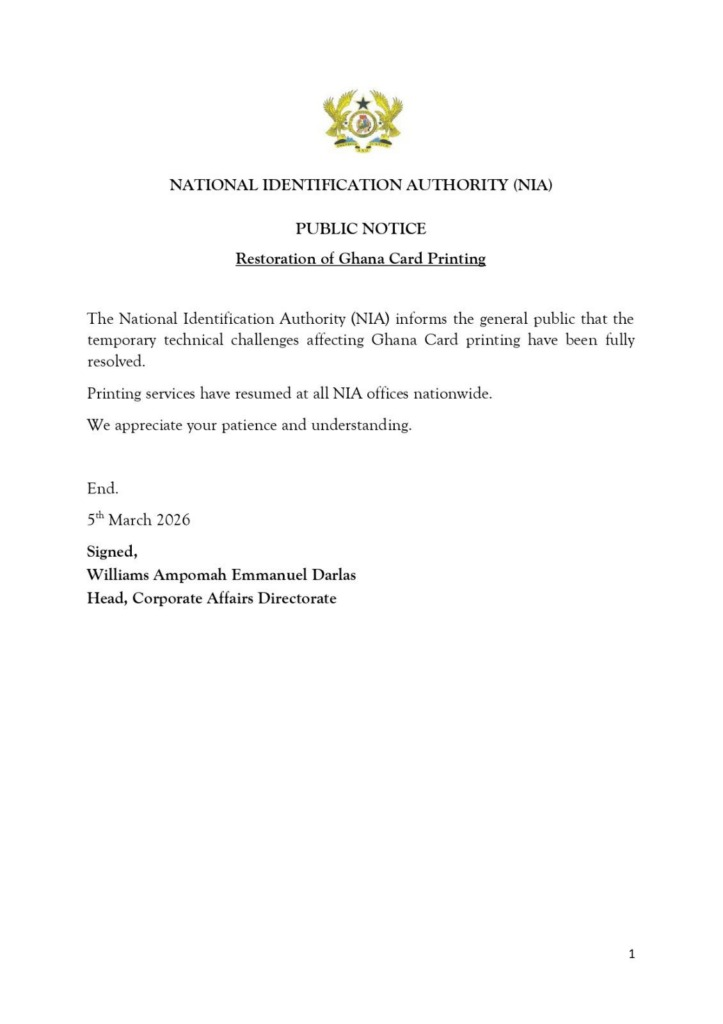
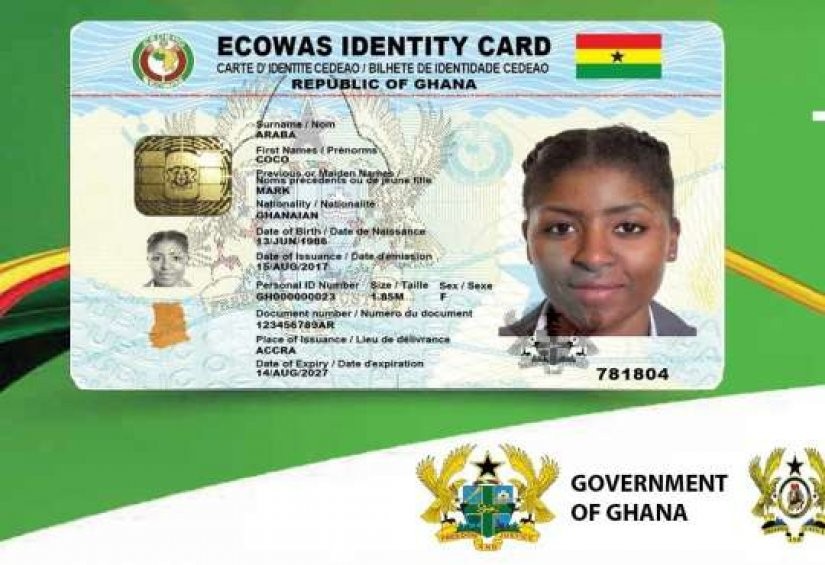
The National Identification Authority (NIA) has announced that it has fully resolved the technical challenges that were affecting Ghana Card printing.
This comes after the identity regulator, on March 3, announced that it was experiencing technical issues which were affecting the card printing process.
However, today, March 5, the NIA, in a formal statement, announced that the challenge has been resolved; hence, card printing has resumed at all of its offices nationwide, and it thanked the public for their patience while their system was down.
“Printing services have resumed at all NIA offices nationwide. We appreciate your patience and understanding,” parts of the statement read.
Meanwhile, in January this year, the National Identification Authority (NIA) announced a hike in its service charges.
The NIA announced the hike in a flier shared on their official Facebook page on Wednesday, January 22. The statement listed five crucial services that will see a price increase soon, though no timeline or specific amounts were provided.
The Authority said the price adjustments are necessary to support the sustainability and efficiency of its operations.
The statement noted that, “We wish to respectfully inform the general public that there will be an adjustment in the prices of the following services: First-time Registration, Personal Information Update, Replacement Service, Nationality Update, and Non-Citizen Card Registration.”
Last year, the NIA announced that it was set to upgrade the Ghana Card into an electronic wallet, allowing holders to use it not only as a national ID but also for digital financial transactions.
Executive Secretary of the NIA, Yayra Korku Deku, shared the news with Joy News’ James Avedzi, where he intimated that the initiative will help the authority generate revenue to support its activities. He is optimistic that this will optimise the operations of the authority.
“What it means is that you can put money on your Ghana Card and use it to do transactions, that is, to pay for anything that you do. And we are hoping that that one will generate a huge sum of money for us,” he stated.
Adding that the e-wallet initiative will be a significant move that will reshape the NIA’s operations while boosting electronic money transfers in Ghana.
He noted that several financial institutions are eager to partner with the NIA to ensure the initiative succeeds.
As of May last year, a total of 648,862 Ghana Cards printed by the National Identification Authority (NIA) were yet to be collected by their respective holders.
The NIA made this known on its Facebook platform when it released recent data on the national identification registration exercise as of May 9.
Per the data, a total of 18,713,474 individuals have been enrolled in the National Identification System.
So far, some 18,197,477 Ghana Cards have been printed, whereas 17,548,615 cards have been issued.
The NIA urged individuals who have yet to claim their Ghana Cards to do so.
“Still Haven’t Collected Your Ghana Card? Thousands of cards are ready and waiting! Check. Collect. Be Identified.”
“Visit your nearest NIA District Office today; we’re open and operational!” the NIA stated.
Last month, the Ghana Revenue Authority responded to claims that it had been disconnected from the National Identification Authority (NIA)’s Identity Verification System (IVS).
The NIA disconnected GRA from its Identity Verification Service (IVS) platform on Tuesday, August 5, 2025, due to the GRA’s failure to settle a GH₵376 million debt.
In a statement released on August 5, 2025, the GRA clarified that the current administration seemed to have inherited a legacy debt due to some services rendered to the GRA by the NIA before 2025.
However, “from the GRA’s present assessment, there were no regulatory and governance approvals for the transaction that created the purported debt. GRA’s principles of transparency, compliance, and governance protocols do not permit enforcement of transactions that do not meet regulatory requirements, particularly as demanded by the reset vision of the President and the Government,” the statement read.
BoG makes the Ghana Card the sole identity document for banking and digital transactions nationwide.
The Bank of Ghana (BoG) has issued a revised Supervisory Guidance Note on the use of the Ghana Card in banking and digital financial transactions across the country. In a 19-page document shared on January 8, the central bank announced the Ghana Card as the primary and, in most cases, the sole form of identification for financial transactions nationwide.
The new directives replace the June 2022 guidance, which introduced the Ghana Card as the primary ID for financial transactions. The October/November 2025 revision, however, makes the Ghana Card mandatory and exclusive, requiring biometric verification through the National Identification Authority (NIA) database and removing alternative identification options. The 2025 directive takes immediate effect, fully replacing the 2022 framework.
BoG noted that, “This Guidance Note provides clarity to Bank of Ghana Notice Number BG/GOV/SEC/2025/36, issued on 13th November 2025, and aims to ensure compliance with Know Your Customer (KYC) and Customer Due Diligence (CDD) requirements. This revised Supervisory Guidance Note on the use of the Ghana Card for Accountable Institutions, October 2025, comes into effect from the date of issue and replaces the Supervisory Guidance Note on the use of the Ghana Card for Accountable Institutions, June 2022.”
Under the new directive, Accountable Institutions (AIs) are required to use only the Ghana Card to identify and verify all customers, including Ghanaian citizens living in Ghana and abroad, permanent residents, and ECOWAS nationals who are residents during onboarding. Foreign directors, shareholders, and non-residents who are signatories to accounts must also be verified using the Ghana Card.
Institutions are required to verify customers biometrically using features embedded in the card and to update records directly from the NIA database. Any discrepancies in customer information must be handled carefully: primary data, such as name, date of birth, and nationality, must be corrected at the NIA, while secondary data, including phone numbers and address
Effective April, Ghanaians across the country will have access to free essential healthcare services at hospitals.
The Minister for Health, Kwabena Mintah Akandoh disclosed this while speaking on the sidelines of the Accra Reset Addis Reckoning event in Addis Ababa on Saturday, February 14.
“As part of our effort to achieve Universal Health Coverage, since everybody is contributing to the NHIS levy, Ghanaians deserve this basic benefit. Everyone should be able to enjoy at least free primary healthcare.
“We have been directed to ensure that Free Primary Health Care is fully implemented across the country by that timeline,” he said.
Meanwhile, the National Health Insurance Authority (NHIA) has disbursed over GH¢392 million in vetted claims to healthcare providers across Ghana between December 2025 and January 2026.
The payments cover services provided under the National Health Insurance Scheme (NHIS).
According to the Finance Directorate of the NHIA, the funds were released following an extensive vetting and approval process of claims submitted by health facilities. In December 2025, the Authority paid GH¢301,658,338.13, while in January 2026, healthcare providers received GH¢90,373,513.13.
The NHIA in early July 205 disbursed an amount of GH¢267.67 million as claims to health facilities across the country. The disbursement became possible following approval by Chief Executive Dr. Victor Asare-Bampoe. The total payments made by the NHIA in the past seven months stand at over GH¢1.5 billion.
Out of the total amount, public health facilities received GH¢120,700,932.62, which constitutes 45 percent of the total.
Private health facilities have been paid GH¢100,210,906.44, representing 37 percent of the total amount, while mission health facilities have been allotted GH¢446,761,808.96, which makes up 17 percent of the total funds.
One of the ways the National Health Insurance Authority (NHIA) seeks to ease the financial burden on citizens, ensure equal access to healthcare, and reduce illegal fees is by proposing a 120 per cent increase in service tariffs, pending approval from its Board and the Minister of Health.
This was revealed by the Chief Executive Officer of the NHIA, Dr. Victor Asare Bampoe, during an appearance on Channel One TV’s The Point of View on Wednesday, November 26. According to Dr. Bampoe, the proposed tariff increase, if approved, would help reduce the extra charges patients pay at hospitals for medical care and services.
He explained that the proposed increase was planned in consultation with a group of independent experts mandated to review tariffs under Sections 33 and 34 of the National Health Insurance Act, which require annual revisions of both medicines and service tariffs.“Regarding the 120% tariff increase: this is proposed after comprehensive work by a group of experts. The law requires an annual review of service and medicine tariffs (Sections 33 and 34). Although the review was delayed, the proposal is now ready and will go to our board and the Minister of Health for approval. Once approved, it will be implemented. This is partly to address the problem of illegal fees at hospitals, ensuring health providers are paid realistic tariffs so patients no longer have to pay out-of-pocket,” he said.
As the “cash manager” of Ghana’s health insurance system, Dr. Bampoe explained that the NHIA is mandated to collect funds, set tariffs, and pay hospitals, clinics, and pharmacies for services provided to insured patients.
However, he noted that the Authority plans to move beyond this traditional role and become more of a “strategic health purchasing provider.”“But the NHS is more like a spending entity; we do not generate money on our own. So, we are a spending entity. One of the things we’re trying to do is move away from being a claims payment mechanism to a strategic health purchasing provider, which means that we are able to dictate health outcomes because of the financial muscle that the government provides us with.We’re able to determine the prices of medicines, the prices of services, and even go on the global stage and provide a platform to discuss what kind of health outcomes we want, as you saw with the ACRA Health Sovereignty Summit that happened on August 5. So it’s an interesting time, and His Excellency the President, the Minister of Finance, and the Minister of Health have given us the tools to be able to deliver on this mandate,” he said, citing the government’s commitment to ensuring that his outfit can deliver on its mandate.As part of its vision to move from just paying claims to becoming a “strategic health purchasing provider,” Dr. Bampoe highlighted that the NHIA also seeks to provide Universal Health Coverage (UHC) under three distinct pillars. Lauding the NHIA for its success in granting health coverage, he revealed that out of over 35 million Ghanaians, the Authority has provided coverage for about 20 million.“So essentially, the health insurance scheme was set up in 2003 (Act 650) and amended in 2012 (Act 852), and its primary purpose was to pay claims. But now what we are looking at is getting universal health coverage for all Ghanaians. Universal health coverage has three pillars: population coverage, service coverage, and financial protection. I am proud to say that we are at 20 million in population coverage, which is unprecedented.”He noted that while the medicines tariff review has already been completed, the service tariff review, initiated in 2022, took longer due to its comprehensive nature. “There are two types of reviews that we need to do, but this was a really comprehensive one, so I think they could not finish on time, and so it is now that they have finished,” he explained.
Dr. Bampoe stressed that implementation now depends solely on statutory approvals. “Now it has to go to the Board for them to look at it and give their view on it. It has to go to the Minister of Health to give his assent, and then we will implement it if they all think it is okay,” he stated.
The NHIA CEO applauded the government for removing the cap on NHIA funds.“Regarding funding, we are dependent on the importance the government places on healthcare. I’m proud of His Excellency the President, the Finance Minister, and the Minister of Health because the capping act (Act 947 of 2019) has put a limit on funds coming to the NHIA. The President removed that cap, giving us an extra 3.4–3.5 billion cedis for healthcare.“We are trying to do three things; shift mindsets in government and across the country to see healthcare as important for development. Healthy people are more productive. Focus on areas where we get the best results, such as Mahama Cares and Free Primary Healthcare. If 40%+ of people are affected by non-communicable diseases, it makes sense to prevent them. Preventive actions include health promotion and screenings. For example, catching prostate cancer early with a PSA test is more cost-effective than treating stage 4 disease. Shift realities. At the Global Fund and UN, programs were comprehensive but expensive. We now aim for solutions that fit our reality, whether that’s a Rolls-Royce, a Toyota VIT, or even a motorbike; the key is to deliver,” he detailed.
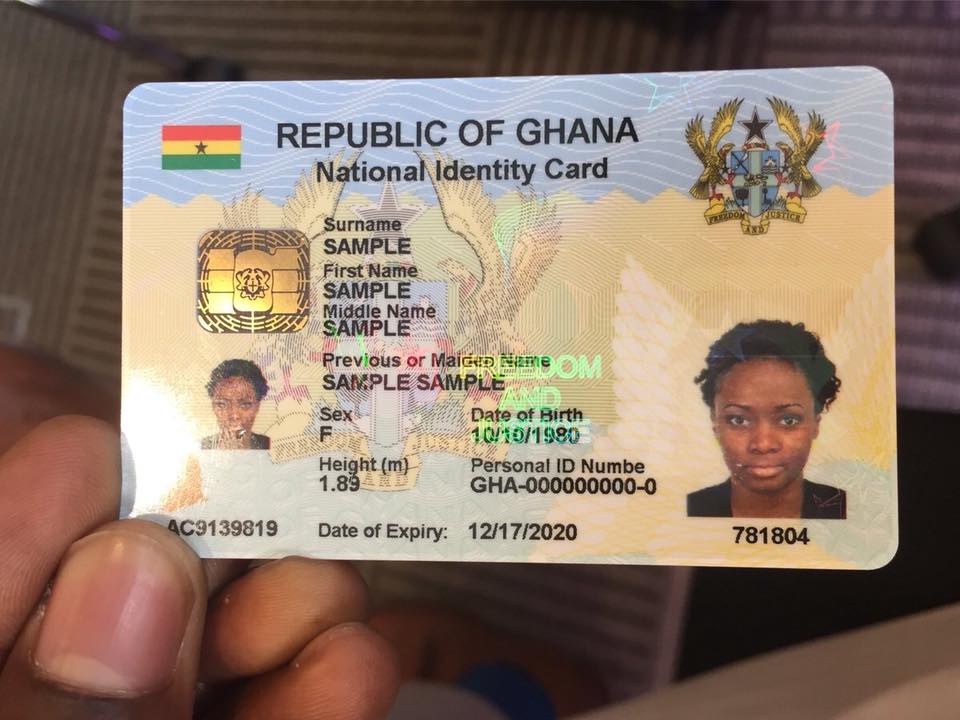
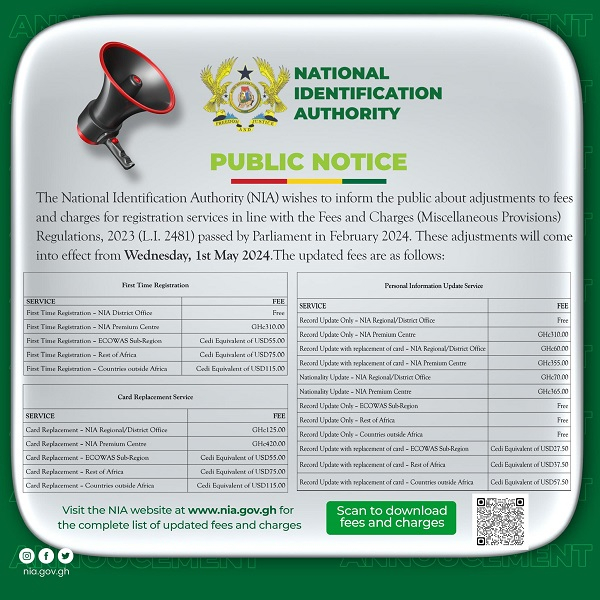
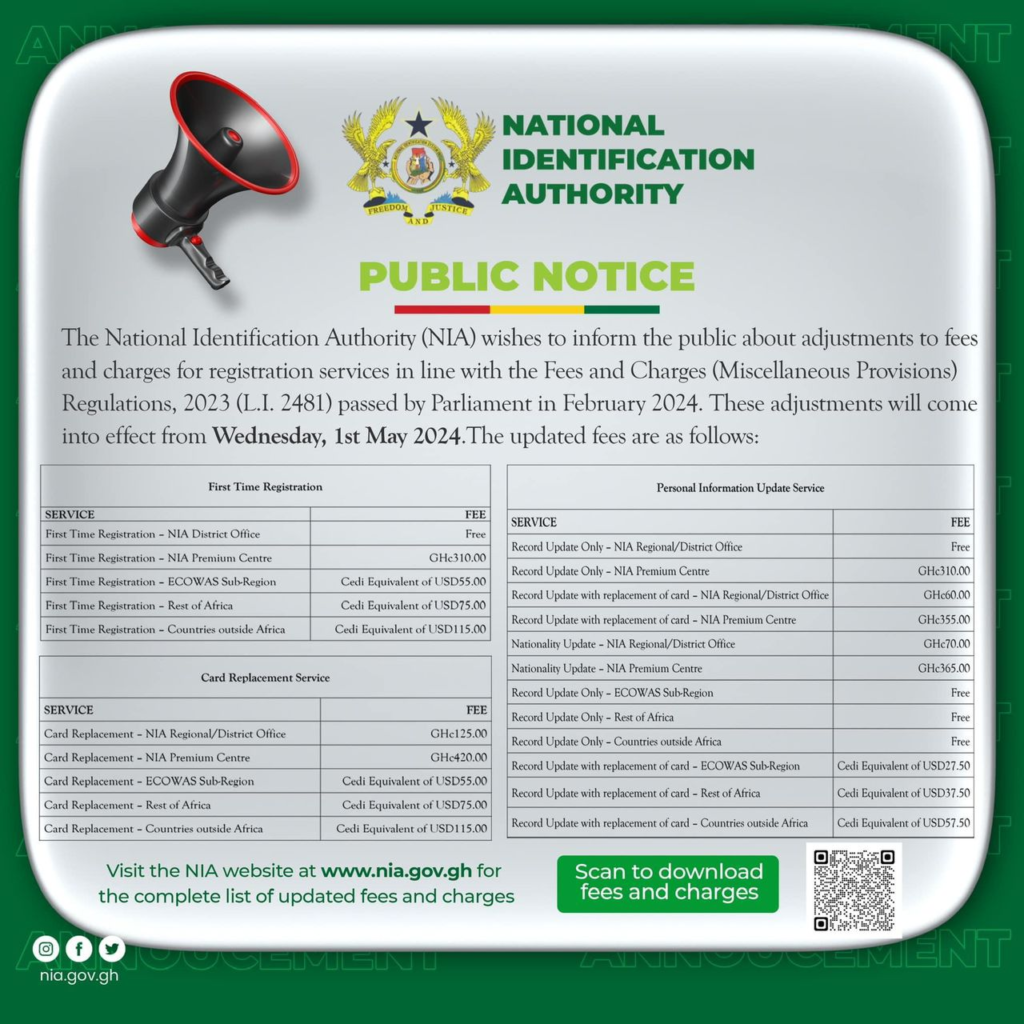
The National Identification Authority (NIA) has announced an adjustment in its service charges, effective February 2, 2026. A new Ghana Card for first-time adults below 25 years will now cost GH¢30, while card replacement has been pegged at GH¢200 at NIA District Offices.
On the other hand, first-time applicants under 25 years will pay no fee. Meanwhile, card transfer services will now attract a fee of GH¢75. First-time registration for foreigners have been set at the cedi equivalent of $120, while annual card renewal will cost $78.
This information was contained in a statement issued on Monday, January 26 by the Authority.
“The fees have been reviewed to support the efficient delivery of services and the long-term maintenance of the national identity infrastructure,” the NIA said.
The revised charges has become successful following parliamentary approval of amendments under the Fees and Charges (Miscellaneous Provisions) Regulations. This marks the first fee review since 2023.
Last year, the NIA announced that it was set to upgrade the Ghana Card into an electronic wallet, allowing holders to use it not only as a national ID but also for digital financial transactions.
Executive Secretary of the NIA, Yayra Korku Deku shared the news with Joy News’ James Avedzi, where he intimated that the initiative will help the authority generate revenue to support its activities. He is optimistic this will optimise the operations of the authority.
“What it means is that you can put money on your Ghana card and use it to do transactions. That is to pay for anything that you do. And we are hoping that that one will generate a huge sum of money for us,” she stated.
Adding that the e-wallet initiative will be a significant move that will reshape the NIA’s operations while boosting electronic money transfers in Ghana.
He noted that several financial institutions are eager to partner with the NIA to ensure the initiative succeeds. As of May this year, a total number of 648,862 Ghana cards printed by the National Identification Authority (NIA) were yet to be collected by their respective holders.
The NIA made this known on its Facebook platform when it released recent data on the national identification registration exercise as of May 9.
Per the data, a total of 18,713,474 individuals have been enrolled onto the National Identification System. So far, some 18,197,477 Ghana cards have been printed, whereas 17,548,615 cards have been issued.
The NIA urged individuals who have yet to claim their Ghana Cards to do so. “Still Haven’t Collected Your Ghana Card? Thousands of cards are ready and waiting! Check. Collect. Be Identified. Visit your nearest NIA District Office today, we’re Open and Operational!” the NIA stated.
Last month, the Ghana Revenue Authority responded to claims that it had been disconnected from the National Identification Authority (NIA)’s Identity Verification System (IVS).
The NIA disconnected GRA from its Identity Verification Service (IVS) platform on Tuesday, August 5, 2025 due to the GRA’s failure to settle a GH₵376 million debt.
In a statement released on August 5, 2025, the GRA clarified that the current administration seemed to have inherited a legacy debt due to some services rendered to the GRA by the NIA prior to 2025.
However, “from the GRA’s present assessment, there were no regulatory and governance approvals for the transaction that created the purported debt. GRA’s principles of transparency, compliance and governance protocols do not permit enforcement of transactions that do not meet regulatory requirements, particularly as demanded by the reset vision of the President and the Government,” the statement read.
BoG makes Ghana Card sole identity document for banking, digital transactions nationwide
The Bank of Ghana (BoG) has issued a revised Supervisory Guidance Note on the use of the Ghana Card in banking and digital financial transactions across the country.
In a 19-page document shared on January 8, the central bank announced the Ghana Card as the primary and, in most cases, sole form of identification for financial transactions nationwide.
The new directives replace the June 2022 guidance, which introduced the Ghana Card as the primary ID for financial transactions.
The October/November 2025 revision, however, makes the Ghana Card mandatory and exclusive, requiring biometric verification through the National Identification Authority (NIA) database and removing alternative identification options. The 2025 directive takes immediate effect, fully replacing the 2022 framework.
BoG noted that, “This Guidance Note provides clarity to Bank of Ghana Notice Number BG/GOV/SEC/2025/36, issued 13th November 2025, and aims to ensure compliance with Know Your Customer (KYC) and Customer Due Diligence (CDD) requirements. This revised Supervisory Guidance Note on the use of the Ghana Card for Accountable Institutions, October 2025, comes into effect from the date of issue and replaces the Supervisory Guidance Note on the use of the Ghana Card for Accountable Institutions, June 2022.”
Under the new directive, Accountable Institutions (AIs) are required to use only the Ghana Card to identify and verify all customers, including Ghanaian citizens living in Ghana and abroad, permanent residents, and ECOWAS nationals who are residents during onboarding. Foreign directors, shareholders, and non-residents who are signatories to accounts must also be verified using the Ghana Card.
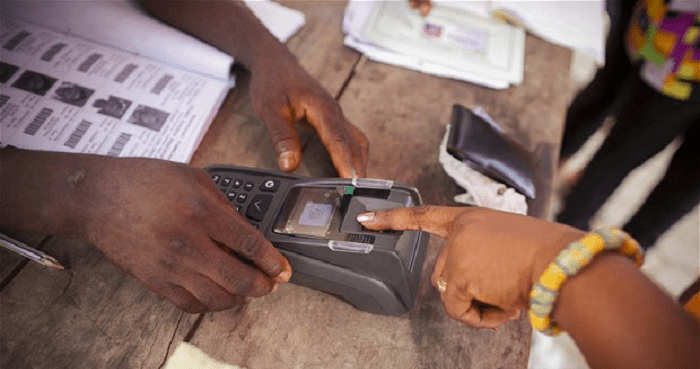
Institutions are required to verify customers biometrically using features embedded in the card and to update records directly from the NIA database.
Any discrepancies in customer information must be handled carefully: primary data, such as name, date of birth, and nationality, must be corrected at the NIA, while secondary data, including phone numbers and addresses, may be updated through institutional procedures.
Ghanaians are to brace themselves for more fees as the National Identification Authority (NIA) announces a hike in its service charges.
The NIA announced the hike in a flier shared on their official Facebook page on Wednesday, January 22.
The statement listed five crucial services that will see a price increase soon, though no timeline or specific amounts were provided.
The Authority said the price adjustments are necessary to support the sustainability and efficiency of its operations.
The statement noted that, We wish to respectfully inform the general public that there will be an adjustment in the prices of the following services: “First-time Registration, Personal Information Update, Replacement Service, Nationality Update, Non-Citizen Card Registration”.
Last year, the NIA announced that it was set to upgrade the Ghana Card into an electronic wallet, allowing holders to use it not only as a national ID but also for digital financial transactions.
Executive Secretary of the NIA, Yayra Korku Deku shared the news with Joy News’ James Avedzi, where he intimated that the initiative will help the authority generate revenue to support its activities. He is optimistic this will optimise the operations of the authority.
“What it means is that you can put money on your Ghana card and use it to do transactions. That is to pay for anything that you do. And we are hoping that that one will generate a huge sum of money for us,” she stated.
Adding that the e-wallet initiative will be a significant move that will reshape the NIA’s operations while boosting electronic money transfers in Ghana.
He noted that several financial institutions are eager to partner with the NIA to ensure the initiative succeeds
As of May this years, a total number of 648,862 Ghana cards printed by the National Identification Authority (NIA) were yet to be collected by their respective holders.
The NIA made this known on its Facebook platform when it released recent data on the national identification registration exercise as of May 9.
Per the data, a total of 18,713,474 individuals have been enrolled onto the National Identification System.
So far, some 18,197,477 Ghana cards have been printed, whereas 17,548,615 cards have been issued.
The NIA urged individuals who have yet to claim their Ghana Cards to do so.
“Still Haven’t Collected Your Ghana Card? Thousands of cards are ready and waiting! Check. Collect. Be Identified.”
“Visit your nearest NIA District Office today, we’re Open and Operational!” the NIA stated.
Last month, the Ghana Revenue Authority responded to claims that it had been disconnected from the National Identification Authority (NIA)’s Identity Verification System (IVS).
The NIA disconnected GRA from its Identity Verification Service (IVS) platform on Tuesday, August 5, 2025 due to the GRA’s failure to settle a GH₵376 million debt.
In a statement released on August 5, 2025, the GRA clarified that the current administration seemed to have inherited a legacy debt due to some services rendered to the GRA by the NIA prior to 2025.
However, “from the GRA’s present assessment, there were no regulatory and governance approvals for the transaction that created the purported debt. GRA’s principles of transparency, compliance and governance protocols do not permit enforcement of transactions that do not meet regulatory requirements, particularly as demanded by the reset vision of the President and the Government,” the statement read.
BoG makes Ghana Card sole identity document for banking, digital transactions nationwide
The Bank of Ghana (BoG) has issued a revised Supervisory Guidance Note on the use of the Ghana Card in banking and digital financial transactions across the country. In a 19-page document shared on January 8, the central bank announced the Ghana Card as the primary and, in most cases, sole form of identification for financial transactions nationwide.
The new directives replace the June 2022 guidance, which introduced the Ghana Card as the primary ID for financial transactions. The October/November 2025 revision, however, makes the Ghana Card mandatory and exclusive, requiring biometric verification through the National Identification Authority (NIA) database and removing alternative identification options. The 2025 directive takes immediate effect, fully replacing the 2022 framework.
BoG noted that, “This Guidance Note provides clarity to Bank of Ghana Notice Number BG/GOV/SEC/2025/36, issued 13th November 2025, and aims to ensure compliance with Know Your Customer (KYC) and Customer Due Diligence (CDD) requirements. This revised Supervisory Guidance Note on the use of the Ghana Card for Accountable Institutions, October 2025, comes into effect from the date of issue and replaces the Supervisory Guidance Note on the use of the Ghana Card for Accountable Institutions, June 2022.”
Under the new directive, Accountable Institutions (AIs) are required to use only the Ghana Card to identify and verify all customers, including Ghanaian citizens living in Ghana and abroad, permanent residents, and ECOWAS nationals who are residents during onboarding. Foreign directors, shareholders, and non-residents who are signatories to accounts must also be verified using the Ghana Card.
Institutions are required to verify customers biometrically using features embedded in the card and to update records directly from the NIA database. Any discrepancies in customer information must be handled carefully: primary data, such as name, date of birth, and nationality, must be corrected at the NIA, while secondary data, including phone numbers and addresses, may be updated through institutional procedures.
The Bank of Ghana (BoG) has issued a revised Supervisory Guidance Note on the use of the Ghana Card in banking and digital financial transactions across the country. In a 19-page document shared on January 8, the central bank announced the Ghana Card as the primary and, in most cases, sole form of identification for financial transactions nationwide.
The new directives replace the June 2022 guidance, which introduced the Ghana Card as the primary ID for financial transactions. The October/November 2025 revision, however, makes the Ghana Card mandatory and exclusive, requiring biometric verification through the National Identification Authority (NIA) database and removing alternative identification options. The 2025 directive takes immediate effect, fully replacing the 2022 framework.
BoG noted that, “This Guidance Note provides clarity to Bank of Ghana Notice Number BG/GOV/SEC/2025/36, issued 13th November 2025, and aims to ensure compliance with Know Your Customer (KYC) and Customer Due Diligence (CDD) requirements. This revised Supervisory Guidance Note on the use of the Ghana Card for Accountable Institutions, October 2025, comes into effect from the date of issue and replaces the Supervisory Guidance Note on the use of the Ghana Card for Accountable Institutions, June 2022.”
Under the new directive, Accountable Institutions (AIs) are required to use only the Ghana Card to identify and verify all customers, including Ghanaian citizens living in Ghana and abroad, permanent residents, and ECOWAS nationals who are residents during onboarding. Foreign directors, shareholders, and non-residents who are signatories to accounts must also be verified using the Ghana Card. Institutions are required to verify customers biometrically using features embedded in the card and to update records directly from the NIA database. Any discrepancies in customer information must be handled carefully: primary data, such as name, date of birth, and nationality, must be corrected at the NIA, while secondary data, including phone numbers and addresses, may be updated through institutional procedures.
The guidance also imposes stricter rules for mobile and internet banking, citing heightened risks of money laundering and terrorist financing. Financial institutions are no longer permitted to use a risk-based approach for identification at the onboarding stage and must conduct full biometric verification, including liveness checks, for all digital onboarding processes.
BoG emphasized that, “Given the inherent Money Laundering, Terrorist Financing, and Proliferation Financing (ML/TF/PF) risks associated with non-face-to-face technologies, identification and verification shall not be risk-based. AIs, during the onboarding of new customers on mobile banking applications and internet banking platforms, shall verify the identity of the customer using the Ghana Card, Non-Citizen Identity Card, or Refugee Identity Card in the case of non-Ghanaians, utilise a liveness check to biometrically verify the customer, collect all applicable KYC/CDD/EDD information in line with AML/CFT/CPF laws, and update customer KYC data using information from the National Identity Authority.”
For existing customers and foreign nationals, banks are mandated to verify and update customer information using NIA data and biometrics. Customers without a valid national or refugee ID cannot conduct transactions. Those without a Ghana Card or an approved alternative identification for non-citizens and refugees are barred from all financial transactions. Short-term foreign visitors are only permitted to conduct limited transactions, with banks required to verify passports, collect risk-based information, and maintain detailed records of these transactions.
Bank of Ghana (BoG) released a revised set of rules for the fast emergence of International Money Transfer Operators (IMTOs), who, through partnerships with licensed payment service providers and banks, play a critical role in facilitating the smooth and secure the flow of funds into Ghana.
In a 16-page document shared on Friday, January 2, the central bank outlined new rules to “foster a secure and enabling environment for remittance services ” in Ghana.
The document outlines a set of guidelines on legality, transparency, accountability, consumer protection, and robust data security for all remittance services for IMTOs in Ghana.
The guidelines include, “Legality and Enforceability where all IMTO activities must comply with relevant laws, directives and notices as prescribed by the Bank of Ghana. Transparency: An IMTO shall provide accurate, timely, and complete information on services, fees, charges, and exchange rates to promote accountability and consumer trust. Accountability: An IMTO, including its board, management, and agent, shall be responsible for ensuring compliance with regulatory obligations and the safe conduct of inward remittance operations.
Also on consumer protection, “an IMTO shall uphold fair treatment, privacy, and effective mechanisms for complaint resolution to safeguard customer rights. Technology neutrality: An IMTO may utilise any technology or delivery channel, provided they comply with regulatory standards for interoperability, security, operational efficiency, and consumer protection. Data protection and privacy: An IMTO shall safeguard customer information, ensuring confidentiality, integrity, and compliance with the Data Protection Act, 2012 (Act 843) and relevant international standards.”
Ghana’s Data Protection Act, 2012 (Act 843) establishes the legal framework for protecting personal data, regulates how organisations collect, store, and use it, and creates the Data Protection Commission to enforce compliance.
Additionally, parties interested in operating IMTOs in Ghana must apply for registration with the Bank of Ghana, providing detailed documentation including proof of licensing in their home country, company ownership and management profiles, transaction flow processes, internal controls, and consumer protection mechanisms. The BoG will assess applications for completeness and compliance, granting or rejecting approval within 90 days, and may request additional information or third-party assessments as part of the process.
IMTOs, according to BoG, are to desist from engaging in any other financial activities outside the scope of their license or risks loosing it.
The National Identification Authority (NIA) is set to upgrade the Ghana Card into an electronic wallet, allowing holders to use it not only as a national ID but also for digital financial transactions.
Executive Secretary of the NIA, Yayra Korku Deku shared the news with Joy News’ James Avedzi, where he intimated that the initiative will help the authority generate revenue to support its activities. He is optimistic this will optimise the operations of the authority.
“What it means is that you can put money on your Ghana card and use it to do transactions. That is to pay for anything that you do. And we are hoping that that one will generate a huge sum of money for us,” she stated.
Adding that the e-wallet initiative will be a significant move that will reshape the NIA’s operations while boosting electronic money transfers in Ghana.
He noted that several financial institutions are eager to partner with the NIA to ensure the initiative succeeds
As of May this years, a total number of 648,862 Ghana cards printed by the National Identification Authority (NIA) were yet to be collected by their respective holders.
The NIA made this known on its Facebook platform when it released recent data on the national identification registration exercise as of May 9.
Per the data, a total of 18,713,474 individuals have been enrolled onto the National Identification System.
So far, some 18,197,477 Ghana cards have been printed, whereas 17,548,615 cards have been issued.
The NIA is urging individuals who are yet to claim their Ghana Cards to do so.
“Still Haven’t Collected Your Ghana Card? Thousands of cards are ready and waiting! Check. Collect. Be Identified.”
“Visit your nearest NIA District Office today, we’re Open and Operational!” the NIA stated.
Last month, the Ghana Revenue Authority responded to claims that it had been disconnected from the National Identification Authority (NIA)’s Identity Verification System (IVS).
The NIA disconnected GRA from its Identity Verification Service (IVS) platform on Tuesday, August 5, 2025 due to the GRA’s failure to settle a GH₵376 million debt.
In a statement released on August 5, 2025, the GRA clarified that the current administration seemed to have inherited a legacy debt due to some services rendered to the GRA by the NIA prior to 2025.
However, “from the GRA’s present assessment, there were no regulatory and governance approvals for the transaction that created the purported debt. GRA’s principles of transparency, compliance and governance protocols do not permit enforcement of transactions that do not meet regulatory requirements, particularly as demanded by the reset vision of the President and the Government,” the statement read.
The authority further clarified that added GRA’s principles of transparency, compliance and governance protocols do not permit enforcement of transactions that do not meet regulatory requirements, particularly as demanded by the reset vision of the President and the Government,” the statement indicated.
Nonetheless, discussions are currently ongoing between high officials of the two agencies to resolve the issue.
“There are current high-level discussions between the two agencies in resolving the issues particularly where GRA has identified some procedural breaches and cannot affirm the existence of a service agreement between the parties,” a part of the statement read.
The IVS platform is a critical digital infrastructure that aids with public and private institutions to instantly verify the identity of individuals using the Ghana Card database.
This function is vital for a wide range of services, including revenue mobilisation, passport issuance, banking, and healthcare access.
The National Identification Authority (NIA) has blocked the Ghana Revenue Authority (GRA) from using its identity verification system over the Authority’s GH₵376 million debt owed to them.
The National Identification Authority officially announced the disconnection of the Ghana Revenue Authority (GRA) from its Identity Verification Service (IVS) platform during an interview with JoyNews during their midday news.
During the interview, the Head of Corporate Affairs at the NIA, Williams Aumman Dallas, stated that the NIA will restrict GRA’s access to their identity verification platform due to the Authority’s failure to settle the financial obligations to the NIA. He noted that GRA has not made any financial commitments to the NIA over the last three years.
“Effective 1st August, we have restricted them — we’ve cut them off, we’ve unplugged them from our identity verification platform. For over three years, their financial obligations to the National Identification Authority have not been fulfilled,” Williams Aumman Dallas stated.
The NIA explained that before the disconnection, the GRA was using its system to register taxpayers for Personal Identification Numbers (PINs), now rebranded as Ghana Card numbers, in line with government policy. The government had earlier directed GRA and other institutions to cease issuing separate ID cards and instead integrate the use of the Ghana Card and the NIA database into their operations.
GRA began integrating NIA data into its systems around 2021, when the two agencies started harmonising databases. By September 30, 2021, over 14.7 million individuals had already been migrated from the NIA database to GRA’s systems. To assist the GRA, the NIA had provided bulk biometric data to enable them to perform identity matching with client records. However, the GRA was never fully onboarded onto the NIA’s system via the standard API integration.
With no payments forthcoming and no signs of commitment to resolve the matter, the NIA has taken further steps by writing to the Data Protection Commission for approval to access GRA servers and delete the data previously provided.
“The data belongs to us,” the spokesperson stressed. “Once we retrieve it, we will know we have no further obligations to them,” he fumed.
“Our contact centre is inundated with calls from people asking for help to clear their goods. But from where we stand, there’s nothing we can do. The authority must fulfil its financial obligations. Once that is done, we can reconnect them and resume normal business,” he added.
While GRA has not responded to NIA’s gesture, the impact of the move has already started being felt by many importers and exporters. They have been left stranded, as they are unable to clear goods at the country’s ports.
This is because the NIA’s Identity Verification Service (IVS) platform is essential for verifying individuals’ identities using the Ghana Card database, which is a critical step in customs clearance and tax-related processes.
Without access to the IVS, GRA cannot confirm the identities of traders, which means goods cannot be processed or released. This has resulted in frozen operations at key clearance points, a situation that the Executive Secretary of the Importers and Exporters Association, Samson Asaki Awingobit, has described as a disaster. He said that many of his members have been directly affected by this action.
Williams Aumman Dallas contends that “the verification platform needs to be maintained, and we need money.” In a press conference held on the morning of August 5 at the Tomreik Hotel in Accra, Ghana, Mr Dallas announced the current financial constraints the NIA is facing due to the heavy debt from various public institutions.
“Let me state that there are institutions that are owing us. These are public institutions, and I’ve been advised not to mention names. So I will not mention names, but it is honestly affecting our operations as an authority,” Dallas said.
He further went on to charge all indebted public institutions to fulfil their financial obligations without delay or risk facing the same fate as GRa is currently facing. “And so by this press briefing, we are appealing to these public institutions to fulfil their financial obligations owed to us so that we can maximise our operations. Failure to fulfil their financial obligations; we will be left with no other choice but to deny them the services,” he stated.
The NIA’s financial woes have been a recurring issue. The authority, which operates on a semi-commercial basis, generates revenue from providing identity verification services and the issuance of Ghana Cards.
However, a significant portion of its operational budget is often tied up in delayed payments from government agencies. In 2024, the NIA reported an estimated debt of over GH₵ 150 million from various government entities, a figure that has likely grown.
The continuous debt has hampered the NIA’s ability to maintain its systems, expand its services, and even pay staff salaries on time. Meanwhile, a total number of 648,862 Ghana cards printed by the National Identification Authority (NIA) are yet to be collected by their respective holders.
The NIA made this known on its Facebook platform when it released recent data on the national identification registration exercise as of May 9. Per the data, a total of 18,713,474 individuals have been enrolled onto the National Identification System. So far, some 18,197,477 Ghana cards have been printed, whereas 17,548,615 cards have been issued.
The NIA is urging individuals who have yet to claim their Ghana Cards to do so. “Still Haven’t Collected Your Ghana Card? Thousands of cards are ready and waiting! Check. Collect. Be Identified. Visit your nearest NIA District Office today, we’re Open and Operational!” the NIA stated.
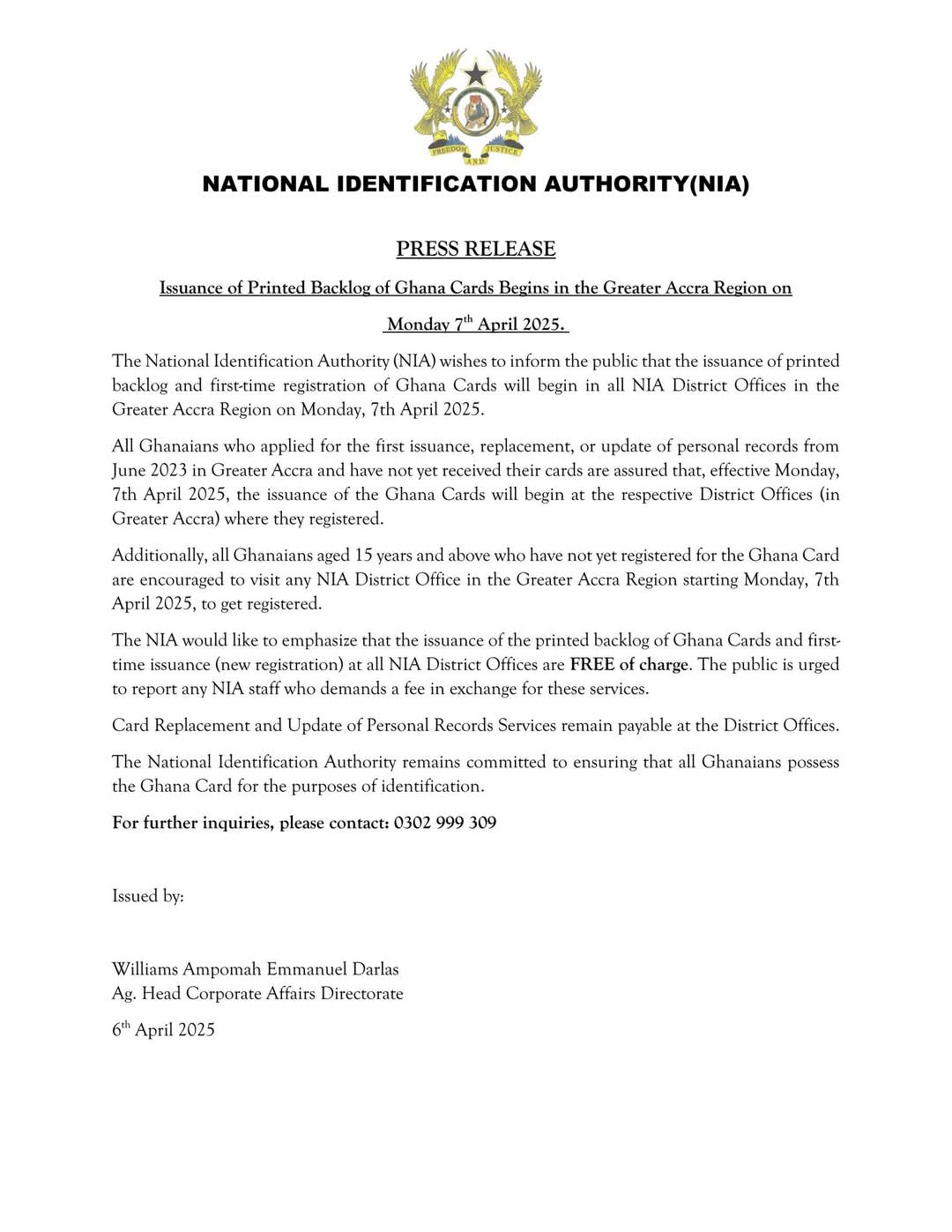
The National Identification Authority (NIA) has announced that starting today, April 7, 2025, it will begin issuing printed Ghana Cards and registering new applicants in the Greater Accra Region.
According to a statement from the NIA, all District Offices in the region will be giving out cards to people who registered between June 2023 and now but haven’t received them yet.
People who fall into this group should go back to the same District Office where they first registered to pick up their cards.
Also, all Ghanaians aged 15 and above who haven’t registered for the Ghana Card are encouraged to visit any NIA District Office in the Greater Accra Region to complete their registration.
The NIA stressed that both the registration and the card are completely free. They warned the public not to pay anyone for these services.
The Authority also urged Ghanaians to report any staff member who tries to take money for helping with registration or card collection.
“However, replacement cards and updates to personal records will still attract a fee, as previously stipulated.”
The National Identification Authority (NIA) has responded to misinformation circulated by the Daily Graphic on Facebook, clarifying that the fees for Ghana Card services have not been altered since 2023.
The NIA stressed that claims of a fee revision were false and misleading.
On February 4, 2025, Daily Graphic published a post with the headline “NIA introduces new fees for Ghana card services at premium centres,” which suggested that the NIA had recently revised its fees.
The authority swiftly issued a statement denying this assertion, noting that a previous post on its official Facebook page, which highlighted charges for certain services, had been misunderstood.
“The statement by Daily Graphic is false and untrue,” the NIA declared. “The said fees and charges were approved in 2023 by the Parliament of the Republic of Ghana and have not been reviewed since. All fees and charges reviews are done solely with the approval of Parliament and not by the Authority.”
The NIA also emphasized that the posted fees only applied to services provided at premium centres, as district offices continue to offer free first-time registration services. “The said fees and charges posted on our Facebook page apply to our Premium Centres only as our District Offices remain free for all first issuance processes,” the statement clarified.
In an effort to prevent further confusion, the NIA urged all media outlets to verify the accuracy of information before publication. “We entreat all media houses to verify the authenticity of information before the dissemination of same.”
The NIA further outlined the existing charges for services at its premium centres, which have been in place since May 2024. First-time registration and record updates are priced at GH₵310.00, while a card replacement costs GH₵420.00. For those seeking both a record update and card replacement, the fee is GH₵355.00, and nationality updates are set at GH₵365.00.
The NIA also reiterated that first-time issuance of the Ghana Card remains free at district offices, where applicants can also replace a lost or damaged card for GH₵125.00.
Foreign Affairs Minister nominee, Samuel Okudzeto Ablakwa, has called for an overhaul of Ghana’s passport application system, arguing that citizens who already possess the Ghana Card should not have to endure long queues for passport registration.
Addressing the Appointments Committee on Friday, January 31, Ablakwa emphasized the need to leverage technology to simplify the process and eliminate unnecessary bureaucratic bottlenecks.
“I’ll like to use technology to reform our passport services, and I do not think that in this age, Ghanaians with Ghana Card should be queuing to register for passports,” he stated.
He explained that the Ghana Card already contains biometric and personal information, making additional biometric registration for passports redundant. Ablakwa believes that integrating the Ghana Card into the passport issuance system would reduce processing time and improve efficiency.
He further stressed that a digital-first approach would not only ease the burden on applicants but also enhance service delivery at passport offices nationwide.
“If we already have a national identification system that captures all necessary data, why should people go through the same process again just to obtain a passport? It is an unnecessary duplication that must be addressed,” he argued.
Ablakwa assured the committee that if confirmed as Foreign Affairs Minister, he would prioritize the modernization of Ghana’s passport administration by introducing digital solutions that streamline identity management.
🇬🇭 ‘No need to visit the passport office if you have a Ghana Card! Apply from home and receive it via courier.’ – Okudzeto Ablakwa outlines plans to simplify Ghana’s passport application process.
Veteran musician Mzbelhas sparked fresh discussions about the value of the Ghana Card after facing a challenging travel experience.
The outspoken NDC supporter criticized the card, which outgoing Vice President Dr. Mahamudu Bawumia has championed as a key identification document, for not helping her in a difficult situation during her travels.
In a video posted on social media, Mzbel shared her experience while trying to return to Ghana with her two children from an undisclosed location.
She explained that she had lost her purse, which contained her passport and other important documents.
When she presented her Ghana Card as proof of identity, airport officials still refused to let her board her flight home.
“I was left stranded because they told me the Ghana Card wasn’t enough for the necessary processes. How does that even make sense when it’s supposed to be our ultimate form of identification?” she questioned.
Mzbel shared that she tried to resolve the issue directly with airport authorities, but her efforts were unsuccessful. This left her with no choice but to reach out to the Ghanaian embassy for help.
She said the incident highlighted flaws in the system, challenging the claims made by Dr. Bawumia, who had promoted theGhana Cardas a revolutionary tool during his time in office.
“This is the same card Bawumia said could be used for everything. So why couldn’t I use it in a situation like this? It’s no surprise he lost so badly in the elections,” Mzbel stated, referencing Dr. Bawumia’s significant defeat in the 2024 NPP presidential primaries.
North Tongu MP, Samuel Okudzeto Ablakwa, has expressed dissatisfaction with the Commission on Human Rights and Administrative Justice’s (CHRAJ) report exonerating Rev. Victor Kusi Boateng from allegations of holding a double identity.
Speaking on JoyNews’ The Pulse on Monday, November 25, Mr. Ablakwa criticized CHRAJ for failing to fully investigate the evidence he submitted, including a driver’s license and Ghana Card. He claimed the Commission “only scratched the surface” of the allegations regarding double identity and conflict of interest.
“My petition succeeded in a larger part regarding procurement breaches and corruption-related offences. However, on the conflict of interest allegations against Rev. Kusi Boateng, CHRAJ failed to confirm the allegations despite the substantial evidence I submitted,” he stated.
Mr. Ablakwa pointed out that while CHRAJ’s report acknowledged Rev. Kusi Boateng’s appointment to the National Cathedral Board under that name, his diplomatic passport was issued in the name of Kwabena Adu Gyamfi.
The CHRAJ report concluded that Rev. Kusi Boateng, also known as Kwabena Adu Gyamfi, holds only one passport under the latter name and has not been issued a passport as Kusi Boateng.
However, the lawmaker argued that the Commission overlooked critical identification documents he had submitted as evidence in January 2023.
“CHRAJ’s findings relied solely on passport documentation and ignored other forms of identification, such as the driver’s license and Ghana Card, which I provided,” he said.
Mr. Ablakwa’s petition to CHRAJ originally sought an investigation into allegations of multiple identities, conflict of interest, and alleged criminal dealings involving Rev. Kusi Boateng’s role as Secretary of the National Cathedral Board of Trustees.
Controversial Ghanaian prophet Ebenezer Opambour Yiadom, popularly known as Prophet 1, has issued a stern warning to broadcast journalist Afia Pokua (Vim Lady) for labelling him as a “shallow-minded” person.
In a viral video, Prophet Opambour was spotted saying that if the broadcaster insulted him again, he would hurl curses at her.
“If I have not said anything negative about her (Afia Pokua) and she chooses to insult me, I will curse her and do whatever I please with her, including her unborn children,” he declared.
He added, “I give her until Sunday; if she makes another comment about me, I will curse her.”
Prophet Opambour also took the opportunity to question the ‘One District, One Factory’ policy promised by the New Patriotic Party (NPP).
“We don’t want the promise the NPP made in 2016 and 2020 about the One District, One Factory. Where are all the factories? Where are the dams? We don’t want another promise from Bawumia that the Ghana Card can be used to purchase a car when elected. That’s why I asked the question when we met Mahama. So I don’t understand why the girl insulted me,” he added.
Background
On November 11, 2024, the National Democratic Congress (NDC) flagbearer, John Dramani Mahama, held a fellowship service with clergymen in Kumasi.
At the event, Prophet Opambour expressed concerns about Dr. Mahamudu Bawumia’s policy that would use the Ghana Card as a foundation for a credit scoring system, allowing citizens to purchase cars. Opambour ridiculed the initiative, questioning its feasibility and challenging the notion that the Ghana Card could simply be used to buy vehicles.
However, Afia Pokua disagreed, calling Opambour “shallow-minded” and arguing that he had misunderstood the project’s intent.
“Anybody who condemns the Ghana Card is a shallow-minded person. This shouldn’t even be a topic for discussion because this same identification card is what has made Europe what it is today,” she stated.
The parliamentary candidate for Zebilla representing the New Patriotic Party (NPP), John Krugu, has expressed serious concerns regarding the alleged misuse of the Ghana Card to identify individuals’ tribal affiliations amid the escalating conflict in Bawku.
In an appearance on the Citi Breakfast Show on October 28, Mr. Krugu stated that the Ghana Card is reportedly being misused to target individuals based on their tribal backgrounds, a situation he argues has resulted in tragic consequences.
He highlighted the overwhelming number of casualties at the Presbyterian Hospital in Bawku due to the ongoing violence, noting that attempts to transfer critically injured patients to Bolgatanga have been thwarted by blocked roads caused by the unrest.
Moreover, Mr. Krugu revealed that the conflict has also claimed the lives of individuals not directly involved in the main dispute, particularly from the Kusasi and Mamprusi groups, indicating that the violence has far-reaching effects beyond the primary factions.
His comments underscore the growing complexity and expansion of the conflict, which has intensified recently, raising significant security concerns throughout the region.
In response to the situation, there has been an increase in police and military presence in Bawku and its neighboring areas, aimed at preventing further escalation and restoring order.
“I am aware that people have not slept in the last two nights. It has been a full-fledged war ongoing and now you have a situation where two factional chiefs are living next to each other. Bawku is not a big town and each side is aiming at getting to the other person so you have an illegitimate chief who is sitting there and then you have the existing chief who is celebrating 40 years on the throne and then you have young men who are losing their lives.
“Last night, we got the message that there was no space to keep the injured at the Presbyterian Hospital, roads were blocked and you cannot carry the injured to Bolgatanga for treatment. The roads between Bolga and Tamale were blocked and people were being asked for their Ghana Cards to identify their tribal affiliation and to kill them.
“I am aware that some people who do not belong to the two tribes were mistakenly killed and this is a sad situation that we are having.”
Eight travelers tragically lost their lives when gunmen ambushed the Bolgatanga-Tamale highway near Gbimsi, a community close to Walewale, on Sunday, October 27.
During the blockade, passengers were subjected to identity interrogations by the assailants. In this violent incident, around eight individuals were killed, and two vehicles were set on fire, raising serious security concerns in the region.
The global registration and issuance of the Ghana Card to Ghanaians abroad is set to begin on Tuesday, October 22, 2024, starting in Denmark.
This follows the successful pilot registration exercises conducted by the National Identification Authority (NIA) in Canada and the United States.
After successful trials in cities like Ottawa, Toronto, Washington, D.C., and New York, the NIA is now ready to expand the initiative globally. Ahead of the official launch, NIA officials and their technical partner, Identity Management Systems II Limited (IMS), have trained staff at the Ghana Embassy in Copenhagen to serve as registration officers.
Before the official rollout, the NIA will engage with Ghanaians living in Denmark and Sweden on Sunday, October 20, 2024, to inform them about the registration process and requirements, ensuring a smooth experience for applicants.
The global launch will take place in Copenhagen on Tuesday, October 22, 2024. The event will feature the participation of the Minister for Foreign Affairs and Regional Integration, Madam Shirley Ayorkor Botchwey, joining virtually. The ceremony will be chaired by Ghana’s Ambassador to Denmark, Mrs. Sylvia Naa Adaawa Annoh.
Countries targeted in the first phase
Following Denmark, the NIA will extend the registration drive to Berlin, Amsterdam, Rome, Brussels, and Paris as part of the first phase of the rollout.
Simplified registration process
The NIA has streamlined the Ghana Card registration process for Ghanaians abroad. Applicants can now begin the process online by filling out registration forms, paying the required fees, and scheduling enrollment appointments from their homes before visiting the Ghanaian mission for in-person biometric capture.
This system provides greater flexibility and convenience for Ghanaians living abroad.
Key requirements and eligibility
The registration is open to individuals aged six and above who hold valid Ghanaian passports or birth certificates. Those without these documents can still register using a vouching system. However, individuals who have renounced their Ghanaian citizenship or non-Ghanaian spouses are not eligible.
Dual citizens who can prove their Ghanaian heritage are also eligible to apply. This initiative is in line with the NIA’s mandate to register all Ghanaians both at home and abroad.
How to register
To register for the Ghana Card, Ghanaians living abroad can follow these steps:
Visit the web portal at www.register.nia.gov.gh and follow the instructions.
Complete the application form, upload required documents, and submit it online.
Schedule a virtual interview for the application review.
After the interview, visit the Ghana Mission for biometric capture using the encrypted QR code sent via email.
Vouching process
For applicants lacking a valid passport or birth certificate, the vouching process allows two non-relatives or a relative with a Ghana Card to vouch for them. This process is completed through a virtual interview with a Commissioner for Oaths and the voucher.
Scores of Ghanaians seeking to obtain their Ghana Cards have been left stranded as the ongoing strike by staff of the National Identification Authority (NIA) begins to severely impact services across the country.
Citizens visiting NIA offices have been forced to return home empty-handed, unable to acquire the identification cards they urgently need for essential activities.
The strike, organized by the NIA under the Public Services Workers Union of the Trades Union Congress (TUC), comes in response to the government’s failure to implement a newly approved scheme of service, which has deteriorated the working conditions of staff.
As a result, NIA offices nationwide, including key locations like the Techiman Municipal Office and the Bono-East Regional Office, remain closed, frustrating many citizens.
In interviews with JoyNews, several individuals expressed their disappointment and shared the challenges caused by the shutdown.
“I lost my Ghana Card, and that’s what I use for all my documentation. I traveled from my community, spent money, and after all this stress, I’m not getting what I came here for,” lamented one affected individual.
Another applicant, who recently lost his card in a fire, explained, “I went to the bank for a transaction, and they demanded my Ghana Card. That’s why I’m here, but the NIA is on strike.”
The strike has left many pleading for the government’s intervention. “We’re asking the government to resolve this quickly because we can’t do anything without the card,” said one concerned citizen.
In the Ashanti region, disappointed applicants echoed the same frustrations. “I came to get my Ghana Card, but they are on strike. They said the offices will remain closed until further notice, so I have to go back home without my card,” shared one frustrated individual.
The Corporate Affairs Officer of the National Identification Authority (NIA), Theodie Addo-Dankwa, revealed that minors taking part in the upcomingGhana Card Registration on October 7, 2024, will be required to present either a valid passport, birth certificate, or, where applicable, a certificate of acquired citizenship.
During a Stakeholder Engagement in Accra on September 26, 2024, focusing on the registration of Ghanaians aged 6 to 14 years, she mentioned that in the absence of these documents, the child would have to go through a vouching process.
“The vouching process allows for the biological parents, the legal guardian of the child, a relative which includes an auntie or grandparents.
It must be noted that all these categories of persons must be above 18 years of sound mind and must be Ghanaian and equally possess their Ghana Card,” she explained.
She stated that at the registration centres, essential information about the minors taking part in the exercise would be required.
“At the registration centre, the questions that will be asked will be the full name of the child, date of birth, place of birth of the child, nationality and hometown.
A form will be signed by the person who is representing the child. The Ghana Card of that person will be equally taken,” she noted.
The government’s initiative to register minors aims to include every citizen in the national identification system, enhancing both the accuracy and accessibility of identification for all.
During the first phase, the registration process will be conducted in specific schools across different districts, streamlining the enrolment process foreligible children.
This initiative is part of the government’s ongoing efforts to ensure that every citizen is included in the national identification framework.
In this initial phase, registration will be conducted in selected schools across various districts, providing a more accessible means for eligible children to enroll.
By focusing on educational institutions, the NIA seeks to simplify the process for parents and guardians.
In a recent interview with Citi News, Alfred Gazari, the NIA’s Deputy Director of Operations, highlighted the significance of this initiative, stating that integrating children into the national database is vital for establishing a comprehensive identification system for all Ghanaians.
“This registration for children aged 6 to 14 is essential to our goal of enrolling every Ghanaian. We’ve already registered individuals over 15 and initiated the process for those under 5. This is the final phase for all citizens, including those abroad.”
“Everyone needs the Ghana Card. Without it, you can’t access essential services, so it’s vital to include children in this age group.”
He emphasized that possessing a Ghana Card is essential for accessing critical services, making it imperative to include children in this registration effort.
The Minister of Health, Dr. Bernard Okoe-Boye, has announced that a total of 5,885,583 National Health Insurance Scheme (NHIS) cards have been successfully linked to the Ghana Card as of February 2024.
This milestone, he explained, is part of a broader initiative to streamline healthcare services and enhance data integration in support of Universal Health Coverage (UHC).
Speaking at a press conference, Dr. Okoe-Boye emphasized the importance of this development, noting that the linkage would strengthen the national health database and ensure better healthcare delivery.
“As of February 2024, 5,885,583 NHIS cards have been linked to the Ghana Card,” he stated, highlighting the government’s commitment to achieving UHC through strategic policies.
Ghana’s UHC roadmap, implemented in 2020 and running until 2030, aims to ensure universal access to quality healthcare services for all citizens. The roadmap aligns with the country’s National Health Policy (2019), which focuses on strengthening healthcare systems, expanding public health interventions, and improving service availability through community health initiatives.
The objectives of UHC, as outlined by Dr. Okoe-Boye, include providing universal access to better-managed quality healthcare services, reducing preventable maternal, adolescent, and child deaths, and increasing access to emergency public health services. The ongoing NHIS-Ghana Card integration is a key step in achieving these goals.
On September 7, 2023, the Ministry of Health launched the National Health Database and the Health Facilities Regulatory Authority’s (HeFRA) Digitised Health Facility Assessment Platform. These initiatives aim to improve data accessibility within the healthcare sector, further enhancing efforts to meet UHC targets.
As of March 2024, a total of 17,918,135 Ghanaians had registered for the Ghana Card since mass registration began in April 2019. In addition, Joseph Annor, Deputy Director of the Information Management System at the NHIA, revealed that 30 million Ghanaians were enrolled in the NHIS as of July 2024.
Per reports, nearly $30 million is being saved each year by the various state institutions that have successfully integrated their systems with the National Identification Authority (NIA) database.
The savings are being made from the absence of the procurement of new equipment, non-printing of new sector-specific cards and non-duplication of services as the Ghana Card now serves as the sole identity for health insurance, social security, taxation and business transactions.
Dr. Okoe-Boye also announced that GHC 135.6 million had been disbursed to healthcare providers for NHIS claims for February and March 2024. This payment ensures that healthcare providers continue to deliver essential services to patients covered under the scheme.
In a significant policy shift, the Ministry of Health is preparing to integrate major herbal medicines into the NHIS, providing patients with alternative treatment options alongside conventional medicine.
“Not all herbal medicines are dangerous because some have gone through scientific processes and have been approved for use,” the Minister explained.
Mental health treatments and related medications are also set to be included in the scheme, further expanding the scope of services covered by NHIS.
Ghana is making strides toward achieving Universal Health Coverage by 2030, ensuring that citizens have access to affordable and quality healthcare services.
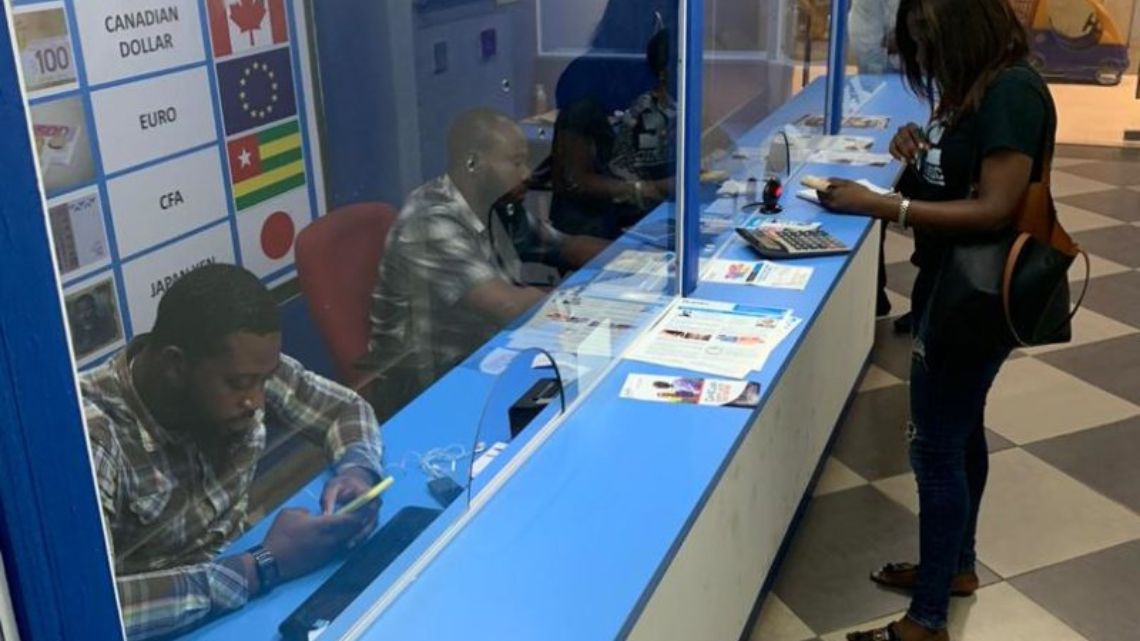
The Bank of Ghana (BoG) has declared that starting August 1, 2024, all licensed Foreign Exchange Bureaux must request the Ghana Card from individuals before conducting any transactions.
This announcement follows the launch of a centralized foreign exchange trading platform, aligned with the BoG’s goal to uphold the integrity and development of the financial system.
“Effective August 1, 2024, all licensed Foreign Exchange Bureaux will be required to use this platform for the buying and selling of foreign currencies. This initiative marks a milestone in the Bank’s efforts to ensure safe and sound operations of the foreign exchange business,” the BoG stated.
The BoG clarified that this platform will enhance oversight for bureau directors and management, and bolster the Bank’s monitoring and supervision of their operations to ensure compliance with the Foreign Exchange Act, 2006 (Act 723) and the Anti-Money Laundering Act, (Act 1044), as amended, along with other relevant notices and regulations.
To guarantee the full utilization and effectiveness of the system, the following requirements must be met:
Trading of Foreign Currencies with Licensed Dealers Only: Transactions involving the buying and selling of foreign currencies must be conducted solely with Bank of Ghana licensed foreign currency dealers, including licensed Foreign Exchange Bureaux.
Usage of the Platform: All transactions by Foreign Exchange Bureaux must be carried out on the new trading platform.
Issuance of Electronic Receipts: Foreign Exchange Bureaux are mandated to provide electronic receipts to customers for all foreign currency transactions.
Verification of Customer Identity: In accordance with Bank of Ghana’s Notice No. BG/GOV/SEC/01 titled “Use of Ghana Card for All Financial Transactions,” individuals wishing to buy or sell foreign currencies must present a Ghana Card or Passport (for Foreign Nationals) and undergo biometric verification.
The BoG also mentioned that the platform is integrated with the National Identification System to ensure that all foreign currency transactions are conducted by verified individuals. Additionally, it will be linked with the national payment platform to facilitate electronic payments and the receipt of Ghana Cedis for transactions at bureaux.
The public is reminded that foreign currency transactions must only be conducted with Bank of Ghana licensed foreign currency dealers,” the statement concluded.
The Bank of Ghana (BoG) has announced that starting August 1, 2024, all licensed Foreign Exchange Bureaux will need to verify the Ghana Card before conducting any transactions with customers.
This requirement follows the launch of a centralized foreign exchange trading platform, aimed at upholding the integrity and progress of the financial system.
“Beginning August 1, 2024, all licensed Foreign Exchange Bureaux will be mandated to utilize this platform for buying and selling foreign currencies. This initiative represents a significant step in the Bank’s efforts to ensure secure and sound operations in the foreign exchange sector,” stated a release from the BoG.
The statement further explained that the platform will enhance oversight capabilities for the Directors and Management of bureaux and improve the Bank’s ability to monitor and supervise their activities in accordance with the Foreign Exchange Act, 2006 (Act 723), the Anti-Money Laundering Act, (Act 1044), as amended, and other relevant regulations and enactments.
To achieve the full implementation and objectives of the system, the following guidelines must be followed:
Trading of Foreign Currencies with Licensed Dealers Only: The buying and selling of foreign currencies shall only be conducted at Bank of Ghana licensed foreign currencies dealers, which include licensed Foreign Exchange Bureaux.
Usage of the Platform: All Foreign Exchange Bureaux transactions shall be conducted on the new trading platform.
Issuance of Electronic Receipt: Foreign Exchange Bureaux are required to issue electronic receipt to customers for all purchases and sales of foreign currencies.
Verification of Customer Identity: In line with Bank of Ghana’s Notice No. BG/GOV/SEC/01 titled “Use of Ghana Card for All Financial Transactions”, all persons seeking to buy or sell foreign currencies must provide a Ghana Card or Passport (for Foreign Nationals) and undergo biometric verification.
The statement mentioned that the platform is linked with the National Identification System to guarantee that all foreign currency transactions are conducted by verified individuals.
Additionally, it stated that this platform will be connected to the national payment system to facilitate electronic payments and the receipt of Ghana Cedis for foreign currency transactions at bureaux.
“The public is reminded that the buying and selling of foreign currencies shall only be conducted with Bank of Ghana licensed foreign currencies dealers”, the statement concluded.
The Electoral Commission (EC) of Ghana is advocating for the Ghana Card to become the sole identification for voter registration in future elections, aiming to prevent the confrontations that marred the recent voter transfer exercise.
This exercise, notably in Weija, saw several incidents of confusion and violence, resulting in injuries, including the son of Awutu Senya East MP, Mavis Hawa Koomson.
Speaking to the media following a meeting with over 50 Civil Society Organizations (CSOs), EC Chairperson Jean Mensa highlighted the need for Parliament to pass a bill endorsing the Ghana Card as the exclusive requirement for voter registration.
She emphasized that such a change would streamline the process and reduce conflicts.
Mensa expressed satisfaction with the feedback from the CSOs, underscoring the collaborative efforts to ensure peaceful elections in the future.
“The input from the CSOs has been invaluable, and we hope Parliament recognizes the importance of the Ghana Card as the sole voter ID,” she stated.
Reflecting on the recent voter transfer exercise, Mensa noted that although it was generally successful, there were instances of unrest and conflicts.
“No lives were lost, thankfully, but the issues around the guarantor system led to parties challenging each other at the registration centers,” she said.
The EC believes that adopting the Ghana Card exclusively would eliminate such disputes, leading to more orderly and conflict-free voter registration processes.
Mensa expressed hope that Parliament will align with the EC’s proposal to adopt the Ghana Card for future elections, albeit after the 2024 elections.
“We trust that Parliament will see the necessity of this change to prevent future conflicts,” she added.
Albert Kofi Arhin, National Coordinator of the Coalition of Domestic Election Observers (CODEO), emphasized the importance of promoting peace ahead of the elections.
He highlighted the high tensions and desperation among the populace due to the economic situation. “The EC’s engagement with CSOs is crucial. We need to educate the people about peace, especially given the heightened tensions this election year,” Arhin urged.
Asylum seekers in Ghana are voicing frustration over their challenges in obtaining National Identification cards, which they say have imposed significant economic hardships by hindering their ability to secure employment and enhance their quality of life.
Refugees, speaking to Channel One News, lamented their exclusion, particularly in accessing citizenship and IDs in Ghana.
However, Chairman of the Ghana Refugee Board, Kenneth Agyemang Attafuah, revealed that the issuance of non-citizen identification cards to refugees is currently underway.
“The issuance of the non-citizen ID cards to refugees is ongoing. It continues to ensure that refugees are included in socioeconomic and other related activities in the country.”
Executive Secretary of Ghana Refugee, Tetteh Paddie, highlighted insufficient funding for supporting refugees in the country and appealed to the private sector for assistance.
“The same donor who provides fund activities to maybe Europe are the same who provide funds for us here. A lot of them are diverting to what they consider as more emergencies; the Ukraine situation, the situation in Palestine and so UNHCR is finding it difficult to fund activities in this part of the world.”
A Liberian refugee in Ghana, Dr. Felix Hughes, proposed that stakeholders empower refugees with skills to enable them to prosper and thrive.
“There’s a drive, I mean the brain drive is there, it has been in Ghana for a while, but I think that if refugees are empowered, they are given skills, some of them, can do well to sustain themselves, I think they can be able to survive.”
Acting Head of the United Nations High Commissioner for Refugees, Andrews Ginsberg, urged stakeholders to facilitate the integration of refugees into Ghanaian society.
A member of the Clergy was excited and surprised upon hearing that the Ghana Card can also perform the function of a passport.
During a meeting with the Clergy on June 10, as part of his tour of the Ashanti Region, the Vice President and flagbear of the New Patriotic Party (NPP), Dr Mahamudu Bawumia noted that the Ghana card can be used a passport should the latter go missing.
“If you travel abroad today, to USA, Japan, China, all countries Ghana and you misplace your passport, you can use your Ghana card as a passport and travel back to the country.
Shell-shocked about this assertion, the man of God in a clerical collar silently exclaimed, “Wow.”
According to the National Identification Authority (NIA), the new Ghana Card can be used for international travel within the ECOWAS region when countries in the region begin to use e-gates at their borders.
This is because its features are compliant with ICAO standards.
Also, the Ghana Card has the features of an e-passport and can be used for travels where immigration stamps are not required.
The National Health Insurance Authority (NHIA) and the National Identification Authority (NIA) have launched a partnership to register children under the age of 15, starting from June 10.
This collaboration marks a significant step towards expanding healthcare coverage and national identification for the nation’s youth.
The initiative aims to issue Ghana cards to these children, serving a dual purpose: providing access to healthcare services under the NHIS and acting as official identification through the NIA.
The joint registration drive, beginning on June 10, 2024, will establish registration centers in schools nationwide to streamline the process. This information was detailed in a statement released by the NHIA on Tuesday, June 4.
The Authority stated that by issuing Ghana cards to young individuals early, the initiative seeks to enhance their access to essential healthcare services and enable their participation in various socio-economic activities requiring official identification.
“The collaborative efforts between the two government agencies underscore Ghana’s commitment to streamlining administrative processes and broadening the reach of social services.”
“The agenda behind this joint registration drive contributes to a more inclusive society by emphasising the vital role of healthcare access and identity recognition for the Ghanaian youth,” it stated.
During a second-phase training session in Winneba for staff from the middle and northern belts of the Authority, NHIA and NIA representatives highlighted the importance of universal healthcare coverage and ensuring every child’s access to fundamental services in the country.
Mrs. Louisa Atta-Agyemang, Deputy Chief Executive in charge of Operations at NHIA, emphasized the importance of this partnership in expanding healthcare access and building a more inclusive and empowered community.
Dr. Kenneth Agyemang Attafuah, NIA Executive Secretary, highlighted the Ghana card’s role as a crucial tool for identity verification and access to public services, particularly for children aged 6 to 14 years.
Starting June 17 of this year, all children attending basic school nationwide will be assigned Ghana Card identity numbers.
This announcement was made byDr. Mahamudu Bawumia, the Flagbearer of the New Patriotic Party (NPP), during his visit to the Oti region in Dambai.
He explained that the Government has collaborated with various agencies including the Ghana Health Service, the Births and Deaths Registry (BDR), the Ghana Statistical Service, and the National Identification Authority (NIA) to integrate their systems for seamless deployment.
This integration aims to provide every child aged 0 to 13 years in Ghana with a unique identity number, linking them to their parents’ identity and ensuring their inclusion in the national identity system.
Dr Bawumia said the Ghana Card “is not just an ID, but also a promise to our children of a future, where their identity and rights are recognised from their very first birth.”
“It is a testament to our commitment to building an effective, efficient responsive and accountable public sector that meet the needs of the Ghanaian citizenry,” Dr Bawumia said.
Following this, he embarked on a tour to the Dambai Saturday market, where the market women warmly greeted him.
Other traders and residents also gathered around, eager to catch a glimpse of him as he stopped to exchange pleasantries with them.
This visit extended Dr. Bawumia and his campaign team’s time by close to an hour before they proceeded to the Presbyterian Church, where he was scheduled to meet with the participants of ‘Youth Connect.’
Throughout the campaign tour, supporters have demonstrated vibrant hospitality, expressing their confidence in his leadership and the NPP’s capacity to guide the country towards greater success.
The Flagbearer of the New Patriotic Party (NPP), Dr. Mahamudu Bawumia, has declared that the government’s payroll is now free from ghost names.
He attributed this achievement to the integration of the Ghana Card into the national digital system.
In an audio excerpt circulated on GHOne TV, Dr. Bawumia, also serving as the country’s Vice President, confidently asserted that the absence of ghost workers on the government payroll is directly linked to the utilization of the Ghana Card.
“So now, we can confidently say that because of the use of the Ghana Card, we don’t have ghost workers on government payroll anymore,” he stated.
While the exact context of his statement remains unclear, it’s noteworthy that the Ghana Card has emerged as the primary identification card in the nation.
Furthermore, the Electoral Commission has signaled its intent to reintroduce a bill in parliament, advocating for the Ghana Card to serve as the sole document for citizenship identification during voter registration.
In the meantime, viewers are encouraged to catch up on the latest episode of The Lowdown on GhanaWeb TV.
Etsey Atisu hosts a discussion with Davis Ansah Opoku, the MP for Mpraeso, addressing pertinent issues such as the E-Levy, the Saglemi Housing Controversy, and the ongoing OSP Impeachment saga.
Join us for a comprehensive examination of these significant topics shaping Ghana’s current landscape.
The Presidential Candidate of the New Patriotic Party (NPP), Dr. Mahamudu Bawumia, has asserted that the government payroll is now free of phantom employees.
He attributed this achievement to the incorporation of the Ghana Card into the nation’s digital infrastructure.
In an audio recording aired on X by GHOne TV, the presidential candidate, who also serves as the country’s incumbent vice president, confidently stated that the absence of fictitious workers from the government payroll is a direct result of the implementation of the Ghana Card system.
“So now, we can confidently say that because of the use of the Ghana Card, we don’t have ghost workers on government payroll anymore,” he stated.
The source of his statement remains unclear, but it’s noteworthy that the Ghana Card has emerged as the primary identification card in the nation.
Additionally, the Electoral Commission has announced its intention to reintroduce a bill in Ghana’s parliament, advocating for the Ghana Card to serve as the exclusive document for verifying citizenship during voter registration.
In the meantime, don’t miss the latest episode of The Lowdown on GhanaWeb TV, where Etsey Atisu engages in a conversation with Mpraeso’s Member of Parliament, Davis Ansah Opoku, addressing topics such as the E-Levy, the Saglemi Housing Controversy, and the OSP Impeachment.
The Electoral Commission (EC) has revealed that fraudulent Ghana Card numbers were used to register some individuals at the Pusiga District Registration Centre during the ongoing voter registration process on May 13, 2024.
It was found that approximately 17 individuals had used fake Ghana Card numbers during the registration exercise at this centre.
The implicated Registration Officer was dismissed and subsequently arrested after a report was made to the police.
In a statement issued on Monday, May 20, the EC disclosed that the Registration Officer was found to be complicit in the fraud.
The EC explained that the officer failed to physically verify the Ghana Cards of each applicant and instead accepted the fraudulent numbers from Party Agents who had accompanied the 17 applicants.
“Upon investigation, it was revealed that the Ghana Card numbers were fake. It was further discovered that the Registration Officer was complicit because he did not physically inspect the Ghana Card of individual applicants but rather accepted the fake numbers from Party Agents who had accompanied the 17 applicants.
“The Registration Officer was dismissed. A report was made to the Police and he was arrested. He has since been granted a police enquiry bail while the Police continue with their investigations. The 17 Applicants were subsequently registered through the Guarantor System.”
The Electoral Commission (EC) has emphasized that the recent violence witnessed during the limited voter registration process validates its proposition to utilize the Ghana Card as the exclusive document for registration.
The commission has noted instances of violence at certain registration centers, primarily stemming from disputes over the age and citizenship status of registrants.
However, it contends that such conflicts could have been mitigated had the Ghana Card been adopted as the sole registration credential.
During a press conference held on May 13, 2024, to provide an update on the limited voter registration, Deputy Electoral Commissioner Dr. Bossman Asare urged party agents to utilize the challenge process instead of physically obstructing registrants.
“We have also noticed that some of the disturbances occurring at some of our registration centres are due to the fact that some people are doubting the ages of some of the applicants. This is the reason why the commission has been advocating for the usage of the Ghana Card, which has the date of birth and the nationality of the bearers of the card and the abolishment of the guarantor system.
“We are hopeful that in the next registration exercise, applicants will use the Ghana card as the means of identification,” he stated.
In a bid to protect its customers against fraudsters and fraudulent activities, the Mobile Money Advocacy Group Ghana (MOMAG) has issued a warning to mobile phone users regarding fraudulent activities associated with SIM card registration.
The group in a release dated May 9, 2024 explained how “unscrupulous agents” use register SIM cards using the Ghana card other customers unbeknownst to the owners of the card.
Their trick is that they “will register two of the cards, with the excuse that the first one was not successful due to network challenges. They secretly keep the other cards and later use them for fraudulent activities or sometimes sell them at exorbitant prices to people without Ghana Cards,” MOMAG explained.
A large number of people who fall victim to these fraud MOMAG says are females.
“Incidentally, quite a greater number of the victims are females – Over 90% Again, some of our Ghanaian ladies who befriend some male of foreign nationals are coaxed into registering SIM Cards with their Ghana Cards. Some of these men will then use the SIM Cards to perpetrate fraudulent activities,” MOMAG added.
In light of this, the group has taken proactive measures by informing the “ National Communications Authority (NCA) on this issue in the year 2023, but no action has been taken yet. We humbly appeal to the NCA to take necessary action to protect citizens by curbing this menace. This, we believe, will prevent or reduce such fraudulent activities”.
MOMAG is ready to provide the numbers used by these fraudsters to the NCA to assist in any investigation.
“To nip this issue in the bud, we strongly suggest that the authorities take immediate action, by launching a public awareness campaign through electronic (radio and television) and print media to educate the public to shun the use of their Ghana cards to buy SIM cards for friends,” MOMAG added.
While they advised the public against leaving their damaged cards with MoMo agents, they also sent caution to these dubious agents involved in these unscrupulous acts.
“…the public should be educated to collect their damaged SIM cards from agents if they are told the card is damaged or gone bad during the registration process. What is more, we are sending a word of caution to these bad Agents, who are aiding the fraudsters by registering SIMs or selling “registered SIM Cards” (pre-registered) to them. We urge such Agents to stop such activities immediately. Should the association get hold of such bad agents, we would report them to the police to face the full rigours of the law”
The adjustments are in accordance with the Fees and Charges (Miscellaneous Provisions) Regulations, 2023 (L.I. 2481) passed by Parliament in February 2024.
The new rates apply to three main areas of Ghana Card services: First Time Registration, Replacement of Cards, and Personal Information Update Service.
FIRST TIME REGISTRATION
First-Time Registration – NIA District Office: Free
Record Update with replacement of card – ECOWAS sub-region: US$27.50
Record Update with replacement of card – Rest of Africa: US$37.50
Record Update with replacement of card – Countries outside Africa: US$57.50
The Ghana Card is a secure and multi-purpose card used for verifying and authenticating electronic and physical transactions in both public and private services. It establishes the biometric identity of the holder.
The registration is open to three categories of people: all Ghanaian citizens by birth (descent), registration, or naturalization aged zero years and above currently residing in Ghana; all Ghanaian citizens living abroad; and foreign nationals legally or permanently resident in Ghana.
Broadcast journalist and Managing Editor of ABCNews, Gordon Asare-Bediako, has voiced strong opposition to the recent increase in fees for the Ghana Card.
Asare-Bediako, who also hosts “Ghana Rising & Bɛkyerɛ Mu” on Wontumi Radio and is part of the New Patriotic Party’s (NPP) campaign team for the 2024 elections, criticized the government for imposing what he sees as an unfair financial burden on Ghanaians.
He questioned the rationale behind the new charges, asking, “What crime have Ghanaians committed?” to warrant such high fees for obtaining or replacing the national identification card.
Highlighting the gap between the leadership and the grassroots, Asare-Bediako stressed the need for immediate attention to the matter.
“Sometimes when we speak, our leaders argue that when issues arise, we need to take our time. We are also on the ground and hear about things that are going on,” he said, recounting the palpable anger he observed among the people regarding the new charges.
“I witnessed this on Saturday and the way people are angry. For the new charges, if President Akufo-Addo himself were to make an announcement, I would expect Dr. Bawumia to also issue a counter-announcement. What crime have Ghanaians committed? People struggled greatly to register for this Ghana Card, and perhaps by mistake, some have misplaced it. And yet, you’re discussing such high charges. What kind of madness is this?
“Nobody can defend this rubbish,” he declared on a panel discussion on Wontumi radio on April 22, 2024. “Forgive me for using harsh words, but these are the realities. Nobody can defend this rubbish, and if you guys go ahead to do this, kiss 2024 goodbye. Why?”
Asare-Bediako’s remarks were particularly pointed towards the NPP, warning that such decisions could have adverse effects on their performance in the upcoming elections. He called on Vice President Dr. Mahamudu Bawumia, the NPP’s flagbearer, to address the people’s concerns and not to risk his electoral prospects.
The National Identification Authority (NIA) has announced that the fee increases will start on May 1, 2024, in accordance with the ‘Fees and Charges’ regulation L.I. 2481.
This adjustment will affect those applying for new Ghana Cards or updating their information, stirring debate about the financial impact on citizens.
This decision is in line with the provisions outlined in the ‘Fees and Charges’ (Miscellaneous Provision Regulations, 2023) L.I. 2481.
The adjustment in fees, as announced by the authority, applies to individuals seeking to obtain national identification cards, commonly known as Ghana Cards, or those intending to update their existing information.
Citizens are advised to take note of the impending changes and plan accordingly for any upcoming registration or information update requirements.
Managing Editor of ABCNews, Gordon Asare-Bediako, has condemned the recently announced hikes in fees and charges for obtaining or replacing a Ghana Card.
Asare-Bediako, who doubles as a communication team member of the ruling New Patriotic Party (NPP), minced no words as he lambasted the government for what he perceived as an unjust burden on the citizens.
According to him, the Ghanaian populace has committed no offence warranting such treatment.
He expressed dismay at the new charges, emphasising the hardships citizens endure to obtain the Ghana Card, only to face exorbitant fees for replacements. “What crime have Ghanaians committed?” he questioned.
Asare-Bediako directed his criticism specifically at the NPP, cautioning that their actions could cost them in the upcoming 2024 elections.
He urged Vice President Dr. Mahamudu Bawumia, who is also the NPP’s flagbearer, not to jeopardise his chances by ignoring the grievances of the people.
Drawing attention to the disconnect between the leadership and the grassroots, Asare-Bediako emphasised the urgency of addressing the issue.
“Sometimes when we speak, our leaders argue that when issues arise, we need to take our time. We are also on the ground and hear about things that are going on.
“I witnessed this on Saturday and the way people are angry. For the new charges, if President Akufo-Addo himself were to make an announcement, I would expect Dr. Bawumia to also issue a counter-announcement.
“What crime have Ghanaians committed? People struggled greatly to register for this Ghana Card, and perhaps by mistake, some have misplaced it. And yet, you’re discussing such high charges. What kind of madness is this?
“Nobody can defend this rubbish. Forgive me for using harsh words, but these are the realities. Nobody can defend this rubbish, and if you guys go ahead to do this, kiss 2024 goodbye. Why?” he said on a panel discussion on Wontumi radio on April 22, 2024.
The National Identification Authority (NIA) has announced its intention to increase fees for registration services, starting from Wednesday, May 1, 2024.
This decision aligns with the regulations outlined in the ‘Fees and Charges’ (Miscellaneous Provision Regulations, 2023) L.I. 2481.
The fee adjustment, as outlined by the authority, will affect individuals applying for national identification cards, also known as Ghana Cards, as well as those wishing to update their existing information.
Broadcast journalist and Managing Editor of ABCNews, Gordon Asare-Bediako, has voiced strong opposition to the recent increase in fees for the Ghana Card.
Asare-Bediako, who also hosts “Ghana Rising & Bɛkyerɛ Mu” on Wontumi Radio and is part of the New Patriotic Party’s (NPP) campaign team for the 2024 elections, criticized the government for imposing what he sees as an unfair financial burden on Ghanaians.
He questioned the rationale behind the new charges, asking, “What crime have Ghanaians committed?” to warrant such high fees for obtaining or replacing the national identification card.
Highlighting the gap between the leadership and the grassroots, Asare-Bediako stressed the need for immediate attention to the matter.
“Sometimes when we speak, our leaders argue that when issues arise, we need to take our time. We are also on the ground and hear about things that are going on,” he said, recounting the palpable anger he observed among the people regarding the new charges.
“I witnessed this on Saturday and the way people are angry. For the new charges, if President Akufo-Addo himself were to make an announcement, I would expect Dr. Bawumia to also issue a counter-announcement. What crime have Ghanaians committed? People struggled greatly to register for this Ghana Card, and perhaps by mistake, some have misplaced it. And yet, you’re discussing such high charges. What kind of madness is this?
“Nobody can defend this rubbish,” he declared on a panel discussion on Wontumi radio on April 22, 2024. “Forgive me for using harsh words, but these are the realities. Nobody can defend this rubbish, and if you guys go ahead to do this, kiss 2024 goodbye. Why?”
Asare-Bediako’s remarks were particularly pointed towards the NPP, warning that such decisions could have adverse effects on their performance in the upcoming elections. He called on Vice President Dr. Mahamudu Bawumia, the NPP’s flagbearer, to address the people’s concerns and not to risk his electoral prospects.
The National Identification Authority (NIA) has announced that the fee increases will start on May 1, 2024, in accordance with the ‘Fees and Charges’ regulation L.I. 2481.
This adjustment will affect those applying for new Ghana Cards or updating their information, stirring debate about the financial impact on citizens.
A significant milestone has been achieved with the onboarding of 2456 pharmacies onto the National E-Pharmacy Platform, marking a major advancement for digital healthcare in Ghana.
The nationwide e-pharmacy platform, comprising registered pharmacies, offers the convenience of uploading and purchasing prescribed medicines online, with doorstep delivery upon registration using the Ghana card.
This initiative is part of the government’s agenda to digitize public services and is the result of collaboration between the Office of the Vice President, the Pharmacy Council, and the Pharmaceutical Society of Ghana.
In 2019, Vice President Bawumia urged the Pharmaceutical Society of Ghana to digitize pharmacy services, leading to the introduction of Africa’s first national-scale e-pharmacy platform.
Launched by Vice President Dr. Mahamudu Bawumia in July 2023 and piloted for six months, the e-pharmacy platform went live in January this year.
Ghana’s pioneering national e-pharmacy platform, with over 2000 participating pharmacies, expands access to digital healthcare across the country.
Upon registration with a Ghana card on the e-pharmacy platform, prescriptions can be uploaded via mobile phone or USSD code at https://www.gnepplatform.com/.
Subscribers can locate nearby pharmacies and check medicine availability, as well as compare prices across different pharmacies.
Using their mobile phones, subscribers can order and pay for medicines, which are then delivered to their homes or specified locations via digital address.
The authenticity of drugs is ensured through integration with the Food and Drugs Authority (FDA) platform, providing peace of mind to users.
This discovery has sparked debates about the NIA’s competence and its ability to defend Ghana’s interests in the Ghana Card Public-Private Partnership (PPP) with Margins Group.
The issue was brought to light by an X user, Sharudeen Yahya, who tagged the Vice President of IMANI Africa, Bright Simons.
Mr Simons raised concerns about the NIA’s lack of originality and its reliance on copied content. He argued that the real problem lies not in the act of plagiarism itself but in the NIA’s apparent incompetence and disregard for Ghana’s interests.
1/ Finally! De-zombification? Ghana's NIA removes webpages copied verbatim from UAE agency websites because it couldn't even bother to create its own. The real issue isn't plagiarism. It is that the NIA isn't fit to defend Ghana's interest in the Ghana Card PPP with Margins. https://t.co/2VV0Bbpplc
Earlier, Mr Simons alleged that Ghana’s National Identification System, also known as the “Ghana Card” is owned by a company called Margins Group and not the government of Ghana.
He is of the view that the National Identification Authority (NIA) is no longer useful, describing it as a “zombie” as “it lacks the capacity to develop specifications and to exercise serious oversight.”
He made this claim in an article in which he provided an extensive analysis of his research.
“Ghana Card’s main technology asset base belongs to Margins Group, not the government of Ghana,” he wrote.
According to him, this makes it impossible for the government to save money by using smart procurement to obtain the printed cards, biometric devices, and system integrations.
“It must get everything from Margins alone. Ghana Card, as a system, cannot be operated without Margins, so the idea that the government “owns” the data is meaningless.”
Mr Simons noted that due to Margins Group’s ownership of the Ghana Card, each unit costs Ghana nearly 20 times what a similar smartcard costs Rwanda.
“The Ghana Card Public Private Partnership (PPP) agreement between NIA was supposed to be cost-neutral to the government. It was to pay a startup contribution of $124 million and then recoup over time as revenues come in. However, the “revenues” are a sham since they come from the same government,” he added.
He asserts that by 2033, the Ghana card system would have generated revenue of $1.44 billion. However, this money, he said will be paid to Margins Group.
“Government of Ghana is therefore going to end up paying up all the $1.44 billion revenues the system is designed to generate by 2033, and Margins will get virtually all of the money.”
1/ Most Ghanaians think that Ghana Card is the greatest thing since sliced bread. They don't know that they are being ripped off. The lack of awareness is a product of "State Enchantment". This essay is the first attempt to de-hypnotise the masses.https://t.co/cbUVQpTRvU
The National Identification System (NIS), project contract is being executed under a Public Private Partnership (PPP) agreement between NIA and Identity Management Systems (IMS), a subsidiary of the Margins Group of companies.
The cost of the project is jointly shared by the parties. NIA’s component of the contract sum is $124 million, which caters for operations in both Ghana and abroad to register and issue smart, biometric, chip-embedded ID cards to all Ghanaians aged 15 years and over, and 2-dimentional bar code cards to all Ghanaians under 15 years old. The cost of the project to IMS is $169 million. All subsequent costs will be covered by proceeds from the project over the contract term of 15 years.
Unlike other traditional contracts, IMS will not be given any money by the Government of Ghana.
It will be recalled that the Minority in Parliament issued a press statement on 10 June 2018 in which it admitted to having received documents from NIA which it subsequently approved, showing the total life cost of the project over 15 years as $1.2bn with tax exemption of $176million. It is baffling that the NIA will be accused of bloating the contract sum which it presented to all members of Parliament. th
It must be emphasised that the cost per smart card issued to Ghanaians 15years and above is $5.40, while the cost per 2D bar code card issued to Ghanaians under 15years is $1.50.
It is factually not correct that nationals of India are issued with a biometric ID card. What India issues to its nationals is merely a Personal Identification Number; India does not provide its citizens with any form of identity cards whatsoever.
The closest national ID cards that can be compared to the Ghana Card, in terms of their physical characteristics and technical functionalities, are those of Rwanda and Nigeria. The Rwandan national ID card is a multipurpose card with a 64-kilobyte chip which contains the bearer’s passport, driving licence and health insurance information. The Ghana Card has a 148-kilobyte capacity chip and greater functionalities than the Rwandan card. The Ghana Card also has 14 applets, and far transcends Rwanda’s, and it also has a passport for travel within West Africa. There are also three international ID profiles on the Ghana Card. Information from other data silos, such as the DVLA, NHIA, SSNIT and GIS may be incorporated onto the Ghana card.
The Rwandan biometric ID card will be optionally available at a cost of $18.17 while the Ghana card costs $5.40, and is issued free of charge to Ghanaian citizens in Ghana.
The NIA-IMS contract costs have undergone Value-For-Money (VFM) audits by the Public Procurement Authority (PPA) and have also been thoroughly assessed by the Public Investments Division of the Ministry of Finance. The contract has also been reviewed by the Attorney-General’s Department and the Legal Unit of the Ministry of Finance. In addition, the contract has been reviewed and given approval by the Public Private Partnership Approval Committee (PPPAC) of the Ministry of Finance, as well as the Economic Management Team of Government. It has also received Cabinet approval.
Copies of the draft Contract were distributed to all 275 members of Parliament, and appropriate waivers for import duty exemptions were also granted by Parliament prior to the contract being executed by the parties in April 2018.
Further information on the NIS project could be found on NIA’s website www.nia.gov.gh
Vice President of IMANI Africa, Bright Simons, has indicated that Ghana would forfeit the revenue generated from Ghana’s National Identification System, also known as the “Ghana Card” to one Margins Group.
He alleged that the Ghana National Identification System is owned by a company called Margins Group and not the government of Ghana.
Mr Simons noted that due to Margins Group’s ownership of the Ghana Card, each unit costs Ghana nearly 20 times what a similar smartcard costs Rwanda.
He made this claim in an article in which he provided an extensive analysis of his research.
“The Ghana Card Public Private Partnership (PPP) agreement between NIA was supposed to be cost-neutral to the government. It was to pay a startup contribution of $124 million and then recoup over time as revenues come in. However, the “revenues” are a sham since they come from the same government.”
“Government of Ghana is therefore going to end up paying up all the $1.44 billion revenues the system is designed to generate by 2033, and Margins will get virtually all of the money.”
According to him, this makes it impossible for the government to save money by using smart procurement to obtain the printed cards, biometric devices, and system integrations.
“It must get everything from Margins alone. Ghana Card, as a system, cannot be operated without Margins, so the idea that the government “owns” the data is meaningless.”
He is of the view that the National Identification Authority (NIA) is no longer useful, describing it as a “zombie” as “it lacks the capacity to develop specifications and to exercise serious oversight.”
1/ Most Ghanaians think that Ghana Card is the greatest thing since sliced bread. They don't know that they are being ripped off. The lack of awareness is a product of "State Enchantment". This essay is the first attempt to de-hypnotise the masses.https://t.co/cbUVQpTRvU
The National Identification System (NIS), project contract is being executed under a Public Private Partnership (PPP) agreement between NIA and Identity Management Systems (IMS), a subsidiary of the Margins Group of companies.
The cost of the project is jointly shared by the parties. NIA’s component of the contract sum is $124 million, which caters for operations in both Ghana and abroad to register and issue smart, biometric, chip-embedded ID cards to all Ghanaians aged 15 years and over, and 2-dimentional bar code cards to all Ghanaians under 15 years old. The cost of the project to IMS is $169 million. All subsequent costs will be covered by proceeds from the project over the contract term of 15 years.
Unlike other traditional contracts, IMS will not be given any money by the Government of Ghana.
It will be recalled that the Minority in Parliament issued a press statement on 10 June 2018 in which it admitted to having received documents from NIA which it subsequently approved, showing the total life cost of the project over 15 years as $1.2bn with tax exemption of $176million. It is baffling that the NIA will be accused of bloating the contract sum which it presented to all members of Parliament. th
It must be emphasised that the cost per smart card issued to Ghanaians 15years and above is $5.40, while the cost per 2D bar code card issued to Ghanaians under 15years is $1.50.
It is factually not correct that nationals of India are issued with a biometric ID card. What India issues to its nationals is merely a Personal Identification Number; India does not provide its citizens with any form of identity cards whatsoever.
The closest national ID cards that can be compared to the Ghana Card, in terms of their physical characteristics and technical functionalities, are those of Rwanda and Nigeria. The Rwandan national ID card is a multipurpose card with a 64-kilobyte chip which contains the bearer’s passport, driving licence and health insurance information. The Ghana Card has a 148-kilobyte capacity chip and greater functionalities than the Rwandan card. The Ghana Card also has 14 applets, and far transcends Rwanda’s, and it also has a passport for travel within West Africa. There are also three international ID profiles on the Ghana Card. Information from other data silos, such as the DVLA, NHIA, SSNIT and GIS may be incorporated onto the Ghana card.
The Rwandan biometric ID card will be optionally available at a cost of $18.17 while the Ghana card costs $5.40, and is issued free of charge to Ghanaian citizens in Ghana.
The NIA-IMS contract costs have undergone Value-For-Money (VFM) audits by the Public Procurement Authority (PPA) and have also been thoroughly assessed by the Public Investments Division of the Ministry of Finance. The contract has also been reviewed by the Attorney-General’s Department and the Legal Unit of the Ministry of Finance. In addition, the contract has been reviewed and given approval by the Public Private Partnership Approval Committee (PPPAC) of the Ministry of Finance, as well as the Economic Management Team of Government. It has also received Cabinet approval.
Copies of the draft Contract were distributed to all 275 members of Parliament, and appropriate waivers for import duty exemptions were also granted by Parliament prior to the contract being executed by the parties in April 2018.
Further information on the NIS project could be found on NIA’s website www.nia.gov.gh
Vice President of IMANI Africa, Bright Simons, has alleged that Ghana’s National Identification System, also known as the “Ghana Card” is owned by a company called Margins Group and not the government of Ghana.
He made this claim in an article in which he provided an extensive analysis of his research.
“Ghana Card’s main technology asset base belongs to Margins Group, not the government of Ghana,” he wrote.
According to him, this makes it impossible for the government to save money by using smart procurement to obtain the printed cards, biometric devices, and system integrations.
“It must get everything from Margins alone. Ghana Card, as a system, cannot be operated without Margins, so the idea that the government “owns” the data is meaningless.”
Mr Simons noted that due to Margins Group’s ownership of the Ghana Card, each unit costs Ghana nearly 20 times what a similar smartcard costs Rwanda.
“The Ghana Card Public Private Partnership (PPP) agreement between NIA was supposed to be cost-neutral to the government. It was to pay a startup contribution of $124 million and then recoup over time as revenues come in. However, the “revenues” are a sham since they come from the same government,” he added.
He asserts that by 2033, the Ghana card system would have generated revenue of $1.44 billion. However, this money, he said will be paid to Margins Group.
“Government of Ghana is therefore going to end up paying up all the $1.44 billion revenues the system is designed to generate by 2033, and Margins will get virtually all of the money.”
He is of the view that the National Identification Authority (NIA) is no longer useful, describing it as a “zombie” as “it lacks the capacity to develop specifications and to exercise serious oversight.”
1/ Most Ghanaians think that Ghana Card is the greatest thing since sliced bread. They don't know that they are being ripped off. The lack of awareness is a product of "State Enchantment". This essay is the first attempt to de-hypnotise the masses.https://t.co/cbUVQpTRvU
The National Identification System (NIS), project contract is being executed under a Public Private Partnership (PPP) agreement between NIA and Identity Management Systems (IMS), a subsidiary of the Margins Group of companies.
The cost of the project is jointly shared by the parties. NIA’s component of the contract sum is $124 million, which caters for operations in both Ghana and abroad to register and issue smart, biometric, chip-embedded ID cards to all Ghanaians aged 15 years and over, and 2-dimentional bar code cards to all Ghanaians under 15 years old. The cost of the project to IMS is $169 million. All subsequent costs will be covered by proceeds from the project over the contract term of 15 years.
Unlike other traditional contracts, IMS will not be given any money by the Government of Ghana.
It will be recalled that the Minority in Parliament issued a press statement on 10 June 2018 in which it admitted to having received documents from NIA which it subsequently approved, showing the total life cost of the project over 15 years as $1.2bn with tax exemption of $176million. It is baffling that the NIA will be accused of bloating the contract sum which it presented to all members of Parliament. th
It must be emphasised that the cost per smart card issued to Ghanaians 15years and above is $5.40, while the cost per 2D bar code card issued to Ghanaians under 15years is $1.50.
It is factually not correct that nationals of India are issued with a biometric ID card. What India issues to its nationals is merely a Personal Identification Number; India does not provide its citizens with any form of identity cards whatsoever.
The closest national ID cards that can be compared to the Ghana Card, in terms of their physical characteristics and technical functionalities, are those of Rwanda and Nigeria. The Rwandan national ID card is a multipurpose card with a 64-kilobyte chip which contains the bearer’s passport, driving licence and health insurance information. The Ghana Card has a 148-kilobyte capacity chip and greater functionalities than the Rwandan card. The Ghana Card also has 14 applets, and far transcends Rwanda’s, and it also has a passport for travel within West Africa. There are also three international ID profiles on the Ghana Card. Information from other data silos, such as the DVLA, NHIA, SSNIT and GIS may be incorporated onto the Ghana card.
The Rwandan biometric ID card will be optionally available at a cost of $18.17 while the Ghana card costs $5.40, and is issued free of charge to Ghanaian citizens in Ghana.
The NIA-IMS contract costs have undergone Value-For-Money (VFM) audits by the Public Procurement Authority (PPA) and have also been thoroughly assessed by the Public Investments Division of the Ministry of Finance. The contract has also been reviewed by the Attorney-General’s Department and the Legal Unit of the Ministry of Finance. In addition, the contract has been reviewed and given approval by the Public Private Partnership Approval Committee (PPPAC) of the Ministry of Finance, as well as the Economic Management Team of Government. It has also received Cabinet approval.
Copies of the draft Contract were distributed to all 275 members of Parliament, and appropriate waivers for import duty exemptions were also granted by Parliament prior to the contract being executed by the parties in April 2018.
Further information on the NIS project could be found on NIA’s website www.nia.gov.gh
This is a fairly long essay, so here is the quick take for those too busy to read.
Ghana Card’s main technology asset base belongs to Margins Group, not the government of Ghana.
This makes it impossible for the government to save cost by using smart procurement to obtain the printed cards, biometric devices, and system integrations. It must get everything from Margins alone.
Ghana Card, as a system, cannot be operated without Margins, so the idea that the government “owns” the data is meaningless.
The government agency in the Ghana Card PPP, NIA, has become a “zombie”; it lacks the capacity to develop specifications and to exercise serious oversight. Some senior parliamentarians are also mere praise-singers of Margins.
Due to the stranglehold Margins has over the Ghana Card, each unit costs Ghana nearly 20 times what a similar smartcard costs Rwanda.
The Ghana Card PPP was supposed to be cost neutral to the government. It was to pay a startup contribution of $124 million and then recoup over time as revenues come in. However, the “revenues” are a sham since they come from the same government.
Government of Ghana is therefore going to end up paying up all the $1.44 billion revenues the system is designed to generate by 2033, and Margins will get virtually all of the money.
Now, let us get into the meat.
Some senior MPs are making it hard to take Ghana’s Parliament seriously
A few weeks ago, members of the “subsidiary legislation” committee of Ghana’s Parliament visited one of the factories of Margins Group, the company that owns Ghana’s National Identification System, the so-called “Ghana Card”. The powerful committee makes virtually all the administrative and regulatory laws that govern many day-to-day functions of the administrative state and its government.
Even though concerns about Ghana Card are a matter of periodic inquiries before the Parliament, the Chair of the Committee, the Member for Bolgatanga East, could not contain his enthusiasm to declare the Opposition Party’s unrestrained support for anything Ghana Card. Given his premature and prejudicial excitement, one wonders how anyone can expect the Parliament, as presently constituted, to exercise any serious oversight in the matter.
The MP’s behaviour is reminiscent of another visit to another company, whose business relationship with Ghana has come under severe scrutiny, SML. Even whilst the matter was under investigation by Parliament, and concurrently by the Presidency, the Chair of a powerful parliamentary committee rushed to the premises of the company to pass very prejudicial comments about the ongoing investigations. He insisted that he had observed “world class monitoring” activity on the premises, the very issue being probed. This was curious since the President of Ghana had announced a suspension of the company’s activities whilst investigations continued.
How then was the MP, the Honourable Member for Akim Abuakwa South, able to observe “world class monitoring” in an operation halted by no mean person than the President of the Republic? How?
State Enchantment
It has become clear for some time now that the institutions set up to safeguard the public interest in Ghana have been performing below par. In some cases, the results suggest that they may even have become compromised.
Even more concerning is a trend best described by this term: “state enchantment”, a process by which projects primarily intended to enrich private actors are wrapped up in spectacular clothes of national glory, so radiant that the public is perpetually blinded as to the underlying commercial motives. The “haze of glory” surrounding these projects makes any call for scrutiny easily dismissible as bizarre negativity.
Such state enchantment programs benefit massively in an environment such as Ghana, where the official watchdogs like Parliament and the anti-graft institutions have powerful actors within who compromise these institutions’ oversight functions in relation to these same programs.
This author recently had the opportunity to talk about this at an event organized by some respected institutions. One of the case studies highlighted in the talk was, unsurprisingly, Ghana Card.
Ghana Card, for reasons to be offered shortly, is one of the most brazenly potent examples of state enchantment ever conceived.
What is Ghana Card?
Creating a general-purpose ID card for Ghanaians is a national dream of old. The military regime after the Second Republic acted on this and distributed some cards starting with areas around Ghana’s land borders. Not much progress was made thereafter.
After various fits and starts, the National Identity Authority was set up in 2003 and its enabling legislation passed in 2006 (Act 707). A strategy was taken to issue cards to both Ghanaians at home and abroad.
In the perennial confusion and amidst the jostling for rents by elites that attend every public project in Ghana, the project got stuck. Even though loans sourced from France for French contractor, Sagem Morpho, and “counterpart funding” from the Ghanaian government, led to a $60 million budget being put together by 2008, time was too short; the government of the day lost elections at the end of that year and the new government, as is customarily, decided to restructure the entire project. Margins was a subcontractor to Sagem in that initial run.
After 8 years, some progress had been made, but significant challenges remained. Activist organisations like IMANI pointed out a wide range of defects in the prevailing regime which unchecked would undermine outcomes over time. Before the sitting government could get a grip on the project, they also lost power.
Wastefulness
When the new government arrived on the scene in 2017, 15 million Ghanaians were already captured in the national database, and the entire infrastructure (except the foreigners segment) was primarily controlled by the State.
What remained was the development of value-adding authentication modules on top of the national database, the perfection of a higher-spec physical card production process, and a distribution system to ensure that printed cards could get to their owners. So weak was the initial logistics solution that even though 2.7 million cards had already been produced by 2013, only 900,000 had been distributed by then. By the end of 2016, 50% of the 3 million printed cards remained uncollected. A new biometric data collection system held data for 4.5 million Ghanaians (less than 30% target penetration).
Fixing project challenges, the Ghana Way
When the new government took the reins of power in 2017, the usual review of programs occurred. Having identified the problem as being one of inadequate resources, all that was necessary was to determine the right level of government financial commitment, prioritise efficient procurement, and cut out waste due to poor logistics planning.
Instead, the government decided to start all over again, discard the old databases on grounds of forward-incompatibility of the technology stack, and enter into a new public-private partnership (PPP) contract with the Margins group. This is the precise moment when the state enchantment effort began.
What had been a routine bureaucratic program of identifying citizens, something that many Francophone countries have been doing for decades without fanfare, suddenly became a messianic affair of Marian proportions. All of a sudden, every problem in Ghana was only solvable by “Ghana Card”.
Many have been swayed by these antics, and the more hard-nosed among the population merely dismiss the hype as the usual dross of PR-centric Ghanaian political showboating. In this essay, however, the intent is to show how the PPP model by its very design requires such high levels of state enchantment to operate. It also explains why all levers of state power has been brought to bear to force the Ghana Card on the population in order to artificially inflate its importance.
How did Margins get in? (Nice contract if you can get it)
The subsidiary of the Margins group that entered into the PPP with the NIA to roll out the Ghana Card solution is Identity Management Services (IMS). IMS got its muscle from a joint venture it initiated with American and Danish investors to print cards for the first incarnation of the Ghana Card in 2003 when the design was based on State control of the system, with contractors just producing the cards and selling equipment. IMS had the local relationships, the Danes and Americans had the technology and fund-raising capacity.
With both local and international connections in place, the Margins Group would benefit from a million-dollar grant from the Danish government to cover its part of the joint investment. In total, $3.5 million in Danish funding went to the partners in a nice blend of grant funding and commercial credit. The Danish development finance institution, IFU, doubled down on the project with additional credit of $5 million by 2015.
With financial muscle comes influence, and so Margins was able to convince the NIA to enter into a PPP in 2013 to handle just the registration of foreigners in Ghana. The template was thus set for the current wide-ranging relationship consummated with the 2018 PPP agreement.
Why PPPs can unblock resources in Ghana
The impression created that somehow the PPP for the national ID card program in Ghana unlocked fresh private sector resources and saved the government money is of course abject nonsense. regardless of the precise model, in the end, the money would have come from the government.
What is true however is that crafting the program as a PPP did make the government more willing to release money. Somehow, just having a big private beneficiary driving outcomes propels government institutions to unlock large amounts of money they would never otherwise had released if a government agency was the one driving the project. Furthermore, entrusting the asset base of the project to a private businessman appeared to have created the necessary motivation across all levels for the project to succeed. This is the only reason why Ghana Card issuance has successfully been boosted to ~17 million Ghanaians.
Who owns the Ghana Card Assets
There are a number of key systems that make the Ghana Card work:
A datacenter to store the data, including the biometrics.
Database software to organize the data effectively for retrieval, validation and updating.
A special memory chip to contain the identification information stored on the physical smartcard.
Unique cryptographic and encryption solutions, plus the accompanying cybersecurity techniques, to prevent manipulation of the data and enable authentication of the individual.
A stack of security features to prevent unauthorized issuance, alteration and duplication of cards.
Biometric capturing, de-duplication, and validation systems.
As mentioned previously, the data collected is meaningless unless organized and deployed by such assets. That is why the 15 million citizen data points collected by 2016 did not translate into much; the asset base was not adequate.
When Margins Group says that “government of Ghana” owns the Ghana Card data, it is not being candid. It owns the assets and infrastructure that makes the data usable.
The best way to emphasise the reality of things as currently pertains in Ghana is to say that WITHOUT MARGINS, GOVERNMENT OF GHANA CANNOT OPERATE THE GHANA CARD.
The licenses covering the critical technologies and the service contracts for their maintenance are all owned and controlled by the Margins Group and not the government of Ghana. The government can easily put minds at ease by publishing the inventory of technologies with a map of ownership.
Ghana’s fingers are in Margins’ mouth
To underscore the point about ownership, let us ask a simple question: could the government of Ghana ask another contractor to print Ghana Cards or to supply biometric authentication devices for any purpose related to national identification, such as a mass registration campaign, service center setup (offices where one can go to replace their Ghana Cards or seek technical assistance), or integration into the information system of another government agency without the Margins Group? The answer is an emphatic, NO. It cannot.
And the issue is not just about requiring the expertise of to provide technical support. We are talking here about the actual provision of goods and services related to national identification. No other company can produce the physical cards for the government, supply biometric devices, or handle data integration activities for any national identification purpose in Ghana EXCEPT Margins group. No matter how cheaper any other company can print ID cards (which, by the way, is a commodity business today), procure and supply biometric devices, or handle integration between another agency and the National Identity Register, the government of Ghana is bound to use Margins.
This is absolutely not the kind of PPP most have in mind when they hear about the Ghana Card project, and yet that is what the country is saddled with.
Of course, a rational strategist designing a Ghana Card system purely in the public interest would have unbundled the architecture such that the underlying registry containing the biometric data would have been entirely government controlled.
They would then have ensured that assets purchased and configured by the private contractor for authentication and validation would have been transferred to the government.
And, no doubt, they would have ensured that the peripherals such as the physical ID cards and biometric devices are uncoupled from the core infrastructure such that anytime the government or any of its agencies want to acquire some cards or biometric terminals, they would simply issue a tender and award the contract to the most cost-effective and technologically advanced vendor. This is how it is done in Malaysia. This is how it is done in Indonesia. And this is how it is done in South Africa. And, in fact, this is how it is done in every serious jurisdiction concerned about fiscal prudence and fairplay. Even Rwanda’s card production (even though it was coupled with data collection) was subject to open tender. Of course, tenders can be rigged, but without even the option to tender, a country is essentially locked in a pattern of poor procurement.
Pretend Nationalisation
Constant complaints by a few activists like this author about the way the National Identification System was set up finally convinced the authorities to act. In 2022, they began the process of migrating the Ghana Card database to the national datacenter and transferring the Public Key Infrastructure (PKI) associated with the project to the National Information Technology Agency (NITA).
However, this effort has been cosmetic because the essential design and structure of the database system makes it very difficult for the government to pursue a flexible vendor strategy: letting anyone other than Margins print cards remains a practical impossibility. As for the PKI model, it has never been fully implemented, except for the deposit of Ghana’s public keys in Montreal, with ICAO, as part of the comical e-Passport fiasco. This year, the Ministry of Communications is requesting yet more money to build this mysterious PKI thing. Ghana Card’s encryption and cryptographic domains remain the exclusive province of Margins.
In fact, Margins simply used the half-hearted nationalisation process to secure more lucrative contracts. They billed the government more than 55 million GHS to establish the Disaster Recovery System that they claimed the transfer required to be successful.
Furthermore, the authentication software is still closely-coupled with the data system (with related licenses, such as those covering the Entrust technology and its durashield module, remaining with Margins). The net effect of all these is that any vendor brought in to compete for jobs like cards production, biometric device supply, and API integrations for government agencies, will be entirely reliant on Margins. In fact, they will be redundant.
This pretense of a transfer continues unchallenged because of the extreme opacity of the entire architecture and process.
Some readers may still be unconvinced at this point about whether these serious institutional defects are having any tangible adverse effects. And the answer is, yes. Plenty.
Ghana Card has become a MASSIVE rip-off
The big justification for the PPP model used in rolling out the National identification System is that it unlocked private resources and thus overcame the old “no money” syndrome bedeviling so many public sector initiatives. But this is a big lie. It merely UNLOCKED GOVERNMENT MONEY.
As part of the April 2018 Agreement signed between Margins and the government of Ghana, which was never published for the benefit of the general public, the government of Ghana agreed to make guaranteed payments every month to Margins. These payments are due if the fantastic revenue amounts anticipated under the agreement do not materialise.
Since the agreement was based on agencies like SSNIT (the public pensions fund), Ghana Revenue Authority, the National Health Insurance Authority (NHIA), the Drivers & Vehicles Licensing Authority (DVLA) and others paying Margins hundreds of millions of Ghana Cedis over the 15-year lifecycle of the project, it was always a foregone conclusion that the burden would ultimately be transferred to the central government. NHIA, GRA, CAGD and the likes are not primarily profit-making institutions. To buttress the point, note NIA’s projected revenue from Ghana Card operations of barely 8 million GHS in 2024.
Source: Ministry of Finance, Ghana
The projected 2024 figures are based on a recognition that the premium services forced down the throats of Ghanaians in the last few years at 250 GHS per person, and the integrations forced on some state institutions, leading to revenues of nearly 78 million GHS in 2023, have ceased having attraction, with premium service centers now lying mostly empty.
Source: Ministry of Finance, Ghana
It was thus a ruse to pretend that there was something financially innovative about how the PPP was set up. Government was always going to have to pay for the system, except that in the specific type of PPP model selected, the cost burden on the government was heavily inflated just so that a private company can make fantastic returns that other private companies struggle to make in any industry.
It is mind-boggling reflecting on the whole financial design of the Ghana Card
The April 2018 agreement was based on the premise of the setup of the card costing a little less than $300 million, and operations and maintenance costing another $900 million over the 15-year period (i.e. 780 million Ghana Cedis a year). The private partner was guaranteed a minimum 17% return.
For the numbers to work out, the system must generate income of at least $93 million a year (far more than that, actually, if one considers the time value of money, which we are ignoring to keep things simple). If the system doesn’t, then the government is indebted to Margins since the “profits” and “losses” are shared in a way whereby Margins is guaranteed a profit only. Essentially, the government bears all the risks, and Margins has none of the downside. On top of all these, Margins has already been granted tax exemptions of at least ~$177 million.
It was thus highly deceitful when the impression was earlier created that the government’s liability was limited to the $124 million it had to contribute to setting up NIA’s offices, buying vehicles, and hiring people. The approval of the PPP by Cabinet and the Ministry of Finance (and later by Parliament) was based on this erroneous impression of a one-off cost and self-sustenance thereafter.
In the end, the government of Ghana had to hire roughly 1400 more people to provide the NIA with the manpower needed for national operations. Actually, the NIA wanted to hire 3265 people, but the Ministry of Finance refused. The total personnel cost of running the government side of the system was barely 5.2 million GHS in 2017. Total admin costs in 2019 were 3.3 million Ghana Cedis in 2019. Today, the goods and services budget alone is over 165 million GHS per annum and compensation has gone up by more than ten times.
Source: Ministry of Finance
The idea of a one-time cost has now been thrown out of the window and government contributions both to the NIA and Margins keep ballooning even as arrears pile up.
The government’s maximal exposure could well exceed $1 billion if the evasive revenues don’t show up. Remember, however, that the revenues are mostly supposed to come from government agencies that often struggle to balance their books, and whose liabilities always end up being transferred to the government anyway. Like the NHIA policy that was supposed to find innovative financing through “insurance” but is today 98% tax-funded, the Ghana Card project is today predominantly tax-financed.
One-half of the Ghana Card PPP, the portion focused on the Ghanaian diaspora, had already racked up losses of nearly $300 million by 2021. Losses that the government of Ghana is expected to make whole for Margins.
Source: Ministry of Finance, Ghana
How then can one attribute the successful issuance of 17 million cards as an outcome of some innovative PPP, except for the fact that the mere existence of private incentives has made the government more willing to spend money that in the past it was not willing to spend?
Squeezing every drop from Ghanaians
Margins, with the strong support of the NIA and various other elite enablers, constantly find ways to squeeze more money from Ghanaians. It’s justification is that it invested massively to set the system up and as a private investor, it is entitled to recoup. But this claim is dubious in a number of respects.
It is true that the PPP strategy envisaged an upfront investment of $169 million by Margins. But no one has ever audited the actual expenses made. Even though Margins was supposed to be totally responsible for the entire technical infrastructure setup, including all equipment etc., the situation right now is that government agencies are buying the equipment and paying for activities that per the April 2018 agreement Margins was expected to fund.
Heavily incentivized to make the most money possible, Margins constantly induces the NIA to shift strategy towards approaches that cost more money.
For example, an earlier decision was made to produce 2D barcoded cards (instead of cards with chips) for children under 15 years since their risk of impersonation and identity fraud in general is so low. A plastic card without a smart chip can cost about one-tenth of the price of one that has a chip. Imagine the surprise of analysts then when it was recently announced that NHIA will procure smartcards from Margins for children.
It stopped being surprising, however, when the cost was revealed. Just for the physical cards, NHIA will pay 81.9 Ghana Cedis per unit, that is nearly $9 at the time the procurement decision was made. Just for the cards. Adding ancillary costs like equipment and data capture, which are also being billed to the NHIA, take the cost to nearly $20, about the same price Margins and NIA charges for those who want to acquire the Ghana Card outside the government’s poorly organized mass registration campaigns. Rwanda, because it could use open tender to obtain smartcards and data capture services spends just $0.9 per card.
The unconscionable unit costs reflect in the total NHIA budget for the Ghana Card for Children project.
Source: Parliament of Ghana
NHIA’s Parliament-approved allocation model for the NHIF levies all Ghanaians pay when they buy VAT-rated products for 2023 shows that the 4th largest budget item, at 405 million GHS, was for spending on Ghana Card. Thus, every time anyone in Ghana pays NHIL on any item, a massive amount is pumped through schemes like this into Margins’ ever-ready pocket.
In the end, instead of the 6.87 billion GHS spending plan, the total budget for 2023 came down to 4.53 billion GHS, of which 4.37 billion GHS was actually spent. The allocation to Ghana Card thus reduced to 180 million GHS, but it still remained the 4th largest budget item. Consider that the entire call center operation of the NHIA, so essential to customer service, was allocated just 1 million GHS. NHIA’s entire sensitization budget was just 3 million GHS. Only 42 million GHS was spent on emergency medical care. Public education, social marketing and sensitization was lucky to get 9 million GHS.
In 2024, the NHIA intends to spend more than 300 million GHS on Ghana Cards.
Why on Earth would a health insurance service prioritise ID cards to such a great extent when everyone knows that its anti-fraud concerns are not about people impersonating other people (no point in doing that as packages are virtually identical) but about service providers inflating costs? In most countries, ID cards don’t even merit their own line item in the budgets of public health insurance bodies. Why couldn’t Parliament push back when confronted with these mind-boggling figures? Simple answer: State Enchantment.
The NHIA is of course not the only organisation being squeezed to ensure that the $1.2 billion revenue target (plus extra return) is reached at all cost by 2033 so that Margins can make its guaranteed returns. Organisations like SSNIT, GRA and others have large bills outstanding for so-called integration services. As at 2022, GRA alone owed Margins at least $12 million. And, of course, citizens must bear the inconvenience of being denied services like banking and drivers’ licenses if they can’t show a Ghana Card in order to induce them to part with nearly $20 for the privilege.
Somehow, someone has been able to hypnotise the whole country into believing that Ghana Card is actually saving government entities money. That somehow GRA needed to pay tens of millions of dollars just to integrate into a national identity system. And that impersonation is such a big problem that instead of a cheap plastic card with a 2D barcode costing about 20 cents ($0.2), NHIA instead needs a $9 smartcard.
When the previous government secured a loan promise from China of $115 million in 2013 to rollout a truly national system, many were those who criticized the government for profligacy. Yet, in the name of an innovative PPP, the government is on course to spend a billion dollars for an identical system.
The NIA is a zombie partner
It is not entirely clear how much the NIA sees its role as simply facilitating the profit margins of Margins Group versus defending the public interest.
One thing, however, is for sure, the NIA is quite clueless in serving as some kind of technical bulwark to Margins in the defence of the national interest. It is clear that it is simply out of its depth and cannot shadow the shrewd Margins operators in this fairly complex domain.
How do we know? In attempting to shed a bit of light on the notoriously opaque Ghana Card system, NIA simply went over to the websites of various government agencies in the United Arab Emirates and copied everything verbatim, a clear sign that they had no hand in designing the specifications. Because of a history of webpages disappearing in the heat of national debates, we have ensured that the screenshots below have the exact web addresses so that readers can make their own screenshots (here, for example).
We have NOTHING against Margins Group
No one is disrespectful of the entrepreneurial acumen of the people behind Margins Group. In fact, many of us with an exposure to entrepreneurship in Africa admire their tenacity and shrewdness. Most businesspeople who get the chance to milk an unserious client, who seems all too happy to be milked, will do so. The founders of Margins are in business to make money.
The people who deserves our ire are the politicians in Parliament and elsewhere who are busily working to throw wool in the eyes of the citizens, even as the hypnotic effect of state enchantment works to siphon off hundreds of millions of dollars into private pockets.
DISCLAIMER: TIGPost.co will not be liable for any inaccuracies contained in this article. The views expressed in the article are solely those of the author’s, and do not reflect those of The Independent Ghana.
Vice President of Ghana, Dr. Mahamudu Bawumia, has introduced the Ghana Card Number at Birth initiative, with the goal of enhancing service delivery nationwide.
Speaking at the launch event at Ga North Hospital in Ofankor, Greater Accra Region, Dr. Bawumia highlighted the initiative’s importance, foreseeing its smooth incorporation into forthcoming population censuses.
“With the Ghana Card Number at Birth, the forthcoming population census will no longer require physical counting. Digital data will provide clear demographic insights,” Dr. Bawumia stated.
Pointing out the wider advantages, he observed how the initiative could lower expenses associated with censuses and assess the efficacy of interventions for childhood development.
“The Ghana Card at Birth will serve as a robust platform for monitoring childhood health programs, facilitating economic development, and refining population statistics,” Dr. Bawumia explained.
Furthermore, he emphasized its significance in combating child trafficking, stressing the database’s usefulness in finding missing children and apprehending perpetrators.
“This database will also allow us to deal with the problem of child trafficking, which is a major issue when a child is trafficked and you can arrest the perpetrator, you will be able to find the parents of the child,” he said.
On Thursday, March 14, 2024, Vice-President, Dr. Mahamudu Bawumia, is slated to unveil the ‘Ghana card number at birth’ initiative.
The launch will take place at Ga North Hospital in Ofankor, Greater Accra Region, laying the groundwork for assigning a unique identity number to every child born in Ghana. Notably, the Ghana Card will be presented to the individual upon reaching the age of 15.
The initiative, dubbed “Ghana card number at birth,” is spearheaded by the Office of the Vice-President, contributing to the government’s broader efforts to ensure universal access to a Ghana Card, facilitating easy access to essential social services for all Ghanaians.
To date, the National Identification Authority (NIA) has successfully registered 17.5 million Ghanaians in its biometric data register.
The Electoral Commission (EC) has scrapped plans to eliminate the guarantor system for the upcoming limited voter registration exercise.
This decision was made during an Inter-Party Advisory Committee (IPAC) meeting where the revised electoral calendar was discussed and accepted by all political parties.
Dr. Omane Boamah, Director of Elections for the National Democratic Congress (NDC), expressed satisfaction with the outcome, stating that his party is content with the revisions.
“I can’t recollect a disagreement, very cordial meeting chaired by the chairperson herself Jean Mensa. The calendar was for the first time put out we discussed the calendar and made inputs. None of the inputs were rejected and I’m talking about the political parties. The cordial manner in which the chairperson opened the meeting and declarative statement about issues that we have been haggling for some time now.
“Officially she declared to all the political parties present that in the 2024 elections, indelible ink will be used. She further stated that ahead of the 2024 elections, the registration that we are going to have, the guarantor system will stay. Because that has been a concern we have been raising.
The NPP’s Evans Nimako, Director of Elections, says that attempts to misuse the guarantor system will not be tolerated.
“What the NPP will not support is for stakeholders to guarantee for minors and non-citizens to be on the electoral roll. It is for this reason we were in full support of a new CI for the use of the Ghana card. That notwithstanding, we will go along with what exists and make sure the right thing is done, as parties, we have had a successful deliberation and will see to its implementation.”
Former Deputy Secretary of the National Democratic Congress (NDC), Peter Boamah Otokunor, has been critical of the Ghana Card, which Vice President Dr. Mahamudu Bawumia has highlighted as one of the government’s achievements.
In July 2022, Otokunor took a jab at Vice President Bawumia during the New Patriotic Party’s Delegates Conference at the Accra Sports Stadium. He sarcastically mentioned that due to the harsh economic conditions, he was only able to buy a ball of kenkey for GH¢5.
Vice President Bawumia has emphasized the government’s commitment to addressing challenges within the informal economy through the implementation of the Ghana Card as part of the digitalization agenda. He highlighted issues such as age cheating, identity fraud, and the proliferation of fake documents that the Ghana Card aims to combat.
“What did you buy today with your Ghana card?” the journalist asked Mr Otokunor in response to his earlier claim of buying food with the Ghana card.
Peter Otokunor replied, “Incidentally, I have realized that a lot of people are tired and it is not working. So I have advised that anytime you try and it is not working, let them call the Vice President.”
“When you go and buy fuel and you give them a Ghana card, I saw one video, they said they would not collect.”
In recent times, the Communications Officer of the opposition National Democratic Congress (NDC), Sammy Gyamfi, has touted the significant contributions of the erstwhile John Mahama administration in developing the Ghana Card system.
According to him, the NDC government started the implementation process of the Ghana Card as far back as 2016, arguing that the NPP government only continued with the system developed by the Mahama government.
He claimed that the Mahama administration in 2016 collected biometric and demographic data on about 16 million Ghanaians and processed about 4.7 million cards.
Commenting on Dr Bawumia’s address to the nation, Sammy Gyamfi claimed that the Mahama administration distributed about 900,000 cards before leaving office in 2016.
Video🎥: NDC Former Deputy Secretary, Peter Boamah Otokunor ridiculing the Ghana card but John mahama & his stooges are now shamelessly trying hard to deceive Ghanaians that they brought the Ghana Card. Mmoa!
The Communications Officer of the opposition National Democratic Congress (NDC), Sammy Gyamfi, has highlighted the substantial role played by the former John Mahama administration in the establishment of the Ghana Card system.
Gyamfi contends that the NDC government initiated the implementation of the Ghana Card as early as 2016, asserting that the NPP government merely continued the system developed by its predecessor.
He asserted that in 2016, the Mahama administration gathered biometric and demographic data for approximately 16 million Ghanaians, processing around 4.7 million cards. Gyamfi, in response to Dr. Bawumia’s recent address to the nation, claimed that the Mahama administration distributed about 900,000 cards before leaving office in 2016.
Gyamfi criticized Dr. Bawumia for allegedly overlooking the significant contributions of the NDC/Mahama administration to the development of the Ghana Card system.
He emphasized that, by 2016, the NDC/Mahama government had passed a law designating the Ghana Card as the sole document for identification purposes in any transaction (L.I 2111).
He argued that the government merely continued the implementation of a system initiated by the NDC/Mahama government, acknowledging the contributions of successive administrations, including that of former President J.A Kufuor and former President J.E Atta-Mills. Gyamfi noted that Dr. Bawumia did not credit President Akufo-Addo in his address.
Read below portions of Sammy Gyamfi’s speaking notes on Dr Bawumia’s address to the nation
THE GHANA CARD LIE
*Dr. Bawumia deliberately ignored the significant contributions of the NDC/Mahama administration in developing the GhanaCard system to what it is today.
It is important to note, that by 2016, the NDC/Mahama administration had:
Passed the law that makes the Ghana Card the sole document for identification purposes for any transaction (L.I 2111)
Collected biometric and demographic data on about 16 million Ghanaians
iii. Processed about 4.7 million cards
Distributed about 900,000 cards
Procured 9 million blank cards
Upon assumption of office in 2017, Dr. Bawumia constituted a three-man committee headed by Prof. Ken Attafuah, to review the contract and implementation of the Ghana Card system.
The committee established the facts enumerated above which is contained on page 1 of the report and recommended the use of the existing database to continue from where the NDC left off.
Indeed, the NIA boss Prof. Ken Attafuah told Parliament that the contract that was signed by the NDC/Mahama administration with the Margins Group, is the same contract that is being implemented today.
Clearly, this government only came to continue the implementation of a system that had already been developed by the NDC/Mahama government, as a continuation of what was started under President Kuffour and continued by President Mills of blessed memory.
The Ghana card credit must therefore be shared by all successive governments who have contributed to where we are today. Note that Bawumia does not even credit his boss, Akufo-Addo…
Presidential Candidate of the National Democratic Congress (NDC) for the 2024 election, John Dramani Mahama, is advocating for stakeholders in the electoral process to be granted access to monitor the operations of the National Identification Authority (NIA).
He asserts that this measure would establish effective checks and balances, crucial for preventing fraud and exploitation of the system, especially amid discussions proposing the Ghana Card as the sole identification document for general elections.
Mr. Mahama conveyed this stance during a workshop for the minority caucus in parliament held at the Volta Serene Hotel in Ho, the capital of the Volta Region.
“We demand that the process must necessarily include a system that enables all political parties and relevant stakeholders to possess the capacity to monitor to avoid fraud and exploitation to the undue advantage of any of the political stakeholders,” he said.
He reiterated the NDC’s opposition to the proposed utilization of the Ghana Card in the forthcoming general election, citing concerns that the National Identification Authority (NIA) is not adequately prepared to handle such a significant responsibility.
The former president elucidated that the Authority has not completed the registration of all eligible individuals, and furthermore, a considerable number of the cards issued have not been distributed to applicants nationwide.
“The Ghana card is a relatively new feature of our national life and its merit in the scheme of things. At the moment, it is being blemished more as a political tool around in all manners fashioned towards elections.”
“There is a need to allow sufficient time for its full integration into our way of life before this kind of doubtful excuses of all other legitimately acquired credible and time-tested forms of identification are implemented.”
“Until full and nearly total coverage is achieved in the rollout of the Ghana Card, room must be made for those who are yet to be served to exercise their democratic right of voting. They cannot be excused from the voter’s register due to no fault of theirs”, Mr Mahama argued.
Controller and Accountant General Kwasi Kwaning Bosompem has assured the public that there are no ghost names on the government’s payroll.
He made this statement during a gathering in Kumasi, attributing the transparency to a newly implemented digital solution.
This comprehensive digital solution has led to the introduction of the ‘No GhanaCard, No Pay’ policy by the Controller and Accountant General’s Department (CAGD), set to be implemented in March 2024.
The policy involves integrating the National Mechanised Payroll Database (CAGD) with the National Identification Authority (NIA) database.
Through this system, government employees undergo real-time biometric validation and verification, a process decentralised to CAGD verification centres nationwide.
“The payroll database has been an active database all these years. What it means is that we’ve gone through a process of putting interventions in place to make sure the payroll database is credible and that there would not be any instance where we’ll find an unauthorised person existing on the payroll and benefiting from the government’s resources.
On the specific subject of ghost names, Bosompem told journalists emphatically: “There are no ghost names [on government’s payroll] recently.”
He was speaking on the sidelines of the 2024 Controller and Accountant General’s Department Annual Conference in Kumasi.
Bawumia introduces new policy to clear ‘ghost’ names in government payroll
Just about a month ago, on January 10, 2024, Vice President Dr. Mahamudu Bawumia unveiled a new government policy aimed at removing ‘ghost’ names from the public sector payroll system.
Speaking at the launch of the National Mechanised Payroll Database by the Controller and Accountant General’s Department in Accra, Dr. Bawumia outlined the initiative.
He emphasised that to cleanse the government’s payroll of any ‘ghost names’, all government employees would be required to link their Ghana Card details to the payroll system.
“This linkage between theNIA database and the government payroll will significantly contribute to eliminating the incidence of ghost names on the government of Ghana’s mechanised payroll system, which has persisted for some time,” Dr Bawumia stated.
Vice President Dr Mahamudu Bawumia has indicated that individuals who possess the Ghana Card will no longer need to submit a separate application for a passport.
Speaking at the University of Professional Studies (UPSA) in Accra today, the Vice President said; “If you a holder of a Ghanacard, you will not need to apply separately for a passport. You just provide Your Ghanacard number and pay the fee through your mobile phone.
“This is because the Ghanacard contains all the information and biometrics required for a regular passport. Your passport can then be delivered to your home using your digital address
He indicated that so far, Ghana has about 4.5 million passport holders and 17 million people enrolled on the Ghanacard (which is also an e- passport).
In November 2021, Dr Bawmia noted that the Ghana card is set to be recognized as an electronic passport in 197 countries by 2022.
Delivering a public lecture on the digital economy at Ashesi University on Tuesday, November 2, 2021, the Vice President said this will make travelling for Ghanaians in the diaspora more convenient.
“The Ghana card will be recognized as an e-passport and can be read and verified in all [International Civil Aviation Organization] ICAO compliant borders (in 197 countries and 44,000 airports in the world). When this happens, holders of the Ghana card will be allowed to board any flight to Ghana.”
“Furthermore, the good news for diasporan Ghanaians is that when the Ghana Immigration Service is linked to the NIA architecture, diasporan Ghanaians who hold the Ghana card should not have to obtain visas to travel to Ghana.”
In his recent address, the Vice president touted the role of digitalisation in the acquisition of passport.
“When you look at the Passport Office, we have digitalized the passport office with oversight from my office.
“The average turnaround for the acquisition of a passport has been significantly reduced, and today you can apply for a passport online from your home 24 hours a day.
“The ultimate objective is to eradicate human interface in all phases of the passport application process to give true meaning to the online filing and processing of forms,” he said.
Senior Analyst for Sub-Saharan Africa at Fitch Solutions and spokesperson for Vice President Dr Mahamudu Bawumia, Dr Gideon Boako, has defended Bawumia’s competence, asserting his suitability to become the next president of Ghana in the 2024 elections.
Highlighting various accomplishments of the vice president since taking office, Dr. Boako challenged critics who label the vice president as all talk and no action to identify a single promise he made in opposition that he has not fulfilled since assuming office.
Speaking on Peace FM’s Kokrokoo morning show with host Kwame Sefa Kaye, Dr. Boako emphasised that everything Dr. Bawumia extensively lectured on while in opposition has been realised.
And these interventions, he said, have alleviated the burdens of middle-class men like himself.
He said, “Bawumia’s interventions since assuming the vice presidency have alleviated some of our burdens. These are the issues he extensively lectured on while we were in opposition. However, today, there is little to show for it.
I challenge anyone to dispute that while we were in opposition, Bawumia made numerous promises, and none have come to fruition.I want to be challenged, but there is not a single person to do so because everything Bawumia said, he has accomplished.”
Citing some achievements of Dr Bawumia and its impact on the Ghanaian economy, Dr Baako mentioned that “For instance, he introduced the Ghana Card system, which has simplified borrower tracking for banks. Banks can now easily identify and trace borrowers, leading to reduced interest rates as a result of mitigated borrowing risks.”
The National Identification Authority (NIA) has officially confirmed that approximately 191 financial institutions, including Universal Banks, Rural Banks, and Savings and Loan companies, have successfully integrated into its data system.
In an interview on the Citi Breakfast Show on Friday, February 2, the Executive Secretary of the NIA, Prof. Kenneth Attafuah, revealed that these institutions have seamlessly connected to the Authority’s system.
This integration, he emphasized, streamlines the process of identity verification for clients by financial entities, enabling smooth fund transfers from bank accounts to mobile money wallets.
The disclosure comes in response to public concerns about fees associated with transferring money between bank accounts and mobile money wallets with identical details.
Head of the Ghana Association of Bankers, John Awuah, attributed these fees to inconsistencies in Ghana Card details between mobile money (MoMo) and bank accounts. He suggested that such discrepancies trigger the system to treat individuals differently, resulting in the application of charges.
Contrary to this, Prof. Attafuah stressed that the shared information includes vital details such as names, birth dates, gender, and nationality, leaving no room for inconsistency.
In the interview with sit-in host Caleb Kudah, Prof. Attafuah specifically mentioned, “I can tell you that the Bank of Ghana, all 24 universal banks in the country, 145 rural banks in Ghana some savings and loans companies, about eight of them and some centres, approximately 14 have been onboarded unto the NIA’s personal verification system platform enabling these institutions to verify the identities of persons who transact business for them in real-time.”
He further elaborated that “as agreed with their regulator that is the Central Bank, we give them personal information that a client is required to give for KYC [Know-your-customer] and in fulfilment of the bank’s anti-money laundering rule. So the personal information that we give includes the surname, the first name, the previous name, date of birth, gender, nationality, residential address, digital address code and telephone number,” Prof Attafuah stated.
He further explained that the NIA, in agreement with the Central Bank, provides personal information necessary for Know-Your-Customer (KYC) compliance and anti-money laundering rules. This information includes surname, first name, previous name, date of birth, gender, nationality, residential address, digital address code, and telephone number.