Tag: Ghana Revenue Authority (GRA)

  • Dept Finance Minister says customs officers connive with importers to undervalue goods

    Dept Finance Minister says customs officers connive with importers to undervalue goods

    Ghana Deputy Minister for Finance, Thomas Nyarko Ampem, has accused some customs officers within the Customs Division of the Ghana Revenue Authority (GRA) of collaborating with importers to deliberately undervalue goods, mostly to pay lower taxes or import duties, as well as reduce insurance costs, resulting in significant revenue losses to the state.

    His comments come after the interception of 18 articulated trucks at the Akanu and Aflao border posts on February 18.

    The trucks, declared as in transit to Niger, were found carrying assorted goods, including cooking oil, spaghetti, and tomato paste, but suspected to be part of a broader transit diversion scheme.

    According to authorities, the trucks were stopped following a suspected irregularity and absence of a customs human escort, which is considered a major violation of transit regulations.

    Under the Customs Act, 2015 (Act 891) and GRA guidelines, goods declared as “in transit”, passing through Ghana to another country, such as Niger. must follow the transit rules, which include mandatory escort to prevent a diversion of goods to designated countries, to avoid import duties, causing huge losses to the state.

    Preliminary investigations indicate the consignments could have led to potential revenue losses of GH¢85.3 million, with an immediate revenue exposure estimated at GH¢2.62 million.

    Post-interception examinations in the recent case uncovered material discrepancies in declared unit values, tariff classifications, and weights, which revised the suspended revenue exposure from approximately GH¢2.6 million to over GH¢85 million.

    Speaking on Citi FM’s Citi Breakfast Show, Mr Nyarko Ampem said concerns about customs officers aiding importers in manipulating declarations have persisted for some time. He revealed that officers had been monitoring the trucks before their interception.

    “I have seen a letter from one officer to the Aflao border, directing that the goods should not be allowed to enter. This indicates the matter had been under surveillance for a while,” he noted.

    While acknowledging that most customs officers perform their duties professionally, the Deputy Minister said a few “bad nuts” within the system are undermining efforts to protect state revenue.

    “There are some bad nuts in customs who are aiding importers to defraud the nation through practices such as undervaluation and diversion of goods. When diligent officers realised what was happening, they acted,” he stated.

    Due to the recent bust, Ghana will no longer transit cooking oils through its borders, as the Finance Minister has announced a sweeping ban on such consignments following the interception of 18 articulated trucks declared for transit to Niger but suspected to be part of a broader transit diversion scheme.

    The Finance Minister, Dr Casiel Ato Forson, announced the ban in a formal statement on Friday, February 21.

    According to the new directive, all such consignments must henceforth be routed exclusively through the country’s seaports.

    The statement indicated that cooking oil shipments destined for landlocked countries that will transit via Ghana will no longer be permitted to move through land border collection points; they must be processed exclusively through Ghana’s seaports, where stricter valuation systems, electronic tracking, scanning infrastructure, and layered customs controls are in place.

    Aside from the border ban, the Finance Minister charged the Ghana Revenue Authority (GRA) to implement enhanced monitoring and strict enforcement of compliance for all transactions originating from land collection points, including intensified cargo tracking, reinforced escort protocols, and tighter supervisory oversight.

    In a suspected customs complicity, Dr Ato Forson ordered a crackdown on customs officers, importers, and clearing agents implicated in diversion schemes, warning that officers found culpable will face strict sanctions and that heightened monitoring systems at seaports would be strengthened to prevent future diversions.

    The Minister has also ordered the prompt commencement of disciplinary proceedings against any Customs officers found culpable in similar breaches. Criminal investigations are to extend to importers and clearing agents where evidence supports prosecution.

    Officials say the measures are designed not only to protect state revenue but also to safeguard local edible oil producers from unfair competition arising from diverted transit goods.

    The government reaffirmed its resolve to apply the full rigour of the law, including confiscation and auction of impounded goods where applicable, and to ensure that Ghana’s customs regime is not exploited to undermine domestic revenue mobilisation and national development.

  • GRA disputes dealers’ claim of price hikes under new VAT regime

    GRA disputes dealers’ claim of price hikes under new VAT regime

    The Ghana Revenue Authority (GRA) has rejected claims by the Abossey Okai Spare Parts Traders Association that the new tax regime under the Value Added Tax Act, 2025 (Act 1151), puts a financial burden on both customers and traders.

    In a press statement issued on Tuesday, February 10, GRA explained that the traders are making these claims because they lack “fundamental understanding” of how the revised tax system works.

    Under the previous 4% flat rate scheme, traders paid 21.9% input VAT on purchases, which was non-deductible and therefore embedded in their cost structure.

    Under the new regime, the standard VAT rate is 20%, and input VAT is fully deductible. According to the GRA, this reduces the effective cost base for traders.

    Using an illustrative example of a GH¢500 product with a 20% profit margin, the Authority showed that under the old system, the final consumer price would be GH¢760.66, also, the new system, the final price would be GH¢720.

    Explaining further, GRA noted that, if businesses correctly subtract the VAT they already paid on the goods they bought (called input VAT) before charging customers, the new tax system should actually make the final price lower, not higher.

    “The appearance of higher prices is the result of traders applying the new 20% output VAT on top of a cost base that still includes non-deductible input VAT,” the statement said.

    Under the new structure, businesses declare input and output VAT in the same return and remit only the difference.

    GRA also addressed traders’ concerns on the VAT registration limit. The traders claimed that turnover of over GH¢750,000 is required to register for VAT and charge 20% at the point of sale, while those below the threshold can sell at lower prices, as sourcing from the same importer, for which reason they are unable to claim their money back.

    Non-registered traders (small businesses below the threshold) still pay 20% VAT when they buy goods. But they cannot claim that money back. Registered traders also pay VAT when they buy goods, but they can claim it back (deduct it), so their real cost becomes lower.

    Even so, the GRA says that in the end, both types of traders would sell the item at the same final price, GH¢720 in the GH¢500 example.

    GRA continued that the new system comes with numerous benefits, including a reduction in the overall effective tax rate from 21.9% to 20%, abolition of the 1% COVID-19 Health Recovery Levy, full ull deductibility of input VAT, including NHIL and GETFund levies, elimination of cascading “tax-on-tax” effects, lower cost of doing business due to removal of embedded VAT in cost structures simplified and unified VAT system, higher registration threshold to ease compliance for small traders.

    According to the Authority, a trader’s cost on a GH¢500 item falls from GH¢609.50 under the old regime to GH¢500 under the new system, a reduction of nearly 18%.

    GRA also contends that the increased prices currently being faced are a result of transitional pricing errors, not the policy itself.

    Transitional pricing errors refer to temporary mistakes or distortions in how new prices are calculated and applied during the shift from one pricing system to another.

    “The price increases currently being observed are the result of a failure to remove now-deductible input VAT from cost calculations,” the Authority added.

    To support businesses during the transition, the GRA has established a joint technical team with the Ghana Union of Traders’ Associations (GUTA) to guide VAT record-keeping, input tax claims, and correct pricing structures. The Authority said it is prepared to extend similar support to the Abossey Okai traders and other groups.

    The new VAT regime forms part of broader tax reforms aimed at simplifying compliance, improving transparency, and reducing embedded costs within Ghana’s tax system.

    GRA’s detailed breakdown of how the new tax regime works comes a few days after Abossey Okai spare parts dealers threatened a one-week strike over the new Value Added Tax (VAT) regime under the Value Added Tax Act, 2025 (Act 1151).

    The dealers, in a statement shared on Friday, February 8, and signed by the Head of Communications, Takyi Addo, called for a review of the new VAT rate of 20 percent or risk embarking on a strike in protest against the new tax regime.

    “This imbalance penalises growth, efficiency, and compliance, while unintentionally rewarding fragmentation and informality,” parts of the statement said.

    Even though they acknowledged the government’s efforts to expand the tax net to accrue revenue for national development and economic growth, the Association proposed either a reduced VAT rate of 5–8 percent for spare parts or a simplified sector-specific VAT scheme at a flat rate of 3 percent, applied uniformly regardless of whether goods are imported or sourced locally.

    The group argued that such measures would restore price competitiveness, encourage voluntary compliance, protect formal businesses, and ultimately increase net revenue by reducing tax leakage through informality.

    The Association concluded by urging the government to review the VAT rate and structure for the spare parts sector, emphasising that larger, compliant businesses should not be disadvantaged.

    “We respectfully request a review of the VAT rate and structure as applied to the spare parts sector and remain open to further engagement on this matter,” the statement said.

    The government is scheduled to launch a mobile application soon, the Minister of Transport, Joseph Bukari Nikpe, has revealed.

    According to him, the app, which is currently being developed, is intended to ensure transparent pricing and easy nationwide access to spare parts, following consistent complaints from drivers about disparities in spare parts prices, which have hindered transport fare reductions despite a drop in fuel prices.

    Mr Nikpe announced this in an appearance on Accra-based radio station Asempa FM’s Ekosii Sen show on Thursday, February 5.

  • ‘Rambo Style’ of tax collection from business owners is a thing of the past – GRA

    ‘Rambo Style’ of tax collection from business owners is a thing of the past – GRA

    The Ghana Revenue Authority (GRA) has announced significant changes in its approach to revenue collection, moving away from previous aggressive tactics.

    In a recent briefing with the Parliamentary Press Corp in Accra, Deputy Commissioner Daniel Adisi emphasized that the GRA is now prioritizing engagement and education in its interactions with the business community.

    He highlighted that effective taxation is a technical process that requires clear and continuous communication.

    Adisi assured that the GRA is adopting a more customer-focused approach, aiming to work collaboratively with businesses to enhance understanding and compliance with tax regulations.

    He stressed the crucial role of taxes in national development and encouraged businesses to recognize their importance.

    “The business community is ready to engage us. Like I did say taxation is a bit technical, so you have to explain, explain and explain, and that is what we are trying to do. Now GRA is customer centric. Please carry this message across and let’s grow together. Because without taxes we can’t grow our nation.

    “We go out there to collect loans and other things, it is some country’s citizens that have paid their taxes, we also must endeavor to pay. GRA is ready to educate and use channels like this to reach out there for us to know the importance of the taxation we need to pay,” Daniel Adisi stated.

  • Those responsible for breaches in GRA/SML deal must be punished – Dr. Arthur Kennedy

    Those responsible for breaches in GRA/SML deal must be punished – Dr. Arthur Kennedy

    Prominent figure known for his roles as a physician, author, and politician, Dr. Arthur Kobina Kennedy has spoken out about the contractual breaches involving the Ghana Revenue Authority (GRA) and Strategic Mobilisation Limited (SML), emphasizing the need for accountability.

    In an interview on JoyNews’ AM Show, Dr. Kennedy expressed concern over the violations of laws in the GRA’s dealings with SML, particularly highlighting the lack of approval from the Public Procurement Authority (PPA) for sole sourcing contracts and the absence of parliamentary oversight.

    He stressed that individuals responsible for these breaches must face consequences and called for a reevaluation of contracts awarded against legal protocols.

    “The SML situation is terrible. A lot of laws were breached in sole sourcing without approval from the Public Procurement Authority, and Parliament didn’t play the role it was supposed to play.

    “I think that all those contracts which were awarded contrary to our laws, people cannot benefit from breaking the law, so we need to pull those things back,” he said on JoyNews’ AM Show.

    His remarks were made in response to the release of the full KPMG audio report on the GRA-SML agreement, which revealed multiple service agreements entered into without proper authorization and oversight.

    “We need to go back and collect their taxes and we need to find out those who were sleeping behind the wheel or looked the other way and why all these things happened when they should have been doing their job.

    “I think basically it lays bare the fact that we honour our constitutional structures when in breach even though these things are there on paper. So when powerful people decide that they want to do something, they ignore them and that is a classic example of what we are witnessing,” he stressed.


    Dr. Kennedy criticized the lax enforcement of constitutional structures, noting that powerful individuals often disregard established procedures.

    Additionally, he praised investigative journalist Manasseh Azure Awuni for exposing the discrepancies in the contract, commending his efforts in combating corruption.

    “…it sounds like he does more anti-corruption work than our anti-corruption agencies combined, which is interesting,” he added.

    Similarly, Manasseh Azure Awuni asserted on JoyNews’ Newsfile programme that those implicated in the contract violations could face prosecution and emphasized the importance of holding accountable those who benefited unlawfully.

    Both Dr. Kennedy and Manasseh Azure Awuni emphasized the need for swift and decisive action to address the misconduct and recover misappropriated funds, highlighting the potential for legal repercussions for individuals involved in the GRA-SML deal.

    SML/GRA deal has many candidates for jail – Manasseh Azure

    Manasseh Azure Awuni has asserted that the contract is riddled with numerous violations that could lead to prosecution.

    He believes that those responsible for the wrongdoing could be jailed since it would be possible for any government to take legal action and recover the funds.

    Speaking on JoyNews’ Newsfile programme on Saturday, May 25, Mr Azure emphasized that substantial amount of state fund has been inappropriately paid to individuals who did not deserve it.

    He called for accountability and urged the government to take decisive action against those involved in the contract.

    “This is a case that has a number of candidates for jail if any government wants to take this up, it is going to be very easy to put people in jail, and it is going to be very easy for us to retrieve hundreds if not billions of cedis paid to people who did not deserve a pesewa,” he stated.

  • Cancel GRA/SML deal – Manasseh Azure

    Cancel GRA/SML deal – Manasseh Azure

    Investigative journalist Manasseh Azure Awuni has called for the complete dissolution of the contentious revenue mobilisation deal between the Ghana Revenue Authority (GRA) and Strategic Mobilisation Ghana Ltd (SML).

    Speaking on Joy FM’s Super Morning Show on Thursday, May 23, Awuni, whose investigative work with the Fourth Estate, a project of the Media Foundation for West Africa (MFWA), exposed flaws in the deal, expressed his disappointment with the government’s attempts to retain parts of the contract.

    He highlighted the lack of evidence showing that SML held politically affiliated oil marketing companies accountable, noting these companies engage in practices such as diversion, dilution, and under-reporting, which rob the government of significant revenue.

    “The fact that politically affiliated OMCs sell products, collect taxes, and fail to remit payments to the government is a major revenue loss,” Awuni said.

    Based on these findings, Awuni argues that SML is not fulfilling its duties and recommends terminating the contract.

    “From this report, I have yet to see anywhere that SML is tackling this problem. The best move is to clear out this deal,” he stated.

    SML Controversy

    In April this year, an investigation by The Fourth Estate, uncovered numerous irregularities in the contracts between Strategic Mobilisation Limited (SML), the Ministry of Finance, and the Ghana Revenue Authority (GRA).

    The investigation revealed discrepancies in SML’s claims regarding its services aimed at tackling revenue losses in the downstream petroleum sector.

    President Akufo-Addo subsequently instructed KPMG to conduct a comprehensive audit.

    Despite SML’s assertions that its services were effectively addressing under-declaration, dilution, and diversion of petroleum products, evidence presented by The Fourth Estate showed that these functions were being carried out by other companies and the National Petroleum Authority (NPA).

    Managing Director of SML, Christian Tetteh Sottie admitted to the inaccuracies and promptly removed the false claims from the company’s website.

    Despite these revelations and other admitted falsehoods, Minister of Finance Ken Ofori-Atta initiated a process in 2023 to expand SML’s contracts to include the gold and oil-producing sectors. This decision significantly increased the annual contract sum to over $100 million.

    Following the investigation by The Fourth Estate and subsequent public outcry, President Akufo-Addo suspended the contracts and commissioned KPMG to conduct an audit and submit a report.

    While the president released a press statement regarding the findings, the full report provides even more damning revelations about SML’s operations within its contracts with the Ministry of Finance and the GRA.

  • Your investigative reports has caused reputational damage to our outfit – SML in suit against MFWA, Manasseh

    Your investigative reports has caused reputational damage to our outfit – SML in suit against MFWA, Manasseh

    Strategic Mobilisation Limited (SML) has initiated legal action against The Fourth Estate’s investigative reports, following investigative reports that led to public outcry and political scrutiny. 

    The reports, which focused on SML’s contracts with the Ghana Revenue Authority (GRA), have sparked intense backlash and calls for contract termination.

    In its lawsuit against the Media Foundation for West Africa (MFWA) and the Founding Editor of The Fourth Estate, SML alleges that the reports incited public hatred and inflicted reputational harm.

    Former President John Dramani Mahama’s pledge to terminate SML’s contracts if elected has further escalated the situation.

    Despite rebuttals and clarifications from SML, the media outlet continued to use terms like ‘shady’ and ‘questionable,’ prompting SML to seek GHS10 million in damages.

    The company also seeks an injunction against further defamatory publications, along with a retraction and apology.

    This legal action marks the second time SML has sued over The Fourth Estate’s exposé.

    The initial lawsuit was dismissed as The Fourth Estate is not a legal entity.

    However, SML has now redirected its legal efforts toward MFWA, under which The Fourth Estate operates.

    In response to the reports, President Nana Akufo-Addo ordered an audit of the GRA/SML deal by KPMG.

    The audit revealed discrepancies, including instances where approval from the Public Procurement Authority was bypassed.

    The ongoing legal battle underscores the contentious issues surrounding SML’s contracts and the scrutiny faced by investigative journalism in Ghana.

  • Wrongful E-Levy charges on some electronic transactions will be rectified – GRA

    Wrongful E-Levy charges on some electronic transactions will be rectified – GRA

    Reacting to the recent internet connectivity issues leading to wrongful charging of E-Levy on electronic transactions, the Ghana Revenue Authority (GRA) has assured the public of corrective measures.

    Acknowledging the impact of internet outages on transaction routing to the Electronic Transfer Levy Management and Assurance System (ELMAS), GRA announced steps to address the situation in a press release dated March 22.

    The key measures implemented by GRA include:

    Temporary Procedures for Delayed Transactions: GRA has established temporary procedures for processing “Offline Transactions” caused by internet outages. These procedures ensure that E-Levy is charged only on applicable transactions, even if there is a delay in real-time routing to ELMAS.

    Refunding Wrongful Charges: Recognizing that the outage may have resulted in wrongful E-Levy deductions, GRA is collaborating with Charging Entities to facilitate the reimbursement process for affected transactions. Charging Entities will be responsible for reimbursing customers for any incorrectly applied E-Levy charges once GRA completes its refund procedures.

    For further information and clarification, individuals can reach out via email to elevyinfo@qra.gov.qh.

    The GRA’s proactive steps aim to ensure a seamless E-Levy collection process and address any issues arising from the recent disruptions in internet connectivity.

    See statement below:

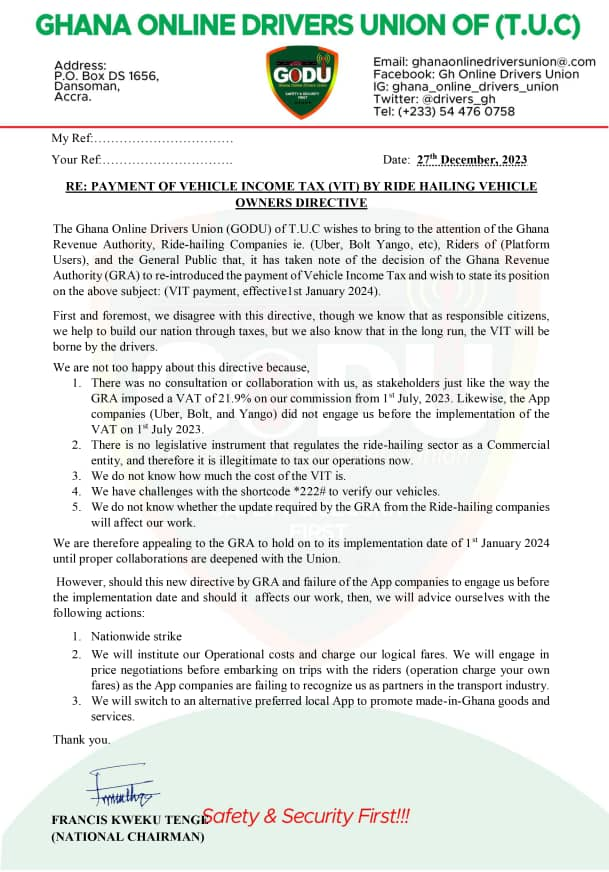
  • GODU threatens nationwide protest over VIT

    GODU threatens nationwide protest over VIT

    The Ghana Online Drivers Union (GODU) has issued a stern ultimatum, threatening a nationwide strike unless the Ghana Revenue Authority (GRA) engages in discussions regarding the recent introduction of the Vehicle Income Tax (VIT) for ride-hailing drivers.

    The announcement of the new tax, slated to take effect from January 1, 2024, has sparked widespread outrage among GODU members.

    They argue that the decision was made unilaterally without any prior consultation with stakeholders, especially the drivers who will bear the direct impact of the tax.

    GODU emphasizes the absence of proper legislative regulations in the ride-hailing sector, raising doubts about whether drivers can accurately be classified as commercial vehicle owners subject to the VIT.

    In a strongly-worded statement, GODU urges the GRA to postpone the implementation of the VIT and instead initiate discussions with the union to address their legitimate concerns.

    They stressed the importance of a collaborative approach to develop a tax system that is both fair and sustainable for the ride-hailing sector.

    However, should the GRA fail to respond, GODU has warned of potential consequences, indicating the looming threat of a nationwide strike.

    Read the full statement below:

  • SML received GHC24m monthly payment from govt even after ‘lying’ about what they do – Report

    SML received GHC24m monthly payment from govt even after ‘lying’ about what they do – Report

    An explosive investigative report by investigative journalist Manasseh Azure Awuni‘s The Fourth Estate, titled “THE GH₵ 3 BILLION LIE,” exposes startling revelations about Strategic Mobilisation Ghana Limited (SML).

    Despite making wild claims of saving Ghanaian billions, SML continued to receive monthly payments of up to GH₵24 million from the government. The blockbuster report, released today on December 18, 2023, delves into a murky contract signed with the Ministry of Finance and the Ghana Revenue Authority (GRA).

    The investigation, conducted by Evans Aziamor-Mensah, Adwoa Adobea-Owusu, and Manasseh Azure Awuni of The Fourth Estate, uncovers a trail of deceit involving false and unsubstantiated claims made by SML. The company’s dubious operations became the basis for substantial payments it received from the government, with indications that officials from the Ministry of Finance and GRA were aware of the false claims.

    The Fourth Estate team confronted SML’s management with the findings, leading to the sudden disappearance of major services claimed by the company from its website. This action raised further questions about the legitimacy of SML’s dealings with the government.

    The investigation also sheds light on an outrageous deal initiated by Finance Minister Ken Ofori-Atta, entitling SML to over $100 million annually for the next decade. The report highlights a 2019 contract signed between the Government of Ghana and SML, questioning its necessity amid pre-existing measures introduced in 2018 to curb losses in the downstream petroleum sector.

    Key revelations include the questionable procurement process, where SML, led by Managing Director Christian Tetteh Sottie, was handpicked through a single-source method despite lacking prior experience in the services it claimed to provide. Procurement expert Kobina Ata-Bedu raises concerns about potential breaches of Ghana’s procurement laws.

    The report dismantles SML’s false claims of resolving issues such as underreporting, diversion, and dilution of fuel products in the petroleum industry. The company’s website displayed misleading information that was later removed after the Fourth Estate’s investigation.

    Christian Tetteh Sottie, the Managing Director of SML, admitted that the company did not engage in activities related to checking underreporting or anomalies in the downstream sector, contradicting its earlier claims. The GRA officials, present during the confrontation, expressed shock at the services SML claimed to provide.

    Despite the revelations, SML’s Managing Director denied knowledge of the GH₵3 billion savings claim, attributing it to a mistake made by an IT Systems Engineer during a presentation to the GRA. The Fourth Estate’s persistent questioning forced admissions of discrepancies, prompting SML to remove the false claims from its website.

    The Minister of Finance, Ken Ofori-Atta, who initially lauded SML for saving billions, now faces scrutiny as evidence suggests financial mismanagement. Despite unanswered Right to Information requests, sources close to the Ministry of Finance reveal monthly payments of up to GH₵24 million to SML.

    The shocking details unveiled in this report raise serious questions about the transparency and legitimacy of government contracts, urging further investigation into SML’s dealings and the accountability of public funds.

  • Majority Leader justifies 10% withholding tax on betting 

    Majority Leader justifies 10% withholding tax on betting 

    Majority Leader, Osei Kyei-Mensah-Bonsu, thinks that the 10% withholding tax imposed by the Ghana Revenue Authority on total earnings from gaming is reasonable.

    He remarked that the tax, scheduled to be implemented on Tuesday, August 15, is a prudent policy decision.

    In his view, gambling promotes idleness and dissuades people from putting in diligent effort.

    In an interview with Kumasi-based Angel FM on Thursday, Suame MP exhorted the youth to work hard and stop gambling.

    “I don’t believe in betting. I don’t believe in luck. I believe in hard work and sweat to get money. Let’s be serious. As for me, I’m against betting coming into the country. I don’t support it because it doesn’t encourage hard work.”

    “As an individual, I don’t engage in the lottery because I don’t believe in that. I don’t believe in luck. Work hard so God will bless it.”

    Background

    The implementation of a 10% withholding tax on all gross gaming winnings from August 15, 2023, the Ghana Revenue Authority (GRA) has announced.

    According to the GRA, the withholding tax will be charged on profits accrued after each win and the existing 15% Value Added Tax (VAT) rate on each stake will no longer be charged.

    The GRA said that the new policy is in line with an amendment to the Income Tax Act 2023 (No.2), Act 1094.

    Commissioner for the Domestic Tax Revenue Division at the GRA, Edward Gyamerah, addressed a press briefing and said gaming companies that fail to comply with the new policy will face sanctions.

    Such companies he added would have their licenses withdrawn.

    “Come August 15, we expect that when you are making the payments, you will withhold 10 percent to the Ghana Revenue Authority (GRA). As you have been appointed as withholding agents, the obligation is on you to withhold. If you fail to do that, with the interactions we had with you and with the support of the gaming commission, you can be assured that your licenses will be withdrawn,” he said.

  • Ghana’s failure to impose penalties on surface rentals results in a $8.3 million loss – Auditor-General 

    Ghana’s failure to impose penalties on surface rentals results in a $8.3 million loss – Auditor-General 

    Ghana has incurred a loss of $8.3 million due to its failure to impose penalties on surface rentals. 

    This is according to a recently released Auditor General’s report. 

    The Auditor General attributed the development to sanction companies defaulting on their payments as stipulated by the Petroleum Revenue Management Act, 2011 (Act 815), Section 3.

    As outlined in the Act, organisations that do not make timely payments should incur an extra fine equivalent to either five percent of the initial sum for each day of delay or the rate prescribed by alternate legislation, whichever happens to be greater.

    This formed part of the Auditor-General‘s assessment of the management of petroleum funds during the time frame spanning from January 1, 2022, to December 31, 2022.

    The report revealed that surface rentals were due to reach $2.8 million by the end of 2022, making up 80 percent of the expected income for the year.

    Significantly, four contractors, whose Petroleum Agreements were canceled by the Minister of Energy, owed a notable portion of the outstanding amount, specifically $1.8 million.

    The Auditor-General suggested that the Ghana Revenue Authority (GRA) should take steps to guarantee prompt payment of surface rentals. These steps include obtaining bank guarantees from exploration firms and conducting comprehensive due diligence and Know Your Client (KYC) assessments for companies engaged in oil-related operations.

    In addition, the report recommended that both the Petroleum Commission and GRA should apply additional fees to companies that fail to meet their obligations, following the guidelines outlined in Section 3 of the PRMA 2011 (Act 815).

    Reacting to the report’s conclusions, the GRA affirmed that it had commenced enforcement actions, such as sending Demand Notices to companies that had failed to meet their obligations.

    Conversely, the Petroleum Commission indicated that it had refrained from granting specific approvals to contractors who were not in compliance, and it committed to supporting the GRA in evaluating and recovering penalty fees.

  • GHS500m tax fraud uncovered by GRA, NIB

    GHS500m tax fraud uncovered by GRA, NIB

    Executives of Wan Heng Ghana Limited, a Chinese-owned cement manufacturing company, have been arrested by a joint operation involving the National Intelligence Bureau (NIB) and the Ghana Revenue Authority (GRA).

    The arrests were made due to alleged tax violations totaling ¢500 million.

    The investigation was initiated following a tip-off from the GRA’s Tema Medium Taxpayer Office, which detected inconsistencies in monthly filings related to the National Health Insurance Levy (NHIL) and Ghana Education Trust (GET) Fund.

    During a joint operation, police and military personnel attempted to gather further evidence from Wan Heng Ghana Ltd., known for producing Sol Cement. However, the company’s management refused to cooperate with the authorities investigating the alleged tax evasion. As a result, the military personnel detained the executives, and the premises were locked pending the outcome of the ongoing investigation.

    According to documents obtained from the GRA, Wan Heng Ghana Ltd. evaded approximately ¢500 million in Value Added Tax (VAT) and income tax payments between 2018 and 2021.

    Despite importing sufficient clinker to manufacture and sell ¢1.36 billion worth of cement based on Ghana Standards Authority (GSA) standards, the company reported a mere ¢223 million in revenue, significantly under-declaring their earnings by 84%. The GRA estimates that this under-declaration led to a tax loss of ¢490 million for the state.

    A GRA official present during the operation said “The evidence we have gathered thus far paints a clear picture of deliberate tax evasion, with Wan Heng Ghana Ltd. grossly under-declaring their revenues and evading their tax obligations. Such illicit practices hinder Ghana’s efforts to raise domestic revenue and address pressing economic challenges”.

    In response to the situation, the Chamber of Cement Manufacturers Ghana (COCMAG), which includes Wan Heng Ghana Ltd. as a member, has emphasized the significance of all cement manufacturers meeting their tax responsibilities to contribute to the nation’s welfare. COCMAG has reaffirmed its dedication to fostering fair competition and ethical conduct within the cement industry.

    As the investigations proceed, the authorities have expressed their determination to hold those accountable for tax evasion responsible, demonstrating their unwavering commitment to preserving national integrity and safeguarding the country’s economic interests.

  • 2 managers, others arrested over non-compliance of tax obligations

    2 managers, others arrested over non-compliance of tax obligations

    The Ghana Revenue Authority (GRA) taskforce has arrested two managers of restaurants and the staff of an electrical cable company in Accra for not issuing VAT tax invoices.

    The companies are Waves Lounge and Pub, Chez Amis Pub and Grill, and Grand Pacific Limited, dealers in general electrical cables.

    The managers were taken to the Customs Office at the headquarters for their statements before being handed over to the Criminal Investigation Department of the Police.

    Mr Edward Appenteng Gyamerah, Commissioner, Domestic Tax Revenue Division, GRA, said the managers had refused to issue certified VAT invoices by the Commissioner-General at the point of purchase of goods at their outlets.

    The initiative, he stated, was part of the Authority’s exercise to ensure tax compliance and retrieve taxes due the state.

    He said the Division had several options at its disposal to aid in revenue mobilization, including already existing initiatives such as auditing and test purchasing, among others.

    Mr Gyamerah said the test purchases conducted on 115 taxpayers that were sampled for a week revealed that a total of 93 taxpayers were not issuing the VAT invoice.

    The figure, he stressed translated into a non-compliance rate of 80.9 per cent and said it was an offense for a registered taxpayer to fail to issue a VAT invoice for purchases made.

    He said the division would continue with the enforcement exercises with an eye on the implementation of the electronic invoicing system and other tax types.

    The government has tasked the GRA with raising a revenue target of GHc 106 billion for the 2023 fiscal year.

    Out of this figure, the Domestic Tax Revenue Division is expected to collect 70 per cent of the total revenue.

    This year, President Nana Akufo-Addo assented to the three amendments passed by Parliament.

    They are the Excise Duty (Amendment), Act 2023 (Act 1093), the Income Tax (Amendment), Act 2023 (Act 1094), and the Growth and Sustainability Levy Act 2023 (Act 1095).

    These amendments were to complement efforts to ensure the Authority met its revenue target.

    Mr Joseph Annan, Area Enforcement Manager of GRA, in charge of Accra Central, said the Authority would continue to embark on surprise exercises across the country to apprehend culprits evading tax.

    He urged the public, especially customers who make taxable purchases, to always request and insist on their VAT invoices.

  • Do the right thing – Customs warns importers of paper products

    Do the right thing – Customs warns importers of paper products

    The Customs Division of the Tema Sector Command of the Ghana Revenue Authority (GRA) has cautioned importers, especially paper product importers, to desist from under-declaring and under-invoicing of imported products.

    The division has vowed to go hard on anyone who attempts to short-change the state by deliberately under-declaring goods at the ports.

    This came to light at a press briefing in Tema after Customs officials discovered a container of finished products such as photo-copy papers (A-4 sheets), which was declared by the clearing agent as stationery.

    Head of Intelligence at the Ghana Revenue Authority, Assistant Commissioner Wisdom Xetor, lamented the manipulation of actual duty payment by some paper importers and clearing agents at the port.

    He disclosed that investigations show that most paper importers are under-invoicing, giving wrong descriptions and under-valuing their imports in a bid to evade taxes.

    Mr. Xetor said the GRA has introduced a new strategy of tracking some of these importers: “We just want to send a clear message to the importing public that they are under our radar; we are monitoring them so they should just do the right thing”.

    Mr. Xetor therefore cautioned the importers that going forward culprits will be sanctioned severely, including having to pay a 300 percent penalty; and in cases where contents are banned goods, they will be seized.

    Chief Revenue Officer, Public Education, Media Relations and Review, Dzinunya Mawuli, on his part said this exercise was previously carried out underground, but will now be done publicly as a way of warning others to desist from such acts.

    “Today we were supposed to open one of the containers and re-examine the items in it, but unfortunately the importer and clearing agent are not available. The clearing agent entered 68 items, but our scan image is telling us that it is one item. They described it as stationery, but it is not stationery when we look at the scan image,” Ms. Mawuli said.

    She noted that the container will be opened by next Wednesday, in order for them to carry out the necessary examination so they can establish its true content.

  • GRA urges Ghanaians to pay tax and enjoy many benefits

    GRA urges Ghanaians to pay tax and enjoy many benefits

    For Ghanaians who pay their taxes and submit their tax returns, the Ghana Revenue Authority (GRA) claims there are numerous tax benefits.

    Assistant Commissioner, in charge of Training and Development Department at GRA, Lawrence Hotsonyame, said the country had all these services, but citizens might not benefit if they failed to file their tax returns.

    Mr Hotsonyame made this known at a two-day workshop for some selected court reporters in Accra.

    The two-day workshop was organised by the GRA in collaboration with the Judicial Training Institute for selected journalists and Staff of the Communication and Public Affairs Department of GRA.

    It was aimed at educating participants on the Judicial System of Ghana, effective reporting of court proceedings and courtroom etiquette, among others.

    Some of the tax reliefs include Aged and Dependent relief, Marriage relief, Children relief, Disability relief, mortgage relief, Responsibility relief and Cause of Training relief.

    He said in the administration of the tax laws, disputes might arise between the taxpayer and GRA which would require resolution by the law courts.

    “It is therefore the expectation that tax cases brought before the courts should be dealt with expeditiously to ensure fairness and timely collection of taxes due the State,” he said.

    The Assistant Commissioner said the GRA was counting on the Judiciary to assist to fulfill its statutory obligations of mobilizing tax revenue for national development.

    He said with the disputes arising as a result of tax-related issues, the Ministry of Finance inaugurated the Independent Tax Appeals Board to provide a clear mechanism for resolution.

    The establishment of the board is part of government’s initiative to transform revenue administrations and enhance revenue mobilization.

    “It is to provide an alternative tax dispute mechanism in the country, instill confidence in investors by providing a neutral entity for the resolution of tax disputes and relieve the Ministry of Finance from having to mediate or resolve tax disputes between GRA and taxpayers.

    The Board was established in accordance with the Revenue Administration (Amendment) Act, 2020 (Act 1029).”

    He said the GRA aimed to become a world class revenue administration institution with professionalism, integrity and excellence.

    According to him, the GRA has commenced an aggressive automation drive and appealed to the public to assist the authority by paying their taxes regularly to propel development.

    Mr Yaw Boadu-Ayebuafoh, Chairman of the National Media Commission, said using the media to inform or educate the public about GRA and taxpayers was one of the positive ways to enhance awareness about the Constitutional imperative of open declaration of incomes.

    “As journalists, we must deploy our skills to consciously enable the people understand the work of GRA. We must also stimulate change with our reportage on tax issues,” he added.

  • ECG in talks with GRA to offset its debt

    ECG in talks with GRA to offset its debt

    The Electricity Company of Ghana (ECG) is negotiating with the Ghana Revenue Authority (GRA) to offset about GHS 600 million of its tax obligations to the state.

    The GRA intends to write off the debt of some “sensitive” public sector institutions that have accumulated over the years

    Mr Samuel Dubik Mahama, the Managing Director, ECG, who disclosed this in an interview, said the amount would still not be enough “as we owe GRA over a billion Ghana cedis in taxes.”

    ECG has so far retrieved about GhS 2.5 billion out of GHS 5.7 billion debt it intends to recover from a month-long revenue mobilisation exercise.

    The exercise which started on March 20, 2023, and ends on April 20, 2023, targets domestic users, businesses, organisations, Ministries, Departments, and Agencies (MDA).

    Mr Mahama urged customers to take the proactive steps of paying deposits in anticipation of bills that may be delayed due to technical reasons.

    He said the differences would be reconciled when the next bill for the customer was prepared.

    He bemoaned the use of fake meters leading to a high loss of revenue due to the inability of the service provider to capture and bill power consumed.

    “ECG is the only company that is supposed to provide these meters, but some people have found a way of bringing these meters into the market. By the continuous use of these meters by people not on the ECG network, that means our customer numbers are wrong” he said.

    Mr Mahama warned customers against illegal connections and indicated that the company would begin another exercise after the revenue mobilisation exercise to fish out culprits.

    “And our intention with that is to punish them by charging them with stealing,” he said.

  • NIB officials arrest 9 Lands Commission employees, 7 others over alleged theft of GHC 100m

    NIB officials arrest 9 Lands Commission employees, 7 others over alleged theft of GHC 100m

    About 16 persons, including nine employees from the Lands Commission have been arrested by the National Intelligence Bureau (NIB) officials over their alleged involvement in the stealing of 500 draft cheques meant for the Land Commission of Ghana.

    According to a news report by the Daily Guide newspaper, the 16 suspects were part of a 21-member syndicate involved in stealing cheques worth around GHC 100 million belonging to the Ghana Revenue Authority (GRA).

    The report indicated that the suspects were arrested between January 2023 and February 2023 after a petition was filed against them for crimes they committed from 2021 to 2023.

    It added that all the suspects were charged with three counts, including conspiracy to commit crime, stealing, and money laundering, contrary to Sections 23(1) and 124(1) of the Criminal Offences Act 1960 (Act 29) and Section 1 of the Anti-Money Laundering Act 2020 (Act 1044), stealing contrary to Section 124 (1) of the Criminal Offences Act 1960, Act (29) and Money Laundering: Contrary to Section 1 of Anti-money Laundering Act, 2020 (Act 1044).

    It was stated in the report that the suspects included Frederick Okai, Gideon Obeng Mensah, Andrews Tettey Antwi, Frank Kwame Darko, Jude Odoom Yamoah, Emmanuel Mawuli Bani, and Jephther Sanso Akyea, all staff of the commission.

    The remaining suspects are Gilbert Fongadje Awuvie, Isaac Karikari Junior alias Bonsu, Sani Mohammed Issah, David Maanyin Antoh, Kofi Armoo Okyne, Samson Sebrah, Frank Debrah alias Franko, Emmanuel Ketigoa, and Nutifafa Asare Kojo.

    It added that five of the suspects, including Alfred Amarquaye, Jason Hassan Degalu, Mary Kish Bagbodjan, Leslie Bruce, and Adams, escaped arrest and are currently at large.

    It was stated in the report that the nine suspects, who were staff of the Land Commission, conspired with the other suspects, including private businessmen, a banker with First National Bank, the Chief Executive Officer of the Air State Company Limited and a staff at the Tema Development Company Limited to commit the crime.

    The suspects, according to sources at the NIB, paid draft cheques ranging from GHC 20,000 to GHC 2,500,000 to the other accomplices at the Lands Commission rather than paying them to the commission, thereby denying the GRA the much-needed revenue.

    They agreed and were able to manipulate the software of the Lands Commission to show that the said payments were made to the commission, but that did not happen.

    “The draft cheques were thereafter handed over to Emmanuel Ketigo through Samson Debrah and Frank Debrah, who took the cheques to clearing agents at the Tema Harbour, wherefore the said cheques were used to pay import duties for importers.

    “Thereafter, Emmanuel Ketigo received physical cash of the face value of the cheques, and the monies were shared among themselves based in percentage, with Emmanuel taking 15 percent of the face of the cheques, the first-nine suspects taking 40-45 percent whilst the remaining 40-45 per cent were shared among the remaining suspects,” a source is quoted to have said by the Daily Guide.

    The suspect told the NIB that they used the proceeds from their criminal venture to buy houses and other properties in Greater Accra, the Eastern and Central Regions.

    It added that suspects are still in the custody of the NIB, having failed to meet their GHC 2 million bail terms.

  • Private citizen petitions Special Prosecutor to investigate ‘retiree’ GRA boss

    Private citizen petitions Special Prosecutor to investigate ‘retiree’ GRA boss

    A private citizen, Charles Tuffuor has petitioned the Office of the Special Prosecutor to look into the ongoing employment of two senior Ghana Revenue Authority (GRA) officials despite their being far older than the legal retirement age of 60.

    According to the petitioner, the Director General of GRA, Rev. Dr. Ammishaddai Owusu-Amoah and the Revenue Generation Officer of GRA, Julian Essiam contrary to law are still in office despite attaining retirement age and the expiration of their respective contract extensions as approved by the president.

    “I am a citizen of Ghana and I write to you to respectfully investigate why commissioners of the Ghana Revenue Authority are still at post. Rev. Dr. Ammishaddai Owusu-Amoah who has been the Commissioner General of the Ghana Revenue Authority, Customs Division has illegally stayed at post even after the expiration of his contract extension in 2021.

    “Meanwhile, the Government of President Nana Akufo-Addo and Dr. Bawumia led the NPP government and introduced a policy that sought to end the working contract extension of government agencies and departments whose expertise are not scarce in the country,” his petition said.

    Mr Tuffuor noted that the stay in office of the GRA boss defies the exact basis on which some state officials including Dr Amishaddai’s predecessor was removed from office.

    In the case of the Revenue Generation Director, the petitioner said Ms. Essiam’s contract after retirement expired over a year ago but that she still remains at post contrary to the law.

    “It would also interest you to note that, Ms. Julian Essiam, who is a Revenue Generation Officer is also a beneficiary of this unfair, and illegitimate act by President Nana Akufo-Addo and Dr. Bawumia’s led government.

    “Ms. Julian Essiam was born on July 5, 1961, which means by law and per the 1992 Constitution of Ghana, she’s due for a Pension but still at post even though her contract has expired,” the petitioner said.

    Read the full petition below:

    Charles Tuffour
    Box SY 2337, Sunyani
    Bono Region – Ghana
    Wednesday, February 15, 2023.

      The Special prosecutor
    Office of the Special Prosecutor
    PMB Accra
    Ghana- West Africa

    REQUEST FOR THOROUGH INVESTIGATION.

    I am a citizen of Ghana and I write to you to respectfully investigate why commissioners of the Ghana Revenue Authority are still at post. Rev. Dr. Ammishaddai Owusu-Amoah who has been the Commissioner General of the Ghana Revenue Authority, Customs Division has illegally stayed at post even after the expiration of his contract extension in 2021. Meanwhile, the Government of President Nana Akufo-Addo and Dr. Bawumia led the NPP government and introduced a policy that sought to end the working contract extension of government agencies and departments whose expertise at not scarce in the country.

      Dr. Ammishaddai Owusu-Amoah, Ghana’s chief taxman who was born on October 10, 1961, was appointed as Commissioner in charge of the Domestic Tax Revenue Division (DTRD) on May 30, 2019, and started work on June 4, 2019. He was made the Acting Commissioner-General on September 20, 2019, and will hit retirement age on October 10, 2021.
    Mr. Owusu-Amoah has since been in office from the time of his contract expiration defying the legal basis upon which his predecessors were relieved of their posts.

      The principle was applied by the immediate past Auditor General, Mr. Domelovo, Col. Damoah RTD., Col. Kofi Nti RTD Col. Diawuo RTD. So why is the government reluctant in applying such sanctions to Rev. Dr. Ammishaddai? And why has he been allowed to illegitimately remain at post almost two years after the expiration of his one-year contract which ended in 2021?
    Why do we as a country have to spend so much on paying for his contract and the juicy goodies that come with it, especially, in this current state of the country?

      Furthermore, concerning a letter issued by the deputy finance minister, Mrs. Abena -Osei Asare on the subject matter on August 5, 2022, affirmed the decision of the government on this subject matter. So why is he still at post? Please find attached, the letter issued by the Deputy Finance Minister.

      Moreover, it would also interest you to note that, Ms. Julian Essiam, who is a Revenue Generation Officer is also a beneficiary of this unfair, and illegitimate act by President Nana Akufo-Addo and Dr. Bawumia’s led government. Ms. Julian Essiam was born on July 5, 1961, which means by law and per the 1992 Constitution of Ghana, she’s due for a Pension but still at post even though her contract has expired.  

      My intelligence gathered, further tells me that the Finance minister, Mr. Ken Ofori Attah, and the Board Chairman of the commission is planning a two to a three-year contract extension for the current Boss of GRA while their thousands of Ghanaians out there with the requisite expertise to carry out this same task to save the country money and also reduce the unemployment situation.

      I strongly sense something fishy is going on between the government and the GRA Boss to the detriment of the entire country.

    My background checks also suggest, that she together with Dr. Amishaddai, who both attained the age of 60 years two years after their contract was renewed until 2021 but chose to stay in the office until today as we speak.

    Source:Ghanaweb.com

  • Veep’s Office supports investigation into unauthorised letter to clear 15 containers of rice

    Veep’s Office supports investigation into unauthorised letter to clear 15 containers of rice

    The Office of the Vice President Tuesday expressed satisfaction with the Special Prosecutor’s decision to continue investigations into the clearance of 15 containers of rice in which the Office allegedly facilitated the clearance.

    Mr James Keck Osei allegedly sought assistance from the Commissioner-General of Ghana Revenue Authority (GRA) to clear the 15 containers of rice in April, 2022.

    Mr James Keck Osei, a civil servant who works at the Office of the Vice President as Director of Administration, is being investigated by the Special Prosecutor for addressing an unauthorised letter to the Commissioner-General of the GRA on April 27, 2022, seeking assistance to clear the 15 containers of rice.

    The letter, among other things, falsely conveyed information that the Office of the Vice President needed the containers of rice for the Ramadan festivities.

    The GRA did not comply with the said letter but rather informed him that there was another claimant to the rice.

    On receipt of that information, Mr Keck Osei wrote another letter on July 5, 2022, to withdraw his letter of 27th April, 2022.

    In his second letter, he stated that the Commissioner-General of the GRA should cancel any prior action taken based on his previous letter.

    A statement issued on Tuesday by the Secretary to the Vice President, Mr Augustine Blay, in response to the matter, said it was only the Secretary to the Vice President who is mandated to write letters on the Office’s behalf and that Mr Keck Osei did not have any such authority.

    It said the Chief Director at the Office of the President had also begun investigations into the issue in accordance with the Civil Service procedures, rules and regulations and where a breach is established, the Service shall apply the necessary sanctions.

    In September, last year, it came to the attention of the Office of the Vice President that Mr Keck Osei had been invited by the Office of the Special Prosecutor (SP) to assist in an investigation related to rice importation.

    https://www.youtube.com/watch?v=hiTal4VJyUE

    Following the SP’s announcement, Mr Keck Osei was arraigned on Monday, February 13, 2023.

    Source: GNA

  • Ablakwa calls out GRA, Passport Office, others over silence on ‘Rev Kusi Boateng multiple documents’

    Ablakwa calls out GRA, Passport Office, others over silence on ‘Rev Kusi Boateng multiple documents’

    The Member of Parliament (MP) of North Tongu has called out some state institutions for their silence over the issue of Rev Victor Kusi Boateng, the founder and leader of Power Chapel International, illegally having multiple statutory documents under different names.

    Samuel Okudzeto Ablakwa said that the state agencies that Rev Kusi Boateng scammed to illegally acquire multiple documents including the Ghana Revenue Authority (GRA), Registrar Generals Department, Passport Office and the Driver and Vehicle Licensing Authority (DVLA), must explain to Ghanaians how the blunders happened.

    In a Citi TV interview monitored by GhanaWeb, the MP posited that these agencies should be conducting internal investigations to find out how they issued the same person with multiple documents under different names.

    “All these institutions should be issuing statements by now (and) carrying out investigations. How is it that they are (so quiet)? Is it that they are complicit?

    “How did they take advantage of them so easily. GRA, Registrar General Department, Passport Office, DVLA. How did this happen?” he queried.

    The MP in his latest corruption exposé on the National Cathedral made some allegations against Rev. Victor Kusi Boateng, who is the secretary to the Board of Trustees of the National Cathedral of Ghana.

    In an earlier revelation about the National Cathedral, Okudzeto Ablakwa said that a whopping GH¢2.6 million was dished out to a company named JNS Talent Centre Limited.

    In his latest exposé, Ablakwa said that further investigations into the alleged payment led to the discovery of one Kwabena Adu Gyamfi as a director of JNS Talent Centre.

    Having confirmed the identities of two out of three directors of the centre, Ablakwa dug deeper in a bid to discover the identity of the third director, Kwabena Adu Gyamfi.

    According to his findings, citing a number of statutory documents including passports, Tax Identification Numbers and driver’s licenses, Kwabena Adu Gyamfi was the same as Reverend Kusi Boateng, who has allegedly been operating under the pseudonym Kwabena Adu Gyamfi.

    Source: Ghanaweb

  • MTN Ghana disputes $773m tax liability imposed by GRA

    MTN Ghana disputes $773m tax liability imposed by GRA

    MTN Ghana is strongly disputing an alleged tax infringement placed on the company by the Ghana Revenue Authority (GRA) between 2014 and 2018.

    According to the leading telecom firm, it is a tax-compliant corporate citizen and the tax liability notice of GH¢8,209,603,842.14 (US$773 million) issued against it by the GRA is unacceptable.

    The assessment of ¢8,209,603,842.14 includes penalties and interest charges.

    “In this regard, from the base component of the assessment (that is, excluding penalties and interest), on MTN Ghana’s analysis, the GRA infers that MTN Ghana under declared its revenue by more than approximately 30% over the 5-year period 2014 to 2018”, it said in a statement.

    “The GRA audited MTN Ghana for the period 2014-2018, using a third-party consultant as well as a new methodology based on call data records (CDR), recharges, and other data. MTN Ghana strongly disputes the accuracy and basis of the Assessment, including the methodology used in conducting the audit. MTN Ghana believes that taxes due have been paid during the period under assessment”, it explained.

    MTN Ghana believed the taxes due have been paid during the period under assessment.

    The statement further said MTN Group and MTN Ghana will continue to engage with the relevant authorities on this matter and MTN remains resolute that MTN Ghana is a tax compliant corporate citizen.

    Again, it said MTN Ghana would like to further assure its shareholders and other stakeholders that MTN Ghana is a responsible business with an absolute commitment to transparency, good corporate governance, and compliance.

    MTN Ghana one of largest taxpayers in Ghana

    MTN Ghana is one of the largest private sector taxpayers in Ghana, having been recognized on numerous occasions for its support of the GRA’s revenue mobilization efforts.

    The GRA has also satisfactorily concluded multiple tax assessments on MTN Ghana over many years and presented MTN Ghana with various taxpayer awards in recognition of its contribution to the fiscal development of the country.

    MTN Ghana thanked the GRA for its support throughout the process, especially allowing us a temporary withdrawal of the Notice of Assessment in a bid to resolve this matter in an amicable manner.

    Background

    In 2019, the GRA commenced an audit of MTN Ghana with the objective to give assurance on the reliability and completeness of revenues declared by MTN Ghana for the purpose of tax computation for the period 2014-2018.

    The GRA had not issued MTN Ghana with any prior guidelines and standards relating to the new CDR sequence-based methodology used for the audit.

    In May 2021, after consultations and discussions between MTN Ghana, MTN Group, the Ministry of Finance of the Republic of Ghana and the GRA, the parties agreed to an independent review by a global professional services firm.

    MTN Ghana has fully cooperated in this independent review, which was commissioned by the GRA in September 2021. The independent review found that it was unable to support the conclusions reached by the GRA’s third-party consultants as the basis for the assessment.

    Source: myjoyonline

  • GRA bills MTN Ghana US$773 million for 2014-2018 back taxes

    GRA bills MTN Ghana US$773 million for 2014-2018 back taxes

    The Ghana Revenue Authority (GRA) is suing MTN Ghana, the local affiliate of the South African mobile telecom giant MTN Group, for US$773 million.

    The sum is in lieu of back taxes for a five-year period from 2014 to 2018, according to records seen by GhanaWeb Business.

    The overdue tax amount as well as fines and interest costs are included, according to the MTN Group’s statement on Friday (January 13).

    The Ghana Revenue Authority issued MTN Ghana with the bill after auditing it for the years 2014 to 2018 and inferring that the company under declared its revenue by about 30% during the period, MTN said in a statement.

    The telco stressed, however, that all previous taxes had been duly honoured and that it disputes the “accuracy and basis” of the assessment.

    “MTN Ghana believes that the taxes due have been paid during the period under assessment and has resolved to defend MTN Ghana’s position on the Assessment,” the company said.

    The MTN Group has a presence in 19 countries in Africa and the Middle East.

  • GRA Customs exceeds revenue collection target by 7.95% – Commissioner

    GRA Customs exceeds revenue collection target by 7.95% – Commissioner

    Seidu Iddrisu, Commissioner, Customs Division of the Ghana Revenue Authority (GRA) has disclosed that Customs exceeded its revenue collection target by 7.95 percent. 

    “Nationally, the Customs Division Collected GH¢22.26 billion as against a target of GH¢20.62 billion, representing a positive deviation of 7.95 percent,” Mr Iddrisu said. 

    The Commissioner gave the figure at a ceremony for the outgoing Tema Collection Sector Commander, Assistant Commissioner Julius Aweya Kantum as he retires from the service after 37 year’s work life. 

    He added that the Tema Collection also recorded an excellent performance in its revenue mobilization drive which also exceeded the target by GH¢1.25 billion translating to 7.83 percent. 

    He congratulated all officers, personnel of Nation Builders Corps (NABCO) and other stakeholders of the Customs Division for putting in the effort to rake in the needed revenue for 2022. 

    Mr Iddrisu said the GRA has set a revenue target of GH¢206 billion for this year and out of it, Customs Division is expected to collect GH¢28.5 billion. 

    The Customs Commissioner further said GRA top management has also challenged the Customs Division to collect an additional GH¢12 billion for this year. 

    He, therefore, called on all to rally around and double their efforts to achieve the target for the year 2023. 

    The Assistant Commissioner Kantum (Rtd), on his part said it was no secret that when Tema Collection performed very well and exceeds its target by a high percent, it took care of the shortfalls of other collections to ensure that the national target was achieved or exceeded. 

    He advised the youth to discover themselves in the Customs work by charting their own path, defining their values, and taking cues from the values of the GRA. 

    He reminded them to always remember that they were tax collectors, and therefore must uphold professionalism, and integrity, while having a learning and innovative mindset which were key to a long and enduring career.  

    Source: Ghanaweb

  • GRA urges taxpayers to hook on the electronic-invoicing system

    The Ghana Revenue Authority (GRA) has urged all taxpayers to hook on to the electronic invoicing system for Value Added Tax (E-VAT) to allow monitoring.

    The Commissioner-General of the Ghana Revenue Authority on October 1, 2022, began its certified electronic invoicing system to ensure all invoices that are issued by taxpayers are witnessed by the Commissioner’s system.

    The electronic invoicing system will be authenticated with an app and deployment of compliance officers to ensure its enforcement.

    There are 50 taxpayers selected across and enrolled on the system. The selected 50 reflect all types of taxpayers registered with the Authority of which some are complying, and others are not.

    The Authority will ensure no operations of customers until they hook on to the system.

    In a brief meeting with the media on Tuesday, at the Head Office of the Ghana Revenue Authority Accra, Mr Kwesi Eghan, Deputy Commissioner for Operations at the GRA, said the exercise would continue until each taxpayer was fully compliant, 600 additional taxpayers will be enrolled by the end of the first quarter of 2023.

    The whole exercise will see its conclusion by 2024 when all taxpayers will be using the Commissioner-General’s invoicing system.

    “This closing down of shops is not the path the Authority is forging willingly; it is a last resort action. We will advise that you comply before we start this whole exercise,” he said.

    He urged taxpayers to effectively roll out the Commissioner-General’s system to help curb the illegal issuance of own invoices to help generate revenue for the government.

    He said the exercise was targeted at the initial selected 50 taxpayers, who are supposed to hook on to the system.

    “It is not as if all other taxpayers are not compliant, quite a number are hooked on the system voluntarily as mandated by the Authority,” he added.

    He said non-compliant taxpayers would be prevented from operating until hooked on to the system, “if you have six branches and one is closed, you will be prevented from operating from any branch across the country till all six shops are hooked on the system,” he said.

    The Authority is embarking on several exercises, including invigilation by officers, electronic invoicing exercises, test-purchase exercises, and enforcement of taxpayers to register with the Authority.

    Source: GNA

  • GRA locks up popular event center ‘Underbridge’

    Popular event center ‘Underbridge’ at East Legon in the Greater Accra region has been locked up by enforcement team of the Ghana Revenue Authority (GRA).

    The action follows the inability of managers of the facility to register and issue Value Added Tax (VAT) receipt to its customers.

    The GRA has for some time now been descending on businesses evading or under-declaring taxes.

    Accra Area Enforcement Manager at the Ghana Revenue Authority, Joseph Annan, interacting with Joy Business before the action explained that ‘Underbridge’ has not been complying with the tax law, hence the need for the distress action.

    GRA locks up popular event center ‘Underbridge’

    “They have not registered for VAT as a business and this is an offence. So we have no option than to lock up the place until they register and pay the penalties that will be slapped on them”.

    “They know that as a business you must register with the GRA and pay your taxes accordingly”, he added.

    The team moved next to the Tema Industrial area where numerous cold store businesses have been operating with fake VAT invoices.

    About four coldstores were locked up and the managers were arrested by the Criminal Investigation Department officials attached to the exercise.

    At Tema Community 9, Chief Executive of Joshnartey Ventures, Joseph Nartey was arrested for issuing fake VAT invoices.

    Source: MyJoyOnline.com

  • NDC express concerns over alleged $100 million missing oil money

    The Minority called the development a major worry in a statement released on Thursday.

    The Minority in Parliament claims that more than in oil revenue from Ghana has vanished.

    In a statement issued on Thursday, the Minority described the development as a serious concern.


    “The decision by the current NPP government to transfer revenues accruing from about 944,164bbls of crude lifting in the Jubilee and TEN fields to a company established in a safe haven (outside Ghana) without Parliamentary approval, amounts to a gross violation of the Petroleum Revenue Management Act, 2011 (Act 815) and Public Financial Management Act (Act 921),” John Abdulai Jinapor, the ranking member on the Energy and Mines Committee of Parliament, said.

    The government is yet to respond to the allegation.

    Below is the full statement:

    US$100 MILLION WORTH OF GHANA’S OIL MONEY MISSING – MINORITY RAISES CONCERN

    The Minority in Parliament has noted with serious concern the inability or refusal of the Akufo-Addo/Bawumia led Government to account for over $100Million accruing from Ghana’s Petroleum lifting in the first quarter of 2022.

    The decision by the current NPP Government to transfer revenues accruing from about 944,164bbls of crude lifting in the Jubilee and TEN fields to a company established in a safe haven (outside Ghana) without Parliamentary approval, amounts to a gross violation of the Petroleum Revenue Management Act, 2011 (Act 815) and Public Financial Management Act (Act 921).

    We have become aware that following the acquisition of a Seven percent (7%) interest in the Occidental (Oxy) transaction in respect of the Jubilee and TEN Fields by the Government ostensibly for GNPC in 2021, the Minister of Finance has clandestinely ceded the shares to an offshore company known as JOHL (a company set-up in the Cayman Islands) in a very surreptitious and opaque manner.

    The Minority is very much alarmed that contrary to requirements of the PRMA, revenues accruing from the nation’s oil fields are not being paid into the Petroleum Holding Fund (PHF), which has been confirmed in the 2022 semi-annual report on petroleum receipts by the Public Interest and Accountability Committee (PIAC).

    As if this is not enough, the report further reveals that Capital Gains Tax was not assessed and collected by the Ghana Revenue Authority (GRA) in the sale of the 7% interest by Anadarko in the Jubilee and TEN Fields in 2021.

    This NPP Government is proving by the day, that the nation’s oil resources cannot be entrusted in their care because not long ago the PIAC under the chairmanship of Dr. Steve Manteaw accused them over their inability to account for about GHȼ2 billion of Ghana’s oil cash for the 2017, 2018 and 2019 fiscal years.

    This is surely another “Agyapa” deal in the making and we as a Minority will not sit aloof for this Government to raid the national purse, especially at a time when the nation is struggling to raise much needed revenues for critical expenditure.

    We demand that the Minister of Finance and for that matter Government, must with immediate effect repatriate all such illegal transfer payments back into the Petroleum Holding Fund (PHF).

    Failure to comply with our ultimatum will compel the Minority to use the necessary parliamentary processes to haul the Minister of Finance to parliament for possible censure.

    *John Abdulai Jinapor
    (Ranking Member, Mines and Energy Committee)*

  • Ofori-Atta says Ghana’s economy is gradually improving despite shocks

    In spite of recent devastating shocks, the economy of Ghana, according to Minister of Finance Ken Ofori-Atta, is growing only a little.

    “Overall, our growth outturn of 3.4% and 4.8% in Q1 and Q2 of 2022 respectively, coupled with modest improvements in our fiscal position, suggests our economy is gradually on the upswing despite the numerous shocks we have faced over the past two years,” he said at a press briefing on Wednesday.

    “These figures demonstrate that in spite of recent challenges, there has been economic growth, modest as the gains so far may be,” the Finance Minister added.

    Mr. Ofori-Atta said this progress gives Ghana a solid foundation to confront its economic challenges head-on.

    “Undoubtedly, global risks remain on the horizon, including a strengthening US dollar and higher interest rates which negatively affect external borrowing. This development is exerting enormous pressure on our Balance of Payment position, and thus the need for us to expedite our engagement with the IMF.”

    Ghana is currently seeking a $3 billion bailout programme from the International Monetary Fund (IMF).

    Ghana was compelled to seek IMF support because of the worsening debt stock, fiscal challenges, depreciation of the cedi, upsurge in inflation, as well as shocks from COVID-19 and the Russia-Ukraine war.

    Mr. Ofori-Atta told the press that the Ghana Revenue Authority has intensified its efforts to shore up domestic revenue mobilization, particularly in relation to the enforcement of compliance measures, in a bid to resolve the country’s fiscal challenges.

    “The increased visibility of GRA officials at shopping malls and various commercial establishments and at our borders across the country is in pursuit of meeting our revenue objectives.”

    Cedi depreciation

    With regard to the cedi which has depreciated by 37.1% against the US Dollar as of Tuesday, September 27, 2022, Ofori-Atta said the government has put efforts in place to arrest the free fall of the currency.

    He further indicated that the Bank of Ghana has introduced enhanced measures such as a Special Foreign exchange auction for bulk distribution companies and a Gold Purchase Programme to contain the depreciation of the cedi.

    “As part of measures to shore up our reserves, improve exchange rate stability and address some of the funding needs, the Ministry successfully worked on a US$750 million Afreximbank loan facility which was received in August 2022. The traditional Cocoa Syndication Loan, expected in the last quarter of 2022 which will promote the cocoa sector, will further help us build our FX reserves and provide a strong buffer for the cedi in the last quarter of the year.”

    “Additionally, the Bank of Ghana has introduced enhanced measures such as a Special Foreign exchange auction for bulk distribution companies and a Gold Purchase Programme to contain the depreciation of the cedi, which is now slowing down,” he added.

  • Government eyeing GHC750m with new E-VAT policy

    The government is seeking to raise GHC750 million in Ghana following the passage of the Value Added Tax Amendment bill, which introduces the E-Vat policy.

    The tax measure broadens the scope of the existing laws to cover electronic commerce, provides for the electronic issuance of a tax invoice, upfront payment of Value Added Tax by an unregistered importer and the zero-rating of the supply of locally assembled vehicles.

    A report of the Finance Committee of Parliament indicates that the e-vat policy addresses issues of inequalities and compliance in the payment of tax.

    During the mid-year budget review, the Ghana Revenue Authority said it was finalising all relevant processes to facilitate the effective collection of VAT revenue including the proposed amendment of the Value Added Tax Act 870 to enable its electronic collection, effective October 1, 2022.

    The government is currently reeling from the disastrous implementation of the electronic transfer levy.

    The Ministry of Finance has had to downgrade its projection of revenue expected from the controversial e-levy to GHC611 million from the earlier projected $1.6 billion.

    For the Value Added Tax (VAT), the expected revenue was adjusted upwards from the initial GHC14,534,864,446 to GHC15,402,925,770.

    Source: Citinewsroom