Tag: Ghana Stock Exchange

  • Ghana Stock Exchange kicks out Worldwide Securities over regulatory violations

    Ghana Stock Exchange kicks out Worldwide Securities over regulatory violations

    The Ghana Stock Exchange (GSE) has officially expelled Worldwide Securities Limited (WSL) from its Licensed Dealing Membership (LDM), citing multiple regulatory breaches. The decision, which takes immediate effect, bars WSL from operating as a broker or dealing in securities on the exchange.

    In a statement, the GSE outlined the reasons for WSL’s expulsion, highlighting key violations of the Exchange’s Dealing Membership Rules. 

    According to the GSE, WSL failed to renew its broker-dealer license with the Securities and Exchange Commission (SEC), a requirement under Rule 9(2)(e). Additionally, the firm defaulted on its financial obligations to the Exchange, violating Rule 9(2)(b).

    Further infractions included the company’s inability to maintain the necessary staff to run its brokerage operations, breaching Rules 6(j) and 6(k). The Exchange also found that WSL was not actively engaging in its broker-dealer business at an acceptable level, contravening Rule 6(L).

    Due to these breaches, WSL is now prohibited from opening or managing brokerage and investment accounts for the public. It is also barred from trading securities across any of the Exchange’s markets and from presenting itself as a member of the GSE.

    The Exchange has advised clients of WSL to make immediate arrangements to transfer their securities accounts and holdings to other Licensed Dealing Members. “Clients of WSL should contact the Exchange for assistance with transferring their securities accounts and holdings to any Licensed Dealing Member of their choice,” the GSE stated.

    This action reinforces the Exchange’s commitment to upholding strict regulatory compliance and ensuring the integrity of Ghana’s capital markets. The GSE emphasized its dedication to maintaining a robust and transparent market, warning that non-compliance with regulatory standards will not be tolerated.

    Franklin Cudjoe, the Founding President of IMANI Africa, has shared his thoughts on U.S. President Donald Trump’s plan to shut down USAID. He believes that instead of getting rid of foreign aid completely, it should be improved to focus more on trade, job skills, and technology sharing.

    According to Mr. Cudjoe, too much money is wasted on unnecessary processes and middlemen before it reaches the people who actually need help. He insists that fixing these issues would make aid more effective.

    Franklin Cudjoe, who has long criticized foreign aid in articles for major newspapers like The Wall Street Journal and The Telegraph, pointed out similar concerns raised by economist Jeffrey Sachs.

    Mr Sachs estimated that a large chunk of aid money goes to consultants, emergency relief, and debt payments, leaving little transparency on how much actually helps the poor.

    Cudjoe also referenced Rwandan President Paul Kagame, who has criticized how aid money is often wasted on administration instead of directly helping people in need.

    “Prof. Sachs is right about tougher seeds but not about more aid. By his own calculation, ‘out of every dollar of aid given to Africa, an estimated 16% went to consultants from donor countries, 26% went into emergency aid and relief operations, and 14% went into debt servicing.’ He could not account for how much of the remaining 44% got siphoned off by corrupt officials, nor could he explain why $400 billion dollars of aid over the last 30 years has left the average African poorer.

    “Rwandan President Paul Kagame told Ugandan journalist Andrew Mwenda in April, ‘There are projects here worth $5 million and when I looked at their expenses, I found that $1 million was going into buying these cars, each one of them at $70,000. Another $1 million goes to buy office furniture, $1 million more for meetings and entertainment, and yet another $1 million as salaries for technical experts, leaving only $1 million for the actual expenditure on a poverty-reducing activity. Is this the way to fight poverty?” he stated.

  • Ghana Stock Exchange named West Africa’s best by CFi.co

    Ghana Stock Exchange named West Africa’s best by CFi.co

    The Ghana Stock Exchange (GSE) has been recognized as the best stock exchange in West Africa, by a a print journal and online resource that covers business, economics, and finance known as CFi.co.

    It applauded GSE for its role in boosting economic growth and supporting sustainable development in Ghana and the region

    CFi.co pointed out GSE’s expansion on its services as they have added options like a commercial paper market to help companies secure short-term funds and a sustainable market segment aligned with global environmental, social, and governance (ESG) standards.

    It has become a key platform for raising money and investing, with initiatives like financial education programs and technology-driven tools that make the market more accessible to all types of investors.

    Additionally, GSE collaborates with the government and other organizations to encourage local investment, improve governance, and promote broader participation in the stock market.

    The Exchange has committed to long-term sustainability goals and is part of the Sustainable Stock Exchanges Initiative, which promotes responsible investment worldwide.

    Commenting on the award, Abena Amoah, Managing Director of GSE, said, “We are thrilled to be named the Best Stock Exchange for Economic Growth in West Africa 2024 by CFi.co. This recognition reflects our dedication to innovation and growth, and it motivates us to continue creating opportunities for businesses in Ghana and beyond.”

    Looking ahead, the GSE aims to build an inclusive financial market that transforms Ghana’s economy by channeling local savings into impactful projects. Its focus on regional and African-wide initiatives positions it as a key player in the continent’s financial future.

    The CFI.co Judging Panel congratulated the GSE on its win, emphasizing its role in fostering economic growth in West Africa.

  • Ghana Stock Exchange achieves ¢90bn market value

    Ghana Stock Exchange achieves ¢90bn market value

    The market capitalization on the Ghana Stock Exchange (GSE) has reached ¢90 billion for the first time since its inception.

    This figure represents the total value of all shares and equities on the market.

    According to managers of the bourse, this milestone highlights the expanded opportunities available for investors and underscores the importance for more Small and Medium Enterprises to consider when making investment decisions.

    The Composite Index provided investors with a 34 percent growth as of the end of Thursday, July 18.

    The GSE Composite Index gained 109.96 points, closing at 4,195.72 points, and reflecting a year-to-date (YTD) return of 34.04%.

    The GSE Financial Stocks Index also saw an increase, rising to 2,083.94 points with a YTD gain of 9.59%.

    MTN Ghana (MTNGH) saw a rise of ¢0.09, ending the session at ¢2.10.

    Enterprise Group Limited (EGL) recovered from a previous ¢0.05 loss, closing higher at ¢1.37.

    The increase in equity prices pushed the market capitalization up by GH¢1.20 billion to ¢90.09 billion, marking the first time the bourse has achieved this level.

    From a market capitalization of ¢6.4 million in 1990, the GSE has seen a significant increase over the years to reach its current value.

    Trade activity on the exchange was robust, with total turnover soaring to ¢7,277,762.40, an increase of 6875.84% over the previous day.

    Trading volume surged to 5,518,463 shares across twelve counters by the end of Thursday.

    Notable offers included Société Générale Ghana (SOGEGH) at GH¢1.55, Guinness Ghana Breweries (GGBL) at GH¢5.17, and Fan Milk Limited (FML) at GH¢3.70.

    EGL led the volume chart, with 4,744,779 shares traded.

  • GSE introduces Over-The-Counter Market to broaden financial markets

    GSE introduces Over-The-Counter Market to broaden financial markets

    The Ghana Stock Exchange (GSE) has introduced Over-The-Counter Market trading tailored for rural banks and small and medium enterprises (SMEs), marking a significant stride towards enhancing financial inclusion nationwide.

    This new initiative establishes a platform for trading securities that are not listed on the main exchange, aiming to broaden access to financial markets.

    Managing Director of the GSE, Abena Amoah, expressed optimism that the new product will bolster the growth of the capital market. She encouraged small business owners to utilize the platform to secure affordable funding for expanding their operations.

    “We believe that as a stock market, this platform is needed to encourage small businesses and the community banks to raise funds and also for shareholders to offload shares smoothly. This is a step in the right direction to support growth and expansion, “she said.

    She underscored that the Over-The-Counter Market aligns with the overarching strategy outlined by the Securities and Exchange Commission and the Ghana Stock Exchange to develop the country’s capital market.

    Amoah highlighted that the platform aims to attract rural and community banks currently not listed on the stock exchange, offering them opportunities to trade shares and strengthen their operational capabilities, thereby providing investors with additional investment avenues.

    Alex Kwasi Awuah, Chief Executive of ARB Apex Bank, welcomed the initiative, emphasizing its timeliness for rural banks to access patient capital.

    “As community and rural banks, you know we are not listed on the stock market but we need investors to support our operations so we can serve our rural folks. This is a good opportunity for many of us. We believe this will help strengthen us,” he said.

    All rural and community banks are expected to register and participate in this new trading platform to leverage its benefits fully.

  • Ghana Stock Exchange market capitalization hits GHS400bn threshold

    Ghana Stock Exchange market capitalization hits GHS400bn threshold

    The market value of securities on the Ghana Stock Exchange (GSE) has surged beyond GH¢400 billion, equivalent to approximately US$27 billion according to the latest data from the exchange.

    As a result, the market capitalization now represents approximately 39 percent of the GDP as of March 2024 – amounting to GH¢1.05 trillion.

    The breakdown reveals that equities listed on the GSE were valued at GH¢84 billion, while the larger fixed income market stood at a significant GH¢328 billion. However, corporate issuances accounted for only a negligible 0.77 percent of the total value.

    During an interview with B&FT on the sidelines of a meeting with the media jointly organized by the GSE and Institute of Financial and Economic Journalists (IFEJ), themed ‘Collaborating with the media to enhance the equities market’, GSE’s Managing Director, Abena Amoah, characterized the GH¢400 billion milestone as a positive stride.

    However, she promptly acknowledged the necessity for further growth, particularly in line with the global market.

    “It is a step in the right direction, but we know that it should be more – especially in dollar terms as we seek to reach a global audience,” Madam Amoah stated.

    The Managing Director’s remarks mirror a larger trend observed across stock markets in Africa. As outlined in the African Stock Exchanges Focus Report by Oxford Business Group, African exchanges collectively possess a market capitalization of approximately US$1.6 trillion, constituting merely 2 percent of the global stock market capitalization. The Africa Stock Exchanges Association (ASEA) comprises 28 member exchanges spanning 38 nations, boasting over 2,400 listed firms.

    Additionally, the GSE Managing Director emphasized the significance of cultivating a robust private capital market in Ghana.

    “If indeed the private sector is the engine of growth, we should see more private participation,” she added.

    “It is always the biggest market because government is huge. But we need to make sure that the private sector is actively participating in the fixed income market as well,” she said in acknowledgment of the public sector’s dominance.

    On efforts to attract more companies to list through IPOs, Ms. Amoah said: “I think one of our biggest challenges today is having more credible companies come to the market and raise capital. We are seeing many investors with funds. How can they invest it? Where can they invest it? Investors gain confidence when strong and well-performing companies come to the market”.

    She cited examples of state-owned enterprises (SOEs) and private firms with “good financials, strong management” that should consider listing to raise equity or debt capital from institutions like pension funds and high net worth individuals.

    “That’s why we are working with the Mineral Income Investment Fund (MIIF) to launch new products like a gold-backed ETF. We are talking to issuers in sectors like real estate to launch real estate investment trusts, giving people access to diversified investment options,” Ms. Amoah explained.

    The GSE is also launching an over-the-counter (OTC) market targetted at over 100 public unlisted companies in Ghana. Amoah said: “Their shareholders don’t know the share price, how to buy or sell securities. The OTC market gives them that transparency and avenue to trade”.

    She also mentioned that it might facilitate these companies in efficiently accessing capital when necessary.

    Concerning the GSE Alternative Market (GAX) designed for SMEs, where only Intravenous Products Ltd. is actively traded, Ms. Amoah emphasized the necessity for increased issuer involvement.

     “When you engage with investors, share your strategy and plans, you engender confidence that gives them appetite for your securities.”

    Ms. Amoah mentioned Jamaica, where over 50 companies listed swiftly as a result of corporation tax holidays for new issuers, as evidence that tax incentives could also aid in attracting SMEs.

    “We are in discussions for some of these incentives in Ghana. If we say the private sector is the engine of growth, and their biggest challenge is access to affordable capital, we need to create incentives linking our US$50billion pension funds with SMEs needing growth financing,” she stated.

    “If we have this cohesive capital markets approach – investors, issuers, the private sector working together – the economic growth we are looking for will happen.”

    The OTC market is expected to be launched at end-June 2024, further boosting options for investors and companies seeking to raise capital in Ghana.

  • John Kwakye urges Ghana Stock Exchange to move away from colonial concepts

    John Kwakye urges Ghana Stock Exchange to move away from colonial concepts

    The Institute of Economic Affairs’ Director of Research, Dr. John Kwakye, urges the Ghana Stock Exchange to move away from upholding colonial concepts and instead address the ownership concerns related to the nation’s mineral resources.

    Dr. Kwakye emphasizes that prioritizing ownership issues is essential. These remarks come in light of the Ghana Stock Exchange’s collaboration with various stakeholders to create climate finance and carbon trading instruments.

    “Please let’s sort out ownership of our mineral first before you start talking about listing on the GSE. Don’t just propagate colonial concepts. The colonial African is even more dangerous than his colonial master,” he wrote on X on December 13, 2023.

    The Managing Director of the Ghana Stock Exchange (GSE), Abena Amoah, has revealed the exchange’s intention to collaborate with the Ghana Carbon Market Office of the Environmental Protection Agency (EPA), along with all capital market stakeholders and the business community.

    The goal is to thoughtfully develop climate finance and carbon trading mechanisms that will attract domestic, regional, and international capital to support the country’s just transition targets by 2070.

    Amoah made this announcement during the inaugural GSE Ring the Bell for Climate Change initiative, dedicated to highlighting and celebrating issuers on the GSE market that have implemented innovative technologies to address climate change in Ghana.

    With an estimated requirement of approximately $562 billion, Ghana aims to finance its energy transition and achieve a net-zero emission target by 2070. This ambitious objective aligns with the National Energy Transition Framework, which aims to decarbonize the energy sector.

  • Ghana Stock Exchange collaborates for climate finance and carbon trading initiatives

    Ghana Stock Exchange collaborates for climate finance and carbon trading initiatives


    The Managing Director of the Ghana Stock Exchange (GSE), Abena Amoah, has announced the Exchange’s intention to form strategic collaborations.

    These partnerships will involve the Ghana Carbon Market Office of the Environmental Protection Agency (EPA), all capital market stakeholders, and the business community.

    The goal is to meticulously develop climate finance and carbon trading mechanisms, mobilizing domestic, regional, and international capital to fund Ghana’s just transition targets by 2070.

    Abena Amoah shared this initiative during her address at the inaugural GSE Ring the Bell for Climate Change event, dedicated to acknowledging issuers on the GSE market who have implemented innovative technologies to combat climate change.

    Ghana, aiming to finance its energy transition and achieve a net-zero emission target by 2070, estimates the need for approximately $562 billion.

    This objective is underpinned by the National Energy Transition Framework, which aims to decarbonize the energy sector. According to the United Nations Economic Commission for Africa (UNECA), Ghana, along with other African nations, has the potential to unlock a substantial $82 billion annually from carbon credits.

    UNECA fervently advocates for the establishment of a comprehensive carbon market, positioning it as a sustainable financing mechanism to replace traditional official development assistance to African countries.

    Notably, Ghana has already taken a significant step by approving the transfer of mitigation outcomes in a climate change agreement with Switzerland.

    This initiative involves the exchange of carbon credits for payment, strategically retaining developmental benefits domestically.

    The project’s focus is on transforming Ghana’s waste sector, creating premium organic fertilizer, and generating over 1000 direct jobs, with a special emphasis on women’s employment.

  • 30.75% surge in GSE composite index as of November 13, 2023

    30.75% surge in GSE composite index as of November 13, 2023

    Despite challenging economic conditions, the Ghana Stock Exchange (GSE) has continued its robust performance, achieving a remarkable 30.75 percent growth in its overall composite index, according to the revelation by GSE’s Managing Director, Abena Amoah.

    This significant growth positions GSE as the third-best performing stock market on the continent.

    The positive momentum is particularly noteworthy considering the challenges faced by the economy. The performance marks a substantial improvement from the end of 2022 when the Accra bourse recorded a year-to-date (YTD) return of -12.38 percent and -4.61 percent for the Composite Index and Financial Stock Index, respectively.

    This recent growth suggests a promising outlook for the GSE.

    “A bright light in our year has been the GSE Composite and Financial Stock Indices’ performance. I am happy to share that our Composite Index is up 30.75 percent as of November 13, making us third-best in Africa so far this year – while our FSI continues to improve as well,” she said.

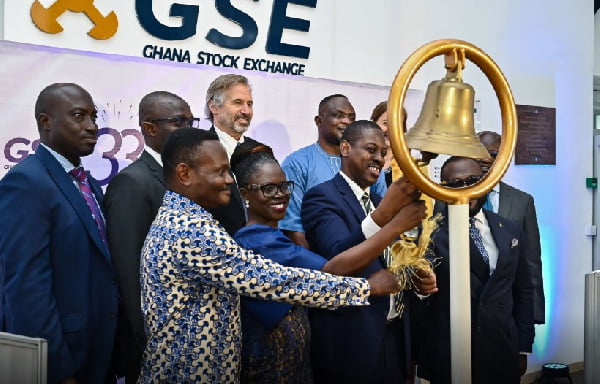
    She was speaking at the Ghana Stock Exchange’s (GSE) annual ‘Ring the Bell’ programme to mark the local bourse’s 33rd anniversary celebration themed “Resilience and adaptability: thriving in challenging times”.

    In its 33-year existence, the Ghana Stock Exchange (GSE) has diligently pursued its vision to boost national economic development by facilitating access to long-term capital and investment. During this period, the GSE has achieved significant milestones, including the establishment of three markets (the Main Market, GAX, and GFIM), hosting 45 issuers, and featuring 240 listed securities valued at GH¢356 billion.

    Furthermore, companies listed on the GSE have successfully raised over GH¢26 billion in long-term capital across its markets, with GH¢6 billion in equity and GH¢20 billion in debt.

    According to Ms. Abena, over GHȼ750 billion worth of securities have been traded, with the fixed-income market prominently contributing to this liquidity. Additionally, the GSE has expanded its reach from three brokerage firms to currently having 52 licensed companies actively trading across its markets.

    “Our trading and settlement processes are fully automated, and improvements in our technology solutions have twice won us the Most Innovative African Exchange award by ai Investor. There are 1.4 million securities accounts in the Central Securities Depository, with many more Ghanaians investing through collective investment schemes. We have trained over 70,000 people through our securities and investment education courses.

    “The past 12 to 18 months have tested our collective resilience like never before. Our macroeconomic challenges, the DDEP and global developments have impacted our issuers, intermediaries and investors alike. Volumes and values traded are significantly lower in 2023 compared to 2022. In all, 69 billion securities have been traded so far in 2023 versus 196 billion in the same period of 2022 on the GFIM; and 424 million versus 1.3 billion on the equities market,” she stated.

    Progress

    According to the Managing Director, the years ahead will see GSE unveil an array of products and initiatives: including a Commercial Paper Market; Over the Counter Market; Securities Lending and Borrowing; Asset-backed Securities (ETFs); Margin Trading; Market Making; and Underwriting and Issuing House Rules.

    These, she said, will help diversify investment avenues, embolden investors and invigorate the market’s vibrancy.

    Collaboration

    Head of Bank and Non-Bank Unit, Ministry of Finance, Andrew Ameckson, in his address commended the exchange for setting the pace in the investment landscape and capital market as a whole.

    He further urged players to intensify collaboration and be deliberate to ensure the market attains higher heights and becomes a beacon of hope for development.

    “Despite this progress, you will agree with me that we must do more to develop our industry. Let us intensify our collaboration to ensure our market leapfrogs to higher heights and becomes the beacon of hope for the development of Ghana and the continent.

    “We should be deliberate with market collaboration, as it will promote a reduction of costs and inefficiencies for issuers and investors – ultimately contributing to a more connected and robust infrastructure in the region. We need to be poised for entering a new era of opportunities as we better integrate into and align with the country’s development,” he admonished.

    Director-General, Securities and Exchange Commission, Rev. Daniel Ogbarmey Tetteh, noted that to achieve resilience, financial literacy must be prioritised; saying it serves as a guiding beacon for prudent financial planning, diversification and balancing risk-return expectations – all crucial tools for resilient market participants.

    He added it will play an essential role in enhancing investor protection and resilience, boosting confidence and encouraging active engagement in financial planning and decision-making.

    He therefore encouraged all market operators, especially the brokers and fund managers, to invest time and resources to help close the financial literacy gap.

    He commended GSE’s financial literacy efforts, urging it to redouble its efforts to augment the number of listed securities across all its trading platforms.

    Deputy Chief Exchange Officer-Ghana Investment Promotion Centre (GIPC), Yaw Afriyie, underscored the need to embrace digital innovation to create new opportunities for future business, which will have positive cascading benefits for business culture, jobs and livelihoods.

  • GSE to halt PBC listing due to missing financial reports

    GSE to halt PBC listing due to missing financial reports

    Effective November 8, 2023, the Ghana Stock Exchange (GSE) is poised to suspend the listing status of PBC Limited (PBC) in accordance with Rule 13(1) of the Exchange’s Listing Rules.

    The decision was conveyed through a circular directed at Licensed Dealing Members, Investors, and other concerned stakeholders.

    It emphasized that PBC failed to provide its financial results following the close of its fiscal year in September 2022, contravening the stipulations for timely disclosure outlined in Rule 13(4)(c) and (e) of the Exchange’s Listing Rules, despite repeated reminders.

    Rules 13(4)(c)(f) grant the GSE the authority to suspend a listing or mandate the de-listing of securities when a company fails to comply with, or is unable or unwilling to meet, the Exchange’s requirements for ongoing listing obligations and disclosure policy.

    Rule 13(4)(e) recommends similar measures when a company disregards its Listing Agreement or other agreements with the Exchange or violates the Exchange’s Rules.

    In accordance with these regulations, the GSE has determined that PBC’s listing status will be suspended from November 8, 2023.

  • Ghana’s corporate boards see women representation rise by 12% – Report

    Ghana’s corporate boards see women representation rise by 12% – Report

    Ghana has shown significant advancements in its pursuit of gender equality within corporate boardrooms, particularly among companies listed on the Ghana Stock Exchange according to the 2023 Board Diversity Index, a collaborative effort between TheBoardroom Africa (TBrA) and Alitheia Capital.

    The report reveals that the number of women holding positions in the boardrooms of Ghanaian-listed companies has experienced a noteworthy 12% increase, rising from 67 in 2022 to 75 in 2023.

    In a statement issued by TheBoardroom Africa, it emphasized that Ghana, where women make up nearly half of the workforce, has achieved an impressive 12% growth rate in gender parity within boardrooms in the current year.

    While this progress is commendable and encouraging, it also underscores the ongoing imperative for continued and unwavering efforts to champion gender equality in leadership roles.

    The report’s key findings offer a comprehensive overview of gender diversity within corporate boardrooms in Ghana, highlighting the substantial impact of women chairs on boardroom diversity.

    “Companies led by women as Chairpersons exhibit significantly higher boardroom diversity, with 80% of them having 30% or more women on their boards, while only 26% of companies with male Chairs reach this threshold,” it said.

    As per the report, there has been a notable increase in the representation of women in C-suite or Chair positions within Ghana. Women now constitute 14% of Chairs, 12% of CEOs/MDs, 22% of CFOs, and 13% of COOs on the boards of listed companies in Ghana.

    While the number of Chairs, CFOs, and COOs has seen a positive growth of 2%, 5%, and 7%, respectively, there was a slight decrease of 1% in the number of CEOs/MDs compared to the figures from 2022.

    The report also highlights a positive trend indicating a rising number of companies with women on their boards. An encouraging 89% of listed companies now have at least one woman on their board, as opposed to 88% in the preceding year.

    Sectors that directly engage with consumers, such as advertising & communications, fast-moving consumer goods, and telecommunications, notably excel in gender diversity, with 100% of their companies boasting over 30% women directors.

    The financial services sector stands out in terms of the highest number of women board directors in Ghana, with 34 women directors, accounting for 45% of the total, as per the report.

    On the flip side, boards composed entirely of men are decreasing in prevalence, with the proportion of listed companies without any women on their boards decreasing from 12% in 2022 to 11% in 2023.

    Speaking on the report, Founder and CEO of TheBoardroom Africa, Marcia Ashong said, “While acknowledging the progress made, Ghanaian corporate boards possess the potential to drive enduring change by strategically embracing key factors that fuel progress toward gender diversity. These factors include fostering an inclusive culture and securing an unwavering commitment from top leadership to prioritise and champion gender diversity.”

    She emphasized that the importance of this commitment is further emphasized by the findings of the 2023 report, which demonstrate the significant impact of women chairs in promoting greater female representation on boards.

    “We remain steadfast in our commitment to ongoing collaboration with the Ghana Stock Exchange and other stakeholders to advance this vital agenda,” Marcia Ashong said.

    Meanwhile, Abena Amoah, the Managing Director of the Ghana Stock Exchange, emphasized that gender diversity is not only a matter of ethics but also a driving force for improved governance and enhanced stock performance. She further highlighted that compelling evidence supports the idea that companies that prioritize diversity across all leadership tiers are better equipped to make sound decisions, foster innovation, and, in the end, achieve more robust financial outcomes.

    “At the Ghana Stock Exchange, we see gender diversity as a fundamental component of responsible and sustainable business practices, and we are committed to supporting our listed companies in achieving greater diversity and, in turn, greater success,” she said.

    The 2023 Ghana Board Diversity Index report provides a comprehensive analysis of the current state of gender diversity in corporate boardrooms, identifies areas for growth and improvement, and serves as a call to action for all stakeholders—businesses, policymakers, and civil society—to accelerate progress toward gender equality in leadership.

    About The Boardroom Africa

    The Boardroom Africa (TBrA) is the largest regional network of female executives in Africa. Our goal is to improve access to board opportunities for women and accelerate the presence of women on boards by working with development finance institutions, private equity investors and companies to accelerate the appointment of women on boards and build a growing pipeline of board-ready women while inspiring and educating the business community on the power of diverse leadership.

    About Ghana Stock Exchange

    The Ghana Stock Exchange (GSE) was established in November 1990 with the mission to provide an efficient securities market for national economic development through access to capital and investment. Since then, GSE has facilitated the mobilisation of long-term capital by corporate bodies, businesses, and the government and provided a reliable platform for the trading of issued securities. There are three markets created under the GSE brand: the Main Market, Ghana Alternative Market (GAX) for SME’s and Ghana Fixed Income Market (GFIM) for trading of government and corporate bonds. For more information, visit
    www.gse.com.gh.

    About The Board Diversity Charter

    The Board Diversity Charter (BDC) is a joint initiative co-founded by TheBoardroom Africa (TBrA) and Alitheia Capital to raise awareness of diversity as a critical driver of success for business and society. Joining the charter signals an organisation’s commitment to developing and implementing initiatives that seek to build and maintain diversity and equality in the boardroom. The Charter’s current signatories (organisations that have already achieved 30% women in the boardroom) and pledge partners (organisations publicly committing to strive to achieve 30% women in the boardroom) include leading DFIs and organisations such as British International Investment, Norsad Capital, Woodside Africa Group, DEG, FCMB Bank and more. Companies interested in becoming a Board Diversity Charter Signatory or Pledge Partner can apply here.

  • GSE ranked third in Africa’s top performers for 2023

    GSE ranked third in Africa’s top performers for 2023

    The Ghana Stock Exchange (GSE) has displayed remarkable improvement in performance from the beginning of 2023 until the end of August, ranking as the third-best performing stock market in Africa.

    This achievement places it just behind Nigeria and Egypt, marking a significant shift from its status as the worst-performing market in the region at the close of 2022. During that time, portfolio reversals, particularly from foreign investors, and rapid depreciation of the cedi had a detrimental impact.

    The Composite Index (GSE-CI) experienced a substantial rally, reaching 3,084.79 points during this period, reflecting a significant appreciation of 26.22 percent.

    The market capitalization exceeded GH¢73 billion.

    This rally can be attributed to renewed interest in the equities market, driven by developments in the debt segment.

    A clear indication of this renewed interest is the fact that pension funds accounted for 17 percent of equity market trades between January and August 2023, a stark contrast to the 4 percent recorded for the same period in 2022.

    The GSE is on track to exceed market expectations, but analysts stress that more must be done to sustain growth amid cyclical challenges.

    This comes as the stock market has experienced a roller-coaster ride in recent years, marked by sharp highs and steep declines. Analysts closely monitor the market’s performance as it navigates challenging economic conditions, foreign investor sentiment, and policy changes.

    2021: Recovery and Gains

    In 2021, Ghanaian equities rebounded, closely reflecting the country’s economic recovery after pandemic-induced losses in 2020. The GSE-CI recorded an impressive annual return of +43.66 percent in local currency terms, second only to Zambia’s Lusaka Stock Exchange in Africa. This surge was attributed to increased consumer demand, a stable exchange rate, and robust corporate earnings across various sectors. However, the financial sector, including banking and insurance counters, lagged behind, with the GSE Financial Stock Index (GSE-FSI) returning +20.70 percent for the year.

    2022: A Challenging Year

    In 2022, the equity market faced adversity, emerging as the worst-performing stock market in the sub-region. Macroeconomic uncertainties, including currency pressures, high inflation, interest rate hikes, and sovereign credit downgrades, fueled widespread selling. Foreign investors led the selling pressure, creating a predominantly buyers’ market. This trend resulted in lower share prices, offering buying opportunities. Despite the turbulence, market turnover increased significantly to GH¢1.64 billion, driven by assets like the New Gold ETF, which attracted investors seeking refuge from inflation.

    1HY-23: Signs of Recovery

    The market showed signs of recovery in the first half of 2023, with investors returning to equities due to concerns about the impact of the Domestic Debt Exchange Programme (DDEP) on the fixed-income market. The GSE-CI achieved impressive gains of 14.90 percent, outperforming the GSE-FSI, which fell by 17.57 percent. Key factors contributing to this recovery included easing price pressures, a stable currency, and optimism about economic recovery following the successful negotiation of a US$3 billion extended credit facility with the IMF.

    Outlook for 2023: Non-Financial Stocks in Focus

    Experts closely watch the domestic stock market in the second half of 2023. Non-financial stocks are expected to continue leading the way, driven by strong demand. However, some profit-taking may occur as investors seek to secure their gains. Analysts have adjusted their year-end forecast for the GSE-CI to 15 percent (±300 basis points).

    The announcement of a second wave of DDEP has raised concerns about its impact on financial stocks. As a result, income investors are likely to favor reliable, high dividend-paying, and defensive stocks such as Benso Oil, MTN, and TotalEnergies, which offer steady earnings and returns even during economic downturns.

  • Frank Berle appointed Deputy MD of Ghana Stock Exchange

    Frank Berle appointed Deputy MD of Ghana Stock Exchange

    The Council of the Ghana Stock Exchange (GSE) has officially appointed Frank Yoofi Mensa Berle as the Deputy Managing Director, a position that became effective on July 11, 2023.

    In his new role, Berle assumes the responsibility of providing strategic direction and leadership to the various operational divisions of the GSE.

    Having previously served as the Head of Finance and Administration, Mr. Berle brings with him a wealth of experience.

    His journey at the exchange commenced in January 2004, encompassing diverse roles that spanned finance, operations, administration, human capital management, surveillance, and clearing and settlement.

    A chartered accountant by profession, Frank Berle boasts additional chartered qualifications in areas such as taxation, financial economics, and wealth management.

    His affiliations include being a Fellow of the Chartered Institute of Taxation, Ghana; a member of the Institute of Chartered Accountants, Ghana; Association of Certified Chartered Economists, USA; Global Academy of Finance & Management, USA; and the Chartered Institute of Management Accountants (CIMA), UK.

    He holds the esteemed status of Chartered Global Management Accountant (CGMA) from the Association of International Certified Professional Accountants (AICPA).

    His educational background comprises a Master of Philosophy degree in Economics and a Bachelor of Commerce degree, pursued concurrently with a Diploma in Education, all attained from the University of Cape Coast (UCC).

    Taking up this pivotal role at a transformative juncture, Frank Berle steps into his position during the GSE’s demutualization process, a strategic trajectory that will metamorphose the Exchange into a limited liability company.

    The Council expressed their best wishes to Berle, foreseeing his significant contributions to the Exchange’s advancement and its successful navigation through this transitional phase.

  • GSE aims for GH₵130 billion equities

    GSE aims for GH₵130 billion equities

    The West African Capital Markets Integration Project, supported by the African Development Bank’s Capital Markets Development Trust Fund, aims to integrate the capital markets in the region.

    The Ghana Stock Exchange (GSE) is strategically planning to enhance trading and attract more companies to list on its platform.

    According to the managing director of GSE, Abena Amoah, the goal is to position the Accra bourse as the preferred medium in the country and the sub-region for companies to raise capital for their business operations.

    With a total market capitalization of over GH₵65 billion, constituting about 11 percent of Ghana’s Gross Domestic Product (GDP), the Ghanaian market holds significant importance in Africa.

    The GSE is actively encouraging both private and state-owned enterprises (SOEs) to list on its exchange.

    They are collaborating with the government to attract more SOEs and private companies to list.

    The Managing Director of GSE is optimistic about doubling the size of its equities and increasing the number of listed companies in the medium term.

    The GSE has created a market and demonstrated potential for investment opportunities.

    Notably, private pension funds have more than GH₵50 billion available for investments, presenting an opportunity for SOEs and private companies to raise capital for their business operations.

  • Ghana intends to double its equity market value, increasing from GHS65b to GHS130b

    Managing director of the Ghana Stock Exchange, Abena Amoah, has stated that Ghana intends to quadruple its stock market from its current position of GH65 billion to GH130 billion.

    She contends that the stock market is essential to the economy and that efforts must be made to boost Ghana’s market’s competitiveness in order to draw investors to the capital market.

    The GSE MD joined demands for the integration of the capital market in the African sub-region while speaking to attendees at a sensitization workshop for phase two of the West African Capital Market Integration.

    “The Ghana market is one of the significant markets in Africa. Our equity market has a capitalization of about GH¢65 billion and we are looking to double that, move from the 40 listed companies that we have to about 100 and by joining other markets in Africa we can leverage by learning from each other,” Amoah is quoted by citibusinessnews.com.

    She additionally asked those involved in the financial sector to coordinate their efforts with those of other African markets in order to strengthen the region’s equities markets.

  • GSE market cap reaches record high in first half of 2023

    GSE market cap reaches record high in first half of 2023

    Despite a challenging start, the Ghana Stock Exchange (GSE) concluded the first half of the year on a positive note, with its market capitalization reaching an all-time high of GH¢70.24 billion. Investors have continued to show confidence in equities, contributing to this impressive performance.

    As trading commenced for the second half of the year on Monday, July 3, 2023, the market capitalization further increased by 0.14 percent to GH¢70.34 billion. This growth was primarily driven by the GSE Composite Index (GSE-CI), which achieved its second-highest monthly return in June 2023.

    The GSE-CI, a benchmark for overall market performance, experienced a significant rise of 296.7 points, resulting in a year-to-date return of 14.9 percent. Additionally, the GSE Financial Stock Index (GSE-FSI) saw an increase of 14.6 points during the month. This improvement can be attributed in part to the recovery of some key stocks in the financial segment, reducing losses since the beginning of the year to 17.6 percent, according to data from the Accra bourse.

    In comparison to the first half of 2022, the GSE-CI has risen by 10.3 percent, climbing from 2,545.48 points to 2,808.03 points. Likewise, the market capitalization has appreciated by 8.32 percent compared to the same period in the previous year.


    Source: afx.kwayisi.org

    This represents a reversal of fortunes compared to 2022, when the GSE-CI closed the financial year with -12.38 percent from a high of +43.66 percent the previous year – ending the period as one of the worst performers on the continent, as investor sentiment kept pace with happenings in the general economy.

    This surge in market capitalisation is not unrelated to improved investor confidence on the back of listed stocks’ performance, as well as the announcement of dividend payment dates by a number of them.

    However, trading activity experienced a notable decrease in volume and value. Compared to the previous month, both volume and value traded decreased by 87.1 percent and 86.6 percent respectively. This decline can be attributed to various factors, including market fluctuations and investor caution as elements of profit-taking took ground.

    Similarly, the circa 20 percent depreciation of the cedi against the US dollar resulted in a -10.1 percent return for the GSE in US dollar terms.

    Commenting on this performance on the side-lines of a Facts Behind the Figures session when the GSE hosted Société Générale, Managing Director-GSE Abena Amoah said: “In the first half of 2023 performance and what we are seeing now is that there’s a gradual upturn in the equities market; the index is up about 14.96 percent – almost 15 percent, and the market cap has also crossed GH¢70billion for the first time. We’re very excited about that as it means investors are looking for diversification and equities are interesting to them. Several of our listed companies have also announced strong dividends, and we see investors reacting to that market.”

    The top-five price-gainers for the month are spread across the manufacturing, telecommunications, extractives and finance sectors. They include Guinness Ghana Breweries (28.48 percent), MTN (21.1 percent), CalBank (20 percent), New Gold Exchange Traded Fund (18.2 percent) and Standard Chartered Bank (3.9 percent).

    Earlier this year, analysts at Databank Research projected that as the year progresses initial defensive sentiments will normalise since the domestic debt exchange will positively influence demand for equities – with low interest rates on Treasury securities drawing investors to dividend-paying stocks.

    This, it added, will push the GSE-CI to approximately 2,737 points (±500bps) at the end of 2023, from the 2.443.91 with which it closed in 2022.

    Debt market

    On the debt market, the Ghana Fixed Income Market (GFIM) trades in short-term Government securities accounted for 77.8 percent of activity on the market. The platform witnessed a volume-traded of 5.41 billion at the end of June 2023. This represents an 8.2 percent increase compared to the previous month, but is down 78 percent from the same period in 2022.

    The volume and value traded in the GFIM were 4,581,168 and GH¢14.8million respectively. These figures represent a decline of 90.5 percent and 67.35 percent compared to the same period last year. Cumulatively, the volume of trades in the GFIM from January to June 2023 amounted to 40.9 billion – down 67 percent compared to the 124.1 billion traded during the same period last year.

    “On the debt market, I think many are still waiting to see how government pays its first interest on the new bond in August; and for the overall macroeconomic environment also, especially for interest rates, to come down so investor confidence will be there. So yeah, we are cautiously watching that and engaging the right people to ensure we have the right macroeconomic environment to drive demand in the market,” the GSE MD added.

  • Investors receive 14.9% return in cedi terms from GSE in first half of 2023

    Investors receive 14.9% return in cedi terms from GSE in first half of 2023

    Boosted by improved market sentiments driven by the International Monetary Fund-support programme, the Ghana Stock Exchange (GSE) delivered a 14.9% return for investors in cedi terms during the first half of 2023.

    This positive performance followed a challenging economic period in 2022 that necessitated debt restructuring.

    Ranking fourth among 15 stock markets in Africa, the GSE demonstrated its resilience. However, the dollar return for investors stood at -10.0%.

    Notably, non-banking stocks led the gains in the equity market, contributing to an increased market capitalization of ¢69.59 billion as of June 30, 2023, according to data from the GSE.

    Conversely, the Financial Stock Index experienced a decline of 17.57% in value during the first six months of 2023. This decrease was primarily attributed to the impact of the Domestic Debt Exchange Programme on the balance sheets of financial institutions.

    In summary, the Accra Bourse performed as the fourth-best stock market in Africa in cedi terms, yet placed eleventh when considering the performance in dollar terms.

    In all, six stocks recorded gains as compared to 10.

    Meanwhile, the best-performing stock market in the first six months of this year was Benso Oil Palm Plantation (84.44%).

    It was followed by TotalEnergies (70.00%), Unilever (60.82%) and MTN Ghana (50%).

    Per reports, the biggest losers were Fanmilk (-56%), Societe Generale (-41.0%) and Standard Chartered Bank (-35.96%).

    CountryYear-To-Date Return (Cedi)Year-To-Date Return (dollar)Positions
    Malawi MASI76.27%71.75%1st
    Nigeria NGSE21.21%-29.43%2nd
    Egypt  EGX21.01%-3.14%3rd
    Ghana GSE15.28%-10.10%4th
    Zambia LUSE12.28%17.75%5th
    Tunisia TUNINDEX10.43%10.82%6th
    Morocco MASI6.74%13.29%7th
    Botswana BSE4.48%-0.99%8th
    South Africa JSE3.30%-6.31%9th
    Ivory Coast BVRM-0.75%2.10%10th
    Mauritius SEMDEX-2.73%-6.08%11th
    Namibia NSX-3.41-12.60%12th
    Tanzania DSE-3.80%-4.66%13th
    Kenya ASI-15.73%-26.04%14th
    Uganda USE-16.57%-15.53%15th
  • New commercial paper market to provide investors with options – GSE

    New commercial paper market to provide investors with options – GSE

    In response to the limited investment options available to investors, the Ghana Stock Exchange (GSE) is making preparations to establish a formal commercial paper market.

    This initiative aims to broaden the range of investment opportunities accessible to investors in the market.

    The domestic bourse sees accommodating the increasing demand for diversification within the capital market as a key step and aims to provide investors with additional opportunities, in a bid to enhance the safety net against risks of default.

    In an interview with the B&FT, GSE’s Managing Director Abena Amoah expressed enthusiasm about the progress made in establishing Ghana’s commercial paper market, saying: “We have submitted the work done by stakeholders to establish Ghana’s commercial paper market to the SEC, and we are eagerly awaiting their response”.

    The collaboration between various stakeholders has been instrumental in developing a framework for the commercial paper market, similar to the approach taken for the fixed-income market, she said.

    One notable aspect of the upcoming commercial paper market is a requirement for ratings on these issuances. This new feature will provide investors with valuable information and enhance their confidence in the market.

    “You’ll find that many of them require a rating to give investors confidence that this credit is rated at B, and so this is the risk level and I can price it differently from an A-rated institution, for instance,” Ms. Amoah explained.

    A commercial paper market will also facilitate the raising of additional capital by companies aiming to strengthen their positions. Public offers are expected to enter the market, offering investors a chance to diversify their investments.

    Furthermore, the Exchange is collaborating with the Minerals Income Investment Fund to issue a gold-backed exchange-traded fund (ETF). This initiative will further expand the range of products available on the market, providing investors with increased diversification options. The ETF’s launch is anticipated to take place by September or before end of the year.

    The move toward a formal commercial paper market is a significant development for Ghana’s financial landscape. Currently, an informal commercial paper market exists; but the formalisation of this market will enhance investor protection and instil a greater sense of security.

    Ms. Amoah emphasised the importance of lending and capital formation in a growing economy, stating: “Lending is a critical part of capital formation. So for short-term loans – as long as the economy is growing, as long as businesses are growing, as long as our GDP is growing – companies have capital needs”.

    The formal market will provide a regulated environment that assures investors of the credibility and reliability of commercial paper investments.

    However, it should be noted that the formal trading platform will not be the sole avenue for commercial paper issuance. Some investors may still prefer to engage in over-the-counter (OTC) trading outside the formalised market. The market structure’s flexibility aims to accommodate the diverse preferences and needs of investors.

    The introduction of a commercial paper market reflects the country’s commitment to expanding and diversifying its financial sector. By offering a regulated platform for short-term debt securities, GSE aims to attract more investors and foster economic growth.

    The upcoming launch, along with the introduction of a gold-backed ETF, demonstrates the GSE’s dedication to providing a wide range of investment options and diversifying its financial markets in the face of current limited options available to investors.

  • Market activity on GSE is driven by strong price gains for shares

    Market activity on GSE is driven by strong price gains for shares

    The Ghana Stock Exchange (GSE) reports that market activity on the Accra bourse was driven by strong increases in the prices of some shares in March of this year.

    The GSE Composite Index (GSE-CI), which tracks the performance of all companies trading on the Accra bourse, increased by 14.01 per cent in March, bringing the year-to-date gain to 12.33 per cent, the GSE said in the summary of March 2023 market activities copied to the Ghanaian Times.

    “The continued rally of the GSE-CI was underpinned by div­idend announcements from some listed companies and investors seeking to diversify their hold­ings,” GSE stated.

    It said the volumes of and values traded on the Accra bourse went up significantly by 2,730 percent and 588 per cent respectively, over the previous month mostly due to block trades in MTN Gha­na shares.

    The total value of 181,344,788 were traded on the market at a val­ue of GH¢199,048,178.41, while total market capitalisation of the Accra bourse at the end of March stood at GH¢67,846.89.

    The report said TOTAL shares went up by 39.82 per cent, MTNGH, 35.87 per cent, UNIL, 33.78 per cent, BOPP, 20.93 per cent, and GGBL, 9.49 per cent, and they made up the top five price gainers in March.

    However, the GSE Finan­cial Stock Index, on the other hand, achieved a year-to-date loss of 11.98 per cent in line with investors’ expectations of reduced profitability in 2022 for financial stocks.

    On the equities market, the report said, the volume of shares traded in March stood at 173,658,609 valued at GH¢167, 969,700, both down by 19.22 per cent and 29.17 compared to the same period last year.

    The volume and value of shares traded in the same period last year were 280,656,909 and GH¢301, 850,157.39.

    “The cumulative volume of 181,344,788 valued at GH¢199, 048,171.4, represent a decrease of 35.39 and 34.06 per cent to the same period last year,” the GSE said.

    On the Ghana Fixed Income Market (GFIM), the report said the GSE’s fixed income market closed March 2023 with a volume traded of 5.57 billion, a decline of 39.26 per cent and 80.18 per cent respectively, over the previous month’s and same period in 2022 numbers.

    “Yields on short-term Govern­ment securities came down signifi­cantly during the Month, the 91-day Treasury bill ended the month at 19.39 per cent from 35.55 per cent at the beginning of March 2023. The new Government of Ghana bonds witnessed thin trad­ing during its first full month of trading, post the Domestic Debt Exchange Programme,” the report said.

    It said the month closed with a total volume trade of GH¢5.57 billion, representing a decline of 39.26 per cent compared to total volume trades in the previous month and a decline of 80.18 per cent compared to the same period last year.

    The report said the cumulative volume traded from January to March 2023 of 24.76 billion was a 61.35 per cent dip from the 64.07 billion traded in the same period last year.

  • Asante Gold announces the completion of a non-brokered private placement for C$27 million

    Asante Gold announces the completion of a non-brokered private placement for C$27 million

    Asante Gold Corporation has announced that it has completed its previously announced non-brokered placement of approximately C$27 million pursuant to which the company issued a total of 18,232,000 units of the company to a major institutional investor.

    Each unit was sold at a price of C$1.50 and was comprised of one common share in the capital of the company and one common share purchase warrant of the company.

    Each warrant is exercisable to acquire one common share at a price of C$1.75 per common share until April 6, 2024.

    The securities issued under the offering are subject to a hold period expiring four months and one day following the closing date of the Offering in accordance with applicable securities laws.

    Until the investor holds at least 5% of the outstanding common shares, the investor will have a right to participate in future equity financings by the company to maintain its share ownership percentage in the company.

    No commissions or finder’s fees were paid by the company in connection with the offering.

    The company intends to use the net proceeds of the offering to advance the exploration and development of the company’s mineral properties and for general corporate working capital purposes.

    About Asante Gold Corporation

    Asante is a gold exploration, development and operating company with a high-quality portfolio of projects and mines in Ghana.

    Asante is currently operating the Bibiani and Chirano Gold Mines with combined forecast production of approximately 400,000 ounces of gold for 2023.

    The company continues with detailed technical studies at its Kubi Gold Project for early production. All mines and exploration projects are located on the prolific Bibiani and Ashanti Gold Belts.

    Asante has an experienced and skilled team of mine finders, builders and operators, with extensive experience in Ghana.

    The company is listed on the Canadian Securities Exchange, the Ghana Stock Exchange and the Frankfurt Stock Exchange.

    Asante is also exploring its Keyhole, Fahiakoba and Betenase projects for new discoveries, all adjoining or along strike of major gold mines near the centre of Ghana’s Golden Triangle.

    About the Bibiani Gold Mine

    Bibiani is an operating open pit gold mine situated in the Western North Region of Ghana, with previous gold production of more than 4.5 million ounces.

    It is fully permitted with available mining and processing infrastructure on-site consisting of a newly refurbished 3 million tonne per annum process plant and existing mining infrastructure.

    Mining commenced in late February 2022 with the first gold pour announced on July 7, 2022. Commercial production was announced on November 10, 2022.

    About the Chirano Gold Mine

    Chirano is an operating open-pit and underground mine located in the Western Region of Ghana, immediately south of the Company’s Bibiani Gold Mine.

    Chirano was first explored and developed in 1996 and began production in October 2005.

    The mine comprises the Akwaaba, Suraw, Akoti South, Akoti North, Akoti Extended, Paboase, Tano, Obra South, Obra, Sariehu and Mamnao open pits and the Akwaaba and Paboase underground mines.

    Gold Equivalent Production in 2021 was 154,668 oz on a 100% basis (source Kinross Gold Corporation).

  • Assist rural banks in raising capital through stock purchases — BoG Governor

    Assist rural banks in raising capital through stock purchases — BoG Governor

    The Governor of the Bank of Ghana (BoG), Dr Ernest Addison, has urged the Ghana Stock Exchange (GSE) to explore the possibility of helping rural and community banks (RCBs) to list on the stock market.

    Dr Addison said the GSE’s Ghana Alternative Market (GAM) was an avenue for patient capital and the RCBs could leverage the platform to access funds for expansion.

    He, therefore, advised the GSE to collaborate with the ARB Apex Bank Limited, the mini central bank for the community-based lenders, on how best they can support the institutions to float shares in return for long-term capital.

    Dr Addison made the call when the Managing Director of the GSE, Abena Amoah, led a five-member delegation from the bourse to pay a courtesy call on him.

    The meeting was for Ms Abena Amoah, who was appointed the first female of the GSE in November last year, to introduce herself to the central bank’s management.

    The Managing Director (MD) of the GSE was accompanied by the acting Deputy MD, Frank Berle; the Head of the Ghana Fixed Income Market, Augustine Simons; the Head of Strategy & International Relations, Diana Okine and the Head of Marketing & Public Relations, Jerry Boachie-Danquah.

    The BoG Governor received the delegation in the company of the First Deputy Governor, Dr Maxwell Opoku-Afari, and some directors of the bank’s departments.

    The BoG Governor, congratulated Ms Amoah on her appointment and further expressed confidence in her ability to ensure a seamless transition from her predecessor, given her experience in the sector.

    Dr Addison said the outlook for the economy remained positive and urged the GSE management to continue to work with relevant stakeholders to help create a robust economy to help improve the fortunes of the market.

    He noted that the DDEP that was concluded in January was to facilitate a fiscal consolidation exercise meant to achieve macroeconomic stability and sustainable growth.

    The Governor further stated that the private sector had a key role to play in the transformation of the economy and that private sector investment must lead with the state providing an enabling environment.

    For her part, Ms Amoah expressed delight about the warm reception and commended the Governor for his leadership, which she said had positively impacted the financial sector.

    On the stock exchange, the MD indicated that although the Ghana Composite Index declined by 13 per cent last year, the market recorded its largest trading value of about GH¢1.3 billion.

    This, she said, was attributed to MTN Ghana floating more of its shares on the stock exchange.

    The MD added that about GH¢230 billion was traded in fixed income market.

    She informed the governor that in 2022, GSE was admitted as a full member of the World Federation of Stock Exchangers, placing the Accra bourse at par with the major players in the global stock exchange space.

    Impact of DDEP

    Ms Amoah said the DDEP, which was undertaken by the government as a condition precedent to the country’s entry into the International Monetary Fund (IMF) programme, had eroded investor confidence in the country.

    To bolster investor confidence, the MD highlighted the need for increased financial literacy engagements, availability of sufficient investment information and the diversification of products on the market.

    On the foreign exchange market, Ms Amoah said it was the intention of GSE to liaise with the central bank and other stakeholders to form a committee for the formalisation of the foreign exchange market.

  • GSE fortunes will boost as the economy improves– BoG Governor

    GSE fortunes will boost as the economy improves– BoG Governor

    The Governor of the Bank of Ghana, Dr. Ernest Addison, is confident that the positive economic outlook would improve the fortunes of the Ghana Stock Exchange despite recent sluggish performance of the local bourse.

    The GSE’s Composite Index (GSE-CI) recorded a decrease of about 13 percent as of the end of last year, compared to a 43.66 percent gain for 2021.

    However, Dr. Addison said: “The outlook of the economy remains positive and hopefully, a robust economy would improve the fortunes of GSE”.

    He said this when a five-member delegation, led by the Managing Director (MD) of the Ghana Stock Exchange (GSE), Abena Amoah, paid a courtesy call on him in Accra.

    Already, analysts, including those at Databank Research, are forecasting that the market could return as much as 12 percent to investors this year.

    Governor Addison noted that the Domestic Debt Exchange Programme (DDEP) is to facilitate fiscal consolidation, and indicated that the objective is to achieve macroeconomic stability and sustainable growth.

    He further stated that the private sector has a key role to play in the transformation of the economy and that private sector investments must lead, with the state providing an enabling environment. He added that the lessons from the current economic events will inform this shift.

    The governor also urged the GSE to collaborate with the ARB Apex Bank Limited to promote the idea of having rural and community banks listed.

    In her remarks, GSE’s MD highlighted the decrease in equities trading on the local bourse of about 13 percent in 2022, compared with 2021. However, she pointed out that the largest value of about GH¢1.3billion was traded in 2022. This, she said, was attributed to MTN Ghana floating more of its shares on the stock exchange.

    The MD added that about GH¢230billion was traded in securities, which, in comparison with the previous year, was low.

    She informed the governor that in 2022, GSE was admitted as a full member of the World Federation of Stock Exchangers, placing GSE at par with the major players in the global stock exchange space.

    Commenting on the impact of the Domestic Debt Exchange Programme (DDEP) on the GSE, the MD stated that the DDEP being implemented by the government, as a condition for the International Monetary Fund (IMF) bail-out programme, had eroded investor confidence in the country.

    To bolster investor confidence, the MD highlighted the need for increased financial literacy engagements, availability of sufficient investment information, and the diversification of products on the market.

    On the foreign exchange market, the MD stated that it is the intention of GSE to liaise with the central bank and other stakeholders to form a committee for the formalisation of the foreign exchange market.

    The Governor congratulated Ms. Abena Amoah on her appointment as MD of GSE and expressed confidence in her ability to ensure a seamless transition from her predecessor, given her experience in the sector.

    In the governor’s team were the First Deputy Governor, Dr. Maxwell Opoku-Afari, and the Directors of Financial Markets, Research, Governors’ Departments and other officials of the bank.

    The MD of the GSE was accompanied by the Acting Deputy Managing Director, Frank Berle; the Head of the Ghana Fixed Income Market, Augustine Simons; the Head of Strategy and International Relations, Diana Okine; and the Head of Marketing & Public Relations, Jerry Boachie-Danquah.

  • We are giving the Finance Ministry 48-hour ultimatum to pay all matured bonds – Individual bondholders

    We are giving the Finance Ministry 48-hour ultimatum to pay all matured bonds – Individual bondholders

    The Coalition of Individual Bondholder Groups is giving the Ministry of Finance a 48-hour ultimatum to pay all matured principal and outstanding coupons due on the existing bonds issued by the Government of Ghana.

    This follows the expiration of the deadline by the government to honour its debt obligation.

    In a statement signed by Dr. Joel Djangma Akwetey and Senyo Hosi, the coalition called on the Securities and Exchange Commission and the Ghana Stock Exchange to enforce the rules of full disclosure required by all issuers including the Government of Ghana.

    “We are giving a 48-hour ultimatum to the Ministry of Finance to honour its word to pay all matured principal and outstanding coupons due on the existing bonds issued by the Government of Ghana. We call on the Securities and Exchange Commission and the Ghana Stock Exchange to enforce the rules of full disclosure required by all issuers including the Government of Ghana”.

    It pledged to fight to ensure the full payment of investors’ monies and the preservation of the securities markets for the future generation.

    The Finance Ministry in February promised to pay all bondholders who opted out of the Voluntary Domestic Debt Exchange programme their coupons and principals March 13, 2023, but that has not been the case.

    Finance Minister’s posture

    The coalition described as unfortunate, the disregard by the Finance Minister, Ken Ofori-Atta, of all the basic rules that have been established to protect the integrity of the local markets and maintain sovereign credibility for Ghana.

    “At the close of business on March 13, 2023, the Ministry of Finance, led by Ken Ofori-Atta, has disregarded all the basic rules that have been established to protect the integrity of the local markets and maintain sovereign credibility for Ghana. It is most unfortunate that the Ministry continues to have absolute disregard for its creditors, in this case individual bondholders, despite prior meetings held in which we stated the need for communication.”

    “The coupon and principal payments due to Individual Bondholders who opted out of the Voluntary Domestic Debt Exchange programme have not been paid, despite written press releases confirming the resumption of payments on March 13, 2023, it added.

    It also expressed worry about the loud silence of the SEC – charged with the mandate to protect investors and market integrity.

    “The umbrella regulator of the Securities markets – Securities and Exchange Commission (SEC), Ghana – charged with a mandate to protect investors and market integrity have also maintained a loud silence throughout this period on the plight of Individual Bondholders. The Ghana Fixed Income Market of the Ghana Stock Exchange, where the old Government of Ghana bonds are listed and traded have also not enforced its basic rules of disclosure required by issuers. More loud silence.”

    Market confidence waning

    Furthermore, it warned of the fading away of the little confidence remaining in the market.

    “The little confidence remaining in the markets as a result of assurances from the Ministry of Finance is fading away under the full watch of the very institutions set up to protect”.

    It promised to fight till payments are done.

     “Individual Bondholders, as was the case in the aftermath of the DDEP announcement, have been left to fight for themselves as the Government creates a full default on its obligations. Fight we will”.

    .

  • 10 SOEs ready for listing — Abena Amoah

    10 SOEs ready for listing — Abena Amoah

    Ten state owned enterprises (SOEs) have been prepared and ready for listing on the Ghana Stock Exchange (GSE).

    The 10 SOEs were identified by the GSE, together with the State Interest and Governance Authority (SIGA) and the Public Enterprises Ministry after a market readiness assessment was done.

    This was disclosed by the Managing Director of GSE, Abena Amoah, at the just ended SIGA annual stakeholder meeting held in Kwahu Abetifi in the Eastern region.

    She, however, did not mention the SOEs identified for listing.

    Despite controlling about half of the country’s assets, SOEs in Ghana have largely been a drain on the country’s resources rather than being a tool for economic development.

    The 175 SOEs, contribute just five per cent to the country’s gross domestic product (GDP).

    The underperformance of these SOEs have largely been due to mismanagement, which has led to some legacy debts which in turn has made it difficult for them to raise additional capital to expand their businesses.

    At the moment, most of these SOEs have made appeals to the government through the Ministry of Finance to assist them to recapitalise their businesses.

    Contributing to a panel discussion, Abena Amoah said the stock market presented the best opportunity to raise additional capital for these SOEs.

    “The stock exchange presents an opportunity to strengthen and grow SOEs. GCB Bank, Goil, SIC, among others are some of our success stories on how the stock market can help develop SOEs.

    She said the President could, therefore, sign off the 10 identified SOEs to enable them list on the market.

    “At the stock exchange, we focus on accountability and transparency and these are very important to build sustainable businesses.

    “Aside giving you capital, being on the market also ensures that you are able to manage your capital and be a long term global player,” she stated.

    There is money in Ghana

    Ms Abena Amoah pointed out that there was enough money in the country which could be assessed by these SOEs through the local capital market.

    “Government has been able to borrow a GH¢130 billion that it seeks to restructure now. Our private pensions industry has about GH¢40 billion under management. SSNIT has over GH¢12 billion under management.

    “There is money in Ghana and the lesson is that international capital markets are closed to us but domestic capital markets can be built to raise the money we need to develop our country,” she stated.

    She said companies listed on the Ghana bourse have collectively raised over GH¢20 billion on the stock market; GH¢12 billion from the Ghana Fixed Income Market and GH¢8 billion from the main equities market.

    “We need SOEs like Ghana Re, Ghana Gas and the stronger ones to list on the market. What makes capital markets grow is when you bring your best, because the investors need a strong success story.

    “We are willing and able to work with the rest progressively. When they have a massive capital plan that has a good balance, we will migrate them onto the market,” she noted.

    Let’s be cautious

    In an interview with Graphic Business, the Director General of SIGA, Mr Edward Boateng, said the country must be cautious in the listing of some of its SOEs.

    He said the country must be careful not to list some of its strategic assets whereby they may fall into foreign hands.

    It’s not just Ghanaians who invest on the capital market, with funds coming in from Abu Dhabi, Toronto, and all over the world.

    On the equities market, 60 per cent of trades are by foreign investors.

    Mr Boateng said the country must, therefore, ensure that there is local capacity such that when some of these strategic SOEs are listed, the local entrepreneurs and local institutions could take them up.

    “So, we are looking at all those options but definitely some of these SOEs are going to be listed on the stock exchange or in some cases privatised or divested off government hands so that government can focus on its core mandate,” he stated.

  • The GSE Accra bourse had a negative January 2023

    The GSE Accra bourse had a negative January 2023

    Trading on the Ghana Stock Exchange (GSE) was subdued in January due to the challenging macroeconomic conditions facing the country.

    The performance of the Accra stock exchange was negative, reflecting investor attitudes against the Ghanaian economy.

    In its review of January 2023 market activity given to the Ghanaian Times, the GSE stated that “the GSE markets’ performance in January reflected investor views in the general macroeconomic climate and the Domestic Debt Exchange scheme.”

    It said on the equities market, the GSE composite and financial stock indices recorded negative returns of 3.68 percent and 0.81 percent respectively.

    It said the thin trading resulted in a dip in the number of transac­tions to 1,249, a decline of 16.12 percent compared to the same period 2022.

    “The month closed with 1.55 million shares traded valued at GH¢ 6. 67 million. The figures recorded represent a 95.52 per cent and 82.58 per cent decrease in volume and value traded respec­tively over the same period last year,” the GSE stated.

    It said the top price gainers were Benso Oil Palm which saw its shares rising by 15.03 percent, NewGold ETF saw an apprecia­tion of its shares by 11.66 percent and TotalEnergies shares rose by 1.50 percent.

    On the fixed-income market, the total volume traded was GH¢ 10.09 billion, a decline from the GH¢ 11.40 billion traded in the previous month and a drop of 39.86 percent compared to the GH¢ 16.50 billion traded in Janu­ary 2022.

    “Volume traded on the debt market closed the month at GH¢10. 09 billion, which was 39.98 percent lower than the same period last year” the GSE said.

    The GSE explained that the number of trades during the month was 51,273, which was 50.05 percent more than the same period last year.

    It said the total market cap­italisation in January 2023 sat at GH¢ 63, 706.71 million, a decline of negative 1.22 percent of the GH¢64,495.20 million in January 2022.

  • Government working on policy to list profitable SOEs on the stock market – Joseph Cudjoe

    According to Joseph Cudjoe, the Minister of Public Enterprises, the government is developing a strategy to ensure that several lucrative State-Owned Enterprises (SOEs) are listed on the Ghana Stock Exchange for the first time.

    He claims that an equity study is now being conducted, and that its implementation will result in government action to enlist a strategic investor to help some SOEs remain viable.

    According to Joseph Cudjoe, “this study would establish which SOEs are necessary to be put on the stock market to enable Ghanaians to take ownership role in the firms.” Cudjoe made this statement in an interview with GhanaWeb Business.

    “…Also, this study will determine SOEs that will need to be disposed of completely because their market potential may not exist or the private sector can better handle them, or for any other reason that their assets or enterprises as a whole should be disposed of off to enable private sector manage them efficiently,” he told GhanaWeb Business.

    The minister further added that the Equity Study has been granted expression along with ongoing work ongoing a cabinet memo for the asset disposal policy.

    “So far, we have gone to cabinet for a start and it has directed that we provide more comprehensive information on the Equity Study and the implementation of the assent disposal policy,” Joseph Cudjoe said.

    To ensure SOEs remain profitable and efficient, the minister said the State Interests and Governance Authority (SIGA) is handling the rollout of the Performance Management Framework.

    He said the document is currently undergoing stakeholder review in order to make it efficient for use.

  • The Ghana Stock Exchange launches Green Bond Rules at its 32nd anniversary celebration

    The Ghana Stock Exchange (GSE), in partnership with its regulator, the Securities and Exchange, introduced new Green and Sustainable Bond Rules to govern the listing and trading of green and sustainable bonds on the Ghanaian market as part of celebrations for the GSE’s 32nd anniversary.

    The anniversary for this year was held under the banner of “Investing in a Green and Sustainable Future.”

    Green bonds support new or ongoing projects that have a positive impact on the environment or the climate and adhere to the Green Guidelines and Standards, whereas sustainable bonds support new or ongoing projects that have a positive impact on both the environment and society and adhere to the Sustainability Guidelines.

    The first Green Bond was issued in 2007 by the European Investment Bank under the label Climate Awareness Bond. Due to the role the finance sector plays in allocating capital efficiently, it remains a key channel for economies all over the world to make a real impact. As such, the best way to combat climate change while still making a profit is through the financial market.

    In his remarks, the keynote speaker for the event, Mr. Aliou Maiga, IFC’s Regional Industry Director for the Financial Institutions Group in Africa said, “I commend Ghana and the Ghana Stock Exchange for showing leadership in green and sustainability finance. Climate financing is not only a development imperative but also a significant market opportunity.

    IFC is committed to working with Ghana’s stakeholders to facilitate investments that reduce greenhouse gas emissions and support climate change adaptation.”
    Speaking at the event, the Director General of the Securities and Exchange Commission stated that “Investing in green and sustainable future is both well timed and opportune.

    Sustainability is a broader topic that stands on social human, economic and environmental pillars, none of which can be ignored. It is the most pressing challenge of our time for many business leaders. However, there is evidence of a correlation between the long-term success of a business and sustainability. Investors across the world are demanding opportunities to invest in companies or investments with strong ESG markets.”

    Delivering his goodwill message at the event, the Senior Financial Markets Specialist at FSD Africa, Victor Nkiiri hinted that “At Financial Sector Deepening Africa (FSD Africa), we see the development of capital markets to an end, to increase income and job creation, access to basic services and building of sustainable futures. Deep liquid markets are fundamental to economic growth because they help channel longer-term domestic savings of an economy to the most productive use.”

    In his remarks, the Managing Director of GSE, Ekow Afedzie said, “Green and Sustainable bonds have gained traction globally due to the enormous benefits it brings to the environment and society at large.” GSE has been very committed to sustainability initiatives over the past years culminating in our recent admission to the UN Sustainable Exchanges in July.

    The launch of ESG Disclosure Manual Guidelines in November this year is another testament to our commitment to this sustainability journey. The launching of Green and Sustainable bond rules today is another milestone on our sustainability journey. Listed companies in Ghana now can tap into these fast-growing bond investment products to raise capital that can be used in supporting ESG initiatives.

  • Ghana’s richest stock investor loses another $1 million from stake in GCB Bank – Report

    As a result of the sustained sell-off of shares on the Ghana Stock Exchange, which has impacted the market value of publicly traded companies, Daniel Ofori, a Ghanaian businessman and serial investor, has seen the market value of his stake in GCB Bank fall by more than $11 million since the start of 2022.

    According to data tracked by Billionaires.Africa, the market value of his stake has dropped by GH¢25.6 million since the beginning of 2022, resulting in a total value loss of $11.2 million after adjusting for the recent depreciation of the Ghanaian cedi against the U.S. dollar.

    GCB Bank, which ranks as the ninth most valuable company on the Ghana Stock Exchange, is one of Ghana’s largest banks in terms of total operating assets and industry deposits.

    According to Tesha Capital, a Ghanaian asset management firm, the bank is the country’s second-largest bank, accounting for more than 11 percent of banking industry deposits.

    Ofori, a prominent businessman and the wealthiest investor on the Ghana Stock Exchange, owns 7.49 percent of GCB Bank, making him the banking group’s third-largest shareholder after the Social Security and National Insurance Trust and the Ghanaian government.

    The market value of his stake has dropped by GH¢25.6 million ($11.2 million) since the start of the year, from GH¢104 million ($16.92 million) on January 1 to GH¢8.4 million ($5.69 million) at the time of writing this report.

    The drop can be attributed to the bank’s share price falling 24.6 percent year to date, from GH5.24 ($0.853) at the start of the year to GH¢3.95 ($0.286). The group’s market capitalization is worth GH¢1.05 billion ($75.5 million) at the current price level.

    Despite a recent drop in GCB Bank’s market capitalization, which has resulted in millions of dollars in losses for shareholders and investors, the Ghana-based financial services group continues to create value for its shareholders, with profits exceeding GH¢463 million ($33.3 million) at the end of the first nine months of its 2022 fiscal year.

    The group’s profit after tax increased by 28.4 percent from GH¢360.4 million ($26 million) to GH¢463.14 million ($33.4 million), according to figures contained in its recently published financial statement for the nine months period of its current fiscal year.

    The increase in the bank’s earnings puts Ofori and other shareholders on track to receive a substantial dividend from the bank’s operations when the 2022 dividend is declared and approved in 2023.

  • GAX poised for more listings; as over 140 SMEs engage

    The Ghana Alternative Exchange (GAX) is on course to attract additional market listings as managers of the stock exchange have engaged more than 140 Small and Medium-sized Enterprises (SMEs) in partnership with the Association of Ghana Industries (AGI), as well as Stanford Seed Transformation Network Ghana.

    GAX, a parallel market, focuses on businesses at various stages of their development, including start-ups and existing enterprises – both small and medium, with potential for growth.

    In an interview with the B&FT on the side-lines of the Entrepreneurs Solutions Summit, incoming Managing Director of the Ghana Stock Exchange (GSE), Abena Amoah, mentioned that the Exchange has over the last two years stepped up its efforts at engaging with SMEs through the various established associations, which is expected to yield some positive outturns.

    “We’ve signed various memoranda of understanding (MoU) and some are being implemented; one is already with the Stanford Network which is made up of about 140 medium-sized Ghanaian companies run by serious entrepreneurs, and we’re talking to them about utilising the market. We are confident that in the medium-term we can get about 10 of them to come into the market.

    “Another partnership we’re pursuing is with the Association of Ghana Industries. What we are doing is screening SMEs, running clinics for them and preparing them to be put in front of investors,” Ms. Amoah said.

    Some weeks ago, the Ghana Stock Exchange (GSE) signed an MoU with Development Bank Ghana (DBG) and the Association of Ghana Industries (AGI), ensuring that SMEs listed on the Ghana Alternative Market (GAX) will be able to access long-term debt at a low-cost.

    Even though the agreement will give these companies access to debt funding, it is anticipated that its design won’t prevent the listed companies from using the Ghana Fixed Income Market (GFIM) or seeking equity financing in the long run.

    “We have held some joint clinics with DBG already, screening these companies and even outside that – what we are doing with AGI – we are targetting some of the individual AGI members that could be attractive to the market,” Ms. Amoah said.

    Currently, there are six companies listed on the Alternative Market with a total market capitalisation of GH¢49.8billion, which is woefully inadequate at a time the country is ramping up efforts to be a major player in the continental free trade area.

    Ms. Amoah hinted that the GSE is already engaging institutional investors on possibly investing in some of the identified SMEs, in order to diversify their investment portfolios.

    “We have also been engaging with institutional investors to help them look at how they go about diversifying their portfolios. To this end, we are planning a non-deal road show whereby we bring some significant businesses to sell their stories to institutional investors. Hopefully, by the time some of these companies are ready to come to the market, the institutional investors would already know a lot about them,” Ms. Amoah disclosed.

    “Our stance is that the market is big for businesses, so SMEs should not be afraid of using the market. Many of these SMEs worry about opening up their companies and being transparent about their operations and putting out their financial information to the public,” she added.

    ESG

    The Deputy MD further stated that her outfit is putting in measures to ensure the long-term viability of these companies, with the recent roll-out of its guidance manual for disclosures on Environmental, Social, and Governance (ESG) for listed firms.

    At the launch, she said the manual will help publicly-listed companies, including those listed on the GAX, better position themselves to be globally competitive.

    “It is a well-known fact that businesses across the globe have moved beyond solely focusing on financial metrics in performance evaluation, and are now focusing on both the positive and negative impacts of their operations on the environment… The GSE is thankful to our partners for their support in producing this ESG guide that helps Ghanaian companies be more accountable for the impact of their businesses,” she said, adding that the Accra bourse will lead the way by reporting on its ESG impact as an entity.

    The manual has been in the works for three years, and is the result of efforts led by the Global Reporting Initiative (GRI), the Swiss State Secretariat for Economic Affairs (SECO) and the African Securities Exchanges Association (ASEA).

    It sees the GSE join some 60-plus stock exchanges globally which provide guidance on ESG reporting, according to the United Nations Sustainable Stock Exchanges (SSE), and comes as the value of global sustainable bond issuance is projected to top US$1.5trillion in 2022.

    Source: Ghanaweb

  • Female representation on boards of GSE-listed companies still low

    Women hold only 25% of board seats and only 27% of non-executive director seats among the 35 businesses listed on the Ghana Stock Exchange in 2022, which is the same as in 2021.
    This information can be found in the 2022 Board Diversity Index Report, which TheBoardroom Africa and the Ghana Stock Exchange jointly released this week (GSE).

    These statistics, according to the report, show that efforts to promote gender diversity have stopped since the previous year.
    The survey also finds that corporate secretary, which is not a board-director function, is the most frequent position held by women across the majority of Ghana’s listed companies.

    Meanwhile, research shows that companies with 30 percent or more female non-executive directors are likely to result in an average of 15 percent increase of women in board chair and executive roles. “It is critical that women not only have a seat at the table but also occupy positions of leadership in these spaces to ensure continuous progress – and this has to be led by boards,” the report said.

    It noted that while an increasing number of Ghanaian companies are responding to the call for more gender-diverse boardrooms, the overall gender gap among senior executives still remains wide.

    Per the report, 61.5 percent of the industry sectors have more than 30 percent women on their boards – a 15.4 percent increase from 2021, and by international standards 30 percent is the minimum to reap the benefits of boardroom diversity.

    Having 30 percent women on boards, the report said, is the pivotal point at which minority voices become heard – it also represents the minimum target recognised by the Board Diversity Charter. However, this threshold remains a minimum target, not a ceiling. “While we recognise the companies meeting this standard, much remains to be done in working toward gender parity – the ultimate goal,” the report stated.

    Indeed, it noted that more than one-third (38 percent) of companies still have one or zero females on their boards, indicating a decrease by 9 percent from 2021. But that gap still needs to be bridged. In terms of sectors that have more women in their boardroom, the report said the advertising & communications, fast-moving consumer goods, mining/natural resources and telecommunications sectors have the highest number of women represented in the boardroom.

    However, in terms of the aggregate number of women directors, the financial services sector outperformed all with 45 percent of all female directors in GSE-listed companies being from the sector. Per the breakdown, women make up 12 percent of Chairs; 13 percent of CEOs/MDs; 17 percent of CFOs; and 6 percent of COOs on Ghana’s listed boards.

    The report observed that there has been an increase in the number of CEOs/MDs and CFOs by 1 and 13 percent respectively from 2021; however, there has been a decrease in the number of Chairs and COOs by 3 and 4 percent respectively from 2021. It also notes that almost one-third (32 percent) of Ghana’s listed companies have boards featuring at least 30 percent female board directors, an increase of 3 percent from 2021.

    Commenting on the methodology, Marcia Ashong, Founder and CEO of TheBoardroom Africa, said: “As we acknowledge the progress made so far, we remind stakeholders to continuously press for progress to solidify and expand on recent strides. We advocate that the Government of Ghana should encourage business leaders to have boardrooms that are fully representative of their stakeholders by signing the Board Diversity Charter; and also promote gender-conscious board appointments in state-owned companies to ensure that, as a country, we can fully reap the benefits of diversity”.

    Touching on the 2022 Board Diversity Index’s significance, Abena Amoah – incoming Managing Director of the Ghana Stock Exchange said: “The Ghana Stock Exchange is an integral part of the Ghanaian economy, and we aim to be at the forefront of sustainable, diverse and inclusive economic growth. We are delighted to see more and more companies respond to the call for diversity, and we further pledge to work with all stakeholders to ensure that Ghanaian boards are more inclusive and effective”.

  • GSE attains full membership status with World Federation of Exchanges

    Confidence in the Ghana Stock Exchange from both investors and issuers has further received a major boost as the market attained full membership status with the World Federation of Exchanges (WFE).

    WFE is the leading industry group for exchanges and clearing houses (CCPs) across the globe, and is widely considered the gold standard for best practices in regulated securities and derivatives markets – representing more than 250 market infrastructures across well-established and frontier markets.

    The umbrella-body comprises some 59,400 listed companies with a cumulative market capitalisation in excess of US$122.94trillion at the close of 2021.

    Describing the best practices which WFE brings to the table in an exclusive interview with the B&FT, the Exchanges’ Managing Director, Ekow Afedzie, said the comprehensive scope of assessment and subsequent adherence to best practices by WFE members offers assurance to the exchanges themselves, and stakeholders who interact with them, of their commitment to the highest standards of fiduciary responsibility.

    “Becoming a full member does not mean we are perfect, but means that the highest possible standards are being applied. Not only is what we are doing good enough for Ghana, but it shows that what we are doing also meets the minimum global best practices – and that is a very high standard in running a stock market,” the GSE’s MD stated.

    Consequently, investors and issuers can rest assured that their positions will not be compromised, as beyond the national regulator there is a higher authority to appeal to.

    Chronicling the GSE’s journey, Mr. Afedzie said it is the culmination of years of hard work and bears testimony to the quality of products and procedures available at the Accra bourse.

    “This is another milestone chalked up by the Exchange following our formal affiliation in January 2020. Becoming a full member of the WFE is a testament of our commitment to adhering to the highest international standards and best practices which are embodied in the WFE,” he said of the umbrella-body.

    The GSE’s position at the WFE will ensure wider benefits – including capitalising on the depth of research, networking and technology available at the Federation.

    “We will have access to helpful materials; and if you want to mark yourself against the best, you will have to measure yourself against what they have. And you can only do that when you know what they have, then you can strive to measure where you are. It is an all-round package,” Deputy MD, Abena Amoah added – noting that it will not be one-way traffic as the GSE has much to teach its peers.

    “There is a lot of interest in how we set up our fixed income market with friends from Morroco, Uganda and other markets who are all very eager to learn, so we also have things to teach them; the models that worked and things like that,” she explained.

    The GSE’s managers reiterated the Exchange’s focus on positioning itself for the medium-term, when the current economic downturn passes, as it focuses on a variety of products, sustainability and education.

    Assessment

    Mr. Afedzie further explained that the development came after a series of rigorous assessments of the GSE’s application – as captured in its candidacy paper – as well as a comprehensive evaluation of factors such as the wider economy, the nation’s financial sector, capital market and operations of the stock exchange.

    Other factors considered included the financial standing of GSE, ease of market access, listing admission, details about trading, risk assessment, AML/CTF, investigating abnormal trading and the economy, and the variety of listings.

    The assessment process also saw a team from the Federation interact with key stakeholders from the Ministry of Finance, Securities and Exchange Commission (SEC), Bank of Ghana (BoG), Central Securities Depository (CSD) as well as some brokers and issuers.

    In addition to its membership of the WFE, the GSE is also a member of the International Capital Markets Associations, and equally has running MoUs with various exchanges in order to achieve its goals.

    Founded in 1961, the Federation has maintained its mandate of contributing to the development, support and promotion of organised and regulated securities markets in order to meet the needs of the world’s capital markets in the best interests of their users.

    Currently, 37 percent of its members can be found across the Asia-Pacific region, 43 percent in Europe, Middle East and Africa, with 20 percent in the Americas.

    Source: BnFT

  • GSE attains full membership status with World Federation of Exchanges

    Investors’ and issuers’ confidence in the Ghana Stock Exchange has further increased as a result of the market’s full participation in the World Federation of Exchanges (WFE).

    WFE, which represents more than 250 market infrastructures in both mature and emerging economies, is the premier industry organisation for exchanges and clearing houses (CCPs) globally and is widely regarded as the gold standard for best practices in regulated securities and derivatives markets.

    At the end of 2021, the umbrella organization’s 59,400 listed firms had a combined market value of more than US$122.94 trillion.

    Describing the best practices which WFE brings to the table in an exclusive interview with the B&FT, the Exchanges’ Managing Director, Ekow Afedzie, said the comprehensive scope of assessment and subsequent adherence to best practices by WFE members offers assurance to the exchanges themselves, and stakeholders who interact with them, of their commitment to the highest standards of fiduciary responsibility.

    “Becoming a full member does not mean we are perfect, but means that the highest possible standards are being applied. Not only is what we are doing good enough for Ghana, but it shows that what we are doing also meets the minimum global best practices – and that is a very high standard in running a stock market,” the GSE’s MD stated.

    Consequently, investors and issuers can rest assured that their positions will not be compromised, as beyond the national regulator there is a higher authority to appeal to.

    Chronicling the GSE’s journey, Mr. Afedzie said it is the culmination of years of hard work and bears testimony to the quality of products and procedures available at the Accra bourse.

    “This is another milestone chalked up by the Exchange following our formal affiliation in January 2020. Becoming a full member of the WFE is a testament of our commitment to adhering to the highest international standards and best practices which are embodied in the WFE,” he said of the umbrella-body.

    The GSE’s position at the WFE will ensure wider benefits – including capitalising on the depth of research, networking and technology available at the Federation.

    “We will have access to helpful materials; and if you want to mark yourself against the best, you will have to measure yourself against what they have. And you can only do that when you know what they have, then you can strive to measure where you are. It is an all-round package,” Deputy MD, Abena Amoah added – noting that it will not be one-way traffic as the GSE has much to teach its peers.

    “There is a lot of interest in how we set up our fixed income market with friends from Morroco, Uganda and other markets who are all very eager to learn, so we also have things to teach them; the models that worked and things like that,” she explained.

    The GSE’s managers reiterated the Exchange’s focus on positioning itself for the medium-term, when the current economic downturn passes, as it focuses on a variety of products, sustainability and education.

    Assessment

    Mr. Afedzie further explained that the development came after a series of rigorous assessments of the GSE’s application – as captured in its candidacy paper – as well as a comprehensive evaluation of factors such as the wider economy, the nation’s financial sector, capital market and operations of the stock exchange.

    Other factors considered included the financial standing of GSE, ease of market access, listing admission, details about trading, risk assessment, AML/CTF, investigating abnormal trading and the economy, and the variety of listings.

    The assessment process also saw a team from the Federation interact with key stakeholders from the Ministry of Finance, Securities and Exchange Commission (SEC), Bank of Ghana (BoG), Central Securities Depository (CSD) as well as some brokers and issuers.

    In addition to its membership of the WFE, the GSE is also a member of the International Capital Markets Associations, and equally has running MoUs with various exchanges in order to achieve its goals.

    Founded in 1961, the Federation has maintained its mandate of contributing to the development, support and promotion of organised and regulated securities markets in order to meet the needs of the world’s capital markets in the best interests of their users.

    Currently, 37 percent of its members can be found across the Asia-Pacific region, 43 percent in Europe, Middle East and Africa, with 20 percent in the Americas.

  • Activities on Accra bourse slows down in September 2022 – GSE

    As the economy continues to be severely impacted by mounting debt and rising prices, the country’s stock market kept its pessimistic stance in September 2022.

    The year-to-date returns for the Ghana Stock Exchange (GSE) Composite Index, which tracks the performance of all businesses traded on the Accra stock exchange, and the Financial Stock Index, which gauges the performance of stocks of publicly traded financial sector businesses, were -11.80 percent and 3.80 percent, respectively.

    According to the GSE’s Summary of September 2022 Market Activities, which was recently sent to the Ghanaian Times in Accra, trading on the Accra Stock Exchange slowed down in September compared to August.

    It said the top gainers for September were Access Bank which stock rose by 10.47 per cents, SIC 6.45 percent, Cal 5.26 percent and BOPP 2.21 percent.

    The GSE said the volume of shares traded increased to 47,720, 862, representing an increase of 56.91 percent, while the value of shares rose to GH¢51,992,322.99, representing an increase of 22.65 of shares traded in the same period last year.

    “Cumulative volume of 1,280,374,211 valued at GH¢1, 289,252,215.60 represent an increase of 219.61 percent and 213.61 percent over the same period last year. Number of transactions increased by 48.42 percent when compared to the same period last year,” the GSE, said.

    The GSE said a total market capitalisation also fell by 0.29 percent in September 2022 to GH¢63, 985.81 from GH¢64,170.83 in August, 2022.

    On the Ghana Fixed Income Market (GFIM), the GSE said the market closed the month with a “volume traded of 14.95 billion which is a 6.35 percent was increase from the 14.06 billion traded same period last year.”

    “The total volume traded between January and September 2022 was 173.89 billion, which was 12.27 percent higher than the 154.87 billion traded during the same time period in the previous year,” the GSE, said.

  • Activities on Accra bourse slows down in September – GSE

    The stock market in the country maintained its bearish position in September 2022 as rising debt and growing inflation continue to bite hard on the economy.

    The Ghana Stock Exchange (GSE) Composite Index, which tracks the performance of all companies traded on the Accra bourse, and Financial Stock Index (which measures stocks of publicly-listed financial sector companies) posted year-to-date returns of -11.80 per cent and 3.80 per cent respectively.

    The GSE in its summary of September 2022 market activities copied to the Ghanaian Times in Accra yesterday, said activities on the Accra bourse slowed down in the month of September compared with the previous month.

    It said the top gainers for September were Access Bank which stock rose by 10.47 per cents, SIC 6.45 per cent, Cal 5.26 per cent and BOPP 2.21 per cent.

    The GSE said the volume of shares traded increased to 47,720, 862, representing an increase of 56.91 per cent, while the value of shares rose to GH¢51,992,322.99, representing an increase of 22.65 of shares traded in the same period last year.

    “Cumulative volume of 1,280,374,211 valued at GH¢1, 289,252,215.60 represent an increase of 219.61 per cent and 213.61 per cent over the same period last year. Number of transactions increased by 48.42 per cent when compared to the same period last year,” the GSE, said.

     The GSE said a total market capitalisation also fell by 0.29 per cent in September 2022 to GH¢63, 985.81 from GH¢64,170.83 in August 2022.

    On the Ghana Fixed Income Market (GFIM), the GSE said the market closed the month with a “volume traded of 14.95 billion which is a 6.35 per cent was increase from the 14.06 billion traded same period last year.”

    “The total volume traded between January and September 2022 was 173.89 billion, which was 12.27 per cent higher than the 154.87 billion traded during the same time period in the previous year,” the GSE said.


  • 7 state entities shortlisted to list on Ghana Stock Exchange


    Deputy Managing Director of Ghana Stock Exchange, Abena Amoah, has said about 7 state-owned institutions have been shortlisted for this year’s listing on the stock market.

    This comes after two committees – steering and technical [committees] -were set to review the performances of about 30 companies. 

    She noted that the government of Ghana owns most of the market-ready companies, however, some jointly operate with private sectors.  

    Speaking at a press briefing in Accra, Abena Amoah said, “The GSE and SIGA have formed two committees, a steering and a technical committee. And throughout the whole of last year, we worked to review about 30 companies. Out of that, we came out with the first shortlist of about 18 companies, and we have narrowed it down to the first 7 companies that we believe are market-ready. Many of these companies, the Government of Ghana owns 100% in them. There are some of them in the larger group that are in joint ventures with other private sectors.” 

    Speaking during a meeting with the media in Accra, Deputy Managing Director of the Ghana Stock Exchange, Abena Amoah, noted that the move forms part of efforts to make state entities profitable and capable of contributing significantly to the development of the country.

    In 2018, 2019, state enterprises and specified entities run at a 200% loss, a report by the Auditor-General showed. 

    As of 2020, state institutions run at a loss of GH¢5.3 billion.

    Source: www.ghanaweb.com

  • Market completes holiday-shortened week in bullish mode

    The benchmark index advanced further by 31.72 points (+1.66%) on the back of three banking counters to close the holiday-shortened week at 1,941.59 with a -13.98% year-to-date return while the market capitalization increased by 0.61% to settle at GH¢54.38 billion.

    Ecobank Ghana (9.92%), Standard Chartered (+5.23%) and GCB Bank (+1.25%) pushed the GSE Financial Index upward by 57.63 points (+3.34%) to close at 1,782.76 with a -11.73% year-to-date return.

    The SAS Manufacturing Index recorded no gains or losses, closing at 1,701.33 with a year-to-date return of -51.13%.

    Trading activity strengthened as 30,218,537 shares valued at GH¢13,598,638 changed hands from 13,241,564 shares valued at GH¢8,502,553 last week. GOIL Company dominated trades by volume, accounting for 56.87% of the total volume traded while MTN Ghana dominated trades by value, accounting for 61.06% of the total value traded.

    We expect trading activity to surge.

    Source: SAS

  • Ecobank Ghana drags stock market down despite gains in other stocks

    The bear market ruling the Ghana Stock Exchange is refusing to go away as the stockmarket gets closer to its third full year fall on the trot. The benchmark GSE all share index closed the week 18.22 points (-0.98%) lower at 1,864.32 with a -18.21% year-to-date return due to Ecobank Ghana (- 14.29%) while the market capitalization moderated by 0.05% to close at GH¢53.27 billion.

    The GSE Financial Index shed 33.21 points (-1.94%) to close at 1,667.29 with a -17.45% year-to-date return in spite of gains in Ecobank Transnational (+16.67%), Societe Generale (+9.38%) and Standard Chartered (+0.67%).

    The SAS Manufacturing Index was unchanged at 1,934.21 with a yearto-date return of -44.44%.

    A total of 10,686,783 shares valued at GH¢8,090,248 changed hands from 11,455,041 shares valued GH¢8,069,161 last week. MTN Ghana dominated trades by volume and value, accounting for 86.59% of the total volume traded and 69.75% of the total value traded.

    Source: SAS Ghana

  • Ghana Stock Market opens week flat

    The GSE Composite Index opened the week flat at 1,841.38 with a -18.42% year-to-date return while the market capitalization stayed at GH¢53.17 billion.

    Accordingly, the GSE Financial Index recorded no gains or losses to close at 1,669.29 with a -17.35% year-to-date return while the SAS Manufacturing Index remained unchanged at 2,028.66 with a year-to-date return of -41.77%.

    Trading activity surged as 5,836,214 shares valued at GH¢3,736,899 changed hands from 25,666 shares valued at GH¢35,925 in the previous session.

    MTN Ghana dominated trades by volume and value, accounting for 88.70% of the total volume traded and 83.12% of the total value traded.

    We expect activity levels to increase as investors take advantage of bargain stocks.

    Source: SAS Ghana

  • Ghana Stock Exchange set for a rebound

    The Ghana Stock Exchange (GSE) has gone through a lot of barren periods in recent years. Between 2015 to 2019, the only year it returned a positive was in 2017 when the market gained 52.73%.

    The rest of the years has been negative. -11.77% in 2015, -15.33 in 2016, -0.29 in 2018 and -12.25 in 2019. If 2020 ends in a negative (July figure is -16.81) it would be the second election year in a row the market has returned a negative; the last time was in 1992 when it returned -3.63.

    Beyond 2015, the biggest gain till date happened in 2013 when the market chalked more than 70% by year end.

    People have questioned the potential of the GSE to return good to investors. In the article; Accra Bourse: the highs and lows of 2018 the Young Investors Network showed readers how some investors earned more than 60% within a short period in 2018 on individual stocks, though the market as a whole returned -0.29%. The rational behind the writeup was to portray that short-term investors can also patronize the stock market.

    After a strong performance in 2017, investors took positions in expectation that the trend would continue in the following year, 2018.

    The first half of 2018 was generally good for investors as it recorded a year high of 35.62%.

    Within the period, some individual stocks such as Societe General, GOIL, CAL Bank and TOTAL also recorded year highs of 65.83%, 45%, 44.67% and 41.17% respectively.

    What this means is that when you purchase stocks and pay attention to it, you are likely to make some income within a short period then you can sell off.

    The troubles of the market coincided with the announcement by the Bank of Ghana in August 2018 of the consolidation of Unibank Ghana Ltd, The Royal Bank Ltd, Beige Bank Ltd, Sovereign Bank Ltd, and Construction Bank Ltd to form a new bank called Consolidated Bank Ltd. Around the same period, Menzgold too had been clamped down. Liquidity in the financial system became an issue.

    The GSE thrives on liquidity. Basically, because the GSE is a risky area and investors normally use dispensable funds to enter.

    Though the consolidated banks were not listed entities, pension fund managers, who are mainly the drivers of the Ghana Stock Exchange where hugely hit because of their exposure to the collapsed institutions.

    Most investors had to fall on the stock market to cater for short term obligations. Between August 2018 and present, pension fund managers have sold more equities than they have purchased.

    Individual investors have found no reason to commit funds into the market.

    This shows that the main reason why the stock market remained down in the last few years was because the financial sector crises remained unresolved.

    The financial sector cleanup was in fact very necessary. The five-year bond that was proposed for settlement however was going to compound matters. The decision therefore to pay cash has the potential to shore up public confidence in the financial system.

    Pension Fund Managers will have to revert to their statutory requirement of purchasing equities as part of their portfolios under management.

    Our article, The GSE: How the Banks Have Performed in the Last Five Years, showed how the banks have performed between 2015 and 2019.

    Shareholders are being rewarded with dividends for the sterling performance in 2019. The strong performance has continued in 2020. Strong financials have been produced. The share prices are very low.

    It is essential for investors to speak to their stock brokers and investment advisors to enable them take positions within the market especially within the banks as soon as possible. This is not the time to wait and see.

    Young Investors Network (YIN) is a financial education organization with a commitment to educating the youth in financial literacy, business skills and dedicated to preparing the next generation of investors.

    Its mission is to inspire youth to be outstanding investors investors in companies, investors in their communities, and investors in themselves. Please visit www.younginvestorsghana.org for more.

    Source: goldstreetbusiness.com

  • Ghana Stock Exchange opens week flat

    The GSE Composite Index began the week flat, closing at 1,862.77 with a -17.47% year-to-date return while the market capitalization stayed at GH¢52.57 billion.

    Consequently, the GSE Financial Index recorded no gains or losses, closing at 1,725.21 with a -14.58% year-to-date return while the SAS Manufacturing Index remained unchanged at 2,581.74 with a year-to-date return of -25.84%.

    Trading activity weakened as 79,837 shares valued at GH¢125,780 changed hands from 20,924,985 shares valued at GH¢11,717,464 in the previous session.

    MTN Ghana dominated trades by volume, accounting for 51.81% of the total volume traded while GCB Bank dominated trades by value, accounting for 69.76% of the total value traded.

    We expect activity levels to increase as investors take advantage of bargain stocks.

    Source: SAS Ghana

  • Major sector indices stay flat while CAL dominates trading activity

    MTN Ghana (-1.72%), the sole decliner at the session, moderated the benchmark index by 11.84 points (-0.63%) to close at 1,865.69 with a year-to-date return of -17.34% while the market capitalization decreased by 0.23% to settle at 52.60 billion.

    The GSE Financial Index recorded no gains or losses, closing at 1,706.66 with a -15.50% year-to-date return while the SAS Manufacturing Index remained unchanged at 2,599.53 with a year-to-date return of -25.33%.

    Trading activity strengthened as 85,632 shares valued at GH¢53,668 changed hands from 18,815 shares valued at GH¢18,954 in the previous session.

    CAL Bank dominated trades by volume and value, accounting for 58.39% of the total volume traded and 60.56% of the total value traded.

    We expect activity levels to increase as investors take advantage of bargain stocks.

    Source: SAS Ghana

  • Ghana Stock Exchange records GH¢194 million in traded shares from January to June

    The Ghana Stock Exchange has recorded a total of more than 262.2 million traded shares valued at GH¢194 million in the first six months of 2020 amid the uncertainty of the Coronavirus crisis.

    The performance, from January to June 2020, represents 107.9 percent growth in volumes and 87.7 percent in value traded for the same period in 2019.

    On a month-on-month basis, trading volumes recorded a dip of 16 percent at the end of June after an impressive run in May 2020.

    A volume of 60.74 million shares were recorded at the end of June compared with 72.61 million shares in May.

    This resulted in a total value of GH¢46.983 million recorded in June 2020 as against GH¢47.825 million recorded at the end of May 2020, representing a slight fall of 1.76 percent.

    The daily average value recorded in June was GH¢2.174 million compared to GH¢2.517 million recorded in May 2020.

    The GSE Composite index at the end of June 2020 continued the downward trend to record a decline of-15.83 percent (YTD) compared to the-14.01 percent (YTD) recorded at the end of May 2020.

    On the bonds market, trade volume for the first six months were up 49.7 percent over the same period in 2019.

    Again the half-year trade volume of 49,519 million is 89 percent of the total trade volume in 2019,” the Ghana Stock Exchange said.

    The volume of securities traded for the month of June 2020 increased by 145 million from the May 2020 figure of more than 8.8 billion while the liquidity of the market went up to 54 percent at the end of June from 32 percent in May, 2020.

    Source: GNA

  • Benchmark index marks positive closure while major sector indices moderate

    The GSE Composite Index advanced by 33 points (+1.77%) on the back of two telecom and oil marketing counters, MTN Ghana (+5.36%) and GOIL Company (+3.13%) to close at 1,899.90 with a year-to-date return of -15.83% while the market capitalization increased by 0.65% to 52.95 billion.

    CAL Bank (-3.95%) moderated the GSE Financial Index by 3.34 points (-0.19%) to close at 1,725.04 with a -14.59% year-to-date return.

    The SAS Manufacturing Index shed 35.59 points (-1.35%) to close at 2,608.43 with a year-to-date return of -25.08% due to Fan Milk (-10.00%).

    A total of 202,472 shares valued at GH¢63,538 changed hands from 48,249 shares valued at GH¢65,407 in the previous session.

    Intravenous Infusions dominated trades by volume, accounting for 67.

    02% of the total volume traded while CAL Bank dominated trades by value, accounting for 35.41% of the total value traded.

    We expect activity levels to increase as investors take advantage of bargain stocks.

    Source: SAS Ghana

  • Stock market remains downbeat as two banking bounters moderate

    The benchmark index remained downbeat at the session, declining by 16.82 points (-0.88%) to close at 1,903.03 with a year-to-date return of -15.69% due to GCB Bank (-4.23%) and Standard Chartered (-5.88%) while the market capitalization decreased by 0.33% to settle at 52.98 billion.

    Consequently, the GSE Financial Index tumbled 31.04 points (-1.76%) to close at 1,732.56 with a -14.21% year-to-date while the SAS Manufacturing Index remained unchanged at 2,658.25 with a year-to-date return of -24.06%.

    Trading activity weakened as 149,895 shares valued at GH¢1,616,654 changed hands from 593,483 shares valued at GH¢1,981,648 in the previous session.

    Standard Chartered dominated trades by volume and value, accounting for 60.71% of the total volume traded and 90.06% of the total value traded.

    We expect activity levels to increase in the next session.

    Source: SAS Ghana

  • Trading activities on Ghana Stock Exchange increases by 147 percent in May

    Trading activities on the Ghana Stock Exchange (GSE) picked up in May this year despite the bite of the novel Coronavirus on markets and the global economy.

    A summary of May 2020 trading activities released by the GSE said trading activities on the local bourse jumped in May with a 147 percent increase over the trades recorded at the end of April.

    The total volumes of shares traded at the end of May stood at 72,618,971 compared with the 29,372,476 shares recorded at the end of April this year.

    “Total value increased by 114 percent to end May 2020 with GH¢47,825 million as against GH¢22,354 million recorded at the end of April, 2020,” the GSE said.

    The GSE explained that the daily average value recorded in May was GH?2, 517 million compared to GH¢1,117 million recorded in April this year.

    It said the total traded stocks between January and May 2020 was 201,504,907 shares valued at GH¢147,024,696.05 representing 135 percent and 73 percent respectively over volume and value traded for the same period in 2019.

    The GSE said the GSE Composite index, at the end of May recorded a decline of 14.01 percent (YTD) compared to the 8.74 (YTD) recorded at the end of April 2020, adding that that “this was due to selling pressure from investors on the market”.

    It said the top five volumes of stocks traded were MTN Ghana, 188,381,392, Cal Bank, 3,422,624, Ecobank Transnational Incorporated, 1,910,027, Ecobank Ghana Limited, 1,389,555 and Aluworks 1,197,862.

    The GSE indicated that the MTN Ghana led the group terms of the top five in terms of the value of stocks traded with 121,630,336.6, EGH with 7,681,211.59, GCB with 5,219,371.46, SCB with 5,084,297.64 and Cal with 2,940,235.26.

    On the Fixed Income Market, the GSE said the volumes of securities traded for the month of May 2020 went down by 298 million from the April 2020 figures of 9,188,273,051.00 and the total volume of 8,889,357,142 securities were traded at a value of GH¢9, 198,499,234.00.

    “The total cumulative trades executed on the Fixed Income Market from January 2020 to the end of May 2020 stands at 40,485,145,499, a 50 percent increase over the same period in 2019 and 73 percent of the entire 2019 trade volume.

    Liquidity of the market has increased to 32 percent at the end of May from 26 percent in April 2020,” the GSE said.

    It said the top five securities traded in the period under review were the Government of Ghana securities which ranged from two and ten-year bonds.

    For the two-year bond, the GSE said the volume traded was 969,296,001 at an interest rate of 15.78 percent with 1,536 of trades, while the volume traded for the three-year bond was 2,571,258,449 at an interest rate of 13.04 percent which attracted 1,933 trades.

    The GSE said the volume traded for the five-year bond was 1,852,858,846 at an interest rate of 16.08 percent with 1,821 trades and the volume traded for the six-year bond was 741,096,647 at an interest rate of 20.20 with trades of 95 percent and the volume for the 10-year bond was 1,125,352,866 at an interest rate of 20.56 percent with 359 trades

    Source: ghanaiantimes.com.gh

  • Manufacturing Index halts changeless streak after fourth session

    The benchmark index shed 24.31 points (-1.22%) due to downward price movements in three counters, Fan Milk (-0.29%), MTN Ghana (-3.33%) and Benso Oil (-5.66%) to close at 1,975.81 with a -12.46% year-to-date return.

    The market capitalization decreased by 0.47% to settle at GH¢53.90 billion.

    The GSE Financial Index remained unchanged at 1,840.80 with a year-to-date return of -8.86% while the SAS Manufacturing Index moderated by 9.77 points (-0.33%) to end its changeless streak after four successive sessions at 2,980.13 with a -14.40% year-to-date return.

    Trading activity jumped as 10,100,023 shares valued at GH¢5,840,219.56 changed hands from 157,769 shares valued at GH¢59,604 in the previous session.

    MTN Ghana dominated trades by volume and value, accounting for 99.06% of the total volume traded and 99.36% of the total value traded.

    We expect trading activity to pick up as investors take advantage of bargain stocks.

    Notification of Resignation of Managing Director

    Intravenous Infusions PLC – (GSE: IIL)

    IIL has announced the resignation of Mr. David Klutse as the Managing Director of the company effective 15th May 2020. The company also announces the appointment of Mr. Moukhtar Soalihu the Head of Finance as the Acting Managing Director.

    Notification of Change of Directorship

    Tullow Oil PLC (GSE: TLW)

    Tullow Ghana has announced that Kweku Awotwi, Managing Director of Tullow Ghana, and Executive Vice President of Tullow Oil plc, will be retiring on 30th June. He will hand over his responsibilities to Wissam Al Monthiry who becomes Managing Director, Tullow Ghana and Cynthia Lumor, Corporate Affairs Director, over the coming weeks.

    Source: SAS Ghana

  • Trading activity soars while two banking counters inch stock market lower

    The GSE Composite Index shed 17.30 points (-0.81%) as a result of downward price movements in five counters in the financial and oil sectors to close at 2,116.74 with a -6.22% year-to-date return while market capitalization decreased by 0.34% to settle at GH¢55.36 billion.

    The GSE Financial Index declined by 30.90 points (-1.65%) to close at 1,846.88 with a year-to-date return of -8.55% due to Standard Chartered (-0.21%), Societe Generale (-1.33%) and Ecobank Ghana (-7.69%).

    The SAS Manufacturing Index remained unchanged at 3,203.29 with a -7.99% year-to-date.

    Trading activity strengthened as 12,492 shares valued at GH¢73,336 changed hands from 3,783 shares valued at GH¢3,728 at the previous session. Ecobank dominated trades by volume and value, accounting for 80.85% of the total volume traded and 82.63% of the total value traded.

    We expect trading activity to pick up as investors take advantage of bargain stocks.

    Preference Share Dividend Payment

    Standard Chartered Bank Limited (GSE: SCB)

    SCB has announced a dividend payment of GH¢0.0471 per preference share in respect of the dividend period 31st March, 2020 to 30th September, 2020. The Dividend Rate (interest) is 18.1519%.

    Source: SAS Ghana

  • 3 more firms want new dates to submit financial report

    Three more companies have sought for permission from the Ghana Stock Exchange to submit their 2019 Audited Financial Statements to latter dates.

    The companies are Quantum Terminals Plc, Mega African Capital and Bayport Savings and Loans Company.

    They are asking for 15 May 2020; 30 April 2020 and 3rd April 2020 as the new dates for submission of their financial statements.

    The Listing Committee of the GSE is however yet to take a decision on their request.

    Already, the GSE has granted approval to six companies for an extension in the deadline for the submission of their 2019 audited financial statements.

    The firms are Enterprise Group Limited, Intravenous Infusions Limited, Fan Milk Limited, Total Ghana Limited, Aluworks Limited and GOIL Company Limited.

    The new dates for the submission of their 2019 audited financial statements are; April 30, 2020 for Enterprise Group Ghana; April 14, 2020 for Intravenous Infusions Limited and April 30, 2020 for Fan Milk Ghana Limited.

    Total Petroleum, Aluworks and GOIL are also to submit their 2019 audited financial statements by April 30, 2020; August 31, 2020 and April 30, 2020.

    Source: classfmonline.com

  • CIDAN market research for March 27, 2020

    The stock market closed weaker in the review week as the laggards outpaced the gainers. The GSE Composite Index (GSE CI) shed 18.50 points (-0.85%) to close at 2,160.52 points, compared to 2,179.02 points at the close of the previous week.

    This translates into a year-to-date (YTD) loss of 4.28%. The GSE Financial Stocks Index also shed 26.57 points to close the week at 1,925.60 points, increasing its YTD loss to 4.66%.

    Market capitalization decreased by 0.34% for the week from GH¢56,186.91 million at the close of the previous week to GH¢55,995.00 million at the close of the week. This represents YTD decline of 1.40%.

    There was less activity on the market compared with that of the preceding week. A total of 218,630 shares, valued at GH¢288,234.18 changed hands for the week, compared with 1,427,692 shares valued at GH¢767,271.37 recorded in the preceding week.

    ETI and UNIL dominated volume and value of shares traded for the week respectively. ETI accounted for 30.31% (66,262 shares) of total volume of shares traded and UNIL accounted for 14.28% (GH¢41,166.00) of total value of shares traded for the week.

    The market closed on Friday with seven laggards and no advancer for the week. Ghana Oil Company Limited led the laggards. Its share price closed at GH¢1.62 from GH¢1.70 (-4.71%) at week open. Thirty-three (33) counters remained flat at the closing bell on Friday.

    The graphs and table below highlight activity on the market during the week.

    CURRENCY MARKET

    The Cedi weakened against the USD for the fifth straight week. It traded at GH¢5.4377/$ on Friday, compared with GH¢5.3603/$ at week open, reflecting w/w depreciation and YTD appreciation of 1.42% and 1.77% respectively against the USD. This compares with YTD depreciation of 5.18% a year ago.

    The Cedi also weakened against the Euro on the week. It traded at GH¢5.9988/€, compared with GH¢5.7528/€ at week open, reflecting w/w depreciation and YTD appreciation of 4.10% and 3.54% respectively against the Euro. This compares with YTD depreciation of 3.42% a year ago.

    The Cedi likewise weakened against the GBP on the week. It traded at GH¢6.7042/£, compared with GH¢6.3249/£ at week open, reflecting w/w depreciation and YTD appreciation of 5.66% and 9.13% respectively against the GBP. This compares with YTD depreciation of 6.73% a year ago.

    The Cedi again strengthened against the CAD for the week. It opened at GH¢3.7360/C$ but closed at GH¢3.8612/C$, reflecting w/w depreciation and YTD appreciation of 3.24% and 10.54% respectively against the CAD. This compares with YTD depreciation of 7.07% a year ago.

    GOVERNMENT SECURITIES MARKET

    Government raised a total of GH¢743.38 million in the week under review across the 91-Day, 182-Day and 364-Day Treasury Bills. This compared with GH¢1,141.36 million raised in the previous week.

    The 91Day, 182-Day and 364-Day Bills shed 11bps, 3bps and 15bps to settle at 14.64%, 15.15% and 17.65% respectively.

    COMMODITY MARKET

    Gold futures dipped on Friday but notched its best weekly gain in almost 12 years, despite a cash out of part of its gains by some investors. Gold futures settled at US$1,625.00 per ounce on Friday, reflecting w/w and YTD gains of 9.46% and 6.84% respectively.

    Oil prices weakened for the fifth straight week amid fear of further slowdown in demand resulting from increasing global economic lockdowns and a Saudi-Russia price war. Brent futures traded at US$24.93 a barrel on Friday, reflecting w/w and YTD losses of 7.60% and 62.23% respectively.

    Prices of Cocoa strengthened for the week. Cocoa futures settled at US$2,257.00 per tonne on Friday, reflecting w/w gain and YTD loss of 1.21% and 11.14% respectively.

    Source: cidaninvestments.com

  • The Ghana Stock Exchange has said that trading on the Ghana Stock Exchange will continue uninterrupted despite the partial lockdown

    The Ghana Stock Exchange has granted approval to six companies for an extension in the deadline for the submission of their 2019 audited financial statements.

    The firms are Enterprise Group Limited, Intravenous Infusions Limited, Fan Milk Limited, Total Ghana Limited, Aluworks Limited and GOIL Company Limited.

    The GSE has, therefore, granted the firms new deadline dates to submit their audited financials.

    The new dates for the submission of their 2019 audited financial statements are; April 30, 2020 for Enterprise Group Ghana; April 14, 2020 for Intravenous Infusions Limited and April 30, 2020 for Fan Milk Ghana Limited.

    Total Petroleum, Aluworks and GOIL are also to submit their 2019 audited financial statements by April 30, 2020; August 31, 2020 and April 30, 2020.

    It is, however, unclear why the firms requested an extension in publishing their 2019 audited financial statements.

    Per the Listing Regulation, every firm listed on the GSE is expected to published its audited financial statement every quarter of the financial year.

    source: classfmonline.com

  • Trading continues uninterrupted – GSE

    The Ghana Stock Exchange has said that trading on the Ghana Stock Exchange will continue uninterrupted despite the partial lockdown of the Greater Accra region.

    This is because the Exchange operates its market on an Automated Trading System (ATS) which brokers trade on via the internet and a Wide Area Network (WAN).

    However, its offices will be physically closed during the period of the restriction on movement.

    In a statement, the GSE reiterated and assured all investors that it will be fully operational considering all directives that has currently been issued by the Government.

    “The Exchange also has a Disaster Recovery Site (DRS) which allows seamless business continuity when the need arises. Consequently, investors will be able to have their orders executed by their brokers via the Licensed Dealing Members (LDMs). The Staff of the Exchange will also be working from home to ensure that all activities of the Exchange falls in line as expected.”

    The GSE said it continues to closely monitor the national situation of this pandemic and will respond accordingly.

    “We encourage the general public to adhere to the guidelines on precautionary measures provided by the Ghana Health Service.”

    The GSE has lost 4.36% of its value since the beginning of the year.

    Market capitalization of the 39 listed companies stands at GHS55.9 billion.

    Source: classfmonline.com