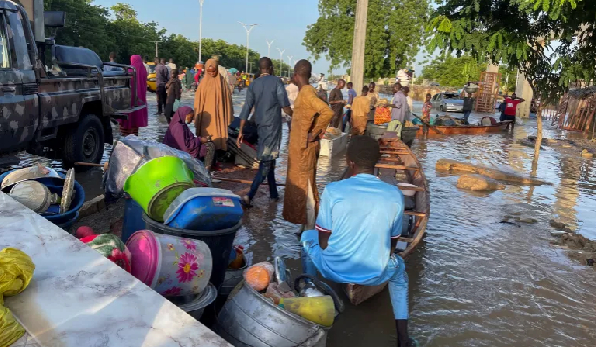
Flood victims are seen standing beside their belongings, which were recently unloaded from a canoe that helped them escape to safety.
According to scientists, global warming has significantly intensified the rainy season in several African countries in 2024, resulting in catastrophic flooding. The World Weather Attribution (WWA) network announced on Wednesday that human-induced climate change, primarily due to fossil fuel usage, has worsened seasonal downpours across the Niger and Lake Chad basins by 5-20 percent this year.
This increase in rainfall has led to a humanitarian crisis, displacing thousands and threatening livelihoods across the affected regions. Local authorities and relief organizations are struggling to provide adequate support to those impacted, as the situation continues to evolve amid ongoing climate challenges.
“These results are incredibly concerning,” said Izidine Pinto, a researcher at the Royal Netherlands Meteorological Institute and one of the study’s authors.
He pointed out that “spells of heavy summer rainfall” had become the “new normal” in Sudan, Nigeria, Niger, Cameroon and Chad.
“With every fraction of a degree of warming, the risk of extreme floods will keep increasing,” Pinto added, calling for the United Nations COP29 climate summit to “accelerate the transition away from fossil fuels” when it meets in Azerbaijan next month.
Floods have claimed the lives of approximately 1,500 individuals and forced over one million people to flee their homes in West and Central Africa this year, as reported by the UN aid agency OCHA. The heavy rainfall has also put immense pressure on dams in Nigeria and Sudan, leading to further challenges in those regions.
Such downpours “could happen every year” if global temperatures increase to 2 degrees Celsius (3.6 degrees Fahrenheit) above pre-industrial levels, warned WWA. It forecasts that this could happen as early as the 2050s.
The network’s scientists focused on war-torn Sudan, where millions of displaced people have been uprooted by conflict and driven into flood-prone areas.
They used modelling to analyse current weather trends, comparing them with patterns in a world without human-induced warming, finding that monthlong spells of intense rainfall in parts of Sudan had become heavier as a likely result of climate change.
“Africa has contributed a tiny amount of carbon emissions globally, but is being hit the hardest by extreme weather,” said Joyce Kimutai, researcher at the Centre for Environmental Policy at Imperial College in London.
The role of climate change in the floods was compounded by other human-made problems, said scientists, calling for better maintenance of dams and investment in early warning systems.
“This is only going to keep getting worse if we keep burning fossil fuels,” said Clair Barnes from the Centre for Environmental Policy.
A report by the World Meteorological Organisation, a combination of heat-trapping gases from fossil fuels and an impending El Nio make it more likely than not that the world will reach 1.5 degrees Celsius of warming above pre-industrial levels for the first time.
According to the WMO, a momentary threshold breach may have occurred. However, it would be a sign of how swiftly climate change is happening and that the globe has passed a crucial climate threshold. And as temperatures soar, the WMO projected that there is a 98% chance that at least one of the following five years and the five-year span as a whole would be the warmest on record.
Countries pledged in the Paris Climate Agreement to limit global warming to well below 2 degrees – and preferably to 1.5 degrees – compared to pre-industrial temperatures. Scientists consider 1.5 degrees of warming as a key tipping point, beyond which the chances of extreme flooding, drought, wildfires and food shortages could increase dramatically.
In its annual climate update, the WMO said that between 2023 and 2027, there is now a 66% chance that the global average temperature will breach 1.5 degrees Celsius – or 2.7 degrees Fahrenheit – of warming for at least one year.
“This report does not mean that we will permanently exceed the 1.5 degrees Celsius level specified in the Paris Agreement which refers to long-term warming over many years. However, WMO is sounding the alarm that we will breach the 1.5 degrees Celsius level on a temporary basis with increasing frequency,” said WMO Secretary-General Professor Petteri Taalas, in a statement.
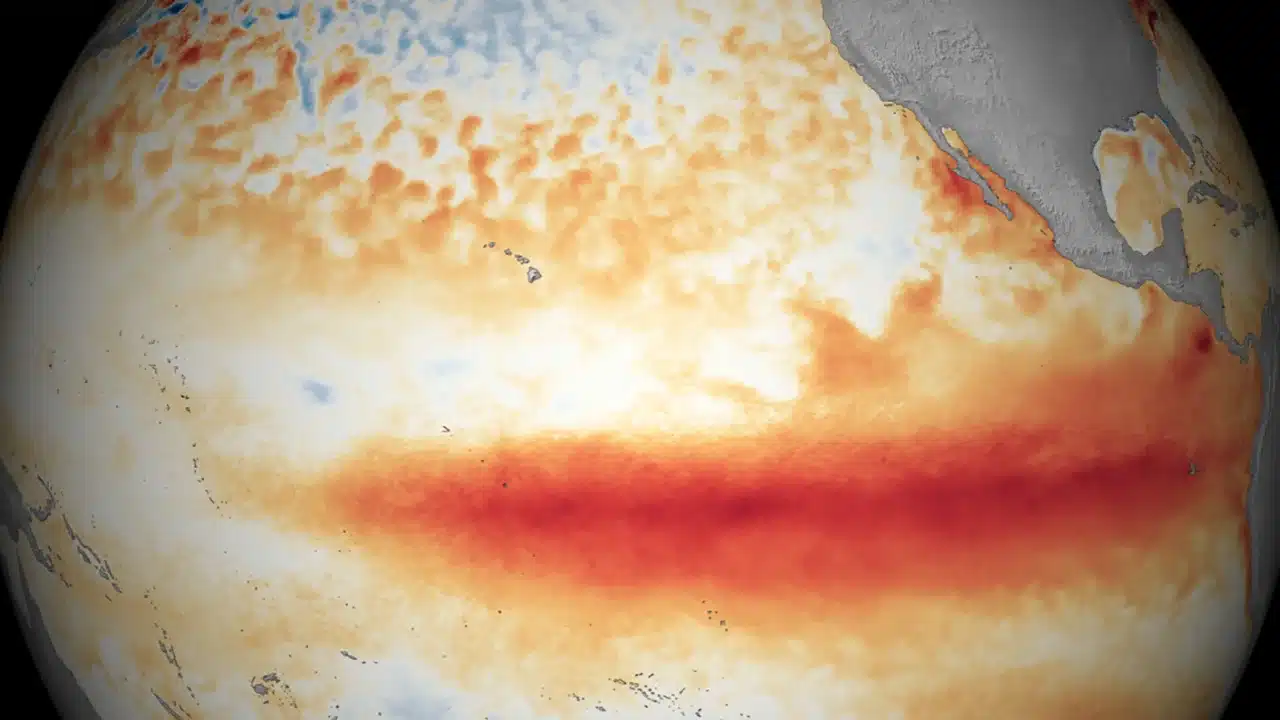
The temperature increases are fueled by the rise of planet-heating pollution from burning fossil fuels, as well as the predicted arrival of El Niño, a natural climate phenomenon with a global heating effect.
“A warming El Niño is expected to develop in the coming months and this will combine with human-induced climate change to push global temperatures into uncharted territory,” Taalas said. “This will have far-reaching repercussions for health, food security, water management and the environment. We need to be prepared.”
The current hottest year on record is 2016, which followed a very strong El Niño event. El Niño tends to ramp up the temperatures the year after it develops, which could put 2024 on track to be the hottest year on record.
The world has already seen around 1.2 degrees of warming, as humans continue to burn fossil fuels and produce planet-heating pollution. And despite three years of cooling La Niña, temperatures have soared to dangerous levels. The last eight years were the warmest on record.
The report stated that the chance of temporarily exceeding 1.5 degrees Celsius has risen steadily since 2015, when the WMO put the chance of breaching this threshold at close to zero.
The annual mean global near-surface temperature for each year between 2023 and 2027 is predicted to be between 1.1 degrees Celsius and 1.8 degree Celsius higher than the 1850-1900 average, said the WMO. That refers to the period before the sharp increase of planet-heating pollution from burning fossil fuels.
“Global mean temperatures are predicted to continue increasing, moving us away further and further away from the climate we are used to,” said Leon Hermanson, a Met Office expert scientist who led the report, in a statement.
We don’t have time to choose between stopping emissions and removing CO2 from the air. We need to do both to survive.
In 2015, I visited Fiji, Kiribati, and Tuvalu, which had just been hit by a cyclone. There, I learned a slogan — “1.5 to stay alive” — which refers to the 1.5 degrees Celsius (2.7 degrees Fahrenheit) threshold for global warming that, in theory, would avoid disastrous consequences. People living on the Pacific islands are well aware of the grave threat to humanity posed by climate change.
Six months later, I met these new comrades again at climate negotiations in Paris. While speaking at an event, I referred to “1.5 to stay alive”. I saw people shaking their heads. They told me their slogan had changed. Now, it was “1.5, we might survive”.
This was the sad reality seven years ago. It is even more so today. World leaders are gathered at the United Nations climate change conference in Sharm el-Sheikh. It is past time for them to take action. This means rapidly reducing emissions through just transition pathways.
However, because we have delayed reducing emissions for so long, it also means acting to restore the climate system and removing existing carbon dioxide (CO2) pollution already causing extreme harm. Leaders must act to accelerate research for carbon dioxide removal strategies and enact equitable policy frameworks that ensure solutions are guided and owned by affected communities. This work can happen at the same time that the crucial work of mitigation takes place.
The significant 1.2C (2.2F) of warming we are already experiencing, compared with pre-industrial times, is destroying lives and livelihoods, making parts of our world uninhabitable. These horrific effects are felt especially in the Global South,where people who have made negligible contributions to greenhouse gas emissions are paying the first and most brutal price.
Leaders of the world’s most powerful nations and corporations have chosen to ignore the pleas, with half-hearted responses that fail to offer the scale and pace required. Millions of people stand on the brink.
Enter carbon dioxide removal. While I wish we had acted early enough through emissions reductions so there was not a need for carbon dioxide removal, I recognise now that these strategies must be part of the climate solution. Science agrees. The Intergovernmental Panel on Climate Change – the global scientific body informing the UN on climate change – says we must remove between 100 and 1,000 gigatons of CO2 build-up in our atmosphere in this century, even as we also pursue all other decarbonisation paths.
To be clear, just a decade ago, supporting carbon removal was unthinkable for activists like me. Many, including myself, thought these strategies would be an excuse for the fossil fuel industry to avoid action.
Today, while there is a global consensus that we need to get off fossil fuels, we have no time left to wait. Even if we stop all emissions tomorrow, the problem remains. In fact, the choice between reducing emissions or removing carbon dioxide is one we simply do not have. Rather, affected communities demand we do both, urgently, and equitably.
When considering carbon dioxide removal, I have feared the effects of intervening in nature. It does not help that CO2 removal is mostly a Global North-led effort in the early stages of pilots — sometimes with exaggerated claims of efficacy. These efforts often have inadequate levels of transparency and accountability.
Still, the idea of climate restoration – giving to the earth as much or more than we take – itself is squarely in line with ancient wisdom and indigenous knowledge, as well as with the needs of affected communities. Protection is step one. Clean-up and revitalisation are step two.
Carbon dioxide removal also suffers from being confused with carbon capture and sequestration – a technology and approach led by fossil fuel industry giants that is not delivering on its promise to reduce emissions but instead has been used by these corporations to pollute more. Consider Shell’s Quest facility in Canada, built with $1bn in government grants, and Chevron’s Gorgon facility, built with $60m in government funding.
We must not confuse the two. While carbon capture and sequestration allow for the same bad actors that have gotten us into this mess to continue emitting, carbon removal represents a mindset that allows us to clean up pollution while also transitioning from fossil fuels.
There are, in fact, many forms of carbon removal available. Some are nature-based, or, what some have called “rewilding”. These solutions include planting trees, restoring mangroves, cultivating seaweed or growing algae blooms in the open ocean. There are also more technological solutions that claim to augment and speed up natural processes and bring them to larger scales.
For all solutions, be they natural or technological, it is important that we accelerate science-led research in a transparent and accountable manner. All risks must be considered, including those of no action.
It is also critical that free, prior and informed consent is secured on the lands of the communities involved. Policy frameworks around carbon removal – and particularly that which occurs in the Global South – should be evolved to include systems whereby solutions and profits from solutions are guided and owned by the most affected communities. For ocean-based solutions, which have fewer chances of land conflict, we must also ensure that benefits flow to affected communities globally.
So, not only must we act urgently, but we must act thoughtfully. It is our collective moral responsibility as a global community to move forward together. As my friends on the Pacific islands told me: “1.5, we might survive”. Let this COP be the one at which we reset our ambition to restore and thrive.
DISCLAIMER: Independentghana.com will not be liable for any inaccuracies contained in this article. The views expressed in the article are solely those of the author’s, and do not reflect those of The Independent Ghana