Tag: Global

  • SME Global appoints Sammi Awuku as vice president for Africa

    SME Global appoints Sammi Awuku as vice president for Africa

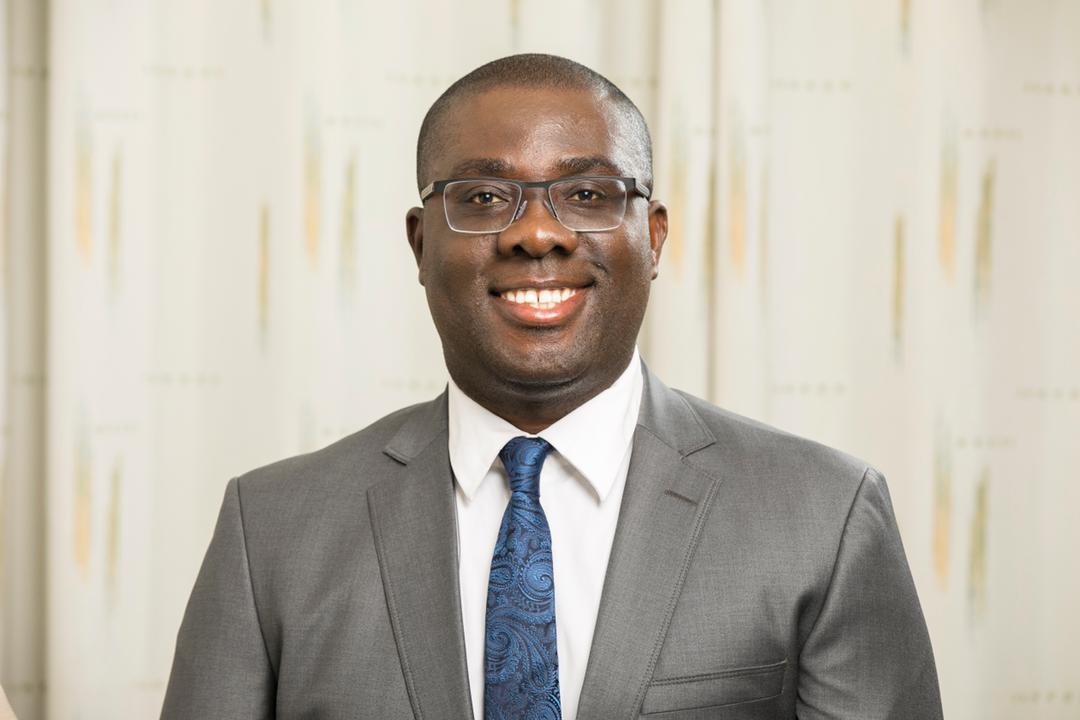
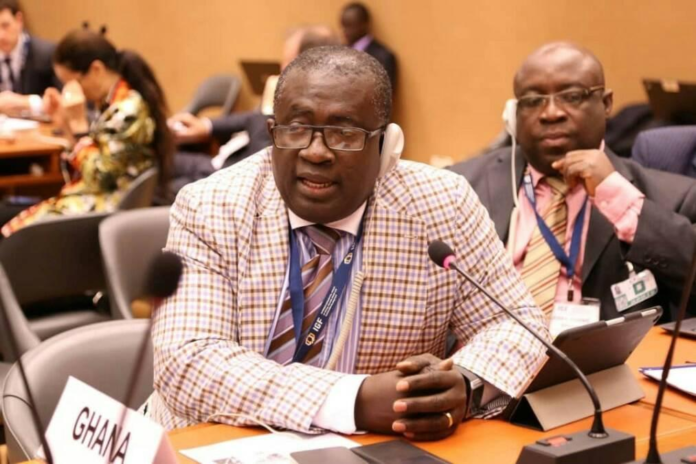
    A former National Organiser of the New Patriotic Party (NPP) and the current Member of Parliament (MP) for Akuapem North in Ghana’s Eastern Region, Sammi Awuku, has been appointed as Vice President for Africa at SME Global.

    His appointment was confirmed in a letter dated March 10, 2025, signed by Lilia Heitz, Secretary General of SME Global under the International Democracy Union (IDU).

    “On behalf of the Executive Office of SME Global, I am pleased to formally confirm your appointment as Vice-President of SME Global of the IDU.

    “We are confident that your contributions will be instrumental in driving our mission forward and fostering impactful initiatives. We appreciate your willingness to take on this responsibility and look forward to working together to strengthen the SME landscape globally. Once again, congratulations, and welcome to SME Global.”

    The letter expressed confidence in Awuku’s capacity to advance the organization’s mission and make a meaningful impact on small and medium-sized enterprises (SMEs) across Africa.

    SME Global serves as the trade and economic wing of the IDU, committed to promoting SMEs and startups on a global scale. It brings together policymakers from IDU-affiliated political parties and business leaders to advocate for economic policies that support enterprise growth, reduced taxation, and sustainable business practices.

    As Vice President for Africa, Awuku will lead initiatives to strengthen SME policies, push for regulatory reforms, and support small businesses in playing a more significant role in Africa’s economic transformation. His leadership is expected to reinforce SME Global’s commitment to fostering entrepreneurship and addressing challenges faced by businesses across the continent.

    In his new role, Awuku will collaborate with other senior officials at SME Global, including President Jörgen Warborn, MEP (Sweden), and Vice Presidents Randy Hoback, MP (Canada), Todd McClay, MP (New Zealand), Kevin Hollinrake, MP (United Kingdom), and Germana Figueroa Casas, MP (Argentina).

    His appointment marks a renewed focus on Africa within SME Global, as the organization aims to drive innovation, advocate for business-friendly policies, and create a more supportive environment for SMEs to thrive.

  • Ghana listed 7th among countries with most educated politicians

    Ghana listed 7th among countries with most educated politicians

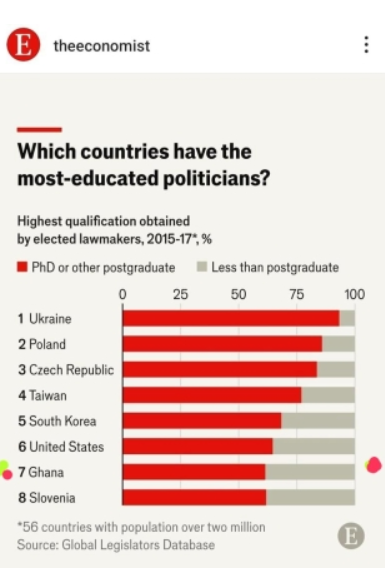
    Ghana is ranked seventh in a global list of countries with the most educated politicians, according to a report analyzing the educational backgrounds of lawmakers.

    This ranking is based on two studies conducted by researchers from global universities, using data from 2015, 2017, and 2023.

    The analysis, drawn from a Global Legislators Database, focused on 56 countries with populations exceeding two million.

    It examined the highest qualifications of elected lawmakers between 2015 and 2017, categorizing their education levels from PhDs and other postgraduate degrees to those with less education than a postgraduate.

    Ukraine tops the list, followed by Poland in second place and the Czech Republic in third. Taiwan is ranked fourth, with South Korea fifth, and the United States sixth. Ghana holds the seventh position, with Slovenia ranked eighth.

    The findings, published by The Economist, provide insights into the educational qualifications of national parliamentarians. Political scientists have long tracked the age and gender demographics of elected officials but have found it more challenging to compare other characteristics like education.

    However, recent datasets have made it easier to analyze the educational backgrounds of politicians across various countries.

    The first study, involving researchers from six universities, collected data on nearly 20,000 parliamentarians from 97 countries between 2015 and 2017. The study revealed that 78% of parliamentarians held at least a bachelor’s degree, with 40% possessing postgraduate degrees.

    These figures far exceed the average education levels among the general population, with wealthier nations averaging 35% education, and poorer countries at 15%.

    Ukraine has the highest proportion of legislators with postgraduate degrees, including a significant number holding doctorates.

    This trend is supported by Ukraine’s presidential history, where all presidents except Volodymyr Zelenskyy have claimed doctoral degrees. South Korea also stands out, with nearly a third of its legislators holding doctorates, and the United States follows closely with over two-thirds of its lawmakers holding postgraduate degrees.

    In contrast, some countries like Italy, Norway, and the UK have a larger share of parliamentarians with only secondary education.

    For instance, Sir Lindsay Hoyle became Speaker of the UK House of Commons without a university degree, while Italian politicians like Luigi Di Maio and Matteo Salvini did not complete their university education.

    The second study, published in 2023, focused on 6,000 legislators from nearly 30 countries and highlighted regional trends.

    In North and Latin America, most legislators hold law degrees, while Nordic countries tend to elect those with backgrounds in social sciences like economics. The UK stands out for electing many lawmakers with degrees in arts and humanities.

    However, studies on whether highly educated politicians perform better than their peers have shown mixed results. A 2015 study on the U.S. Congress found no significant differences in the performance of degree holders versus those without.

    Similarly, a study in Spain found no notable improvement in mayors’ performance in areas like unemployment reduction or city development, despite having degrees.

    Moreover, research has shown that the most educated politicians do not necessarily have a better track record in elections, often losing at the same rate as less formally educated candidates.

    Still, obtaining a degree has become a significant barrier to entry for aspiring politicians, as it has become increasingly difficult for individuals without degrees to secure a place on the ballot.

    While national legislatures have become younger and slightly more gender-balanced, they are also becoming more elite, raising concerns that the growing educational divide could disconnect elected officials from the populations they represent.

    This shift might have consequences, as those with higher education often have different priorities than the general electorate, potentially affecting voter engagement and representation.

  • Collective efforts needed to fix climate crisis – Akufo-Addo

    Collective efforts needed to fix climate crisis – Akufo-Addo

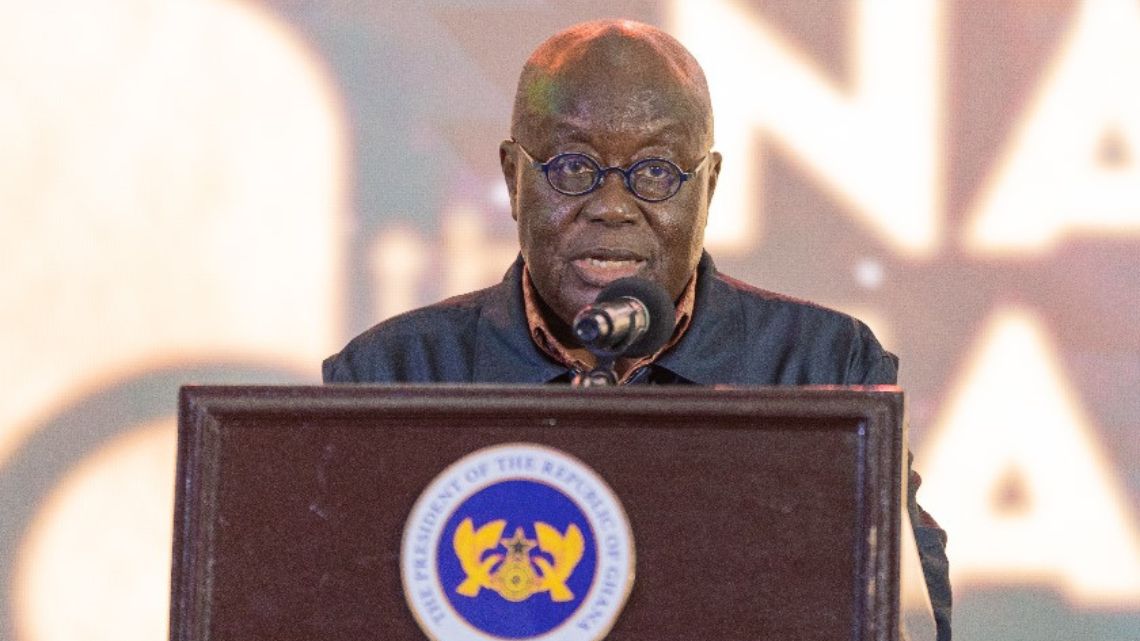
    President Nana Addo Dankwa Akufo-Addo called on world leaders to move past mere rhetoric and take decisive, tangible actions in the fight against the global climate crisis.

    During the World Climate Leaders Summit at COP29 in Azerbaijan on Wednesday, November 13, he stressed the urgent need for effective strategies to protect vulnerable communities from the escalating dangers posed by climate change.

    With time running out, the President underscored that swift and meaningful solutions are crucial to preserving both lives and ecosystems across the globe.

    “We gather here, we must demonstrate that we are not only individuals or policy makers but as people bound by the love for our land and environment

    “Our children’s future hinge on our decisions, so COP29 must be a shift from dialogue to action,” he stressed.

    During COP29, where climate financing took a central role, President Akufo-Addo stressed the need for developed nations to provide financial support to help accelerate the shift toward green energy.

  • Oil prices surge globally – Report

    Oil prices surge globally – Report

    Oil prices rose on Friday in global commodities markets as supply risks overshadowed weak demand forecasts. Brent crude reached $77.15 per barrel, while West Texas Intermediate (WTI) saw a 0.83% increase, bringing it to $73.85 per barrel.

    Fears of supply disruptions from the ongoing conflict between Israel, Hamas, and Hezbollah fueled the price hikes. Israeli airstrikes in southern Lebanon on Wednesday night left 10 dead, including 5 paramedics, and injured 12, according to the Lebanese Civil Defense. Many countries are evacuating their citizens due to the rising violence. On Thursday, Hezbollah retaliated by launching rockets at Israeli military sites, following Israel’s airstrike on a Hezbollah member in Syria.

    Simultaneously, Israel has intensified its airstrikes on Gaza, despite global calls for a ceasefire. Medical sources reported that seven Palestinians, including three children, were killed in the latest attacks.

    Meanwhile, in the United States, hurricane Milton left over 2 million people without power in Florida, increasing fuel demand as residents lined up at gas stations, fearing gasoline shortages.

    China’s economy is also expected to drive up oil demand, with new stimulus measures anticipated over the weekend to bolster economic activity.

    Supply concerns have kept the market on edge, with analysts pointing to heightened volatility. Speculation continues over a potential Israeli retaliation against Iran following recent missile attacks, though the US and Gulf nations are urging Israel to avoid targeting oil infrastructure.

    Recent inventory data from Insights Global revealed a drop in gasoil and fuel oil stocks in the ARA region, while gasoline inventories increased. In the US, natural gas prices rose slightly, despite higher-than-expected storage growth of 82 Bcf, as reported by the EIA.

  • Global food prices to decrease significantly in 2025 – World Bank

    Global food prices to decrease significantly in 2025 – World Bank

    The World Bank has recently published its April 2024 Commodity Outlook Report, projecting a significant decrease in global food prices for 2024, with an estimated 6 per cent decline, followed by an additional 4 per cent drop in 2025.

    This reduction is primarily attributed to lower prices for grains, oils, and meals, while other food categories are anticipated to experience price increases in 2024.

    However, 2025 is anticipated to witness widespread decreases in food prices.

    The grains price index is expected to decrease by 11 per cent in 2024, fueled by increased global grain supplies. Wheat prices are predicted to fall by 15 per cent in 2024 due to heightened production, with an additional 2 per cent decline projected for 2025.

    These forecasts coincide with intense export competition and slightly higher production, counterbalanced by somewhat increased consumption and the lowest end-of-season stocks-to-use ratio in eight years.

    Global maize production is poised to reach a record high in the 2023–24 seasons, while global rice production in 2023-24 remains steady, accompanied by a decrease in the stock-to-use ratio to its lowest level in three years.

    Rice prices are expected to climb by 8 per cent (year-on-year) in 2024 due to tight global markets and export restrictions imposed by India.

    In the Ghanaian context, a reversal in food disinflation is evident as the food inflation rate surged from 27.0 per cent in February to 29.6 per cent in March 2024.

    This uptick in food inflation occurs amidst persistent concerns about food insecurity in the sub-Saharan region.

    As global food prices are projected to decline, it remains to be observed how these developments will impact Ghana’s food market and the overall food security situation in the country.

  • Ghana’s lithium pact fails to global opportunities – Toni Aubynn

    Ghana’s lithium pact fails to global opportunities – Toni Aubynn

    Former CEO of the Minerals Commission, Dr. Toni Aubynn, has voiced strong criticism against Ghana’s recent lithium development agreement at Ewoyaa in the Central region.

    In a social media post, he argued that Ghana missed an opportunity to capitalize on the current global demand for lithium, pointing out that the announced increase in royalty rate and free carried interest falls short of global standards.

    Drawing a contrast with countries like Mexico and Australia, Mr Aubynn highlighted their choice to pursue 100% or majority interest in lithium development, citing Australia’s significant direct investment.

    “Ghana failed to take advantage of the current importance and demand for lithium,” he added.

    He underscored the need for new frameworks responsive to the strategic importance of lithium, criticizing Ghana’s deal for lacking transparency and offering minimal benefits.

    “Our present agreement is a lost opportunity to exact optimal benefit for Ghana, given the criticality and present global demands for lithium and other critical minerals.” he added.

    The critique from industry experts and civil society, including the IEA, the clergy, and IMANI, increases pressure on the government to reevaluate the terms of the agreement amid the growing significance of lithium in the global market.

  • Global Search for Paul McCartney’s lost guitar

    Global Search for Paul McCartney’s lost guitar

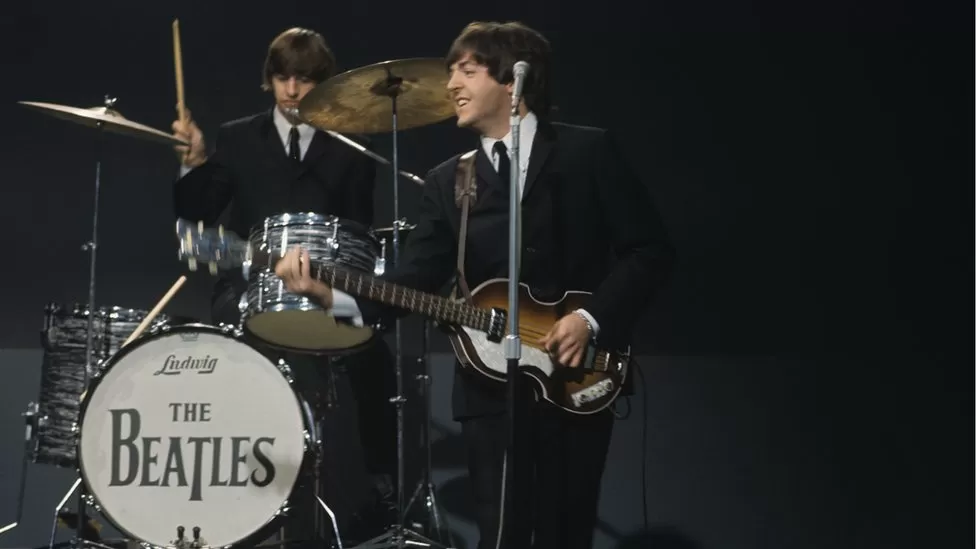
    A global search has been initiated to locate one of the world’s most iconic musical instruments: Paul McCartney’s original Höfner bass guitar.

    The Lost Bass Project is appealing for information about what it deems “the most important bass in history.” McCartney acquired the instrument for £30 ($38) in Hamburg, Germany, in 1961, but it vanished eight years later.

    This bass guitar played a significant role in The Beatles’ music during that period, including hits like “Love Me Do” and “She Loves You.”

    Nick Wass is leading Höfner’s search project and has teamed up with two journalists to unravel the “greatest mystery in the history of rock and roll.”

    Having worked extensively with McCartney and authored a book about the missing Höfner 500/1 Violin Bass, Wass shared that the idea to locate the guitar arose during a recent conversation with the famous Beatle.

    The circumstances surrounding the instrument’s disappearance remain unclear. Presumably, it was stored away after the Beatles completed filming “Get Back” in 1969.

    “It’s not clear where it was stored, who might have been there. For most people, they will remember it… it’s the bass that made the Beatles,” Wass emphasized.

  • This is a big win for me – Camidoh reacts to his BET nomination

    This is a big win for me – Camidoh reacts to his BET nomination

    Ghanaian Afrobeats artist, Camidoh, has expressed his delight after being nominated for the prestigious BET Viewer’s Choice: Best New International Act award for 2023.

    Among a carefully selected group of exceptional global musicians, including Asake from Nigeria, Flo from the UK, Libianca from Cameroon, Maureen from France, Mc Ryan SP from Brazil, Pabi Cooper from South Africa, Raye from the UK, and Werenoi from France, Camidoh finds himself in illustrious company.

    During an interview on TV3 New Day, Camidoh shared his disbelief and the overwhelming emotions that followed the nomination. He stated, “I am still really in shock because I don’t even know what to say. Yesterday, I had to take time to really process it because it’s really like one big blessing. This was not something I was looking out for, do you understand? I mean, I am just grateful.”

    The singer admitted that the nomination came as a complete surprise, as it was not a goal he actively pursued. Nonetheless, he recognized its significance and viewed it as a valuable lesson in his artistic journey.

    Camidoh expressed deep gratitude for the opportunity to be acknowledged on such a prestigious platform.

    When questioned about the factors contributing to his success, Camidoh attributed it to his team’s strategic marketing plan and their unwavering dedication to reaching a global audience.

    He emphasized their commitment to delivering captivating performances during international shows, aiming to leave a lasting impression on audiences in every country they visit. These tireless efforts, he believes, played a pivotal role in propelling his career to this remarkable point.

    Reflecting on his journey, Camidoh shared, “To answer your question, I think it depends on your goal and based on your marketing plan. It’s just us doing shows across the globe, and when we go into a country, we do the most to ensure that everyone hears of the brand and it cements on the end before you leave. I think these were the very small things that we were doing that brought us here.”

    As anticipation continues to build, fans and well-wishers are urged to rally behind Camidoh and cast their votes, contributing to his path toward potentially securing the coveted honor at the BET Awards. The prestigious event is scheduled to take place at the Microsoft Theater on Sunday, June 25.

  • New website launched to track global state of democracy and human rights

    New website launched to track global state of democracy and human rights

    A new website that closely tracks the status of democracy and human rights around the world has been launched on April 27, by the Stockholm-based International Institute for Democracy and Electoral Assistance, or IDEA.

    It will provide monthly analysis and data on 173 countries based on over 100 indicators, from holding clean elections to fair access to justice and civil liberties.

    Seema Shah, head of the Democracy Assessment team at IDEA, says she thinks it is a valuable tool as it documents what is happening in a country through the lens of democracy, and why and how it is being impacted.

    “It’s one thing to say, ‘oh, well, the democratic health of country X is weak right now because they just had a flawed election‘. But it’s another thing to really dig into that election and see what happened that made it flawed. Why should that matter to the overall health of democracy?”

    For each country tracked, the website will include basic information such as the population, system of government, and head of state.

    But it also includes analysis that aims to give policymakers and others globally the tools to assess and understand the quality of their democracies.

    While it doesn’t rank countries, rather compares trends within a nation over time, IDEA’s data shows that democracy in 25 of them is on the decline, while just 11 have shown progress.

    “What we’ve seen is that democracy all over the world has been declining for at least the last decade, if not more. And all the interventions that have been created and all the policy recommendations that are circulating out there so far haven’t been able to stem the tide,” said Shah.

    She said IDEA thinks having more timely data would be able to help decision-makers to be able to make more strategic decisions using the most up to date information out there.

    The data is based on Global State of Democracy indices that are the evidence base for IDEA’s annual Global Report on the State of the Democracy.

  • Education must remain a priority for global development – Akufo-Addo

    President Akufo-Addo has charged Member States of the United Nations Educational, Scientific and Cultural Organisation (UNESCO) to ensure that education remains a priority in the common development agenda of countries.

    As the recently appointed Domestic Financing champion of the Global Partnership for Education, President Akufo-Addo sought the co-operation and support of UNESCO “to work towards developing sustainable homegrown financial solutions, so we can develop the educational system for the future we want in our various countries.”

    Addressing the 215th Meeting of the Executive Board of UNESCO, on Monday, 10th October 2021, in Paris, France, the President noted that the world does not have the luxury to pick and choose which crises it wants to fix.

    “At this moment, we cannot pick and choose between funding guns and education. We cannot pick and choose between the interests of the present generation and the future of our girls and boys. We cannot choose geopolitical concerns over preserving our cherished cultural heritages, lest we perish universally,” he said.

    Due to global instability, however, President Akufo-Addo noted that, education has become one of many competing priorities of domestic budgets, with development aid to the education sector also seriously under pressure.

    “Indeed, countries reduced their spending on education after the onset of the COVID-19, and, at the same time, direct aid to education by bilateral donors fell by some three hundred and fifty-nine million dollars ($359 million), which is not compatible with the objectives of the Addis Ababa Action Agenda for financing sustainable development and the goals of the SDGs,” he said.

    The President continued, “We are further informed that prospects for reaching funding target, through voluntary contributions, are uncertain as several long-term donors have already reduced significantly their voluntary contributions to UNESCO due to a change in development cooperation priorities, thereby significantly impacting our planned programme implementation.”

    In spite of these challenges, President Akufo-Addo commended UNESCO for the lead role it played in ensuring the success of the Transforming Education Summit, held on the sidelines of the UN General Assembly in September this year.

    Necessitated by the seminal “Futures of Education” report from UNESCO, the President indicated that the Transforming Education Summit, and, indeed, the pre-summit held here in Paris, have been extremely successful in getting the world to reflect deeply on the trajectory of educational systems, and how to addresses the challenges of our time.

    Touching on Global Priority Africa Programme, which has been adopted by the UNESCO General Conference at its 41st Session, President Akufo-Addo was delighted that UNESCO has made Africa a Global Priority, and was delighted to see UNESCO’s flagship programmes as being relevant to achieving the objectives of the Africa Union’s Agenda 2063, i.e. “The Africa We Want”.

    He also urged UNESCO’s Executive Board to help win the fight against Climate Change, especially as the planet is heading towards a dangerous tipping point as a result of climate change.

    In furtherance of this, he commended UNESCO for the effort to strengthen the “Man and Biosphere Programme”, whose goal is to help protect nature and biodiversity loss globally, through the Biosphere Reserve Concept.

    “I urge UNESCO Member States to strengthen measures, at their respective national levels, that recognise formally the contribution of Biosphere Reserves, and designate more biosphere reserves and geoparks as a sure way for solving the climate crisis”, he added.

    In concluding, the President informed the Executive Board of the news that Accra has been named as the UNESCO World Book Capital for 2023, making Accra part of the prestigious World Book Capital Cities Network.

    This, he stated, is an acknowledgement of the giant strides Ghana and Africa are making in developing Ghana’s book and creative arts industry.

    “The year-long programme to celebrate this honor done us by UNESCO will commence from 23rd April 2023, which is celebrated globally as the World Book and Copyright Day. I wish to use this opportunity to invite you all to join Ghana in this year-long celebrations,” the President added.

  • Ghana re-elected to ITU Council

    Ghana has been re-elected as a council member of the International Telecommunication Union (ITU), to continue contributing its quota to the United Nation’s specialized agency that oversees global telecommunication operations.

    The election for the Council membership, which was held on Monday, was the high point of the ongoing ITU Plenipotentiary Conference 2022 in Bucharest, Romania.

    Ghana secured 145 votes and ranked 2nd among the 13 countries elected to the
    Council from Region D in Africa, which is the highest number of votes that Ghana has secured at an ITU Council election.

    The ITU Council acts as the Union’s governing body in the interval between
    Plenipotentiary Conferences, held every four years.

    Its role is to consider broad telecommunication policy issues to ensure that the Union’s activities, policies, and strategies fully respond to today’s dynamic, rapidly changing telecommunications environment.

    The Minister for Communication and Digitalisation, Mrs Ursula Owusu-Ekuful, who led Ghana’s electoral campaign pledged that Ghana would continue to make a valuable contribution to the ITU council while making sure that it provides its service to telecommunication in a resourceful, open, and futuristic way.

    She explained that the government has already done a lot through initiatives such as the innovative Rural Telephony Project and Sectoral Computer Emergency Response Teams (CERTS) to secure cyberspace amongst others.

    In a related development, Rev. Ing. Edmund Yirenkyi Fianko, the Acting Director of Engineering at the National Communications Authority (NCA) was elected to ITU’s Radio Regulations Board (RRB) for the 2023-2026 term.

    In total, forty-eight ITU Member States were elected to the Council ITU Radio Regulations Board (RRB).

  • Global air travel won’t recover till 2024 – IATA

    Global air travel won’t recover from the COVID-19 crisis until 2024, the International Air Transport Association (IATA) announced Tuesday.

    That’s a year later than the airline body’s previous projection.

    The body, which represents 290 airlines, blamed the sluggish recovery on a number of factors, including a lack of consumer confidence, the decline in business travel, and fresh coronavirus spikes in the United States and elsewhere.

    The revised baseline forecast is that international passenger traffic will drop 55% in 2020, compared to 2019. Back in April, the IATA had predicted the drop to be just 46%.

    Passenger numbers are expected to rise 62% next year, but will still be down almost 30% compared to pre-COVID times, with a full recovery to pre-pandemic levels not on the cards until four years from now.

    “Passenger traffic hit bottom in April, but the strength of the upturn has been very weak,” said Alexandre de Juniac, IATA’s director general and CEO in a statement. “What improvement we have seen has been domestic flying.”

    Unsurprisingly, short-haul travel is expected to recover faster than long-haul — due to passenger comfort levels, but also because international markets remain largely closed.

    “Consumer confidence is depressed and not helped by the UK’s weekend decision to impose a blanket quarantine on all travelers returning from Spain,” said de Juniac.

    The British government made a surprise U-turn on its UK-Spain travel corridor on Saturday, reinstating with immediate effect its 14-day quarantine for all travelers arriving from the popular tourist destination, following a rise in coronavirus cases in the country.

    Many British holidaymakers — who’d jetted off shortly after schools broke up for summer — were caught out by the decision. British Foreign Secretary Dominic Raab defended the move, telling Sky News that it “took the decision as swiftly as we could, and we can’t apologize for doing so.”

    In terms of countries’ domestic traffic, China’s airlines are leading the recovery, with traffic down 35.5% in June compared to the 2019 period, up from a 46.3% decline in May.

    The IATA says that scientific advances in fighting Covid-19, including the development of a successful vaccine, could allow for a speedier recovery. But for now, the future is looking bleak.

    “In many parts of the world infections are still rising,” said IATA’s de Juniac. “All of this points to a longer recovery period and more pain for the industry and the global economy.”

    With airlines struggling financially, governments will need to continue relief measures to stop carriers going under, said the airline body.

    “Summer — our industry’s busiest season — is passing by rapidly,” said de Juniac. He said that there was “little chance for an upswing in international air travel unless governments move quickly and decisively to find alternatives to border closures, confidence-destroying stop-start re-openings and demand-killing quarantine.”

    Source: edition.cnn.com

  • Millions of children miss key vaccinations

    Nearly 14 million children globally were not immunised against preventable illnesses last year, according to a joint report by two UN agencies: WHO and Unicef.

    More than half of these children are in Africa with those living in countries in conflict being the most affected, Dr Robin Nandy, chief of immunisation at Unicef, told the BBC.

    “Some of the missed vaccines are against [diseases like]: polio; measles; meningitis; diphtheria; tetanus and whooping cough. Of greater concern to us are children who have not been immunised against measles,” Dr Nandy said.

    Children living in remote rural areas and urban slums are also said to be vulnerable.

    Nigeria, Democratic Republic of Congo, Ethiopia, Chad, Central African Republic and South Sudan are some of the African countries with high numbers of children who have not been vaccinated.

    The report also warns that the number of children likely to miss vaccinations this year could double as a result of disruption to immunisation services due to the coronavirus pandemic.

    In March, the WHO advised countries to temporarily suspend mass vaccination campaigns, until effective measures for reducing Covid-19 transmission were established.

    So far, Angola, Ethiopia and Burkina Faso are among the few countries that have resumed mass vaccinations following strict guidelines.

    Source: bbc.com

  • More countries to ease coronavirus restrictions as global cases rise

    More countries in Europe and Asia began to ease restrictions and resume operations, but more than 1 million cases of COVID-19 have been recorded in Latin America and the Caribbean, now the new epicentre of the coronavirus pandemic.

    Globally, confirmed COVID-19 cases have surpassed 6.16 million, according to data compiled by the Center for Systems Science and Engineering at Johns Hopkins University.

    New Epicenter

    Brazil on Sunday said its nationwide tally of confirmed COVID-19 cases reached 514,849 after 16,409 people tested positive in the past 24 hours, while the death toll neared 30,000. Its death toll rose to 29,314, the fourth highest in the global pandemic after the United States, Britain and Italy, after 480 deaths had been reported since Saturday, while another 4,208 deaths are still being investigated for any linkage with COVID-19, the Ministry of Health said.

    Also on Sunday, Mexico’s Deputy Health Minister Hugo Lopez-Gatell said that the country reported 3,152 new coronavirus cases in the past 24 hours, bringing the total number of confirmed cases in the country to 90,664.

    There were 151 new coronavirus deaths in Mexico, taking total fatalities to 9,930, Lopez-Gatell added.

    Meanwhile, Chile’s COVID-19 cases increased by 4,830 to reach 99,688 on Sunday.

    In the past 24 hours, 57 more patients died, the highest number of fatalities in a single day so far, taking the death toll from the disease to 1,054.

    A lockdown is in effect in the capital Santiago and the metropolitan area through June 5, as the region is the epicentre of the country’s outbreak.

    In recent weeks, Chile has seen an exponential rise in the number of cases and deaths, leading the government to set up field hospitals to deal with the growing number of patients.

    Easing Restrictions

    Italy has now recorded fewer than 600 new cases per day for eight consecutive days, a dramatic drop from peaks of more than 6,000 new infections a day when Italy was the epicentre of the pandemic in late March.

    Recent trends show that the spread of the virus has slowed dramatically despite a gradual easing of Italy’s national lockdown at a two-week interval, first on May 4 and again on May 18.

    The next step toward easing will come on June 3, when Italians will be allowed to move freely between regions even if for non-essential reasons.

    It will be the first time such travels will be allowed since March 9, the day before the national lockdown entered into force.

    Many businesses across Turkey on Sunday also prepared to resume operation for the first time after over two months of closure amid a slowdown in the spread of COVID-19.

    Restaurants, cafes, parks, beaches, daycare centres, kindergartens, libraries, sports facilities, swimming pools, and museums will be operational as of June 1 as part of the new normalization process announced on May 28.

    Following the announcement, the Health Ministry prepared a guide in particular for the eating and drinking industry, explaining the new rules in a detailed way.

    Likewise, the Egyptian government on Sunday announced a decision to reduce its curfew from 10 hours to nine, following a meeting led by Prime Minister Mostafa Madbouly.

    The government has already started gradual reopening of services and offices suspended since mid-March amid a “coexistence plan” to maintain anti-coronavirus precautionary measures while resuming services, businesses and economic activities.

    Chairing Saturday’s Downing Street daily briefing, British Culture Secretary Oliver Dowden said Britons will be able to exercise outside with up to five others from different households from Monday, provided that strict social distancing guidelines are followed.

    He also announced that from Monday, competitive sport will be allowed behind closed doors in England, paving the way for the return of live sports on TV screens in almost three months.

    The move came as some experts warned that lifting restrictions before cases come down is too “risky.”

    Professor Jonathan Van-Tam, England’s deputy chief medical officer, said that Britons need to “actually follow the guidance.”

    Disclaimer : “Opinions expressed in this article are the sole responsibility of the author(s) and do not in any way reflect those of backend.theindependentghana.com. Our outfit will hereby not be liable for any inaccuracies contained in this article.”

    Source: GNA

  • Coronavirus: Global push for inquiry into Covid-19 response

    Global health leaders are pushing for an independent review of the response to the Covid-19 pandemic at the UN’s World Health Assembly.

    Monday’s virtual meeting brings together envoys from 194 member states of the World Health Organization (WHO).

    The WHO is facing questions on how it dealt with the coronavirus pandemic.

    Chinese President Xi Jinping, who has defended his country’s actions during the outbreak, spoke during Monday’s opening ceremony.

    He said China had acted “with openness and transparency” and insisted that any investigation should happen after the pandemic was brought under control.

    In other opening remarks, WHO Director-General Tedros Adhanom Ghebreyesus welcomed a proposed resolution calling for a review of the WHO’s handling of the pandemic and said it would initiate it “at the earliest opportunity”.

    South Korean President Moon Jae-in said the WHO must be given more legal powers to ensure that countries report outbreaks and share data.

    “A novel infectious disease could emerge at any time and we must be able to respond more quickly and effectively,” he said.

    The two-day assembly – an annual meeting that reviews the work of the UN’s health agency – comes amid recriminations between the US and China over the virus.

    The US has already stopped its funding for the agency and is promoting its own vaccine programme.

    More than 4.5 million people have been infected and more than 300,000 have died since the virus emerged in China in December.

    What is the assembly discussing?

    The European Union, alongside countries including the UK, Australia and New Zealand, is pushing for an inquiry into how the pandemic has been handled and what lessons can be learned.

    EU spokeswoman Virginie Battu-Henriksson said several key questions needed to be answered as part of any review.

    “How did this pandemic spread? What is the epidemiology behind it? All this is absolutely crucial for us going forward to avoid another pandemic of this kind,” she said.

    However, she added that now was not the time for “any sort of blame game”.

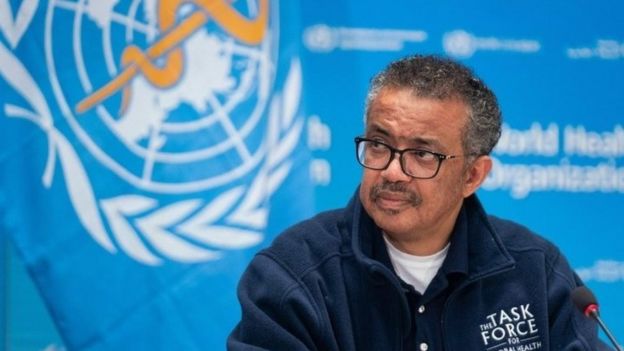
    WHO director-general Tedros Adhanom GhebreyesusImage copyrightAFP
    Image captionWHO director-general Tedros Adhanom Ghebreyesus has faced criticism for the agency’s handling of the pandemic

    A draft resolution calling for a review, to be put to a vote on Tuesday, requires a two-thirds majority to pass and already has support from 116 of the 194 member states, according to Reuters.

    Last month, an EU report accused China of spreading disinformation about the crisis.

    The bloc’s External Action Service said Russia, and to a lesser extent China, had promoted “conspiracy narratives”.

    Grey line

    War of words looms between US and China

    Analysis by Tulip Mazumdar, BBC global health correspondent

    The annual World Health Assembly is an important, but usually quite dry, event. Not this year.

    The Covid-19 pandemic is taking centre stage and the event is likely to host a strong war of words between China and the US about how this health emergency has unfolded – with the WHO stuck in the middle of a bigger geopolitical fight between the superpowers.

    The EU-led call for an investigation into the international response – and to find the animal source of Covid-19 – has been deliberately worded without mentioning China, where the virus first emerged.

    Also expect calls for an independent WHO team to be allowed into China to investigate the origins of the virus. So far international teams have only been allowed in alongside Chinese authorities. The US and others including Australia will no doubt call for this, China is highly unlikely to agree.

    Grey line

    What has the WHO said?

    WHO spokeswoman Dr Margaret Harris said that the World Health Assembly was “always the time for a lot of scrutiny [of the WHO].”

    But, she added, the organisation would remain “laser-focused” on working to lead the overall response, and on the science and solutions for this pandemic.

    The WHO is supposed to represent the interests of all member states equally but has found itself at the centre of a political battle between China and the US.

    US President Donald Trump, who faces re-election this year and has been criticised for his handling of the pandemic, has blamed China for trying to cover up the outbreak and has accused the WHO of failing to hold Beijing to account.

    The row culminated last month with the US – the WHO’s largest single donor – pulling funding to the agency.

    The assembly is also expected to hear calls to give the WHO more powers to allow inspectors to go into countries at the start of outbreaks, and carry out independent investigations.

    The WHO did send a team of scientists into China in January and February, but it was a joint mission alongside Chinese officials.

    What has China’s response been?

    China has already rejected calls for an independent international investigation into Covid-19.

    Last month, senior Chinese diplomat Chen Wen told the BBC that such demands were politically motivated and that an investigation would only divert attention and resources away from fighting the virus.

    The outbreak first emerged in the Chinese city of Wuhan late last year and was widely reported to have originated in a food market.

    Since then, however, some senior US politicians have suggested that the source was a research facility in Wuhan that had been carrying out research on bat coronaviruses. China has dismissed the idea.

    US Secretary of State Mike Pompeo said earlier this month that there was “a significant amount of evidence” that the virus came from a laboratory in Wuhan. However, in a TV interview with Breitbart on Saturday he appeared to step back, saying “we know it began in Wuhan, but we don’t know from where or from whom”.

    The draft resolution mentions identifying “the zoonotic source of the virus and the route of introduction to the human population, including the possible role of intermediate hosts”.

    Source: bbc

  • Coronavirus: How long does it take to recover?

    More than 1.1 million people have recovered from coronavirus globally, but the time it takes to recover can vary.

    Most people will only develop mild symptoms, which usually take a week to recover from, maybe longer. In more serious cases, it could be more than a year.

    Medics at the Centre for Perioperative Care say stopping smoking, drinking less alcohol, exercising more, and maintaining a healthy weight can make a difference.

    BBC health correspondent Laura Foster explains recovery times and what you can do to help others.

    Source: bbc.com

  • Global coronavirus death toll surpasses 250,000

    Global Coronavirus fatalities exceeded the 250,000 mark on Monday, according to a running tally by the US-based Johns Hopkins University.

    The university’s figures counted 250,134 deaths, while the numbers of cases and recoveries stand at 3,562,919 and 1,144,454, respectively.

    The US is the country hardest-hit by the global pandemic with over 1.1 million cases and more than 68,300 fatalities.

    Italy has the second-highest death toll with 29,079, followed by the UK’s tally of 28,809.

    Since last week, China did not register a single fatality and its death toll continues to stand at 4,637. These figures continue to raise questions in and outside China.

    Overall, the virus has spread to 187 countries since it first emerged in China in December.

    Despite the rising number of cases, most who contract the virus suffer mild symptoms before making a recovery.


    Source: aa.com.tr

  • Global coronavirus deaths pass 250,000

    he number of deaths related to Coronavirus around the world has passed 250,000, according to Johns Hopkins University, which is tracking the disease globally.

    The US is the country with the highest number of fatalities, with nearly 69,000. Italy has over 29,000 deaths while the UK has almost 29,000.

    Comparisons are difficult though because of different methods employed by countries in reporting their figures – such as including only the deaths that happened in hospitals. Lack of testing, a problem in many nations, may also hide the true extent of the outbreak.

    Source: bbc.com

  • Coronavirus: World must ‘pull together’ to find and fund vaccine

    The European Commission has launched a global effort to fund research on a vaccine and other tools to combat the coronavirus.

    It is hosting a virtual conference for world leaders and philanthropists in a bid to raise €7.5bn (£6.6bn; $8.3bn).

    European leaders have pledged support for the fundraising plan in a joint open letter.

    The Brussels-led initiative was set out by European Commission President Ursula von der Leyen on Friday.

    The European Commission has pledged $1bn to fund research on a vaccine. Norway has matched the European Commission’s contribution, and France has pledged €500m, as have Saudi Arabia and Germany. The US, China and Russia are not taking part.

    In her opening remarks at the summit, Ms von der Leyen said everyone must chip in to finance “a truly global endeavour”.

    “I believe 4 May will mark a turning point in our fight against coronavirus because today the world is coming together,” she said.

    “The partners are many, the goal is one: to defeat this virus.”

    UK Prime Minister Boris Johnson, another co-host of the conference, said the “more we pull together” in sharing expertise, “the faster our scientists will succeed” in developing a vaccine.

    Mr Johnson, who spent three nights in intensive care with Covid-19, was to confirm the UK’s pledge of £388m for vaccine research, testing and treatment during the conference.

    Along with the European Commission, the conference is being co-hosted by the UK, Canada, France, Germany, Italy, Japan, Norway and Saudi Arabia.

    Italian Prime Minister Giuseppe Conte, French President Emmanuel Macron and German Chancellor Angela Merkel are also among those who have signed up to the initiative.

    In the open letter published in weekend newspapers, the leaders said the funds raised would “kickstart an unprecedented global co-operation between scientists and regulators, industry and governments, international organisations, foundations and healthcare professionals”.

    “If we can develop a vaccine that is produced by the world, for the whole world, this will be a unique global public good of the 21st Century,” they added.

    At the same time, the signatories gave their backing to the World Health Organization in the face of US criticism of its handling of the outbreak.

    The UN says a return to normal life will only be possible with a vaccine.

    Dozens of research projects trying to find a vaccine are currently under way across the world.

    Even with more financial commitment, it will take time to know which ones might work and how well.

    Most experts think it could take until mid-2021, about 12-18 months after the new virus first emerged, for a vaccine to become available.

    Source: bbc.com

  • GE plans to cut aviation workforce by as much as 25% in 2020

    General Electric Co (GE.N) said on Monday it was planning to cut its global workforce in the aviation unit by as much as 25% this year, including both voluntary and involuntary layoffs, due to business disruptions caused by the COVID-19 pandemic.

    The job cuts are part of the $3 billion in cost and cash savings announced by the company last month.

    Source: reuters.com

  • Coronavirus: What global travel may look like ahead of a vaccine

    Sun loungers separated by plexiglass. Blood tests and sanitiser spray-downs before flights.

    These might sound extreme, but they are real measures some in the travel industry are looking at to keep holidaymakers feeling safe and comfortable in a post-lockdown world.

    It’s too early to say when international travel might restart again – Argentina, for example, has extended flight bans until September and a UK minister has said he won’t be booking a summer holiday anytime soon.

    But what will overseas trips look like when they’re able to be taken again?

    Here’s what you might expect.

    The airport

    Many airports, including in London, have already introduced measures to cater for essential travellers based on government guidelines – so they might sound familiar.

    These include between one and two-metre distancing at all times (excluding people who live together), hand sanitisers distributed throughout the airport and efforts to spread passengers more evenly across terminals.

    In the US, the Transport Security Administration (TSA) says travellers should wash their hands for 20 seconds – in accordance with official guidelines – before and after the security screening process.

    But, at Hong Kong International Airport, testing is under way on a full-body disinfectant device. This, the airport says, can sanitise users within 40 seconds, using sprays that kill bacteria and viruses on skin and clothing.

    The airport is also trialling autonomous cleaning robots that move around killing microbes by zapping them with ultraviolet light. Similar robots have been tested in makeshift hospital rooms.

    Airports that have electronic check-in kiosks are encouraging passengers to use them where possible to avoid unnecessary interaction.

    Most will display posters that explain guidance measures and instructions throughout their buildings.

    James Thornton, chief executive of Intrepid travel group, says the process of passing through airports is likely to take longer because of stricter checks.

    “Just as taking out liquids and devices before going through machines has become the norm, so too will new social distancing guidelines,” he says, adding: “It’s possible we’ll see the introduction of an immunity passport.”

    Earlier this year, several airports announced they were introducing “thermal detection screening” in efforts to prevent the further spread of the virus overseas.

    However, the procedure divided experts on its effectiveness, as some people are said to be asymptomatic, and many airports will not be introducing it.

    Some have gone further, though, with Emirates offering passengers rapid Covid-19 blood tests prior to boarding at Dubai airport terminals. Emirates says the tests produce results within 10 minutes.

    On the plane

    As you take your seat, you’ll have to picture the usual smiles from the flight attendants, who will most likely be wearing masks.

    You might choose to smile back, but you’ll probably be wearing one, too – as more and more countries recommend their use.

    Your mind, meanwhile, should be at ease in the knowledge that most major airlines will have stepped up their cleaning and sanitation procedures, leaving your tray table, seat rest and safety belt suitably disinfected.

    If you’ve booked your flight with Korean Air, don’t be alarmed if people appear in the aisle wearing full personal protective equipment (PPE), as the airline says it plans to issue cabin crew with gowns, gloves and eye masks.

    This might be as good a time as any to appreciate that you won’t be sharing either of your armrests, as most airlines have said that flights will not be fully booked and middle seats will be kept empty (at least to begin with).

    An airline pilot for Tui, who asked to be named only as Christian, said that while spreading passengers on a plane made sense in respect of distancing guidelines, it could prove “hugely prohibitive” and costly.

    “Losing a third of seats means either that airlines fly at a loss, or we go back to the good old days when a Paris to Nice return ticket used to cost £1,000 (€1,145; $1,245) in today’s money.”

    Christian says countries that rely heavily on tourism are already contacting operators. “I believe that we will see a small restart of flights to selected destinations towards the end of the season.”

    At your destination

    How does an Italian beach holiday sound? Well, you could find yourself weaving between tall sheets of plexiglass used to separate sun loungers as you look for a shady spot in the sand.

    “I’ve seen drawings,” says Ulf Sonntag of the Institute for Tourism Research in Northern Europe, “they are seriously considering this as an idea in Italy.”

    Source: bbc.com

  • Over two million coronavirus cases recorded globally

    More than two million cases of the new coronavirus have been officially registered around the world, half of them in Europe, according to a tally compiled by AFP at 1000 GMT Wednesday based on official sources.

    At least 2,000,576 infections, including 126,871 deaths, have been recorded.

    Europe is the hardest hit continent, with 1,010,858 cases and 85,271 fatalities.

    The United States, where the virus is spreading most rapidly, registered 609,240 cases, and 26,033 deaths.

    The tallies, using data collected by AFP from national authorities and information from the World Health Organisation, probably reflect only a fraction of the actual number of infections. Many countries are testing only the most serious cases.

    Source: punchng.com

  • Global coronavirus infections exceed 1.9M

    The global Coronavirus cases surpassed 1.9 million on Monday, according to a running tally by U.S.-based Johns Hopkins University.

    The Hopkins data showed that the global number of deaths reached 118,459, while the number of people who recovered stands at 446,002.

    As a total of 1,904,566 cases are recorded worldwide, the U.S. has the most cases with more than half a million infections — over 572,000. It also has the highest number of deaths with more than 23,000, becoming the new epicenter of the COVID-19.

    While Italy has the second-highest death toll with 20,465, Spain is the second country with the highest cases, 169,496.

    China, ground zero of the virus, most recently reported 3,345 deaths and over 83,200 cases, but those figures raise question in and outside China.

    Recently, according to the Hopkins data, daily fatalities remain in single digits in China and it recorded the most recoveries from the epidemic with above 78,000.

    Overall, the virus has spread to 185 countries since it first emerged in China in December.

    Despite the rising number of cases, most who contract the virus suffer mild symptoms before making a recovery.

    Source: www.aa.com.tr

  • Global coronavirus deaths top 86,000

    The worldwide number of fatalities from the novel coronavirus pandemic rose to 86,289 on Wednesday, according to a tally compiled by AFP at 1900 GMT from official sources.

    More than 1,469,920 declared cases have been registered in 192 countries and territories since the epidemic first emerged in China in December. Of these cases, at least 280,300 are now considered recovered.

    The tallies, using data collected by AFP from national authorities and information from the World Health Organization (WHO), probably reflect only a fraction of the actual number of infections.

    Many countries are only testing the most serious cases.

    Since 1900 GMT Tuesday, 6,221 new deaths and 72,738 new cases were recorded worldwide.

    The United States recorded the most new deaths over that period, with 1,808. It was followed by Britain with 938, Spain with 757, and Italy with 542.

    Italy, which recorded its first death in late February, has had the most fatalities with 17,669, as well as 139,422 infections.

    Spain has recorded 14,555 fatalities and 146,690 infections.

    The death toll in the United States is now the third highest, at 13,829 for 404,352 infections — the highest number of cases in the world.

    France has reported 10,869 deaths and 112,950 infections, followed by Britain with 7,097 deaths and 60,733 cases.

    China excluding Hong Kong and Macau has to date declared 3,333 deaths and 81,802 cases, with 77,279 recoveries.

    Since 1900 GMT Tuesday, Antigua and Barbuda, Barbados, Belize, Malta and the US Virgin Isles have announced their first coronavirus-linked deaths.

    Europe has listed 772,592 cases and 61,118 deaths to date, the US and Canada together have 423,535 cases with 14,285 deaths, Asia 125,864 cases and 4,409 deaths, the Middle East 89,003 cases and 4,238 deaths, Latin America and the Caribbean 40,671 cases with 1,612 deaths, Africa 11,119 cases with 571 deaths and Oceania 7,138 cases with 56 deaths.

    Source: punchng.com

  • Global trade will plunge by up to a third in 2020 amid pandemic – WTO

    Global trade growth is expected to plummet by up to a third in 2020 due to the coronavirus pandemic, the World Trade Organization said Wednesday, warning that the numbers would be “ugly”.

    “World trade is expected to fall by between 13 percent and 32 percent in 2020 as the COVID-19 pandemic disrupts normal economic activity and life around the world,” the WTO said in a statement.

    There were a wide range of possibilities for how trade would be hit by the “unprecedented” health crisis, it added.

    However, WTO chief Roberto Azevedo warned the downturn “may well be the deepest economic recession or downturn of our lifetimes”.

    In its main annual forecast, the 164-member WTO pointed out that trade had already been slowing in 2019, before the emergence of the novel coronavirus.

    But the virus has now infected some 1.4 million people since late last year, killing more than 80,000 and forcing governments across the world to take radical measures.

    More than half of humanity has been asked to stay at home and economic activity has ground to a virtual standstill in many places.

    Global trade, already hit by trade tensions and uncertainties around Brexit, is expected to register “double-digit declines in trade volumes” in nearly all regions this year, the WTO said.

    “This crisis is first and foremost a health crisis which has forced governments to take unprecedented measures to protect people’s lives,” Azevedo said in a statement.

    “The unavoidable declines in trade and output will have painful consequences for households and businesses, on top of the human suffering caused by the disease itself,” he said.

    Dramatic downturn

    Before the current crisis, trade tensions, uncertainty and slowing economic growth weighed on global merchandise trade, which registered a slight decline of 0.1 percent in 2019 after rising 2.9 percent a year earlier.

    The dollar value of world merchandise exports fell by three percent to $18.89 trillion, the WTO said.

    World commercial services trade fared better last year, with exports in dollar terms rising by two percent to $6.03 trillion, but the expansion was far slower than in 2018, when services trade increased by nine percent, said the WTO.

    But the situation has taken a dramatic turn since the new coronavirus first emerged in China late last year.

    The WTO said that while the global shock might invite comparisons to the financial crisis of 2008-2009, the situation now was worse.

    “Restrictions on movement and social distancing to slow the spread of the disease mean that labour supply, transport and travel are today directly affected in ways they were not during the financial crisis,” it said.

    “Whole sectors of national economies have been shut down, including hotels, restaurants, non-essential retail trade, tourism and significant shares of manufacturing.”

    Developments remained very uncertain, said the WTO.

    An optimistic outlook posits that a sharp drop in trade will be followed by a recovery starting in the second half of 2020, said the organisation.

    But the more pessimistic view is that the initial decline will be steeper and the recovery will be “prolonged and incomplete”.

    “Under both scenarios, all regions will suffer double-digit declines in exports and imports in 2020”, it said, adding that North America and Asia would be hardest hit.

    Source: France24

  • Four out of five peoples jobs hit by coronavirus

    A total of 81% of the global workforce of 3.3 billion people have had their workplace fully or partly closed.

    Restrictions on daily life have led to the closure of many companies and the laying off of staff either permanently or temporarily.

    The International Labour Organization (ILO), an agency of the United Nations, has been looking at the global impact with a series of charts.

    Their work shows the global scale of the impact of the coronavirus outbreak.

    “Workers and businesses are facing catastrophe, in both developed and developing economies,” said ILO director general Guy Ryder.

    “We have to move fast, decisively, and together. The right, urgent, measures, could make the difference between survival and collapse.”

    Nearly 200 million people could end up out of work

    The outbreak is expected to wipe out 6.7% of working hours across the world during the second quarter of 2020.

    That is the equivalent of 195 million full-time workers losing their jobs.

    The worst-hit region is predicted to be the Arab states, with an 8.1% decline in working hours (five million full-time workers).

    The ILO says it is “the most severe crisis” since World War Two.

    It adds that the eventual increase in global unemployment during the course of 2020 will depend largely on two factors:

    *How quickly the world economy recovers in the second half of the year.
    *How effectively policy measures will boost the demand for labour.

    There is a high risk that the end-of-year worldwide unemployment figure will be much higher than an initial ILO projection of 25 million people.

    Different sectors of the economy have been hit in different ways by the sudden downturn in work.

    Not surprisingly, with travel at a minimum and social lives put on hold, the accommodation and food services industries are among those suffering most, along with manufacturing, wholesale and retail, and real estate and business.

    Together, they account for nearly 38% of the global workforce, with 1.25 billion people employed in these industries around the world.

    Americas and Europe have most high-risk workers

    The percentage of people around the world in high-risk jobs varies considerably.

    A total of 43.2% of people in the Americas and 42.1% in Europe and Central Asia work in high-risk sectors.

    These regions have far fewer informal workers, who make up the majority of the workforce in Africa, the Arab states and Asia and the Pacific.

    While these workers play a crucial role in the economy, especially in countries like India, Nigeria and Brazil, they miss out on things like social protection, that other permanent workers have.

    Mr Ryder said: “This is the greatest test for international co-operation in more than 75 years. If one country fails, then we all fail, We must find solutions that help all segments of our global society, particularly those that are most vulnerable or least able to help themselves.”

    Source: bbc.com

  • Coronavirus like spark ‘devastating’ global condom shortage

    A global condom shortage is looming as the coronavirus pandemic shutters factories and disrupts supply chains, the world’s top maker of the contraceptives said, with the United Nations warning of “devastating” consequences.

    Over half of humanity has been confined to their homes as the highly contagious virus marches round the planet, while governments worldwide have ordered the closure of businesses deemed non-essential.

    Malaysia — one of the world’s top rubber producers and a major source of condoms — imposed a nationwide lockdown last month as infections surged to the highest level in Southeast Asia.

    But restrictions on the operations of Malaysian contraceptive giant Karex, which makes one in every five condoms globally, mean the firm expects to produce 200 million fewer condoms than usual from mid-March to mid-April.

    With other producers around the world likely facing disruption and difficulties in getting condoms to market due to transport problems, supplies of contraceptives will be hit hard, warned Karex chief executive Goh Miah Kiat.

    “The world will definitely see a condom shortage,” Goh told AFP.

    “It’s challenging, but we are trying our best right now to do whatever we can. It is definitely a major concern — condom is an essential medical device.

    “While we are fighting the COVID-19 pandemic, there are also other serious issues that we need to look at,” he said, adding he was particularly worried about supplies of condoms to developing countries.

    UN sounds alarm

    Karex, which supplies condoms to many companies as well as governments and for distribution by aid programmes, had to close its three Malaysian factories for a period at the start of the country’s lockdown, which is due to last until April 14.

    The company has since been allowed to resume operations but with only 50 percent of its usual workforce, and Goh wants permission to ramp up production.

    The UN is also sounding the alarm, with its sexual and reproductive health agency warning it can currently only get about 50-60 percent of its usual condom supplies due to virus-related disruptions.

    “Border closings and other restrictive measures are affecting transportation and production in a number of countries and regions,” said a UN Population Fund spokesperson, adding they were taking steps such as adding extra suppliers to support urgent needs.

    The agency, which works with governments worldwide to support family planning, said a key concern was being able to ship condoms to where they were needed quickly enough — and warned the poorest and most vulnerable would be hit hardest if stocks run low.

    “A shortage of condoms, or any contraceptive, could lead to an increase in unintended pregnancies, with potentially devastating health and social consequences for adolescent girls, women and their partners and families,” said the spokesperson.

    There could also be an rise in unsafe abortions and an increased risk of sexually transmitted infections and HIV, the agency said.

    Even as factory shutdowns and border closures throw the condom industry into chaos, demand appears to be increasing.

    Goh said Karex had seen growing demand as people worldwide are confined to their homes, while Indian media reported that condom sales had jumped 25-35 percent in the week after the country of 1.3 billion people announced a lockdown.

    China to the rescue?

    Despite the warnings about a potential shortage, there are positive signs from condom makers in China, where the virus first emerged last year but which has largely managed to bring its outbreak under control.

    Major producers there have resumed operations as authorities eased tough restrictions to halt the virus, which has claimed more than 80,000 victims worldwide.

    HBM Protections, which makes more than one billion condoms a year, said production is back to normal levels and it is pushing ahead with earlier plans to triple its number of manufacturing lines by the end of the year.

    And Shanghai Mingbang Rubber Products said it was ready to ramp up condom exports, which currently make up only about 10 percent of its output, if there is a global shortfall.

    “If the international market runs into such problems… we will be willing to export more,” chief executive Cai Qijie told AFP.

    Source: France24

  • Pandemic forces polio eradication group to suspend campaigns

    The COVID-19 pandemic has dealt an unprecedented blow to the world’s battle against polio, the head of the global organisation to combat the disease told AFP Thursday after it suspended vaccination campaigns for the first time in three decades.

    With the Coronavirus marching swiftly across the world and nations imposing strict travel restrictions to slow its spread, the Global Polio Eradication Initiative (GPEI) has announced that its health workers cannot continue their immunisation drives — and warned this risks a resurgence of the poliovirus.

    “We’re devastated by the fact that we have to stop the activities for a disease that we were working so hard to eradicate,” said the World Health Organisation’s Michel Zaffran, who heads GPEI.

    There are only two nations remaining where the wild version of the poliovirus continues to spread — Pakistan and Afghanistan — but a strain that has mutated from the vaccine itself has also caused outbreaks in several nations in Africa.

    Immunisation campaigns protect against both wild and vaccine-derived outbreaks of the virus, which spreads in areas of poor sanitation and contaminated water and can cause irreversible paralysis. Children under five are particularly vulnerable.

    – Polio could advance again –

    Zaffran told AFP that beyond travel restrictions put in place by governments, the new coronavirus itself was considered too great a risk for health workers and the community to continue vaccination drives.

    “Many of these activities have been suspended because they bring people together, they increase the mass gathering effect and also the delivery of the vaccine uses a dropper which could actually get contaminated, either by the recipients, or by the health worker,” he said.

    An announcement last week by GPEI said it would halt immunisations until at least June, but Zaffran said it was impossible to predict when they will resume, with decisions likely made on a country-by-country basis.

    In the meantime, a devastating disease that the world had come achingly close to snuffing out will be free to spread.

    Zaffran said the group was “extremely concerned” that the poliovirus could now start to advance again within Afghanistan and Pakistan and warned that in Africa it could cross borders into countries currently unaffected.

    ‘Terrible pandemic’

    When the GPEI was set up in 1988, polio paralysed more than 1000 children worldwide every day in dozens of endemic countries.

    In the last decade, GPEI says more than 10 billion doses of oral polio vaccine have been given worldwide, estimating that this prevented some 6.5 million children from being paralysed by the virus.

    While the vaccine-derived outbreaks have presented a grave setback, causing hundreds of cases, GPEI had put its hopes in a new vaccine that is awaiting WHO pre-licence approval for emergency use later this year.

    Despite halting some services, GPEI will continue to try to monitor outbreaks and thousands of people in its network will be redeployed to help with the COVID-19 response in the countries where they work.

    “Because we’ve got this infrastructure of very competent epidemiologists and surveillance officers and laboratories and logistics networks and so on on the ground, we believe that we have a role to play in supporting the response to this terrible pandemic,” he said.

    ‘Substantial amount of time’

    Zaffran said the weeks and months of suspension will be used to ensure that manufacturers keep sufficient stocks of the existing vaccine to deploy quickly once it is possible to resume immunisations.

    But he cautioned that the suspension in some countries could last a “substantial amount of time”, leaving remote communities potentially in need of an array of vaccines and medical help.

    “Keeping in mind that we do want to eradicate polio, but we cannot go to remote communities and only offer polio drops if those communities are also affected by the lack of health services over the next several months,” he said.

    Source: AFP

  • Coronavirus: Confirmed global cases pass one million

    More than a million cases of coronavirus have been registered globally, according to the latest figures from Johns Hopkins University – another grim milestone as the world grapples with the spreading pandemic.

    Nearly 53,000 people have died and more than 210,000 have recovered, according to the US university’s figures.

    The US has the most cases, and about 1,000 died there in the past day.

    The disease, Covid-19, first emerged in central China three months ago.

    Though the tally kept by Johns Hopkins records one million confirmed cases, the actual number is thought to be much higher.

    It took a month and a half for the first 100,000 cases to be registered. A million was reached after a doubling in cases over the past week.

    Nearly a quarter of cases have been registered in the United States, while Europe accounts for around half.

    What’s the latest?

    On Thursday, Spain said 950 people had died in the previous 24 hours – thought to be the highest number of deaths of any country in one day.

    The number of confirmed Spanish cases rose from 102,136 on Wednesday to 110,238 – an 8% rise that is similar to the rate recorded in previous days. Authorities believe the virus is now peaking and say they expect to see a drop in figures in the days ahead.

    “We continue with an increase of around 8%. This points, as we have already seen, to a stabilisation in the data that we’re registering,” María José Sierra, from the Spanish health ministry’s emergency co-ordination unit, said at a news conference.

    Spain, the second-worst hit nation in terms of deaths, has also lost nearly 900,000 jobs.

    The US on Thursday said it saw a record 6.6 million new unemployment benefit claims.

    How did we get here?
    In China at the end of December, a 34-year-old ophthalmologist named Dr Li Wenliang tried to send a message to other medics warning them about a new virus in the city of Wuhan in Hubei Province.

    He was later visited by the police and accused of scaremongering. Dr Li died on 6 February after contracting the virus while treating patients in Wuhan.

    China first informed the World Health Organization (WHO) about cases of pneumonia with unknown causes on 31 December.

    On 3 January, the BBC wrote its first news report about a “mystery virus” in Wuhan. At the time, 44 cases had been confirmed, 11 of which were considered severe.

    Many feared there would be a repeat of the 2003 Sars outbreak that killed 774 people. By 18 January the confirmed number of cases had risen to around 60 – but experts estimated the real figure was closer to 1,700.

    Just two days later, as millions of people prepared to travel for the lunar new year, the number of cases more than tripled to more than 200 and the virus was detected in Beijing, Shanghai and Shenzhen.

    Source: bbc.com

  • Global virus cases near million as US records youngest death

    A six-week-old baby died of Covid-19 and global agencies warned of food shortages as coronavirus infections around the world neared one million Wednesday.

    Governments expanded lockdowns to affect about half of the planet, with funeral parties banned in the Democratic Republic of Congo, New York locking up its famed street basketball courts and hard-hit Italy extending its economically-crippling lockdown until April 13.

    More than 900,000 people have been infected by the coronavirus and nearly 46,000 have died since it first emerged in the Chinese city of Wuhan late last year, according to an AFP tally.

    HIT A MILLION

    World Health Organisation (WHO) Director-General Tedros Adhanom Ghebreyesus said the number would hit one million “in the next few days.”

    “I am deeply concerned about the rapid escalation and global spread of infection,” he said.

    “The entire world is shut down,” said US President Donald Trump. “It’s very sad.”

    Cases in the United States soared, rising to more than 213,000, and deaths neared 4,800, according to the Johns Hopkins University database.

    SIX-YEAR-OLD DEAD

    Among the victims was a six-week-old in Connecticut who was brought unresponsive to a hospital late last week, believed to be the youngest victim yet of the virus.

    “Testing confirmed last night that the new-born was Covid-19 positive,” Governor Ned Lamont wrote on Twitter. “This is absolutely heart-breaking.”

    The victims of the coronavirus have been disproportionately elderly, but a number of recent cases have highlighted that the disease can befall even youngsters with seemingly strong immune systems.

    The dead have included a 13-year-old in France, a 12-year-old in Belgium, and 13-year-old Ismail Mohamed Abdullah in Britain, whose family said the “gentle and kind” boy had no underlying health issues.

    US NUMBERS RISE

    The US numbers continued to outpace the rest of the globe, though Washington made clear it believes China, with a reported 82,000 cases, is deliberately masking its figures.

    “How do we know” if they are accurate, Trump asked at a press conference, not denying a Bloomberg report that US intelligence has concluded China is concealing the extent of the coronavirus pandemic there.

    “Their numbers seem to be a little bit on the light side,” Trump said.

    Densely populated New York continued to be the US epicentre.

    REFRIGERATED TRUCKS

    Across the city refrigerated trucks grimly parked outside hospitals to deal with the surge in bodies.

    New York Governor Andrew Cuomo announced he was closing all playgrounds and basketball courts to enforce “social distancing” to halt transmission.

    “You still see too many situations with too much density by young people,” he said. “No density, no basketball games.”

    In Florida, Governor Ron DeSantis ordered all 21 million residents of the Sunshine State to stay inside for one month, after having resisted a lockdown for weeks.

    Germany extended to April 19 its bans on gatherings of more than two people outdoors, with Chancellor Angela Merkel warning that families may not be able to visit during Easter celebrations.

    “A pandemic does not recognise holidays,” she said.

    CHURCHES CLOSED

    In Greece, too, the Orthodox Church’s Holy Synod said all churches are to remain closed over the Easter period, the biggest celebration of the year which culminates on April 19.

    The global crisis wiped more major events off the calendar with Wimbledon, the signature event of tennis, cancelled for the first time since World War II.

    And in a sign of shifting focus, Britain said that UN climate talks due in November in Glasgow were being postponed.

    Lockdowns have been especially challenging in developing countries, with some of the world’s poorest fearing they could lose their livelihoods entirely.

    SOUTH AFRICA

    Dwellers of South Africa’s townships say it is simply impossible to stay at home.

    “We don’t have toilets… we don’t have water, so you must go out,” said Irene Tsetse, 55, who shares a one-bedroom shack in Khayelitsha township with her son.

    The Food and Agriculture Organisation, WHO and the World Trade Organisation warned in a joint statement that panic buying already seen in parts of the world could threaten food supplies.

    “Uncertainty about food availability can spark a wave of export restrictions, creating a shortage on the global market,” they said.

    ITALY

    In Italy, half a million more people require help to afford meals, adding to the 2.7 million already in need last year, according to the country’s biggest agricultural union Coldiretti.

    “Usually we serve 152,525 people. But now we’ve 70,000 more requests,” said Roberto Tuorto, who runs a food aid association.

    It is crucial to “ensure that the economic crisis unleashed by the virus doesn’t become a security crisis,” he warned.

    BRITAIN, FRANCE

    Britain and France both reported their highest daily death tolls from Covid-19, although there were signs that the epidemic could be peaking in Europe.

    Italy’s death toll, the highest in the world, climbed past 13,000 and the government extended its lockdown until April 13.

    “If we start loosening our measures now, all our efforts will have been in vain,” Prime Minister Giuseppe Conte told the nation in a televised address.

    In Spain, deaths passed 9,000 on Wednesday, but the rate of new cases continued to slow.

    Fernando Simon, head of the health ministry’s emergency coordination unit, said it appeared the country may have passed the peak.

    Source: allafrica.com

  • Pandemic pranks off the table on April Fools’ Day

    It may be the global day for pranks but with the world under assault from the deadly coronavirus pandemic many governments on Wednesday were warning against virus-themed April Fools’ jokes; some even threatening jail.

    The April 1 tradition sees families, web users and corporations embrace practical jokes.

    But few are in the mood as the global death toll mounts and billions remain under some form of lockdown.

    One K-pop star who joked on Instagram that he had tested positive for coronavirus faced a backlash at home and abroad.

    Jaejoong, a member of popular band JYJ, formerly TVXQ said he had been infected and hospitalised.

    Worried fans left countless messages wishing him a speedy recovery.

    But about an hour later he updated the post, revealing it was a prank and adding he wanted to “raise awareness”.

    “Although it may have been too much as an April Fools’ joke, a lot of people worried for me,” he wrote. “I’ll receive any punishment due to this post.”

    Many, including his own fans, lambasted the post, calling it inappropriate and not funny.

    “Please have some respect. People out there are suffering,” wrote one fan.

    Threats of jail

    The coronavirus outbreak has already been accompanied by a deluge of online misinformation, making it harder for governments to keep their citizens safe.

    Some are now threatening jail for virus pranks.

    Taiwan, which has been held up as a model for how to tackle an outbreak, warned people who spread false rumours that they may face up to three years in jail and a $100,000 fine.

    “On April Fools’ Day we can exercise our sense of humour if we have to but we can’t make jokes on the pandemic to avoid breaking the law,” President Tsai Ing-wen posted on Facebook alongside a photo of one of her cats.

    “I wish everybody not only a humorous but also healthy and safe April Fools’ Day.”

    Thailand was taking a similarly hard line, threatening up to five years in jail.

    “It’s against the law to fake having COVID-19 this April Fools’ Day,” the government said on Twitter.

    “There may be people who do not have good intentions… who may use April 1 or April Fools’ Day and assume they will not face legal action,” Krissana Pattanacharoen, deputy national police spokesman, told reporters on Tuesday.

    In India, where disinformation, especially on WhatsApp remains a pervasive problem, politicians made similar appeals.

    “The state govt won’t allow anyone to spread rumours/panic on #Corona,” tweeted Maharashtra state’s home minister Anil Deshmukh.

    “We urge citizens to verify information and only share messages from trusted sources and not fall for fake news,” Pranay Ashok, a spokesman for Mumbai Police, told AFP, adding that anyone found spreading fake news would be prosecuted.

    Many well-known brands with a prior track record of jumping on the annual bandwagon were steering clear of the tradition this year.

    Google, a company renowned for its elaborate annual stunts, told its employees it would “take the year off from that tradition out of respect for all those fighting the Covid-19 pandemic,” according to an internal email obtained by Business Insider.

    James Herring, from London-based PR agency Taylor Herring, had the following warning.

    “Tip for any PR agencies planning an April Fools Day stunt,” he wrote last week on Twitter. “Just. Don’t.”

    Source: France24

  • Global lockdown tightens as virus deaths mount

    Lockdowns aimed at halting the march of the coronavirus pandemic have extended worldwide as the US outbreak continued to accelerate with the death toll there passing 3,000.

    Despite slivers of hope in stricken Italy, tough measures that have confined two-fifths of the globe’s population to their homes are being broadened.

    Moscow and Lagos joined the roll call of cities around the world with empty streets, while Virginia and Maryland became the latest US states to announce stay-at-home orders, followed quickly by Washington DC.

    A US military medical ship steamed into New York, where it will relieve pressure on the city’s badly stretched health system. A field hospital set up in Central Park was due to go online later Tuesday.

    The scale and speed of the US pandemic continued to expand, with the death toll topping 3,000 out of 163,000 known infections — the highest case count for any single country.

    President Donald Trump sought to reassure Americans that authorities were ramping up distribution of desperately needed equipment like ventilators and personal protective gear.

    But he also offered a stark warning, saying “challenging times are ahead for the next 30 days” as he acknowledged a potential nationwide stay-at-home order.

    “We’re sort of putting it all on the line,” Trump said, likening the efforts against coronavirus to a “war.”

    The number of confirmed COVID-19 cases around the world rose above 784,000, with 413,000 of those in Europe, which also has the lion’s share of the deaths, according to an AFP tally.

    World leaders — several of whom have been stricken or forced into isolation are still grappling for ways to deal with a crisis that is generating economic and social shockwaves unseen since World War II.

    Trump and Russian President Vladimir Putin discussed “closer cooperation” and addressed plunging oil prices in a Monday call, the Kremlin said.

    Putin’s government was getting to grips with its own outbreak, with the Russian strongman urging residents of Moscow to respect a lockdown that has closed all non-essential shops, and left Red Square deserted.

    Anna, a 36-year-old web designer, said the lockdown would be hard for her and her five-year-old daughter. “But I don’t want Arina to get sick,” she told AFP on her way to buy bread. “So of course we will observe the quarantine.”

    ‘Work continues’

    After weeks of a national lockdown in Italy, signs were emerging that drastic action could be slowing the spread of the disease.

    Even though the country’s death toll grew by 812 in 24 hours to 11,591, the number of infections climbed just 4.1 percent.

    “The data are better but our work continues,” said Giulio Gallera, the chief medical officer of Lombardy, Italy’s worst-hit region.

    Spain announced another 812 virus deaths in 24 hours, taking it past China, where the disease first emerged in December.

    Even with the US health system stretched, Trump said he was ordering some excess medical equipment be sent to Italy, France and Spain.

    ‘Nothing to eat’

    The lockdowns are causing hardship across the world but particularly in impoverished cities in Africa and Asia.

    Africa’s biggest city, Lagos, joined the global stay-at-home from Monday, with Nigerian President Muhammadu Buhari ordering a two-week lockdown for its 20 million people. The measures also apply to the capital Abuja.

    “Two weeks is too long. I don’t know how we will cope,” said student Abdul Rahim, 25, as he helped his sister sell food from a market stall.

    Impoverished Zimbabwe also began enforcing a three-week lockdown.

    “They need to be fed, but there is nothing to eat,” vegetable vendor Irene Ruwisi said in the township of Mbare, pointing at her four grandchildren. “How do they expect us to survive?”

    The shutdown has already put millions out of work and forced governments to rush through huge stimulus plans.

    Experts in Germany, Europe’s economic powerhouse, said the virus would shrink output there this year by up to 5.4 percent.

    The World Bank warned the economic fallout from the pandemic could cause Chinese growth to shudder to a halt, and thrust millions of East Asians into poverty.

    Source: France24

  • Global stocks fall again despite coronavirus action

    European stock markets have taken further hits over fears of the economic impact of the coronavirus pandemic.

    London’s FTSE 100 index sank more than 4%, while main indexes in Frankfurt and Paris were down more than 3%. Earlier, Asian stock markets had fallen sharply.

    Crude oil prices have also dropped as economies around the world come to a virtual standstill.

    There are concerns that policymakers are struggling to ease the impact of an impending global recession.

    The Organisation for Economic Co-operation and Development has warned that the world will take years to recover from the coronavirus pandemic.

    Angel Gurría, OECD secretary general, told the BBC the economic shock was already bigger than the financial crisis and it was “wishful thinking” to believe that countries would bounce back quickly.

    Russ Mould, investment director at AJ Bell, said: “We really are in the thick of a global crisis and markets are showing little sign of optimism as the new trading week gets underway.

    “Events are moving so fast that it is difficult for investors to truly understand what’s going on with businesses.”

    In Asia, the Hang Seng index in Hong Kong fell by nearly 5%, while China’s Shanghai Composite lost 2.4%.

    New Zealand’s main share index started the day down by more than 10%, but recovered some ground to close 7.6% lower.

    The ASX 200 in Sydney dropped more than 7% in early trading and closed down 5.6% at the end of the trading session

    In India, where a 14-hour curfew was announced, its Sensex index fell 10%, triggering a “circuit breaker” and a 45-minute trading halt. It continued its slide to fall 12%.

    “It would be a brave, or foolish, man to call the bottom in equities without a dramatic medical breakthrough,” said Alan Ruskin from Deutsche Bank.

    Brent crude oil futures fell by more than 5%, taking the price to below $26 a barrel, as the closure of businesses and mass travel bans around the world hit demand for energy.

    It comes as fears are growing over what authorities around the world can do to combat the effect of the sharp slowdown in global economic activity.

    In the US, senators have failed to pass a motion to advance stimulus legislation worth almost $2 trillion to help the world’s biggest economy deal with the impact of the pandemic, after congressional Democrats said it would be too generous to big business.

    At the same time countries around the world have announced new measures to slow the spread of the virus, including ordering people to stay at home and closing down bars and restaurants.

    UK Prime Minister Boris Johnson has warned “tougher measures” could be introduced if people do not take the government’s coronavirus advice seriously.

    Germany has expanded curbs on social interactions to try to contain the outbreak, banning public gatherings of more than two people

    Australia is shutting down non-essential services as coronavirus cases rise rapidly in the country.

    US stocks have already fallen by around a third since the middle of last month, while even areas of investment normally seen as safe havens, such as the bond market, are under stress as hard-hit funds are forced to sell good assets to cover losses elsewhere.

    Source: bbc.com